Feeds:
Posts
Comments

Archive for the ‘Uncategorized’ Category

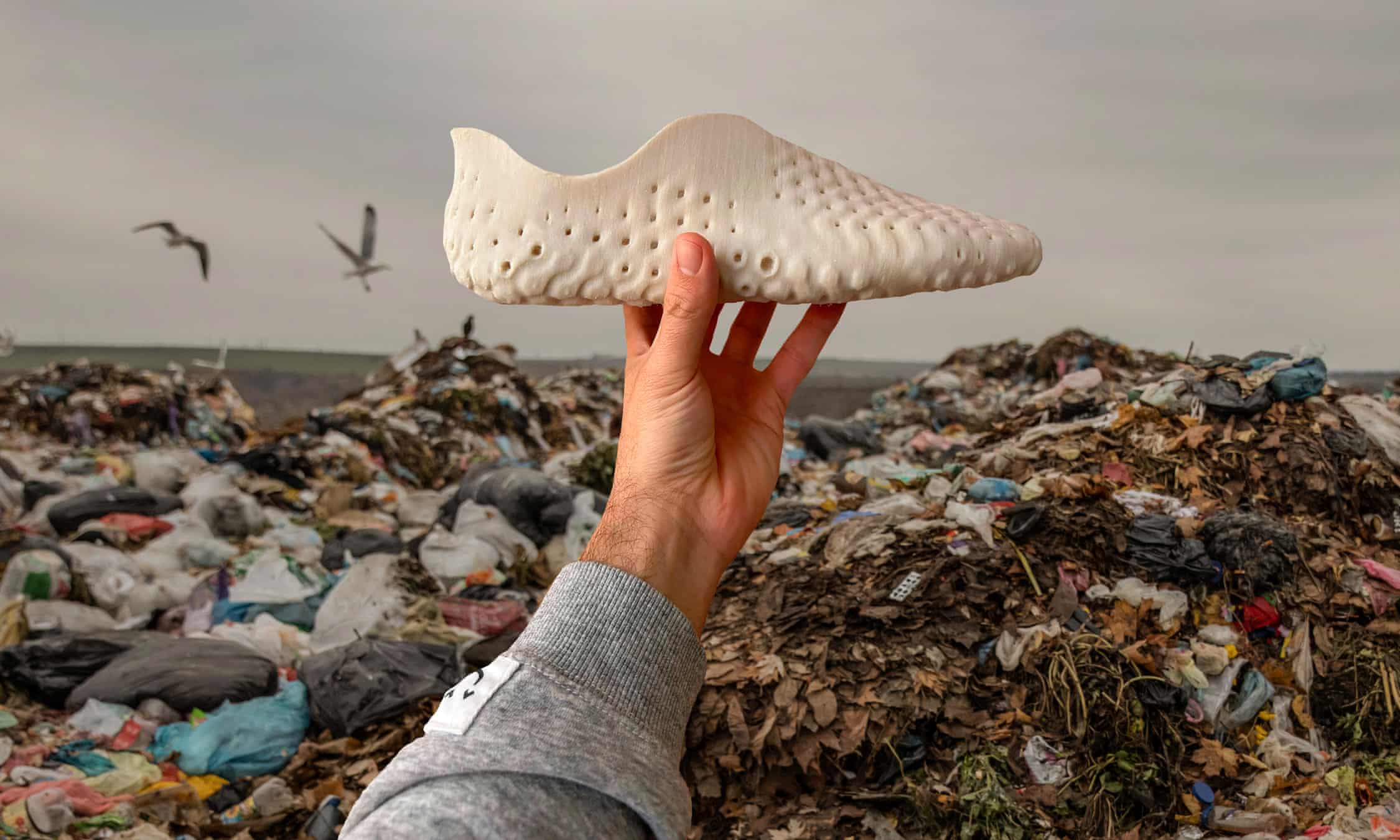
Photo composite: Alessio Mamo.
Compostable shoes are being created using 3D printing. 

Overthinking things can lead to a kind of paralysis. You want to do the right thing for the environment, you look for clothes not made with synthetics, wear the clothes many years, finally give them to Goodwill for others to use, and recycle raggedy textiles safely. But you know that a lot of this is still going to end up on the beaches of some African country. How can you do more? Do enough?

And what about shoes?

Well, one step at a time. You have to trust that every little bit helps.

At the Guardian, Patrick Greenfield writes that there is now such a thing as a compostable shoe. “The shoes may not immediately strike you as the future of mainstream fashion. Pale and porous, they resemble a cross between a beige Croc and the long-net stinkhorn fungus found on forest floors. Their creators, however, hope this will be the next huge breakthrough in sustainable footwear: the world’s first 3D printed, made-to-measure, compostable shoe, which can be broken down at the end of its life, in an attempt to stem the flow of millions of shoes into landfill each year.

“Fashion is among the world’s top polluting industries. It is responsible for about 10% of global carbon emissions and consumes huge amounts of water and land for production. Modern shoes are among the hardest items to produce sustainably because of their complexity, say industry experts, and there are few reliable statistics about the number manufactured every year for the world’s 8 billion humans. There is an almost total dearth of statistics about their environmental impact.

“Most shoes are composed of a mixture of synthetic fabric, rubber, plastic and metal, which is often held together with strong adhesives, and they are incredibly difficult to dispose of. The vast majority are bound for landfill once used, where they could take hundreds of years to break down. There are efforts to pioneer recyclable trainers [sneakers] for the world’s $70bn (£55bn) industry, with some brands offering services if customers post back.

“To produce its new compostable model, the London-based shoe company Vivobarefoot has joined forces with a material science company, Balena, to create prototypes of the shoes, which are not yet available for sale. They will be manufactured based on in-store foot scans and then printed over 30 hours. Once they have worn down, the footwear can be returned for composting at an industrial facility. …

“Says Asher Clark, a co-founder of Vivobarefoot. ‘This is about reimagining the way things are done from linear, offshore production to the world’s first scan-to-print-to-soil footwear. It is a vision for cutting out a lot of waste in supply chains and providing an end of life solution for the footwear industry.’

“There are caveats to the sustainability claims of the shoes, says Clark, which will be sold for between £200 [$255] and £260 [$331]. BioCir flex, the patented thermoplastic used to make them is 51% biological materials, 49% petrochemical. It cannot be thrown on a compost heap at the end of the garden to break down – it needs to go to a composting plant. …

“ ‘There is a trade-off between the biodegradability and durability: that is the key tension. The external factors that break down physical products are things like light, heat and moisture,’ he says. ‘The challenge is to make a shoe that will handle all those elements but also respond to the elements that start to break it down at the end of its life.’ …

“Glue and other binding materials can make shoes difficult to recycle, even when new substances are used for their main components, such as cactus ‘leather’ – a material made from the leaves of the nopal cactus – and grape-skin derivatives, says Luca Mosca, fashion lead at the sustainability consultancy Quantis. He says it is still hard to say what constitutes an environmentally friendly shoe, and that consumers should use them for as long as possible. … ‘Shoes are very complicated products.’ ”

More at the Guardian, here.
Read Full Post »

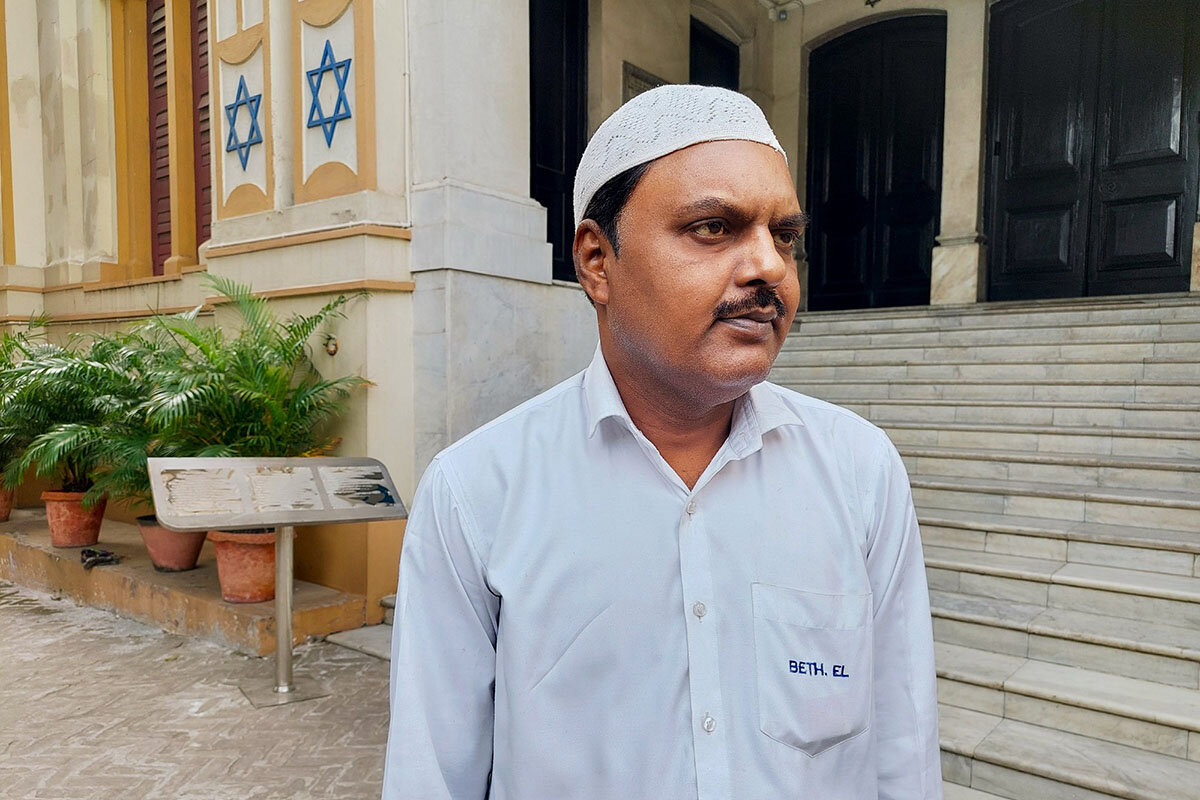
Photo: Sarah Aziz.
Muslims and Jews in Kolkata, India, have a long history of friendship.
Shaikh Wasim, one of six Muslims who work as caretakers in Kolkata’s synagogues, stands outside his place of work.

All religions teach peace and friendship. So why do they go to war with each other? Sometimes humans make no sense.

In India, which under the current Hindu prime minister is known for repression of Muslims, one city has a surprising story to tell. Not about Hindus and Muslims, alas, but about Jews and Muslims. And the story is especially welcome in this time, when the war in Gaza has made relations worse in other parts of the world.

At the Christian Science Monitor, Sarah Aziz explains how Kolkata, India, is different.

‘The Oct. 7 attack profoundly affected the Jewish community in Kolkata, but failed to sour Jewish-Muslim relations.’

“Dilawar Mondal gently bends the stems of a centuries-old myrtle plant to examine its aromatic leaves, used in the Jewish ritual bath for the dead. It is among the myriad plants, shrubs, and trees that he has tended to for the last eight years in Kolkata’s only Jewish cemetery, established in the early 19th century by Jewish merchants from Baghdad and Aleppo.

“He pauses to check the time – the sun is overhead, which means he’ll soon need to take a break to perform Zuhr, the afternoon Muslim prayer.

“Many of the city’s Jewish institutions – including synagogues, schools, and the cemetery – are maintained by Muslim caretakers. The intertwined communities have offered each other hope, security, and strength amid rising global hostilities following Hamas’ Oct. 7 attack and Israel’s military campaign in Gaza. …

“The camaraderie and respect between the Jewish and Muslim communities of Kolkata can be traced back to the establishment of the cemetery, says Owaiz Aslam, founder of the Kolkata-based Indian Pluralism Foundation, which promotes interfaith harmony among Indian youth.

“Historical records show Shalom Aaron Obadiah Cohen, the founder of the Baghdadi Jewish community in Kolkata, reached out to a Bengali Muslim friend regarding the cemetery.

“ ‘They were new to the country and needed help,’ Mr. Aslam says. ‘The Muslim friend offered him a plot of his own land free of cost, but … Cohen insisted on giving his friend a gold ring as a token of solidarity between the two communities, which continues even today.’ … 

“More than a century later, the Baghdadi Jews in Kolkata assigned a Muslim family from the neighboring state of Odisha the job of caring for their synagogues, explains Navras Jaat Aafreedi, an expert in Jewish history who teaches at Presidency University in Kolkata.

“Since then, several generations of that family have continued to serve the three synagogues in Kolkata – Beth El, Maghen David, and Neveh Shalom – even as the Jewish population here has dwindled.

“Fewer than 15 Jewish residents remain, most of them older. But women’s rights activist Jael Silliman, who grew up Jewish in Kolkata, says that the synagogues still hold special significance.

“ ‘These three beautiful spiritual spaces mark our presence in the city, and recall and embody our history in a place where we flourished and prospered through trade and business endeavors,’ says the scholar, noting with pride that Kolkata is home to the only two synagogues protected by the Archaeological Survey of India as important heritage sites.

“Today, the synagogues draw tourists from all over the world, and in November, Mr. Aslam initiated an interfaith Jewish-Muslim prayer ceremony at the Beth El Synagogue, where he prayed for the safe return of the hostages taken from Israel by Hamas on Oct. 7.

“ ‘As a Muslim, my heart cries for innocent children and adults suffering in Israel as well as Gaza,’ he says.

“At the same synagogue, Shaikh Wasim shows up for work in his pristine uniform, Beth. El’ embroidered on his breast pocket and a white topi, or Muslim skullcap, on his head. With reports of a global uptick in antisemitic attacks against synagogues and other Jewish institutions, Mr. Wasim and the five other caretakers who currently oversee Kolkata’s synagogues are no strangers to fear. 

“ ‘I am afraid, like any other human being,’ he says. ‘But the deep love that the Jewish and Muslim people in Kolkata share always pulls me back to the synagogue, no matter the circumstance.’

“[Jo Cohen, secretary for Jewish Community Affairs in Kolkata] says the Oct. 7 attack profoundly affected the Jewish community in Kolkata, but failed to sour Jewish-Muslim relations.

“ ‘The Muslim caretakers of the synagogues and the cemetery, alongside my Muslim friends, are as close to me as ever. The Israel-Gaza situation has not affected our relationships in the slightest,’ says Ms. Cohen, who also serves as honorary secretary at the city’s Jewish Girls’ School, where the majority of the students are Muslim. 

“Later, while cleaning around the synagogue, Mr. Wasim echoes Ms. Cohen’s sentiments. ‘I pray for the violence and bloodshed to end, so that Jewish and Muslim communities can coexist in peace like they do in Kolkata,’ he says. …

“ ‘Ultimately, a Jew and a Muslim are praying to the same God, even if they call Him by different names,’ [Cohen] says.”

More at the Monitor, here.

Read Full Post »

Photo: Melanie Stetson Freeman/CSM.
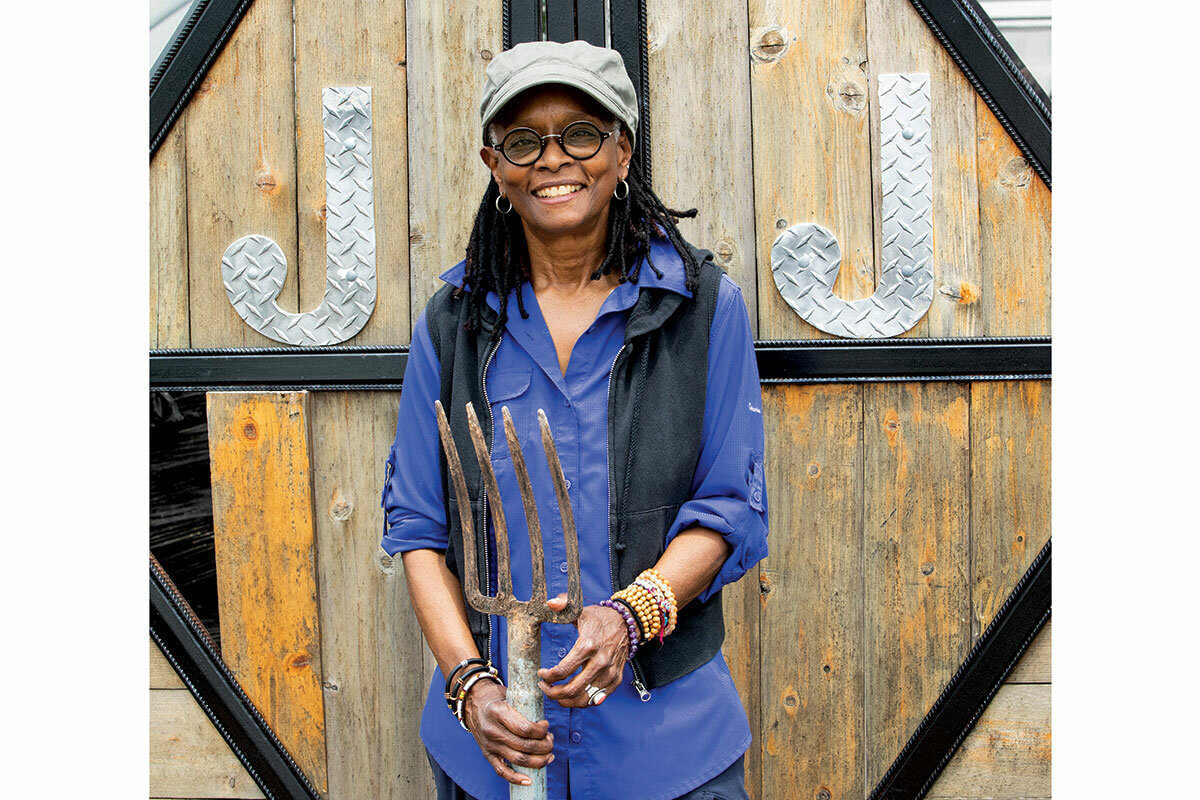
Konda Mason, founder of the nonprofit Jubilee Justice, poses at her farm in Alexandria, Louisiana, May 7, 2023. She teaches Black farmers a sustainable and environmentally friendly method for growing rice.

There are people who try their hand at many different things over a lifetime until something clicks. Or until all the pieces converge to make a new whole.

Consider Konda Mason, currently of Louisiana. Diane Winston has a long article about her at the Christian Science Monitor.

“It’s past daybreak on a muggy July morning when Konda Mason reaches the farm, a 5-acre plot in rural Louisiana. Mindful of the heat to come, several workers are already weeding, and Ms. Mason – her daily meditation and yoga done – is ready for a busy day.

“She’ll field calls from farmers and suppliers, check the progress of the industrial rice mill she’s building, and meet with a journalist curious about why a Black Buddhist from Oakland, California, is growing rice in a red county of a very red state. …

“A slender, muscled woman with waist-length dreadlocks, Ms. Mason sees the farm as the apex of her efforts as a social entrepreneur and eco-spiritual activist. Today she’s sporting a red bandanna to shade herself from the sun, but in her nearly 70 years, she has worn many hats. She’s been a concert promoter, filmmaker, and supporter of Black innovators and problem-solvers. As with her other endeavors, this new project manifests the values that have guided her life: love, justice, community, and a willingness to leap into the unknown.

“ ‘I was taught by my family that I had a role to play in making this world a better place,’ Ms. Mason told listeners in her keynote address at the 2015 Wisdom 2.0 forum in San Francisco. …

“ ‘The question I ask myself is, how can you go deeper, what do you have to let go of in order to do that, and are you willing to do it?’

“This time, going deeper meant leaving her home, her sister, her partner, and her friends to promote what she hopes is a revolution in rice production. Her goal is to support a more sustainable and less expensive way to grow rice, in hopes of staunching the loss of Black-owned farmland. Working alongside an agronomist from Cornell University, she uses what’s called the System of Rice Intensification, common in developing nations but new to American farmers. Going deeper has also meant mastering the complexities of soil and weed management, crop rotation, fertilization, the milling of rice, and bringing it to market. Equally complex, of course, is working in a region where race relations are historically fraught. …

“Though deeply committed to Buddhism, Ms. Mason is not an evangelist. At the farm, she rarely discusses her practice, and if she does, she talks about mindfulness, not Buddhism.

“ ‘Konda’s had many lives, and I never thought there would be a home for her,’ says Dianne Houston, a longtime friend. ‘But the combination of working on the land with people who share her beliefs about social justice – all the boxes are checked.’

“Ms. Mason’s work on the 3,700-acre former plantation is equal parts passion project, spiritual mission, and response to the loss of 12 million acres of Black farmland over the past century. … Since arriving in Louisiana in 2020, Ms. Mason has grown a network of nearly a dozen Black farmers whom her team visits regularly. Her agronomy colleagues offer technical assistance, and she provides rice seed and access to loans. She secured a centrally located, solar-powered industrial mill for processing the plants, and has a distributor to help with marketing. When she’s not working the land or promoting the project, Ms. Mason sometimes dons another hat, leading intentional conversations across racial and economic divides.

“Both the farming project and the conversations are part of Jubilee Justice, a nonprofit Ms. Mason created to help change a system that she says has profited by discriminating against people of color and despoiling the planet. It’s the natural outcome of her lifework. …

“in 1973, when she arrived for her first year at the University of California, Berkeley, … a new friend introduced her to yoga and broadened her taste in music. Soon Ms. Mason was running the Berkeley Jazz Festival, a well-funded community program sponsored by the university. Ultimately, she left school to team up with the manager for Sweet Honey in the Rock, a Black, female a cappella group whose music blended blues, gospel, and jazz. The two joined forces to promote female musicians. 

“ ‘We would put a Native American group with a Black group or a lesbian group,’ she says. ‘We kept building coalitions. We did it all over the country.’  …

“[Some years later in Louisiana] she helped organize a gathering of progressive women; most of the wealth-holders were white, and the activists people of color. Among the attendees was Elizabeth Keller, a white woman and devout Christian. Her grandfather had purchased a former plantation in Louisiana, hoping to ‘redeem’ the land, but he never did. When he died, he left all 3,700 acres to her.

“At the gathering, Ms. Keller spoke about the farm and her desire for healing there. She had prayed for someone to show her the way, and, to her surprise, Ms. Mason seemed to be the answer to that prayer.  The plantation could be redeemed, Ms. Mason realized, by using the System of Rice Intensification (SRI) to cultivate a pilot crop and develop a network of Black farmers to adopt the technique. 

“Ms. Keller, acknowledging that Ms. Mason ‘saw something I couldn’t,’ agreed to let her use the land.  Now Ms. Mason needed expertise. She cold-called Erika Styger, the Cornell agronomist, who knew from working with farmers around the world how SRI increases crop yields, improves the soil, cuts costs, enhances profits, and reduces the environmental impact of rice production. It took some convincing, but in the end, Ms. Mason’s vision and practicality persuaded her to provide technical assistance.”

Read more at the Monitor, here. No firewall. Subscriptions are encouraged and are reasonably priced.

Read Full Post »

Photo: SBS News.
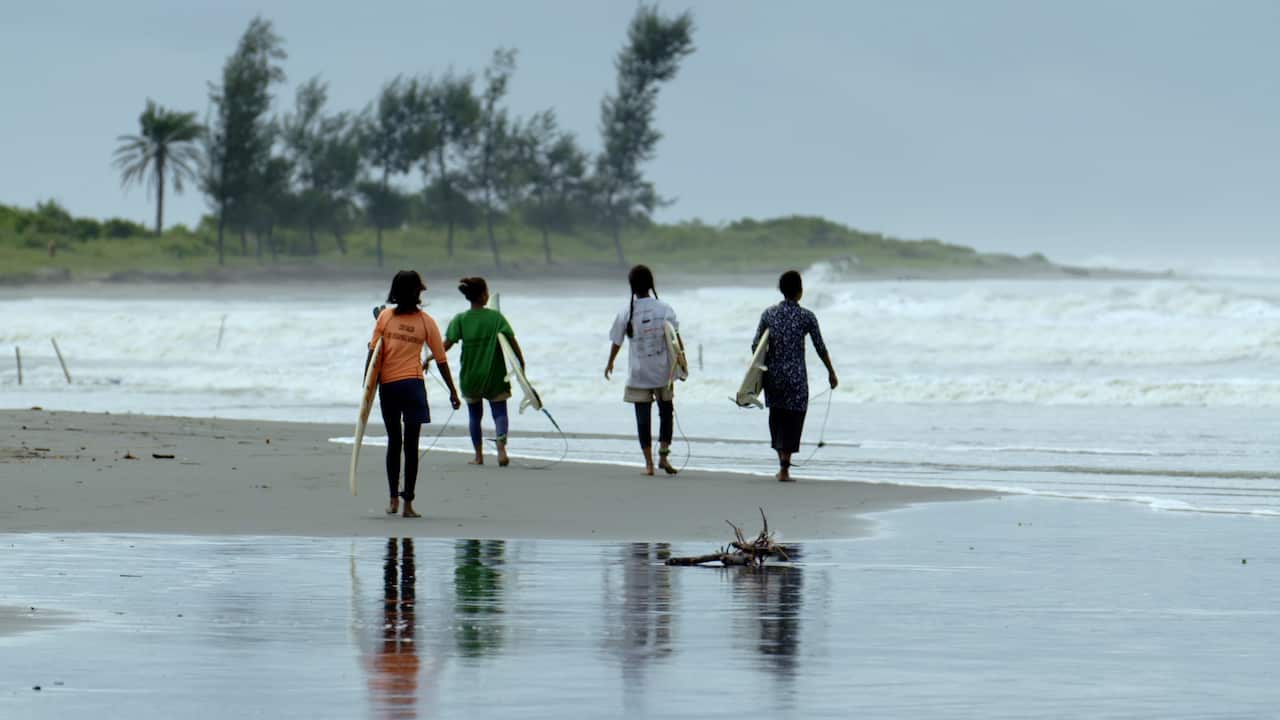
The surf club in Cox’s Bazar teaches girls in Bangladesh how to surf.

From the little I know about Bangladesh, it’s a hard life there. It’s hard even for a man, even for a famous one like Nobel Peace Prize winner Muhammad Yunus, who has drawn the resentment of the country’s prime minister. But for most females, it’s almost out of the question to have any kind of independent life.

Today’s story suggests that some young women in Bangladesh are bucking tradition. Rhiona-Jade Armont writes at SBS News, “Along one of the longest uninterrupted beaches in the world, two young surfer girls paddle out past the break.

“The conditions out here are rough and unruly, but these fearless teens cling to their boards, waiting for the perfect wave to ride back to shore.

“Here, in the coastal town of Cox’s Bazar in Bangladesh, Shobe and Ayesha are not your average 13-year-olds.

“ ‘Everybody says I live like a boy,’ Shobe says. ‘I go everywhere wearing a t-shirt. I’ve been surfing since childhood, so people are used to seeing me like this.’

“Girls in Cox’s Bazar are often expected to follow a set path, including working from a young age, marrying early and bearing children. Bangladesh has one of the highest rates of child marriage in the world.

“Parents who struggle to earn a steady income often marry off their teenage daughters, despite it being illegal until age 18. … Shobe’s older sister was married at 13. …

“These girls often come from poorer households and are more likely to miss out on a full education. But a small surf club has given girls like Shobe a chance to change their fate and do something they love. …

“Blazing a new trail has meant breaking tradition, and girls like Ayesha have fought hard battles at home. Her father has been the toughest to win over.

“ ‘If I tell [people] my girls do surfing they ridicule us,’ he says. ‘I want a good future for them. I don’t want to live from their earnings. Now that they are 14 and 15 years old, I have to think about their marriages.’

“For Ayesha, the pressures at home only drive her further away. ‘I don’t feel good at home. That’s why I spend as much time as I can at friends’ home or school.’

“Ultimately, she always ends up where she feels the most free. ‘My best friend is the sea.’

“For Shobe and Ayesha, surfing provides a future filled with possibility. They’ve excelled in local competitions, but the next stage is seeking out opportunities to compete on the international circuit.

“Shobe in particular dreams of one day being a famous surfer and representing Bangladesh. But fame is not only a shiny way to a new life. It’s a means of finding family who she’s lost contact with and receiving recognition.”

More more at SBS News, here. No firewall.

Read Full Post »

Photo: Mary Altaffer/AP.
Construction underway on a flood resiliency project in East River Park in Manhattan in October 2022. Hello, Boston! See this?

For years there have been voices crying in the wilderness about the danger Boston faces from flooding. A city originally lifted from the sea like the Netherlands, Boston has powerful “progress” fanatics that have allowed the Seaport area to be overbuilt in the last 20 years. The Boston Globe’s David Abel even made a movie about it, calling the city’s touted Innovation District the Inundation District.

Meanwhile, in New York City, politicians have heeded a painful lesson from Hurricane Sandy.

Andrew S. Lewis writes at Yale Environment360, “On a recent morning in Asser Levy Playground, on Manhattan’s East Side, a group of retirees traded serves on a handball court adjacent to a recently completed 10-foot-high floodwall. Had a sudden storm caused the East River to start overtopping this barrier, a 79-foot-long floodgate would have begun gliding along a track, closing off the playground and keeping the handball players dry. In its small way, this 2.4-acre waterfront park is a major proof of concept for a city at the forefront of flood resilience planning — a city working toward living with, and not against, water.

“The Asser Levy renovation, completed in 2022, is part of East Side Coastal Resiliency (ESCR), the largest urban resiliency project currently underway in the United States. Over the next three years, at a total cost of $1.8 billion, ESCR will reshape two-and-a-half miles of Lower Manhattan’s shoreline. But ESCR is just one link in a much larger, $2.7 billion initiative called the BIG U — a series of contiguous flood resilience projects that runs from Asser Levy, near 25th Street, around the southern tip of Manhattan, and up to Battery Park City, along the Hudson River. When finished, the BIG U will amount to 5.5 miles of new park space specifically designed to protect over 60,000 residents and billions of dollars in real estate against sea level rise and storm surges.

“The BIG U was conceived in the aftermath of 2012’s Superstorm Sandy, which flooded 17 percent of New York City and caused $19 billion in damage. Like Hurricane Katrina in 2005, Sandy helped push New York … toward embracing the Dutch concept of ‘living with water,’ which emphasizes building infrastructure that can both repel and absorb water while also providing recreational and open space.

“In New York, ESCR, like any large infrastructure project slated for a densely populated place, has moved in fits and starts. Still, New York is making significant progress. ‘Anything that’s on the scale of Manhattan is always going to be so much bigger and more complicated,’ says Amy Chester, director of Rebuild by Design, the post-Sandy design competition from which ESCR was born. ‘And yet a lot has been done.’

“The ESCR project area encompasses a flood-prone wedge of Manhattan’s natural topography — a ‘pinch point’ between two higher stretches of shoreline. Some 400 years ago, when the island was inhabited by the Lenni-Lenape, this shoreline was woods and marsh that never rose more than a few feet above sea level. Tidal creeks drained from uplands dense with American chestnut, aster, and goldenrod, winding through spartina meadows to the river. Today, that landscape is lost beneath four separate public housing complexes, whose roughly 10,000 residents count on East River Park to buffer their homes from a waterway that has risen 8 inches since the mid-20th century.

“Because ESCR is the first segment of the BIG U to get underway, its path has been rocky, from debates about its final design, to budget cuts, to new concerns about the evolving risks of climate change, including the extreme rain events that New York experienced this year. …

“In 2018, the administration of Mayor Bill de Blasio quietly revamped the design: it would be faster and cheaper, the mayor’s team said, to wipe the park clean, elevate the landscape with more than a million tons of fill, then build anew on top.

“Unlike the kind of permeable buffers championed by the Dutch, the raised park would function more like a hard barrier. … Opposition to the redesign remains, but many residents of the public housing complexes, which are at high risk of flooding, support it. In the fall of 2021, demolition crews got to work. …

“The park will be landscaped with pathways and vegetation beds that snake around and through sports fields, an amphitheater, and playgrounds to form a terraced topography that will function as a berm to keep water from city streets. More floodwalls and retractable gates will run the park’s length and extend into surrounding streets, where archaic infrastructure will be overhauled so stormwater is less likely to mix with wastewater during flooding. …

“Other segments of the BIG U are also underway. In the Battery, at the city’s southern tip, the waterfront is being elevated with fill. Next, floodwalls, higher-capacity drainage, and new park space will be installed. Similar projects to protect the historic South Street Seaport area and the Financial District remain in the planning and design phase. …

” ‘Building a level of resilience capacity across society is critically important,’ says Henk Ovink, the former Netherlands Special Envoy for International Water Affairs and one of the creators of Rebuild by Design. ‘If you don’t invest in the most vulnerable links, the chain breaks.’ ”

Read more at Yale e360, here. No firewall. Donations solicited.

Read Full Post »

Photo: Anna Svanberg/Nobel Prize Outreach.
The Dream Orchestra started with just 13 members. Now there are more than 400, including this group performing at a Nobel Foundation event in Gothenburg, Sweden, in December 2023. 

Sweden has long been a country that took in refugees, but what I know from family members there is that Sweden doesn’t always do a good job helping immigrants integrate and feel at home. That’s why the orchestra leader in today’s story stands out.

As Mostafa Kazemi, originally from Afghanistan, recalls, the conductor told him that of course he could play an instrument even though he thought he couldn’t. “He’d been in Sweden for a matter of months,” Catherine E. Shoichet at CNN reports. “No one had talked to him like this before.”

The long and interesting article about the Dream Orchestra begins, “Ron Davis Álvarez stood on a train platform in Stockholm, stunned by what he saw. The Venezuelan orchestra conductor was visiting Sweden as part of a university exchange program. … He watched throngs of people getting off trains, their faces drawn and exhausted. Volunteers raced past him to hand out bananas and water to the new arrivals.

“ ‘I was completely in shock, seeing all of these young boys arriving,’ Álvarez recalls. He asked someone what was going on.

“The answer: ‘They are from Syria and Afghanistan. Many of them are unaccompanied. They traveled here alone.’

“ ‘What will happen to them?’ Álvarez asked. No one knew. …

“Álvarez was there watching, and he had an idea. That idea would change his life, and the lives of hundreds of others he hadn’t met yet. …

“It wasn’t long before Álvarez was back in Sweden. He’d been tapped as the artistic director of El Sistema Sweden, based in the coastal city of Gothenburg. … As he began his new role, the memory of what he’d seen months earlier on the train platform remained seared in his mind.

“El Sistema Sweden’s work was focused on younger children enrolled in Swedish schools. The youth he’d seen pouring into the train station were already in their later teenage years. It’s an age when many might assume it’s too late to learn an instrument.

“Álvarez knew it wasn’t. And he knew he had to try to help them. … With a handful of instruments on loan, he visited schools to drum up interest. Eventually, he recruited a group of 13 youth from Afghanistan, Syria, Eritrea and Albania. He dubbed them the Dream Orchestra.

“ ‘I remember coming into the room and there were a lot of girls and boys, and I was nervous,’ Álvarez says in a short film about the orchestra featured on its website. … Many of the Dream Orchestra’s members had never played an instrument before they joined. They came from different countries. They didn’t speak the same languages. …

“Mostafa Kazemi lights up when he recalls the day he met Álvarez in 2016.

“ ‘Which instrument do you play?’ the conductor asked him.

“ ‘I can’t play,’ Kazemi replied.

“Álvarez’s response was confident and unflinching: ‘Yes, you can. Come and pick which one you want.’

“Kazemi, originally from Afghanistan, was 16 years old at the time. He’d been in Sweden for a matter of months. No one had talked to him like this before. So a few weeks after the Dream Orchestra began, Kazemi became one of its first members. He picked the cello. …

“The small ensemble rehearsed on Fridays and Saturdays. Those were Álvarez’s days off, and also a time when he knew it was important to keep young people occupied and off the streets.

“At first, teaching the group wasn’t easy, Álvarez recalls. He was used to instructing younger Spanish-speaking students who came from similar backgrounds. This would require a different approach.

“Álvarez spoke English, and some of the other members of the Dream Orchestra did, too. But still, misunderstandings were frequent, even comical at times. Body language was key to overcoming those obstacles. So was finding a way to connect more deeply with each person – to learn what music they liked and where they came from and who they were.

“Another key part of Álvarez’s approach with these older students: giving them the confidence to make mistakes.

“I tried to build confidence – first the confidence of the sound.’ …

“ ‘Ron was full of energy all the time,’ Kazemi says. ‘And that made us want to do more and more and more. We were practicing at home. I even brought some more students. I told my friends. … And everyone told their friends, and everyone came to orchestra.’ …

“Now, eight years later, the Dream Orchestra has more than 400 members from nearly 20 countries who speak around 20 languages between them. …

“As [Álvarez] sees it, politicians and world leaders could learn a lot from this music ensemble.

“ ‘I see the orchestra like society,’ he says. ‘When you are in an orchestra, you need to learn how to hear each other, how to listen to each other, compassion, how to empathize.’

“That’s not to say there haven’t been challenges over the years. Some students at first struggled with taking direction from female conductors and teachers, Álvarez says, and tensions have boiled over at times between members of the orchestra whose home countries have a history of conflict with each other.

“Some conductors might direct their orchestras simply to play on and ignore these difficulties. Álvarez says he addresses them directly. He wants the orchestra not only to be a safe space, but a place where its members can grow and learn to live together.

“ ‘We are all people that need to respect each other. It’s difficult because you cannot erase this history, but you can rewrite the future,’ he says.”

More at CNN, here. No firewall.

Read Full Post »

In my town, everyone knows who Louisa May is, but you may know her better as Louisa May Alcott, author of Little Women.

When Alcott was first starting out as a writer, she wrote dramatic potboilers under various pseudonyms. Researchers keep discovering more. Michael Casey at AP has the story.

“The author of Little Women may have been even more productive and sensational than previously thought,” he writes. “Max Chapnick, a postdoctoral teaching associate at Northeastern University, believes he found about 20 stories and poems written by Louisa May Alcott under her own name as well as pseudonyms for local newspapers in Massachusetts in the late 1850s and early 1860s.

‘One of the pseudonyms is believed to be E. H. Gould, including a story about her house in Concord, Massachusetts, and a ghost story along the lines of the Charles Dickens classic ‘A Christmas Carol.’ He also found four poems written by Flora Fairfield, a known pseudonym of Alcott’s. One of the stories written under her own name was about a young painter. …

“Alcott remains best known for Little Women, published in two installments in 1868-69. Her classic coming-of-age novel about the four March sisters — Meg, Jo, Beth and Amy — has been adapted several times into feature films, most recently by Greta Gerwig in 2019.

“Chapnick discovered Alcott’s other stories as part of his research into spiritualism and mesmerism. As he scrolled through digitized newspapers from the American Antiquarian Society, he found a story titled ‘The Phantom.’ After seeing the name Gould at the end of the story, he initially dismissed it. … But then he read the story again.

“Chapnick found the name Alcott in the story — a possible clue — and saw that it was written about the time she would have been publishing similar stories. The story was also in the Olive Branch, a newspaper that had previously published her work.

“As Chapnick searched through newspapers at the society and the Boston Public Library, he found more written by Gould — though he admits definitive proof they were written by Alcott’s has proven elusive.

“ ‘There’s a lot of circumstantial evidence to indicate that this is probably her,’ said Chapnick, who last year published a paper on his discoveries in J19, the Journal of Nineteenth-Century Americanists. …

“When first contacted by Chapnick about the writings, Gregory Eiselein, president of the Louisa May Alcott Society, said he was curious but skeptical. … But he has come to believe that Chapnick has found new stories, many of which shed light on Alcott’s early career.

“ ‘What stands out to me is the impressive range and variety of styles in Alcott’s early published works,’ he said. ‘She writes sentimental poetry, thrilling supernatural stories, reform-minded non-fiction, work for children, work for adults, and more. It’s also fascinating to see how Alcott uses, experiments with, and transforms the literary formulas popular in the 1850s.’

“Another Alcott scholar at Kansas State, Anne Phillips, said … his paper makes a ‘compelling case’ that these were her writings.

“ ‘Alcott scholars have had decades to compare her work in different genres, and that background is going to help us evaluate these new findings,’ she said in an email interview. ‘She reworked and reused names and situations and details and expressions, and we have a good, broad base from which to begin considering these new discoveries,’ she said. ‘There’s also something distinctive about her writing voice, across genres.’ …

“In the 1940s, Leona Rostenberg and Madeleine Stern found thrillers written under the name A. M. Barnard, an Alcott pseudonym. She also wrote nonfiction stories, including about the Civil War where she served as a nurse, under the pseudonym Tribulation Periwinkle.

“It wasn’t unusual for female writers, especially during this period, to use a pseudonym. …

“ ‘She might not have wanted [her family] to know she was writing trashy stories about sex and ghosts and whatever,’ Chapnick said. …

“ ‘The detective work is fun. The not knowing is kind of fun. I both wish and don’t wish that there would be a smoking gun, if that makes sense,’ he said.”

More at AP, here.

Read Full Post »

China/Taiwan Comedy Act

Photo: An Rong Xu for NPR.
Vickie Wang (left) is from Taipei, Taiwan, and Jamie Wang is from Shanghai, China. Together they make a funny team.

Recently a resident in my retirement community was telling a dinner table of avid listeners about his (non-Chinese) grandson who speaks perfect Mandarin and has a comedy act that’s a hit both in Taiwan and on the US West Coast. I thought, it can’t be easy for a Caucasian to make comedy about China, especially if he ever hopes to go there.

I thought of this young man when I read Ailsa Chang‘s interview with two Chinese comedians at National Public Radio.

“Vickie Wang calls Jamie Wang her ‘mirror sister.’ No, they are not related, but they share an inverse history. Vickie, who’s originally from Taipei, Taiwan, spent about a decade living in Shanghai, where she began her stand-up comedy career, notably under Chinese censorship. Jamie, who’s from Shanghai, came across the Taiwan Strait and fell into a stand-up career in Taiwan.

“They both met at the bar in a bilingual comedy club, tucked inside Taipei’s red-light district and began performing together. Their recent show, A Night of Cross-Strait Comedy, was so well-received that their friends suggested they start touring together.

“Vickie jokes that if they were to tour together it would feel like something of a ‘peace and reconciliation tour.’ … They spoke to All Things Considered host Ailsa Chang at the very bar where they first met.”

Here are some excerpts from the conversation.

Vickie Wang [of Taiwan]: I grew up thinking that people in mainland China are not to be trusted, that they spit, and that they’re really aggressive and they’re not, like, polite and civilized like Taiwanese people. And it took years in Shanghai to consciously undo that kind of stereotype and prejudice. …

Jamie Wang [of Mainland China]: I think people kind of have this stereotype about Taiwanese where they’re, like, villagers because they live on a small island and they haven’t seen much of the world. They’re very backwards.

“Because I’m a Chinese student here, there’s a lot of unfair regulation towards us. Like, Chinese students are the only international students who cannot work here. Luckily, this February, Chinese people can have health insurance in Taiwan now. But for the past seven years, I couldn’t. [Most] Chinese people are also not allowed to work here, so there’s no way for Chinese people to stay and live and work in Taiwan unless, like, you get married to a Taiwanese citizen.

Vickie: When I first started doing stand-up in China, I was immediately briefed on the three Ts: Tibet, Tiananmen Square and Taiwan. These are hard red lines that we’re not supposed to talk about. It’s interesting. It means that I can’t talk about politics. I can’t really talk about LGBTQ issues. …

Now that I’m not living in China anymore, right now, I’m also revenge bingeing on democracy and freedom of speech. I’m really enjoying being able to say whatever I want.

“Jamie: I posted two jokes, and they were all viral, obviously because I’m very funny. But one of the jokes touched the fine line. And I thought it was OK, but a lot of Chinese people were trolling me on the internet. I also received death threats. Trolls DMd me, they were like, ‘I’m going to kill you.’ And I’m like, ‘You can’t. Because you can’t get a visa here.’ I don’t think you can ever be free as long as you are Chinese.

Vickie: There are a lot of things that I can say that Jamie can’t say. And I don’t want to speak over my Chinese friends, but I’m also very aware that, like, there’s things that I have to amplify for them. And in the meantime, I can also call out my own people. Ever since COVID started, I had Taiwanese friends on my Facebook feed who were saying things like, ‘Oh, yeah, they deserve it. These commies, they deserve a plague on their house.’ And I was so, so devastated to feel, like, oh my God, my people, who I’d like to think are generally decent, kind people, have so dehumanized this other population that they’ve never actually encountered. And, you know, I feel like having both of us on stage performing together, I hope that somehow bridges the gap.

“Jamie: I think comedy is a very powerful thing ’cause it’s not, like, a debate. Comedy is like, ‘I make you like me. I make you feel weird together. And then let me tell you what I have to say.’ I think it’s a very non-hostile, very friendly way to make people listen to you.

“Vickie: When someone laughs with you, it’s the closest thing you get to changing someone’s mind. When you’re laughing with someone, it means you — in that moment — you get their perspective. To a degree, you agree with them. It’s a very proactive kind of empathy. And it’s a very joyful kind of empathy. … I think that’s the best thing we can do, is to make jokes about it. I just still struggle to make everything funny. I’ll get there. I’ll figure it out, or Jamie will first.”

More at NPR, here.

Read Full Post »

Photos: Suzanne and John’s Mom.

I love walking around dirty old New York, even in cold and rainy weather. Today’s photos are from last weekend, when I took the train down for a wedding.

It’s the small things one notices. The saxophone player under the pedestrian bridge in Central Park, where the sound amplifies like an orchestra. He was playing “Beauty and the Beast,” with his sax case open for tips, a stick placed inside to keep any bills from blowing away.

A nicely dressed woman on a city bus scrolling her phone and wearing a rubber Halloween monster mask — blue and green rubber with a gaping hole at the nose and beaver teeth hanging down.

Then there were two people from my childhood that I ran into on the same morning in the Upper West Side. Not people I even knew from the Upper West Side but from Fire Island. The one I met in an elevator was a close childhood friend. The one I met in a diner was someone I knew from the Ocean Beach teenage musicals I directed. So there we were in a diner on Broadway singing one of those old teenage show tunes.

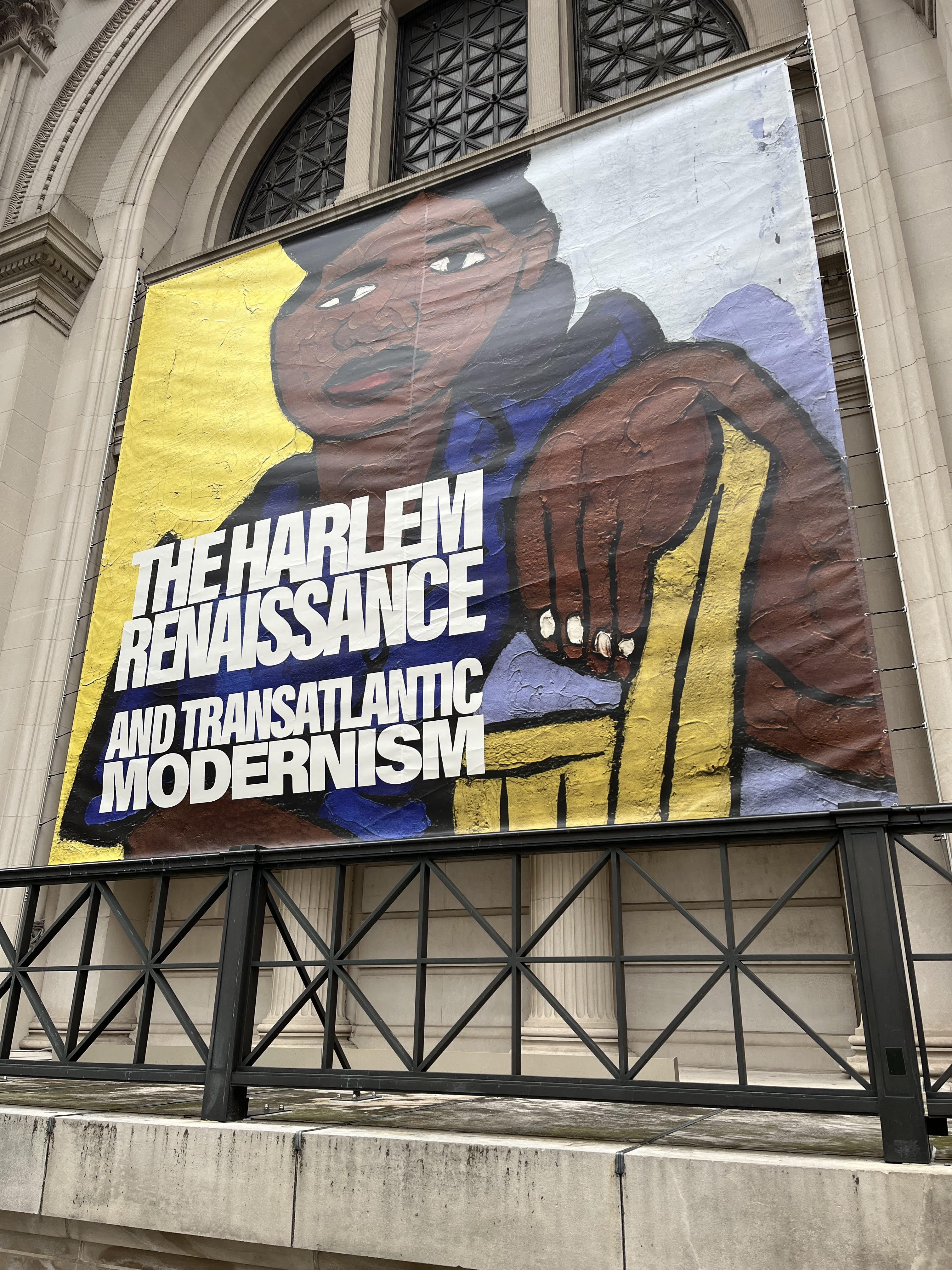
I got myself lost in Central Park on my way to the Met Museum to see the Harlem Renaissance exhibit. Like all New York, it was way too crowded, too many long lines. You spend 20 minutes waiting to buy a ticket, and then, if you want to unload your coat and backpack, you can wait in a ten-minute line to check them in and another long line to pick them up. I decided I could carry mine.

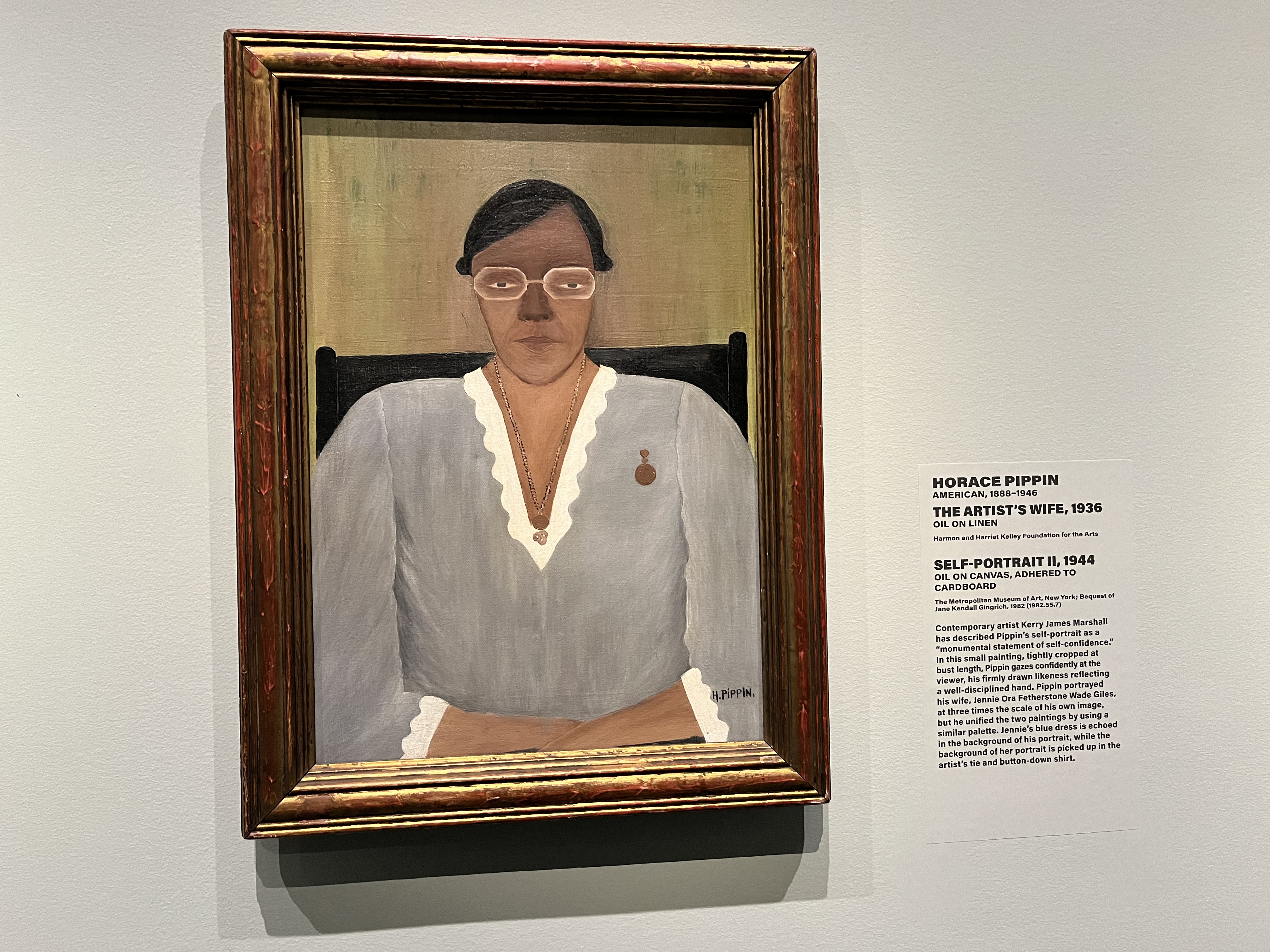
I photographed the Horace Pippin painting for my artist friend Meredith, a Pippin fan. There were many works by Aaron Douglas, but it was too crowded for much picture taking. Here’s a representative sample of Douglas’s art from the Rhode Island School of Design Museum.

The Met exhibit was huge, with portraits of luminaries like Langston Hughes, Zora Neale Hurston, James Weldon Johnson, and Marian Anderson, and scenes of Black life in the 1920s and ’30s rendered in many styles and media. Some artists, like photographer Carl Van Vechten, were not technically part of the Harlem Renaissance, but close observers.

Moving on to other New York sights.

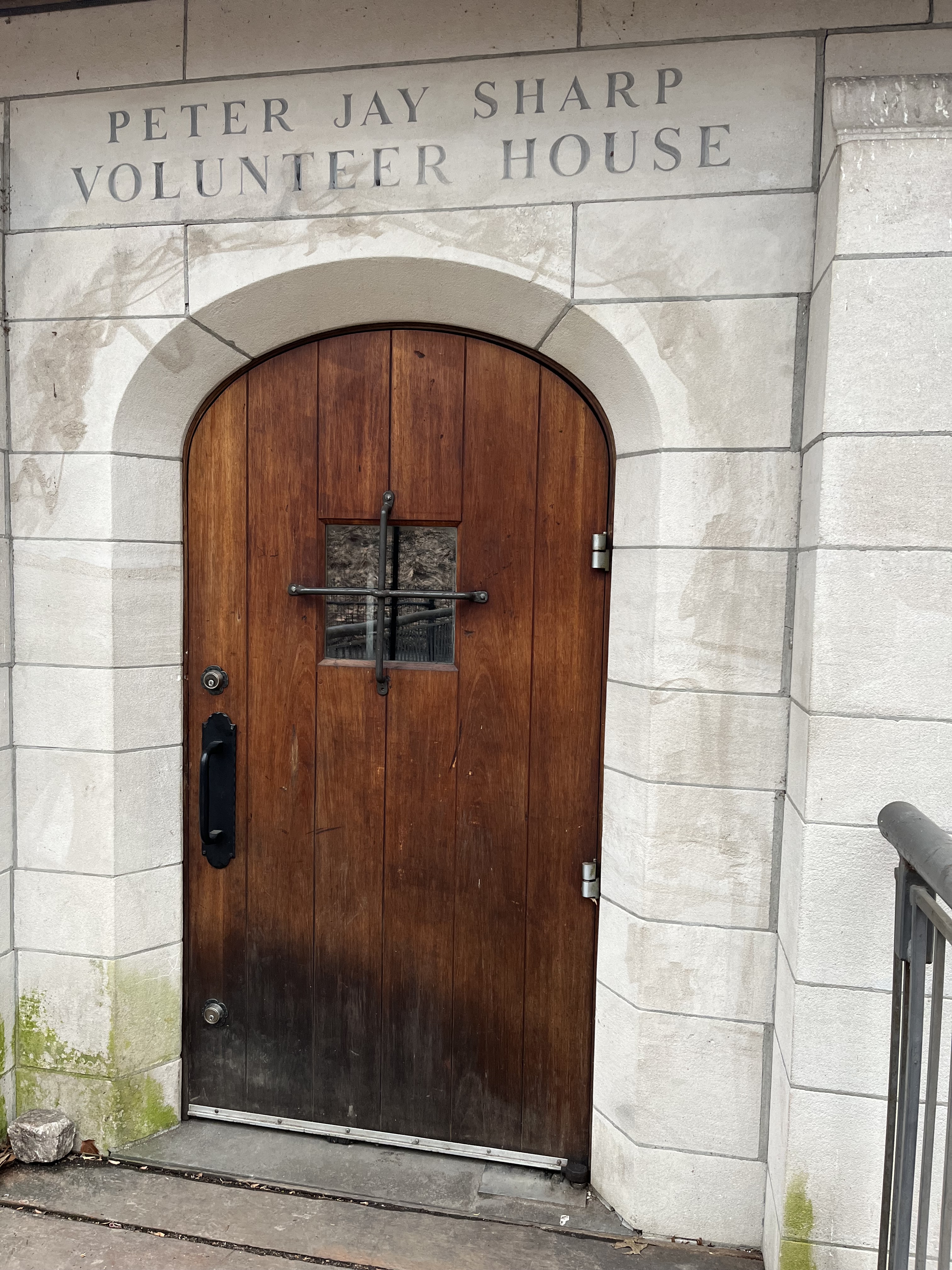
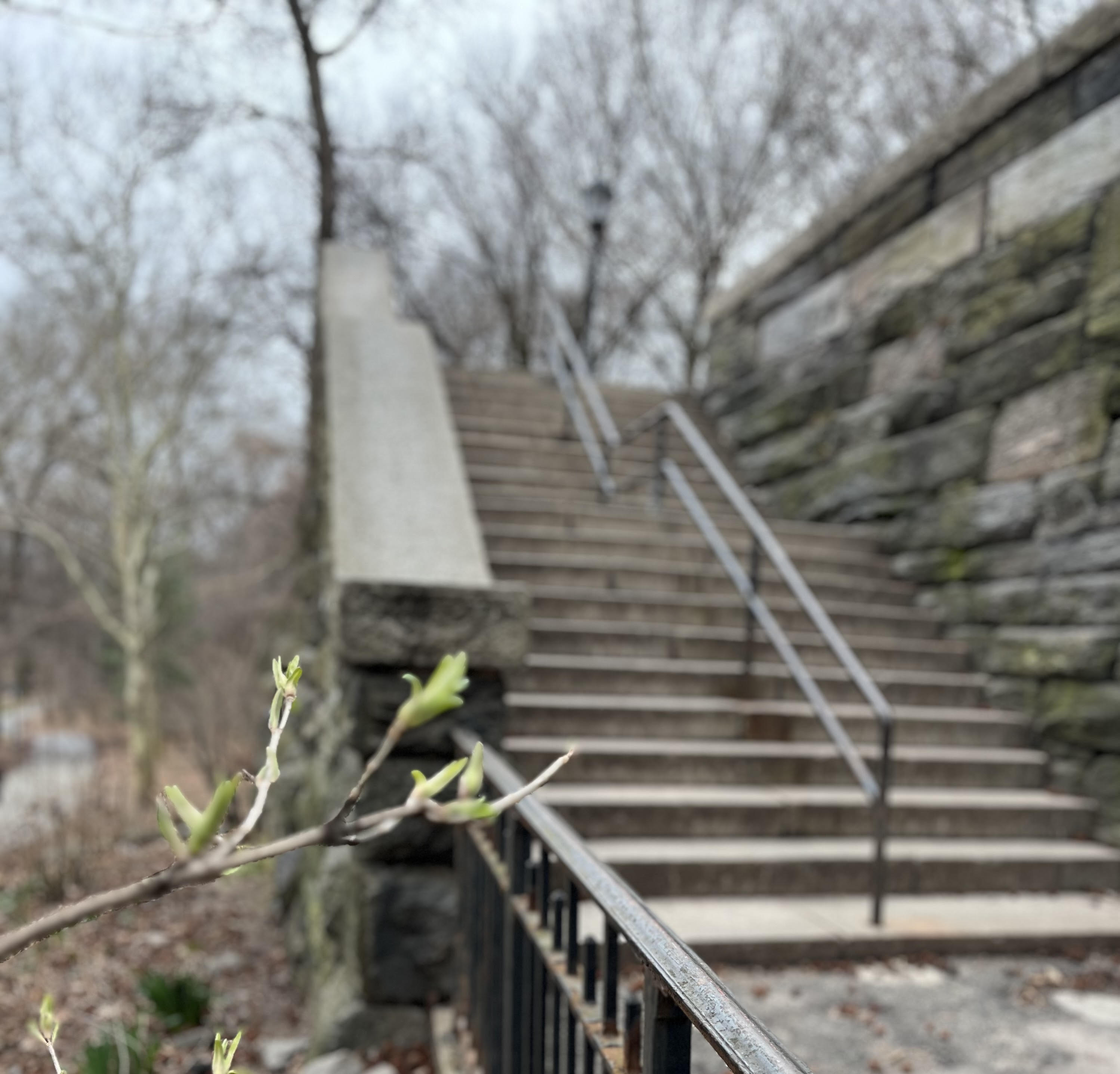
I often envy blogger Sheree, at View from the Back, who can post the most wonderful door photos. Of course, she lives in Europe. I have to go to New York to get anything comparable. Here are two interesting doors, the second in Riverside Park, where signs of spring were defying the miserable weather.

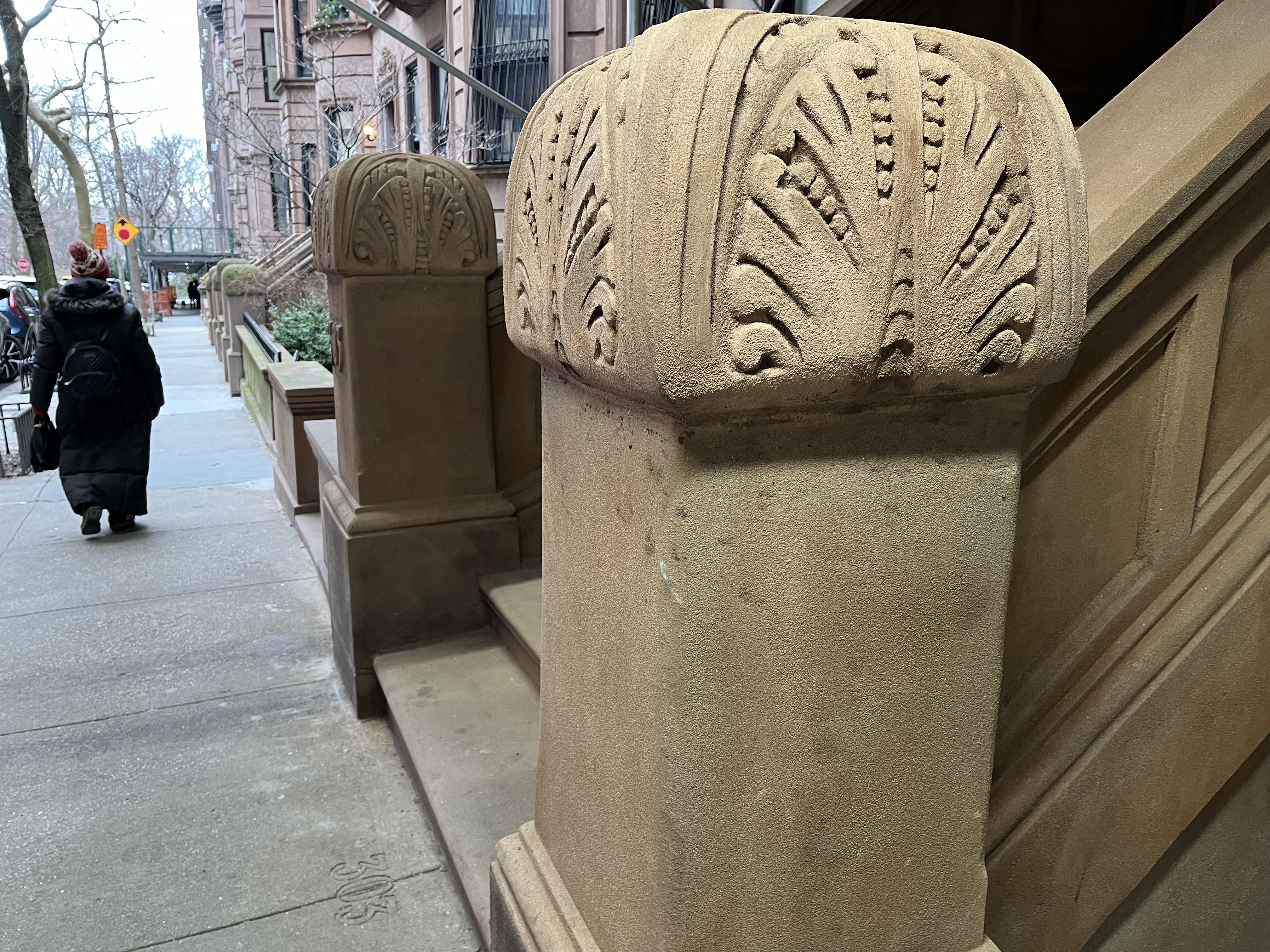
I love that new homeowners in New York often clean up the lovely, old architectural details. Notice the carved staircase, all sandblasted and spiffy.

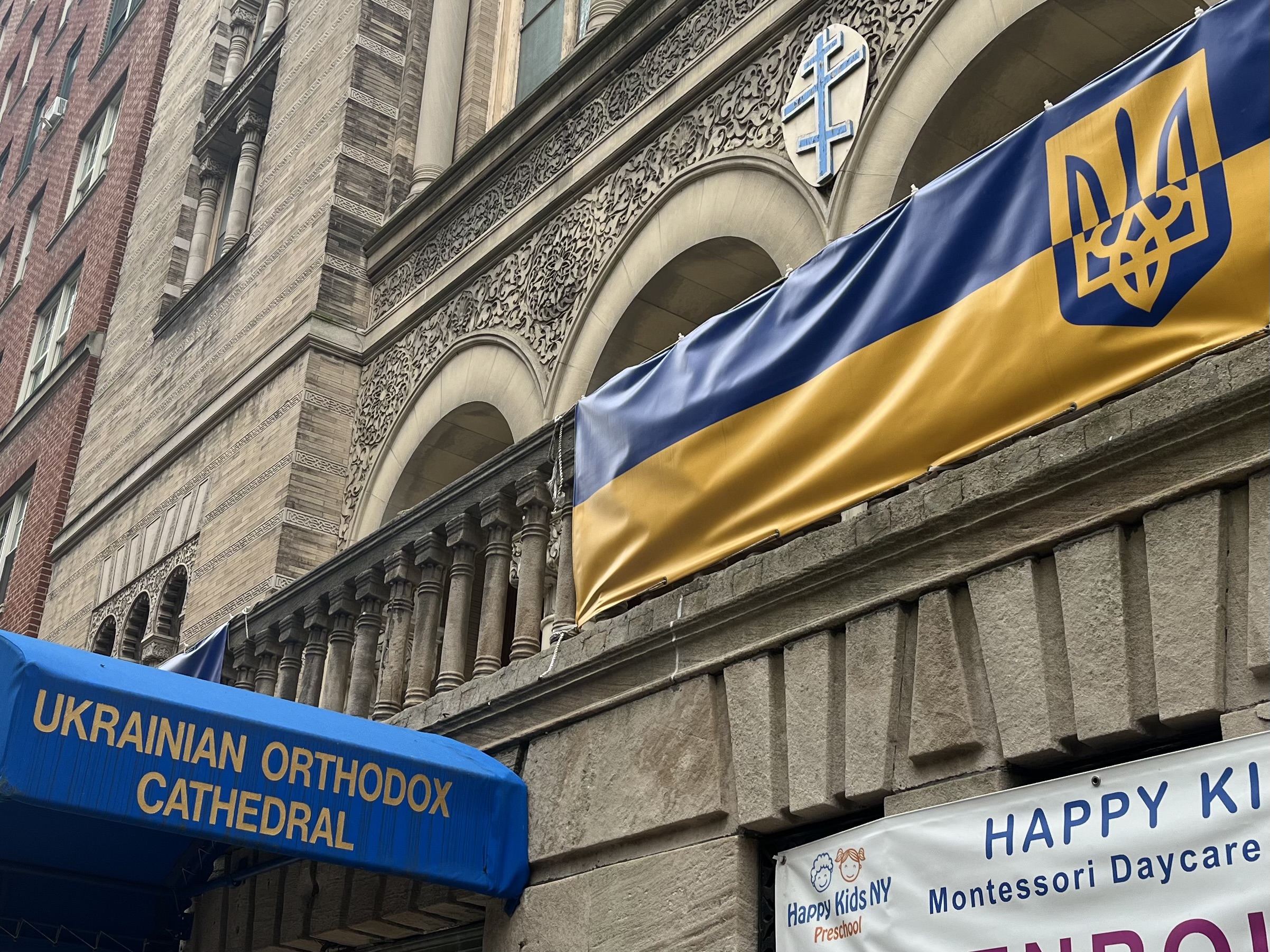
Finally, here’s a shot for my Ukrainian friends. Thinking of you. Always.

Read Full Post »

Photo: Vanessa Chisakula.
Vanessa Chisakula of Zambia wrote her first spoken word poem in her early 20s and “didn’t want to stop.”

It’s a universal human need: to have people listen to you, to be heard. How often do you find yourself talking to someone who is only waiting for you to pause so they can say their own thing? Well, that’s not being heard.

Recently in Africa, young people are finding that poetry events can be an outlet where other people are really trying to listen. It feels good.

Sarah Johns has written at the Guardian about poetry slams in Zambia.

“After giving birth, Vanessa Chisakula started writing poetry as a way of processing the changes and struggles she was experiencing as a new mother. ‘I was in my early 20s. I had just become a mum and didn’t understand it,’ she says. …

“Chisakula wanted to share her stories. She was inspired to do spoken-word poetry – a genre written to be read out loud and performed – when she heard I Will Wait For You by Janette…ikz, an American spoken-word poet.

“Now, she is spearheading efforts to expand the spoken-word scene in Zambia, where she is from. In 2017, she co-founded Word Smash Poetry, a movement for young creative activists across southern Africa. In her own award-winning work, she uses poetry as a tool for activism, focusing on issues including women’s rights, youth, African identity and mental health. …

” ‘Art is a form of protest that leaves no blood. It can be peacefully done but a strong message can be communicated artistically. … Poetry is just so beautiful,’ she says. ‘It can be a short but inspiring piece; it leaves you thinking and wanting more. I didn’t want to stop.’

“One of her first poems, ‘Her Place,’ was an examination of womanhood. She explains: ‘I wanted to tell my truth. What exactly is womanhood?’ … In 2020, Chisakula released a short collection of poems, Africana, written to embrace her identity as a black African.

“ ‘I always wanted to relocate to the US when I was young,’ she says. ‘I thought the American dream was the dream. There’s no African dream.’ She no longer believes this; now she wants to celebrate her home continent. …

“Over the past five years, Chisakula has seen the spoken-word scene grow in popularity in her home country. It is already well established across southern Africa, she says. From September to December there are poetry festivals ‘nonstop’ across countries including South Africa, Botswana, Zimbabwe and Zambia. In 2022, the winner of the World Poetry Slam, held in Brussels, was Xabiso Vili from South Africa.

“This year, the competition will be held in Togo. … ‘There’s a poet on every corner now,’ she says. ‘Back then, it was a bit uncommon; now people are doing it on a larger scale. I see poets at almost every event.’

“Male poets still outnumber female poets, however. Chisakula believes women struggle to get a foothold in the arts in Zambia. … Last month, the Word Smash Poetry movement hosted its second all-female national poetry slam in Lusaka, which took place during the 16 Days of Activism Against Gender-based Violence, an annual international campaign that kicks off in late November.

“There were 12 performers in total; four had returned after performing last year and there were eight new faces, which was a huge achievement, according to Chisakula.”

More at the Guardian, here.

Read Full Post »

Photo: BBC.
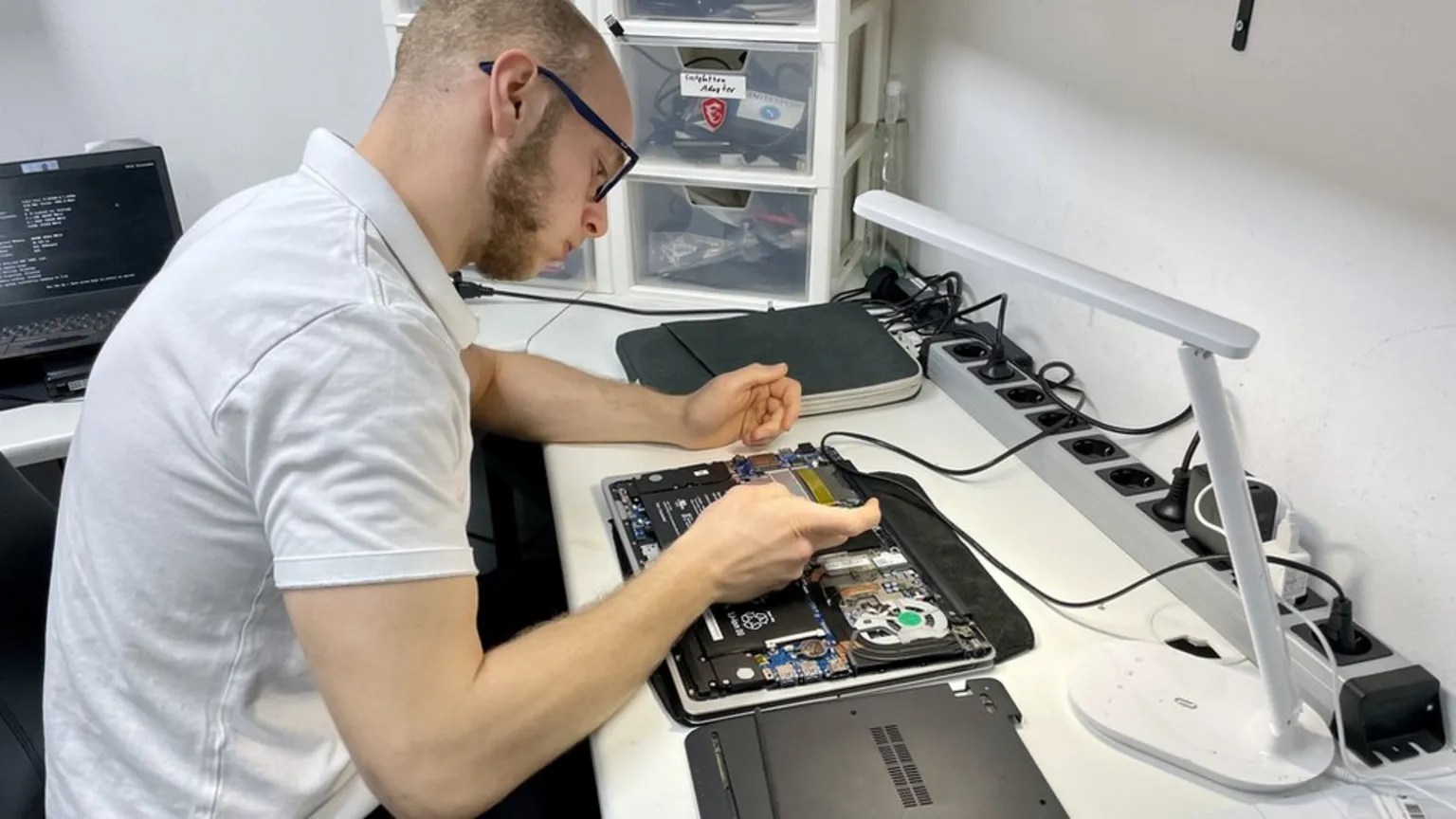
Under a government voucher plan, Austria will pay residents to repair broken machines instead of throwing things out.

A new plan in Austria could lead to the emergence of a whole class of tinkerers. There’s money to be made.

Bethany Bell writes at the BBC, “Has your washing machine broken down, or is your electric kettle, laptop or mobile phone refusing to work? Well, if you live in Austria, the government will pay up to €200 ($219) towards getting it repaired.

“The Repair Bonus voucher scheme is aimed at trying to get people to move away from throwing away old electrical appliances – and focusing on getting things mended.

“Erik’s laptop is broken, so he has come to Helferline, a computer and mobile phone repair workshop in Vienna. Because of Austria’s Repair Voucher scheme, he will only have to pay 50% of the repair costs to get it fixed. … Erik has already used the Repair Bonus to mend an old CD player, which is now working well. He says the scheme makes it easier to decide whether or not to throw something away. …

“Helferline’s chief executive, Clemens Schmidgruber, says the Repair Bonus scheme has been great for his business. ‘Our revenues have doubled since it was introduced. So we’re very happy about it,’ he said. …

” ‘Customers benefit because it helps them save a lot of money. Of course, it’s good for local businesses because they generate additional revenues. And the environment benefits, because there’s less electronic waste.’

“Mr Schmidgruber says customers have to download a voucher from a government website and then pay the repair shop upfront. ‘Then you get back half of the costs after three to four weeks.’ …

“The City of Vienna runs a separate scheme – which works in a similar way and helps people pay for repairs to old clothes, bicycles or furniture.

“Markus Piringer, the co-ordinator of the Repair Network in Vienna, says ‘if the costs of the repair are more than 20-30% of the cost of the new product, people tend to buy new. And as the Repair Bonus lowers those costs, it’s a big incentive to repair more. … [But] for many people, it’s still very positive to have always the newest product and to throw away your clothing after half a year or even less. And so this is also something where we need awareness raising.’

“And he warned that while the number of repairs was rising in Austria because of the voucher schemes, there were still too few technicians and craftspeople to do it. ‘We have a problem that we don’t have enough repairers. So we also need a system which is promoting repairs as a job.’ …

“At his bicycle shop in Vienna, Marc Warnaar and his team are fixing a bike, which has rusted brake and gear cables. ‘They don’t make spare parts for this gear system,’ he says, ‘Especially the gear cables, you cannot buy them anymore. So what we’ll do is exchange them with a newer model, so it will run again.’

“He says the Vienna Repair voucher has made a big difference to his business. ‘Normally we see a large decline in repairs, especially in winter. But now we see a lot of people coming because of this voucher and getting their bikes repaired also in winter.’ “

More at the BBC, here. And check out my 2012 post about Dutch repair cafés, here

Read Full Post »

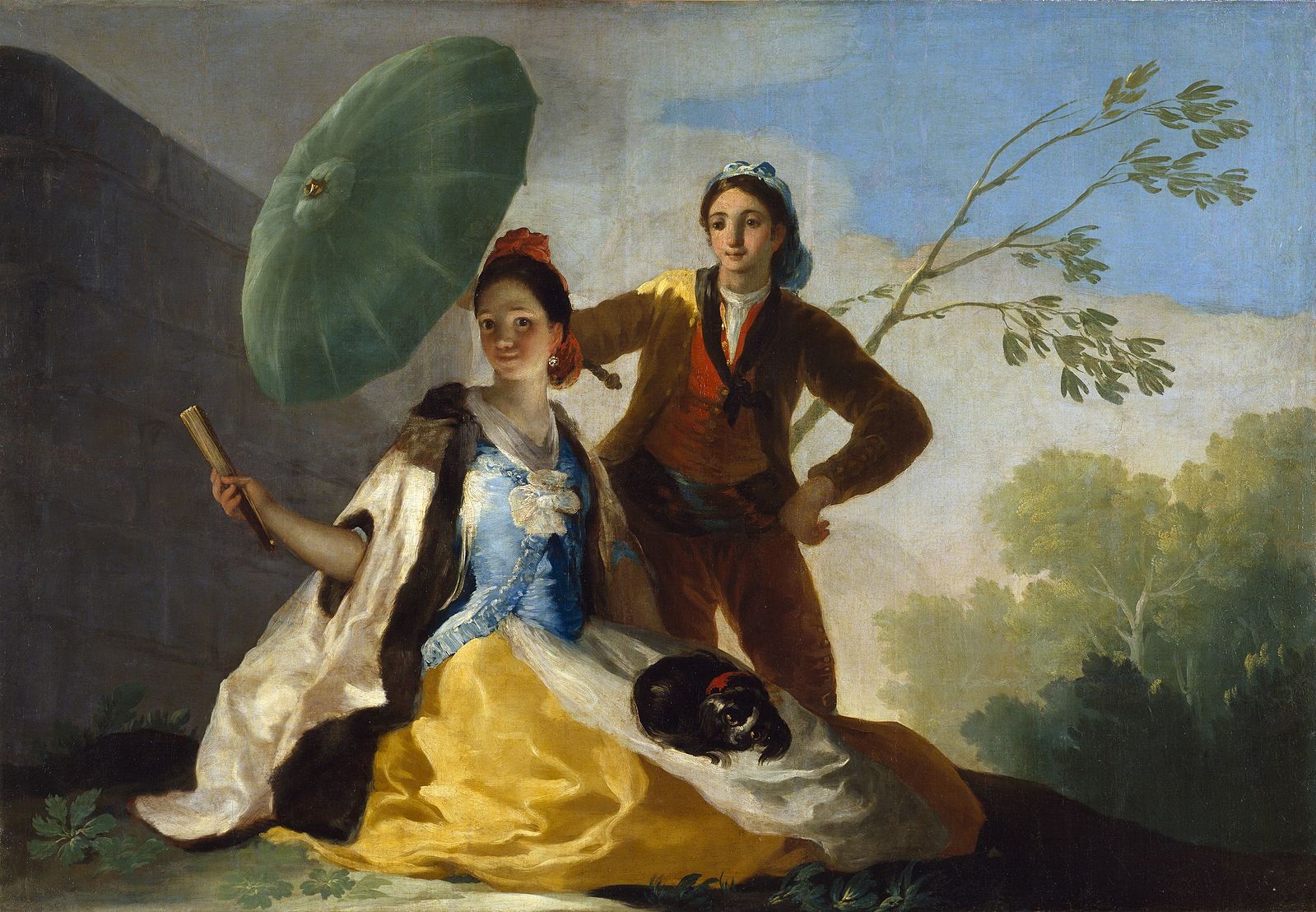
Art: Francisco Goya via Museo del Prado.
The Parasol (also known as El Quitasol) is one of a series of oil on linen paintings made by Francisco Goya. This series was made in order to be transformed into tapestries that would be hung on the walls of the Royal Palace in Madrid.

Companies that last over many generations know how to evolve with the times. There are a few in the US but more in other parts of the world. In Spain, for example, a factory that once converted pieces by the painter Francisco Goya into tapestries for his clients still plays a role in art and design.

Irene Yagüe writes at the Associated Press (AP), “Spain’s Royal Tapestry Factory has been decorating the walls and floors of palaces and institutions for more than 300 years. Located on a quiet, leafy street in central Madrid, its artisans work with painstaking focus on tapestries, carpets and heraldic banners, combining the long wisdom of the craft with new techniques.

“The factory was opened in 1721 by Spain’s King Felipe V. He brought in Catholic craftsmen from Flanders, which had been part of Spain’s empire, to get it started. Threads and wool of all colors, bobbins, tools and spinning wheels are everywhere. Some of the original wooden machines are still in use.

“The general director, Alejandro Klecker de Elizalde, is proud of the factory’s sustainable nature. ‘Here the only products we work with are silk, wool, jute, cotton, linen,’ he said. ‘And these small leftovers that we create, the water from the dyes, or the small pieces of wool, everything is recycled, everything has a double, a second use.’ …

“The factory recently received one of its biggest orders, 32 tapestries for the Palace of Dresden in Germany — worth more than 1 million euros and providing work for up to five years, according to Klecker de Elizalde. …

“Creating a tapestry is a delicate process that takes several weeks or months of work for each square meter. A tapestry begins with ‘cartoons,’ or drawings on sheets of paper or canvas that are later traced onto vertical thread systems called warps, which are then woven over.

“One of the factory’s most illustrious cartoonists was master painter Francisco Goya, who began working there in 1780. Some of the tapestries he designed now hang in the nearby Prado Museum and Madrid’s Royal Collections Gallery.”

Just for fun, see if you recognize any companies on the list of the world’s oldest companies, here. There’s one called Adam & Eve, which you’d expect to be old! It’s a pub in England, founded 1249.

More at AP, here. No paywall. Wonderful pictures!

Read Full Post »

Photo: Ann Scott Tyson/Christian Science Monitor.
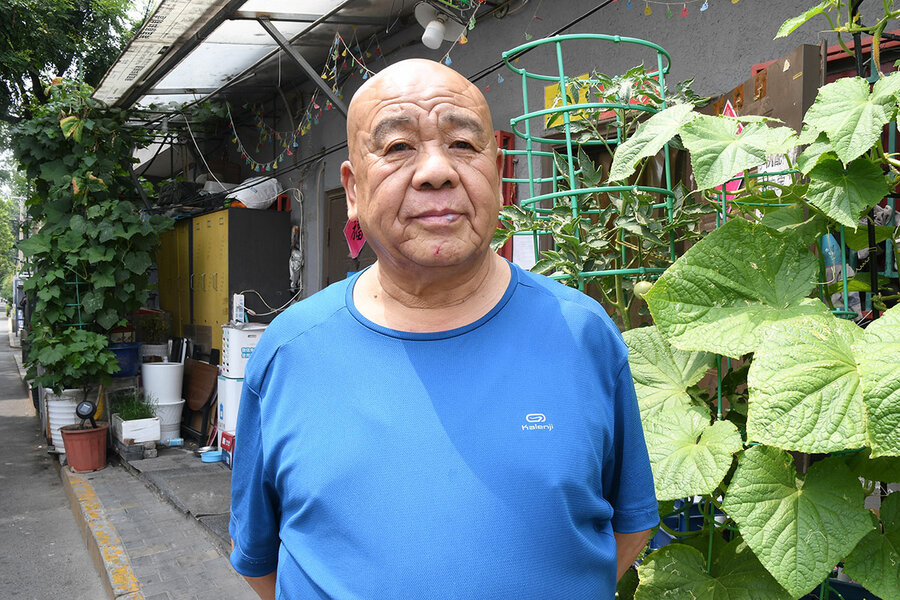
In China’s hutongs, people travel more slowly, affording them time to enjoy the lush bounty of small gardens.

I do like stories about the joy and innocence of growing things. Check out today’s feature from the Christian Science Monitor, an outlet that reliably covers more positive news than the blaring headlines we are used to.

Ann Scott Tyson writes, “On his morning rounds after a summer rainstorm breaks Beijing’s heat, Zhao Shisheng inspects his favorite vine of gourds. 

“From a small pot of dirt set against the wall of his back alley home, the vine climbs a bamboo pole, rising past mops hung out to dry. From there, it scales window ledges, pipes, and electricity wires, soaring toward a makeshift trellis Mr. Zhao built on his rooftop.

“In fact, Mr. Zhao’s prolific, potted garden – bursting with vines of melon, grapes, tomatoes, cucumbers, mint, and beans – is rapidly enveloping his modest, one-story house, where he lives with three generations of his family and a pet parrot.

“Mr. Zhao counts himself among the ranks of Beijing’s hutong gardeners – the avid, green-thumbed residents who work wonders in the city’s maze-like ancient neighborhoods, tucked behind skyscrapers and traffic-clogged avenues. In hutongs, as the narrow alleys are called in Chinese, people travel more slowly – often by bicycle or by foot – affording them time to enjoy the lush bounty, and admire the gardeners’ horticultural feats. 

“ ‘We eat some and I share the rest with neighbors. I don’t need to sell what I grow. I already have a way to make a living,’ Mr. Zhao says, pointing to a tiny convenience shop in the front room of his house.

“These gardens are largely vertical, rising like Jack’s beanstalk out of humble clay pots or small planters. Vibrant vines and curly tendrils cling to the old stone and rounded tiles of the traditional courtyard homes. Their rustling leaves create a soothing sound and welcome shade as they arc over alleys and courtyards on trellises. …

“Around the corner next to another hutong garden, a plein-air painter has set up an easel and canvas to capture the scene. ‘This plant is a loofah gourd,’ says Liu Changli, dabbing leaves on his watercolor tableau. ‘People in Beijing like to grow it because you can eat it, or simply enjoy looking at it.’ …

“The grower of the loofah gourds, Zhao Guangliang, steps out his door carrying a potted tomato that needs a sunnier exposure. Space is precious in the hutongs, where people live in crowded conditions and share public toilets. So gardeners must be creative. Assisted with strategically placed bamboo, they use every nook and cranny for plants. One of Mr. Zhao’s neighbors arrays plants on the roof of an unused van. Mr. Zhao opts, for now, to seat his tomato on a small chair. …

“Visit with them for a time, and the gardeners enjoy sharing not only growing tips, but also how to use different plants in cooking and other practical ways. ‘This is a Sichuan pepper bush I’ve been growing for more than a decade,’ boasts Mr. Wang, who withheld his first name for privacy. ‘You dry out the pepper in the yard, then you can use it to make mapo tofu or meat stew.’ …

“ ‘This is mint. Do you have some in your house? Smell this kind – see how strong it smells? If you get bitten by a mosquito you can crush some and rub it on your skin. … It’s good for people to chat like this,’ he reflects. ‘It gets rid of your worries.’ “

I wanted to grow loofah gourds here, but I knew I shouldn’t introduce a species to my region. Loofahs make those wonderful “sponges” I used to think came from the sea.

More at the Monitor, here. No paywall. Subscriptions encouraged.

Read Full Post »

Photo: Institute For Figuring.
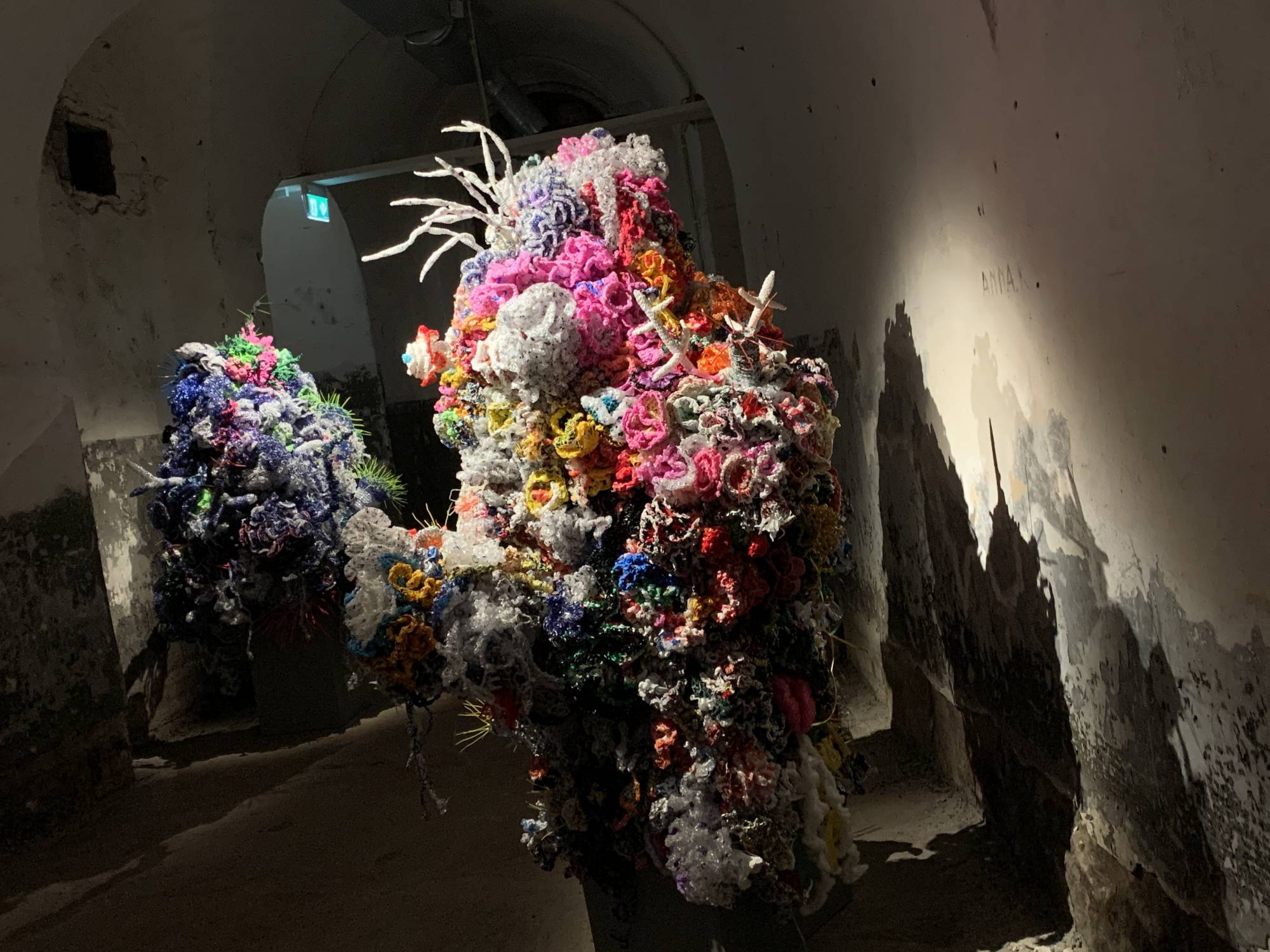
Coral Forest – Helsinki, crocheted from recycled plastic. A collaboration between Christine and Margaret Wertheim and the Helsinki Satellite Reefers, hosted by Helsink Art Museum and Helsinki Biennial 2021.

Remember my post on how crochet art was drawing attention to dying coral reefs? (See it here.) Well, after my friend Kristina told me about seeing some of the new additions to the crochet project, I decided to post a follow-up.

Siobhan Roberts reported at the New York Times in January, “Every year after the full moons in late October and November, Australia’s Great Barrier Reef begins its annual spawning — first the coral species inshore, where waters are warmer, then the offshore corals, the main event. Last year, this natural spectacle coincided with the woolly propagation of two new colonies of the Crochet Coral Reef, a long-running craft-science collaborative artwork now inhabiting the Schlossmuseum in Linz, Austria, and the Carnegie Museum of Art in Pittsburgh.

“To date, nearly 25,000 crocheters (‘reefers’) have created a worldwide archipelago of more than 50 reefs — both a paean to and a plea for these ecosystems, rainforests of the sea, which are threatened by climate change. The project also explores mathematical themes, since many living reef organisms biologically approximate the quirky curvature of hyperbolic geometry. …

“The surface of a sphere displays constant positive curvature; at all points, the surface bends inward toward itself. And a hyperbolic plane exhibits constant negative curvature; at all points, the surface curves away from itself. Reef life thrives on hyperbolism, so to speak; the curvy surface structure of coral maximizes nutrient intake, and nudibranchs propel through water with frilly flanges.

“In the artworks, marine morphologies are modeled — crocheted — with loopy verisimilitude. A bit like Monet’s water lilies, the crochet corals are abstract representations of nature, said Christine Wertheim, an artist and writer now retired from the California Institute of the Arts. Dr. Wertheim is the driving artistic force behind the project, which she created with Margaret Wertheim, her twin sister, a science writer who is in charge of scientific and mathematical components as well as management. …

“Crochet Coral Reef exhibitions typically have two main components: The Wertheims provide an anchor, of sorts, with works from their collection that they have crocheted over the years. They also incorporate pieces by select skilled international contributors. One is a ‘bleached reef,’ evoking corals stressed by increases in ocean temperature; another, a ‘coral forest’ made from yarn and plastic, laments the debris that pollutes reef systems.

“Then in response to an open call, volunteers far and wide crochet a pageant of individual specimens that agglomerate in a ‘satellite reef,’ staged by a local curatorial team with guidance from the Wertheims. … All contributors are credited.

“The largest satellite reef thus far coalesced in 2022 at the Museum Frieder Burda in Baden-Baden, Germany, with some 40,000 coral pieces by about 4,000 contributors. The Wertheims call this the Sistine Chapel of crochet reefs (documented in a splashy exhibition catalog). But the show at the Linz Schlossmuseum, which is dedicated to natural science as well as art and culture, is reminiscent of the work of the painter Giuseppe Arcimboldo, whose collage portraits from depictions of fruits, vegetables and flowers are ‘fantastically heterogeneous, also very funny and clever,’ Ms. Wertheim said.

“The Linz satellite reef unites some 30,000 pieces by 2,000 crocheters. The disparate parts take colorful inspiration from traditional Austrian ‘craftswomanship,’ as the exhibit text puts it, and there is a vast, glittery coral wall that gives a nod to the artist Gustav Klimt. In the Wertheims’ view, however, the crochet coral project is proof that it is not always lone geniuses who create great art, but also communities. In the art world, that is a radical idea, they noted, yet in science big collaborative projects and papers with thousands of authors are not unprecedented. …

“The mathematical dimension of the story intersects (from afar) with research by the applied mathematician Shankar Venkataramani and his students at the University of Arizona. They use idealized models to study hyperbolic surfaces in nature. [The] benefit, he said, is that it helps optimize processes like circulation and nutrient absorption. …

“When Margaret Wertheim, who studied math, physics and computer science at university, learned hyperbolic geometry, she found it ‘a bit bamboozling.’ She took the principles more on faith than understanding. Yet through crocheting models, she said, ‘you really do learn in a very deep way what a hyperbolic structure is, and in a way that I think is very powerfully pedagogical.’ “

More at the Times, here. Gorgeous photos.

See also Crochet Coral Reef, here. As the website notes, “Every crafter who contributes to the project is free to create new species of crochet reef organisms by changing the pattern of stitches or working with novel materials. Over time, a Darwinian landscape of wooly possibility has been brought into being. What started from simple seeds is now an ever-evolving, artifactual, hand-made ‘tree of life.’ “

Read Full Post »

Photo: Joel Sartore/Photo Ark.
Rare flat-headed cats were declared “lost” before the species was rediscovered in 1995.

Lady Macbeth says, “What’s done cannot be undone.” Similarly, when a species is truly extinct, it’s done, never mind random talk of bringing back a wooly mammoth from its DNA. What is more feasible is bringing back to its former range a species that is merely extinct in that region.

Remember our post on the tiger quoll, thought to be extinct in southern Australia? And how about that gray whale, thought to be extinct in the Atlantic Ocean? It just showed up, although that was probably a sign of melting ice that could have opened a passage from the Pacific.

You might like Daniel Shailer’s related story at Scienific American on species that scientists think may yet be found. He explains how researchers will go about prioritizing their searches.

“Gison Morib was home lying in bed, sick from exhaustion after a month-long jungle expedition, when his phone buzzed and a black-and-white photograph appeared. Morib ran outside, jumped on his motorbike and sped through the city of Sentani on Indonesian New Guinea to his colleagues’ expedition and research base — where he broke down in tears.

“ ‘I cannot believe we found it,’ was all he could say, over and over. The photograph showed the first recorded sighting in more than 60 years of an Attenborough’s long-beaked echidna, an egg-laying mammal. After the researchers had spent three years of research and four weeks of trekking through the island’s remote Cyclops Mountains … the team’s camera trap had finally captured an image of the echidna. ‘Even now I can’t describe the feeling,’ … says Morib, a biology undergraduate student at nearby Cenderawasih University. …

“It can be painful for scientists to conclude that an entire species is gone forever. So after at least a decade without recorded sightings, local researchers sometimes simply declare a species temporarily ‘lost’ — hoping it may eventually be found again — instead of giving up entirely. In 2023 that hope led to rediscoveries of animals that included Attenborough’s echidna, De Winton’s golden mole in South Africa and the Victorian grassland earless dragon, a type of Australian lizard that went unseen for half a century. Such hope also fuels ongoing, decades-long searches for species such as the American Ivory-billed Woodpecker, which was last seen in 1944.

“Now an international study published [in] Global Change Biology aims to ‘bring a bit of science back to the search’ for all mammals, amphibians, reptiles and birds playing hide-and-seek, according to senior study author Thomas Evans, a conservation scientist at the Free University of Berlin. In a span of two years, Evans and a team of researchers across the globe — from the U.S. to China, Ecuador and South Africa — compiled what they call the most exhaustive catalog ever of four-limbed creatures that were considered lost to science and those among these animals that were later rediscovered. …

“Although there has been plenty of research into lost species, the study authors say that rediscoveries haven’t been thoroughly assessed since 2011. Analysis tallying losses and rediscoveries across animal groups is even rarer, Evans says.

“His team’s catalog suggests that 856 species are currently missing and that the number of lost species is growing around the world faster than expedition parties can keep up. And this is occurring even though researchers are finding animals through the use of increasingly sophisticated technology, including systems that detect environmental DNA (eDNA) traces of burrowing birds near the South Pole, software that disentangles the noises of different nocturnal species, and even techniques used to spot microscopic traces of rare frogs in ship rats’ stomachs.

“Adding up losses and rediscoveries also suggests that roughly a quarter of lost species are likely already extinct. … Analysis shows that many rediscovered species fit a certain profile: they are big, charismatic mammals or birds that tend to live across a range of habitats, often near humans and in more-developed countries. So, Evans says, if an animal fits the bill for the kind of species that is usually found more easily but continues to evade researchers after long searches, it is probably gone forever. The thylacine, or Tasmanian tiger, is a good example: since the last captive thylacine died in a zoo in 1936, the wolflike species has taken on huge cultural significance across Australia and inspired decades of searching, but it remains lost. The paper argues that precisely because the thylacine is a perfect candidate for rediscovery, the fact it remains lost strongly suggests that it is actually extinct. The same goes for more than 200 other lost species that have been thoroughly searched for as well, Evans says.

“On the other hand, creatures that don’t fit the profile for easy rediscovery, especially reptiles, could still be out there. Because they’re often hard to find and inspire less search effort, small, uncharismatic species are more likely to genuinely be lost but still alive, Evans says. His optimism is backed up by the numbers: new species of small reptiles continue to be discovered at a steady rate, and rediscoveries have boomed, with more than twice as many lost reptiles found between 2011 and 2020 than in the decade before.

“The thylacine has acquired a Bigfoot-like status, complete with amateur hunters and highly questionable sightings. Meanwhile reptiles such as the Fito leaf chameleon of Madagascar are probably sitting pretty and waiting to be found. …

“A probability analysis of some factors also rang ‘alarm bells’ in different ways for different classifications of lost species, Evans says. Mammals classified as lost on islands, such as the Bramble Cay melomys, a rat lost in 2009 and declared extinct in 2016, are disproportionately likely to be gone for good, compared with mammals in other environments. There’s also a sweet spot for finding birds after they’ve been lost: 66 years, on average. This time span is long enough to raise interest in search expeditions but not so long that the animals are considered extremely likely to be extinct. So the odds are not good for the more than a dozen bird species that were lost more than a century ago.

“Evans hopes such details about what may be simply unseen versus what is more likely extinct will help conservationists.”

More at Scientific American, here.

Read Full Post »

« Newer Posts - Older Posts »