Feeds:
Posts
Comments

Archive for the ‘Uncategorized’ Category

Photo: Baileigh Industrial.
Above, using the Action Trackchair around the house. Wilderness adventurers love it, too.

Technology is erasing the barriers for people with disabilities who want to do everything other people do. At the Washington Post, Andrea Sachs and Natalie B. Compton wrote on Nov. 8 about a 500-pound miracle arriving in US parks: all-terrain wheelchairs.

“Cory Lee has visited 40 countries on seven continents,” they write, “and yet the Georgia native has never explored Cloudland Canyon State Park, about 20 minutes from his home. His wheelchair was tough enough for the trip to Antarctica but not for the rugged terrain in his backyard.

“Lee’s circumstances changed [recently], when Georgia’s Department of Natural Resources and the Aimee Copeland Foundation unveiled a fleet of all-terrain power wheelchairs for rent at 11 state parks and outdoorsy destinations, including Cloudland Canyon.

The Action Trackchair models are equipped with tank-like tracks capable of traversing rocks, roots, streams and sand; clearing fallen trees; plowing through tall grass; and tackling uphill climbs.

“ ‘I’ll finally be able to go on these trails for the first time in my life,’ said the 32-year-old travel blogger, who shares his adventures on Curb Free With Cory Lee. …

“In 2017, Colorado Parks and Wildlife launched its Staunton State Park Track-Chair Program, which provides free adaptive equipment, though guests must pay the $10 entrance fee. Michigan’s Department of Natural Resources has placed off-road track chairs in nearly a dozen parks, including Muskegon State Park. …

“South Dakota is [expanding] its squadron: On Tuesday, the South Dakota Parks and Wildlife Foundation unveils its second all-terrain chair. South Dakota resident Michael M. Samp is leading a fundraising campaign to purchase up to 30 chairs. Last year, Samp’s father packed up his fishing pole and piloted a track chair to Center Lake in Custer State Park. He reeled in trout, just as he had before he was diagnosed with spinal cerebral ataxia. …

“This month, the Minnesota Department of Natural Resources will wrap up its months-long pilot program that tested out the chairs in five parks. … Said Jamie McBride, a state parks and recreation area program consultant with the Parks and Trails division of the Minnesota DNR, ‘People have told us this is life-changing.’

“The Georgia initiative was spearheaded by Aimee Copeland Mercier, who suffered a zip-lining accident in 2012 and lost both hands, her right foot and her left leg to a flesh-eating bacterial infection. Copeland Mercier, a psychotherapist and licensed clinical social worker, tested several types of all-terrain chairs before committing to the Action Trackchair, which several other state programs also use.

“The Minnesota-based company was founded by Tim and Donna Swenson, whose son, Jeff, was paralyzed in a car accident. The original design resembled a Frankenstein of sporting goods parts, with snow bike tracks and a busted boat seat. Today’s model could be an opening act at a monster truck rally.

“ ‘I was floored by what it could do,’ said Copeland Mercier, whose foundation raised $200,000 to purchase the chairs at $12,500 each. ‘Oh my gosh! I can go over a whole tree trunk, up a steep incline and through snow, swamps and wetlands. If I took my regular wheelchair, I’d get stuck in five minutes.’

“Each program has its own reservations system and requirements. For Georgia’s service, visitors must provide proof of their disability and a photo ID, plus complete an online training course available through All Terrain Georgia. Once certified, the organization will forward the rental request to the park. Copeland Mercier urges visitors to plan ahead: The certification course takes about an hour, the foundation needs 72-hour advance notice and the park requires a 48-hour head’s up.

“ ‘These are 500-pound chairs,’ she said. ‘There are some risks involved.’

“The Minnesota DNR, which owns and maintains its five chairs, advises visitors to call the park to reserve a chair. …

“Track chairs can conquer a range of obstacles, but they do not work in all environments.

“ ‘You need the width. If two trees are too close together, the wheelchair can’t pass between them,’ Copeland Mercier said. ‘And some inclines are too steep. The chair also can’t go down staircases.’

“To steer visitors in the right direction, parks have created maps highlighting the trails designated for the track chairs, such as Staunton State Park’s trio of routes that range from roughly three to four miles. … McBride said one goal is to erect markers that would provide detailed information about the hike, such the extent of accessibility. ‘We want to let people know if they can get all the way to the waterfall or halfway,’ he said, using a hypothetical example.

“Copeland Mercier also has a wish list. She hopes to expand the network of chairs to other parts of Georgia, such as the coastal, southern and central regions. Once the foundation acquires several vans (another aspiration), the staff could move the 30 to 40 chairs (ditto) around the state to fill fluctuating demand. She is also eyeing other states.

“ ‘North Carolina is next,’ said Copeland Mercier, who divides her time between Atlanta and Asheville, N.C. But the grand plan is even bigger. ‘The goal is to alter the U.S.A.,’ she said.”

More at the Post, here.

Read Full Post »

Photo: Piscataway Indians.

Our history with indigenous tribes is dark, and reconciliation must start with facing facts. In this endeavor, archaeology can help.

From St. Clement’s Island, Maryland, Dana Hedgpeth writes for the Washington Post on recent discoveries about a tribe’s long-ago presence.

“The small pieces of oyster shells and ceramic shards in the palm of archaeologist Julia King don’t look like much. But her team’s discoveries of roughly 1,500 pounds of shells and 200 pieces of ceramics bring new and more concrete evidence of the dominance of Native Americans who once lived at St. Clement’s Island and along the surrounding Potomac River shoreline in Southern Maryland. Native American leaders said their archaeological findings shed fresh light on their tribes’ historic presence in the state — which continues to this day but is often unknown, forgotten and ignored.

“ ‘This work is showing a reclamation of the long history of Native Americans in that area and what it means to our people,’ said Gabrielle Tayac. Tayac is a historian and member of the Piscataway Indian Nation, which considers the area its tribal homelands. ‘There’s been a willful and problematic negligence in the record about us.’

“St. Clement’s Island — an uninhabited 40-acre plot of land only accessible by boat — sits where the Potomac and Wicomico rivers meet, about half-mile off the shoreline of St. Mary’s County. There are roughly 4,500 Native Americans who are part of two state-recognized tribes — the Piscataway Conoy Tribe and the Piscataway Indian Nation — who trace their roots to the area. Piscataway means ‘the people who live where the waters meet’ in the Algonquian language.

“To many, St. Clement’s Island is best-known as the spot where roughly 150 European colonists arrived on March 25, 1634, and held the first Roman Catholic Mass in the British American colonies. …

“Few people had explored the sandy shores and grassy lands of the island until King’s research team spent several months this summer carefully digging up grass and sifting through dirt. … They found scores of Native American artifacts at the site and in collections of area residents and of a small museum on the mainland. The items included stone tools, tobacco pipes, ceramics and oyster shells, along with bits of copper, polished tubes and stone beads. All of it is evidence, said King, an archaeologist with St. Mary’s College of Maryland, of the ‘extensive exchange and network of trade’ between Piscataways and tribes from areas now known as Virginia, New York and as far away as Ohio andWest Virginia — centuries before Europeans came. …

“For Native American leaders in Southern Maryland, King’s work is a validation of their long history and continued presence in the area that’s rarely highlighted.

‘History was not written for us — or about us,’ said Francis Gray, chairman of the Piscataway Conoy Tribe. …

“Archaeological records show Native Americans were in the St. Clement’s Island area as far back as 3500 B.C., according to King. The island itself was once 400 acres, but erosion shrank it. Historians say there were an estimated 5,000 Piscataways living in the Potomac Valley area in the 1600s. …

“Rico Newman, an elder in the Choptico Band of Piscataways, said he remembers when growing up that he heard oral histories from his elders of how Piscataways followed the shad and herring runs along the nearby Wicomico River and went to St. Clement’s Island. Native Americans called it Heron Island after the bird that is fond of nesting in the area.

“ ‘There was no better place to live off the water and the land than there,’ Newman said. He recalled how his grandfather used to tell him, ‘if the heron isn’t fishing, then you weren’t fishing.’ It meant there was ‘something wrong with the fish or the water that day.’ …

“In the early 1600s, Piscataways traded with Europeans from the sister colony in Jamestown, Va. For the Piscataways, the trade meant protection for their homeland from Iroquois. English copper, beads and metal tools ‘made the newcomers useful that they need not be killed or left to starve,’ according to Piscataway leaders and historians.

“The Piscataways’ homeland changed dramatically when in March 1634, two ships — the Ark and the Dove — arrived with colonists looking to create a settlement. To celebrate their arrival, the colonists held the first Catholic Mass in the New World.

“The colonists knew of the disagreements and slayings between Native Americans and settlers at Jamestown, so they planned a different approach. The Calvert family, who founded Maryland as a colony, ‘didn’t want to pay for the costly kinds of wars experienced in Virginia,’ King said, ‘so they made the decision to forge diplomatic relationships with the Indians.’

“They went from St. Clement’s upriver to see the Piscataway tayac — the word for leader in the Algonquian language. They told Wannas, the Piscataway tayac at the time, they’d ‘come not to make war, but out of good will toward them,’ according to records at the St. Clement’s Island museum.

“Wannas, the tayac, cautiously responded to them, saying the Native Americans did not welcome the colonists, but also was not going to force them to leave. The colonists decided St. Clement’s was too small and well-established as ‘Indian country,’ so they returned and went down the river to what would become St. Mary’s City, where they bought land from the Yaocomicos and set up the first English settlement in Maryland.

“By 1650, more colonists moved to the area, and they created a reservation for the Piscataways, but eventually, King said, the Native Americans were pushed out as colonists took over. Some Piscataways went north to what’s now Frederick. Others went to Virginia. And some stayed, but they were ‘no longer considered a sovereign nation,’ King said. …

“Karen Stone, the executive director of the St. Clement’s Island museum, said a major renovation will start early next year with new exhibits that will tell Maryland’s history from the points of view of the colonists and the Piscataways. She said local Native American leaders are involved in designing the materials and exhibits for the new museum to give a more complete story and more accurate history of the Piscataways.”

More at the Post, here.
Read Full Post »

Soccer and Samba

Photo:MB Media/Getty Images.
Brazil’s players celebrate by dancing the samba after their win over South Korea. 

Is it my imagination or is there new excitement in the US over the World Cup this year? We have never been prominent among soccer teams, and that’s changing. Also, we have many immigrants and naturalized Americans from big “futball” nations. So there’s that.

In any case, it’s been fun. Suzanne and Erik and the kids each picked a team at the start, and three of them have had to swallow their disappointment and choose a second favorite. Suzanne is still standing.

Every soccer country has its own way of reacting to wins and losses. Not many are subdued. Today’s story is about the form that Brazilian soccer celebrations take.

Ed Aarons opens his story at the Guardian with a player’s memories of games in the 1930s.

” ‘I was afraid of playing football [soccer] because I had often seen a black player get struck on the pitch for committing a foul,’ said Domingos da Guia, a defender who played for Brazil in the 1938 World Cup. ‘But I was a very good dancer and that helped me on the pitch. I invented the short dribble by imitating the miudinho, a form of samba.’

Roy Keane did not like it but when Brazil’s players – and the coach, Tite – celebrated scoring against South Korea in their last-16 victory on Monday by performing Richarlison’s trademark pigeon dance, they were following a historic tradition that represents the very soul of the Seleção. Samba, which has its roots in Angola and the Democratic Republic of Congo via the African slave trade, and football were adopted by Brazil’s working classes just as Da Guia was making his international debut in 1931.

“According to Brazilian sociologist Gilberto Freyre, the distinctive style of play Brazil has become known for comes from the indelible link between the two:

‘In football, as in politics, a feature of the Brazilian racial blend is a taste for bending the rules, an element of surprise or frills that calls to mind dance steps and the Capoeira.’ …

“When a 17-year-old Pelé and the winger Garrincha inspired them to their first World Cup victory in 1958, the song A Taça do Mundo é Nossa – The World Cup is Ours – left no doubt about the vital importance of music to the team’s success. …

“According to legend, the celebrated samba singer Elza Soares fainted in the stands at the end of Brazil’s 3-1 win over Czechoslovakia in the final but recovered in time to perform a song in honor of her future husband Garrincha in the changing room.

“Pelé was among those to pay tribute to Soares in January after her death at the age of 91, describing her as a ‘legend of our music, historic, genuine, unique and unparalleled.’ …

“The tradition of celebrating goals with dance routines is generally a more recent phenomenon that has not been restricted to Brazilians. Roger Milla’s corner flag wiggle at Italia 90 and again at USA 1994 were inspired ‘by his own imagination’ according to the Cameroon striker, while Papa Bouba Diop celebrated his goal against France, the holders, in 2002 by removing his shirt and performing a mbalax dance with his Senegal teammates. But after Bebeto and Romario’s cradle-rocking routine in 1994 that was a tribute to the former’s newborn Mattheus Oliveira – now 28 and playing in the Portuguese second division – it is Brazil that has always had the strongest tradition to uphold.

“ ‘Dance is the symbol. We symbolize the joy of scoring a goal. We don’t do it to disrespect, we don’t do it in front of the opponent,’ said West Ham’s Lucas Paquetá after the South Korea match. ‘We get together, you can look. Everyone is there and we celebrate. It’s our moment, we scored the goal, Brazil is celebrating.’

“For Vinícius Júnior, who scored the first goal against South Korea, the criticism will have had particular resonance. In September, the Real Madrid forward was accused of not respecting his opponents and told to ‘stop playing the monkey’ by Pedro Bravo – a leading agent and president of the Association of Spanish Agents – on live television after celebrating his goals by dancing. …

“ ‘They say happiness upsets. The happiness of a black Brazilian successful in Europe upsets much more,’ Vinícius wrote. ‘Weeks ago they began to criminalize my dances. Dances that are not mine. They belong to Ronaldinho, Neymar, Paquetá, [Antoine] Griezmann, João Félix and Matheus Cunha. … They belong to Brazilian funk and samba artists, reggaeton singers, and black Americans. Those are dances to celebrate the cultural diversity of the world. Accept it, respect it. I’m not going to stop.’ ”

More at the Guardian, here.

Meanwhile, in Switzerland, riots break out after the World Cup loss to Portugal.

Read Full Post »

An Octopus Tantrum

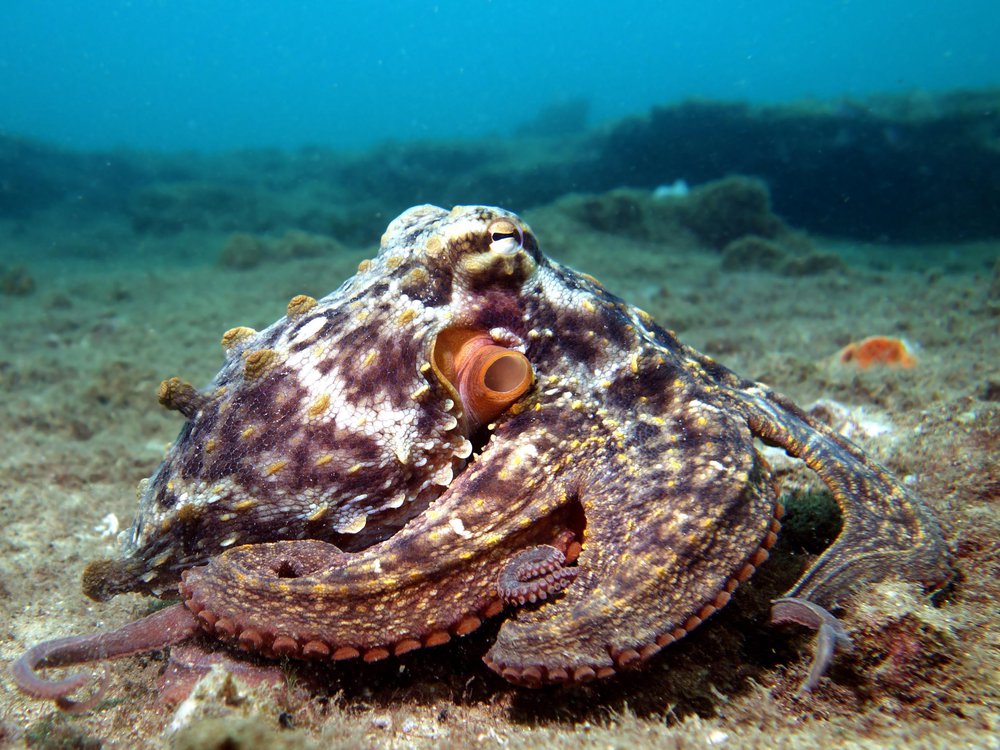
Photo: John Turnbull via Flicker via the Smithsonian.
Female octopuses are far more likely than males to ‘throw’ objects at others.

Have you ever read a book by the popular naturalist Sy Montgomery? She loves every kind of creature (except the Bobbitt worm) and can write and talk engagingly about them all. She’s a regular visitor to the radio show Boston Public Radio (BPR). I hear her Wednesdays as I go to visit the Rhode Island grandchildren, and she loads me up with implausible but true animal stories to share.

Recently, Montgomery talked with BPR hosts Jim and Margery about octopuses throwing things to defend their space. Later, I read about this mostly female behavior at the Washington Post.

Jennifer Hassan wrote, “It looks like a scene from a tense thriller movie — a dark octopus rises from its lair on the ocean floor, sneaking up toward another octopus that lurks, barely visible, nearby among a blanket of shells and algae.

“The second octopus shrinks away, while the first attacks by raising its arms and shooting a cloud of debris through the water toward it. … While octopuses have long been known to thrash around underwater, researchers now believe they have video evidence that shows the creatures can not only throw objects — an uncommon behavior in animals — but may also be capable of deliberately targeting each other. Perhaps out of rage, perhaps to protect their eggs — or possibly because they are seeking the octopus equivalent of personal space.

“Researchers from the University of Sydney described several incidents of octopuses throwing debris during social interactions, including attempted sexual exchanges, which they said provided evidence that octopuses were targeting each other on purpose.

“They had analyzed more than 20 hours of footage from Jervis Bay, off the south coast of New South Wales, Australia, from 2015 and 2016, observing 10 octopuses from the octopus tetricus species — also known as gloomy octopuses or the common Sydney octopus. Their findings published [in November] in the peer-reviewed PLoS One journal.

“In one clip, a female octopus threw 17 objects in 60 minutes — hitting other octopuses nine times.

On another occasion, a single female threw material 10 times, with half of those attempts successfully hitting a male in an adjacent den who had been attempting to mate with her. …

” ‘We can’t be sure, but we think some hits are probably intentional,’ Australian researcher and professor Peter Godfrey-Smith told the Washington Post, adding that they found the wild octopuses used a ‘jet-propelled throw’ to project material through the water — essentially, by releasing the debris from their arms while also creating a powerful jet from the siphon located under their arm web.

“Researchers say the frequent octopus throws ‘appear to be mildly aggressive’ and that this apparent targeting of members of the same species ‘is a rare form of nonhuman projectile use,’ which has only been documented among a handful of social mammals.

“ ‘We doubt if it’s playful,’ Godfrey-Smith said of the behavior caught on camera. ‘I think a lot of it is probably about the octopus equivalent of “personal space.” ‘ …

“The report acknowledges that it is difficult to prove the gesture is targeted, as ‘showing intention in a behavior is difficult in non-human animals.’

“ ‘Some throws hit other octopuses, but is this deliberate? We certainly don’t think it’s 100 percent clear, or close to that. But I do think it is more likely than not,’ Godfrey-Smith said.

“Nonetheless, the study adds, the throws are significant even if there is no deliberate targeting — because ‘they do have social effects in interactions between individuals’ studied at the sites.

“Octopuses hit during such throws ‘often altered’ their behavior in response — many ‘octopuses in the line of fire ducked, raised arms in the direction of the thrower, or paused, halted or redirected their movements,’ researchers said.

“Researchers say they hope to do further research and plan more recordings, though they have faced challenges in recent years due to the coronavirus pandemic and storms and flooding in Australia.”

More at the Post, here.

Read Full Post »

Photo: Fabrizio Bensch/Reuters.
Dancers from the Berlin State Ballet during the dress rehearsal for a production of Don Quixote in Berlin last December. 

I am often surprised to see how much “Old Europe” leads the way into the future. Not only do we count on Europe to curtail the monopolistic excesses of tech companies like Apple and Google, but we look to thought leaders there for ideas on dealing with everything from climate change to improving arts access.

Kate Connolly in Berlin, Sam Jones in Madrid, Jon Henley in Paris and Angela Giuffrida in Rome have a report at the Guardian.

“Young Germans are to join other Europeans in being offered a voucher to spend on their choice of cultural offerings under a scheme launched by the government. The €200 Kulturpass, which will be made available to all 18-year-olds, has twin aims: to encourage young adults to experience live culture and drop stay-at-home pandemic habits; and give a financial boost to the arts scene, which has yet to recover from repeated lockdowns.

“Germany’s culture minister, Claudia Roth, described the cultural passport as the ‘equivalent of a birthday present’ for the 750,000 people who will turn 18 in 2023. It will bring the EU’s most populous country in line with France, Italy and Spain, which have introduced similar schemes.

“The finance minister, Christian Lindner, described the pass as ‘cultural start-up capital’ that its recipients can use within a two-year period for everything from theatre and concert tickets to books or music. It will be managed via an app and a website that provides a direct connection to a virtual marketplace of everything from bookshops to theaters. …

“Online platforms such as Amazon and Spotify have been excluded from the scheme, which places an emphasis on smaller, often local organizations, such as independent cinemas and bookshops.

Individual purchases will be limited in value to prevent someone from using the voucher to buy, for example, a single concert ticket for €200.

“Launching the Kulturpass, Roth and Lindner said that if successful, the scheme would be extended and probably rolled out to a wider age group, possibly from the age of 15 upwards.

“A similar scheme, announced last year by Spain’s Socialist-led coalition government, offers young people a €400 culture voucher when they reach 18. According to the Spanish government, 57.6% of all those who turned 18 in 2022 registered for the voucher scheme in its first year.

“France’s Pass Culture, or youth culture pass, a promise from President Emmanuel Macron’s 2017 election campaign, was trialled across the country the following year and – after a lengthy delay due to the pandemic – officially launched in 2021.

“The app-based pass gives every 18-year-old €300 to spend on cinema, museum, theatre and concert tickets, as well as on books, art materials, arts courses, musical instruments or a subscription to a French digital platform. …

“This year the €200m-a-year scheme was extended to over-15s, in two parts: a collective allowance of (depending on age) €25-30 per pupil per year available to teachers for class visits to exhibitions, films, plays, concerts or workshops, plus from €20-30 that each teenager can spend individually.

“In 2016, Italy introduced a ‘culture bonus’ of €500 for every 18-year-old under prime minister, Matteo Renzi, It has been maintained by the culture ministry despite various changes of government since then and an attempt by populist leaders to scrap it in 2018. …

“Roth said the German pass would open up a range of cultural opportunities for young people comparable with the Interrail Pass, a train ticket that has allowed generations of Europeans the opportunity to travel cheaply around the continent.

“Olaf Zimmermann, the chairman of the German Cultural Council, an umbrella organization representing more than 200 cultural associations, said the voucher was a ‘meaningful way to support both young people and the world of culture which have suffered in particular from the pandemic.’ But he said that establishing what young adults … should cover as many areas as possible, from drawing classes to the purchase of a musical instrument.”

More at the Guardian, here.

Read Full Post »

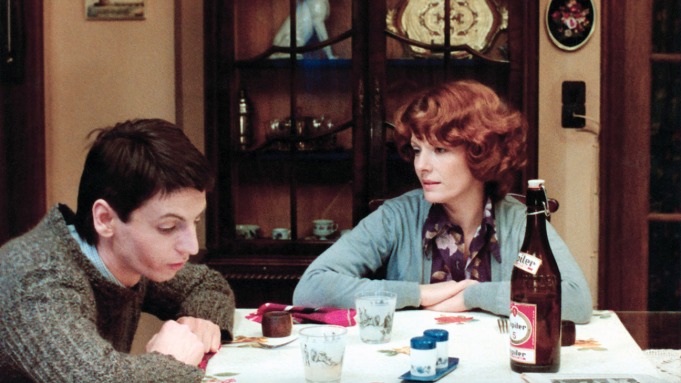
Photo: Everett Collection.
A scene from the French film Jeanne Dielman, voted best of all time at Sight & Sound magazine recently. It’s the first time the best-film honor has come to a female director, Chantal Ackerman.

Do you follow “best of” lists? I find them interesting, and I especially like seeing how judgments change over the years. Today’s story is about voting for the best film of all time. I’ve seen hardly anything on the list, but what caught my attention is that the film that has moved to the top was made by a woman. A first for the poll.

Alex Ritman writes at the Hollywood Reporter, “Almost 50 years after its release, Jeanne Dielman, 23 quai du Commerce, 1080 Bruxelles — Chantal Akerman’s groundbreaking 1975 drama following the meticulous daily routine of a middle-aged widow over the course of three days — has become the first film by a female director to top Sight & Sound magazine’s once-a-decade ‘Best Films of All Time’ poll in 70 years.

“More than 1,600 film critics, academics, distributors, writers, curators, archivists and programmers voted in the poll, which the BFI-backed [British Film Institute] publication has been running since 1952, with the results, announced Thursday, seeing Akerman’s feature — which was heralded by Le Monde in January 1976 as ‘the first masterpiece of the feminine in the history of the cinema’ — leapfrog from 36th position in 2022 to No. 1.

“The 2012 winner, Alfred Hitchcock’s Vertigo, now sits in second place, with Orson Welles’s Citizen Kane (which held the No. 1 spot for 50 years) placed third and Yasujirō Ozu’s Tokyo Story fourth. Three more films are new to the top 10, including Wong Kar Wai’s In The Mood for Love in fifth place (up from 24th in 2012), Claire Denis’ Beau travail at number seven (up from 78th) and David Lynch’s Mulholland Dr. in eighth place (up from 28th). Only four new films released since 2012 managed to break into the top 100 of the poll. …

“ ‘Jeanne Dielman challenged the status quo when it was released in 1975 and continues to do so today. It’s a landmark feminist film, and its position at the top of list is emblematic of better representation in the top 100 for women filmmakers,’ said Mike Williams, Sight and Sound editor. ‘While it’s great to see previous winners Vertigo and Citizen Kane complete the top three, Jeanne Dielman’s success reminds us that there is a world of under-seen and under-appreciated gems out there to be discovered, and that the importance of repertory cinemas and home entertainment distributors cannot be overestimated in their continued spotlighting of films that demand to be seen. What currently undervalued masterpieces might emerge in 10 years thanks to this tireless work?’

“Added BFI executive director of public programs and audiences Jason Wood: ‘As well as being a compelling list, one of the most important elements is that it shakes a fist at the established order. Canons should be challenged and interrogated and as part of the BFI’s remit to not only revisit film history but to also reframe it, it’s so satisfying to see a list that feels quite radical in its sense of diversity and inclusion.’

“See the top 20 greatest films of all time, according to Sight & Sound‘s 2022 poll, below

1       Jeanne Dielman, 23, quai du Commerce, 1080 Bruxelles (Chantal Akerman, 1975)

2       Vertigo (Alfred Hitchcock, 1959)

3       Citizen Kane (Orson Welles, 1941)

4       Tokyo Story (Ozu Yasujiro, 1953)

5       In the Mood for Love (Wong Kar Wai, 2001)

6       2001: A Space Odyssey (Stanley Kubrick, 1968)

7       Beau travail (Claire Denis, 1998)

8       Mulholland Dr. (David Lynch, 2001)

9       Man with a Movie Camera (Dziga Vertov,1929)

10     Singin’ in the Rain (Stanley Donen & Gene Kelly, 1951)

11     Sunrise: A Song of Two Humans (F.W. Murnau, 1927)

12     The Godfather (Francis Ford Coppola, 1972)

13     La Règle du jeu (Jean Renoir, 1939)

14     Cléo from 5 to 7 (Agnès Varda, 1962)

15     The Searchers (John Ford, 1956) 

16     Meshes of the Afternoon (Maya Deren & Alexander Hammid, 1943)

17     Close-Up (Abbas Kiarostami, 1989)

18     Persona (Ingmar Bergman, 1966)

19     Apocalypse Now (Francis Ford Coppola, 1979)

20     Seven Samurai (Akira Kurosawa, 1954) 

More at the Hollywood Reporter, here, and at the Boston Globe, here. I imagine that the reason several movies jumped higher up the list is that voters who had never heard of them found them and watched.

I am going to research a few and order them through our retro Netflix DVD service. Jeanne Dielman might be a bit dark for me. At least from what I’ve read about it. The selections I’ve already seen are the kinds I like: Vertigo, Citizen Kane, 2001. (How funny to think the the year 2001 is futuristic. Kubrick, you have no idea!)

Do you have any recommendations?

Read Full Post »

Artist Tackles Potholes

Photo: Jim Bachor via CBS News.

If any of you were following this blog in 2015, you might have seen what a stealth artist was doing in Boston to highlight crumbling infrastructure. Check out that artist’s Lego patchwork here.

Today, a different artist is working on potholes — using mosaics, not Legos. And he’s not anonymous.

Cathy Free reports at the Washington Post, “Jim Bachor travels across the country filling potholes for a living. He doesn’t just fill the unsightly road gaps with cement, he actually turns them into art — and often, social commentary.

“Bachor uses hundreds of pieces of Italian glass and marble that he cuts to create the sometimes subversive mosaics, which he installs on the ground to beautify unsightly city streets. He doesn’t work with cities on the installations, he works rogue, and he places the mosaics himself.

Bachor began his pothole art in Chicago, where he lives, by installing the word ‘pothole’ in black and white marble in a road divot in 2013.

“ ‘People loved it and thought it was funny,’ he said. ‘Was it legal? I still don’t know. I decided to turn my hobby into a bit of a Robin Hood thing. If I had to ask for permission, I wouldn’t be doing this.’ …

“In D.C., Bachor was hired by the #RelistWolves Campaign, a privately-funded group that is working to get Northern Rocky Mountain wolves reclassified as an endangered species in an effort to get them the same protection as other gray wolves.

“Samantha Attwood, one of the group’s co-founders, said they decided to hire Bachor to fill several potholes with mosaics of wolves to help draw attention to their efforts. …

“He made the pieces earlier in his basement studio in Chicago, then selected the locations himself after asking a few of his Instagram followers in D.C. to narrow down the possibilities. Attwood said she was pleased to see the campaign take off in front of Solid State Books at the 600 H Street location.

“ ‘The store put up a display with books and information about relisting the wolves, and they made sure that Jim’s pothole didn’t get covered up by cars parking there,’ she said. …

“He diligently scouts before he decides on a work site for his art, which usually measures 18 inches by 24 inches.

“ ‘The perfect pothole is actually really hard to find,’ said Bachor. ‘It has to be on the edge of a road that isn’t too beat up, and people have to be able to see it from five or six feet away.’ …

“Bachor said he first became intrigued by mosaic art in the late 1990s during a trip to see the archaeological ruins of Pompeii, Italy.

“ ‘A guide pointed out a mosaic on the site and said the art looked the same as the artist intended 2,000 years ago because marble and glass don’t fade,’ he said. ‘It blew me away to think that an art form could endure for centuries after I was gone.’

“Bachor returned to his advertising job in Chicago and began dabbling in mosaics. When he was laid off from his job and decided to make a living as an artist, his inspiration came from an unlikely place.

“ ‘In 2013, the potholes in my neighborhood were particularly bad,’ Bachor said. … Bachor filled the pothole with cement and stuck a flat piece of artwork on the top, making his first in-ground art very meta with the word ‘pothole.’

“After that first project, Bachor said he decided to transform other ugly potholes in his neighborhood into asphalt masterpieces. …

“Bachor enjoyed turning the streets into a drive-over gallery and was soon installing mosaic hot dogs, Cupids and flowerpots. For some of the designs … he installed the phone numbers of car repair places he liked, which he considered a public service.”

More at the Post, here. There is one mosaic based on Edward Hopper’s “Nighthawks” and another showing Van Gogh’s “The Bedroom.” The “Dead Rat” mosaic made me laugh.

Read Full Post »

Photo: Serious Shea.
Community members stand by a tree planted in Senegal during the launch of the Great Green Wall Corporate Alliance, an initiative that is part of larger efforts to prevent desertification in Africa’s Sahel region. “Serious Shea,” says the Christian Science Monitor, “is transforming a previously firewood-dependent shea industry in Burkina Faso.”

When it comes to human rights and climate justice, corporations can get into the act. It can even boost their brand. Blogger Rebecca told me about a clothing company, Fair Indigo, where she buys clothes because the cotton is organic and she knows the workers are paid a fair wage. I myself have bought cotton towels at Patagonia, which has protected the environment for decades and now promises not to use cotton from Chinese forced labor.

At the Christian Science Monitor, Taylor Luck, Whitney Eulich, Ahmed Ellali, and Sandra Cuffe write about how various countries are working on water conservation — and how certain companies are helping.

“In Guatemala, farmers are setting up ‘living fences’ around fields, creating a buffer of roots to protect their soil during increasingly strong rainy seasons. In Jordan, local Bedouin communities and authorities are pioneering resilient desert agriculture in a region that has been hit by longer and more intense heat waves.

“And in Burkina Faso, William Kwende has been working to revolutionize shea butter production – by substituting renewable energy for traditional wood-burning methods that result in deforestation. He has introduced an approach with 100% renewable energy, self-sustaining biomass burners, and a closed water system, which is curbing emissions while also reducing crop losses. 

“At a time of global strain on food production, including an emerging famine in parts of East Africa, his story symbolizes the potential for using innovation to adapt to a changing climate.

The business Mr. Kwende co-founded, called Serious Shea, is designed to promote reforestation and to secure fairer wages and independence for the local women at the heart of the process. 

“A key part of the innovation: Serious Shea’s eco-processing centers transform shea tree biomass into natural biofertilizer and biochar, enriching soils that are at risk of desertification and reducing reliance on expensive imported chemical fertilizers. 

“ ‘People talk about water and food imports, but when you talk about food crises and adaptation, fertilizer is at the heart of it,’ Mr. Kwende tells the Monitor on the sidelines of COP 27 [Conference of Parties 27], this year’s global climate summit, at Sharm el-Sheikh. …

“Across the globe, innovative ideas like that are greatly needed. Extreme weather events are affecting the vital sector of food production – with the shifts especially hard for Indigenous communities and small-scale farmers. In Peru, rising temperatures have upended the livelihoods of alpaca farmers. In Pakistan, massive floods have sidelined several million acres from crop production. In Somalia and Kenya alone, drought threatens to push millions into food-poverty and starvation. …

“With its own farmers suffering losses amid intense heat waves and drop in Nile waters, atop the food-security crisis in the Horn of Africa, Egypt has placed agriculture front and center to an unprecedented degree at the current [COP]. …

“Agriculture experts say some of the solutions will involve mass-produced technologies such as battery-operated farm equipment. But it will also involve the rise and transfer of hundreds of local, homegrown solutions emerging across the world, many of which advocates say can cut carbon, improve resilience, and be replicated elsewhere. 

“In Mexico, where last summer eight of 32 states experienced moderate to extreme drought and where half of all municipalities in the country face water shortages, some farmers turn 2-liter soda bottles upside down over saplings to capture morning dew or dig holes and line them with organic materials like leaves, to retain rainfall around young trees.

“To the south in Peru, Alina Surquislla’s family has never seen anything like the current effects of rising temperatures in their three generations of alpaca herding. 

“There’s no water; the grass is turning yellow and disappearing for lack of rain,” says Ms. Surquislla. Alpacas are dying out at worrying rates. Speaking over a Wi-Fi satellite connection while walking at nearly 16,000 feet above sea level in the Apurimac region … for now, she says the answer for herders is to go to higher and higher elevations in search of water and grazing.

“Water is also scarce in Jordan. There, local Bedouin communities and authorities are scaling up pioneering desert agriculture in Al Mudawara, a border region near Saudi Arabia that has been hit by longer and more intense heat waves in the past few years. 

“Since 2019, under a directive by Jordan’s King Abdullah, each family in the area has been tending to 6-acre plots of yellow corn and green onions, watered from an underground aquifer. The crops have proved resilient to more frequent 120 degree F temperatures, sprouting up into green waves amid reddish desert sands that have not been utilized for agriculture in modern history. 

“Now over 4,000 acres of corn stalks stand 3 feet high and onions sprout in Al Mudawara. These provide alternative sources of income and living for Bedouin families, many of whom have been forced to abandon traditional camel shepherding due to the mounting costs of imported animal feed. …

“Says Abu Fahed al Huweiti, former director of the Al Mudawara Agricultural Cooperative that has steered the project. ‘It has given a new hope for people here.’

“In Tunisia, amid the lush fig and olive groves of Djebba, clinging to the tops of the Gorraa mountain, farmers continue a centuries-old terraced farming that has helped them cope with massive heat waves and drought that has hit much of Tunisia. 

“A series of cement-lined canals crisscross down the hill through the terraced farms, carrying water from natural springs fed by winter’s snow to groves of figs, pomegranates, quince, and olives on a rotating basis of collective water-sharing. 

“This ingenious method of traditional Berber farming provides timed irrigation of entire land plots, allowing local farmers to grow not only trees but also herbs and diverse flora and fauna, feeding livestock and chickens – all from the same measured water delivery. …

“ ‘We in Djebba keep using the same old techniques because it has shown success. It is an inherited model of coexistence and represents the ideal use of available water resources,’ says Fawzi Djebbi, Djebba farmer, activist, and head of the annual Djebba Fig Festival.  ‘Here we use the water as a collective resource from the mountains. This water belongs to all of us.’  

“Knowledge- and expertise-sharing has also been critical to speeding up farmers’ adaptation to the pummeling effects of severe weather events. 

“The CCDA, an Indigenous and small farmers movement for land rights and rural development in Guatemala, is working with many of their 1,300 affiliated communities around new techniques to help farmers adapt. This year’s rainy season has been one of the longest and heaviest this century, for example.

“One technique is planting trees and plants with deep roots around crop plots. The plants are a buffer against erosion, provide shade during the hot and dry season, and sometimes include edible plants as well. …

“Global organizations are seeking to spread helpful practices and information. The United Nations Food and Agriculture Organization (FAO) has been teaming up with Vodafone to get early warning systems and messages to rural farmers across Africa to better prepare for projected climate trends and to provide advice on mitigation measures.” 

More at the Monitor, here.

Read Full Post »

Photo: Melanie Stetson Freeman/Christian Science Monitor.
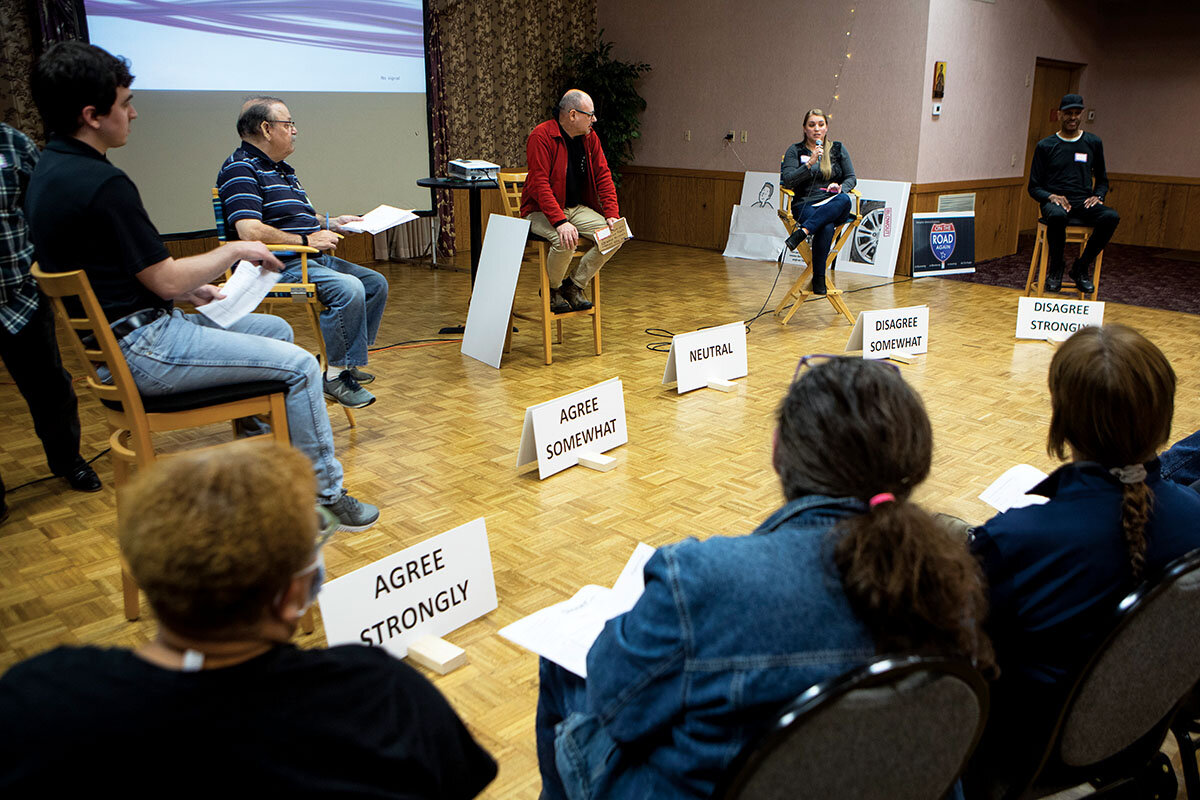
Participants in an Oct. 12 “Dinner and a Fight” event in Fairlawn, Ohio, sort themselves according to their feelings of agreement or disagreement with the statement: “The results of the U.S. voting system do reflect the will of the people.”

Christian Science Monitor has done a great job of digging out stories about Americans working to overcome our unhealthy polarization. Today’s story makes me think of my friend Nancy L and how she was part of a similar effort before Covid. How I admired her for braving some rather acrimonious interactions!

Simon Montlake reports at the Christian Science Monitor about one Ohio man’s “quest to get more voters to agree to disagree.” It starts with breaking bread together.

“About 50 people, many of them meeting for the first time, have gathered in this Greek Orthodox church hall in a suburb of Akron, Ohio. Over a buffet of chicken, pasta, and tossed salad, they politely get to know one another, five to a table, including this reporter, asking icebreaker questions provided on a sheet of paper. The atmosphere is cordial if a little hesitant. After all, they didn’t come just for the meal. 

“They cast sidelong glances to the front of the room to five spotlighted director’s chairs. Each chair sits behind a printed sign, from left to right: ‘agree strongly,’ ‘agree somewhat,’ ‘neutral,’ ‘disagree somewhat,’ and ‘disagree strongly.’ …

“As the meal ends, Arlin Smith, one of the event organizers, fades the music playing from his laptop and picks up a microphone. ‘Let’s get ready to rumble!’ he growls, emulating boxing announcer Michael Buffer. 

“Before the ‘rumble,’ Mr. Smith offers some guidance: Listen to the speaker, try to understand where he or she is coming from, use positive language, and be responsible for your own feelings. ‘We all have emotions. So when you feel those feelings kind of rattled up, try to get comfortable. Lean into the situation and take control of your own self,’ Mr. Smith tells the diners.

“Then he hands the mic to Ted Wetzel, the creator of this grassroots effort to help Americans of all political stripes disagree constructively and, perhaps, rebuild civic bonds in an era of intense polarization and social atomization. He titles this gathering ‘Dinner and a Fight,’ but ‘Fight’ is crossed out and replaced by ‘Dialogue.’

“Mr. Wetzel … looks both elated and antsy. ‘This is the eleventh Dinner and a Fight, so give yourselves a round of applause,’ he says. 

“As the clapping ends, he explains that he’s about to reveal tonight’s ‘divisive topic.’ (Previous topics have included face masks, guns, and gender identity.) Once the topic is announced, anyone can take a director’s chair: First come, first served. …

“For proponents of dialogue, reaching across that chasm is complicated by a suspicion on the right that liberals are setting the agenda. ‘Typically, [these dialogue forums] are very blue,’ says Peter Coleman, a psychologist who studies polarization at Columbia University. ‘One side is more eager to do it than the other side, and that is part of the problem.’

“But by advertising a fight and using folksy language and metaphors, Mr. Wetzel seems to have cracked the code. His speak-your-mind dialogue dinners attract conservatives and liberals, as well as independents. Older pro-Trump voters break bread with Bernie Sanders-supporting millennials. Racial and religious minorities join the conversations. Many come back for more.

“ ‘It’s hard to get people who really see the same world differently into the same room, and he succeeds at that,’ says Bill Lyons, a political scientist at the University of Akron and an informal adviser to Mr. Wetzel. …

“The long-term goal, he says, is a rediscovery of bonds that are stronger than the political tribalism that divides us. … For now, each dinner is something of a gamble: Who will show up? Will opponents find common ground? Might disputation turn into confrontation? It takes a large dollop of faith to believe that getting a roomful of strangers talking can hold back the partisan tide. Mr. Wetzel’s brother likens his work to ‘boiling the ocean.’ But Mr. Wetzel isn’t about to quit. He’s just getting started. 

“It all began, appropriately, with a meal, and a fight. It was 2017, and Mr. Wetzel and his wife were meeting two other couples for dinner. The two men were his former colleagues, back when he was a young engineer before he went into sales and management, then bought a specialist painting company in Akron.  

“He had been looking forward to seeing old friends. But the dinner talk got heated over the topic of President Trump’s ban on Muslim immigrants and the perceived threat of sharia (Islamic law) to U.S. freedoms. The testy conversation continued over dessert and into the parking lot. ‘It didn’t end well,’ says Mr. Wetzel. He knew that his rancorous reunion was being repeated all over the country, as friends and families clashed over politics. 

“But he wanted to study the underlying problem, to figure out what really ailed American society and democracy. So he took a three-month sabbatical, which turned into a year and a half. Eventually he sold his paint company so he could work full time on this project. …

“At his brick ranch-style house in a Cleveland suburb, Mr. Wetzel filled a wall with sticky notes as he kept researching polarization and talking to others who shared his concerns. He self-published a book, Is America Broken? 11 Secrets for Getting Back on Our Feet.

“But he didn’t have a formula yet for how to bring people together to disagree constructively. He tried holding a seminar at a church, but it fell flat. ‘Not one person said, let’s do it again,’ he says. 

“In 2019, Mr. Wetzel attended a national conference on civility in Alexandria, Virginia, where he learned about a dialogue method developed in 2004 at Arizona State University (ASU).

The five-chair method offered an alternative to standard debates between hyperpartisans who reinforce a binary choice.

“Instead of a simple binary, the method gives moderates a greater voice since three of the five chairs are taken by those who somewhat agree/disagree – or are undecided. The occupants of the chairs start the discussion and can question one another; then the audience joins in. 

“Serendipitously, Rob Razzante, an ASU Ph.D. graduate trained in the five-chair method, grew up nearby. … Mr. Wetzel had tried the five-chair method in Professor Lyons’s classes and found it effective at guiding a respectful dialogue. Now, he told Mr. Razzante that summer evening, he wanted to bring it to the wider community and to insert it into a communal meal. And he wanted to call it a fight. Why? Because people ‘want to get into it,’ he says.

“Mr. Razzante liked the dinner format, but wasn’t sure about the name. He wasn’t alone: Other ASU dialogue facilitators also blanched at this branding. ‘The Arizona people were constantly trying to get him to call it a dialogue,’ says Professor Lyons. 

“Mr. Wetzel resisted. It was a fight – and a dialogue. He says the name is both humorous and honest about the fact that disagreement in public can be awkward. 

“Doug Oplinger, a former editor of the Akron Beacon Journal who has worked on other civil dialogue efforts in Ohio, also tried to dissuade Mr. Wetzel from advertising a fight. ‘Oh my word, Ted. You can’t do that,’ he recalls telling him.  But his determination to use that phrase was of a piece with his approach to the challenge, says Mr. Oplinger. …

“The first Dinner and a Fight took place here in September 2021, amid a national surge in COVID-19 infections. Most of the 30 attendees had been personally invited by Mr. Wetzel or his associates. Mr. Razzante agreed to moderate. After dinner ended, the topic was announced, along with a dialogue prompt, which participants could support or oppose, or be neutral. 

“It read, ‘Wearing a mask is the American thing to do.’ The room fell silent. ‘You could cut the tension with a knife,’ recalls Mr. Wetzel. … ‘It was awesome.’ ” 

Imagine this retired small-business owner just taking it on himself to do something about our toxic polarization! Beautiful! More at the Monitor, here. No firewall.

Read Full Post »

Photo: Kimberly Yatsko via EuroNews.
Latin Grammy Awards 2022: 95-year-old Alvarez was nominated for Best New Artist. “Sometimes, I pinch myself,” she says.

File this one under Never Too Old. A sparkling new career awaits a 95-year-old. That’s because of her genuine talent, of course, but it didn’t hurt to have a grandson with a promotional streak.

Sydney Page wrote at the Washington Post, “Growing up in Cuba, Angela Alvarez wanted to be a singer. But after coming to the United States as a young woman, she found herself cleaning a bank in Colorado to make a living.

“It now almost seems impossible that her long-held dream has become a reality: Alvarez was nominated for a Latin Grammy for best new artist. She is 95. …

“Alvarez composed her first song at age 14, then already proficient on piano and guitar. She also loved to sing. When she graduated from high school, Alvarez told her father she wanted nothing more than to become a professional musician. He rejected the idea. …

“ ‘I loved him so much,’ Alvarez said. ‘I liked to be obedient.’

“She put her professional pursuits aside and moved through life, getting married at age 19 and having four children — three boys and a girl.

“Fidel Castro came to power in 1959, upending life as they knew it in their home country. Alvarez and her husband, Orlando — who was a sugar engineer — decided they would flee to the United States. Given his profession, Orlando was initially forced to stay in Cuba. Alvarez took her children — the youngest was 4 and the eldest 15 — to the airport in May 1962, but officials also forbade her from leaving the country, saying she had missing paperwork. Alvarez made the impossible decision to let her children go alone to the United States.

“ ‘It was very hard for me,’ she recalled.

“It took several months before she was granted permission to leave Cuba, and once she arrived in Miami, she wasn’t financially eligible to reclaim her children — who were living at an orphanage in Pueblo, Colo. — through the welfare program they were assigned to.

“Finally, after not seeing her children for nearly two years, she secured a job cleaning a bank in Pueblo and was able to spend time with her kids on weekends. She lived in a small basement apartment.

“Amid her family’s difficult situation, Alvarez strived to fill her children’s lives with happiness, which she did through music. She invited other Cuban children living in the orphanage to join her family, and sang songs to remind them of home. …

“Throughout the many challenges Alvarez faced, she said, she leaned on music to cope with the pain. Over the course of her life, she composed a collection of about 50 songs, reflecting both the deep sadness and joy in her life. … But her music was only enjoyed by her family and friends, as her father had instructed her.

“That changed about eight years ago, when her grandson Carlos José Alvarez decided to record her songs. Carlos, who is a composer, grew up listening to his grandmother sing at family functions. …

“Every time he would visit his grandmother as a child, ‘she would grab a guitar and she would sing,’ said Carlos, 42, who calls Alvarez ‘Nana.’

“As his grandmother was getting older, Carlos wanted to preserve her songs so her future great-grandchildren could marvel at her voice, which he described as ‘angelic and soulful.’ He brought a microphone to her house and asked her to go through her personal trove of tunes. …

“In the process, though, he unexpectedly learned a lot of information about his grandmother’s history — including her undying hope of becoming a singer. …

“ ‘I got so inspired in that moment,’ Carlos said, adding that he decided he would one day bring his grandmother to a recording studio, and produce a proper album of her work. …

“In the years that followed, Carlos was focused on growing his own career. He put his grandmother’s prospective album on the back burner until 2016, when … he arranged to fly his grandmother to Los Angeles, where he lives, to record her songs in a professional studio. …

“In the past year, Alvarez’s career has taken off more than she thought possible. … The ultimate achievement so far has been Alvarez’s Latin Grammy nomination for Best New Artist, which was announced in September.

“ ‘I thought it wasn’t true,’ she said.

“Alvarez is attending the 2022 Latin Grammy Awards on Nov. 17 in Las Vegas with her grandson, and she is scheduled to perform.”

Want to know the rest of the story? She tied for best new artist! See the report. More at the Post, here.

Read Full Post »

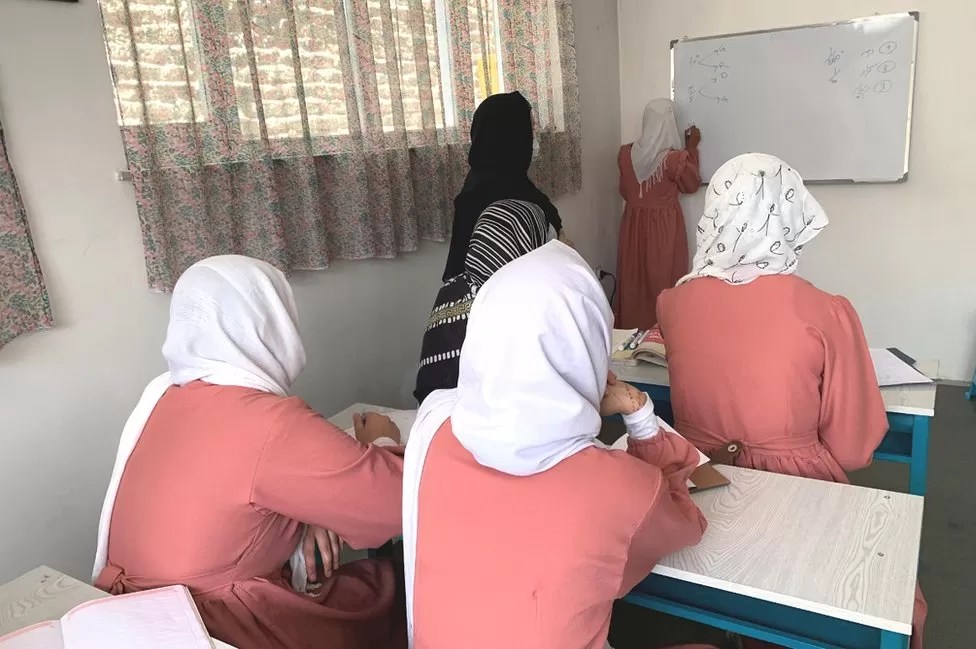
Photo: BBC.
“If you are brave no-one can stop you,” says one girl in the class.

We know we can never completely eliminate rats. Or crime. Or intolerance.

But there are good things that have the same resilience. For example, the determination of young people who have been deprived of education and who — against all odds — persist in learning. Let’s look into the secret girls schools in today’s Afghanistan.

Sudarsan Raghavan has the story at the Washington Post.

“On a quiet residential street, teenage girls with school bags swiftly entered a large green gate. They were dressed in traditional garb, their faces covered, and many were holding copies of the Quran, Islam’s holy book. It was for their own protection.

“The house is a secret school for Afghan girls who are barred by the Taliban from getting an education. If agents raid the house, the girls will pull out their Qurans and pretend they are in a madrassa, or Islamic school, which the country’s new rulers still allow girls to attend.

“ ‘The Taliban are floating around in this area,’ said Marina, 16, a 10th-grader. ‘So, I always carry a Quran in the open. My other books are hidden in my bag.’

“More than a year after seizing power in Afghanistan, the Taliban still refuses to allow girls to attend secondary school, from grades seven to 12. The ban, as well as other hard-line edicts restricting women’s lives, have triggered global outrage and widespread protests by Afghan women.

“But a more subtle form of defiance is also happening. Underground schools for girls have formed in the capital and other Afghan cities, hidden away in houses and apartments, despite the immense threat to students and teachers. For the girls and their families, it is worth the risk. …

“The Taliban has said repeatedly that secondary schools for girls will reopen when there is an appropriate ‘Islamic environment.’ But the group has provided no criteria for what constitutes such an environment.

“When the Taliban first seized power in 1996, it closed schools for all girls —then too, underground schools were formed to fill the void —banned women from working and forced them to wear head-to-toe coverings known as burqas whenever they ventured outside the home.

“The group has been less draconian this time around, and the issue of education has revealed divisions among the Taliban’s leaders and religious scholars. In some areas, local Taliban officials have allowed girls above sixth grade to attend school, bowing to pressure from community leaders.

“[In October], the Taliban’s deputy foreign minister, Sher Mohammad Abbas Stanikzai, made a rare public appeal urging that all secondary schools for girls be reopened, adding that ‘the delay is increasing the gap between [the government] and the nation.’ …

“Abdulhaq Hammad, a top Taliban official in the Ministry of Information and Culture, insisted that ’90 percent of Taliban members are against the closure of the schools.’ But convincing the remaining 10 percent is a delicate process. …

“Five months ago, a woman named Ayesha launched a collective of 45 underground schools around the capital. …

She was motivated in part by her bad marriage, she said: ‘Women should not be dependent on men. Education is the only way out of our difficulties.’

“But within a month, her funds dwindled. Many of the schools closed. Others were shut down out of fear. Only 10 are active today, and Ayesha is struggling to find donors to support them. The girls in her schools come from the poorest families; with the Afghan economy collapsing, most can’t pay tuition or even buy textbooks.

“Worse, she fears the Taliban will come for her. The group’s intelligence agency has summoned her three times, she said, forcing her into hiding. …

“The girls recited a few verses from the Quran. Then class got underway. ‘Today’s lesson is on pages 37, 38 and 39,’ Masouda said, opening a biology textbook. ‘It’s about the types of plants and vegetables. … If someone doesn’t have a book, please take notes.’ …

“ ‘Who would like to come up and explain this?’

“Angila raised her hand. She stood and recited the lesson in a clear, authoritative voice. Biology was her favorite subject, she explained after the class was over.

“ ‘I want to be a physician,’ said Angila, who wore a head-to-toe black gown and a lime-green headscarf. … She was well on her way, part of a generation of girls and women that started attending school during the American occupation. When the Taliban regained power and ordered teenage girls to stay home, Angila was devastated.

” ‘I watched the boys go to school, but I couldn’t,’ she recalled. ‘My heart was broken.’ …

“Three months ago, she stopped classes for 25 days after the Taliban arrested a teacher working in another underground school. If Taliban agents enter Masouda’s school, the girls know to open the cupboard and grab the Qurans.

“Then Masouda will ask Marina, who has memorized the Quran, to come forward.

“ ‘If they come, she will take over the class, and I will pretend to be a student,’ Masouda said.

“Marina, dressed in a traditional purple gown and a black headscarf, said that she’s attending the class ‘to gain courage.’ She wants to become a pilot for Kam Air, an Afghan carrier, because ‘there’s very little representation of women in the aviation sector.’

These girls remind me of Shagufa, who continues to tell everyone about the power of believing in yourself. She, too, was an underage bride of an abusive man. Poor families rely on the bride price.

More at the Post, here. If you don’t have a subscription to the Post, the BBC also has a story about the school, here.

Read Full Post »

Photo: Pixabay.
Not that you were worried about how rats got along when Covid closed restaurants, but the Post has a story on the reasons rats never run out of options — and what you can do about it.

Few of us are fans of cockroaches, rats, or other durable scourges of the human community, and yet perhaps we owe them grudging respect for an uncanny ability to survive no matter what.

Dana HedgpethTara McCarty and Joe Fox reported at the Washington Post on how the rats of the nation’s capital essentially laughed off Covid and its effect on easy food.

“Rats are a fixture of urban life,” they write, “but early in the pandemic, their populations in urban cores shrank as restaurants, parks and offices shut down — and their access to trash did too. But many adapted, desperate to survive. They ate off the bottom of restaurant doors in search of food … and a large number, to residents’ frustration, migrated.

“ ‘They’ve gotten into places where there were no rats, and now people are calling and saying, “I’ve lived here for 20 years and never seen a rat until now,” ‘ said Gerard Brown, who oversees rodent control at D.C. Health. …

“ ‘There’s a rat resurgence,’ said Bobby Corrigan, among the world’s best-known rodentologists. ‘They may be bouncing back with larger families in both the urban core and in the more residential neighborhoods of D.C.’

“Known formally as Rattus norvegicus, the brown rat is the species found in D.C.’s streets and many major cities. Most people agree that rats are gross and that they can cause health problems and property damage. …

“Orkin, one of the biggest pest control management companies in the country, ranked D.C. fourth in its annual ranking of the top 50 ‘rattiest cities,’ placing it behind Chicago, New York and Los Angeles.

“In D.C., reports of rat sightings are up: The city service hotline has fielded more than 13,300 complaints in the 2022 fiscal year — compared with roughly 6,200 in the 2018 fiscal year, according to the city’s health department. Despite this increase, health officials said they haven’t seen a surge in rat-related illnesses.

“More complaints mean more work for rat catchers: Before the pandemic, Scott Mullaney and his wife, Angie Mullaney — who run a business that uses Patterdale terriers to catch and kill rats — used to average about 25 rats at a job site. Now as people return to life and business as usual, their dogs catch closer to 60 per site some nights. …

“To survive as a rat, you must be clever. Think you have what it takes to scavenge for something to eat or find a safe place to sleep? We built a video game to show you how rats live — and thrive — in the city. You’ll play as Cheddar, a D.C. rat whose name was picked by readers. Try your hand (or paw) at survival by finding food, water and a spot to nest in different environments throughout this story. …

“Rats are smart. They know that they can reliably get food and water from fountains, birdbaths, pet bowls, dripping sprinklers and trash cans and that some decked-out yards offer bigger bounties — including pet poop. …

“Redevelopment creates prime real estate for rats: Home and apartment renovations leave stray pipes that can provide a path from the sewer into buildings and into the walls.

“Jake Rosen was living in Petworth when he repeatedly heard rats inside the walls of his home. He believes they worked their way in through gaps in the concrete under a porch when construction started on a nearby house, where he thinks the rats were probably nesting. It takes only one house on a block to draw rats in, and then suddenly they’re everyone’s problem. …

“Tucked away in an alley off Ward Court NW, in Dupont Circle, rats were scrounging for their meals among a cluster of trash cans and dumpsters by several apartment buildings. They fled pedestrians and their dogs, sprinting under bushes and other plants.

“Michael Beidler has lived on the block for more than three decades and sees rats scavenge in trash bags left outside, often on the ground spilling over from dumpsters. For rats, it’s the perfect setup. They get their food from the dumpsters and then burrow in his yard. Beidler spent about $3,000 on rat traps and had a contractor pour as much concrete as he could to cover up his garden to try to keep out the rats. …

“Apartment buildings offer rats a trash feast. From a dumpster, they can jump onto and scurry up the outside of a trash chute, squeezing into holes behind the brackets to get inside. They also get inside trash rooms through open doors or gnaw through the mortar between bricks in a foundation.

“A rat can fit its head through a hole about the size of a marble. Its rib cage has a ‘collapsibility function,’ and once it gets its head in, a rat uses its vibrissae — long whiskers on its nose and face — to feel to make sure it’s safe. Then it does what Corrigan calls ‘squeeze-wiggle gymnastics’ to get the rest of its body through. …

“Rats will never be eliminated — and play an important role in the ecosystem as food for foxes, coyotes, snakes, hawks and owls. Yet for the D.C. rat-control crew, the end game is to reduce their population in areas where humans live, work and play.” That’s the bottom line.

The Post, here. has a list of what to do if you have rats. And in the interest of helping you outsmart them, the newspaper also offers a game that helps you think like a rat. Check it out.

Read Full Post »

Art: Janet Boudreau/GPA Photo Archive via Flickr.
Boudreau’s 1987 sticker is the most familiar “I Voted” design.

Have you noticed that whenever you take a break from being involved in the maintenance of democracy, bad things happen? I think I’ve learned never to look away, never to leave democracy to others. Democracy is not so strong that it can take care of itself.

Because voting is the cornerstone of democracy, citizens often display the “I Voted” after going to the polls. Today’s story is about the sticker.

Rhea Nayyar writes at Hyperallergic, “The oval-shaped  ‘I Voted’ sticker with the billowing flag has been a staple within American voting culture for decades — so much so that even some absentee ballots include it in the envelope. While the sticker remains ubiquitous as the country’s most beloved participation trophy, many are unaware of its origins.

“States and counties across the nation have strayed from the historic sticker, holding contests for original designs that better reflect their local elections. While some areas of the country are phasing out the sticker reward in an effort to save money, 14-year-old Hudson Rowan swept the Ulster County, NY, ‘I Voted’”’ sticker contest with his viral spider-demon design entry, sparking a renewed interest in voter participation and voting paraphernalia all together.

“ ‘We’ve had a lot of fun this year with the sticker contest and are so proud of the positive attention it has brought to the voting process, specifically when it comes to engaging with younger voters,’ Commissioner Ashley Dittus of the Ulster County Board of Elections in New York said to Hyperallergic.

“It’s unclear where the first voting sticker debuted as they’ve been regionally available through local businesses and organizations post-World War II. The Miami Herald mentions the distribution of an ‘I Have Voted’ sticker at Miami polls as early as 1950 to remind others of their civic duty, and another article from 1982 notes small businesses offering Election Day discounts and freebies for those donning the sticker in Fort Lauderdale. On the other side of the country, the Phoenix Board of Realtors claimed that they designed and distributed the first ‘I Voted Today’ sticker for poll visitors in 1985 in an effort to get better acquainted with the community and promote voter turnout in favor of a freeway expansion query that was on the ballot that year.

“The rippling flag sticker design was developed in 1987 by Janet Boudreau, election supply vendor Independent Tabulation’s (InTab) former president, in acknowledgment of the lack of public awareness of Election Day. Boudreau had the design copyrighted, and by late 1988, the stickers were available in all 50 states.

‘I wanted them to see people with an “I Voted” sticker and think, “Oh, I should do that,” ‘ Boudreau told Time Magazine in 2016. ..

“I consulted with Claire Jerry, a political history curator at the Smithsonian Institution’s National Museum of American History (NMAH) in Washington, DC, home to a collection of voting paraphernalia from the 20th century.

“ ‘The oldest Election day paraphernalia we have is from 1920, during the women’s suffrage movement,’ Jerry told Hyperallergic. ‘We have a button with a ribbon extending down that says “I cast my first vote on November 2nd, 1920.” It’s the first time women would’ve been voting nationally in the presidential election, but it mentions specifically the Republican party for which they voted because that was the party that supported suffrage.’ …

“Jerry also pointed out a voting mobilization effort from 1972, when the 26th amendment granted 18-year-old American citizens the right to vote, appeasing the demands of activists who criticized the government for lowering the military draft age from 21 to 18 without lowering the voting age accordingly. …

“Jerry also provided an array of both humorous and serious voting bumper stickers that were circulating between the 1960s to the 1990s. … Certain states, counties, and cities have customized their ‘I Voted’ sticker designs to better reflect their voting populations. During the 2016 presidential election, Chicago administered tri-lingual ‘I Voted’ wristbands instead of stickers as if casting one’s ballot granted admission to a mosh pit. To be fair, many people were punched in the face during the 2016 election season so it’s not totally outrageous to make that comparison.

“When asked about the efficacy of ‘I Voted’ stickers, Jerry wasn’t so sure about their impact on today’s voters. ‘I don’t think it mobilizes people to go vote anymore. … I do hear parents talking about taking their children with them to vote and then sharing their sticker with their child, so I wonder if it’s a way of saying “let’s get future generations thinking about voting” with something that appeals to them.’ “

See a super collection of stickers at Hyperallergic, here. No firewall, but subscriptions are encouraged.

Read Full Post »

Photo: Pandbambooguy.
Female box turtle digging a hole with her back legs to lay eggs. Eastern box turtles are a popular species in the illegal world of wildlife poaching. 

Unsurprisingly, Erik couldn’t believe that global criminal gangs selling endangered species had ties to turtle thieves in little old Rhode Island. I know. It sounds pretty implausible — and grandmothers do tend to sensationalize news stories to entertain the kids.

But it’s all true. Just ask the state herpetologist. (Who knew Rhode Island had an official herpetologist?)

As Frank Carini reported at ecoRI News this month, “Rhode Island’s reptiles and amphibians face pressure from numerous threats, and for many species, removal of even a single adult from the wild can lead to local extinction, according to the state’s herpetologist.

“Since the local and/or regional future for many of these species — eastern spadefoot toad, northern leopard frog, northern diamondback terrapin, to name just a few — is in doubt, removing them from nature to keep as a pet or to sell is against the law. It’s illegal to sell, purchase, or own/possess native species in any context, even if acquired through a pet store or online, according to Rhode Island law.

“Turtles are especially vulnerable, according to Scott Buchanan, who became the state’s first full-time herpetologist in 2018, because some species must reproduce for their entire lives to ensure just one hatchling survives to adulthood. The Rhode Island Department of Environmental Management (DEM) staffer said it takes years, sometimes a decade or more, for turtles to reach reproductive age, if they make it at all.

“Buchanan recently told ecoRI News that ‘broadly, across taxa’ the illegal taking, or poaching, of wildlife is a ‘huge issue. … Globally, it’s considered one of the driving forces of population declines and even extinctions,’ he said.

“Wildlife trade experts and conservation biologists such as Buchanan point to poaching — driven by demand in Asia, Europe, and the Unified States — as a contributing factor in the global decline of some freshwater turtles and tortoises. …

‘Before you take a photo of a turtle in the wild, turn off the geolocation on your phone. If you post a turtle photo on social media, don’t include information about where you found it.’ 

“Of the 360 known turtle and tortoise species, 52% are threatened, according to the International Union for Conservation of Nature Red List of Threatened Species.

“A group of global turtle and tortoise experts published a 2020 paper that noted ‘more than half of the 360 living species [187] and 482 total taxa (species and subspecies combined) are threatened with extinction. This places chelonians [turtles, terrapins, and tortoises] among the groups with the highest extinction risk of any sizeable vertebrate group.’

“Turtle populations are ‘declining rapidly’ because of habitat loss, consumption by humans for food and traditional medicines, and collection for the international pet trade, according to the paper’s authors. Many could go extinct this century.

“Buchanan’s involvement in dealing with the impact of poachers is primarily around North American turtles. He noted turtle diversity is high globally and in the eastern United States — in the Southeast more than the Northeast, however.

“But state and federal law enforcement officials and wildlife biologists consider the illegal collection of turtles to be a conservation crisis occurring at an international scale, according to Buchanan, who is the co-chair of the Collaborative to Combat the Illegal Trade in Turtles (CCITT), formed in 2018 within Partners in Amphibian and Reptile Conservation. …

“In Rhode Island, Buchanan said, there are four turtle species of concern: the eastern box turtle; the spotted turtle; the wood turtle; and the northern diamondback terrapin.

Eastern box (species of greatest conservation need): This turtle spends most of its time on land rather than in the water. They favor open woodlands, but can be found in floodplains, near vernal pools, ponds, streams, marshy meadows, and pastures. They reach sexual maturity by about 10 years of age. Females nest in June and lay an average of five eggs in open areas with sandy or loamy soil. Eggs hatch in late summer.

Spotted (species of greatest conservation need): These turtles are sensitive to disturbance. They are usually found in shallow, well-vegetated wetland habitats, such as vernal pools, marshes, swamps, bogs, and fens. …

Wood (species of greatest conservation need): For part of the year they live in streams, slow rivers, shoreline habitats, and vernal pools, but in the summer they roam widely across terrestrial landscapes. …

Northern diamondback (state endangered): Their population has suffered greatly due to poaching and habitat loss. They are found in estuaries, coves, barrier beaches, tidal flats, and coastal marshes. They spend the day feeding and basking in the sun and bury themselves in the mud at night. They reach sexual maturity at about 6. Females lay a clutch consisting of 4-18 eggs. Some females will lay more than one clutch in a season and hatching usually occurs in late August. The young spend the earlier years of life under tidal wrack (seaweed) and are rarely observed. …

“Other turtle species that can be found in Rhode Island include eastern painted, common snapping turtle, and eastern musk. …

“ ‘We have a lot of turtles for a small state,’ Buchanan said. …

“In late September environmental police officers from DEM’s Division of Law Enforcement found 16 eastern musk turtle hatchlings, a species native to Rhode Island and the eastern United States, in the home of a West Warwick man suspected of illegally advertising them for sale on Craigslist and Facebook.

“The case resulted from a week-long investigation, during which the suspect offered two hatchlings to undercover environmental police officers for purchase, according to DEM. The suspect was charged with 16 counts of possession of a protected reptile or amphibian without a permit. The turtles were taken to the Roger Williams Park Zoo, which has a room and equipment dedicated to the care of turtles seized from the illegal turtle trade. The turtles will be released back into the wild after clearing health screenings and disease testing, according to DEM. …

“To help protect Rhode Island’s native species, you can submit observations of amphibians and reptiles to DEM scientists online.”

More at ecoRI News, here. No firewall.

Read Full Post »

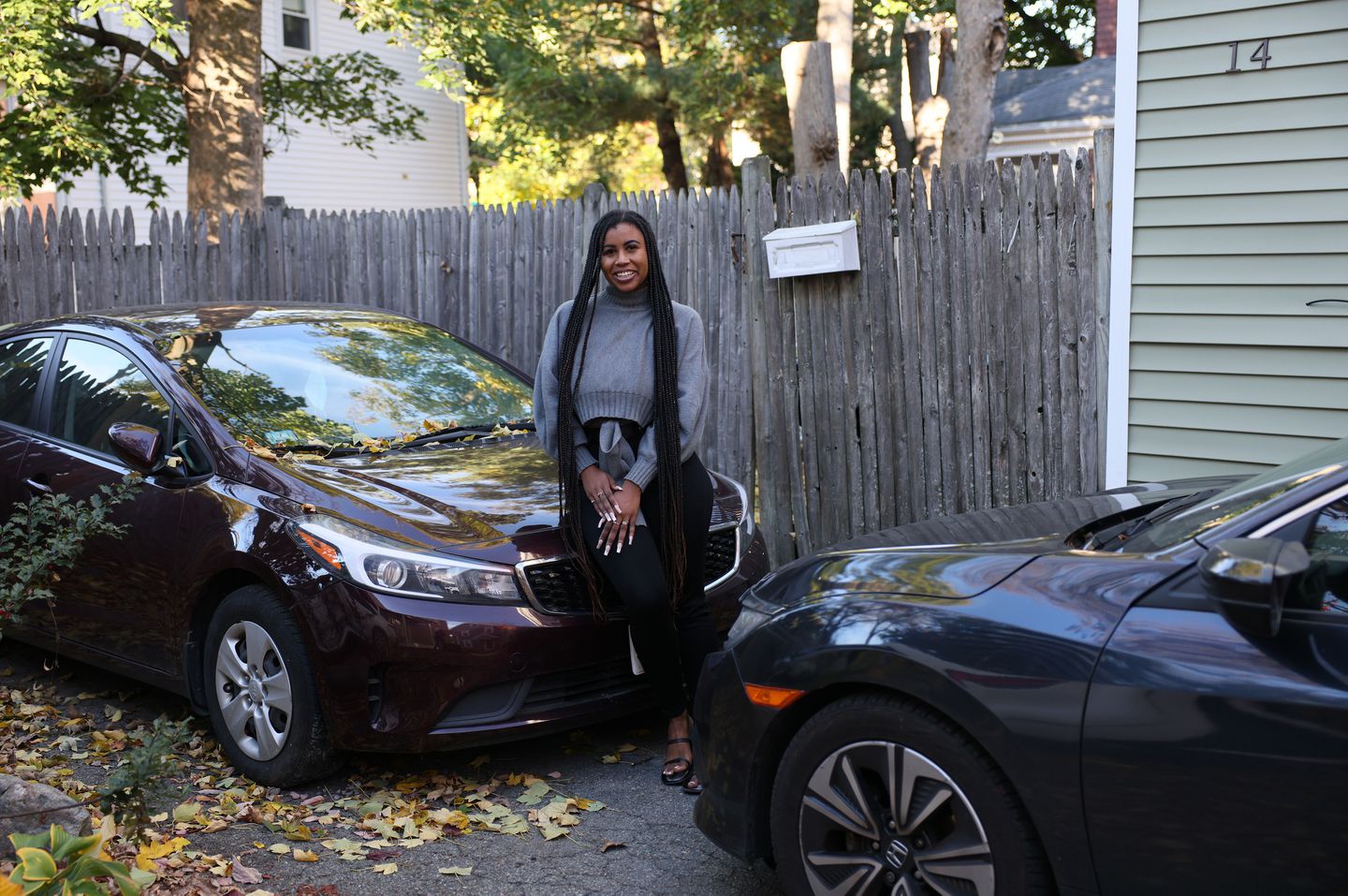
Photo: Jessica Rinaldi/Globe.
Janelle Emmanuel, a Watertown resident, opted to rent out her driveway on Spacer, a parking app that’s gaining users around Boston.

When my friend Sara was a professor at Harvard and Stanford tried to lure her to the West Coast, the most irresistible thing that Harvard offered her was a parking space in Cambridge. There was a spot next to her office building that used to change hands every year among the faculty. It could be hers permanently. Sara stayed.

Although I myself always took public transportation when I worked in Boston and Cambridge, I learned that on a day when I needed a car, parking could be a real problem. There are public garages, of course, but the cost is a king’s ransom. No one who commuted to work in a city would want to pay that every day.

A new app makes it easier for someone with an unused parking space to help out someone who needs a space — and make some money at the same time. Today, using a driveway as an income generator is not just for people who live near the beach.

Collin Robisheaux writes at the Boston Globe, “Everything is pricey these days, and a little extra income can go a long way.

“Enter Spacer, an app that strives to be the ‘Airbnb of monthly parking‘ by connecting commuters in need of an empty space with locals who have an unused parking spot or driveway.

“It works like this: Someone with an empty driveway can download Spacer, input some personal information and details about the spot, and list it on the app or website for renters to reserve in month-long periods. Renters can then snag the parking spot for their personal use. …

Spacer Technologies was founded in Australia in 2015, before expanding to North America and acquiring Where I Park Inc. earlier this year. With more commuters returning to the office, parking has become a more pressing need — and Spacer has been a beneficiary, with Boston receiving more booking requests in October than any other city on the app. …

“With snow causing headaches for drivers with outdoor parking, some users may be thinking ahead, with booking requests for covered spots in the Boston area up 77 percent since July.

“Spacer said it has about 300,000 users globally, and hundreds of rentable spots in and around Boston. It makes money by taking 25 percent of transactions; the remaining 75 percent goes to the users who rent out their spaces.

“Daniel Vernick, 25, in Somerville [said,] ‘It was quite straightforward. It definitely took away some of the rent burden.’ …

“Vernick was able to net $220 per month. That kind of extra cash is what sets Spacer apart from other parking apps, according to Jeremy Zuker, chief executive of North America for Spacer Technologies.

“ ‘You can actually take something that you’re not using, like your driveway or your garage, and you can just turn that into a revenue stream,’ Zuker said. …

“Spacer is relatively new to the rental scene and has plenty of competition. Websites like Facebook and Craigslist have long served as platforms for advertising and renting out parking spaces.

“But Janelle Emmanuel, who joined both Spacer and Craigslist to rent out her driveway last year, says she feels more secure on Spacer than she did digging through Craigslist.

“ ‘I feel like with Craigslist, you don’t really always know what’s going on there,’ Emmanuel said. ‘But Spacer, I felt very safe.’

“Emmanuel rented out her driveway in Watertown, capable of fitting up to three cars, after a friend recommended the rental service as a side gig. Emmanuel said the app adds an element of separation between the renter and the host, which made her feel more secure.

“Residential neighborhoods like Allston, Brookline, Somerville, and parts of Cambridge are all popular locations on the app. Spots in the downtown and Seaport areas are fewer and pricier, but executives at Spacer hope the app can help with parking congestion in the city.

“ ‘This whole idea of efficiency is about both the infrastructure and the spaces,’ Zuker said. ‘But also just in getting people where they need to get without wasting time and fuel.’ “

All my friends in rural America must be laughing now. But you know, it’s a good thing that humans can figure out how to do what they have to do. I will say that better even than a rented parking space is an employer that subsidizes your use of public transportation. I sure missed that perk after I left MIT.

More at the Globe, here.

Read Full Post »

« Newer Posts - Older Posts »