Feeds:
Posts
Comments

Archive for the ‘Uncategorized’ Category

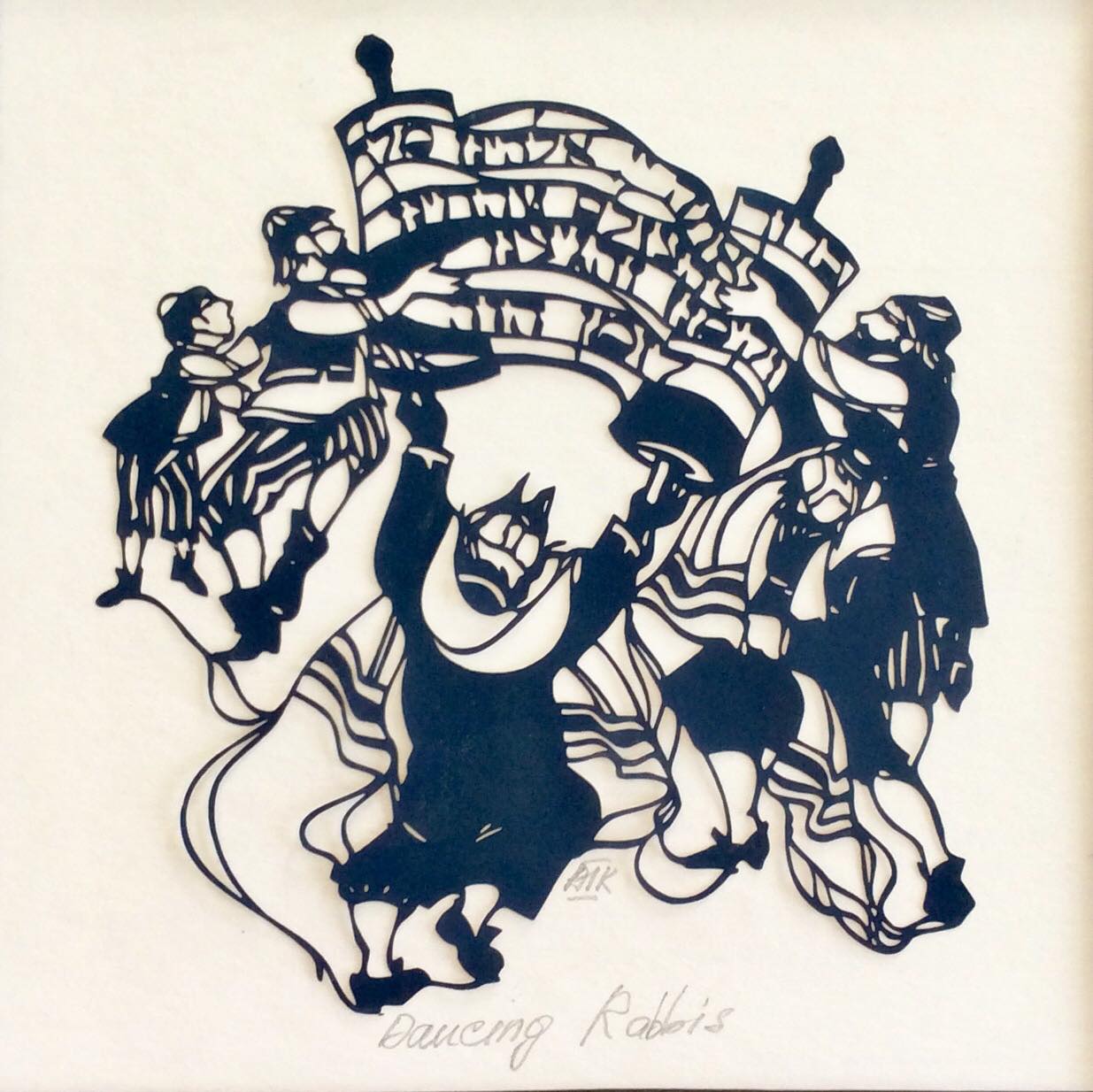
Art: Anna Kronick.
Anna Kronick is one of very few Judaic paper cutters practicing today.

Every time you think an artistic tradition is dying out, some free spirit reinvents it for a new age. Consider the art of sacred paper cutting and its long history in Jewish communities.

Isabella Segalovich reports at Hyperallergic, “Few today know that the walls of many Jewish homes used to be covered with intricate papercuts. Bursting with detailed ornamentation and religious symbolism, these artworks decorated Jewish homes in Eastern Europe, North Africa, and Western Asia for centuries. While some homes today may have a paper-cut marriage certificate or ketubah, the tradition has mostly evaporated. Much of the fragile paper archive was lost to the fires of the Holocaust, or has disintegrated over timeAnna Kronick is one of very few Judaic paper cutters practicing today, with a highly contemporary body of work that breathes new life into the sacred tradition. 

“After graduating from the New York Academy of Art as a sculptor in the ’90s, Kronick was working as a conservator when she came across a richly illustrated book, Traditional Jewish Papercuts by Joseph and Yehudit Shadur. ‘When you come across paper cutting, it’s usually Chinese or Polish. So when I came across Shadur’s book, I was amazed to find that Jews had been doing it too,’ she told Hyperallergic. …

“Some 25 years of practice later, Kronick has earned a place as a master artisan who not only continues this little-known craft but brings a fresh approach that allows the tradition to live on and evolve. 

“Traditional Judaic papercuts are made by slicing through a folded piece of paper, which is then unfolded to reveal a perfectly symmetrical design. While Kronick fell in love with their intricacy, she found this strict symmetry too confining. Instead, her pieces are defined by movement: Her compositions curve as if being blown by the wind. Stunningly, she rarely sketches out her designs. Kronick often draws with the knife itself, allowing her visions to guide her as she cuts through thin silkscreen paper.

‘In the beginning, I drew more,’ she said. ‘But the more I cut the less I drew.’ 

“Some of her papercuts bring life to old Yiddish songs. A navy blue paper rendition of ‘Belz, mayn shtetele Belz’ (Belz, my shtetl belz) lovingly depicts a group of Klezmer musicians — appropriate for a song about longing to return to a life of Jewish community. But while her Yiddish illustrations often contain English lettering, she prefers the graceful lines of Hebrew. ‘I don’t really do a lot of English text, because it stops the eye. It prevents movement,’ she says. ‘But Hebrew just flows.’ 

“Hebrew lettering is woven into her visions of passages from the Bible, like the story of Joseph. … This piece is dense with lush palm trees, bending piles of grain, and billowing patterned textiles. Look closely and you can find tiny cattle, brick walls, and a vast array of plant life swirling together in a dazzling vortex of religious symbolism. 

“The earliest recording of Jewish paper cutting comes from a whimsical 1345 treatise titled The War of the Pen Against the Scissors. The Spanish Rabbi Shem-Tov ben Yitzhak Ardutie describes how he resorted to cutting letters out of his parchment when his ink froze on a cold winter night. Since paper is so delicate, there is little physical evidence to trace the history of papercuts,. … Expert Joseph Shadur has written that the ‘more we learn about Jewish papercuts in one form or another, the more reason we have to believe that they were once exceedingly common.’ 

“While ritual art like spice boxes and Torah crowns were made out of expensive materials, paper was cheap and plentiful in many Jewish homes. Anyone could take up a small blade and develop their own masterpieces at home for very little money, thus fulfilling the Jewish principle of creating beautiful spiritual art known as hiddur mitzvah.

“Papercuts were hung from walls and windows as decorations for holidays like Sukkot and Shavuot, as calendars, and even as protective amulets to ward off the evil eye. We often imagine life in the shtetl as cold, gray, and dull. Rather, it was bursting with color and life. ‘Of all Jewish ritual and folk art, papercuts … lent themselves to the freest expression of religious spirit,’ Shadur wrote. 

“ ‘I think in pictures. When I listen to a Yiddish song, I just see it,’ said Kronick. ‘Maybe that’s why I don’t need drawing — I just cut it.’ But it’s nothing compared with how she sees passages from the Torah: ‘For me, the [Yiddish songs] don’t flow as much, even though it’s music.’ When she reads the texts, ‘it just moves differently. I can see the letters interwoven with the pattern.’ In work that keeps a beautiful craft from being forgotten, the results are deeply spiritual pieces, where we can witness Jewish joy and ancestral memories with our own eyes.”

Lots papercuts at Hyperallergic, here. No firewall, but subscriptions encouraged.
Read Full Post »

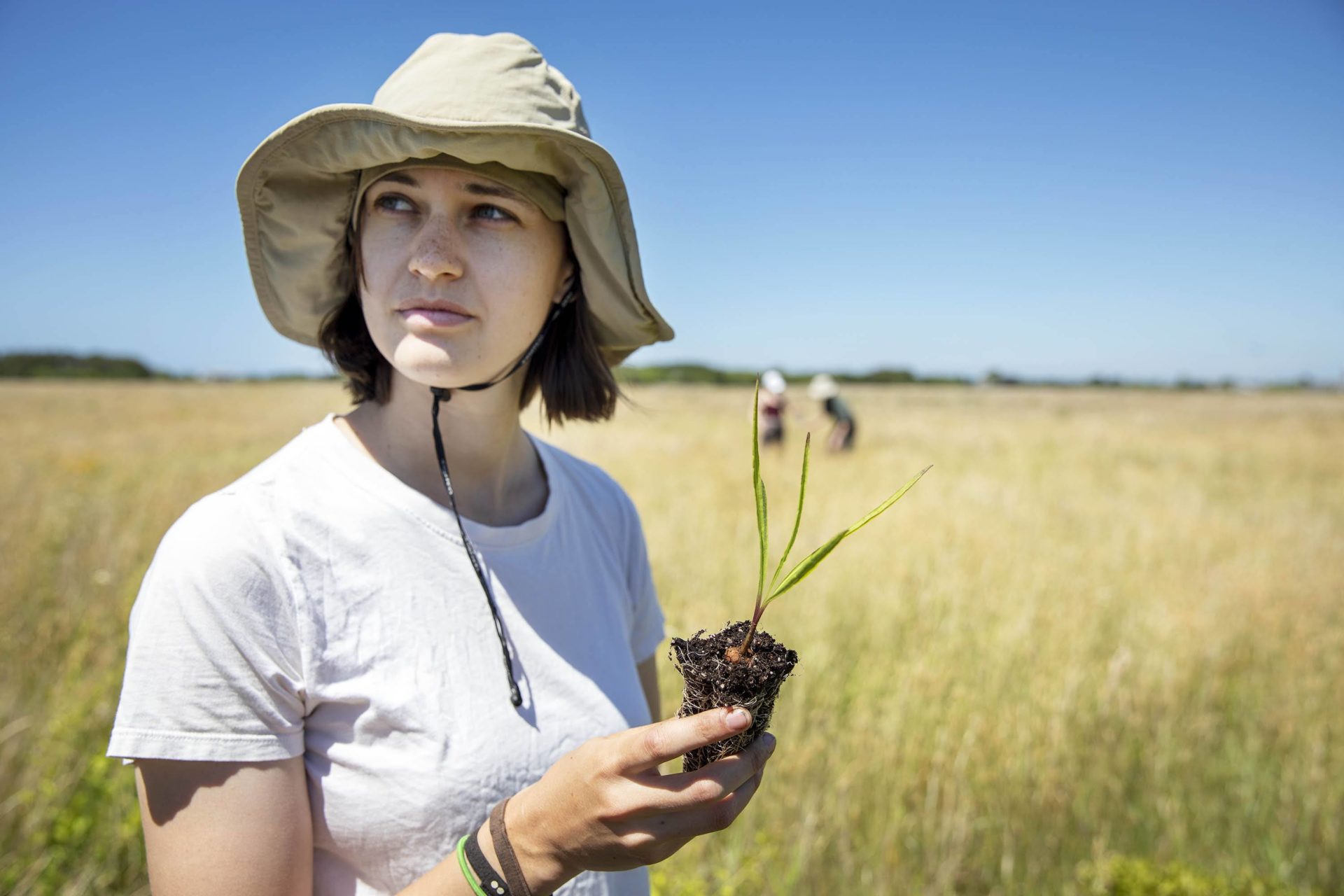
Photo: Robin Lubbock/WBUR.
Linnea Laux holds a blazing star seedling ready to plant in the sandplain grasslands near Edgartown, on Martha’s Vineyard. (“Linnea”! Perfect name for this calling. See Linnaeus.)

The popular Massachusetts island Martha’s Vineyard has been losing its biodiversity. That’s why, as Barbara Moran reports at WBUR radio, a concerned group is planting flowers. And not just any flowers.

“Tim Boland stood next to his black pickup on a dirt road in Edgartown, and waited for a moment. Then, he started handing out wildflowers. … Boland handed out black plastic trays, each holding fifty seedlings of New England blazing star.

” ‘It’s specialized to New England,’ said Boland, executive director of the Polly Hill Arboretum in West Tisbury. He held up a grassy-looking seedling, which did not look like a blazing star — at least not yet. ‘It’ll form these button-like flowers that are a deep indigo blue, that are just gorgeous. It’s a spectacular plant to see in bloom.’

“The New England blazing star is more than just a pretty blossom: it’s an integral part of a globally-rare ecosystem called a ‘sandplain grassland.’ Just like the name suggests, sandplain grasslands have sandy soil with tall grass, no trees and an exceptionally high number of rare plant and animal species. …

“As climate change threatens both human health and the natural world, experts say that protecting biodiversity hotspots like this one will offer the most bang-for-the-buck — protecting threatened species while offering other ecosystem benefits, like open space and flood protection.

“But restoration work is expensive: The Nature Conservancy in Massachusetts has been restoring Bamford Preserve from farm field to sandplain grassland for 15 years, at a cost of $15-$20,000 per year. …

” ‘In conservation, there are limited resources and you want them to have the greatest impact on biodiversity and on the function of ecological systems,’ said
Michael Piantedosi, director of conservation with the Native Plant Trust. Piantedosi is not involved with the Bamford Preserve restoration, but says sandplain grasslands are an ecosystem worth saving.

” ‘The reason for investing in that habitat now is so that it has the right makeup and conditions to be able to adapt to climate change going forward,’ he said. ‘All this ecology is connected and you don’t necessarily know what piece will tip the balance in what direction.’

“Sandplain grasslands are found only along the Atlantic Coast from New York to Maine, and most patches are in Massachusetts. Seven rare species of birds use this habitat, including grasshopper sparrows and short-eared owls, as well as beetles, butterflies and wildflowers, like the New England blazing star, found almost nowhere else.

” ‘These little systems right here hold a high concentration of rare and uncommon species in the region,’ said Mike Whittemore, stewardship manager for The Nature Conservancy in Massachusetts. ‘It’s not only the plants, but it’s the wildlife, the pollinators, the things that you don’t always see.’ …

“Tim Boland had to get a special permit to grow New England blazing star because it’s a ‘species of special concern’ in Massachusetts. He collected seed from native wildflowers on the island and carefully cultivated them for two years.

“And even after the intensive restoration wraps up in a couple years, Mike Whittemore says the grassland will require maintenance — like controlled burns and occasional mowing — indefinitely.

” ‘There was such a harsh land use history for so many years — it was planting of non-native plants and it was haying and it was plowing,’ he said. ‘When you come through here and plow, it does something in the soil. You need to stay on it to keep it open.’

“One of the volunteers, Janet Woodcock from Vineyard Haven, said it’s worth the hard work to preserve or restore the island’s remaining wild spaces, especially in the face of climate change.

‘I mean, the climate has been changing since the Earth started, whenever that was. But it’s happening so quickly that living things don’t have time to adjust to the changes. And so we’re losing species because of that,’ Woodcock said. ‘Anything has a hard time adapting if it happens too quickly.

“Mike Boland, from Polly Hill Arboretum, says stocking the grassland with native plants like the New England blazing star will give all plants and animals living here the best chance of surviving.

” ‘These plants — more than most — have a 14,000 year evolutionary advantage of growing in these ecosystems,’ he said. ‘So there will be plants that persist even with these rough conditions coming on.’

“Boland says preserving diverse ecosystems like this is one of our best defenses in the face of a changing climate. For him, he says, it’s an act of hope.” More at WBUR, here.

Interesting to me: the endangered Blazing Star seen on New Shoreham island in Rhode Island is pink, not deep indigo.

Read Full Post »

Supporters Save Bookshop

Book lovers saved an indy shop in Detroit.

When a community really loves a threatened business, people will pull together to help it survive. Where I live, we had a flash mob event that kept one business going several more years. But it’s up to the owners after that.

Sydney Page reports at the Washington Post, “A small bookstore opened in Detroit just over a year ago, and as a locally owned business, 27th Letter Books had to keep a close eye on its finances. The owners were pleased when they started getting large online orders for textbooks from a new customer.

“ ‘The name they provided matched with a professor,’ said Erin Pineda, 31, who co-owns the bookstore with her husband, Drew, and another couple, Jazmine Cooper and Jake Spease. ‘As a new business, we were trying to build a relationship with someone we thought was a customer.’

“The individual placed several different orders, amounting to $35,000 worth of medical and engineering textbooks, each costing between $100 and $200. Then, in late May, staff received a notification from the store’s merchant service provider, flagging a credit card the person used as fraudulent.

“The bookstore co-owners went through the individual’s purchases — all of which were shipped to the same address outside Michigan — and quickly realized that the person had placed every past order using a stolen credit card, as well.

“ ‘That’s when we started to consider closing,’ said Cooper, 28.

“They contacted law enforcement, their insurance provider and different banks, hoping for a reprieve from the serious financial toll they knew the scam would take on their small company. The cost, they were told, would probably fall entirely on them — which would put them out of business.

“ ‘We heard we were unlikely to get any funds back,’ Erin Pineda said, adding that she and the co-owners spent several weeks trying to remedy the situation, but only hit dead ends. …

“The textbooks were shipped outside the state, which further complicated the matter from a legal standpoint.

When merchants are victims of credit card fraud, liability usually falls on the merchant or the credit card company, depending on the circumstance. Often, the merchant is accountable for covering fraudulent online transactions.

“As a relatively new and fragile business, 27th Letter Books was left with only two options: shut down or seek support.

“ ‘We realized we needed to ask for help,’ Erin Pineda said.

The store co-owners started a GoFundMe campaign, and within 10 days, they surpassed their goal of $35,000. They were stunned by the generosity

“ ‘We’re just blown away by how the community responded and lifted us up in a really difficult situation,’ Erin Pineda said. ‘It was incredible.’

“ ‘The response was not only overwhelming because of the amount, but also because it was so quick,’ Cooper said. ‘I felt that the community really wanted us as part of their community. It was just affirming to me that what we’re doing is worth it.’

“The bookstore emphasizes inclusivity and offers a diverse selection of literature. It also hosts events that aim to bring the community together. … The store runs story-time sessions for children on Saturdays, as well as book club meetings and open mic nights. Additionally, local authors and artists showcase their work.

“Nicole Miazgowicz is one such artist. She had a solo show at the bookstore in April.

“ ‘They just bring so much to the community, and I’ve been really impressed by their kindness and openness,’ said Miazgowicz, 38. ‘It’s kind of like a little family that I’ve found in the community here.’ …

“Miazgowicz held an auction of some of her artwork and donated the proceeds — which totaled $425 — to 27th Letter Books….

“Hank Moon, a Detroit resident, is also a fan of the bookstore. When he found out that it could be closing, he contributed to the campaign and spread the word on social media, encouraging others to do the same. …

“ ‘Yes, they are a bookstore, but they’re a lot more than that,’ he said. ‘It is an incredible community space, and they work really hard to bring in books for a diverse audience of people.’

“More than 400 people contributed to the cause, most of whom live locally, the store owners said. Along with the much-needed funds, messages of support poured in, too.

“Our community needs more businesses like yours. Thank you for all that you do,” commented someone who contributed $200.

The store owners said they are touched by their community’s support and more motivated than ever to keep their doors open.

“ ‘It’s wonderful that people are willing to pay it forward because of what they’ve seen us provide to the community,’ Erin Pineda said. ‘It creates a beautiful reciprocity of gratitude between the people there in our neighborhood and us as a business, and a team of four people who care deeply about southwest Detroit.’

“With the help of their community, 27th Letter Books was able to recoup its losses and remain open. The owners are implementing new procedures to prevent future fraudulent activity.

“Beyond further securing their business and staving off scammers, the owners said they learned another valuable lesson.

“ ‘I would tell other small businesses not to be afraid to reach out to their community,’ Cooper said. ‘They will fight for what they want.’ “

More at the Post, here.

Read Full Post »

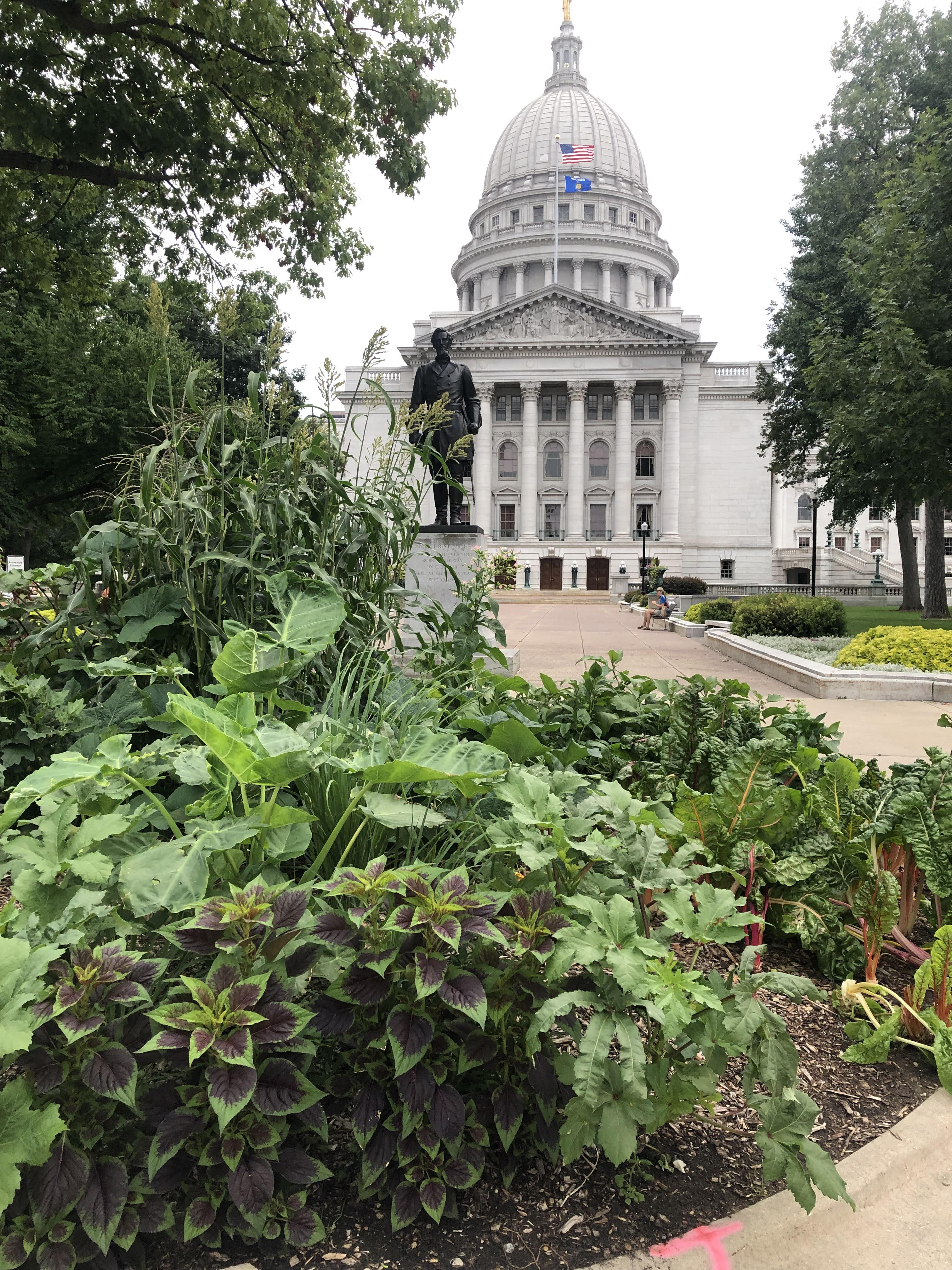
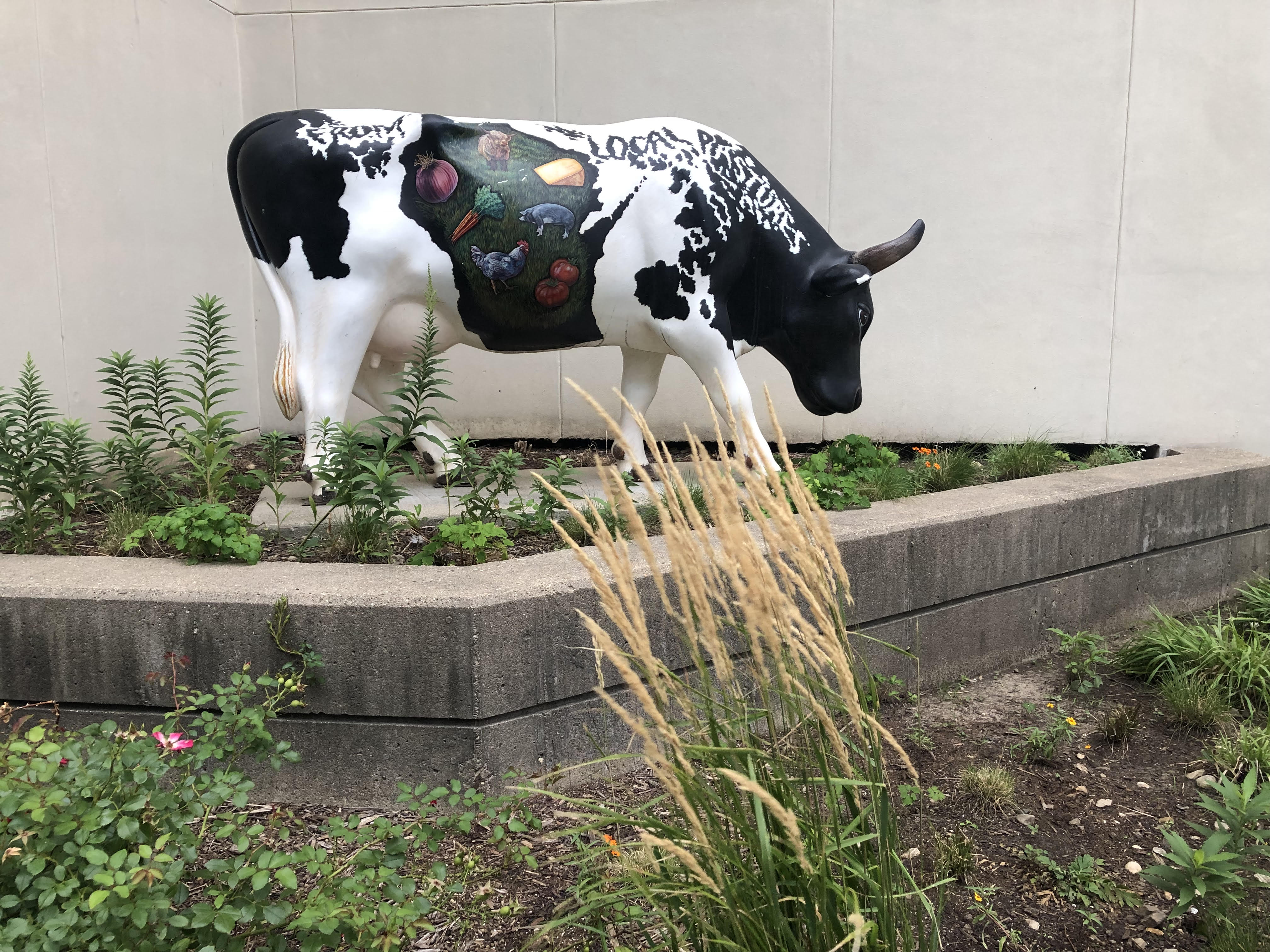
If you’re landscaping the capital in an agricultural state, focus on veggies.

First of all, I need to apologize to blogger Rebecca for not telling her I was in town. I didn’t tell anybody. My family kept scheduling impromptu activities around my nephew’s wedding. I’ll just say I thought Madison was a delightful city and share some memories.

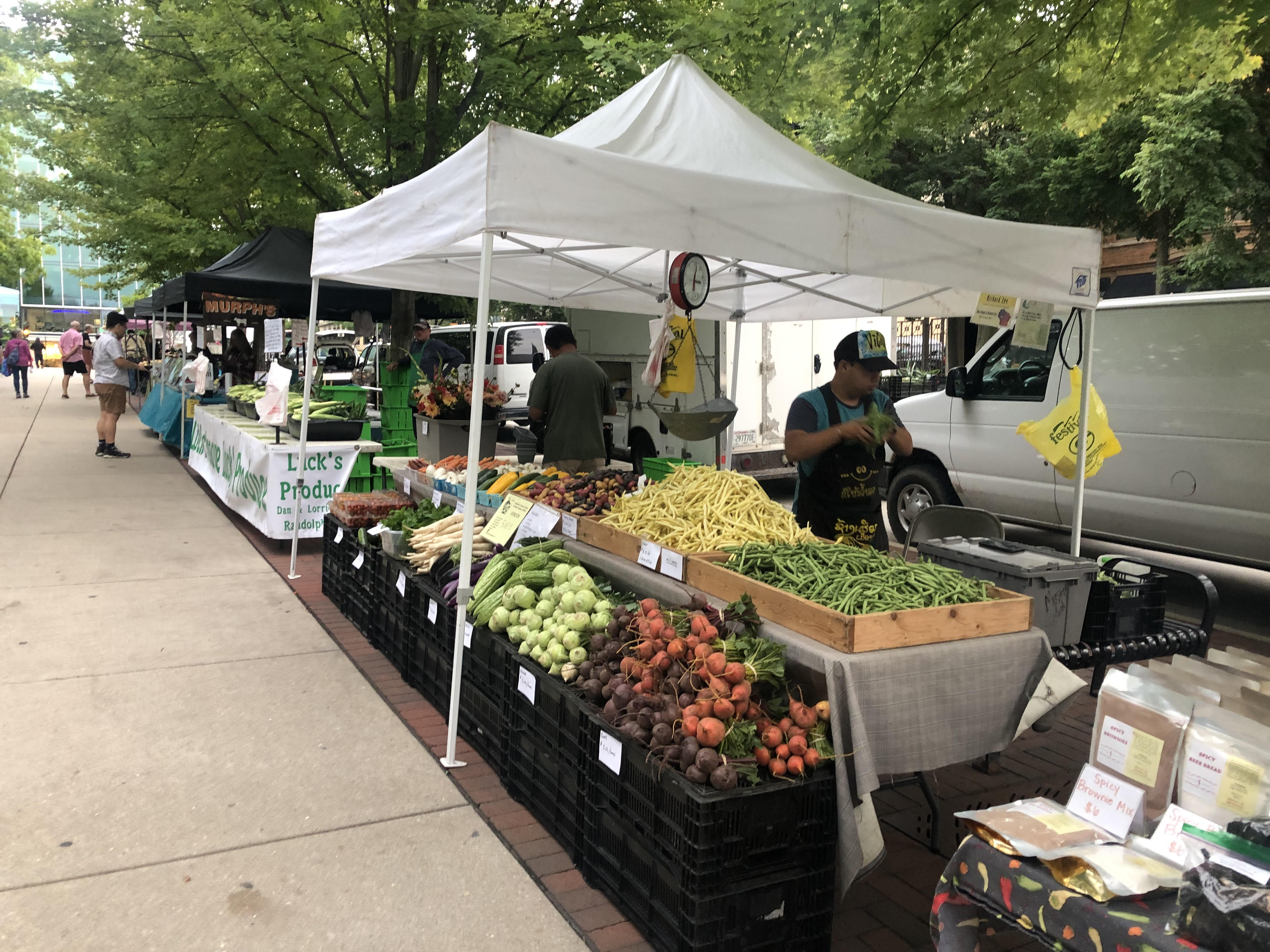
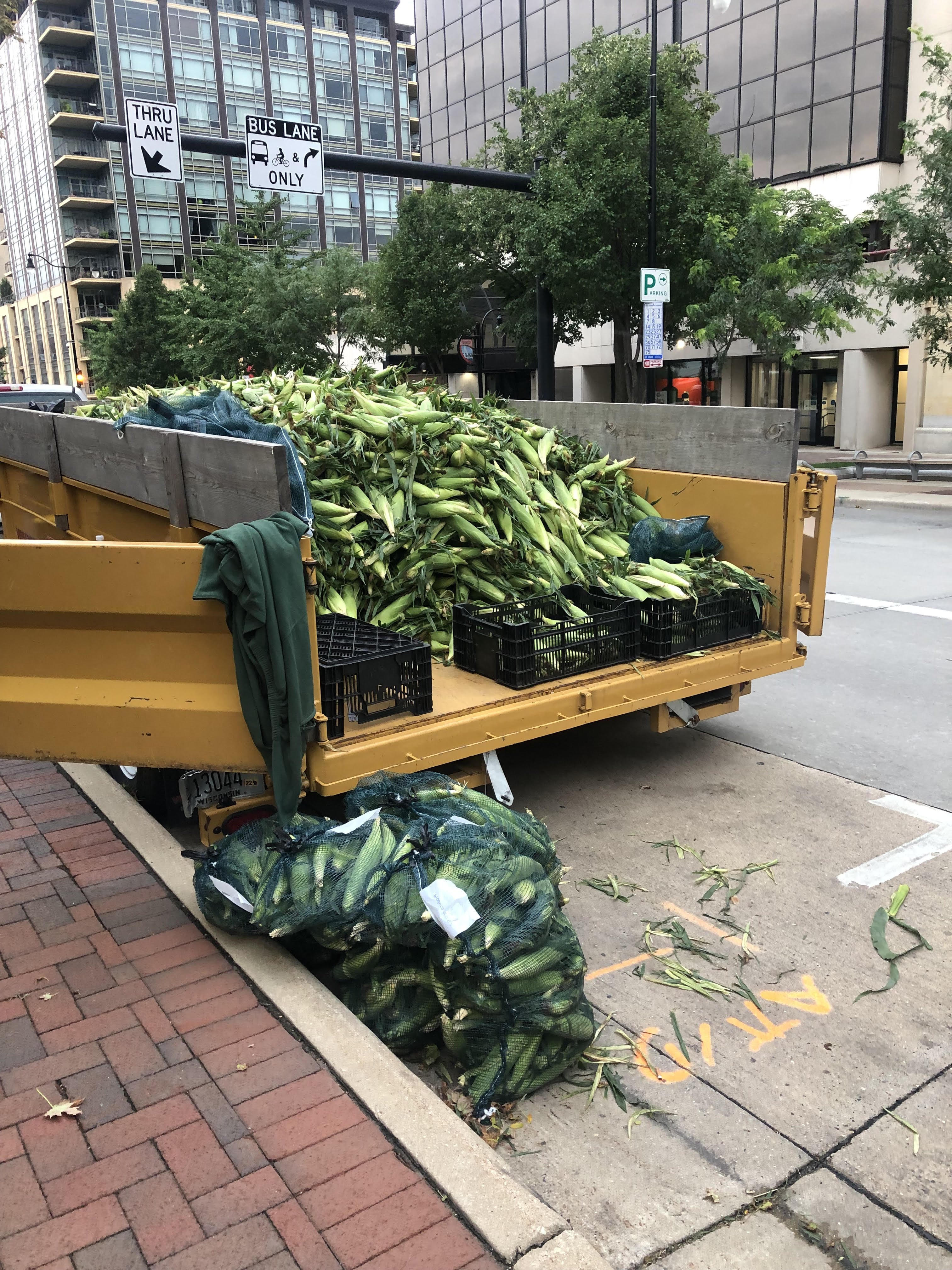
The Sunday farmers market at the capital was amazing. I walked the circuit twice.

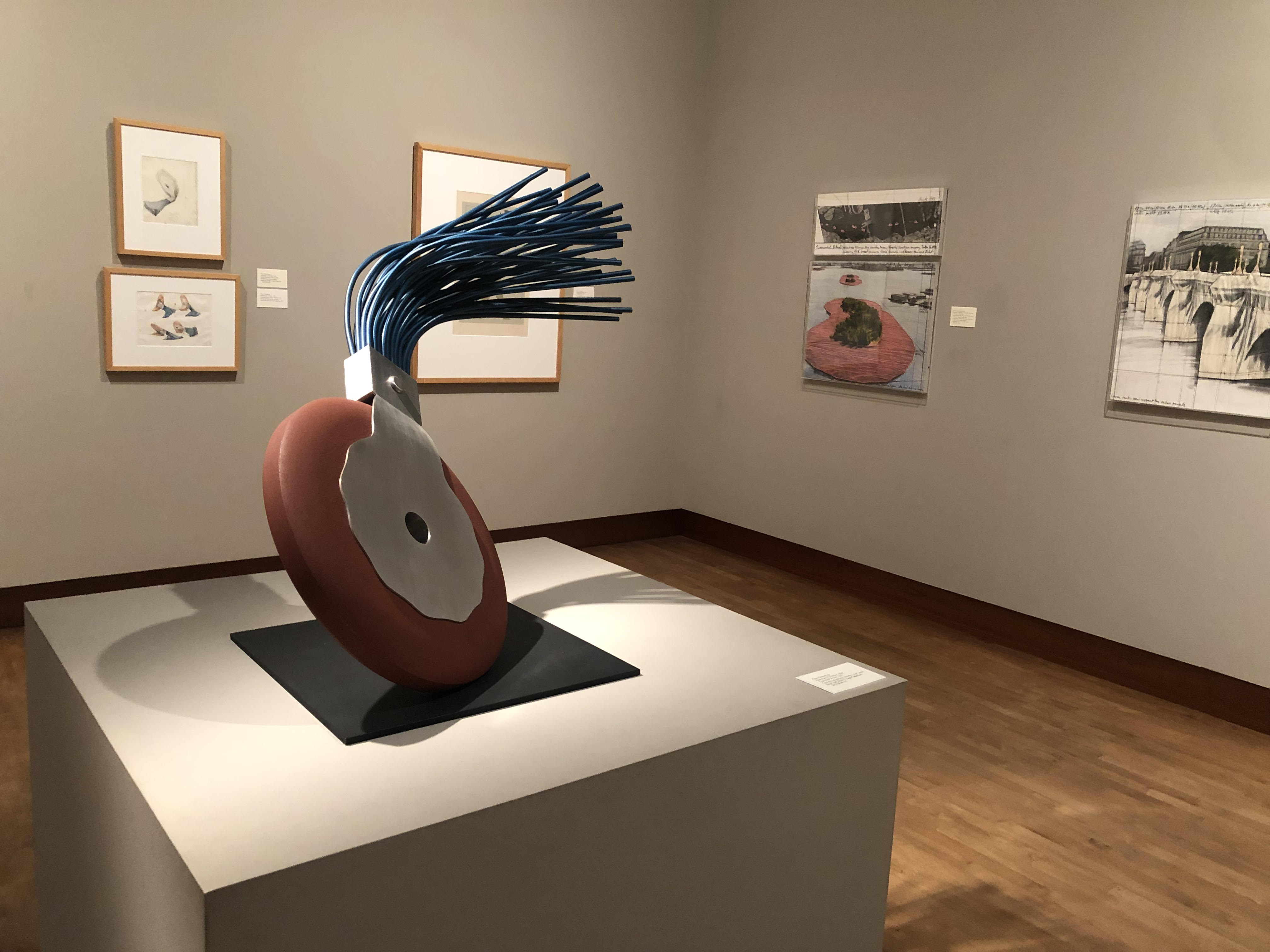
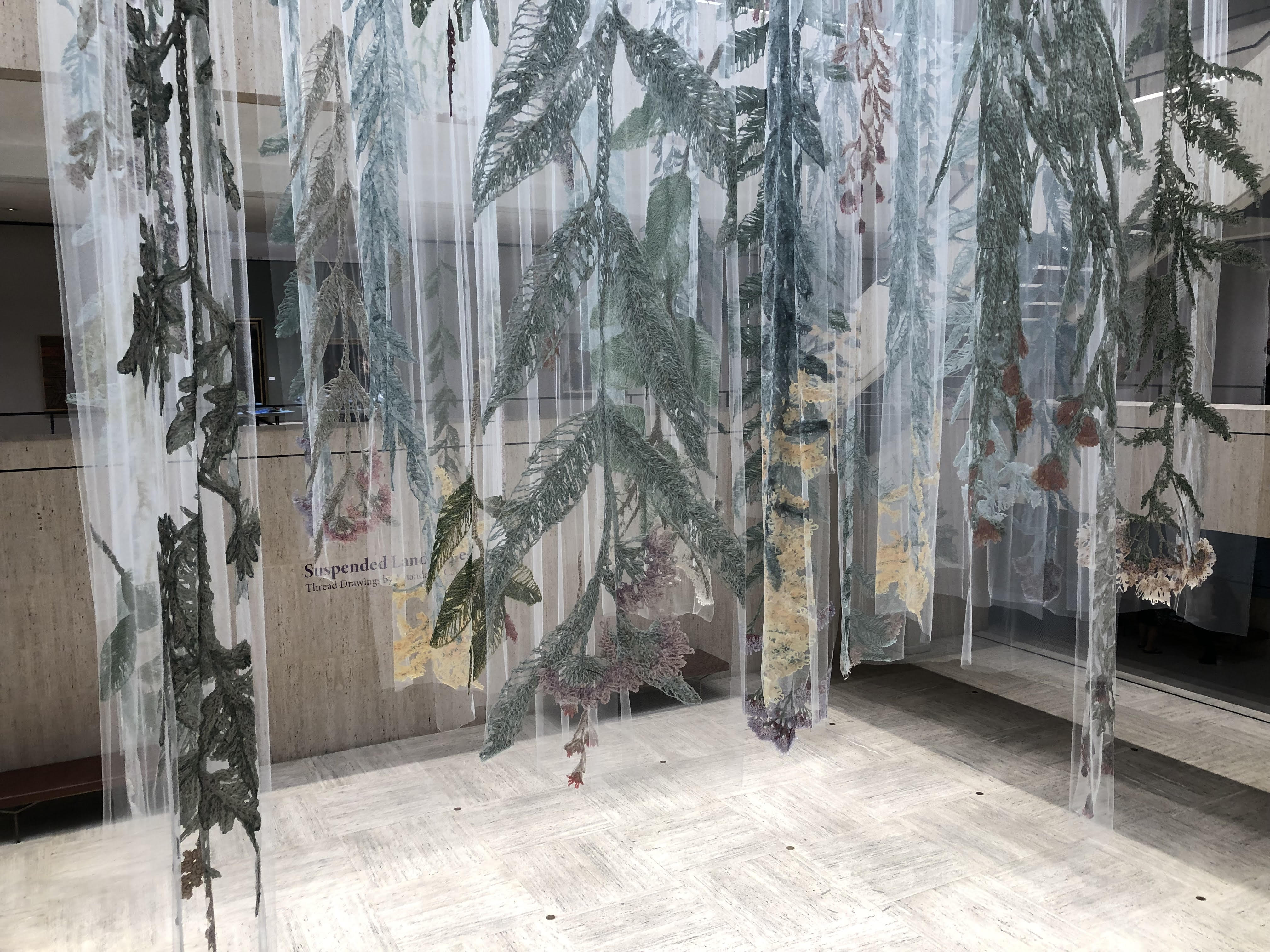
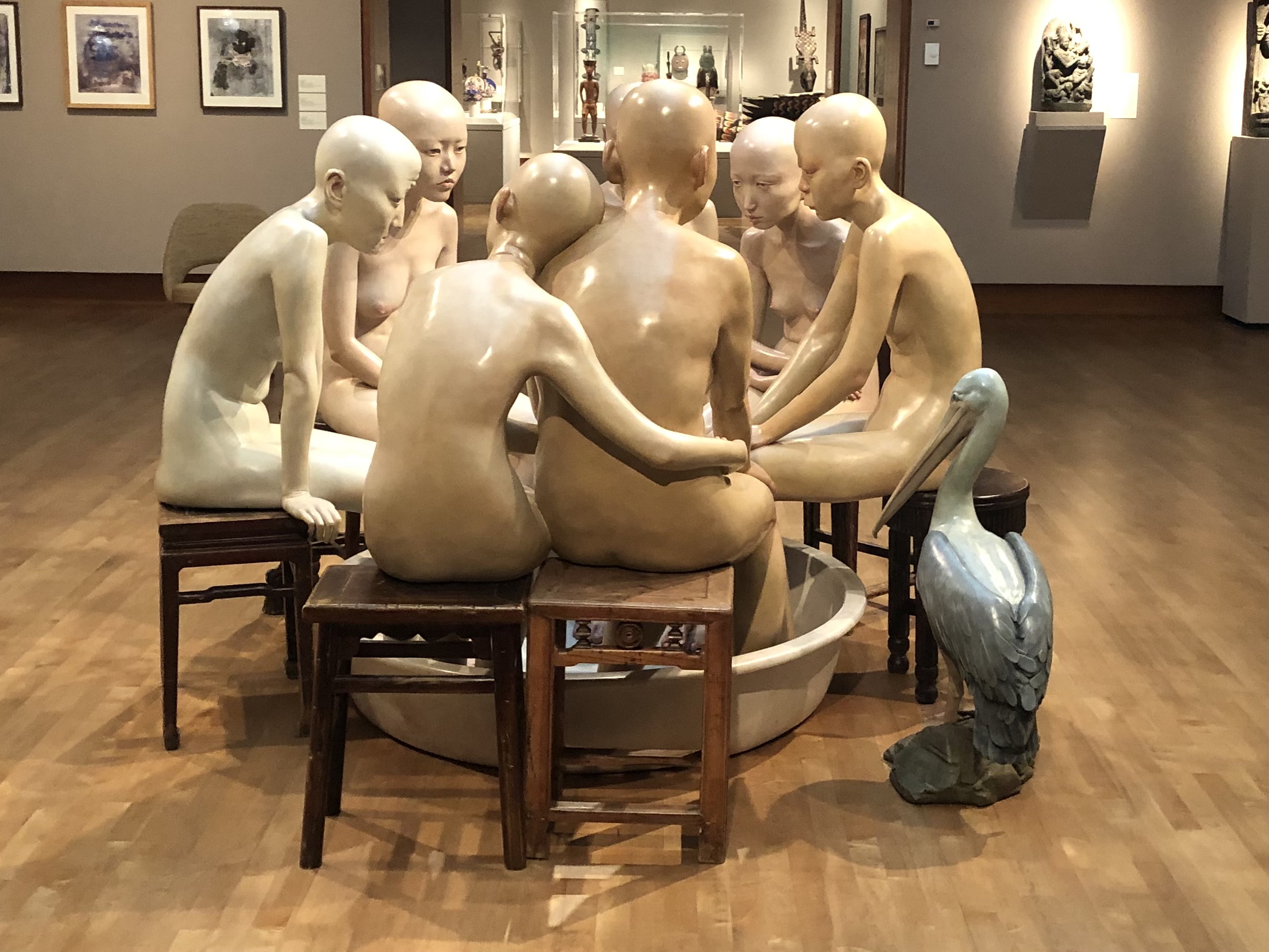
The university’s “dementia-friendly” Chazen Museum was also pretty amazing. I am sharing “L’Amante,” by Beth Cavener, “Typewriter Eraser,” by Claes Oldenburg, “Thread Landscapes,” by Amanda McCavour, and “Are a Hundred Playing You? Or Only One?” by Xiang Jing. (I agree. That title gives no clue to the meaning of the mesmerizing porcelain sculpture.)

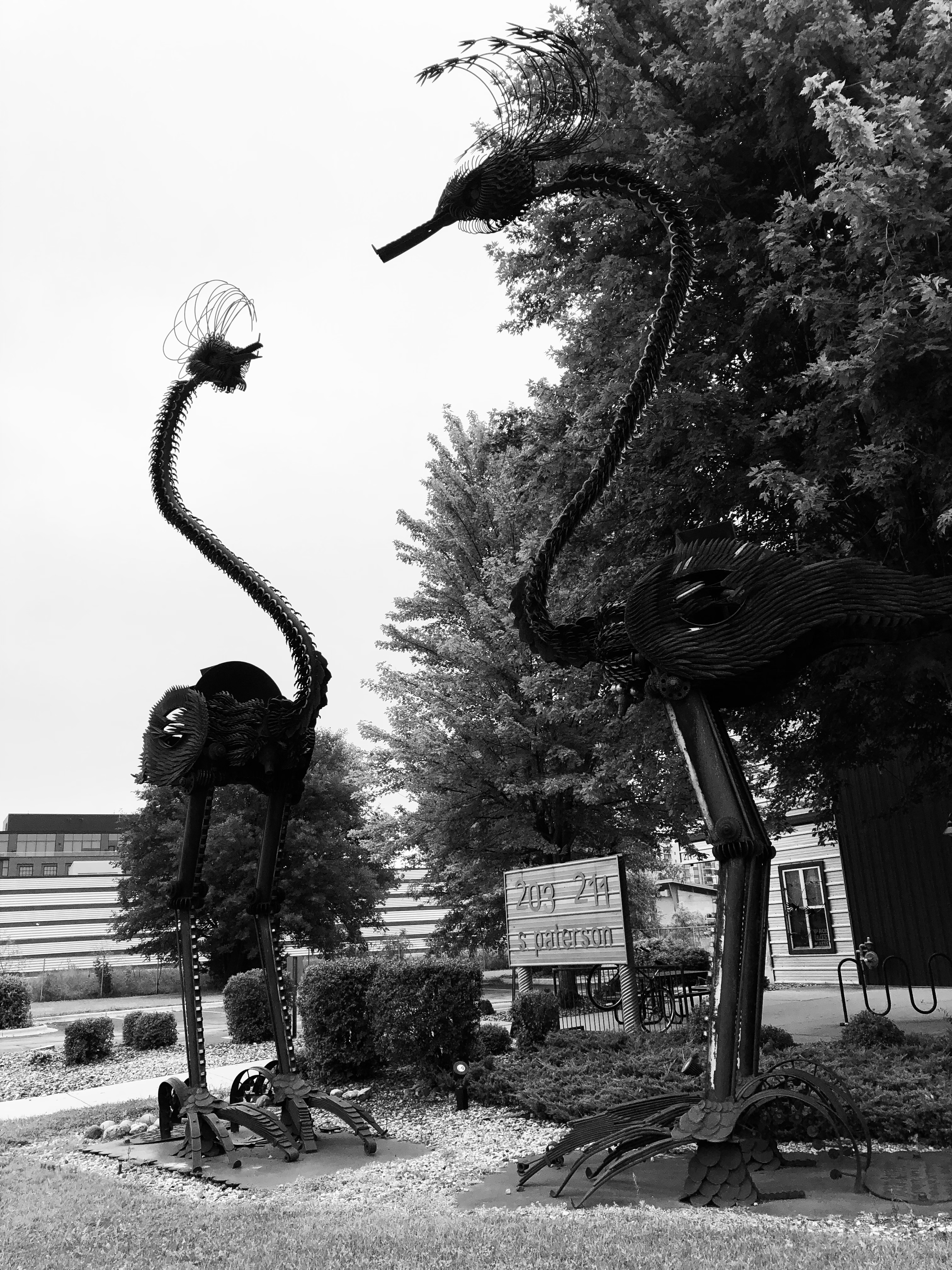
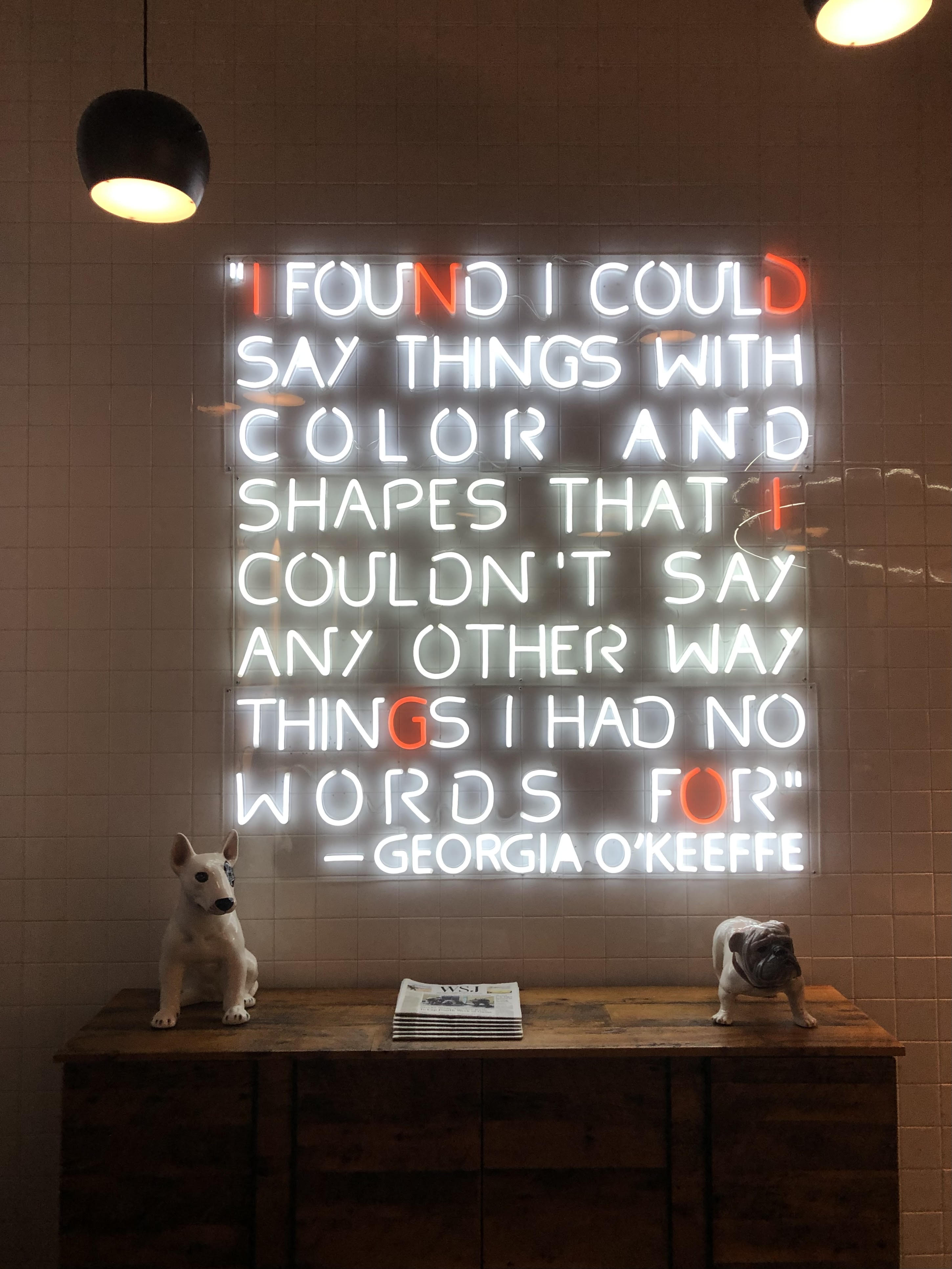
The giant birds were outside a housing complex near our hotel. The illuminated quote from painter Georgia O’Keeffe was inside the hotel, a former paint factory with a paint-and-painters theme. The red letters spell out the name of the hotel. (I needed my grandson to point that out to me.)

Read Full Post »

Being around kids can be good for old folks.

As my friends and I discuss whether or not to sign up for senior communities, one big worry is not seeing children very often. Not necessarily just children in our own families, but the kids that are in the neighborhood or that we pass on our walks or our trips to the the library and shops. Many of us don’t want to be somewhere with no sidewalks to a town, where you can feel a bit normal.

Eleanor Laise at MarketWatch recently reported on a trend that aims to deal with that issue.

She writes, “It’s a warm spring Monday in Easthampton, Mass., and from the front porch of her townhome in the Treehouse intergenerational community, Sue Brow can see several neighbors’ well-kept gardens in bloom. Brow, 60, has helped plant the garden of one neighbor who was ill, and she’s pitching in to grow tomatoes on another neighbor’s patio. Later in the afternoon, residents gather to play games in a communal building. Brow’s 16-year-old son helps take out the older neighbors’ trash, and in their living room sits a birdhouse he just painted at a community celebration attended by residents and friends ranging in age from three to 83. 

“In her four years living at Treehouse, a community designed to bring together seniors with families who are fostering or adopting children, Brow … raised her adopted son with the help of dozens of fellow residents who live within a few minutes’ walk along the horseshoe-shaped street that forms the neighborhood’s backbone. ‘I don’t know what I would have done’ without that [says] Brow. …

“As America enters an era of unprecedented age diversity, new designs for intergenerational communities are taking shape across the country, intentionally weaving together the lives of older and younger residents and breaking down barriers that have segregated elders in traditional senior housing.

“In these new communities, octogenarians can help 8-year-olds with their math homework after school, residents of all ages can prepare and eat meals together, and neighbors can take turns caring for a sick resident who might otherwise wind up in a nursing home. 

“[The] communities often feature smaller, age-friendly dwellings tightly clustered around shared green spaces. Many include community gardens and common buildings where older and younger residents can work and play side by side.

“The trend is not so much a new idea as the resurrection of a very old one. ‘Multiple generations living close by and looking out for each other is possibly the oldest of all human ideas,’ says Dr. Bill Thomas, a geriatrician who last year announced the launch of new, intergenerational Kallimos Communities. …

“In addition to Kallimos, which plans to open its first community in Loveland, Colo., next year, other intergenerational communities in the works include Regenerative Communities, spearheaded by hospitality entrepreneur Chip Conley; Agrihood, designed around an urban farm in Santa Clara, Calif.; and 4300 San Pablo, an Emeryville, Calif., community designed for seniors and young adults who are aging out of the foster care system. …

“These communities are springing up at a time when COVID-19 has spotlighted the pivotal role they can play in society, aging experts say. During the pandemic, it was ‘truly heartbreaking and horrifying how all these ways we’ve separated people — including by age — left us ill-prepared to deal with a crisis of this magnitude,’ says Marc Freedman, president and CEO of Encore.org, a nonprofit focused on intergenerational connection. 

“Isolation proved devastating not only for seniors in locked-down facilities but also younger people stuck taking Zoom classes in their bedrooms, says Bob Kramer, cofounder and strategic adviser for the National Investment Center for Seniors Housing and Care. Now, when he teaches college students about the impact of isolation, he says, ‘for the first time, 22-year-olds I’m speaking to can empathize with what I’m talking about.’ …  

“Intergenerational communities reflect efforts ‘not just to remake housing but to reinvent the notion of what a family is,’ Freedman says. Those efforts come as the U.S. reaches a new milestone in age diversity, with the population roughly evenly distributed across chronological ages through the mid-70s, according to a recent study from the Stanford Center on Longevity. … ‘The demography of America is changing faster than the financiers and developers of housing are willing to change,’ Thomas says. Housing that was developed for a much younger population, he says, is ‘increasingly out of sync with who we really are.’ “

More at MarketWatch, here. No firewall.

Read Full Post »

Art by Maurice Sendak for the Ruth Krauss book Open House for Butterflies.

One hot day after dinner, I had an urge to follow Ruth Krauss’s advice, “Everybody should be quiet near a little stream and listen.”

It gave me two challenges. The first challenge was to find a little stream. The second — because if I were to sit on the bank like the child in the Sendak illustration, I might have trouble getting back up — was to find a little stream where there was a bench.

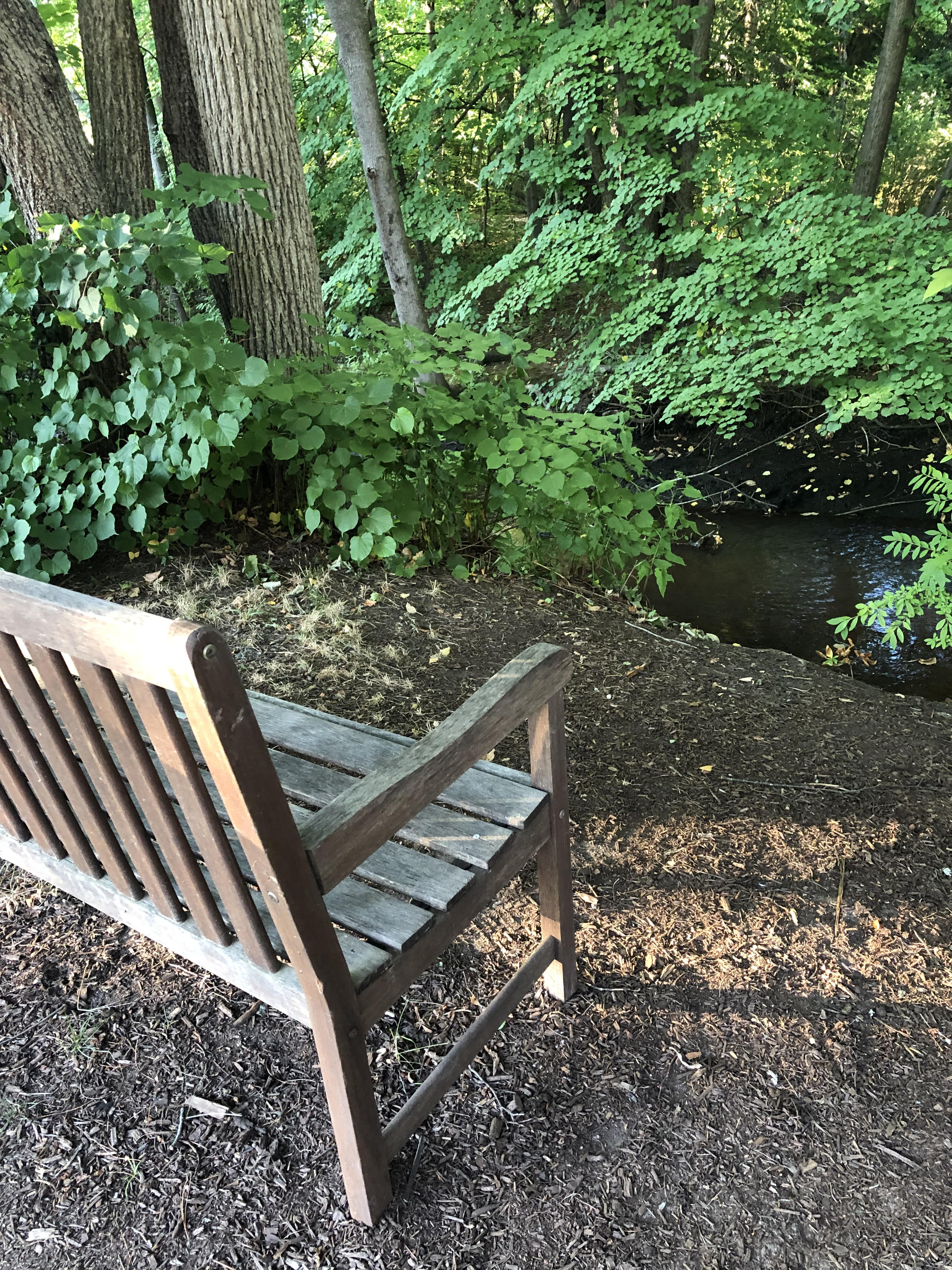
To my surprise, there was in fact a bench facing the Mill Brook behind Main Streets Café. The restaurant had set several benches around for customers waiting at its outdoor eating area, and some inspired worker had turned one toward the stream.

So I sat there a while, and as I sat, I began to wonder if there were other sections of this stream with benches. I also wondered where the stream went.

When I was working at the Boston Fed, I went to a conference about towns like Pawtucket, Rhode Island, getting the idea to “daylight” waterways that had long been hidden in culverts under streets. Towns have been burying assets like that for centuries. Why? Daylighting has really transformed Pawtucket and would be good everywhere.

I’m not sure where the Mill Brook starts, but I can tell you that from a swampy shopping center parking lot, it runs under the pretty pedestrian bridge I’ve shown in other posts, past Main Streets Café, under Main Street, behind several businesses, a theater, an unused bank building (which has a perfect spot for a bench if anyone thought about it), behind private homes, under Heywood Street, and behind the fire station. I know because I went looking.

After the fire and police complex, it went under Walden Street and came out from a culvert near the community gardens, but where it went next, I couldn’t discover. I thought I might find it entering the elementary school grounds, but although I walked up and down there, I couldn’t discern so much as a burble. For me, the stream had vanished behind the homes on Magnolia. It will doubtless show itself when our drought is over and flood season causes it to burst out in a pent-up rage.

I fully intend to investigate the routes of other local streams. You probably need to be retired or a person who likes to walk — or both — to spend time on this activity, but I recommend it. It’s interesting.

Meanwhile, check out what Maria Popova has to say at the Marginalian about Open House for Butterflies and being quiet near a little stream.

Photo: Suzanne and John’s Mom
Bench near a little stream.

Read Full Post »

Photo: Waldemar Brandt/Unsplash.
Though still endangered, tigers are doing better this year than last year.

We hear so much about species on the verge of extinction that we have to blink twice get it through our heads that anything is coming back. That’s why I like today’s story.

Dino Grandoni reports at the Washington Post that “tigers are having a good year. Nepalese officials announced [in July] that the top predator’s numbers within the country’s borders have more than doubled in a bit more than a decade. Across Asia, there are as many as 5,500 tigers prowling jungles and swamps, a leading wildlife group said last week, a 40 percent jump from its 2015 assessment.

“The slow but steady rise in the big cat’s estimated population comes as biologists get better at tracking the animal and marks a high point amid a deepening extinction crisis that may see as many as a million plants and animal species disappear worldwide because of habitat loss and climate change.

“Tiger researchers, while optimistic, warn that the fierce hunter remains under threat from both poaching and encroachment into its remaining habitat. …

“ ‘It’s a fragile success,’ said Dale Miquelle, tiger program coordinator for the Wildlife Conservation Society. ‘There are still many pressures on tiger populations, and they are disappearing from some areas.’

“There are between 3,726 and 5,578 tigers in the wild today, according to the International Union for Conservation of Nature (IUCN), which tracks the status of plants and animals facing extinction. Tens of thousands of tigers once roamed Asia.

“One big reason behind the recent jump in tiger estimates: Scientists have simply gotten better at counting the cats, placing motion-sensing cameras in more spots to identify their territory. …

“But a combination of expanding protected areas and targeting poachers who sell tiger parts for use in traditional medicine has allowed tigers to stabilize or recover in China, India and Thailand.

“ ‘In all of those countries, tiger conservation has been a priority at the highest levels of government,’ said Ginette Hemley, senior vice president of wildlife conservation at World Wildlife Fund.

“Asia’s most iconic predator is perhaps doing best of all in Nepal, where the estimated population has soared from 121 to 355 since 2009, its government said Friday, after the small Himalayan country committed to restoring habitat and dispatched military units to patrol for poachers.

“The grassy lowlands between Nepal and India near the Himalayan foothills — known as the Terai — teem with grazing animals, making it among the most productive potential habitats for the carnivore. …

“Tigers once roamed from Turkey in the west to the eastern coast of Russia and from frigid forests of Siberia in the north to tropical islands of Indonesia in the south. But a century of hunting both tigers and their prey has restricted their range and decimated their numbers.

“By the 1940s, wild tigers vanished from Singapore and Bali. By the 1960s, they were gone for good in Hong Kong and Java. In recent decades, they disappeared from Cambodia, Laos and Vietnam. And today, they continue to die out in Malaysia. …

“Both revered and feared across the globe, the tiger is a classic ‘charismatic megafauna’ — a big, regal animal that receives outsize attention and money in the conservation movement. But by protecting tigers, Miquelle said, conservationists end up protecting entire ecosystems on which other animals and people depend.

“ ‘When we talk about protecting tigers, you’re really talking about protecting the environment that people also need to survive and live a better life,’ he said.

“Yet, as tigers rebound, conflicts arise. In India, home to two-thirds of the world’s wild tigers, the big cats killed 383 people between 2010 and 2019, testing the tolerance of locals for living among them. A protest erupted in a Nepalese village this June after tiger and leopard attacks.

“In a bid to bolster incomes and provide economic incentive for tiger conservation, groups such as the WWF are encouraging residents to open their homes to ecotourists hoping to see the animals.

“Further complicating conservation efforts is Russia’s war in Ukraine, which has made it more difficult for researchers to collaborate with Russian counterparts and to attend a major tiger forum in the port city of Vladivostok scheduled for September.

“And rising seas fueled by global warming threaten to inundate tiger-filled mangroves in Bangladesh, though climate change may end up expanding the cat’s range in Russia.

“Despite the gains, tigers are still officially classified as endangered in the IUCN’s Red List of Threatened Species. And countries still are failing to double their numbers.

“ ‘We haven’t succeeded in that process,’ Miquelle said. ‘But we do feel that there are more tigers today than there were 12 years ago — that progress is being made.’ ”

More at the Post, here.

Read Full Post »

When pannage was common, commoners had the right to run their pigs in the woods. The picture “Harvesting acorn to feed swine” is a miniature from the Queen Mary Psalter, 1310-1320. British Library.

There was a time that poor people could make a living off land that was shared. Then wealthy nobles decided that property rights meant they could close off shared land and keep it to themselves. Some scholars think the enclosure of the commons in England centuries ago was the beginning of capitalism.

Eula Biss at the New Yorker, puts it this way: “Across centuries, land that was collectively worked by the landless was claimed by the landed, and the age of private property was born.

“On the train to Laxton I was facing backward, heading south from Scotland, with the fields of England rushing away from me. I searched their dark creases and their uneven hedges for something I didn’t know how to see, something I wasn’t even certain was visible. I was trying to locate the origins of private property, a preposterous pursuit.

I was looking for a living record of enclosure, the centuries-long process by which land once collectively worked by the landless was claimed by the landed.

“That land already belonged to the landed, in the old sense of ownership, but it had always been used by the landless, who belonged to the land. The nature of ownership changed within the newly set hedges of an enclosed field, where the landowner now had the exclusive right to dictate how the land was used, and no one else belonged there. …

”Walls, fences, hedges, and ditches were all used to mark the boundaries of enclosed land, so that sheep could be kept there, or some other profit could be pursued. Enclosure is how nearly all the agricultural land in Britain came to be owned by less than one per cent of the population. In The Making of the English Working Class, the historian E. P. Thompson writes that enclosure was ‘a plain enough case of class robbery, played according to fair rules of property and law laid down by a parliament of property-owners and lawyers.’

“The pilgrims who sailed on the Mayflower were not property owners but economic migrants financed by property owners. They were also communists, in that they agreed to work communally and share the profits of their labor for the first seven years of their settlement, though that agreement did not last beyond the first year. They settled on land held by the Wampanoag people, who did not practice the absolute ownership of land. Among the Wampanoag, rights to use the same plot of land could overlap, so that one family might hold the right to fish in a stream and another might hold the right to farm the banks of that stream. Usage rights could be passed down from mothers to daughters, but the land itself could not be possessed. …

“Enclosure [unfolded] slowly, in the course of about five hundred years. It began in the Middle Ages and was completed by acts of Parliament in the eighteenth and nineteenth centuries. This land revolution set the stage for the Industrial Revolution. Enclosure, Marx argued, is what produced the landless wage workers who became the proletariat. Historians disagree on that, so it is safer to say that enclosure produced Romantic poetry, a literature marked by nostalgia for a lost world. …

Laxton is the one remaining village in England that was never enclosed, and where tenant farmers still work the land coöperatively, as they have for at least the past seven hundred years

“They use the open-field system, cultivating crops on narrow strips of land that follow the curvature of the hills. There are no hedges or fences between these strips, and working them requires collaboration among the farmers.

“In the time before enclosure, shared pastures where landless villagers could graze their animals were common. Laxton had two, the Town Moor Common and the much larger Westwood Common, which together supported a hundred and four rights to common use, with each of these rights attached to a cottage or a toft of land in the village. In Laxton, the commons were a resource reserved for those with the least: both the commons and the open fields were owned by the lord of the manor, and only villagers with little more than a cottage held rights to the commons.

“As a visitor from the age of private property, it seems remarkable to me that commoners held rights to land they did not own or rent, but, at the time, it was commonplace. In addition to common pasture, commoners were granted rights of pannage, of turbary, of estovers, and of piscary — rights to run their pigs in the woods, to cut peat for fuel, to gather wood from the forests, and to fish. These were rights to subsistence, rights to live on what they could glean from the land. In the course of enclosure, as written law superseded customary law, commoners lost those rights. Parliament made property rights absolute, and the traditional practice of living off the land was redefined as theft. Gleaning became trespassing, and fishing became poaching. Commoners who continued to common were now criminals. An entire legal history is told in the four lines of one anonymous English poem:

“The law locks up the man or woman
“Who steals the goose from off the common,
“But lets the greater villain loose
“Who steals the common from the goose.”

More at the New Yorker, here. The book Ramp Hollow: The Ordeal of Appalachia offers considerable insight on the world’s loss of the commons. Fascinating read.

Read Full Post »

Photo: Yasmin Amer / WBUR.
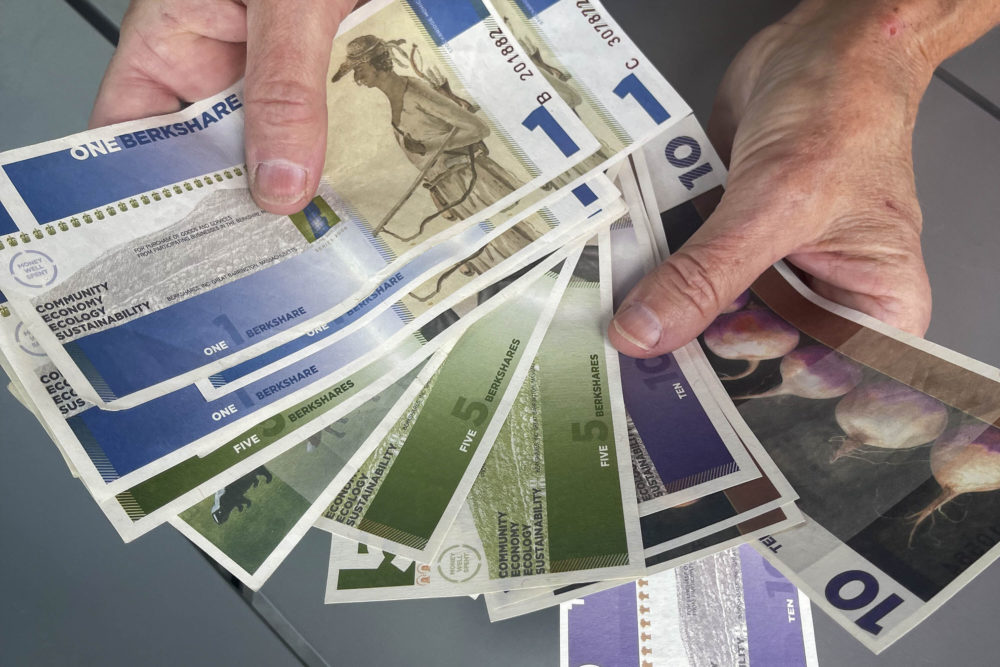
Leah Barber, a volunteer member of the BerkShares board, shows off the local currency in its paper form. Local currency benefits local businesses.

Back when I was working at the Boston Fed, I sometimes covered innovative currencies in the magazine. I was especially interested currencies that were designed to help local communities. BerkShares was one. Recently, I learned that not only is the paper money still in use in the Berkshire region of Massachusetts, but it’s expanding to include a digital option.

Yasmin Amer reported at WBUR radio, “At The Magic Fluke in Sheffield, rows of wooden string instruments line the wall: ukuleles, violins, and a triangular instrument called the fluke.

” ‘The look is different, the sound is a little different,’ said Dale Webb, who designed the fluke. ‘It’s got a richer, fuller sound.’

“Dale and Phyllis Webb co-own this shop, where a basic instrument runs about $250. Since most customers don’t carry that much cash, most opt to use their credit cards. That comes with a fee for the business.

” ‘If somebody spends money at our store mostly with credit cards, I’m paying anywhere from 2.7% to 3%,’ Phyllis said.

“A sign hanging by the instruments inside the shop reminds customers there is another way to pay: a local currency called BerkShares. It can help business owners like the Webbs avoid the fees that accompany credit card transactions.

” ‘Those dollars through Visa, MasterCard, Discover, do nothing for our community,’ Phyllis said. ‘They just whisk away into the atmosphere to some other place that couldn’t care less about the Berkshires.’

“To keep more money in the region, the Webbs and hundreds of other business owners have joined this experiment in local currency. People in the Berkshires can exchange U.S. dollars for BerkShares, for free, at any of nine participating bank branches. The exchange rate is one dollar for one BerkShare.

“As of March, it’s also possible to transfer funds from almost any bank straight into the BerkShares app, which acts like a digital wallet. There is one catch: Transfers can take up to six business days.

“When a customer uses digital or paper BerkShares instead of a credit card, business owners don’t pay any transaction fees. There’s also an incentive to keep BerkShares circulating in the local economy instead of converting them back to dollars. Converting from BerkShares to USD involves a 1.5% fee, which is about half of a typical credit card fee.

“Members of the Schumacher Center for New Economics, a nonprofit in Great Barrington, came up with the idea for a Berkshires currency more than 15 years ago. Since then, more than 350 businesses have signed on to accept paper BerkShares, and about 70 also are using the new digital version. …

“The goal of a local currency like BerkShares comes from a basic economic idea: When more money stays in a community, it increases revenue for local businesses over time, and allows those businesses to grow.

“Leah Barber, a volunteer board member with the BerkShares program, likes the convenience of using the new digital BerkShares app. However, she still keeps a wad of the blue and green bills in her purse. …

” ‘If I whip out my BerkShares, it makes you think, “Oh, maybe I should be paying in BerkShares too,” ‘ Barber said. …

“Hayley Ranolde, a customer service manager at the Berkshire Food Co-op in Great Barrrington, said she typically sees no more than a handful of people paying with digital BerkShares each day. The co-op is one of the early adopters of the new digital currency. For those transactions, Ranolde uses a cell phone with the BerkShares app since the cash registers don’t accept that type of currency. …

“If more people used BerkShares, especially local vendors, Ranolde said it would be a game changer. The store would be able to keep more BerkShares circulating without having to convert them back into dollars.

“Though BerkShares have been around for more than a decade, the currency hasn’t achieved widespread adoption. … BerkShares advocates have high hopes the new digital currency will reach more people. …

” ‘I think that the digital way is the way of the world,’ said Phyllis Webb. ‘We’re excited to be part of of a first opportunity to see how this works with a local currency.’ “

If your community had a system like this, would you use it? Or would it feel like one thing too many to remember when you’re rushing to finish errands?

More at WBUR, here.

Read Full Post »

Photo: Melanie Stetson Freeman/CSM.
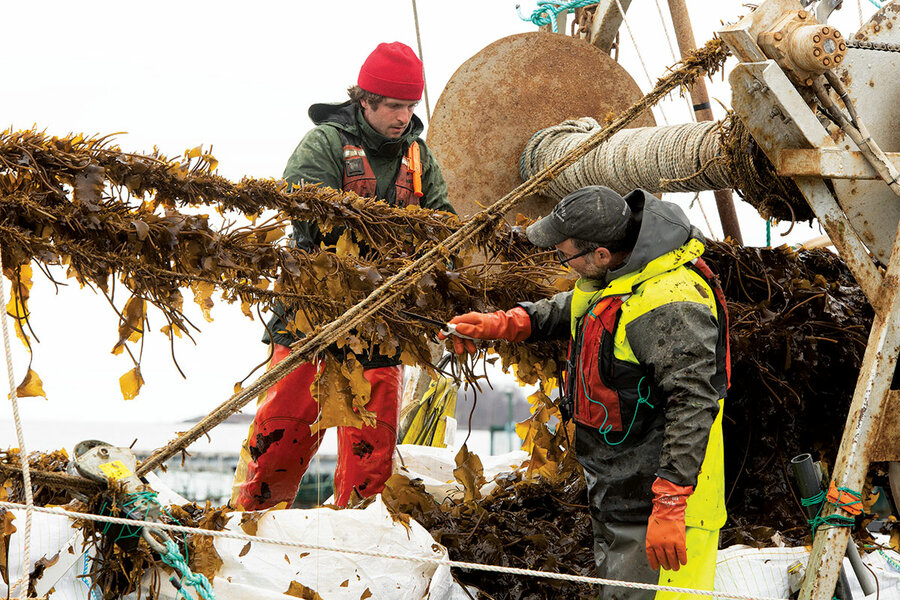
Workers with Bangs Island Mussels, a Maine-based aquaculture company, harvest multiple lines of kelp in Casco Bay.

Humans never stop having to make adjustments. Consider all the confusing updates to your phone, problems with your printer, and the like. You are always having to learn something new.

Similarly, businesses have always had to adjust to market changes, floodplain dwellers have had to move to higher ground, families attacked by invaders have had to move to other countries … the list goes on.

Meanwhile, in Maine, lobster fishermen are having to consider new sources of income.

Stephanie Hanes wrote at the Christian Science Monitor, “The landing dock of the Portland Fish Exchange is busy this afternoon, in a way that almost reminds David Townsend of when there were still groundfish to catch in Casco Bay, when this pier was piled with cod and haddock … back before the fisheries collapsed.

“Now Mr. Townsend waves down to Justin Papkee, who has maneuvered his boat up to the dock. Mr. Papkee is a lobsterman. But hours earlier, he and his crew harvested thousands of pounds of sugar kelp, hauling the seaweed onto his boat from the ropes where it had been growing, cutting off the leafy blades and stuffing them into half-ton potato sacks. …

” ‘We love the new business,’ says Mr. Townsend. ‘This is the thing of the future.’

“Briana Warner smiles when she hears this. This is a new tune for the dockworkers, who not long ago grumbled about how their lives had descended to this, landing ocean weeds. But as the boats keep coming in, their enthusiasm for her efforts has grown. …

“It is her company, Atlantic Sea Farms, that is buying all of it, part of an ambitious effort to revamp not only Maine’s working waterfront, but also the way the state is fighting, and adjusting to, climate change. …

“Ms. Warner says, ‘We are presenting a climate change adaptation tactic that also does no harm, and in fact does positive things. … It makes the ocean better. It makes our coastal ecosystems better. It makes our coastal economy better. And it makes the consumer healthier.’ …

“The story of seaweed here in Maine, and how it is evolving into what some are calling Maine’s new cash crop, is part of a global story. … But it is also intensely local. And this, climate activists say, makes it even more important for understanding how humans around the world might adjust to a quickly changing planet.

“While few researchers would discount the importance of sweeping climate actions by international organizations and countries, there is a growing sense that, at least in the short term, real change will come from variations of what is happening in the waters off the coast of Maine. These will be place-specific initiatives. They will be based on cooperation and unity, not only between humans – the environmentally minded businesswoman and the sometimes conservative fishermen – but also among people and nature: the carbon and the kelp and the restaurateurs. …

“ ‘There’s no one silver bullet,’ says Susie Arnold, a marine scientist at the Island Institute, a Maine nonprofit focused on preserving the state’s working waterfront. ‘It’s going to take everybody. And at this point, we’ve taken such a toll on the Earth that there are going to have to be trade-offs.’ …

“For generations, life in this sparsely populated, ruggedly proud Northeastern state has focused on the ocean. Although Maine’s coast is only about 228 miles from north to south, when you include the various bays and inlets, the state’s shoreline measures more than California’s, totaling some 3,478 miles. Studies show that more than 80% of the household income in some communities traces back to fisheries. …

“For a generation now, lobster has been king of Maine’s seafood industry. It forms the base of a billion-dollar-plus business in the state, which provides the vast majority of domestically caught lobster in the United States. … And the people who hoist the traps take pride in crafting their own stringent measures to protect the fishery. They have imposed regulations on everything. ….

‘Lobster fishermen are notoriously good stewards of our coastal ecosystems,’ says Jesse Baines [of Atlantic Sea Farms]. ‘But we all know that the seasons are more variable every year.’

“Yet the seasons are not just more variable, starting unpredictably later or earlier. On the water, they are also warmer.   

“ ‘The Gulf of Maine is one of the fastest bodies of warming water in the world,’ says Sebastian Belle, executive director of the Maine Aquaculture Association. ‘And frankly, it’s incredibly scary how fast it’s happening.’

“The reason, scientists say, is climate change. As humans release more greenhouse gases into the atmosphere, the air warms. Much of that heat is absorbed into the oceans. There are also ocean currents that some scientists believe are being disrupted. A shift in one particular circulation pattern has allowed warmer water coming up from the Gulf Stream to push away colder water coming down from Labrador, leaving warmer, saltier currents entering the Gulf of Maine. And that has prompted the lobster population to shift northward. …

“The warmer water has caused other species to migrate to the area, including the endangered right whale. Legal battles have erupted among the lobster industry, interest groups, and the federal government over protecting the mammal. Looking at all of this, economic development experts throughout the state are worried about the risk of so much of Maine’s economy being dependent on lobster. …

“Before she and her family moved to Maine, her husband’s native state, in 2013, Ms. Warner had spent nearly a decade as a U.S. Foreign Service economic development officer based in multiple African countries. There, she watched the struggles of individuals and communities working against forces far larger than themselves. And so she recognized what she was seeing in Maine.

“ ‘It’s just really devastating to see an industry that has taken such a leadership role in conservation and has no ability to stop the volatility because of the greater world’s usage of fossil fuels,’ she says. ‘No matter what the lobster fishery does, they can only control so much because the ocean is just warming.’

“The industry needed another way to make money, she realized – one that would be ecologically helpful instead of harmful. …

“The seaweed known as Saccharina latissima, or sugar kelp, is a yellowish brown alga that grows along rocky coastlines. It takes the shape of an elongated lasagna noodle, with crinkled edges, and can grow up to 16 feet long.

“It is high in a variety of nutrients, and also has a gelling capacity that makes it a useful ingredient for everything from cosmetics to ice cream to toothpaste. And like all plants, kelp absorbs carbon while giving off oxygen. …

“The idea of kelp as both a food source and an environmental solution is not new. Indigenous people in the Americas harvested kelp for generations. In Asia, it’s part of a multibillion-dollar seaweed farming industry.  

“But in the U.S., where far fewer people eat seaweed, there has been scant commercial interest in kelp farming until recently. … Although seaweed currently makes up only a small percentage of [the aquaculture] industry, it is the fastest-growing subsector, according to the National Oceanic and Atmospheric Administration. …

“ ‘The kelp is sucking carbon dioxide directly out of the water, and actually reducing the acidity of the water in its general vicinity,’ [says one kelp farmer]. ‘So if you put the kelp close enough to the mussels, we have measurable, significant evidence showing that the kelp halo effect helps the mussels grow bigger and faster.’ ”

More at the Monitor, here. No firewall.

Read Full Post »

Photo: Waterstudio/Dutch Docklands Maldives via dezeen.
Maldives Floating City is planned to accommodate up to 20,000 residents. Badly needed. Global warming is sinking the country.

Is it possible to reverse the harm we’ve done to the planet after burning so much fossil fuel? For the people of Maldives, time is of the essence, and they’re not waiting to find out.

Alice Finney writes at dezeen, “The Maldives has partnered with architecture studio Waterstudio to create a brain-shaped floating city that will house 20,000 people in a lagoon near the country’s capital.

“Called Maldives Floating City, the development will contain 5,000 low-rise floating homes floating within a 200-hectare lagoon in the Indian Ocean. As sea levels rise, so too will the city, which will be built upon a series of hexagonal-shaped floating structures.

“In the Maldives, 80 per cent of the country sits less than one metre (three feet) above sea level. With the Maldives islands predicted to be uninhabitable by 2100 due to rising sea levels, the government of the Maldives hopes to offer up to 20,000 locals and foreigners the opportunity to move to the floating city as early as 2024.

“Construction is planned to begin later this year on the development, which will be 10 minutes by boat from the Maldivian capital Male.

” ‘This first-of-its-kind island city offers a revolutionary approach to modern sustainable living perched against a backdrop of the azure Indian Ocean,’ said the studio. …

“Maldives Floating City is among a number of floating city proposals, including Oceanix Busan by architecture firms BIG and Samoo and tech company Oceanix that are designed to offer a housing solution to rising sea levels and global temperature increases.

“However, developer Dutch Docklands claims that none have been attempted on this scale and at this speed with full governmental support.

” ‘While attempts at floating cities have been tried before, none have featured Maldives Floating City’s most compelling selling points: full-scale technical, logistical and legal expertise,’ explained Dutch Docklands.

“The development, which is set to be fully completed by 2027, will be composed of a series of hexagonal islands modeled on the geometric shapes of a local coral called brain coral. When combined and viewed from above the development will resemble a brain. …

“The living platforms will support houses, hotels, restaurants, shops, a hospital, a school and a government building. …

” ‘As a nation at the front lines of global warming, the Maldives is perfectly positioned to reimagine how humankind will survive — and, indeed, thrive — in the face of rising seas and coastal erosion,’ said the Dutch Docklands.

” ‘Inspired by traditional Maldivian sea-faring culture and developed in close cooperation with Maldivian authorities, Maldives Floating City homes will eventually be joined by hotels, restaurants, stylish boutiques and a world-class marina.’

“The Intergovernmental Panel on Climate Change (IPCC)’s Sixth Assessment Report 2022, states that small island nations such as the Maldives may become completely uninhabitable as the world is on track to warm by two to three degrees this century.

” ‘The world faces unavoidable multiple climate hazards over the next two decades with global warming of 1.5°C (2.7°F)’ the report by the United Nations’ climate change panel said. ‘Even temporarily exceeding this warming level will result in additional severe impacts, some of which will be irreversible. Risks for society will increase, including to infrastructure and low-lying coastal settlements.’

“Viable solutions for urban development into the ocean listed in the report include elevating houses on stilts and creating ‘amphibious architecture’ that can float on the surface of rising floodwater.”

Oy. I try to find hopeful stories for the blog, but I think I failed on this one. We really need to reverse what we’ve done. I know climate is not the same as weather, but the extremes of weather we are seeing should convince even nonbelievers that something is going on. I left for my walk at 5:15 am today to “beat the heat.” It was already 80F (26.6 C)!

More at dezeen, here.

Read Full Post »

Photo: Haven Daley/AP via NBC.
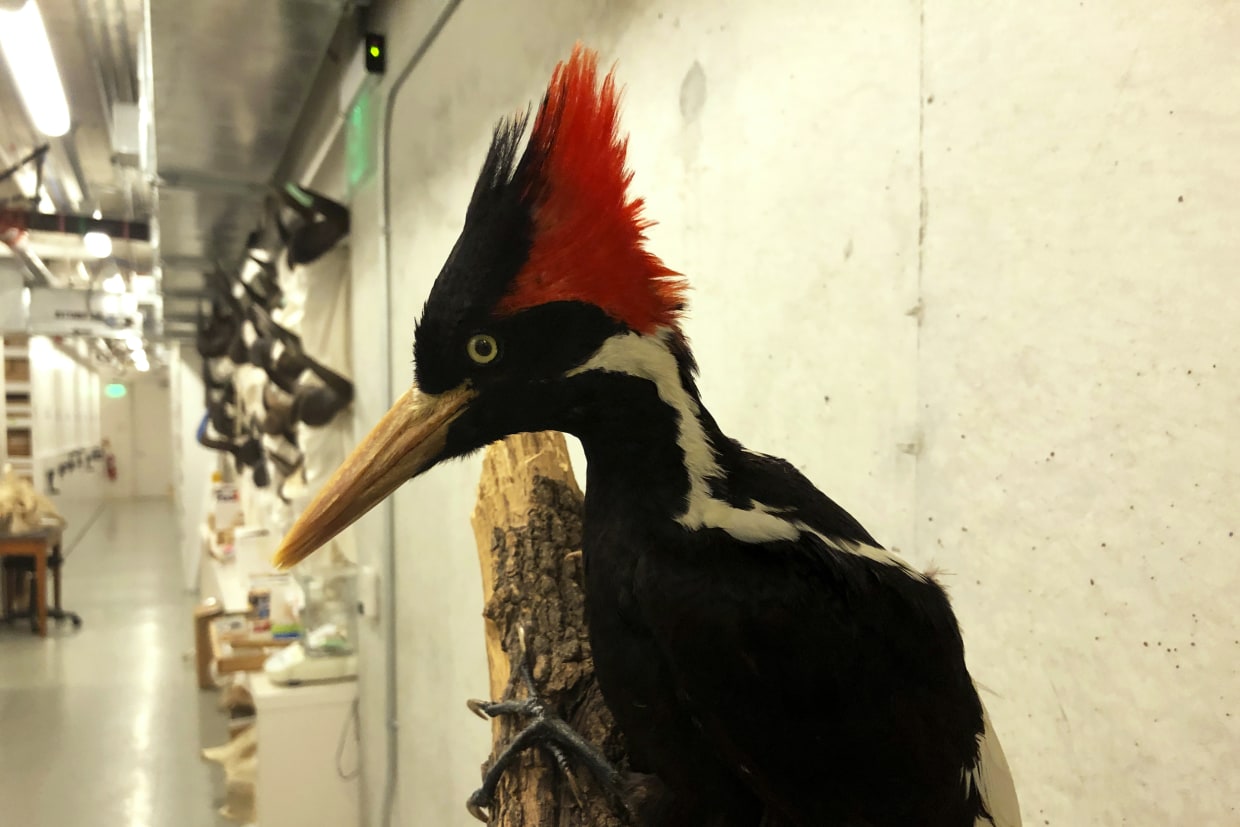
An ivory-billed woodpecker specimen on display at the California Academy of Sciences in San Francisco. The ivory-billed woodpecker has been officially declared extinct, but hope lingers on.

Jenni Doering at the environmental radio show Living on Earth recently interviewed a woman who works to protect endangered species — and who sometimes fields calls from enthusiasts who think they have found the last living … whatever. The interview begins with Curry’s memory of an encounter that opened her eyes to the parallel lives we are living with wild creatures.

“JENNI DOERING: I talked with Tierra Curry, a senior scientist with the Center for Biological Diversity. Today she mostly has a desk job, working towards getting legal protection for endangered species, plants and animals, but she started by telling me about a close encounter she had a while back working with animals in Alaska. …

“TIERRA CURRY: One winter morning, it was my job to take two bald eagles in really large dog kennels out to this flight center. And there happened to just be a huge blizzard that day. And in Anchorage, when there’s a blizzard, your life doesn’t shut down, you just keep going. And so you just go out on the road and try to make a lane and hope for the best. …

“I kept having to get out of the car and chink the ice off my windshield wipers. And because this was my first winter in Alaska, I didn’t even really have an ice scraper. So, I’m embarrassed to say this, but I was using a credit card. I’m just like stuck there with my head down, it’s pouring snow, I’m sure my hair’s freezing and, and I look up and there’s a wolf at the edge of the woods, just looking at me. And I stared back at it. And it was just this moment where I was hyper aware of being a human. I’m here, at this moment, on a Tuesday morning, outside Anchorage. And this wolf is here too. And we just stared at each other and shared this moment. And we’re both dealing with the snow. … And then we both just went on about our schedules after that moment. …

“I work on all kinds of species across the country, from crayfish to butterflies to the Humboldt martens, just whatever is endangered and needs help if it’s a plant or an animal. And people contact me regularly when they have an experience with one of these animals. Like, if someone has a monarch butterfly that they’ve watched grow from a caterpillar and it isn’t doing what they think it should be doing, they contact me for advice.

That ranges from ‘my monarch lacks self confidence’ to, like, ‘it’s the wrong color’, or ‘should I help it out of its shell?’

“Or one time somebody found me because their dog was down in the creek and came back with a blue crayfish attached to its lip. And they had heard on the news that there was this endangered blue crayfish. … I sent the pictures to crayfish researchers in that state and it actually was a species that we had petitioned for protection for and this ended up being a new location for it. …

“One time, there was a fairy shrimp in Florida called the Florida fairy shrimp and we petitioned for protection for it, and the Fish and Wildlife Service said that it was extinct. And so that was hard and we put out a press release about the Florida fairy shrimp being gone. And then, this woman a couple months later, the roads around her house flooded and she found a bunch of fairy shrimp on the road. And she thought that maybe these fairy shrimp were the Florida fairy shrimp and she didn’t know what to do. …

“She contacted the state Wildlife Commission, a local Marine Lab. Upon their advice, she went and bought a tank and food to feed them. She just wanted so desperately to help these fairy shrimp. And she felt so much responsibility, because beyond compassion for the individual animals, she was afraid they were going to get run over, or that vector control was going to spray for mosquitoes and that it would kill them. She felt responsibility for the fate of the entire species. What if she had found this animal that was just declared extinct.

“And for days, it took over her life, she dropped, like, everything she was doing to try to take care of these shrimp to see if she could save the species. … They ended up being the common species of fairy shrimp in that area. But they could have been! So it’s really important that when people do have these encounters, they report it to someone who could help save them because it’s entirely possible that it’s just something that researchers didn’t find, and that you could find it. …

“Just take a picture, take a bunch of pictures of it, don’t disturb it. … Mostly just take the pictures so that you can contact the researcher or contact me and I can find the researcher to find out what it is. Most of the time unless an animal is hurt — even if it is hurt — just contact somebody who has the skills to go pick it up.”

More at Living on Earth, here.

Read Full Post »

Photo: Paul Salopek/ National Geographic.
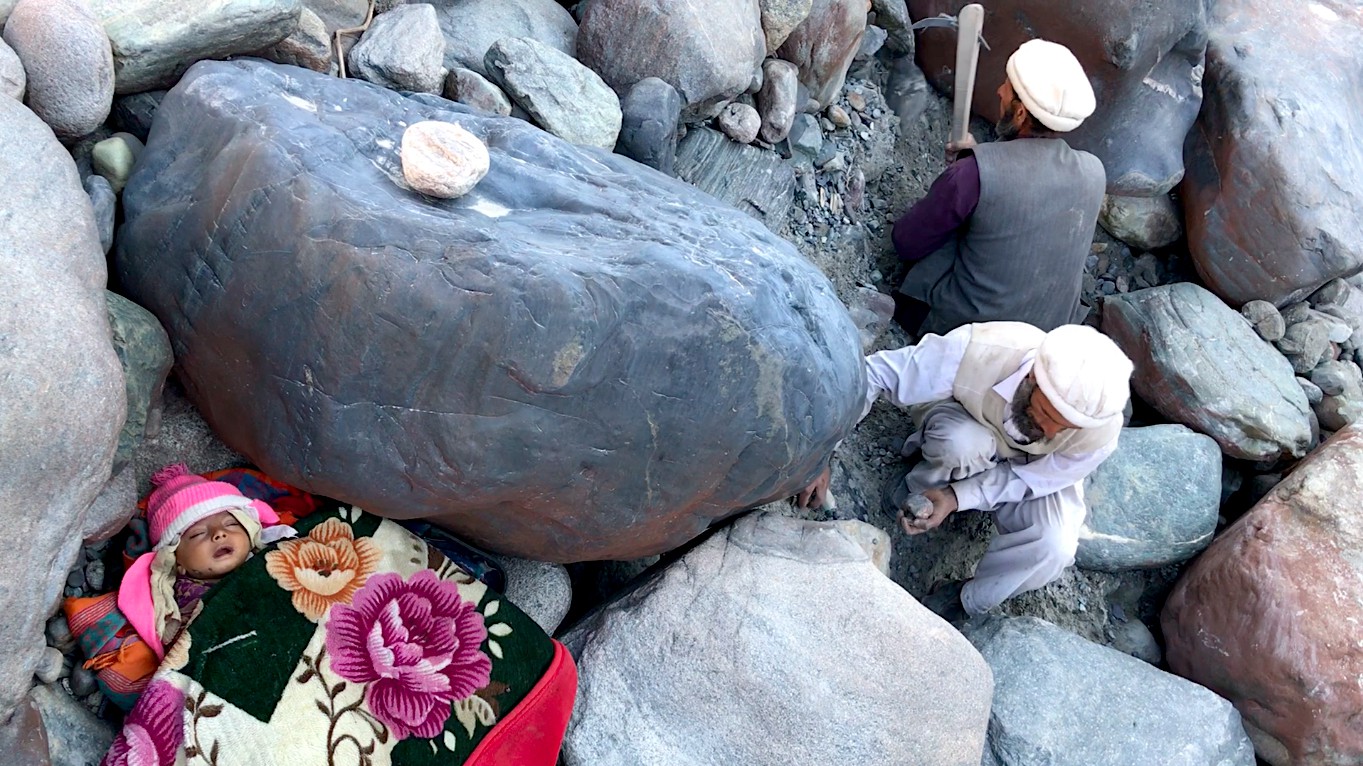
A baby sleeps near a gold prospector’s diggings in northern Pakistan.

I’m not sure how many readers will be interested in today’s rather academic treatment of an exotic part of the world and its many languages. Although I am not fluent in anything but English, I myself like learning about languages, especially those that are spoken by a small number of people and don’t even have a written form.

Language activist Zubair Torwali writes at Aeon about the many languages of ‘Dardistan,’ which includes northern Pakistan, parts of Eastern Tibet in China, eastern Afghanistan and the Kashmir valley on both sides of the Pakistan-India border.

“Dardistan is one of the most diverse linguistic regions in the world. … The region has the large Dardic languages such as Kashmiri, Shina and Khowar on the one hand and, on the other, it is home to the Burushaski language, which could not be placed within any language family because of its unique features. The Nuristani, formerly Kafiri, languages are spoken here, too. There are minor languages such as Kalasha, spoken by the Kalash community of hardly 4,000 people who still follow the ancient animistic religion that was once practiced across Dardistan.

“The name ‘Dardistan’ describes the area comprising the highest mountain ranges of Hindu Kush, Karakoram, western Himalaya and the Pamir mountains. … Dardistan’s enormous linguistic diversity occurs despite the fact that, culturally, the area is fairly homogeneous. [Anthropologist Augusto] Cacopardo says there is no match for this region in terms of linguistic and cultural diversity, except the Caucasus. Though, of course, minor differences exist, the same religious rituals and religious pantheon prevailed among the polyglot peoples of Dardistan.

“The many languages spoken here, though mostly belonging to the Indo-European family, still more narrowly to the Dardic sub-family within the Indo-Aryan group, are so different from each other that the people of one linguistic community have to rely on a third language, Pashto or Urdu, to communicate with members of another community. For instance, the people belonging to the Torwali and Gawri communities of the upper Swat valley in Pakistan need Pashto to converse with each other. This is despite the fact that the Torwali and Gawri languages are ‘sister languages’ and seem to have evolved from one single language a few centuries ago. …

“In 1986, the Summer Institute of Linguistics in collaboration with the National Institute of Folk Heritage, Lok Virsa, and the National Institute of Pakistan Studies at the Quad-e-Azam University in Islamabad, undertook a survey of the languages of northern Pakistan. Published in five volumes, this Sociolinguistic Survey of Northern Pakistan (1992) documented 25 languages. In fact, there are even more – at least 35 – languages in north Pakistan. …

“In his paper ‘India as a Linguistic Area’ (1956), the linguist M B Emeneau uses the phrase ‘linguistic area’ as a technical term to mean an area that includes languages of more than one family sharing some common traits with one another, but not all the linguistic features are alike among the language families. …

“[Swedish linguist Henrik Liljegren] argues that the Hindu Kush–Karakorum (HK) – also known as Dardistan – is a ‘linguistic area’ in the sense that it is a ‘convergence zone with a core that shares certain linguistic features’ as a result of a prolonged period of contact with other subareas. …

“Writing a century earlier, Morgenstierne was correct to claim that the region is among the most linguistically diverse in the world. Presently, about 50 languages are spoken here. [The] region has maintained this linguistic diversity, but it is under grave threat. Dardistan is at the crossroads of South Asia and Central Asia. It is mountainous and makes for very hard traveling. … It is perhaps thanks to Dardistan’s mountainous geography that we still find such a rich array of languages. …

“Dardistan is home to six language groups: namely Indo-Aryan, Iranian and Nuristani (all branches of the Indo-European language family), as well as Turkic, Sino-Tibetan and Burushaski. The Indo-Aryan phylum is the largest, including about 30 languages that have also been lumped together as ‘Dardic’ (North-Western Indo-Aryan) by linguists. … My work as an ethnographer and linguist has focused on north Pakistan. ….

“North Pakistan is a spectacular mountainous land of immense linguistic, ethnic and geographic diversity. It is undoubtedly one of the most multilingual places on planet Earth. Over many centuries, the movement and contact of people at this crossroads of Central and South Asia have left a complex pattern of languages and dialects. …

“None of Pakistan’s governments nor a university has ever taken any initiative in profiling the languages spoken by the people of Pakistan. Only a few – Urdu, Pashto, Punjabi, Balochi, Sindhi and Saraiki – are mentioned in any media, teaching materials and in any kind of national database. It is, therefore, difficult to estimate the exact number of speakers of each language because none of these languages has been counted in the six national censuses so far conducted in Pakistan. The number of speakers of these languages may vary from a few hundred to a million. Many are also spoken in Pakistan’s neighboring countries – Afghanistan, India and China.

“All these languages are categorized as ‘endangered’ in the Routledge Encyclopedia of World’s Endangered Languages (2007) edited by Christopher Moseley. Many of them are ‘severely endangered’ whereas a few are ‘moribund’ or already ‘extinct.’ “

The author details six of the languages at Aeon, here, and posts videos of people singing in them. No firewall.

Read Full Post »

Pirate Artist

Photo: Art in America.
Dick Riley’s approach to art stirs things up.

The New York Times calls this anti-plastic missionary a “pirate artist.” Melena Ryzik‘s article explains how he got that moniker.

“The artist Duke Riley isn’t exactly sure why he had the idea to turn a plastic tampon applicator into a fishing lure, but he knows one thing for certain: It works.

“He put it to the test one summer day on a buddy’s boat in Block Island Sound, and, with his pastel bait bouncing along the ocean floor, pulled up a sizable fluke. It was a keeper — ‘I definitely ate it,’ he said.

“The applicator tube had first washed up ashore, part of the many tons of seaborne trash that Riley, a Brooklyn artist known to scavenge New York’s waterways for materials and inspiration, has collected over the years. Putting this spent plastic product to use as fish food — that was some D.I.Y. upcycling. Putting it into the Brooklyn Museum of Art: that is Riley’s wild and singular artistic ingenuity.

“There’s a film of the fishing endeavor, done in the style of a crusty YouTube tutorial. The lures — displayed on pegboard, as in a real bait shop — join other plastic detritus that Riley has repurposed, like straws, dental floss picks and vape pens, in ‘DEATH TO THE LIVING, Long Live Trash,‘ an exhibition [that opened in June] at the Brooklyn Museum. Across multiple rooms and settings, it confronts the calamitous environmental impact of the plastics industry and the ways in which unchecked consumption, for personal convenience, has polluted waterways.

“Its centerpiece is more than 200 works of painstakingly hand-drawn scrimshaw that Riley has spent three years making. Instead of the whale teeth and walrus tusks that 19th-century sailors once etched, he uses a contemporary, dispiritingly abundant, analog: discarded plastics. Lotion tubes, squirt bottles, brushes, a honey bear, solo flip-flops, a Wiffle ball and a legless lawn flamingo now stained bone-white, all provide the canvas for Riley’s patterned mariner drawings in India ink.

“As whalers often depicted the leaders and profiteers of their day, Riley portrays the C.E.O.s of chemical companies, plastic industry lobbyists and others he deems responsible for producing the devastating tonnages of single-use plastics that are engulfing our oceans and threatening our ecosystems. It’s a downer, but if you look closely there’s often a Riley twist of humor, like the seagull shown relieving itself on the head of a water bottle magnate.

“ ‘This is an artist who I always refer to as a modern-day pirate,’ said Anne Pasternak, the director of the Brooklyn Museum. ‘He’s not just an aesthete pointing to something passively, he’s working to actively spur change — you have to be in it with an artist like Duke. He’s not going to hold back.’

“Calling out corporate titans and politicians — particularly when institutions like the Brooklyn Museum depend on them for donations and support — comes from a fearless ethic and ‘a wit that is hilarious and unforgiving.’ She added, ‘I always think of him as the George Carlin of the art world.’ …

“Best known for ‘Fly by Night,’ a 2016 performance in which 2,000 trained pigeons outfitted with LEDs lit up the New York sky, or for launching his own homemade Revolutionary War submarine into the path of the Queen Mary 2 cruise ship, Riley has mostly succeeded by navigating around the commercial New York art world, though he holds degrees from some of its prestigious feeder institutions (a B.F.A. from the Rhode Island School of Design and an M.F.A. in sculpture from Pratt Institute). …

“ ‘Duke is a natural,’ said Ernesto Pujol, an artist and former professor at Pratt who has mentored him. ‘A huge talent. … He had to fight his way for the art world to see him holistically — he is the kind of artist that is always more than you bargain for.’ …

“Riley works in many mediums: The Brooklyn exhibition includes films, decorative installations, mosaics and illustrations, like a vast map of Brooklyn’s Gowanus Canal, encompassing its history from precolonial bounty to Dutch settlers through the polluted Superfund site that in 2007 tested positive for gonorrhea. …

“His mosaics offer one of the biggest wows of the show. Inspired by sailors’ valentines, a nautical souvenir traditionally made of shells, Riley’s are enormous and quite beautiful.

Only on close inspection do you notice that the perfect, shiny seashells are interlaid with a rainbow of bottle caps, cigar tips, bits of mechanical pencils, and bread bag clips, all harvested from New York streets and waterfronts. …

“[His studio is] a cleanish space, stacked with neatly bagged, color-coordinated trash. A trailer outside was filled with more refuse. Some of it came from Fishers Island, the exclusive enclave in Long Island Sound, where Riley had a residency in 2019, and where he met a woman whose full-time job is to rid its beaches, the summer home of families like the DuPonts, of plastic rubbish.

“ ‘The exhibition is so much about holding people accountable, and the little acts that people can take to solve this problem,’ Liz St. George, the show’s curator, said. That includes museum administrators; in the course of working with Riley, they changed cafeteria suppliers to minimize plastic, and reconfigured water fountains to accommodate reusable bottles. …

“He did the scrimshaw in solitude aboard his boat, now docked in Rhode Island. A Massachusetts native who worked on the fish docks and grew up visiting places like the New Bedford Whaling Museum, he has always been attracted to a New England nautical aesthetic. …

“This week, Riley is also debuting a mosaic in Boston’s central library. It is one of only a few pieces of contemporary art purchased for permanent installation in the landmark 1895 building, since a circa-1900s John Singer Sargent mural. Riley’s work is partly inspired by the Great Molasses Flood of 1919, an urban disaster caused when a storage tank exploded, releasing millions of gallons of the sticky stuff. It destroyed neighborhoods in the North End, a community of Italian immigrants. …

“For his core group of collaborators, no project is too brazen, or too labor-intensive. ‘We always pull it off,’ said Nicholas Schneider, a New York City firefighter and a longtime member of Riley’s crew. Through all the fun, ‘there is always a somber or very serious component that I think he’s always been the most focused on and proud of.’ “

More at the Times, here. See also Art in America, here.

Read Full Post »

Photo: Nadia Abdullah via Sentinel Source.
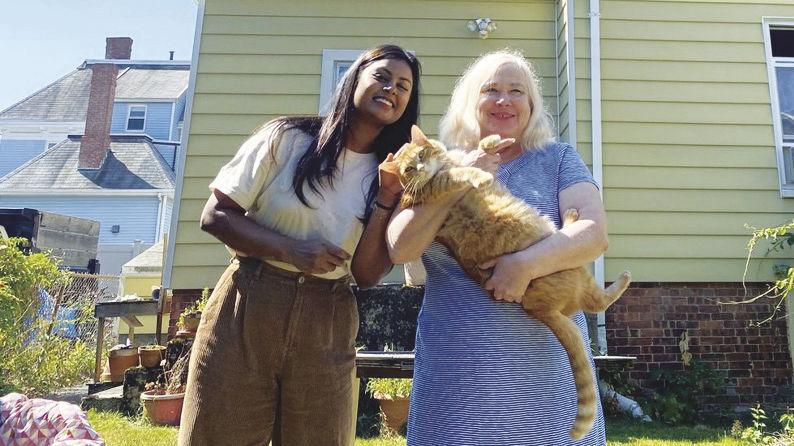
Nadia Abdullah, 25, with Judith Allonby, 64, holding Mango the cat, have been roommates in Malden, Mass., since 2019.

Pretty much all my friends are investigating what Roz Chast calls Places or else at-home services — especially if they expect to need assisted living or memory care eventually. According to today’s story, there’s an interim step, particularly for seniors who live alone, and it’s gaining in popularity.

Cathy Free reports at the Washington Post, “Nadia Abdullah was on the hunt for an affordable apartment in the Boston area a few months before she graduated from college.

“ ‘It was a little frustrating because I couldn’t find anything in my budget,’ said Abdullah, 25, who was sharing on-campus housing with four other students until she graduated from Tufts University.

“At the same time, Judith Allonby, 64, was debating whether to move out of her family’s old home in Malden, Mass., after her parents died. Her two-story house seemed too large for one person and it required a lot of upkeep, but she liked the neighborhood.

“ ‘I rely on public transportation,’ said Allonby, an attorney.

“Then she and Abdullah discovered an alternative: an intergenerational housing arrangement that would benefit them both. While researching their options, they each learned about Nesterly, an online home-sharing agency that matches young renters with not-so-young people looking to supplement their incomes and share their space.

“Abdullah and Allonby each passed the agency’s background check, then they were paired in an arrangement designed to fit their specific needs: Allonby would rent the first floor of her home to Abdullah for $700 a month in exchange for help with the housework and gardening and occasional grocery runs. And Abdullah would get a safe and spacious place to live just six miles from Boston and a 30-minute drive from her robotics engineering job in Beverly, Mass. …

“Allonby said she was surprised at how compatible they turned out to be. ‘It’s really nice to have somebody else around, and Nadia brings a different atmosphere and energy than I had with my 88-year-old mother,’ she said. ‘Nadia is definitely not listening to Frank Sinatra.’

“About 18 percent of Americans live in multigenerational households — meaning two or more adult generations — according to a study from Pew Research Center published this year. Such arrangements have quadrupled in the United States since the 1970s, with about 60 million U.S. residents now living with adults who are of a different generation, according to the study.

“Contributing to that trend is that more young people are priced out of the housing market and more seniors want to age in place, said Donna Butts, executive director of Generations United, a D.C.-based organization that focuses on programs and policies that connect generations. …

“In the United States, several universities foster such arrangements, including Winona State University in Minnesota, Quinnipiac University in Connecticut and the University of California at Berkeley, which has an intergenerational housing program that started in 1986.

“At Drake University in Des Moines, music students are given the opportunity to live rent-free at a local senior living center in exchange for performing several times a month for the residents.

“Molly McDonough, a 22-year-old vocal performance major, recently moved into Wesley Acres, a senior living community that offers everything from independent apartment life to long-term care. …

“She said she was happy to find a pleasant, one-bedroom apartment waiting for her last month on the center’s fourth floor. ‘It came fully furnished, with towels, dishes and anything else I needed,’ McDonough said. ‘They also allowed me to bring my two cats.’ …

“McDonough now often shares meals with senior residents in the communal dining room and she enjoys hearing their life stories. …

“Shortly after she moved in, she found a note on her door from Arlene DeVries, 81, who lives at Wesley Acres with her husband, Fred DeVries, 83.

“ ‘Arlene wanted to give me a tour of Wesley Acres and I found out she’d also been a voice major at Drake,’ McDonough said. ‘Right away, we became good friends.’ …

“In Canada, college students and seniors are moving in together, too.

“Michael Wortis, 85, a retired physics professor from Burnaby, B.C., near Vancouver, said he was intrigued when he received an email last year from Simon Fraser University, where he’d taught for 15 years.

“The university had recently started an intergenerational housing program with Canada HomeShare. Wortis, whose wife died of Alzheimer’s disease in 2015, decided that he could use a little help around the house, in addition to someone to chat with.

“He was matched with Siobhan Ennis, 27, a health sciences graduate student who had been living with three roommates and was looking for some quiet study space.

“In exchange for $400 a month to rent the bottom level of Wortis’s home, Ennis now mows the lawn and helps clean up around the house, and she and Wortis dine together several times a week. They also garden together and have movie nights. …

“As a bonus, Ennis makes terrific stir-fries, he said, and she’s better at figuring out problems with high-tech equipment than he is.

“Ennis said she believes that she actually benefits the most from the arrangement.

“ ‘Michael is such a great person — I love having him as my roommate,’ she said. ‘There is always something to talk about and he’s always direct and thoughtful. We’ll be friends for life.’ ”

More at the Post, here. See my 2019 post on Nesterly here.

Read Full Post »

« Newer Posts - Older Posts »