Feeds:
Posts
Comments
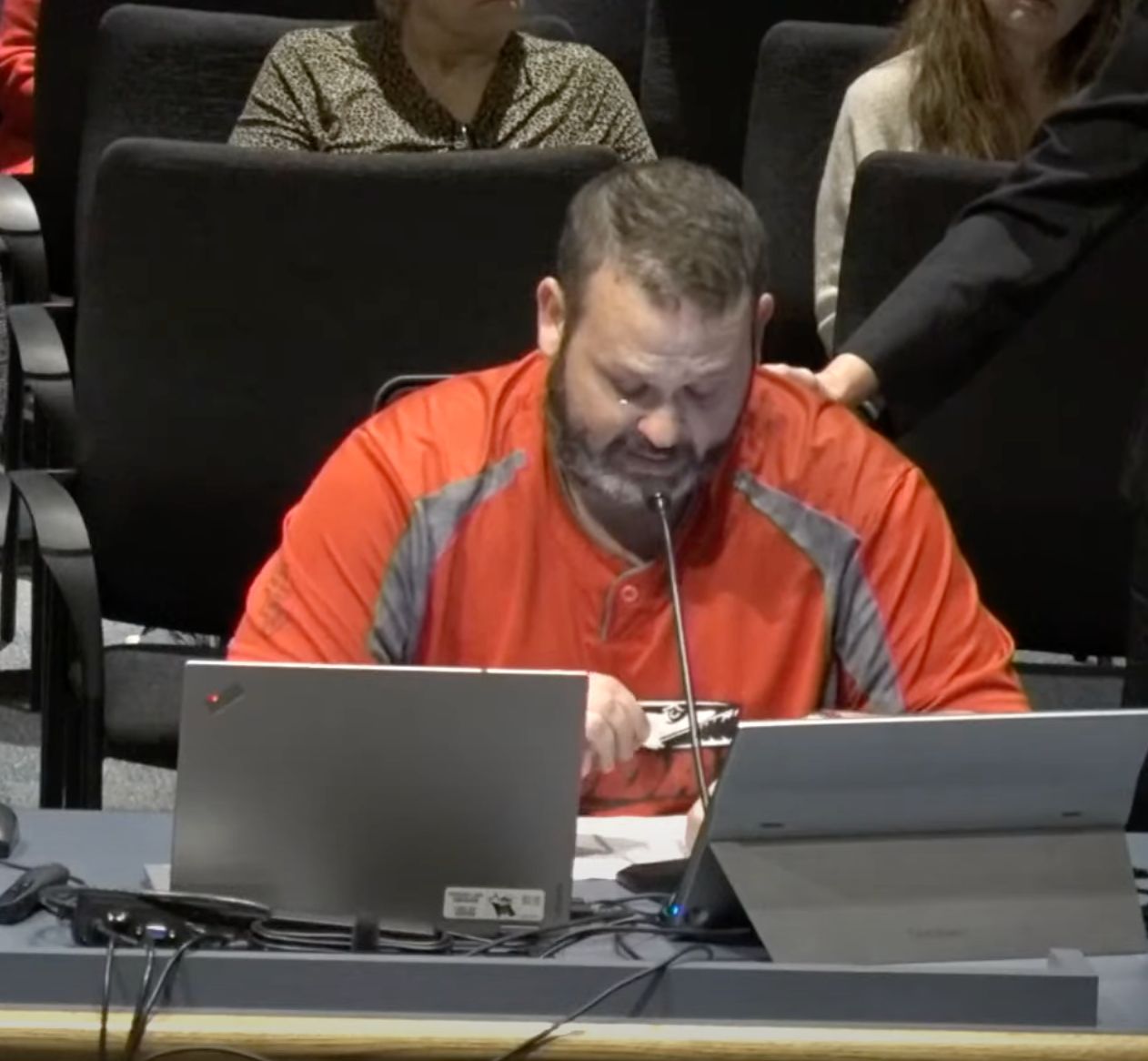
Photo: Boaz Rottem/Alamy.
“For hundreds of years, Rwandans with enough milk would share their supply with those in need,” says the BBC.

You learn something every day. From an article in the New York Times and another at the BBC, I just learned that drinking milk is so popular in Rwanda that milk is the main thing served at the country’s favorite bars.

Abdi Latif Dahir reports at the Times, “As the sun scorched the hilly Rwandan capital on a recent afternoon, a motorcycle taxi driver, two women in matching head scarves and a teenager wearing headphones all separately sauntered into a small roadside kiosk to drink the only thing on tap: milk.

“ ‘I love milk,’ said Jean Bosco Nshimyemukiza, the motorcycle taxi driver, as he sipped from a large glass of fresh milk that left a residual white line on his upper lip. ‘Milk makes you calm,’ he said, smiling. ‘It reduces stress. It heals you.’ …

“Men and women, young and old, sit on benches and plastic chairs throughout the day, glass mugs before them, gulping liters upon liters of fresh milk or fermented, yogurt-like milk, locally known as ‘ikivuguto.’

“Some patrons drink it hot, others like it cold. Some — respecting an old custom of finishing your cup at once — chug it down quickly, while others sip it slowly while eating snacks like cakes, chapatis and bananas. …

“ ‘I come here when I want to relax, but also when I want to think about my future,’ said Mr. Nshimyemukiza, who added that he drinks at least three liters of milk daily.

‘When you drink milk, you always have your head straight and your ideas right.’

“While milk bars have popped up everywhere over the last decade, the drink they sell has long been intrinsic to the country’s culture and history, as well as its modern identity and economy.

“Over the centuries, cows were a source of wealth and status — the most valuable gift to confer on a friend or a new family. Even royalty craved easy access to milk. During the Kingdom of Rwanda, which lasted for hundreds of years until the last king was deposed in 1961, cows’ milk was kept in wooden bottles with conical woven lids right behind the king’s thatched palace.

“Cows were considered so valuable they ended up in children’s names — Munganyinka (valuable as a cow) or Inyamibwa (beautiful cow) — as well as in traditional dances, where women raised their hands to emulate the giant-horned Ankole cows.

“In 1994, Rwanda was the scene of a genocide. … As the country recovered from the genocide, Rwanda’s government looked to cows again as a way to grow the economy and fight malnutrition.

“In 2006, President Paul Kagame introduced the ‘Girinka’ program, which aims to give every poor family one cow. The program has so far distributed over 380,000 cows nationwide, according to the Ministry of Agriculture and Animal Resources — with contributions coming from private companies, aid agencies and foreign leaders including Prime Minister Narendra Modi of India. …

“As milk production increased in this landlocked nation, so did the number of people who moved to urban areas for education and employment. And so were born the milk bars, which allowed farmers to sell their surplus milk and let customers drink copious amounts of it to be reminded of home. Most milk bars are in Kigali, the country’s most-populous city, with 1.2 million people.

“Steven Muvunyi grew up with nine siblings in the Rubavu district in the country’s west. After moving to Kigali to attend university, he said he missed being in the countryside, milking cows and drinking milk without limits.

“I come to the milk bars and I am overcome with nostalgia from my childhood,” he said one evening in late September, as he drank from a big mug of hot, fresh milk in downtown Kigali.

“As he sat at the bar, Mr. Muvunyi, 29, who works in Rwanda’s budding technology sector, showed photos of his 2-year-old son looking at him while he drank a glass of milk at his parents’ farm. He worried, he said, that children growing up in cities would not be as connected to the country’s dairy culture, given the easy access now to pasteurized milk at supermarkets. ‘I want to teach my children early the value of milk and cows,’ he said. …

“No matter the circumstances, Rwandans say the milk bar is here to stay. During the pandemic last year, Ngabo Alexis Karegeya started sharing images and videos on Twitter about the Rwandan attachment to cows and milk — drawing national attention. Mr. Karegeya graduated from university this year with a degree in business administration, but still fondly remembers his days tending cows as a boy. He tweeted a photo of himself in his graduation gown with the caption ‘certified cow-boy y’all.’

“ ‘Rwandans love cows and they love milk,’ said Mr. Karegeya, who owns five cows in the lush hills of his family’s home in western Rwanda and drinks three liters a day.

“ ‘The milk bar brings us together,’ he said. ‘And we will keep coming to the milk bar to drink more milk.’ ”

More at the Times, here, and at the BBC, here.

The Marathon Is Back

The year there was no Boston Marathon.

October 11 is a little different this year. Some people will still be celebrating Columbus Day. (Time, here, explains why some Italians feel positive about the explorer.) Others will recognize Monday as Indigenous People’s Day, honoring the tribes who were here before the arrival of Europeans and the devastation they brought. Rhode Island, for example, plans to use its the PRONK parade to celebrate Native Americans.

And here’s something that hasn’t happened in October before: the Boston Marathon. Erik is running again, so my husband and I will be there, cheering him on.

The Boston Marathon is usually run at the April holiday New Englanders call Patriots Day, the day that in 1775 the “embattled farmers” stood at the North Bridge in Concord “and fired the shot heard ’round the world.”

In 2020, Covid cancelled the Marathon. And 2021 was touch and go, too, until organizers at the Boston Athletic Association decided the pandemic might be under control by October.

Well, it is and isn’t. So there are unusual Marathon protocols in place.

Says the BAA, “Entrants in the 125th Boston Marathon, scheduled for Monday, October 11, will need to either provide proof of vaccination or produce a negative COVID-19 test in order to participate in the fall race. It is strongly recommended that all entrants, staff, and volunteers are vaccinated. Masks will not be required while running the 26.2-mile course, but will be enforced on participant transportation and in other areas in accordance with local guidelines.

“We understand that COVID-19 related-travel restrictions may prevent many international participants from toeing the line in Hopkinton. In recognition of this unique and extenuating circumstance, any Boston Marathon participant who resides outside of the United States can move their entry to the virtual race and be refunded for the difference.

“Prior to bib number pick-up, Boston Marathon participants will be required to either produce proof of a complete vaccination series of a World Health Organization-certified vaccine or produce a negative COVID-19 test, which will be administered on site in a Boston Marathon medical tent.”

According to the Boston Globe, “there will be 14 former champions in the field, with a combined 32 first-place Boston finishes, including two-time men’s winner Lelisa Desisa of Ethiopia, as well as countryman Asefa Mengstu, who has the fastest personal best in the field and the 23rd-fastest marathon ever at 2:04:06.

“The women’s field features nine sub-2:22:00 marathoners, including Ethiopia’s Yebrgual Melese, whose 2:19:36 personal best ranks fastest in the field. Melese will have some tough competition from fellow Ethiopian Mare Dibaba, the 2015 world champion and 2016 Olympic bronze medalist.”

If an aspiring runner hasn’t run the required number of previous races at the required times, she or he can still participate if sponsored by a charity and willing to raise money for it. The Globe says, “There are 41 charity organizations, with 2,090 runners, participating. Over the past 32 years, more than $400 million has been raised for charity.”

And here’s an interesting note: “For the only time in its history, the Boston Marathon will take place on Oct. 11 — which is recognized as Indigenous Peoples Day in cities and towns on the route.

“Patti Catalano Dillon, a three-time Boston runner-up and a member of the Mi’kmaq tribe, will be interviewed at Fan Fest Oct. 8 at 1 p.m. about setting the American marathon record at Boston 40 years ago. She also will serve as an official starter.

“A ceremony will be held Oct. 8 to commemorate the 85th anniversary of Ellison Brown’s first of two marathon titles. A banner will be presented to the grandchildren of Brown, who was a member of the Narragansett tribe.”

More at the Globe, here.

Photo: Upcycle Stitches.
Sashiko is a needlework to reinforce, to repair, to mend, and to decorate the fabric. 

Whenever I hear something good on Public Radio International’s the World, I hope they will post a text version online so I have something to edit, but today’s story is accessible only as audio. So I am combining it with a May 2018 blog post that “atsushijp” wrote at Upcycle Stitches: “Otsuchi Recovery Sashiko Project.” (Atsushijp did us all a favor by sharing this work with a different audience, and I have not tried to tweak her English.)

“It has been almost 7 years since I had encountered this beautiful project: Otsuchi Recovery Sashiko  Project. … After the earthquake followed by Tsunami on March 11th, 2011, the five volunteers established the project to support the people in Otsuchi, especially those who had nothing to do but sitting in the evacuation shelter. The men had a lot of things to require the muscle power after the disaster. The young generation also had many tasks to revive the infrastructure such as distributing the support goods and clean. However, those who wouldn’t be able to move, mostly elderly women, did not have things to do and had to wait. …

“The project tries to create jobs for those who couldn’t do hard labor outside. They have been trying to create the community where anyone can gather for the purpose of stitching. We all then hope that the stitching can be a part of the purposes of their new life after the earthquake. I, Atsushi, first join the project in June 2011. …

“I had written many articles and reports regarding the Otsuchi Sashiko in English, but I had to give them up when my father passed away and the stakeholders decided to shut down the website. Well, even after the sad reality of me leaving Sashiko behind for while, my mother, Keiko Futatsuya, kept in touch with them. Now, she is the advisor of Sashiko technique and designing in Otsuchi Recovery Sashiko Project. …

“Otsuchi town was badly damaged by the earthquake followed by Tsunami, including the loss of town hall and the mayor and more than 1,280 of people’s life. The survivors [who] needed an evacuation shelter by losing their house were more than 9,000 people.

“In the evacuation shelter, mothers and grandmothers, who were very much hard worker in their own house as a house-maker, didn’t have anything to do. There were no kitchen to cook, no living room to clean, no dishes to wash. Men and young generation could work for the cleaning debris, but the job required a lot of muscle power. Mothers and Grandmothers couldn’t help them even if they wanted to. …

“The answers they had come up with was Sashiko, in which requires only a needle, thread, and piece of fabric. The Sashiko was doable in a limited space of the evacuation shelter. The mothers and grandmothers wanted to do ‘something’ instead of just waiting.

“An elder woman who lied down all the day in the evacuation shelter. A hard-working mother who lost her house-making job. A young woman who lost their job opportunity. Everyone in Otsuchi moved the needle with hoping the recovery of Otsuchi. Otsuchi Recovery Sashiko project is their first step to the recovery by women in Otsuchi since June 2011. The Earthquake destroyed the houses and jobs and took away our previous people. We, as Otsuchi Recovery Sashiko Project, would like to re-establish the town of Otsuchi throughout Sashiko by strengthening, mending, and making it more beautiful. …

“When a mother, who enjoy Sashiko, is happy, the household will be filled with smiles. If the household is filled with smiles, the town of Otsuchi will be energetic. When the town of Otsuchi become energetic, everyone in the town and related to the town will be happy. …

“We strongly respect the value of hand-made craft culture with spending so much time and putting the good-heart in it in the era of ‘speed’ and ‘efficiency (productivity)’ with mass-production and mass-information. ‘Hand-Made Craft’ provide us ‘Care’ and ‘Mindfulness (Mental Wellness)’ by thinking of other, and using our own hands.”

More at Upcycle Stitches, here. The audio story at the World, here, covers aspects of the initiative in which men have helped, too.

Photo: Radio TV Suisse/ The Literacy Project.
This is the poster for A is for Angicos, a documentary about an inspired literacy innovator in Brazil.

I was listening to the radio show the World the other day and was impressed by the story of the late Brazilian educator Paulo Freire. Most remarkable — and practical — was the way he approached the problem of adult illiteracy. Respectfully.

Carol Hills produced the report.

Some 60 years ago, Brazilian philosopher and educator Paulo Freire had a bold idea: teach 300 people in a poor, remote town in Brazil to read in just 40 hours of classes.

“His literacy experiment was not only successful — it was hugely influential around the world.

“Freire is best known for his groundbreaking book, Pedagogy of the Oppressed, first written in Portuguese in 1968. The book was later translated into multiple languages. …

“Freire, who died in 1997, was one of the founders of critical pedagogy, a movement that promotes the ’emancipation’ of students in the classroom and emphasizes the political nature of education. This year marks his centenary. 

“Now, a new documentary looks back at the pioneering work of Freire called A is for Angicos, made by Catherine Murphy.

“The 26-minute documentary tracks Freire’s early literacy experiments in the town of Angicos, in northeastern Brazil, where Freire worked with college-aged volunteers to mobilize illiterate villagers to learn to read and write and apply that knowledge to heighten their political consciousness. …

“Murphy joined the World‘s host Marco Werman to talk about the making of her film and Freire’s profound influence in the fields of education and social justice around the globe.

“How did Paulo Freire go about his work in that first experiment in northeast Brazil? This was the early 60s, right? 

“Yes. Paulo Freire mobilized a group of college students to be sort of co-creators with him of a technique to teach literacy in 40 hours to illiterate, mostly rural adults. And they went about designing a vocabulary system together with the people they would teach and choosing what they called ‘generative words,’ which were words in common usage in that region and held night classes to use these words to spark deeper discussion about the state of their lives and the world. …

“How different was that approach from previous approaches to literacy in Brazil?

“Well, they emphatically rejected earlier adult literacy materials that used children’s books, a children’s vocabulary. They created a methodology that used words that were in common usage, a common vocabulary that was co-created with the students and that honored their knowledge and wisdom. They had words like tijolo [‘brick’]​​​​ or ladrillo [’tile’], which are construction materials, but they also used words like povo and voto, which means ‘people’ and ‘vote.’ So, they were raising issues with people about: ‘Can you vote?’ ‘Do you have an identification card?’ … And really connecting them to these sort of larger questions about their lives and sort of social justice issues and trying to involve them in becoming protagonists in their own lives and in the world around them.

“At one point in your documentary, Catherine, we hear Paulo Freire himself talk about how he thinks of education and literacy, giving people power as change agents. … What is the essence of his philosophy, Catherine? 

“Freire talks about education as a tool for transformation. He rejects what he calls the ‘banking system’ of education, which is that you’re basically just depositing information in a person. He promotes what he calls learning to read the word and the world and to create what he also calls critical consciousness and to bring people into being change agents and agents for positive transformation in the world around them. 

“In 1964, a year after the literacy experiment in Angicos. The military came to power in Brazil and it came down hard on Paulo Freire and his methods. What happened? 

“The experience in Angicos was in full course that had the potential to become a national program. [The] coup happened on April 1, and Paulo Freire was taken prisoner the very next day, he was arrested in his home on April 2, 1964, went to jail for about 70 days and was then sent into exile and lived for many years in exile before returning to Brazil.

“He became a global figure, of course, in terms of empowerment education and published many, many books, including his most famous work, Pedagogy of the Oppressed. But the fact that he was on that early, early list of the first people that they arrested is not a coincidence. At one of the previous graduations of the newly literate adults, there were some military figures present that were involved in the coup that would then happen. And seeing this, you know, upsetting of the traditional then sort of largely feudal system in Brazil in which landless peasants were learning how to read and write, registering to vote and taking an active role in changing the world around them, well, that was exactly what the coup was trying to prevent.”

I found the whole broadcast interesting. You can read more at the World, here, or listen to the program itself.

Photo: Singapore Chinese Orchestra.
Ionisers attached to ornamental snake plants in front of the stage improve air circulation with an “ionising curtain” between the performers and audience at a Singapore Chinese Orchestra concert. The idea is to keep people safe from Covid.

I was saddened and surprised the other day when I offended a woman wearing a mask by asking her if she was also vaccinated. We were in a small room where there was little air circulation, and she was there to give me a hearing test.

Sadness was my primary reaction as the question really upset her. But I was also surprised because so many clinics, performance spaces, restaurants, etc. bend over backwards to make patrons feel safe, even if their requests seem unreasonable.

Consider the introduction of snake plants at the Singapore Chinese Orchestra. Toh Wen Li reports for the Straits Times about their role in an unusual air-quality initiative.

“The air was charged with more than just emotion when the Singapore Chinese Orchestra (SCO) staged its first wind concert in months last Saturday (Sept 25).

“As the rousing sounds of the dizi, sheng and suona filled the concert hall, high-tech devices attached to 20 ornamental snake plants in front of the stage created an ‘ionising curtain’ between the performers and audience.

“The ionisers, designed to reduce the spread of Covid-19, induce a negative charge in the air particles around the plants. This pulls positively charged aerosols, droplets and particulate matter towards the leaves of the plants.

“The devices were introduced following a six-month collaboration between the orchestra and the Agency for Science, Technology and Research (A*Star).

“SCO’s executive director Terence Ho hopes these — and a slew of other measures, such as a filterless high-volume air purifier developed by A*Star to be used in the foyer — will give people peace of mind and encourage them to attend live concerts.

” ‘We have to work towards bringing audiences back to the hall and more musicians back on stage,’ he tells The Straits Times, adding that the plant-based ionisers will remain for future concerts at Singapore Conference Hall, home to the SCO. …

“SCO’s suona and guan principal Jin Shiyi, 56, says in Mandarin: ‘Wind players are now a “high-risk” occupation, and we have had fewer opportunities to go on stage. I’m so happy we can perform on stage again.’

“Last Saturday’s wind concert, also available online for streaming, was part of the recently concluded Singapore Chinese Music Festival. It had drawn a physical audience of about 100 people, less than half the permitted capacity of 250 for that venue.

“Mr Ho says audiences are worried about the recent spike in Covid-19 cases. … For now, he is keeping his fingers crossed as the orchestra prepares for two concerts in early October to celebrate the SCO’s 25th anniversary, while taking precautions to reduce the risk of Covid-19 transmission. It has split performers  into separate ‘teams,’ cut down on rehearsals and roped in understudies in case performers are hit by the virus or with a 10-day quarantine order. …

“The orchestra would have launched it even without the pandemic, [Chief executive Chng Hak-Peng ] adds, as a way to maintain ties with local and overseas audiences. Before the pandemic, as many as 10 per cent of SSO’s live audience members were tourists.

“Home-grown charity the Foundation For The Arts And Social Enterprise has also launched a 10-year Music Commissioning Series to support Singapore composers and build up a canon of local contemporary music — from Chinese orchestra and cross-cultural works to jazz and musicals. …

“Founder Michael Tay says: ‘While we have had Singapore composers write works for wind bands and orchestras in the past, we don’t see a systematic plan to encourage the writing of major works (of at least 30 minutes).’ The series, he adds, ‘is meant to plug this gap.’ …

“Despite the resumption of live concerts … life has not returned to normal for orchestras. While live performances with up to 1,000 audience members, subject to conditions, are allowed, most venues can accommodate only a fraction of this after factoring in safe distancing measures. …

“[Mr Chng] adds: ‘Even though we are having concerts, we still have not, for the last year and a half, been able to have our entire orchestra perform together.’

“Then there is the impact on freelancers, who in pre-pandemic times would often perform with the orchestra and give pre-concert talks. …

“Countertenor and freelance choral director and educator Phua Ee Kia, 41, had no income for eight months last year and has not performed since 2019. He has been doing his rehearsals online during the pandemic.

” ‘Conductors are really struggling,’ he says. ‘Not all of us are tech-savvy and we don’t just have to cope with our own (issues), but also have to deal with situations when our students say, … “My screen went blank.” ‘

“Phua, who tapped a training grant to take a course in audio production software Logic Pro, hopes there will be more upskilling opportunities and financial support for freelancers. …

“Phua says: ‘A choir is not formed of just five people. I hope in the near future, we are allowed to gather and sing in a bigger group, albeit with masks on. Some of us are forgetting what it’s like to be able to perform in a bigger group.’ “

More at the Straits Times, here.

Photo: Alan Cressler.
Archaic Period pictograph of a hunter and prey dated to 6,500 years ago. Indigenous art like this in the American Southeast is less well known than that in the Southwest.

You knew that tribes in the Southwest made paintings centuries ago, but did you know that indigenous people were also making art in the caves of the American Southeast? Jan Simek, a professor of anthropology at the University of Tennessee, fills in the blanks for us at the Conversation.

“On a cold winter’s day in 1980,” he writes, “a group of recreational cavers entered a narrow, wet stream passage south of Knoxville, Tennessee. They navigated a slippery mud slope and a tight keyhole through the cave wall, trudged through the stream itself, ducked through another keyhole and climbed more mud. Eventually they entered a high and relatively dry passage deep in the cave’s ‘dark zone’ – beyond the reach of external light.

“On the walls around them, they began to see lines and figures traced into remnant mud banks laid down long ago when the stream flowed at this higher level. No modern or historic graffiti marred the surfaces. They saw images of animals, people and transformational characters blending human characteristics with those of birds, and those of snakes with mammals.

“Ancient cave art has long been one of the most compelling of all artifacts from the human past, fascinating both to scientists and to the public at large. Its visual expressions resonate across the ages, as if the ancients speak to us from deep in time. And this group of cavers in 1980 had happened upon the first ancient cave art site in North America.

“Since then archaeologists like me have discovered dozens more of these cave art sites in the Southeast. We’ve been able to learn details about when cave art first appeared in the region, when it was most frequently produced and what it might have been used for.

We have also learned a great deal by working with the living descendants of the cave art makers, the present-day Native American peoples of the Southeast, about what the cave art means and how important it was and is to Indigenous communities.

“Few people think of North America when they think about ancient cave art. … As the earliest expressions of human creativity, some perhaps 40,000 years old, European paleolithic cave art is now justifiably famous worldwide.

“But similar cave art had never been found anywhere in North America, although Native American rock art outside of caves has been recorded since Europeans arrived. Artwork deep under the ground was unknown in 1980, and the Southeast was an unlikely place to find it given how much archaeology had been done there since the colonial period.

“Nevertheless, the Tennessee cavers recognized that they were seeing something extraordinary and brought archaeologist Charles Faulkner to the cave. He initiated a research project there, naming the site Mud Glyph Cave. His archaeological work showed that the art was from the Mississippian culture, some 800 years old, and depicted imagery characteristic of ancient Native American religious beliefs. Many of those beliefs are still held by the descendants of Mississippian peoples: the modern Cherokee, Chickasaw, Choctaw, Coushatta, Muscogee, Seminole and Yuchi, among others.

“After the Mud Glyph Cave discovery, archaeologists here at the University of Tennessee, Knoxville initiated systematic cave surveys. Today, we have cataloged 92 dark-zone cave art sites in Tennessee, Alabama, Georgia, Kentucky, Virginia and West Virginia. There are also a few sites known in Arkansas, Missouri and Wisconsin. …

“The Mississippian Period (A.D. 1000-1500) is the last precontact phase in the Southeast before Europeans arrived, and this was when much of the dark-zone cave art was produced. Subject matter is clearly religious and includes spirit people and animals that do not exist in the natural world. There is also strong evidence that Mississippian art caves were compositions, with images organized through the cave passages in systematic ways to suggest stories or narratives told though their locations and relations.

“In recent years, researchers have realized that cave art has strong connections to the historic tribes that occupied the Southeast at the time of European invasion.

“In several caves in Alabama and Tennessee, mid-19th-century inscriptions were written on cave walls in Cherokee Syllabary. This writing system was invented by the Cherokee scholar Sequoyah between 1800 and 1824 and was quickly adopted as the tribe’s primary means of written expression.

“Cherokee archaeologists, historians and language experts have joined forces with nonnative archaeologists like me to document and translate these cave writings. As it turns out, they refer to various important religious ceremonies and spiritual concepts that emphasize the sacred nature of caves, their isolation and their connection to powerful spirits. These texts reflect similar religious ideas to those represented by graphic images in earlier, precontact time periods. …

“That archaeologists were unaware of the dark-zone cave art of the American Southeast even 40 years ago demonstrates the kinds of new discoveries that can be made even in regions that have been explored for centuries.”

More at the Conversation, here.

Clown Shortage

Photo: Pacemaker.
Noeleen and Henrik Fries Neumann on their wedding day in 2017. Clowns are serious about clowning.

One of my brothers performed as a clown for years at his church. In his other life, he was a professor doing research into how the immune system works. The great thing about clowns is how they help you look at things differently. Now that I think about it, that’s what scientific research does, too.

I thought of that brother when I read today’s story about how Covid and Brexit have caused a serious shortage of clowns in Northern Ireland.

In case you haven’t already heard more than enough about Brexit (the United Kingdom’s decision to leave the European Union), you can read up on the Northern Ireland complication at Wikipedia, here.

In a nutshell, Ireland itself is still enjoying all the benefits of being in the EU, but Northern Ireland, since it is part of the UK, has to have special treatment so it can still do a lot of what it used to do — and not reignite friction with its neighbor. Add Covid to that and what you have is a royal mess!

To see the problem in microcosm consider the shortage of clowns.

The BBC reports, “There’s a lot more to being a clown than just putting on a big red nose and a big baggy pair of pants. That’s according to David Duffy, co-owner of Duffy’s Circus, who is appealing for people from Northern Ireland to become clowns.

“The Covid-19 pandemic has caused a shortage of the performers, as many returned to their home countries when the first lockdown came into force in early 2020, according to Mr Duffy.

“But what makes a good clown?

” ‘Someone who’s willing to make themselves vulnerable,’ says Noeleen Fries Neumann, known professionally as Silly Tilly.

” Not everybody likes to be laughed at but for someone who is a clown, your worst nightmare would be to not be laughed at,’ Mrs Fries Neumann told the BBC’s Good Morning Ulster programme.

‘You have to be able to poke fun at yourself, it’s not about poking fun at other people.’

“During lockdown, Mrs Fries Neumann and her husband Henrik, who is also a clown known as Jarl, set up a big top circus tent in their garden, allowing them to continue to rehearse and perform.

“The couple first met at an international clown festival, before having a clown themed wedding in 2017.

“[Lockdown] was hard for Mr Duffy and his circus has been closed for more than 500 days. …

” ‘Because all the circuses in Europe and in England have been up and operational for the past six months, that huge pool of EU artists are already back at work and up until last week we haven’t been able to even get visas issued for non-EU artists and entertainers,’ Mr Duffy said.

” ‘That’s why we’re trying to reach out for any of our folks at home who feel that they can give it a go.’

“In order to be a clown, Mr Duffy says you have to be ‘really, really adaptable’ and be able to think on your feet. …

” ‘A clown actually can be the loneliest place because you’re in there on your own and you have to be able to read your audience, in a short couple of minutes you have to be able to get a rapport going with them and interact and feed off them.’

“Aspiring clowns will be performing a short piece during online auditions being held by Mr Duffy as he tries to recruit a new team of performers.” More at the BBC, here.

You know, some of the best clowns in the business worked for Ringling Brothers Barnum Bailey circus and attended the company’s clown school in Florida. Now that the circus is out of business, maybe there’s a clown or two who would consider relocating to Northern Ireland. What do you think?

Photo: International Mermaid Museum.
This mermaid museum is in Washington State. It opened about the same time as one in Maryland.

I have a granddaughter who is into mermaids big time. And my friend Asakiyume has done considerable research on people who give expression to their inner mermaid on a regular basis. (See Asakiyume’s interview with a “mer-tail maker,” here.)

So I’m not as surprised as some folks might be that the interest in mermaids is enough to support two museums in the US, at least for now.

Hakim Bishara reports at Hyperallergic, “A curious, almost mystical coincidence occurred earlier this year when two separate mermaid-themed museums debuted almost simultaneously on opposite ends of the United States. First, it was the Mermaid Museum in the town of Berlin, Maryland, which opened its doors on March 27. Days later, on March 29, the International Mermaid Museum started welcoming visitors outside the coastal town of Aberdeen in Washington state.

“So, how can we explain this coast-to-coast siren call in the span of one week last spring? According to the respective founders of the two museums, Alyssa Maloof and Kim Roberts, they were just as surprised as anyone at the concomitance of their mermaid-centric projects. …

“Variations of the myth of fish-tailed people, first appearing in Mesopotamian art from the Old Babylonian Period, exist in nearly every oceanic culture, from Europe and the Americas to the Near East and Asia. Their magic endures, as evidenced by the stories behind these two new American mermaid museums.

“Both museums are self-funded, women-led projects that hold personal importance to their founders. And both happen to be located about nine miles from the ocean.

“Maloof, a visual artist and photographer, lived between Philadelphia and Berlin, Maryland, since 2018, until she eventually permanently settled in the small seaside town with her 7-year-old. She rented a studio space and prepared for a new chapter of her life and career, but then COVID-19 happened, forcing her to conjure up a new plan.

“It’s around then that the second floor of a 1906 building — built by the secret society of the International Order of Odd Fellows, as a wall insignia testifies — became available. Maloof used her savings to purchase the 2,200-square-foot space and started conducting research and collecting items for the museum.

“ ‘I thought of it as re-feminizing the space,’ she told Hyperallergic in a phone conversation, explaining that the project was a long-held dream driven by her ‘love of the feminine and the water.’

“Accrued from thrift shops and internet sites like eBay, the museum’s collection spans dozens of mermaid-related artifacts, most prominently a Fiji Mermaid, a mythical half monkey-half fish said to have been caught off the coast of Fiji. …

“The museum also features a timeline of mermaid sightings by sailors and pirates from the first century CE to as recently as 2017. It also offers activities for children, including a scavenger hunt and an opportunity to dress up like a mermaid. The Mermaid Museum’s gift shop sells aquatic paraphernalia crafted by local artists. …

“Thousands of miles away, on the other side of the country, the International Mermaid Museum is a nonprofit created with an educational mission to teach ocean ecology ‘from seashore to seafloor’ through mermaid mythology. According to Roberts, the museum is currently developing a curriculum for school children and will soon launch a scholarship program for individuals who wish to work in the marine industry. The museum’s board of directors is comprised entirely of local women leaders with an interest in ocean preservation.

“Roberts is an architect, author, and local entrepreneur who runs several businesses in Aberdeen with her husband Blain, an underwater photographer. … Roberts, a pioneering boat captain, has also authored three mystery novels set on Maui, where she and her husband formerly owned the island’s largest scuba charter.

“Roberts is also a venerated member of the West Coast mermaid community. In July, she received the 2021 Mermazing Citizen Award from the Portlandia Mermaid Parade and Festival. …

“Portland, Oregon, is home to one of the biggest modern-day mermaid societies in the country. Other groups are active in Seattle, California, Florida, and New York. They are part of a global community of merpeople (or ‘mers’) of all genders, who commune to swim together in mermaid costumes and tails. … They have a vibrant online community and local pods and meetup groups that organize conventions, festivals, and competitions. …

“The idea of creating a mermaid museum occurred to Roberts when a friend sent her a shipment of special seashells, among them a single ‘mermaid comb,’ also known as the Venus Comb murex. ‘That’s when it’s all clicked,’ she said. The museum was set to open in March of 2020, but because of the COVID-19 lockdown, the official opening was postponed to March 29 this year, which marks the annual International Mermaid Day.”

More at Hyperallergic, here. And if you have a middle grade reader who likes mer people, there are a few in Eva Ibbotson’s wonderful children’s fantasy Island of the Aunts, which has a not exactly hidden theme about protecting the sea.

Sustainable Fashion

Photo: Jill Mead/The Guardian.
Fleur Britten with Simon Johnson at Pattern Project in south London. Covid got people going with sewing their own clothes. Sustainability concerns could make them continue.

Unlike me, not everyone is OK with wearing the same clothes for 30 years. But even fashionistas are starting to worry about how much clothing ends up in landfills or is sourced from factories paying slave wages.

Fleur Britten has an article at the Guardian about being mindful while having fun making her own clothes.

She writes, “My foot hovers nervously over the sewing machine pedal. I am cautiously working my way through a sew-it-yourself kit produced by Pattern Project, a ‘microfactory’ startup in south London. It has pioneered a laser-cutting machine that can cut patterns on demand, with minimal waste. The pieces for the dropped-sleeve dress that I am sewing have been snipped to my precise measurements by a zippy little laser, which whizzes over the crisp Irish linen, scorching faint seam guides into the fabric so I know exactly where to sew.

“Pattern Project’s founders, Shruti Grover, 34, and Simon Johnson, 35 – partners in life and in business – are seeking funding for their first shop. A ’22nd-century’ vision of fashion, says Grover, it will hold no stock, but will sell custom-fit clothing that is laser-cut in front of you within minutes, out of local, ethical and sustainable fabrics – and then sewn by you.

“They have already collaborated on a zero-waste pattern for the latest collection by the fashion designer Phoebe English, while last weekend they exhibited at the V&A in west London as part of the London Design festival. …

“The sew-it-yourself (SIY) movement has become something more modern, sustainably minded and social. For starters, sewers have been rebranded as ‘sewists’ – because who would want to be mistaken for a waste pipe? Plus, thanks to a new wave of independent pattern-makers, it is not hard to find on-trend designs, downloadable in pdf format anywhere in the world. …

“According to Jones, the new customers are ‘young and mostly female, against fast fashion and much more switched on about environmental issues.’ Many are motivated to sew because it enables them to avoid sweatshop production. …

“There is plenty of support available for newbie sewists, too. The Fashion District festival, a five-day celebration of sustainable fashion that took place last week in Stratford, east London, dedicated a third of this year’s programme to maker workshops, including a tutorial on upcycling scarves into kimonos, hosted by the community interest company Trashion Factory.

‘There’s a huge appetite for people to be involved in their own fashion,’ says Helen Lax, the festival’s founder. ‘This is a different incarnation of the good life. Rather than just following a pattern, the maker community is going off-grid and having a go. …

“For many sewists, the face mask was a gateway drug. After spotting a callout for 500 cloth masks from a homeless charity, Lydia Higginson, the founder of Made My Wardrobe sewing kits, rallied her followers to help. ‘It was a quick win – the perfect small challenge to get people back on their machines,’ she says. ‘And then they were like: “What else can I make?” ‘ …

“While you will find only British and European organic fabrics at Pattern Project (as well as an Italian polyamide that they claim will biodegrade about five years after disposal), the bigger fashion problem it wants to solve is overstock. It is estimated that 20% of the 100bn items of clothing produced each year are not sold; they are then usually buried, shredded or burned. ‘Brands always over-order,’ says Grover. ‘It’s cheaper to produce more and sell at mad discounts later than it is to produce less, but higher-quality, stuff.’ Pattern Project’s ultimate goal is to see its zero-waste laser in fashion stores and haberdasheries across the country, so clothes can be cut and sewn on demand, affordably and quickly.

“In the meantime, the sewists are playing what they call ‘pattern Tetris – making patterns fit into a smaller amount of fabric,’ says Atia Azmi, 38, a GP and a host of un:CUT: The Makers’ Podcast. According to the government’s 2019 report Fixing Fashion, ‘as much as 15% of fabric can end up on the cutting room floor … Hundreds of thousands of tonnes of fabric are wasted at the design and production stage before clothing reaches the customer.’ Within the sewing community, downloadable zero-waste patterns have blown up online.

“Reducing ‘fashion miles’ – the distance a garment and its component parts travel through the supply chain – is also on the sewists’ agenda. The starting point for the newly opened Mend Assembly in Totnes, Devon – a two‑storey centre offering a makers’ space, dressmaking workshops, repairs and upcycling – was ‘clothing localism,’ says its co-founder, Joss Whipple.

“As well as utilising ‘existing waste streams’ (upcycling old sweatshirts into kids’ leggings, say), Mend Assembly hopes to work with the regenerative ‘farm-to-clothing’ concept of the non-profit group Fibershed, whereby local demand for clothing is met by using local, natural fibres in a closed loop. ‘We believe that when clothing becomes aligned with local practice, so many of the problematic elements of the global commercial model fall away, from reduced carbon and transport to deeper connection, respect and care for the clothes that we own and wear,’ says Mend Assembly’s website.”

More at the Guardian, here.

Photo: Erika Page/The Christian Science Monitor.
“Craig Watson (left), Keela Hailes (center), and Shannon Battle – seen here at the office of Free Minds Book Club & Writing Workshop in Washington on June 21, 2021 – form a network of support for formerly incarcerated individuals
,” reports the Monitor.

If you were following this blog five years ago, you might have caught the post about Norway’s enlightened prison system, which focuses less on punishment than on rehabilitation (here). Whenever I read about the system in the US and remember Norway’s impressive success, I just feel sad.

In this country, it’s pretty much up to nonprofits and volunteers to reacclimate ex-offenders to society and prevent recidivism. Today’s story is about one such effort, one that a certain US prison allows to enter its walls.

Erika Page reports at the Christian Science Monitor, “Craig Watson only showed up at that poetry workshop back in 2015 because his prison compound’s championship basketball game was canceled. ‘I was just sitting there, like, “I don’t write poems. I don’t rhyme,” ‘ he recalls, chuckling.

“The facilitator from Free Minds Book Club & Writing Workshop told him to forget about rhyming and just express himself. The blank page in front of him began to fill up. Poetry offered an outlet for expressing difficult feelings about a childhood marked by violence. During community ‘write nights,’ Free Minds members gave him positive feedback, and he began to lean into that network of support.

“Free Minds, founded in 2002, operates book clubs and writing workshops in prisons around the United States and at the jail and juvenile detention center in Washington, offering constructive connections among its nearly 2,000 members. Members never ‘graduate’ but remain part of the organization for life; thousands are on its waitlist.

When incarcerated people are released, Free Minds helps them find their feet back home through its reentry program. 

“When Mr. Watson returned from prison through the Second Look Amendment Act in 2019, he had 22 years of catching up to do. Free Minds helped him with practical things, like finding his first job, but most important, the organization became an extended family that kept Mr. Watson from becoming another statistic.  

“Every year, the U.S. releases 7 million people from jail and more than 600,000 from prison. Of the latter, more than two-thirds are rearrested within three years. Many return to communities of historical underinvestment with limited education and weak social support. Criminal records make the job search difficult, and drug use and suicide rates are high, according to a report by the Office of Disease Prevention and Health Promotion. 

“Free Minds offers its 330 reentry members workshops, coaching, counseling, group support, and connections to opportunities. But during the pandemic, Mr. Watson, who was serving as a Free Minds poetry ambassador, noticed he wasn’t hearing from a lot of reentry members.

“So in January, he presented his idea: a formalized peer support program, with the goal that every reentry member would have someone to talk to who had been through it themselves. Today, Mr. Watson is one of 12 peer supporters guiding others through the emotional and logistical challenges of starting over after incarceration. That level of peer involvement is key to the success of reentry, experts say. …

“Mr. Watson traces his journey as a peer supporter back to a time in solitary confinement in 2005. In many prisons, incarcerated people sent to solitary confinement end up doubled up in cells together. His cellmate had just learned of the death of his mother. Mr. Watson sat with the man, though he barely knew him. The two talked, heart to heart. Mostly, Mr. Watson listened. When his time in solitary confinement ended, Mr. Watson voluntarily stayed longer, to be there for his new friend. 

“ ‘I know how important it is to have somebody when you’re going through something,’ says Mr. Watson. …

” ‘The prison system is designed to break ties, to separate the person who is incarcerated from their community,’ says Tara Libert, co-founder and executive director of Free Minds. She says that peer support does the opposite. ‘They repair, restore, and create new community connections which are essential to successful reentry.’ …

“The peer supporters say that helping others helps them heal, too.

“ ‘After talking with them, we understand what our family was going through – our mothers, our sisters, our brothers,’ says Mr. Watson. ‘That’s where that connection really builds.’ ” 

More at the Monitor, here.

Photos from September

In March 1990, thieves broke into Boston’s Isabella Stewart Gardner Museum and “cut Rembrandt’s ‘Christ in the Storm on the Sea of Galilee‘ and ‘A Lady and Gentleman in Black,’ ” among other works, from their frames.

A renewed flurry of interest in the 1990 art heist at the Isabella Stewart Gardner Museum occurred the week that my husband and I took Minnesota friends to see the collection.

It was the week that “Robert V. Gentile, a Connecticut mobster long suspected by federal authorities of having information about the whereabouts of $500 million worth of masterworks stolen from Boston’s Isabella Stewart Gardner Museum decades ago,” died. (See Boston Globe story.)

Visitors still flock to see the blank places where the missing pieces were once exhibited, and the museum staff is well primed on details. (Our friends asked one guard how long it took the thieves to get in and out with the goods. “Eighty-one minutes,” he answered promptly.)

So today I will share some pictures from our visit as well as a few other photos of the season.

Isabella Stewart Gardner, seen in the portrait below, was an unusual, wealthy woman who imported the courtyard and many other rooms and reconstructed them in the mansion that became a museum. She insisted in her will that nothing ever be changed after her death.

That posed a challenge for trustees. So in recent years, a separate building was constructed and connected to the mansion museum. In the new building, we saw the Titian exhibition, which features a series of paintings that Titian created between 1551 and 1562 for King Philip II of Spain. The most famous of the series is a painting Gardner actually owned.

The scenes of violence against women from Roman Mythology have forced curators to jump through a few hoops. Read about that here.

I have included a photo of the fireplace in the Dutch Room, the room from which most of the art works were stolen, and 15th century artist Paolo Uccello’s “A Young Lady of Fashion.”

The sculpture of ballet feet was outside the Mass College of Art, where we sat for a while to chat with our friends without masks that day.

Later, when I was back home, I shot the formal garden of a house in town, thinking how much it reminded me of the Gardner courtyard.

Also in town, there was a neighborly Porchfest once again, having been canceled last year because of Covid.

For the red flower picture, I very carefully tried to exclude all the clutter around it, but there is still an orange traffic hat peeking through in back. The next shot features a creative Toyota bumper.

Finally, a few photos from Rhode Island — a wall of giant stones and a Blackstone Park Eagle Scout project that created an activity space for children.

Photo: Zuni Youth Enrichment Project.
By incorporating the Zuni people into the planning, design, and execution, a unique park in New Mexico addresses health on multiple levels.

Call it the department of “Don’t tell people what they need. Ask them.” It’s a bit of wisdom that organizations and government entities proposing to do good have been trying to apply to their work for years now. Unfortunately, past failures mean they first have to overcome suspicion.

Amanda Loudin reports at Shelterforce, “Six artists reside in the Shack family home in Zuni Pueblo, New Mexico. While that many artists living under one roof is an anomaly, in the Zuni tribe there’s at least one artist living in nearly 70 percent of households, according to a study by the University of New Mexico. Art is part and parcel of the tribe’s history and culture.

“The Zuni Youth Enrichment Project (ZYEP) understands this, so when it began planning a new youth center and park in 2015, Zuni artists and community members were invited to play a central role in the design and execution of the project.

“Their opinions and their art were woven into the fabric of the process from start to finish. The end result is the 2.5-acre H’on A:wan, or ‘Of the People,’ Community Park, which officially welcomed youth and the wider tribal community in 2018.

“ZYEP is a grassroots nonprofit founded by community members with the mission of enhancing the health of the tribe’s youth, who number 2,900 of the 10,000 tribe members. Zuni households face many challenges, including systemic poverty, which affects one in two Zuni families with children. And poverty, of course, is closely linked to health.

“Daryl Shack, one of the six artists in his Zuni household, played an integral role in the youth center/park project. ‘I kind of became involved by accident,’ Shack says. ‘We had a Main Street Art Walk project underway, and I was already involved in that to help ensure the modernization included a cultural aspect to it. When I heard about the park project, I wanted to learn more.’

“Funding for the park and community center originated with ArtPlace America, a 10-year collaboration among federal agencies, foundations, and financial institutions. … By design, the projects involve artists, culture bearers, and community members in every step of the planning and implementation.

“With the grant money, ZYEP set its sights on developing a center for youth that would benefit their spiritual well-being. To ZYEP, this meant Zuni art, history, and culture needed to be integral to the project. But Zuni youth also need access to safe spaces to play and be physically active, says ZYEP Executive Director Joe Claunch.

“ ‘We were well aware of the fact that they lacked space where they could run, play, and fall down without getting injured — every surface was either concrete or desert,’ he says. ‘The park represents a green space that celebrates Zuni identity and [is a] safe place where kids and families could engage in a range of healthy activities without concern.’

“Like many kids today, the Zuni youth have access to technology, which can quickly override cultural influences and healthy traditions. ‘Kids can get stuck on technology and start practicing a sedentary lifestyle, planting the seeds for preventable diseases,’ says Claunch. …

“The original intent for the park goes back more than a decade. ‘We had a local pediatrician who heard too many times from youth that they had nothing going on in their summers,’ Claunch explains. ‘He recognized that they needed healthy spaces and places, not just activity.’ …

“On a spiritual/emotional level, [the park] is a supervised space with a positive, culturally sensitive staff in place to encourage healthy activity. ‘We provide training to our staff that focuses on the strengths of the community, the family, and the youth.’ …

“In 2014, ZYEP approached the Zuni Tribal Council about acquiring land to develop the park and community center. Together, they found a spot near the center of the village, and ZYEP leased 2.5 acres. A year later, they applied for the ArtPlace America grant. …

“Typical government-sponsored development brings with it an institutional look, says Claunch, rather than a cultural look. Think chain link fences, sometimes even topped with barbed wire, which is unwelcoming and devoid of character. The same goes to new housing developments, which are designed for the nuclear family, rather than the extended family commonly found in Zuni culture. A government-designed home will look like a typical two-to- three-bedroom home, whereas a traditional Zuni home will house three to four families living under one roof — much larger in structure with large communal spaces for family functions like meals.

Having a recent history of development that often neglected the role of Zuni culture meant that when approached by ZYEP, community members were initially skeptical about the good intentions of the project. …

“Like others in his community, Shack came to the table with a healthy dose of skepticism. ‘Usually, grants come into Zuni and the planning and models are made, the meetings are held and that’s where it ends,’ he says. ‘When the park project was directed to the artists community, I was hesitant but interested.’

“Shack’s first introduction to the project was in a large-scale meeting he attended to listen in and hear about the planning process. ‘Subsequent meetings were smaller, and that’s when I decided to sign on,’ he explains.

“From the get-go, says Claunch, ZYEP aimed to build trust in the community, and did it by engaging residents in conversation. ‘We didn’t make any promises but assured them that over time, we’d show them we were serious about having them shape decisions,’ he says. ‘The artists took on the role of advocates and cast the vision. They also took the feedback and concerns from the neighbors, often in the Zuni language. If it weren’t for the artists, we wouldn’t have gotten anywhere.’ ”

Read more about how this beautiful park came together at Shelterforce, here.

Goat vs. Wildfire

Photo: Goat Green LLC.
Lani Malmberg “contracts with federal, state, county, and city governments, homeowners associations, and private landowners for noxious weed control, fire fuel load abatement, re-seeding, watershed management, and land restoration.

While we’re on the subject of fungi and their role in improving soil, how about the work that goats are doing? Goats are not as ubiquitous as mushrooms, but they can really help restore damaged land and even prevent wildfires.

Coral Murphy Marcos reports at the New York Times, “When megafires burn in unison and harsh droughts parch the West, local governments, utilities and companies struggle with how to prevent outbreaks, especially as each year brings record destruction.

“Carrying an unconventional weapon, Ms. Malmberg travels the American West in an Arctic Fox camper, occupying a small but vital entrepreneurial niche.

“Ms. Malmberg, 64, is a goat herder and a pioneer in using the animals to restore fire-ravaged lands to greener pastures and make them less prone to the spread of blazes. She developed the fire-prevention technique in graduate school and is among a few individuals using grazing methods for fire mitigation. …

“Ms. Malmberg works with her son, Donny Benz; his fiancé, Kaiti Singley; and an occasional unpaid intern. The team runs on the goats’ time and have their dinner only when the day’s job is done. They arrive early and open the trailer. The goats jump out, ready to eat, as Ms. Malmberg watches that they don’t stray. The team sets up an electric fence to confine the goats and their meals to a specific area overnight.

After the goats digest the brush, their waste returns organic matter to the soil, increasing its potential to hold water.

“Goats are browsers that eat the grass, leaves and tall brush that cows and other grazers can’t reach. This type of vegetation is known as the fire fuel ladder and leads to wider spread when wildfires spark. More than quell a fire, Ms. Malmberg aims to prevent it from even starting. ‘By increasing soil organic matter by 1 percent, that soil can hold an additional 16,500 gallons of water per acre,’ said Ms. Malmberg. ‘If helicopters come and dump water on the fires, nothing is done for the soil.’ …

“ ‘Lani is a leading example of someone who has carved the pathway and is a trailblazer in this industry of prescribed grazing,’ said Brittany Cole-Bush, one of Ms. Malmberg’s mentees and the owner of Shepherdess Land and Livestock in Ojai Valley, Calif. ‘We want to support ecology as much as possible. We want to support the growth of native perennial grasses.’ Ms. Cole-Bush, who uses goats and sheep in her business, believes that fortifying perennial grasses, rather than planting grass annually, will make the land more tolerant of drought.

“Ms. Malmberg, who has a master’s degree in weed science from Colorado State University, spends most of the year traveling around the West on jobs. Last year, for the first time, the Bureau of Land Management contracted Ms. Malmberg and her goats for fire mitigation in Carbondale, Colo. …

“Ms. Malmberg’s assignments can take anywhere from a day to six months; she prices them after evaluating the site. In late August, she was hired to work on a property in Silverthorne that took six days and cost more than $9,000.

“At the beginning and end of every job, Ms. Malmberg asks the spirits in the area to protect her herd. She lights a ceremonial stick of tobacco and calls out to introduce herself, an intruder on the land, to the animals living there. …

“The work can take longer because of on-the-ground conditions. The Carbondale mitigation project was pushed back three weeks because mudslides caused by last year’s wildfires had closed Interstate 70, the state’s main highway

“Scientists say that wildfires have become hotter, more intense and more destructive in recent years.

“Experts attribute the longer and more ferocious fire seasons to climate change. Wildfires in the West are growing larger, spreading faster and reaching higher, scaling mountains that were once too wet and cool to support them. Studies have shown that wildfires are leading to skin damage and premature births.

“The cost of fire suppression has doubled since 1994 to over $400 million in 2018 — a cost, Ms. Malmberg notes, that doesn’t account for how people are affected by the loss of their land and homes.

“ ‘How do we value the nest that supports us?” Ms. Malmberg asked. ‘We’re just about out of time to change the ways of how we do things.’ ”

Amanda Lucier’s excellent photos of Malmberg’s work are at the New York Times, here. You can also search this blog on the word “goat” for related stories. I’m kind of a fan of goats.

Mushrooms Mushrooming

Last night my husband reported that Massachusetts had just experienced its wettest July ever, breaking the record set in 1938.

Now, if you live in New England, you have no need to be told what happened in 1938. Most of us call it the Hurricane of ’38, and many books have been written about it. The one I loved had the awesome title A Wind to Shake the World. My mother experienced that wind firsthand.

But today’s post is not about hurricanes: its about wet weather and what follows it. Because lately on my walks, I’ve been noticing an unusual number and variety of mushrooms blooming in the wet. (Does one say “blooming” in regard to mushrooms? Let’s say they are “mushrooming.”)

I’ve blogged about mushrooms before. Last year’s Love for Fungi post described how these natural wonders “knit Earth’s soils into nearly contiguous living networks of unfathomable scale” and may ultimately save the planet.

I love the idea of anything knitting the world together without boundaries. Just imagine how wonderful it would be if we took the concept a step farther and began advocating for earthworm diplomacy — a kind of interaction among nations recognizing that certain aspects of borders are about as meaningless for humans as they are for an earthworm. Consider Covid. Consider climate change.

Anyway, here are the kinds of mushrooms our wettest July has engendered: speckled, yellow, red, blue , bizarre … I wind up with a window photo of something Lena Takamori, a mushroom-inspired artist, created.

Would love to see mushrooms from where you live.

Photo: Lover’s Eyes: Eye Miniatures from the Skier Collection.
Gold brooch surrounded by a rope of brown hair (ca. 1835), an example of a short-lived craze in England.

King George IV of England was a pretty wild youth, and when he clapped eyes on one commoner that he knew he would never be authorized to marry, he sent her a picture of his love-at-first-sight eye. She sent an eye picture back. They married in secret, a marriage later abandoned.

But England was left with one of those nutty crazes for which it is is well known.

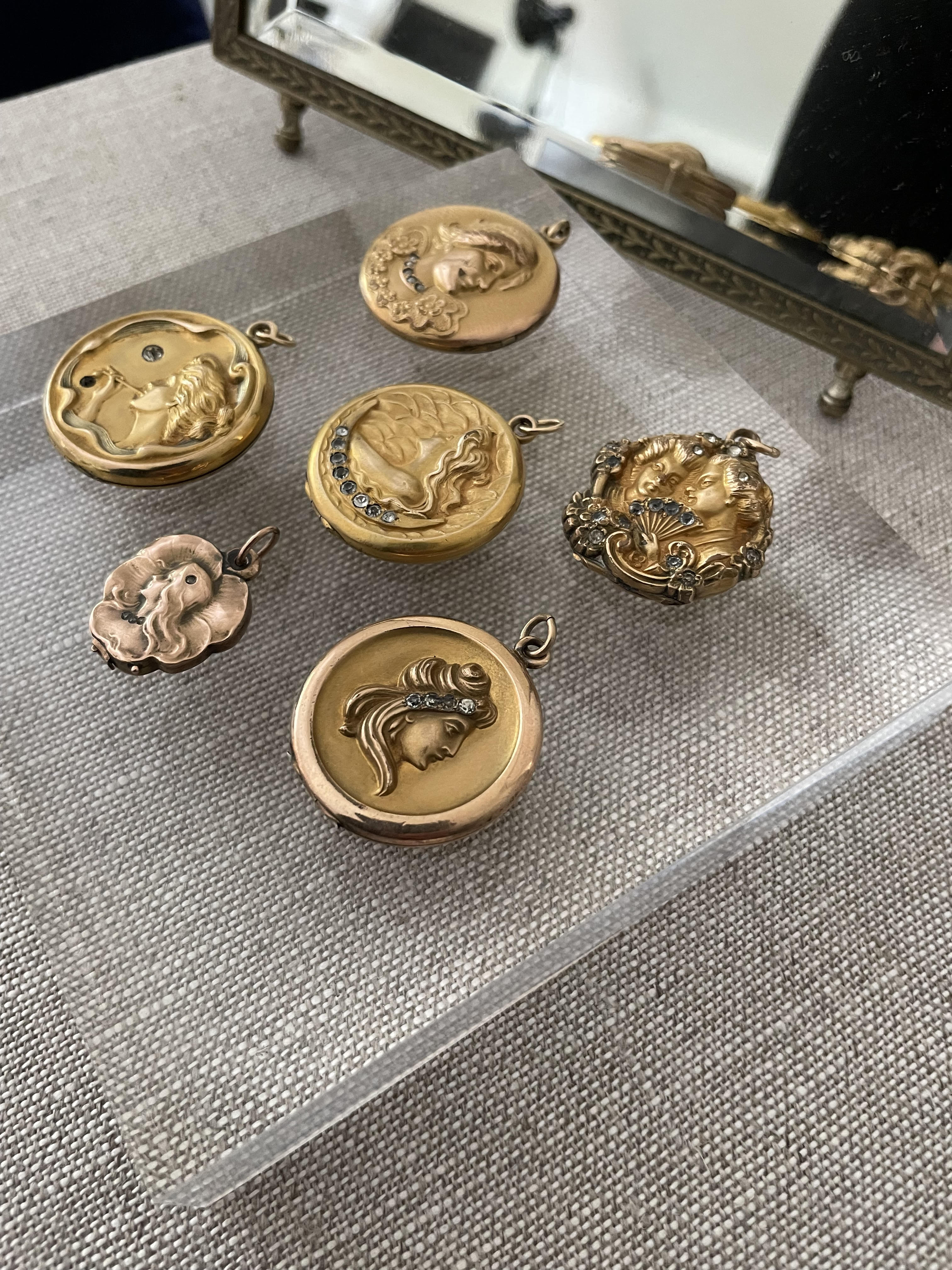
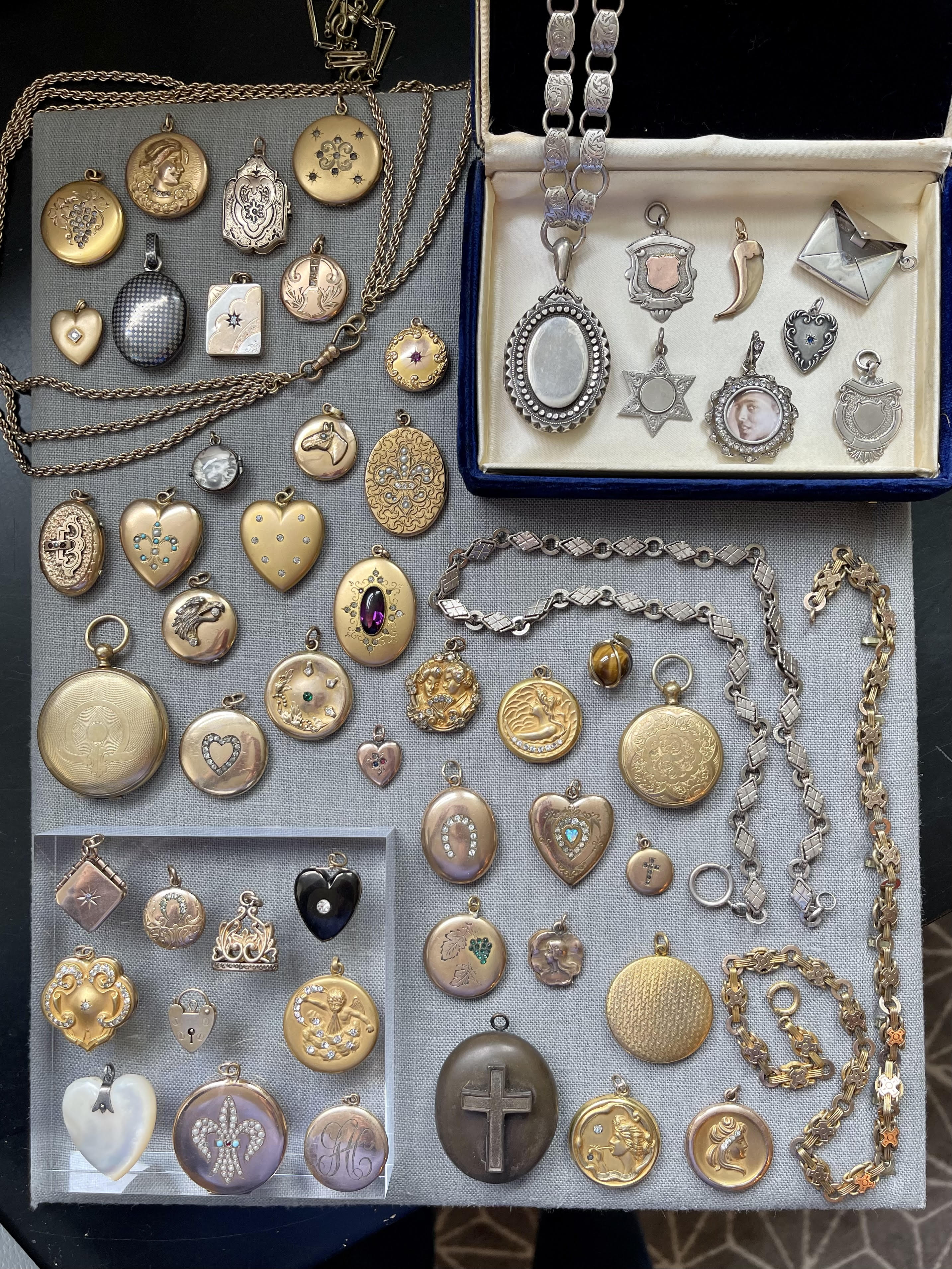
“Lover’s eyes” became a thing. The fact that they were worn close to the heart on lockets and pendants makes me wonder if the antique-locket side of Suzanne’s jewelry business, Luna & Stella, might have come across any.

Lauren Moya Ford reports at Hyperallergic on a new book about a collection of the mysterious miniatures.

“From the moment the Prince of Wales (later, King George IV of England) laid eyes on Maria Firtzherbert at the London opera in 1784, he knew it was love. But Fitzherbert, a Catholic, twice-widowed commoner, knew that British law would never allow their union. She fled to France to escape the future king’s ardor, but Fitzherbert’s absence only inflamed the prince more. In his passion, he sent Fitzherbert a miniature portrait of one of his eyes. She reciprocated with her own eye miniature, and one month later, the two were married in a secret ceremony. The scandalous tale of love at first sight set off a craze for eye miniatures across England that would stretch for nearly four decades. 

“A new book, Lover’s Eyes: Eye Miniatures from the Skier Collection (D Giles Limited, 2021) edited by Elle Shushan, features a richly illustrated cache of over 130 of these bejeweled, hand-painted treasures. Eye miniatures are typically made of painstakingly detailed watercolors on polished pieces of ivory, and surrounded by carved gems, enameled metals, and human hair. These exquisite, enigmatic objects are frequently unsigned, making the majority unattributable to a single artist, and because they depict only a single eye and sometimes a stray lock of hair or eyebrow, the sitter’s identity is also often obscured. …

“Most lovers’ eyes were worn as jewelry, especially on brooches, lockets, and pendants worn close to the heart. Others decorated small functional boxes and etuis used to hold toothpicks, false beauty marks, and other trinkets. Most eye miniatures were exchanged between lovers, though they were also given to close friends and family members. Others were produced as memorial tokens after a loved one’s death. In this case, the eye is often surrounded by clouds to symbolize the subject’s ascent from earth.

“But it wasn’t just the eye itself that carried meaning in these small portraits. An essay by art historian Graham C. Boettcher explains the messages conveyed by the miniatures’ accompanying diamonds, coral, and other gemstones. Pearls, for example, symbolized purity but also tears, and often framed the portraits of the deceased, while garnets represented friendship.

“Another essay by Shusan details the ways that eye miniature artists utilized the language of flowers, or floriography, in their work. For example, a miniature thought to be the eye of Mary Sarah Fox surrounded by foxgloves may be a play on the sitter’s last name, but could also connect the sitter to the energy, magic, and cunning that the flower was then considered to represent. In addition to eyes, some miniatures also featured locks of the sitter’s hair, another fragment of a beloved body to be captured and cherished by the miniature’s owner forever. 

“Although the king later abandoned Fitzherbert for a more legitimate marriage, he requested to be buried with her eye miniature placed directly over his heart upon his death. In this way, he took a piece of his lover — and her watchful gaze — with him to the grave.

Lover’s Eyes: Eye Miniatures from the Skier Collection, edited by Elle Shushan and published by D Giles Limited, is available on Bookshop.”

Photos showing an array of these mementos may be seen at Hyperallergic, here.