Feeds:
Posts
Comments

Photo: Peter Means.
Linsey Marr’s unusual set of skills puts her in high demand for insight into Covid-19 aerosol dangers.

With new Covid-19 data coming out every day, I am a bit less anxious about potential germs on the groceries and a bit more concerned about how long a contaminated droplet can last in the air and how many droplets it takes to get sick. Even the experts don’t know. But it sure is reassuring to read about people who are on the case. Dr. Linsey Marr, for example.

Tara Parker-Pope wrote about her recently at the New York Times. “When Linsey Marr’s son started attending day care 12 years ago, she noticed that he kept getting sick with the sniffles and other minor illnesses. But unlike most parents, Dr. Marr, an aerosol scientist at Virginia Tech, tried to figure out why. …

“Dr. Marr was uniquely equipped to tackle the problem [of airborne illness]. She had graduated with an engineering science degree from Harvard University, where she developed an interest in air pollution during her daily runs breathing car exhaust on nearby Boston streets.

“She earned a doctorate in civil and environmental engineering from the University of California at Berkeley, and completed post-doctorate work at the Massachusetts Institute of Technology, with Mario J. Molina, a Nobel laureate recognized for research into ozone damage caused by chlorofluorocarbon gases.

“But it was during that first foray into day care germs that she discovered how little was known about airborne transmission of viruses.

‘I was surprised to find out we don’t even know how much of the flu is spread through the air or through touching,’ Dr. Marr said. …

“Now, Dr. Marr’s maternal and scientific curiosity and her multidisciplinary background have made her one of the world’s leading scientists on airborne viruses. Her research led to the publication of a groundbreaking study that found flu virus in microscopic droplets that were small enough to remain floating in the air for an hour or more. …

“Public health officials in the United States and with the World Health Organization have called on Dr. Marr for her expertise, and scientists from all over the world have asked her to review their papers. Her lab has focused on testing new materials to solve shortages of personal protective equipment for medical workers. Working with her colleagues and graduate students, Dr. Marr’s lab found that a large stockpile of expired respirator masks were still effective but that 3-D printed masks unfortunately were not.

“ ‘There are not many people who are trained engineers who also study infectious disease,’ said Dr. X.J. Meng, a Virginia Tech professor who studies emerging animal viruses. … ‘Linsey is one of very few scientists who has this ability to study aerosol transmission because she can use the engineering tools to study the dynamics of viruses and bacteria in the air.’ …

“Part of the reason Dr. Marr has become so popular in public forums is her ability to explain difficult scientific concepts in easy-to-understand terms. She uses the visual of cigarette smoke when explaining viral plumes. To explain a concept called Brownian motion — and why masks can more easily filter the smallest microscopic particles — she uses the analogy of a drunken person stumbling into chairs and walls while trying to cross a room. ‘The particle is the drunk person, and the chairs are the fibers of the masks,’ she says. ‘The fibers stop the particles.’

“When people began asking whether their clothes could be covered in virus after going to the store or walking outdoors, she gave us all a lesson in aerodynamics.

Just as bugs don’t smash into the windshield of a slow-moving car because they’re carried by air currents alongside the car, lingering viral particles also slip by the human body as we move, and don’t smash into our clothes, she explained. …

“She used mathematical models to determine the safety of hugging during a viral outbreak, taking photos with her daughter in various hug positions to explain how to lower risk. She collaborated with Dutch researchers on how we can safely return to the gym. And her team is in the midst of research on the benefits of homemade masks.

“But the demand for Dr. Marr’s expertise also highlights an alarming problem in the study of viruses and respiratory illness. There are, perhaps, fewer than a dozen scientists around the world with extensive expertise in aerosol transmission of viruses, but funding for their research often falls between the cracks of different disciplines. Basic science grants tend to view airborne viruses as a topic to be supported by health funds. But health agencies tend to focus on how a virus behaves inside the body, not how it gets there. Environmental scientists may study waterborne pathogens or air pollution, but they don’t typically focus on airborne transmission of disease. …

“Despite knowing more than most of us about the risks posed by the coronavirus, Dr. Marr exudes a sense of calm about managing risks. She has access to top-rated N95 medical masks, but she chooses to wear a cloth mask, like the rest of us. … ‘For the things we don’t know, it’s good to err on the safe side, but also to not be paranoid.’

“Dr. Marr said she personally focuses on a ‘top four’ for lowering risk — social distancing, avoiding crowds, wearing a mask and washing hands.”

More at the New York Times, here.

Photo: Purple
Jean-Philippe Delhomme, an artist, was hired by the Musée d’Orsay to bring humor to promotion on the museum’s Instagram account.

Back in January, Lanre Bakare wrote at the Guardian about an artist that the Musée d’Orsay in Paris hired to make weekly contributions to its Instagram account. Naturally I wondered how Covid-19 had affected this effort. Answer: Not at all.

Bakare wrote, “One of France’s most celebrated and august art institutions has taken a novel approach to embracing technology while breathing new life into its collection – by installing an Instagram artist-in-residence who imagines the social media accounts of famous artists from history.

“The Paris museum Musée d’Orsay has invited the illustrator Jean-Philippe Delhomme to take over its Instagram account every Monday during 2020. On the account he will post a different drawing each week, depicting an artist as a contemporary social media user. …

“The Orsay president, Laurence des Cars, told Le Figaro that the purpose of the project was to bring more visibility to its artists from centuries ago. ‘The aim [of the residency] is to bring these artists of the second half of the 19th century closer by enrolling them in today’s interactions.’ …

“The idea was not to ‘desecrate works’ but to draw attention to a particular moment in an artist’s biography, and through ‘contemporary commentaries, fictitious or not, to evoke the adhesions or antagonisms aroused.’

“Delhomme released a book last year called Artists’ Instagrams: The Never Seen Instagrams of the Greatest Artists, in which he depicted the social media accounts of Jackson Pollock, Frida Kahlo and Paul Gauguin. ‘If Instagram had existed a century ago, there would be no art criticism today,’ he told the Guardian at the time. ‘Only thumbs-ups and emojis.’ …

“He wanted to focus on artists who were famous to the ‘point of creating mythologies around themselves. … That’s what was fun about it. They’re the gods of art. It’s like doing the Instagram of Mount Olympus. Artists want to be seen – even the most serious ones. Why wouldn’t they show off like everyone else?’ …

“Orsay was widely praised last year for its ground-breaking exhibition Black Models: From Géricault to Matisse, which displayed French masterpieces but renamed them in honour of the black subjects in the pictures but absent from the narratives.”

More at the Guardian.

There’s also a nice interview with Delhomme at ArtNews.

ARTNEWS: “Since you do a weekly post, do you plan out in advance which works to tackle?

DELHOMME: “No, no, no — I don’t plan ahead of time. At the beginning of this collaboration, I took walks in the museum with Sylvie Patry, the museum’s head of collections and conservation. It was wonderful.

“I started looking at the paintings in a much more intimate way. Obviously I can’t go back there for a while, but I have my own memories and I’m reading biographies of artists, trying to deepen my knowledge of nineteenth–century art history.

“I’m reading Michael Fried on Manet. Thinking of the current lockdown situation, one of the posts I did was on Henri Fantin-Latour’s ‘La Liseuse’ [‘The Reader,’ 1861] — and of course it speaks to us today: we’re in our rooms, we can’t go out. It’s a challenge to be absorbed by at-home activities.”

If you’re on Instagram, check out @Jean-Philippe Delhomme and @museeorsay.

Art: Jean-Philippe Delhomme
Delhomme knows that artists must adapt to changing media tastes, like using Instagram to promote their work. What if the Greats had to do that? he asks.

Photos: Bakers Against Racism
Both chefs and home bakers are making and selling desserts, then donating profits to a group of their choice that supports black people in their community.

It’s been interesting to see how many different kinds of food businesses have been on the front lines helping out in difficult times. After all, everyone has to eat, and when they buy food, they’re often open to doing good simultaneously.

Whether it’s a nonprofit raising funds to keep restaurant workers employed feeding healthcare workers (OffTheirPlate) or bakers taking a stand against racism (@BakersAgainstRacism), there have been quite a few spontaneous efforts taking off.

Teddy Amenabar reported recently at the Washington Post, “Three D.C. pastry chefs have launched an effort that’s become an international bake sale raising money for nonprofit community groups working against racism.

“Through Bakers Against Racism, professional chefs and home bakers are making and selling desserts, then donating profits to a group of their choice that supports black people in their community. The project was launched the first week in June and has more than 3,000 bakers in more than 200 cities in 16 countries.

“On the first day they put the word out on social media, 100 chefs signed up. … Days later, there were more than 1,000 participating chefs.

” ‘After that, it just snowballed out of control,’ said Paola Velez, executive pastry chef at Kith/Kin on the Wharf, who with two other D.C. chefs started what might be the world’s biggest bake sale.

“It works like this: Bakers contact the group on its website to join in the bake sale. Bakers Against Racism then sends participants instructions on starting and precautions to take during the pandemic. Each baker is expected to make a minimum of 150 pastries or other goodies and send a majority of the proceeds to an organization that promotes social justice in their community. Once all the baked goods are sold, bakers will record on the website how much they’ve raised.

“Bakers are sending donations to local chapters of Black Lives Matter, nearby nonprofits and organizations that support communities of color.

“Raisa Aziz, a home baker who lives in Northeast Washington, is preparing to make 250 almond shortbread cookies at home and donate the proceeds to the Okra Project — which provides home-cooked meals for black transgender people — as well as the Loveland Foundation, which helps black women and girls seeking therapy. …

“The idea for the project came in late May after Willa Pelini, a pastry chef who works at Emilie’s on Capitol Hill, saw the success Velez had with a pop-up Dominican doughnut shop at Union Market in March called Doña Dona. Velez donated a portion of her proceeds to a group that provides legal counsel for immigrants in the D.C. area.

“Pelini messaged Velez about possibly teaming up to raise money for Black Lives Matter after the death of George Floyd in police custody in Minneapolis. …

“Velez created a Google Docs folder with information to share with any pastry chef or home baker who wanted to be involved. She called up Rob Rubba, the chef and a partner at the not-yet-open Oyster Oyster in Shaw who has a background in graphic design, to create a logo. After a few days of planning, the three pastry chefs launched their idea. …

‘It takes zero dollars to start something like this. I used Google Forms, you know?’ Velez said.

“The team’s Instagram account for the project has more than 28,000 followers, but chapters also are popping up in Berlin, Kansas City, New York, Paris and San Francisco to help organize the effort. Velez said people on five continents are participating.

“Rachel Anderson, a pastry chef in Saint Paul, Minn., learned about the project a few days ago on Instagram from other women in the restaurant industry. … She is using donated rhubarb from a local nonprofit to make and sell about 100 rhubarb crisp pies through a coffee shop with locations around the Twin Cities….

“All proceeds from the rhubarb pies are going to Appetite for Change, a nonprofit that grows and makes food, distributes meals and offers job training in North Minneapolis. Anderson said the bakery has raised about $2,000.” More here.

Check out some yummy photos on Instagram, @bakersagainstracism.

Photo: ergey Ponomarev for the New York Times.

This was completely new to me: Many Russian restaurants provide disposable gloves for things like burgers that you eat with your hands. Although I know I’m much more likely to get Covid-19 from breathing droplets, I think I could get used to the glove concept.

As Anton Troianovski reports at the New York Times, “When you enter a home in Moscow, you take off your shoes. When you go to a play, you have to check your coat. When you eat a burger, you often wear gloves.

“Across hygiene-conscious Eastern Europe, many people consider it uncouth and unsanitary to eat a burger with their bare hands. The answer used to be a knife and fork. But the pandemic has accelerated a years-old trend: order a burger from Kyiv to Kamchatka — or in Brighton Beach, Brooklyn — and there is a fair chance it will come with a side of disposable gloves.

“Most often, the gloves are made of a synthetic, latex-free rubber called nitrile. At Black Star Burger, which launched the phenomenon in Moscow in 2016, the gloves on offer are black, individually wrapped in plastic packets. At Star Burger in Kyiv, Ukraine, they are green (or pink on Valentine’s Day). At Butterbro, a gastro pub in Minsk, Belarus, they come wrapped discreetly inside a napkin next to a serving dish made of the trunk of an ash tree.

‘Gloves, I think, are an unspoken, required attribute of any burger restaurant,’ said Butterbro’s manager, Alina Volkolovskaya. ‘I’m surprised that establishments in every country don’t offer them.’

“To visiting Americans, the practice always seemed odd, bordering on blasphemous. But when Moscow’s lockdown ended this month and I went out to celebrate, nervously, with a cheeseburger to go, it suddenly kind of made sense. …

“I called George Motz, a New York hamburger specialist, and he insisted that gloves negate the ‘very tactile experience’ of eating a burger. ‘Take the gloves off and get closer to your burger!’ Mr. Motz said. ..

“Several American restaurant safety experts, however, were intrigued, having never heard of establishments providing diners with disposable gloves. They doubted the practice would take off in the United States — the coronavirus, after all, is not even known to spread through food — but some said that gloves used properly could help protect people who don’t wash their hands from a variety of germs. …

“Vanity, not health concerns, first propelled Eastern Europe’s gloves-and-burgers fad. Mr. Levitas of Black Star Burger recruited Timati, a Russian rap star close to the Kremlin, to lend a celebrity cachet to his new burger chain, which now has 67 locations across the former Soviet Union and one in Los Angeles. …

“The gloves help Black Star’s customers feel special, Mr. Levitas said, like the sparklers that go off when waiters bring out the $11 ‘V.I.P.’ burger.

“The gloves proved impervious to politics. A Kyiv restaurateur, Gennady Medvedev, says he had the idea to serve gloves with burgers independently of Black Star Burger in the years after he opened his Star Burger chain in the Ukrainian capital in early 2014 — during his country’s anti-Putin revolution. …

“The trend took off behind the former Iron Curtain as fancy burger places popped up in a region unfamiliar with the dish before McDonald’s arrived in the 1990s. Alexander Monaenkov, a Moscow-born burger-bar owner in Prague, says he handed out gloves to evoke the refinement of white-gloved waiters in Michelin-star restaurants. Corina Enciu, a Moldovan-born restaurateur in Krakow, Poland, said she introduced gloves because her burger joint lacked a place for people to wash their hands. …

“Gera Wise, a Kyiv-born cafe and nightclub owner in the Russian-speaking Brooklyn neighborhood of Brighton Beach, said his customers started asking for gloves after Timati started modeling them. …

“Isaac Correa, a Puerto Rico-born chef who lived in Moscow for two decades, thinks the gloves-and-burgers concept could have a global future. Mr. Correa worked with Mr. Medvedev in Kyiv to start the Star Burger chain. … Now Mr. Correa runs a restaurant in Sarasota, Fla., and his diners hesitate to touch menus or to come inside to collect takeout orders.

“ ‘I could see some of my customers in a casual restaurant say, “Hey, look, I’m going to try this,” ‘ Mr. Correa said.”

I’m thinking of adding gloves to my other nutty pandemic practices, including throwing out the takeout container immediately and reheating all the food in the oven. Now, if only I could find a place that sells disposable gloves.

More at the New York Times, here.

topper-2

Photo: Taobao / JD.com.
Livestreaming has brought some Chinese farmers badly needed customers during the pandemic.

I originally heard this reassuring tale at the radio show called The World, which is great about covering news from around the world, not just the US. If you’d like to listen to the broadcast, click here.

As Karen Hao reported at MIT Technology Review, some Chinese farmers hurting from the Covid-19 lockdown have been saved by technology.

“A few years after Li Jinxing graduated from college, he returned to his rural hometown to become a flower farmer. The days were long but the routine familiar: rise early and tend to the blossoms in the morning; trim and package those in bloom during the afternoon; deliver the parcels, delicately stacked in trucks, to customers by late evening.

“Where the flowers ended up, Li was never quite sure. From his fields in Yunnan province, China, he sold them to national distributors who sold them to flower shops who sold them to end consumers. … It all threatened to come to an end with covid-19.

“Li, 27, remembers the exact moment he heard about the viral outbreak: it was past midnight on January 20, 2020. The Chinese New Year was only five days away, and he had spent the day harvesting flowers in preparation for the expected holiday bump in sales. As he swiped through Douyin, China’s version of TikTok, he saw a fleeting mention of the disease. Li wasn’t sure what to think. Wuhan was nearly 1,200 miles away — the problem felt distant and intangible. …

“But as lockdown protocols swept through the country, panic began to set in. The logistics company that Li relied on had shut down for the holidays, and now the drivers were stuck at home. Without any way to carry out deliveries, Li watched as his flowers plummeted in price and still couldn’t be sold. In the end, tens of thousands of blossoms waiting in storage spoiled. …

“Then, on February 11, he received a message from an old friend, Ao Fenzhen, the COO of a flower distribution company. JD.com, one of China’s largest online retailers, was offering to help farmers use live-streaming to reach consumers, she said. It would involve broadcasting a few hours of content each day on its app, JD Live, to show off different products and answer questions from potential buyers. The company would provide access to its delivery networks — one of the few that had survived the lockdown — and take a small percentage of sales. Did Li want to join in? …

“Both JD.com and Alibaba-owned Taobao … helped farmers and merchants set up online stores with expedited approvals and showed them how to design the content of their broadcasts. They made their apps more intuitive and used their logistics networks to ship the products directly from farm to home. …

‘Most farmers didn’t know how to live-stream; even fewer understood e-commerce,’ says Zhang Guowei, the head of JD Live.

“But the pressure of the crisis — and the unique scale of China’s consumer base — provided the necessary catalyst. … Growers who had once sold 90% of their products offline have now flipped to selling 90% online. Live-streaming has not only helped the industry weather the crisis — it’s forged an entirely new way of business that is likely to continue long after the pandemic is over.

“Li’s friend Ao had been with her family for the holiday when news of covid arrived. … It was through an ad that she learned of JD.com’s live-streaming initiative. She didn’t have any experience with the medium, but she also didn’t know what else to do. She contacted the company and messaged Li. He was onboard.

“The first week of live-streaming was largely a blur. Ao set up an online store for consumers to make their purchases, and prepared scripts for one to two hours of content per day. Li then used JD Live to broadcast from his fields. He gave a tour of where the flowers grew, showcased their characteristics, and explained how to care for them. Li worked even longer hours than before … but when he sold 100 orders on the first day, he knew they were on to something.

“Through JD’s initiative, Ao and Li also connected with live-stream influencers who offered to help them promote the flowers for free. The pair provided the expertise, teaching the influencers the properties of the flowers and how to arrange them. Once, an influencer’s broadcast surpassed 1 million viewers.

“More orders came flooding in, and Li began to gain his own following. At one point, he remembers, he barely had enough farmhands to fulfill the sales. … By the end of the harvesting season, he had sold several hundred thousand flowers. His and Ao’s businesses had survived.”

More at MIT Technology Review, here.

wing-page-hero

Photo: Wing. 
A Virginia school district has been using Wing, a drone service owned by the parent company of Google, to deliver books to students during the pandemic.

I love stories about the determination of librarians to get books to people no matter what the odds. You may have read my bicycle-library post, camel-library post, library-on-horseback post, or the 2020 post about a book bus in Kabul, here. You can’t keep a good librarian down.

The story today is about book delivery by drone. Marie Fazio writes at the New York Times, “Last week, Deanna Robertson and her two sons stood on their front lawn in western Virginia scanning the sky for a drone they could hear humming from almost a mile away.

“When it finally arrived, hovering above their heads, the boys rushed forward to take what it offered: a copy of ‘All Quiet on the Western Front,’ required summer reading and possibly the first library book delivered by drone in history.

“With students unable to make it to the library because of the coronavirus, the Montgomery County Public School district has partnered with Wing, the drone-delivery unit of Google’s parent company, Alphabet, to deliver books to their homes. One week into the project, there have been more than 35 successful deliveries, said Kelly Passek, a middle-school librarian and the mastermind of the project. …

“Students living in Wing’s four-mile delivery zone in Christiansburg can use a Google form to request a specific book or ask Ms. Passek to choose one she thinks they would like. Around 600 Montgomery County students live within the delivery footprint.

After pulling a book from the library shelf and making sure it weighs less than three pounds, Ms. Passek packages the book and brings it to Wing’s office in Christiansburg. The drone takes over from there.

“It flies to a delivery site, lowers the book on a cable and releases the grip as it hits the ground.

“The students can borrow multiple books and do not have to return them until they go back to school in the fall. …

“Keith Heyde, the head of Virginia operations for Wing, said the company had completed thousands of deliveries for requests like Walgreens over-the-counter medications and cold brew from local coffee shops. The drones, which have a wingspan of 3.3 feet and weigh 10.6 lbs., can carry packages around three pounds up to speeds approaching 70 miles per hour, according to the company. They can fly 12 miles round trip.

“Ms. Passek was one of the first Christiansburg residents to receive a drone delivery when Wing began the program. Her first order, a Walgreens cough and cold care package, made her think of other uses for drones in the community, namely library books. She raised the idea with Mr. Heyde last fall, and revisited it with him when the coronavirus hit the United States.

“Book requests have been a mix of required summer reading and books of a student’s choice, Ms. Passek said. While Ms. Robertson’s 14-year-old son, Brendan, was assigned ‘All Quiet on the Western Front,’ [Camden], 11, ordered John Grisham’s ‘Theodore Boon: Kid Lawyer’ to read for fun. …

“Since the coronavirus pandemic began, drones have been used in novel ways all over the world. In Britain, the police used drones to enforce social distancing. In Fairfield, Conn., they were used to monitor beach and parkgoers. An eager drone user in Queens broadcast a coronavirus safety message on his drone’s speakers as it flew over the streets of New York City. …

“Cold-brew coffees from a local coffee shop are particularly popular, Mr. Heyde said. Since the coronavirus, there has been a substantial increase per month in sign-ups for drone delivery, he said, but he believes the virus accelerated a pre-existing trend. … To the best of his knowledge, this is the first library book program by drone in history.

“ ‘If we can provide even one or two students with a resource they wouldn’t have access to otherwise because they wouldn’t be able to go to the library, that’s a win,’ he said.”

More here.


Bedrock Gardens

6447179_orig

Photos: Bedrock Gardens

I’m excited that the now-public garden of our friends Jill Nooney and Bob Munger in Lee, New Hampshire, is opening up again after a long hiatus. If you live anywhere near southeast New Hampshire, you are in for a treat when you enter the magical world of Bedrock Gardens.

Although they originally created the wonderland for their family and friends and to display Nooney’s monumental sculptures, Bedrock Gardens is now a nonprofit entity open to all.

4470550_orig

Here is what Robin Sweetser at New Hampshire Home magazine had to say about it recently.

“This year, Bedrock Gardens in Lee is opening for its first full season as a public garden. Owners Jill Nooney and Bob Munger decided in 2007 that, for their garden not to fall into disrepair when they could no longer care for it, they would have to take action to preserve it.

‘The pleasure others derived from the garden — paired with the fact we can’t take it with us — propelled us to try and turn the garden into one open to the public,’ Nooney says.

“Bedrock was already a popular garden destination. ‘Way back in 1998, we started opening the garden two weekends a year as a stage to showcase my outdoor sculptures,’ Nooney says. …

“ ‘For several years, we were open one weekend a month, and when we went to two weekends a month, we had more than five thousand visitors!’ Munger says.

“The most impressive water feature on the property is a two-hundred-foot-long channel dubbed ‘the Wiggle-Waggle’ for the way it curves across the property. …

“The garden has been created on land that was originally a farm dating from 1740. When Nooney and Munger bought the property in 1980, the land had been neglected for about forty years. The couple spent their first years there clearing overgrown fields of poison ivy, saplings and brush.

“Actual landscaping began in 1987; then Nooney and Munger added a ¾-acre pond in 1991. The soil excavated from the pond was used to build a berm alongside busy Route 125 to buffer the road noise and block the sight of traffic. Selective cutting of trees opened up the property even more, and two miles of trails made the wooded areas accessible. …

“Nooney believes that a garden needs to have destinations. At Bedrock, there are twenty-three garden areas linked with paths to form a journey with comfortable spots along the way to sit and enjoy the sights. There are many axis views that draw visitors through the garden. One is nine-hundred-feet long, …

“Becoming a public garden has been a long process; attaining nonprofit status for the Friends of Bedrock Gardens was one of the first hurdles to overcome, taking ten years. ‘The mission of the Friends group is to take over and run the garden,’ Nooney says. The Friends group also established a governing board and brought in John Forti as founding executive director. …

“Forti recently returned to New Hampshire after three years as horticulture director at the Massachusetts Horticultural Society. Area folks know him from his years as curator of historic landscapes at Strawbery Banke in Portsmouth and co-founder of the Seacoast Slow Food chapter. ‘His knowledge of plants, the region and its people, in addition to his magnetic personality, make him the perfect person for the job,’ Nooney says….

“ ‘We are just starting to explore how we can add plantings like a fernery, and a children’s garden space that will offer fun and meaningful lessons for families with our own unique twist,’ Forti says. … ‘Above all, I look forward to helping us grow as a land-based cultural oasis and gathering place for the community to find calm and inspiration in a harried and fractious world.’ ”

More here.

monoculafinal

Gulf Stream Energy

oceanbased-tidal-launch.902568

Photo: OceanBased Perpetual Energy
Using the constant flow of the Gulf Stream in the Atlantic Ocean to generate power holds promise for an energy future based on renewables.

People fighting global warming have been understandably concerned that coronavirus has soaked up all the oxygen (to coin a phrase) in the public forum. On social media, they try to remind us that health issues — and racial justice, too, for that matter — are inextricably tied to pollution, global warming, and climate justice. I heard one expert opine on the radio that our clearer skies would not last and that as polluting manufacturing slows down so does manufacturing related to renewable energy.

So I was happy to see from today’s story that inventors in the renewable arena are still inventing.

Craig Pittman writes at the Washington Post, “Nasser Alshemaimry was on a boat last month, heading for a spot in the Atlantic Ocean to test out his turbines. He was also, he said, heading for completion of his final life goal.

“ ‘This is my last hurrah,’ said Alshemaimry, 70. ‘I’m going to do this and then retire.’

“A year ago his company, OceanBased Perpetual Energy, agreed to work with Florida Atlantic University to develop a way to generate electricity by harnessing the steady-flowing Gulf Stream, the powerful ocean current that brings warm water from the Gulf of Mexico into the Atlantic and up the East Coast to Canada. Now his company was ready for the first test of five types of turbines to see which one would work best while anchored 80 feet below the ocean’s surface.

“A successful test, Alshemaimry said, would lead to a project that would cost an estimated $16 billion. The goal: in five years, producing 5 gigawatts of electricity from turbines spun by the Gulf Stream, which would be sent through underwater cables to a power distribution station built in the West Palm Beach area.

“The 12-person team submerged the turbines in the Gulf Stream current approximately 20 miles offshore between Broward and Palm Beach counties [and] left them there for 24 hours to see which ones would spin the best in the Gulf Stream’s flow, producing power with the fewest problems. …

“All of the turbines worked well, but the team selected a design that looks like a pair of airplane engines mounted on a single wing to eliminate the torque caused by the rotating propellers.

Ocean energy works very much like wind power — the force of the sea turns the propellers of a turbine, activating a generator to produce electricity.

“Small numbers of underwater energy devices are unlikely to harm marine life, change their habitats or affect the natural flow of ocean waters, according to [oceanographers] with the U.S. Department of Energy’s Pacific Northwest National Laboratory in conjunction with the International Energy Agency. But submerged turbines do come with unique challenges — electrical parts have to be sealed and must resist corrosion, while underwater repairs are disruptive and difficult.

“Producing energy from the ocean is not a new idea. The La Rance tidal power station in Brittany, France, has been using 24 turbines to convert ocean tides into electrical power since 1966. Ocean power produces none of the carbon emissions linked to climate change, and it appeals to some energy executives because tides and currents are predictable, unlike solar and wind. But the cost of building the complex infrastructure required is so great that, so far, solar and wind have outpaced it. …

“ ‘Many of these niche applications, while interesting and helpful for research purposes, can’t compete in the wholesale power market,’ said the [Energy Information Administration’s] Glenn McGrath. …

“Gabriel M. Alsenas, director of the Southeast National Marine Renewable Energy Center at Florida Atlantic, said that’s in part because ocean energy hasn’t been given the same government subsidies [as] solar and wind. …

“Alshemaimry, a Saudi entrepreneur with prior experience building solar-powered homes, spent several years working on a never-completed tidal energy project in Sweden. Then [he] met a U.S. Department of Energy official who suggested he contact Alsenas at Florida Atlantic University about the use of ocean currents. …

“After one phone conversation … Alsenas said, Alshemaimry dropped his Swedish project, switched from waves to currents and moved his entire operation. …

“ ‘Tidal is not 24/7 power,’ [Alshemaimry] said. ‘It’s back and forth. … The Gulf Stream flows 24/7/365.’ ” More here.

chevro_profileshot

Photo: SIE / GWC / Leibniz-IZW / NCNP)
Rabbit-sized Silver-backed Chevrotain live in the scrubby forests of Vietnam’s coast. Also known as mouse-deer, they are the world’s smallest ungulates, or hooved animals.

The great environmental radio show Living on Earth covered this hopeful story in early March, and despite the changes happening in our constantly upended world, it’s still good news.

“HOST STEVE CURWOOD: When a species hasn’t been seen for years, we start to worry it might be gone forever, just a ghost from a bountiful past. But in the forests of Vietnam, a team of scientists from Global Wildlife Conservation and its partners have caught just such a ghost on camera: The Vietnamese Fanged Mouse-deer.

“There have been no scientific records of this tiny creature in nearly 30 years, but now, camera traps have identified at least one population of the elusive creature, also known as the Silver-backed Chevrotain. The chevrotain is the first species found as part of Global Wildlife Conservation’s hunt for 25 ‘Most Wanted’ species, which they think may be lost. But the discovery of this particular species doesn’t necessarily mean that it is safe from extinction. Vietnam has a lot of biodiversity, but it also has huge conservation challenges, including a thriving bush meat trade.

“For more about the search for the chevrotain, Andrew Tilker, the Asian Species Officer for Global Wildlife Conservation spoke with Living on Earth’s Aynsley O’Neill. …

“AYNSLEY O’NEILL: How did it feel to see this creature for the first time?

“ANDREW TILKER: It’s a really cool animal. So it looks like a tiny deer.

And when I say tiny, I mean the size of a rabbit. It looks like a small deer that somebody had dipped halfway into a bucket of silver paint and then pulled it out again. …

“I was overjoyed, as was the entire team. We felt confident that we had a good shot at getting photographs of the species because local people said they saw this animal that couldn’t be anything else. … Just highlights the importance of [working] with local people and local ecological knowledge. …

“In two different locations, local people told us they had seen a gray colored chevrotain. And so we went to one of these locations and put out camera traps and obtained the first photos of the species and the first record that the species exists in almost 30 years. So the species wasn’t lost to local people, which is why we try to be very careful to say that silverbacked chevrotain was lost to science. …

“We don’t yet know if there are threats that are specific to the chevrotain. But the species is, without a doubt heavily threatened by rampant indiscriminate snaring because every mammal species in Vietnam is threatened by snaring.

“In Vietnam and in other parts of Southeast Asia, bushmeat is something of a status symbol. So if you’re upper middle class and you want to show off to your friends, an easy way to do that is to go out and go to a bushmeat market and buy bushmeat rather than domestic meat. …

“We’re very intentionally not releasing the name of that site or the location of that site, just to be sure that there is no chance that any poachers who want something different or novel would try to hunt animals from that population. We know that the species is threatened by poaching, there’s no question about it. …

“O’NEILL: What are the next steps? Where do we go from here?

“TILKER: So the work is just beginning. The first step is securing the single known population. The second step, I think, is try to figure out where else the species occurs. If we lose these species from Vietnam, because they’re only found in this country, then that equates to global extinction. …

“[The] story, I think, gives much needed momentum for a positive outlook to conservation in Vietnam. And I’ve seen that in my interactions with local stakeholders, both from NGOs and also from the Vietnamese government. So it’s it’s nice to be part of a story that has such a positive direction because I think that’s often needed when you’re working in such a difficult field.”

To read more or listen to the original episode, click here.

By the way, you can join a free Living on Earth Zoom call with ecologist Carl Safina on Monday at 7 pm. Register here.

image

Photo: Raidió Teilifís Éireann (RTÉ ), Ireland’s National Public Service Broadcaster.
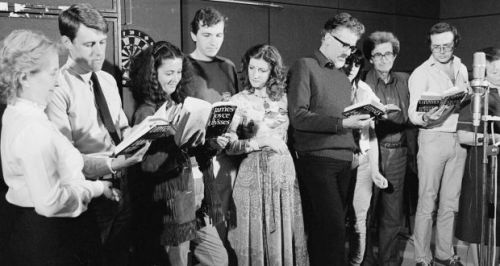
RTÉ Players recorded James Joyce’s mammoth work
Ulysses in 1982 for the Joyce centennial. It was rebroadcast today. Still going.

I didn’t know this before, but apparently many Irish people didn’t initially love James Joyce. They didn’t understand his writing any more than you or I did. But when a radio production brought his characters to life, they realized they knew these guys.

Denis Staunton has the story at the Irish Times.

“Britain had just defeated Argentina in the Falklands, Israeli forces were shelling Beirut. … But Dublin’s mind was elsewhere on June 16th, 1982, as the city celebrated the centenary of James Joyce’s birth with a mammoth Bloomsday festival. …

“Joyce’s words were everywhere in the city that day because from 6.30 am until the following afternoon, RTÉ Radio broadcast a complete reading of Ulysses lasting almost 30 hours.

“Listening on transistor radios and Walkmans, many Dubliners who had long been intimidated by the book found that they not only understood it but enjoyed it and recognised themselves in it. …

“The Irish Times [wrote], ‘The voices of the RTÉ readers became the medium for Joyce’s living words. The writer’s poor sight and fondness for singing surely must have affected the conspicuous musicality of his prose: he wrote to be listened to rather than read, so that Ulysses in its radio shape was shown to be an epic ballad.’

The recording, … broadcast in full on RTÉ Radio One Extra from 8 am [today and] available on rte.ie/ulysses, includes every word in the novel. But it is as much a dramatisation as a reading, with 33 actors playing more than 400 parts.

“As a 20 year-old actor in the RTÉ Players when the company spent most of 1981 on the project, I played a number of small parts including Ned Lambert and Lyster, the Quaker librarian and various voices that ensured I was at most of the rehearsals and recordings. …

“The director was Willie Styles, a former actor from New Zealand who had trained at London’s Royal Academy of Dramatic Art (Rada) before moving to Dublin … He was RTÉ’s most talented radio drama director by a distance and one of the most accomplished in the world, winning a succession of international awards as he embraced each technological advance. He worked on Ulysses with Marcus McDonald, a sound engineer who shared both his fastidiousness and his appetite for experimentation in sound.

“The textual adviser was Roland McHugh, an entomologist whose interest in the acoustics of grasshoppers led him to become an expert on Finnegans Wake. McHugh’s first challenge was to go through the text working out which words should be spoken by whom, with some chapters involving multiple narrators as well as characters. He decided that the Sirens chapter, which is set in the Ormond Hotel, should have four narrators.

“ ‘If you listen to it, the thing starts with Miss Douce and Miss Kennedy talking and you’ve got a narrator for them. And that goes on for about four pages, I think, and then you switch to Bloom, and he gets a separate narrator. So we’re jumping backwards and forwards between those two narrators until we get about halfway through the thing, and then a third narrator comes in and mostly says short things about the coach that Blazes Boylan is travelling in. And then towards the end there’s a fourth for the piano tuner. Those four narrators seemed to me to make a lot more sense of the thing,’ [McHugh] said. …

“Laurence Foster, an actor in the company who later became an energetic and innovative head of radio drama at RTÉ, says the medium makes specific demands on an actor.

“ ‘You have to get inside your own head – it’s a very selfish medium. You have to believe what you’re saying. You have to see through the mind’s eye and you have to bring up an incredible energy that converts the voice into painting pictures. The voice has to get a dynamic and a colour and a resonance and a rhythm,’ he says.

“ ‘You don’t play to the other person. The microphone is the audience and the audience’s ear. And when you get that into your head that you’re whispering into their ear, you don’t need a huge amount of voice.’ …

“It will now be available free online to listen to any time you want. But as The Irish Times observed after the first broadcast, listening to the entire book continuously is an experience of a different order entirely.

“ ‘When the seamless broadcast ended, many listeners must have discovered withdrawal symptoms,’ the editorial said.” More here.

Glad I read the book last year, so I sort of know what we’re talking about.

5eafcde1-2bda-48dc-8168-08c7813ab232-mining_lead_in_santa_ana_riverbed_3

Photo: Jay Calderon/The Desert Sun.
A large net at the Redlands Shooting Park is designed to stop lead shot from getting into the adjacent Santa Ana River, but shot often gets through.

Today I’m sharing an interesting article that Earle Cummings sent back in March, right before I began focusing on Covid stories. It’s about lead pollution at a firing range in the desert. We know about lead pollution in pre-1978 house paint and in the water of Flint, Michigan, where some children from poor families suffer from permanent damage.

But there’s also lead pollution from bullets, which can be especially dangerous near a river. Mark Olalde reported on the issue for the Palm Springs Desert Sun.

“Shrapnel from ricocheting bullets hits Kenny Graham about four times a day. At this point, he just accepts it as part of his job.

“As he rolled a cigarette and talked, a piece of flying metal banged viciously off a mechanical contraption with holes in it used to separate sand and rocks, not two feet from Graham’s unprotected hands. ‘There goes a pellet right there,’ he said deadpan, seated in the dry, sandy Santa Ana River in Redlands. …

“Graham — who said he is experiencing homelessness, working through a divorce and otherwise unemployed — makes money by mining and recycling lead buckshot and bullet fragments that escape from the adjacent Redlands Shooting Park. …

“The park has hosted sport shooters since the mid-1960s, but the business did little to stop lead, which is toxic to humans and wildlife, from entering the ephemeral waterway until 2013. Even now, pieces of bullets appear to find their way into this dry portion of the river where they can flow downstream when it rains.

“For much of its history, the site fell through the cracks among various regulatory bodies tasked with guarding the environment and public health. In their absence, a small-scale mining economy has sprung up in the legally protected river.

“While many people in need of steady work scour garbage bins for recyclable aluminum cans, glass bottles or plastic containers, Graham and a small cadre of compatriots spend their days pulling bullet fragments from the ground. They sell the lead at a nearby recycling center for 40 cents a pound. …

Graham said, ‘It’s not much money, but I get a sense of peace knowing that I possibly can help somebody.’

“Graham said he can’t afford personal protective equipment but knows that lead is a heavy metal that’s toxic to humans. Although lead’s health consequences are more dire in children, the metal can cause cardiovascular and kidney problems, damage to cognitive functions and reproductive issues in adults, according to the Centers for Disease Control and Prevention. …

“Documents from the U.S. Environmental Protection Agency revealed that decades of errant bullets had contaminated 42 acres of the waterway, including habitat for several federally listed endangered species. … The business no longer tries to recover lead from the riverbed. …

” ‘It’s the sporting of the rich man, but it’s the poor cleaning up,’ observed Tommy Lu, who runs an efficient-looking operation just downstream of Graham. …

“Against the backdrop of the regular report of gunfire, he laid a tarp down, scraped his shovel against the wall in his pit and watched sand, rocks and metal shower down. Next, he poured the mixture over a perforated metal sheet on a contraption he built to separate out rock. An orange extension cord attached to it snaked out of the hole and under the hood of his dusty Lexus SUV parked nearby to provide electricity.

“Lu turned on the machine, and it began to rattle noisily, sifting out pebbles. The final step, he said, would be to set up a fan and pour the remaining mixture across the stream of air, blowing away the lighter sand while collecting the lead.

“It’s not a place to get rich, but the labor does bring a consistent payday. If he works long hours, Lu said he can sometimes make more than $100 in a day. ..

“Every so often, a sound like the crackle of dying fireworks signaled material showering against the netting. Lu, like Graham, said he gets hit several times a day, comparing the feeling to a rubber band unexpectedly snapping on the back of his neck.

“Most of the miners’ holes dug in the riverbed are covered by tarps and fabric held up by mismatched tent poles. The lean-tos are meant to protect them against the hot sun and stinging pellets.

“Lu joked that he would mine into someone else’s pit if they didn’t move fast enough, but he said the group digging in the river is otherwise peaceful. …

“Carl Baker, a spokesperson for the city of Redlands, said via email that the Redlands Police Department does not usually arrest anyone for mining lead there, but the department is aware that ‘illegal scavenging’ is ongoing. …

“But if Graham and Lu are breaking the law, whose job is it to force them to stop, let alone to clean up the river, to protect community health and to ensure that Redlands Shooting Park keeps its shot curtain in good condition? …

“Calls and emails to the EPA, the San Bernardino County Department of Public Health, the county’s public works department, the California Natural Resources Agency, the State Water Resources Control Board, the Redlands Fire Department, the county fire department and the Department of Toxic Substances Control did not turn up a lead agency checking on the situation. …

” ‘I’ve never seen anyone take a mineral sample,’ said Graham, who said he lives at the site and has worked there nearly a year. …

“Robert Wise, an EPA employee assigned to act as the on-scene coordinator, called off further reclamation [September 2013], saying that it would do more damage than good to the important habitat. … ‘Wise made the determination that no further cleanup of the lead in the River/Preserve is warranted. Over time, the illegal scavenging operations will remove the lead currently present in the River/Preserve,’ according to an EPA report on the matter. …

“Even though [Graham is] saving up to buy Lu’s old car, he’s adamant that his main rationale for scavenging is to protect public health and the environment.

” ‘It’s not fair for people to get unknowingly sick because of someone else’s extracurricular carelessness,’ he said.” More at the Desert Sun, here.

original-4628652-3

Image: Teachers Pay Teachers.
Why we doodle.

I keep a list of potential posts, but since the pandemic, many of them feel out of date. There’s one, for example, that I’ll put up when things return to normal, but if I tell you now about a rug market in Morocco run by women, how do I know that it’s currently operating?

Fortunately, there are some topics that work for both normal times and times of isolation. Today we consider what the act of making art can do for the brain.

“A lot of my free time is spent doodling,” writes Malaka Gharib. “I’m a journalist on NPR’s science desk by day. But all the time in between, I am an artist — specifically, a cartoonist. I draw in between tasks. I sketch at the coffee shop before work. And I like challenging myself to complete a zine — a little magazine — on my 20-minute bus commute.

“I do these things partly because it’s fun and entertaining. But I suspect there’s something deeper going on. Because when I create, I feel like it clears my head. It helps me make sense of my emotions. And somehow it makes me feel calmer and more relaxed.

“That made me wonder: What is going on in my brain when I draw? Why does it feel so nice? … It turns out there’s a lot happening in our minds and bodies when we make art.

” ‘Creativity in and of itself is important for remaining healthy, remaining connected to yourself and connected to the world,’ says Christianne Strang, a professor of neuroscience at the University of Alabama Birmingham and the former president of the American Art Therapy Association. …

” ‘Anything that engages your creative mind — the ability to make connections between unrelated things and imagine new ways to communicate — is good for you,’ says Girija Kaimal. She is a professor at Drexel University and a researcher in art therapy, leading art sessions with members of the military suffering from traumatic brain injury and caregivers of cancer patients. But she’s a big believer that art is for everybody — and no matter what your skill level, it’s something you should try to do on a regular basis. Here’s why. …

“Art’s ability to flex our imaginations may be one of the reasons why we’ve been making art since we were cave-dwellers, says Kaimal. It might serve an evolutionary purpose. She has a theory that art-making helps us navigate problems that might arise in the future. …

Her theory builds off of an idea developed in the last few years — that our brain is a predictive machine. The brain uses ‘information to make predictions about we might do next — and more importantly what we need to do next to survive and thrive. …

” ‘So what our brain is doing every day, every moment, consciously and unconsciously, is trying to imagine what is going to come and preparing yourself to face that. … This act of imagination is actually an act of survival,’ she says. ‘It is preparing us to imagine possibilities and hopefully survive those possibilities.’ …

“For a lot of people, making art can be nerve-wracking. What are you going to make? What kind of materials should you use? What if you can’t execute it? What if it … sucks?

“Studies show that despite those fears, ‘engaging in any sort of visual expression results in the reward pathway in the brain being activated,’ says Kaimal. ‘Which means that you feel good and it’s perceived as a pleasurable experience.’

“She and a team of researchers discovered this in a 2017 paper published in the journal The Arts in Psychotherapy. They measured blood flow to the brain’s reward center, the medial prefrontal cortex, in 26 participants as they completed three art activities: coloring in a mandala, doodling and drawing freely on a blank sheet of paper. …

“Although the research in the field of art therapy is emerging, there’s evidence that making art can lower stress and anxiety. In a 2016 paper in the Journal of the American Art Therapy Association, Kaimal and a group of researchers measured cortisol levels of 39 healthy adults. Cortisol is a hormone that helps the body respond to stress.

“They found that 45 minutes of creating art in a studio setting with an art therapist significantly lowered cortisol levels.

The paper also showed that there were no differences in health outcomes between people who identify as experienced artists and people who don’t. So that means that no matter your skill level, you’ll be able to feel all the good things that come with making art. …

“Ultimately, says Kaimal, making art should induce what the scientific community calls ‘flow’ — the wonderful thing that happens when you’re in the zone. ‘It’s that sense of losing yourself, losing all awareness. You’re so in the moment and fully present that you forget all sense of time and space,’ she says.

“And what’s happening in your brain when you’re in flow state? ‘It activates several networks including relaxed reflective state, focused attention to task and sense of pleasure,’ she says. …

“A number of studies have shown that coloring inside a shape — specifically a pre-drawn geometric mandala design — is more effective in boosting mood than coloring on a blank paper or even coloring inside a square shape. And one 2012 study published in Journal of the American Art Therapy Association showed that coloring inside a mandala reduces anxiety to a greater degree compared to coloring in a plaid design or a plain sheet of paper.

“Strang says there’s no one medium or art activity that’s ‘better’ than another. ‘Some days you want to may go home and paint. Other days you might want to sketch,’ she says.”

More at NPR, here.

The NPR reporter in today’s post wrote this book.

51yhizuzlyl

merlin_173066703_e2716cc9-9930-43cf-bddc-793876f48fd6-jumbo

Photo: Dmitry Kostyukov for the New York Times.
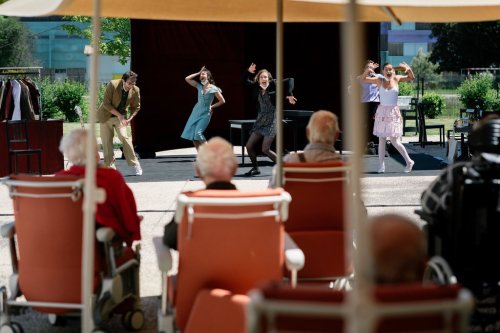
The cast of “Cabaret Under the Balconies,” kept away from their theater by Covid-19, performs at a safe distance for nursing home residents in France.

What hath Zoom wrought? Despite its glitches, Zoom has solved a lot of problems in the coronavirus era and has even introduced new ideas for future activities. Yesterday, for example, one brother and I watched another brother give a lecture on immunology research to a conference — a thing we could never before have imagined doing. Although we hardly understood a word, we both found the experience of watching our kid brother explain obscure transformations of molecules — and gracefully answer all sorts of technical questions — completely delightful.

In today’s story, a theater group in France tapped Zoom to conduct remote rehearsals before performing in front of a live audience.

Laura Cappelle reports at the New York Times, “When circumstances close theaters’ doors, you can count on some performers to find a window to open. Last week in [a] city in eastern France, the residents and staff of a nursing home watched from a safe distance — some from windows and balconies — as five actors appeared in the building’s courtyard in front of a makeshift red curtain. ‘It feels like it’s been such a long time,’ they sang, in a cover of Joe Dassin’s wistful chanson ‘Salut.’ ‘Far from home, I’ve been thinking about you.’

“ ‘Cabaret Under the Balconies’ [was] the first professional theater performance in France since lockdown was imposed on March 17. …

“The relief of the cast was palpable as they performed at the facility, the Ehpad Bois de Menuse. … The 45-minute show was designed to respect social distancing among the cast members as well as between them and the audience, Bréban explained in an introduction.

“Except for one real-life couple, who were allowed to kiss, none of the performers touched. … Bréban, who also performed in the show, capitalized on the actors’ individual strengths, from Antonin Maurel’s clownish energy to Cléo Sénia’s burlesque background.

“Their approach appeared to resonate with the audience, limited to 40 people. (The show was performed twice so that most of the 90 residents could see it.) Many of them were in wheelchairs, yet could be seen nodding or tapping their feet to the beat. In the courtyard, one woman got up, swung her arms and danced with a masked worker from the home. Another teared up as Léa Lopez, a young performer with a lush voice, sang ‘Somewhere Over the Rainbow.’

“Valérie Gonthier, a nursing assistant who stayed by the woman’s side as she cried, said in an interview afterward that music often stirred up emotions for residents who experienced memory loss. The Ehpad has a choir, but French nursing homes don’t typically have the funds to bring in professional performances; Gonthier couldn’t remember anything like last week’s show in the 26 years she has been with the institution. …

“Nicolas Royer, the theater’s director since January, said he disagreed with many French arts administrators who had interpreted government regulations to mean that performances were impossible. He didn’t furlough any employees, instead asking the costume department to make surgical-style masks, welcoming doctors from a nearby hospital in the theater’s guest apartments and hosting training sessions for city workers dealing with the crisis.

“In April, Royer got a call from Bréban, an experienced actress and emerging director who was going stir crazy in her Paris home: She told Royer she was down for anything he dreamed up. …

“The cast of ‘Cabaret Under the Balconies’ rehearsed over Zoom for seven days and, after the relaxing of lockdown in France in May, met in Chalon-sur-Saône for one week of in-person rehearsals — with strict rules. Bréban booked cast members with no health conditions. Daily temperature checks and frequent use of sanitizing gel were mandated, and everyone was offered a coronavirus test.

“By far the most onerous directive for the performers was to maintain a distance from one another of roughly one meter at all times. … ‘We were confident that we were within labor regulations, with an audience that was already confined and highly protected,’ Royer said. …

“The last time I went to the theater, two and a half months ago, Isabelle Huppert headlined Ivo van Hove’s staging of ‘The Glass Menagerie.’ For all the star appeal of that night at the Théâtre de l’Odéon, ‘Cabaret Under the Balconies’ was the more memorable event — a sincere attempt to go back to basics, in the right place, at the right time.”

More at the New York Times, here.

farmlink_james-555x370-1

Photo: Owen Dubeck
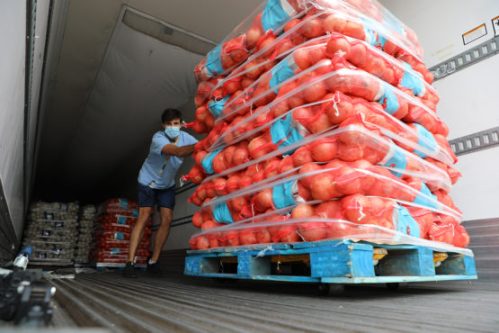
Stanford sophomores James Kanoff and Stella Delp created the not-for-profit FarmLink to salvage surplus food from farmers and donate it to overwhelmed food banks. Above, Kanoff is seen helping to deliver a shipment of onions.

One of the more troubling manifestations of Covid-19’s impact on the economy is that farmers who no longer have restaurants and large institutions buying their food, unable to afford to transport it to food banks that desperately need it, are destroying much of what they produce.

Two sophomores at Stanford University knew that something had to be done. Sydney Page at the Washington Post has the story.

“Doug Hess spent the last three months staring at a mammoth mountain of potatoes — enough to feed more than 6 million people. The potato farmer in Ashton, Idaho, who sells to commercial farms that supply the food service industry, said the novel coronavirus pandemic has gutted his business. …

“He donated what he could, but the cost to pack the produce and ship it to food banks was too high, especially considering the massive financial loss the family farm, which goes back four generations, was already suffering.

“As Hess’s pile of wasted potatoes slowly started to rot, stomachs rumbled across the country.

“Food banks in the United States are grappling with unprecedented need — a direct symptom of widespread unemployment, as roughly 16 percent of Americans are still without a paycheck. …

“James Kanoff, 21, a sophomore at Stanford University, took note of the troubling paradox: Farms have a surplus of food from canceled restaurant contracts and a shattered supply chain, while food banks are experiencing a staggering surge in demand. …

“So Kanoff and a group of college students from Stanford and Brown universities started FarmLink, a grass-roots movement to prevent food waste while also working to address food insecurity. FarmLink raises money to pay farmers for produce and dairy that would otherwise be wasted, then funds the transportation to send the goods to food banks in the neediest areas around the country.

“Since it started in mid-April, FarmLink has delivered 2 million pounds of produce, including some of Hess’s potatoes, to hungry Americans, in just over a month. That’s roughly 1.5 million meals.

“Volunteers have delivered potatoes, eggs, milk, onions, lettuce, zucchini, cucumbers, salt, celery, carrots and sweet potatoes to communities in 22 states, including Hawaii — with no plans to stop, even after the pandemic ends. …

“Through social media campaigns and word of mouth, the initiative has raised more than $750,000 — mostly from small, individual donations.

“Kanoff grew up volunteering at Westside Food Bank in Santa Monica. When he heard the organization’s food supply was scarce, he decided to test the FarmLink concept by reaching out to a local farm and asking if it had an oversupply. …

“Farmers all around the United States are experiencing a major surplus — from thousands of acres of fresh fruits and vegetables in Florida and California, to millions of gallons of milk and countless eggs in Vermont, Pennsylvania, New York and Wisconsin.

“Once Kanoff and his team secured 90,000 pounds of [onions from Shay Myers, the CEO of Owyhee Produce,] they reached out to Food Finders, a nonprofit food rescue organization that connects donated food to hundreds of pantries in Southern California. …

“ ‘The problem with the government programs is that the farms are not in the business of sourcing food banks,’ said [Diana Lara, the executive director of Food Finders]. … FarmLink is helping to bridge the gap. USDA distributors, including Borden Dairy, have started reaching out to FarmLink directly for assistance in finding food banks in need and distributing surplus product, Kanoff said.

“The burgeoning organization has divided its [100] volunteers into three specializations: the farms team locates farms with excess supply, the logistics team targets hot spots with the greatest food insecurity, and the food banks team connects directly with local pantries across the country to assess demand. The organization also has sponsorships with Uber Freight and Coyote Logistics, to assist with transporting the goods.

“FarmLink’s work has made an impact on some of the hardest-hit regions of the country, including Navajo Nation at the intersection of Arizona, New Mexico and Utah … Nathan Lynch, a site coordinator at Navajo Nation Christian Response Team, … who delivers emergency food boxes to 2,000 homes on the reserve, said the food insecurity in the region is pervasive. ‘FarmLink has filled a big void.’ ”

More here.

ylzbpavkn4i6vjb7nn4knyfwne

Photo: Samsung
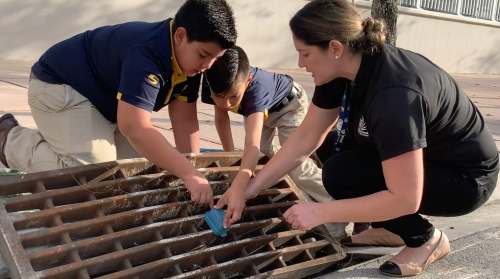
Sixth-graders at the Downtown Doral Charter Upper School in Florida worked with teacher Rebeca Martinez on a device to detect sediment buildup in a storm drain. The students’ project, which aims to stop flash floods, was among five grand-prize winners in the Samsung Solve for Tomorrow Contest.

To my way of thinking, no amount of money is too much to pay teachers like those guiding the middle school students in today’s story to tackle a science competition. Whether in public or private school, teachers build the future, but since most students are in public schools, the type of education there is the most critical and most in need of funding. Every child should have opportunities to stretch themselves.

Lela Nargi reports at the Washington Post, “In late May, storms flooded streets in Miami-Dade County in Florida. The floods made cars sink and turned roads into brown rivers.

“A team of local middle school students has a plan to stop this ongoing problem.

“Alyssa Neuber, Bianca Verri and Jose Pirela are sixth-graders at Downtown Doral Charter Upper School. They designed a device to warn city workers when and where there is a danger of flooding. The team is one of five grand-prize winners of the Samsung Solve for Tomorrow Contest. The contest asked for science, technology, engineering and math (STEM) solutions to the biggest challenge facing a school community.

‘I’ve been living here my entire life, and all of us have encountered problems with flooding,’ says Bianca. ‘We knew that was the problem we were going to tackle.’

“Flash flooding can happen when storm drains get plugged up and, especially during hurricanes, overflow into streets. It’s the leading cause of weather-related deaths in the United States.

“The students’ device uses a laser system called lidar, which stands for ‘light detection and ranging.’ The device, if approved by the city government, could be attached to Doral’s 2,575 storm and manhole drains — one device per drain. If a drain gets clogged with sediment, the device could send a computer alert to the city’s stormwater management office. Then the stormwater manager could send someone to clean the drain.

“ ‘We had our class help us in the beginning to find information about how we were going to use lidar,’ says Jose.

“The three STEM whizzes then started to work more closely with their science teacher, Rebeca Martinez. They figured out what each of them is good at. … Class parents who were engineers and website coders helped them figure out the details.

“Starting in March, the school was closed, so team meetings went virtual. Luckily, says Bianca, ‘We already had a prototype device, and we just had to tweak it some more.’

“They also had to pitch their idea virtually to contest judges. …

“A team from Dougherty Valley High School in San Ramon, California, made a wildfire alert. At Fairfield Senior High School in Fairfield, Ohio, students designed an app to prevent deaths of kids left in hot cars. Students at the North Carolina School of Science and Mathematics in Durham invented an app that helps people recycle. And in Wisconsin, kids at Omro High School created a sensor that lets ice fishers know when it’s safe to walk on frozen lakes.

“Each of the five teams won $100,000 for technology and supplies for their science classrooms.” More at the Washington Post, here.