Feeds:
Posts
Comments

merlin_141879969_eeff1f2b-bf6b-42a2-be3f-3bd75ef7ae51-superjumbo

Photo: Gabriela Bhaskar for the New York Times
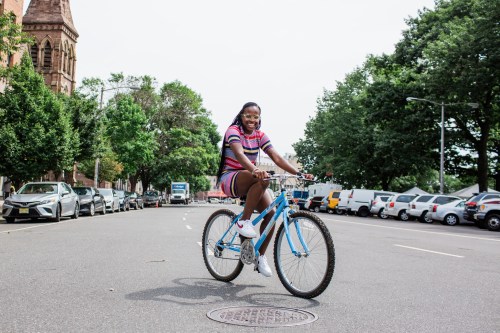
A graduate of Rutgers University in Newark is teaching girls to ride bicycles as part of a program run by the organization she founded, Girls on Bikes.

I love reading how a small gesture or comment can lead to something big in a person’s life. It’s all about the Power of One. In this story, a bystander said something upbeat to Kala La Fortune Reed when she was biking to class, and it led to a movement.

Liz Leyden writes at the New York Times, “The training wheels were off. The young woman with a bright smile and golden sunglasses told Kaneisha Marable she didn’t need them. The little girl believed her.

“Kaneisha pedaled a wobbly path up the block beside Lincoln Park. House music thumped from the stage to her left, a festival underway, but the 8-year-old girl paid it no mind. Her eyes darted between the pavement ahead and Kala La Fortune Reed, the woman jogging by her side.

“The bike tipped. Kaneisha teetered. Finally, the wheels began to spin. Ms. La Fortune Reed let go, watching girl and bike move farther away.

“ ‘Yes, she’s got it,’ she exhaled. ‘You got it!’

“The victory came on a [Sunday in August] at a learn-to-ride clinic run by Girls on Bikes, a community group aiming to achieve pedal equality for a new generation of girls and women in Newark.

“The effort began in 2016 when Ms. La Fortune Reed rediscovered her old bicycle and started riding everywhere: to classes at Rutgers University in Newark, thrift shops and parks throughout the city.

“One day, a man called out to her. Keep it up, he said. There aren’t enough girls on bikes.

“Ms. La Fortune Reed scanned the streets and realized he was right. … She recruited Maseera Subhani and Jenn Made, friends from Rutgers who shared her love of cycling and for Newark itself; the idea of using bicycles to spread empowerment resonated with each of them.

“The trio juggled full-time classes and part-time jobs to get the group going. Ms. La Fortune Reed interned with a local bike mechanic and learned how to repair bikes and build them from scratch. Ms. Made created a curriculum for school workshops. Ms. Subhani found graphic designers to make fliers and T-shirts, and reached out to other community groups to collaborate. …

” ‘We wanted to create a sisterhood,’ Ms. La Fortune Reed said. ‘We go really slow. We have fun. We’re doing this to build relationships, to build a movement.’ …

“Ms. La Fortune Reed said Girls on Bikes tries especially hard to reach girls in middle school.

“ ‘We try to catch them at that age, to build up bicycling and the idea of empowerment and leadership, before peer pressure hits,’ she said.

“In June, the group taught a four-week workshop for sixth- through eighth-grade girls at Marion P. Thomas Charter School. …

“ ‘Before, there was a negative connotation for a lot of them — this idea that if you rode a bike it meant you couldn’t afford a car, that you weren’t cool,’ [the teacher] said. ‘But having that reimagined by these strong, stylish young women, the students really bought into it.’ …

“More than 80 children, including 45 girls, participated throughout [the August bike] weekend. Some didn’t need any help, just a nudge to put on helmets. Simply watching them enjoy the bicycles made Ms. La Fortune Reed happy.

“But the moments when she saw girls growing in their confidence — testing out no-hands, standing on their pedals, letting go of training wheels — meant something more. ‘We’re leaving a memory in their lives that they can accomplish anything,’ she said.

“When Kaneisha Marable realized that she was riding on her own, she looked back at Ms. La Fortune Reed, astonished. She rode and rode and then ran off, returning a few minutes later with her mother. She climbed back on the bicycle.

“ ‘Look, Mommy, look! Look what I learned to do!’ ”

More at the New York Times, here.

vvzodywnvei6rlikbya67or4yePhoto: Charlotte Kesl/For The Washington Post
Leroy Wilson outside his home in Marianna, Florida, a day after Hurricane Michael hit the panhandle.

I believe that when a hurricane is coming and you’re told to evacuate, you should evacuate. But this story about a homeowner who refused to leave is pretty great anyway.

Like the wolf in the “Three Little Pigs,” Hurricane Michael huffed and puffed, but the homeowner’s brick house not only stood strong, it welcomed neighbors whose houses were not so strong.

Read what Patricia Sullivan and Frances Stead Sellers wrote at the Washington Post about why the Marianna, Florida, native couldn’t bear to leave his house. It adds a whole other level to the story.

“The modest one-story brick house on Old U.S. Road,” they report, “meant more to Leroy Wilson and his family than a roof over their heads.

“Their ancestors lived on this land as slaves before Wilson’s grandfather acquired five acres here in 1874, right after emancipation. … So as Hurricane Michael ripped the top off a 50-year-old dwelling next door, brought a tree down on Leroy’s daughter’s home and snapped nearby pine trees like pencils, the Wilsons stayed put in their brick house on Wednesday, opening the doors to neighbors whose homes were succumbing under Michael’s powerful winds.

“ ‘I wasn’t going anywhere,’ said Wilson, 74. …

“Sixty miles from the coast in Jackson County, this city of about 10,000 rarely suffers through hurricanes. Known as ‘The City of Southern Charm,’ Marianna has experienced storms that have taken down trees and power lines, but it has been largely spared the devastation regularly wrought in coastal towns. Hurricane Michael was different.

“ ‘It hit everybody hard,’ said Annell Wilson, Leroy’s wife. ‘We prayed a lot.’

“[Leroy’s son] Lamar, an assistant professor at the University of Alabama in Tuscaloosa, said he dismissed class around 5 p.m. Wednesday after getting a text from his sister describing the devastation in his hometown and he began making frantic telephone calls to his relatives. He knew they would not leave their land.

“ ‘To be able to own several homes you built with your hands, to protect the home your mother built, that your grandfather toiled for, it’s noble,’ Lamar said.

“And in this case, dangerously noble. His sister lost her home; his brother’s house is barely habitable.

“But the little brick house protected the Wilsons and the people they took in. It lost its water pump and its shutters, and the wind drove water in under the window panes. But the structure stayed intact — and by the end of the evening, more than a dozen members of five families were seeking shelter there.

“ ‘That’s what we do. We all help each other,’ said Annell Wilson, 73, Lamar’s mother, describing how she settled her unexpected visitors and got them fed, and then stuffed towels along the windows to mop up the water that seeped in.”

More at the Washington Post, here. No word on a wolf coming down the chimney or the canny homeowner setting a boiling pot in the fireplace to welcome him, but I wouldn’t have been surprised.

Don’t you love it when life imitates art? (Having said that, I still urge you, “Don’t sit out a hurricane when told to evacuate.”)

Tribes on the Edge

tribesonthebrink

Photo: The Explorers Club

You remember the great marine explorer Jacques Cousteau? Well, his granddaughter has grown up to be an explorer of vanishing cultures, and recently she made a movie about endangered tribes in the Amazon.

The film by Céline S. Cousteau is called Tribes on the Edge, and according to its website, it’s “more than a narrative of tribal reality in the Amazon [as it] suggests the universal story of our human tribe and how our future is interwoven with each other and with nature. This is a story that invokes the critical importance of respect and care – for land, culture, and humanity. …

“[The film] explores the timely topics of land threats, health crises, and human rights issues of indigenous peoples, expanding the view to how this is relevant to our world. More than a film, it has grown into a movement driven by a passionate effort to enact tangible impact in the Javari [Valley of Brazil] through education, advocacy, and activism. …

“Spanning more than 85,000 km2 (an area the size of Portugal), the Vale do Javari is the second largest indigenous territory in Brazil and is home to 5000 indigenous peoples from 6 tribes as well as the largest population of people living without any contact with the outside world in the entire Amazon and some say the world.

“Though the Javari has been designated for the tribes living there, there is looming pressure to increase harmful resource extraction which in other parts of the Amazon has led to environmental degradation. … It is estimated that the Amazon produces 20% the world’s oxygen and releases 55 gallons of water into the Atlantic ocean every second.”

Read more at the website, here, about what the International Union for Conservation of Nature calls “one of the irreplaceable areas of our planet.” And at the website for New York’s Explorers Club, which screened the film this past April, you can also can read about speaker Beto Marubo. A Marubo Indian, he has served with the national Indian foundation of Brazil, FUNAI, an initiative threatened by the likely election of someone Wikipedia calls “a polarizing and controversial politician” to the country’s presidency.

The movie is more timely than ever.

beto_250

Remember this September post on the way benches can civilize a town? Grace promised to send an addendum from Maine, and it was worth waiting for.

If you have others, send them along.

2018-Maine-bench-pic-by-G-Gregor

blackorpheus01

I’ve always been interested in other countries and cultures and have tried to read books from afar if they are written in English or translated into English. Years ago, the works of Africa writers Chinua Achebe and Wole Soyinka were among my favorites. I have continued to read other African writers, but none have interested me as much as those two.

Recently I learned that some new authors have complained that African literary magazines — often the place to launch a writing career — have not been open to younger voices.

An article in Okay Africa provides an overview of the magazines that publish African literature and explains why the number of outlets has been increasing.

Tadiwa Madenga writes, “African literary magazines and journals don’t just shape literary culture, they offer the most rebellious responses to political and social movements. They not only respond to the cultures they’re in, these magazines also create distinct cultures of their own that reflect the personalities of their editors.

“Some are experimental and bold, some are satirical and polemic, some can also be aesthetically conservative, but they all find beautiful ways to confront the most pressing issues in society. Magazines archive stories that might not always gain the attention that books will, but are sometimes the most thrilling work in a writer’s career. Here are five of the most notable literary magazines that have shaped contemporary African literature.

“Based in Nigeria, Black Orpheus was groundbreaking as the first African literary periodical on the continent publishing works in English. It was founded in 1957 by German editor Ulli Beier, and was later edited by Wole Soyinka, Es’kia Mphahlele, and Abiola Irele. The magazine stopped printing in 1975.

“At a time when African writers needed spaces where they could simply gather and enjoy each other’s works, the magazine was started to promote African literature, publishing the works of literary giants like Chinua Achebe, Ama ata Aidoo, and Christopher Okigbo in their early career. The best part of the magazine was that it introduced literature from French, Spanish, and Portuguese speaking regions to an English speaking audience …

“Transition was founded [in 1961] by Rajat Neogy in Kampala when Uganda, like other African nations, was gaining its independence. Like Black Orpheus, the magazine published notable writers like Achebe, Ngugi wa Thiong’o, Nadine Gordimer, and Taban lo Liyong when they were new writers.

“Transition … has had fearless takes on politics that eventually forced it to be transferred to Nigeria when Soyinka was editor, and later to the U.S. Transition is now housed at Harvard University and is still producing provocative work …

“Kwani? began after a group of Kenyan writers, artists, and journalists became frustrated with the slow publishing scene in the country that mostly accommodated earlier writers like Ngugi from the Transition and Black Orpheus generation. A new publication was created in 2003 for emerging writers that has led to the incredible literature we enjoy today from Kenya. The journal has published works by writer like Yvonne Owuor, Parselelo Kantai, Andia Kisia, Uwem Akpan and Billy Kahora.

“Edjabe is a Cameroonian journalist and a DJ who engages literature, music, and politics with a rebel spirit [in the magazine Chimurenga]. Edjabe founded Chimurenga in 2002 in Cape Town at a time where South Africans were having lively discussions about life during and after political and social revolutions. What makes Chimurenga unique is not only the amazing writing that they publish, but the ways the platform evokes other mediums with literature. …

“While the other literary magazines and journals where mostly print magazines, JALADA represents the digital moment where African literature is thriving on online platforms like Saraba, Enkare, and Brittle Paper. JALADA began after a group of writers from various African countries published their work on their own website which became so popular they began receiving submissions from other writers.”

Read more here.

600x600


092118-Swedish-flag-on-Peace-Day092118-Egyptian-flag-International-Peace-Day

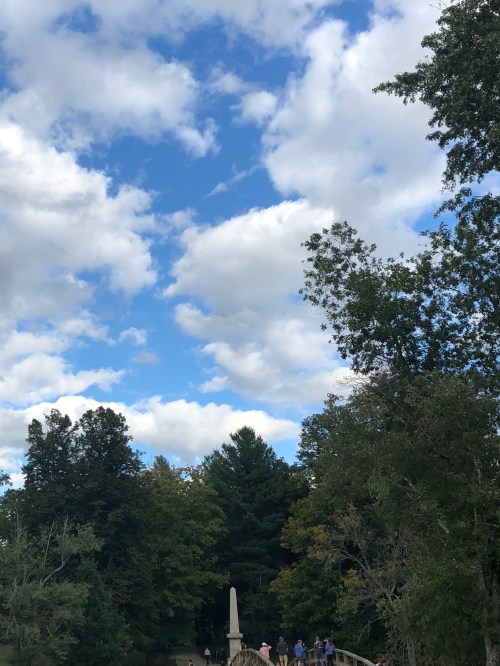
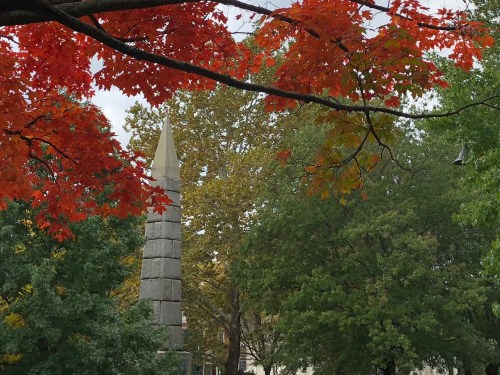
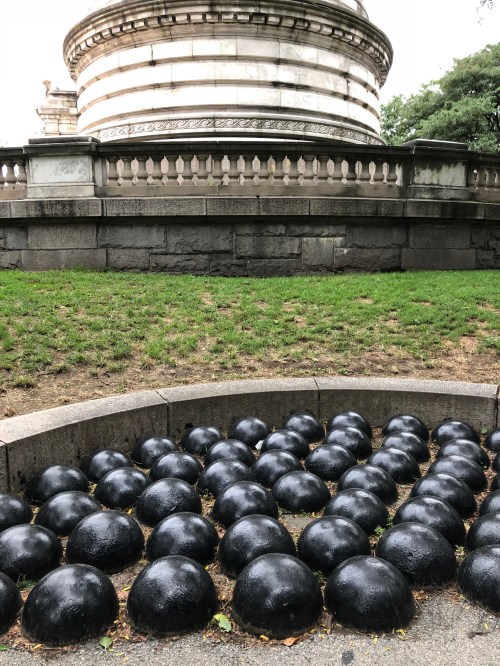
Except for the cannon balls at the Civil War monument in New York City, these photos are all from my walks in Massachusetts.

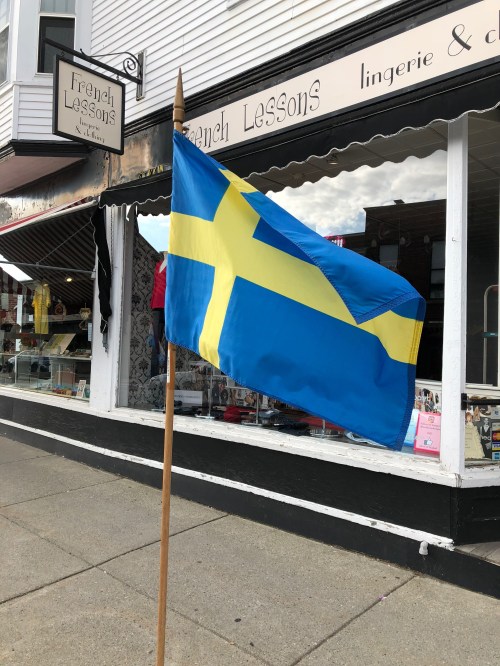
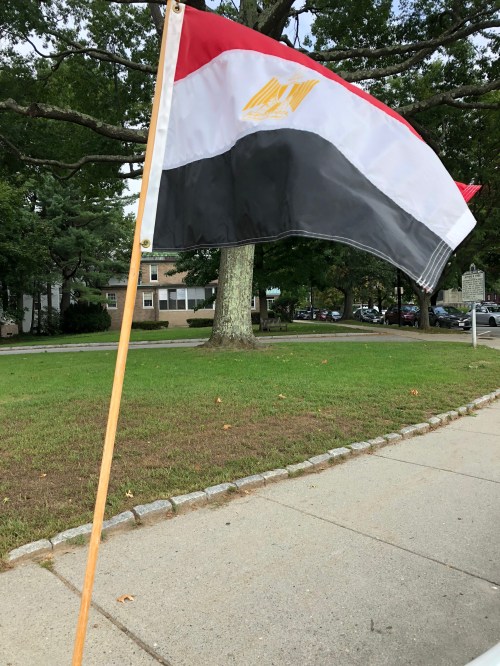
The town of Concord recognizes the International Day of Peace every year by putting up the flags of all members of the United Nations. This year I sent photos of my relatives’ countries of origin to them — Sweden and Egypt.

The Old Manse, run by the Trustees of Reservations, is decorating for fall. Its most famous tenants were author Nathaniel and artist Sophia Hawthorne. Tour guides like to show visitors where the couple carved window messages with her diamond ring.

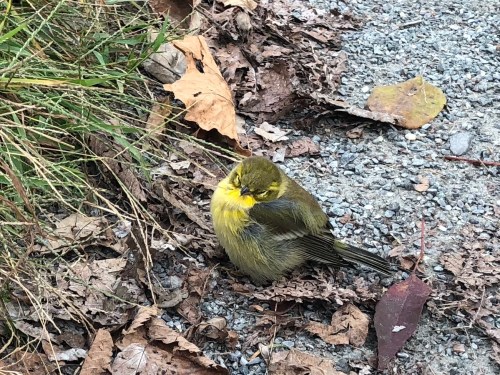
The injured Blackpoll warbler had a tough fall migration and didn’t make it through the night. I did learn from Kim that one should put an injured bird in a “small, warm, dark box for night. If living in the morning, drip a little sugar water into mouth and release.” Something to keep in mind.

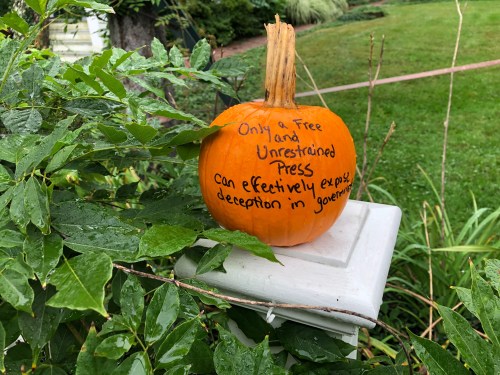
The pumpkin has an important quotation from former Supreme Court Justice Hugo Black about a free press. My neighbor puts 24 small pumpkins on her fence posts every year near Halloween and inscribes something on each. This year the words are from Supreme Court justices, the 19th Amendment (giving women the vote), Massachusetts justice Margaret Marshall (making the state the first to allow gay marriage), and the like.

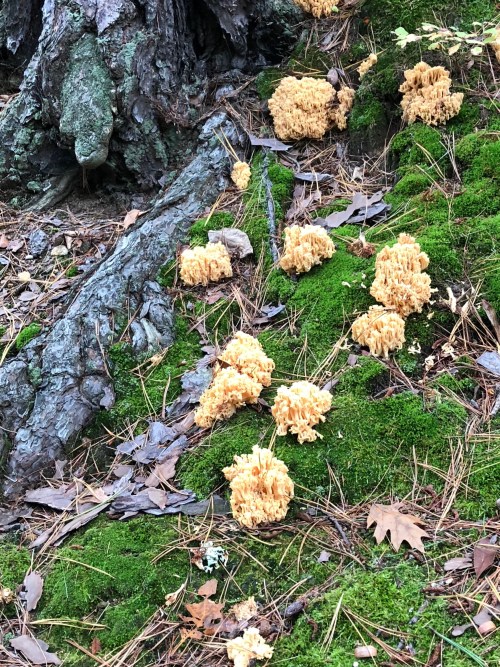
I wind up with another neighbor’s new tree house and a couple fungi photos. There seems to be a huge array of fungi in town this year, some of them very peculiar looking. We also have a lot of mosquitoes. Too much rain?

092918-Old-Manse

092918-clouds-over-North-Bridge

100918-fall-in-ConcordMA

092018-Civil-War-cannon-balls-NYC

092918-injured-Blackpoll warbler

092818-Justice-Black-addresses-free-press-on-pumpkin

100518-treehouse

100918-weird-fungus-in-cemetery

100918-fungi-at-Sleepy-Hollow


skatekitchen_custom-7cb11468e3eaad2e6acb94579b8e6315ed0687dc-s700-c85

Photo: Magnolia Pictures 
In the film Skate Kitchen, the introverted Camille (played by Rachelle Vinberg, left) finds her tribe of skaters in New York City. The filmmaker found her subjects almost the same way — instinctively.

What I especially loved about this article on making a female-skateboarder movie was the director’s sixth sense. She hears girls on the subway talking in a wildly creative way and experiences vibes that direct her to pursue a new path of possibility.

Lakshmi Singh reports at National Public Radio, “Director Crystal Moselle made waves three years ago when her documentary The Wolfpack won the grand jury prize at the Sundance Film Festival. The film told the true story of six brothers growing up in confinement in Manhattan’s Lower East Side — and it all began from a chance encounter Moselle had with the brothers on the street.

“Her new film comes from a similar place. Skate Kitchen follows a group of teenage girl skateboarders and activists rolling their way through the streets of New York. This time, she met them on the subway.

From the NPR interview:

“I learned to understand my instinct. There’s this thing that happens to me. …  I’m like: Oh, this is something. This is interesting. I just — I have to explore it. …

“I was on the train in New York City. I was on the G train. And I heard this voice that just — you know, sometimes there’s a voice that’s so charismatic, you just have to figure out who’s talking and what’s happening. I mean, that’s how I am. And I look over, and there’s these three teenage girls, and they have skateboards. And Nina [Moran] — she’s telling a story. I can’t remember what the story was about. I think maybe it was about a party she went to or something that happened in the park that day. And she has that kind of voice that almost silences a room where you want to — just everybody stops what they’re doing and they want to see who’s talking.

“And so I — just out of curiosity and out of this instinct that I’ve kind of gained from my past project, I just — I feel like there’s this moment where I sort of know that there’s something there and I have to figure it out. And I went up to them and asked them — I just said, hey, you know, introduced myself. I said, my name’s Crystal. I’m a filmmaker, and I’d love to talk to you guys. Maybe you guys would be interested in doing some sort of video project at some point. [And] — I don’t remember saying this — I said, is there more of you? …

“They’ve found all these really interesting pockets [of the city], and they go to these skate parks, and they have these, like, spots that they skateboard and they just use the architecture of buildings. And you know, people chase them away. And it’s just, like, this kind of really riveting scene. And I would just start hanging out with them and experiencing it myself. They’d even, like, make me jump on the skateboard. They’re like, if you’re going to hang out with us, you have to skateboard. Here’s the board. Skate down the block. …

“The girls actually met through YouTube. They would be commenting on each other’s videos and, you know, that’s how they would create these communities because it’s difficult. Like, if you’re a girl living on Long Island and there’s no other girls around that skateboard, you can go to, you know, a social media platform to find other women that also do the same thing that you do that’s, like, something specific. …

“I think that it’s actually a really positive thing to be able to find people that are, I guess, your tribe. …

“When I was with Rachelle one day — Rachelle Vinberg, who plays Camille. She was skating with all these boys. And they all rolled by, and the little girl [watching the film crew] didn’t notice them at all. And then Rachelle rode by with her hair just like in the wind. It was just an epic moment — she’s, like, carving down this hill. And this little girl, like, stopped in her tracks and just watched her and, like, saw the future.”

More here. I love how this director is drawn by curiosity to pursue things that are unfamiliar and interesting. Having something interesting to think about is apparently as essential to her as food.

merlin_141970665_3226dcb4-ae59-4f88-aa9e-53ad5880d80e-jumbo

Photo: Lisa Marie Summer for the New York Times
A German opera company invited current refugees to be part of its production of “Moses,” lending immediacy to the story of exile.

Powerful stories from any century speak to the human condition in any other century. Thus, for example, the story of exile in the opera “Moses” speaks to the sense of dislocation that today’s refugees experience. To drive home that point, an opera company in Germany has invited current refugees to participate in a production.

Joshua Barone reports at the New York Times, ” ‘We tell the story of Moses because it is actually our story,’ one teenager, a refugee from Afghanistan by way of Iran, said in the Hazaragi dialect to the German-speaking audience at the Bavarian State Opera here on a recent Sunday evening.

“Others chimed in: ‘The story of Moses is also my story,’ they said in French, Kurdish, Greek and Arabic.

“They were the cast of ‘Moses,’ a feel-good yet sobering new production by the Bavarian State Opera’s youth program, written for refugees, children of immigrants and born-and-raised Bavarians.

“In the opera, a mixture of new music by Benedikt Brachtel and adapted excerpts from Rossini’s “Mosè in Egitto” [“Moses in Egypt”], the teenagers tell the story of Moses — common ground for followers of the Bible, Torah and Quran — with Brechtian interludes about refugee experiences and current events.

“The director Jessica Glause, who created the libretto based on interviews with refugees in the cast, has concocted a blend of humor, horror and youthful energy that hardly feels like a didactic documentary about Europe’s refugee crisis. Behind the scenes, ‘Moses’ has provided a way to learn German and make friends — in short, to make the process of migration a little less painful. And audiences have responded favorably. …

“Theater about the refugee crisis has proliferated in Germany since migration into the country reached its peak in 2016. But rarely has the hot-button issue — which continues to threaten Chancellor Angela Merkel’s power and fuel the rise of the far-right party Alternative for Germany, or AfD — entered the realm of opera, much less children’s opera. …

“Ms. Glause, who had volunteered on boats in the Mediterranean, also wrote the libretto for ‘Noah,’ after interviewing many of the same young refugees who are in ‘Moses.’ She described the process — hearing stories of loss, danger and fear from teenagers — as acting as both an artist and a counselor.

“Among the people she spoke with were Ali Madad Qorbani, a young man from Afghanistan who fled to Iran, then Europe, after his father had disappeared; and Zahra Akhlaqi, also from Afghanistan, whose mother came to Europe first while she and her sister waited in Iran, where, she said, they were forbidden from going to school but would dress up like students at home and play pretend.

“Now, their lives are slightly more stable, though just as precarious as any refugee’s. …

“There are still monologues of how and why some of the cast members came to Europe, but much of the material is about reconciling their faiths and cultures with those of Germany — including one humorous passage about trying German beer for the first time. But they also describe how they don’t always feel welcome, such as a scene in which the plagues in Moses’s story give way to one person describing signs near Munich that say refugees overrun Germany like locusts. …

“In interviews, [youth program director Ursula Gessat] and Ms. Glause were quick to say that their job is to reflect the world around them, and that it would be irresponsible to ignore the refugee crisis. Indeed, Ms. Glause said that conservative politicians may change their minds if they met the cast of ‘Moses.’

“ ‘I would tell them to come see this show,’ she said. ‘Come hear these stories.’ ”

More at the New York Times, here.


dsc0221-2_wide-3fcfb07127773efdd138130d9f2491856f240005-s700-c85

Photo: Claire Harbage/NPR
Susan van Rooyen and Moe Kekana of communications firm King James Group were behind the 2-Minute Shower Song project the helped rescue Cape Town, South Africa, from a severe water crisis.

When it’s a matter of life and death, people can cooperate. That’s what we saw in Cape Town, South Africa, this year, when residents threatened with the very real possibility of running out of water were able to cut down enough on consumption to save the day.

And one way they cut down on consumption was by singing in the shower.

In this January report from National Public Radio (NPR), Ari Shapiro explains. “When the drought in Cape Town, South Africa, was worsening in late 2017, one of the country’s leading insurance companies, Sanlam, wanted to help get the word out that people needed to save water. Sanlam’s idea was to make a billboard telling people to cut down on water use.

“But that seemed boring to copywriter Susan van Rooyen and art director Moe Kekana. They’re with the King James Group, the communications firm that Sanlam pitched.

“So van Rooyen and Kekana started brainstorming. Cape Town’s government was asking people to save water by taking showers that lasted two minutes or less. Inspiration struck soon enough.

” ‘What do people do in the shower?’ says 30-year-old van Rooyen. ‘They sing.’

“She and Kekana, 28, came up with something of a musical challenge: the 2-Minute Shower Songs campaign. The team asked South Africa’s biggest pop stars to record new, shortened versions of their most famous songs.

” ‘I remember sending an email where somebody said, “How many do you want?” And I said, “I could live with four or five, but 10 would be the dream,” ‘ Kekana says. ‘And we got 10.’ …

“The idea of 2-Minute Shower Songs is fairly simple: You hit play as you jump in the shower, sing along and finish by the time the song ends. …

“In June — after the city cut down on water usage by more than half — Cape Town officials proclaimed that ‘Day Zero’ had been averted. The term refers to the day it was predicted the city would have had to turn off its taps and distribute rationed water. …

“During this water crisis, everyone had a role to play.

” ‘Sometimes you don’t know what you can do to help within a crisis,’ van Rooyen says, ‘and [the pop stars] were doing what they do best.’ ” More at NPR, here.

I take away the encouraging message that if you contribute whatever you’re good at to save your place, you can be successful.

Image: Gifer

2idr

3709018635_ecef9dc046_b

Photo: Tom Blackie via Flickr
The Avenue of Sphinxes on the Al-Kabbash road in Luxor. Recently, a previously unknown sphinx was discovered by construction workers.

Every day new discoveries. Today I have a story about a recent discovery in Egypt. But first, to refresh your classical memory, the mythological creature called a sphinx has the body of a lion and the head of a human. Although the most famous sphinx story — the one that involved Oedipus — took place in Greece, all the statues of sphinxes are in Egypt.

Naomi Rea writes at artnet news, “A previously unknown statue of a sphinx has been discovered in Egypt, the general director of Luxor Antiquities, Mohamed Abdel Aziz, announced [in August].

“Construction workers upgrading the historic Al-Kabbash Road between the famous Luxor and Karnak temples stumbled upon the find, the English-language Egypt Today reports. …

“The Ministry of Egyptian Antiquities is developing a way to lift the newfound statue from its resting place. … In the meantime, construction work has been paused on the road and the Minister of Antiquities, Khaled al-Anani, is encouraging tourists to visit the site to see the statue.

“A researcher in Egyptology, Bassam al-Shamma, told Egyptian media that the find is not altogether surprising as many similar sphinx statues have been found across Luxor. Several new discoveries have been found in recent years, and the road is already lined with many other small stone versions of the mythical creatures dating from around 1400 BC. …

“The mythical creature of the sphinx has the head of a human and the body of a lion. In ancient Greek tradition, the sphinx’s head is often a merciless female. … For the Egyptians, though, the guardian creature was seen as benevolent, and the heads of the statues were often carved in the likeness of pharaohs. This is the case with the famous Great Sphinx; the monumental statue is thought to have been sculpted in likeness of the pharaoh Khafra.

“Other famous Egyptian sphinxes include a granite example with the head of the pharaoh Hatshepsut, which is now in the Metropolitan Museum of Art in New York. The Great Sphinx of Tanis in the Louvre is one of the largest sphinxes outside of Egypt.”

More at artnet, here

13-mobilehomestead-atsidewalkdetroit-2018-720x405

Photos: Museum of Contemporary Art Detroit (MOCAD)
Visitors to the Sidewalk Festival enjoy a µTopian Dinner with Hinterlands performers outside the Mobile Homestead.

Kristina and I were discussing the other day all the different kinds of yoga that are popping up. Suzanne’s friend Liz tried goat yoga. Kristina had heard of knitting yoga and laughter yoga.

Similarly, it seems like I’m constantly hearing about new ways of extending the boundaries of theater. In this story from Hyperallergic, sharing food with audiences in person and through Skype is the focus.

As Sarah Rose Sharp writes, artists are practiced “in finding ways to forge interpersonal connections through gesture, metaphor, and performance — or sometimes just by inviting people to dinner.

“ ‘Food is so interesting, because it evokes memory, and it’s a multi-sensory experience,’ said Liza Beilby, in an interview with Hyperallergic during preparations for one in a series of µTopian Dinners, staged by Detroit-based experimental theater ensemble The Hinterlands and co-produced with Poetic Societies, a performance lab fostering cross-cultural and poetic connections. …

“Since 2017, the group has been staging permutations of the µTopian Dinners as a subset of a larger work, The Enemy of My Enemy, a hybrid, digital-live performance project that simultaneously links performers and audiences in the US and so-called ‘enemy’ nations of China, Russia, and Iran. …

“The Hinterlands views the µTopian Dinner projects as a kind of a laboratory to investigate the cultural values that are reinforced through eating, meals, and cooking. [In August], µTopian Dinners took literally to the streets, as the ensemble presented a four-part performance and rotating series of events, during the homegrown and wildly popular Sidewalk Festival of Performing Arts. …

“[The group] — as well as their foreign counterparts tuning in from Moscow, Bejing, and Tehran — operated out of the modular traveling unit from Mike Kelley’s Mobile Homestead, which is permanently housed at the [Museum of Contemporary Art], making one of the rare forays into the farther-flung Detroit neighborhoods for which it was expressly designed. …

“Artist and designer Yi Zhou, who runs a studio out of Beijing called Body Memory, met The Hinterlands during her 2016 residency at Popps Packing, and the ensemble has visited her twice over the last two years, touring with their previous show, The Radicalization Process, and other performances.

“ ‘In between the first year that we went and the second year that we went, she and a bunch of friends who are designers and architects started this group called TGIS,’ said Beilby. ‘It’s a Sunday brunch in this little courtyard at the studio of one of the members, and they invite people to come and have brunch, and then there’s a lecture, or talk, or conversation, which are themed.’ During the Sidewalk performance, Hinterlands Skyped into the beginning of the brunch taking place in Bejing. …

“ ‘It’s like translation, in a way. You’re trying to contextualize something for the people where you are, that’s meaningful, and then express something about the people here to another group. … It’s an interesting way to try to bridge two spaces or times or peoples, through sensory experiences that aren’t just talking.’ …

“One could call it a new medium, enabled by the tools of our increasingly interconnected world, or one might consider it the mission of any meal undertaken by people who begin as strangers, and perhaps leave with a better understanding of each other.”

More here.

Mike Kelley’s Mobile Homestead traveling unit at the Sidewalk Festival for the Performing Arts in Detroit.

14-mobilehomestead-atsidewalkdetroit-2018-720x405

072018tb_berrylaser_wide-ce270980ab8d553df98e403fb22f55694ee9c7a1-s900-c85

Photo: Tom Banse/Northwest News Network
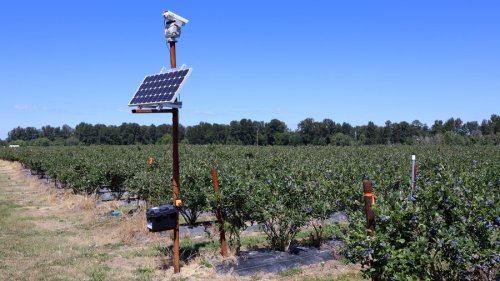
This laser unit is one of six that repel thieving birds from the blueberry fields of Meduri Farms near Jefferson, Oregon.

Are you familiar with the arch-criminal Moriarity, featured in Sherlock Holmes stories? “Moriarity” is what my husband called every devious catbird that got through his garden defenses last summer, eating many of the best berries. No sooner had my husband patched a piece of netting that the birds had sneaked through than they collaborated with one another to extend some tiny opening. And then they would get all tangled up and have to be rescued. (As Kim says, “Catbirds have such disorganized feathers.”)

Suzanne suggested the Scare-Eye Bird Chaser she had seen at a Rhode Island farm, but New Shoreham is too windy for a balloon defense.

A plastic hawk interested the grandchildren, but Moriarity was bored.

Next year it might be necessary to think about lasers.

Tom Banse writes at NPR, “During every berry-picking season in the Pacific Northwest, blueberry and raspberry growers fight to prevent birds from gobbling up the crop before harvest. This year, some farmers are trying something new to scare away the thieving birds: lasers.

“Justin Meduri manages a large blueberry farm and cherry orchard outside Jefferson, Ore. Birds like both fruits.

” ‘Flocks can move in of up to 2,000 to 3,000 starling birds,’ Meduri says. The starlings gorge themselves and knock down berries right as the crop is ready to pick. When he didn’t take countermeasures, Meduri says the damage was ‘inconceivable, huge. We had almost a 20 to 25 percent, maybe even 30 percent damage loss.’

“Meduri says he previously hired a falconer to protect his fields. But the falcons were expensive, temperamental and sometimes flew away. Then last year, he became one of the first farmers in the U.S. to install automated lasers. … Meduri is thrilled with the results.

” ‘[The lasers are] running right now as we speak. You’re out here in over 175 acres of blueberries,’ he says, punctuating the observation with a staccato of hand claps. ‘There’s not one bird that you see flying around.’ Meduri says that had any birds been in the bushes, the clapping would have made them come out. …

“[Laser maker] Bird Control Group started out in Europe, for the most part using lasers to shoo pesky birds away from industrial sites and airports. In the U.S. market, the agricultural industry appears to be the most promising.

“[Director of North American business development is Wayne] Ackermann says some of his initial sales have come from farmers trying to appease neighbors. …

“The silent lasers proved a friendlier — and sometimes better — bird repellent than traditional tools such as propane cannons or squawk boxes. The lasers are also friendlier than using poison or a 12-gauge shotgun.”

On second thought, the price is prohibitive for a backyard gardener, and not enough is known about whether the lasers are harmful to the birds. Researchers at Purdue University are studying that very question. So stay tuned for that — and for more on the misadventures of Moriarity.

The story is originally from the Northwest News Network. You can read the rest of it here.

Photo: Scare-Eye Bird Chaser
Another possible bird-control option if you don’t live in a windy region.

bird-x-animal-rodent-control-se-pack-64_1000

092618-basket-ordered-direct-from-Ghana

Look at this thing of beauty! I ordered it direct from Ghana to replace my old laundry basket. Here’s how I learned about the amazing Baba Tree.

The story starts with Suzanne’s bicycle. She wanted a bicycle basket and went online to see what might be available. That’s when she found a company in Ghana that helps basket-making artisans sell their works in the global marketplace.

Suzanne ordered a bicycle basket, and when it arrived safe and sound a few weeks later, I happened to be at her house. I starting thinking, What kind of basket do I need? I went online.

Founder Gregory MacCarthy writes an oddly defensive blog at Baba Tree in which he explains about the company, the prices, and the reasons he is not applying for “fair trade” status. As I read it just now, I was reassured — I have a lovely basket in front of me and I like finding quirky individuals behind something good.

MacCarthy writes, “We are not a ‘project,’ a charity, a foundation or a non – governmental organization (NGO). Though we engage small acts of charity every day, we are here, in Bolgatanga, to do business and do our best to empower the folks with whom we work through the open market. …

“The people with whom we work are very capable. Though we have customers who are very committed to their charities and purchase our baskets wholesale to raise money for them, the Baba Tree chooses to empower our people in the market place. It’s not that the Baba Tree is fundamentally opposed to aid and charity, it’s that it is rarely carried out honestly, efficiently and effectively which creates further dysfunction.

“The weavers with whom the Baba Tree works are more than capable of taking care of themselves, excelling through their own sweat and creativity that ultimately produces Excellence. The Baba Tree refines and cultivates the excellence brought forth through our weavers, and does an excellent job organizing and marketing that excellence throughout the world. …

“We are not subsidized in any form at all. All that is produced, and received, by the Baba Tree, is through our own sweat and creativity. At the Baba Tree everyone gets paid.”

A card inserted with my basket describes the hours spent stripping and dying elephant grass fibers, then braiding them in the Baba Tree compound to the accompaniment of “laughter and singing … interwoven into the very folds of our baskets.”

In the picture of my new basket (created by Martha, I’m told), you can see that “Do Not Crush” was written on the box. Although neither my basket nor Suzanne’s got crushed, the boxes and the baskets inside sometimes do suffer in transit from Ghana. For that reason, a paper was enclosed telling me how to fluff out a crushed basket by soaking it first in a tub of water.

I loved tip no. 8 on that paper: “Please do your best to use the water to water a tree or plant” after finishing. That tells me so much about Africa and about this company. And it reminds me that we should all be more thoughtful and thrifty with our abundant water.

Read more at Baba Tree and enjoy the gorgeous pictures there.

sidebar_staticblock

A Unique Pollinator

dl_514blueorchardbees_bee_on_phacelia_tanacetifolia_wide-026b809eb16b094939e36911aa87b02aad62ddca-s900-c85

Photo: Josh Cassidy/KQED
A female blue orchard bee forages for nectar and pollen on blue (or purple) tansy. Blue orchard bees are solitary bees that help pollinate California’s almond orchards.

There’s been a lot of attention to honeybees in recent years and to chemicals that may be responsible for the bee die-offs threatening our food supply. But apparently honeybees are just one of the pollinators that benefit the oblivious human race.

Gabriela Quirós reports at KQED, “While honeybees and their buzzing hives and hyper-fertile queens get all the press for pollinating our food supply, the hard-working blue orchard bee is one of 4,000 bee species native to North America that does its solitary work in relative obscurity. That is, until now.

“In the video, you can see how this bee builds its nests, alternating mud and a purple nectar-pollen mixture in hollow, skinny spaces. The blue orchard bees are preparing a purple lunch box of sorts for their offspring so they have food to eat in the tunnel. …

“But the blue orchard bee is more than a pretty face. It is an efficient pollinator that some farmers are exploring as a possible alternative or supplement to honeybees in sweet cherry and almond orchards.

“Honeybees are more prolific, but 40 to 50 percent of colonies die every year, according to a yearly National Honey Bee Survey, taken by universities and sponsored by the U.S. Department of Agriculture and the California Almond Board, among others. Enter the blue orchard bee.

” ‘This is, I think, the moment for these bees to shine,’ says entomologist Natalie Boyle, who studies blue orchard bees at the USDA in Logan, Utah. …

“Research has found that 400 female blue orchard bees are as effective at pollinating almonds as the more than 10,000 bees in a honeybee hive, says Boyle.

“Finding other bees that could work side by side with honeybees could offer what she calls ‘pollination insurance.’

“But it’s not a simple swap. Blue orchard bees take their time reproducing. They lay only about 15 eggs a year, while the queen honeybee can lay 500 or more a day. And the blue orchard bees wander off, rather than return to a hive every night.” More here.

There’s an awful lot we don’t know about insects because we just don’t pay attention. Maybe if we paid more attention, we would understand that we need them.

091918-Banksy-tagged-5-NYC-boroughs-in-2013

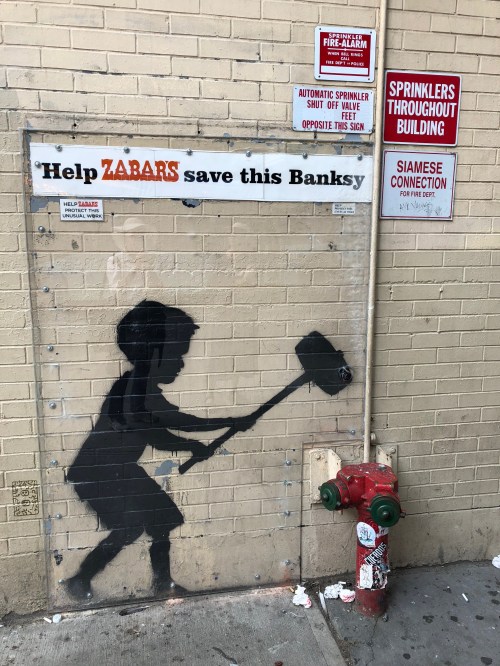
When I was last in Manhattan, I took a photo of a putative Banksy stencil. It’s one that the gourmet food emporium Zabar’s helped to preserve in 2013, when the British street artist was said to be tagging all five New York City boroughs.

I have written often about Banksy — here, for instance. I get a real kick out of his ideas and the fact that he works by stealth. (Speaking of that, if you search on the word “stealth” at the blog, you will find all kinds of examples.)

Banksy’s art, like other street art, is not necessarily meant to last for the ages, but he has become such a phenomenon that there are now efforts to restore murals that have been painted over.

The BBC reports from Scotland, “Restoration work is under way on three early works by the artist Banksy which were accidentally painted over with grey emulsion in a Glasgow nightclub.

“The murals, which feature a gun-toting monkey in a tutu and a framed Mona Lisa, were created as part of an exhibition at The Arches in 2001. But they were mistakenly covered in 2007 then left after the club went into administration [bankruptcy] in 2015.

“A team of restorers are expected to take five months to uncover the works. … Banksy created the works, which also feature the words ‘Every time I hear the word culture I release the safety on my 9mm’ when he was beginning his career as a graffiti artist.

“They were shown as part of the ‘Peace is Tough‘ exhibition in March 2001, … but six years later, and long after Banksy had established himself as an international artist, the murals were covered with grey emulsion during refurbishment work at the nightclub.

“When the club went into administration in 2015, the then owners had considered restoring the murals and selling them to clear the club’s debts.

“Chris Bull, technical director at Fine Arts Restoration Co (Farco), which is carrying out the restoration, said the murals were the only known works by Banksy in Scotland with any provenance. …

“The new owners of the venue, Argyle Street Arches, say they now want to save the works for the nation. … Once complete the works will be put on permanent display.”

More at the BBC, here.