Here’s a creative way to address the urgent need for housing in this country: make a deal with Canada to take the houses it doesn’t want anymore.
Kirk Johnson has the story at the NY Times.
“In the San Juan Islands of northwest Washington State, where a severe shortage of affordable housing threatens the economy and the community, a small nonprofit group has found an unlikely way to help anchor families that are struggling to stay — by lifting up unloved houses in Canada, hoisting them onto barges and hauling them to where they are needed. …
“The structures had what builders call good bones, and the group, the San Juan Community HomeTrust, discovered that the cost of transporting them across the Haro Strait from Canada and restoring them here was comparable to the cost of building from scratch. …
“The number of people living in poverty in the county has risen about 17 percent since the end of the recession in 2009, according to census figures, even as the economic recovery in Washington and around the nation gained steam.
“ ‘It’s kind life or death to keep our working families here,’ said Peter Kilpatrick, the project manager in refitting the houses to be imported by the San Juan Community HomeTrust. When the rewiring, painting and structural repairs are finished in June, buyers who have already met income and residency requirements can take possession.
“Through a combination of donated land, government and foundation grants and local fund-raising, the homes will cost the buyers — a hospital worker, several teachers and a massage therapist among them — from $160,000 to $210,000. The median market price here was almost $500,000 at the end of last year.” More here.
Nothing like a little recycling ingenuity applied to a problem! In fact, I was just commenting to a blogger who’s teaching in El Salvador that the locals’ skill at repairing and reusing items is a great foundation for creative problem solving in general. (Please read Milford Street’s report from El Salvador, here.)
Photo: Nancy DeVaux Houses from Canada were transported by barge to the San Juan Islands in Washington State, where affordable housing is badly needed.
Providence has to be the New England capital of playful graffiti. After PVD Fest a week ago, I caught three new bits of cheerful vandalism around town — new to me anyway.
Pasted on a wall near my office was a duck in a suit, which a younger friend informs me should be understood as “ducktales” because the suit has tails.
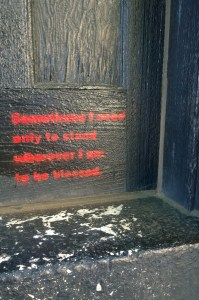
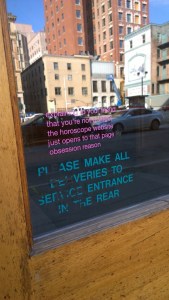
I especially love graffiti sayings, like the one about being blessed where you stand and the one about explaining to a friend that you are not a Virgo.
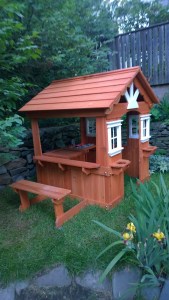
In other Rhode Island photos, we have the playhouse that Farmor gave her Providence grandchildren. Erik put it together, with help from Suzanne and the kids. The 18-month-old now thinks she’s in charge of screwdrivers.
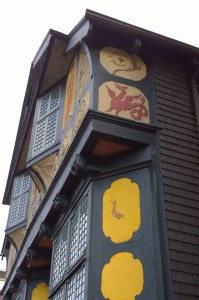
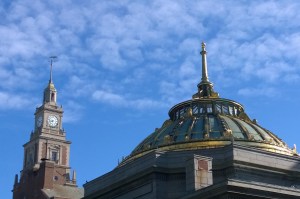
The picture of berries has a robin eating them. You may have to take my word on that. And if you walk around looking up all the time, you’re sure to see interesting tops of buildings.
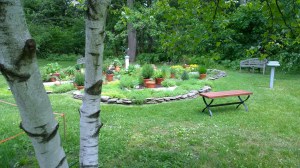
I’m winding up this photographic array in Massachusetts, with the herb garden behind the church, the sexton’s bonsai trees, and another tree that reminds me of a line from a hymn: “roots, hold me close.”
I’ve often wondered if a pay-what-you-want model could work for all the parties involved. I know Panera tested an approach that allowed well-wishers to pay for food that someone else couldn’t afford, but I believe that they eventually closed it down.
Another approach was covered in a recent Providence Journal article.
John Kostrzewa wrote, “Customers are always questioning the price — and they’re not the only ones.
“Stephen Atlas, an assistant professor of marketing at the University of Rhode Island, has been trying to find some answers. Atlas, who has a background in economics and a doctorate in marketing from Columbia, has been doing experiments in a local restaurant to learn what people will pay.
“He’s trying to advance existing studies of the ‘Pay What You Want’ model deployed in some urban areas, where customers decide on the price of a good or service. …
“Atlas has added a new twist to the research by asking what would happen if a vendor used a different strategy called ‘Rebate What You Want’ that would allow customers to get back what they have already paid. …
“The test worked this way: At the end of a meal, 231 randomly selected diners were given a card with one of three payment options, which differed from table to table.
“The options on the cards were: They could pay any portion of the menu price. They could agree to pay the posted price but request a full or partial rebate immediately. Or they could pay full price and later mail in a rebate form to get back up to a full refund. (The URI grant helped pay for the rebates.) One set of diners also received a regular bill with no card as a control for the test.
“The results showed the payment options did affect how much diners wanted to pay for their meal. The diners paid the most up front if they picked the option to mail in the rebate later. They paid less up front if they picked their own price directly. And they paid the least when they picked their own instant rebate. …
” ‘The most surprising outcome was how much diners paid across all the options despite being told when they received their bill that they could have received a free meal,’ Atlas said. Including the tip, ‘diners in all the pay-what-you-want conditions paid more than the asking price.’ ”
Tim is an architect and WordPress blogger who is concerned with, among other things, how real communities develop organically. He has a strong sense that creating places top-down should not be regarded as sustainable place making.
Being a bit of a contrarian, I’d love to think of a contrary example, but so far I can’t.
Here Tim takes off on a planned community in his neck of the Florida woods.
“The problem with the Love Street / Jupiter Inlet Village project is that nobody will live there. … The planners, architects and developer of the project say the project is all about real place making. Fortunately, we have a large amount of accepted research and knowledgeable writing on the subject of place making dating back over 40 years …
“First, 2 things need to be clear about place making – 1) It is a human phenomenon that is, therefore, very personal, varying, and not measurable; 2) ‘Real’ place making happens anywhere, and anytime there are humans present. …
“Wasteful land use in the form of a high percentage of non-places is the critical flaw with all drive-to places that claim to be urban or have high quality place making at their core. They simply do not, and they perpetuate the car-centric development pattern that exacerbates quality-of-life negatives in South Florida – traffic, loss of identity, and the replacement of real places with faux places.
“For Love Street / Jupiter Inlet Village to become the real place in claims it will be, it should do the following:
Embrace the residential patterns that are still in the area, and were once far more prominent, and include residential units of a similar urban village quality.
All parking should be metered, and of the on-street variety, and the parking lot should be replaced with a public green.
Retail, commercial, and office space should be geared toward neighborhood uses, with the goal of replacing vehicle trips with bicycle or pedestrian trips to a very high degree.
The lighthouse promenade must actually align with the lighthouse, and, thereby, solidify a framed street scape view of this landmark in perpetuity for all to share in. The promenade is presently a few degrees off, and focuses on a point well east of the lighthouse.
“Development and redevelopment projects are not inherently bad things, in fact, many developments create great pedestrian and transit oriented places that foster living, working and playing within a tight-knit community. However, developments that pretended to be great place makers, and really are not, represent a continuation of the very harmful growth patterns of the last half-century in disguise.
“Jupiter Inlet Village can be a great place, and an asset to the community, but it will not get there by pretending to be something that it is not.” More at Tim’s WordPress blog, here.
Straight from Maria Popova’s wonderful Brain Pickings blog, a review of an illustrated book on strange trees.
“In Strange Trees and the Stories Behind Them (public library), French author Bernadette Pourquié and illustrator Cécile Gambini choreograph an illustrated tour of the world’s greatest arboreal wonders, from species that have witnessed the dinosaurs roam this Earth to exotic marvels like Brazil’s ‘Walking Tree’ (Red Mangrove) and the Philippines’ ‘Rainbow Tree’ (Mindanao gum tree) to underappreciated procurers of human delights, such as the sapodilla tree that gives us chewing gum and the cocoa tree without which there would be no chocolate.
“Alongside each imaginative illustration, partway between botany and fairy tale, is a one-page autobiography of the respective tree, describing its natural and cultural habitat in a short first-person story fusing curious science facts, history, and local customs.” Read more.
I hope that John is reading this post. He’s officially on his town’s tree committee — promoting the value of trees in urban and commercial areas as well as residential — and he is leading a town tree inventory that was launched yesterday.
Because of my Swedish relatives, I naturally felt curious about SEI and looked it up. The website doesn’t say which think tank is first — or at least not prominently — but it does say that the US office is in Somerville, Mass., of all things. You learn something every day. I did know that the great environmental radio show Living on Earth is in Somerville, but the city is still a bit under the shadow of its industrial past.
From SEI’s website: “SEI’s vision is a sustainable future for all. Our mission is ‘to support decision-making and induce change towards sustainable development around the world by providing integrative knowledge that bridges science and policy in the field of environment and development’.
“To deliver on our mission, we work across issues like climate change, energy systems, water resources, air quality, land-use, sanitation, food security, and trade, and we approach these issues from a range of perspectives from the natural and social sciences.
“We combine scientific research with policy analysis, connecting our work to decision-makers and civil society in global governance, national public policy, regional cooperation, local planning, and the private sector. We generate and share knowledge that catalyses action, and always take a highly collaborative approach: stakeholder involvement is at the heart of our efforts to build capacity, strengthen institutions, and equip partners for the long term.
“Making scientific knowledge accessible is a priority. We publish our own series of open-access reports and briefs, alongside articles in leading academic journals, and work creatively through a range of media to ensure that our research is available to those that need it. We convene seminars and conferences that bring together decision-makers, academics, and practitioners to debate key issues and share knowledge, and engage in and inform policy processes, development action, and business practice worldwide.”
Whew! Wonky! Wish I could introduce SEI to Somerville neighbor Steve Curwood of Living on Earth. He’s pretty good at using everyday language for listeners.
I hope to learn more about the Stockholm Environment Institute, in any case, and am delighted its US office is so close to home.
Photo: Stockholm Environment Institute One environmental concern SEI is studying is disaster risk in the Asia-Pacific region.
A Native American chef trained in French cuisine has a mission to teach the world about an older, unrecognized culinary tradition that has influenced most of us. Hanna Choi reported the story for National Public Radio.
“When Nephi Craig enrolled in the culinary program at Arizona’s Scottsdale Community College, there was nothing like ‘Native American Cuisine 101’ in the curriculum. Craig identifies as White Mountain Apache and Navajo, and the first mention he can recall of anything remotely related to his background was a class discussion on fry bread, a crispy fried concoction that ‘is really a taste of American colonialism,’ he says …
“Since then, he increasingly came to sense a sort of dismissiveness and sloppiness towards Native Americans and indigenous food ways in the mainstream culinary world.
“Craig grew up immersed in his culture through art, music and ceremony, and food always played a large role. He wanted to find a way to bridge the gap. …
“Upon graduating from culinary school in 2000, Craig launched the Native American Culinary Association. Based in Arizona, NACA is a network of Native chefs — professionals and those just starting out — dedicated to the research, refinement, and development of Native American cuisine. Since 2011, the association has organized a yearly Indigenous Food Symposium, bringing people from different fields together to share and learn about Native foods, agriculture and landscapes.
In the NPR interview, Craig tells Choi, “I had always been cooking since I was a kid, growing up here on the rez with my mom and my family. We didn’t have a lot of money and so we would bake and sell our goods and I would bag up stuff in sandwich bags and sell them as a little guy.
“I’ve been cooking my entire life, all through my adolescence and I had ultimately wanted to do something creative. …
“I had no idea the world that I would be entering in the long classical legacy that is French cuisine. But that’s kind of where I started out, just in childhood, and then realizing just by pure observation that we were left out of this picture of world cuisine even when about 70 percent of foods consumed around the world today were developed and domesticated by Indigenous peoples of the Americas.”
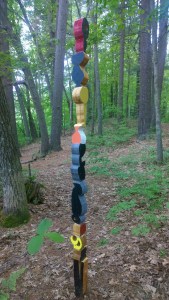
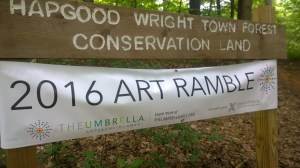
At first I saw no art. I didn’t enter the woods where the sign was, and I thought, “Maybe I have the wrong time.”
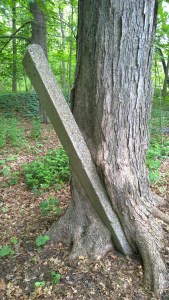
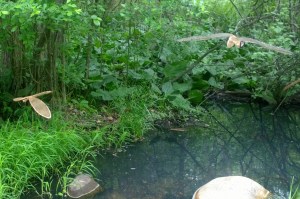
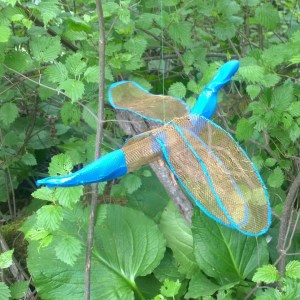
But the Hapgood Wright Town Forest is a work of art in itself, and I was up for a walk. The hilly pine-needle paths, the pond, the sounds of bullfrogs, wind in the trees, unfamiliar bird calls — all lovely. Then bit by bit, I began noticing pieces of art, part of the 2016 Art Ramble, which can be seen in the woods until September 5. How good of artists to do this!
The Umbrella Community Arts Center explains on its website, “This collaborative project with the Concord Department of Natural Resources celebrates all the arts. Sculpture, poetry, dance, and dramatic readings encourage the intersection of art, nature, and community in a historic natural setting.
“The arts offer a doorway for exploring our relationship with nature and place. An exhibit map will guide you through the exhibit at your own pace. And our calendar of special events and activities offers numerous opportunities to engage with the artists and with nature along the trails.
“We invite you to visit often, reflect, and play. Share your experiences via writing and drawing in the journals provided along the trail. Or make your own art using natural materials in the forest.”
Curator Ursula Ziegler says, “It’s been a rumble-tumble-fantastic-interesting road, and it has already exposed us to so many interesting-important dialogues, thoughts, and ideas. Beyond the visible part of art works in a public space, there is an equally important but less visible part, which are the conversations, networks, and structures that are created within our local community and beyond.”
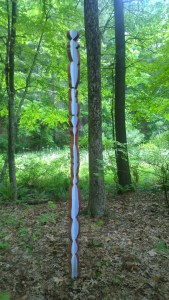
I took some pictures of ceramic toadstools, a QR code I don’t know how to use that would have identified an artist, sapling-like totems (or totem-like saplings), a small sculpture of a boy attached to a tree, fluttery dragonflies and the sign I missed on entering.
Here are some recent Rhode Island and Massachusetts photos. (Connecticut is also considered Southern New England, but I haven’t been there in ages.)
I wonder if other people have preferences for seeing certain kinds of photos on certain kinds of social media. For example, unless it’s a picture of one of my grandchildren, I really don’t like seeing people pictures on Instagram, but on Facebook, people pictures are the only kinds of photos I want to see. I’m still figuring out Ello, which is more likely to have art or gifs. I like almost any kind of photo on twitter or on blogs.
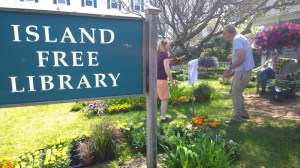
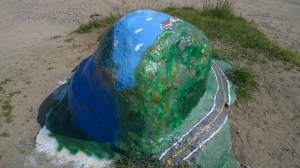
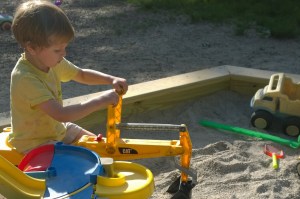
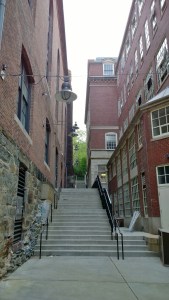
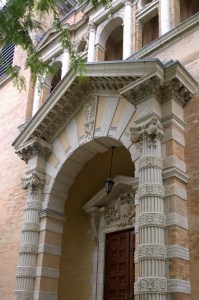
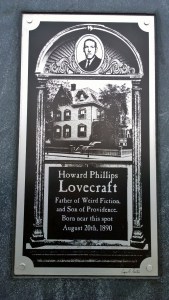
My own pictures are mostly from my walks. I’m starting off here with the plant sale at the New Shoreham library fundraiser and a typically short-lived scene on the island’s famed painted rock. Also in Rhode Island, an intensely serious heavy-equipment operator in a sandbox, the alley beside the Rhode Island School of Design Museum, fancy church architecture, and a plaque commemorating H.P. Lovecraft, a popular Providence-based horror writer with some regrettable character flaws.
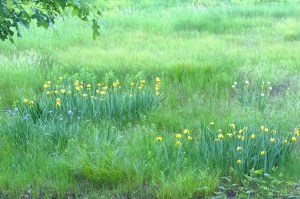
From Massachusetts, yellow iris in a meadow that is more often than not under water — or ice. Also a clematis, a remnant of a once-spectacular garden at a house that got sold. (Too spectacular for the new owners to live up to. Kind of like the garden in Woolf’s To the Lighthouse.)
I’ve been telling Suzanne and John about a free children’s hour on Thursdays at the Tomaquag Museum in Exeter, Rhode Island. I thought it sounded like fun for the kids.
According to the website, the program teaches “the history and culture of the Narragansett Tribal Nation through music, dance and storytelling. … Children’s Hour targets pre-school and homeschoolers during the school year and the families during school vacation. …
“Each week will have a different theme or focus. It will include music, dance, storytelling, engagement with exhibits and art or science activities. Each activity will be scaled to fit the ages and abilities of the youth. We will encourage peer mentoring between older and younger participants.
A typical Children’s Hour consists of: Traditional Greeting & Narragansett Welcome Dance (weather permitting); Narragansett Lesson/cultural concept (in our museum); Scavenger Hunt connected to theme where kids can explore exhibits; Social Dance to our Pavilion building; Storytelling/book share; craft or game depending on the content; Closing circle
The museum just won a national award for museum and library services. Executive Director Lorén Spears and Narragansett tribal leaders went to Washington last week, where Michelle Obama presented the award.
I was reading about the community outreach of the artist chosen to represent the United States at the Venice Biennale in 2017. How inspiring to see a once-disadvantaged kid reach back to help others after he meets with success!
Sebastian Smee writes at the Boston Globe, “The next artist to represent America at the Venice Biennale, the world’s most prestigious contemporary art event, will be the Los Angeles-based artist Mark Bradford. And his exhibit for the US Pavilion will be presented by the Rose Art Museum at Brandeis University. …
“The recipient of a 2009 ‘genius’ grant from the MacArthur Foundation, Bradford grew up in South Los Angeles. He worked for many years in his mother’s hair salon, which later became his studio. …
“Bradford, 54, is known for his tough, large-scale abstract works made from layers of paper, much of it salvaged and repurposed, and bound together with clear shellac. Using power sanders and other devices, he then works back into the surface, exposing the layers underneath. The results are some of the most beautiful, raw, and inventive works in recent art. …
“Bradford and his partner, Allan DiCastro, along with the collector Eileen Harris Norton, established a private foundation called Art + Practice, which combines an exhibition space with the provision, among other things, of job training and other forms of support for children transitioning out of foster care.”
More at the Globe. Check out Bradford, Norton and DiCastro’s nonprofit, Art + Practice, here.
Photo: Caitlin Julia Rubin Christopher Bedford (left), director of the Rose Art Museum at Brandeis University, with artist Mark Bradford at the Rose in 2014.
Not everyone can be an inventor, but inventors can be found everywhere. Teo Kermeliotis at CNN describes a boy inventor in Africa who is destined for great things.
“Richard Turere, 13, doesn’t like lions. In fact, he hates them. Yet this bright Maasai boy has devised an innovative solution that’s helping the survival of these magnificent beasts — by keeping them away from humans.
“Living on the edge of Nairobi National Park, in Kenya, Turere first became responsible for herding and safeguarding his family’s cattle when he was just nine. But often, his valuable livestock would be raided by the lions roaming the park’s sweet savannah grasses, leaving him to count the losses. …
“So, at the age of 11, Turere decided it was time to find a way of protecting his family’s cows, goats and sheep from falling prey to hungry lions …
” ‘One day, when I was walking around,’ he says, ‘I discovered that the lions were scared of the moving light.’
“Turere realized that lions were afraid of venturing near the farm’s stockade when someone was walking around with a flashlight. He put his young mind to work and a few weeks later he’d come up with an innovative, simple and low-cost system to scare the predators away.
“He fitted a series of flashing LED bulbs onto poles around the livestock enclosure, facing outward. The lights were wired to a box with switches and to an old car battery powered by a solar panel.
“They were designed to flicker on and off intermittently, thus tricking the lions into believing that someone was moving around carrying a flashlight.
“And it worked. Since Turere rigged up his ‘Lion Lights,’ his family has not lost any livestock to the wild beasts, to the great delight of his father and astonishment of his neighbors.
“What’s even more impressive is that Turere devised and installed the whole system by himself, without ever receiving any training in electronics or engineering. …
“Paula Kahumbu, executive director of the Kenya Land Conservation Trust … helped him get a scholarship at Brookhouse International School, one of Kenya’s top educational institutions, where he started last April. …
” ‘One thing that’s unique about Richard is that if you give him a problem, he’ll keep working at it until he can fix it. [He] doesn’t give up; he doesn’t find things too difficult; he’s not afraid of being unable to do something and I think this is why he is such a good innovator — because he’s not worried that it might not work, he’s going to try and do it anyway.’ ”
More here. And you can catch Richard’s TED Talk here. (Yes, he got on TED Talk!)
John told me that my efforts to learn Swedish online with Duolingo help to improve Google Translate and similar translation services, which purchase the history of users’ mistakes in order to refine their translation algorithms. I think Google Translate has fewer howlers lately. Maybe I helped.
Now along comes a product that claims to translate as you converse with a speaker of another language. Spenser Mestel has the story at the Atlantic.
“Last week, New York City-based Waverly Labs announced its recent invention, Pilot, a set of two ear buds that costs $299. Scheduled to be released by spring of 2017, the device purports to offer near-simultaneous translation for four languages.
“Inspired ‘when he met a French girl,’ Andrew Ochoa, the company’s founder, says that Pilot promises ‘a life untethered, free of language barriers.’ …
“Despite how quickly machine translation has progressed in the last few decades, language is a data set that’s far more complex than it seems, so no matter how quickly translation technology evolves, the stochastic messiness of speech will always outpace it. …
“In 1949, the scientist Warren Weaver proposed an alternative to rule-based translation called statistical machine translation (SMT). Instead of attacking language one minutia at a time, Weaver suggested a two-pronged approach: First, the computer would mine millions of documents looking for statistically significant linguistic patterns, thereby discovering the grammar, syntax, and morphology rules for itself. At the same time, the program would create a model to predict how certain phrases are translated and where in the sentence they should appear. …
“Waverly Labs hasn’t yet released the details of its software, but it likely works in the same fundamental way as Google Translate, which uses these rules and the predictive model to give the most statistically likely translation, the one that best mirrors the patterns it already found. …
“Even if it lags and stutters, Waverly Labs’s Pilot … could allow for more substantive engagement with the world.” More here.
Photo: Waverly Labs The Pilot in-ear translators from Waverly Labs
I call this one Downward Facing Dogwood. Taken from above, it shows our dogwood’s drooping magnificence. Next is a view from almost the same angle but including the neighbors’ flowering trees, too. On the back steps is an arrangement of lilacs, dogwood and a ubiquitous yellow flower whose name I don’t know.
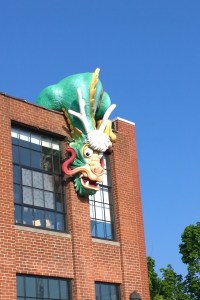
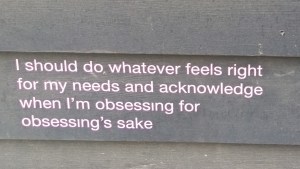
Three pictures taken in Providence feature a decorated utility box near the Rhode Island School of Design, the dragon that hovers over the Children’s Museum, and a cryptic statement in small print on the side of a Benefit Street house. My question: Is this the homeowner’s voice or vandalism?
Photo: Thomson Reuters Foundation Schoolgirls make their way to their school on an early morning in New Delhi.
Not long ago I read a story about boys in India who volunteer to help girls pursue education.
The article by Astrid Zweynert and Ros Russell begins, “Boys campaigning for girls’ education is not common in most parts of the world, but in India’s Rajasthan state, they are at the heart of a drive to get more girls into schools.
“Educate Girls trains young people to go into villages to find girls who are not in the classroom in a country where more than 3 million girls are out of school.
“Some 60 percent of Educate Girls’ 4,500 volunteers are boys, founder and executive director Safeena Husain told the Thomson Reuters Foundation.
” ‘Having these boys as champions for the girls is absolutely at the core of what we’re trying to achieve,’ Husain said in an interview as she was awarded the $1.25 million Skoll Award for Social Entrepreneurship, the largest prize of its kind. …
“In Rajasthan, 40 percent of girls leave school before reaching fifth grade, often because their parents do not see education as necessary for their daughter because she is going to get married or stay at home to do housework, Husain said. …
“Educate Girls’ approach to is to define hotspots where many girls are out of school, often in remote rural or tribal areas, and then deploy its volunteers to bring them back into the classroom, said Husain.”
There’s plenty of research showing that when girls are educated, the standard of living in a country goes up. Educated girls “are less likely to get married at an early age or to die in childbirth, they are likely to have healthier children and more likely to find work and earn more money.”











.jpg)







 Suzanne's Mom's Blog