January 8, 2015 by suzannesmom
A Framingham, Mass., couple who run a restaurant have decided to do their bit to combat hunger in their town.
Bella English has the story at the Boston Globe. “The Foodie Cafe is a 24-seater in a factory-and-warehouse section of Framingham. Workers stop in for coffee and eggs or for a lunch of homemade soups and breads, artisan sandwiches, and cupcakes with killer icing.
“But David and Alicia Blais, who own and run it, feed more than just their paying customers. They also aim to feed all of the city’s hungry. A chalkboard in the cafe proclaims: ‘Thanks to you (our wonderful customers), we have fed over 890 people in need this November. Thank you! Thank you! Thank you!’
“About three years ago, the couple opened the Foodie Cafe — they loved its huge kitchen — after selling a Walpole restaurant they had run for several years. …
” ‘There was no sense of food insecurity in Walpole on the scale found in Framingham,’’ says Alicia, 55. “All you have to do is drive around, and you can see the need. …’
“Devout Christians, the couple went to hear a pastor speak about his street ministry and when he mentioned that he always runs out of sandwiches for the hungry, they decided to help. …
“ ‘They’ve been tremendous to us,’ says Jim Bauchman, founder of Framingham Street Ministries. “I can’t thank them enough. I see it as a partnership.” …
“For them, feeding the hungry is a matter of philosophy and faith. ‘I feel that people should have the necessities of life,’ says Alicia. ‘People should be sheltered. People should have food. We have a restaurant. We make food. It’s not rocket science.’ ”
More here.
Photo: Suzanne Kreiter/Globe staff
Inside Alicia Blais assembles sandwiches.

Posted in Uncategorized | Tagged alicia blais, bella english, food insecurity, Framingham, framingham street ministries, hunger, jim bauchman, low-income, poor, postaday, poverty, Suzanne Kreiter | Leave a Comment »
January 7, 2015 by suzannesmom
Renée’s Christmas letter said she sometimes got children’s book ideas from this blog, which inspires me to increase my effort in that department.
Maria Popova’s extraordinary Brain Pickings website is a great source for children’s book recommendations, and I love that she often makes her finds in libraries.
Recently she described a sweet book called The Jacket, about a little girl who falls in love with a book.
Popova begins, ” ‘A book is a heart that only beats in the chest of another,’ Rebecca Solnit wrote in her sublime meditation on reading. But how that transplant happens is a matter wholly subjective and deeply mysterious. In the unusual, wonderful, and magically meta picture-book The Jacket (public library | IndieBound), writer Kirsten Hall and illustrator Dasha Tolstikova explore the beauty and terror of falling in love with a book from the perspective of the book itself. …
“ ‘Book was a book that had just about everything,’ the story begins. ‘He was solid and strong. His words were smart and playful. The problem was, Book didn’t feel special.’
“Book does want to be noticed … And then, one day, it happens. A little girl walks into the bookstore and falls in love with Book.”
But Book has to compete with the little girl’s dog for her affection. One day at a picnic, the dog accidentally splatters Book with mud.
“That night, her mother helps clean Book up, but the girl is ‘too sad and gloomy’ to read. … But when the girl opens her eyes in the morning, ‘something had changed.’
“She has a plan. With quiet excitement and optimism, she sits down at her desk with some art supplies as [her dog] and Book wonder what she’s working on.
“And then, the reveal: a colorful handmade jacket for Book, which she wraps around him as she beams a smile.” You learn how to make a jacket for your own book.
I love that after the girl sleeps on her problem, she wakes up with a solution, a feeling that she can do something about this. Strangely perhaps, my associations are to the Prodigal Son (“And when he came to himself, he said …”) and the ancient Greeks (“A dream came and stood at her head and said …”).
More at Brain Pickings, including lots of pictures.
Art: Dasha Tolstikova
Maria Popova says, “The Jacket comes from Brooklyn-based Enchanted Lion Books, by far the most intelligent and imaginative picture-book publisher today.

Posted in Uncategorized | Tagged brain pickings, children's books, Dasha Tolstikova, enchanted lion, kristen hall, maria popova, postaday, reading, the jacket | Leave a Comment »
January 6, 2015 by suzannesmom
One of these days I hope to see a moose in the wild, but not under the circumstances described in this recent report on National Public Radio.
“It was the brown snout and ears that caught their attention. Then they heard noises coming from under the snow. That was reason enough for three passing snowmobile riders to jump off their machines and start digging.
” ‘It looked like a guy’s arm at first because we were expecting to see a skier,’ Marty Mobley told the Alaska Dispatch News. …
“Mobley said he and two friends, all residents of Matanuska-Susitna Borough, Alaska, used their shovels to free the animal. …
“When the moose was mostly free, one of the men gently poked the moose, which suddenly stood up. Mobley said it looked like the abominable snowman, as it was covered in packed snow.
“It shook off the snow and ran down the mountain ‘at full steam’ and was apparently uninjured.
” ‘I am an animal lover, and I couldn’t leave it there,’ Mobley said. ‘Besides, we deal with a lot of avalanches and a lot of snow. That kind of karma is something we don’t pass up.’ ” More at NPR.
Photo: Pitkin County Sheriff’s Office, near Aspen, Colo./AP
Not moose but elk. It’s bad all over. Two out of three elk were saved in time.

Posted in Uncategorized | Tagged alaska, Aspen, colorado, elk, hatcher pass, marty mobley, Matanuska-Susitna Borough, moose, Pitkin County Sheriff, postaday, snowmobile | 3 Comments »
January 5, 2015 by suzannesmom
Speaking of libraries, if any of you decide to publish a collection of stories on the value of libraries, be sure to include this one about a family in India.
The nonprofit Read Global provided opportunity to them. “Om Prakash and his wife Sheela Devi raised three daughters and a son in the rural community of Geejgarh, in Rajasthan India. There were no educational resources nearby except for underfunded public schools, where books and computers were rare. …
“When we opened a READ Center in their village, the whole family was excited to join.
“ ‘It is a safe place for my daughters and wife to visit because it is close by, and it’s community owned and operated,’ Om Prakash says, ‘The staff are like family members. Anyone can visit and see what’s going on.’
“Their daughter Anuradha was the first to join the local READ Center. She took trainings in English, computer skills, and radio, where she created programs on health and women’s rights to help spread awareness in her community. …
“Their daughter Archana started an online college program, and uses the books and computers at the Center for school. After graduating, she wants to become a teacher …
“Their son Pankaj is applying for government jobs. He took computer training from the Center and uses the library daily to prepare for the government’s required entrance exam.
“Mahima is the youngest. She participated in beautician training at the Center, and now she plans to become a makeup artist and open a beauty parlor of her own. …
“Anuradha says there has been a change in social norms in her community because of the Center: ‘Earlier, villagers were totally against letting their wives and daughters work, but now many of them have changed. They see women with respect, and they value their opinions.’ ”
More at Read Global.
Photo: ReadGlobal.org 
Posted in Uncategorized | Tagged education, empowerment, Geejgarh, india, learning, library, opportunity, postaday, Rajasthan, read global | Leave a Comment »
January 4, 2015 by suzannesmom
New research in the UK is providing confirmation of my belief that boredom is not always a destructive thing but often a path to creativity. Other people have had the same impression. After all, the site with some of the most creative links on the web calls itself Bored Panda.
Recently, my husband sent along a relevant article by the BBC’s David Robson, who caught my interest at once with his claim that boredom was first mentioned in Bleak House, by Charles Dickens. (I’ve read that novel enough times to know that Robson spelled Lady Dedlock’s name wrong, though.)
For his report, Robson interviewed Sandi Mann, coauthor with Rebekah Cadman of a University of Central Lancashire study on boredom.
He begins, “I’ve met lots of people with a talent to bore in my time, but Sandi Mann is one of the few to have honed it as a craft. Eager volunteers visiting her lab may be asked to carry out less-than-thrilling chores like copying out lengthy lists of telephone numbers. They mostly tolerate the task politely, she says, but their shuffling bottoms and regular yawns prove they are hardly relishing the experience. …
“Mann has found that their ennui boosted their performance on standard tests of creativity – such as finding innovative uses for everyday objects. She suspects the tedium encouraged their minds to wander, which leads to more associative and creative ways of thinking. ‘If we don’t find stimulation externally, we look internally – going to different places in our minds,’ she says. ‘It allows us to make leaps of imagination. We can get out of the box and think in different ways.’ Without the capacity for boredom, then, we humans may have never achieved our artistic and technological heights. …
“Given this benefit, Mann thinks we should try not to fear boredom when it hits us. ‘We should embrace it,’ she says – a philosophy that she has now taken into her own life. ‘Instead of saying I’m bored when I’m stuck in traffic, I’ll put music on and allow my mind to wander – knowing that it’s good for me. And I let my kids be bored too – because it’s good for their creativity.’ ”
My own approach to being stuck at the end of a long line is to recite the poems I know. I also carry in my bag a few other poems in case I run out.
More here, at the BBC, which also covers the darker side of boredom.
Photo: Socialphy
Yawning.

Posted in Uncategorized | Tagged bbc, bleak house, boredom, creativity, David Robson, ennui, imagination, lady dedlock, postaday, Rebekah Cadman, sandi mann, University of Central Lancashire, yawn, yawning | 5 Comments »
January 3, 2015 by suzannesmom
My husband pointed out this cool story about how NASA is using 3-D printing. I have had a couple posts about using 3-D to create food, but this is the first use of the technology that really makes sense to me. It’s sending design instructions to someone you have no physical access to so they can create a needed tool.
Janet Fang writes at IFLScience, “For the first time ever, hardware designed on the ground has been emailed to space to meet the needs of an astronaut. From a computer in California, Mike Chen of Made In Space and colleagues just 3D-printed a ratcheting socket wrench on the International Space Station. ‘We had overheard ISS Commander Barry Wilmore (who goes by “Butch”) mention over the radio that he needed one,’ Chen wrote in Medium [in December]. So they designed one and sent it up.
“ ‘The socket wrench we just manufactured is the first object we designed on the ground and sent digitally to space, on the fly,’ he adds. It’s a lot faster to send data wirelessly on demand than to wait for a physical object to arrive via rockets, which can take months or even years.
“The team started by designing the tool on a computer, then converting it into a 3D-printer-ready format. That’s then sent to NASA, which transmits the wrench to the space station. Once the code is received by the 3D printer, the wrench is manufactured: Plastic filament is heated and extruded layer by layer. The ISS tweeted this photo earlier this week, and you can see more pictures of the very cool wrench-printing process here.” More here.
Photo: NASA
Commander Barry Wilmore, traveling in space, shows off a 3D printed ratchet
Posted in Uncategorized | Tagged 3-D printing, ames research center, astronaut, barry wilmore, extrude, International Space Station, iss commander, janet fang, made in space, mike chen, nasa, postaday, space, wrench | 2 Comments »
January 2, 2015 by suzannesmom


Here are a few recent photos from Rhode Island and Massachusetts. I took all but the shivery January 1 New Shoreham plunge, which is the work of Sandra M. Kelly. I doubt I would have been brave enough even to go watch these hardy souls freeze on such a cold day.
What can I tell you about the other photos? The Hmong church near my grandson’s play school was a surprise. I knew about Hmong refugees in California, Minnesota, and Central Massachusetts. Didn’t know they were in Providence. A wonderful book about the Hmong immigrant experience is The Late Homecomer, by Kao Kalia Yang, who grew up in St. Paul.
I include a porcine household god from Providence, a bathrobe in the guest room where I awaited the arrival of my new granddaughter in December, and two aspects of the Seekonk River on January 1.
The photo I call “In Trial Realest, a Message from Beyond,” is one I was determined to capture while the sign was broken. It called to me from my office window as it lit up at dusk. I’m glad I caught it when I did, because the neon letters are now all working, and its message is no longer as interesting.





Posted in Uncategorized | Tagged hmong, kao kalia yang, late homecomer, massachusetts, minnesota, new shoreham, photo, photography, postaday, rhode island, Sandra M. Kelly, seekonk river | Leave a Comment »
January 2, 2015 by suzannesmom
WordPress asked me if I would like to post its summary of my 2014 blogging, and I said OK. So the rest of this post is from WordPress.
“WordPress.com stats helper monkeys prepared a 2014 annual report for this blog.

“Here’s an excerpt:
The concert hall at the Sydney Opera House holds 2,700 people. This blog was viewed about 16,000 times in 2014. If it were a concert at Sydney Opera House, it would take about 6 sold-out performances for that many people to see it.
“Click here to see the complete report.“
Posted in Uncategorized | Tagged 2014, stats, wordpress | Leave a Comment »
January 1, 2015 by suzannesmom
You have heard of “slow food” and perhaps “slow money” (a loan with a long time to pay back) and other efforts designed to help us reduce the often meaningless haste of modern life. Well, Cousin Claire has been posting news on Facebook about another slow movement that is sure to intrigue you, Slow Textiles.
Says Slow Fiber Studios on its About page, “We are founded on a simple intention: to offer real-world insight into the multifaceted and holistic practice of textile-making. Slow Fiber Studios™ offers dynamic, hands-on field study programs in diverse areas of the world where textile culture runs deep — India, Mexico, Japan, France, Italy, and on. We believe the best way to understand a philosophy is to see it being lived.”
Here is a description of a 2012 offering: “Special opportunity to travel throughout India with Yoshiko, who has been exploring this country for over 30 years (lived in Ahmedabad in 1983/84 on an Education & Culture Fellowship and frequent 3-month residencies spanning 3 decades). Yoshiko will introduce her friends in India who are involved in welfare, community empowerment, and cultural sustainability projects.
“Tour Highlights: natural dyes, organic cotton cultivation, handloom weaving, khadi, biodynamic farming, architecture, local food and religion, contemporary art and design educational institutions, museums, solar energy development, hand spinning and weaving wild silks and Tibetan wool in Himalayan communities.” More here.
How well I remember the wistful feeling I got in reading the book Lark Rise to Candleford when the beautiful handmade lace was spurned as soon as the factory-made came in. There is something to be said for speed and efficiency, but also something to be said for craft.
Photos: Slow Fiber Studios

Posted in Uncategorized | Tagged architecture, biodynamic farming, community empowerment, craft, cultural sustainability, endangered, fiber, handloom weaving, himalayan, india, khadi, lace, lark rise to candleford, natural dyes, organic cotton cultivation, postaday, slow fiber studios, textile, tibetan, wool | 2 Comments »
December 31, 2014 by suzannesmom
As an icebreaker at lunch Monday, a colleague asked us all to go around the table and name a New Year’s resolution. I said I was going to emulate the phone-reading guy in the comic who tells his friend, “Yes, I just got a text, but I think there’s also a subtext.”
I meant that I want to go beneath the surface of things, to listen to what people are really saying. You know how you can sharpen your skills in that department? Read fiction.
That’s according to an Emory University study written up at Mic. Gabe Bergado has the story. “It’s not news that reading has countless benefits: Poetry stimulates parts of the brain linked to memory and sparks self-reflection … But readers of fiction? They’re a special breed.
“The study: A 2013 Emory University study looked at the brains of fiction readers. [Neuroscientist Gregory Berns and coauthors] compared the brains of people after they read to the brains of people who didn’t read. The brains of the readers — they read Robert Harris’ Pompeii over a nine-day period at night — showed more activity in certain areas than those who didn’t read.
“Specifically, researchers found heightened connectivity in the left temporal cortex, part of the brain typically associated with understanding language. The researchers also found increased connectivity in the central sulcus of the brain, the primary sensory region, which helps the brain visualize movement. When you visualize yourself scoring a touchdown while playing football, you can actually somewhat feel yourself in the action. A similar process happens when you envision yourself as a character in a book: You can take on the emotions they are feeling. …
“Need more proof? Psychologists David Comer Kidd and Emanuele Castano at the New School for Social Research focused on the effect of literary fiction, rather than popular fiction, on readers. For the experiment, participants either read a piece of literary fiction or popular fiction, followed by identifying facial emotions solely through the eyes. Those who read literary fiction scored consistently higher, by about 10%.
” ‘We believe that one critical difference between lit and pop fiction is the extent to which the characters are complex, ambiguous, difficult to get to know, etc. (in other words, human) versus stereotyped, simple,’ Castano wrote to Mic.” More here.
Thank you, Claire, for sending this. You know what I like.
Posted in Uncategorized | Tagged central sulcus, David Comer Kidd, Emanuele Castano, emory university, empathy, fiction, Gabe Bergado, Gregory Berns, neuroscientist, New School for Social Research, pompei, postaday, robert harris, science, temporal cortex | Leave a Comment »
December 30, 2014 by suzannesmom
TreeHugger frequently covers biking. And since my four-year-old grandson has mastered all but the braking on his new two-wheeler and expects me to start biking with him, I think I better cover bikes, too.
Here is an article by Derek Markham from the TreeHugger website about a new bike that aims to combine the best of two worlds.
Writes Markham, “When you go from riding a skinny-tired road bike to a mountain bike with fat tires, it opens up a whole new world of cycling, even if you don’t ever leave the pavement. With fat tires (and perhaps some suspension), your bike can float right over bumps and cracks in the road without rattling your teeth, hopping up or down curbs is almost effortless …
“But even with these advantages, there are still riding situations that can bog down a mountain bike, such as sandy and snowy conditions, and if you really want to go where most people don’t, then a fat bike is the next logical step.
“Fat bikes, with their extremely wide (4″) tires, can make a sandy wash or a gravel road as easy to ride as a packed singletrack (well, almost as easy), and riding in and on snow and mud can be something you seek out instead of try to avoid. But those big fat tires also take some extra effort, and if your thighs aren’t quite up to the task of pedaling a fat bike through and over slush, snow, sand, gravel, or mud, a fat bike ride can be grueling. However, when you add the power of a 500W electric motor to a fat bike, such as Biktrix has done, a virtually unstoppable Juggernaut is created.” More here.
Hmmm. An upstoppable Juggernaut might impress my grandson, but I am pretty sure he doesn’t want me to be as impressive as he is. He told his dad Saturday, “You need to be slower than me.”
Besides, the electric part reminds me of mopeds, and I really don’t like mopeds.
Photo: Biktrix

Posted in Uncategorized | Tagged bike, biking, biktrix, derek markham, electric, fat bike, postaday, treehugger | Leave a Comment »
December 29, 2014 by suzannesmom
Did you catch the NY Times article before Thanksgiving featuring a special recipe from every state? Asakiyume says she made the wild rice recipe and the persimmon pudding, “both of which were fabulous.”
Since my husband and I lived in Minnesota for a few years in the 1990s, I had to check out that state’s recipe. If you listen to Garrison Keillor’s radio show A Prairie Home Companion, you know that food in the “hot dish” capital of the world is often a little … different. (“That’s different!” as the book How to Talk Minnesotan teaches us to say when we’re feeling skeptical.)
Anyway, the Minnesota Thanksgiving dish is grape salad. I’m not saying it wouldn’t be delicious, but some of the other state recipes look positively luscious.
Here is the grape salad recipe. It gave me a chuckle.
- 2 pounds seedless grapes, removed from stems and rinsed, about 6 cups
- 2 cups sour cream
- 1 cup brown sugar
- ¾ cup toasted pecans (optional)
- Heat broiler. Put grapes in a large mixing bowl. Add sour cream and stir with a wooden spoon or spatula, making sure all grapes are well coated.
- Transfer mixture to a 2-quart ceramic soufflé dish or other baking dish. Sprinkle brown sugar evenly over top. Place dish under broiler as far from heat source as possible and broil until sugar is caramelized and crispy, about 5 minutes (be vigilant or you’ll risk a burnt black topping). Rotate dish as necessary for even browning. Chill for at least one hour. May be prepared up to 24 hours ahead. Just before serving, sprinkle with toasted pecans, if using.
More state recipes here. Save the collection for a special occasion — or next Thanksgiving.
Photo: David Tanis/NY Times

More here.
Photo: David Tanis/NY Times
Posted in Uncategorized | Tagged david tanis, garrison keillor, grape salad, how to talk minnesotan, minnesota, new york times, postaday, prairie home companion, recipes, thanksgiving | 8 Comments »
December 28, 2014 by suzannesmom
I liked this story at TreeHugger on protecting trees and fighting poverty at the same time — especially the part about the importance of women in the effort.
Sami Grover writes, “The old trope that we can either have economic development or environmental protection has been pretty much blown out of the water by this point. …
“Nowhere is this more true than the dry lands of Africa, where desertification, resource depletion, climate disruption and political unrest have all taken their toll on communities’ ability to survive and thrive. There is, however, plenty to be hopeful about too. …
“Tree Aid, a charity which works with villagers living in the drylands of Africa, has long been at the forefront of this fight. By working cooperatively with villagers and on-the-ground non-profit partners in Africa, the charity doesn’t just plant trees, but rather increases villagers’ capacity to protect, nurture and utilize trees to protect their soils, increase agricultural yields, and provide a buffer against the drought, floods and failed crops that are predicted to get ever more common with the advance of climate change.
“A new free report from the charity, entitled Building Resilience to Climate Shocks, the charity is seeking to spread the word about how trees can be used to both alleviate poverty and protect the environment at the same time. …
“Previous tree planting efforts in the drylands have often failed because they’ve either focused on the wrong species of trees, or they have failed to take into account the needs, resources and skills of the local population. …
“Unless short-term needs are met, long-term needs are compromised. … Tree Aid has worked with villagers to develop alternatives to ecologically damaging land management practices:
TREE AID provides training for villagers to plan ways to make money in the short-term as well as the long. For example by producing honey from the bees which live on unburnt land and using fallen trees for fuelwood. This gives them enough income to sustain and invest in their futures and environments, as well as preparing themselves for weather extremes. …
“One of the strategies the charity uses to build climate resilience is to establish ‘Tree Banks’ within a community. These banks are essentially mixed-species tree plantings that can provide for a range of needs from fuel wood to animal fodder to fruit or other products. Each community establishes rules and management practices for when and how a Tree Bank may be used. …
“Any successful strategy for regreening these regions must work within those cultures to empower and educate women as caretakers of the environment: When women take part in decision-making there is a long-term positive impact on trees. They become important forest caretakers.”
More at Tree Aid, here ,and at Treehugger, here.
Photo: Tree Aid

Posted in Uncategorized | Tagged africa, Building Resilience to Climate Shocks, charity, climate change, desertification, ecology, empower, environment, forest, honey, non-profit, postaday, resources, sami grover, tree aid, treehugger, trees, villagers | Leave a Comment »
December 27, 2014 by suzannesmom
I like to listen to the radio show Studio 360 (on the arts) as I drive to tai chi Saturday mornings.
In October, I heard about a contest the show was running. The Studio 360 website explains: “We challenged you to The Great Studio 360 Doodle Dare. Cartoonist and newly-minted MacArthur ‘genius’ grant winner Alison Bechdel started a drawing — of a disconcerted young woman grasping at something unseen — and we asked you to complete the picture.
“More than two hundred doodlers took our challenge, putting Alison’s character in every imaginable situation — fighting spaghetti, hitching a ride on a dragonfly, hanging off of Iggy Azalea’s backside. …
“ ‘I was amazed by how many submissions there were,’ says Bechdel. ‘And many of them were really, really wonderful.’
“Carlolita Johnson explained in her submission that the drawing depicts something that really happened to her. ‘She had a little dog that was rolling around on a cliff above the ocean and the dog went over,’ Bechdel explains to [Studio 360 host] Kurt Andersen. ‘So it was exciting to me, because I like to write about my own life, to see someone turn this into a real scene from their own life.’ ”
More here.
Alison Bechdel’s original drawing next to the winning submission from Carlolita Johnson (Studio 360 Doodle Dare) 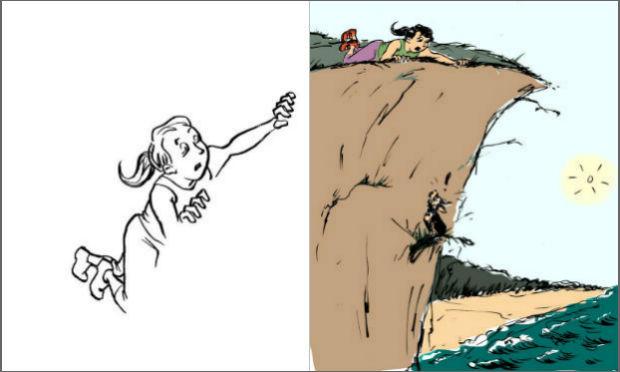
Posted in Uncategorized | Tagged alison bechdel, carlolita johnson, cartoon, comic, doodle, genius, kurt andersen, macarthur, postaday, studio 360 | 2 Comments »
December 26, 2014 by suzannesmom
Tara Mitchell writes at EcoRI News, about the many virtues of compost. It’s a timely topic for gardeners starting to think about spring and what to order from the seed catalogs that arrive this time of year.
Mitchell reports from Wrentham (MA), “John Engwer, owner of Groundscapes Express Inc., and Butch Goodwin, operations manager, recently led Ecological Landscaping Alliance (ELA) participants on a tour of the company’s composting facility, explaining how compost is made and discussing its many benefits and uses. …
“With the recent implementation of the Massachusetts ban on food waste being buried or incinerated, food scrap from hospitals, restaurants and supermarkets have become another component in the composting process. Food scrap from a local hospital is now incorporated into Groundscapes’ composting operation. …
“Goodwin said the material takes about four months to decompose and is then left to cure for another two months. It’s then screened. The finished product, dark brown, moist, light and crumbly, smelling of earth and full of microbes, is then ready to be delivered. …
“Engwer emphasized the importance of using, reusing and retaining existing wood, stumps, brush and other natural material on site so that organic matter can remain part of the cycle of growth, death, decomposition and renewal.”
You can find more on the how-to here.
Photo: Ecological Landscaping Association
The first step in the Groundscapes Express composting process is mixing the raw materials.

Posted in Uncategorized | Tagged Butch Goodwin, compost, EcoRI News, ela, Groundscapes Express, John Engwer, postaday, Tara Mitchell, wrentham | 2 Comments »
« Newer Posts - Older Posts »









 Suzanne's Mom's Blog