Feeds:
Posts
Comments

Photo: Zihui Zhou/University of California, Berkeley.
A carbon-capturing powder, pictured on Berkeley’s campus. 

Somehow or other scientific research about global warming will continue. Today’s example comes from Berkeley in California.

At the Guardian, Katharine Gammon reports, “An innocuous yellow powder, created in a lab, could be a new way to combat the climate crisis by absorbing carbon from the air.

“Just half a pound of the stuff may remove as much carbon dioxide as a tree can, according to early tests. Once the carbon is absorbed by the powder, it can be released into safe storage or be used in industrial processes, like carbonizing drinks.

“ ‘This really addresses a major problem in the tech field, and it gives an opportunity now for us to scale it up and start using it,’ says Omar Yaghi, a chemist at the University of California, Berkeley. It’s not the first material to absorb carbon, but ‘it’s a quantum leap ahead [of other compounds] in terms of the durability of the material.’

“The powder is known as a covalent organic framework, with strong chemical bonds that pull gases out of the air. The material is both durable and porous, and can be used hundreds of times, making it superior to other materials used for carbon capture.

“Yaghi has been working on similar materials for decades. It’s part of a broader push to collect tiny amounts of carbon from the air – either from power plants or from air around cities. Yaghi’s research with Zihui Zhou, a graduate student in his lab, and others was published in the journal Nature. …

“Yaghi’s team tested the new powder and found that it could successfully absorb and release carbon more than 100 times. It fills up with carbon in about two hours, and then must be heated to release the gas before starting the process over again. It only requires a temperature of about 120F to release the carbon; that makes it an improvement over other methods, which require a much higher temperature.

“That feature means places that already produce extra heat – such as factories or power plants – could use it to release the gas and start the cycle again. The material could be incorporated into existing carbon capture systems or future technology.

“Yaghi … plans to scale the use of this type of carbon capture with his Irvine, California-based company, Atoco, and believes the powder can be manufactured in multi-ton quantities in less than a year.

“Shengqian Ma, a chemist at the University of North Texas who was not involved in the new work, says this technology could be gamechanging. ‘One longstanding challenge for direct air capture lies in the high regeneration temperatures,’ he says, adding that the new material can substantially reduce the energy needed to use direct air capture. …

“Says Farzan Kazemifar, a associate professor in the department of mechanical engineering at San Jose State University who was not involved in the new study, ‘In the short term, replacing large emitters of carbon dioxide – like coal power plants – with renewable electricity offers the fastest reduction in emissions. However, in the long term, in case the emissions don’t go down at the desired pace, or if global warming effects intensify, we may need to rely on technologies that can remove carbon dioxide from the atmosphere, and direct air capture is one of those technologies.’

“Still, removing carbon from the air remains difficult, and as with all early-stage lab-scale studies, the challenge is scaling up the system for pilot studies. … Any technology to capture the gas from the air requires moving huge volumes of air – and that requires large electricity consumption for running fans, says Kazemifar. …

“Some scientists worry that the expectations of direct air capture systems has been overly rosy. A group of scientists from MIT recently wrote a paper analyzing the assumptions of many climate stabilization plans, and pointing to ways that direct air capture may be overly optimistic.

“Ma also points out that a major challenge to using this approach to combat climate change lies in the high cost of materials for creating substances that capture carbon.

“Still, Yaghi says this material can change the way we address carbon removal. ‘This is something we’ve been working on for 15 years, that basically addresses some of the lingering problems,’ he says.”

More at the Guardian, here.

Photo: Riley Robinson/CSM.
Above, Lucy Lujana, a carpenter with United Brotherhood of Carpenters and Joiners Local 54 in Chicago. As of 2023, only 3.1% of carpenters were women. Sometimes they call themselves the “Sisters of the Brotherhood.”

In the US, some women have moved into jobs traditionally held by men, but progress seems slow to me. In countries including India, Australia, Finland, England, and Israel, women have served at the very top, same as being president in the US. America’s oddly progressive and backward character is something to ponder.

Today we consider women in unions.

Richard Mertens writes at the Christian Science Monitor, “Last year, Lisa Lujano, a longtime member of the United Brotherhood of Carpenters and Joiners Local 54, found herself in very unfamiliar company. She had been tasked to build stairs in one section of the Obama Presidential Center on Chicago’s South Side. When she showed up for work, she discovered she would be part of a crew of five, all women.

“ ‘I don’t know how it came about,’ Ms. Lujano says. … Most of the time, when she shows up for work, she’s the only woman on the crew. And she and her fellow tradeswomen know as well as anyone an inescapable truth: The American construction site is still a man’s world. Until that moment, at least, when suddenly it wasn’t.

“ ‘It was a good experience,’ Ms. Lujano says, looking back on the 11 months working alongside other women carpenters. ‘We were able to relate, be more comfortable with each other. Then she adds, almost exultingly, ‘We’re sisters in the brotherhood!’ …

“Ms. Lujano has been a member of her union for almost 25 years. The journeyman carpenter loves her work, the daily routine. But she still puts up with unpleasant conversations. At lunch she’ll sometimes sit by herself, or take a nap in her car. …

“On a recent Friday, she was … on a team of about 60 workers rebuilding a train station at the edge of the University of Illinois Chicago campus. She’s one of only five women at the site today, the only one on her crew of 10. …

“Over the past decade, the number of women in the construction sector of the U.S. economy has risen steadily, from about 800,000 in 2012 to about 1.3 million in 2023, according to the U.S. Bureau of Labor Statistics.

“Only 11% of jobs in construction industries are held by women, and the majority of these jobs are in office work, sales, or other support services. A growing number are even becoming managers. But on construction sites themselves, the vast majority of construction workers remain men. …

“ ‘The whole process of diversifying the construction trades has been an incredible slog,’ says Jayne Vellinga, executive director of Chicago Women in Trades, an organization that has worked for decades to help women find jobs in the skilled trades.

“[Yet] there’s been a surge in demand for construction workers. … About 94% of construction firms report being unable to hire the skilled workers they need, according to the Associated General Contractors, a trade group in Arlington, Virginia. Experts estimate this shortage numbers more than a half-million workers.

“Given these shortages, the contractors trade group also found last year that 77% of construction companies report that ‘diversifying the current workforce at our firm is critical to strengthening our future business.’

“This doesn’t mean companies will be hiring more women. There remains a significant cultural obstacle to bringing more women into and training them for the skilled trades: Construction is still widely believed to be the domain of men. …

“Like many women, Ms. Lujano followed an unconventional path into the trades. She had no family connections, no uncle or father to bring her into the business, as young men often had. She had dropped out of high school to care for a son who was just a year old. ‘I couldn’t support him,’ she says. …

“In 1998, she saw a flyer from Job Corps, a federal program that offers young people preapprenticeship training and a chance to finish high school. The flyer listed different jobs: plumber, electrician, carpenter, secretary, and more.

“She enrolled in a program in Golconda, a small Illinois town on the banks of the Ohio River. There, over 13 months, she earned a GED certificate and received hands-on training in how to build things. She and other students built ladders, bunk beds, and even frame houses. ‘It was just so cool,’ she says. ‘I ended up loving it.’

“But it wasn’t easy. In her first job she spent four months demolishing and rebuilding porches for a nonunion contractor. Then she got her first union job, working on a bridge in Skokie, just north of Chicago. She was the only woman in a crew of young men in their early 20s. The men would make vulgar comments to her, or about her, even in her presence. …

“Ms. Lujano is no longer a rookie apprentice, but a journeyman carpenter making the full journeyman’s wage: $55 an hour, plus health benefits and a pension. She’s also a union steward, responsible for making sure the workers are properly credentialed and helping them deal with complaints or problems on the job. …

“Looking out over the worksite at the train station in Chicago’s Near North Side, Ms. Lujano sees both good and bad, both progress and the limitations of that progress. Including her with the carpenters, there is one woman among the electricians, one among the ironworkers, one among the bricklayers, and one among the painters. Tradeswomen often feel they are only tokens of diversity on the job site. But to Ms. Lujano, one woman is better than none. …

“Now in her third decade as a union carpenter, she feels keenly the need to help younger women as they face the challenge of working in a world that has, for so long, been dominated by men.”

More at the Monitor, here. No firewall. Subscriptions solicited.

Photo: ItalianNotes.
Prickly pear, or cactus pear. When Italy suffers from drought, some people turn to an edible cactus.

A while ago I posted photos I’d taken in New England and was surprised to see a cactus this far north. Hannah called it “prickly pear” and told me it was known for its versatility. It’s apparently the same cactus that Italy is looking to as a reliable food source.

Stefano Bernabei and Gavin Jones write at Reuters, “Global warming, drought and plant disease pose a growing threat to agriculture in Italy’s arid south, but a startup founded by a former telecoms manager believes it has found a solution: Opuntia Ficus, better known as the cactus pear.

“Andrea Ortenzi saw the plant’s potential 20 years ago when working for Telecom Italia in Brazil, where it is widely used as animal feed. On returning to Italy he began looking at ways to turn his intuition into a business opportunity.

“He and four friends founded their company, called Wakonda, in 2021, and began buying land to plant the crop in the southern Puglia region where the traditionally dominant olive trees had been ravaged by an insect-borne disease called Xylella.

“The damage from the plant disease has been compounded by recurring droughts and extreme weather in the last few years all over Italy’s southern mainland and islands, hitting crops from grapes to citrus fruits.

“Ortenzi is convinced the hardy and versatile cactus pear, otherwise called the prickly pear or, in Italy, the Indian fig, can be a highly profitable solution yielding a raft of products such as soft drinks, flour, animal feed and biofuel. …

” ‘As an industry, cactus pear production is growing rather quickly, especially for fodder use and as a source of biofuel,’ said Makiko Taguchi, agricultural officer at the United Nations’ Food and Agriculture Organization headquartered in Rome.

“The cactus produces a tasty fruit eaten in much of Latin America and the Mediterranean, while in Mexico the flat green pads that form the arms of the cactus, are used in cooking. In Tunisia, where it covers around 12% of cultivated land, second only to olive trees, the cactus pear is a major source of income for thousands, particularly women who harvest and sell the fruit.

“In Brazil, which has the world’s largest production, it is mainly cultivated in the north-east for fodder, while Peru and Chile use it to extract a red dye known as Cochineal, used in food and cosmetic production.

Sportswear group Adidas and carmaker Toyota have recently shown interest in using the cactus to produce plant-based leather sourced mainly from Mexico.

“The cactus pear is not yet included in the FAO’s agricultural output statistics, but Taguchi cited the rapid expansion of CactusNet, a contact network of cactus researchers and businesses worldwide which she coordinates. …

“The plant, native to desert areas of south and north America, thrives in the increasingly arid conditions of Italy’s south, and needs ten times less water than maize, a comparable crop whose byproducts also include animal feed and methane. …

“Of the roughly 100,000 hectares of olive trees destroyed by Xylella in southern Puglia, only 30,000 will be replanted in the same way, [Ortenzi] told Reuters in an interview. ‘Potentially 70,000 could be planted with prickly pears,’ he said. …

“Wakonda’s business model discards the fruit and focuses instead on the prickly pads, which are pressed to yield a juice used for a highly nutritious, low-calorie energy drink. The dried out pads are then processed to produce a light flour for the food industry or a high-protein animal feed.

“Wakonda’s circular, ecological production system also includes ‘biodigester’ tanks in which the waste from the output cycle is transformed into methane gas used as a bio-fuel either on site or sold. …

“Under Ortenzi’s business plan, rather than buying up land to plant the cactus, Wakonda aims to persuade farmers of its potential and then license out to them, in return for royalties, all the equipment and know-how required to exploit it.

” ‘The land remains yours, you convert it to prickly pears and I guarantee to buy all your output for at least 15 years,’ Ortenzi said.”

Hmmm. I have two issues. Throwing out the fruit seems super wasteful. And methane may be a biofuel, but it’s no better for the environment than fossil fuel. What do you think?

More at Reuters, here. No firewall.

Photo: Landmark Media/Alamy.
Gia Carides and Paul Mercurio in
Strictly Ballroom in a scene filmed in Australia’s Petersham town hall back in the day. 

This is not a new thought, but we all know of underutilized spaces and worthwhile organizations looking for space. How can we make sure we use extra space productively?

Here’s what Maddie Thomas at the Guardian says some Australian town halls are doing.

“It’s been more than three decades since Baz Luhrmann’s Strictly Ballroom was filmed in Petersham town hall. But earlier this year, the 82-year-old building in Sydney opened its doors to the Inner West Theatre Company’s production of the classic, free of charge.

“Beautiful brick early 20th-century town halls were once venues for council meetings, award nights and country dances. But in recent decades many have been under-used or left entirely empty as modern buildings serve changing community needs.

“Sydney’s Inner West council is the product of repeated amalgamations and, as a result, has an unusually large number of former town halls serving no obvious municipal purpose. Since July it has opened no fewer than seven as arts and culture venues with no hiring fees, hoping both to revive its old buildings and address a crisis in the performing arts sector.

“Since the Covid pandemic about 1,300 live performance venues around Australia have closed, leaving many in the music and arts industries struggling to stay afloat. In Sydney, revered institutions including jazz club 505 have been lost, and the number of people attending popular venues has almost halved.

“The cost of hiring a commercial venue for rehearsals and a final show can be as high as $80,000. In the first three months of the council offering its spaces free of charge, it has had more than 1,100 bookings across Marrickville, Petersham, Leichhardt, Annandale, St Peters, Balmain and Ashfield town halls, 72% of them for independent theatre, music or dance productions.

“Kane Wheatley is the musical director of the Inner West Theatre Company.

“ ‘Being able to have the town hall at no cost means that our money can be spent in putting on great productions and … providing affordable theatre in a cost-of-living crisis for members of the community,’ Wheatley says.

“His company has booked two musicals to run at the Petersham town hall in 2025. Tickets will cost $49, which just covers the costs of bringing in sound and lighting equipment. …

“The council’s mayor, Darcy Byrne, says offering affordable spaces for rehearsal, exhibition and live performance mirrors one of the original functions of town halls.

“ ‘Most town halls in Australia traditionally were used for dances, concerts, major events and so, in a way, by repurposing them as arts and cultural venues, we’re going back to their traditions,’ Byrne says. …

“After the second world war, [Lisa Murray, formerly the historian for City of Sydney council] says, councils began building civic centers to expand their services and in the 1950s there was an ‘explosion’ of municipal libraries. …

“Like many of their counterparts around the country, the Inner West buildings have retained Victorian or early 20th-century heritage features. … They offer large performance spaces with elaborate stages and commercial kitchens, and have been fitted out with live performance and recording equipment. …

“ ‘In a lot of them, the acoustics are challenging because they were designed in the era when people were giving speeches without microphones,’ Byrne says. ‘There’s acoustic treatments that may be necessary but absolutely, in every town across Australia, there is one of these beautiful buildings that’s currently being greatly under-utilized.’ …

“North of Melbourne (which is home to 30-odd town halls), Clunes is the third largest locality in Hepburn shire council. It has recently restored its town hall, built in 1873, after cracks began to appear in the masonry and the symmetrical facade started to rotate.

“The project manager at the council, Sam Hattam, says revitalization of the building gets the community engaged to start using the space.

“Thirty minutes away, the council’s headquarters at Daylesford town hall are also due to undergo restoration and electrical works later this year. Creswick town hall, renovated in 2021, is used for the newly established folk n’ roots music festival CresFest.

“ ‘The councils across Australia are spending millions and millions of dollars every year on the maintenance and repair of town halls because they have enormous heritage and civic value,’ Byrne says. ‘But the truth is most of them are sitting empty, dormant and unused for 80% or 90% of the time, which is just a waste of a great public resource.’

“Byrne hopes the momentum from such efforts will make other council areas think about throwing open their doors as Inner West has done.”

Is your town hall living its best life? What about other buildings — schools, parish halls, etc.?

More at the Guardian, here. No paywall.

Photo: Adinel C. Dincă / Biblioteca Batthyaneum.
Buried for centuries in a Transylvanian church tower, a forgotten medieval library has come to light, offering a glimpse into the intellectual and cultural life of medieval Romania.

By Jove! How many treasure troves are yet to be discovered on Planet Earth? It makes me want to start a limerick using “Jove,” “trove,” “grove” …

The website Medievalists reports, “Hidden away for centuries in a Transylvanian church tower, a forgotten medieval library has come to light, revealing treasures as old as the 9th century. This extraordinary discovery of manuscripts, books, and documents offers a rare glimpse into the intellectual and cultural life of medieval Romania.

“The discovery was made two years ago in the Church of St. Margaret in Mediaș, a 15th-century Gothic structure built by the Transylvanian Saxons. A team led by Professor Adinel C. Dincă of Babeș-Bolyai University uncovered the collection in the church’s Ropemakers’ Tower, where it had remained hidden for decades, possibly centuries. Biblioteca Batthyaneum, which first announced the find, described it as a scene straight out of an Indiana Jones adventure, complete with a struggle against nesting pigeons to recover the precious volumes. The cache includes:

  • Printed Volumes: Approximately 139 books printed between 1470 and 1600.
  • Manuscript Volumes: Two manuscripts from the early 16th century.
  • Original Documents: Around 60 documents from the 14th to 16th centuries, with a few originals and copies from the 17th century.
  • Administrative Registers: About 10 registers from the 17th–18th centuries, containing fragments of medieval manuscripts. …

“Professor Dincă believes the library was deliberately hidden, possibly during a period of war or religious upheaval. The organization of the books suggests a carefully curated collection rather than a haphazard storage. ‘When I first encountered the books, I immediately noticed the disposition of the volumes according to a certain historical typology: bibles and biblical texts, patristic, theology etc,’ Dincă explained to Medievalists.net. ‘This order doesn’t look like an improvisation. …

“The items found are likely part of a larger collection held by the church. A catalogue from 1864 lists around 7,700 books in the church library, many of which were authored by key Protestant Reformers such as Martin Luther, John Calvin, and Philip Melanchthon. The cache provides researchers with the rare opportunity to match the recovered volumes with the historical records and explore what remains of this once vast repository.

“Among the most intriguing finds are fragments of medieval manuscripts, some dating as far back as the 9th century. These include texts written in Carolingian minuscule, a script commonly associated with the Carolingian Renaissance, as well as liturgical manuscripts from the 14th and 15th centuries. Many of these fragments were found recycled into administrative registers, offering insights into how older texts were reused within the community.

“ ‘One highlight of this historical collection is the large number of original 16th-century bindings, many of them dated,’ Dincă notes. ‘In addition to that, in the series of administrative registers of the parish, there are several fragments of mediaeval manuscripts, among them one copied in Carolingian minuscule, the rest of the “fragments collection” containing the usual liturgical manuscripts from the 14th to 15th century. The closed context of re-use makes it very likely that such recycled pieces of parchment are in fact remnants of a pre-Reformation stock of manuscripts locally used.’

“The discovery has launched a comprehensive research project. … Funded by Germany’s Ministry for Culture and Media, the project focuses on preserving the collection, digitally reconstructing it, and conducting detailed scientific analysis. …

“Researchers are particularly interested in the collection’s role in reflecting the intellectual and cultural life of the Transylvanian Saxons. The books and manuscripts provide unique insights into the circulation of ideas in medieval Europe. …

“Professor Dincă and his team believe the discovery represents more than just a hidden archive — it is a time capsule that offers a rare glimpse into the cultural and religious life of the region during the Middle Ages.”

More at Medievalists, here. No paywall. (Once I started thinking about rhymes for “ove,” I realized once again how weird English is. You can’t use “love” or “shove” with “trove” or “move” either.)

Photo: Ahmed Gaber for the New York Times.
“I figured I was probably winding down,” the soprano Lucy Shelton said of her career. “But then I got wound up again.” Shelton’s latest opera is Lucidity, about identity and dementia.

Today’s story is about an 80-year-old opera singer whose career took a new lease on life. I’m always impressed by things like that, especially as I know that memory starts playing tricks. In fact, today I nearly posted a story that I posted a couple weeks ago. Of course, I’ve been blogging every day for about 13 years, getting older all the time. Bound to repeat a post by accident.

Back to the opera singer. Corinna da Fonseca-Wollheim reports at the New York Times, “When the soprano Lucy Shelton opened a recital at Merkin Hall in 2019 with ‘Adieu à la vie,’ a song by Rossini, she was about to turn 75. And though she was not bidding farewell to life as the song’s title suggests, she felt she was done with performing. For decades, she had been one of the most sought-after interpreters of contemporary vocal music. But she had reached a point where ‘I couldn’t sing the things that I used to sing,’ she said in an interview. …

‘It’s kind of a riot,’ she said. ‘It probably thrills everybody else more than it thrills me.’

“Today [last November], Shelton, 80, takes center stage at the Abrons Arts Center in the world premiere of Lucidity, an opera about identity and dementia, composed by Laura Kaminsky, with a libretto by David Cote. With a score that calls for a multitude of expressive registers, including floated lyricism and sprechstimme, musically notated recitation, the work is tailored to Shelton’s undiminished dramatic strengths. It’s also a testament to her continuing dedication to her craft. …

“After five decades making her name primarily on the concert scene, Shelton finds her engagement calendar increasingly filled with opera. In 2021, she performed in the critically acclaimed premiere of Kaija Saariaho’s Innocence in Aix-en-Provence, France. Next season, she will reprise the role at the Metropolitan Opera, making her house debut at 82. ‘It’s kind of a riot,’ she said. ‘It probably thrills everybody else more than it thrills me.’ …

“One challenge of staged roles is memorization, which can be made harder by age. In discussing Lucidity with Kaminsky, she raised her concerns that she might not be able to perform the whole show from memory. In this production, she will always have either a newspaper or sheet music to hold (her character is an aging musician), so that she has all her lines at hand. …

“Opera, though, was never the focus of Shelton’s ambitions. Growing up in Claremont, Calif., she developed a love for playfully experimental singing at home with her siblings and parents, who had met in an amateur choir. ‘We would do crazy things with our rounds or Christmas carols or Bach chorales,’ she said. ‘We might slide from tone to tone and wait until everybody got to the chord and then hold it and slurp around.’ Along the way, she said she developed a taste for ‘the thrill of dissonances.’

“She was drawn into contemporary music when she studied with Jan DeGaetani, a champion of the avant-garde known for her virtuosic facility with unorthodox techniques. Among those was DeGaetani’s dramatic use of sprechstimme in Schoenberg’s Expressionist chamber drama Pierrot Lunaire, which would also become a signature role for Shelton.

“Working primarily in contemporary music, Shelton developed an instrument that prized rhetorical impact and sound color over the high gloss favored by opera. She often performed with a microphone (including in Saariaho’s Innocence), saving her voice from the strain of projecting full-throttle to the last row of a large auditorium.

“She worries that concentrating too much on opera can stymie young singers’ curiosity about the full spectrum of expressive colors in their voices. She said she often reinvented her technique to match the dramatic demands of a given piece. By contrast, an aspiring opera singer hustling for work is forced into a loop of preparing for and performing at auditions. ‘That’s not making music,’ Shelton said. ‘It’s making an impression.’ …

“Still, Shelton knew she needed help with her singing when her 75th birthday came and went and the invitations to perform kept coming. She had lost some of her upper extension, and struggled to keep her tone even across her range. Her intuitive approach to technique no longer served her.

“For the past two years, she has been taking lessons from Michael Kelly, a baritone she met at the Tanglewood Institute when she was his mentor. He remembers being in awe of her. ‘She was probably the vocalist who had collaborated with the most composers ever,’ he said in a video interview. …

“Kelly said that aside from helping Shelton unlearn some habits that had crept into her technique in reaction to physical changes, there was a psychological dimension that had to be addressed. ‘Not being able to do what she could do at one point in her career made her hesitant,’ he said. ‘A lot of it was getting her out of her head about it and saying: “You don’t have to sing this the way you would have when you were 25 years old. This is the voice you have which is still very beautiful and capable.” ‘ “

More at the Times, here.

Photo: Associated Press.
This image from the National Oceanic and Atmospheric Administration [NOAA], shows a North Atlantic right whale in the waters off New England, May 25, 2024.

Recently a long Inside Climate News essay about NOAA’s efforts to get lobster fishermen to switch to ropeless gear — and save a few whales — appeared in the Boston Globe. The approach is sound but costly for lobster fishermen struggling to make a living.

Kiley Price wrote, “It was a blessedly calm day as Scott Landry’s team set out in their inflatable boat to scan the glistening waters of Great South Channel between Rhode Island and Massachusetts for an endangered whale affectionately known as Wart. They were on a mission to save her life.

“The group, from the nonprofit Center for Coastal Studies located in nearby Provincetown, had spent the better part of three years monitoring Wart after an aerial team spotted the North Atlantic right whale with a large piece of rope lodged in her mouth.

“Instead of coming loose on its own, the fishing rope slowly tangled itself deeper into Wart’s baleens, hindering her ability to eat and reproduce. Finally, Landry’s team decided to take a more hands-on approach — a dangerous but necessary last resort. …

“His team had to rig up a tool that could slice the rope at a distance — essentially a crossbow with an arrow like a throwing star. Eventually, Wart came up for air close enough to Landry’s dinghy for him to get a single clean shot. He took a breath and fired. The whale immediately dove underwater again, leaving the team in suspense. A few minutes later, she popped back up, revealing the knife had cut right through the chunky rope. …

“Wart’s case is a rare bright spot in the pervasive problem of rope entanglements, one of the leading causes of death for whales. …

“The situation is particularly dire for North Atlantic right whales like Wart, with only around 350 left in the wild. Found along the East Coast of North America, the whales’ migratory paths overlap with highly productive lobster fishing areas in Maine and Massachusetts, where scientists say the whales struggle to dodge copious amounts of gear and traps. …

“Scientists and conservationists are scrambling to find a strategy to reduce entanglement risk without threatening the lobster industry, which is facing its own struggles with climate change. In recent years, a seemingly simple approach has taken center stage: getting rid of the rope.

“The traditional lobster traps that sit on the seafloor are connected to the surface by a line of rope attached to a floating buoy. But the National Oceanic and Atmospheric Administration (NOAA) is working with manufacturers and partners to help develop different high-tech traps that they can sink to the seafloor without the rope tethered to the surface — in hopes of giving whales an unobstructed path through fishery waters. Then lobstermen can use a device to call these wireless traps back up to the surface with their catch.

“Officials say this ‘ropeless’ on-demand gear could help people continue to work during seasonal fishing closures. Enacted by the federal government in New England over the past decade, these restrictions limit lobster harvesting at different times of the year during the whales’ migration season. As whale populations struggle to bounce back, more potential closures loom. …

“The problem? Many lobstermen don’t want it.

“Rob Martin’s lobster boat carved through the gray waters off Cape Cod’s Sandwich Marina this May, temporarily transformed into a gear testing laboratory. NOAA scientists and tech experts had squeezed in alongside Martin, a Massachusetts lobsterman, and his crewmate, former lobsterman Marc Palombo.

“Martin brought the boat to a halt once they were far enough out in the bay, and the team dropped on-demand traps into the water, which quickly sank to the seafloor. Several minutes later, Martin activated the gear using a device onboard. … A few yards away, a bright yellow buoy that had been underwater a moment before now bobbed in the water. Martin and Palombo fished the float out of the water, revealing a cage with a string of lobster traps attached to it. …

“This year, fishers from 19 vessels participated in restricted area trials using on-demand equipment borrowed from a NOAA-run ‘gear library’ located in Woods Hole, Massachusetts. Under a special permit, the participants are allowed to keep and sell their catches throughout the winter and spring months. …

“The end goal for these ropeless gear efforts is to give lobstermen an option to get back out on the water during seasonal fishing closures or restrictions. That includes one in place since 2015 across a stretch of Cape Cod Bay every February to April. The federal government is likely to establish new large closures in just a few years to prevent right whales from going extinct. …

“In 2022, the Massachusetts Division of Marine Fisheries published a report to assess the feasibility of ropeless gear throughout the state, produced by the ocean policy consulting company Homarus Strategies. To assess potential economic impacts, Homarus combined the estimated costs of switching to ropeless gear with the potential loss of revenue from the additional time it takes to operate the gear compared to traditional traps — and the findings were stark. If the government mandates a fisheries-wide shift to ropeless gear, the state could lose around $24 million in revenue per year, according to the report.

“There’s a big caveat to that conclusion: The government has no plans to require this type of shift, said Colleen Coogan, branch chief for the Marine Mammal and Sea Turtle Team at NOAA Fisheries Greater Atlantic Region’s Protected Resources Division.

“ ‘We’ll never require fishermen to use ropeless gear, but that means that if they don’t use it, there will be areas that will be closed for fishing,’ she told Inside Climate News. ‘It’s more that the closure is what helps the whales; the ropeless [gear] is what helps the fishermen.’ …

“ ‘Personally, I don’t think there’s anything that they’re going to be able to do to make it viable … to deal with the financial burden,’ said Cape Cod lobsterman Jeff Souza, whose house is the collateral for a loan he took out a few years ago to build a new boat. … ‘I just want to keep being able to fish and not go broke.’ …

“In the fight to pull right whales back from the brink of extinction, there is a bright spot. Last year, NOAA released the annual population estimate for the species using the most up-to-date data, and found that the rate of their decline is slowing down, likely due to the regulations protecting them. Research suggests that ropeless gear could further help. …

“Landry thinks whales can deal with ‘some level of challenge that we throw at them, but, you know, it’s pile upon pile. There’s the changing of the prey, there’s the rope, there’s the boats. You’re asking a lot of a population of 350 animals.’ ”

More at Inside Climate News via the Globe, here.

Photo: Nathaniel Bivan.
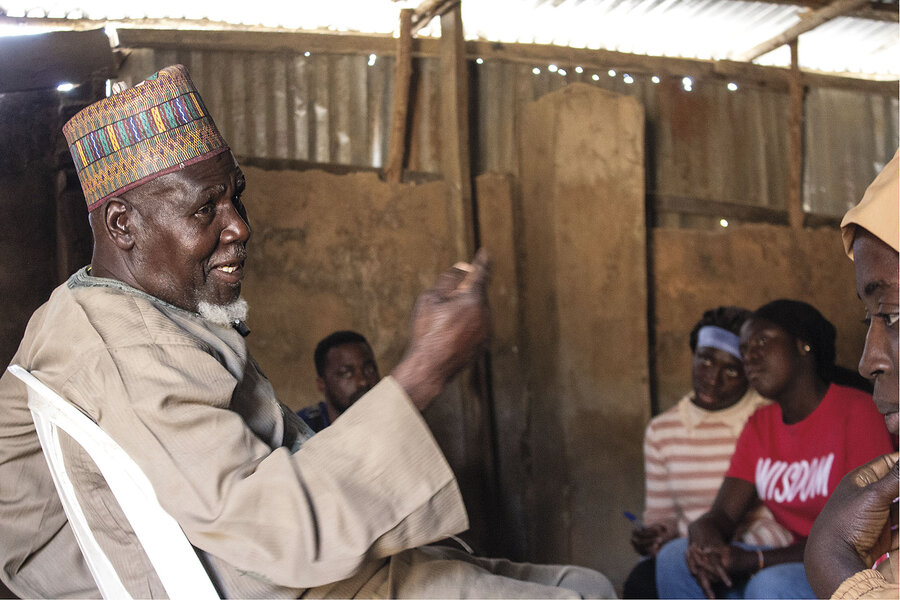
Muhammad Auwal Ahmad wears a cap and shirt with the Flowdiary logo during a meetup in KanoNigeria with some of his educational app’s tutors and students.

Whenever I used to read about Boko Haram terrorists in Nigeria, all I could think was how horrifying and hopeless the situation seemed. But it’s amazing how the human spirit can work around almost any hopeless situation.

Today’s story is about the young man who invented an app to help displaced Nigerian youth learn skills — despite terrorists and a disrupted education.

Nathaniel Bivan reports at the Christian Science Monitor, “Seventeen-year-old Ahmad Aminu finished secondary school and would like to go to college near his village in Zamfara state. But this region of northwestern Nigeria bears the brunt of attacks by bandits who kidnap students for ransom. …

“The 17-year-old Mr. Aminu [has] been able to take – for free, or at very little cost – courses in various digital skills in Hausa. He is becoming a well-known graphic designer within the community surrounding Dalba.

“ ‘The payment depends,’ says Mr. Aminu, the excitement clear in his voice. Designing an invitation card, for example, earns him about 2,000 Nigerian nairas, about $1.25; doing video editing, up to 3,000 nairas.

“ ‘In a month, I make as much as 30,000 naira,’ he says. ‘I really thank God.’ …

“Mr. Aminu is the sort of student whom Muhammad Auwal Ahmad had in mind when he created Flowdiary two years ago as a 23-year-old attending Federal University Gashua in northeastern Yobe state. He says Flowdiary now has more than 8,000 students enrolled from far-flung, impoverished areas across northern Nigeria; on average, almost one-fifth of those are active weekly users. The platform’s name refers to opportunities flowing to young people who might not normally have them.

“ ‘We have students from regions affected by terrorism and banditry … that we train and mentor,’ Mr. Ahmad says, noting that students who speak only Hausa struggle to find online courses in digital skills in their language.

“Mr. Ahmad’s dream began in Bayamari, a village in Yobe state that has only two small schools, a health center, and a police outpost. As a curious tween growing up there, Mr. Ahmad started researching digital technology when his father brought home a mobile phone and, later, a computer. Gradually, Mr. Ahmad started troubleshooting and soon had ambitious digital goals. …

“After unsuccessful attempts at building a couple of online businesses as an undergraduate computer science student, Mr. Ahmad set up Flowdiary in March 2022. It started as a team of tutors, who included some of his friends, teaching digital skills on Telegram to other young people across northern Nigeria at low cost.

“By that November, students could access the Flowdiary website. In February 2023, the app’s release became official. Paying as little as 1,200 nairas per course, students could register to learn web development, graphic design, and other digital skills. Tutors net half of the proceeds from course fees, and the rest goes toward operational costs such as maintaining the app and helping link Flowdiary students with career opportunities, Mr. Ahmad explains.

“Registered as a business, not as a nonprofit, Flowdiary has struggled to find other funding. … But Mr. Ahmad says he is set to obtain some much-needed funding after winning the 2024 Yobe State Research and Innovation Challenge, a prestigious regional competition organized by the Biomedical Science Research and Training Center of Yobe State University, in partnership with Yobe’s state government. …

“In 2011, Al’amin Dalha Suleiman and his seven family members abandoned their home in Maiduguri, the capital of northeastern Borno state, because of the Boko Haram insurgency there. They fled to Kano, more than 500 kilometers (about 310 miles) away, mourning the deaths of neighbors and friends as well as the loss of the family’s hat shop. But discrimination in Kano against outsiders forced them to return three years later to Maiduguri, where Mr. Suleiman struggled to revive the family business. …

“Through a friend on Facebook, Mr. Suleiman heard last year about Flowdiary. He enrolled in several courses, including video editing, web development, and graphic design. There was a major challenge, though – the need for wireless data and a laptop. For months, Mr. Suleiman struggled to finish the courses over his phone, but the payoff – the skills he has acquired – has been worth it. …

“Mr. Ahmad currently teaches computer science in northwestern Kebbi state as part of his National Youth Service Corps requirement. His vision after the one-year program is to expand the Flowdiary platform to reach more young people and – crucially – to help them grow their skills into careers.

“The end of online training for each student does not necessarily mean goodbye at Flowdiary. The Flowdiary team recently set up a mentoring and internship program; any student who takes a course can apply to work with companies that Flowdiary has forged a relationship with. As of late September, 20 students had secured internships – including two with Abdul Gusau, the owner of Abdoul Shoe Ventures in Zamfara.

“ ‘It is impressive to see how effective Flowdiary is through the work the interns are putting in my store,’ Mr. Gusau says. “ ‘The graphic designer has not yet entered the intermediate class, and yet his work is excellent. The same goes for the social media manager, who runs effective ads.’ “

More at the Monitor, here. No paywall. Subscriptions solicited.

Photo:  British Library, Harley MS 4751 (Harley Bestiary).
As a hunter lands several arrows in his quarry, a wounded doe nibbles dittany to heal herself.

I think we don’t give enough credit to ancient wisdom. Researchers of former times may have been ignorant of cars and computers and smart phones, but why do we think they were unintelligent? (I’m a little cranky because I recently attended a talk on reflexology that barely mentioned traditional Chinese medicine.)

Today we learn that art works from centuries ago suggest humans were observing animals self-medicating long before contemporary scientists started publishing papers on the practice.

Adrienne Mayor, a classics, history and philosophy of science scholar at Stanford University, writes in the Conversation, When a wild orangutan in Sumatra recently suffered a facial wound, apparently after fighting with another male, he did something that caught the attention of the scientists observing him.

“The animal chewed the leaves of a liana vine – a plant not normally eaten by apes. Over several days, the orangutan carefully applied the juice to its wound, then covered it with a paste of chewed-up liana. The wound healed with only a faint scar. The tropical plant he selected has antibacterial and antioxidant properties and is known to alleviate pain, fever, bleeding and inflammation. …

“In interviews and in their research paper, the scientists stated that this is ‘the first systematically documented case of active wound treatment by a wild animal’ with a biologically active plant. …

“To me, the behavior of the orangutan sounded familiar. As a historian of ancient science who investigates what Greeks and Romans knew about plants and animals, I was reminded of similar cases reported by Aristotle, Pliny the Elder, Aelian and other naturalists from antiquity. A remarkable body of accounts from ancient to medieval times describes self-medication by many different animals. The animals used plants to treat illness, repel parasites, neutralize poisons and heal wounds.

“The term zoopharmacognosy – ‘animal medicine knowledge’ – was invented in 1987. But as the Roman natural historian Pliny pointed out 2,000 years ago, many animals have made medical discoveries useful for humans.

Indeed, a large number of medicinal plants used in modern drugs were first discovered by Indigenous peoples and past cultures who observed animals employing plants and emulated them.

“Some of the earliest written examples of animal self-medication appear in Aristotle’s ‘History of Animals‘ from the fourth century BCE, such as the well-known habit of dogs to eat grass when ill, probably for purging and deworming.

“Aristotle also noted that after hibernation, bears seek wild garlic as their first food. It is rich in vitamin C, iron and magnesium, healthful nutrients after a long winter’s nap. The Latin name reflects this folk belief: Allium ursinum translates to ‘bear lily,’ and the common name in many other languages refers to bears.

“Pliny explained how the use of dittany, also known as wild oregano, to treat arrow wounds arose from watching wounded stags grazing on the herb. Aristotle and Dioscorides credited wild goats with the discovery. Vergil, Cicero, Plutarch, Solinus, Celsus and Galen claimed that dittany has the ability to expel an arrowhead and close the wound. Among dittany’s many known phytochemical properties are antiseptic, anti-inflammatory and coagulating effects.

“According to Pliny, deer also knew an antidote for toxic plants: wild artichokes. The leaves relieve nausea and stomach cramps and protect the liver. To cure themselves of spider bites, Pliny wrote, deer ate crabs washed up on the beach, and sick goats did the same. Notably, crab shells contain chitosan, which boosts the immune system.

“When elephants accidentally swallowed chameleons hidden on green foliage, they ate olive leaves, a natural antibiotic to combat salmonella harbored by lizards. Pliny said ravens eat chameleons, but then ingest bay leaves to counter the lizards’ toxicity. Antibacterial bay leaves relieve diarrhea and gastrointestinal distress. Pliny noted that blackbirds, partridges, jays and pigeons also eat bay leaves for digestive problems.

“Weasels were said to roll in the evergreen plant rue to counter wounds and snakebites. Fresh rue is toxic. Its medical value is unclear, but the dried plant is included in many traditional folk medicines. Swallows collect another toxic plant, celandine, to make a poultice for their chicks’ eyes. Snakes emerging from hibernation rub their eyes on fennel. Fennel bulbs contain compounds that promote tissue repair and immunity.

“According to the naturalist Aelian, who lived in the third century BCE, the Egyptians traced much of their medical knowledge to the wisdom of animals. Aelian described elephants treating spear wounds with olive flowers and oil. He also mentioned storks, partridges and turtledoves crushing oregano leaves and applying the paste to wounds.”

Need more proof that modern science sometimes just reinvents the wheel? Read the Conversation, here. No paywall. Fun artworks.

Photo: Jamie Fullerton/The World.
A snowman figurine made by the woodworkers at the Witney Shed, part of the UK Men’s Sheds Association.

In my retirement community, there are two or three times more women than men — and more activities geared to women. It’s not surprising that some male residents become a prey to loneliness. Loneliness can plague older men anywhere, not just men in retirement communities.

That’s why some countries have taken the concept of the backyard work shed where men hang out alone and put it in more of a group setting.

Jamie Fullerton writes at the radio show The World, “In the United Kingdom, there is a gently mocking stereotype about older men and sheds — the wooden outhouses usually found at the end of a garden.  The cliche image is of an elderly man tinkering with tools for hours, alone and avoiding the outside world.

“Things are more social in The Witney Shed, in the town of Witney in Oxfordshire, southern England. 

“ ‘I just like coming here; it’s the camaraderie with everybody,’ said Tony Halcrow, a regular visitor to the Witney Shed, as he worked on a lathe, making wooden Christmas decorations. ‘And it gets me out of the house.’

“In the large shed, situated behind a church-run community center, there’s space for about 10 shedders, as they are known, plus a few more working in the garden outside. They’re making bird boxes and other wooden objects, occasionally pausing for coffee and light banter.

“The Witney Shed is one of around 1,100 community sheds in the UK, affiliated with the UK Men’s Sheds Association. The charity originated in Australia, and was set up in the UK around a decade ago, primarily to help older men tackle loneliness.

“Some British community sheds charge small fees, but people can turn up to the Witney Shed for free, then join in with woodwork or just have a coffee. Most people who visit are seniors, but people of all ages are welcome. ‘Anybody can come, even ladies,’ said Phil Tarry, co-founder of the Witney Shed. …

“The shedders make wooden items like bird boxes, bat boxes and Christmas decorations, and sell them locally at cheap prices, to help fund the shed. They also help out local residents, schools and the church where the shed is based. ‘On a Monday morning, the first thing is a toddler group in here, and they’re our best customers, for repairing toys’ [says Tarry].

“Over a third of shed leaders said they believed that their community shed may have helped prevent a suicide. Tarry said he certainly thinks so.

“ ‘Loneliness is a very big part of it,’ he said, ‘because there are a lot of lonely people out here. I live in sheltered housing, and I know what it’s like. Some people don’t see anybody from one week to another, and it is important to get those people to come out.’ …

“Local doctors have told some of their mental health patients about the shed. A couple of men with dementia also visit.

“ ‘You’ve got to be very patient because, with people with dementia, they’ll come and say, “What can we do today?” and you say, “Oh, can you sand this?” They’ll go off, then come back and say, “What are you doing today?” You’ve got to be patient and say, “Yeah, it’s OK. Sand this,” ‘ Tarry said.

“Rachel Meadows, who works as the volunteer and community development manager for the UK Men’s Sheds Association, said … ‘We hear a lot that people find it easier to talk to each other when they’re engaged in an activity. … It’s easier to talk shoulder-to-shoulder, rather than face-to-face,’ she said. ‘Somebody’s not looking you in the eye and asking you to talk about your feelings, but there’s usually somebody at the shed who’s maybe been through something similar, or can relate to how you’re feeling.’ …

“Nearby, an older man sat alone on a bench. Tarry asked him if he was OK. The man said he was fine, but a bit confused. But later, he suddenly stood up and started helping another man, glueing together a bird box. …

“Tarry said that his main problem is that the Witney Shed is so popular, they’ve decided their next woodwork project needs to be a shed extension.”

More at The World, here. No firewall. Charming photos.

AI De-Ages Tom Hanks

Photo: Everett Collection.
A de-aged version of actors Tom Hanks and Robin Wright, created by artificial intelligence for the 2024 film Here.

We are well into the age of AI, and I certainly hope that doesn’t mean we’re going to realize the dire warnings of one of its pioneers but just use it in relatively harmless ways.

Today’s story is about using AI to “de-age” actors in a movie covering 60 years.

Benj Edwards writes at Wired, “Here, a $50 million Robert Zemeckis–directed film [used] real-time generative AI face transformation techniques to portray actors Tom Hanks and Robin Wright across a 60-year span, marking one of Hollywood’s first full-length features built around AI-powered visual effects.

“The film adapts a 2014 graphic novel set primarily in a New Jersey living room across multiple time periods. Rather than cast different actors for various ages, the production used AI to modify Hanks’s and Wright’s appearances throughout.

“The de-aging technology comes from Metaphysic, a visual effects company that creates real time face swapping and aging effects. During filming, the crew watched two monitors simultaneously: one showing the actors’ actual appearances and another displaying them at whatever age the scene required.

“Metaphysic developed the facial modification system by training custom machine-learning models on frames of Hanks’ and Wright’s previous films. This included a large dataset of facial movements, skin textures, and appearances under varied lighting conditions and camera angles. …

“Unlike previous aging effects that relied on frame-by-frame manipulation, Metaphysic’s approach generates transformations instantly by analyzing facial landmarks and mapping them to trained age variations. … Traditional visual effects for this level of face modification would reportedly require hundreds of artists and a substantially larger budget closer to standard Marvel movie costs.

“This isn’t the first film that has used AI techniques to de-age actors. ILM’s approach to de-aging Harrison Ford in 2023’s Indiana Jones and the Dial of Destiny used a proprietary system called Flux with infrared cameras to capture facial data during filming, then old images of Ford to de-age him in postproduction. By contrast, Metaphysic’s AI models process transformations without additional hardware and show results during filming. …

“Meanwhile, as we saw with the SAG-AFTRA union strike [in 2023], Hollywood studios and unions continue to hotly debate AI’s role in filmmaking. While the Screen Actors Guild and Writers Guild secured some AI limitations in recent contracts, many industry veterans see the technology as inevitable. …

“Even so, the New York Times says that Metaphysic’s technology has already found use in two other 2024 releases. Furiosa: A Mad Max Saga employed it to re-create deceased actor Richard Carter’s character, while Alien: Romulus brought back Ian Holm’s android character from the 1979 original. Both implementations required estate approval under new California legislation governing AI recreations of performers, often called deepfakes. …

“Robert Downey Jr. recently said in an interview that he would instruct his estate to sue anyone attempting to digitally bring him back from the dead for another film appearance. But even with controversies, Hollywood still seems to find a way to make death-defying (and age-defying) visual feats take place onscreen — especially if there is enough money involved.”

What could go wrong?

The first thing I think of is fewer job opportunities for actors who play younger versions of stars. Still, I’d love to see an AI child version of the actress who plays Astrid in the French crime show of the same name, because I think it would look more natural than the mimicking girl they’ve got. (Awesome tv, by the way. Check it out on PBS Passport.)

More at Wired, here. This story originally appeared on Ars Technica.

Photo: Sanjaya Dhakal/BBC Nepali.
In Nepal, some communities have put their recovered idols in iron cages for security.

Who does art belong to? For centuries, looters have justified their thefts by asserting that they aim to protect the stolen art for posterity. That no longer holds up, and now art is getting returned to the plundered countries.

And if you play nice and return Nepali idols, you may be given an accurate replica.

Sanjaya Dhakal writes at The Guardian, “Along a small street in Nepal’s Bhaktapur city stands an unassuming building with a strange name — the Museum of Stolen Art. Inside it are rooms filled with statues of Nepal’s sacred gods and goddesses.

“Among them is the Saraswati sculpture. Sitting atop a lotus, the Hindu goddess of wisdom holds a book, prayer beads and a classical instrument called a veena in her four hands.

“But like all the other sculptures in the room, the statue is a fake. The Saraswati is one of 45 replicas in the museum, which will have an official site in Panauti, set to open to the public in 2026.

“The museum is the brainchild of Nepalese conservationist Rabindra Puri, who is spearheading a mission to secure the return of dozens of Nepal’s stolen artifacts, many of which are scattered across museums, auction houses or private collections in countries like the US, UK and France.

“In the past five years, he has hired half a dozen craftsmen to create replicas of these statues, each taking between three months and a year to finish. The museum has not received any government funding. His mission is to secure the return of these stolen artifacts – in exchange for the replicas he has created.

“In Nepal, such statues reside in temples all across the country and are regarded as part of the country’s ‘living culture,’ rather than mere showpieces, says Sanjay Adhikari, the secretary of the Nepal Heritage Recovery Campaign. Many are worshipped by locals every day, with some followers offering food and flowers to the gods. …

“It is also common for followers to touch these statues for blessings — meaning they are also rarely guarded — leaving them wide open for thieves.

“Nepal has categorized more than 400 artifacts missing from temples and monasteries across the country, but the number is highly likely to be an underestimate, says Saubhagya Pradhananga, who heads the official Department of Archaeology.

“From the 1960s to the 1980s, hundreds of artifacts were looted from Nepal as the isolated country was opening up to the outside world. Many of the country’s most powerful administrators back then were believed to have been behind some of these thefts — responsible for smuggling them abroad to art collectors and pocketing the proceeds.

“For decades, Nepalis were largely unaware about their missing art and where it had gone, but that has been changing, especially since the founding of the National Heritage Recovery Campaign in 2021 – a movement led by citizen activists to reclaim lost treasures. …

“There are many hurdles. The Taleju Necklace, dating back to the 17th century, is a case in point. …

“It’s still unclear how it might have been stolen and many in Nepal had no idea where it might have gone until three years ago, when it was seen in an unlikely place – the Art Institute of Chicago.

“It was spotted by Dr Sweta Gyanu Baniya, a Nepali academic based in the US who said she fell to her knees and started to cry when she saw the necklace.

“According to the Art Institute of Chicago, the necklace is a gift from the Alsdorf Foundation — a private US foundation. The museum told the BBC it has communicated with the Nepali government and is awaiting additional information.

“It’s not just a necklace, it’s a part of our goddess who we worship. I felt like it shouldn’t be here. It’s sacred,” she told the US university Virginia Tech. …

“But [Saubhagya Pradhananga, who heads the official Department of Archaeology] said Nepal’s Department of Archaeology had provided enough evidence, including archival records. On top of that, an inscription on the necklace says it was specifically made for the Goddess of Taleju by King Pratap Malla.

“It’s these ‘tactics of delay’ that often ‘wear down campaigners,’ says one activist, Kanak Mani Dixit. ‘They like to use the word “provenance” whereby they ask for evidence from us. The onus is put on us to prove that it belongs to Nepal, rather than on themselves on how they got hold of them.’ …

“Many worshippers are now a lot more paranoid — putting these idols in iron cages to protect them from going missing.

“Mr Puri however hopes his museum will eventually have its shelves wiped bare.”

More at the BBC, here. No paywall.

Photo: BBC.
A PhD student found a lost city by accident in eastern Mexico, in Campeche.

Talk about happy accidents! I’m sure we have all experienced a few, whether in cooking or driving around. And we often hear of happy accidents in science. Today, we learn about an alert PHD student who found an ancient civilization without precisely looking for one.

Georgina Rannard writes at the BBC, ” ‘I was on something like page 16 of Google search and found a laser survey done by a Mexican organization for environmental monitoring,’ explains Luke Auld-Thomas, a PhD student at Tulane university in the US.

“It was a Lidar survey, a remote sensing technique which fires thousands of laser pulses from a plane and maps objects below using the time the signal takes to return.

“But when Mr Auld-Thomas processed the data with methods used by archaeologists, he saw what others had missed — a huge ancient city which may have been home to 30,000-50,000 people at its peak from 750 to 850 AD. … Mr Auld-Thomas and his colleagues named the city Valeriana after a nearby lagoon.

“The find helps change an idea in Western thinking that the Tropics was where ‘civilizations went to die,’ says Professor Marcello Canuto, a co-author in the research. Instead, this part of the world was home to rich and complex cultures, he explains. …

It is ‘hidden in plain sight,’ the archaeologists say, as it is just 15 minutes hike from a major road near Xpujil, where mostly Maya people now live.

“There are no known pictures of the lost city because ‘no one has ever been there,’ the researchers say, although local people may have suspected there were ruins under the mounds of earth.

“The city [had] two major centers with large buildings around 2km (1.2 miles) apart, linked by dense houses and causeways. It has two plazas with temple pyramids, where Maya people would have worshipped, hidden treasures like jade masks and buried their dead. It also had a court where people would have played an ancient ball game. There was also evidence of a reservoir, indicating that people used the landscape to support a large population. …

“Professor Elizabeth Graham from University College London, who was not involved in the research, says it supports claims that Maya lived in complex cities or towns, not in isolated villages. …

“The research suggests that when Maya civilizations collapsed from 800 AD onwards, it was partly because they were so densely populated and could not survive climate problems.

” ‘It’s suggesting that the landscape was just completely full of people at the onset of drought conditions and it didn’t have a lot of flexibility left. And so maybe the entire system basically unravelled as people moved farther away,’ says Mr Auld-Thomas.

“Warfare and the conquest of the region by Spanish invaders in the 16th century also contributed to eradication of Maya city states.

“Lidar technology has revolutionized how archaeologists survey areas covered in vegetation, like the Tropics, opening up a world of lost civilizations, explains Prof Canuto. …

” ‘I’ve got to go to Valeriana at some point. It’s so close to the road, how could you not? But I can’t say we will do a project there,’ says Mr Auld-Thomas. ‘One of the downsides of discovering lots of new Maya cities in the era of Lidar is that there are more of them than we can ever hope to study,’ he adds.

“The research is published in the academic journal Antiquity.

More at the BBC, here. Seems to me the discovery was hardly an accident. Anyone with the patience to look at page 16 of a Google search deserves a bit more credit.

Photo: Francine Kiefer/The Christian Science Monitor.
Meetan Kaur, of United Sikhs, stands with hot meals of basmati rice and chickpea curry for fire evacuees at the Pasadena Church East Campus donation center, Jan. 17, 2025.

Despite the loss of many houses of worship in the recent Southern California fires, faith communities are rising up to help others. And helping others others is helping the volunteers themselves begin to feel hopeful. (Scientologists? Why not? We are all human beings in a disaster.)

Francine Kiefer and Sophie Hills write at the Christian Science Monitor, “Cars pull into the Pasadena Church parking lot, waved forward by a couple of Scientologists. Christian volunteers hand out groceries and diapers. Orange, yellow, and black turbans dot the crowded lot, as Sikh volunteers dish out hot chickpea curry and basmati rice and cups of steaming chai.

“The line of cars stretches around the lot. Volunteers pass meals through car windows and load back seats with pet food, toiletries, and paper goods. Some Sikhs traveled from as far as New York and Canada to cook and serve meals to people displaced by the wildfires. The chai, especially, gets five-star reviews from volunteers and evacuees alike.

“ ‘That’s what we’re really hoping to do here – it’s really offering solace, offering comfort, in this absolutely crazy time,’ says Meetan Kaur, an organizer with United Sikhs, an international aid organization.

“The Eaton Fire destroyed thousands of homes, schools, restaurants, and businesses. Houses of worship burned, too. But their congregations are still here, gathering to pray in borrowed spaces and distributing food and clothing. …

“Organized religion provides space for worship and spiritual study, but it can be especially helpful when disasters strike because there’s already ‘a built-in system of caring,’ says Cynthia Eriksson, a dean at Fuller Theological Seminary, who specializes in the intersection of faith and mental health. …

“At the Pasadena Church, Chanel Jackson is loading up SUV after SUV with free groceries. She attends the Faithful Central Bible Church in Inglewood, clear across Los Angeles. But she’s driven to this donation and distribution center by both her faith and her roots.

“Ms. Jackson grew up in Altadena, so like several other volunteers, she says this is personal. Two of her schools burned. She knows some of the people in line. Sporting a ‘Dena’ T-shirt – that’s what folks call the Altadena-Pasadena area – she talks about the imperative from Scriptures to help the poor.

“ ‘A lot of people – their faith is shaken,’ she says. ‘They’re questioning God – “Why me?” – which I completely understand and empathize with. But God is in the people; God is in the angels. God is in the people that are here at this relief center, trying to help families in need.’ …

“The tragedies and hardship calls on a core aspect of faith: community. ‘It’s about the connection to something bigger than ourselves,’ says Rabbi Joshua Levine Grater, the director of Friends in Deed, a local interfaith nonprofit. His family lost its house in the Eaton Fire, as well as its synagogue, where he was once head rabbi and is now a congregant. …

“But leaders rescued 13 Torah scrolls before the building burned. When the fire died, one wall remained, etched with a mural that members didn’t know was hiding behind drywall. It depicts people and animals in the desert, beneath a single palm tree. …

“Founded 130 years ago, Friends in Deed focuses on the most needy people, operating a food pantry and providing housing assistance and case management. Since the fires, the requests for help have only increased. But so have the donations and volunteers.

“Despite the uncertainty his family and so many others face, there’s only one choice, says Rabbi Grater. ‘We have to find the courage to rebuild a step at a time.’ … The teachings and stories of the Torah are there as ‘reminders that there’s still an immense amount of love in the world.’

“In Altadena, at least five different places of worship succumbed to the wildfire. … First Church of Christ, Scientist, Altadena, whose edifice was spared, says it plans to share its space with nearby congregations once it’s safe to return. …

“For some, that generosity is central to their faith. A gurdwara is not just a place of worship, but also a place to coordinate and supply aid, says Gurvinder Singh, international humanitarian aid director for United Sikhs.

Seva, which translates to ‘selfless service,’ is a call to action, says Mr. Singh. That goes hand-in-hand with the tradition of langar, a community meal.

“ ‘It’s really the basis of humanity,’ says Ms. Kaur at the Pasadena Church. ‘It’s bonding through food.’ ”

More at the Monitor, here. Also, see how LA libraries are helping, here. No paywall.

Photo: Rhode Island School Recycling Club via ecoRI News.
The nonprofit’s mission is to help reduce school food waste.

My Rhode Island grandson has inhaled environmental lessons at home and in school to the point that he requests only such clothes as are made of recycled material and eschews beef. He’s in charge of composting the family’s fruits and vegetables, at least when the bin isn’t frozen solid.

Today I’m sharing news on a composting story involving both public and private Rhode Island schools.

Veteran environmental reporter Frank Carini writes at ecoRI News, “Rhode Island’s 450 or so public and private schools generate a lot of food waste, nearly 28,000 pounds every school day, according to more than a dozen food-waste audits conducted by a local nonprofit.

“Among the food wasted daily is some 4,000 pounds of milk, fruit, granola bars, yogurt, baby carrots, and other sustenance that is unopened and perfectly edible.

Here are some other findings from the Rhode Island School Recycling Project’s 15 lunch audits:

  • “About 5 million pounds, some 2,500 tons, of school food scrap is sent to the Central landfill in Johnston every year. Of that, some 750,000 pounds is edible.
  • “Each high school student generates an average of 0.23 pounds of food waste daily, and 41 pounds every school year.
  • “Each middle school student generates an average of 0.39 pounds of food waste daily, and 70 pounds every school year.
  • “Each elementary school student generates an average of 0.48 pounds of food waste daily, and 86 pounds every school year.

“The Rhode Island School Recycling Project was co-founded in 2001 by James Corwin, in partnership with the Rhode Island Resource Recovery Corporation (RIRRC) and the state Department of Environmental Management, to improve school recycling.

At that time, the number of schools recycling properly was 18%, which was among the lowest in New England. Today, it is close to 70%.

“The nonprofit quickly incorporated diverting cafeteria food from the state’s waste stream into its work. That’s where much of the Project’s focus is now centered. … The nonprofit’s mission is to reduce, recover, and recycle to help protect the environment and develop the next generation of environmentalists through project-based learning, according to Corwin.

“Currently, there are 21 schools participating in the Project’s waste-reduction efforts. Since its inception, the program has diverted nearly 150 tons of food and food scrap from the Central Landfill, according to Corwin.

“The cost per school is about $5,000 annually. The Project pays for the first year, and buys participating schools a refrigerator to store recovered food. Students can take food from the refrigerator when they are hungry.

“ ‘So we’re saying to custodians, listen, when you see that that dumpster is only half full let’s talk to the facilities director about reducing the amount of pickups to, you know, instead of one a day, one every other day, so that you can offset the cost of the organics hauling,’ Corwin said. …

“The Project’s program starts with an educational presentation by RIRRC, which operates the Central Landfill, about the many problems associated with food waste. Corwin and Warren Heyman, the nonprofit’s organizing director, then visit the participating school to discuss what the students learned during the RIRRC presentation and start training them, and staff, on a new waste-sorting system.

“Participating students — in groups called Green Teams in middle school and Cafeteria Rangers in elementary school — go to lunch early so they can spend the last 8 minutes of the period managing the station and making sure everything is sorted correctly. There’s usually four to five students working a sorting station. …

“Each station features a ‘share table’ that repurposes uneaten food. On the table is a cooler where students place leftover perishable items such as milk and yogurt. There’s a basket for leftover fruit. These provisions are then moved to the refrigerator.

“A 5-gallon bucket is where students pour out leftover milk. There’s a compost bin for food scrap and a recycling bin for milk cartons and plastic bottles. A landfill bin holds the trash that can’t be eaten, composted, or recycled. The compostable material is picked up weekly by one of two local composting outfits — Black Earth Compost or Bootstrap Compost. …

“Heyman noted that after Richmond Elementary School implemented the Project’s waste-reduction system, cafeteria trashed was reduced from eight bags a day to one. He also noted that the state Department of Education has been a supportive advocate of the Project’s work.

“Nearly 1 in 3 Rhode Island households can’t afford adequate food, according to the Rhode Island Community Food Bank. … About 40% of U.S. food is wasted, either buried or incinerated. In schools, the amount of wasted food increases. A 2019 study of school cafeteria waste found that 27% to 53% of the food served was thrown away. Another study has estimated that U.S. schools waste some 530,000 tons of food annually — about 39 pounds of food and 29 cartons of milk per student per year — costing $1.7 billion nationally.”

More at ecoRI News, here.