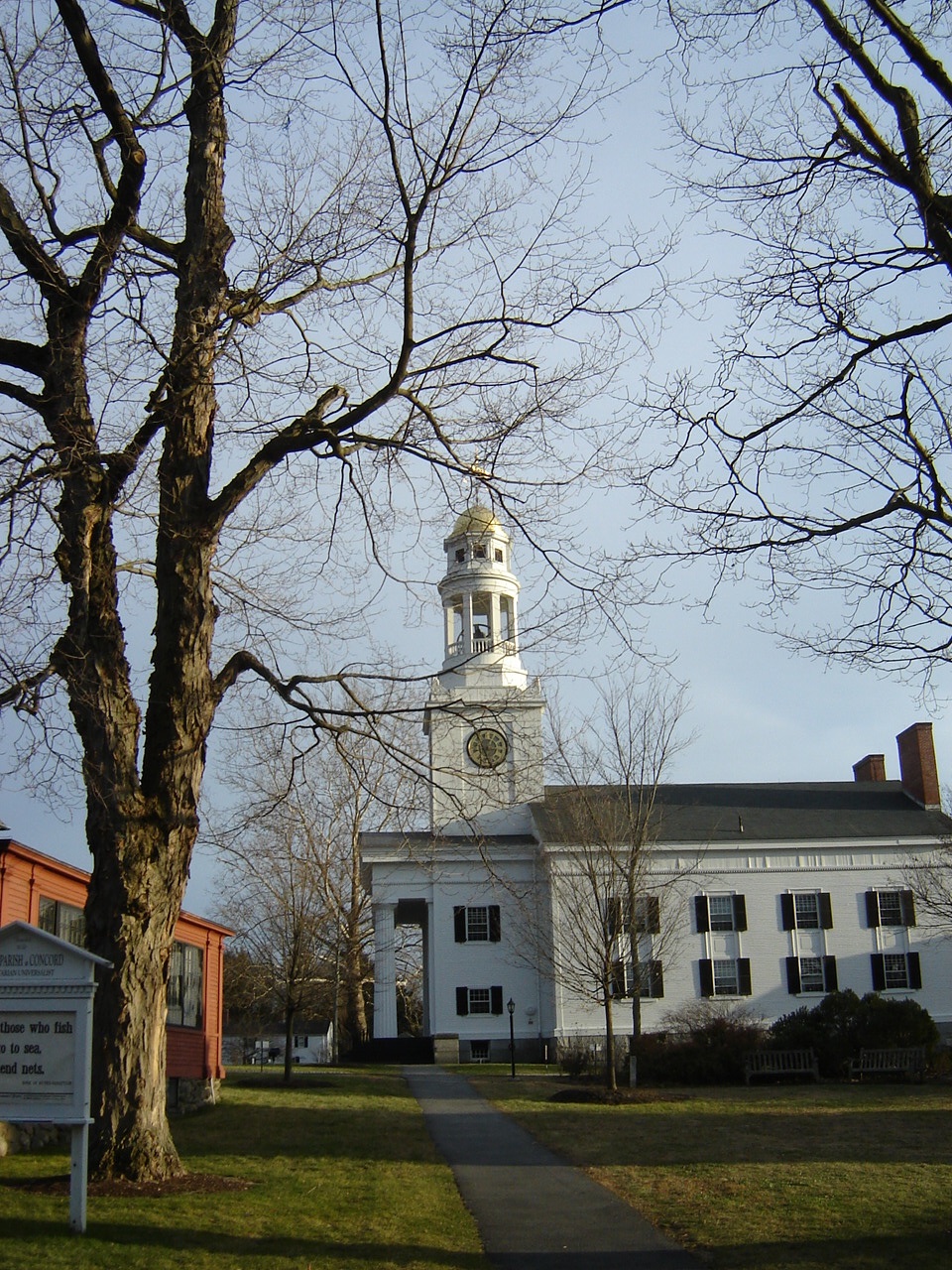
On Christmas Eve we have always gone to First Parish for one of the candlelight services. Nowadays we go to the early one because we have a toddler in the family.
Today we got a big kick out of watching him take it all in: so many grownups in the house at once, so many boxes covered with paper you’re allowed to rip, so many curiosities to remove from the bottom of a tree and show people. And rather nice chicken sausages.
The kitchen cupboards were interesting, too. They have different stuff from the ones at home and everything badly needs organizing.
We cooked and ate, and cooked and ate, and cooked and ate.
For lunch, Meran made tarts suggested by Cook’s Illustrated. One was a shitake mushroom and leek tart, the other was butternut squash and spinach. Both had cheese. There also was a salad with fennel, pears, and sugared pecans.
The main course at dinner was a Lamb Tagine we always like. This one is made with prunes and cinnamon, but there are recipes with raisins and almonds or apricots and caramelized onions. Meran contributed a lovely couscous with veggies.
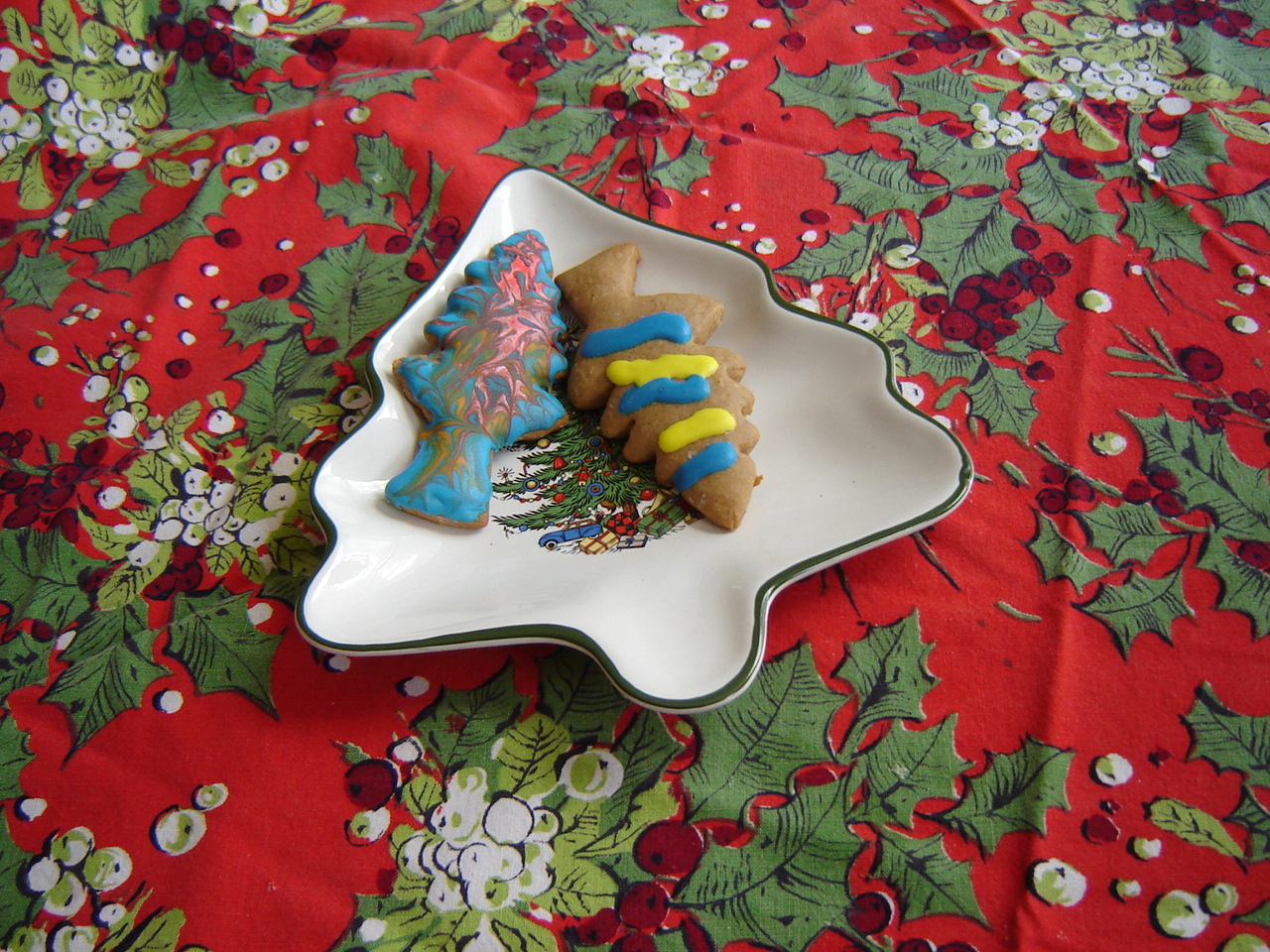
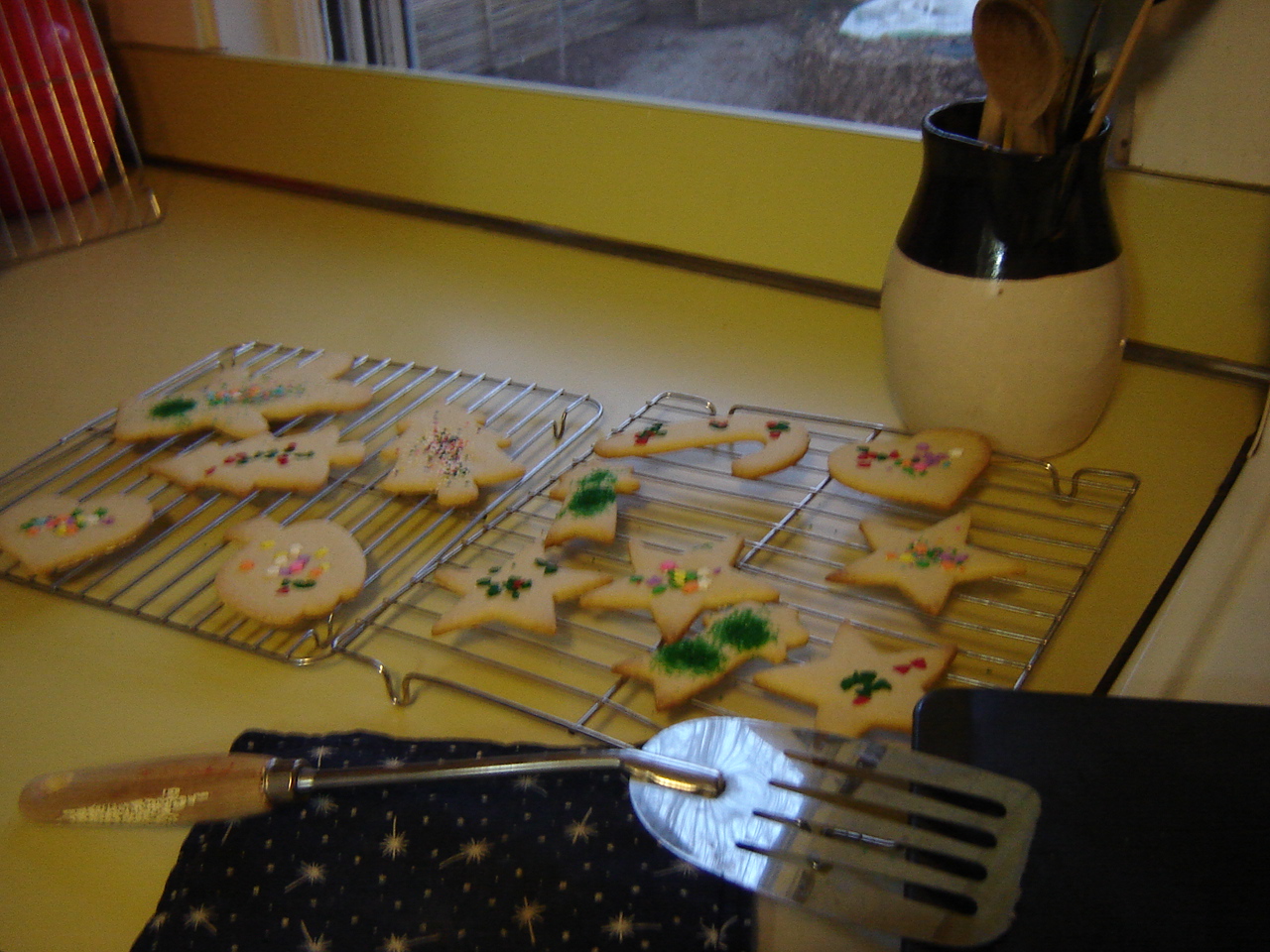
Suzanne and Erik made an apple crisp that we ate with ice cream. There were loads of Christmas cookies.
The phrase comes from the carol “Lo, How a Rose E’er Blooming.”
Somehow, the words “when half-spent was the night” instead of “in the middle of the night” (a choice doubtless made to fit the rhythm) makes one think about the meaning more. Something about a gift arriving unexpectedly halfway through a time of darkness. Something surprising and curious.
A nice gift I received Friday was an expression of gratitude for being there for someone through her first year at my workplace. With tears in her eyes. Golly. Something surprising. A welcome surprise.
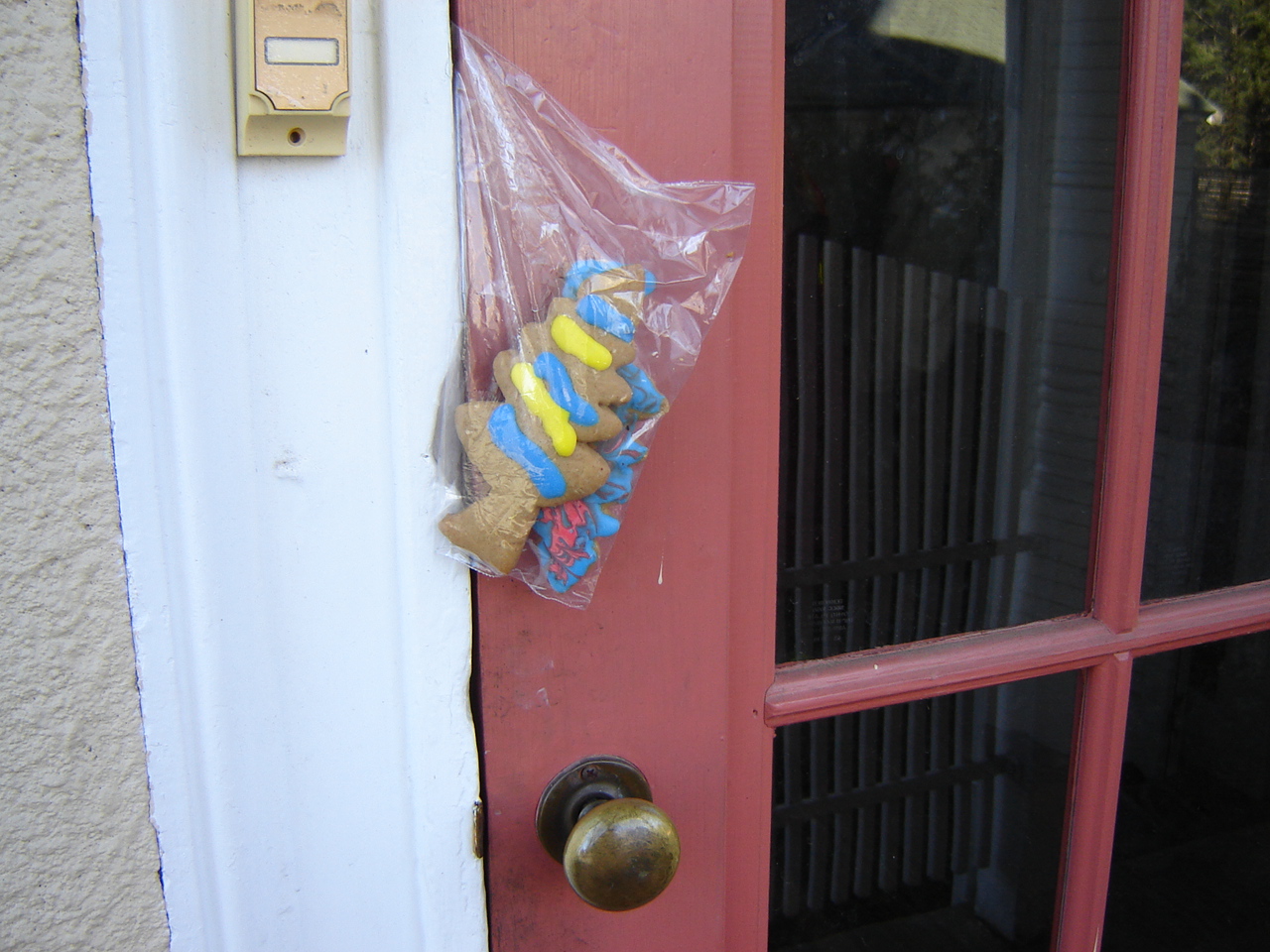
Then today, tucked in the back door, a stealth gift. Hmmm. No note. Swedish colors. For Erik? I think I recognize the cookie style. It suggests Suzanne’s longtime friend, a buddy since kindergarten, known for — among other things — her mother’s cookie-painting parties at Christmas.
Suzanne is being remembered, and being reminded of fun times, at a busy season when her friend is visiting town for only a short while. These are gifts that make people feel good.
Among the invented languages that people actually speak is Klingon, which came from a television series, Star Trek. Today television is inventing more languages.
As Amy Chozick notes in the NY Times, “Game of Thrones” needed the feeling of authenticity that language (and subtitles) can impart.
She writes, “At his best friend’s wedding reception on the California coast, David J. Peterson stood to deliver his toast as best man. He held his Champagne glass high and shouted ‘Hajas!’ The 50 guests raised their glasses and chanted ‘Hajas!’ in unison.
“The word, which means ‘be strong’ and is pronounced ‘hah-DZHAS,’ has great significance for Mr. Peterson. He invented it, along with 3,250 other words (and counting), in the language he created for the HBO fantasy series ‘Game of Thrones,’ called Dothraki”
So glad someone is worried about the disappearing advertising jingle, a subject near and dear to my heart.
Robert Everett-Green of Toronto’s Globe and Mail asks the question. “What happened to the jingle? How did such a successful tool, whose mnemonic punch has been confirmed by the latest brain research, end up in the trash?
“ ‘If you write a jingle now, it’s mostly meant to be ironic,’ says Chris Tait, a composer and partner at Pirate Toronto, which provides music and ‘sound design’ for advertising. ‘Nobody buys that naive, innocent style any more.’ ” Well, excu-use me.
I can still sing, “Brusha, brusha, brusha, get the new Ipana” and “Use Ajax the foaming cleanser” and “There’s a menace in your house” and “You better get Wildroot cream oil, Charlie” and many others. Some jingles have lasted longer than the products they advertise. Do marketers object to that?
This time of year there always seems to be a slew of good videos getting passed around. Already two people told me about the first one below, so maybe you have seen it, too. But unless you are a regular reader of Andrew Sullivan, you probably haven’t seen the second.
There was a most unusual “Hallelujah Chorus” performed by the Kuinerrarmiut Elitnaurviat 5th Grade in Quinhagak, Alaska. Here is what the Quinhagak teacher said in response to the YouTube comments:
“Wow!! Thank you for all for the wonderful comments. The village of Quinhagak is glowing because of them. The amount of views is mind blowing!! Considering this video was intended for an audience of about 200. As many of you have thought, the kids worked very hard on this project. They put in 10 hours of work shooting all the scenes (on a weekend nonetheless!!) I am very proud of them!
“Thank you also for pointing out the apostrophes! I now have a very teachable moment once we start school again. One they will never forget!! I’m just glad I spelled ‘Hallelujah’ correct.
“Thank you on behalf of Quinhagak, Alaska!! Merry Christmas!!”
Now be sure to click on the old guys dancing at Andrew Sullivan’s blog. And leave a comment, why not?
Here is the Christmas cookie recipe I have used ever since John put together his little recipe book in nursery school.
(have ingredients at room temperature)
Rolled Sugar Cookies
2 cups sifted flour
1-1/2 tsp. baking powder
1/2 tsp. salt
1/2 cup margarine
1 cup sugar
1 egg, well beaten
1 tsp. vanilla
1 Tbsp. milk
Sift together first three ingredients.
In another bowl, cream margarine, add sugar gradually. Cream until light and fluffy.
Add egg, vanilla, milk and sifted dry ingredients.
Mix dough well, chill at least one hour.
Roll approximately 1/8 inch thick on lightly floured board and use good-sized cookie cutters so children can be successful in handling shapes.
Place cut out cookies on ungreased cookie sheets and let children sprinkle sugar on them.
Bake at 375 degrees for 8-10 minutes. (My oven prefers 350 for 6-10 minutes.) 2 doz.
“New York City is using poetry to boost traffic safety. The city is installing 200 colorful 8-inch square signs featuring haiku about safety at cultural spots, schools, and high accident areas. In an age when many messages compete for attention, officials hope that ones such as
‘Oncoming cars rush
‘Each a 3 ton bullet
‘And you, flesh and bone’
“will encourage pedestrians to exercise caution.”
So writes the Innovators Insights listserv, linking to the CBS New York news story, where you will find some amused and amusing comments from New Yorkers.
“ ‘What we’ve learned that is that the more innovative the message and with a little bit of humor, or something a little off beat, is much more effective form of communication,’ Transportation Commissioner Janette Sadik-Khan said.”
Reminds me of my October post on traffic mimes in Caracas. Remember? There’s something delightfully incongrous about traffic adminsitrators being the ones, out of all possible professions, to use mimes and haiku to further their work objectives.
But maybe I don’t know much about traffic administrators.
Gian Carlo Menotti composed Amahl and the Night Visitorsfor an NBC Christmas show in 1951. He was under deadline and drawing a blank when the painting “The Adoration of the Magi” at the Metropolitan Museum of Art sparked his childhood memories of three kings who visit Italian children with gifts.
I have seen the operetta and listened to the recording many times. It takes only the first few bars and the lovely oboe representing the shepherd boy’s pipe for me to bring out the tissues and start crying and smiling all the way through.
A production today at the Friends of the Performing Arts in Concord was excellent. Kim Lamoureux took the role of Amahl. Robert Runck was stage director. Robin Farnsley was music director. Farnsley also was a breathtaking Mother of Amahl. Her anguish in the scene where her fear for her son overcomes her is heartbreaking as she inches toward the gold of the sleeping kings.
“All that gold! All that gold!
I wonder if rich people know what to do with their gold?
Do they know how a child could be fed? Do rich people know?”
You may read the whole script of this short operetta here. And there are lots of snippets on YouTube.
Update: December 22, 2013 at 2:00 p.m. and 4:00 p.m.
Amahl and the Night Visitors, with soloists Julia Shneyderman, Robin Farnsley, Ray Bauwens, Brad Amidon, Thomas Dawkins, and Michael Prichard. Chorus and orchestra conducted by Alan Yost, Tickets $20 adults/$10 students. Call 978 369-7911 or buy on-line.
I blogged here about the late Jane Scott, who was still reviewing rock bands into her 80s. Today I thought I might write on a couple mature gals in wheelchairs who write a political blog on WordPress. Unfortunately, their language is too salty for a blog associated with Luna & Stella. So I’m going to tell you about a jazz musician who, having been rediscovered in his 80s in a nursing home, and is back in the business.
As Dan Barry writes in the NY Times, “For years, the donated piano sat upright and unused in a corner of the nursing home’s cafeteria. Now and then someone would wheel or wobble over to pound out broken notes on the broken keys, but those out-of-tune interludes were rare. … Then came a new resident, a musician in his 80s with a touch of forgetfulness named Boyd Lee Dunlop, and he could play a little. Actually, he could play a lot, his bony fingers dancing the mad dance of improvised jazz in a way that evoked a long life’s all. …
“And so Mr. Dunlop would have remained, summoning transcendence from a damaged piano in the Delaware Nursing and Rehabilitation Center, his audience a couple of administrators, a few nurses and many patients beset with dementia, loneliness and age — were it not for a chance encounter … .
“In the spring of 2010, a freelance photographer named Brendan Bannon arrived to discuss an art project with nursing home administrators — and Mr. Dunlop greeted him at the door. … A bond quickly developed, and before long Mr. Dunlop invited his new friend to hear him play what he referred to as “that thing they call a piano.” Mr. Bannon, who knows his Mingus from his Monk, could not believe the distinctive, vital music emanating from a tapped-out piano missing a few keys.
“ ‘He was a beautiful player,’ Mr. Bannon says. ‘He was making it work even though it was out of tune.’ ” Read the whole story.
I told my kids that I used to hope I’d make a splash before I was 40. Then before I was 50. Now I’m thinking 90 is more realistic.
About a year ago we had the great pleasure of attending a panel discussion featuring Orhan Pamuk, winner of the 2006 Nobel Prize for Literature. We took our seats at the New Yorker magazine’s lecture series, and because I had read his novel Snow, I was expecting someone quite dour and grim.
Instead he was hugely entertaining and funny as he talked about literature and his latest project, creating a museum to replicate one he had invented for his 2008 novel, The Museum of Innocence.
Writes Gareth Harris in the September 2010 Art Newspaper, “Turkey’s most famous living novelist is holding a pair of dentures in a room packed with ephemera reflecting everyday Turkish life of the past three decades. Orhan Pamuk, winner of the Nobel Prize in Literature 2006 and author of My Name is Red (1998) and Snow (2002), is standing among a sea of objects—sewing machines, clocks, soda-bottle tops, buttons, lottery tickets, china dogs, birdcages, cigarette lighters and false teeth—that will soon go on display in The Museum of Innocence, a four-storey building in the Çukurcuma neighbourhood, central Istanbul. This venue, not just a chamber of curiosities, is the real-life incarnation of the museum painstakingly assembled and detailed in his book The Museum of Innocence (2008).”
I expect that, for someone who has read the novel, the museum experience will be both delightful and unnerving. I know I felt delighted and unnerved years ago after reading a nonfiction book about a Rhode Island community and then trying to reconcile the characters who had seemed so real with the people who had been described. Storybook characters coming to life. At first the real people seem shadows. Then as you get to know them, the storybook characters become the shadows, superficially imagined imitations.
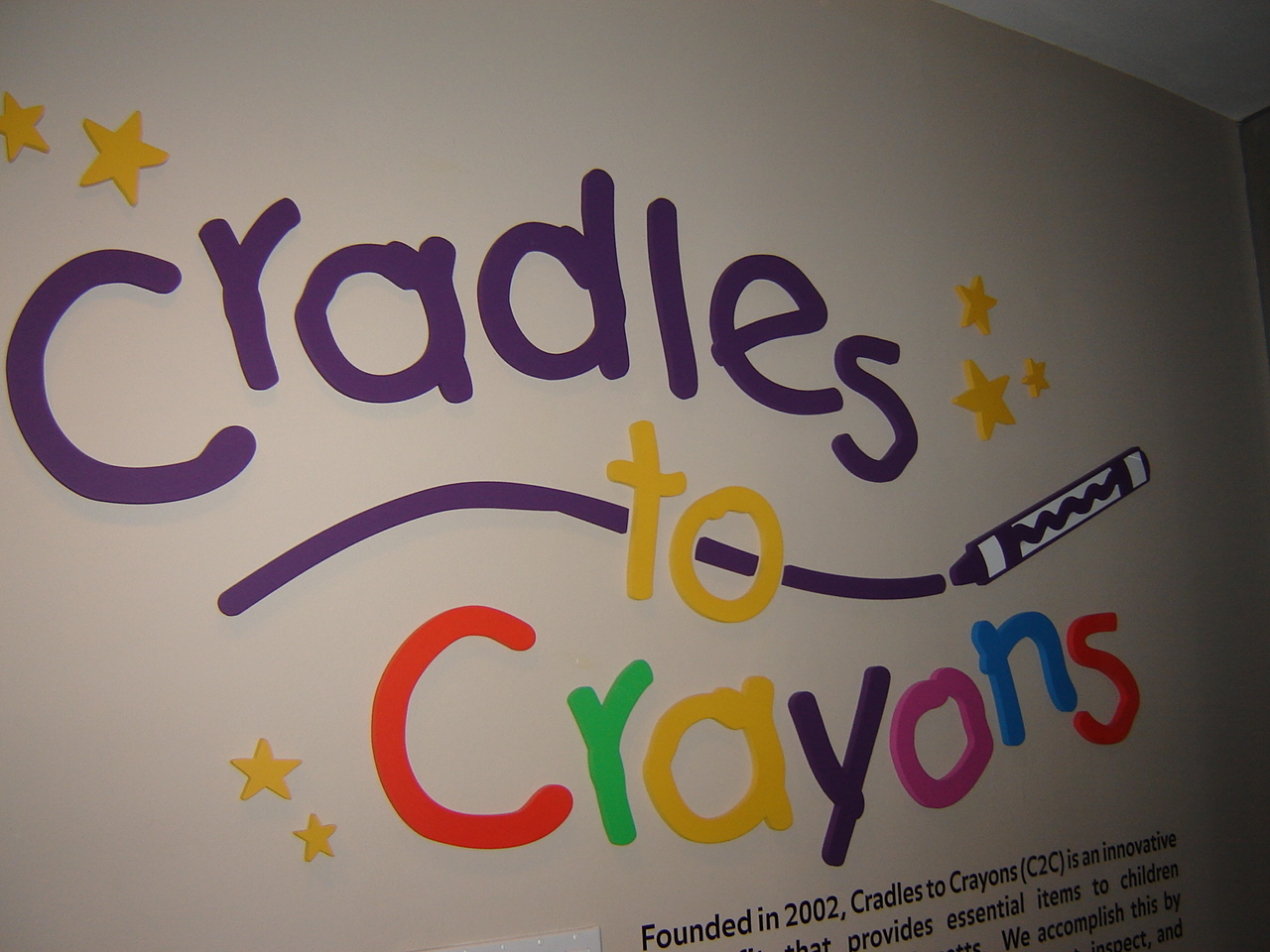
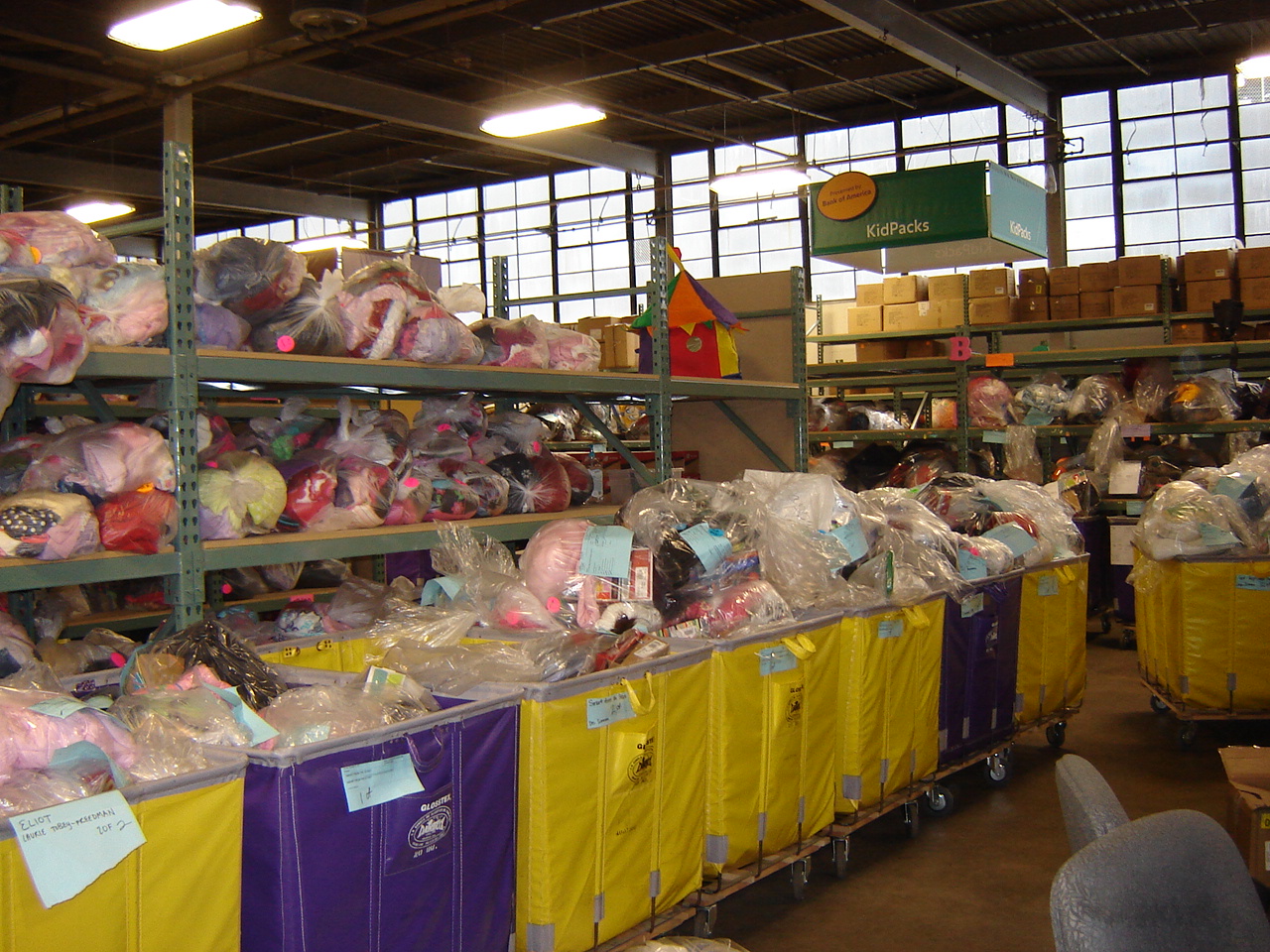
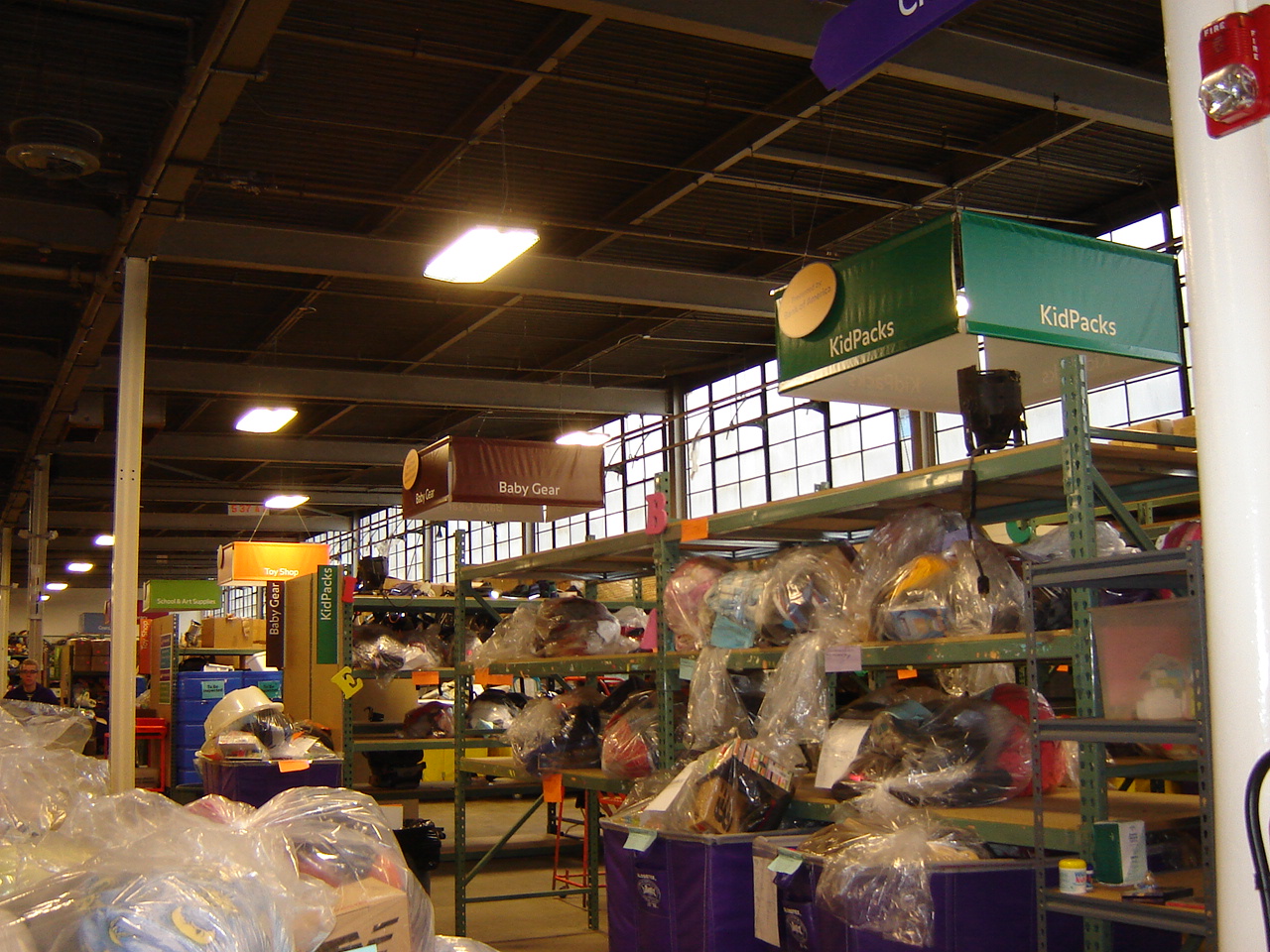
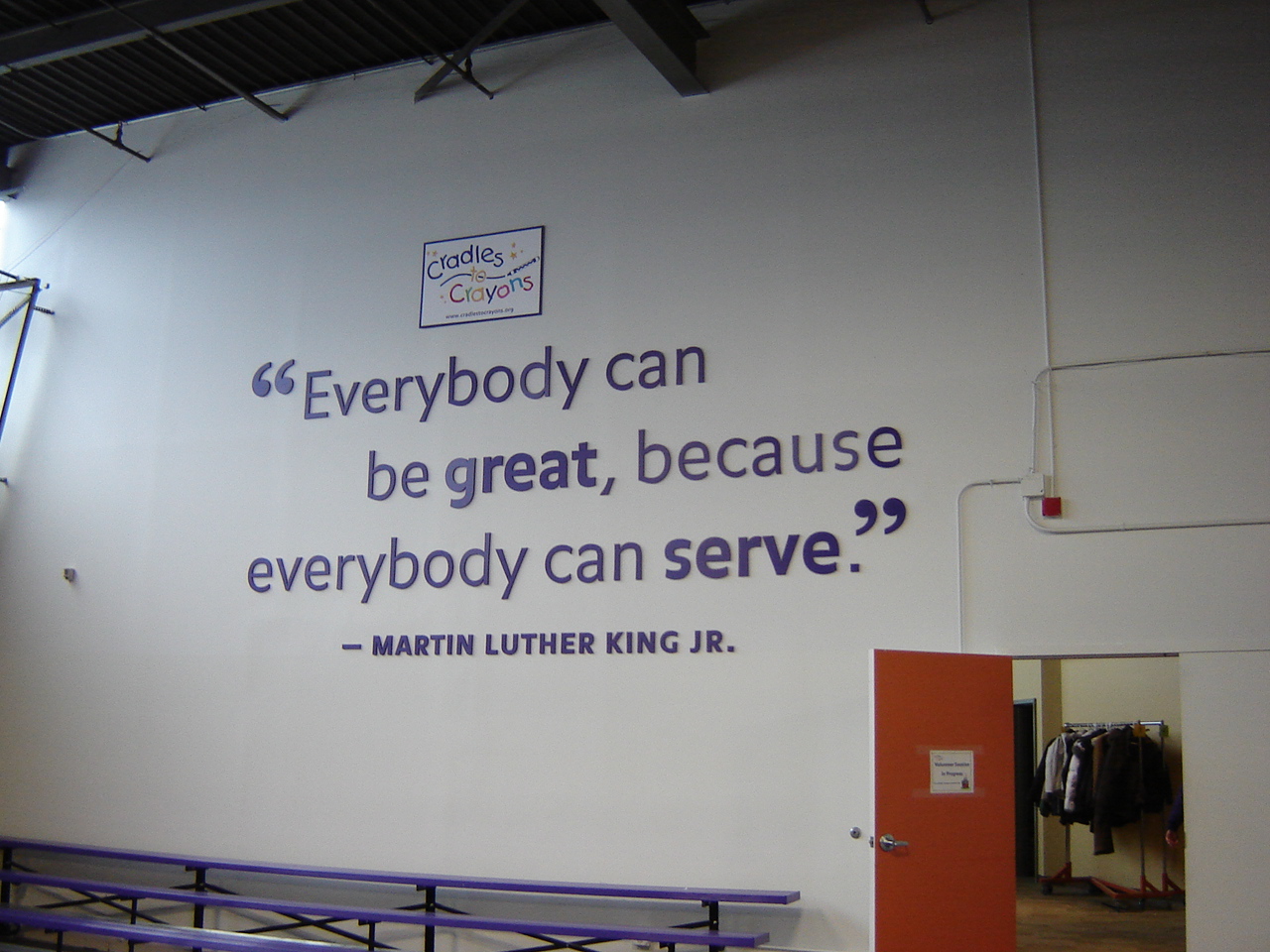
Today at work we had a holiday team-building outing to the nonprofit Cradles to Crayons. A lot of organizations bring employees to the group’s Giving Factory for their community service projects. Our team volunteered at the same time as Blue Cross Blue Shield and Bank of America.
First we watched a video about the history of the organization, which takes donations of clothes and equipment for children, sorts them, and fills orders for individual children at the request of social service agencies. The donations come from ordinary people and from partner corporations.
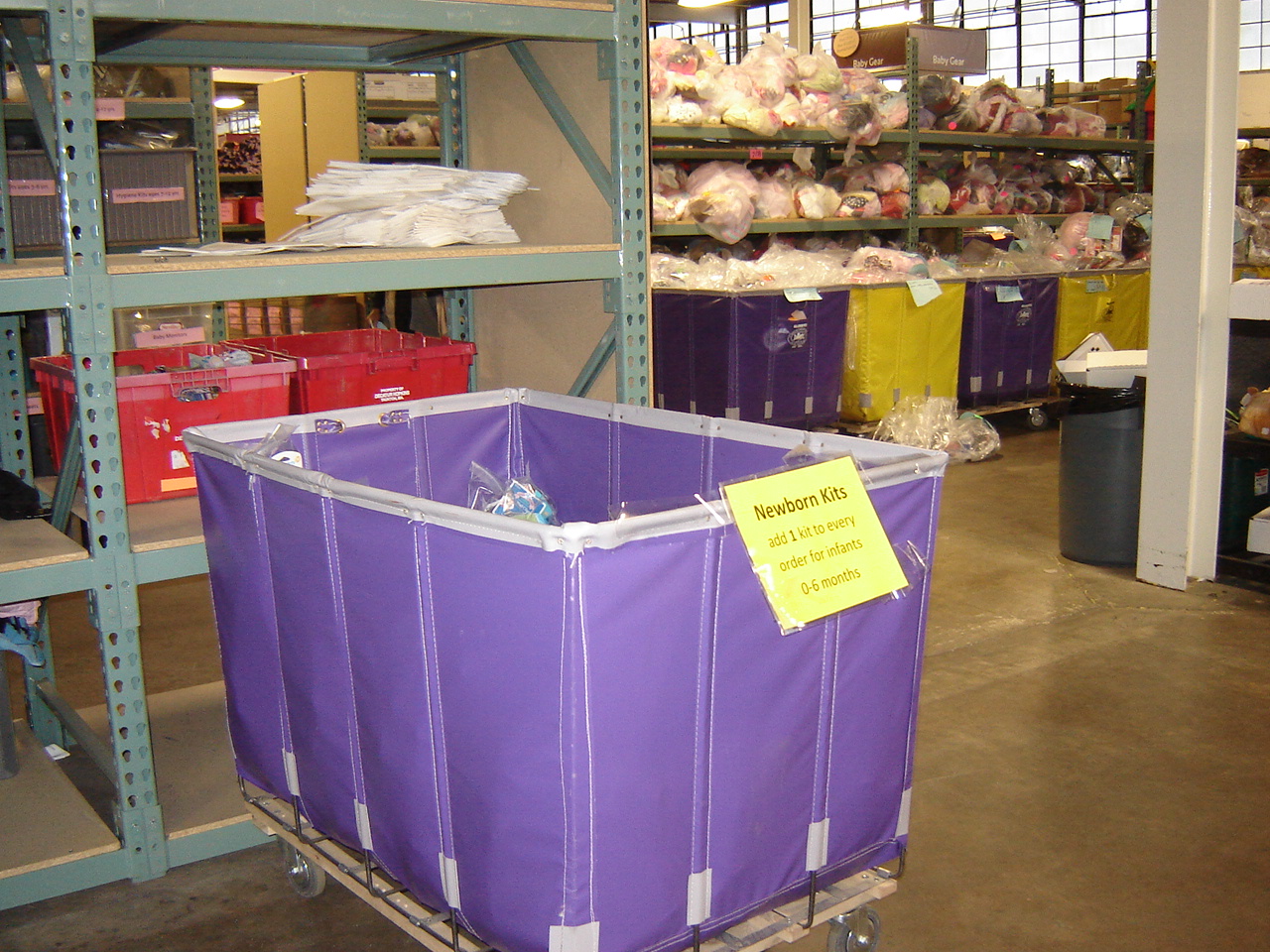
A group of us sorted donated coats. I was with the group that “shopped” among the warehouse shelves for bundles of sorted and age-labeled items, looking for the needs listed on individual order sheets. For example, we might have a sheet for a boy, age 4, that said “clothing pack, book bundle, craft packet, boots size 6, coat size 6.” It was very well organized. If we found that Cradles to Crayons was out of something, the staff would fill the order anyway and invite the requesting agency to reapply for missing items. They like to provide whatever they can as fast as they can.
Cradles to Crayons says, “Our vision is that one day every child will have the essentials they need to feel safe, warm, ready to learn and valued. Through the Giving Factory, we provide those essentials, as donated clothes, shoes, books and school supplies to homeless and low-income children. We also offer meaningful volunteer opportunities to hundreds of corporations and thousands of individuals and families each year.”
In a recent study of professions that involve intensive memorization, London cab drivers were found to have brains with swollen hippocampi. Not even doctors or so-called memory champions show that effect. Andrews Sullivan has the story.
Says researcher Eleanor Maguire, “We’re in a situation where people are living longer and often have to retrain or re-educate themselves at various phases in their lives. It’s important for people to know that their brains can support that. It’s not the case that your brain structure is fixed.”
A cabbie competes against a satellite system in a really cool video.
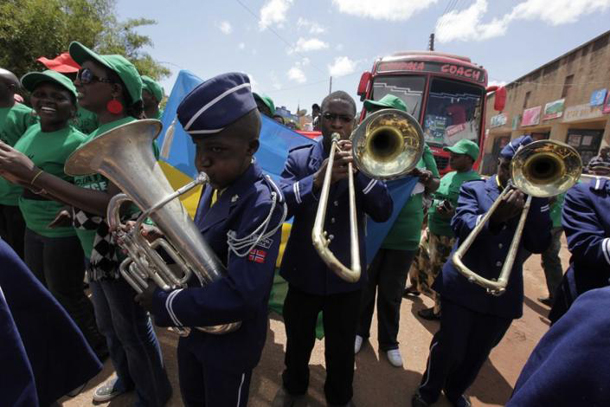
Living on Earth, a radio show based in Somerville, Massachusetts, and distributed by Public Radio International, recently did a story on East Africa and the worst drought in 60 years. Bobby Bascomb interviewed musicians who decided to do something about it, letting their voices be heard in the way they know best.
They call themselves the Caravan of Hope, says Bascomb. “More than 25 bands from 11 different African nations are traveling across the continent to raise awareness about climate change … as international climate talks begin in Durban, South Africa.”
Singer Angella Katatumba of Uganda explains, “We use our voices to get people fired up and educate people about climate change in Africa. Uganda usually has an amazing climate. It’s usually warm and just perfect. These days, when it’s hot it’s way too hot. When it’s cold it’s way too cold. When it’s wet, it’s storming. We’re seeing things like landslides, which we’ve never had before.” So she’s taking her concern on the road. Read more here.
Not an appropriate quote, but I can’t keep it from coming into my head:
“Like the leaves of the forest when Summer is green,
“That host with their banners at sunset were seen:
“Like the leaves of the forest when Autumn hath blown,
“That host on the morrow lay withered and strown.”
There is always something new to learn about Stonehenge, a site shrouded in mystery for centuries.
Rossella Lorenzi writes at Discovery News, “Using noninvasive technologies such as ground-penetrating radar and geophysical imaging, a team from the University of Birmingham’s IBM Visual and Spatial Technology Centre, known as VISTA, and the Ludwig Boltzmann Institute for Archaeological Prospection and Virtual Archaeology in Vienna, discovered evidence of two huge pits positioned on a celestial alignment at Stonehenge. …
” ‘This is the first time we have seen anything quite like this at Stonehenge,’ said project leader Vince Gaffney, an archaeologist from the University of Birmingham. ‘When viewed from the Heel Stone, a rather enigmatic stone which stands just outside the entrance to Stonehenge, the pits effectively mark the rising and setting of the sun at midsummer days.’ ”
On YouTube you can find both boring videos about Stonehenge and funny ones. A comedy routine by Eddie Izzard made me laugh, but it’s a bit too naughty for Suzanne’s Mom’s Blog. You can check out a few of Spinal Tap singing “Stonehenge” in the movie This is Spinal Tap. And here is a great scene about Druids from that movie.
 On Christmas Eve we have always gone to First Parish for one of the candlelight services. Nowadays we go to the early one because we have a toddler in the family.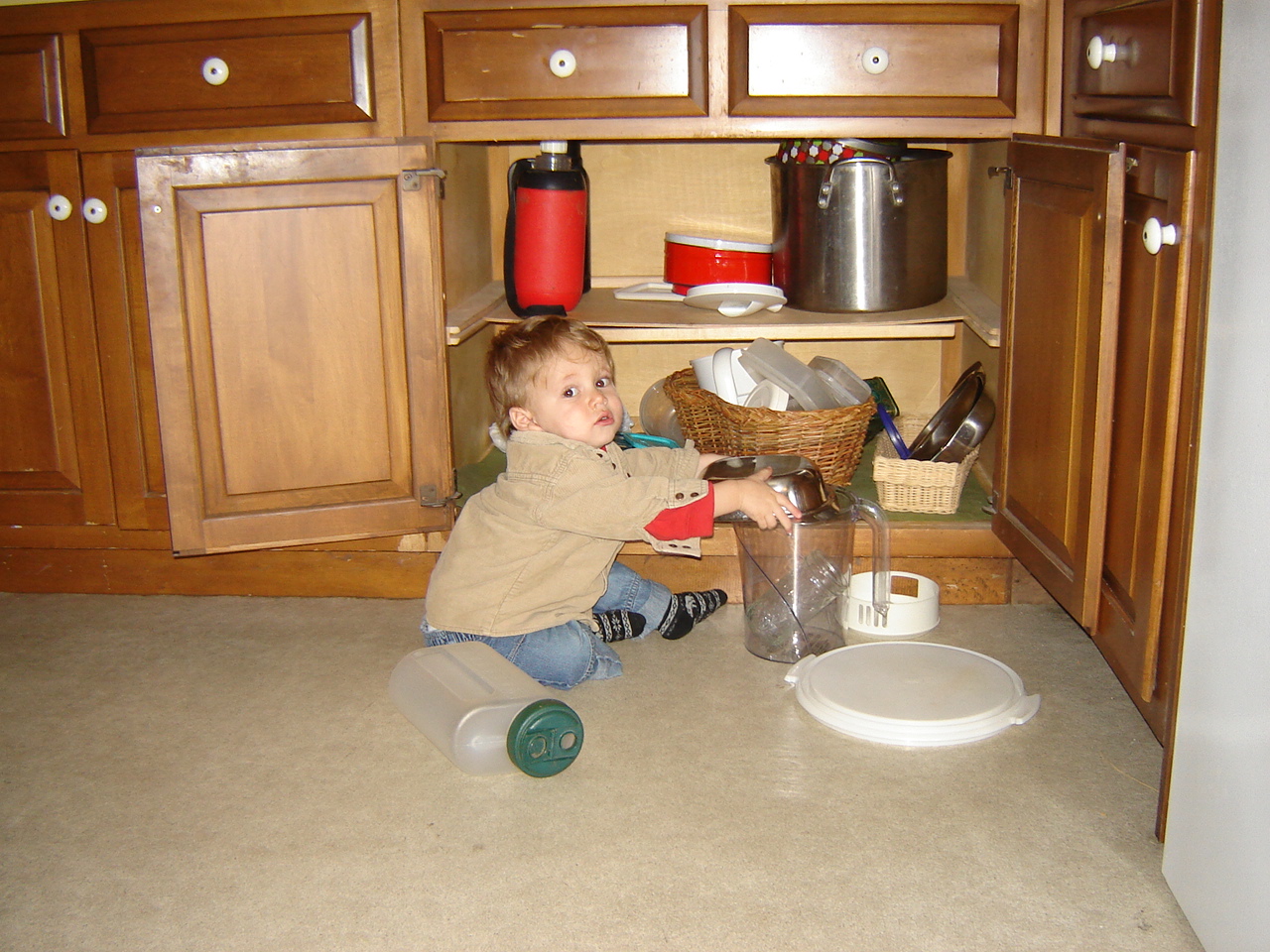





 Suzanne's Mom's Blog