Nicholas Kristof wrote recently about a new ” ‘poverty statement’ from the premier association of pediatricians, based on two decades of scientific research.” It ties early childhood stress to persistent poverty.
In his NY Times column “A Poverty Solution that Starts with a Hug,” Kristof says of stressed children, “Toxic stress might arise from parental abuse of alcohol or drugs. … It might derive from chronic neglect — a child cries without being cuddled. Affection seems to defuse toxic stress — keep those hugs and lullabies coming! — suggesting that the stress emerges when a child senses persistent threats but no protector. … The crucial period seems to be from conception through early childhood. After that, the brain is less pliable and has trouble being remolded.
“ ‘You can modify behavior later, but you can’t rewire disrupted brain circuits,’ notes Jack P. Shonkoff, a Harvard pediatrician who has been a leader in this field. ‘We’re beginning to get a pretty compelling biological model of why kids who have experienced adversity have trouble learning.’ ”
Lest this is striking too dark a note for Suzanne’s Mom’s Blog, I hasten to point out that identifying a problem is the first step to fixing it. As a proponent of both hugs and poverty alleviation, I was really happy to see this addressed! And Kristof’s mention of the stress hormone cortisol jumped out at me because I hadn’t heard about it until I saw the research in yesterday’s post, which suggested that a pleasant phone conversation with Mom can reduce cortisol more effectively than instant messaging with Mom. (Or whoever reduces your stress.)
(I must look up that article from a few years ago about the Indian woman who stood on a street corner in New York and gave free hugs to long lines of people craving hugs.)
New research on the importance of calling your mom is doing the rounds.
John, @OFH_John on twitter, saw it at a Washington Post blog, which saw it at Wired, which saw it at the journal Evolution & Human Behavior: “Wired flags a new study that proves many mothers across the country right: For your own sake, you should call home more often. … A phone call to mom provides significant stress relief while instant message conversations won’t.”
Once my post goes up and triggers @LunaStellaBlog1 (you’re aware that I write this blog for Suzanne’s birthstone-jewelry company?), who knows where the message in a bottle will end up? Telephones will ring.
The Evolution & Human Behavior authors say that upbeat hormones can be generated by Mom’s voice (unless she is hassling you, of course), and those good hormones can combat your stress chemicals (read the abstract).
Bet moms get stress relief, too. As Dr. Malissa Wood said at a book reading today, women with more interpersonal connections are less likely to have heart attacks.
The call-your-mom paper is “Instant messages vs. speech: hormones and why we still need to hear each other.” The authors are Leslie J. Seltzer, Ashley R. Prososki, Toni E. Ziegler, and Seth D. Pollak.
Bless their healthy little hearts for getting ET to phone home.
I had dinner with friends at Harvard Square’s Casablanca last night.
Hadn’t seen them in ages. Their older son is moving to New York City with his family this summer. A key attraction is an experimental “international” school opening in Chelsea in the fall. My friends’ granddaughter will start in the new middle school and their grandson in the new elementary school.
Avenues School is the brainchild of publishing whiz Chris Whittle, best known for his not-so-successful Edison Schools. He puts that experiment in a positive light on the Avenues website, saying that it helped to spark the charter school movement. My friends say that experienced and inventive educators from all over have rushed in to help with Whittle’s new global approach to education.
“Begin by thinking Avenues Beijing, Avenues London, Avenues São Paulo, Avenues Mumbai,” says the website. “Think of Avenues as one international school with 20 or more campuses. It will not be a collection of 20 different schools all pursuing different educational strategies, but rather one highly-integrated ‘learning community,’ connected and supported by a common vision, a shared curriculum, collective professional development of its faculty, the wonders of modern technology and a highly-talented headquarters team located here in New York City.”
Erik went to an international school in Wales, a United World College, and made lifelong friends from many nations. As Avenues plans to do, United World Colleges has campuses in different countries. The one in Wales is for high school, but other UWC schools are, like Avenues, preschool to 12th grade, even beyond. Kim Jong-Il’s grandson attends the one in Bosnia!
Sometimes a new perspective is called for. This is the hallway staircase, from below.
It’s a little weird how I discovered this might make a good shot.
Normally I do my back exercises in the dining room on a yoga mat, but because I hoped to catch the trash and recycling guys and give them their New Year’s envelope, I did the exercises in the hall where I could hear if a truck stopped. Hence.
WERS featured Elaine Stritch singing a tongue-in-cheek Noel Coward song on Saturday: “Why do the wrong people travel, travel, travel/ When the right people stay at home?” I will include some lyrics.
“What explains this mass mania to leave Pennsylvania
“And clack around like flocks of geese
“Demanding dry martinis on the isles of Greece
“In the smallest street, where the gourmets meet,
“They invariably fetch up
“And it’s hard to make them accept a steak
“that isn’t served rare and smeared with ketchup …” More here.
But staying at home can be quite an extreme adventure. Especially when a neighbor decides to move a house facing Academy Lane so that it faces Sudbury Road, around the corner. Here are the old moorings of the house I have in mind. And just beyond is the house on its new foundation. What a lot of work! There must have been a very compelling reason. If it were me that needed to move a house, I think I would travel, travel, travel — and come back when it was all over.
June 30, 2013 Update. Would you like to see how that house looks now?
I love the colors of the blue claw crab (callinectes sapidus) and couldn’t resist photographing a blue-claw sticker on the back of car in a parking lot.
Thinking that a picture of a sticker was not enough for a blog post, I went hunting for poems on blue claw crabs. I found a couple really awful ones, and I do wish one of my poet readers would write one that I might share.
Here is a poem on a generic crab that is cute.
Jim Clark, Poetry Reincarnations, copyrighted the little animation. He explains it on YouTube.
I also discovered that Richmond Lattimore (my Greek professor back in the day) wrote a short poem called “The Crabs.” Judging from a Google search, “The Crabs” is popular with the makers of standardized tests, probably because it is compact and lends itself to “deep thoughts.”
Finally, this site covers resources related to blue claws, opining that the book Beautiful Swimmers is a “must read for any crab aficionado.”
Pamela and I went to see the movie Hugo. The theater didn’t have 3-D, and one critic said 3-D is essential for full enjoyment of the film, but we found it delightful anyway.
Before I saw the movie, a NY Times review worked its way into my post on the charm of looking out windows. Indeed, as little Hugo peers out of windows and clock faces in the Paris train station where he works, it’s as if he were watching a theatrical entertainment staged for him alone.
A major “character” in Hugo is an old automaton that the boy had worked to repair with his father before a fire left him an orphan. He desperately wants to finish the work. He fancies that if the automaton were to write something, it would deliver a message from his father.
Automatons were apparently quite popular in the early 20th century. They were ingenious robots that could perform feats like writing and drawing.
There is one that can be seen today at the Franklin Institute in Philadelphia. Thought to have been constructed around 1800, it knows how to make four drawings and write three poems — two in French and one in English. “Henri Maillardet, a Swiss mechanician of the 18th century who worked in London producing clocks and other mechanisms” is the tinkerer behind it. Read more.
First Parish does not have a typical service on New Year’s Day. For one thing, attendance is sparse.
Sunday’s “Taizé” service put me in mind of something my mother used to say about Unitarians to tease my father, who was one. (The denomination was not yet Unitarian-Universalist.) She liked to say that her impression of Unitarians had always been “seven people in an attic with a violin.”
Parishioner Joan Esch and her cello provided the opening music yesterday. Instead of going into the main sanctuary, we gathered in the parish hall, sitting on folding chairs around a small table with candles and flowers. At most there were 40 people, including toddlers running and climbing.
Mark Richards led the Taizé service, explaining that the concept started in France. The First Parish version is short and consists of one-verse songs sung over and over in unison without accompaniment and interspersed with readings, cello interludes, meditation, and candle lighting — for remembrance (such as an illness or death) and hope (such as a new beginning or a birth).
I enjoyed being there. It was different. And I liked a line that was quoted from a long-ago minister — something about the mystery within reaching for the mystery without.
In Eastern Massachusetts, it’s been a mild and sparkling day.
In Northern Sweden, there’s snow.
Suzanne, her dad, Erik, and Erik’s family are doing cross-country skiing there. At Fjallnas hogfjallshotel and Strandgarden, where Erik’s extended family stays every year between Christmas and New Year’s, dusk descends at 1 p.m.
Can you read the signpost for Strandgarden? Me neither. But it’s pretty nice for skiing in those latitudes. Last year, dog sledding was on the agenda, too.
Friday night I went to see the Groove Barbers at 51 Walden, not knowing quite what to expect. It turns out that three of the barbershop team were the original founders of Rockapella. One of them, Charlie Evett, lives in Concord, which explains why the others came to town.
They started off with “Love Potion Number 9,” and I knew I had come to the right place. The evening was super entertaining. It wasn’t exactly Oldies Night, but I liked hearing some songs I recognized from my youth. I also appreciated some of the musical jokes. The guys did a jazzy “Angels we have heard on high,” with the Deo of “in excelsis Deo” gradually morphing into “Day-o.” And they premiered of a new orchestration of one of my all-time favorite pop songs, “You don’t know me.”
They brought on a few guests: a young guy who makes those snare drum sounds so essential to a capella and a niece from Barnard College. Really terrific was lead singer Sean’s wife, Inna Dukach, a professional opera singer, who sometimes performs opera as they doo-wop in the background.
Sean Altman, Charlie Evett and Steve Keyes are the ones who were in Rockapella. Kevin Weist is the fourth Groove Barber. In addition to barbershop, the four perform rock, doo-wop, and jazz. Their website says they were featured in national TV commercials as The Astelins, offering “Astelin nasal spray to seasonal allergy sufferers.” (Available on YouTube.)
The Groove Barbers wound up with a bread and butter song from their past life, “Where in the World Is Carmen Sandiego,” which Suzanne’s dad suspects had a key influence on her love of travel.
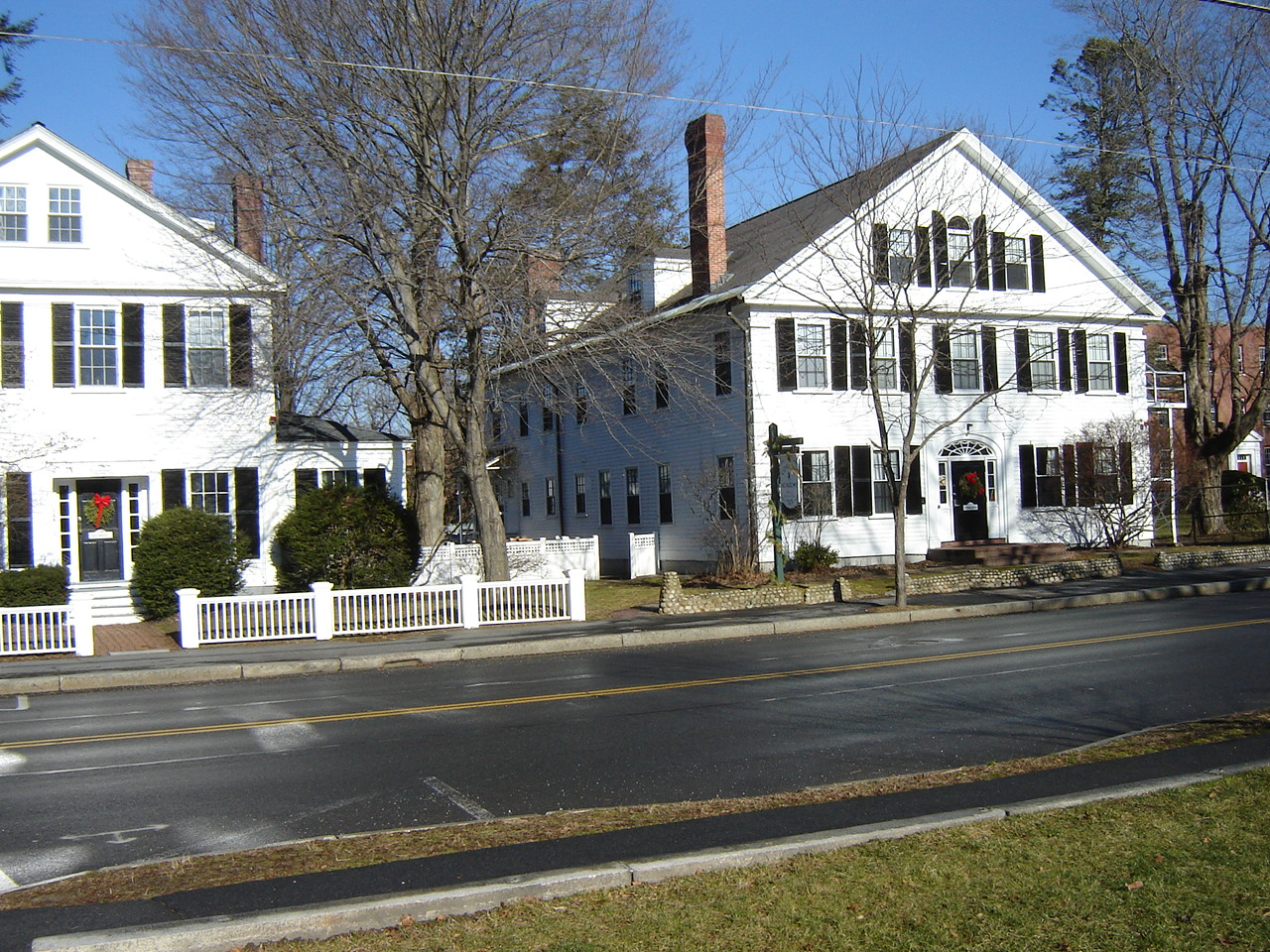
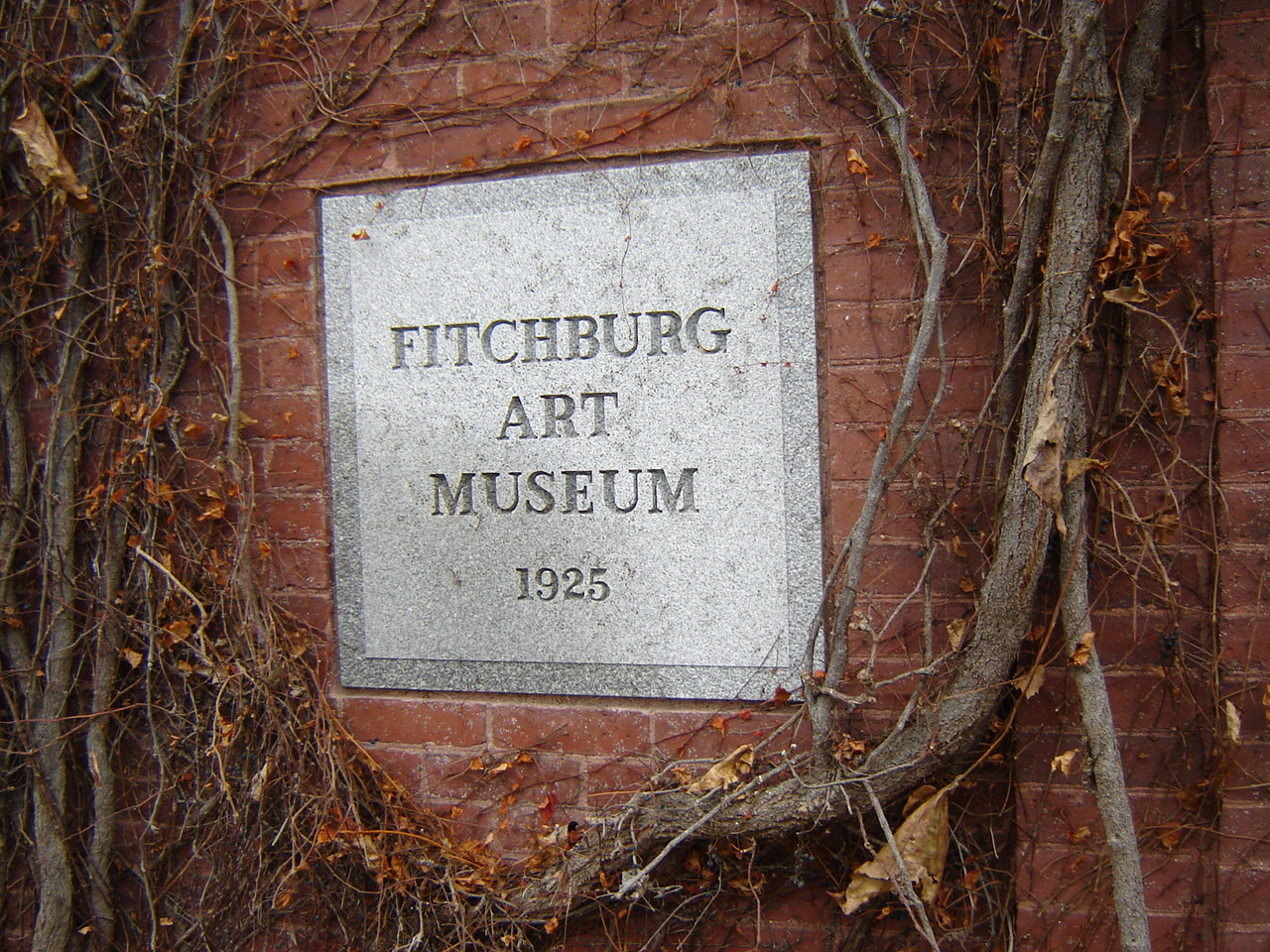
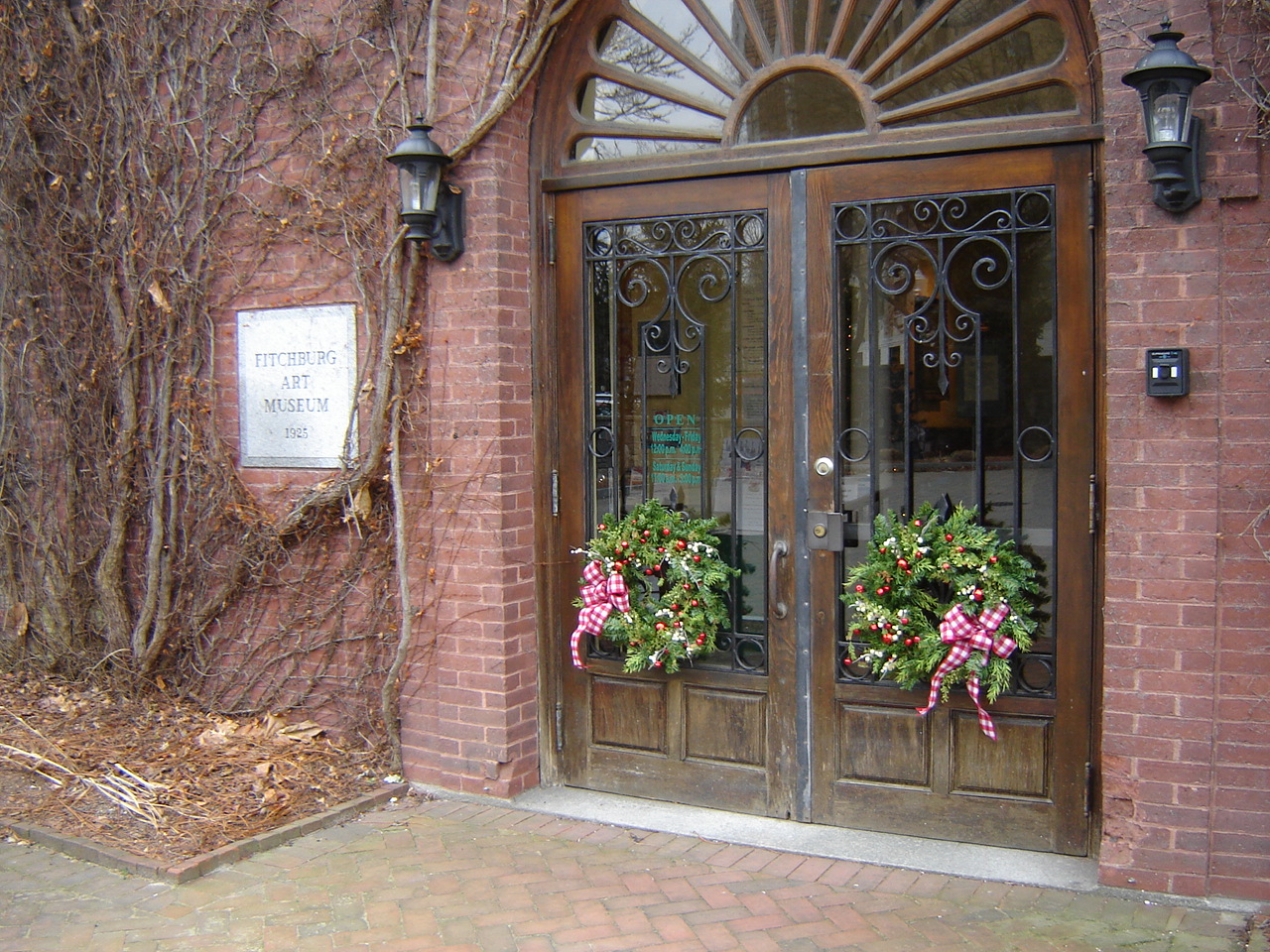
Today I met up with Asakiyume and her daughter the Animator in Fitchburg, a run-down postindustrial city with a lovely little museum, established in 1929 by artist and one-time resident Eleanor Norcross. The show we came for, on graphic art, was put together by the Norman Rockwell Museum in Stockbridge, Mass., and is traveling to New York. Definitely worthwhile. So is the Fitchburg Art Museum itself.
I enjoyed seeing what caught the attention of my companions among the wide variety of graphic styles and stories. For me, the book by Brian Fies on his mother’s cancer and a different book illustrating Kafka’s Metamorphosis were of special interest.
One fun thing was an actual bedroom set up to suggest where a typical comic-loving teen might hang out. The Animator scrutinized the book collection and pronounced the teen’s taste eclectic.
I recognized the art of Lynd Ward, although I did not know he created novels without words. The series in the museum was the novel Gods’ Man, described at the Library of America site:
“Gods’ Man (1929), the audaciously ambitious work that made Ward’s reputation, is a modern morality play, an allegory of the deadly bargain a striving young artist often makes with life.”
If you scroll down at the website, you can see woodcuts from the book.
Asakiyume asked me how I knew about Lynd Ward, and I had a vague memory of a children’s book, possibly of folk tales. I don’t think the book I remembered was The Little Red Lighthouse and the Great Gray Bridge although Ward was the illustrator. It might have been The Biggest Bear.
Today I read an article at Miller-McCune on an astronomer and an economist who want to dump the calendar we all use (Gregorian) in favor of something completely new.
It reminded me of my late friend Doc Howe, who was commissioner of education under Lyndon Johnson and who often spoke of an idea for a calendar that he learned about in his Ford Foundation days. (It might have been the World Calendar seen here, but I’m not sure. Like invented languages, new calendar systems keep popping up.)
Writes Emily Badger at Miller-McCune, “The ever-changing calendar, with its periodic leap years and mouthful of monthly mnemonic devices, has irked timekeepers almost since the system was introduced in the 1500s.
“ ‘It’s a very accurate calendar,’ says Richard Conn Henry, a professor of astronomy at Johns Hopkins University. …
“That said, he wants to get rid of the thing. He and Johns Hopkins economist Steve Hanke are now lobbying to replace it with their invention, the Hanke-Henry Permanent Calendar. In the long tradition of calendar reformers, they believe they’ve settled on the elusive solution to the Gregorian calendar’s floating days of the week: one calendar that remains constant every year, where New Year’s Day falls without fail on, say, Sunday every single time.
“The big advantage to such a system is that nobody — businesses, the NFL, universities, beleaguered governments — would have to go through the exercise every year of rewriting holiday schedules, course calendars or sports seasons.”
Henry and Hanke believe it preferable to insert “an entire extra week onto the end of December every five or six years. … The rest of the calendar would remain constant with four equal quarters of 91 days each, with two months of 30 days and a third month of 31.”
Does this solution speak to you?
Read more on the Hanke-Henry Permanent Calendar here.
The Boston Globe has been covering the arrival and treatment of injured Libyan fighters.
In the first installment, the Spaulding Hospital president expressed concern about making the wounded men comfortable in a new culture — especially as they were going to have to pass through Salem at Halloween. Salem, you know, is full of witches in October, and witches aren’t the half of it.
As Billy Baker wrote of the injured on October 30, “They took off from a desert and landed in a numbing rain with snow in the forecast. And then, if that weren’t strange enough, they were taken to Salem. On Halloween weekend.
“For the 22 Libyan fighters airlifted to Logan International Airport yesterday, the first of the injured to arrive in the United States for medical treatment after the overthrow of Moammar Khadafy’s government less than two weeks ago, it was a day of great joy and great culture shock.
“The injured men, who ranged in age from 17 to 46, were whisked away in ambulances shortly after landing …
“The men are here for treatment at the Spaulding Hospital North Shore facility in Salem, which has been preparing for their arrival by training staff in the customs and religious practices of the patients. A prayer room was being designed with the help of an imam; doctors and nurses will wear name tags in Arabic; and a team of translators trained in medical terms has been brought in to explain the medications and therapies.” Read more.
In a November 10 follow-up, the fighters praised their warm reception. “Lying in bed, the 37-year-old Naser said he is grateful for the opportunity to receive medical attention in the United States, and was surprised by the warm reception he has received.
“ ‘It has been a kind and very sincere welcome,’ said Naser. “It has changed completely my vision of America.’ ”
You knew that the poet Wallace Stevens was a lawyer for the Hartford Insurance Company in Connecticut, right?
It’s fascinating, the double lives many creative people live. In this post, for example, I mentioned Kyan Bishop, a colleague with a pretty businesslike job, who turns out to be an accomplished conceptual artist.
Today I have two gentlemen from the financial-services industry, which whatever else one might say about it, pays enough for a guy to indulge an artistic bent.
Consider first Geoff Hargadon, now showing at the Kayafas Gallery in Boston.
Art critic Cate McQuaid writes in the Boston Globe, “Bring up conceptual art, and some people’s eyes glaze over. So before we dive into the conceptual underpinnings of the work of … Geoff Hargadon now up at Gallery Kayafas, let’s say this: It’s funny, wry, and self-mocking — accessible on many levels.
“Hargadon’s ‘Dealers Protected!’ features signs that he has put up, first around Boston and then during the Frieze Art Fair in London in October, and during Art Basel Miami Beach earlier this month. Perhaps you have seen them. They read ‘Cash for Your Warhol.’ This show features the signs themselves, and photos of them in situ.
“The artist, who is an unlikely hybrid of street artist and senior vice president at the financial services company UBS, was inspired by the ‘cash for your house’ signs he saw on telephone poles during the worst of the economic collapse. He hilariously posted his first ‘Cash for Your Warhol’ sign outside the Rose Art Museum at Brandeis in 2009, after the museum announced controversial — and later canceled — plans to close and sell off its collection.” Read more here.
Second is the late Warren Hellman, Wall Street financier and devoted banjo player. “After nearly 20 years at Lehman in New York, he started several money management businesses, including Hellman & Friedman in San Francisco, one of the country’s most successful private equity funds. More recently Mr. Hellman focused on philanthropy, bestowing millions of dollars on cultural, educational and medical charities in the Bay Area. The three-day concert he founded, Hardly Strictly Bluegrass, held each year in Golden Gate Park, has been financed entirely by him.” Read about Hellman in the NY Times obit.
Someone who used to know her well alerted me to the story of the Mystery Grammy Nominee. At 51 and without a record label, she has managed to get a remarkable burst of attention for her music.
Writes Christopher Morris at Variety, “Linda Chorney used the Recording Academy’s Grammy 365 website to connect with voters.
“Armed only with a computer and some chutzpah, a longshot snuck through the back door and into the Grammy Awards competition this year.
The resourceful Linda Chorney secured a Grammy nomination in the category of Americana album for her self-produced, self-released ‘Emotional Jukebox’ by taking her mission directly to voters, employing the peer-to-peer function of the Recording Academy’s own site for members, Grammy 365.
“Many in the tight-knit Americana community have reacted quizzically, and sometimes vehemently, to Chorney’s nomination, which trumped several well-known artists in the genre. The virtually unknown Sea Bright, N.J.-based musician will face off on Feb. 12 against a field of nominees that has collectively garnered a total of 23 Grammys. And while some question her methods, her online campaign falls completely within the academy’s parameters for acceptable self-promotion.” Read more.
There are several videos on YouTube. What do you think? Leave a comment.
Follow us on twitter @LunaStellaBlog1.
Update: Chorney didn’t win a Grammy, but she has been invited to sing the national anthem at Fenway Park before an April 2012 Red Sox game, another item on her “bucket list.”


















 Suzanne's Mom's Blog