
Photo: Shereefdeen Ahmad.
“Today you do not play as rivals, but as brothers,” a match organizer tells the men from Nigeria and Benin.
One of the worst things about colonialism is the way it arbitrarily separates ethnic groups and plunks families down in different countries. Today we see how a sport is bringing relatives back together.
Shereefdeen Ahmad writes for the Christian Science Monitor, “It’s game day at the village soccer field, and spectators bunch along the sidelines with banners and drums to support their teams.
“They watch as the captains of the two squads walk to the center of the field for a coin flip to determine who kicks off first. …
“This match is part of a festival celebrating the culture of the Borgu, an ethnic group that straddles the border between Benin and its eastern neighbor, Nigeria. The teams and fans gathered here today have come from both countries, part of an effort to use soccer to bridge the divide imposed by colonial powers more than a century ago.
“ ‘I believe that football can reconnect us beyond those lines,’ says organizer Adam Kabirou, who regularly hosts cross-border matches.
“Mr. Kabirou grew up hearing stories about the Borgu kingdom, a civilization tracing its roots to the late 15th century. He also learned how colonial powers carved up his people’s lands in the late 19th century, splitting the Borgu between present-day Benin and Nigeria.
“Today, the majority of Borgu, approximately 1.4 million, reside in Benin, with a smaller population in Nigeria.
“As a child, Mr. Kabirou saw firsthand how that border created a rift between his community and the Borgu people living just 15 miles away on the other side. For one thing, the two groups often literally didn’t have the words to speak to one another.
Borgu in Nigeria learned English, the colonial language there, while Borgu in Benin spoke French, the language of their former rulers.
“These languages mingled with Batonu, the Borgu language, changing the way it was spoken on each side of the border.
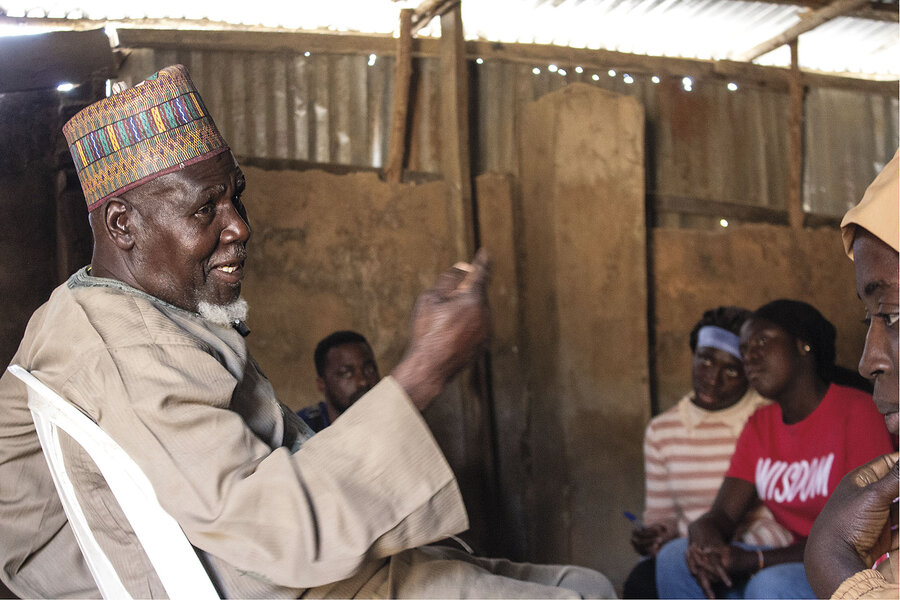
“Meanwhile, Western-style schooling in both countries had pushed the Borgu people away from their shared customs and traditions, says Lafia Hussaini, a Borgu ethnographer and adjunct lecturer at the Centre for Cultural Studies and Creative Arts at the University of Ilorin in Nigeria. [Simultaneously] the border created an administrative division that made close ties practically difficult. …
“Sometimes the division even cut through a single community. For instance, half of the village of Chikanda sits in Benin, the other half in Nigeria. The difference is most clear at night. Electric lights illuminate the houses on the Beninese side of the border, while the Nigerian side, which doesn’t have an electricity connection, is dark.
“Over the years, Mr. Kabirou, a farmer, occasionally attended cross-border soccer matches, and saw how the game shrank the distances between the two communities. So in 2022, he decided to organize a tournament.
“In its most recent edition, in 2024, the Tournoi Brassage Culturel – the Cultural Blend Tournament – drew five teams from Nigeria and 15 from Benin. Mr. Kabirou estimates that more than 4,000 fans attended the final match between Gwanara, Nigeria, and Tchatchou, Benin.
“For the players who participate in these matches, the importance stretches beyond soccer.
“Bashiru Adamu, a Nigerian player, says he barely knew his paternal family in Benin before crossing the border to play a match here in 2023. Now, whenever he comes to play a game, he pays them a visit as well. …
“Today, there are three separate tournaments bringing together Borgu teams from Nigeria and Benin. … They have been important not only for the players, but for spectators as well.
“Watching these matches ‘has really brought us together,’ says Souaibou Seko, a resident of Nikki, Benin. In addition to the soccer itself, he says, he appreciates the cultural performances from Borgu artists that often take place before matches or at halftime.
“These performances ‘stress our newfound cultural unity,’ says Sanni Sika Gounoun, chairman of the organizing committee for the Solidarity Tournament. ‘This camaraderie is growing organically.’ “
“This article is published in collaboration with Egab,” which focuses on stories from lesser known areas.
More at the Monitor, here.






 Suzanne's Mom's Blog