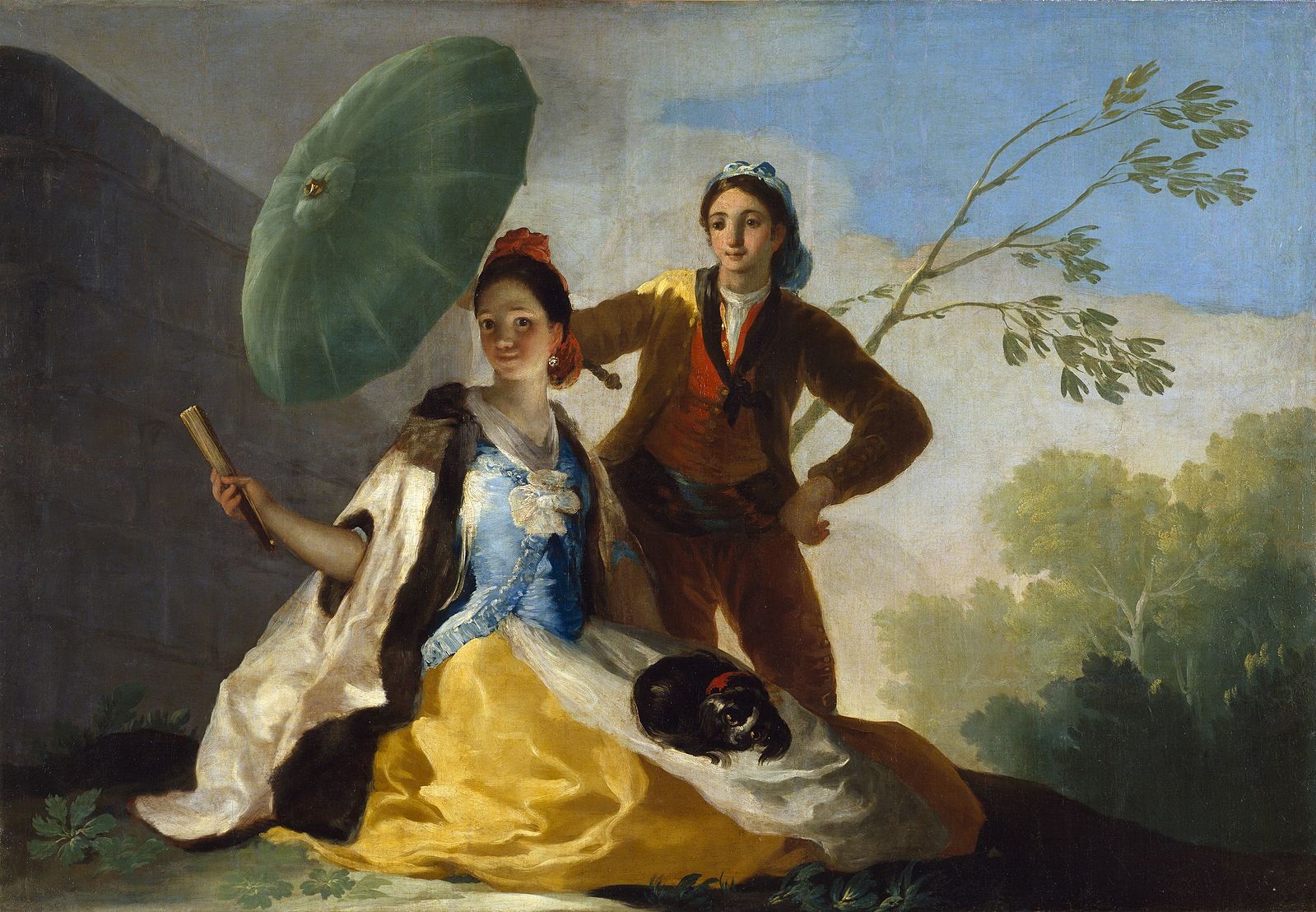
Art: Francisco Goya viaMuseo del Prado. The Parasol (also known as El Quitasol) is one of a series of oil on linen paintings made by Francisco Goya. This series was made in order to be transformed into tapestries that would be hung on the walls of the Royal Palace in Madrid.
Companies that last over many generations know how to evolve with the times. There are a few in the US but more in other parts of the world. In Spain, for example, a factory that once converted pieces by the painter Francisco Goya into tapestries for his clients still plays a role in art and design.
Irene Yagüe writes at the Associated Press (AP), “Spain’s Royal Tapestry Factory has been decorating the walls and floors of palaces and institutions for more than 300 years. Located on a quiet, leafy street in central Madrid, its artisans work with painstaking focus on tapestries, carpets and heraldic banners, combining the long wisdom of the craft with new techniques.
“The factory was opened in 1721 by Spain’s King Felipe V. He brought in Catholic craftsmen from Flanders, which had been part of Spain’s empire, to get it started. Threads and wool of all colors, bobbins, tools and spinning wheels are everywhere. Some of the original wooden machines are still in use.
“The general director, Alejandro Klecker de Elizalde, is proud of the factory’s sustainable nature. ‘Here the only products we work with are silk, wool, jute, cotton, linen,’ he said. ‘And these small leftovers that we create, the water from the dyes, or the small pieces of wool, everything is recycled, everything has a double, a second use.’ …
“The factory recently received one of its biggest orders, 32 tapestries for the Palace of Dresden in Germany — worth more than 1 million euros and providing work for up to five years, according to Klecker de Elizalde. …
“Creating a tapestry is a delicate process that takes several weeks or months of work for each square meter. A tapestry begins with ‘cartoons,’ or drawings on sheets of paper or canvas that are later traced onto vertical thread systems called warps, which are then woven over.
“One of the factory’s most illustrious cartoonists was master painter Francisco Goya, who began working there in 1780. Some of the tapestries he designed now hang in the nearby Prado Museum and Madrid’s Royal Collections Gallery.”
Just for fun, see if you recognize any companies on the list of the world’s oldest companies, here. There’s one called Adam & Eve, which you’d expect to be old! It’s a pub in England, founded 1249.
Photo: Adeline Heymann/One Ocean Expeditions. Candice Pedersen, a guide for One Ocean Expeditions in the Arctic, tells passengers that Inuit women feel empowered reclaiming traditional tattoos for themselves.
I love the radio show called The World because of the international focus. It always has a deeper take on mainstream media stories, and you can hear music you’re unlikely to be exposed to anywhere else. Recently, Joshua Coelda, Sejersdal Dreiager, and Shirsha Chakraborty reported about a tradition that is coming back from the brink: Inuit tattoo art.
“Najannguac Dalgård Christensen, 35, pulled back her sleeve on one forearm to reveal a pair of tattoos shaped like train tracks across her wrists. …
“These are traditional Inuit tattoo patterns that speak to her Indigenous Inuit heritage. The markings, she said, represent Sila, a word that carries many meanings, including ‘breath,’ ‘sky,’ ‘spirit’ and ‘universe.’
“To Christensen, who got the tattoo several years ago, it also means ‘the Greenlandic belief that we should be aware of who we are and what we can be, and that is attached to each other.’
“In precolonial times, Inuit women of Greenland, and across much of the Arctic, would have tattoos on both their bodies and faces, holding important pre-Christian spiritual meaning. Today, some Greenlandic Inuit like Christensen are reclaiming their identity through this long-lost art.
“She said that she didn’t always embrace her Greenlander identity — because it is often associated with negative stereotypes about the Inuit diaspora living in Denmark, who colonized the North American island three centuries ago.
“ ‘I felt empowered by getting the tattoos because it was like there was some kind of relief that I didn’t have to be embarrassed about being a Greenlander anymore,’ Christensen said. …
“The custom itself is far from new, but tattoos were some of the first traditions to be discouraged when Danish-Norwegian missionaries started colonizing the island at the beginning of the 18th century. The missionaries found tattooing incompatible with Christian faith, [Randi Sørensen Johansen, intangible cultural heritage curator at the Greenland National Museum and Archives] said. …
“As the custom disappeared, so did much of the knowledge about the tattoos’ meaning. ‘We didn’t have that tradition of writing down,’ Johansen said — Inuit passed knowledge through oral storytelling. …
“Inuit would use amulets to protect them from ‘unwelcome spirits,’ but also to help certain attributes or ensure a successful childbirth, among other things. It is likely, Johansen said, that Inuit tattoos were seen as a kind of amulet, giving strength, help or protection to the women or — in rarer cases — men who had gotten them.
“The tattoos were most often made as linear patterns across the brow and vertical lines on the chin made by using both a puncture or dot technique and a sewing technique. The latter technique consisted of pulling sinew dipped in soot under the skin with a needle made of animal bone, curator Johansen said.
“Maya Sialuk Jacobsen is one of about a dozen Inuit tattoo artists across the globe reviving this traditional art. … It was she who created Christensen’s tattoos. For over six years, she’s been helping Inuit like Christensen who live in Denmark connect with their culture through ink. Like Christensen, she is of both Danish and Greenlandic Inuit descent — a group she describes as an emerging ‘third culture’ in the Scandinavian country.
“The community is fairly small in Denmark and not well-defined demographically. According to StatBank Greenland, there are a little under 17,000 people born in Greenland currently living in Denmark. But community leaders, including from the Greenlandic House of Aalborg, aren’t even sure about the exact number of Inuit in Denmark. The number of self-identifying Inuit could be even higher, due to the presence of third-culture community members, who are partially Inuit. …
“Sialuk Jacobsen said, ‘It’s basically identity work all the time.’ Many come to her with a feeling of sadness, in search of a sense of belonging, she said. ‘They need to talk about these things, and to learn about the culture, they just want to learn.’ …
“While Sialuk Jacobsen said she uses inks and needles approved for tattooing on clients in Denmark, her research into the traditional techniques has included experimental tattooing on herself, and using her own right leg as her test area to reconstruct authentic methods of inking up.
“But in Denmark, finger, hand and face tattoos are prohibited (though it’s not illegal in Greenland). So, Sialuk Jacobsen is limited to tattooing the rest of the body. …
“The legacies of colonialism hang heavy over the community living in Denmark. Greenlanders are overrepresented among Denmark’s homeless population — accounting for 7% of people experiencing homelessness, according to VIVE.
“In recent years, Denmark’s colonial past came under public scrutiny. For her master’s degree, Christensen looked into a form of ‘modern boarding schools.’ She found that Inuit children in Denmark are more likely than Danish children to be taken away from their families and placed in foster homes, which are almost always Danish families.
“ ‘They learn to speak Danish, and there isn’t any focus on the Greenlandic language, so they lose their Greenlandic language. And when the parents only speak Greenlandic, they can’t talk to each other without an interpreter.’
“Christensen, who has become an activist through her research, believes the government should make it at least mandatory for Inuit children living in foster care to have lessons on Greenlandic.”
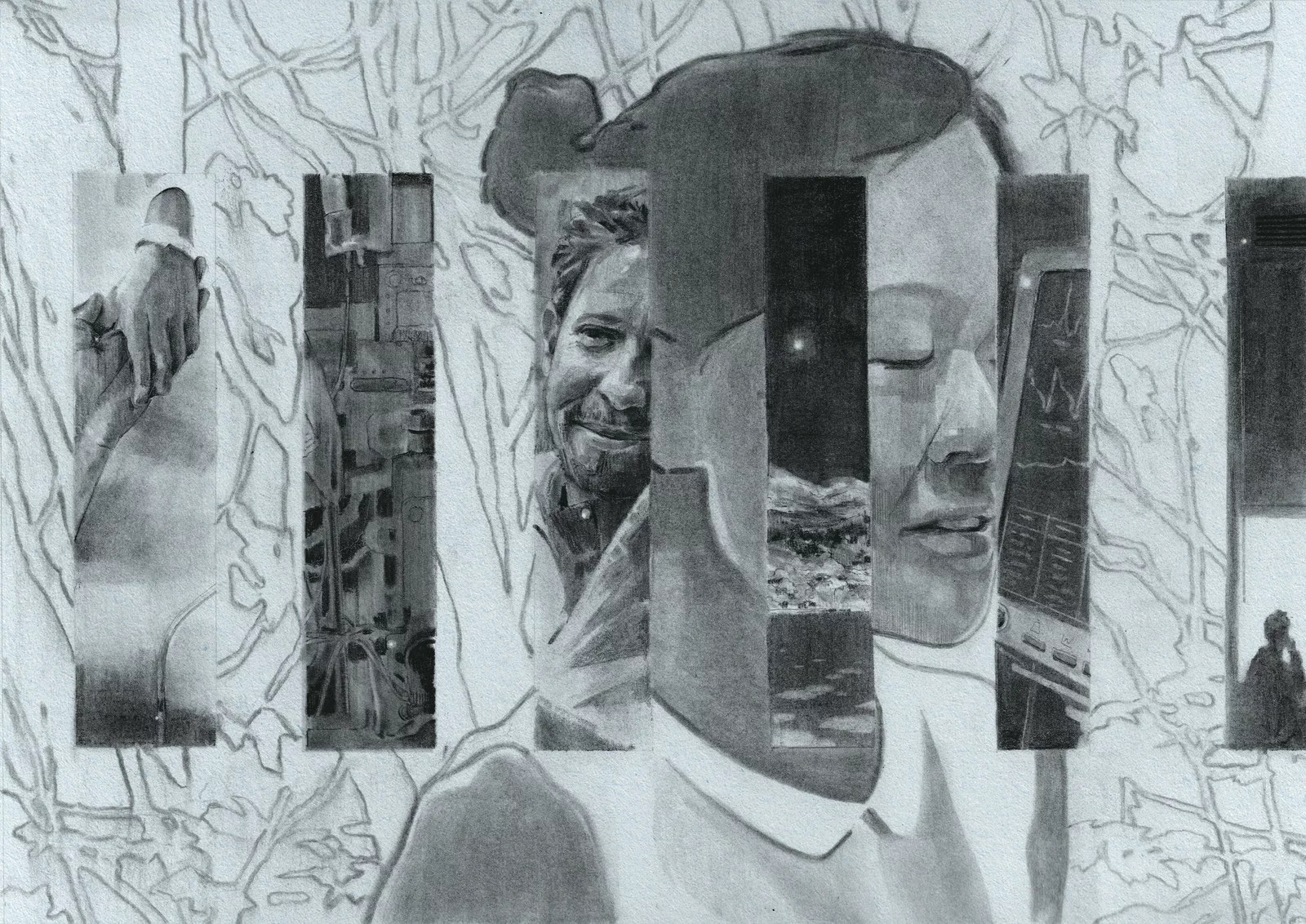
Photo: James Lee Chiahan/Procedure Press. “Tone Shift,” by James Lee Chiahan. depicts musician Yoko Sen’s journey from being patient in the hospital to working to improve the sounds of ICU alarms around the world. Chiahan is a Taiwanese-Canadian artist currently working out of Montreal, Canada.
Those of us who have ever had a hospital stay know how difficult it is to get any sleep. Part of the reason is noise. Today’s article suggests that since artists started applying their creativity to the challenge, hospitals have new ways they could improve sounds and doctors have new ways to improve patient interactions.
Mara Gordon at NPR (National Public Radio) begins her story with Emily Peters, who had a rough time with the health care system when her daughter was born. “Peters, who works as a health care brand strategist, decided to work to fix some of what’s broken in the American health care system. Her approach is provocative: she believes art can be a tool to transform medicine.
“Medicine has a ‘creativity problem,’ she says, and too many people working in health care are resigned to the status quo, the dehumanizing bureaucracy. That’s why it’s time to call in the artists, she argues, the people with the skills to envision a radically better future.
“In her new book, Artists Remaking Medicine, Peters collaborated with artists, writers and musicians, including some doctors and public health professionals, to share [ideas] about how creativity might make health care more humane. …
“For example, the book profiles electronic musician and sound designer Yoko Sen, who has created new, gentler sounds for medical monitoring devices in the ICU, where patients are often subjected to endless, harsh beeping.
“It also features an avant-garde art collective called MSCHF (pronounced ‘mischief’). The group produced oil paintings made from medical bills, thousands and thousands of sheets of paper charging patients for things like blood draws and laxatives. They sold the paintings and raised over $73,000 to pay off three people’s medical bills.
“It’s similar to a recent performance art project not profiled in the book: A group of self-described ‘gutter-punk pagans, mostly queer dirt bags’ in Philadelphia burned a giant effigy of a medical billing statement and raised money to cancel $1.6 million in medical debt. …
“There’s very little in the way of policy prescription in this book, but that’s part of the point. The artists’ goal is to inject humanity and creativity into a field mired in apparently intractable systemic problems and plagued by financial toxicity. They turn to puppetry, painting, color theory, and music, seeking to start a much-needed dialogue that could spur deeper change.
“Mara Gordon: What made you want to create this book? “Emily Peters: I think I’m always very curious why so many people – really the majority of everybody in any way involved in the health care system – feel so powerless. … And so the book came about as thinking about power and change. And then I realized that artists have this unique intersection where they are very powerful, they bring a lot of the things that were missing in health care, trying to build a better future.
“MG: What is it about art that feels like a tool to challenge that feeling of powerlessness? “EP: The very first person I interviewed for the book was a photographer, Kathleen [Sheffer], who was a heart-lung transplant survivor. She used her camera in the hospital to try to be seen as more powerful, to be seen as a full person by these very fancy transplant surgeons who are whisking in and out of her room, viewing her as just a body. I saw that she had gained that power through being an artist.
“I had another conversation with a physician out of New York, Dr. [Stella] Safo. … She really highlighted that there’s this crisis of imagination. Everybody feels so demoralized that we can’t even imagine what we want to ask for to make it better.
“That’s a creativity problem. And the people who are creative are artists. They are really good at sitting in complexity and paradox, and not wanting everything to be perfect, but being able to imagine. And so that was the hypothesis: Oh, there’s something really interesting at this intersection between art and medicine. …
“MG: My favorite part of the book was the section where there’s a color palette, named for different medical phenomena: pill bottle orange, Viagra blue.… I think a lot of people in health care worry that too much color somehow distracts from the seriousness of medicine. “EP: So many of these things, somebody chose, and they didn’t do a huge amount of research on it. They just chose it, and we take it as gospel now.
“The white coat ceremony. [I had thought it must have started in] medieval Florence: they were putting white coats on medical students and welcoming them into the guild, it just feels like this ancient tradition. And it’s something that was invented in Chicago in 1989. A professor was complaining that the students weren’t dressing professionally enough. …
“We surveyed a couple hundred people [and published the results online]: ‘What colors would you want to see in the hospital?’ I was expecting those soothing pastel tones. And it was totally different: it was neon purples and oranges and reds. Don’t assume what people want. We have the technology and the capability now to build in systems that give people some control and some agency over things like color. …
“MG: Has anyone told you that they think that health care is too important for art? “EP: I’ve heard the criticism that this is just about wallpaper on a pig: ‘You’re talking about adding more sculpture gardens and increasing the cost of health care.’
“I did not want it to be a book about creating more luxurious hospitals. We have a crisis of financial toxicity, we have a crisis of outcomes. It’s specifically a book about fighting those things. …
“MG: Do you think medicine takes itself too seriously? Do we need more humor in health care? “EP: You’re holding somebody’s heart in your hand – this is a very intense job. You’re trying to convince somebody to enter hospice – that is not easy. This is not an easy job. But that seriousness can feel almost like play acting and really inauthentic to people. …
“And that’s such a waste to me, because it is such a beautiful, incredible profession. We, as patients, also want you guys to be humans. We’re on your side.”
Photo: Janie Korn. “Challah Menorah” by Janie Korn.
Today is the first day of Hanukkah, and I can finally share the Hyperallergic article I’ve been saving on the creativity that goes into making menorahs.
Sarah Rose Sharp writes, “The central activity of the eight-night holiday is the lighting of candles, which symbolizes the restoration of the Temple of Jerusalem in 164 BCE, reclaimed from Seleucid takeover in 175 BCE. After Judah the Maccabee led a rebel force to win back the Temple, only enough lamp oil remained to last for a single night. But legend has it that the lamps burned for eight nights, and because of this, celebrants light an escalating series of eight candles held by a menorah.
“As a fixture of even largely non-practicing Jewish households, menorahs come in all styles, from traditional to modern, simple to maximalist. Their aesthetics and symbolism are a vast subject, but in honor of Hanukkah year 5783 (by the Hebrew calendar), let’s take a look at some great menorahs that break the mold!
“New York’s very own Jewish Museum has a vast collection of Hanukkah lamps — the largest in the world, with more than 1,000 pieces — like a whimsical deconstructed menorah by Peter Shire. Senior Curator Claudia Nahson explained how artists like Shire, working in the 1980s, began to upend the centuries-old menorah design. …
“ ‘Peter Shire typically takes familiar objects and reimagines their shapes, colors, and materials so that we barely recognize them,’ Nahson told Hyperallergic. ‘In his inventive Hanukkah lamp, a mixture of pastel and hot colors, industrial metals, and a cantilevered, swirling arrangement of parts challenge the modernist aesthetic of simplicity that had dominated design for a century.’ …
“While most menorahs rigidly indicate where to place the nightly candles, the ‘Emerald Ripple Menorah’ by the local industrial design studio Friends Of takes a more organic approach, enabling the user to arrange the candles in circles that radiate out from the center point, occupied by the shamash that is used to light the other candles. …
“Why not celebrate Hanukkah with a candle-lit shoutout to everyone’s favorite egg bread? This incredible menorah [above] was created by visual artist and curator Janie Korn, and is sure to make any carb-lover light up.
“Since holidays of all kinds are an opportunity to gather with your community and engage in the roots that connect us to something bigger, menorahs of mushroom clusters by ceramic artist Ben Noam perfectly encapsulate the spirit of the season. Noam’s series, which he began for his own family to celebrate the holiday, reimagines the age-old rites of Hanukkah in a fun and colorful piece that can displayed year-round.
“ ‘[I] drew on the California Clay Movement to create a psychedelic fantasy rooted in Jewish stories,’ Noam told Hyperallergic. ‘The mushrooms form architectural villages — like a shtetl — inspired by the bright colors of Chagall, Jewish modernism, and the forest mushrooms that emerge with the changing of the seasons.’ …
“Holidays are also a great time to reflect on where you’ve been and where you’re going. In 2021, the Jewish Museum Berlin expanded their collection to include their first-ever modern menorah, a stunning 1924 work by the German-born sculptor Ludwig Yehuda Wolpert that evokes Art Deco sensitivities. Hetty Berg, the museum’s director, explained that the acquisition was in line with the institution’s focus on Jewish ceremonial objects by German artists from the late 19th and early 20th century.
“ ‘We want to document the stylistic change that took place during this era,’ Berg said. ‘Only a very small number of Jewish ceremonial objects made by artists in Germany during the 1920s still exist today. Wolpert’s Hanukkah menorah is a prime example of this decisive period and Modernism’s creative awakening, and it fills a gap in the museum’s collection.’
“And this is hardly the only 20th century artist moved by the imagery of menorahs. Though the Surrealist painter Salvador Dalí was not Jewish, he produced several sculptures inspired by the branches of the olive tree that grows in Jerusalem. (The olive tree is also an important symbol of Palestinian resistance.) Dalí’s 1981 ‘Peace Menorah’ has organic lines and subtle details, including a face and a star of David etched into its stem.
“When it comes to fine art menorahs, there are clearly many directions one can turn, but obviously the most avant-garde is not part of any museum collection, but available online at BananaMenorah.com. … Very much in the spirit of Hanukkah, Banana Menorah is an institution born out of scrappy necessity. According to their website, Samantha Weisman was visiting her goyish boyfriend, Zach Lupei, over college winter break and needed to improvise a menorah to celebrate Hanukkah.
“ ‘That first menorah was created from an underripe banana, a chopstick, and some creative thinking,’ according to Weisman and Lupei. They’ve celebrated with banana menorahs ever since, and finally decided to quit wasting bananas and make things official in stainless steel.”
More great menorah photos at Hyperallergic, here. No firewall. And check out the wild array of menorahs at the Jewish Museum in New York, here.
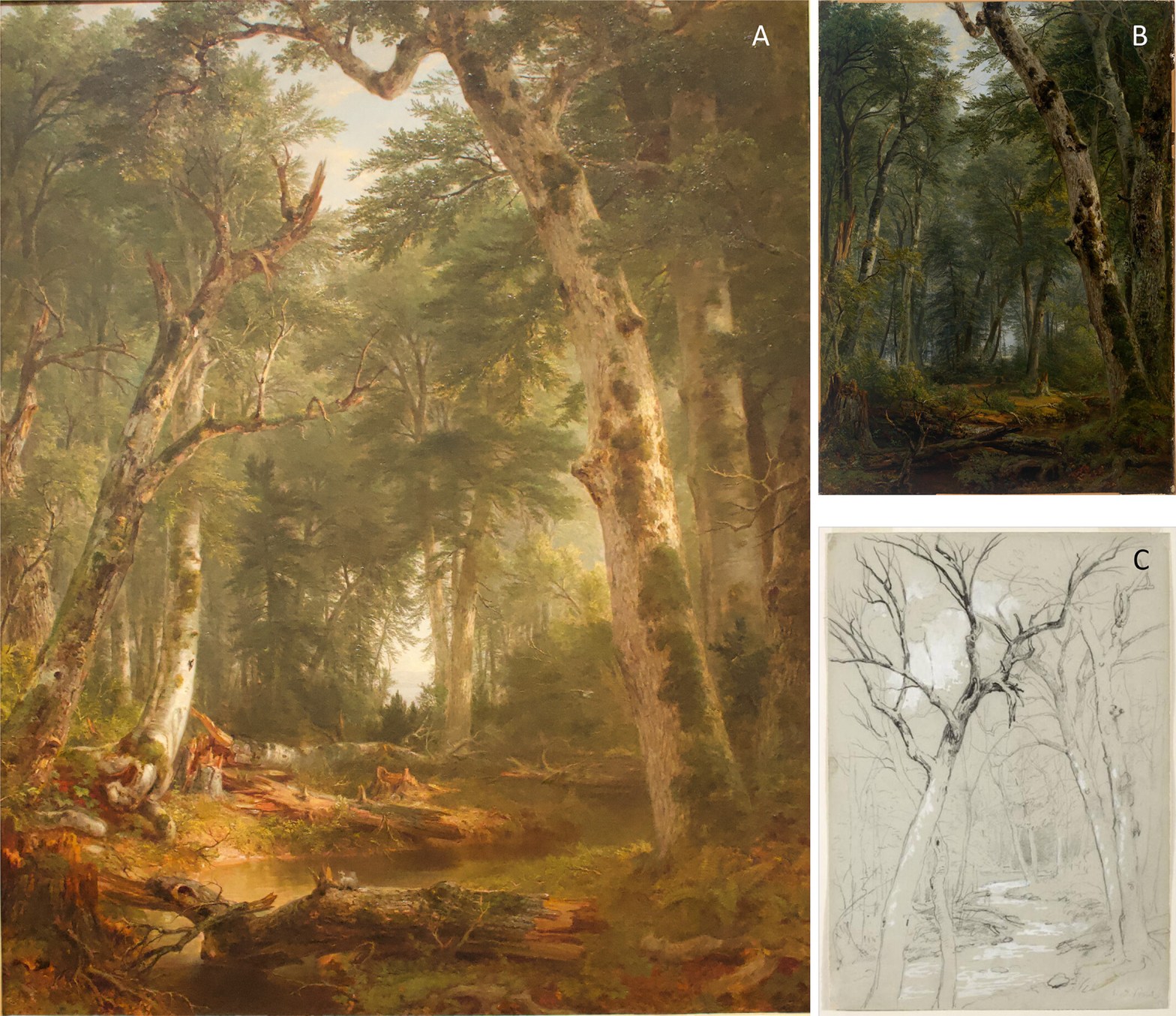
Art: Asher Durand. Nineteenth-century paintings of old growth forests are helping ecologists learn aboutwhat we have lost. Asher Durand, for example, understood the way that beech trees fit into their forest habitats. A) “In the Woods” (1855); B) “Woodland Interior” (c. 1854), oil on canvas; C) “A Brook in the Woods” (c. 1854), graphite, gouache, and white lead on paper.
Call me retro, but I’ll always love the Hudson River School paintings of a long-gone majestic American wilderness. So do ecologists, as it turns out.
Elaine Velie reports at Hyperallergic on a new study showing that the 19th-century paintings have a value beyond the aesthetic.
“The Hudson River School movement is an enduringly popular slice of 19th-century American art history,” Velie writes, “but as beloved as it is, its paintings of bucolic hills drenched in golden light are not particularly known for their adherence to reality. In a recently published study, a team of ecologists and art historians set out to determine just how true to life these works really were.
“Using onsite sketches and historical writings, the team determined that some of these paintings were true to life. …
Some were so detailed that they could even help scientists today learn about the centuries-old forests that were destroyed before the advent of color photography.
“Dana Warren and Harper Loeb of Oregon State University published their findings last month in the academic journal Ecosphere along with scholars Peter Betjemann, Isabel Munck, William Keeton, David Shaw, and Eleanor Harvey.
“ ‘I have been interested in understanding older forests and old growth forest systems in the Northeast for a while,’ Warren told Hyperallergic. … ‘I was interested in these 19th-century paintings, but I had always thought that issues of artistic license removed the potential for any of these images to be used in a rigorous quantitative way.’ She paired up with art historians to investigate.
“The interdisciplinary team focused on Hudson River School paintings completed between 1830 and 1880, when Northeastern forests were being cleared for farms but more remote regions still remained untouched by European colonizers. Blights and invasive species had yet to arrive, and trees like the chestnut, ash, and elm still shaded the woodland floor. …
“In the early 1800s, American painters began working en plein air. Portable oil paints had come into fashion, and growing infrastructure made it easier to venture upstate. A fascination with ‘wilderness’ in literature and art emerged alongside the dark underpinnings of ‘manifest destiny‘ and colonial expansion.
“As creators emphasized nature, they were acutely aware of the changing landscapes around them.
“ ‘The beauty of [untouched] landscapes is quickly passing away,’ Thomas Cole, the painter credited with founding the Hudson River School movement, wrote in 1836. ‘The ravages of the axe are daily increasing — the most noble scenes are made desolate.’
“While painters like Cole crafted dramatic allegorical renderings of the forests disappearing around them … other artists adhered to observational truth.
“Warren and her team used the interior forest scenes of prominent Hudson River School painter Asher Durand (1796–1886) as a case study, examining his onsite sketches, writings, and oil paintings to establish the veracity of his finished works. …
“Durand explicitly stated his emphasis on depicting the natural world just as he saw it. Like other artists, Durand had been familiarized with the specimen-based botany that had been available in published form since the 1700s.
“The scholars examined an 1855 Durand painting of the Catskills titled ‘In the Woods’ — a calm depiction of a shady stream lined with beech trees. Notably, an 1854 painting of the same scene excludes these plants, but an onsite sketch of a similar setting includes them, signifying that the artist added the trees into his final painting from a real sketch. …
“Warren said her recent study is a ‘proof of concept,’ and that she thinks the team’s exploration of Durand’s paintings can extend to the work of other artists. For now, Hudson River School depictions of microhabitats — groupings of flora like mushrooms on tree trunks and mats of moss on bark — can help ecologists learn about what old growth forests were really like.
“With an interdisciplinary approach to ecology and art history, the scholars think paintings of the American West could help scientists learn about long-melted glaciers and plowed prairie biomes, and artworks showing the coast could help researchers study lost marsh habitats.”
Today we have lots of color photography, but if any of you artists out there want to help the scientists of the future, you know the way.
Check out the art at the Hyperallergic, here. No firewall, but subscriptions solicited.
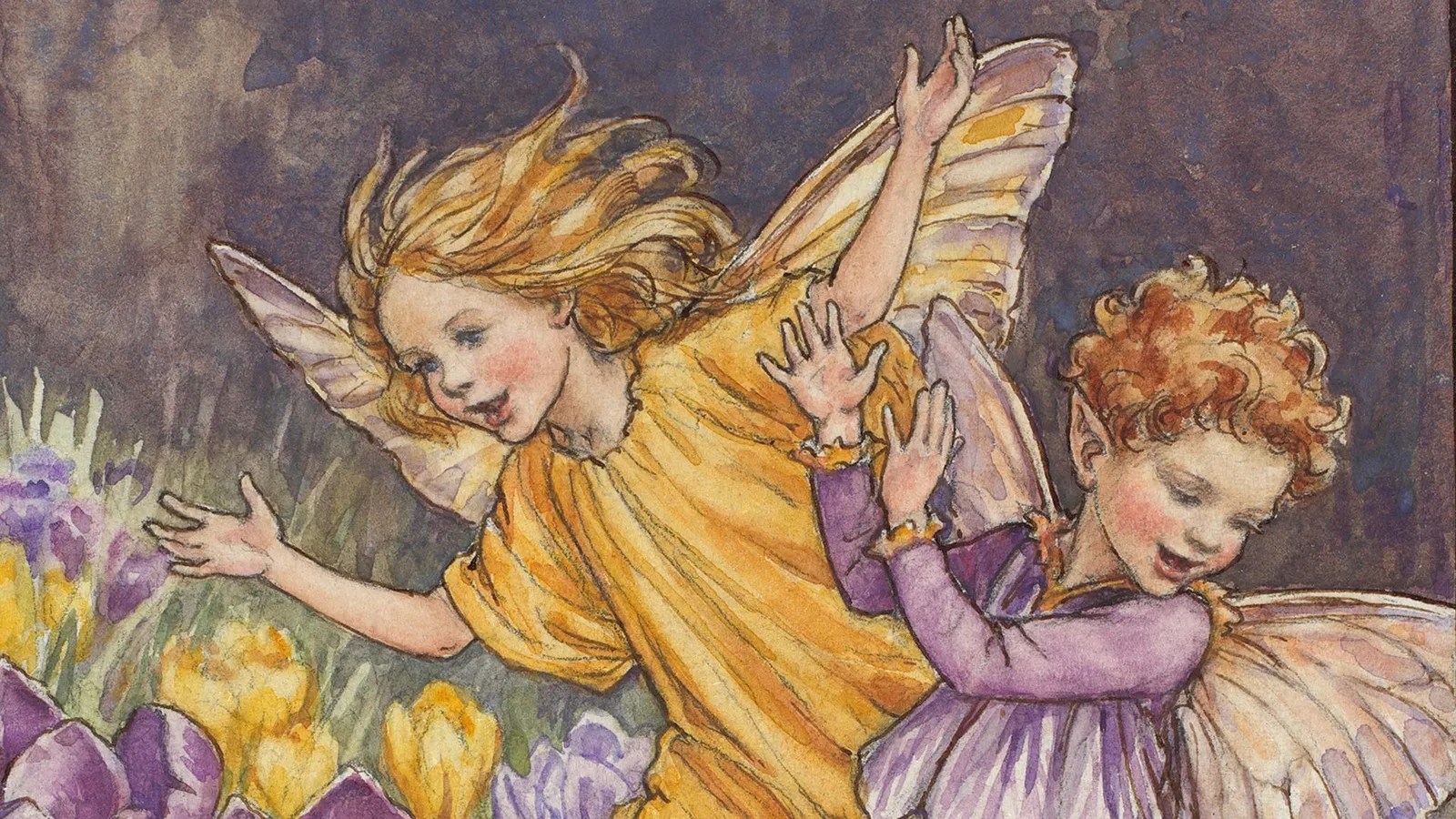
Photo: Estate of Cicely Mary Barker, 1934 Flower Fairies. The Crocus Fairies from Flower Fairies of the Spring – the watercolors are still popular today with “fairycore” fans, the BBC opines.
Hannah will remember my devotion to the subject of today’s post. Fairies. I have always been into fairies, and long ago Hannah joined me in bringing them to life.
Meanwhile in the UK, the BBC’s Holly Williams writes this about them: “Imagine a fairy. Is the picture that appears in your mind’s eye a tiny, pretty, magical figure – a childish wisp with insect-like wings and a dress made of petals?
“If so, it’s likely you’ve been influenced by Cicely Mary Barker, the British illustrator who created the Flower Fairies. 2023 marks 100 years since the publication of her first book of poems and pictures, Flower Fairies of the Spring – an anniversary currently being celebrated in an exhibition at the Lady Lever Gallery in Merseyside, UK.
“The Flower Fairies’ influence has endured: they have never been out of print, and continue to be popular around the world. … Barker’s delicate watercolors certainly helped cement several tropes we now consider classic – almost essential, in fact – in the iconography of the fairy: they are miniature, sweet and youthful, they are intertwined with plants and the natural world, and they are distinctly twee.
“Yet her drawings were also ‘firmly footed in realism’ points out Fiona Slattery Clark, curator of the show. … Barker drew children from the nursery school her sister ran in their house in Croydon near London; each was assigned a flower or tree, and Barker’s detailed illustrations were botanically accurate – she would source samples from Kew Gardens, says Slattery Clark. Even the petal-like wings and fairy outfits were closely based on plants: an acorn cup becoming a jaunty cap, a harebell becoming a prettily scalloped skirt.
“The Flower Fairies were an immediate hit – but Barker was far from the only artist of her era to find success with fairies. In fact, fairy fever swelled within the United Kingdom for over half a century, reaching something of a peak around the time the Flower Fairies emerged in 1923. Over 350 fairy books were published in the UK between 1920 and 1925, including in Enid Blyton‘s first fairy foray, a collection of poems called Real Fairies in 1923. Fairy art even had the stamp of royal approval: Queen Mary was a fan of Ida Rentoul Outhwaite‘s ethereal drawings, and helped popularize them by sending them in postcard form. …
“But for many hundreds of years, they were not necessarily tiny and fey, but grotesque or fierce elemental forces, capable of great darkness. ‘In 1800, if you thought your child was a fairy it would have been like demonic possession – you would have put that child in the fire to drive out the fairy,’ points out Alice Sage, a curator and historian.
“Yet within 100 years, the whole conception of fairies completely changed. … Fairies became a fashionable subject for Victorian artists, often taking inspiration from Shakespeare’s A Midsummer Night’s Dream and The Tempest. John Anster Fitzgerald, Edwin Landseer, John Everett Millais, Joseph Noel Paton, Arthur Rackham and even JMW Turner – among many others – painted supernatural sprites from the 1840s onwards. But there was still a sense of otherworldly strangeness in many of their depictions – as seen in the work of Richard Dadd, who made his hyper-intricate fairy paintings while living in a Victorian asylum. …
“Barker never made any claims for fairies being real – ‘I have never seen a fairy,’ she wrote in a foreword to Flower Fairies of the Wayside. But it is worth noting that she first published the Flower Fairies at a moment when the desire to believe in magical beings was at a rare high. In 1920, Britain was gripped by the story of the Cottingley Fairies, after two girls claimed to have photographed fairies at the bottom of their garden in West Yorkshire – and were widely believed.
“Their beautiful photographs were created by paper cut-outs, floating on hat pins. Although many were skeptical, they nonetheless also fooled many of the great and the good – the photographs were brought to prominence by no less than Sir Arthur Conan Doyle, the author of Sherlock Holmes, who wrote a whole book about it, The Coming of the Fairies, in 1922.
“Cousins Elsie Wright and Frances Griffiths were aged 16 and nine when they took the first photos. Many years later, in the 1980s, they admitted it was a hoax, explaining that they kept up the pretense that the fairies were real a because they felt sorry for the middle-aged men, like Conan Doyle, that so wanted to believe. …
” ‘For Conan Doyle, it was all about a search for another realm of being that related to life after death, vibrations, telepathy, telekinesis – this fascinating world on the edge of the limits of human perception,’ says Sage. ‘And obviously that’s connected to the loss of his son in World War One.’ …
“Sage is pleased to see the Flower Fairies exhibited in a fine art context at the Lady Lever gallery. For a long time, men painting fairies has been considered art – but when women do it, it’s just silly flowery stuff for children. ‘This is fine art – it’s mass, popular fine art,’ insists Sage.”
More at the BBC, here. No paywall. If you live in the UK, you have until November 5 to see the fairy exhibit at the Lady Lever Art Gallery, Port Sunlight Village.
Photo: Alexandra Ionescu/Rhode Island Collective. This floating wetland, an artificial island hosting a human-made ecosystem, was scheduled to remain in Ice Pond in Southborough, Mass., until Sept. 17.
Here’s a new thing under the sun: a floating wetland. Art and science join forces, and Frank Carini at ecoRI News has the story.
“Floating in a circle around a pond in Massachusetts is a mini-wetland built by six Rhode Islanders. Earlier this summer, the mostly natural creation was chosen as the winning installation in the seventh annual Art on the Trails outdoor art and poetry program.
“But the freshwater wetland, built by a group of Ocean State artists, designers, and a botanist, wasn’t commissioned to win an award. It was designed to raise awareness about the importance of wetlands and show how they work. Mission accomplished.
“Art juror Sarah Alexander, who chose ‘Below and Above: A Floating Wetland Supports Life” by the Rhode Island Collective as the best installation, said, ‘The amount of careful research and thoughtful response to the space, along with the combined efforts of its dedicated creators, blew me away.’ …
“The wetland has been floating in Ice Pond in Southborough since June 11. It was created by sourcing native plants, and experiments with natural cordage. It shows how pollutants could be sucked from stressed waterbodies with a little help from human hands. A single anchor line keeps the wetland floating in a 15-foot circle, and not all over the popular skating pond.
“Members of the Rhode Island Collective include Holly Ewald (visual artist), Maxwell Fertik (interdisciplinary artist), Alexandra Ionescu (ecological artist), Hope Leeson (botanist), and August Lehrecke and Matthew Muller (co-founders of an inflatable architecture studio), who led the project’s construction. …
“ ‘The floating wetland ecosystem creates a habitat for the more-than-human world below and above the water line through the growth of native macrophytes. Through the plants’ life cycles, they regenerate the food web, amplifying the natural processes between sunlight, water, and microorganisms,’ according to the Collective. …
“Their structure was built using dried Japanese knotweed, broadleaf cattails, and bamboo for buoyancy, as alternatives to petroleum-based materials such as plastic and foam typically used to construct floating wetlands. A small amount of stainless steel wire mesh and cable holds the craft together.
“The knotweed used to create the floating wetland was harvested in late winter as dry stems from Mashapaug Pond and Gano Park in Providence. Fertik said repurposing invasive species for the project’s pontoons removed some of their biomass from the environment and transformed the nonnative plants into a vessel to improve water quality and promote biodiversity. (The dead stalks weren’t capable of spreading.) …
“The craft is home to 18 native wetland plant species: American bur-reed; bayonet rush; brown fruited rush; Canada rush; common cattail; Alleghany monkey-flower; blue flag iris; boneset; cardinal flower; flat-topped goldenrod; Joe-Pye weed; New York ironweed; northern water horehound; pickerelweed; swamp milkweed; buttonbush; silky dogwood; and steeplebush. …
“Suspended in water, the plant roots provide a home for diverse communities of algae, bacteria, fungi, and protozoans, known as periphyton. As the plants upcycle nutrients from the water into their roots, stems, leaves, and flowers, the periphyton provide nutrient uptake, filtration, oxygenation, and toxin removal.
“Southern New England’s freshwater lakes and ponds, especially the shallow ones, are being stressed by development, wastewater overflows, old and failing septic systems, antiquated cesspools, and stormwater runoff carrying nutrients such as nitrogen and phosphorous from fertilizers and roadway pollutants such as polycyclic aromatic hydrocarbons. …
“The Collective’s 48-page PowerPoint presentation noted Indigenous communities built floating islands for hundreds of years by harvesting natural materials found in their surroundings. ‘By incorporating native plants from freshwater marsh and pond ecosystems, we are supporting a variety of other life forms,’ they said.
“Ice Pond, part of the 58.5-acre Elaine and Philip Beals Preserve, is a healthy ecosystem in little need of a floating wetland to pull pollutants out of the water, but it did give the Collective an opportunity to learn how floating wetlands create a habitat, observe the decay of the natural materials used to build the craft, and document the growth of the native wetland plants. … The Providence Stormwater Innovation Center has requested the craft’s presence for the ponds at Roger Williams Park. …
“Art on the Trails is an annual site-specific ecological sculpture park exhibition. To watch a video about the project, click here.”
Photo: Matthew Schuerman/NPR. “Jonah Kinigstein, 99, has been making art since he was a teenager,” says NPR. “Some of his work satirizes modern artists such as Andy Warhol and Jackson Pollock, visible in the painting behind him.”
Although I am personally a big fan of abstract art, I find it interesting to consider that that former rebellion against convention spurred its own rebellion. When abstract art was the accepted best, what happened to artists whose inspiration lay elsewhere?
Matthew Schuerman reported at National Public Radio (NPR) about one artist working in the heyday of abstract expressionism who swam against the tide.
“In the 1950s, Jonah Kinigstein was on the verge of making it big in New York’s art world. He won a Fulbright to Rome. His paintings got into the Whitney Museum’s annual show of contemporary art (the precursor to the Whitney Biennial). And he was taken in by one of the biggest gallerists in the city, Edith Halpert. …
“Once, when Life magazine ran a profile of Halpert and nine of the artists she was promoting titled, ‘New Crop of Painting Protégés,‘ Kinigstein was among them. In fact, in the main photo, he stood directly behind Halpert. But then, as a result of changing tastes in the art world, he fell into obscurity and could not convince anyone to give him a gallery show.
“He nonetheless kept painting … and painting … and painting some more. Even today, at age 99, he said he spends two to three hours a day. …
“His painting style has gone through a lot of changes throughout his life, but he calls himself a ‘figurative expressionist.’ That is, he paints people, but they are often distorted and grotesque, set against backgrounds that are surreal and fantastical. His subjects are saints, rabbis, impresarios and showgirls — people who [seem] to be suffering or seem to be enjoying other people’s suffering. …
” ‘I was born in Coney Island, and I remember certain things,’ he said. ‘These large figures and people waiting in line.’ …
“Born in 1923 in Brooklyn, Kinigstein was raised in the Bronx by Jewish-Russian-Polish immigrants. As a teenager, he learned he had a knack for art by drawing with chalk on the sidewalk. His father, a house painter, used to brag about him to his co-workers.
” ‘I used to go with him to help paint the apartments. And he would say, as he introduced me, “Hey, I’m painting with a real artist,” ‘ Kinigstein said with a laugh.
“After high school, Kinigstein attended The Cooper Union. … But before he could finish, he was drafted into the Army for World War II, where he worked in a photo topography unit. …
“To Kinigstein, though, the twilight of figurative art meant it was less and less likely that he would ever make a living as a painter. The rejection stung.
” ‘I made painting after painting. And I always felt, you know, I was doing my best,’ he said.
“Kinigstein married and had two children while continuing a career in commercial art. He designed store windows and also Bloomingdale’s first-ever collectible shopping bag. (He was later inducted into the National Academy of Design.) And he kept painting.
“He also began to draw cartoons: satirical and biting, like something out of a 19th century political magazine, except his lampooned the art establishment that promoted abstract painting.
“One of them is based on a famous Rembrandt painting, The Anatomy Lesson of Dr Nicolaes Tulp. Except the cadaver on the bed is labeled ‘figurative painting’ and the men around him, cutting him up, are members of the art establishment that promoted abstraction in the 1950s.
“A few times, Kinigstein took these cartoons to New York’s gallery district, SoHo, and pasted them onto building walls and lamp posts. Some passersby would get into arguments with him, while others would take them down and ask him to sign them. …
“To Kinigstein, abstract painting took no talent, no skill, no ability to observe the world. There was also a moral component — he refused to change the way he painted simply because it wasn’t popular.
” ‘I saw a guy right in my front of my eyes going from real, real painting to, you know, he laid the painting down on the floor and he started to splash around,’ he said. ‘I couldn’t talk to that guy. I really couldn’t talk to him.’
“Recently, though, Kinigstein is finally getting some recognition. In 2014, Fantagraphics, arguably the foremost art comics publisher in the U.S., came out with a collection of his cartoons, The Emperor’s New Clothes: The Tower of Babel in the ‘Art’ World. Editor Gary Groth knew he wanted to publish them the day he opened Kinigstein’s submission.
” ‘They were clearly not drawn by a young person because they displayed a level of craft,’ Groth said. ‘They were all so extraordinarily well-drawn. And then I looked at the content, and every single one of them was a ferocious attack on abstract expressionism.’
“Groth visited Kinigstein in Brooklyn and took a tour of his studio, which is packed with hundreds of paintings standing on their ends, like playing cards. That’s when he decided to do a second book, this one focused on Kinigstein’s paintings.
Photo: Joshua Ware. Ian Fisher art, “Atmosphere No. 139 (Nate & Marissa)” (2022), oil on canvas.
My friend Nancy L. is a fan of beautiful cloud formations. She is also a member of the Cloud Appreciation Society, where she signed up for cloud-a-day photos and bought a bumper sticker that reads, “I brake for clouds.”
If you think about it, gazing at clouds can really enrich a life. Try stopping where you are sometime and just looking up.
An article by Sommer Browning at Hyperallergic talks about what clouds have meant to a couple of artists.
She writes that the paintings in the“Carey Fisher” exhibit at the Redline Contemporary Art Center in Denver last December were “as expansive and composed as one might expect from landscape paintings, though there isn’t much land in them. The exhibition of new works by Albuquerque-based Beau Carey and Denver-based Ian Fisher, alumni of RedLine’s artist residency program, takes place mainly in the sky, among mountain tops, the moon, and the clouds. The horizon line is often thousands of feet below view or occluded by giant ancient rocks.
“Carey chooses realistic depictions of mountain peaks and ranges as one of his main subjects, but his work in this exhibition is kaleidoscopic. In ‘Solaris’ (2022), a celestial sphere seems to rise multiple times behind multiple mountain ranges. It might be a moon the color of the sun, or the sun looking as cold and harsh as the moon. The mountain range vibrates with rich purples and Martian-like colors.
“Some of the paintings, like ‘Folie a Deux’ (2022), look like reflections of themselves — the mountain ranges repeat down the canvas, almost upside down at times. In ‘Magdalenfjorden’ (2022), a stark heavenly circle casts a cold glow across a mountain valley. The mountain paintings remind me of the delirium of standing on a cliff. The moon/sun paintings evoke quarantine feelings of desolation; I remembered wondering, after a couple of weeks, if I had forgotten how to interact with other people.
“Fisher paints exquisite hyperrealist oil paintings of cloud formations. He manages to paint these ephemeral, giant puffs of water vapor with such attention and detail that the paintings seem somehow more real than real clouds. … What is approaching transcendent really, is the perspective. I’d have to be flying to see clouds at these angles, to see them this close. But here there was nothing — not a 747’s plexiglass window, not a camera lens — between me and the cloud. It’s as though what I was seeing is how clouds see each other in the sky. …
“The effect of seeing both painters’ work together is disorienting, unmooring. The longer I looked at Carey’s orange moons and icy mountain-scapes and Fisher’s impossible, vertiginous vistas, the more I wobbled. To be removed from the world by looking at paintings of our world is a wonderful experience. That would have been enough to carry (no pun intended) the show, but the exhibition wall text encourages viewers to draw connections to climate change, which feels a bit unearned. … For a while there, Carey and Fisher had me floating.”
I am reminded of a beautiful N.C. Wyeth painting you may have seen of an old man and a young boy digging a trench in the snow. The boy is looking down, focused on the digging. The old man is standing still, gazing up at the light on the snow, the sky, the clouds. So moving.
More at Hyperallergic, here. No firewall. Subscriptions solicited.
Since ancient times, people have found all sorts of ways to get themselves on an even keel when they are feeling down. I’m the last person to say folk remedies can cure real depression, but I am interested in the many ways people lift their spirits.
At the New York Times, Christina Caron writes about people who use art.
“When Dr. Frank Clark was in medical school studying to be a psychiatrist, he decided to write his first poem.
“ ‘All that chatter that is in my head, everything that I’ve been feeling, I can now just put it on paper and my pen can do the talking,’ he said, recalling his thoughts at the time.
“Back then, he was struggling with depression and had been relying on a number of things to keep it at bay, including running, therapy, medication and his faith.
“ ‘I had to find something else to fill the void,’ he said.It turned out that poetry was the missing piece in his ‘wellness puzzle.’
“But there’s a ‘really robust body of evidence’ that suggests that creating art, as well as activities like attending a concert or visiting a museum, can benefit mental health, said Jill Sonke, research director of the University of Florida Center for Arts in Medicine. …
“Dr. James S. Gordon, a psychiatrist and the founder of The Center for Mind-Body Medicine, pioneered something called the ‘three drawing technique.’ It is featured in the new book Your Brain on Art: How the Arts Transform Us. …
“If you are one of the many people who have turned to adult coloring books, it may not come as a surprise that research suggests this activity can help ease anxiety.
“Coloring within the lines — of an intricate pattern, for example — appears to be especially effective. One study that evaluated college students, and another that assessed older adults, found that spending 20 minutes coloring a mandala (a complex geometric design) was more helpful at reducing anxiety than free-form coloring for the same length of time.
“Susan Albers, a clinical psychologist at the Cleveland Clinic and the author of 50 Ways to Soothe Yourself Without Food, described coloring as a ‘mini mental vacation.’ When we focus on the texture of the paper and choose the colors that please us, it becomes easier to tune out distractions and stay in the moment, she said.
“ ‘It’s a great form of meditation for people who hate meditation.’
“Listening to music, playing an instrument or singing can all be beneficial, research shows.
“A 2022 study, for example, surveyed more than 650 people in four age groups and asked them to rank the artistic activities that helped them ‘feel better’ during the 2020 pandemic lockdowns. The youngest participants, ages 18 to 24, overwhelmingly rated musical activities as most effective. Across all age groups, ‘singing’ was ranked among the top activities. …
“[Susan Magsamen, an assistant professor of neurology at the Johns Hopkins University School of Medicine and a co-author of the book] noted that music can be effective at reducing stress because things like rhythm and repetitive lyrics and chords engage multiple regions of the brain.
“ ‘I sing in the shower,’ Ms. Magsamen said. ‘I sing at the top of my lungs to the radio.’
“Dr. Clark has continued to write poetry since graduating from medical school and offered some tips for those interested in trying.
“First, banish any thoughts that you aren’t creative enough. … Start with a simple haiku, Dr. Clark suggested. Haikus consist of just three lines — the first and last lines have five syllables and the middle has seven.”
That’s not all there is to a haiku, of course, but it can really get you going with poems. I used it with sixth grade students a lot when I was teaching, not for mental health, but it sure lifted spirits.
Photo: Loren King. Art at St. Ann Art and Cultural Center, Woonsocket, Rhode Island.
For my first issue of a certain Boston Fed magazine in 2005, I was a bit panicked about learning the ropes of editing a new field. I managed to line up an article on a troubling change in bankruptcy law from Elizabeth Warren. And through my friend Nancy L, I talked to a guy who knew everyone in the community development field in the region and who put me in touch with Joe Garlick at the Woonsocket Neighborhood Development Corporation (now NeighborWorks) in Rhode Island.
And so it was that I got a memorable tour of initiatives benefiting residents of this former industrial town, where the rivers once ran with clothing dyes.
Today I learn that I better go back to Woonsocket and check out a particular church, now a cultural center.
Amanda Milkovits reports at the Boston Globe, “Swing open the heavy doors of this twin-spired former Roman Catholic church on an ordinary city street some Sunday afternoon, and enter a museum that takes your breath away.
“Elegant and intricate fresco murals soar across the barreled ceiling and along the walls of the nave, above the sanctuary and alcoves, and the choir loft. Scenes from Bible stories, and religious figures, saints and sinners, angels and devils, nearly glow from the frescoes’ warm pastel colors, painted in the style of the Italian High Renaissance.
“Years ago, Yankee Magazine dubbed St. Ann Arts and Cultural Center as the Sistine Chapel of America, and that’s no exaggeration. The former church, which is actually larger than the Sistine Chapel in Rome, is home to the largest collection of fresco paintings in North America.
“Its place here in this working-class city on the northern edge of Rhode Island, away from the tourist meccas of Providence and Newport, can make visitors feel as if they’ve discovered an incredible treasure.
“ ‘That’s why we say it’s the best-kept secret, and the worst-kept secret, too,’ said Joe Petrucci, a docent and volunteer. ‘Because it’s a wonderful gem, but not a lot of people know about it.’
“Along with the stunning frescoes, there’s the rich color and depth of 40 stained-glass windows made by artisans in Chartres, France, and the hand-carved marble altar and the marble stonework imported from Carrara, Italy. Outside, the church’s twin 165-foot cupola towers resemble those of the Shrine of Sainte-Anne-de-Beaupré outside Québec City, and have been an integral part of Woonsocket’s skyline for a century.
“But for the keepers of St. Ann, what makes the former church so distinctive to the city of Woonsocket is how an artist immortalized its residents in the frescoes.
“Guido Nincheri, an Italian-born artist considered the Michelangelo of North America, painted these ordinary people into his extraordinary artwork. The mill workers, the mischievous children, and those lost in World War II, and other residents were models for the 475 faces painted into the frescoes.
“ ‘Aside from the incredible, amazing art and the architecture, the stained glass and the marble work, my favorite part is the story of how it came to be. It’s a part of my heritage,’ said Dominique Doiron, St. Ann’s executive director and Woonsocket native, who was a parishioner until the church closed in 2000. ‘Especially in such a time of turmoil, to be able to look at something and go, What if we all just got along? Look at the great things that we can accomplish together.’
“Roll back the calendar more than a century, back when Woonsocket was nicknamed ‘Le Petit Canada’ for its large population of French-Canadians, who’d arrived in the city to work in the mills. This church on Cumberland Street, which opened in 1918, was the second French-Canadian parish in the city.
“The church was the social hub for its hardworking parishioners, and there were seven Masses on Sundays, standing room only, Doiron said. Though they were poor, the parishioners pooled together their own meager funds for the construction of their church, and later, for its beautification. …
“While the architecture was beautiful, there wasn’t enough money to complete the interior, so the gray stucco cement walls weren’t plastered. That would turn out to be a lucky accident.
“In 1925, the 35th anniversary of the founding of the parish, the parishioners raised money again to install 40 stained-glass windows, made in Chartres, France.
“During the Great Depression, the priest leading St. Ann’s still wanted to do something about those plain walls. the Rev. Ernest Morin visited different churches throughout Rhode Island for ideas, and ended up at St. Matthew Church in Central Falls, where Nincheri was painting.
“Nincheri had been knighted by Pope Pius XI as one of the great artists of the Roman Catholic Church and would win four papal awards for his work. He’d studied the Old Masters style in Florence and apprenticed in stained glass in Montreal.
“Nincheri had immigrated to Canada and later moved to Rhode Island, where he was working on churches and public projects. Morin invited him to visit St. Ann’s.
“ ‘As soon as he walks into the building, the first thing Nincheri notices is, Oh my God, the walls and ceilings aren’t plastered,’ Doiron said. ‘Now, he’s getting excited, because this is a rare opportunity to do the fresco style.’ …
“The technique, which reached its height in the Italian Renaissance, requires that an artist is both careful and quick, because there is no room for error.
“At this, Nincheri was a master. He explained the possibilities to Morin, how Michelangelo had painted the frescoes in the Sistine Chapel in Rome, and he could do the same here, at this busy Woonsocket church. They settled on a contract for $25,000 in 1940. …
“Nincheri told a reporter for the Woonsocket Call newspaper that St. Ann’s would be ‘America’s most beautiful church.’
“As Nincheri began the work, he studied the faces of people in the community. … ‘All of the faces were people of the parish and people of the city of Woonsocket at the time. He would always be on the lookout for a face that would fit a particular subject, and he would invite them to sit for him,’ Doiron said. ‘And what we now have here is a scrapbook, a pictorial history of who we now call the “Greatest Generation.” ‘ ” More at the Globe, here.
See also my 2018 post on a Sistine Chapel replica in Mexico, here.
Photo: Ben Toht. Liz Sexton’s rat mask for Halloween in Brooklyn, New York, a few years ago started her papier-mâché art career.
I’m guessing that nearly everyone who launches into serious downsizing finds a papier-mâché puppet head that a kid made in school — in my case, not only Suzanne’s puppet head but also one that I made around age 10. Clumsy as the heads invariably are, it’s painful to get rid of something that feels so much like an accomplishment.
Today’s story is about a woman who has raised papier-mâché to high art.
Alex V. Cipolle reports at Minnesota Public Radio, “Hunched over her work bench with a box cutter, Liz Sexton carves out the spikes on the back of a horseshoe crab. … The crab is papier-mâché and the size of a shield. Composed of more than a dozen layers of paper bags, its shell feels as strong as one, too. …
“At her home studio in St. Paul, many of these animal creatures — an Atlantic walrus, a humpback angler fish, a polar bear — stare down at her from the shelves. Others are placed around the house in various stages of completion. …
“Her masks are incredibly lifelike. And papier-mâché is only step one. She can spend upwards of 100 hours on a mask, honing the details using woodworking techniques, be that carving more than a hundred tri-pointed teeth of a marine iguana, or using an orbital sander to achieve the milky smooth skin of a beluga whale. …
“Sexton receives commissions from around the globe, so they must withstand all the perils of international shipping. And the masks, she says, are meant to be worn, after all. …
“Her partner, Ben Toht, is a fellow creative and collaborator. He shoots photos and creates gifs of Sexton wearing her masks in the wild, which will also be featured in the exhibition. Watching the masks progress from their initial lumpy gumdrop shape, he says, is incredible. …
“Like many of us, Sexton learned papier-mâché as a kid — her dad taught her. For many years, she did it as a hobby. …
“ ‘I moved around a lot. I was in France and Germany,’ she says of her time living in small apartments in Europe. With papier-mâché, ‘you don’t need a lot of supplies or space. You get some newspapers for free, some flour and water, and you can make whatever you want.’
“In her free time, she would make costumes and props for weddings. The turning point was Halloween in New York, when she and Toht were living in Brooklyn. For the city’s annual Halloween parade, she made them masks of the city’s patron saint, the rat.
“ ‘It was kind of incredible,’ Toht says. ‘With all the insanity of New York, and all the insanity of New York Halloween, these always got a lot of attention. People love the rats.’ They recall how people would chant ‘New York City rats’ at them. …
“Sexton and Toht moved back to Minnesota from New York right before the pandemic. Her family, a family of artists, lives here. As Sexton rips up paper bags, she says they are surprised by her career, but very excited. …
“Sexton has also been an animal lover since she was a kid, and she’s particularly keen on marine life. Part of her artistic process, she says, is doing deep research into her subjects.
“She talks with ease about how the blood of horseshoe crabs is used for vaccines or describes the unusual mating habits of angler fish.
“ ‘Oh, another fun fact: Manatees can regulate their buoyancy by releasing gas from their bodies,’ she says, laughing. ‘I put that in the show notes because I thought kids would appreciate it.’ “
“Liz Sexton: Out of Water” runs through Sept. 3 in Winona, Minnesota.
More at Minnesota Public Radio, here. No firewall. Delightful pictures.
Photo: Kate Laster. Kate Laster’s paper cutout “Waiting Game” (2022).
I’ve been reading almost more than I can bear lately about the Holocaust, so when I saw this unusual use of a Jewish paper-cutting tradition at Hyperallergic, it really spoke to me.
Isabella Segalovich wrote, “April 5marked the first night of Passover. Upholding Jewish tradition, we reclined in our chairs, sang boisterously, and drank ample wine. We reveled in the joy and safety many of us are thankful to have in the present while holding close the memory of those that came before us. Alaskan-born Jewish artist Kate Laster carves those memories into delicate paper cuts. Then, she dunks that paper in the ocean.
“ ‘My art is about the people we carry with us,’ she told Hyperallergic in an interview.
“Laster’s first memories are of snow floating on water. She grew up moving from place to place in rural Alaska, from temperate rainforest of Juneau to the icy treeless wilderness in Utqiaġvik. In a world ‘dense with imagination,’ as she described it,she learned to whittle scraps of wood into small figures while hearing stories and poetry by a warm fireside. She said she first saw language being used as a ‘visual medium in the sense of people putting time aside and really either being in nature or being in warm space talking.’
“Today, she uses the visual force behind letters themselves, cutting paper into vibrant collages with fragments of poems — some collected, some written by her. The paper is thoroughly weathered as stencils, multiplying its message as it’s doused in spray paint again and again. Then, she painstakingly laminates the paper by hand, using ‘really scruffy bits of tape.’ The ritual is completed at sundown when Laster dips her works into the Pacific Ocean. As the paper undulates and floats, she understands the waves, part of a living, ‘primordial soup,’ to be reading the text on the pages.
“Laster’s youth in Alaska is proof that the Jewish diaspora spreads far beyond the urban landscape. But for all of us, Jewish practices are deeply tied to the natural world. Festivals begin with the setting sun. … As the great star sets, Laster lifts the text up from the water. And as drips fall off its edges, she uses the hollow paper cut as a viewfinder, so words are filled with the sky.
“The water that laps at Laster’s paper cuts is of the same body that carried our ancestors as they wandered the world, searching for home and safety. “…
“Laster is one ofa growing number of anti-Zionist American Jews. For those who do not wish to move to Israel, it’s common to lift up and celebrate the beauty of the diaspora. Following the love of movement, this celebration is also a deep love of the places we find ourselves now. For the Laster, that place is the Bay Area, where theMexican and Chicano paper-cutting tradition of papel picado is tied to trees lining the Mission, a historically Latinx neighborhood. Chinese paper cuts — 窗花 chuāng huā, or ‘window flowers’ — bloom in glass panes. …
“But this artist’s work is also a part of her own ancestry. Jewish paper cutting is a centuries-old tradition that used to be much more commonplace. It was practiced by both professionals and amateurs at home, not only for marriage contracts or ketubot, but also for holidays like Shavuot and Sukkot. Laster now sees herself as a part of the newest generation carrying it forth. With no other materials needed than paper and a sharp edge, she sees the beauty in paper cutting’s accessibility.
“The belief that everyone has a fundamental right to engage with and create art is central to Laster’s work, both in and outside of her visual practice. She runs suggested donation-based art history classes, and has held a position as a studio assistant at Hospitality House’s Community Arts Program, a free-of-charge art studio for unhoused and low-incomeresidents of the Tenderloin. Today, she works as a studio facilitator at the NIAD Art Center, a creative space for artists with disabilities. …
“ ‘Printmaking and paper cut in general are about accessibility, making a message, a transmission, go as far as possible,’ she said. Laster is also in the tradition of modern Jewish graphic arts: Words that dance and shout diagonally across the page recall the utopian dreams of the 1920s Eastern European Kultur-Lige (Culture League) artists like El Lissitzky and Nathan Altman. …
“Messages can be interpreted differently depending on who hears them. ‘This is the struggle of sharing, of trying to convey anything you feel to someone else. And knowing once it’s public, it can be altered and transformed and interpreted,’ Laster noted. ‘I revel in that.’
“Laster’s work is also deeply personal, as she grieves the loss of her father during the COVID-19 pandemic. In ‘Kaddish Reunion’ (2021) a self-portrait shows the artist sitting by her father’s bedside. Spray-painted shapes bleed into each other. The text typical of her pieces is replaced by swirls, stars, and leaves. Shadows of these words return in another laminated book. Lovingly saved scraps from past paper cuts are laminated alongside a plastic bag that says ‘THANK YOU.’ The only full words are on the cover: ‘I don’t know how to say goodbye.‘
“Laster’s father was a pilot of a small bush plane. As a child, she studied the dense text and cartoons of flight emergency manuals, replicated today in her shining messages of grief, love, and hope. Perhaps the Haggadahis another kind of emergency manual: a guide on how to keep on going?
“On Passover, we remember those that came before us and those that we lost. … We taste the bitter herbs of longing and grief, but also wash down dry matzoh with sweet wine. And most importantly, we argue, laugh, and tell stories of our survival.”
More at Hyperallergic, here. No firewall. Check out the short video of a paper cutout floating on water.
Photo: Luana Rigolli/T293 Gallery). Art by Dylan Rose Rheingold, “Hot Skates” (2022), oil, acrylic, paint pen on canvas. Although growing numbers of artists question the value of signing their works, Rheingold is one who has chosen to sign.
When my mother died, there were decisions to be made about several works by our neighbor, the Abstract Expressionist Richard Pousette-Dart. For most of his career he rebelled against the custom of signing work. But toward the end of his life, he came around to the idea that in the art market, his family and friends needed to have his signature. He offered to sign our paintings. We sold some and kept some. The photographs and brass jewelry were never signed.
Anoushka Bhalla wrote recently at Hyperallergic that the issue of signing keeps coming back in the art world.
“It all began during the early Renaissance when a young Raphael Santi forwent the long-held tradition of co-operative art making under guild systems to autograph his first painting, ‘The Mystical Marriage of St. Catherine.’
“While Raphael was modest in breaking long-established customs, obscuring his signature within decorations behind a Virgin Mary figure, his male successors centuries down the line would not remain as bashful. The signatures of Picasso and Keith Haring are far more familiar than that of, say, Helen Frankenthaler. …
“Signed artworks by male artists fetch astounding prices in the secondary market as compared to their female counterparts. A recent study states that ‘For every £1 a male artist earns for his work, a woman earns a mere 10p.’ The same study also states that ‘while the value of a work by a man rises if he has signed it, the value of a work by a woman falls if she has signed it, as if it has somehow been tainted by her gender.’ Female artists have long been conscious of this gender disparity, with some feeling paralyzed against the market and choosing to forgo their signatures to make their works more ‘collectible.’ Are these artists signing away their autonomy too?
“I spoke to Baseera Khan about these troubling statistics. A femme artist of color, they were the subject of a solo exhibition at the Brooklyn Museum in 2021. ‘No, I don’t sign my works. I think it’s an old tradition,’ they declare. ‘I don’t think I’m valued because of my gender, because I’m a femme artist, quite not as much as the male artists — and that’s a fight.’ …
“Artists Julie Torres and Ellen Letcher, who operate LABspace, an artist-run gallery in Hillsdale, New York, often find themselves in awkward positions, having to ward off collectors who demand signatures from their artists and sometimes even return works for them to be signed. But for others, like Lucia Hierro, whose work was recently acquired by the Guggenheim Museum, and who often does not sign her pieces, says she will stand her ground. There is a finality to signatures, she says, which she dislikes.
“[Although Xayvier Haughton] makes art that is difficult to collect, he feels defenseless in the face of powerful collectors who make sure to somehow obtain his signature before acquisition. He acknowledges this as a conscious decision on his part. Installations are notoriously difficult to collect, and that in itself is an anti-market statement. … While Haughton wants to adhere to his principles, he doesn’t want to be blacklisted in the art world — which he feels is the fate of artists who defy the desires of collectors. In this fickle art-world bubble, he’s attempting to hold onto his autonomy by forgoing his signature.
“But some disagree with this sentiment. Bhasha Chakrabarti, also an emerging artist, who works in painting, sculptures and installations, is a skeptic. ‘I find the idea of making installation with the motivation of evading the market to be disingenuous…. If you make art and are functioning within the gallery system, you’re not evading the art world,’ even though, she adds, she feels suspicious of the art world’s deep stake in capitalism. When I mention the Eurocentric history of asserting ownership via signatures on artwork, she counters, citing Sufi mystic poets who claimed authorship after each recital. …
“Artist Chiffon Thomas approaches the dilemma more philosophically. Thomas, whose solo show Staircase to the Rose Window was on view at PPOW Gallery in Tribeca last year. … Over time, he explains, he stopped signing his works and acquired an existential approach to art-making. He realized he wanted to capture a sense of universality in his art, to the extent that he grew uncomfortable using his childhood, his family, or any personal signifiers. …
“But perhaps the most compelling response comes from a young artist, Dylan Rose Rheingold. As more painters shy away from signing their works on the front of their canvases, Rheingold realizes this is an empowering act as a woman. Nevertheless, she will occasionally sign as ‘Dylan,’ a traditional male name, although she also uses the more feminine ‘Dylan Rose,’ and lately she is using her full name, Dylan Rose Rheingold, boldly asserting ownership over her art.
“Her resolve strengthens when she explains passionately a recent encounter she had with a ‘big collector who owns a big gallery in New York. … When I met him, he told me that I should drop my middle name because my work would be a lot more valuable. People would not assume I’m a woman.’ She countered with ‘I’m happy to take my chances.’ ”
More at Hyperallergic, here. No firewall but memberships are encouraged.
Art: John Everett Millais. Pre-Raphaelite artist Elizabeth Siddal was the model for the drowned Ophelia of Shakespeare fame.She is not known for her art but for looking lovely in death.
I never thought about this before, but I read a critique the other day that claimed Western culture has an unhealthy admiration for pictures of beautiful dead girls — starting at least with the painting by John Everett Millais of the drowned Ophelia from Hamlet, if not earlier.
That’s a new reason to see something different in the painting. And here’s another reason: the model herself may have been victimized, or at least marginalized.
Richard Brooks writes at the Guardian, “She is immortalized as the drowning Ophelia in John Everett Millais’s celebrated 1850s painting and as the auburn-haired model for several pre-Raphaelite artists in the mid-19th century. After dying prematurely aged 32, Elizabeth Siddal was marked down for decades as a depressive and laudanum addict, and was portrayed as such in Ken Russell’s 1967 BBC film Dante’s Inferno – named after her husband, Dante Gabriel Rossetti.
“More recently, she has been mythologized in several TV dramas and novels – even as a vampire victim.
“Only now, with The Rossettis exhibition opening on 6 April at Tate Britain, will Siddal finally be judged for what she really was and achieved – a considerable artist in her own right.
“Admittedly, she had some bouts of poor health and suffered, not surprisingly, after giving birth to a stillborn daughter in 1861. However, this exhibition, with several previously unseen works, will show Siddal as an independent woman who was not just a talented artist but also had a strong influence on the career of Rossetti. …
“Siddal was untrained as an artist, as a teenager working in clothes shops in central London where she taught herself to design dresses. She was introduced to the pre-Raphaelites just as the group formed in 1849, before meeting Rossetti and becoming the model in his Rosso Vestita portrait. In 1852, she sat for Millais’s Ophelia and other pre-Raphaelites such as William Holman Hunt.
“She then began to draw and paint herself, encouraged by Rossetti and her patron, John Ruskin, who gave her an allowance. She also wrote poetry.
“And yet during the 1850s, as she began a relationship with Rossetti … her work was dismissed by the pre-Raphaelites as a ‘pale imitation’ of Rossetti. There were even claims that Rossetti helped paint her watercolors. Regarded as an appendage to her husband, she remained unknown during her lifetime. …
“However, ‘The Rossettis,’ featuring 17 of her drawings and watercolors, along with Jan Marsh’s forthcoming biography, Elizabeth Siddal: Her Story, plus new research by Glenda Youde, a York University art historian, highlight her as a skilled artist.
“They also prove that she had a real influence on Rossetti by comparing and contrasting the work of the two artists in the exhibition. ‘They were together, after all, in the same studio,’ says Youde. ‘You can see her effect on the style in paintings which Rossetti did himself either during her lifetime, or especially afterwards.’
“This view is supported by Marsh. ‘In many cases it was Rossetti who was adopting and responding to her ideas and execution,’ she says.
“The exhibition also contains a remarkable poem, dedicated to her by Rossetti. ‘The Portrait,’ which illuminates the power of a portrait to bring back memories of a dead loved one, was one of several kept inside a leather-bound book that in 1862 Rossetti buried beside her body in Highgate cemetery in north London.
“Seven years later the book was removed after the tomb was, controversially, opened. Owned for many years by the University of Delaware in the US, a loose sheet of paper with Rossetti’s original crossings-out and changes for ‘The Portrait’ will be seen for the first time at the Tate. Alongside will be Rossetti’s most famous portrait of Siddal – ‘Beata Beatrix.’ …
“There is, however, one unsolved mystery. Siddal is known to have completed one self-portrait – a rendering showing her red locks and stern expression. Siddal painted it in 1853, but it has not been seen publicly for more than a century, although it was photographed about 50 years ago. This photograph is in the exhibition’s catalogue.”
More at the Guardian, here. All I know is Rossetti wrote one of the saddest poems ever, “The Woodspurge,” which I always thought was after the death of this young wife. I memorized it in high school for a poetry assembly, and I still know it by heart. But now I have just looked it up and learned it was written before he even married her. No one seems to know what was troubling him when he wrote it. Hmph.