Feeds:
Posts
Comments

Posts Tagged ‘art’

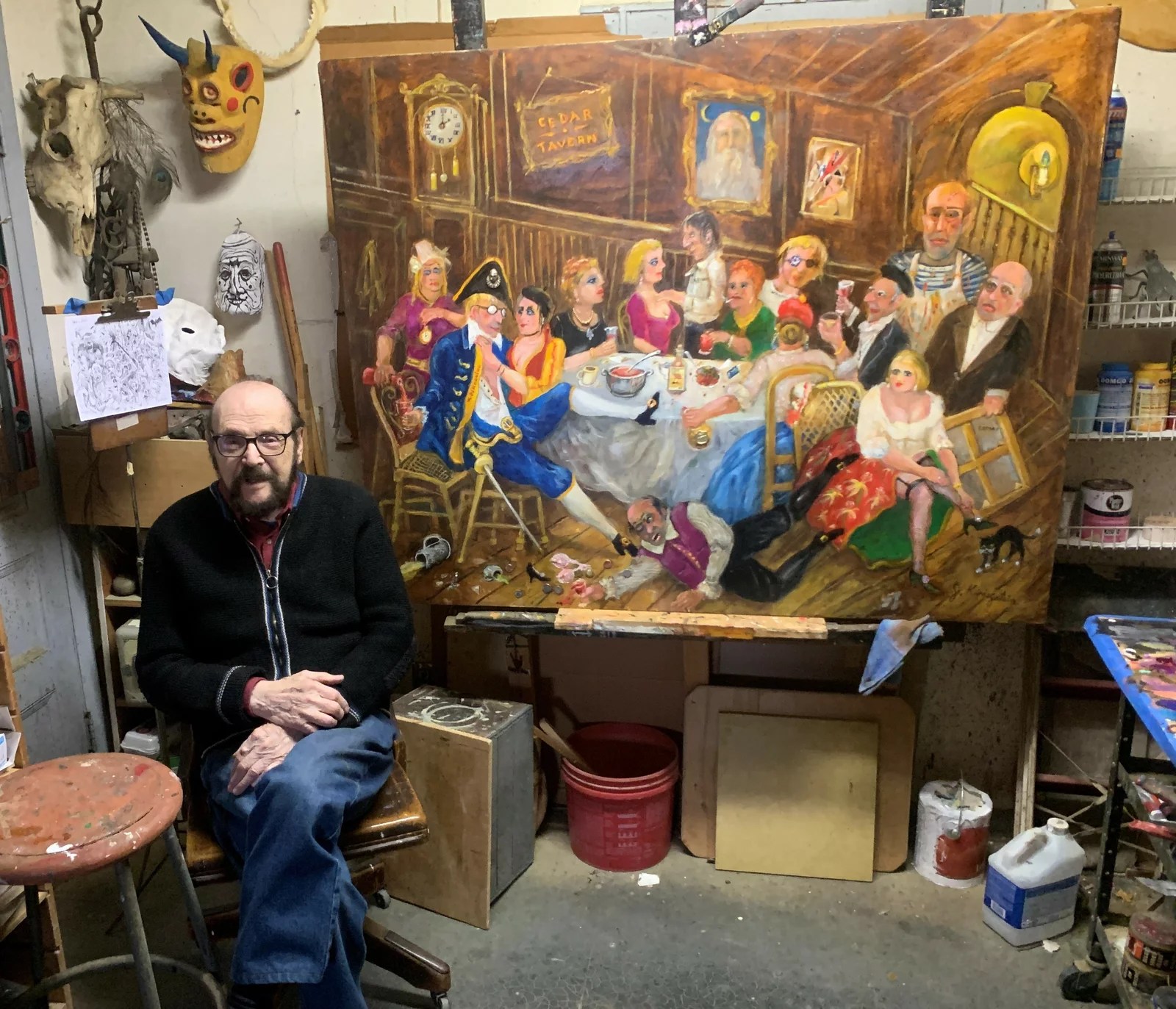
Photo: Matthew Schuerman/NPR.
“Jonah Kinigstein, 99, has been making art since he was a teenager,” says NPR. “Some of his work satirizes modern artists such as Andy Warhol and Jackson Pollock, visible in the painting behind him.”

Although I am personally a big fan of abstract art, I find it interesting to consider that that former rebellion against convention spurred its own rebellion. When abstract art was the accepted best, what happened to artists whose inspiration lay elsewhere?

Matthew Schuerman reported at National Public Radio (NPR) about one artist working in the heyday of abstract expressionism who swam against the tide.

“In the 1950s, Jonah Kinigstein was on the verge of making it big in New York’s art world. He won a Fulbright to Rome. His paintings got into the Whitney Museum’s annual show of contemporary art (the precursor to the Whitney Biennial). And he was taken in by one of the biggest gallerists in the city, Edith Halpert. …

“Once, when Life magazine ran a profile of Halpert and nine of the artists she was promoting titled, ‘New Crop of Painting Protégés,‘ Kinigstein was among them. In fact, in the main photo, he stood directly behind Halpert. But then, as a result of changing tastes in the art world, he fell into obscurity and could not convince anyone to give him a gallery show.

“He nonetheless kept painting … and painting … and painting some more. Even today, at age 99, he said he spends two to three hours a day. …

“His painting style has gone through a lot of changes throughout his life, but he calls himself a ‘figurative expressionist.’ That is, he paints people, but they are often distorted and grotesque, set against backgrounds that are surreal and fantastical. His subjects are saints, rabbis, impresarios and showgirls — people who [seem] to be suffering or seem to be enjoying other people’s suffering. …

” ‘I was born in Coney Island, and I remember certain things,’ he said. ‘These large figures and people waiting in line.’ …

“Born in 1923 in Brooklyn, Kinigstein was raised in the Bronx by Jewish-Russian-Polish immigrants. As a teenager, he learned he had a knack for art by drawing with chalk on the sidewalk. His father, a house painter, used to brag about him to his co-workers.

” ‘I used to go with him to help paint the apartments. And he would say, as he introduced me, “Hey, I’m painting with a real artist,” ‘ Kinigstein said with a laugh.

“After high school, Kinigstein attended The Cooper Union. … But before he could finish, he was drafted into the Army for World War II, where he worked in a photo topography unit. …

“For years after World War II, the type of figurative art that Kinigstein practiced co-existed with abstract expressionism — e.g., the drip paintings of Jackson Pollock or the color field art of Mark Rothko. But as the 1950s wore on, abstract expressionism won the day. …

“To Kinigstein, though, the twilight of figurative art meant it was less and less likely that he would ever make a living as a painter. The rejection stung.

” ‘I made painting after painting. And I always felt, you know, I was doing my best,’ he said.

“Kinigstein married and had two children while continuing a career in commercial art. He designed store windows and also Bloomingdale’s first-ever collectible shopping bag. (He was later inducted into the National Academy of Design.) And he kept painting.

“He also began to draw cartoons: satirical and biting, like something out of a 19th century political magazine, except his lampooned the art establishment that promoted abstract painting.

“One of them is based on a famous Rembrandt painting, The Anatomy Lesson of Dr Nicolaes Tulp. Except the cadaver on the bed is labeled ‘figurative painting’ and the men around him, cutting him up, are members of the art establishment that promoted abstraction in the 1950s.

“A few times, Kinigstein took these cartoons to New York’s gallery district, SoHo, and pasted them onto building walls and lamp posts. Some passersby would get into arguments with him, while others would take them down and ask him to sign them. …

“To Kinigstein, abstract painting took no talent, no skill, no ability to observe the world. There was also a moral component — he refused to change the way he painted simply because it wasn’t popular.

” ‘I saw a guy right in my front of my eyes going from real, real painting to, you know, he laid the painting down on the floor and he started to splash around,’ he said. ‘I couldn’t talk to that guy. I really couldn’t talk to him.’

“Recently, though, Kinigstein is finally getting some recognition. In 2014, Fantagraphics, arguably the foremost art comics publisher in the U.S., came out with a collection of his cartoons, The Emperor’s New Clothes: The Tower of Babel in the ‘Art’ World. Editor Gary Groth knew he wanted to publish them the day he opened Kinigstein’s submission.

” ‘They were clearly not drawn by a young person because they displayed a level of craft,’ Groth said. ‘They were all so extraordinarily well-drawn. And then I looked at the content, and every single one of them was a ferocious attack on abstract expressionism.’

“Groth visited Kinigstein in Brooklyn and took a tour of his studio, which is packed with hundreds of paintings standing on their ends, like playing cards. That’s when he decided to do a second book, this one focused on Kinigstein’s paintings.

“The result, Unrepentant Artist: The Paintings of Jonah Kinigstein, appeared in June [2022]. …

” ‘What I paint is what I like to paint,’ [Kinigstein] said. ‘And I don’t paint for anybody.’ “

More at NPR, here. No firewall.

Read Full Post »

Clouds

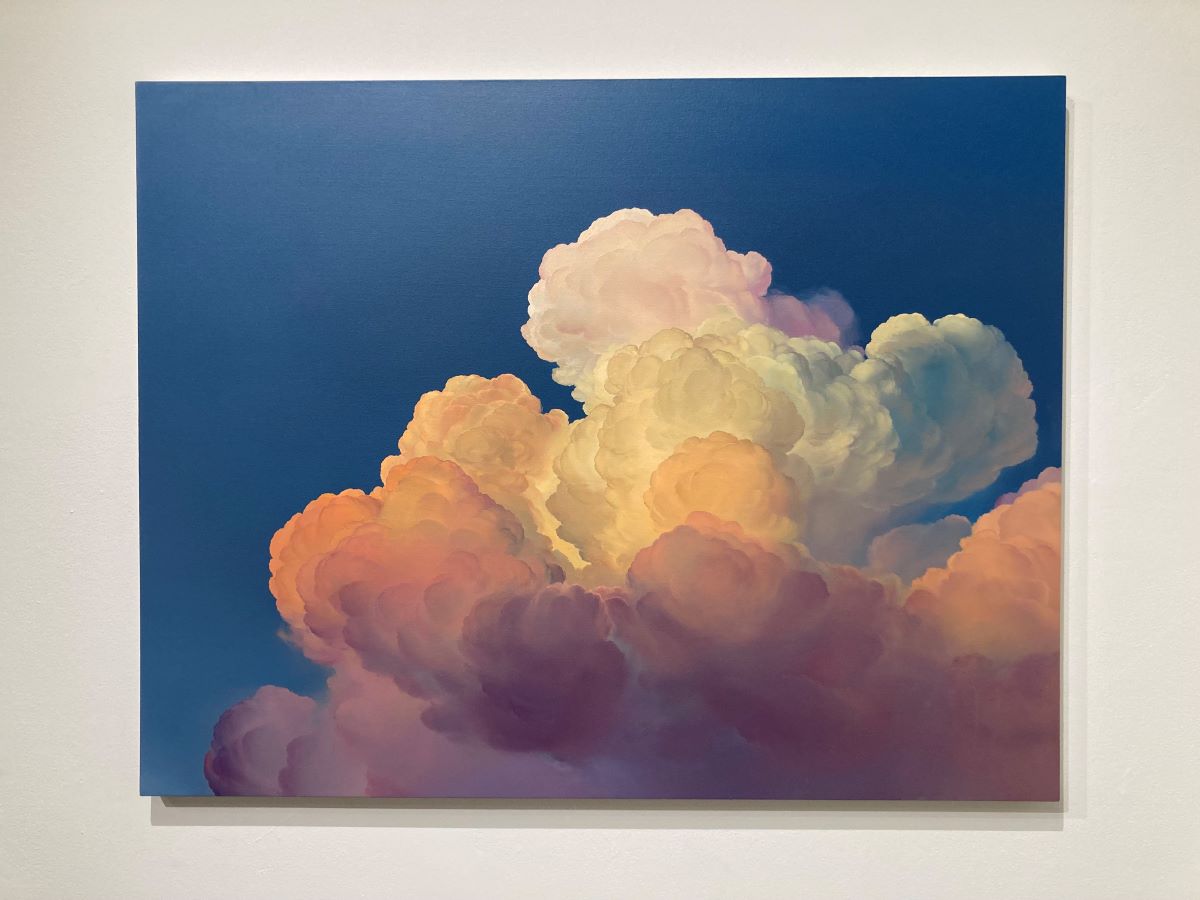
Photo: Joshua Ware.
Ian Fisher art, “Atmosphere No. 139 (Nate & Marissa)” (2022), oil on canvas.

My friend Nancy L. is a fan of beautiful cloud formations. She is also a member of the Cloud Appreciation Society, where she signed up for cloud-a-day photos and bought a bumper sticker that reads, “I brake for clouds.”

If you think about it, gazing at clouds can really enrich a life. Try stopping where you are sometime and just looking up.

An article by Sommer Browning at Hyperallergic talks about what clouds have meant to a couple of artists.

She writes that the paintings in the “Carey Fisher” exhibit at the Redline Contemporary Art Center in Denver last December were “as expansive and composed as one might expect from landscape paintings, though there isn’t much land in them. The exhibition of new works by Albuquerque-based Beau Carey and Denver-based Ian Fisher, alumni of RedLine’s artist residency program, takes place mainly in the sky, among mountain tops, the moon, and the clouds. The horizon line is often thousands of feet below view or occluded by giant ancient rocks. 

“Carey chooses realistic depictions of mountain peaks and ranges as one of his main subjects, but his work in this exhibition is kaleidoscopic. In ‘Solaris’ (2022), a celestial sphere seems to rise multiple times behind multiple mountain ranges. It might be a moon the color of the sun, or the sun looking as cold and harsh as the moon. The mountain range vibrates with rich purples and Martian-like colors.

“Some of the paintings, like ‘Folie a Deux’ (2022), look like reflections of themselves — the mountain ranges repeat down the canvas, almost upside down at times. In ‘Magdalenfjorden’ (2022), a stark heavenly circle casts a cold glow across a mountain valley. The mountain paintings remind me of the delirium of standing on a cliff. The moon/sun paintings evoke quarantine feelings of desolation; I remembered wondering, after a couple of weeks, if I had forgotten how to interact with other people.

“Fisher paints exquisite hyperrealist oil paintings of cloud formations. He manages to paint these ephemeral, giant puffs of water vapor with such attention and detail that the paintings seem somehow more real than real clouds. … What is approaching transcendent really, is the perspective. I’d have to be flying to see clouds at these angles, to see them this close. But here there was nothing — not a 747’s plexiglass window, not a camera lens — between me and the cloud. It’s as though what I was seeing is how clouds see each other in the sky. …

“The effect of seeing both painters’ work together is disorienting, unmooring. The longer I looked at Carey’s orange moons and icy mountain-scapes and Fisher’s impossible, vertiginous vistas, the more I wobbled. To be removed from the world by looking at paintings of our world is a wonderful experience. That would have been enough to carry (no pun intended) the show, but the exhibition wall text encourages viewers to draw connections to climate change, which feels a bit unearned. … For a while there, Carey and Fisher had me floating.”

I am reminded of a beautiful N.C. Wyeth painting you may have seen of an old man and a young boy digging a trench in the snow. The boy is looking down, focused on the digging. The old man is standing still, gazing up at the light on the snow, the sky, the clouds. So moving.

More at Hyperallergic, here. No firewall. Subscriptions solicited.

Read Full Post »

Since ancient times, people have found all sorts of ways to get themselves on an even keel when they are feeling down. I’m the last person to say folk remedies can cure real depression, but I am interested in the many ways people lift their spirits.

At the New York Times, Christina Caron writes about people who use art.

“When Dr. Frank Clark was in medical school studying to be a psychiatrist, he decided to write his first poem.

“ ‘All that chatter that is in my head, everything that I’ve been feeling, I can now just put it on paper and my pen can do the talking,’ he said, recalling his thoughts at the time.

“Back then, he was struggling with depression and had been relying on a number of things to keep it at bay, including running, therapy, medication and his faith.

“ ‘I had to find something else to fill the void,’ he said. It turned out that poetry was the missing piece in his ‘wellness puzzle.’

“But there’s a ‘really robust body of evidence’ that suggests that creating art, as well as activities like attending a concert or visiting a museum, can benefit mental health, said Jill Sonke, research director of the University of Florida Center for Arts in Medicine. …

“Dr. James S. Gordon, a psychiatrist and the founder of The Center for Mind-Body Medicine, pioneered something called the ‘three drawing technique.’ It is featured in the new book Your Brain on Art: How the Arts Transform Us. …

“If you are one of the many people who have turned to adult coloring books, it may not come as a surprise that research suggests this activity can help ease anxiety.

“Coloring within the lines — of an intricate pattern, for example — appears to be especially effective. One study that evaluated college students, and another that assessed older adults, found that spending 20 minutes coloring a mandala (a complex geometric design) was more helpful at reducing anxiety than free-form coloring for the same length of time.

“Susan Albers, a clinical psychologist at the Cleveland Clinic and the author of 50 Ways to Soothe Yourself Without Food, described coloring as a ‘mini mental vacation.’ When we focus on the texture of the paper and choose the colors that please us, it becomes easier to tune out distractions and stay in the moment, she said.

“ ‘It’s a great form of meditation for people who hate meditation.’

“Listening to music, playing an instrument or singing can all be beneficial, research shows.

“A 2022 study, for example, surveyed more than 650 people in four age groups and asked them to rank the artistic activities that helped them ‘feel better’ during the 2020 pandemic lockdowns. The youngest participants, ages 18 to 24, overwhelmingly rated musical activities as most effective. Across all age groups, ‘singing’ was ranked among the top activities. …

“[Susan Magsamen, an assistant professor of neurology at the Johns Hopkins University School of Medicine and a co-author of the book] noted that music can be effective at reducing stress because things like rhythm and repetitive lyrics and chords engage multiple regions of the brain.

“ ‘I sing in the shower,’ Ms. Magsamen said. ‘I sing at the top of my lungs to the radio.’

“Dr. Clark has continued to write poetry since graduating from medical school and offered some tips for those interested in trying.

“First, banish any thoughts that you aren’t creative enough. … Start with a simple haiku, Dr. Clark suggested. Haikus consist of just three lines — the first and last lines have five syllables and the middle has seven.”

That’s not all there is to a haiku, of course, but it can really get you going with poems. I used it with sixth grade students a lot when I was teaching, not for mental health, but it sure lifted spirits.

More at the Times, here.

Photo: Making art can make you happy. More here.

Read Full Post »

Photo: Loren King.
Art at St. Ann Art and Cultural Center, Woonsocket, Rhode Island.

For my first issue of a certain Boston Fed magazine in 2005, I was a bit panicked about learning the ropes of editing a new field. I managed to line up an article on a troubling change in bankruptcy law from Elizabeth Warren. And through my friend Nancy L, I talked to a guy who knew everyone in the community development field in the region and who put me in touch with Joe Garlick at the Woonsocket Neighborhood Development Corporation (now NeighborWorks) in Rhode Island.

And so it was that I got a memorable tour of initiatives benefiting residents of this former industrial town, where the rivers once ran with clothing dyes.

Today I learn that I better go back to Woonsocket and check out a particular church, now a cultural center.

Amanda Milkovits reports at the Boston Globe, “Swing open the heavy doors of this twin-spired former Roman Catholic church on an ordinary city street some Sunday afternoon, and enter a museum that takes your breath away.

“Elegant and intricate fresco murals soar across the barreled ceiling and along the walls of the nave, above the sanctuary and alcoves, and the choir loft. Scenes from Bible stories, and religious figures, saints and sinners, angels and devils, nearly glow from the frescoes’ warm pastel colors, painted in the style of the Italian High Renaissance.

“Years ago, Yankee Magazine dubbed St. Ann Arts and Cultural Center as the Sistine Chapel of America, and that’s no exaggeration. The former church, which is actually larger than the Sistine Chapel in Rome, is home to the largest collection of fresco paintings in North America.

“Its place here in this working-class city on the northern edge of Rhode Island, away from the tourist meccas of Providence and Newport, can make visitors feel as if they’ve discovered an incredible treasure.

“ ‘That’s why we say it’s the best-kept secret, and the worst-kept secret, too,’ said Joe Petrucci, a docent and volunteer. ‘Because it’s a wonderful gem, but not a lot of people know about it.’

“Along with the stunning frescoes, there’s the rich color and depth of 40 stained-glass windows made by artisans in Chartres, France, and the hand-carved marble altar and the marble stonework imported from Carrara, Italy. Outside, the church’s twin 165-foot cupola towers resemble those of the Shrine of Sainte-Anne-de-Beaupré outside Québec City, and have been an integral part of Woonsocket’s skyline for a century.

“But for the keepers of St. Ann, what makes the former church so distinctive to the city of Woonsocket is how an artist immortalized its residents in the frescoes.

“Guido Nincheri, an Italian-born artist considered the Michelangelo of North America, painted these ordinary people into his extraordinary artwork. The mill workers, the mischievous children, and those lost in World War II, and other residents were models for the 475 faces painted into the frescoes.

“ ‘Aside from the incredible, amazing art and the architecture, the stained glass and the marble work, my favorite part is the story of how it came to be. It’s a part of my heritage,’ said Dominique Doiron, St. Ann’s executive director and Woonsocket native, who was a parishioner until the church closed in 2000. ‘Especially in such a time of turmoil, to be able to look at something and go, What if we all just got along? Look at the great things that we can accomplish together.’

“Roll back the calendar more than a century, back when Woonsocket was nicknamed ‘Le Petit Canada’ for its large population of French-Canadians, who’d arrived in the city to work in the mills. This church on Cumberland Street, which opened in 1918, was the second French-Canadian parish in the city.

“The church was the social hub for its hardworking parishioners, and there were seven Masses on Sundays, standing room only, Doiron said. Though they were poor, the parishioners pooled together their own meager funds for the construction of their church, and later, for its beautification. …

“While the architecture was beautiful, there wasn’t enough money to complete the interior, so the gray stucco cement walls weren’t plastered. That would turn out to be a lucky accident.

“In 1925, the 35th anniversary of the founding of the parish, the parishioners raised money again to install 40 stained-glass windows, made in Chartres, France.

“During the Great Depression, the priest leading St. Ann’s still wanted to do something about those plain walls. the Rev. Ernest Morin visited different churches throughout Rhode Island for ideas, and ended up at St. Matthew Church in Central Falls, where Nincheri was painting.

“Nincheri had been knighted by Pope Pius XI as one of the great artists of the Roman Catholic Church and would win four papal awards for his work. He’d studied the Old Masters style in Florence and apprenticed in stained glass in Montreal.

“Nincheri had immigrated to Canada and later moved to Rhode Island, where he was working on churches and public projects. Morin invited him to visit St. Ann’s.

“ ‘As soon as he walks into the building, the first thing Nincheri notices is, Oh my God, the walls and ceilings aren’t plastered,’ Doiron said. ‘Now, he’s getting excited, because this is a rare opportunity to do the fresco style.’ …

“The technique, which reached its height in the Italian Renaissance, requires that an artist is both careful and quick, because there is no room for error.

“At this, Nincheri was a master. He explained the possibilities to Morin, how Michelangelo had painted the frescoes in the Sistine Chapel in Rome, and he could do the same here, at this busy Woonsocket church. They settled on a contract for $25,000 in 1940. …

“Nincheri told a reporter for the Woonsocket Call newspaper that St. Ann’s would be ‘America’s most beautiful church.’

“As Nincheri began the work, he studied the faces of people in the community. … ‘All of the faces were people of the parish and people of the city of Woonsocket at the time. He would always be on the lookout for a face that would fit a particular subject, and he would invite them to sit for him,’ Doiron said. ‘And what we now have here is a scrapbook, a pictorial history of who we now call the “Greatest Generation.” ‘ ” More at the Globe, here.

See also my 2018 post on a Sistine Chapel replica in Mexico, here.

Read Full Post »

Photo: Ben Toht.
Liz Sexton’s rat mask for Halloween in Brooklyn, New York, a few years ago started her papier-mâché art career.

I’m guessing that nearly everyone who launches into serious downsizing finds a papier-mâché puppet head that a kid made in school — in my case, not only Suzanne’s puppet head but also one that I made around age 10. Clumsy as the heads invariably are, it’s painful to get rid of something that feels so much like an accomplishment.

Today’s story is about a woman who has raised papier-mâché to high art.

Alex V. Cipolle reports at Minnesota Public Radio, “Hunched over her work bench with a box cutter, Liz Sexton carves out the spikes on the back of a horseshoe crab. … The crab is papier-mâché and the size of a shield. Composed of more than a dozen layers of paper bags, its shell feels as strong as one, too.  …

“The crab is one of more than 15 papier-mâché animal masks and sculptures Sexton is preparing for her first-ever solo exhibition. The show, ‘Liz Sexton: Out of Water,’ [opened] May 5 at the Minnesota Marine Art Museum in Winona, Minn. …

“At her home studio in St. Paul, many of these animal creatures — an Atlantic walrus, a humpback angler fish, a polar bear — stare down at her from the shelves. Others are placed around the house in various stages of completion. …

“Her masks are incredibly lifelike. And papier-mâché is only step one. She can spend upwards of 100 hours on a mask, honing the details using woodworking techniques, be that carving more than a hundred tri-pointed teeth of a marine iguana, or using an orbital sander to achieve the milky smooth skin of a beluga whale. …

“Sexton receives commissions from around the globe, so they must withstand all the perils of international shipping. And the masks, she says, are meant to be worn, after all. …

“Her partner, Ben Toht, is a fellow creative and collaborator. He shoots photos and creates gifs of Sexton wearing her masks in the wild, which will also be featured in the exhibition. Watching the masks progress from their initial lumpy gumdrop shape, he says, is incredible. …

“Like many of us, Sexton learned papier-mâché as a kid — her dad taught her. For many years, she did it as a hobby. …

“ ‘I moved around a lot. I was in France and Germany,’ she says of her time living in small apartments in Europe. With papier-mâché, ‘you don’t need a lot of supplies or space. You get some newspapers for free, some flour and water, and you can make whatever you want.’ 

“In her free time, she would make costumes and props for weddings. The turning point was Halloween in New York, when she and Toht were living in Brooklyn. For the city’s annual Halloween parade, she made them masks of the city’s patron saint, the rat. 

“ ‘It was kind of incredible,’ Toht says. ‘With all the insanity of New York, and all the insanity of New York Halloween, these always got a lot of attention. People love the rats.’ They recall how people would chant ‘New York City rats’ at them. …

“Since then, Vogue Singapore has used her masks in video shoots. And the New York Times Style Magazine commissioned 70 animal busts for a star-studded 2019 event. …

“Sexton and Toht moved back to Minnesota from New York right before the pandemic. Her family, a family of artists, lives here. As Sexton rips up paper bags, she says they are surprised by her career, but very excited. …

“Sexton has also been an animal lover since she was a kid, and she’s particularly keen on marine life. Part of her artistic process, she says, is doing deep research into her subjects. 

“She talks with ease about how the blood of horseshoe crabs is used for vaccines or describes the unusual mating habits of angler fish. 

“ ‘Oh, another fun fact: Manatees can regulate their buoyancy by releasing gas from their bodies,’ she says, laughing. ‘I put that in the show notes because I thought kids would appreciate it.’ “

Liz Sexton: Out of Water” runs through Sept. 3 in Winona, Minnesota. 

More at Minnesota Public Radio, here. No firewall. Delightful pictures.

Read Full Post »

Photo: Kate Laster.
Kate Laster’s paper cutout “Waiting Game” (2022).

I’ve been reading almost more than I can bear lately about the Holocaust, so when I saw this unusual use of a Jewish paper-cutting tradition at Hyperallergic, it really spoke to me.

Isabella Segalovich wrote, “April 5 marked the first night of Passover. Upholding Jewish tradition, we reclined in our chairs, sang boisterously, and drank ample wine. We reveled in the joy and safety many of us are thankful to have in the present while holding close the memory of those that came before us. Alaskan-born Jewish artist Kate Laster carves those memories into delicate paper cuts. Then, she dunks that paper in the ocean.

“ ‘My art is about the people we carry with us,’ she told Hyperallergic in an interview.

“Laster’s first memories are of snow floating on water. She grew up moving from place to place in rural Alaska, from temperate rainforest of Juneau to the icy treeless wilderness in Utqiaġvik. In a world ‘dense with imagination,’ as she described it, she learned to whittle scraps of wood into small figures while hearing stories and poetry by a warm fireside. She said she first saw language being used as a ‘visual medium in the sense of people putting time aside and really either being in nature or being in warm space talking.’

“Today, she uses the visual force behind letters themselves, cutting paper into vibrant collages with fragments of poems — some collected, some written by her. The paper is thoroughly weathered as stencils, multiplying its message as it’s doused in spray paint again and again. Then, she painstakingly laminates the paper by hand, using ‘really scruffy bits of tape.’ The ritual is completed at sundown when Laster dips her works into the Pacific Ocean. As the paper undulates and floats, she understands the waves, part of a living, ‘primordial soup,’ to be reading the text on the pages.

“Laster’s youth in Alaska is proof that the Jewish diaspora spreads far beyond the urban landscape. But for all of us, Jewish practices are deeply tied to the natural world. Festivals begin with the setting sun. … As the great star sets, Laster lifts the text up from the water. And as drips fall off its edges, she uses the hollow paper cut as a viewfinder, so words are filled with the sky. 

“The water that laps at Laster’s paper cuts is of the same body that carried our ancestors as they wandered the world, searching for home and safety. “…

“Laster is one of growing number of anti-Zionist American Jews. For those who do not wish to move to Israel, it’s common to lift up and celebrate the beauty of the diaspora. Following the love of movement, this celebration is also a deep love of the places we find ourselves now. For the Laster, that place is the Bay Area, where the Mexican and Chicano paper-cutting tradition of papel picado is tied to trees lining the Mission, a historically Latinx neighborhood. Chinese paper cuts — 窗花 chuāng huā, or ‘window flowers’ — bloom in glass panes. …

“But this artist’s work is also a part of her own ancestry. Jewish paper cutting is a centuries-old tradition that used to be much more commonplace. It was practiced by both professionals and amateurs at home, not only for marriage contracts or ketubot, but also for holidays like Shavuot and Sukkot. Laster now sees herself as a part of the newest generation carrying it forth. With no other materials needed than paper and a sharp edge, she sees the beauty in paper cutting’s accessibility.

“The belief that everyone has a fundamental right to engage with and create art is central to Laster’s work, both in and outside of her visual practice. She runs suggested donation-based art history classes, and has held a position as a studio assistant at Hospitality House’s Community Arts Program, a free-of-charge art studio for unhoused and low-income residents of the Tenderloin. Today, she works as a studio facilitator at the NIAD Art Center, a creative space for artists with disabilities. …

“ ‘Printmaking and paper cut in general are about accessibility, making a message, a transmission, go as far as possible,’ she said. Laster is also in the tradition of modern Jewish graphic arts: Words that dance and shout diagonally across the page recall the utopian dreams of the 1920s Eastern European Kultur-Lige (Culture League) artists like El Lissitzky and Nathan Altman. …

“Messages can be interpreted differently depending on who hears them. ‘This is the struggle of sharing, of trying to convey anything you feel to someone else. And knowing once it’s public, it can be altered and transformed and interpreted,’ Laster noted. ‘I revel in that.’

“Laster’s work is also deeply personal, as she grieves the loss of her father during the COVID-19 pandemic. In ‘Kaddish Reunion’ (2021) a self-portrait shows the artist sitting by her father’s bedside. Spray-painted shapes bleed into each other. The text typical of her pieces is replaced by swirls, stars, and leaves. Shadows of these words return in another laminated book. Lovingly saved scraps from past paper cuts are laminated alongside a plastic bag that says ‘THANK YOU.’ The only full words are on the cover: ‘I don’t know how to say goodbye.

“Laster’s father was a pilot of a small bush plane. As a child, she studied the dense text and cartoons of flight emergency manuals, replicated today in her shining messages of grief, love, and hope. Perhaps the Haggadah is another kind of emergency manual: a guide on how to keep on going?

“On Passover, we remember those that came before us and those that we lost. … We taste the bitter herbs of longing and grief, but also wash down dry matzoh with sweet wine. And most importantly, we argue, laugh, and tell stories of our survival.”

More at Hyperallergic, here. No firewall. Check out the short video of a paper cutout floating on water.

Read Full Post »

Photo: Luana Rigolli/T293 Gallery).
Art by Dylan Rose Rheingold, “Hot Skates” (2022), oil, acrylic, paint pen on canvas. Although growing numbers of artists question the value of signing their works, Rheingold is one who has chosen to sign.

When my mother died, there were decisions to be made about several works by our neighbor, the Abstract Expressionist Richard Pousette-Dart. For most of his career he rebelled against the custom of signing work. But toward the end of his life, he came around to the idea that in the art market, his family and friends needed to have his signature. He offered to sign our paintings. We sold some and kept some. The photographs and brass jewelry were never signed.

Anoushka Bhalla wrote recently at Hyperallergic that the issue of signing keeps coming back in the art world.

“It all began during the early Renaissance when a young Raphael Santi forwent the long-held tradition of co-operative art making under guild systems to autograph his first painting, ‘The Mystical Marriage of St. Catherine.’

“While Raphael was modest in breaking long-established customs, obscuring his signature within decorations behind a Virgin Mary figure, his male successors centuries down the line would not remain as bashful. The signatures of Picasso and Keith Haring are far more familiar than that of, say, Helen Frankenthaler. …

“Signed artworks by male artists fetch astounding prices in the secondary market as compared to their female counterparts. A recent study states that ‘For every £1 a male artist earns for his work, a woman earns a mere 10p.’ The same study also states that ‘while the value of a work by a man rises if he has signed it, the value of a work by a woman falls if she has signed it, as if it has somehow been tainted by her gender.’ Female artists have long been conscious of this gender disparity, with some feeling paralyzed against the market and choosing to forgo their signatures to make their works more ‘collectible.’ Are these artists signing away their autonomy too?

“I spoke to Baseera Khan about these troubling statistics. A femme artist of color, they were the subject of a solo exhibition at the Brooklyn Museum in 2021. ‘No, I don’t sign my works. I think it’s an old tradition,’ they declare. ‘I don’t think I’m valued because of my gender, because I’m a femme artist, quite not as much as the male artists — and that’s a fight.’ …

“Artists Julie Torres and Ellen Letcher, who operate LABspace, an artist-run gallery in Hillsdale, New York, often find themselves in awkward positions, having to ward off collectors who demand signatures from their artists and sometimes even return works for them to be signed. But for others, like Lucia Hierro, whose work was recently acquired by the Guggenheim Museum, and who often does not sign her pieces, says she will stand her ground. There is a finality to signatures, she says, which she dislikes.

“[Although Xayvier Haughton] makes art that is difficult to collect, he feels defenseless in the face of powerful collectors who make sure to somehow obtain his signature before acquisition. He acknowledges this as a conscious decision on his part. Installations are notoriously difficult to collect, and that in itself is an anti-market statement. … While Haughton wants to adhere to his principles, he doesn’t want to be blacklisted in the art world — which he feels is the fate of artists who defy the desires of collectors. In this fickle art-world bubble, he’s attempting to hold onto his autonomy by forgoing his signature.

“But some disagree with this sentiment. Bhasha Chakrabarti, also an emerging artist, who works in painting, sculptures and installations, is a skeptic. ‘I find the idea of making installation with the motivation of evading the market to be disingenuous…. If you make art and are functioning within the gallery system, you’re not evading the art world,’ even though, she adds, she feels suspicious of the art world’s deep stake in capitalism. When I mention the Eurocentric history of asserting ownership via signatures on artwork, she counters, citing Sufi mystic poets who claimed authorship after each recital. …

“Artist Chiffon Thomas approaches the dilemma more philosophically. Thomas, whose solo show Staircase to the Rose Window was on view at PPOW Gallery in Tribeca last year. … Over time, he explains, he stopped signing his works and acquired an existential approach to art-making. He realized he wanted to capture a sense of universality in his art, to the extent that he grew uncomfortable using his childhood, his family, or any personal signifiers. …

“But perhaps the most compelling response comes from a young artist, Dylan Rose Rheingold. As more painters shy away from signing their works on the front of their canvases, Rheingold realizes this is an empowering act as a woman. Nevertheless, she will occasionally sign as ‘Dylan,’ a traditional male name, although she also uses the more feminine ‘Dylan Rose,’ and lately she is using her full name, Dylan Rose Rheingold, boldly asserting ownership over her art.

“Her resolve strengthens when she explains passionately a recent encounter she had with a ‘big collector who owns a big gallery in New York. … When I met him, he told me that I should drop my middle name because my work would be a lot more valuable. People would not assume I’m a woman.’ She countered with ‘I’m happy to take my chances.’ ”

More at Hyperallergic, here. No firewall but memberships are encouraged.

Read Full Post »

Art: John Everett Millais.
Pre-Raphaelite artist Elizabeth Siddal was the model for the drowned Ophelia of Shakespeare fame. She is not known for her art but for looking lovely in death.

I never thought about this before, but I read a critique the other day that claimed Western culture has an unhealthy admiration for pictures of beautiful dead girls — starting at least with the painting by John Everett Millais of the drowned Ophelia from Hamlet, if not earlier.

That’s a new reason to see something different in the painting. And here’s another reason: the model herself may have been victimized, or at least marginalized.

Richard Brooks writes at the Guardian, “She is immortalized as the drowning Ophelia in John Everett Millais’s celebrated 1850s painting and as the auburn-haired model for several pre-Raphaelite artists in the mid-19th century. After dying prematurely aged 32, Elizabeth Siddal was marked down for decades as a depressive and laudanum addict, and was portrayed as such in Ken Russell’s 1967 BBC film Dante’s Inferno – named after her husband, Dante Gabriel Rossetti.

“More recently, she has been mythologized in several TV dramas and novels – even as a vampire victim.

“Only now, with The Rossettis exhibition opening on 6 April at Tate Britain, will Siddal finally be judged for what she really was and achieved – a considerable artist in her own right.

“Admittedly, she had some bouts of poor health and suffered, not surprisingly, after giving birth to a stillborn daughter in 1861. However, this exhibition, with several previously unseen works, will show Siddal as an independent woman who was not just a talented artist but also had a strong influence on the career of Rossetti. …

“Siddal was untrained as an artist, as a teenager working in clothes shops in central London where she taught herself to design dresses. She was introduced to the pre-Raphaelites just as the group formed in 1849, before meeting Rossetti and becoming the model in his Rosso Vestita portrait. In 1852, she sat for Millais’s Ophelia and other pre-Raphaelites such as William Holman Hunt.

“She then began to draw and paint herself, encouraged by Rossetti and her patron, John Ruskin, who gave her an allowance. She also wrote poetry.

“And yet during the 1850s, as she began a relationship with Rossetti … her work was dismissed by the pre-Raphaelites as a ‘pale imitation’ of Rossetti. There were even claims that Rossetti helped paint her watercolors. Regarded as an appendage to her husband, she remained unknown during her lifetime. …

“However, ‘The Rossettis,’ featuring 17 of her drawings and watercolors, along with Jan Marsh’s forthcoming biography, Elizabeth Siddal: Her Story, plus new research by Glenda Youde, a York University art historian, highlight her as a skilled artist.

“They also prove that she had a real influence on Rossetti by comparing and contrasting the work of the two artists in the exhibition. ‘They were together, after all, in the same studio,’ says Youde. ‘You can see her effect on the style in paintings which Rossetti did himself either during her lifetime, or especially afterwards.’

“This view is supported by Marsh. ‘In many cases it was Rossetti who was adopting and responding to her ideas and execution,’ she says.

“The exhibition also contains a remarkable poem, dedicated to her by Rossetti. ‘The Portrait,’ which illuminates the power of a portrait to bring back memories of a dead loved one, was one of several kept inside a leather-bound book that in 1862 Rossetti buried beside her body in Highgate cemetery in north London.

“Seven years later the book was removed after the tomb was, controversially, opened. Owned for many years by the University of Delaware in the US, a loose sheet of paper with Rossetti’s original crossings-out and changes for ‘The Portrait’ will be seen for the first time at the Tate. Alongside will be Rossetti’s most famous portrait of Siddal – ‘Beata Beatrix.’ …

“There is, however, one unsolved mystery. Siddal is known to have completed one self-portrait – a rendering showing her red locks and stern expression. Siddal painted it in 1853, but it has not been seen publicly for more than a century, although it was photographed about 50 years ago. This photograph is in the exhibition’s catalogue.”

More at the Guardian, here. All I know is Rossetti wrote one of the saddest poems ever, “The Woodspurge,” which I always thought was after the death of this young wife. I memorized it in high school for a poetry assembly, and I still know it by heart. But now I have just looked it up and learned it was written before he even married her. No one seems to know what was troubling him when he wrote it. Hmph.

Read Full Post »

Photo: Sophia Evans/The Observer.
Gilbert, left, and George at their new gallery on April 1. When artists want control, they sometimes open their own museums.

I am always curious about innovations in the museum world. If you search this site on the word “museum,” you will find a wide range of posts, including one about a pandemic-era “mini museum for stir-crazy gerbils,” here, and a 2018 post on micro museums, here.

Vanessa Thorpe reported at the Guardian recently about two guys in London who decided to open a museum for their own work.

“Every creative person yearns for a room of their own,” wrote Thorpe. “But for the stars of Britain’s contemporary art world, it seems that now only a venue of their own will do. [In March] it was Tracey Emin in Margate; on [April 1] it was the turn of the veteran duo Gilbert and George.

“ ‘It is very exciting to see so many people,’ said George Passmore, 81, after the gates swung wide at 10 am to let in an orderly queue of first visitors. ‘Most amusing,’ added his lifelong collaborator – and, since 2008, civil partner – Gilbert Prousch, 79. …

“ ‘Do you know the gates [at this building] are painted in a shade called Invisible Green?’ asked Passmore. ‘It was invented for the great garden designer Humphry Repton when he noticed the grounds of the stately homes he created were being walked across by the public. He needed to put up barriers in a color that would not stand out. It is odd, because it is not invisible at all.’

“The pair’s decorative wrought-iron gates are also not intended to keep out the public. Far from it: the Gilbert and George Centre, which they have planned for years, is a built representation of their slogan ‘art is for all’ and designed as a gift to the community they have lived and worked alongside together for most of their working lives.

“Passmore, born in Devon, and Prousch, born in Italy, met in 1967 while studying sculpture at St Martin’s School of Art in London and developed a unique and entertaining style that places their own images in a variety of visual contexts and poses. ‘We are two people but one artist,’ they have been fond of explaining.

“This first show in the venue features vast photographic screens of leaves and organic products, including figs, roses, dates and leafy greens through which the artists peer or can be seen lolling on benches, either resting or in a swoon. …

“Mark Schofield, 50, a longtime fan, brought his parents, Jackie and Tony, down from Peterborough to see the show. A scientist who now lives in Boston, he was bowled over by the galleries.

“ ‘There’s this clear contrast that I love between the deadpan faces and the joy and mischief of the art. It is so English, somehow,’ he said.

“Rachel Scott, a painting conservator from Dalston, was also struck by the humor of the work. … For Bash Ali, 44, a charity worker and artist, the trip up from the south-east of the city had been well worth it. ‘It really works. It is such a great space.’

“The ‘naughty and a bit rude’ tone of much of Gilbert and George’s art was part of the appeal, said Paul Rudgley from Birmingham, who was visiting the centre with his artist friend Arran Patel from London. But in the end, as a collector of Pantone colors and a former paint industry executive, it was the bright and bold hues that won the day for him.

“The opening of the Gilbert and George Centre followed last weekend’s seaside event in Margate, Kent, when a new artists’ space run by Tracey Emin, a comparative newcomer on the subversive art scene, was unveiled. And over in south London, Damien Hirst’s Newport Street Gallery has also given space to displays of work from his own art and his wider collection since 2015. Admission to each of these three new private galleries is free, although Hirst’s is currently closed.

“Emin, 59, wore a full town crier’s outfit for the opening of her venue. Called the TKE Studios and T.E.A.R. (Tracey Emin Artist Residency), it has been constructed inside a former Edwardian bath-house after a [$1.3 million] investment. As the artist cut the ribbon, she promised: ‘We are going to make Margate an artistic mecca’ before she announced new plans to buy up a nearby derelict pavilion, for swimmers and surfers.

“Early to the trend for running his own artistic space, Turner prize finalist Yinka Shonibare offered more than just a gallery to visitors to his experimental space in east London. Called Guest Projects, and launched a decade ago, his project still offers residences for performers as well as visual artists and musicians.

“When it started, it provided food, too, in a special supper club called the Artists Dining Room where guest chefs create dinners inspired by the work of artists including Louise Bourgeois, David Lynch, Frida Kahlo and Jean-Michel Basquiat.

“ ‘Artists should have a space in which they can fail, and the art market doesn’t really allow room for failure – there’s too much at stake, Shonibare said at the time.”

More at the Guardian, here. You can enjoy all the pictures as there is no firewall.

Read Full Post »

Photo: Luiz Bicalho.
The Sydnie and Haylie Jimenez creation “Memory Armor,” 2023. Stoneware, underglaze, glaze, oxide wash.

We have all read stories about the closeness of twins and the unusual effects that such closeness can lead to. I have blogged more than once about pairs of twins who become collaborative artists, for example, including the Brazilian brothers Os Gemeos (“the twins” in Portuguese), who created the first of the giant Dewey Square murals in Boston, part of my beat.

The acclaimed art critic Cate McQuaid wrote in April at the Boston Globe about identical twins whose work was being shown even closer to my home.

“There’s a rich figurative thread in the history of marginalized artists that declares, ‘this is who we are. See us,’ ” she writes. “When the 20th-century art world was besotted with modernist abstraction, sculptor Elizabeth Catlett, painter Aaron Douglas, and others stuck to figuration to tell Black stories. In the 1980s and 1990s, Nan Goldin and Catherine Opie used photography to showcase their queer communities.

“Identical twins Sydnie and Haylie Jimenez, mixed-race artists born in 1997, are the heirs of such artists. Their barbed show ‘Love You to Death’ is at Lucy Lacoste Gallery.

“Sydnie, a ceramicist, and Haylie, who paints and draws on paper and on clay tiles, make defiantly exuberant figurative works rejoicing in identity and relationship — their own, and those of their LGBTQ/BIPOC community. Some figures grin convivially, but many wear stern expressions, on the lookout for trouble.

“ ‘Memory Armor’ depicts a young woman with her hair atop her head in two buns. Sydnie crafted the figure and Haylie inscribed the tattoos. A chain inked at her hairline drops down, hinting at a third eye, a channel to wisdom and divinity. With a skull on her shoulder and Pegasus on her chest, a two-headed dragon and a butterfly on her back, she’s at once cautious and expressive.

“In collaborative pieces such as ‘I Love Country Boys’ and ‘Black Bikini,’ solid young women stand proud in their swimsuits, tattooed with flowers, nails, and the word ‘ROTTEN’ in ornate script. These figures, presented with the illustrative flare of cartoons, come across as people to be reckoned with. Many of Sydnie’s solo works have that thorny charm. A series of cherubs outfitted with black batwings includes ‘Blonde Haired Cherub,’ who looks ready to fight, and ‘Bucket Hat Cherub,’ wearing a beatific smile but a T-shirt emblazoned with ‘PROBLEM.’ …

“The Jimenez sisters say in their statement for ‘Love You to Death’ that their own relationship informs how they build community. These warm and prickly works invite viewers to hang with them, and savor their ferocity, loyalty, and joy.” More at the Globe, here.

You can read about artist twins Mohammed and Omar Kabbani from Lebanon and the Brazilian team Os Gemeos at this blog, here and here.

By the way, gallery owner Lucy Lacoste, who started out in ceramics herself, has a sharp eye for innovation in the field.

In the early 2000s, I brought her a booklet I picked up at a gallery in Minnesota where I was enraptured with the mysterious tea cups of Anne Kraus, coming back multiple times to admire the tiny paintings and read the inscriptions.

Lucy was grateful. She told me I’d made her day, and she set out at once to see if Kraus was already represented by a gallery. She was. Nevertheless, Lucy has been very successful hunting for similar kinds of quirky genius. What is interesting to me is that although the messages of the pieces are often dark, the artistic expression brings joy.

I guess that is how art tames and triumphs over what is painful.

Read Full Post »

Photo: John Tlumacki/Globe Staff.
Artist and muralist Alex Cook painted two illusion paintings that he placed in Boston’s Franklin Park. The challenge is to keep them from being stolen.

It takes a brave artist to leave work in the woods. Where I live, Umbrella Arts members create art for an annual theme, trusting dog walkers, nature lovers, and connoisseurs to leave the paintings and sculptures in place over a period of months.

In Boston, trompe-l’œil art is appearing in woodland. Steve Annear has the story at the Boston Globe.

“When Jeffrey Jacobs went for a stroll along the trails in Boston’s Franklin Park last month, on a day when winter briefly gave way to spring, he expected to see the usual brown and beige leaves blanketing the ground, bare trees towering overhead, and a smattering of wildlife. But something else caught his attention that day: a clever piece of camouflaged artwork, just off the beaten path.

“The large painting perfectly matched its surroundings, but made it appear as if the trunks of the two trees it leaned against had been partially removed, replaced by a stack of gray stones and a twig wedged between the missing parts as if holding them up.

“ ‘I appreciated the illusion; I thought it was just wonderful,’ said Jacobs, who posted about his discovery on a Facebook page for Jamaica Plain residents. …

“The mysterious mural was one of two paintings recently hidden in a section of the sprawling park known as The Wilderness as part of a project by local artist Alex Cook. …

“ ‘There’s something so magical about coming across something wonderful in the woods,’ said Cook, a muralist by trade whose work is featured prominently on buildings around Boston and beyond. …

“The idea for the project, which he describes as a bit of a ‘treasure hunt,’ came at the beginning of the pandemic, when Cook was temporarily living in New Jersey with his wife’s family.

“After stumbling across a pair of boards from an old ping-pong table in the basement, he was inspired to bring them outside and use them as canvases. …

“ ‘All my projects had evaporated,’ he said. ‘I started making paintings on this thing.’

“Each Monday for several months, Cook would whip up a different mural on the boards, which he leaned against a pair of trees. …

“Some of the last murals he painted in the series were ‘illusion paintings’ that blended in with the natural surroundings and the trees that supported them. They had elements of trickery. …

“The memory of the playful paintings and the joy they brought people recently came back to him. He grabbed a wood panel, packed his art supplies into a bag, and headed out to the trail near his home in Jamaica Plain.

“The result was the first of two, 4-foot-by-4-foot paintings for people to discover on their way through Franklin Park. In a description of the process, which he posted online, Cook said the biggest challenge was reproducing and depicting the natural colors of the backdrop as accurately as possible, so everything lined up.

“ ‘And it’s crazily hard as the light is changing all through the day,’ he wrote. ‘But wicked fun when it works.’ …

“His work has ‘been received so warmly’ by the community, especially on Facebook, where people have marveled at its ingenuity.

“ ‘I appreciate this so much!’ one person wrote beneath a post of his artwork. ‘I walk here every day and finding surprise art is a delight and a treasure.’

“In the category of ‘this is why we can’t have nice things,’ [a painting with] missing trunks was stolen from its spot sometime in the past few days. But Cook is hoping the ‘art bandit’ will return it. …

“ ‘If you find yourself at a party and this painting is on the wall, do us all a favor and bring it right back to Franklin Park.’

“As for the remaining mural, once spring arrives and it no longer matches the landscape, Cook may swap it out for one that fits the season. Later, he’d like to feature his work in a more neutral environment, like an indoor art gallery. For now, he hopes his art continues to bring joy to unsuspecting viewers.

“ ‘I just want people to get a feeling of beauty, of wonder, of mystery,’ he said.”

Cook makes me think of Orson, the youngest of the Easter Egg Artists, who can’t help painting everything he sees. More at the Globe, here.

Read Full Post »

Photo: National Research and Restoration Center.
The location of Russia’s attacks, says Richard Kurin at Smithsonian magazine, suggest they target “sites that are significant to Ukrainian history, culture and identity.” (Above, although many items in storage were already in fragile condition, the conservation task is now more difficult.)

Today I have a couple articles about efforts to protect Ukrainian culture since the full-scale Russian invasion.

Richard Kurin writes at the Smithsonian, “Russian leader Vladimir Putin has wrongly made culture both a justification and an object of war with Ukraine. As in other regions of Europe, the population of the geographic region of modern Ukraine reflects a diversity of ethnic migrations and cultural influences, as well as a succession of political rulers and changing boundaries over millennia.

“Putin, though, claims that Ukrainians lack the history, culture and identity worthy of a national state separate from Russia. While drawing on periods of the czarist Russian Empire and the Soviet era to make his case, Putin denies crucial cultural realities.

“The Ukrainian language, the country’s art and its history — including the Slavic-Christian state centered in Kyiv a thousand years ago, the 19th-century flowering of Ukrainian culture and nationalism, the post-World War I Ukrainian republic, the Ukrainian independence movement of the early 1990s and its reaffirming Orange Revolution in 2004 and the Euromaidan Revolution in 2013-2014 — all represent an undeniable Ukrainian identity that is centuries in the making. …

“We take a close look at the ongoing work of hundreds of professionals across a landscape of Ukrainian and international organizations to defend endangered cultural heritage.

“Crucial investigations are underway that will one day provide an accounting of Russia’s devastating war crimes. These attacks are not just random, nor do they represent collateral damage. Rather, they suggest a targeted attack on Ukrainian history, culture and identity, a means toward Putin’s ends — the destruction is a deliberate attempt to obliterate Ukrainian history and culture.

“To support Putin’s wrongful argument that Ukraine doesn’t have a culture and history independent of Russia, his forces figure they can simply bomb away the country’s cultural heritage.

“To date, almost 1,600 cases of potential damage to Ukrainian cultural heritage sites have been documented, including some 700 monuments and memorials, and more than 200 museums, archives and libraries. Notably, more than 500 are religious sites — places of worship and cemeteries — with those of the Ukrainian Orthodox Church specifically targeted. The greatest number of cases are associated with regions of the most aggressive Russian attacks: Kyiv, Kharkiv, Mariupol and Luhansk. And the work of organizations, including the Smithsonian, mobilized thanks to years of cultural heritage training efforts, is aiding the country in its effort to protect artifacts, books, documents and artworks from these insidious attacks. …

“[In 2010], the Smithsonian formally established [Smithsonian Cultural Rescue Initiative or] SCRI under the direction of curator and former U.S. Army  ‘monuments woman‘ Cori Wegener. … As part of SCRI’s expanding research and training activities, [Ihor Poshyvailo, now director of the Maidan Museum in Kyiv] became first a trainee and then an instructor for the program and stayed in close contact with Wegener. …

“Last year, with the Russian invasion of Ukraine on February 24, the lab ramped up its efforts employing [satellites], including some with specialized sensors that can detect heat signatures to record ‘kinetic’ activity. That enables the monitoring of bombings, missile strikes, artillery shelling and fires. Using that data, the lab’s analysts are able to see how closely the heat signatures align with cultural sites. If proximate, they call up satellite photographic imagery to examine possible damage. Given satellite coverage, they can reference images over a period of time to pinpoint when the damage occurred and how extensive it is.” More at the Smithsonian, here. No firewall.

Meanwhile at CNN, there’s a great story about one woman’s quiet campaign to get US museums to relabel Ukrainian art misidentified as Russian.

For example: “Repin, a renowned 19th century painter who was born in what is now Ukraine, has been relabeled on the Met’s catalog as ‘Ukrainian, born Russian Empire’ with the start of each description of his works now reading, ‘Repin was born in the rural Ukrainian town of Chuhuiv (Chuguev) when it was part of the Russian Empire.’ …

“One of Repin’s lesser-known contemporaries, Kuindzhi was born in Mariupol in 1842 when the Ukrainian city was also part of the Russian Empire, his nationality has also been updated. The text for Kuindzhi’s ‘Red Sunset’ at the Met has been updated to include that ‘in March 2022, the Kuindzhi Art Museum in Mariupol, Ukraine, was destroyed in a Russian airstrike.’

“In reference to the recent relabeling process, the Met told CNN in a statement that the institution, ‘continually researches and examines objects in its collection in order to determine the most appropriate and accurate way to catalogue and present them. The cataloguing of these works has been updated following research conducted in collaboration with scholars in the field.’ …

“Semenik told CNN that she channeled her anger about the Russian invasion into her efforts to identify and promote Ukraine’s art heritage, using her Twitter account [Ukrainian Art History, or @ukr_arthistory] to showcase Ukrainian art to the world.

“Semenik is herself lucky to be alive. She was trapped in the Kyiv suburb of Bucha for weeks as Russian forces laid waste to the area last March, hiding out in the basement of a kindergarten before eventually walking some 12 miles to safety with her husband and their cat in tow.

“She began her campaign after a visit to Rutgers University in New Jersey last year. While helping curators there, she was surprised to see artists she always considered as Ukrainian labeled as Russian.”

So interesting! Read more here. No firewall.

Read Full Post »

Photo: David L. Ryan/Globe staff.
A detail of Barrington Edwards’s “Monumental: Oscar Dunn and His Radical Fight in Reconstruction Louisiana,” 2020. It’s part of a Boston University exhibit aiming to establish comics as a medium.

Comics have evolved until they have become an art. Are they also a “medium”? A new exhibit at Boston University argues for the distinction.

Abigail Lee reports at the Boston Globe, “For the comic fan, the assumption that comics are merely a children’s genre — colorful like an animated kids’ movie, easy to read like a picture book — is exasperating at best, inaccurate and reductive at worst.

“Comics, like any other art form, are capable of complex expression and storytelling. That’s exactly the idea an exhibit from Boston University Art Galleries, called ‘Comics Is a Medium, Not a Genre,’ aims to establish. …

“Some 184 pieces from 29 lenders are on display in what curator Joel Christian Gill calls ‘an explosion of comics.’

“ ‘We have as many kinds of comics as you can think of,’ Gill said. ‘When you walk in, it’s going to be overwhelming.’

“Gill is himself a cartoonist, historian, and the chair of BU’s Master of Fine Arts in Visual Narrative program. The Visual Narrative program began in fall 2022, and the exhibit was meant to roughly accompany its launch. When planning the exhibit, Gill sought to combat the misconceptions about comics.

“People often mistake the most prominent comics in pop culture as representative of the entire form, Gill said. For example: Because the Marvel and DC comics are well-known, many assume comics in general tell superhero stories, he explained, the problem is a conflation of genre with medium.

“As he put it: ‘It would be like reading a bunch of Stephen King books and then thinking all novels were Stephen King.’

“Gill pulled together a variety of comics — from fiction to nonfiction, newspaper strips to self-published works, mainstream to underground pieces — to provide a ‘macro view of comics.’

“Most of the pieces in the exhibit are samples from longer works, which allowed for the large assortment of comics, said Lissa Cramer, director of BU Art Galleries. … The exhibit includes Charles M. Schulz’s first published appearance of Charlie Brown, a self-portrait by ‘Maus’ creator Art Spiegelman that pays homage to the cartoonist Ernie Bushmiller, and pages from Alison Bechdel’s ‘Dykes to Watch Out For’ comic strips. Other artists featured are the comics pioneer Will Eisner, Mad magazine founder Harvey Kurtzman, and Denys Cowan, cofounder of Milestone Media, a company created in the 1990s to diversify comics.

“There are also several international artists showcased, including Claire Bretécher and Jean Giraud from France, Gabriella Giandelli from Italy, and Tatsumi Yoshihiro from Japan.

“Gill tried to create a diverse representation of artists of color, female artists, and LGBTQ+ artists. However, he was wary about arranging the artists into these sections or categories because he didn’t want to define them by their identities. Instead, the exhibit is organized ‘by what looks good together,’ Gill said.

“The curation process involved asking artists and lenders for specific works, but also giving them the option to contribute works of their own choice. Gill’s approach was unconventional, according to Cramer, but it made the experience ‘free’ and ‘collaborative.’

“ ‘This really is an artist-driven show in that respect because the artist got to choose what they thought was most valuable,’ Cramer said.

“Gill said he hopes visitors leave wanting to find comics that appeal to them. He emphasizes that comics encompass a range of genres and audiences because at the end of the day, they are a mode of storytelling.” More at the Globe, here.

“Comics Is a Medium, Not a Genre,” is on display through March 24, at the Stone Gallery, 855 Commonwealth Ave., Boston. Free.

Read Full Post »

Photo: Deepa Bharath/AP.
Deity decorator S. Goutham is seen at the altar of the goddess Durga at the Anantha Padmanabha Swamy Temple in Chennai, India, on Nov. 29, 2022. Goutham is a fifth-generation practitioner of this millennia-old spiritual art of decorating temple deities.

Isn’t it amazing how many kinds of jobs there are in the world? Today’s story from the Associated Press (AP) is about a young man whose family has had the job of decorating statues of local deities for five generations!

Deepa Bharath reports, “On a recent afternoon, 33-year-old S. Goutham was perched on a ladder at the altar of the goddess Durga at the Anantha Padmanabha Swamy Temple in Chennai, India. Goutham — his hand moving steadily — was pleating a green silk sari to adorn the deity. …

“A computer science graduate, Goutham quit his job nearly a decade ago to pursue his calling. He has since followed in the footsteps of his ancestors as a fifth-generation decorator of temple deities.

“In Hindu temples, idols are mostly made of materials such as black granite, white marble or five-metal alloys that have sacred significance. These deities are worshipped as physical, tangible representations of god (Brahman) who is believed to be infinite, omnipresent and beyond comprehension. Worship in a Hindu temple includes bathing these deities in milk, decorating them with colorful clothes, flowers, perfumes such as sandalwood, jewelry, and even weapons such as swords, clubs and tridents. Oil lamps are lit at the altar, and sacred chants and foods are offered to the gods.

Decorating the deities is a millennia-old practice that is described in the Hindu epic Ramayana, and Goutham has been learning the art since he was a toddler. He crafted his first formal decoration when he was 13. …

“Goutham said he became interested in decorating deities as a child because of his father.

“ ‘When you are little, your father is your hero,’ he said. ‘I wanted to be just like him.’ The first lesson Goutham got from his dad was about the weapons each god would hold. He heard stories about the power of each weapon and how gods would wield them.

“ ‘The personality of the deity and the story of the god or goddess could change depending on their weapons, the clothes they wear, the expression on their face or the position in which they are sitting or standing,’ he said. …

“There are rules about the types of materials that can be used on deities.

“ ‘The human body is made up of earth, water, fire, air and space, and everything you see naturally occurring on Earth is made of these elements,’ Goutham said. ‘To show this, we decorate deities using things that occur in nature and are a representation of these elements, like copper, cloth, coconut fibers and so on.’

“He says decorating a deity combines elements from art, dance and yoga, in terms of the hand gestures and postures the deities assume. Man-made materials such as plastic are prohibited. Goutham says he uses little pins to hold fabric together, but makes sure the pins don’t directly touch the idol. …

“[He] dreams of establishing an institution to train artists who can maintain the sacred tradition. While most deity decorators are men, he sees no reason why women cannot learn and practice it. ‘Everyone is equal under god,’ he said.

“Storytelling is an important part of what he does. One of his favorite installations depicts the friendship between Lord Krishna, an incarnation of Vishnu, and Kuchela.

“ ‘It shows Krishna washing the feet of Kuchela, a poor man, conveying the message that humility is a virtue — whether you are a human being or god,’ Goutham said.

“The term ‘idol worship’ may have negative connotations in some faiths. But for Hindus, deities — which are kept in temples, homes, shops and offices — serve as focal points ‘for to us channel our devotions, our actions and serve as a reminder of all the positive values that are associated with those deities,’ said Suhag Shukla, executive director of the Hindu American Foundation.

“Shukla says this form of worship is a way for her to connect with her ancestors. ‘As a second-generation Hindu American, I didn’t grow up with all these things around me where I could absorb through osmosis,’ she said. ‘But just knowing that I’m part of a tradition that has been passed down from generation to generation is personally powerful for me.’

“In U.S. Hindu temples, community members come together to help create the costumes for the deities, and it is an act of devotion, Shukla said.

“ ‘No one has to sit there and embroider a skirt or sari for a goddess, but they do it as a display of love,’ she said. ‘It’s humbling and empowering.’ ”

More at AP, here. No firewall.

Read Full Post »

Art: Yun-Fei Ji via James Cohan Gallery.
Yun-Fei Ji, “Everything Moved Outside” (2022), acrylic on canvas.

The daughter of my mother’s college friend visited us in about 1980. Her family had been deeply traumatized by the anti-intellectual fervor of the Cultural Revolution in China. She couldn’t speak much English at the time, but I understood constant repetitions of “very painful, very painful.”

When I read today’s article about an artist who evolved from the Socialist Realism he was taught at the time, I thought of Ching and the way she grew, never completely shedding the deep hurt of totalitarian madness turned against friends and neighbors.

John Yau writes at Hyperallergic about Yun-Fei Ji, a Chinese painter who learned the state-sanctioned style of Socialist Realism “and then elected to unlearn it in order to reinvent himself.

“Yun-Fei Ji was born in Beijing in 1963, three years before the start of the Cultural Revolution (1966–76). Launched by the demagogue Mao Zedong, who distrusted intellectuals, the Cultural Revolution was an attempt to turn China into a utopian paradise run by and for workers. … 

“Ji belongs to the generation that studied at the Central Academy of Fine Art (CAFA) in Beijing in the first years after it reopened. Like the other painters in this group, he learned the state-sanctioned style of Socialist Realism and then elected to unlearn what he had absorbed in order to reinvent himself. … He secretly studied calligraphy — which was considered intellectual, bourgeois. …

“He opened it up and used it to respond to current events, such as post-revolutionary China’s massive Three Gorges Dam Project and the consequent displacement of more than 1.5 million people. …  

“As long as Ji continued to work in the tradition of Chinese landscape painting, Western audiences may have seen his views of displacement and protest, wayfarers carrying all their possessions, and melancholic ghosts as foreign to their experience. 

“This is why Ji’s change is radical. He decided to take on the Western tradition of painting in order to suggest that his subject matter is global, rather than local to China. … While the traumatic social upheaval caused by the Three Gorges Dam Project is still very much on Ji’s mind, as evidenced by painting titles such as ‘Migrant Worker’s Tent,’ ‘Satellite Dish on a Bed,’ and ‘Everything Moved Outside,’ new things are happening in his work.

“Three paintings signal a departure for Ji: two depictions of flowers (‘Sunflower Turned Its Back’ and ‘Early Spring Bloom 2020’) and a three-quarter-length view of a standing man — and my favorite work — ‘The Man with Glasses.’ … 

“Against a mottled brown, violet, and gray-blue abstract ground Ji has depicted an elderly man in blue pants and a long blue jacket over a pale blue shirt. The man is looking down, his hands in his pockets, and we cannot see his eyes. His head seems too large for his body, a deliberate choice by the artist. The shirt becomes a series of dry brushstrokes near the bottom and the gray-blue pants are largely unpainted. The jacket’s color reminds me of the blue surgical scrubs worn by doctors, which folds another level of feeling into the painting. The fact that the portrait resists a reductive reading is important to the change in Ji’s work and thinking. 

“The premier coup approach is in keeping with ink painting, which cannot be revised or layered, but in his use of paint he works differently, as seen in the mottled background and single dry brushstroke used to separate the front pockets of the shirt. The incompleteness of the man set against a dark, fully painted abstract ground seems both a formal and emotional decision. The man is ephemeral, while the dark, inanimate ground is permanent. The evocation of change and transience is also inherent to Ji’s paintings of sunflowers and blossoming branches. In these works, he meditates on the relationship between forced change and inescapable transformation.”

More paintings at Hyperallergic, here. No firewall. Subscriptions welcomed.

It was interesting to me that “Everything Moved Outside” (2022) makes this reviewer think of the migrant life. For me “everything moved outside” means Covid. Would love to hear more reactions to the paintings shown at Hyperallergic.

Read Full Post »

« Newer Posts - Older Posts »