Feeds:
Posts
Comments

Posts Tagged ‘art’

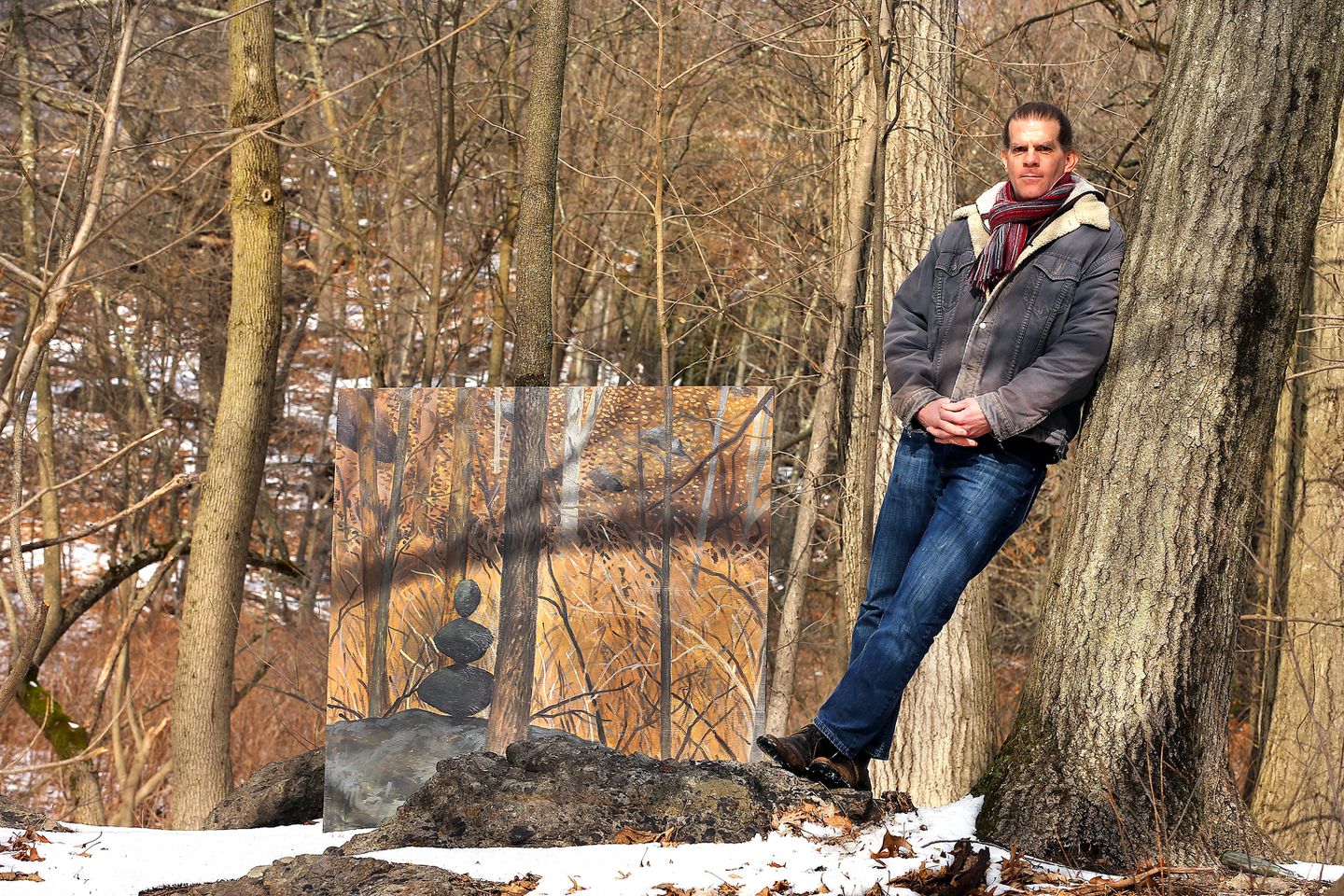
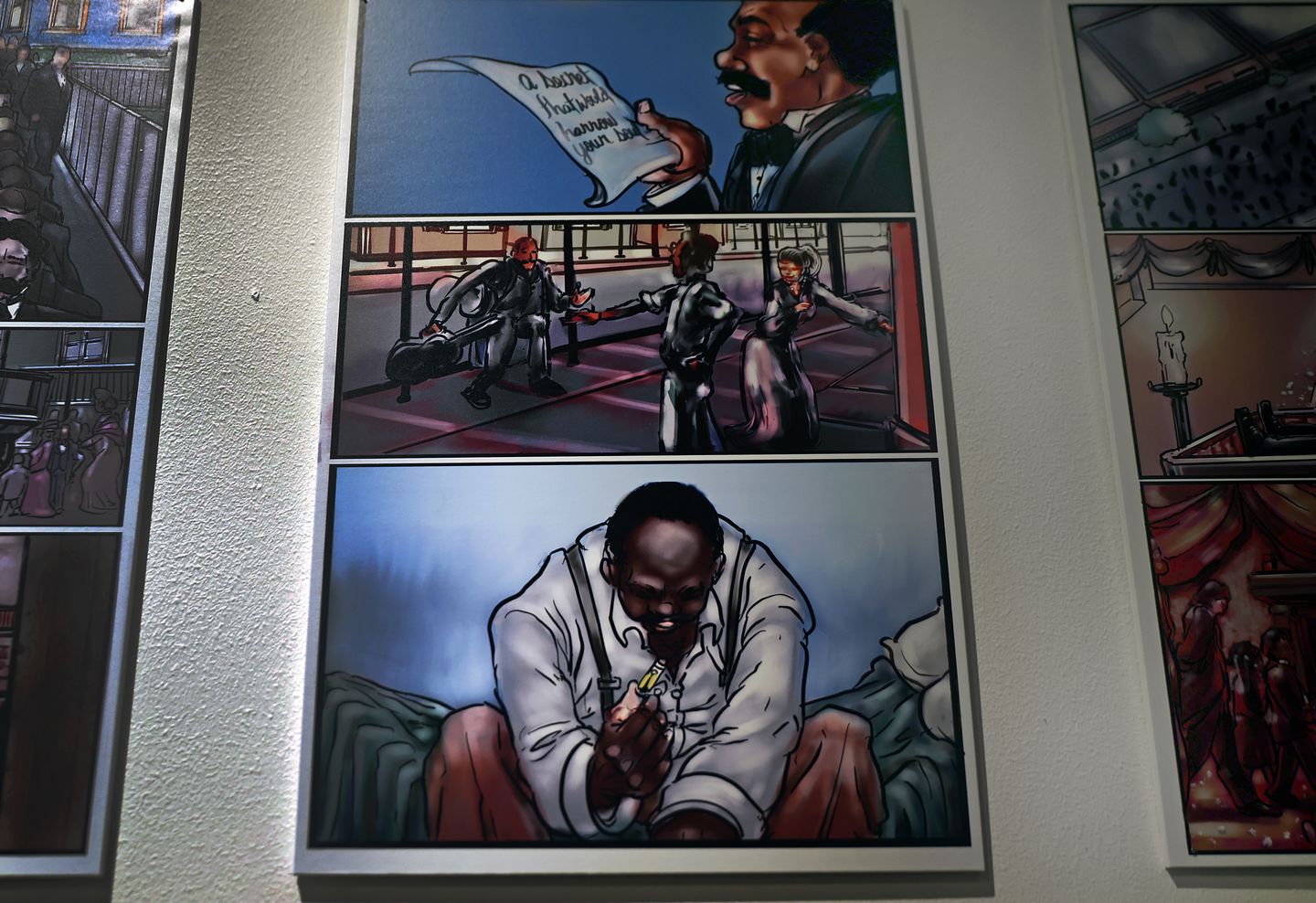
Photo: David L. Ryan/Globe staff.
A detail of Barrington Edwards’s “Monumental: Oscar Dunn and His Radical Fight in Reconstruction Louisiana,” 2020. It’s part of a Boston University exhibit aiming to establish comics as a medium.

Comics have evolved until they have become an art. Are they also a “medium”? A new exhibit at Boston University argues for the distinction.

Abigail Lee reports at the Boston Globe, “For the comic fan, the assumption that comics are merely a children’s genre — colorful like an animated kids’ movie, easy to read like a picture book — is exasperating at best, inaccurate and reductive at worst.

“Comics, like any other art form, are capable of complex expression and storytelling. That’s exactly the idea an exhibit from Boston University Art Galleries, called ‘Comics Is a Medium, Not a Genre,’ aims to establish. …

“Some 184 pieces from 29 lenders are on display in what curator Joel Christian Gill calls ‘an explosion of comics.’

“ ‘We have as many kinds of comics as you can think of,’ Gill said. ‘When you walk in, it’s going to be overwhelming.’

“Gill is himself a cartoonist, historian, and the chair of BU’s Master of Fine Arts in Visual Narrative program. The Visual Narrative program began in fall 2022, and the exhibit was meant to roughly accompany its launch. When planning the exhibit, Gill sought to combat the misconceptions about comics.

“People often mistake the most prominent comics in pop culture as representative of the entire form, Gill said. For example: Because the Marvel and DC comics are well-known, many assume comics in general tell superhero stories, he explained, the problem is a conflation of genre with medium.

“As he put it: ‘It would be like reading a bunch of Stephen King books and then thinking all novels were Stephen King.’

“Gill pulled together a variety of comics — from fiction to nonfiction, newspaper strips to self-published works, mainstream to underground pieces — to provide a ‘macro view of comics.’

“Most of the pieces in the exhibit are samples from longer works, which allowed for the large assortment of comics, said Lissa Cramer, director of BU Art Galleries. … The exhibit includes Charles M. Schulz’s first published appearance of Charlie Brown, a self-portrait by ‘Maus’ creator Art Spiegelman that pays homage to the cartoonist Ernie Bushmiller, and pages from Alison Bechdel’s ‘Dykes to Watch Out For’ comic strips. Other artists featured are the comics pioneer Will Eisner, Mad magazine founder Harvey Kurtzman, and Denys Cowan, cofounder of Milestone Media, a company created in the 1990s to diversify comics.

“There are also several international artists showcased, including Claire Bretécher and Jean Giraud from France, Gabriella Giandelli from Italy, and Tatsumi Yoshihiro from Japan.

“Gill tried to create a diverse representation of artists of color, female artists, and LGBTQ+ artists. However, he was wary about arranging the artists into these sections or categories because he didn’t want to define them by their identities. Instead, the exhibit is organized ‘by what looks good together,’ Gill said.

“The curation process involved asking artists and lenders for specific works, but also giving them the option to contribute works of their own choice. Gill’s approach was unconventional, according to Cramer, but it made the experience ‘free’ and ‘collaborative.’

“ ‘This really is an artist-driven show in that respect because the artist got to choose what they thought was most valuable,’ Cramer said.

“Gill said he hopes visitors leave wanting to find comics that appeal to them. He emphasizes that comics encompass a range of genres and audiences because at the end of the day, they are a mode of storytelling.” More at the Globe, here.

“Comics Is a Medium, Not a Genre,” is on display through March 24, at the Stone Gallery, 855 Commonwealth Ave., Boston. Free.

Read Full Post »

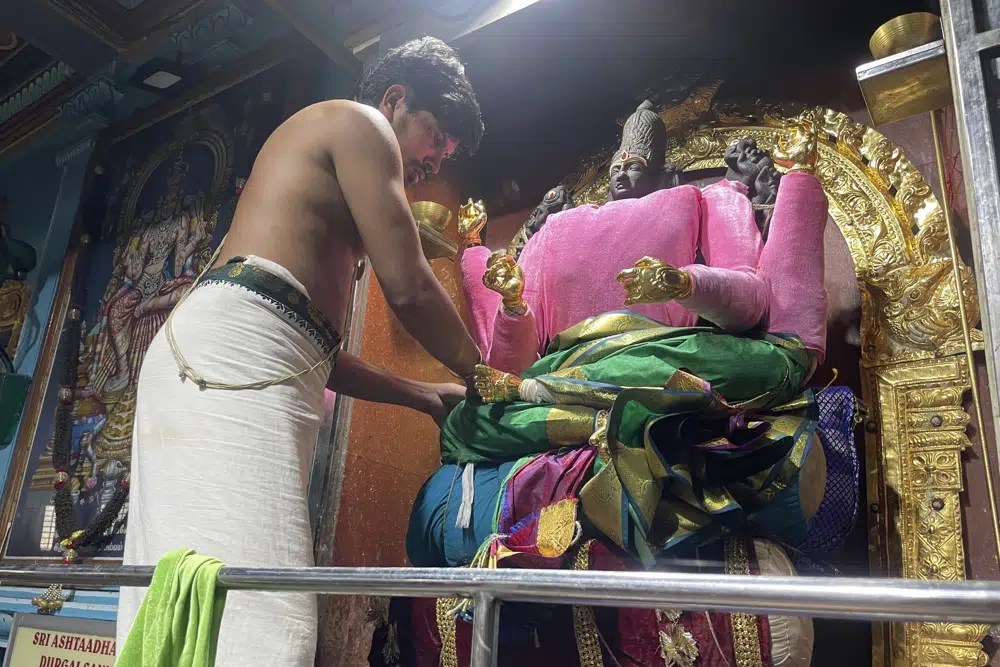
Photo: Deepa Bharath/AP.
Deity decorator S. Goutham is seen at the altar of the goddess Durga at the Anantha Padmanabha Swamy Temple in Chennai, India, on Nov. 29, 2022. Goutham is a fifth-generation practitioner of this millennia-old spiritual art of decorating temple deities.

Isn’t it amazing how many kinds of jobs there are in the world? Today’s story from the Associated Press (AP) is about a young man whose family has had the job of decorating statues of local deities for five generations!

Deepa Bharath reports, “On a recent afternoon, 33-year-old S. Goutham was perched on a ladder at the altar of the goddess Durga at the Anantha Padmanabha Swamy Temple in Chennai, India. Goutham — his hand moving steadily — was pleating a green silk sari to adorn the deity. …

“A computer science graduate, Goutham quit his job nearly a decade ago to pursue his calling. He has since followed in the footsteps of his ancestors as a fifth-generation decorator of temple deities.

“In Hindu temples, idols are mostly made of materials such as black granite, white marble or five-metal alloys that have sacred significance. These deities are worshipped as physical, tangible representations of god (Brahman) who is believed to be infinite, omnipresent and beyond comprehension. Worship in a Hindu temple includes bathing these deities in milk, decorating them with colorful clothes, flowers, perfumes such as sandalwood, jewelry, and even weapons such as swords, clubs and tridents. Oil lamps are lit at the altar, and sacred chants and foods are offered to the gods.

Decorating the deities is a millennia-old practice that is described in the Hindu epic Ramayana, and Goutham has been learning the art since he was a toddler. He crafted his first formal decoration when he was 13. …

“Goutham said he became interested in decorating deities as a child because of his father.

“ ‘When you are little, your father is your hero,’ he said. ‘I wanted to be just like him.’ The first lesson Goutham got from his dad was about the weapons each god would hold. He heard stories about the power of each weapon and how gods would wield them.

“ ‘The personality of the deity and the story of the god or goddess could change depending on their weapons, the clothes they wear, the expression on their face or the position in which they are sitting or standing,’ he said. …

“There are rules about the types of materials that can be used on deities.

“ ‘The human body is made up of earth, water, fire, air and space, and everything you see naturally occurring on Earth is made of these elements,’ Goutham said. ‘To show this, we decorate deities using things that occur in nature and are a representation of these elements, like copper, cloth, coconut fibers and so on.’

“He says decorating a deity combines elements from art, dance and yoga, in terms of the hand gestures and postures the deities assume. Man-made materials such as plastic are prohibited. Goutham says he uses little pins to hold fabric together, but makes sure the pins don’t directly touch the idol. …

“[He] dreams of establishing an institution to train artists who can maintain the sacred tradition. While most deity decorators are men, he sees no reason why women cannot learn and practice it. ‘Everyone is equal under god,’ he said.

“Storytelling is an important part of what he does. One of his favorite installations depicts the friendship between Lord Krishna, an incarnation of Vishnu, and Kuchela.

“ ‘It shows Krishna washing the feet of Kuchela, a poor man, conveying the message that humility is a virtue — whether you are a human being or god,’ Goutham said.

“The term ‘idol worship’ may have negative connotations in some faiths. But for Hindus, deities — which are kept in temples, homes, shops and offices — serve as focal points ‘for to us channel our devotions, our actions and serve as a reminder of all the positive values that are associated with those deities,’ said Suhag Shukla, executive director of the Hindu American Foundation.

“Shukla says this form of worship is a way for her to connect with her ancestors. ‘As a second-generation Hindu American, I didn’t grow up with all these things around me where I could absorb through osmosis,’ she said. ‘But just knowing that I’m part of a tradition that has been passed down from generation to generation is personally powerful for me.’

“In U.S. Hindu temples, community members come together to help create the costumes for the deities, and it is an act of devotion, Shukla said.

“ ‘No one has to sit there and embroider a skirt or sari for a goddess, but they do it as a display of love,’ she said. ‘It’s humbling and empowering.’ ”

More at AP, here. No firewall.

Read Full Post »

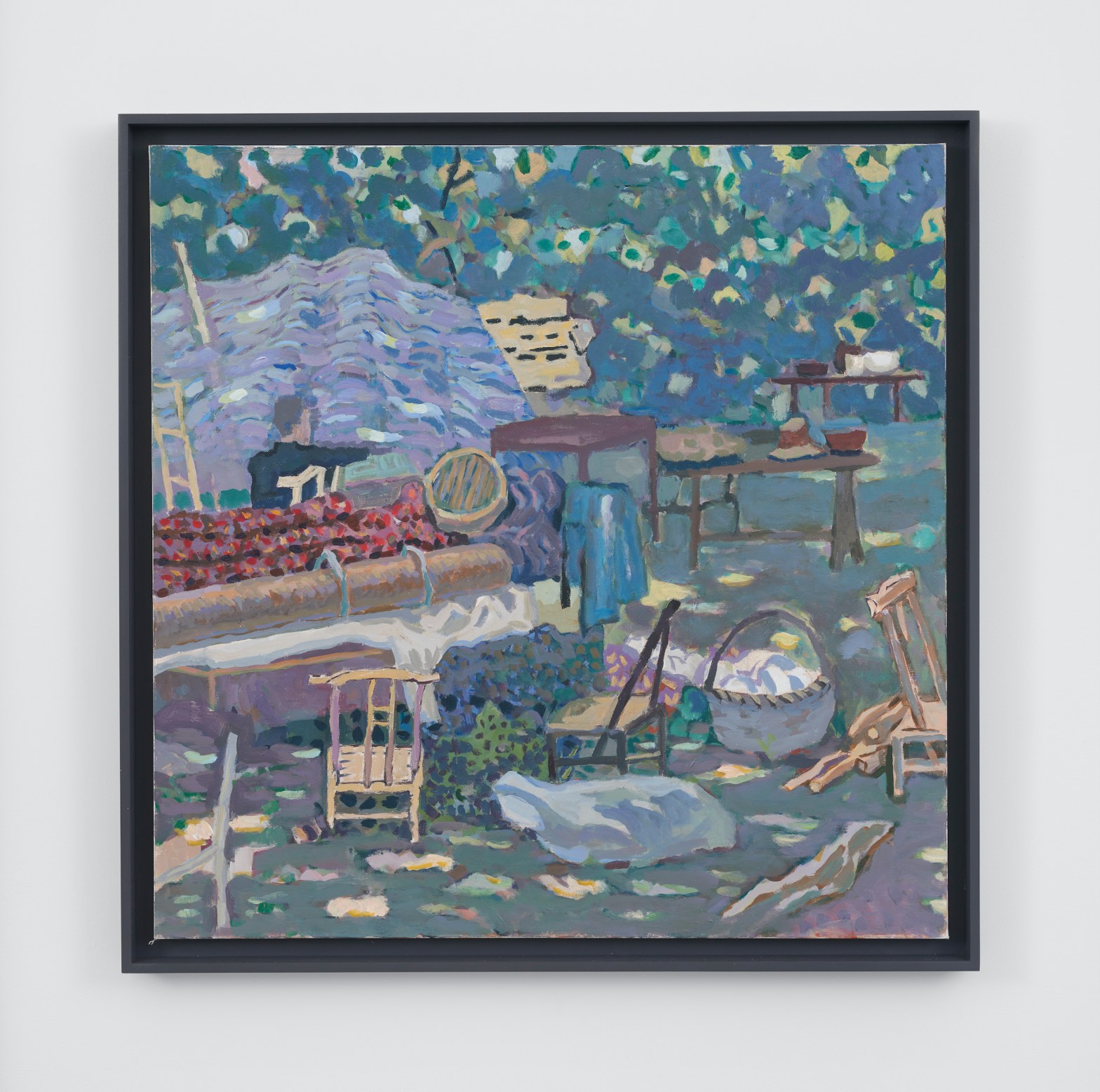
Art: Yun-Fei Ji via James Cohan Gallery.
Yun-Fei Ji, “Everything Moved Outside” (2022), acrylic on canvas.

The daughter of my mother’s college friend visited us in about 1980. Her family had been deeply traumatized by the anti-intellectual fervor of the Cultural Revolution in China. She couldn’t speak much English at the time, but I understood constant repetitions of “very painful, very painful.”

When I read today’s article about an artist who evolved from the Socialist Realism he was taught at the time, I thought of Ching and the way she grew, never completely shedding the deep hurt of totalitarian madness turned against friends and neighbors.

John Yau writes at Hyperallergic about Yun-Fei Ji, a Chinese painter who learned the state-sanctioned style of Socialist Realism “and then elected to unlearn it in order to reinvent himself.

“Yun-Fei Ji was born in Beijing in 1963, three years before the start of the Cultural Revolution (1966–76). Launched by the demagogue Mao Zedong, who distrusted intellectuals, the Cultural Revolution was an attempt to turn China into a utopian paradise run by and for workers. … 

“Ji belongs to the generation that studied at the Central Academy of Fine Art (CAFA) in Beijing in the first years after it reopened. Like the other painters in this group, he learned the state-sanctioned style of Socialist Realism and then elected to unlearn what he had absorbed in order to reinvent himself. … He secretly studied calligraphy — which was considered intellectual, bourgeois. …

“He opened it up and used it to respond to current events, such as post-revolutionary China’s massive Three Gorges Dam Project and the consequent displacement of more than 1.5 million people. …  

“As long as Ji continued to work in the tradition of Chinese landscape painting, Western audiences may have seen his views of displacement and protest, wayfarers carrying all their possessions, and melancholic ghosts as foreign to their experience. 

“This is why Ji’s change is radical. He decided to take on the Western tradition of painting in order to suggest that his subject matter is global, rather than local to China. … While the traumatic social upheaval caused by the Three Gorges Dam Project is still very much on Ji’s mind, as evidenced by painting titles such as ‘Migrant Worker’s Tent,’ ‘Satellite Dish on a Bed,’ and ‘Everything Moved Outside,’ new things are happening in his work.

“Three paintings signal a departure for Ji: two depictions of flowers (‘Sunflower Turned Its Back’ and ‘Early Spring Bloom 2020’) and a three-quarter-length view of a standing man — and my favorite work — ‘The Man with Glasses.’ … 

“Against a mottled brown, violet, and gray-blue abstract ground Ji has depicted an elderly man in blue pants and a long blue jacket over a pale blue shirt. The man is looking down, his hands in his pockets, and we cannot see his eyes. His head seems too large for his body, a deliberate choice by the artist. The shirt becomes a series of dry brushstrokes near the bottom and the gray-blue pants are largely unpainted. The jacket’s color reminds me of the blue surgical scrubs worn by doctors, which folds another level of feeling into the painting. The fact that the portrait resists a reductive reading is important to the change in Ji’s work and thinking. 

“The premier coup approach is in keeping with ink painting, which cannot be revised or layered, but in his use of paint he works differently, as seen in the mottled background and single dry brushstroke used to separate the front pockets of the shirt. The incompleteness of the man set against a dark, fully painted abstract ground seems both a formal and emotional decision. The man is ephemeral, while the dark, inanimate ground is permanent. The evocation of change and transience is also inherent to Ji’s paintings of sunflowers and blossoming branches. In these works, he meditates on the relationship between forced change and inescapable transformation.”

More paintings at Hyperallergic, here. No firewall. Subscriptions welcomed.

It was interesting to me that “Everything Moved Outside” (2022) makes this reviewer think of the migrant life. For me “everything moved outside” means Covid. Would love to hear more reactions to the paintings shown at Hyperallergic.

Read Full Post »

Photo: Abelardo Morell.
“2016–Flowers for Lisa #30” (2016) at Edwynn Houk Gallery.

Lauren Moya Ford at Hyperallergic asks, “Can photographers capture the vitality of flowers compellingly, innovatively, and beautifully?” She reviews a new book that answers the question in the affirmative.

“In the late 1830s,” writes Ford, “the Welsh botanist John Dillwyn Llewelyn began making photographs of orchids he’d grown at his home near Swansea. Llewelyn’s pictures are thought to be among the first to use the photographic process to identify plant specimens, though he himself found them lacking. ‘I have amused myself with making Daguerreotype [sic] portraits [of several flowers], and from their exact accuracy they are interesting,’ he wrote in an 1842 letter to the director of London’s Kew Gardens, ‘though the want of color prevents them from being beautiful as pictures.’ …

Flora Photographica: The Flower in Contemporary Photography by William A. Ewing and Danaé Panchaud (Thames & Hudson, 2022), features 200 photos taken over the past 30 years. The lavishly illustrated book follows its 1991 predecessor, which covered the period from 1835 to 1990. The newest edition features more than 120 artists from 30 countries working with digital and analog photography in a variety of modes, including performance, collage, and textiles. 

“Some of the most provocative images come from artists who use flowers to take on today’s pressing political and social issues.

In the book’s first photo, taken at the 2020 Belarus protests by the Polish photojournalist Jędrzej Nowicki, we see the hand of a demonstrator gripping a small bouquet of white flowers tied with white ribbon, the color of the opposition.

“ ‘The Pansy Project’ by Paul Harfleet documents single pansies that the artist plants at the site of homophobic abuse. And Thirza Schaap’s brightly-colored, modern-day vanitas ‘Plastic Ocean Series’ features floral still lifes made of discarded waste. …

“Other photos are personal, documentary, and playful. Some of Ewing and Panchaud’s selections riff on the way flowers have been depicted in the past, while others push in new directions. Flowers are a well-worn subject matter in the history of art, appearing in human production well before Llewelyn’s snaps in the 19th century. This book shows that they remain a powerful springboard for visual experimentation and meaning.”

I have chosen to illustrate this post with Abelardo Morell‘s photo both because I like it and because Abe and his wife were friends of my late sister. Nell knew them decades ago at Columbia University, when as a relatively recent immigrant from Cuba, Abe was doing menial jobs and thinking he might like to take up photography. The rest is history. Now his photographs are collected in museums.

More at Hyperallergic, here. Read about Abe here. He’s an interesting guy.

Read Full Post »

Photo: Mrs.
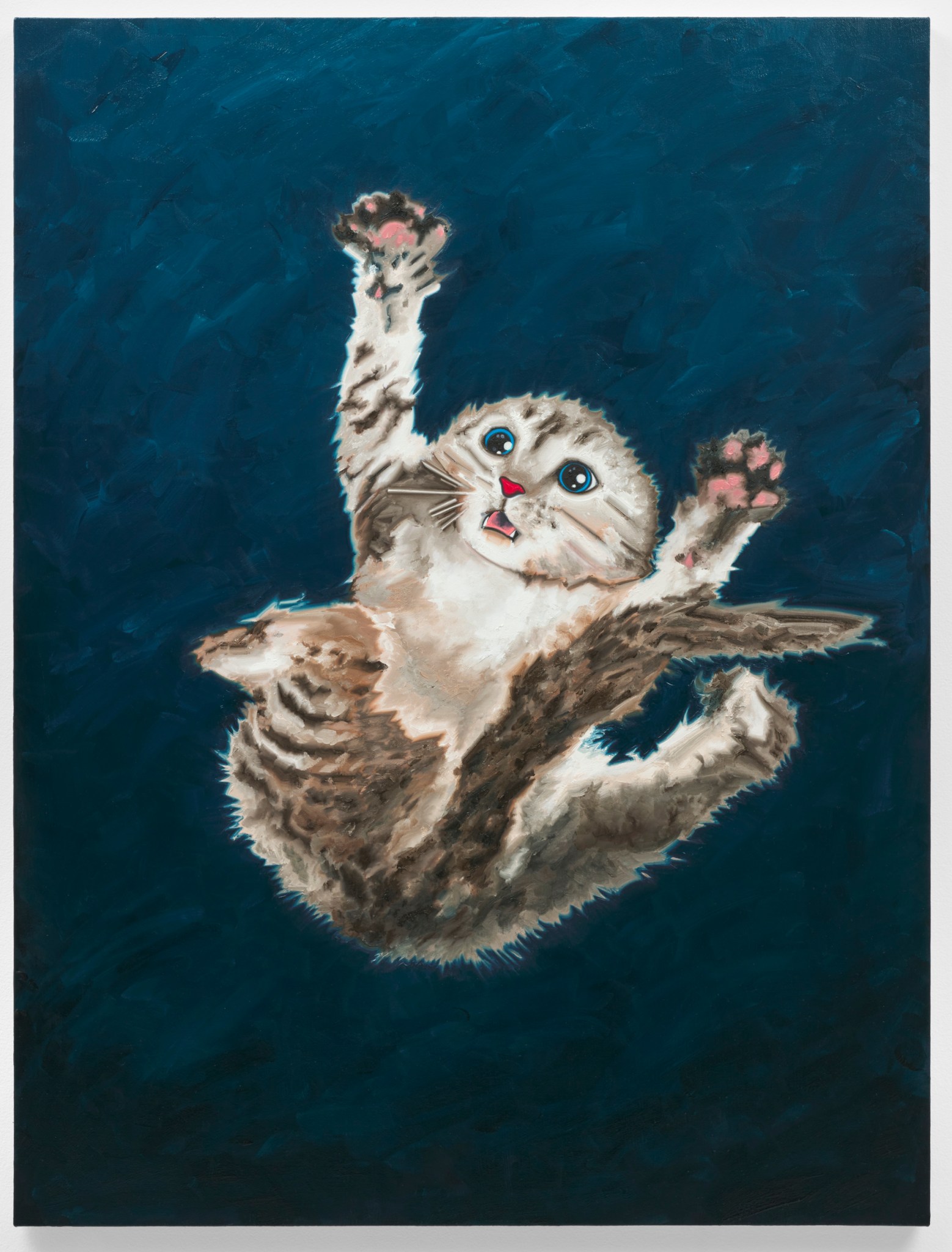
Luke O’Halloran‘s “Eeeeeeeeeee” (2022).

Are you a cat person or a dog person? Both? I’m not sure that I have a preference, but over the years, I’ve cohabited with more cats than dogs mainly because they are so independent and relatively easy to care for.

I know from YouTube that there’s a large segment of the population that can’t get enough of videos featuring cats, and as the gallery in today’s post notes, cats have been subjects of awe throughout history.

“Since ancient Egypt,” the Mrs. gallery’s website notes, “cats have maintained a ubiquitous presence in art. Originally symbolic of an Egyptian idol and guide in the afterlife, during the Middle Ages cats became synonymous with superstition, witchcraft, and paganism — associations that linger to this day. It wasn’t until the 1600s that they became the domestic companions they are known as today. Featuring artists from multiple generations, this exhibition depicts cats in all of their glory, as loving companions, fierce protectors, stubborn rebels, shadows in the dark, mythical shapeshifters, and as vehicles of unabashed comic relief.” 

Today I must apologize to readers who might have been able to get to the Mrs. art gallery in Queens, New York: the cat-art show has ended. Fortunately, you can still enjoy it online at Hyperallergic.

Elaine Velie wrote about it there: “Cats have descended upon Maspeth, Queens, where Mrs. gallery is featuring the work of 39 artists focused on a single theme: furry felines. Cats have been an art historical focus for thousands of years, and the gallery’s latest exhibition, titled ‘Even a Cat Can Look at the Queen,’ suggests they are here to stay.

“From Cait Porter’s loving rendering of a fuzzy tabby’s paw to a Philip Hinge chair sculpture made out of scratching posts, the exhibition includes works by longtime artists of Mrs.’s program as well as some who have never before shown with the gallery.

“Almost all of the works are by living artists, with a few exceptions, including an Andy Warhol print that presents perhaps the exhibition’s most straightforward depiction of a cat. A painting by Renate Druks — movie star, director, and avid painter of cats — titled ‘Male Cat Club’ (1980) evokes the visual language of the Hollywood Golden Age she lived through. … The setting looks like a movie or stage set and the outdoor views visible in the background evoke the dreary exteriors of film noir.

“Other works in the show are decidedly more modern, such as Sophie Vallance’s ‘Tiger Diner’ (2022), which features the checkerboard pattern and rounded aesthetic that has become popularized on social media over the last few years. But like Druks, Vallance places cats in a surprising setting; namely, sitting in a diner.

“In both paintings — and in almost every work in the exhibition — cats display the utmost confidence, a holier-than-thou attitude that any cat parent will likely recognize in their own beloved pet. The animals take up space with dignity, suggesting that the oddity is not their presence but that of a human being.

“Other highlights include Katharine Kuharic’s ‘Long Wait’ (1990), an oil painting with such fine lines it looks like a tapestry. … Elbert Joseph Perez’s ‘Pierrot Greatest Performance’ (2022) is a highly detailed portrayal of a cat presenting an ominous paw toward his toy likeness as an audience of creepy, obscured cats watches the animal from the dark. …

“Johanna Strobel’s sculpture commemorates feline hero Félicette, the first cat in space, and Abby Lloyd’s ‘Enchanted Cat Girl’ (2019), a pink anthropomorphic foam figure, assumes different facial expressions depending on where the viewer stands. Lloyd has impressively managed to keep the sculpture upright despite the figure’s enormous head.

“The show’s title, Even a Cat Can Look at the Queen, comes from an old English proverb implying that even people of the lowest status — as low as a cat — have rights. After gazing at the works in the exhibition, however, the proverb seems too on-the-nose. With their distinguished attitudes and regal postures, it’s quite evident cats can ‘look at the queen.’ As Anna Stothart notes in her essay for the show, perhaps the ancient Egyptians were right: Dogs may be man’s best friends, but cats are humans’ idols, and although they may bless us with companionship, we exist only to serve them.’ “

Do you have a favorite piece of art from the show? For me, it was hard to pick. Click at Hyperallergic, here, to choose from some great pictures. The gallery’s site is here.

Read Full Post »

Covid Murals

Photos: John.

John was in Malden yesterday and saw the Covid murals on the bike path. He was stunned. I tried to find a descriptive article about them online but ended up having to copy lines of poems from the photos on Flickr. I hope I got all the punctuation right. Poets care about such things.

How soon we forget what it was like to be deep in the midst of this! When we thought protecting ourselves meant wiping down the groceries with bleach. When doctors and nurses were having to reuse masks and were sending out pleas for people to find old masks in their garage workshops and take them to emergency rooms. When there were few test kits and no vaccines. How soon we forget it was all about breath and breathing!

The memorial to lost lives in Malden features both art and written words. These are excerpts from the poems.

Terry E. Carter wrote a poem about his mother called “Ventilation.”

“She wouldn’t wear a mask.
“I couldn’t even ask. …
“Said her freedom meant more than anything —
“wasn’t gonna let the liberals win.”

Ten-year-old Elliana J. Shahan’s poem “Because of You” honors farmers, shopkeepers, postal workers, doctors, teachers, and all who kept the world running in the dark times.

Jessica Frazier Vasquez’s is poem about the beep beep beep of her dad’s ventilator showing he was at least still alive: “It tells me that you’re still fighting/Battling to come back.” At least for a while.

Sharon Briner Santillo’s poem noted how one never used to know what was going on behind a neighbor’s windows and how one may feel more connected now.

“I know you
“Your sorrowful heart
“Your beautiful resilience …
“I know you
“And you know me.”

There is another by Dina Stander called “Breath”: “May her memory be for a blessing.” And one by Denise Keating called “A Slow Goodbye” about her father, who had already been paralyzed by a stroke for 10 years.

“We hovered by the window
“Moths fluttering for your voice
“We went away.
“You slipped away.
“And now.
“Guilt-stricken.
“Paralyzed.
“We let you go.
“We didn’t want you to fight.
“But we still struggle
“To remember
“To breathe.

More at MaldenArts, here. Be sure to look at the Flickr pictures, here: you can zoom in to read the words. Most of the poems are not literary, but all are heartfelt.

Read Full Post »

Photo: Sean Hudson, Aaron Zulpo, and Johnny Defeo via Hyperallergic.
Art making at Bandelier National Monument, January 2021.  

I’ve sometimes wondered how landscape painters over the years have dealt with extremes of weather. Think Hudson River School, think storms in the mountains. Even an ordinary person needs a lot of paraphernalia to go outside in bad conditions, let alone someone bringing along an easel, paints, palette, stool …

Susannah Abbey writes at Hyperallergic that in New Mexico, “the rule of the outdoors is that it changes constantly and consistently: sun angles, wind direction and speed, cloud formations, humidity. It is what makes painting outside, en plein air, so maddening and fun.

Johnny DeFeo, co-founder of the Guild of Adventure Painters, has been painting outside since he was a teenager. The challenge of rendering color and light often determines his subjects when he is on the road with his partner in painting, Brooklyn-based artist Aaron Zulpo. Since 2018 they have taken friends on mobile ‘Residency Programs’ and shorter ‘Excursions’ — driving DeFeo’s box truck to Banff, Yosemite, even Brooklyn’s Green-Wood Cemetery, where they led a community painting day. 

“Landscape painting has gone through different iterations in Western art since Claude Lorrain began painting the Italian countryside in the 17th century, yet has remained popular. … Maybe due to COVID lockdowns, or perhaps to a growing fear of losing the natural world, plein air (like other outdoor activities) is enjoying a small resurgence. Being outside, whether in an urban or wild landscape affords benefits; it’s a way to be fully immersed in and aware of the world.

“While its attractions transcend intellectualizing, at the end of a long day on a residency, the Adventure Painters convene to discuss process. ‘We’ll talk about, say, a waterfall — why is a waterfall so hard to paint?’ says DeFeo.

“DeFeo and Zulpo invite a rotating party of like-minded artists to accompany them. In January 2021, they organized a two-week excursion with Raychael StineBeau Carey, and Sean Hudson, then followed it up with a group exhibition at The Valley gallery in Taos, New Mexico.

“Stine teaches, among other courses, Wilderness Studio at the University of New Mexico, an art class in which students make their own pochade boxes and then go camping for two weeks to experiment with working beyond the confines of the Fine Art Department. Painting outside allows her to distill her outdoor observations into new and sometimes surprising palettes. 

“For Sean Hudson, a former student of Stine’s, the attraction to plein air started with the New Mexico sky. ‘I found these ethereal, transcendent spaces for my work in the bright sunsets, gradients, landscape as this whole idea of change, beauty, origin,’”’ he says.

“Beau Carey, also a Wilderness Studio alum, sometimes joins them. … Carey favors remote, icy corners of the world: the mountains of Longervin, Norway, and Denali National Park. He believes that working in the field is a great way to engage with a space, to record a subject with as much accuracy as possible under changing conditions before reinterpreting it in the controlled conditions of the studio. …

“This transformation of total immersion into a two-dimensional picture is rooted in paradox. The word ‘landscape’ in Western culture has been informed by the traditions of painting. It has come to connote, for instance, a sweeping seascape or desert vista, whose details are carefully curated or embellished by the artist’s perceiving eye. But landscapes are complex systems that resist the framing and blocking of two-dimensional composition. … In any given prospect we may choose to interpret on paper, thousands of creatures are born, live and die, rocks and mountains are eroding, forests growing and dying and rotting, rivers meandering, springs drying up. Every moment subtly changes the reality before, behind, above and below us.

“The impossible charge of a plein air painter is to distill this sensory and intuitive knowledge into a single snapshot. …

“ ‘I love it because it’s a game you can’t win,’ says DeFeo. ‘You get locked on a perfect shadow. A few minutes later you turn your brain into recorder mode and [because the light has changed] paint right through that shadow. It’s right on the edge of glory and annihilation.’ “

Some beautiful examples of the art at Hyperallergic, here. No firewall.

Read Full Post »

Art: John James Audubon.
“Lutra Canadensis, Canada Otter” (New York Public Library).

Hyperallergic is an online art magazine with a wide variety of stories that you just want to share. You can read it without paying, but of course, they need contributors as well as readers.

Today’s inspiration from Hyperallergic is about otters.

Sarah Rose Sharp writes, “Though seals are probably the gateway to aquatic mammal fandom, connoisseurs of the genre all agree that otters are best in class. These furry powerhouses are not only capable of tender intimacy and novel tool usage, they often just seem to be having the best time ever. So it’s no wonder that they have been a recurring motif throughout art history. …

“Though better known for his bird illustrations, John James Audubon’s last major work was The Viviparous Quadrupeds of North America, produced in collaboration with his friend, the Reverend John Bachman, who wrote the text that accompanies his illustrations. On his final drawing expedition in 1843, Audubon traveled with his son up the Missouri River to document and depict the four-legged mammals of North America — including, of course, otters.

“But the love of these little water scamps goes back much further than a couple of centuries. On view at the Metropolitan Museum of Art is just one example of otters as a common motif during the Late Period and Ptolemaic times.

“ ‘The pose of raised paws signifies the otter’s adoration of the sun god when he rises in the morning,’ reads the label on this Ancient Egyptian bronze statuette, dating to between 664 and 30 BCE.

‘In myth otters were attached to the goddess Wadjet of Lower Egypt, whose cult was centered in Buto, in the northern Delta.’ …

“For high otter drama, you can hardly do better than the standoff in Pieter Boel’s painting ‘Otter Harassed by Dogs‘ (c. 1600) currently in the collection of El Museo del Prado in Madrid, Spain. … Otters could mess you up at any time, so try to stay on their good side.

“Obviously, otters are a common motif in ancient and contemporary animal fetish carvings, such as [one] example of an ‘otter toy‘ from Cape Prince Of Wales, Alaska, part of the Smithsonian’s Museum of Natural History collection. According to the Toh-Atin Gallery, otters as a fetish animal represent ‘balanced femininity.’ …

“For the painfully literal seeking out otters in museum collections, nothing can hold a candle to the American Museum of Natural History (AMNH) in New York, whose permanent River Otter installation and background mural in the Hall of North American Mammals was captured by AMNH photographer Denis Finnin. ‘As morning mist veils a lake in Algonquin Provincial Park, a young female river otter comes ashore and inspects a spider web,’ reads the AMNH image description. …

“Speaking of meditative otters, a beautiful painting on silk from the Meiji period, the work of Japanese artist Seki Shūkō, is sure to meet all your needs for minimalist marine mammals. You can practically hear the noise of the rushing river. …

“But otters need not only be social animals, they can also be voices for animal welfare, as a woodcut by South Korean artist Shumu demonstrates.

“ ‘Animals are different from humans in language and appearance,’ the artist said in a message to Hyperallergic. ‘But animals feel the same or similar pain as humans, and they have emotions. Species discrimination against animals must stop. I hope that by continuing to work and share the life of veganism, it can become a small but resonant message.’ “

Nice examples of otter art through the ages at Hyperallergic, here. No firewall. Do you have favorite otter stories or images? Please share them.

Read Full Post »

GPS Art

Photo: GPSArt.
A new fad: using the mapping function on your phone to create art.

At the New York Times, Claire Fahy has a report on a hobby generating the kind of puzzled glances that Pokémon enthusiasts wandering through traffic used to elicit.

“In 1665,” she begins, “Johannes Vermeer dabbed the last drop of paint onto a canvas in his Dutch studio, completing his masterpiece ‘Girl With a Pearl Earring.’

“On an April day 357 years later, Janine Strong slowed her bike to stop, paused her fitness app, and watched as the snaking line of her cycling route drew the shape of Vermeer’s masterpiece over the streets of Brooklyn.

“Ms. Strong creates what has come to be known as ‘GPS art’ — a practice that uses the Global Positioning System mapping capabilities of modern phone apps like Strava to create digital drawings using an athlete’s route across the landscape.

“Instead of biking on a straight path or in circles around a park, Ms. Strong plans her rides in the shapes of birthday cakes, stars, birds, lions — and the occasional Vermeer.

“The hobby has grown with the widespread availability of satellite tracking for use by ordinary people, in fitness apps like Nike Run Club or MapMyRide. It is particularly popular on Strava and often referred to as ‘Strava art.’

“Strava art has existed since that app’s release in 2009, but it experienced a surge in use during the pandemic. According to Michael Joseph, a senior communications manager at the company, more than three billion activities have been uploaded to Strava since the beginning of 2020.

“To complete her digital vision of ‘Girl With a Pearl Earring,’ Ms. Strong biked almost 50 miles around southern Brooklyn, carefully checking Strava to make sure each turn, circle, and straightaway was achieving the iconic earring and head covering of Vermeer’s original.

‘I always have a big smile on my face when it works out and I upload it and it’s done,’ she said. ‘It’s a very satisfying feeling.’ …

“In 2003, the New York Times Magazine ‘Year in Ideas‘ issue told of how Jeremy Wood and Hugh Pryor used Garmin GPS devices that looked like walkie-talkies to trace routes resembling butterflies and fish on walks through the English countryside.

” ‘It’s not just walking; you’ve got to be looking at this device,’ Mr. Pryor said in a recent interview. ‘People always wonder what you’re doing.’

“Mr. Wood said he got the idea for GPS art while he was using a GPS tracker on a flight and the plane flew in a holding pattern above Heathrow Airport. He was captivated by the pattern appearing on his Garmin.

“ ‘It formed this most beautiful oval shape, and it was better than I could draw by hand,’ Mr. Wood said. ‘That’s when I made a connection: You could use one’s movements to make marks in space.’

“Mr. Pryor, a classmate of Mr. Wood’s, had to develop software to get the GPS points off the Garmin and onto a computer, turning the data into drawings. In the years since, technology has advanced enough to create visual maps in real time using a phone or smart watch. …

“The practice has spread from the fields of Oxfordshire in England to the sand dunes of Rio Grande do Norte in Brazil. Gustavo Lyra has run around Rio Grande in the image of John Lennon’s face and spent almost nine hours running a route for his daughter’s fifth birthday. It was an image of Elsa from Disney’s Frozen. …

“Gene Lu, who lives in New Jersey, started creating GPS art when he became a fan of the Game of Thrones TV series in 2013. He ran the shape of the family crests from the program. …

“Lenny Maughan, who refers to himself as a ‘human Etch A Sketch,’ also started out making map art tied to pop culture. Leonard Nimoy — Mr. Spock in the original Star Trek — had just died in 2015, and Mr. Maughan decided to pay him tribute. … ‘I thought, OK, I’m going to do the Vulcan salute.’

“The art form even has its own Guinness World Records categories. The Guardian profiled a couple who completed a 4,500-mile bike ride across Europe (while blogging the journey) that resulted in a 600-mile-wide GPS drawing of a bicycle — the largest such drawing on record, according to the Guardian. …

“For Mr. Lu, the unexpected is part of the beauty.

“ ‘The crazy thing is that you sort of don’t know where the map takes you; you just go with it,’ Mr. Lu said. ‘I always end up with what I’m looking for.’ “

More at the Times, here.

Photo: Daniel Rayneau-Kirkhope/Arianna Casiraghi.
The virtual bicycle drawn by Daniel Rayneau-Kirkhope and Arianna Casiraghi is 600 miles across and covers seven countries. See the article at the Guardian.

Read Full Post »

Art: Elsie Driggs, Pittsburgh, 1927, Whitney Museum of American Art, New York
“Beauty is everywhere if you know how to look for it.”

You don’t have to love pollution to love industrial monstrosities transfigured by art. In fact, the tension between what you know smokestack flames are spewing and the beauty of the fire against the blue sky is part of the appeal. Which is not to say I wouldn’t happily give it up.

Still, I was interested in this article on the general topic at the Millions. Bill Morris writes, “In the early years of the twentieth century, an eight-year-old girl named Elsie Driggs was traveling by train with her parents from Sharon, Pennsylvania, to New York. She had dozed off by the time the train reached Pittsburgh, but as the writer John Loughery would recount years later in Woman’s Art Journal, her sleep was interrupted: ‘She was awakened by her father to witness the drama of the black night-sky over Pittsburgh ablaze with soaring flames from the steel plants. It was a memorable sight.’

“So memorable that 20 years later, with her artistic career beginning to flourish, Driggs returned to Pittsburgh hoping to recapture the scene in paint. But the fiery Bessemer steel-making process had been abandoned by then, so there were no longer any flames spurting into the night sky. Worse, the local mill’s managers insisted that a steel mill was no place for a young lady—and they were suspicious that she was a union organizer or industrial spy. But Driggs did not give up. ‘Walking up Squirrel Hill to my boarding house one night, I found my view,’ she told Loughery. ‘It was such a steep hill. You looked right down on the Jones and Laughlin mills. You were right there. The forms were so close.

And I stared at it and told myself, ‘This shouldn’t be beautiful. But it is.’ And it was all I had. So I drew it.

“And then she made a painting from her sketches. And then, nearly a century later, while viewing an exhibition of the Whitney Museum’s permanent collection, my eye was drawn to a smallish black-and-white painting — just 34 by 40 inches — that from a distance appeared to be abstract. … As I got closer I realized it was a stark depiction of cylindrical industrial smokestacks bound by wires at the top left and a gush of smoke at the bottom right. The smokestacks are black and gray, the only color coming from a hint of sulfur in the pale sky. And that’s it: smokestacks, wires, smoke, sky. No flames, no human beings. How did this unremarkable image manage to be so otherworldly beautiful?

“The card on the wall told me that the picture was called ‘Pittsburgh 1927’ and it was painted by Elsie Driggs. She soon followed it with an equally stark painting of silos and ducts and smokestacks called ‘Blast Furnace,’ and then a monumental, faceted painting called ‘The Queensborough Bridge.’ These paintings gained Driggs entry into a group dubbed the Precisionists, an informal movement of mostly young artists who in the 1920s were drawn to America’s emerging industrial landscape of factories and skyscrapers and bridges, which they rendered with both a geometric precision that echoed Cubism and a sparseness that sometimes bordered on abstraction, typified by ‘Pittsburgh 1927.’

“There were other Precisionists on the walls of the Whitney the day I discovered Elsie Driggs, most notably Charles Sheeler and Charles Demuth. While Driggs was in Pittsburgh, Sheeler was in Detroit on a commission to photograph Henry Ford’s sprawling River Rouge complex, the workplace of 75,000 people, then the largest factory in the world. Sheeler’s assignment was part of the corporation’s publicity campaign for the Model A, which was about to replace Ford’s obsolete Model T. Sheeler spent six weeks roaming the complex with his camera, producing 32 prints that the company used for publicity and that are now regarded as high art. Possibly his most memorable image is ‘Criss-Crossed Conveyors, River Rouge Plant, Ford Motor Company,’ a picture of two conveyors making an X over a tangled netherworld of fences and buildings and ironwork, all of it topped by eight slender smokestacks that reach into the heavens. …

“One of Sheeler’s works from the Rouge was in the Whitney show — a painting made five years later called simply ‘River Rouge Plant,’ an oddly serene depiction of the factory’s coal processing and storage facility. The exterior walls of the buildings are creamy or tan, the foreground waters of a boat slip are glassy and calm, the sky is blue. There are no workers, no smoke or sparks or grease or slag heaps. The only hint of the repetitive, soul-crushing work that was done there is the nose of a freighter visible on the right. Part of Henry Ford’s genius was to make everything he needed to produce cars — what’s known as vertical integration, the cutting out of all middlemen — and so to make steel he had coal brought up by train from Appalachia, while his fleet of freighters brought iron ore down from Duluth, Minnesota. You would not know this by looking at Sheeler’s stately photographs or serene paintings, nor would you know that Ford was a union-busting anti-Semite who ruthlessly policed the morals of his captive work force. Sheeler was not concerned with such unpleasant facts. For him, all that mattered was that the Rouge was a visual gold mine. ‘The subject matter, he wrote to his friend Walter Arensberg, ‘is undeniably the most thrilling I have ever worked with.’ American factories, he added, were ‘our substitute for the religious experience.’

“Hanging on a wall near ‘River Rouge Plant’ was Charles Demuth’s painting ‘My Egypt’ from 1930, a depiction of a grain elevator in his hometown of Lancaster, Pennsylvania. The gray structure, topped by exhaust ducts and flanked by a smokestack, is seen from a low angle, giving it a monumental, nearly monstrous presence. Diagonal lines hint at stained glass — and at the notion, widespread at the time among Sheeler and others, that industrial structures were the cathedrals of the machine age. …

“By depicting industrial architecture and machinery but not the humans who built and operated it, the Precisionists left themselves open to the charge [of] glorifying the machine while minimizing or simply ignoring its human costs. …

“What was behind the Precisionists’ tendency to focus on machines rather than their operators, on the mechanical rather than the human? Was it a way of condemning the pulverizing power of the industrial age? Or was it a way of glorifying these monuments to human ingenuity and will? Or could it be that it was not one or the other, but a bit of both? Or neither? 

“One possible answer comes from Elsie Driggs. The year she painted ‘Pittsburgh 1927,’ Charles Lindbergh became the first person to fly solo across the Atlantic Ocean. A year later, Driggs experienced her first flight, aboard a Ford Tri-Motor that carried her from Cleveland to Detroit. It was an ethereal experience, judging by the painting she executed that year, ‘Aeroplane,’ which was included in ‘Cult of the Machine.’ It shows a curvaceous, silvery plane floating through the heavens. Black diagonal lines suggest the whirring of propellers — and identify it as the work of a Precisionist. It’s a lovely, loving homage, clearly a way of glorifying this airborne monument to human ingenuity and will.”

More at the Millions, here. Wonderful pictures. No firewall.

Read Full Post »

Habibi Bazaar

Photo: Bianca Velasquez.
A rug called “Evil Eye,” by Pamela El Gergi.

Today’s story about beautiful craft rugs is reminding me of a college friend who was really into interior decorating. As a hobby. She got so enthusiastic about Scandinavian rya rugs that she began designing and selling her own. Nowadays, when I’m supposed to be replacing rugs with floor coverings that older people won’t trip on, I’m wishing that I had bought one one of her ryas. I could at least hang it on the wall if I was afraid of tripping. Like other crafts, rugs can hold a lot of meaning.

Bianca Velasquez reports at Hyperallergic about Utah-based Lebanese American artist Pamela El Gergi who “modernizes traditional rug-making as a way to stay connected to her heritage.

“A sweeping reclamation of traditional craftsmanship is taking place around the world,” Velasquez says, “with artists forming communities around their uses of stained glass, jewelry, beading, and textiles. Seemingly unapproachable crafts (because of restricted access to supplies or apprenticeship), such as rug-making and stained glass, have benefited from modernized and simplified techniques and technologies that make practicing these trades more accessible, creating a surge of independent creators who work at their own pace and through their own lens. …

“Among the new voices is Lebanese rug maker Pamela El Gergi, who creates her works under her business name Habibi Bazaar.

“Having relocated to Salt Lake City, Utah, from Beirut, Lebanon, in 2018, El Gergi felt an urge to keep an open connection to her hometown, which she found through the traditional craft of rug-making. … ‘Habibi Bazaar uses my own personal style, which is Oriental rugs, evil eyes (Nazar), patterns that you would see in churches and mosques in Lebanon,’ she told Hyperallergic in an interview.

“And while she applies her voice and background to rug-making in the US, El Gergi creates a new dialogue within traditional rug-making in Lebanon. ‘I’ve taken these vintage, older styles of Oriental rugs, and now I’m trying to make them more centered around Lebanese culture,’ she said. ‘We don’t have much Lebanese representation within Oriental rugs.’ …

“After finalizing her design, El Gergi projects and traces the outline onto her canvas, then uses the tufting gun to apply the yarn accordingly. After applying the carpet glue and backing to the other side of the fabric, she moves on to the final step. ‘I spend hours on each rug, shaving it properly and carving out the designs (or “sculpting” the rug). I finish it all with vacuuming, lint rolling, and doing one last quality check,’ she said.

“El Gergi is currently working on a rug collection in collaboration with her peer Samantha Nader who has created seven Oriental designs based on El Gergi’s concepts. ‘What makes this collection significant to me is the specific flower that is included in the design. This flower is printed on Lebanese coffee cups, and when you drink Arabic coffee, the grounds are collected at the bottom,’ El Gergi said. ‘Then you flip the cup over, and you let the grounds fall along the sides. After letting it sit for five minutes, it reveals a pattern that tells your fortune.’ …

“El Gergi’s pieces tend to use this medium to shed light on her experience as a Lebanese woman, as well as pay homage to and honor the cultural symbolism that has been passed down through her family for generations. 

“Creating cultural ties between Lebanon and the US does not stop at rug-making for El Gergi. Habibi Bazaar also kicked off a pronoun shirt campaign in collaboration with Mexican artist Alethia Lunares, who designed the t-shirt graphic. … She produced three different shirts saying ‘She, Her, Habibi,’ ‘They, Them, Habibi,’ and ‘He, Him, Habibi.’ El Gergi’s decision to include the term ‘Habibi,’ which translates into a non-gendered way of saying ‘my love,’ allows her to incorporate a little bit of her culture into the campaign.

“This year, Habibi Bazaar has been accepted to the 14th Annual Craft Lake City DIY Festival Utah’s ‘largest local-centric art, music, science, and technology festival.’ Not only has she been accepted as a vendor, she was also chosen to be sponsored through the Craft Lake City Artisan Scholarship Mentor Program, allowing her to be mentored by a more tenured local business owner through the entire process of tabling at a large event. 

‘[Her booth] will include her rugs, pottery, stickers, wall hanging, mirrors, and more. … Most importantly, El Gergi hopes to continue finding contemporary ways to pass down traditional Lebanese crafts to future generations.”

More at Hyperallergic, here.

Read Full Post »

Art: Anna Kronick.
Anna Kronick is one of very few Judaic paper cutters practicing today.

Every time you think an artistic tradition is dying out, some free spirit reinvents it for a new age. Consider the art of sacred paper cutting and its long history in Jewish communities.

Isabella Segalovich reports at Hyperallergic, “Few today know that the walls of many Jewish homes used to be covered with intricate papercuts. Bursting with detailed ornamentation and religious symbolism, these artworks decorated Jewish homes in Eastern Europe, North Africa, and Western Asia for centuries. While some homes today may have a paper-cut marriage certificate or ketubah, the tradition has mostly evaporated. Much of the fragile paper archive was lost to the fires of the Holocaust, or has disintegrated over timeAnna Kronick is one of very few Judaic paper cutters practicing today, with a highly contemporary body of work that breathes new life into the sacred tradition. 

“After graduating from the New York Academy of Art as a sculptor in the ’90s, Kronick was working as a conservator when she came across a richly illustrated book, Traditional Jewish Papercuts by Joseph and Yehudit Shadur. ‘When you come across paper cutting, it’s usually Chinese or Polish. So when I came across Shadur’s book, I was amazed to find that Jews had been doing it too,’ she told Hyperallergic. …

“Some 25 years of practice later, Kronick has earned a place as a master artisan who not only continues this little-known craft but brings a fresh approach that allows the tradition to live on and evolve. 

“Traditional Judaic papercuts are made by slicing through a folded piece of paper, which is then unfolded to reveal a perfectly symmetrical design. While Kronick fell in love with their intricacy, she found this strict symmetry too confining. Instead, her pieces are defined by movement: Her compositions curve as if being blown by the wind. Stunningly, she rarely sketches out her designs. Kronick often draws with the knife itself, allowing her visions to guide her as she cuts through thin silkscreen paper.

‘In the beginning, I drew more,’ she said. ‘But the more I cut the less I drew.’ 

“Some of her papercuts bring life to old Yiddish songs. A navy blue paper rendition of ‘Belz, mayn shtetele Belz’ (Belz, my shtetl belz) lovingly depicts a group of Klezmer musicians — appropriate for a song about longing to return to a life of Jewish community. But while her Yiddish illustrations often contain English lettering, she prefers the graceful lines of Hebrew. ‘I don’t really do a lot of English text, because it stops the eye. It prevents movement,’ she says. ‘But Hebrew just flows.’ 

“Hebrew lettering is woven into her visions of passages from the Bible, like the story of Joseph. … This piece is dense with lush palm trees, bending piles of grain, and billowing patterned textiles. Look closely and you can find tiny cattle, brick walls, and a vast array of plant life swirling together in a dazzling vortex of religious symbolism. 

“The earliest recording of Jewish paper cutting comes from a whimsical 1345 treatise titled The War of the Pen Against the Scissors. The Spanish Rabbi Shem-Tov ben Yitzhak Ardutie describes how he resorted to cutting letters out of his parchment when his ink froze on a cold winter night. Since paper is so delicate, there is little physical evidence to trace the history of papercuts,. … Expert Joseph Shadur has written that the ‘more we learn about Jewish papercuts in one form or another, the more reason we have to believe that they were once exceedingly common.’ 

“While ritual art like spice boxes and Torah crowns were made out of expensive materials, paper was cheap and plentiful in many Jewish homes. Anyone could take up a small blade and develop their own masterpieces at home for very little money, thus fulfilling the Jewish principle of creating beautiful spiritual art known as hiddur mitzvah.

“Papercuts were hung from walls and windows as decorations for holidays like Sukkot and Shavuot, as calendars, and even as protective amulets to ward off the evil eye. We often imagine life in the shtetl as cold, gray, and dull. Rather, it was bursting with color and life. ‘Of all Jewish ritual and folk art, papercuts … lent themselves to the freest expression of religious spirit,’ Shadur wrote. 

“ ‘I think in pictures. When I listen to a Yiddish song, I just see it,’ said Kronick. ‘Maybe that’s why I don’t need drawing — I just cut it.’ But it’s nothing compared with how she sees passages from the Torah: ‘For me, the [Yiddish songs] don’t flow as much, even though it’s music.’ When she reads the texts, ‘it just moves differently. I can see the letters interwoven with the pattern.’ In work that keeps a beautiful craft from being forgotten, the results are deeply spiritual pieces, where we can witness Jewish joy and ancestral memories with our own eyes.”

Lots papercuts at Hyperallergic, here. No firewall, but subscriptions encouraged.

Read Full Post »

Lydia Ricci, “I’m Not Sure They Need to Do That Now” (2020), scrap materials, 3 x 5 x 1 1/2 inches

The world is full of big wonders that people want to see before Covid or some other misfortune grounds them. As for me, I’m almost more interested in not missing some small, important thing close to home. I keep thinking there might be magic in the ordinary. No wonder I enjoy art that uplifts everyday items!

Sarah Rose Sharp writes at Hyperallergic about artist Lydia Ricci and the endless possibilities she finds in everyday objects.

“As the saying goes, one man’s trash is another man’s treasure, and no one embodies this sentiment more acutely than sculptor and filmmaker Lydia Ricci. From a pile of scraps and everyday detritus accumulated over the last 30 years, Ricci makes imperfectly perfect replicas of quotidian moments and objects.

“ ‘I have been collecting my family’s scraps for over 25 years,’ wrote the artist in a confessional essay on her website, ‘but I have to admit, I also steal some too.’ These purloined scraps include a reusable BINGO card from a family function at the local elementary school (‘fancy … with red plastic windows that cover the numbers’), dusty electrical tape (‘nobody needs three rolls’), a lightbulb box from a neighbor’s garage (‘the bulb probably didn’t even work’). …

“If you leave Ricci alone in a waiting room, she considers your paper clips fair game.

” ‘I treasure an electric bill from 1984 like others would covet their family jewels,’ Ricci told Hyperallergic by email.

The results are mementos that do not so much mirror their real-world counterparts as deeply evoke a sense of life as it is remembered — a little wonky, a little irregular, very detailed in places but highly abstract in others.

“Ricci poses and photographs her tiny sculptures in tableaux in which the objects are often out of proportion, giving them the surreal quality of dreams and memory. A tiny aquarium makes tight quarters for a peeled cocktail shrimp. A ramshackle miniature couch struggles to conceal life-sized keys and Cheerios and hairballs. A teensy dishwasher is slowly buried in a drift of life-sized detergent flakes.

“As if creating these scenes out of multiple media isn’t enough, Ricci then recasts them in multimedia productions, adding single-sentence text snippets that seem to voice over the images or serve as narration to short films. Her three-minute film I WILL ALWAYS LOVE YOU (2021) made the rounds this past spring at film festivals in Arizona and Washington, DC, and tells the story of an evolving relationship through its everyday dramas: the wait for a diner booth, the politics of toothbrush-sharing, the request (or lack thereof) for help reaching a high shelf, the need (or not) for company on a grocery run.

“ ‘There is absolutely nothing precious or precise about what I am constructing,’ Ricci added. ‘The sculptures are messy and imperfect just like our memories.’ …

“Ricci was part of a four-person show that ran through April at James Oliver Gallery in Philadelphia, with another show slated to open on August 23 at the Kohler Art Museum in Sheboygan, Wisconsin. She’s also hoping to publish a book of her images, titled Don’t You Forget About Me.” More at Hyperallergic, here.

You might also be interested in a book by Richard Deming called The Art of the Ordinary, of which Cornell University Press says: “Cutting across literature, film, art, and philosophy, Art of the Ordinary is a trailblazing, cross-disciplinary engagement with the ordinary and the everyday. Because, writes Richard Deming, the ordinary is always at hand, it is, in fact, too familiar for us to perceive it and become fully aware of it. The ordinary he argues, is what most needs to be discovered and yet is something that can never be approached, since to do so is to immediately change it.”

Read Full Post »

Photo: Marc Domage/© Private collection.
A detail from one of Picasso’s sketchbooks for his daughter. 

I have read things about Picasso over the years that have made me think that he might not have been a person I would enjoy knowing. Then he goes and does something like this, and I have to remind myself that people are complicated: almost everyone weaves the good with the not good.

Dalya Alberge has a charming story about Picasso at the Guardian.

“They are the ultimate ‘how to draw’ books for a young child,” Alberge writes, “created by a doting dad who just happened to be one of the greatest artists of the 20th century. The granddaughter of Pablo Picasso has discovered an extraordinary collection of sketchbooks used by the artist to teach his eldest daughter to draw and color.

“Picasso filled the pages with playful scenes – animals, birds, clowns, acrobats, horses and doves. … He created them for Maya Ruiz-Picasso when she was aged between five and seven. On some pages, the little girl made impressive attempts to imitate the master. She also graded her father’s work, scribbling the number ’10’ on a circus scene, to show her approval.

“He drew two charming images of a fox longing for grapes – inspired by the 17th-century fabulist Jean de La Fontaine’s sour grapes fable, The Fox and the Grapes – and Maya colored in one of them. He also drew simple but beautiful eagles in a single movement, without raising the pencil from the paper, conveying his love of form and pure line to her.

“The previously unseen collection includes exquisite origami sculptures of birds that he brought to life for Maya from exhibition invitation cards.

“His granddaughter, Diana Widmaier-Ruiz-Picasso, found the works by chance while looking through family material in storage. Intrigued, she showed them to her mother, now 86, for whom memories came flooding back.

“Widmaier-Ruiz-Picasso told the Observer: ‘She said, “Of course, those are my sketchbooks when I was little.” ‘ …

“Picasso, who died in 1973, had been taught to draw by his father, a professor of drawing, ‘so that was something natural for him to do’ with Maya, his granddaughter said: ‘There’s a beautiful page where he’s drawing a bowl and she’s drawing a bowl.

“ ‘Sometimes she’s making an image and he’s doing another, showing her the right way to do it. Sometimes they would depict different scenes. Other times, he would draw a dog or a hat. Sometimes he’s using the whole page to draw one particular thing. Other times, he’s depicting certain scenes, scenes of the circus.’ …

“Maya particularly remembers that, during the second world war, color pencils and notebooks were in short supply: ‘That’s probably why my father wrote in my exercise books and colored with my pencils. I still have fond memories of those moments when we met up in the kitchen to draw together. It was the only place in the apartment where it was warm.’

“Widmaier-Ruiz-Picasso is an art historian, curator and jewelry designer, who has just published her latest book, Picasso Sorcier, exploring his superstitions and belief in magic.

“She described the discovery of the sketchbooks as ‘fortuitous’ because she was co-curating a major exhibition for the Musée Picasso-Paris on his close bond with his first daughter. … The exhibition, Maya Ruiz-Picasso, daughter of Pablo, runs until 31 December and includes his many portraits of Maya, personal possessions and photographs, along with the sketchbooks and origami sculptures, which are being shown for the first time. …

“In the exhibition’s accompanying book, [his granddaughter] writes: ‘Who has never heard it said when looking at a canvas by Picasso, “A child could have done that!” Many of the artistic revolutions of the 20th century were greeted with mockery and scandal, it is true, but in Picasso’s case there is a hint of truth in that judgment. As Maya, his first daughter, recalls, “the mystery of life, and therefore of childhood, always filled that father of mine with interest.” …

” ‘Picasso borrowed extensively from the unruly lines of children’s drawings. Where Van Gogh, Gauguin and Matisse concentrated on the graphic and pictorial naivety with which children draw, Picasso emphasized more the elements that upset figurative traditions, that is to say, distortion and deformity.’ ”

More at the Guardian, here.

Read Full Post »

In my last batch of photos, I showed a piece from an Art League of Rhode Island exhibit to which my friend Ann Ribbens had contributed. The show, “Below the Surface,” had a humanity-versus-water theme, and the quilt I shared in that post featured a warning about toxins in fish. Today I’m displaying Ann’s lovely “Undersea Tapestry” and two other pictures from “Below the Surface.”

Now I’m wondering if there’s something in the water that New England artists are drinking. The next group of photos is from a recent exhibit at a Massachusetts gallery, and the subject is “Undercurrents: Water and Human Impact.” If artists are to be believed (and they are), things are not looking good for water and it’s all our fault.

At “Undercurrents,” I especially liked Henry Horenstein’s photograph “Cownose ray” and Joan Hall’s “The New Normal,” which hints at manmade items that wash in with the tide.

Still on the subject of art, I want to mention that yesterday I checked out the new mural on the Boston Greenway, where I used to love walking when I worked downtown. There are many post-Covid changes in the area (I felt like Rip Van Winkle gazing around in wonder after a long nap), but the Greenway is still hiring artists to paint the wall of the giant Air-Intake building over the Big Dig. The latest painting, of a little boy with a boombox, has a wistful feeling about it.

The mural photos are followed by several local scenes, including a look at the bright cherries next to John’s front porch.

I end with a picture that Ann took last month while traveling in France. I couldn’t resist. It looks so utterly French to me.

Read Full Post »

« Newer Posts - Older Posts »