Feeds:
Posts
Comments

Posts Tagged ‘artist’

Thursday I went over to the Hapgood Wright Town Forest to check out the latest iteration of the Umbrella Community Arts Center’s Art Ramble.

The center’s website says, “In honor of Henry David Thoreau’s 200th birthday, this exhibit encourages artists to create work that slows the viewer’s experience of the natural world.”

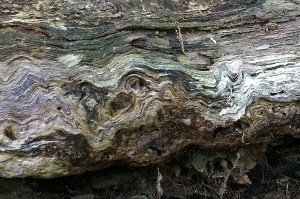
I enjoyed finding the art tucked away here and there in the woods, and I also enjoyed the beauties of the forest: a Great Blue Heron standing patiently in the middle of a pond where I could hear a bullfrog croaking, a beautiful fallen log with wavy lines, Indian Pipe fungi hidden among dry leaves.

The first of the art pieces that I chose to photograph was Mary Baum’s “Point of Entry,” a construction of mirrors covering a rock. Baum says that, in general, “her work deals with themes of belief and mysticism; the connection between the natural and spiritual worlds; and the relationship between magic and miracle.”

The second work I photographed was called “Forest for the Tree” and features small jars holding bits of tree arranged around a trunk.

Self-taught conceptual artist Heather Kapplow says the work “plays with the movement of consciousness or attention between the big picture and the more granular one (with its emphasis resting on the consciousness or attention of one particular tree). It exists as a liminal object, one that touches two worlds and acts as the passageway between. It allows the viewer to consider that there is more to our existence than what meets the eye.” (If you take children, you may want to find a way to translate artistspeak here and elsewhere around the woods.)

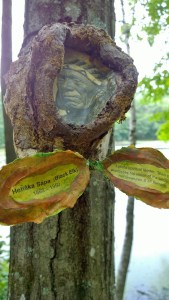
My favorite work was an array of “knotholes” by clay sculptor Liz Fletcher, who creates environmental art because she is “concerned about human impacts on the land.”

The title of her contribution is “Lovers of Life,” and features portraits of people who walked gently on the land, such as Rachel Carson, Aldo Leopold, and Black Elk, a Oglala Lakota (Sioux), who lived from 1863 to 1950.

Fletcher says, ” ‘Lovers of Life’ is an outdoor portrait gallery. Embedded within knotholes are images of people from various eras and cultures who devoted their creative energies to studying and protecting the natural world, and encouraging people to live in harmony with it. Knotholes on trees show where branches once grew out from the trunk. Knotholes are fine frames for these naturalists and spiritual leaders whose ideas have branched out across the world.”

I wrote about last year’s Art Ramble here.

062917-wavy-wood-Wright-Town-Forest-ConcordMA


062917-Indian-Pipe-fungus-ConcordMA


062917-bemirrored-rock-Art-Ramble


062917-Heather-Kapplow-Art-Ramble-ConcordMA


062917-Heather-Kapplow-Art-Ramble-ConcordMA


062917-Black-Elk-Town-Forest-Concord

Read Full Post »

Art: Horace Pippin
Sunday Morning Breakfast, 1943

Recently I read an interesting piece on a little-known African American artist, Horace Pippin. Art critic Michelle Aldredge wrote about him on her delightfully named blog, Gwarlingo. (“Gwarlingo,” she explains, is Welsh for the moment before the clock strikes.)

Aldredge had been visiting the Barnes collection in Philadelphia when she was startled by a small, powerful painting.

She reports, “Last summer I was strolling through the galleries of the new Barnes Foundation in Philadelphia, surrounded by the exquisite paintings of Matisse, Modigliani, Cézanne, when a small painting of Abraham Lincoln and his father building a log cabin caught my eye. …

“That day in Philadelphia I opened my notebook and wrote the following: ‘HORACE PIPPIN!’ And just so I wouldn’t forget, I underlined Pippin’s name three times. And then I starred it for good measure.

“A descendant of slaves, Horace Pippin’s biography is a compelling one. Here is an excerpt from his Wikipedia entry:

He was born in West Chester, Pennsylvania, and grew up in Goshen, New York. There he attended segregated schools until he was 15, when he went to work to support his ailing mother. As a boy, Horace responded to an art supply company’s advertising contest and won his first set of crayons and a box of watercolors. As a youngster, Pippin made drawings of racehorses and jockeys from Goshen’s celebrated racetrack. Prior to 1917, Pippin variously toiled in a coal yard, in an iron foundry, as a hotel porter and as a used-clothing peddler.

“Pippin enlisted in the army in 1917 and fought in the famous, all-black 369th Infantry regiment in France during World War I. Less than a month before the war ended, he was shot in the right shoulder.

“ ‘When I was a boy I loved to make pictures,’ he once wrote, but war ‘brought out all the art in me. … I can never forget suffering and I will never forget sunsets. So I came home with all of it in my mind and I paint from it today.’ …

“One website on Pennsylvania history describes the evolution of Pippin’s brief career:

After the war, the handicapped Pippin devised a way of supporting his right hand with his left. Using a hot poker to burn in the outlines of his figures and objects onto wood (a technique called pyrography) and then filling them in, he was able to resume painting by the mid-1920s. …

“Words like ‘toiled’ appear frequently in Pippin’s biographies and give some hint at the reverential tone that has been used to describe the artist over the decades. His personal story is so riveting that Melissa Sweet and Jen Bryant have just written a new children’s book about the artist called A Splash of Red. …

“By the time of Pippin’s death in 1946 at the age of 58, he had completed 140-odd paintings, drawings and wood panels. In his obituary in the New York Times they called him the ‘most important Negro painter’ to have appeared in America. …

“Pippin’s paintings are in the tradition of other New-Deal artists like Grant Wood and Thomas Hart Benton, whose murals and canvases depicted ordinary rural life. …

“During his life, Pippin was best known for his landscapes, domestic scenes, and religious paintings. Today, it is his historical scenes showing John Brown and Abraham Lincoln that receive the most attention. (Artist Jacob Lawrence said this his own series on John Brown was inspired by Pippin.) …

“Art critics struggle with Pippin because he does not fit neatly into a category or school. But Pippin didn’t need to buy into some pre-defined idea about what art should or shouldn’t be — he didn’t need to hitch himself to a specific art movement in order to get his work into the public eye. He earned critical acclaim the hard way: by creating outstanding art.

“ ‘Pictures just come to my mind,’ Pippin famously said, ‘and I tell my heart to go ahead.’ ”

More at Gwarlingo, where Aldredge has posted an impressive array of Pippin’s works.

Read Full Post »

Photo: Andrew Edlin Gallery
Part-time gravedigger John Byam’s carvings of hands, as seen in a New York gallery.

Artists often have to support themselves with non-art jobs. Gone are the wealthy arts patrons of past centuries, and maybe that’s not all bad, considering the Medicis. In any case, it’s interesting to see what kinds of jobs contemporary artists hold down. You may recall this post about Brando’s gardener’s art, for example.

Now at Hypoallergic, Allison Meier describes the recent gallery showing of a self-taught artist who dug graves in his spare time.

“Dusted with sawdust, John Byam’s sculptures appear as if they’ve just been carved, the shavings attached with glue binder giving a rawness to the miniature spacecrafts, airplanes, houses, helicopters, cameras, and coffins. Andrew Edlin Gallery in Manhattan [displayed] an assembly of these pocket-sized pieces by the late Byam in Unearthed. …

“Born in 1929 in Oneonta, New York, Byam mostly lived a local life, working at his family’s trailer court, with a two-year stint in the military taking him to Japan during the Korean War.

“Later, he had odd jobs with the Delaware and Hudson Railway and as a gravedigger at the local cemetery. The wood carvings, arranged by theme at Andrew Edlin with no label text, have traces of this autobiographical narrative, with a platoon of tanks and heavy artillery, or an open coffin, colored black, on a rolling gurney.

“Yet others, like spaceships and rockets, one with ‘”Moon or Bust’ scrawled in red, herald dreams of exploration. Recognizable pop culture forms, including the U.S.S. Enterprise from Star Trek, suggest these ambitions were limited to vicarious experiences through television, magazines, and movies.

“While that gives the toy-like objects a melancholy edge, they have a lot of joy in their detailed shapes. Byam seemed to delight in making even a simple chair on such a small-scale, with annotations in pencil indicating details like ‘door front’ on a tiny house. An array of human hands chiseled into various poses, one holding a coin, another with the words ‘2 close hands’ folded in prayer, shows a similar enchantment with the shape of things. …

“Byam was a deft craftsman in the tradition of American vernacular woodcarving, and his roughly hewn art is haunted by 20th-century culture, both its wars and fantasies.”

Hyperallergic has some great pictures of Byam’s art here.

Read Full Post »

Photo: Ronald van der Meijs
In January, this candle organ was on exhibit in the Netherlands. 

You may recall my January 2014 post about zebra finches playing instruments at a museum (here) and a December 2016 post on Croatia’s sea organ (here). The sea organ harnessed the tides to push water through narrow passages leading to organ pipes under marble stairs.

How many ways there are to make music! So much need for music!

Today’s post is about an artist who created a candle pipe organ. Lauren Young at Atlas Obscura explains.

“There’s a curious low industrial hum emanating from what used to be a fish market built in 1769. At De Vishal gallery in Haarlem, Netherlands, a large nine-pipe organ operated by burning candles purrs a continuous concert.

“In the video, Dutch artist Ronald van der Meijs shows his elaborate musical mechanism. Inspired by the Muller Organ housed at Grote Kerk church next to the gallery, the series of pipes looks like a massive artillery weapon connected to wooden beam air ducts. The intricate system requires careful maintenance — van der Meijs changes out the candles multiple times a day as they burn.

“For the pipe organ, ‘the candles are the musicians,’ van der Meijs explains. The candles vary in size. As the wax melts, the pitch of each pipe shifts slowly and irregularly. The shortening of the candles causes a vertical movement in each mechanism, pulling a wheel connected to a brass valve at the front end of each pipe. Opening the valves allows for different toned pitches.” More.

The mechanical kookiness makes me smile and reminds me of Rube-Goldberg-esque egg-breaking machines I have known. (See this February 2013 post.)


Read Full Post »

My husband is from Philadelphia and remembers hearing popular lines from a motivational speech in that city, about finding “acres of diamonds” in your own backyard.

“Today, Russell Conwell is best remembered as the founder and first president of Temple University,” says Vimeo. “But in his lifetime, Conwell had a very different claim to fame — that of popular orator.” (A Vimeo video “explores the history of Conwell’s most famous speech, ‘Acres of Diamonds,’ an inspirational message he delivered, by his own estimate, 6,100 times.”)

“Acres of Diamonds” was the first thing I thought of when Kai posted on Facebook about an initiative to turn China’s out-of-control air pollution into diamonds.

Rachel Hallett at the World Economic Forum wrote, “Dutch artist Daan Roosegaarde has come up with an innovative plan to tackle Beijing’s air pollution problem – and in doing so, turn a health hazard into a thing of beauty.

“After a pilot in Rotterdam, the Smog Free Project is coming to China. The project consists of two parts. First, a 7m tall tower sucks up polluted air, and cleans it at a nano-level. Second, the carbon from smog particles is turned into diamonds. Yes, diamonds. …

“Roosegaarde explained … ‘We’ve created environments that none of us want,’ he said. ‘Where children have to stay inside, and where the air around us is a health hazard.’

“The towers suck up polluted air, and clean it, releasing it back into parks and playgrounds. And according to Roosegaarde, these areas are 70-75% cleaner than the rest of the city. …

“The other aspect of the project will see the captured smog transformed into diamonds. 32% of Beijing’s smog is carbon, which under 30 minutes of pressure can be turned into diamonds.”

Can such wonders be? Read more here.

Photo: AP
Smog in Beijing will be turned into diamonds.

Read Full Post »

Photo: Wally Skalij / Los Angeles Times

So, actually, he was an artist first and only did gardening to support himself as immigrant with no connections.

Los Angeles Times reporter Carolina A. Miranda wrote about him in July, around the time of the “Made in L.A.” biennial at the Hammer Museum.

She says, “When artist Kenzi Shiokava received a telephone call from a pair of curators organizing [the biennial], he says he had little clue of the meteoric effect it would have on his life.

“ ‘I’d never seen “Made in L.A.,” ‘ says the 78-year-old sculptor. ‘I’ve always been off the art establishment.’

“But as he does with anyone who is interested in seeing his work, he invited the curators — Hamza Walker and Aram Moshayedi — to his studio so that they could have a look at his totemic wood sculptures, junk-art assemblages and curiosity boxes featuring orderly, patterned displays of old toys, plastic fruit and discarded religious ephemera.

“Shiokava says he was buoyed by the visit but subdued in his expectations. ‘Lots of shows come and go,’ he says. …

” ‘I didn’t know it’d be like this,’ he says with a resplendent grin. ‘The response has been amazing.’…

“[Walker] says that from the moment he and Moshayedi stepped into Shiokava’s studio, early in 2015, they were sure that this was an artist they wanted to include in the show.

“ ‘It was pretty immediate,’ he says. ‘We were both speechless within 10 paces of the entrance. There were all of these totems right up front and we were like, woooowwww.’ …

“ ‘What’s always kept me going is people coming to my studio and enjoying the work,’ [Shiokava] says in his deeply accented English. ‘But now I know my work will have a legacy. My work will live.’ ”

Read about the artist’s early life as a Japanese immigrant in Brazil, how he ended up in LA, and how he began to develop his art while working as a gardener for Marlon Brando and others (here).

Photo: Wally Skalij / Los Angeles Times
Kenzi Shiokava in his studio.

Read Full Post »


Art: Susan Jaworski-Stranc
Neighbors

I’m on the email list of 13 Forest Gallery in Arlington, Mass. The first time I went there, the owner enlivened his art opening with guest opera singers.

This time, he had a printmaker demonstrate a type of linoleum printing that Picasso dubbed “suicide” printmaking. Others use the word “reduction” instead of “suicide.”

When I tell you how the work is done, you will understand why Picasso felt as he did.

Instead of carving, say, four different blocks for a four-color print, the artist uses only one block. A mistake at one stage can end the whole project.

Lowell resident Susan Jaworski-Stranc has been doing reduction linoleum printmaking for more than 30 years. As the website for 13 Forest explains, “with each layer, you carve more of the block away — so once a layer has been printed and you start carving for the next layer, there’s no going back.”

The artist herself says, “After each successive printing of a color, the surface of the block is reduced while at the same time the printing surface is built up with multi-layered colors. Born from one block of linoleum, my relief prints have the nuance and rich textural surfaces of an oil painting.

“Although Picasso coined this method of working a ‘suicide print,’ I rather think of this printmaking process as emulating the journey of life. While creating my prints, I am never able to re-visit past stages. I can only proceed forward with the acceptance of all good and not so good choices which were mediated and acted upon with the hope and joy of completion.”

On August 13, the gallery was packed as Jaworski-Stranc demonstrated. Many in the audience were experienced printmakers who asked intelligent questions that showed the rest of us what sorts of issues matter to artists.

One person asked if Jaworski-Stranc knew what the picture was supposed to look like in advance, and she explained that she started with a detailed drawing. Another artist wanted to know if the colors of Jaworski-Stranc’s very first reduction print (which she showed us) were what she anticipated.

The artist laughed, holding up that print. “Are you kidding? How would I ever think up a color like this!?”

Clearly, despite all the careful planning that goes into a print, Jaworski-Stranc relishes the beauty of randomness.

More here.

Art: Susan Jaworski-Stranc
Coastal Forces at Sunset

Read Full Post »

After a father’s death, the family tries to find homes for his perfect metal miniatures.

Isaac Feldberg writes at the Boston Globe, “On any gift-giving occasion in the Megerdichian household, the most exciting presents to unwrap were always both the smallest and, funnily enough, the heaviest.

“Some boxes held metal miniature re-creations — a brass violin with horse-hair strings and a latched case; an aluminum piano music box that played ‘Raindrops Keep Falling on My Head.’ Others concealed stainless-steel jewelry, intricately detailed, immaculately formed. And others still contained children’s toys, like steel tractor-trailer sets to be nudged along the wooden floors of their Cambridge home.

“ ‘They were 14 ounces of love, 1 ounce of metal,’ says Robert Megerdichian, 63, of the tiniest pieces his late father, Abraham, bestowed upon the family throughout his lengthy career as a machinist. ‘He started off with a solid block of metal, brass, aluminum, copper, or stainless steel, and he gouged away, like a sculptor would, like an artist would, to create all of these objects.’

“Megerdichian’s description of his father as an artist has recently earned official validation, with museums across New England displaying an array of Abraham’s pieces. The Attleboro Area Museum of Industry, the Lynn Museum, and Boston’s Museum of Science all currently house some of his metal miniatures. Additional museum exhibits are set to open in the fall, including at Connecticut’s New Britain Industrial Museum. For more than half a century, however, Abraham’s creations were reserved for his loved ones. …

” ‘It was important to him to make things that made the people he cared for happy,’ ” said his son.

Read about Abraham’s history here. A great example of what the intersection of love and skill can give the world.

Photo: David L. Ryan/Globe Staff
Robert Megerdichian looks over a miniature Hoover vacuum cleaner crafted by his father.

Read Full Post »

Christo is known for making impossible-seeming public art, and just recently, he made some again. Margaret Rhodes reported the story at Wired magazine.

“It takes serious engineering to let 640,000 people walk on water. Luckily, that’s exactly the kind of technical and creative challenge that Christo — the artist who wrapped the Reichstag and dotted Central Park with 7,503 orange panels of fabric—excels at. …

“The new project, the ‘Floating Piers,’ comprises two miles of marigold-yellow walkways gently bobbing on top of Lake Iseo, a small lake in northern Italy, connecting the waterside town of Sulzano with two small islands. …

“Making them work was tricky. Marinas often use temporary, floating piers; a common technique involves propping them atop styrofoam cubes. ‘We discovered very soon that this cube system was perfect for us,’ says Wolfgang Volz, Christo’s project manager. So in the fall of 2014, Christo’s team ran a secret simulation of the Floating Piers in Germany. But the styrofoam blocks were too small and too dense.

“So they built their own blocks—220,000 in total. They’re about 20 percent bigger than the ones marinas use, and more buoyant. A Bulgarian company supplied the materials, and Christo hired four different manufacturing companies to ensure they’d have enough.

“Once Christo had his blocks, he, Volz, and a few dozen workers started connecting the cubes into 50- by 330-foot sections. They attached the cubes with giant screws, right on the water, in a corralled section of Lake Iseo.

“One by one, workers pushed the white styrofoam rafts out into the lake and anchored them to 5.5-ton concrete slabs arranged on the lake floor in a configuration conceived by Christo. ‘Very tedious work,’ Volz says. ‘Every day the same.’

“It took four months, with workers doing shifts of two weeks on, two weeks off the job. ‘The same as an oil rig schedule,’ Volz says.’ ” More here.

Temporary, like most of Christo’s work, the walkway was scheduled to come down early this month and get recycled. But it lives on in photographs — and the memories of those who visited and got a chance to walk on water.

Photo: Wolfgang Volz
Christo’s project the “Floating Piers” comprised two miles of marigold-yellow walkways on Lake Iseo in northern Italy. Visitors walked the path without handrails.

Read Full Post »

Artists seem to think differently from people who aren’t artists, which is why Renée Loth likes the idea of embedding a few in government.

“Imagine a dancer working with police officers to better interpret a suspect’s gait,” she writes. “Or a musician teaching a city parking clerk how to listen deeply. Or an abstract painter rearranging a tangle of contradictory street signs. That’s the idea behind Boston’s new artist-in-residence program, which will embed local artists inside city departments to promote creative thinking about municipal government. …

“ ‘Artists are all about asking questions,’ says Julie Burros, Boston’s cabinet-level chief of arts and culture. ‘They bring a unique set of tools to solving problems.’

“A jury of seven arts professionals and partners from the Massachusetts College of Art and Design [met in February] to winnow a field of 10 finalists to three artists, who will each receive a $20,000 stipend for a six-month residency. …

“Boston is in the throes of a comprehensive planning process that is working to inject fresh ideas into city transportation, housing, and zoning policies. Burros is directing the city’s two-year cultural plan, Boston Creates, and is a prime force behind the artist-in-residence program.

“But Boston is hardly in the vanguard of this approach. The concept dates back to at least 1976, when activist Mierle Ukeles accepted a nonsalaried position as the first artist in residence of the New York City sanitation department.

“Over the decades, Ukeles created artworks that engage questions of nature, class, and culture; her ‘Flow City,’ a video installation at a Hudson River transfer station, confronts visitors with their own role in the massive waste management task of city government. Environmental education is a dull, dutiful business — until it’s in the hands of a performance artist. …

“In 16th century Europe, wealthy rulers of church and state often commissioned artists to live and work in their courts — you might say that Michelangelo was embedded in the Vatican. Today’s artists in residence may not paint the ceiling of City Hall, but they will surely contribute to Boston’s renaissance.”

More at the Boston Globe.

Art: Pep Montserrat for The Boston Globe

Read Full Post »

When I was growing up in Rockland County, New York, my parents liked to buy art from artist friends and, when possible, offer other kinds of support. They hired the Hungarian-American artist André Dugo, for example, to paint a portrait of my brother Bo and me sitting in an armchair and reading one of the artist’s children’s books. We often read his book Pete the Crow or the books featuring a cardinal and a blue jay, or the one about the calf that ate the wrong kind of grass and puffed up like a balloon.

One day, Mr. Dugo came to our house to watch television with us. (We had one of the first TVs because my father was writing a story on Dumont for Fortune magazine.) We kept asking Mr. Dugo what he would like to see, and he kept saying he just wanted to see whatever we ordinarily watched.

As we worked our way through several programs, Mr. Dugo noted our reactions, sometimes asking questions.

Not many months after, a children’s book came out. It was called Tom’s Magic TV, and its premise was that a boy traveled through the TV screen and into adventures with sharks, circus clowns, puppets, cowboys and spacemen. Bo and I were not mentioned. The mother didn’t look like my mother. This was an early exposure to children’s-literature research — or poetic license.

I’m pretty sure that Gene Autry was the model for the cowboy adventure.

030916-Toms-Magic-TV-Dugo

Read Full Post »

I enjoyed this cheery article at Roads and Kingdoms/Slate on a family in Ghana who will design whatever kind of coffin is requested — like the potato chip coffin below.

Reporter Akinyi Ochieng describes seeing “coffins of all shapes and colors: a chili pepper, a cat, a scorpion. …

“Founded in the 1950s by Seth Kane Kwei, this is thought to be the oldest coffin shop specializing in abebuu adekai: proverb boxes.

“In the last 50 years, these fantasy coffins have become one of Ghana’s most unique cultural exports. The curious tradition of burying people in coffins shaped like everything from lobsters to busty women is primarily practiced in Accra and has spawned over 10 workshops in the capital city. Almost all of these are owned by former apprentices of Kane Kwei, who died in 1992. …

“The coffins intended for burial are made from a soft wood and cost about $700. The ones considered works of art and bound for homes and galleries, are made from mahogany. Those can sell for as much as $3,000. …

“ ‘When I started working, people used to call me a coffin maker or a carpenter,’ says [one family member]. ‘Over the years, I’ve become more actively engaged in the design process from start to finish. I think that’s what really helped me transcend just being a carpenter to being a true artist with a vision.’ ”

More from Akinyi Ochieng here. See some finished coffins, too.

Photo: Theophilus Mensah 
Design plans for an upcoming piece.

Read Full Post »

As an official member of his town’s tree committee, John has been working hard to promote the many benefits of an urban tree canopy both for quality of life and for the business environment.

Now here comes a really unusual idea for fans of urban greenery. You just need a large body of water.

At the website “Pop Up City,” describes Rotterdam’s floating forest, thought up by (who else?) an artist.

“Rotterdam will get its first ‘bobbing forest’ in 2016: a collection of twenty trees that are floating in the Rijnhaven, a downtown harbor basin.

“Inspired by Jorge Bakker’s artwork ‘In Search of Habitus‘, an aquarium filled with bobbers that grow small trees, Dutch designers and entrepreneurs from Mothership decided to carry out this idea in ‘real life’. After experimenting with a sample tree last year, an entire floating forest of twenty trees is scheduled to be ‘planted’ on March 16, 2016.” Check out some intriguing photos here.

My only question as a person who grew up in a hurricane corridor: What happens if there’s a storm?

Photo: Popupcity.net

Read Full Post »

Maria Popova at Brain Pickings finds the most wonderful books to blog about. In a recent post she extolled the wonders of fairy tale illustrations by Kay Rasmus Nielsen.

I was surprised to learn that’s a man’s name in Denmark. Wikipedia says, “Kay Nielsen was born in Copenhagen into an artistic family; both of his parents were actors – Nielsen’s father, Martinus Nielsen, was the director of Dagmarteater and his mother, Oda Nielsen, was one of the most celebrated actresses of her time, both at the Royal Danish Theater and at the Dagmarteater.

“Kay … received his first English commission from Hodder and Stoughton to illustrate a collection of fairy tales, providing 24 colour plates and more than 15 monotone illustrations for In Powder and Crinoline, Fairy Tales Retold by Sir Arthur Quiller-Couch in 1913. In the same year, Nielsen was also commissioned by The Illustrated London News to produce a set of four illustrations to accompany the tales of Charles Perrault; Nielsen’s illustrations for ‘Sleeping Beauty’, ‘Puss in Boots’, ‘Cinderella’ and ‘Bluebeard’ were published in the 1913 Christmas Edition.”

This is from Maria Popova: “As a lover of illustrated fairy tales and having just returned from Sweden, I was delighted to discover, thanks to the relentlessly wonderful 50 Watts, East of the Sun and West of the Moon: Old Tales from the North … illustrated by Danish artist Kay Rasmus Nielsen (1886-1957), whose work you might recall from [my list of] the all-time greatest illustrations of Brothers Grimm and the fantastic visual history of Arabian Nights. Originally published in 1914, this magnificent tome of 15 stories was recently reissued by Calla Editions, the same Dover imprint that revived Harry Clarke’s magnificent illustrations for Edgar Allan Poe, and features 25 color illustrations, along with a slew of black-and-white ones, in Nielsen’s singular style of haunting whimsy.”

There are more than 20 amazing Nielson illustrations here, at Brain Pickings.

Art: Kay Rasmus Nielsen
The North Wind went over the sea.

Read Full Post »

island-scene-on-Painted-Rock


Feeling the cold setting in?  Well here’s a summery scene on New Shoreham’s famed Painted Rock, one of my favorite pictures of the island’s constantly changing bulletin board. Wish I knew who the artist was.

John is behind the new tumblr blog featuring the Painted Rock in as many iterations as folks can dig out of the albums and send along.

Here’s what John had to say about it on the island e-board:

“Thanks for the kind comments and great pics submitted to paintedrockbi.tumblr.com The ‘mini cooper rock’ and the ‘hamburger rock’ are especially cool.

“There was also a question about me and the reason for the blog, so here goes.

“About 20 years ago my mother painted the rock early one morning to celebrate my sister turning 16 and my turning 21. Our summer home is a only short walk down Mohegan Trail from the rock, but if you took careful note of our ages, you might guess that my sister and I were not really morning people.

“So by the time we had rolled out of bed and made it down the street to look, it was already painted over. No photos were taken, but I know it’s there buried under all the layers. Now I am a parent, and it kind of reminds me of the many things we do for our children that no one ever really sees, but we keep doing anyhow.

“For many years I’ve been thinking about how best to document the many cool rock paintings. And last week I finally got around to doing something about it; hopefully the page will continue to get submissions and we can save the many small memories behind each coat of paint.”

Check it out: http://paintedrockbi.tumblr.com/

Read Full Post »

« Newer Posts - Older Posts »