Feeds:
Posts
Comments

Posts Tagged ‘author’

Photo: Steve Johnson.
Real books start with a human, a human with feelings.

Blogger Asakiyume is an activist against AI. And no wonder. She’s an author, and an especially creative one. Believe me, what her brain comes up with, no one else’s brain ever could! AI, however, just copies what has come before.

So right now, as other published authors are uniting against AI robot writers, she’s in good company.

Chloe Veltman reports at National Public Radio, “A group of more than 70 authors including Dennis Lehane, Gregory Maguire and Lauren Groff released an open letter on Friday about the use of AI on the literary website Lit Hub. It asked publishing houses to promise ‘they will never release books that were created by machines.’

“Addressed to the ‘big five’ U.S. publishers — Penguin, Random House, HarperCollins, Simon & Schuster, Hachette Book Group, and Macmillan — as well as ‘other publishers of America,’ the letter elicited more than 1,100 signatures on its accompanying petition in less than 24 hours. Among the well-known signatories after the letter’s release are Jodi Picoult, Olivie Blake and Paul Tremblay.

“The letter contains a list of direct requests to publishers concerning a wide array of ways in which AI may already — or could soon be — used in publishing. It asks them to refrain from publishing books written using AI tools built on copyrighted content without authors’ consent or compensation, to refrain from replacing publishing house employees wholly or partially with AI tools, and to only hire human audiobook narrators — among other requests. …

“The letter states, ‘AI is an enormously powerful tool, here to stay, with the capacity for real societal benefits — but the replacement of art and artists isn’t one of them.’

“Until now, authors have mostly expressed their displeasure with AI’s negative impacts on their work by launching lawsuits against AI companies rather than addressing publishing houses directly. Ta-Nehisi Coates, Michael Chabon, Junot Díaz and the comedian Sarah Silverman are among the biggest names involved in ongoing copyright infringement cases against AI players.

“Some of these cases are already starting to render rulings: Earlier this week, federal judges presiding over two such cases ruled in favor of defendants Anthropic AI and Meta, potentially giving AI companies the legal right under the fair use doctrine to train their large language models on copyrighted works — as long as they obtain copies of those works legally.

“Young adult fiction author Rioghnach Robinson, who goes by the pen name Riley Redgate … said, ‘Without publishers pledging not to generate internally competitive titles, nothing’s stopping publishing houses from AI-generating their authors out of existence. We’re hopeful that publishers will act to protect authors and industry workers from, specifically, the competitive and labor-related threats of AI.’

“The authors said the ‘existential threat’ of AI isn’t just about copyright infringement. Copycat books that appear to have been written by AI and are attached to real authors who didn’t write them have proliferated on Amazon and other platforms in recent years.

“The rise of AI audio production within publishing is another big threat addressed in the letter. Many authors make extra money narrating their own books. And the rise of machine narration and translation is an even greater concern for human voice actors and translators. For example, major audio books publisher Audible recently announced a partnership with publishers to expand AI narration and translation offerings. …

“Audible CEO Bob Carrigan said as part of the announcement, ‘We’ll be able to bring more stories to life — helping creators reach new audiences while ensuring listeners worldwide can access extraordinary books that might otherwise never reach their ears.’

“Robinson acknowledged the steps publishers have taken to help protect writers.

” ‘Many individual contracts now have AI opt-out clauses in an attempt to keep books out of AI training datasets, which is great,’ Robinson noted. But she said publishers should be doing much more to defend their writers against the onslaught of AI.”

More at NPR, here.

Read Full Post »

Did you ever have a correspondence with an author or other celebrity? I know that as a child, author Francesca Forrest got to know the fantasy writer Lloyd Alexander and his family really well. And it all started with fan letters.

In today’s story from the Comics Journal, we learn about a family’s relationship with Edward Gorey.

Cynthis Rose wrties, “Edward Gorey’s friends apparently called him ‘Ted.’ But, in our family, he was always ‘Mr. Gorey.’ My father chanced on his works during a business trip, back when they were small, slight booklets that seemed handmade. With them came an entire world, curious and enticing, fashioned out of the finest and most meticulous pen strokes. It was focused on luckless protagonists with preposterous names, languorous figures who proved surprisingly gritty. Their startling encounters and unforeseen fates soon established a hold on my preteen mind.

“Looking back, this is not surprising. I was a kid who worked in theatre, spending half of every day in a theatre school. Since the age of eleven, I had been portraying other children onstage. This surrounded me with ideas of glamour that, if not quite real, were certainly persuasive. Filled as it was with fantasy, costume and wit, Mr. Gorey’s esoteric universe did not seem strange.

“All the more since my theatrical world was not the same one as the sunny productions of local schools. Instead of joining my classmates in Oklahoma!, I was emoting in Lady Audley’s Secret or The Diary of Anne Frank. I wasn’t reading A Wrinkle in Time and Judy Blume, but grappling with Ionesco, Chekhov and Oscar Wilde. 

“Mr. Gorey’s books made him seem a fellow traveler. I saw his kohl-eyed vamps as shady White Russians and his muscular villains as figures out of Bram Stoker. Even his trailing aspidistras felt familiar – just like the herringbone suits in his characters’ closets, they were the hallmarks of a period stage set. Maybe that’s why it seemed logical to write him, once my father looked him up in a Manhattan phone book. 

“Was I surprised when Mr. Gorey wrote me back? I don’t recollect, but most probably not. Ours was a family who liked filling envelopes. We all wrote postcards, birthday letters, condolence notes, thank-yous and regular, chatty epistles. Almost everyone I knew had a pen pal. Once, when my dad opened a box of chocolates and found one missing, he grabbed his Underwood and wrote the head of the candy company. His typed rebuke (why was the workforce kept so hungry they were forced to pilfer bonbons?) was rewarded by a new and bigger box of chocolates.  

“Mr. Gorey made himself a Proustian part of my postal history. He wrote on discreet, elegant, letter-size paper, almost always ivory or pale dove grey. The inks he favored were sepia and navy blue and the pen he used had a small, blunt nib. As everyone now knows, he also liked to decorate envelopes. However fanciful their design might be, those I received always included his famous black doll.

“What were his letters like? Like his stories and the little books he sent, they were florid and funny and full of deliberate effects. Mr. Gorey seemed to be insatiably curious, with catholic tastes that informed his literary style. He was a voracious reader and would cite both classic tomes and modern trash, differences in form or century notwithstanding. He once wrote that he had found ‘the definitive list of phobias.’ Another time, he sent me a recipe for grapefruit slices ‘bathed in’ Coca-Cola. 

But any letter from Mr. G was instructive, because he was never, ever lazy with language. Always reaching for the mot juste, he cherished terms like ‘habituated,’ ‘diverting’ and ‘gelatinous.’

“He made words perform and took the time to make every letter an event. His missives were as lively as those of Dickens and, like his little stories, owed much to Ronald Firbank

“Over time, we discussed a range of topics: the Moors murders, the benefits provided by a ha-ha, Gustave Doré’s views about the London slums, Lillian Gish in The Wind, Japanese ghost behavior in the Edo era, spirit photography, London’s cheap bookstores, Rudolf Nureyev’s feet, illicit dissections and why green wallpaper had killed Victorians. 

“My own life at this time had a Gorey-esque cast. At fifteen, for instance, my parents sent me off to London by myself. I had earned the money through my theatre school, which ‘loaned out’ their pupils to make commercials. I spent three happy weeks in an English hostel, quartered on the eighth floor of a nine-storey building. From here, I searched out genuine art by Aubrey Beardsley, talked my way into Scotland Yard’s ‘Black Museum‘ and explored a then-almost-derelict East End. I also managed to meet another pen pal – the retired costume historian James Laver. An ex-museum staffer and theatrical bon vivant, Mr. Laver was an expert on dandies and the Decadents. 

“When we met for tea in the Charing Cross Hotel, he invited me to dinner at his Greenwich home. This turned out to be a memorable evening, not least because of the Zulu dignitary who arrived with a leopard skin over his suit. To honour my interest in the Yellow Book era, dinner was also followed by a vintage absinthe. Served through the requisite slotted spoon and sugar cube, it was extraordinarily bitter – and extremely strong.

“Mr Gorey liked to hear about such episodes. I wrote him about the streetlamp that ran on sewer fumes, the private museum of Teddy bears and toy theatres – even the Lava soap (largely pumice) that produced my grandma’s youthful skin. I sent him the label of J. Collis Browne’s Mixture, a morphine-and-peppermint-oil cure still popular in London. I wrote him a great deal about cemeteries and tombs, from English boneyards to the graves of Clyde Barrow and Bonnie Parker. When it came to things that no-one else cared about, I could always depend on Mr. Gorey. I could tell him how Pearl Bixby Wait got the whole idea of Jell-O from Orator Francis Woodward. 

“To this day, many things Mr. Gorey told me – some true, many not – have remained stuck in my mind. (Notably, that someone called ‘Sebastian Chaveau’ invented the marshmallow.) I’ve never tried to verify one of these assertions and I’ve avoided reading about their author. But, from time to time, something makes me think of him. Like a phrase I read last month in Daniil Harms’ diary : ‘Poisoning children is cruel. But something has to be done about them!’ ” 

If you’re a Gorey fan, you’ll understand. More at the Comics Journal, here.

Read Full Post »

Photo: Vincent Tullo/The Guardian.
Tony Tulathimutte won the Whiting award for his first novel, Private Citizens. To support his writing, he gives workshops that have launched other writers.

The other day I heard a watercolor artist talk about having an MBA and an investment career before switching to art. Several people in her audience noted that most painters don’t have such a good foundation for income and often support themselves with more menial jobs.

A recent interview in the Guardian shows a Brooklyn novelist finding a still different way to support his art.

Isabel Slone writes, “The list of past guest speakers at Crit, the writing workshop that author Tony Tulathimutte runs out of his Brooklyn apartment, reads like a veritable who’s who of 21st-century literary greats. … And while Tulathimutte describes himself as ‘literally just some guy’ on his website, he’s won an O Henry award, and former students like Beth Morgan and Rax King have gone on to earn lucrative book deals and win highly prestigious prizes.

“Tulathimutte, 39, founded Crit in 2017 after winning the Whiting award for his first novel, Private Citizens. While he had previously taught courses at Sarah Lawrence College and the University of Massachusetts, and led workshops for indie companies like Sackett Street Writers, these gigs came and went.

“Running his own school seemed like a more sustainable way to make a living while maintaining his career as an author (Tulathimutte announced the sale of his second novel, Rejection, earlier this year). According to the US Bureau of Labor Statistics, writers and authors earn on average $69,510 a year, while an alarming Authors Guild survey showed that its members drew a median income of $6,080 in 2017, down 42% from 2009. …

“Crit accepts nine students per session. They meet twice a week (Wednesdays and Fridays) over the course of two months. Spots cost $800, netting Tulathimutte approximately $30,000 per year. He supplements his income by accepting freelance writing assignments and visiting-faculty positions. He is currently a thesis adviser at Brooklyn College.

“In the six years since Crit’s inception, Tulathimutte has managed to build not just a successful side hustle, but a thriving community of writers. He hosts book swaps, parties, even a dedicated Slack channel where alumni can chitchat, form casual writing groups and perhaps land a connection to the agent or editor who will launch their career.

Guardian: What was the impetus for founding Crit?
“Tulathimutte: I just thought I could design the class I would have wanted to take. Most MFA programs function more like book clubs or discussion groups, where people are reading your work and giving feedback. I try to do formal pedagogy in the class, so I came up with 16 lectures breaking down different aspects of craft and process, such as ‘What is plot? or ‘What is dialogue?’ Students find the career-oriented class especially of interest because [practical matters] very often get neglected in the academy. It’s the last class of the course and it goes on indefinitely. My record is 11 hours and 45 minutes.

Why is it important for you to teach practical skills like money management?
“Most working writers I know slap together a bunch of different sources of income. On the side, I take visiting faculty gigs, pitch articles, freelance as a novel editor and writing consultant, and shoot author photos. Plus, there’s the very occasional windfall from book-related things like speaking engagements and selling foreign rights or film and TV options.

“I teach students how to cobble together different income streams to create something workable. Usually I talk about whatever grants, fellowships, residencies, contests, funded MFAs and other things I think are worth applying for, but I’ve also talked about Roth IRAs, eligible tax deductions from writing income, speakers bureaus, negotiating freelance rates, loan forgiveness programs and so on.

“Does it feel harder to make a living as a writer now than it did in the past?
“It’s definitely harder now, with so many media companies and publication venues folding and ever fewer places to publish book-related content. …

“Crit students have landed 12 book deals to date. What about your classes gives them a competitive edge?
“I think that a lot of my students would have succeeded just fine eventually. I could point to some writers and say, ‘I introduced them to their agent,’ to others, ‘I made X and Y notes on their manuscript,’ but who knows if that increased or decreased their selling prospects. …

How have you managed to get the word out?
“In the beginning, my only marketing strategy was to ask a couple of my more famous friends, like Jenny Zhang [and] Carmen Maria Machado, to retweet me. The slight bump in visibility was enough to get a handful of people signing up for the first few classes. After the first year, the balance shifted to 50/50 Twitter and word of mouth. Now it’s almost entirely word of mouth.

“How do you manage to convince people like Jonathan Franzen to visit your class?
“I email them. … Jonathan Franzen was a massive get, obviously. He asked me to moderate one of his book launch events for Crossroads in 2021 and after the event I asked if he’d like to guest and he said yes. I just figure there’s no harm in asking.”

More at the Guardian, here. No firewall. Can’t agree it’s harder now. Read New Grub Street.

Read Full Post »

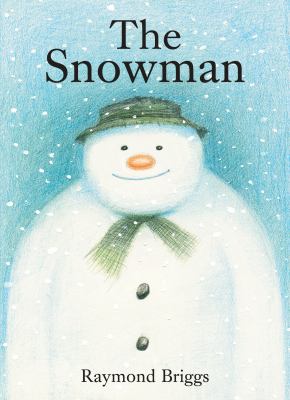
When Suzanne and John were small, we really got into the holiday books by British author-illustrator Raymond Briggs: the grumpy Father Christmas who gets sick on his vacation in the south of France, the silent, genial Snowman.

My husband pointed out this obit on Briggs.

Richard Lea reported at the Guardian, “Raymond Briggs, the writer and illustrator who delighted children and inspired adults with bestselling cartoons and picture books, died on Tuesday morning aged 88, his publisher Penguin Random House has said.

“Ranging from the enchanting magic of The Snowman to a devastating apocalypse in When the Wind Blows, Briggs created a host of much-loved characters including his angst-ridden Fungus the Bogeyman and his curmudgeonly version of Father Christmas. A career spanning six decades brought him numerous awards, with television adaptations making him a fixture of British Christmas viewing. …

“Born in 1934, Briggs went to the local grammar school in Wimbledon. His decision to leave school at 15 to go to Wimbledon Art College may may have puzzled his milkman father, but he was not dreaming of becoming Michelangelo.

” ‘I never thought about being a gold-framed gallery artist and was only pushed into painting when I went to art school,’ he told the Guardian in 2004. ‘I went there wanting to do cartoons.’

“Briggs’s interest in commercial art was met with horror at college – one teacher spluttering, ‘Good God, is that all you want?’ – and after national service Briggs met with more snobbery while studying at the Slade School of Fine Art in London. But when he left at 23, his talent for drawing realistic images from memory meant it was not hard to find work as an illustrator for magazines, advertisers and books.

“As the 1960s dawned, Briggs had begun to despair at the quality of the books he was illustrating. ‘They were so bad that I knew I could do better myself,’ he told the Guardian, ‘so I wrote a story and gave it to an editor hoping he would give me some advice. But instead he said he would publish it, which shows what the standard was like if a complete novice who had never written anything more than a school essay could get his first effort published.’

The Strange House was published in 1961 and five years later, his 800 illustrations for an edition of The Mother Goose Treasury won him the prestigious Kate Greenaway medal. Jim and the Beanstalk, a warmhearted sequel to the traditional tale, came in 1970.

“In 1973, he won a second Kate Greenaway medal and a wider audience with Father Christmas. This 24-page strip cartoon imagines Santa Claus as a grumpy old man, grumbling his way through his busiest day of the year: Christmas Eve. We follow him as he wakes up – ‘Blooming Christmas here again!’ – and sets off on his round, the sparse dialogue a litany of complaints about ‘Blooming aerials,’ ‘Blooming cats,’ ‘Blooming soot,’ ‘Blooming chimneys’ and all the ‘Stairs, stairs, stairs.’ …

“The same spirit infused Briggs’s 1977 Fungus the Bogeyman, which imagined Fungus living in dank, smelly tunnels evoked in a palette of mud brown and acid green. Heading out at night to frighten people on the surface, Fungus ponders the futility of existence: ‘There must be more to life than this.’ The Guardian declared it suitable ‘for children over the age of 10 – or adults – with murky minds and horrid senses of humor,’ while the Times called it ‘the ideal picture book for an age of punk rock and general glorification of ugliness.’ It sold 50,000 copies within a year.

“Briggs turned next to pastels in 1978’s The Snowman, a wordless story about a boy whose snowman comes to life. But this magical story was still grounded in harsh reality; the next morning, the boy wakes to find only the snowman’s hat and scarf listing on a pile of melting snow. ‘I don’t have happy endings,’ Briggs told the Radio Times in 2012. ”I create what seems natural and inevitable. The snowman melts, my parents died, animals die, flowers die. Everything does. There’s nothing particularly gloomy about it. It’s a fact of life.’

“Channel 4 didn’t duck the issue with its 1982 animated version, but sugared the pill by adding a visit to Father Christmas and a soundtrack with a piping choirboy. Despite acknowledging the need for a film to be commercially viable, Briggs told the Guardian in 2015 that he hated it at the time and still found it corny. But the animation became a fixture on festive TV schedules, lending Briggs a Christmassy reputation that only grew after television versions of Father Christmas in 1991 and Fungus the Bogeyman in 2004 and 2015.

“Meanwhile, Briggs turned away from fantasy, with picture books tackling nuclear war (When the Wind Blows), the British invasion of the Falklands (The Tin-Pot Foreign General and the Old Iron Woman) and an account of his parents’ marriage (Ethel and Ernest). But he rejected the idea that his work was divided into books for adults and books for children.

“ ‘There are a few books which are obviously for small children,’ he told the Guardian in 1999, ‘but I don’t usually think about whether a book is for children or adults. After a child has learned to read fluently, at about eight or nine, then the whole idea of categorizing them seems a bit daft.’

“Briggs’s final book Time for Lights Out, a ‘hotchpotch’ of drawings, verse, memories quotations published in November 2019, looks death square in the face. In it, he imagines ‘future ghosts’ looking around his house in Sussex: ‘There must have been / Some barmy old bloke here,’ he writes, ‘Long-haired, artsy-fartsy type, / Did pictures for kiddy books / Or some such tripe. / You should have seen the stuff / He stuck up in that attic! / Snowman this and snowman that, / Tons and tons of tat.’ “

More at the Guardian, here. No firewall.

Read Full Post »

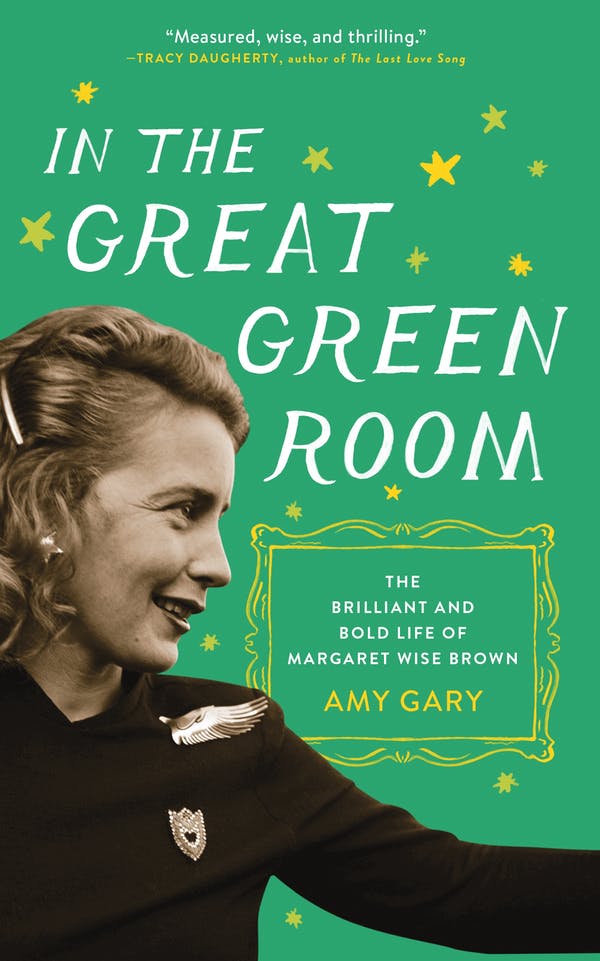
The biography of a woman who channeled childhood.

Today I decided to share this GoodReads report on a biography I read recently.

“I really liked this biography of the prolific and influential writer for children Margaret Wise Brown.

“Amy Gary is not primarily a biographer. In her earlier jobs, she was head of publishing for Lucasfilms and Pixar. But curiosity led her to a treasure trove of unpublished papers that the sister of Margaret Wise Brown had stored away in the attic after Brown’s death at 42 from an embolism.

“Margaret Wise Brown not only wrote the seminal Goodnight, Moon, which after a slow start sold more that 48 million copies worldwide, but many other titles you might recognize without knowing they were by her. At this time of year, I always pull out Home for a Bunny, for example.

“Brown wrote for a variety of publishers, including Harper, Disney, and Golden Books. But it wasn’t that she was a warm and fuzzy child-loving, motherly type. It was more that she never stopped being a child. She thought like a child. She fit in well with the cutting-edge child-development philosophy of the Bank Street School, one of her first employers in New York, but even before she knew about that, she sensed that books featuring repetition and descriptions of very familiar objects would please young children. And she tested everything on her audience.

“Gary’s access to Brown’s papers makes this a rich biography of a wild and original, nature-loving girl who became a wild and original, nature-loving adult. Despite a life of privilege in both New York and the south (she was a frequent visitor to her cousins’ Manhattan-sized island, Cumberland, which is now a national park), nothing could dampen her ability to see everything around her in terms of a story for kids.

“I think you will be interested in how Brown met some great illustrators and writers and nurtured their talents — and in how she came up with innovations like furry books and records in book pockets. She was valued for her work, which was satisfying, but her love life with both men and women she knew were bad for her kept her from being happy for long.

“I really appreciated Gary’s long epilogue, in which she tied up every possible loose end. And the forward by Brown’s fiance, James Stillman Rockefeller Jr., was a lovely way to capture Brown’s vibrant way of talking about, thinking about, whatever she saw.”

Read Full Post »

Photo: Rik Pierce/Concord Players
The 2002 cast of Little Women at the Concord Players. Katie Lynch, standing, played Jo (the author’s alter ego). Jan Turnquist, front left, is in real life the director of Louisa May Alcott’s home, Orchard House, in Concord, Massachusetts.

In the town where I have lived nearly four decades, we get a lot of tourists. One of the main attractions is the home of the Little Women author, Louisa May Alcott. Her book remains popular worldwide. Many movie adaptations have been made. I have friends from Japan who were beyond thrilled to see Alcott’s home because of a popular Japanese television series. And at the theater that Alcott helped to set up, Little Women productions have been staged every ten years for generations. I even helped to cast one production.

Needless to say, I couldn’t resist Hillel Italie’s recent story for the Associated Press about an unfinished bit of Alcott juvenalia.

The current issue of Strand Magazine will give readers the chance to discover an obscure and unfinished Louisa May Alcott work of fiction, and to provide a conclusion themselves.

“Alcott’s ‘Aunt Nellie’s Diary’ has rarely been seen since she drafted what may have been a novel or novella, and set it aside, as a teenager in the late 1840s. The 9,000 word fragment is narrated by the 40-year-old title character, and follows her observations as a romantic triangle appears to unfold among her orphaned, fair-haired niece Annie Ellerton, Annie’s dark-haired friend Isabel Loving and the visiting Edward Clifford, ‘a tall, noble-looking’ young man with a complicated past.

Strand managing editor Andrew Gulli found a reference to the manuscript during an online search of Alcott’s archives, stored at Harvard University’s Houghton Library. ‘Aunt Nellie’s Diary’ appears in the Strand’s spring issue, delayed until now because of the coronavirus. …

“ ‘What struck me was the maturity of the work,’ says Gulli … ‘Here was Alcott, who was on the cusp of adulthood, creating a complex work, where her main character is a single woman in her 40s, who defies many of the stereotypes of how women were portrayed in mid-19th century America.

“Because ‘Aunt Nellie’s Diary’ ends with various storylines unresolved, Gulli is inviting readers to complete the narrative. ‘…

“Alcott scholar Daniel Shealy says that ‘Aunt Nellie’s Diary’ reflects what the author called her sentimental phase, her early immersion in such British authors as Charles Dickens and Sir Walter Scott.

“ ‘You can see her picking up on some of the romanticized, even sensationalized material from those books. It’s a tough time for her, because the family was short of money, but it’s also a creative time. She’s beginning to develop and mature as a writer,’ says Shealy, a professor of English at the University of North Carolina-Charlotte.

“ ‘If I had to compare this to Little Women, I’d say that you can see her ability to create characters that you can take an interest in. And you see her ability to have several strands of the story going off in different directions, and you’re wondering how she going to tie this all together. Clearly, this story is building to a big reveal, and we’re going to learn new things about the characters’ pasts.’ ”

That is, we are going to learn things from Strand readers who send in the best endings. Maybe you.

More at Yahoo, here.

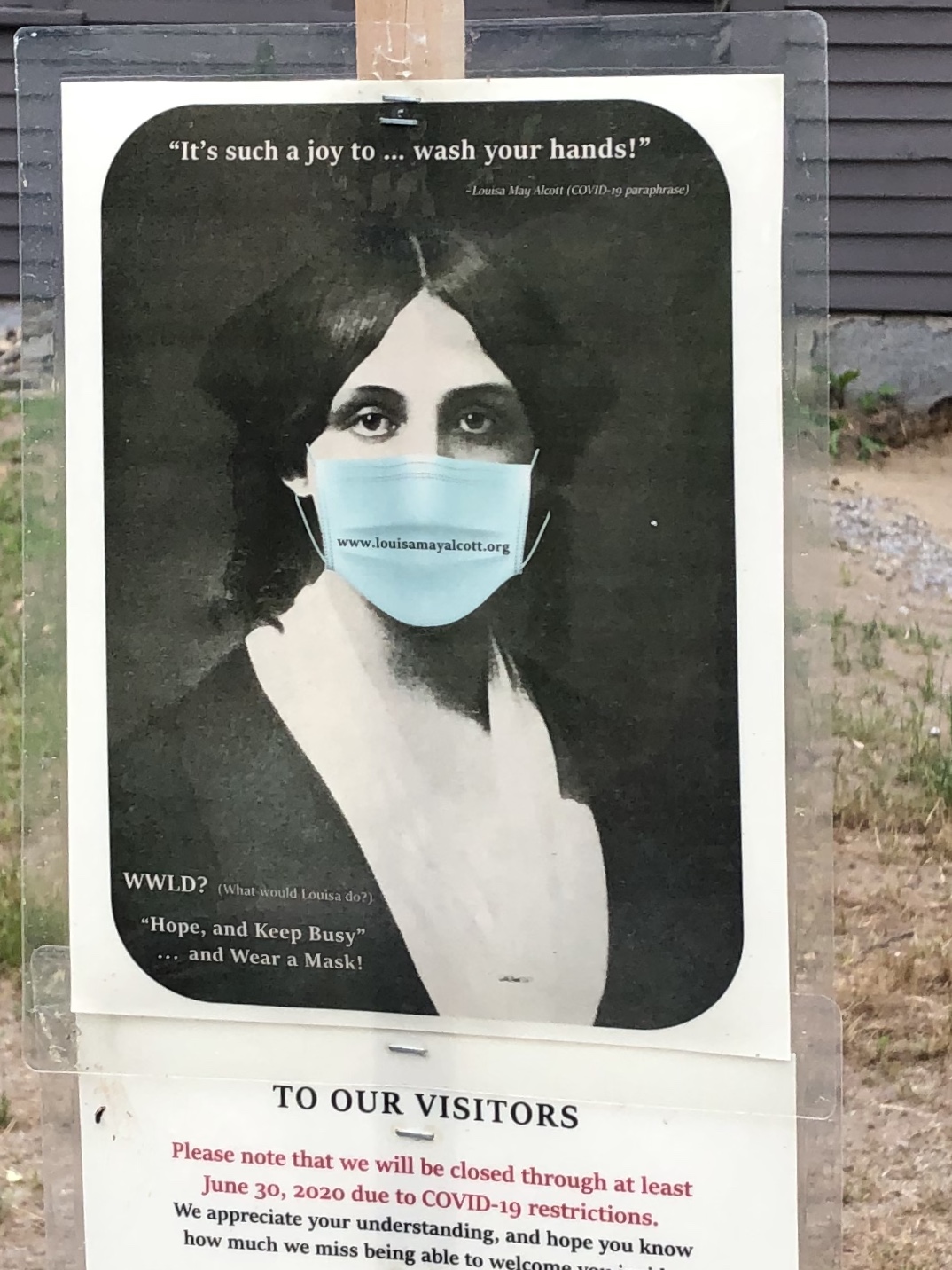
How Louisa has been adapting.

062220-Louisa-May-in-facemask

Read Full Post »

In December, when the Association of Rhode Island Authors (ARIA) was having its annual expo, Erik sent me an email alert. Even though I couldn’t get there, I was curious.

I don’t think of myself as an author, and I’ve never joined a writing group despite the well-known advice from Anne Lamott. But I guess I’m an honorary author as my oldest grandchild once thought it was the same thing as being an editor. (The magazine I used to edit came to his house, and when he saw my photo in it and John explained that I helped to write the articles, he said, “Is Grandma an author?”)

I know that at least one reader of this blog is a Rhode Island author, Tracy Lee Karner.

According to the Association of Rhode Island Authors website, the December meeting was focused on memoirs.”The Lively Literati returns to The Elephant Room in Cranston’s Pawtuxet Village on Thursday, December 17, with authors Patricia Mitchell, Connie Rose Ciampanelli, and Debbie Kaiman Tillinghast. The authors will be discussing memoir writing and sharing short excerpts from their most recent works. Following the presentation, audience members are invited to share their own short writing or poetry, on any topic, at our open mic.”

Also at the website, you can read about the members and many association activities. Note that the “next regular meeting of the Association of Rhode Island Authors will take place on Thursday, January 14, in the Community Room at the Thundermist Health Center, 186 Providence Street, West Warwick. Informal networking begins at 6:30 p.m. and the meeting begins at 7:00 p.m. New authors, members and guests are always welcome.”

Photo: Association of Rhode Island Authors
ARIA member Mark Perry, who agreed to a stint as ‘Post’ Mark, the elf who works in Santa’s mail room. He fielded some surprising questions from kids.

Read Full Post »

I love experiments that garner a new audience for the work of writers and other artists. I remember one effort I tried to join: short fiction for postcards. My submissions weren’t used, but I received a postcard a month for a year, each with a tiny tale.

If you’ve traveled the subway in New York or Boston, you may also have seen posters with some very accessible, but not dumbed-down, poetry.

In France, there’s a vending machine. Alison Flood writes at the Guardian, “Readers in Grenoble can now nibble fiction instead of vending machine snacks, after publisher Short Édition introduced eight short-story dispensers around the French city. …

“Readers are able to choose one minute, three minutes or five minutes of fiction, and, just two weeks since launch, co-founder Quentin Pleplé says that more than 10,000 stories have already been printed.

“ ‘The feedback we got has been overwhelmingly positive … We are getting requests from all over the world – Australia, the US, Canada, Russia, Greece, Italy, Spain, Chile, Taiwan.’ …

“The French publisher hopes the stories will be used to fill the ‘dead time’ of a commute, ‘in a society where daily lives are moving quicker and quicker and where time is becoming precious.’

“ ‘In the bus, the tram or the metro, everyone can make the most of these moments to read short stories, poems or short comics,’ said a statement from Short Édition. ‘And they can be sure to enjoy the ending.’ …

“The stories are drawn from the more than 60,000 stories on Short Édition’s community website, with the publisher’s 142,000-strong reader community selecting the best 600 for the vending machines. Users are not able to choose what type of story – romantic, fantastical or comic – they would like to read. ‘Just the length, it’s the beauty of it,’ said Pleplé.”

More here.

Photo: Short Édition
A short story vending machine in Grenoble. 

Read Full Post »

No, I’m not thinking of the 19th century, of George Eliot (Mary Ann Evans), Currer Bell (Charlotte Brontë), or George Sand (Amantine-Lucile-Aurore Dupin). Masculine names are taken more seriously than feminine ones nowadays, too.

Here is a woman who put it to the test.

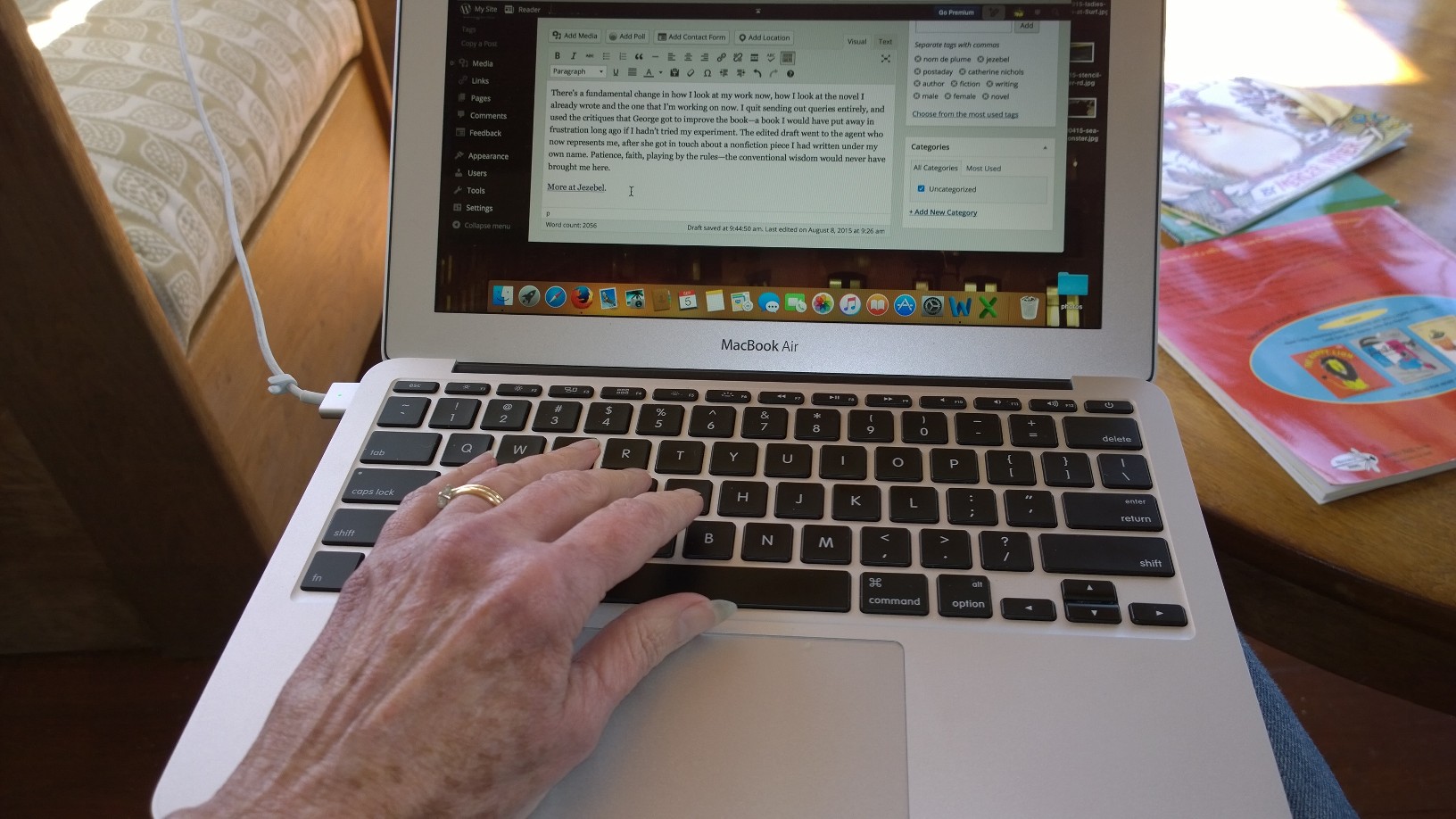
Catherine Nichols writes at the Jezebel blog, “The plan made me feel dishonest and creepy, so it took me a long time to send my novel out under a man’s name. But each time I read a study about unconscious bias, I got a little closer to trying it.

“I set up a new e-mail address under a name—let’s say it was George [Suzanne’s Mom asks, ‘What is it about the name George?’] Leyer, though it wasn’t—and left it empty. Weeks went by without word from the agents who had my work. I read another study about how people rate job applicants they believe are female and how much better they like those they believe are male. …

“So, on a dim Saturday morning, I copy-pasted my cover letter and the opening pages of my novel from my regular e-mail into George’s account. I put in the address of one of the agents I’d intended to query under my own name. I didn’t expect to hear back for a few weeks, if at all. It would only be a few queries and then I’d close out my experiment. I began preparing another query, checking the submission requirements on the agency web site. When I clicked back, there was already a new message, the first one in the empty inbox. Mr. Leyer. Delighted. Excited. Please send the manuscript.

“Almost all publishers only accept submissions through agents, so they are essential gatekeepers for anyone trying to sell a book in the traditional market rather than self-publishing. …

“I sent the six queries I had planned to send that day. Within 24 hours George had five responses — three manuscript requests and two warm rejections praising his exciting project. For contrast, under my own name, the same letter and pages sent 50 times had netted me a total of two manuscript requests. …

“I wanted to know more of how the Georges of the world live, so I sent more. Total data: George sent out 50 queries, and had his manuscript requested 17 times.

He is eight and a half times better than me at writing the same book.

“Fully a third of the agents who saw his query wanted to see more, where my numbers never did shift from one in 25. …

“Most of the agents only heard from one or the other of us, but I did overlap a little. One who sent me a form rejection as Catherine not only wanted to read George’s book, but instead of rejecting it asked if he could send it along to a more senior agent. Even George’s rejections were polite and warm on a level that would have meant everything to me, except that they weren’t to the real me. George’s work was ‘clever,’ it’s ‘well-constructed’ and ‘exciting.’ No one mentioned his sentences being lyrical or whether his main characters were feisty. …

“I quit sending out queries entirely, and used the critiques that George got to improve the book — a book I would have put away in frustration long ago if I hadn’t tried my experiment. The edited draft went to the agent who now represents me, after she got in touch about a nonfiction piece I had written under my own name. Patience, faith, playing by the rules—the conventional wisdom would never have brought me here.” More at Jezebel.

Whew. Now I’m wondering if the fantastic (male) nonfiction writer ML Elrick got some rejection letters because recipients thought he was a female masquerading as a male.  Like JK Rowling. Who now writes mysteries as Robert Galbraith.

090515-typing

Read Full Post »

Asakiyume is a wonderful writer. I have read many of her stories for adults and her three main young adult books. The latest is perhaps the most marketable so far. Kids, teachers, librarians — all sorts of people — will be as riveted as I was. (Perhaps she will comment below with a few words on the theme.)

While waiting for an agent, Asakiyume asked Kelsey Michele Soderstrom to paint the main characters, below, and began to plan a website about the book and its exotic settings.

I thought of Asakiyume when I read an article in the Concord Journal the other day about high schoolers who weigh in on galley proofs of young adult books.

The Journal says, “Just two years after the group’s inception, the Concord Carlisle High School Young Adult Galley has been selected as one of 16 Young Adult Library Services Association Teen Top 10 review groups.

“Members of the group will read galleys, or uncorrected proofs of books, before they are sent off to be published, and select 10 they like best. This information will be used to select YALSA’s top 10 galleys this year.

“Jennifer Barnes, ex-teen library services consultant at Concord Carlisle High School, was the head of YALSA’s teen fiction division and used to bring galleys into the high school’s libraries for interested students to read. The galley group formed …

“When Barnes left the school, students still wanted to review galleys but had a harder time procuring them. …

“Using Kindles, group members would download galleys off of NetGalley, available to bloggers, educators and members of the media. The CC Group members would also send letters to publishers requesting galleys.

“Then, still looking for more galleys to review, the group decided to apply to be a YALSA  Teen Top 10 Review group. …

“ ‘Sometimes authors will respond [to reviews],’ [recent grad Clare] Bannon said. … ‘It was so cool when an author would respond to something you wrote. It would encourage you to keep reading and keep reviewing stuff.’

“The group will continue to get together and meet up to discuss books throughout the YALSA Teen Top 10 process.” More at WickedLocal.com.

Art for Asakiyume’s latest story: Kelsey Michele Soderstrom


Read Full Post »

Author-illustrator Jarrett Krosoczka knows the power of a kind word. He found his calling largely because of two words from a children’s book author who visited his elementary school class.

And he got through a difficult childhood nourished on the kindness of strangers, including lunch ladies, an unjustly maligned species he has honored in a superhero series. (“Serving justice! And serving lunch!)

Linda Matchan has a lovely story at the Boston Globe about Krosoczka.  (I want to call your attention to how nicely she describes him, here: “with impossibly spiky hair that looks as though he penciled it in himself.”)

“Until recently,” writes Matchan, “Krosoczka was very guarded about his childhood. That changed last October when he got a call from the organizer of a TEDx program at Hampshire College, modeled after the TED Talks series. …

“Scrambling for a topic, his wife urged him to talk candidly about his childhood. With no time to come up with other options, he delivered a moving talk about his early years and the people who inspired and encouraged him. The talk caught the attention of the TED editorial team, which featured it in January on TED.com.

“He spoke in his talk about his mother — ‘the most talented artist I knew’ — who was addicted to heroin and often incarcerated. ‘When your parent is a drug addict it’s kind of like Charlie Brown trying to kick the football … Every time you open your heart, you end up on your back.’ …

“Third grade was the year something ‘monumental’ happened. Children’s book author Jack Gantos came to his school to talk about what he did for a living. He wandered into the classroom where Krosoczka was drawing, stopped at Krosoczka’s desk and studied his picture.

“ ‘Nice cat,’ Gantos said.

“ ‘Two words,’ said Krosoczka, ‘that made a colossal difference in my life.’ ”

More.

Photo: Bill Greene
Jarrett Krosoczka declared May 3 (his favorite lunch lady’s birthday) “School Lunch Superhero Day.”

Author-illustrator Jarrett Krosoczka knows the power of a kind word. He found his calling largely because of two words from a children’s book author who visited his elementary school class.
And he got through a difficult childhood nourished on the kindness of strangers, including lunch ladies, an unjustly maligned species he has honored in a superhero series. (“Serving justice! And serving lunch!)
Linda Matchan has a lovely story at the Boston Globe about Krosoczka.  (I want to call your attention to how nicely she describes him, here: “with impossibly spiky hair that looks as though he penciled it in himself.”)
“Until recently,” writes Matchan, “Krosoczka was very guarded about his childhood. That changed last October when he got a call from the organizer of a TEDx program at Hampshire College, modeled after the TED Talks series. …
“Scrambling for a topic, his wife urged him to talk candidly about his childhood. With no time to come up with other options, he delivered a moving talk about his early years and the people who inspired and encouraged him. The talk caught the attention of the TED editorial team, which featured it in January on TED.com.
“He spoke in his talk about his mother — ‘the most talented artist I knew’ — who was addicted to heroin and often incarcerated. ‘When your parent is a drug addict it’s kind of like Charlie Brown trying to kick the football … Every time you open your heart, you end up on your back.’ …
“Third grade was the year something ‘monumental’ happened. Children’s book author Jack Gantos came to his school to talk about what he did for a living. He wandered into the classroom where Krosoczka was drawing, stopped at Krosoczka’s desk and studied his picture.
“ ‘Nice cat,’ Gantos said.
“ ‘Two words,’ said Krosoczka, ‘that made a colossal difference in my life.’ ”

Read Full Post »

Thank you, Gwarlingo, for tweeting this. Looks like there’s hope for us all.

“All your excuses are invalid,” says Dustin Kurtz in an article at the Melville House site about “the seventy-five year old winner of a prize for emerging writers.

“The semiannual Akutagawa prize was awarded in Japan this past Wednesday, and this season’s winner was Natsuko Kuroda. The Akutagawa prize, begun in 1935, is awarded for stories published in newspapers or magazines by new or emerging authors. Kuroda is seventy-five years old.

“Her story, ‘ab Sango’ (it can be previewed and purchased here) is unusual in that it uses no pronouns for its young principle characters, and is written horizontally across the page from left to right, rather than the standard top to bottom. The result is strange and beautiful, and hints at a genealogy of Popper-esque fairy tale formulae, of mathematics or of sociology, and all of which is given subtle cultural freight by Kuroda’s horizontal lines. But again — because it bears repeating — this intriguing emerging writer is seventy-five years old.

“Kuroda is in fact the oldest writer ever to be given the Akutagawa prize, and she is nearly as old as the prize itself. Ryunosuke Akutagawa, the award’s namesake and perhaps Japan’s most celebrated story writer, famously killed himself when he was less than half her current age.

“Upon receiving the prize, Kuroda said, ‘Thank you for discovering me while I am still alive.’ ” More.

Photograph: Melville House, an independent book publisher in Brooklyn, NY.

Read Full Post »

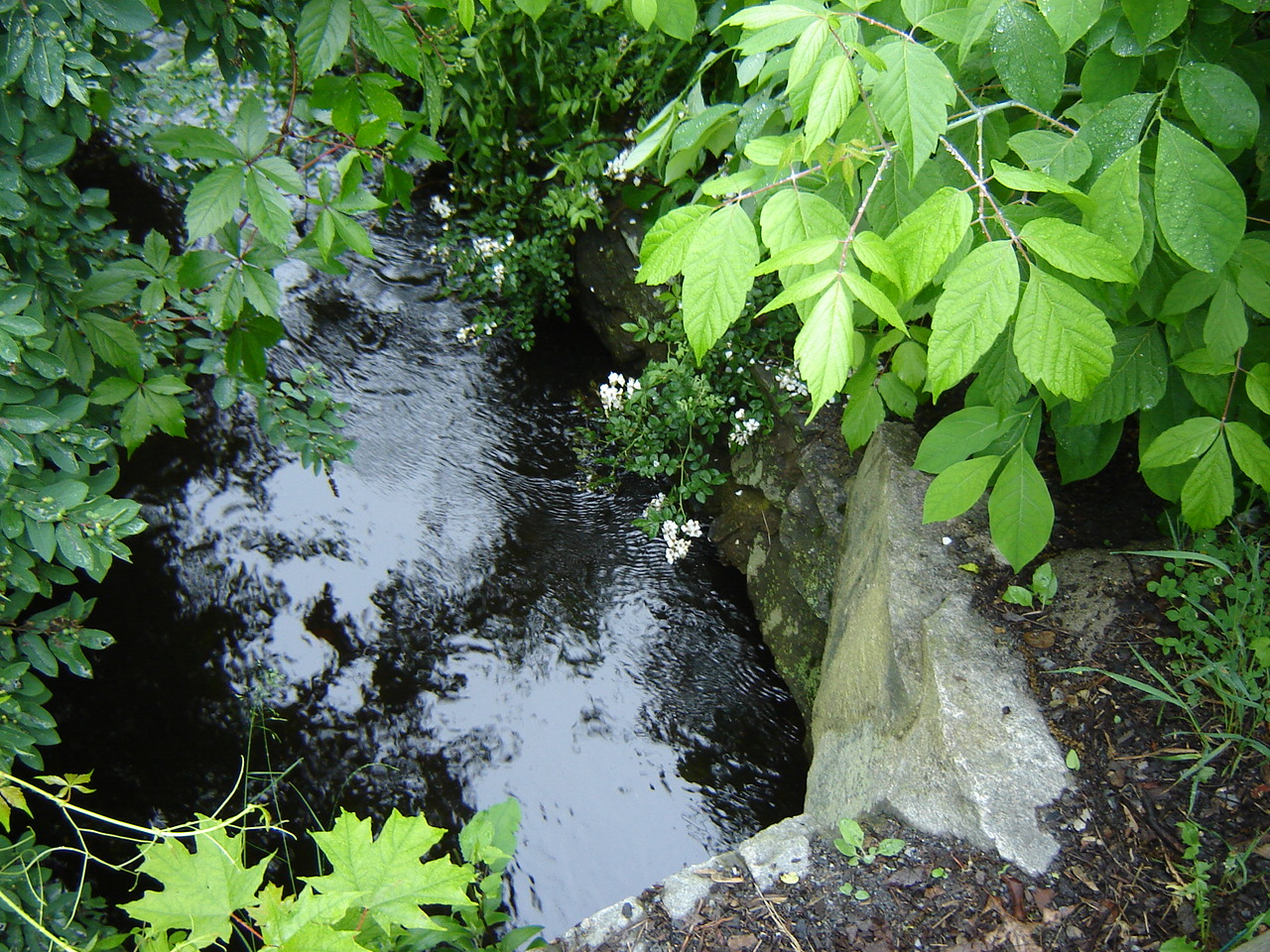
Looking at streams swollen by yesterday’s rain, I began thinking about Scuffy the Tugboat.

“The water moved in a hurry, as all things move in a hurry when it is Spring. Scuffy was in a hurry, too. ‘Come back little tugboat, come back,’ cried the little boy.”

Remember?

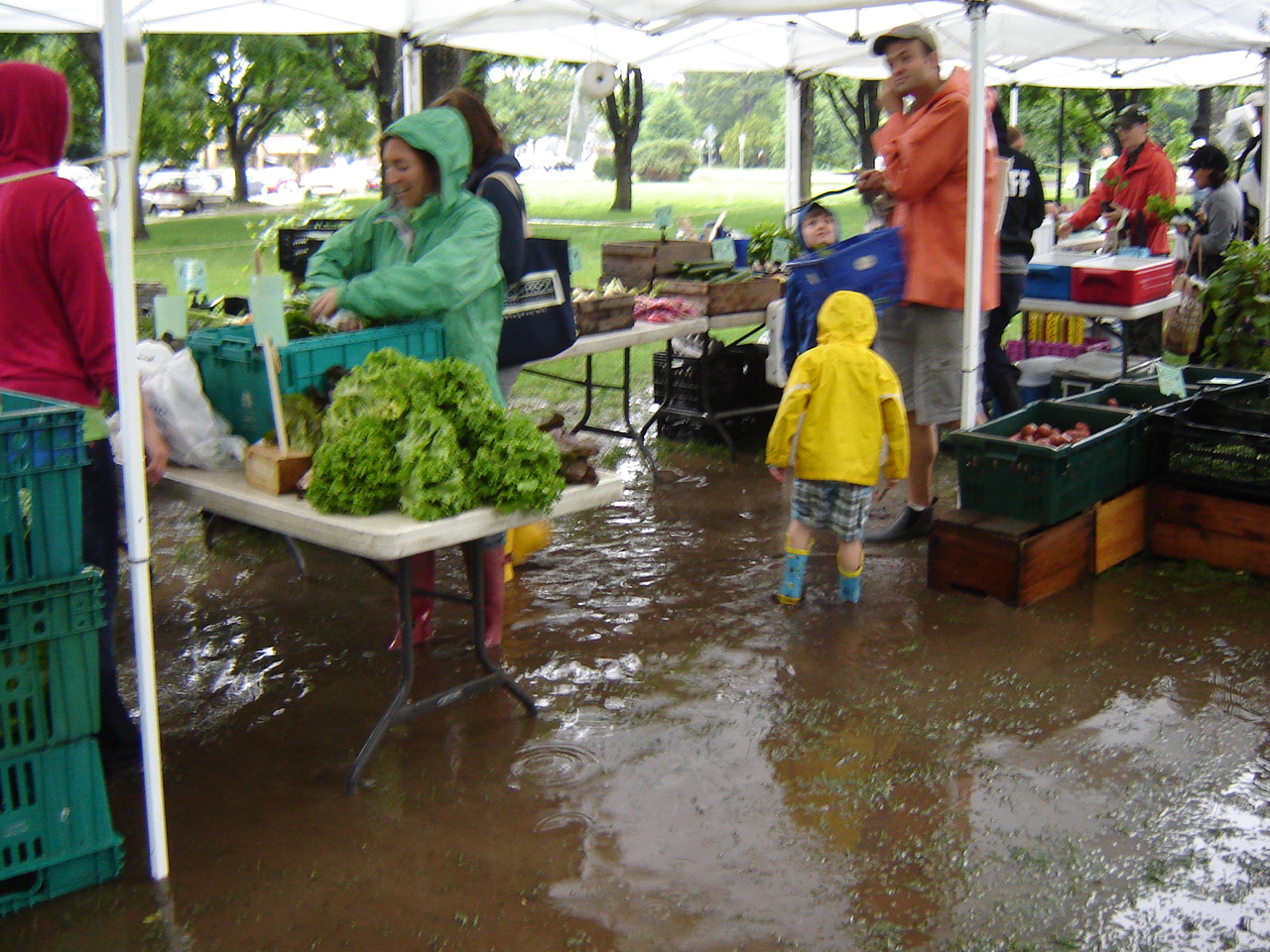
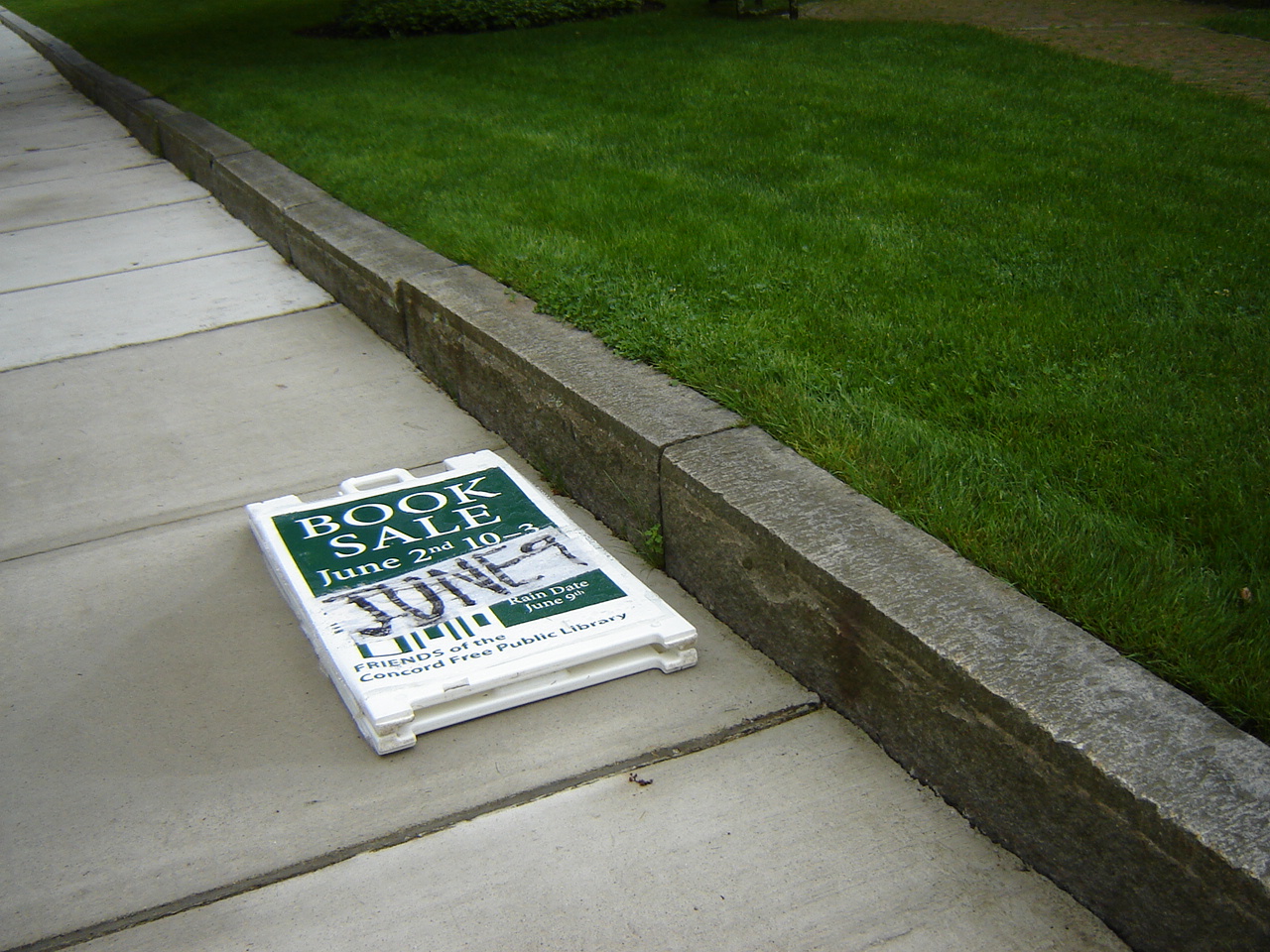
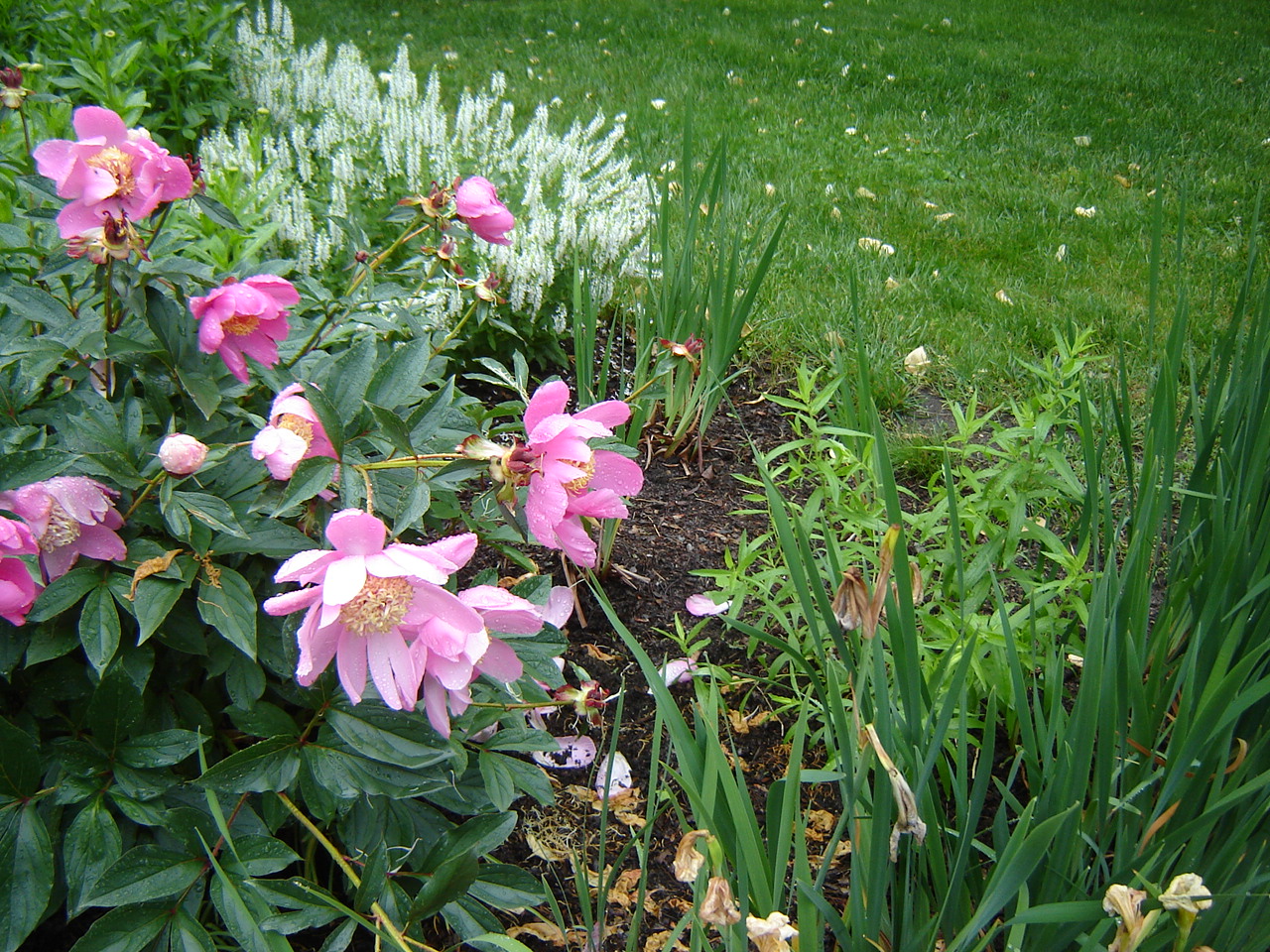
A farmers market in Providence was undaunted by the rain. The farmer at the farmstand here joked that the puddle was just a matter of hydroponic gardening. In other photos, I show peonies and a sign buffeted by the storm — and a rabbit too busy foraging to worry about cameras.

Read Full Post »

I went to the Concord Library today to hear children’s book author and illustrator Ed Emberley give a charming talk to a crew of little kids sitting on a rug.

Emberley used an easel and colored chalks to demonstrate simple ways to create pictures. It was clear that he was used to talking to young children and loved making them laugh. The kids responded gleefully. Grownups did, too.

Several fans asked him — and his wife and collaborator, Barbara — to sign books they had brought along. One woman told me that her kids, now grown, still knew all the words to the Emberleys’ book Drummer Hoff, winner of the 1968 Caldecott Award for  illustration.

I took home a worksheet with Emberley’s drawing tips so I can do more-interesting doodles in long meetings at work.

Read Full Post »