Feeds:
Posts
Comments

Posts Tagged ‘bees’

Photo: Adrian Sherratt/The Guardian.
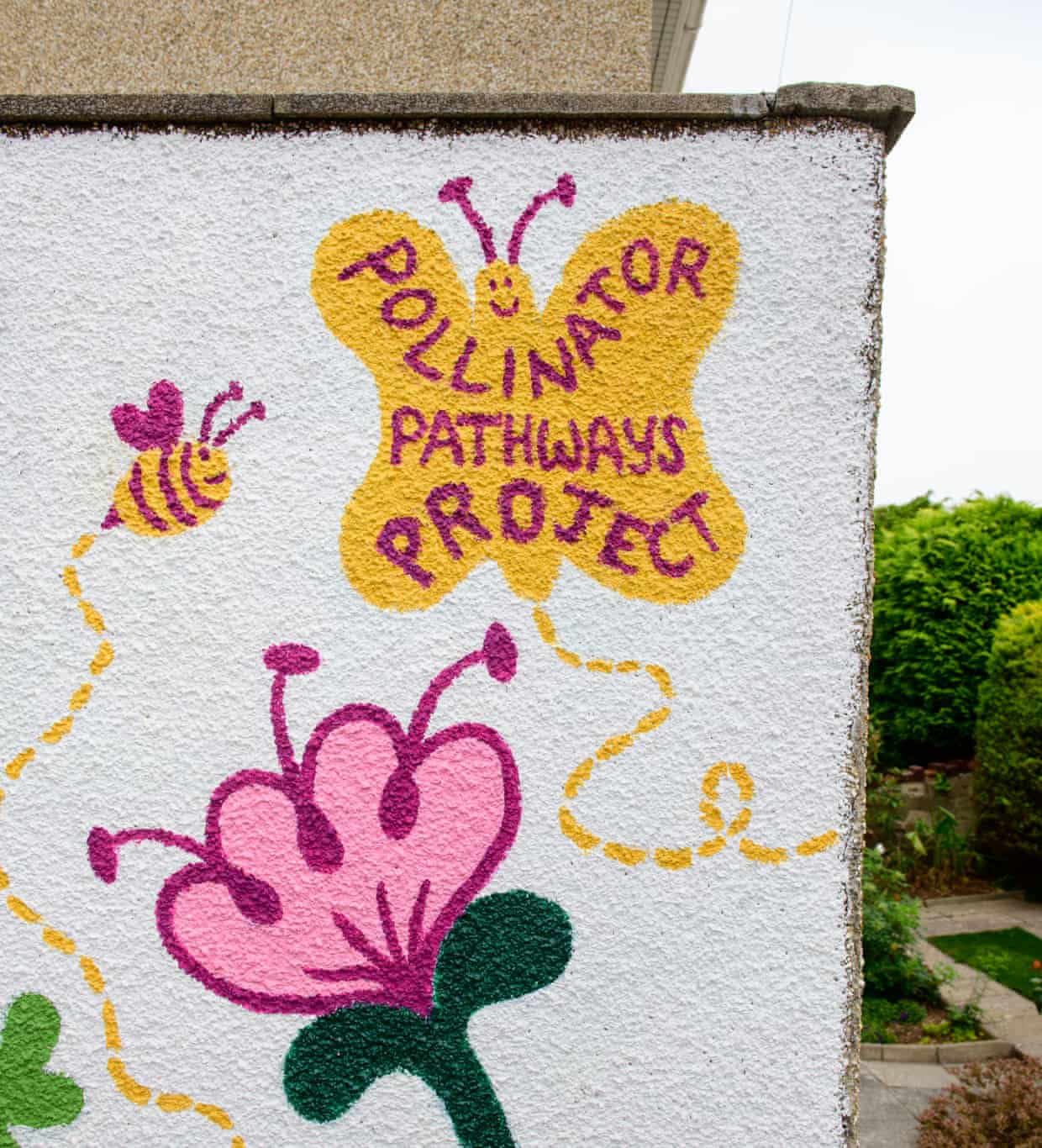
The UK pollinator pathways project in Knowle, Bristol.

I do like stories about how humans sometimes learn what they’ve been doing wrong and then go all out to rectify the damage. I’m speaking of what humanity has done in ignorance to bees and other pollinators that uphold life on Earth.

Emma Snaith has a turnaround example at the Guardian. “Take a closer look at the colorful plants dotted along an initially unassuming Bristol alleyway and you’ll see them teeming with insects. Bumblebees, hoverflies and ladybirds throng around a mixture of catmint, yarrow, geraniums and anemones. ‘It’s buzzing with pollinators now,’ Flora Beverley says.

“Just over a year ago, the alley we are walking down was a dreary, litter-strewn dumping ground. Now, thanks to the pollinator pathways project, it is filled with nectar-rich plants and bee hotels. Colorful murals line the walls. A neighbor and her son passing by stop to tell Beverley they watered the plants yesterday. The local people who helped to transform the pathways continue to maintain them too.

“A trail runner and fitness influencer, Beverley started the project after a chronic illness left her unable to spend as much time running in the countryside. She wanted to bring more nature into her local community and, at the same time, help to connect important nearby habitats in Bristol including parks and the Northern Slopes nature reserve with insect-friendly corridors.

“The project took off unexpectedly well and in the space of a year local groups have revamped seven alleyways around the south of the city. Most transformations take place over a weekend. Volunteers and mural artists pile in, and it is funded by small grants that Beverley – who does not get paid – applies for in her own time, street collections and donations from local businesses.

“ ‘The things that are good for nature tend to be very good for people too,’ she says. ‘We’re lucky to have so many green spaces in Bristol, but there is a lack of connection between them.’ Habitat fragmentation is a big issue.’ …

Scientists are reporting catastrophic declines in insect numbers around the world. International reviews estimate annual losses globally of between 1% and 2.5% of total insect biomass every year. The drivers of the plummeting numbers vary, but include habitat loss, exposure to pesticides and the climate crisis.

In the UK, ​a citizen science survey run by the conservation charity Buglife monitors bug splats on cars. It found a 63% decline in flying insects between 2021 and 2024.

“There are many ways to help protect insects, some simple, others harder to achieve. Prof Dave Goulson from the University of Sussex says that creating more pollinator-friendly habitat in our cities is ‘a fairly easy win.’

“ ‘We already know that urban areas can be surprisingly good for pollinators compared to modern, intensive farmland,’ he says. …

“A huge network of community pollinator pathways has [sprung] up across 300 towns in 24 states in the US and in Ontario, Canada. It began in 2017 when the conservationist Donna Merrill offered people near her home town of Wilton free native trees to form a passage of pollinator habitat that spanned the Connecticut-New York state line. Merrill was particularly inspired by Oslo’s ‘bee highway‘ created a few years before – a network of green rooftops, beehives and patches of insect-friendly plants that stretches across the city.

“In the UK, Buglife is tackling the loss of pollinator habitat on a national scale through its B-Lines network, which is mapping a series of 3km-wide [~2 miles] insect superhighways that crisscross the country, connecting the best remaining wildflower-rich areas. The charity has been working with farmers, landowners, wildlife organizations, businesses, local authorities and the public for more than 10 years to help fill at least 10% of each line with insect-friendly plants. …

“The charity’s B-Lines officer, Rachel Richards, says the lines running north-south are particularly important for migrating species and those moving northwards as a result of the climate crisis.

“ ‘Reconnecting fragmented landscapes builds resilience,’ she says. ‘As we see more fires and floods, it’s quite easy for an amazing site to be destroyed or partly destroyed. But if we have the stepping stones of wildflower-rich habitat, it can be colonized by insects from neighboring sites.’ ” More at the Guardian, here.

In the Greater Boston area, my friend Jean and Biodiversity Builders have been leading the way for years. I wrote about them several times — for example, here. Do you have pollinator pathways near you?

Read Full Post »

Photo: Mike Householder/AP.
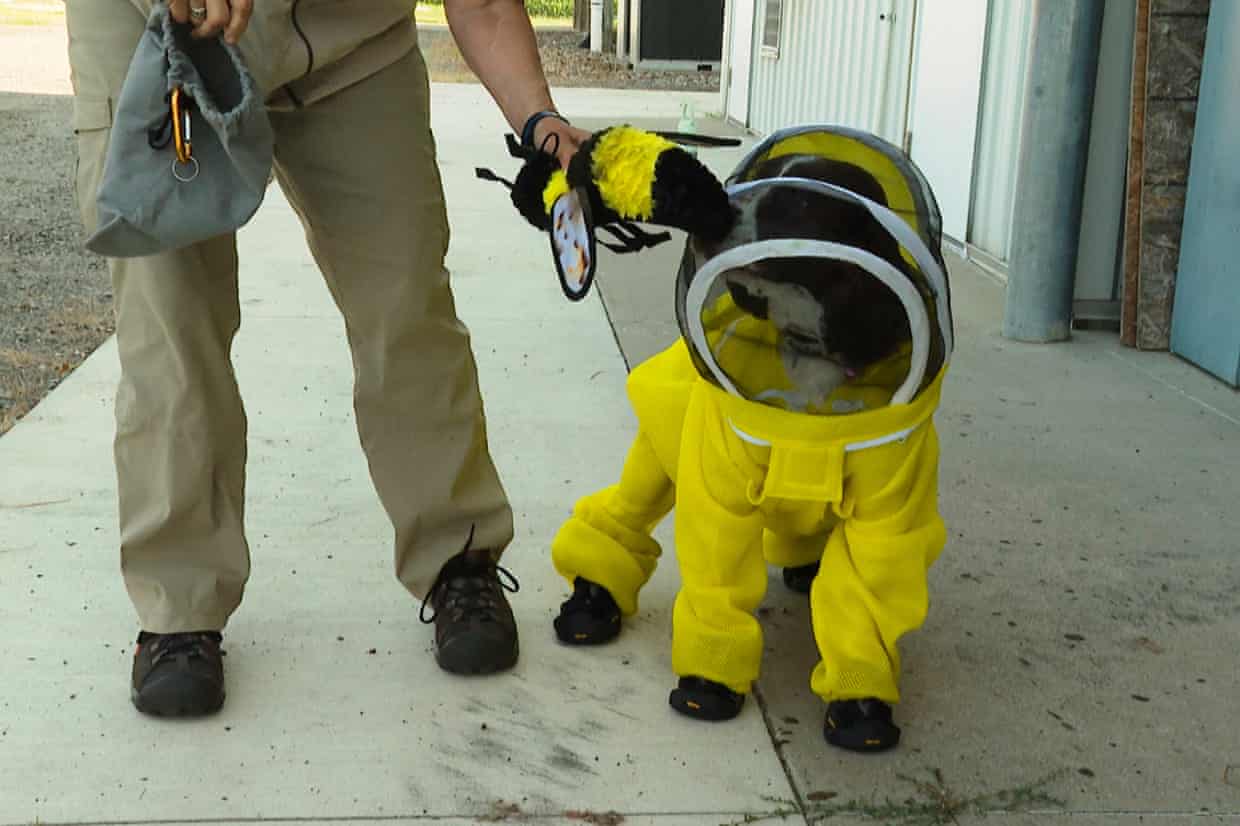
Sue Stejskal lets Maple, an English springer spaniel, sniff a bee-themed dog toy at Michigan State University’s Pollinator Performance Center. Maple is part of an effort to screen and diagnose diseases that sicken honeybees.

It seems that over the past few years, I’m hearing more and more about bees — their importance to the food chain, their worrisome diseases. On Instagram I’ve been following the intrepid Erika Thompson @texasbeeworks, and after Sandra told me about an inspiring bee tour, I added @bodhis.bees in Rhode Island. Then, there’s my friend AJ, who shares honey from his hives when the black bear leaves them alone.

Keeping bees and other pollinators healthy is an important job that’s getting increasingly difficult as unaware humans damage their environment. In today’s story, a specially trained dog is helping protect bees.

Ramon Antonio Vargas reports at the Associated Press via the Guardian, “Maple, a springer spaniel aged nine, is earning news headlines by helping Michigan State University (MSU) researchers identify bacteria that is harmful for bee colonies. …

“Maple landed the role after spending seven years detecting human remains for a sheriff’s office. She had to retire from the sheriff’s office after suffering an injury on the job – leaving her handler, Sue Stejskal, in search of something to keep Maple busy.

“ ‘She’s a very over-the-top, enthusiastic, sometimes hard-to-live with dog because of her energy level,’ Stejskal, who has been training dogs for law enforcement and other uses for more than 25 years, said to the AP.

“Fortunately for Stejskal, MSU professor Meghan Milbrath was seeking out tools to screen and diagnose diseases that sicken honeybees, which her lab studies. A veterinarian who had taken part in a training about honeybees later put Stejksal and Milbrath in touch.

“And soon, the pair hatched a plan by which Stejskal taught Maple to apply her police canine detection methods in beehives to uncover American foulbrood – a bacterial disease that poses a deadly threat to honeybee larvae.

“The work Maple has since done for MSU’s Pollinator Performance Center has been crucial, with bees and other pollinators in a years-long decline stemming from diseases, insecticides, a lack of a diverse food supply and climate change driven by human emissions of greenhouse gases.

“ ‘American foulbrood [harms] young developing bees, and when a hive gets infected, it actually basically leads to death,’ Milbrath, an assistant professor in MSU’s entomology department. …

” ‘Beekeepers have had to burn tens of thousands of dollars of equipment due to this disease,’ Milbrath said to WILX.

“Maple carries out her duties in a distinctive, yellow protective suit. Her gear includes a veil for her head and four bootees worn on her paws to shield Maple in case she steps on a bee. …

“About 465 bee species are native to Michigan alone. Among the goals of training Maple to spot American foulbrood for the Pollinator Performance Center was to create a guidebook with which other dogs could be similarly taught, WILX noted.

“Stejskal told the AP, ‘I was over-the-moon excited because my dog would have joy in her life and would still be able to work,’ Stejskal said.” More at the Guardian, here.

You probably know there are things we can all do to help bees.

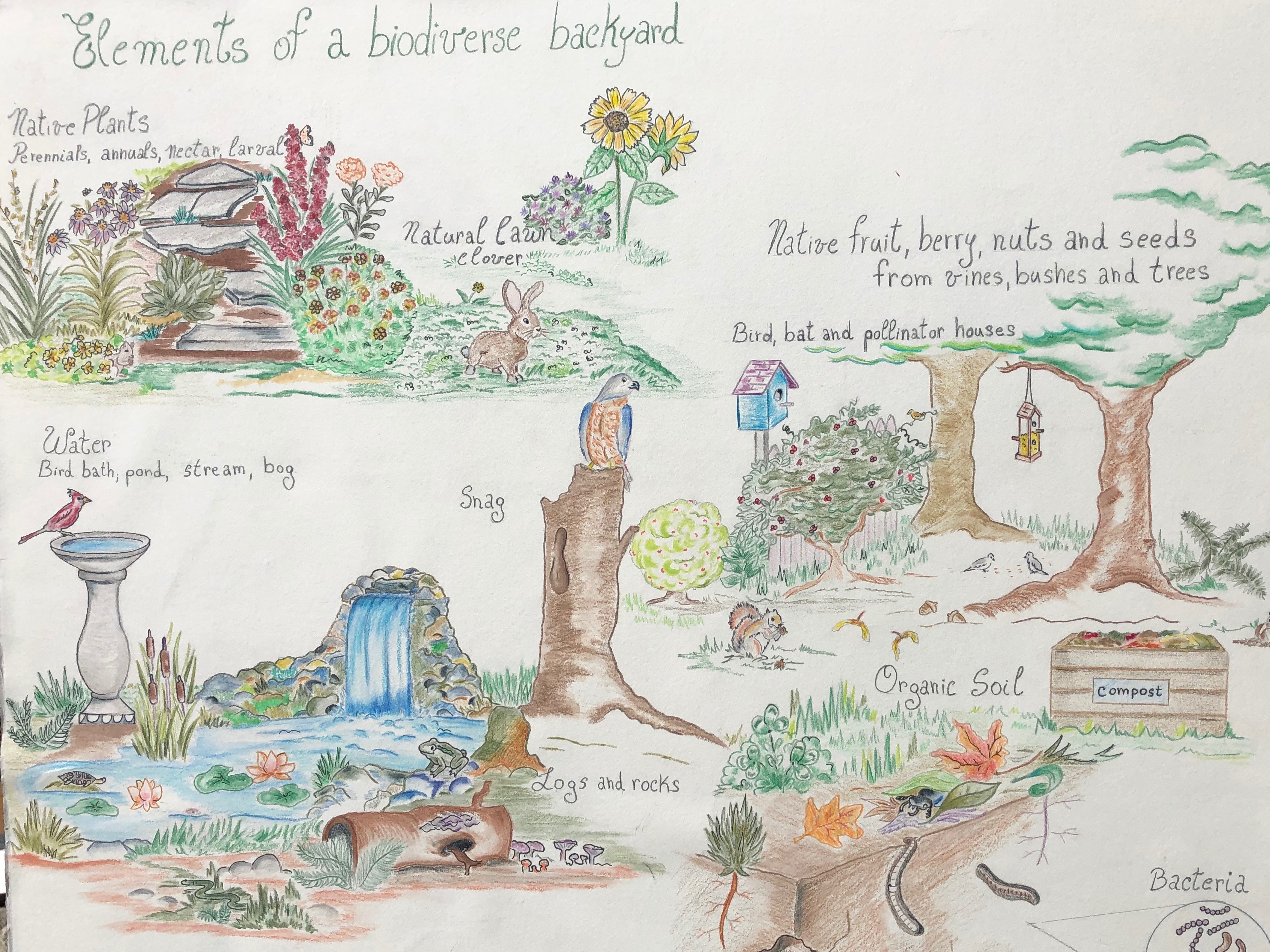
Many homeowners, for example, are giving up pesticides and herbicides. They are leaving the leaves on their lawns in fall to provide pollinator habitat in spring, and they’re committing to No Mow May. After all, as Bee City tells us, “The start of the growing season is a critical time for hungry, newly emerged native bees. Flowers may be hard to find. By allowing it to grow longer, and letting flowers bloom, your lawn can provide nectar and pollen to help your bee neighbors thrive.”

Please add bee tips if you know of some not covered here.

Read Full Post »

Photo: Melanie Stetson Freeman/CSM.
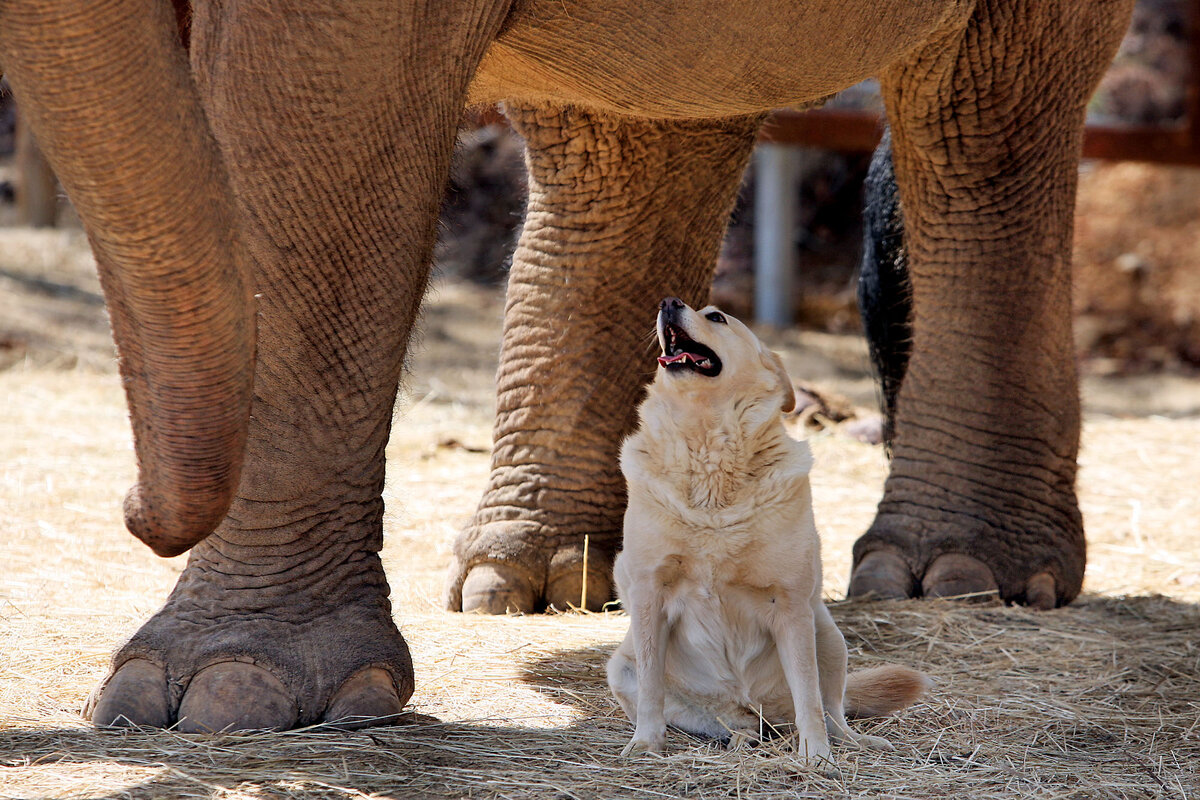
The friendship between Bella, a stray dog, and Tarra, a resident of the Elephant Sanctuary in Tennessee, exemplifies feelings that are not unusual in the animal kingdom.

If you have ever heard Sy Montgomery on Boston Public Radio or read any of her wonderful books about animals, you will know that there is at least one scientist who believes critters have feelings. (FYI: with the exception of the Bobbitt worm, Sy Montgomery loves them all.)

Other scientists also have noticed that animals have feelings. At the Christian Science Monitor, Stephanie Hanes reports on research showing that many “animals exhibit signs of experiencing emotions and being self-aware.”

“This past April,” she writes, “a group of biologists and philosophers unveiled the New York Declaration on Animal Consciousness at a conference at New York University in Manhattan. The statement declared that there is ‘strong scientific support for attributions of conscious experience to other mammals and to birds.’ It also said that empirical evidence points to ‘at least a realistic possibility of conscious experience’ in all vertebrates and many invertebrates, including crustaceans and insects. 

“Researchers have found myriads of indications of perception, emotion, and self-awareness in animals. The bumblebee plays. Cuttlefish remember how they experienced past events. Crows can be trained to report what they see. 

“Given these findings, many believe there should be a fundamental shift in the way that humans interact with other species. Rather than people assuming that animals lack consciousness until evidence proves otherwise, researchers say, isn’t it far more ethical to make decisions with the assumption that they are sentient beings with feelings?

“ ‘All of these animals have a realistic chance of being conscious, so we should aspire to treat them compassionately,’ says Jeff Sebo, director of the Center for Mind, Ethics, and Policy at New York University. ‘But you can accept that much and then disagree about how to flesh that out and how to translate it into policies.’

“Sasha Prasad-Shreckengast is trying to get into the mind of a chicken. This is not the easiest of feats, even here at Farm Sanctuary in Watkins Glen, a scenic hamlet in the rolling Finger Lakes region of upstate New York. For decades the sanctuary has housed, and observed the behavior of, farm animals – like the laying hens Ms. Prasad-Shreckengast is hoping to tempt into her study.

“Chickens, it turns out, have moods. Some might be eager and willing to waddle into a puzzle box to demonstrate innovative problem-solving abilities. But other chickens might just not feel like it.

“Ms. Prasad-Shreckengast also knows from her research, published this fall in the Journal of Applied Animal Welfare Science, that some chickens are just more optimistic than others – although pessimistic birds seem to become more upbeat the more they learn tasks.

“ ‘We just really want to know what chickens are capable of and what chickens are motivated by when they are outside of an industrial setting,’ Ms. Prasad-Shreckengast says. ‘They have a lot more agency and autonomy.’ …

“In other words, how do chickens really think? And how do they feel? And, to get big picture about it, what does all of that say about chicken consciousness?

“In some ways, these are questions that are impossible to answer. There is no way for humans, with their own specific ways of perceiving and being in the world, to fully understand the perspective of a chicken – a dinosaur descendant that can see ultraviolet light and has a 300-degree field of vision.

“Yet increasingly, scientists like Ms. Prasad-Shreckengast are trying to find answers. What they are discovering, whether in farm animals, bumblebees, dogs, or octopuses, is a complexity beyond anything acknowledged in the past. …

“Researchers have found myriads of indications of perception, emotion, and self-awareness in animals. The bumblebee plays. Cuttlefish remember how they experienced past events. Crows can be trained to report what they see. …

“Ms. Prasad-Shreckengast’s study takes place in the wide hallway of Farm Sanctuary’s breezy chicken house. Unlike in pretty much any other chicken facility, the birds here come and go as they please from spacious pens.

“Following up on her previous research, she has designed a challenge that she hopes will appeal to most of her moody chickens. It is a ground-level puzzle box, with a push option, a pull option, and a swipe option. Birds are rewarded with a blueberry when they solve a challenge. …

“The idea of consent – which is a basic, foundational principle in the study of human behavior – is also a hallmark of animal studies here at Farm Sanctuary. To the uninitiated, this might sound absurd, with images of chickens signing above the dotted line. But it is not actually all that rare. Studies of dogs, dolphins, and primates all depend on the animals agreeing, in their own way, to participate. …

“Spearheaded by Kristin Andrews, professor of philosophy and the research chair in animal minds at York University in Canada, the idea emerged from conversations she had with two colleagues, Jonathan Birch, a philosopher at the London School of Economics and Political Science, and Jeff Sebo, director of the Center for Mind, Ethics, and Policy at New York University. …

“ ‘People were dimly aware that new studies were identifying new evidence for consciousness – not only in birds, but also reptiles, amphibians, fishes, and then a lot of invertebrates, too,’ says Dr. Sebo. ‘But there was no central, authoritative place people could look for evidence that the views of mainstream scientists were shifting.’ …

“For instance, trees communicate, and fungal networks send messages throughout a forest. Species such as sea turtles and bats use electromagnetic fields, a force we cannot even perceive, to guide their movements and migrations. Snakes see infrared light, birds and reindeer see ultraviolet light, and dolphins use sound waves to navigate underwater. …

“For generations, the dominant perspective has been that the human perspective is the best view in the house, with the most complex and complete picture of reality.

“But there hasn’t been a species studied over the past 20 years that hasn’t turned out to exhibit pain. There hasn’t been a species that hasn’t turned out to be more internally complicated than people expected, Dr. Andrews says. …

“ ‘That word, “consciousness,” is the problem,’ Dr. Andrews says. ‘The thing that everybody in the field agrees on is that consciousness refers to feeling – ability to feel things. … But then if you start asking people to give a real, concrete definition of consciousness, they’re not able to do it.’ …

“For the purposes of the declaration, researchers said, they focused on what is called ‘phenomenal consciousness.’ This is the idea that ‘There is something that it’s like to be a particular organism,’ explains Christopher Krupenye, professor of psychological and brain sciences at Johns Hopkins University. … Basically means that an animal experiences the world not as a machine, but as a being. Phenomenal consciousness is what you are experiencing right now in your body with the sight of words on a page as you read this article.”

There are numerous species described in the article at the Monitor, here. Don’t miss the playful bees.

No firewall. Subscriptions solicited.

Read Full Post »

Photo: Taylor Luck.
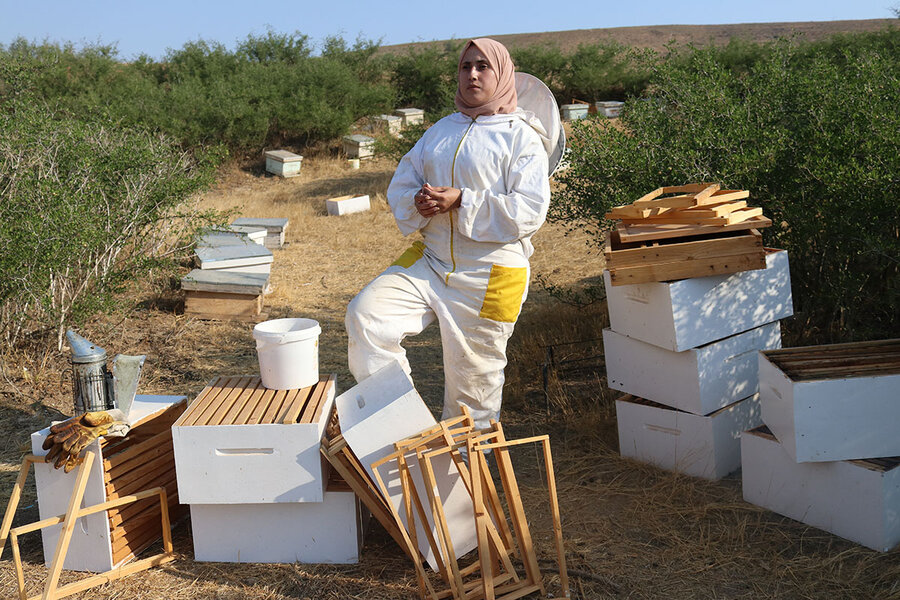
Apiarist and entrepreneur Hela Boubaker stands next to one of her collections of beehives on a farm in Bizerte, Tunisia.

There are two news outlets I especially love for their focus on parts of the world most US media ignores until there’s a disaster. One is the weekday radio show The World. The other is the Christian Science Monitor. These organizations interview people on the ground in foreign countries, voices we seldom hear with perspectives we know nothing about.

In today’s example, Taylor Luck reports at the Monitor on what extreme heat is doing to beekeeping in Tunisia and how beekeepers are adapting to the warming trends that affect us all.

“Tunisian beekeeper Hela Boubaker keeps a firm smile as she inspects an empty hive box, the 20th hive she has lost due to heat or wildfires this year. Hives are carefully placed in the shade on this farm 40 miles north of the capital, Tunis. At 10 a.m. on a late-August Tuesday, it is already 95 degrees.

“Thirsty bees dive-bomb a bucket of water, drowning for a drink before she can place a sponge as a landing pad.

‘It’s not easy,’ she says as she slides an empty honeycomb frame back into its box, ‘but at the same time, we are not easy: We won’t give up.’

“In this North African country, where nearly 40% of citizens and entire communities rely on farming for their livelihoods, bees are a big business. And to protect their beehives against extreme weather, the nation’s apiarists are turning to innovative solutions. …

“Some 13,000 Tunisians work as full-time beekeepers, according to local farming unions, in addition to thousands more who rely on apiary work as another source of income, producing a combined 280,000 metric tons of honey per year. Yet for those new to beekeeping in Tunisia, the past two years have been no honeymoon.

“Tunisia has seen record-setting scorching temperatures, including dayslong 115-plus-degree heat waves and record 120-degree temperatures in its tree-lined temperate north – the nation’s beekeeping hub – that sparked devastating wildfires in 2022 and again this July. This year the country has also struggled with a record drought, leaving regions without water for weeks at a time.

“According to researchers and apiarists, the extreme weather has nearly halved honey production, from an average of 8 kilos (17 pounds) of honey per hive to 4 to 5 kilos per hive in 2023.

“Ms. Boubaker, an entrepreneur in her late 20s, is finding ways to keep her bees alive. She has developed a patented device and nonlethal method to extract bee venom from her honeybees, drawing exactly 0.01 grams of apitoxin per bee to be used in medical treatments and beauty products. …

“To adapt to a changing climate, Ms. Boubaker is working with other apiarists to better cultivate the rented or borrowed plots of farmers’ land where they place their hives. Increasingly, they rely on drought-resistant and hearty plants such as lemon trees, thyme, and marjoram to ensure year-round nectar and food sources for hives, as more delicate flowers and plants wilt in increasingly hot temperatures.

“Like many apiarists, she rotates her beehives through geographic locations with varying topographies – the mountainous pine-treed north, the more arid south, and the rich fertile farmland around Bizerte.

“Ms. Boubaker’s commute to check on her dispersed 82 colonies is a six-hour, 200-mile round trip that she takes every two days. Yet the geographic dispersal of apiarists’ beehives has led to another, emerging threat to Tunisia’s honey-makers: crime. Specifically, theft. …

“ ‘Only a beekeeper would have the knowledge and equipment to be able to pick up hives and transport them,’ says Ms. Boubaker, who rents fields in gated farms to minimize theft. ‘Unfortunately, people are desperate. When you lose the source of your livelihood, you are desperate to rebuild it. Some may be tempted to steal money. Others steal bees.’

“To help Tunisian beekeepers confront 21st-century challenges, innovators are putting constantly updated apiary data in an app. …

“Says Khaled Bouchoucha, a Tunisian engineer who has grappled with solving Tunisia’s plummeting bee numbers, ‘All the knowledge beekeepers have accumulated for decades and generations is no longer applicable’ in a rapidly changing climate.

“In 2021, Mr. Bouchoucha developed and launched SmartBee, a device and app that provides beekeepers with real-time data on hive temperature, humidity, weight, and mortality rates. …

“With the data, advance warnings, and advice sent to beekeepers’ phones, apiarists are informed when to move overheated hives to cooler areas and when isolated hives have become too cold, or they’re alerted to provide sugar solutions to boost weak bees – a critical service when hives are often dozens of miles away. SmartBee is also an anti-theft device.” 

More at the Monitor, here. No firewall. Subscription price is reasonable.

Read Full Post »

Photo: Rachel Rosenkrantz.
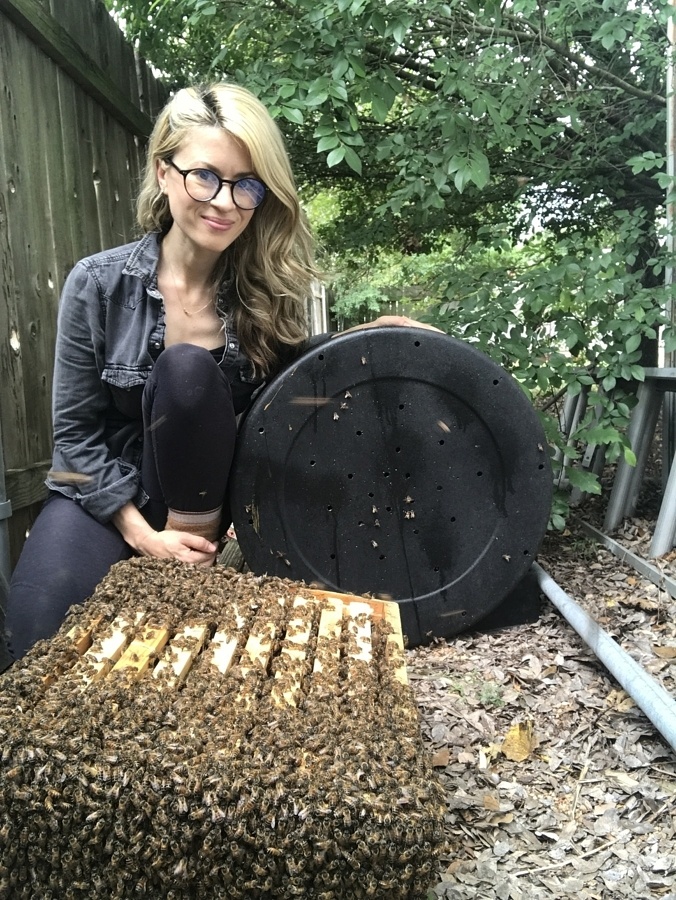
Rachel Rosenkrantz, a luthier, uses all-natural materials. For example, to build a bracing structure for the instrument above, she followed a bee blueprint, placed the structure in a hive, and waited for a year.

Now here’s a commitment to using natural materials that I bet you never heard of.

The nonprofit ecoRI News is great at finding stories like this one by Emily Olson on a Rhode Island luthier who makes guitars using mushrooms and honeycomb.

“During the pandemic lockdown,” Olson reports, “local guitar-maker Rachel Rosenkrantz collected shells from her daily two-egg breakfast. They seemed an appropriate — and certainly plentiful — biomaterial to integrate into a USB-chargeable electric guitar she was working on.

“ ‘Calcium is an integral part of violin varnish because it contributes to the sound quality,’ she explains. With this in mind, and inspired by the work of Gaston Suisse, a French art deco artist who worked with eggshell inlay, she used a laser cutter and manicure file to shape her collected shells into tiny triangles. The eggshell guitar was the last in a series of biomaterial-based instruments she completed during the pandemic. …

“Rosenkrantz had a thriving and well-established career as a commercial furniture and lighting designer when, 10 years ago, she had an epiphany.

“ ‘I can always make money,’ she says. ‘But I can’t make time. … I had been daydreaming about being a luthier for too long to not do it.’ …

“Rosenkrantz grew up just outside Paris in Montfermeil, an industrial town she describes as ‘the Fall River of France.’ She is the daughter of a family of tailors; her grandfather lived in an apartment above his small tailoring shop. …

“Rosenkrantz studied at l’ESAG in Paris, and in her college days, crossed the ocean a couple of times, first as an exchange student at the Rhode Island School of Design — ‘I loved the name Providence,’ she recalls. … She now lives just outside Pawtuxet Village in Cranston … above her guitar-making studio, Atelier Rosenkrantz. ‘I guess I’ve come full circle,’ she says, referencing her grandfather’s shop. … ‘This is my happy place.’ …

“Rosenkrantz is well aware of the negative impact guitar-making has on the environment. Though little seems more environmentally conscious than someone sitting outside plucking a guitar, guitars are made from wood. And it isn’t always harvested in a sustainable way. …

“Rosenkrantz relies on timber updates from the Convention on International Trade in Endangered Species of Wild Fauna and Flora, a Switzerland-based organization that, through international agreement, offers a framework to ensure that when plants and animals cross borders, a species’ survival isn’t threatened.

“ ‘Brazilian rosewood is a big no-no because their rainforests were depleted,’ she says. But it isn’t just the type of wood used that she considers; she also considers how a country manages its resources. ‘India, for example, manages their rosewood really well,’ she adds. …

“Replenishment also is important. ‘Every guitar-maker, every woodworker — if we consume wood, we should grow wood,’ she says. The alternative, of course, is to not use wood at all. …

“One afternoon Rosenkrantz was at RISD, where she teaches spatial design, and decided to spend some time in the Nature Lab.

“ ‘RISD has a whole library of natural specimens, including biomaterials,’ she says. … ‘I know that Styrofoam conducts sound because it’s full of air, so I tested RISD’s [imitation Styrofoam] mushroom sample with my sound diffuser and realized that I could make a solid body sound like a hollow body.’

“The thing that excites her most about using farm waste inoculated with mushrooms in her craft is that she can grow her own design — a plastic mold is at her feet, leaning against the bench. ‘It takes about a week to grow a guitar body — four days to grow, then four days to let a crust develop,’ she says. …

“She slides a banjo from a shelf behind her and explains the body is made from kombucha leather. Kombucha home brewers are familiar with a symbiotic culture of bacteria and yeast (SCOBY), a cellulose mat that forms from the basis of kombucha — sweet tea — and houses the cultures that turn sweet tea into more kombucha. To get a SCOBY large enough make adequate leather for a banjo, Rosenkrantz brewed kombucha in a fish tank. ‘It took 11 tries before I made enough leather for one instrument,’ she says. …

“Rosenkrantz began dabbling in beekeeping, and as she researched hive options, quickly discovered the top bar beehive … a horizontal box with bars on top that support honeycomb, and it allows bees to build the way they would in nature. … ‘The bars in a top bar hive reminded me a lot of the bracing that goes in the front of a guitar that provides rigidity and guides sound,’ she says. … ‘I wondered if I provided the bees with bracing, if I could trick them into building a guitar.’

“But bees are not so easily tricked. ‘Bees have their own egress and architectural code,’ Rosenkrantz says, and she had to learn those codes to encourage the bees to collaborate on a design.

“So, after a great deal of research, she built a bracing structure according to the bees’ blueprint, placed it in a hive, and waited for a year. The result was something she never could have anticipated. The bees not only accepted her design and built their comb along her bracing structure, but they maintained the wood.”

More at ecoRI News, here. Amazing pictures. No firewall.

Read Full Post »

Photo: Christian Jungeblodt/The Guardian.
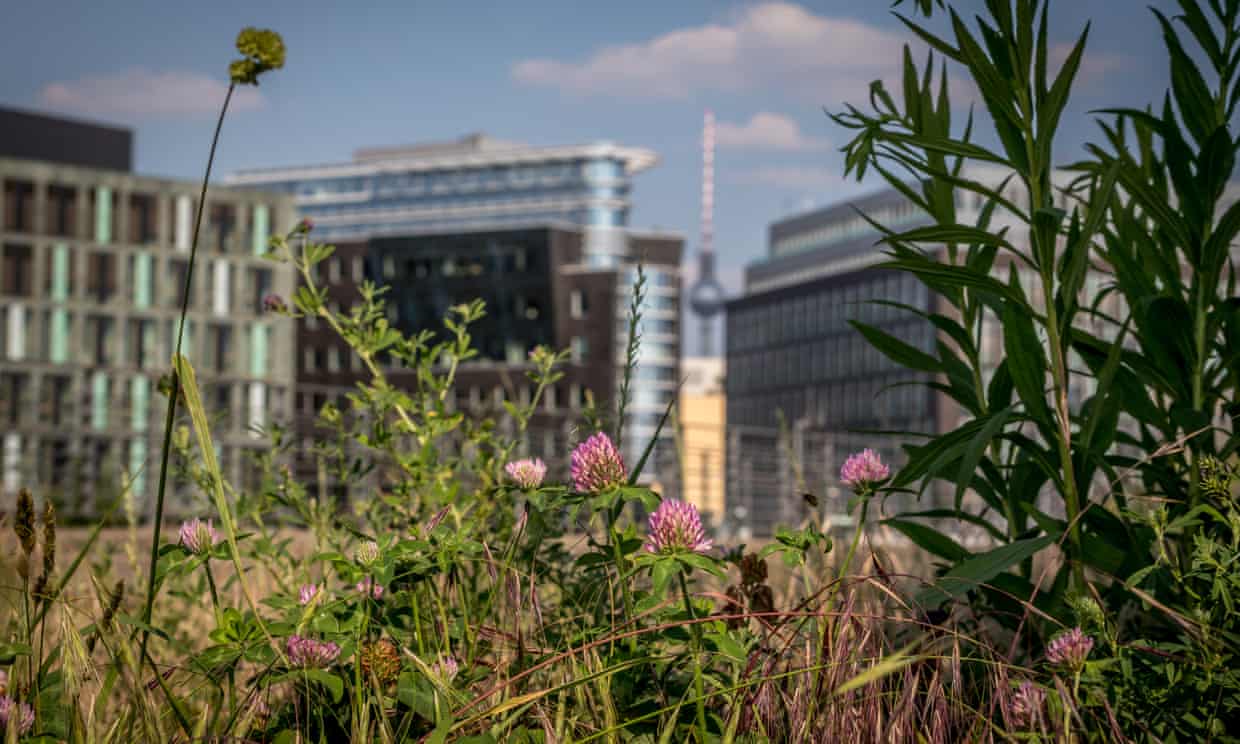
City wildflower meadow with central Berlin’s skyline in the background. It’s all about love for pollinators.

The other day, Asakiyume pointed me to a charming thread on Twitter about volunteers in San Francisco who move bee swarms to safer places.

@Annaleen tweeted, “I have an amazing and wholesome story about a wayward swarm of bees who decided to take up residence on a lamp post in the middle of a residential neighborhood in San Francisco. … love that my city has a volunteer bee swarm emergency hotline! The dispatcher said that exterminators generally call them when they find a swarm. This city is very ‘pro life’ for bees, he told us. When I imagine a better world, this is the kind of experience I think of.”

Meanwhile, in Germany …

Philip Oltermann has this report at the Guardian. “To escape the Berlin bustle on a summer afternoon, all that Derek O’Doyle and his dog Frida have to do is lap the noisy building site outside their inner-city apartment, weave their way through the queue in front of the ice-cream van, and squeeze between two gridlocked lorries to cross over Baerwaldstrasse.

“Bordered by a one-way traffic system lies a bucolic 1,720 sq metre haven as colourful as a Monet landscape: blue cornflowers, red poppies, white cow parsley and purple field scabious dot a sea of nettles and wild grass as armies of insects buzz through the air. Two endangered carpenter bees, larger than their honey bee cousins and with pitch-black abdomens, gorge themselves on a bush of yellow gorse.

“The mini-wilderness on Baerwaldstrasse is one of more than 100 wildflower meadows that have been planted in Germany’s largest cities over the past three years and are coming into full bloom this summer to transform urban landscapes.

“Berlin has set aside [$1.79 million] to seed and nurture more than 50 wild gardens over a five-year period, while Munich has set up about 30 meadows since 2018. There are similar initiatives in Stuttgart, Leipzig and Braunschweig. Hamburg, which started the trend in 2015, this month unveiled the first of a series of bee-friendly flower beds atop bus shelters.

“Juliana Schlaberg of Germany’s Nature and Biodiversity Conservation Union (NABU) said her NGO was receiving more and more requests from city residents who either wanted to grow their own wildflower patches or pressure their council to stop cutting green spaces into manicured lawns. …

“The rain-heavy start to this year’s German summer has created a bloom so spectacular that many a doubter has been swayed. The organisers behind the scheme deliberately mixed in endangered flowers that take two years to come into their prime with populist Akzeptanzpflanzen (‘acceptance plants’) like poppies and cornflowers, which blossom after only a year. Three years on, the full floral array is on display.

” ‘I’ve changed my mind,’ said O’Doyle. ‘It’s become an incredibly attractive addition to our neighbourhood. You experience the seasons in a whole new way.’ Yet aesthetics are a mere bonus for a scheme with serious purpose: the protection of Germany’s population of wild bees.

The country is home to about 580 species of wild bee, of which an estimated 300 can be found in Berlin. More than half are endangered or on the verge of extinction.

“A 2017 study by the Entomological Society of Krefeld showed a 75% decline in total flying insect biomass in protected areas in Germany since 1989, with the use of insecticides, exposure to toxic exhaust fumes and above all a loss of diverse habitats cited as reasons for the drastic decline.

“The findings inspired a 2019 ‘save the bees’ petition in Bavaria that became the most successful in the southern state’s history, nudging politicians to pass into law its demands without putting them to a referendum first. A similar petition will be handed over to the parliament of the large state of North-Rhine Westphalia in July.

“Christian Schmid-Egger, who coordinates Berlin’s wildflower meadows on behalf of the German Wildlife Foundation, said any conservation effort would ultimate require broader changes in agricultural practices: ‘If we are going to save the bees, we won’t be doing it in cities.”’ …

“Unlike the hive-building honey bee, wild bees are solitary creatures always on the look out for new temporary accommodation. … Others have picky dietary requirements: one Berlin species of mason bee, osmia adunca, only collects pollen off viper’s bugloss, a type of plant that only grows in dry grasslands and waste spaces.” More at the Guardian, here.

Asakiyume understood that Annalee’s final statement in the Twitter thread on bee swarms is more or less my philosophy: “Sometimes, if you’re lucky, you get to glimpse a better world in the present. It’s like looking through a pinhole at something huge and distant and almost imperceptible. But you can see just enough of it that you know it’s possible, one day.”

Read Full Post »

Photo: Erika Thompson via StyleBluePrint.
This Texas woman really loves bees. “Bees need advocates,” she says.

If you were to search this blog on words like “bees,” “Honeyland,” and “beekeepers,” you would see that I have a friendly attitude to bees. Besides the fact that they set such a good example for industry and cooperation, there’s this: no bees, no food.

Today’s post is about a woman who really, really loves bees.

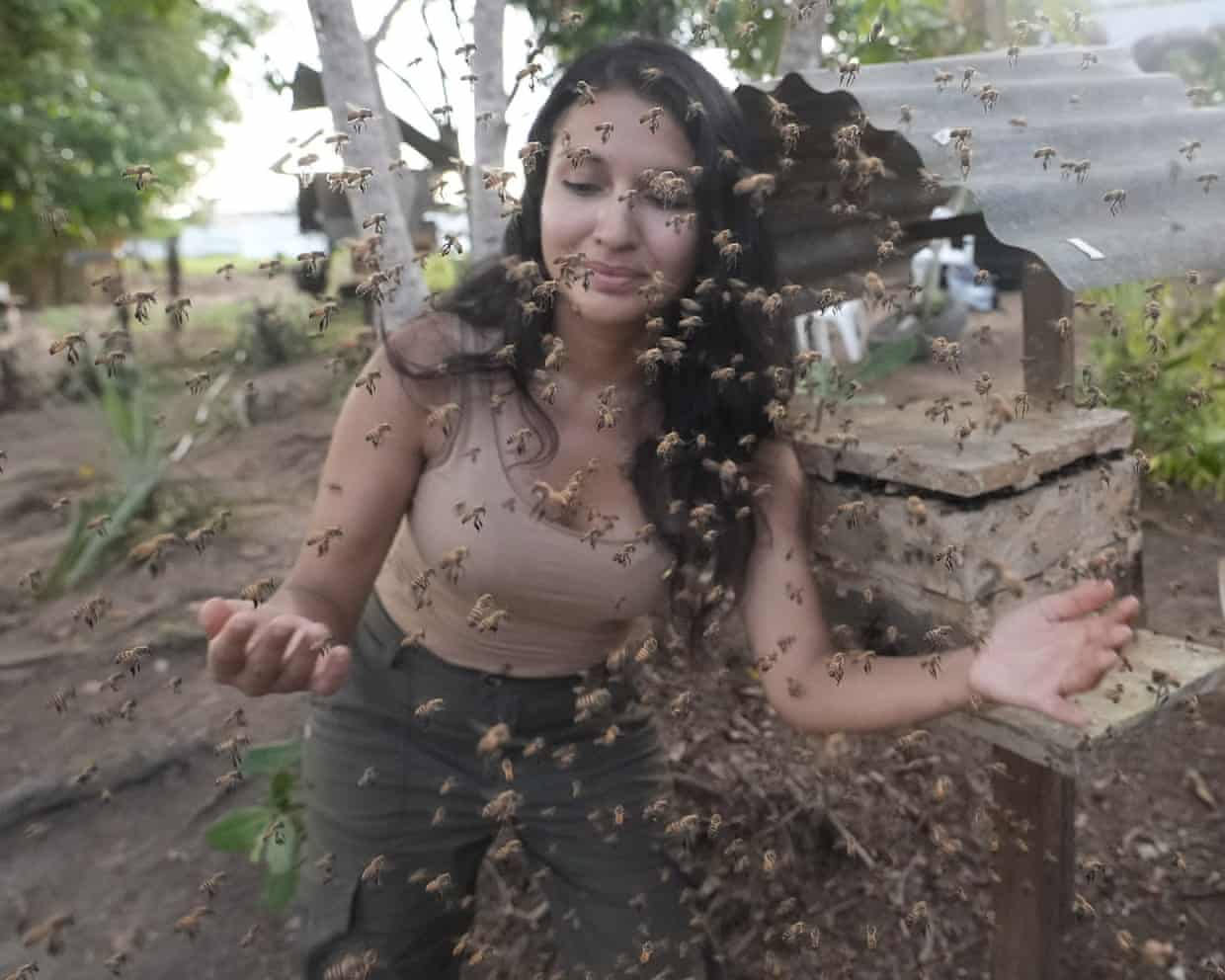
Travis M. Andrews writes at the Washington Post, “The bees drip from Erika Thompson’s bare hand, as if she’s holding a scoop of melting ice cream. But she’s not worried. Just a simple flick of the wrist, and the gentle insects rush into their new home.

“This scene’s out of a recent TikTok from Thompson, an Austin-area beekeeper who has amassed an enormous social media following by documenting her work of ethical bee removal. In this particular video, she explains that she was asked to safely remove a colony of bees that have been living in a backyard shed for two years. At one point, she lifts up a section of wooden flooring to expose hundreds of bees crawling over one another. A delighted grin spreads across her face.

“And like a fly to honey, viewers flocked to the TikTok. It’s been viewed more than 60 million times. …

“Thompson simply love bees. Really loves them. The 35-year-old’s backyard is filled with about 50 hives. … Growing up, Thompson so admired Jane Goodall and Dian Fossey that she would pretend to be them, stringing binoculars around her neck and setting up her stuffed animals like creatures in the wild. Then, she’d head outside.

‘I spent a lot of time in my backyard on nights and weekends, trying to collect bugs and put them in jars … to keep them and care for them,’ she said. ‘It’s something I’ve been into my entire life.’

“About a decade ago, she took a beekeeping class out of curiosity. The University of Texas graduate didn’t expect it to become a living. She worked as a communications director at a nonprofit and didn’t even know if she could keep bees in her central Austin home. But she found herself learning more and more about bees and eventually keeping her own hive.

“She soon launched Texas Beeworks, spending nights, weekends and even some lunch breaks helping others keep bees and driving around with hives in the back of her hatchback. Two years ago, she made it full-time, making her feel like ‘the luckiest person in the world.’ …

“Thompson began making the videos to document her process for clients who, unsurprisingly, usually choose to be absent during a removal. Last year, when the pandemic began, several speaking opportunities she had lined up went by the wayside. With a little more time on her hands, she started a TikTok account. …

” ‘Most of the time when I tell people I’m a beekeeper, they say, “Oh, you’re a bookkeeper?” ‘ Thompson said. ‘I don’t know what has really captivated people, because for me, it’s just so normal. Maybe it’s people seeing something that they’ve never seen before and maybe that they didn’t know was possible.’

“Plus there’s an awful lot to admire about bees, she added, ‘from the way they work together as a superorganism and nobody thinks of herself as an individual but does everything for the good of the colony to the way they build the hive and forage and raise their young.’ …

“Though she didn’t expect her videos to become so popular, she hopes they can help continue changing our attitude by correcting misconception about bees, perhaps the largest one being that ‘all kinds want to sting you all the time.’

“For one, there are more than 20,000 species of bees, all of which have different temperaments. Plus, Thompson said, ‘Most bees, and most honeybees, are docile and do not want to sting you.’ ”

More at the Washington Post, here.

Read Full Post »

2437

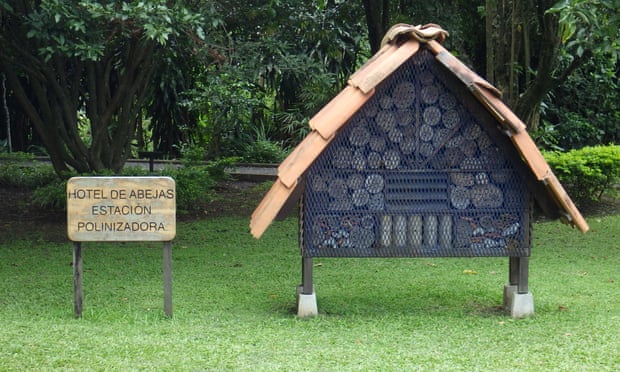
Photo: Curridabat Municipality
A bee hotel, part of Curridabat’s drive to welcome and protect pollinators. Costa Rica takes environmental issues seriously, which has made it a popular destination.

Some folks believe that many of the troubling aspects of our world will get fixed after coronavirus. Some say that’s unlikely. Others expect everything to get worse — problems such as inequality, nationalism, and environmental degradation.

The only prediction I’m confident about is that it will be a long time before we know. Meanwhile, stories from around the world are showing us options — often completely different ways of being.

Consider this story. Patrick Greenfield reports at the Guardian that a suburb of San Jose, Costa Rica, is taking environmental quality very seriously. In fact, the attitude toward nature nationwide has made this part of Central America a desirable destination in normal times. We ourselves went there when the kids were young.

” ‘Pollinators were the key,’ says Edgar Mora, reflecting on the decision to recognise every bee, bat, hummingbird and butterfly as a citizen of Curridabat during his 12-year spell as mayor.

‘Pollinators are the consultants of the natural world, supreme reproducers and they don’t charge for it. The plan to convert every street into a biocorridor and every neighbourhood into an ecosystem required a relationship with them.’

“The move to extend citizenship to pollinators, trees and native plants in Curridabat has been crucial to the municipality’s transformation from an unremarkable suburb of the Costa Rican capital, San José, into a pioneering haven for urban wildlife.

“Now known as ‘Ciudad Dulce’ – Sweet City – Curridabat’s urban planning has been reimagined around its non-human inhabitants. Green spaces are treated as infrastructure with accompanying ecosystem services that can be harnessed by local government and offered to residents. Geolocation mapping is used to target reforestation projects at elderly residents and children to ensure they benefit from air pollution removal and the cooling effects that the trees provide. The widespread planting of native species underscores a network of green spaces and biocorridors across the municipality, which are designed to ensure pollinators thrive. …

“The metropolitan area surrounding San José is home to more than 2 million people – about half of the population of Costa Rica – despite covering less than 5% of the country’s area.

“Were it not for the lush volcanic peaks that surround Costa Rica’s central valley, it would not be immediately obvious that you were in the heart of one of the most biodiverse countries on the planet. Humans dominate and the country’s cloud forests, pristine coastline and emblematic sloths can feel a long way from the concrete and traffic.

“ ‘We attract a lot of tourists because of nature and conservation but there is still friction in the city,’ says Irene Garcia, head of innovation at the mayor’s office in Curridabat, who oversees the Sweet City project. …

“By the middle of the century, the UN projects that 68% of humanity will live in towns and cities, placing further pressure on ecosystems and rapidly vanishing habitats.

“But many urban planners are trying to change this relationship and the importance of green spaces in towns and cities has been recognised in a draft UN agreement to halt and reverse biodiversity loss, often referred to as the Paris agreement for nature.

“Sweet City is just one of a number of biocorridors around the country that allow the genetic spread of species to maintain their strength. In Central America, this concept has developed since the early 2000s following an agreement to form a biocorridor network to connect jaguars.

“ ‘Grey infrastructure makes the city warm up too much. So the idea to connect green areas is to cool down parts of the city, return the ecosystem services that were there previously but have deteriorated,’ says Magalli Castro Álvarez, who oversees Costa Rica’s network of biocorridors with the National System of Conservation Areas (Sinac).

“ ‘Inter-urban biocorridors have a double objective: they create ecological connectivity for biodiversity but also improve green infrastructure through roads and river banks lined with trees that are linked with the small forested areas that still exist in metropolitan areas. They improve air quality, water quality and give people spaces to relax, have fun and improve their health.’

“Many Costa Ricans are happy to speak about the policy benefits of schemes such as Sweet City, as their response to the challenges of bringing nature into the city is part of a deeper national sentiment. It is not in this tiny Central American country’s DNA to behave as if humans were somehow set apart from nature. …

“Says the country’s president, Carlos Alvarado Quesada, who credits Costa Rica’s tradition of pacifism and respect for nature with its desire to tackle big environmental issues, ‘Even though we have a small territory, its characteristics allow us to have 6% of the biodiversity of the world in our land.’ ”

More here.

Read Full Post »

green-bus-stop

Photo: The Independent
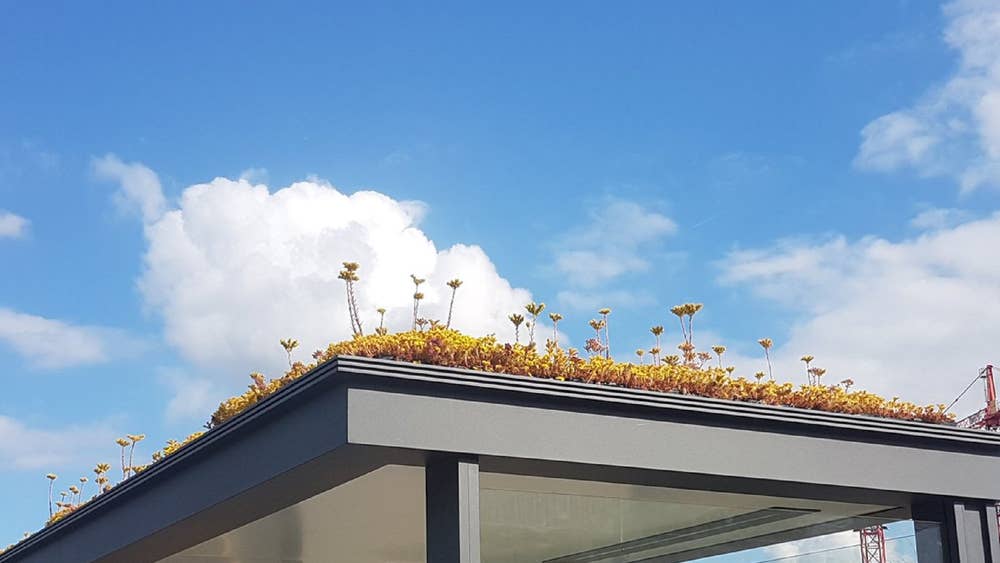
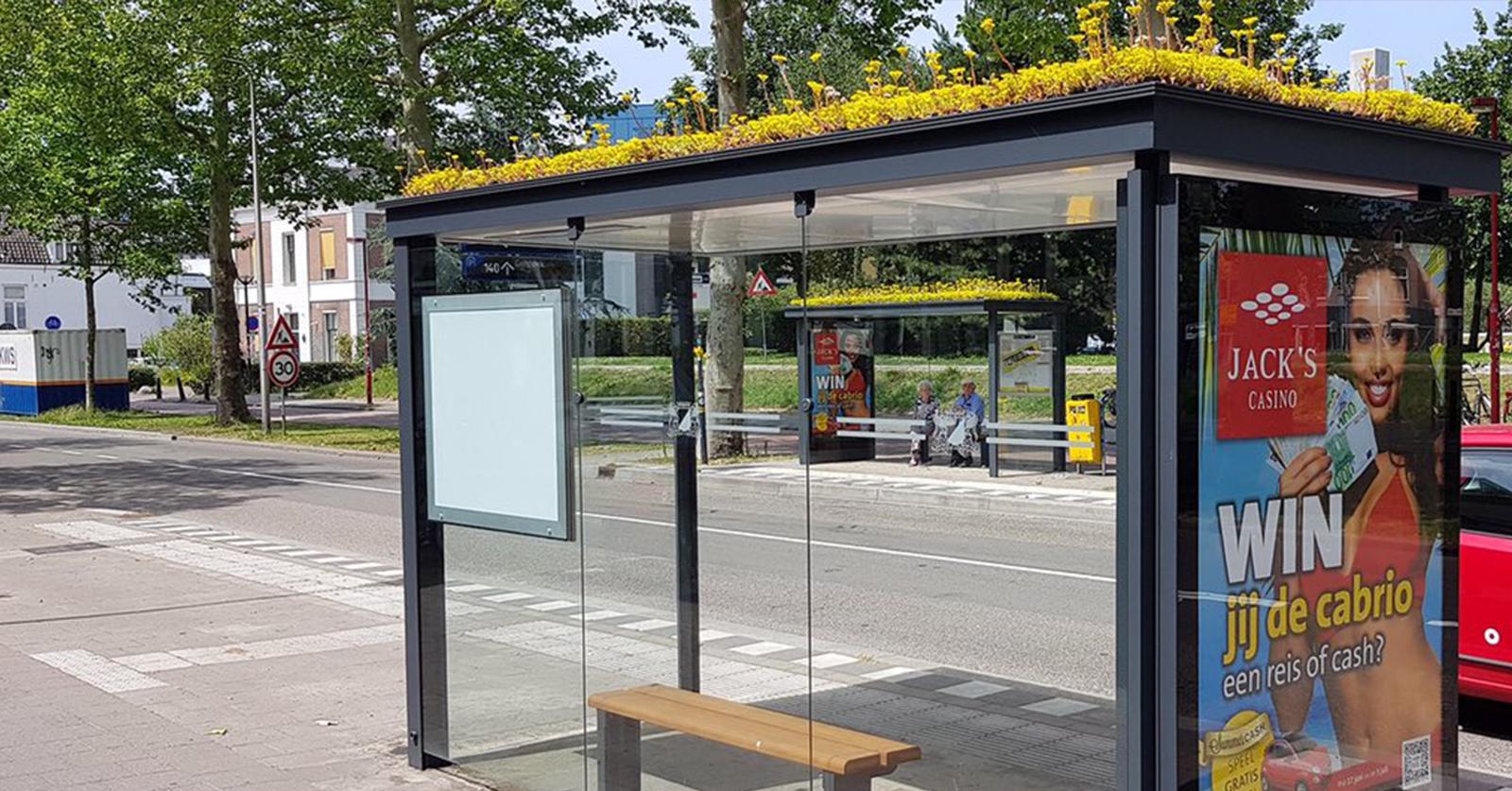
Holland is welcoming bees to bus-stop roofs with plants that also clean dust from the air.

Here is a cool idea for nourishing our valuable pollinators — as long as you’re not allergic to bee stings.

Sophie Hirsh at Green Matters has the story. “Waiting for the bus is typically pretty uneventful — unless you live in one Dutch city. Utrecht, a city in Holland, the Netherlands, recently gave makeovers to 316 bus stops, outfitting them with ‘green roofs,’ The Independent reports. The roofs are covered with sedum flowers and other plants, which act as an oasis for bees. …

“As explained by BrightVibes, the plants will also help absorb rainwater, capture dust or pollutants from the air, and regulate temperatures. …

“In addition to the green roofs, the bus stops also feature bamboo benches and LED lights, which are much more efficient than fluorescent and incandescent lights. And to keep the maintenance of the green bus stops as eco-friendly as possible, Utrecht’s municipal employees who service the bus stops travel from station to station using electric vehicles.

“If Utrecht citizens find themselves inspired when waiting for their daily bus ride, the city is encouraging residents to install green roofs on their houses. In fact, Utrecht residents can actually apply for a subsidy to cover the costs of planting greenery on their roofs, according to BrightVibes. …

“According to the USDA, bee pollination assists in producing one out of every three bites of food we take in the U.S. Many foods we regularly enjoy would not be possible without bees. According to the NRDC, 42 percent of U.S. bee colonies collapsed in 2015, putting our nation’s food supply in jeopardy.

“But over the past few years, there have been a few other local projects to protect bees around the world. For example, in 2010, a German couple began installing bee hives on buildings around Berlin, with the goal of helping bees, as well as creating awareness for the importance of protecting pollinator insects. …

“If you have a garden at your home, there are plenty of ways to use your outdoor space to help bees and other pollinators. For example, you can plant flowers that will attract bees, such as alyssum, echinacea, geranium, and clover, preferably in bright colors like blue, purple, and yellow, according to Gardeners Supply Company. You can also stop weeding your garden and mowing your lawn. As explained by the New York Bee Sanctuary, dandelions and other weeds are great food sources for bees.”

More here.

Photo: GreenMatters.com
Pollinator gardens on bus-stop roofs offer numerous environmental benefits.

bus-stop-bees-1562873127347

Read Full Post »

large_t_bcyzlmnca3tnmpokvf8h7rlalyd5xo7anjqui3htc

Photo: REUTERS/Toru Hanai
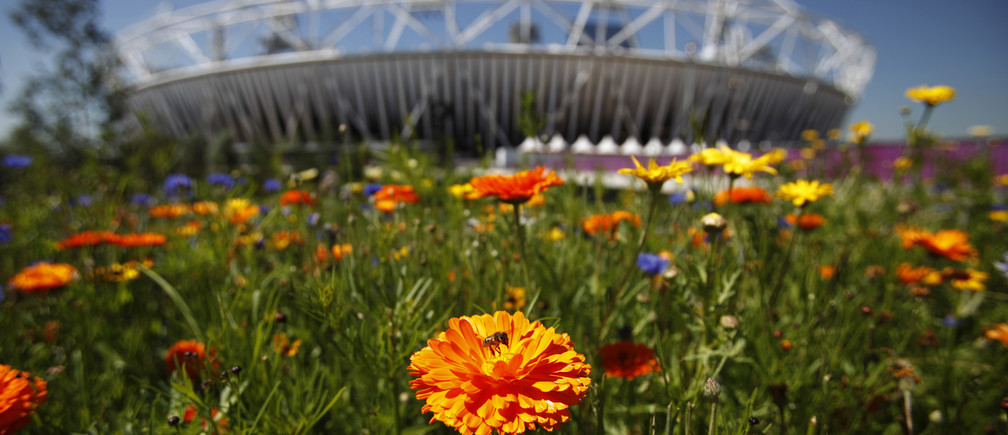
Insects are facing habitat loss across Europe, so London and other cities are taking action.

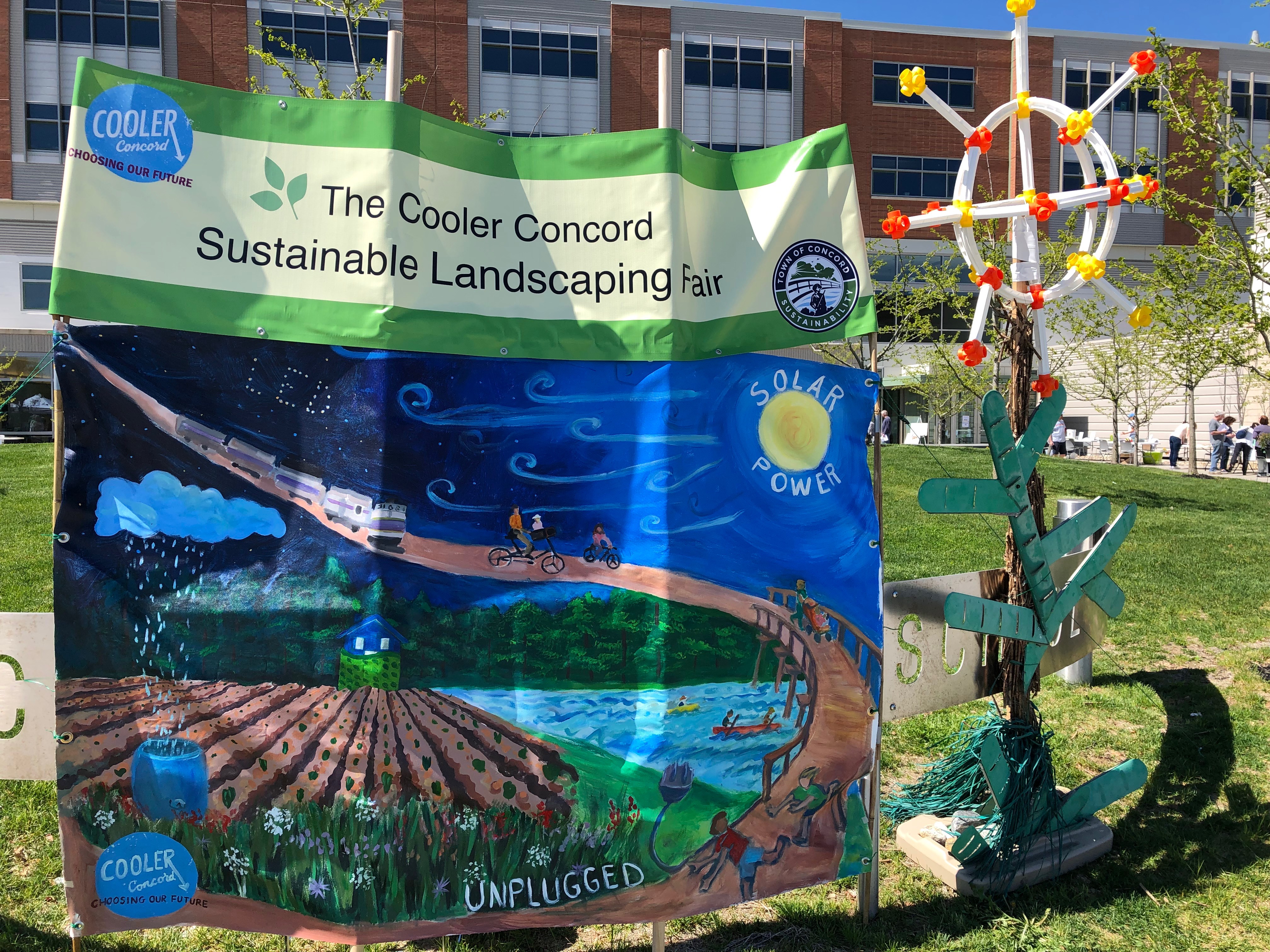
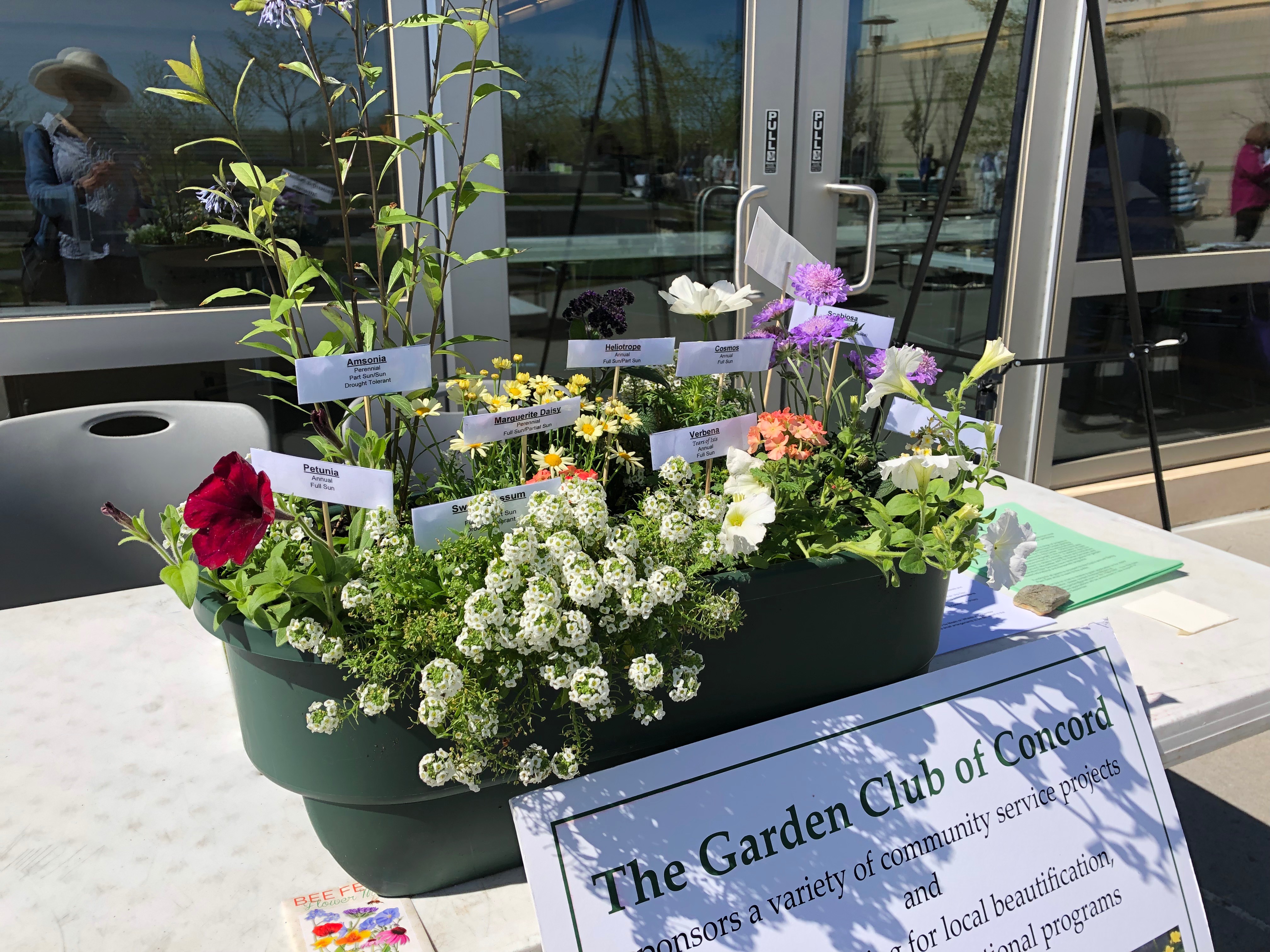
This story is for Jean, whose booth on MeadowScaping for Biodiversity I visited today at the high school’s sustainability event. Forward-thinking students at our school want this town of many lawns and too many lawn chemicals to change its pollinator-killing ways.

Charlotte Edmond at the World Economic Forum reports on how the city of London is getting serious about making bees and other important insects welcome.

“At any one time it’s estimated there are 10 quintillion insects alive. … Many of us hold no great affection for creepy crawlies, so it’s easy to overlook the crucial role they play in supporting ecosystems. Sitting at the bottom of the food web, they are also nature’s waste disposers, crucial to decomposition. Without them we would more than likely go hungry, with many crops needing pollinators to thrive.

But habitat loss and widespread use of insecticides and agrichemicals has led to insect numbers plummeting in recent years.

“In London, as with many other cities, you’re more likely to hear the buzz of cars than insects. But the UK’s capital is looking to give bugs a boost by creating an insect highway through the north-west of the city.

“A seven-mile wildflower corridor is being planted in parkland to provide a safe haven for insects. To support a range of bees and other pollinators, a mixture of seeds has been chosen.

“There has been a catastrophic loss of flower-rich grasslands in England since the 1930s, often as a result of intensive farming or redevelopment of green sites. … Recent studies have shown some species of pollinators in Britain have decreased by up to a third in the past two decades. There has also been a dip in the range of insects seen: in contrast to the sharp decline seen in some species, other insects, particularly those that [eat] crops, have become more prevalent.

“Experts are concerned by the impact the falling bug count will have. The UK government is five years into a strategy to curb pollinator loss, and is working with bodies such as Buglife to introduce more spaces to support pollinating insects. The charity is introducing a network of insect pathways throughout Britain, running through towns and countryside to connect existing wildlife areas together.

“Alongside this, it is working to create ‘urban hotspots’ for insects, transforming mown and unused areas of land by introducing shrubs, flowers and so-called bee hotels.

“Elsewhere, Norway has built a ‘bee highway’ through its capital, Oslo. And Berlin is one of a number of cities around the world to have introduced urban hives in a bid to support bee populations.

“Honey bees, bumblebees, wild bees and other pollinators are estimated to bring at least $25 billion to the European agriculture industry, ensuring pollination for most crops and wild plants.”

For more on London’s biodiversity efforts, go to the World Economic Forum site, here, where you can also find related stories.

Student-run fair to encourage town residents to use sustainable practices in their yards.

051819-sustainable-landscaping-fair

051819-native-flowers-Massachusetts

051819-MeadowScaping-for-BiodiversityJPG

Read Full Post »

bees-at-the-lyric-final_0

Photo: Omari Daniel
Bees at the Lyric Hammersmith Theater in West London.

The arts are always struggling for funds, so it’s lucky that artistic people are by definition creative. In this story, some creative theater people thought up a way to help the environment while simultaneously raising a little cash for their work. It’s all part of a theater’s broad sustainability plan.

Sian Alexander writes, “As a leading producing theatre and the largest creative hub in west London, the Lyric Hammersmith welcomes around 200,000 people a year to its building, including 30,000 young people at classes and activities. We have nine Young Lyric partners based here, three resident companies, 50 permanent staff and over 500 freelancers each year – all under one roof.

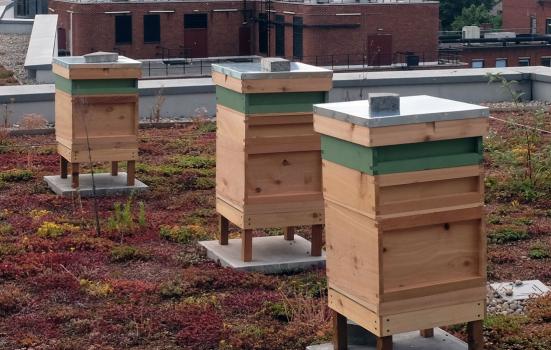
“Our roof is also now a symbol of our long-standing commitment to environmental sustainability. As well as our public roof terrace, a green oasis in the heart of an urban environment, we have a green sedum roof — covered in plants — installed in 2015 during our last major capital redevelopment.

“Last year we teamed up with the local business improvement district, HammersmithLondon, to install three beehives on the roof, now home to 180,000 Buckfast honey bees. They seem to be happy here, and this summer we enjoyed a substantial honey harvest. We sell the honey in our café and at local markets, where it is a great conversation starter about our efforts to go green. …

“Bees have a critical role in food production, as around a third of the food we consume relies on pollination. The bees also help our green roof mature through pollination, and help improve air quality and biodiversity in the local area. …

“We strive to ensure our green values run through all elements of our business. For example, our building has air-source heat pumps and predominantly LED lighting; we send zero waste to landfill, working with First Mile and Scenery Salvage; our energy supply is 100% renewable electricity and green, frack-free gas; our finance and administration teams run on a paperless system; and all new staff and creative teams are given a reusable water bottle on their first day. …

“We are introducing a vegetarian and vegan specials menu in our bar and grill, visiting allotments and trying alternative foods. We are also running a stall at the local food market to engage the public on food packaging, as well as addressing food waste.”

More at Arts Professional, here.

Read Full Post »

3466

Photo: The Guardian
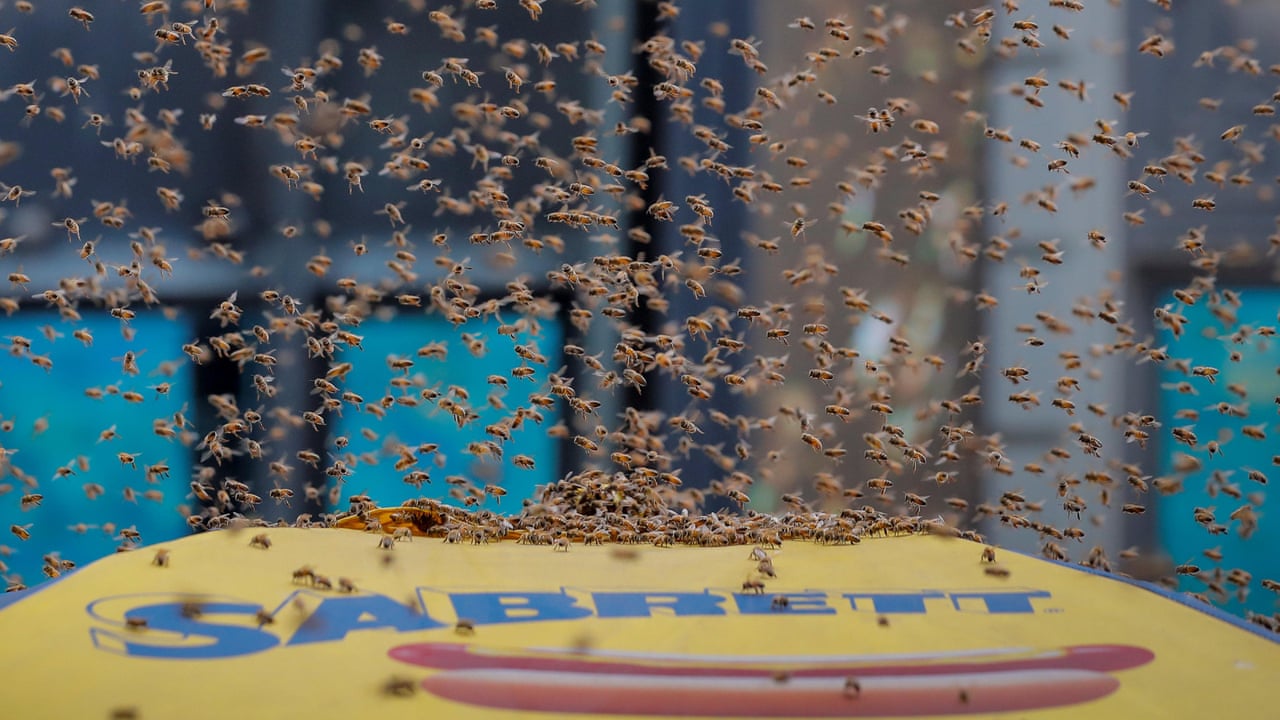
What it looked like when a swarm of bees attacked a New York City hotdog stand.

As you know, I think New York City is an endlessly unspooling entertainment reel. This adventure with swarming bees is a typical example. Wish I had seen it. The police officer in charge must have been surprised to discover that a bit of obscure training would actually come in handy someday.

As Adam Gabbatt reported at the Guardian, “Productivity came to a halt across New York City offices on Tuesday afternoon, as hordes of people eagerly followed the removal of 20,000 bees from a hotdog stand. …

“Thousands watched a Reuters livestream – the stand is located outside the news agency’s New York headquarters – and followed on Twitter as a police officer was called in to remove the bees. With a vacuum cleaner. …

“Officers from the New York police department stood guard, some more willingly than others, as one of their colleagues donned a beekeeper’s hat and approached the hotdog stand.

“The bees had gathered in a densely packed, roughly 15-square-foot clump, and the unidentified officer, who wore a white jacket, thick gloves and has a moustache, proceeded to vacuum up the bees. The bee cleansing took about 40 minutes, much of which was watched online.

“By around 3 pm, the officer, who told journalists he ‘has training,’ had removed the bulk of the bees, but many remained in the area, swarming around a selection of soft drinks displayed on the hotdog stall. …

“Andrew Coté, who runs the New York City beekeepers’ association, had answered a call from the NYPD and was watching as the bees were removed. Removal by vacuum cleaner – it was a specially adapted vacuum cleaner – was common, Coté said. He estimated there were 20,000 bees on the umbrella, but said: ‘You’ve got to count the legs and divide by six to be sure.’

“Coté said … this late-August swarm had likely occurred because of an ill-managed beehive. He said there were a number of hives within a block of the hotdog stand.

“By 3.15 pm police had re-opened the street, although a number of bees were still on the scene.” More here.

You definitely have to know what you’re doing with bees. I’m sure a transplanted Minnesota beekeeper I know in Berlin, Massachusetts, would have managed his hives better if he had set up in a city. Beekeeping is serious business, and you don’t want to be responsible for anyone with an allergy getting stung.

Video: Reuters

Read Full Post »

In Denmark, a beekeeping program is not only beneficial to the environment but a good way for refugee workers to settle in to a new culture.

Jennifer Hattam writes at Take Part about bees atop Copenhagen’s convention center that pollinate crops, produce honey, provide employment, and help flavor a local beer.

“The honey and the beer are the fruits of the innovative project Bybi, named after the Danish word for ‘city bee.’ Its mission: to use urban beekeeping to create a greener Copenhagen, connect residents with the city around them, and bring together and employ people from diverse backgrounds, including refugees and the formerly homeless.

“Syrian beekeeper Aref Haboo is among Bybi’s small staff. He kept dozens of hives back in his home village while also working as a civil servant and agricultural consultant. Like millions of refugees fleeing Syria’s civil war, Haboo made the treacherous journey to Europe, part of it smuggled in the cargo hold of a truck, leaving behind his wife and three children to find a safer place for them all to live. A year ago, he was able to reunite his family in Denmark. …

“Haboo recently helped teach a season-long apiculture course to a mixed group of around 20 Syrians, Africans, and Europeans, who produced 450 kilograms of honey from hives in a Copenhagen park. Graduates who want to continue working with bees will receive support from Bybi, and proceeds from the sale of the first course’s honey will help fund training sessions.

“ ‘A lot of our residents have difficulties getting into the Danish labor market, whether because of language issues, skills gaps, or health problems. Working with Bybi is good for them in terms of getting out to meet people and doing something constructive, something they can be proud of,’ says Simon Christopher Hansen, cultural coordinator for the Copenhagen public housing association 3B. …

“With relatively high rates of winter mortality among honeybees in Denmark, Bybi’s urban hives also help ensure that bee populations stay healthy — along with the green environment they nurture and depend on.

“In a way, [social entrepreneur Oliver Maxwell, who founded Bybi in 2010] sees the hive as a model for Bybi and for humanity. ‘We’re looking at ways we can work together that protect our communities and enrich our environment,’ he says. ‘That’s what bees do: They create bigger apples, richer strawberries; they help everything thrive.’ ”

More here.

Photo: Bybi
Beekeeping in Copenhagen helps refugees and the environment.

Read Full Post »

Photo: Aram Boghosian for The Boston Globe
Jean Devine (left) and Jayden Pineda, 7, make a meadow at the Waltham Y.

I’m excited that today the Boston Globe caught up with my friend Jean’s terrific biodiversity-education outreach. Readers may recall that I blogged here and here about how she and Barbara Passero got started on “meadowscaping” — hoping to ween homeowners from using pesticides and herbicides that harm the environment and contribute to global warming.

Debora Almeida reports on the educators’ latest work with kids: “Swimming, crafting, and playing games are staples of day camp, but kids at the Waltham YMCA are doing something new this summer.

“They’re learning how to plant and cultivate a meadow — and why they should.

“ ‘We just want to save the world, that’s all,’ said Barbara Passero, cofounder of Meadowscaping for Biodiversity, an outdoor environmental education program for students of all ages, which has partnered with the Y for the project.

“Over the course of the summer, Passero and program leader Jean Devine are teaching children the fundamentals of meadow upkeep and the importance of planting exclusively native plants. They are the best hosts for pollinators, such as bees, butterflies, and moths. In turn, the insects attract other wildlife such as birds and rabbits, building biodiversity.

“While some people’s first instinct would be to spray pesticides to protect their hard work from leaf-munching insects, Passero knows that birds will take care of the insects on their own. She also refuses to use any toxic substances around the children, who truly get their hands dirty digging in the meadow. Seth Lucas, program administrator at the Waltham Y, said kids love the activity. …

“The meadow started as a patch of weedy grass, but is in the process of becoming a 10-by-60-foot flourishing garden. Passero and Devine are setting the meadow up for success with native plants that come back year after year. The plants are self-sustaining and spread on their own.”

Such a happy story! Do read the whole thing here.

Read Full Post »

In a Nippon article by Sakurai Shin, translated, we learn about urban bee culture in Central Tokyo.

“The urban bee farm is the work of the nonprofit Ginza Honey Bee Project, or Ginpachi, founded in March 2006 by Tanaka Atsuo.

“It started when Tanaka, who rented out space in Ginza, learned from a beekeeper that it might be possible to raise honeybees on the roof of the Kami Parupu Kaikan building. From this location, Tanaka learned, the bees could gather nectar from Hibiya Park and the grounds of the Imperial Palace, both within a radius of around three kilometers. Bees are highly sensitive to pesticides and other environmental pollutants, but the Imperial Palace is relatively free of agrichemicals. In this sense, Ginza turns out to be a surprisingly good area for beekeeping. …

“In the 10 years since the Ginza Honey Bee Project began on one corner of a Ginza rooftop, the ripple effect has spread to other parts of Tokyo and far beyond. There are now more than 100 urban beekeeping projects nationwide, and more in South Korea, Taiwan, and elsewhere in Asia.

“ ‘Ten years ago, of course, we never imagined the project would have such an impact,’ Tanaka says. ‘I think it’s because people have been able to make it into their own project, reflecting local conditions and responding to local issues.’

“Tanaka also credits the honeybees themselves, emphasizing what human beings can learn from contact with these industrious insects.

“ ‘For example, when I see the bees returning to the rooftop from their flight around Ginza, I can tell from the pollen stuck to them that it’s safflower season, or the tochinoki [Japanese horse chestnut] trees are in bloom. Spending time with the bees puts us in touch with the natural world and its changes. Ginza may seem an unlikely place to be tackling environmental issues, but it’s becoming that sort of neighborhood.’ ”

More here.

This lovely story came to me by way of blogger Asakiyume.

Photo: Nagasaka Yoshiki/Nippon.com

Read Full Post »

Older Posts »