Feeds:
Posts
Comments

Posts Tagged ‘carving’

Illustration: Theodore Low De Vinne (1828-1914) via Wikimedia Commons.
Illustration of a punch (left) and matrix (right) used in type-founding, ca. 1876.

I’ve always loved the way steel-cut letters make a formal invitation look, the way they press into high-quality paper, drawing my attention to the hands of whoever did the typesetting. It’s a dying art to make the letters and even to print with them, and that inspired a filmmaker to look into the masters of the craft.

Carey Dunne writes at Hyperallergic, “In a smoky atelier in Torino, Italy, Giuseppe Branchino works as one of the world’s last punch cutters. Cutting punches, the first step in traditional typesetting, is the meticulous craft of carving letterforms into small steel billets.

“Branchino was the former head of the engraving department of type foundry and printing press manufacturer Nebiolo, founded in Turin in 1852. Along with a few others scattered across the globe, he carries on a centuries-old practice that’s becoming obsolete in the age of digital type.

“In the meditative short film The Last Punchcutter, by Giorgio Affanni and Gabriele Chiapparini, we watch Branchino create a punch. Drinking espresso and smoking a cigarette, he works silently and slowly, carving the letter ‘G’ into a thin block of steel with awls and chisels, peering through a magnifying glass to inspect his handiwork. He spends nearly seven minutes on a single letter.

“The film was created as part of Griffo, the Great Gala of Letters, a multidisciplinary project focusing on the life of Francesco Griffo, a 15th-century Venetian punch cutter and type designer. Born circa 1450 near Bologna, the son of the goldsmith and engraver Cesare Griffo, he went on to work for the house of Aldus Manutius of Venice, the most important publisher of the day. In 1501, for an edition of Virgil (the Aldine Virgil), he created what’s regarded as the first italic typeface. 

“Though his typefaces are still widely used and inspire most contemporary type designers, details of his biography are murky and, as Joseph Blumenthal put it in The Art of the Printed Book 1455–1955, ‘Griffo has never received adequate recognition for his enormous contribution to type design.’ Through videos, texts, and an upcoming exhibition, the Great Gala of Letters project aims to bring Griffo some long overdue recognition on the the 500th anniversary of his death.”

That book is out of print, but nothing stops GoodReaders from reading out-of-print books. Marc Joseph gave Blumenthal book five stars, saying, “Joseph Blumenthal was a fine printer for years at his Spiral Press. One of the great printers of the mid-twentieth century. He was also a typographer, educator, author in all things fine printing and a historian in the history of the printed word.

“Here he brings all of that acumen to bear on the history of the printed book, from 1455 to 1955. … There are multiple plates showing examples of the printing mentioned in the text, so the reader not only reads the facts, but sees them as well.

“This book forms a foundational basis for understanding the history of print. A note must also be made on the production values of this book. It is printed letterpress by the Stinehour Press (which for the size of the book and length is crazy). The tactile feel of the letterpress is amazing and shows the reader what fine press work is all about.

“The plates were printed by the Meridian Gravure Company, another fine printer, particularly of plates, either black and white or in color (black and white here). This hardbound volume was released in 1973 by the co-publishers, the Pierpont Morgan Library and David R. Godine. At the time of writing this review [December 2023], this particular edition can be had for $22.00 in ‘as new’ condition.”
Read Full Post »

Photo: Science Norway.
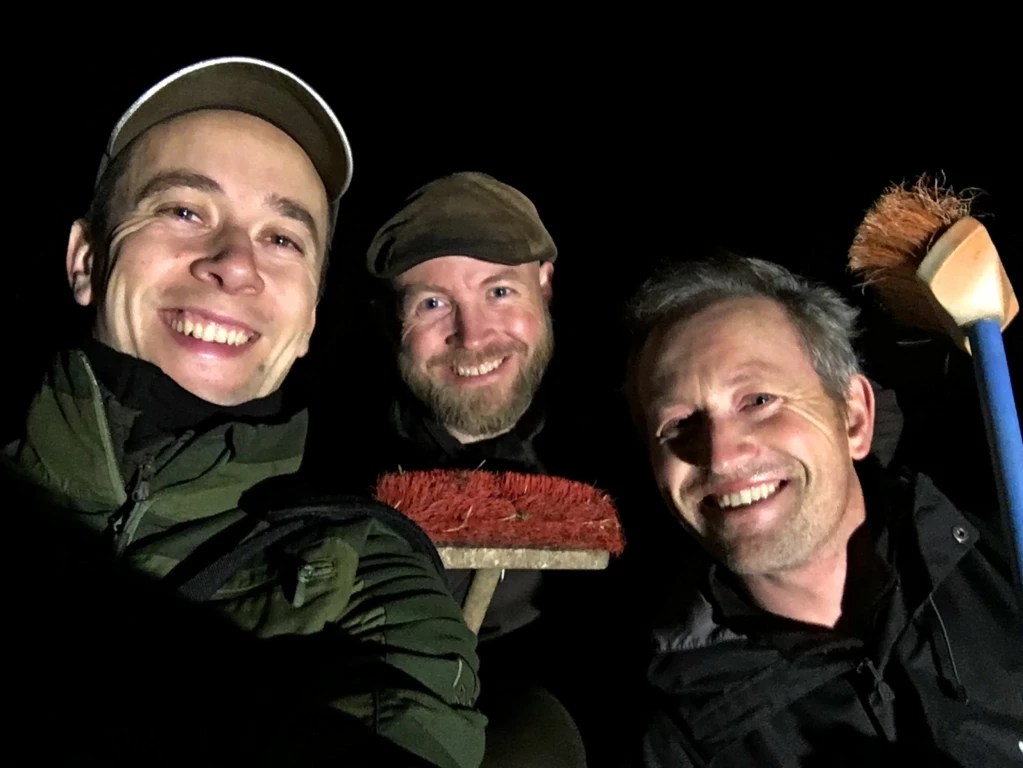
According to Science Norway, all it took was a smart hypothesis and a few brooms. Together, the three friends have discovered hundreds of previously unknown rock carving sites in the Østfold landscape in the last 3-4 years.

Some good buddies hang out in a bar together. Some go bowling together or maybe running. The buddies in today’s story hunt Bronze Age petroglyphs. At night.

Lisa Abend writes at the New York Times, “It was December and the first snow of the season was falling when the three friends set out on their weekly hunt through the fields of Ostfold, in southeastern Norway. … Tromping across the blanketed farmland, the men came to a low outcrop of rock, a few feet wide. With a child-size plastic broom, they brushed away the newly fallen snow from the stone to reveal the outline of a ship, its curved keel carved into the granite roughly 3,000 years ago.

“It was just one of more than 600 Bronze Age rock carvings, known as petroglyphs, that Magnus Tangen, Lars Ole Klavestad and Tormod Fjeld have discovered. Since making petroglyph hunting their collective hobby in 2016, the three enthusiasts have transformed knowledge about prehistoric art in Norway, more than doubling the number of carvings known in their home region. And although they are motivated, in part, by the pleasures of friendship and the outdoors, their findings have also lent serious weight to theories about the mysterious petroglyphs’ meaning.

“Rock carvings from the Bronze Age (which in Scandinavia began around 2,000 B.C.) are common in parts of Sweden and Norway. Regions in both countries have been declared UNESCO heritage sites because of the density and the diversity of the images, which include human figures, animals, geometric shapes and, frequently, ships. Yet because they are commonly cut into granite that is low to the ground and easily obscured by leaves or snow, they often go unnoticed.

“Petroglyphs are also easier to see when the sun is not overhead — a realization that has been one of the keys to the three friends’ success. Because the hunt for them is a hobby rather than a career — Tangen is an archaeologist working in a different field, Fjeld a graphic designer, and Klavestad a landscape architect and artist — they make time for it at night. …

“The thrill of the hunt has naturally led them to speculate on the carvings’ meaning. Because the petroglyphs tend to be more visible in the slanted rays of dusk, or with angled artificial lights, Tangen said he believed that their creators had made deliberate use of shadow and light in their work. Thanks to the sun’s changing angle, petroglyphs can look different depending on the hour of the day, or season, he explained. ‘I think the images have to do with the awakening of people’s minds to time,’ he said.

“That is in keeping with findings from professional archaeologists about rock art and stone monuments, in places like British Columbia and Scotland, whose features are visible only at certain times of year. There is also evidence for another one of Tangen’s theories: that some of the images were meant to be seen in flickering light, so that they appeared almost animated.

“Kristin Armstrong-Oma, a professor of archaeology at the University of Stavanger, said that ‘in excavations around some carvings, archaeologists have found signs of burning or charcoal.’ That suggested fire was being used, almost like a movie camera. ‘The living flames give the carvings a feeling of movement,’ she said.

“The petroglyph-hunting trio got their start in 2016, when Fjeld, the graphic designer, was walking his dog in the countryside and found a strange mark in a rock. He wondered if it was made by humans, or nature. Trying to identify it online, he came across a website with photos of petroglyphs, and contacted its owner, Tangen, who suggested Fjeld’s find could be a Bronze Age cup mark — a simple, round carving that is a common motif in prehistoric art.

“His interest piqued, Fjeld started paying better attention on his walks, and soon found a carving that was unmistakably made by human hands: an image of a ship. ‘That was very, very fun,’ Fjeld said. ‘So I started going on a regular basis.’

“Tangen, who had made similar discoveries while walking his own dog, joined him, and before long suggested that they invite Klavestad, a local enthusiast who had found his first carving when he was 10.

“ ‘We didn’t know each other, but I hadn’t met anyone else with so much passion for it,’ said Klavestad. ‘We are, all three, very dedicated.’ “

More at the Times, here.

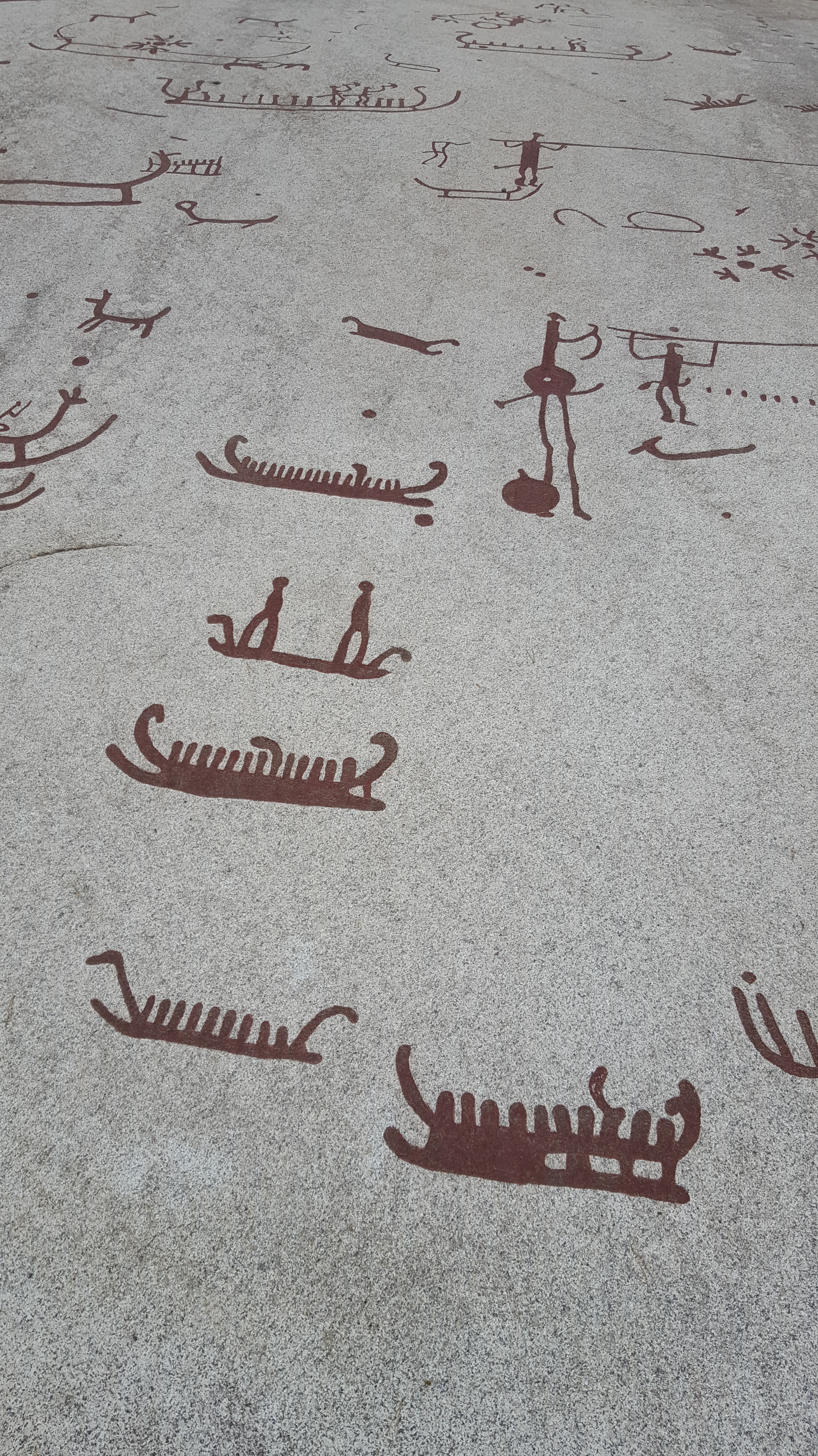
Petroglyphs I saw in 2017 at a UNESCO-protected World Heritage Site in Sweden. Some have been painted red to make them more visible for tourists, a practice which has drawn criticism.

060217-petroglyphs-by-Stuga40-Sweden

Read Full Post »

Photo: CNRS / MADAJ / R. Schwerdtner
Mysterious 2,000-year-old camel carvings found in Saudi Arabian desert.

The lure of space travel notwithstanding, there’s still a lot to discover and puzzle out on Planet Earth. In this story, archaeological adventurers ask why life-size camels might have been carved 2,000 years ago in a Saudi Arabian desert.

Ruth Schuster explores the mystery at Haaretz. “About a dozen life-sized stone sculptures and reliefs of camels have been found in a markedly inhospitable site in northern Saudi Arabia. While camelid art has existed in the region going back millennia, nothing quite like this has been found before.

“The somewhat eroded statues are tentatively dated at around 2,000 years old, give or take a century or more, according to a collaboration between the French National Center for Scientific Research and the Saudi Commission for Tourism and National Heritage reported [in] the Cambridge journal of Antiquity. …

“No associated artifacts were found at Camel Site that could give clues about origin – no hammers, picks or anything.  …

“For all the art, Camel Site seems not to have been inhabited. As the authors write, it ‘does not seem propitious for permanent human settlement.’ However, they point out, the fact that ‘this isolated and seemingly uninhabitable site attracted highly skilled rock-carvers is striking testimony to its importance for surrounding populations.’

“For instance, it might have been a place of veneration going back generations. … Or the site could have been a boundary marker. Or a rest stop for caravans. …

“The camels were carved in proportion. Muscles and heads, particularly the muzzles and eyes, and the thickness of the legs were individual. These were lovingly depicted camels.”

More about the work to uncover the story of the carved camels may be found here. I was surprised to learn camels actually emerged first in North America.

By the way, I once rode a camel briefly. I was five months pregnant with John. I think I pretty much just got on and then got off.

Read Full Post »

discussing-finances

I’m not much of a world traveler although I always enjoy new places once I get there. I feel sufficiently challenged, though, just trying to see what is in front of me and delving into meanings.

I overheard two men who were walking in a shade-dappled lane this morning. They were discussing “operations” and the “lowest cost per month” and were consulting a smartphone. I’m not sure they saw much in front of them.

Not to be superior, I miss things, too. How many times have I come up out of the Porter Square subway station to cross the street and not noticed the bollards with the mysterious carvings? I’ve pasted three samples below.

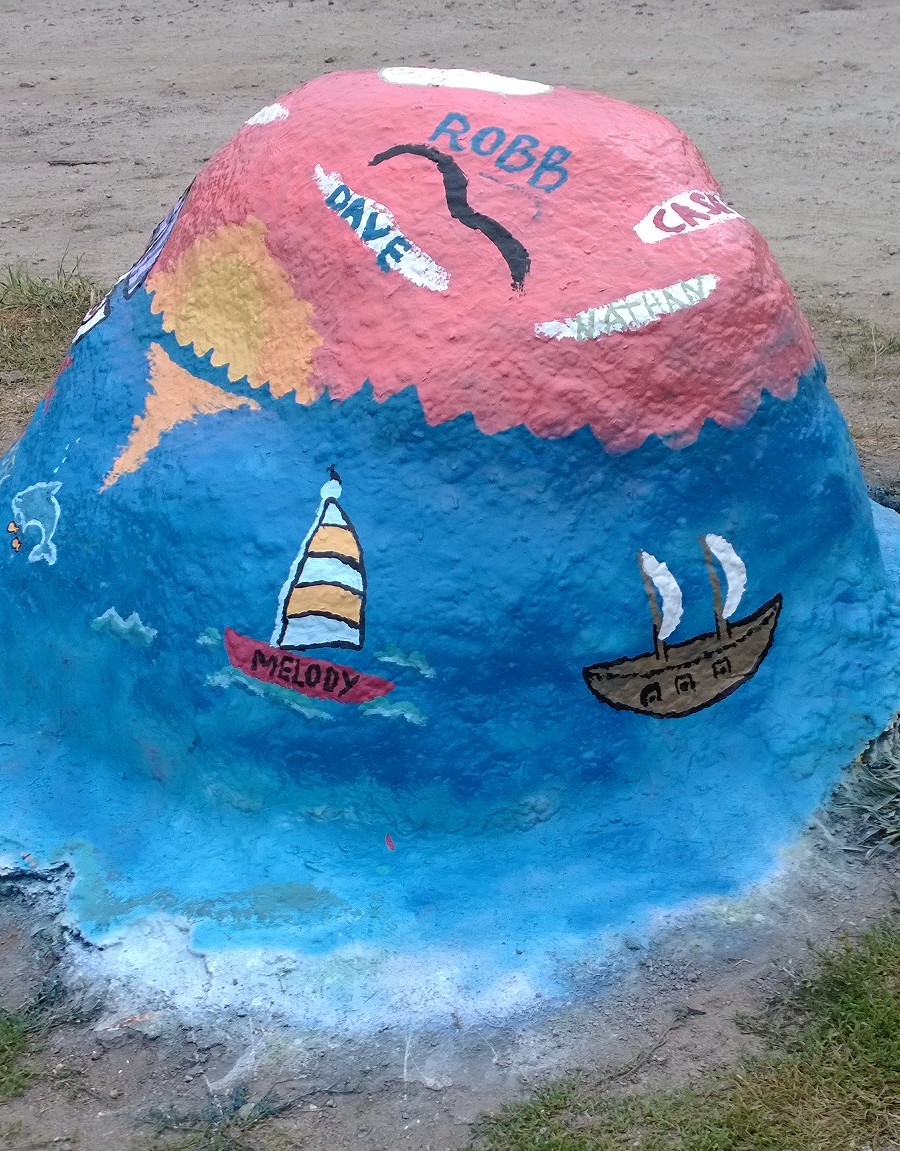
A few more photos. Two sides of an especially nice paint job on the Painted Rock. A whole family brought their beach chairs and drinks to watch the artists among them paint the sunset, boats, and sea creatures and then photograph the art before someone painted over it with new messages. Which happened in a couple hours and involved much less style. But that’s OK — the rock is the billboard of pure democracy.

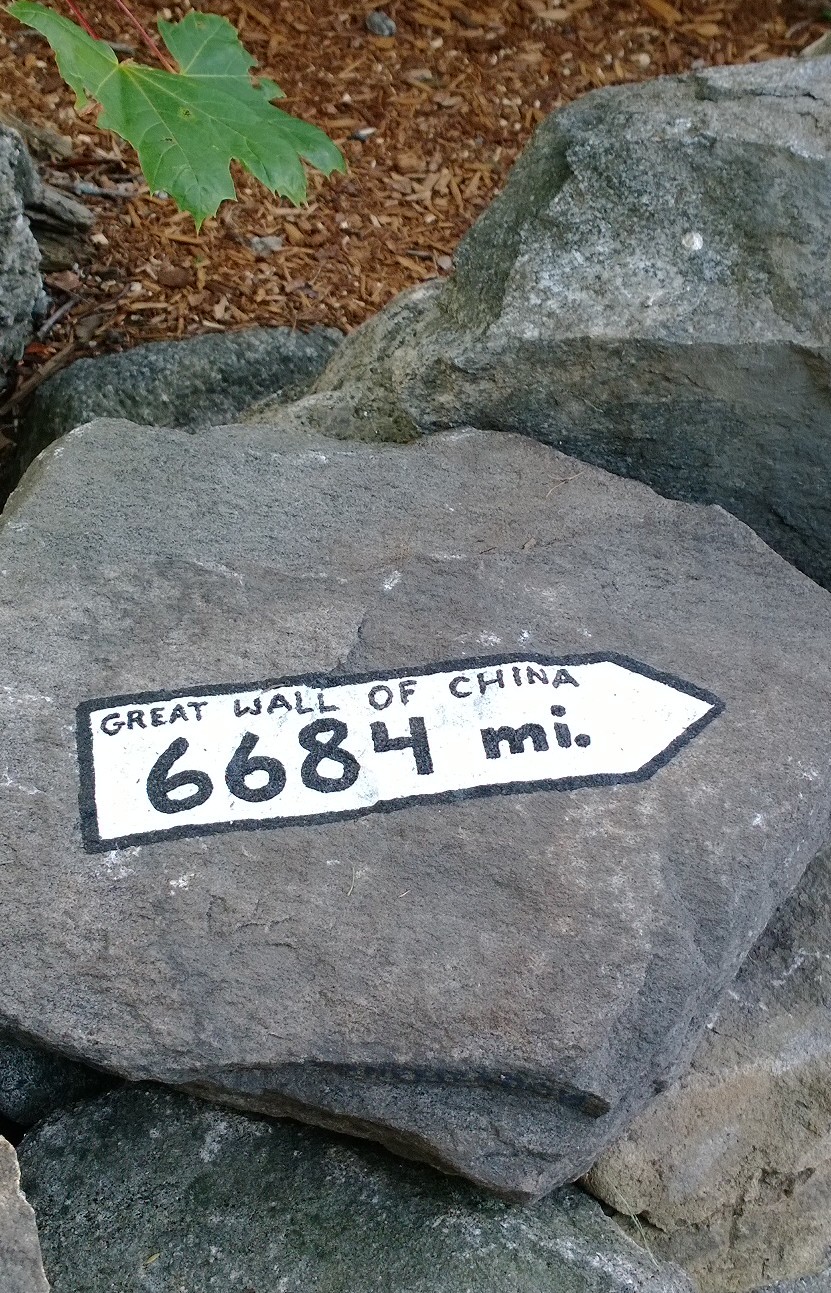
On another rock, one I had never noticed until early Saturday, please note directions to China.

Circling back to the “lowest cost” guys, when I got to the bend in the lane, they were gone. I was walking so much slower than they were.

mysterious-carving-3

mysterious-carving-2


mysterious-carving-1

direction-to-china


rock-with-octopus

rock-with-sunset


RI-summer-lane

Read Full Post »

Lisa W. Foderaro writes in today‘s NY Times (here) about several elaborate carved-pumpkin events in and around New York City. Her article caught my eye because yesterday Suzanne and Erik took their baby dragon and Erik’s mother, sister, niece, nephews (in costume), yours truly and my husband to something pretty dramatic along those lines. In Providence.

As I was reading Foderaro and feeling competitive with New York, this bit in the story jumped out:

“Two carvers, Ray Villafane and Andy Bergholtz, who developed a national following on the Food Network’s ‘Halloween Wars’ show, were at the [New York Botanical] Garden in mid-October, using six-inch rinds of Atlantic Giant pumpkins to sculpture the zombie, whose organs and intestines poke through his cracked ribs. Their assistants were busy harvesting chunks of pumpkin with handsaws and, for the zombie’s jeans, steaming pumpkin rinds.

“Mr. Villafane, a commercial sculptor who has made a year-round business out of carving pumpkins, said … his one disappointment this year was that the official ‘all-time biggest pumpkin,’ the first to weigh more than a ton, did not make it to the Bronx, as was planned. The 2,009-pound specimen, grown by Ron Wallace in Coventry, R.I., ran into trouble.

“ ‘It sprang a leak and rotted on the way,’ Mr. Villafane said. ‘We wanted to carve the world-record holder, so that was sad.’ ”

Well, excu-use me! A Rhode Island monster pumpkin should have gone to the Roger Williams Zoo’s Spectacular, which was way better than anything the Times described. I’m afraid that Mr. Villafone tempted fate. Clearly a curse struck that giant pumpkin when it crossed the border.

The Roger Williams Zoo Spectacular lasts the whole month of October, involves 25 carvers carving 25,000 pumpkins (replaced as they decay), and many fun themes (with piped-in music). We wandered from “Star Wars” to Beatles to “Gone with the Wind” to “The Wizard of Oz” and on and on. I was as amazed as the relatives visiting  from Sweden.

The idea of 25 people carving pumpkins for a month is in itself amazing to ponder. How much do pumpkin carvers get paid? What work do they have during the other 11 months? Are any from Rhode Island School of Design?

The Spectacular would have been a bit scary for the youngest among us, I think, but he was jet-lagged and zonked out in the stroller. A buffet before the walk around the lake was super and got us in early, in front of incredibly long lines. Read more about it all here.

Photograph by Suzanne, Luna & Stella

Read Full Post »