Feeds:
Posts
Comments

Posts Tagged ‘children’

636631935695391365-janel-meindersee-photo-social-candy-2

Photo: Social Candy
Milwaukee Ballet dancer and teacher, Janel Meindersee, tries out a wheelchair herself as she teaches her students. Parents watch with pride.

Heartbreaking as it is to see anyone make fun of a person with a disability, which does happen in these harsh times, it’s important to remember the advice that the mother of Mister Rogers gave him long ago: “Look for the helpers. There are always helpers.”

In Milwaukee, some unusual helpers are found in a dance company.

Amy Schwabe writes at Milwaukee’s Journal Sentinel, “Nine-year-old Namine Eiche may be in a wheelchair, but that doesn’t stop her from being a ballet dancer. That’s thanks to Tour de Force, a partnership between Milwaukee Ballet and Children’s Hospital of Wisconsin that’s been providing ballet classes to children with disabilities since 2014.

“Just last year, the opportunity was opened up to children in wheelchairs through the ‘Glissade’ class, very appropriately named since ‘glissade’ is the French word for ‘glide.’

“Janel Meindersee, a Milwaukee Ballet dancer who teaches Glissade, explained how the children are able to dance.

” ‘We teach a lot of the same things as a normal ballet class — how to spot your head when you move, the quality of arm movements, how to count music and how to stay in line when dancing together,’ Meindersee said. …

“Meindersee said that seeing kids in wheelchairs in other Tour de Force classes was the impetus for Glissade.

” ‘There was a girl in a wheelchair coming to one of our other Tour de Force classes,’ Meindersee said. ‘She was able to get out of her wheelchair sometimes, but she was most comfortable in her chair. We thought there had to be other kids who can’t even get out of their chairs at all. …

“After having taught two sessions of Glissade, Meindersee is ‘blown away’ by the skill, talent and strength of her students — especially when she gets in a wheelchair herself to try out the dance moves. She laughs with her students, pointing out that she’s not as skilled in wheelchair maneuvers as her students are.”

More at the Journal Sentinel, here. Just imagine the joy and self-confidence of these young dancers take home with them after a class. Perhaps some will join one of the professional wheelchair ballets someday. Or start their own company.

Read Full Post »

Photo: The Human Rights Warrior
New study suggests that children exposed to music from other ethnic groups become more tolerant.

Numerous studies have shown that children pick up biases against other ethnic and racial groups at a very young age. Here’s a study suggesting that the music of other cultures can temper that process.

Tom Jacobs writes at Pacific Standard, “Ethnocentrism remains a fact of life in both Europe and the United States. Combating it will require teaching a new generation to view members of different cultures as potential friends rather than threatening outsiders. But what mode of communication has the power to stimulate such a shift?

“New research from Portugal suggests the answer may be music. It reports schoolchildren around age 11 who learned about the music and culture of a faraway land expressed warmer feelings toward immigrants from that country than those who did not. What’s more, those positive emotions were still evident three months after this exposure to the foreign culture. …

“[The] study, published in the journal Psychology of Music, featured 229 Portuguese sixth graders, all living in greater Lisbon. Two-thirds came from blue-collar families.

“The students began by filling out a survey in which they were presented with 10 personal traits — five positive (including ‘hard-working’ and ‘honest’) and five negative (including ‘stupid’ and ‘lazy’). They were asked to pick those that applied to members of three ethnic groups common to the Lisbon area: Portuguese, Brazilian, or Cape Verdean people. …

“For the next six months, half of the students took part in a specially designed ‘cross-cultural music education program.’ During the 20 sessions, each of which was 90 minutes long, they learned about Cape Verdean culture, and listened and sang to both Portuguese and Cape Verdean songs.

“At the end of the program, all the students again filled out the survey in which they evaluated people of the three ethnicities.

“Among those who took the class, ‘prejudice towards Cape Verdean people was reduced,’ the researchers report. ‘Attitudes towards other groups were not altered.’

“In contrast, prejudice did not drop among those who did not take the class. A follow-up three months later found the same pattern held for all of the youngsters, meaning the prejudice reduction for those who took the course had stuck.”

More here.

Read Full Post »

Photo:  Diana Markosian / Magnum Photos
Yazidi refugee children are overcoming fear of the water in Germany.

One reason I was interested in the following story is that I have worked with Yazidi refugees from Iraq like these. One of the people in the family I know actually has relatives in Germany, where the story takes place.

Philip Oltermann writes at the Guardian, “When Hanan Elias Abdo looked over the side of the rubber boat into the deep blue sea, she could make out two large shapes, moving at speed. Were those dolphins? Or sharks? ‘Did you see the fishes?’ she shouted at her siblings.

“Six-year-old Sulin, the youngest, … was lying on top of a thin patch on the boat’s floor and could feel the water moving underneath her. At home, in the Sinjar mountains in Iraq, she had never more than splashed through an ankle-deep brook. What if the floor gave way and she got pushed into the bottomless depths? What, she thought, if the fishes started nibbling at her feet?

“That was in September 2015. Two and a half years later, Sulin stands atop a starting block in northern Germany, takes a two-step run-up, waggles her arms and legs mid-air, before landing in the 2-metre-deep turquoise water and splashing her giggling sisters who are paddling near the edges. Surfacing, she pulls a funny face at the man with the white beard and white slippers applauding her from the side of the pool. ‘That’s it!’ says Günter Schütte, Germany’s first swimming instructor to specialise in helping to cure refugees’ fear of water.

“Schütte is a teacher with 40 years’ experience teaching politics and sport at schools in Wolfsburg, and a passionate swimmer since he was 13. Throughout his career, he says with pride, he made sure that by the end of the school year there was never a non-swimmer in any of his classes. …

“When Schütte realised that many refugees who arrived in Wolfsburg were families from countries with little open water, and that many children had been traumatised by the journey across the Mediterranean, he decided that swimming could become a tool for better integration.

“From October 2015, he booked a two-hour slot every Sunday at a municipal swimming pool and handed out flyers advertising the course at asylum seekers’ shelters in the area. …

” ‘We take our time,’ he says, ‘because when you are scared, time-pressure is the last thing you need.’

“The purpose of the course was to help the new arrivals ease into an unfamiliar element – in a metaphorical sense, too. ‘By learning how to swim, refugees are no longer shut out from the sports lessons at school,” Schütte says. ‘Some of them also get a head start on their German peers – they have a sense of achievement.’ …

“Sinjar province, where Hanan, Helin and Sulin, now nine years old, grew up, is a traditional stronghold of the Yazidi minority who were declared infidels by al-Qaida and actively targeted by Isis in 2014. Helin, now 12, recalls a phone call late that summer from her grandmother, who lived in the next valley along: Isis fighters were approaching and the villagers had run out of ammunition. …

“There was no time to wait any longer. Their mother, the six siblings and a neighbouring couple all piled into a single car and headed for the Turkish border, leaving behind the two family goats and the cherry and orange trees in their garden. Months later, after crossing the Mediterranean and seven different countries, someone sent Helin a photograph of their village. ‘The war had flattened everything,’ she says. …

“For now, the pool can suspend the pressures bearing on them outside. … Hanan wants to go a step further and get the rescue swimming badge in silver, for which she has to take a jump from a 3-metre board, swim 25 metres underwater in one breath, and rescue a drowning person with pull stroke. Asked what she wants to do when she grows up, she doesn’t take long to come up with an answer. ‘I want to become a sports teacher.’ ”

More here.

Read Full Post »


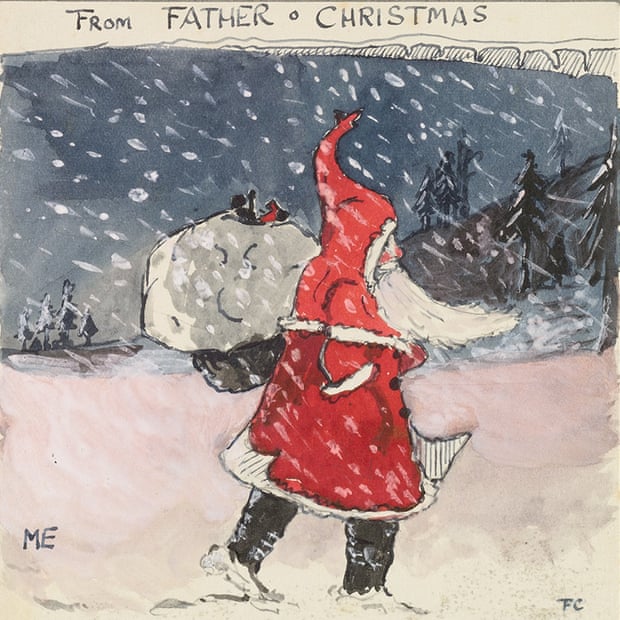
Art: JRR Tolkien
An Oxford exhibit will feature decades of illustrated letters from “Father Christmas” to the children of Middle Earth wizard JRR Tolkien.

This is more of a Christmas post, but as the exhibit won’t go up until next summer, you have time to plan a trip to Oxford, England, to see JRR Tolkien’s illustrated Father Christmas letters. They will be on display from June 1 to October 28, 2018. If you can’t go, there is a heavenly array at the Guardian.

Maev Kennedy writes at the Guardian, “In December 1920 Father Christmas wrote a letter to a modest house in the Oxford suburbs, enclosing a watercolour sketch of his own rather more exotic domed snow house, approached by a flight of steps lit by ice lanterns. ‘I heard you ask Daddy what I was like and where I lived,’ he wrote to three-year-old John Tolkien, and as the family grew to four children, he continued to write every Christmas for 23 years. …

“The illustrated letters continued to arrive every Christmas Eve, sometimes delivered by a postman who had been persuaded to include them with the more boring letters and cards, sometimes materialising on the hearth rug with a handmade stamp. Some years Father Christmas was evidently very busy, and could only pass on the briefest snippets of news, and other years, when he had time on his hands, he could include elaborate multi-layered paintings. One showed his reindeer and sleigh arriving over the Oxford skyline – ‘your house is just about where the three little black points stick up out of shadow on the right.’

“Many recount the adventures of his friend and helper the Polar Bear – in 1926 he accidentally switched on all the Northern Lights – or the goblins who attempted to steal the stored presents in 1932. In one letter Polar Bear ‘found a hole in the side of a hill & went inside because it was snowing.’ He slid down a rocky slope, more rock fell on him, and he could not climb back: ‘But almost at once he smelled goblin & became interested & started to explore. Not very wise for of course goblins can’t hurt HIM but their caves are very dangerous.’

“The snow, the entrance to treacherous caves and the smell of goblin will be instantly familiar to readers of the book Tolkien was working on at the time, The Hobbit, the first of the adventures of Middle-earth. …

“Catherine McIlwaine, Tolkien archivist at the Bodleian, [says,] “There couldn’t be a clearer demonstration of how important his family was to him. He was orphaned from the age of 12, when his mother died, and then he spent years boarded out in lodging houses in Birmingham.’ ”

More at the Guardian, here.

Read Full Post »

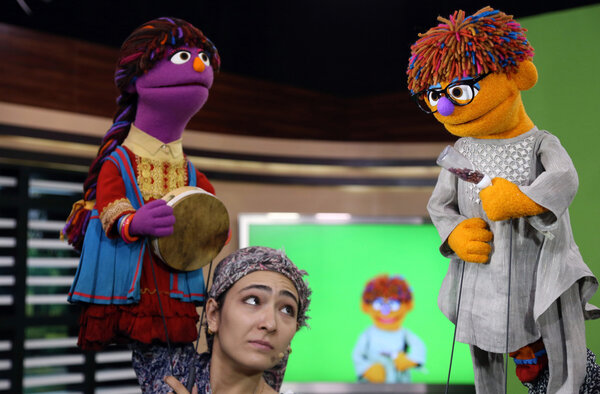
Photo: Rahmat Gul/AP
Characters from the Afghan Sesame Street. A MacArthur Foundation grant will enable the Sesame Workshop and the International Rescue Committee to roll out a version for Syrian refugee children.

Even if they make it to relative safety, children often suffer the most from wars and dislocation. In addition to the trauma, there is the problem of education, which is unavailable or spotty in refugee camps.

That is why people of goodwill are reaching out with programs that can both comfort and teach. Jason Beaubien reports on one example at National Public Radio.

“The MacArthur Foundation will give $100 million to Elmo, Big Bird and their buddies to massively scale up early childhood development programs for Syrian refugees.

“Sesame Workshop and the International Rescue Committee won a global competition by the MacArthur Foundation seeking solutions to what the judges called ‘a critical problem of our time.’

” ‘The most important thing to remember is that the humanitarian system is designed to reach people’s immediate needs — to keep people alive, feed them, make sure that they have shelter,’ says Sarah Smith, senior director of education at the IRC. The global humanitarian system, she says, isn’t very good at supporting displaced children. ‘And the fact is these children are likely to stay as refugees for their entire childhood.’ …

“The IRC and Sesame Workshop plan to launch what they’re describing as the ‘largest early childhood intervention program ever created in a humanitarian setting.’ …

“It will be distributed over traditional television channels, the internet and mobile phones. It will also serve as an educational curriculum for childcare centers, health clinics and outreach workers visiting the shelters where refugees live. The workers will deliver books to kids and caregivers.

“Sherrie Westin of Sesame Workshop says … ‘These Muppets will be created to reflect the children’s reality so that children can relate with them. … One of the Muppets may have had to leave home. She may live in a tent. She may become best friends with her new neighbors.’ …

” ‘We know that in their first years of life the trauma that children are experiencing has the greatest impact on them,’ Westin at Sesame Workshop says. ‘And yet they receive the least support.’ ”

More at NPR, here.

Read Full Post »

Photo: Ben Fractenberg
Jason Reynolds is a 
New York Times bestselling author, a National Book Award Honoree, a Kirkus Award winner, a Walter Dean Myers Award winner, an NAACP Image Award Winner, and the recipient of multiple Coretta Scott King honors.

Some children and teens who think they don’t like literature can really open up to it through poetry that is less intimidating. That’s the view of Jason Reynolds, author of the young adult novel Long Way Down, among others. Recently, he talked to PBS NewsHour’s Judy Woodruff about using poetry to capture the attention of reluctant readers.

“Woodruff: While Hollywood has figured out how to get boys to watch movies, the formula is trickier for getting boys to read, especially among those who have already expressed frustration and boredom with books.

“Reynolds: If you were to tell me that you were afraid of dogs, I wouldn’t then return to you with a pack of pit bulls. … What I might do is casually walk with you by one of those doggy day cares. The ones with the pups small enough to fit in the palm of your hand. Yippy little fur balls that get so excited, their tails wag the entire back halves of their bodies. The dogs that grin and want nothing more than to lap your skin with fervent affection. …

“So then, why, when it comes to young people who don’t like reading, who feel intimidated by literature, do we answer that cry with an onslaught of the very thing they fear? Why do we show up with a pack of pit bulls in the form of pages, and expect them to stop running away?

“Perhaps they haven’t found the right style of book because, sometimes it isn’t about subject matter, or voice, or point of view. …

“For some kids, those words [on the page] — the amount of words — is equivalent to a snarling dog. So, why not start with the less threatening, palm-sized pup in the window? In this case, poetry.

“Poetry has the ability to create entire moments with just a few choice words. The spacing and line breaks create rhythm, a helpful musicality, a natural flow. The separate stanzas aid in perpetuating a kind of incremental reading, one small chunk at a time.

“And the white space, for an intimidated reader, adds breathability to a seemingly suffocating task. …

“With the incredible selection of poetry and novels and verse from past to present, this is an opportune time to use them to chip away at bibliophobia. Less words on the page, more white space, without necessarily sacrificing the narrative elements.

“And once young people experience turning those pages, once the rush of comprehension and completion laps at their psyches for the first time, perhaps they will know they need not fear a thing created to love them, and for them to love.”

Read a 50-word poetic narrative that Reynolds wrote to draw in kids, here. See also this post on “poetry slams,” another way to get young people engaged in language arts.

My thanks to poet Ronnie Hess for posting the Reynolds piece on Facebook.

Read Full Post »

treasurehunt

Photo: No Strings Marionette Company
In this production,
Treasure Hunt, a boy called Jim is lured out to sea, where he encounters a mermaid, “a giant clam, a fish that swallows him whole, an electric eel and an angry octopus guarding his treasure.”

Tuesday night at the Trapp Family Lodge, my husband and I watched a charming puppet show about a fox called Sharp Ears. The show was created and performed by the Vermont-based No Strings Marionette Company. Our four grandchildren were too tired for theater after a day of skiing, but we were charmed — especially by unusual marionettes like the frog, the chicken and chicks, the rooster, the grasshopper, the cow, and the numerous butterflies and flying bugs. And in case the theatrical company’s title threw you off, the puppets do have strings.

We very much enjoyed hanging around afterwards to listen to the questions that children asked the puppeteers: how do you make puppets? how do you make them move? how did you make the bench? did you paint your sets or buy them? do you have other shows?

Puppeteers Dan Baginski and Barbara Paulson have about 12 other shows, which they tour widely, keeping them so busy that the story of Sharp Ears took them two years to create at night — instead of the four months in which they could have finished if they’d been able to work nonstop.  “Sharp Ears” is still new, not even up on the website yet.

The show was based on the Czech story called “The Adventures of the Vixen Known as Sharp Ears,” on which the opera The Cunning Little Vixen is also based. In this version, a henpecked woodcutter who’d rather hang out in nature than do his chores brings home a fox as a pet for his grandson, with unfortunate consequences for the farm.

Dan and Barbara, says their website, “have toured America together for over sixteen years.  Their traveling stage transforms any space into an intimate theater, where the seamless blend of movement, music and masterful manipulation captivates young and old alike.

“With puppeteers in full view,  the audience sees how the puppets are brought to life. These Vermont artisans lovingly hand craft the marionettes, props and scenery, whether for an original tale or an adaptation of a classic.

“Shows begin with an interactive song featuring audience members, and finish with demonstrations sparked by the audiences’ curious questions.”

More here.

Photo: No Strings Marionette Company
Puppet characters from
The Hobbit.

hobbit


Read Full Post »


Photo: Lisa Nolan
A child called Melissa painted artist Lisa Nolan’s portrait of her at Lowell’s Making Art with Artists program in 2015. When artists work with children, freedom to create is the name of the game.

Did you catch the National Public Radio story about a free art camp in Michigan? I read about it at ArtsJournal, one of my favorite sources.

My friend and former boss Meredith Fife Day led a similar program in Lowell, Massachusetts, called Making Art with Artists. It was amazing.

Zak Rosen at NPR’s Weekend Edition Saturday interviewed one of artists behind the Michigan arts camp.

“In Hamtramck, Mich., a working class city almost surrounded by Detroit, camp is not affordable for many kids. An artist has started a camp inspired by adventure playgrounds and neighborhood artists. …

“Hamtramck is formerly a working-class Polish city. But in recent years, there’s been a huge surge of other immigrants, many from Bangladesh and Yemen. Accompanying that surge have been lots of artists who work to put community at the center of their practice, people like Faina Lerman. [Lerman and her husband have] eight open lots.

“They garden on a few of them, but that still leaves plenty of space for other stuff. And in this part of the city, there aren’t any playgrounds. So this summer, Lerman and some neighborhood artists started a free, week-long day camp. …

“Camp Carpenter does not have a stated mission. If it did, it might be, let’s just do this and see what happens. And adults are here to help, not to lead.

“LERMAN: I feel like everything is just very over structured for kids. Like, they don’t have even the space to make their own decisions or to let their minds expand to different ways of learning or gathering information.

“ROSEN: So here, the structure is intentionally loose. But by the end of the week, there is the start of an adventure playground, built in part by the campers. …

“ROSEN: One young camper, Jimmy Engalan, is learning how to use a hammer. A less patient adult may have allowed him a few whacks of the nail and then taken over — but not teaching artist Liza Bielby. …

“She watches Jimmy until he drives the nail all the way down into a wood pallet. It takes 258 knocks. I counted — 258. But he does it. …

“ANGILENA OMOLARA-FOX: I’m Angilena Omolara-Fox, and I am 11 years old. I made a pillow. I made a dress. I helped with the little fort thing over there.

“ROSEN: So would you come back to camp?

“ANGILENA: Yes, because I don’t really get a lot of chances to use tools and to make, like, things that I would like to make.”

More at NPR, here.

Read Full Post »

Photo: Milwaukee Public Schools
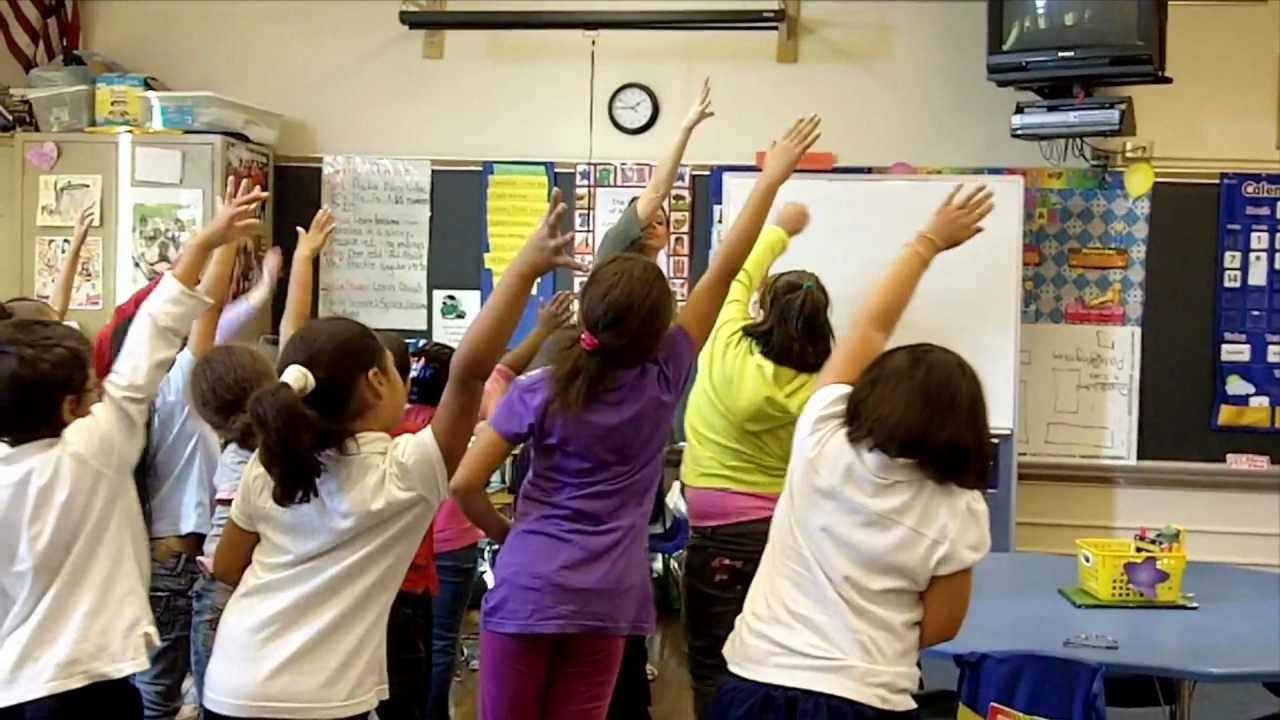
Sarah Wenzel and her class at Forest Home Elementary demonstrate a series of poses from the YogaKids cards, http://www.yogakids.com.

When I was in kindergarten, someone would come to play the piano and we children would walk in a circle pretending to be giraffes (re-e-eaching!) and elephants (swinging gently while bent over).

Just the other day, I realized that those kindergarten stretches were the same as stretches I’ve been doing for my back.

Decades ago, schools like mine were helping kids exercise for health. Now an increasing number of studies suggest that moving while in class helps children’s brains learn better, too.

Donna de la Cruz writes at the NY Times, “Sit still. It’s the mantra of every classroom. But that is changing as evidence builds that taking brief activity breaks during the day helps children learn and be more attentive in class, and a growing number of programs designed to promote movement are being adopted in schools. …

“A 2013 report from the Institute of Medicine concluded that children who are more active ‘show greater attention, have faster cognitive processing speed and perform better on standardized academic tests than children who are less active.’ And a study released in January by Lund University in Sweden shows that students, especially boys, who had daily physical education, did better in school.

“ ‘Daily physical activity is an opportunity for the average school to become a high-performing school,’ said Jesper Fritz, a doctoral student at Lund University and physician at the Skane University Hospital in Malmo, who was the study’s lead author. …

“ ‘Kids aren’t meant to sit still all day and take in information,’ said Steve Boyle, one of the co-founders of the National Association of Physical Literacy, which aims to bring movement into schools. ‘Adults aren’t wired that way either.’

“Mr. Boyle’s association has introduced a series of three- to five-minute videos called ‘BrainErgizers‘ that are being used in schools and Boys and Girls Clubs in 15 states and in Canada, Mexico, Ireland and Australia, he said. A version of the program is available to schools at no charge. …

“ ‘At the end of the week, kids have gotten an hour or more worth of movement, and it’s all done in the classroom with no special equipment,’ Mr. Boyle said. ‘We’re not looking to replace gym classes, we’re aiming to give kids more minutes of movement per week. And by introducing sports into the videos, giving kids a chance to try sports they may not have ever tried before.’ ”

To read more at the NY Times, click here.

Read Full Post »


One of my grandsons goes to a Montessori school where the four-year-olds make lots of maps. They use templates to trace the continents (above).

Which is why I was intrigued to see a delightful National Geographic article about the map juvenalia of professional cartographers.

Betsy Mason wrote, “So many of the cartographers I’ve gotten to know while writing about maps seem to genuinely love their jobs.

It’s one of those professions with a disproportionate number of people who are really happy to be there.

“I suspect that one reason for this could be that many of them have loved maps since they were kids, and they’ve managed to turn that love into a career.

“This collection of childhood maps made by eight professional cartographers backs up that theory. I interviewed each of them about their early mapmaking, how they found their way into cartography, and what they love about their jobs today.

“Their stories all have their individual quirks, but there are some common threads. Several of them recall spending family trips poring over a road atlas in the back seat, for example. And some can still recall the precise moment when they knew they would make maps for a living.”

Here is Mason’s report on one of the two female mapmakers in the article.

“A class assignment to map out a family fire-escape plan probably seemed like more than just an exercise to young Rosemary Wardley. A couple of years earlier, some sheds behind her house had caught on fire.

” ‘I’m sure that was in the back of my mind,’ she says.

“And that’s likely why none of the paths she drew for her family members went out the back door toward the sheds. On the other hand, she deemed it perfectly safe to direct her oldest sister to jump into a pine tree outside of a second-story window …

“The hallway outside of ‘Rosie’s room’ was covered in U.S. Geological Survey topographical maps, and this wall was often Wardley’s first stop after a drive or a hike.

” ‘I always kind of went back there and had my dad point out where we had gone,’ she says. ‘Thinking back, that’s definitely the biggest thing that influenced me as a cartographer. It just made me have that love of geography.’

“Today, Wardley works at National Geographic, where she says the cartography is very collaborative. She makes maps for stories such as a photographer’s trek across China, but a lot of her time is spent editing and working with the data that goes into the maps. It’s the variety that appeals to her most, she says.”

Click to see maps the cartographers made in childhood.

Thank you for putting the link on Facebook, Asakiyume. I wouldn’t have known about this otherwise.

Read Full Post »

knight1

Art: Hilary Knight
Eloise was a favorite of mine back in the day. Art and artifacts related to her history are on display until June 4, 2017, at the Eric Carle Museum of Picture Book Art in Amherst, Mass.

I drove out to Amherst yesterday to meet up with Asakiyume at the Eric Carle Museum of Picture Book Art and have lunch in town. The museum is modern and attractive and features several nice displays, a gift shop, and a studio where kids can do arts and crafts.

If you don’t have another reason to be in the area, as I did, it’s a little far from the Boston suburbs. However, I got a kick out of my tour with Asakiyume, especially because one exhibit was on Hilary Knight, the artist behind the mischievous girl who lives in New York’s Plaza Hotel with her nanny, her pet dog, and her turtle. The display even featured copies of the doll I still have and my Eloise Hotel Emergency Kit.

We saw art by Brinton Turkle and, of course, by Eric Carle. It’s the 50th anniversary of Carle’s book Brown Bear, and it was fun to see all the ways it had been translated. Asakiyume knew how to read the Japanese.

She also picked up a flyer for me about the museum’s “Making Art” blog, which turns out to be loaded with ideas about crafts for kids. Something to check out in addition to Pinterest when brainstorming. In one project example, here, we see how a student intern went about creating a delightful day for both children and adults using feathers in art.

Photo: Eric Carle Museum of Picture Book Art
The Art Studio’s J-Term Intern, Tory Fiske, a senior at UMass Amherst, designed a Special Sunday project for museum guests.  She planned the event, sorted and prepared the materials, and introduced visitors to the project throughout the day.

finefeatheredfriends5

Read Full Post »

Photo: Montgomery County, Maryland, Library

Do you attend a congregation where the children’s “sermon” is given in front of the adults? My husband was recalling the other day how the pastor at our former Rhode Island church was really great with children’s sermons. He was both funny and straightforward. Where we go in Massachusetts, the children’s sermon sometimes plays to the adults too much. But other times it works — especially when the children get to use props and act it out.

I kind of liked this one about different ways of seeing. I’d be interested in what you think.

*******

Whose Reality Is It Anyway?
By Orlanda R Brugnola

It was not a city. It was not a large town. But it was not a small town. It was — just average, you might say. Except for one thing. There was a Storyteller in the town.

That’s Storyteller with a capital S. The Storyteller had arrived one day without advance notice (or as some people would put it, without warning.) There had been no invitation, no request.  The Storyteller just showed up, rented a small house that had been empty for two years and put up a sign inviting people to come and listen to stories.

Mind you, that was not so easy for people in the town.  They were nervous about it and wanted to know wanted to know if the Storyteller was qualified. They wanted to know if the Storyteller was accredited. They wanted to know if the Storyteller was male or female. The children didn’t care of course. … On any afternoon you could be sure that most, if not all the children in town were at the Storyteller’s house.

And so the Storytelling began. The Storyteller might say: “In the smoking tiger’s time” …

“Wait a minute! What do you mean?!”

“Oh, that’s just the way stories begin in Korea: ‘In the smoking tiger’s time’ is just a way of saying: ‘Long, long ago’ ” … And the Storyteller would continue …

All the children and youth listening to the stories wanted to listen forever because the stories made them feel amazed and happy.  And they wanted to share their amazement and happiness with the rest of their families, so they asked the Storyteller if they could take part of the story home with them and the answer was always “Yes, of course!” and so they did.

[Here the children act out taking wondrous things home and finding that the tiger, the mossy rock, the mountain, etc. make their parents apprehensive.]

The children [said] to the Storyteller, “Our moms and our dads won’t let us bring anything home from the stories. … Can you do something?” …

And then something began happening in the town that got everybody talking. Things started showing up in unexpected places — sometimes very unexpected places. A big tree right in the middle of the street.  And then a tiger in front of a garage. And a huge blue mountain at the front door of a house. …

Because the mayor was up for election in a week or so, he said, “I will personally take care of this immediately!” And he marched right over to the Storyteller’s house and knocked on the door.  …

“This has got to STOP!” said the mayor. … “All these things that are showing up everywhere … Today I couldn’t even get into my own house because there was a mountain in front of the door!”

“Why don’t you just go through it? … It’s a story-mountain. … All you have to do is enter the story,” [said a voice.] …

“Maybe I should talk to an expert about this!” [the mayor] thought.  He liked experts.  …

“Why don’t you tell, me about it,” the [expert] said. And so the mayor did. …

“Why did you decide not to enter the story as the Storyteller suggested?” …

“I got angry and didn’t want to. … I’m kind of afraid, though I don’t know what I am afraid of.” …

“New things are unsettling and most of us are reluctant to jump in.”…

“How do we know we will like how the story ends?” [asked the mayor].

“Well, that’s really in our hands.  All of us who enter the story decide how it will turn out.” …

“The mayor thought about it some more and decided that maybe the [expert] was right and that he ought to go back to the Storyteller and find out how to get into the story after all.”

*******

We often joke that our dear UUs explain everything too much. But this sermon must be the exception that proves the rule. See the full children’s story at the UUA website, here.

Read Full Post »

The children’s holiday show at the American Repertory Theater (A.R.T.) this year was a musical version of Roald Dahl’s James and the Giant Peach. My husband and I went to see it with our older grandson and granddaughter.

Last year, invited by our grandson’s friend and her grandmother, we attended A.R.T.’s musical about a pirate princess. Unfortunately, we didn’t have a good view. Somehow or other I had failed to complete my ticket purchase, and we ended up standing in the back much of the time.

This year we were right up front. Our six-year-old grandson was thoroughly engaged with the performance this year. His three-year-old sister, dressed up like a princess, was riveted but felt safest watching the show from my lap.

“What happened to James’s mother and father?” was her first question as the lights went up at the end. I reluctantly reported that they were eaten by a rhinoceros but added that, of course, “That’s pretend. Rhinoceroses don’t eat people.” She took it in stride and later told the theater-going neighbor from down the street that she loved the show.

One thing A.R.T. likes to do with children’s shows is provide some interactivity. For the Pirate Princess, there were actors in costumes before the performance wandering around the lobby and posing for pictures with the children. For Giant Peach, children could make origami fortune tellers (once called “cootie catchers”) that looked either like herring gulls or sharks. When sharks and gulls appeared in the production, children were encouraged to activate their own small versions. Our grandchildren both made sharks.

An adult played James in a childlike way. After James’s parents vanish, he’s sent sent to live with two nasty aunts, played by men. He is rescued when magic beans turn a peach into something big enough to crush the aunts.

As the peach grows, the critters inside the peach become giant-sized themselves (earthworm, spider, ladybug, centipede) and soon join forces with James as they all float skyward in the peach.

Each bug contributes special skills to extricating the team from dangers. I especially liked the blind earthworm, whose special skill turned out to be posing as bait for fearsome gulls so his friends could harness them with Miss Spider’s silk to get the peach away from sharks.

You can read more about the production here. Last chance to see the show is January 8, 2017.

Read Full Post »

My high school friend Susie posted this KQED article on Facebook. I couldn’t agree more with its focus on the value of daydreams and allowing everyone adequate  time to recharge batteries.

Referencing today’s many distractions, KQED reporter Katrina Schwartz writes, “Many people believe they are skilled multitaskers, but they’re wrong. Neuroscience has shown that multitasking — the process of doing more than one thing at the same time — doesn’t exist.

“ ‘The brain doesn’t multitask,’ said Daniel Levitin, author and professor of psychology, behavioral neuroscience and music at McGill University on KQED’s Forum program. ‘It engages in sequential tasking or unitasking, where we are shifting rapidly from one thing to another without realizing it.’ The brain is actually fracturing time into ever smaller parts and focusing on each thing individually. …

“The brain has a natural way of giving itself a break — it’s called daydreaming. ‘It allows you to refresh and release all those neural circuits that get all bound up when you’re focused,’ Levitin said. …

“[Daydreaming] is particularly important for students, who are often asked to sit through a long school day with very few breaks. Lots of research has shown the importance of recess and free play time for academic success, but schools still tend to emphasize time spent in class ‘learning’ over a more nuanced view of how and why kids learn.

“ ‘Children shouldn’t be overly scheduled,’ Levitin said. ‘They should have blocks of time to promote spontaneity and creativity.’ Without that time, kids don’t have the mental space to let new ideas and ways of doing things arise. Daydreaming and playing are crucial to develop the kind of creativity many say should be a focal point of a modern education system.” More.

Time to think, time to free associate, is not just important for kids. If the electric handwarmers I use in winter take twice as long to recharge as to expend their stored heat, then I, too, should have double time to recharge after engaging on anything. You, too.

Photo: Brynja Eldon/Flickr

Read Full Post »

Vanessa Thorpe wrote recently at the Guardian about some old nursery tales that are finding a new audience.

“Old-fashioned language and quaint illustrations are part of the ageless appeal of a classic children’s book, so stop modernising them: this is a growing plea from the parents of young readers – and it seems publishers are beginning to listen.

“[A September 2016] decision to turn back to the original look and vocabulary of the Famous Five books by Enid Blyton has opened the door for another classic children’s author, a forgotten star of storytelling, to be republished, as written, this autumn. Convinced that the best stories stand the test of time, editors at Pikku Books are to bring out original versions of stories by writer Elizabeth Clark, once a familiar sight on nursery bookshelves.

“ ‘There’s always going to be a market there for an elegant turn of phrase and a beautifully crafted story,’ said Elena Sapsford, founder of Pikku. ‘As a child, there are a few well-known classics you work your way through, but it is quite obvious there must have been more good writing going on, and often things are out of print just because copyright contracts have been lost.’

“Clark was a Winchester vicar’s eldest daughter, born in 1875. She found her vocation telling stories to the children in her village and began to teach others, moving to London and becoming a lecturer at teachers’ training colleges as well as the author of a series of successful children’s books, often illustrated by the acclaimed Nina Brisley.

“Clark’s stories, including ‘Dobbin and the Silver Shoes’ and ‘The Cat that Climbed the Christmas Tree,’ were often drawn from foreign folklore and legend and many were broadcast on the BBC’s Children’s Hour radio show in the 1920s. Sapsford came across the writer when secondhand editions were given to her family, and she then set about tracking down the Clark literary estate.

“ ”You have to become a detective because there was a lot of poor record-keeping in many publishing companies and I had to dig quite deep,’ she said. ‘I really don’t think they need any change of vocabulary.

People are looking for something fresh but we tend to forget that for young children everything is new.

More.

Children do seem to like the flowery language. My three-year-old granddaughter, for example, is a fan of the way Beatrix Potter tells the story of Peter Rabbit and can fill in the blanks when an adult reads the book to her. I myself like that explaining a word can lead to an interesting discussion or tangent.

Reprint from the Talkative Sparrow & Other Stories, by Elizabeth Clark 

Read Full Post »

« Newer Posts - Older Posts »