Feeds:
Posts
Comments

Posts Tagged ‘children’

Photo: Montgomery County, Maryland, Library

Do you attend a congregation where the children’s “sermon” is given in front of the adults? My husband was recalling the other day how the pastor at our former Rhode Island church was really great with children’s sermons. He was both funny and straightforward. Where we go in Massachusetts, the children’s sermon sometimes plays to the adults too much. But other times it works — especially when the children get to use props and act it out.

I kind of liked this one about different ways of seeing. I’d be interested in what you think.

*******

Whose Reality Is It Anyway?
By Orlanda R Brugnola

It was not a city. It was not a large town. But it was not a small town. It was — just average, you might say. Except for one thing. There was a Storyteller in the town.

That’s Storyteller with a capital S. The Storyteller had arrived one day without advance notice (or as some people would put it, without warning.) There had been no invitation, no request.  The Storyteller just showed up, rented a small house that had been empty for two years and put up a sign inviting people to come and listen to stories.

Mind you, that was not so easy for people in the town.  They were nervous about it and wanted to know wanted to know if the Storyteller was qualified. They wanted to know if the Storyteller was accredited. They wanted to know if the Storyteller was male or female. The children didn’t care of course. … On any afternoon you could be sure that most, if not all the children in town were at the Storyteller’s house.

And so the Storytelling began. The Storyteller might say: “In the smoking tiger’s time” …

“Wait a minute! What do you mean?!”

“Oh, that’s just the way stories begin in Korea: ‘In the smoking tiger’s time’ is just a way of saying: ‘Long, long ago’ ” … And the Storyteller would continue …

All the children and youth listening to the stories wanted to listen forever because the stories made them feel amazed and happy.  And they wanted to share their amazement and happiness with the rest of their families, so they asked the Storyteller if they could take part of the story home with them and the answer was always “Yes, of course!” and so they did.

[Here the children act out taking wondrous things home and finding that the tiger, the mossy rock, the mountain, etc. make their parents apprehensive.]

The children [said] to the Storyteller, “Our moms and our dads won’t let us bring anything home from the stories. … Can you do something?” …

And then something began happening in the town that got everybody talking. Things started showing up in unexpected places — sometimes very unexpected places. A big tree right in the middle of the street.  And then a tiger in front of a garage. And a huge blue mountain at the front door of a house. …

Because the mayor was up for election in a week or so, he said, “I will personally take care of this immediately!” And he marched right over to the Storyteller’s house and knocked on the door.  …

“This has got to STOP!” said the mayor. … “All these things that are showing up everywhere … Today I couldn’t even get into my own house because there was a mountain in front of the door!”

“Why don’t you just go through it? … It’s a story-mountain. … All you have to do is enter the story,” [said a voice.] …

“Maybe I should talk to an expert about this!” [the mayor] thought.  He liked experts.  …

“Why don’t you tell, me about it,” the [expert] said. And so the mayor did. …

“Why did you decide not to enter the story as the Storyteller suggested?” …

“I got angry and didn’t want to. … I’m kind of afraid, though I don’t know what I am afraid of.” …

“New things are unsettling and most of us are reluctant to jump in.”…

“How do we know we will like how the story ends?” [asked the mayor].

“Well, that’s really in our hands.  All of us who enter the story decide how it will turn out.” …

“The mayor thought about it some more and decided that maybe the [expert] was right and that he ought to go back to the Storyteller and find out how to get into the story after all.”

*******

We often joke that our dear UUs explain everything too much. But this sermon must be the exception that proves the rule. See the full children’s story at the UUA website, here.

Read Full Post »

The children’s holiday show at the American Repertory Theater (A.R.T.) this year was a musical version of Roald Dahl’s James and the Giant Peach. My husband and I went to see it with our older grandson and granddaughter.

Last year, invited by our grandson’s friend and her grandmother, we attended A.R.T.’s musical about a pirate princess. Unfortunately, we didn’t have a good view. Somehow or other I had failed to complete my ticket purchase, and we ended up standing in the back much of the time.

This year we were right up front. Our six-year-old grandson was thoroughly engaged with the performance this year. His three-year-old sister, dressed up like a princess, was riveted but felt safest watching the show from my lap.

“What happened to James’s mother and father?” was her first question as the lights went up at the end. I reluctantly reported that they were eaten by a rhinoceros but added that, of course, “That’s pretend. Rhinoceroses don’t eat people.” She took it in stride and later told the theater-going neighbor from down the street that she loved the show.

One thing A.R.T. likes to do with children’s shows is provide some interactivity. For the Pirate Princess, there were actors in costumes before the performance wandering around the lobby and posing for pictures with the children. For Giant Peach, children could make origami fortune tellers (once called “cootie catchers”) that looked either like herring gulls or sharks. When sharks and gulls appeared in the production, children were encouraged to activate their own small versions. Our grandchildren both made sharks.

An adult played James in a childlike way. After James’s parents vanish, he’s sent sent to live with two nasty aunts, played by men. He is rescued when magic beans turn a peach into something big enough to crush the aunts.

As the peach grows, the critters inside the peach become giant-sized themselves (earthworm, spider, ladybug, centipede) and soon join forces with James as they all float skyward in the peach.

Each bug contributes special skills to extricating the team from dangers. I especially liked the blind earthworm, whose special skill turned out to be posing as bait for fearsome gulls so his friends could harness them with Miss Spider’s silk to get the peach away from sharks.

You can read more about the production here. Last chance to see the show is January 8, 2017.

Read Full Post »

My high school friend Susie posted this KQED article on Facebook. I couldn’t agree more with its focus on the value of daydreams and allowing everyone adequate  time to recharge batteries.

Referencing today’s many distractions, KQED reporter Katrina Schwartz writes, “Many people believe they are skilled multitaskers, but they’re wrong. Neuroscience has shown that multitasking — the process of doing more than one thing at the same time — doesn’t exist.

“ ‘The brain doesn’t multitask,’ said Daniel Levitin, author and professor of psychology, behavioral neuroscience and music at McGill University on KQED’s Forum program. ‘It engages in sequential tasking or unitasking, where we are shifting rapidly from one thing to another without realizing it.’ The brain is actually fracturing time into ever smaller parts and focusing on each thing individually. …

“The brain has a natural way of giving itself a break — it’s called daydreaming. ‘It allows you to refresh and release all those neural circuits that get all bound up when you’re focused,’ Levitin said. …

“[Daydreaming] is particularly important for students, who are often asked to sit through a long school day with very few breaks. Lots of research has shown the importance of recess and free play time for academic success, but schools still tend to emphasize time spent in class ‘learning’ over a more nuanced view of how and why kids learn.

“ ‘Children shouldn’t be overly scheduled,’ Levitin said. ‘They should have blocks of time to promote spontaneity and creativity.’ Without that time, kids don’t have the mental space to let new ideas and ways of doing things arise. Daydreaming and playing are crucial to develop the kind of creativity many say should be a focal point of a modern education system.” More.

Time to think, time to free associate, is not just important for kids. If the electric handwarmers I use in winter take twice as long to recharge as to expend their stored heat, then I, too, should have double time to recharge after engaging on anything. You, too.

Photo: Brynja Eldon/Flickr

Read Full Post »

Vanessa Thorpe wrote recently at the Guardian about some old nursery tales that are finding a new audience.

“Old-fashioned language and quaint illustrations are part of the ageless appeal of a classic children’s book, so stop modernising them: this is a growing plea from the parents of young readers – and it seems publishers are beginning to listen.

“[A September 2016] decision to turn back to the original look and vocabulary of the Famous Five books by Enid Blyton has opened the door for another classic children’s author, a forgotten star of storytelling, to be republished, as written, this autumn. Convinced that the best stories stand the test of time, editors at Pikku Books are to bring out original versions of stories by writer Elizabeth Clark, once a familiar sight on nursery bookshelves.

“ ‘There’s always going to be a market there for an elegant turn of phrase and a beautifully crafted story,’ said Elena Sapsford, founder of Pikku. ‘As a child, there are a few well-known classics you work your way through, but it is quite obvious there must have been more good writing going on, and often things are out of print just because copyright contracts have been lost.’

“Clark was a Winchester vicar’s eldest daughter, born in 1875. She found her vocation telling stories to the children in her village and began to teach others, moving to London and becoming a lecturer at teachers’ training colleges as well as the author of a series of successful children’s books, often illustrated by the acclaimed Nina Brisley.

“Clark’s stories, including ‘Dobbin and the Silver Shoes’ and ‘The Cat that Climbed the Christmas Tree,’ were often drawn from foreign folklore and legend and many were broadcast on the BBC’s Children’s Hour radio show in the 1920s. Sapsford came across the writer when secondhand editions were given to her family, and she then set about tracking down the Clark literary estate.

“ ”You have to become a detective because there was a lot of poor record-keeping in many publishing companies and I had to dig quite deep,’ she said. ‘I really don’t think they need any change of vocabulary.

People are looking for something fresh but we tend to forget that for young children everything is new.

More.

Children do seem to like the flowery language. My three-year-old granddaughter, for example, is a fan of the way Beatrix Potter tells the story of Peter Rabbit and can fill in the blanks when an adult reads the book to her. I myself like that explaining a word can lead to an interesting discussion or tangent.

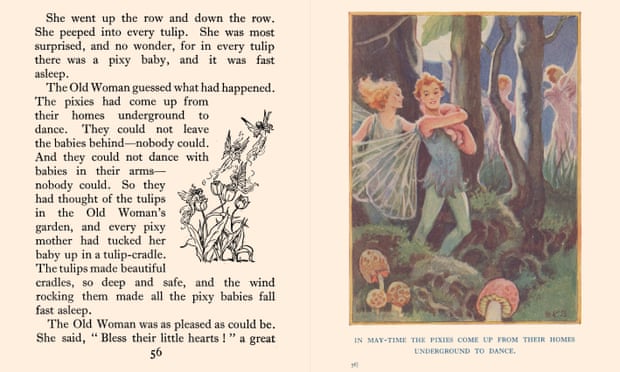
Reprint from the Talkative Sparrow & Other Stories, by Elizabeth Clark 

Read Full Post »

Just saw this 2015 article on Facebook. Originally reported in the Telegraph Herald, the story is about a remarkably wise barber in Iowa.

“Dubuque, Iowa, barber Courtney Holmes is a member of the Dubuque Black Men Coalition (DBMC,) an organization that works to improve the quality of life within their community by providing support and leadership to programs that seek to make a difference in the lives of African-American youth.

“As a father of two, he understands the importance of encouraging kids to read, but also realizes that not all parents share this sense of encouragement, so he decided to take matters into his own hands by rewarding children with a free haircut, if they read books to him while he works.

“The concept began at a back to school event in Comiskey Park, where non-profit organizations gather to support kids in getting ready to go back to school. Holmes started with a few kids, and before he knew it there was a line of over 20 kids getting ready to read a story in exchange for a new look. At the end of the event there were still kids in line so he decided to give out vouchers for them to come back to the salon to read to him and receive their hair cut. …

“Holmes hopes to continue his good work through a monthly event at the salon. He’s also been receiving books from people who want to help keep the movement alive.

‘There’s a lot going on in the world. But it only takes one person to change something. I am just trying to make a difference.’

Check out the rest of the story at Earthables.

Photo: Telegraph Herald
Courtney Holmes, a barber and member of the Dubuque Black Men Coalition, offers free haircuts for children who read to him.

Read Full Post »

I confess that although I can see why children adore books by certain illustrators, sometimes I don’t like reading the artists’ words.

Richard Scarry, for example, with his delightful animals and five-seater pencil cars, writes text that can get boring pretty fast. And Beatrix Potter, whom I admire for a multitude of reasons, employs very big words and potentially scary themes.

Christian Blauvelt recently covered that angle at the BBC. He begins with Potter’s first line in a storybook.

“ ‘Your father had an accident there; he was put in a pie by Mrs McGregor.’

“Old Mrs Rabbit’s frightful warning to her children Flopsy, Mopsy, Cotton-tail and Peter appears on the opening page of Beatrix Potter’s first book, The Tale of Peter Rabbit. Aside from featuring perhaps the most dramatic use of a semicolon in children’s literature, it sets the tone for her work from the start: that horrors abound in a world of Darwinian struggle, but that these must be faced calmly.

“Your parents, and perhaps your children, may be devoured by a vengeful property owner, or sold for tobacco; you may have your tail ripped off by an angry owl; an invading rat might tie you up in string and include you as the key ingredient in a pudding. But life goes on – disappointments must be faced and tragedies overcome. …

“Potter’s tales have been consistently popular with adults, as well as children, since The Tale of Peter Rabbit was published in 1902 when she was 36 years old. This is not just because they feature adorable creatures in harrowing situations; her talking-animal stories also comment on the era’s class politics, gender roles, economics and domestic life.

“Did she examine British society through animals because she spent more time with animals than children, aside from her brother Bertram, when she was young? Because she wanted to rebel against the bourgeois values and morals of her wealthy middle class family – which had made its money in the textile industry – but only dared do so through furry surrogates? Because she could only publish children’s stories since her true passion, science, was a career field closed to women in the late 19th Century? Because she had a German tutor who introduced her to the back-to-nature ethos of the Romantics?” More.

Hmm. Maybe I’m being too anti-intellectual here, but I’d say Beatrix Potter just got a kick out of telling stories like that.

And maybe she was right that small children could handle the scary parts. My three-year-old grand-daughter for example, has always loved Peter Rabbit and could recite the fancy phrases by heart when she was only two. Reciting fancy phrases is great for language development.

Photo of Beatrix Potter’s art: Penguin
Beatrix Potter, an amateur scientist, was meticulous about representing nature accurately, even if the animals did wear clothes. Here Peter Rabbit gorges on Mr. McGregor’s carrots.

Read Full Post »


I had an awfully nice lunch yesterday, and I’d like to tell you about it. It involved two nonprofits — the mostly Caucasian conservation group Trustees of Reservations and the mostly African American community-outreach enterprise called Haley House.

The trustees had a really great idea recently to do meaningful art installations on a couple of their properties and chose one next to the Old Manse in Concord. The Old Manse is most often associated with 19th Century novelist Nathaniel Hawthorne, but the grandfather of Ralph Waldo Emerson was also a resident and saw the historic events unfold at the North Bridge on April 19, 1775.

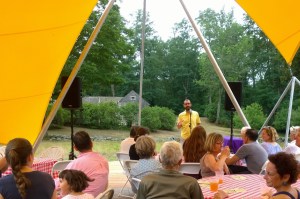
Artist Sam Durant wanted to draw attention to the presence of slaves in the early days of Concord and launch a discussion, so he constructed a kind of big-tent meeting house, with a floor made of the kinds of materials that might have been in slave buildings.

The Trustees conferred with him on a series of “lyceums” that might bring races together at the site. They decided that at the first one, they would encourage races to break bread together and talk about food traditions.

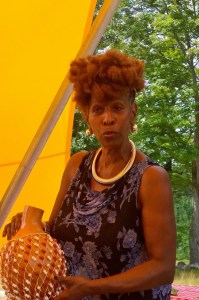
From Haley House in Roxbury, they brought in a chef, a beautiful meal, and singer/educator/retired-nurse Fulani Haynes.

I ate a vegan burger, sweet-potato mash, very spicey collard greens and wonderful corn muffins. Also available were salad and chicken.

Haynes sang a bit and talked about the origins of Haley House, how it helps low-income people and ex-offenders and local children, teaching cooking and nutrition and gardening, among other things. She invited attendees to tell food stories from their early years, and several brave spirits stood up.

That participatory aspect of the activities helped to reduce the impression that African Americans were making entertainments for a mostly white audience (art, food, music entertainments).

I loved the whole thing and learned a lot. (For example, Grandpa Emerson had slaves living upstairs, and “the embattled farmers” who “fired the shot heard ’round the world” were able to go marching off because slaves were working the farms. I really didn’t know.)

African American artifacts are on display next door at the Old Manse. The art installation will be up until the end of October 2016.

More here.

Photos: Artist Sam Durant offers the crowd a new lens on history. The chef from Haley House keeps an eye on the African American cuisine. Fulani Haynes demonstrates how a food can become an instrument.

081316-artist-Sam-Durant-at-installation-picnic

081316-Fulani-Haynes-sings-in-Old-Manse-field


081316-Haley-House-chef-and-corn-muffins

Read Full Post »

Photo: Aram Boghosian for The Boston Globe
Jean Devine (left) and Jayden Pineda, 7, make a meadow at the Waltham Y.

I’m excited that today the Boston Globe caught up with my friend Jean’s terrific biodiversity-education outreach. Readers may recall that I blogged here and here about how she and Barbara Passero got started on “meadowscaping” — hoping to ween homeowners from using pesticides and herbicides that harm the environment and contribute to global warming.

Debora Almeida reports on the educators’ latest work with kids: “Swimming, crafting, and playing games are staples of day camp, but kids at the Waltham YMCA are doing something new this summer.

“They’re learning how to plant and cultivate a meadow — and why they should.

“ ‘We just want to save the world, that’s all,’ said Barbara Passero, cofounder of Meadowscaping for Biodiversity, an outdoor environmental education program for students of all ages, which has partnered with the Y for the project.

“Over the course of the summer, Passero and program leader Jean Devine are teaching children the fundamentals of meadow upkeep and the importance of planting exclusively native plants. They are the best hosts for pollinators, such as bees, butterflies, and moths. In turn, the insects attract other wildlife such as birds and rabbits, building biodiversity.

“While some people’s first instinct would be to spray pesticides to protect their hard work from leaf-munching insects, Passero knows that birds will take care of the insects on their own. She also refuses to use any toxic substances around the children, who truly get their hands dirty digging in the meadow. Seth Lucas, program administrator at the Waltham Y, said kids love the activity. …

“The meadow started as a patch of weedy grass, but is in the process of becoming a 10-by-60-foot flourishing garden. Passero and Devine are setting the meadow up for success with native plants that come back year after year. The plants are self-sustaining and spread on their own.”

Such a happy story! Do read the whole thing here.

Read Full Post »

Shows how far we have come from ancestors who let nothing go to waste that making clothes out of leftover fabric is a novelty. But it’s a good idea nevertheless.

Katherine Martinko at TreeHugger writes that Beru Kids is a children’s clothing company in downtown Los Angeles that makes use of textiles that would otherwise be landfilled.

“The garment workers are mostly female,” she says, “and are paid higher than minimum wage (not per-garment, as is usual in the fashion industry).

“What’s really interesting about Beru is that it repurposes deadstock fabrics to make its clothes. ‘Deadstock’ refers to surplus fabric that has not been used by other factories. In LA, it is sent to a warehouse, where Beru’s founder Sofia Melograno goes on a regular basis to purchase whatever textiles catch her eye. Beru has also begun recently incorporating organic, traceable cotton into its garments.”

Traceability means the cotton can be traced back to its original source so it’s possible to assess whether all steps in the supply chain are environmentally and ethically sound.

Martinko adds that because the fashion industry is a huge polluter, finding a use for fabric that would otherwise get thrown away is good for the planet.

More here.

Photo: Beru Kids (via Facebook)
Beru-Kids-Molly-Bee-dress

Read Full Post »

My friend was born and raised in Hawaii. His parents were Japanese-American. His mother was sent to an internment camp during World War II. It’s a complicated story how she got released and ended up in Japan for the war’s duration. Something like a prisoner swap. She returned to Hawaii after the war and raised a family.

My friend was invited to talk to fifth graders about his mother’s experience in the camp. He was reluctant. It’s painful to think about. Would young children get it?

In the end, he went, and it was a good experience for him as well as for the kids. I think he had an impact on how they think about differences in our multicultural society. And their curiosity and understanding was a comfort to him.

Here is what he put on Facebook this spring.

“Last week I spoke to two classes of fifth graders about my mom’s experience in a Japanese-American relocation camp during World War II. After the talk, one of the students asked me why the Japanese-Americans had been relocated to camps but the German-Americans hadn’t. Wow, I could have hugged that boy for asking such a perceptive question, and I was also touched by how the students were able to draw a parallel between the Japanese-American discrimination decades ago and the anti-Muslim sentiment that’s currently been gaining so much traction in the U.S. and elsewhere.”

My friend posted a family photo that he goes on to describe. It is not the photo I put below.

“This photo, taken in the mid 1930s, is of my mom and her younger sister when they were growing up in downtown Honolulu, before they were forced to relocate to a camp in Arkansas. My mom looks like she’s around the age of the students I was talking to last week, and when I showed those students this photo I got a little emotional imagining my mom as a young girl being in that classroom too, listening to me tell her story. In such ways, our stories really do have such raw power to connect people through different generations and cultures, which, I suppose, is why I first became interested in becoming a writer all those years ago.”

America has always needed people like my friend’s mother — people who carry on and return benefits to the place that harmed them. And there are lots of them. Even in the town where I live, a couple who suffered internment during the war became quietly known for philanthropy to both the Nisei Student Relocation Commemorative Fund, Inc. and our town, donating all their reparation money to local high school scholarships.

Photo: Dorothea Lange
Some Japanese-Americans who suffered from internment in World War II
still chose to return kindness for hurt after the war.

Read Full Post »

Are you familiar with the “Lens” blog at the NY Times? It focuses on “photography, video and visual journalism.” Here David Gonzalez writes about the photos of Putu Sayoga.

[Hat tip: Asakiyume on twitter.]

“If you live in a far-off place, a library may be something you’d only read about in books. That is, if you had books to begin with.

“That became the mission of Ridwan Sururi, an Indonesian man with a plan — and a horse. Several days a week, he loads books onto makeshift shelves he drapes over his steed, taking them to eager schoolchildren in the remote village of Serang, in central Java. ..

“Mr. Sayoga, a co-founder of the collective Arka Project, had seen something about the equine library on a friend’s Facebook page. It reminded him of his own childhood, where his school had only out-of-date books. Intrigued, he reached out to Mr. Sururi, who offered to put Mr. Sayoga up in his home while he spent time photographing Mr. Sururi on his rounds. …

“Mr. Sururi made a living caring for horses, as well as giving scenic tours on horseback. One of his clients, Nirwan Arsuka, came up with the book idea as a way of doing something to benefit the community, specifically a mobile library. He gave Mr. Sururi 138 books for starters. Most were in Indonesian, and the books included a lot with drawings.

“Children at the schools he visits can borrow the books for three days, and demand has been so great that he now has thousands of books.” More here. Check out the slide show.

Photo: Putu Sayoga

Read Full Post »

Erik’s sister and family are off on their five-month European sailing trip. The three children have homework to do during the first part of the trip, when they would ordinarily be in school. All five family members are contributing to a WordPress blog they call Burning Cloud. Four write their posts in English; the youngest sometimes writes in Danish. The entries are a lot of fun to read.

Here is the oldest child’s May 11 post:

this is a word for word conversation.

Klara : the first qustion is, why are we not moving

Klaus: because we are waiting for our gear to come back from the repair shop

Klara : the second question is: when are  we going to move?

Klaus: on Friday

Klara: the third question is: what is wrong with the motor?

Klaus: the gear is leaking a bit of oil.

Karl-Oscar: how will they fix the gear?

Klaus : it will be repaired in Køge  with some spare parts that are cominng form Gottenburg.

written by Axel.

Join the fun at Burning Cloud Blog. You can follow the route on maps the family posts periodically along with other entertaining pictures. (Don’t miss the photo of everyone making sushi on shipboard.)

Photo: School at sea.

Read Full Post »

icki Houska is a woman of many gifts. But one of the first things that her friends and colleagues will tell you about her is that she is a hugger.

“ ‘No one leaves her without a hug and a smile,’ says Michelle Barron, a work crew supervisor for the St. Charles County Juvenile Justice Center. …

“On this busy Saturday, though, Ms. Houska is getting ready to dispense more than just hugs. She’s moving briskly through the jampacked rented rooms that house the operation she runs for FAST (Foster Adoption Support Team), a support organization for foster and foster adoptive families caring for children who are wards of the state of Missouri.

“Houska’s making sure that packages of frozen pork chops, fresh loaves of bread, and tiny snowsuits are all properly shelved and stacked, ready for the families who are about to arrive and lay claim to them. …

“A foster parent herself since 1998, she has fostered 12 children over the years and, of those 12, adopted three. ‘It’s the hardest thing you’ll ever do,’ she says of foster parenting. The emotional challenges ‘will bring you to your knees.’

“But one thing that doesn’t have to be so hard on foster parents, she decided some years ago, is the financial burden. …

“Foster families are expected to provide food, clothing, and household items like toothbrushes and hairbrushes, and to cover school expenses and any additional treats, lessons, or outings.

“From her own experiences and those of other foster families she has met, Houska came to feel that financial challenges were one of the biggest obstacles to the foster-parenting experience. So in 2005, to help alleviate the strain, she lined her own basement with industrial freezers and shelving, sought out donations, and began distributing food, diapers, and toiletries each Saturday, free to all local foster families. …

“Eventually, the OASIS Food Pantry, a local nonprofit, notified Houska that it had rental space available near its own operation in a nearby strip mall. …

“Houska’s pantry offers not only household items but emotional and social support. …

“Foster families arrange play dates, with pickups and drop-offs scheduled at the food pantry. Sometimes, for siblings who have been assigned to separate families, a trip to the food pantry is a chance to reunite in the pantry’s backyard, where the children are invited to romp on the playground equipment donated by a local church and other well-wishers. …

“ ‘Poverty doesn’t take a vacation,’ [Houska] says. ‘Kids in need don’t take a vacation. So neither do I.’ ”

Read what happened to Houska at age 21 that is one reason she is so dedicated, here.

Read Full Post »

A friend on Facebook clicked “like” on an American Museum of Natural History story about youthful doodles covering original Origin of the Species pages. So I have to admit that Facebook is sometimes good for leads.

The museum reported, “We may have Charles Darwin’s children to thank for the surviving handwritten pages of the naturalist’s ‘On the Origin of Species’ manuscript. Most of the original 600 pages are lost, and of the 45 pages that exist today, many were repurposed by Darwin’s brood of 10 children as art supplies.

” ‘Darwin was done with those pages — he was throwing away sections of his draft and not caring about it because the book was published,’ said Darwin Manuscripts Project Director David Kohn.”

McKenna Stayner at the New Yorker magazine has more on the Darwin story, adding that the family lived at Down House “in rural Kent, England. … They had ten children … and Down House was by all accounts a boisterous place, with a wooden slide on the stairs and a rope swing on the first-floor landing. …

“What may seem like sacrilege now—turning the only handwritten copy of a seminal work of science into scratch paper—appears to have been normal then. Once Darwin had sent a fair copy of the manuscript off to his publisher, John Murray, he made the rest of his changes to the book directly on the galley proofs, and evidently he wasn’t precious about the originals. Paper being a hot commodity, the children co-opted the pages for themselves.”

And that, O, Best Beloved, is how some of Darwin’s original thinking got preserved for posterity.

Pretty talented children, if you ask me, with some of their father’s interest in animals and birds. Check out these pictures.

Art: Darwin’s children
From the American Museum of Natural History and Cambridge University Library.

Read Full Post »

Raising a family is challenging under any circumstances, but Simon Romero of the NY Times can tell you about families that have added on a somewhat more extreme challenge: settling in Antarctica.

He writes from Villa Las Estrellas, “Children at the schoolhouse here study under a portrait of Bernardo O’Higgins, Chile’s independence leader. The bank manager welcomes deposits in Chilean pesos. The cellphone service from the Chilean phone company Entel is so robust that downloading iPhone apps works like a charm. …

“Fewer than 200 people live in this outpost founded in 1984 during the dictatorship of Gen. Augusto Pinochet, when Chile was seeking to bolster its territorial claims in Antarctica. Since then, the tiny hamlet has been at the center of one of Antarctica’s most remarkable experiments: exposing entire families to isolation and extreme conditions in an attempt to arrive at a semblance of normal life at the bottom of the planet.

“It gets a little intense here in winter,” said José Luis Carillán, 40, who moved to Villa Las Estrellas three years ago with his wife and their two children to take a job as a teacher in the public school.

“He described challenges like trekking through punishing wind storms to arrive at a schoolhouse concealed by snow drifts, and withstanding long stretches with only a few hours of sunlight each day. …

“Most of the students at the village’s small school, who generally number less than a dozen, are the children of air force officials who operate the base; some of the parents say the isolating experience strengthens family bonds.

“That Villa Las Estrellas is so remote — its name can be translated as Hamlet of the Stars, since the lack of artificial light pollution here enhances gazing into the heavens — sits just fine with many who live here.

“ ‘People in the rest of Chile are so afraid of thieves that they build walls around their homes,’ said Paul Robledo, 40, an electrician from Iquique (pronounced E-key-kay). ‘Not here in Antarctica. This is one of the safest places in the world.’ More here.

And here you thought our cold snap was a little intense!

Photo: Daniel Berehulak for The New York Times  
Children being picked up from school in Villa Las Estrellas. Most of the students at the village’s small school, who generally number less than a dozen, are the children of air force officials who operate a nearby base. 

Read Full Post »

« Newer Posts - Older Posts »