Feeds:
Posts
Comments

Posts Tagged ‘children’

Are you familiar with the “Lens” blog at the NY Times? It focuses on “photography, video and visual journalism.” Here David Gonzalez writes about the photos of Putu Sayoga.

[Hat tip: Asakiyume on twitter.]

“If you live in a far-off place, a library may be something you’d only read about in books. That is, if you had books to begin with.

“That became the mission of Ridwan Sururi, an Indonesian man with a plan — and a horse. Several days a week, he loads books onto makeshift shelves he drapes over his steed, taking them to eager schoolchildren in the remote village of Serang, in central Java. ..

“Mr. Sayoga, a co-founder of the collective Arka Project, had seen something about the equine library on a friend’s Facebook page. It reminded him of his own childhood, where his school had only out-of-date books. Intrigued, he reached out to Mr. Sururi, who offered to put Mr. Sayoga up in his home while he spent time photographing Mr. Sururi on his rounds. …

“Mr. Sururi made a living caring for horses, as well as giving scenic tours on horseback. One of his clients, Nirwan Arsuka, came up with the book idea as a way of doing something to benefit the community, specifically a mobile library. He gave Mr. Sururi 138 books for starters. Most were in Indonesian, and the books included a lot with drawings.

“Children at the schools he visits can borrow the books for three days, and demand has been so great that he now has thousands of books.” More here. Check out the slide show.

Photo: Putu Sayoga

Read Full Post »

Erik’s sister and family are off on their five-month European sailing trip. The three children have homework to do during the first part of the trip, when they would ordinarily be in school. All five family members are contributing to a WordPress blog they call Burning Cloud. Four write their posts in English; the youngest sometimes writes in Danish. The entries are a lot of fun to read.

Here is the oldest child’s May 11 post:

this is a word for word conversation.

Klara : the first qustion is, why are we not moving

Klaus: because we are waiting for our gear to come back from the repair shop

Klara : the second question is: when are  we going to move?

Klaus: on Friday

Klara: the third question is: what is wrong with the motor?

Klaus: the gear is leaking a bit of oil.

Karl-Oscar: how will they fix the gear?

Klaus : it will be repaired in Køge  with some spare parts that are cominng form Gottenburg.

written by Axel.

Join the fun at Burning Cloud Blog. You can follow the route on maps the family posts periodically along with other entertaining pictures. (Don’t miss the photo of everyone making sushi on shipboard.)

Photo: School at sea.

Read Full Post »

icki Houska is a woman of many gifts. But one of the first things that her friends and colleagues will tell you about her is that she is a hugger.

“ ‘No one leaves her without a hug and a smile,’ says Michelle Barron, a work crew supervisor for the St. Charles County Juvenile Justice Center. …

“On this busy Saturday, though, Ms. Houska is getting ready to dispense more than just hugs. She’s moving briskly through the jampacked rented rooms that house the operation she runs for FAST (Foster Adoption Support Team), a support organization for foster and foster adoptive families caring for children who are wards of the state of Missouri.

“Houska’s making sure that packages of frozen pork chops, fresh loaves of bread, and tiny snowsuits are all properly shelved and stacked, ready for the families who are about to arrive and lay claim to them. …

“A foster parent herself since 1998, she has fostered 12 children over the years and, of those 12, adopted three. ‘It’s the hardest thing you’ll ever do,’ she says of foster parenting. The emotional challenges ‘will bring you to your knees.’

“But one thing that doesn’t have to be so hard on foster parents, she decided some years ago, is the financial burden. …

“Foster families are expected to provide food, clothing, and household items like toothbrushes and hairbrushes, and to cover school expenses and any additional treats, lessons, or outings.

“From her own experiences and those of other foster families she has met, Houska came to feel that financial challenges were one of the biggest obstacles to the foster-parenting experience. So in 2005, to help alleviate the strain, she lined her own basement with industrial freezers and shelving, sought out donations, and began distributing food, diapers, and toiletries each Saturday, free to all local foster families. …

“Eventually, the OASIS Food Pantry, a local nonprofit, notified Houska that it had rental space available near its own operation in a nearby strip mall. …

“Houska’s pantry offers not only household items but emotional and social support. …

“Foster families arrange play dates, with pickups and drop-offs scheduled at the food pantry. Sometimes, for siblings who have been assigned to separate families, a trip to the food pantry is a chance to reunite in the pantry’s backyard, where the children are invited to romp on the playground equipment donated by a local church and other well-wishers. …

“ ‘Poverty doesn’t take a vacation,’ [Houska] says. ‘Kids in need don’t take a vacation. So neither do I.’ ”

Read what happened to Houska at age 21 that is one reason she is so dedicated, here.

Read Full Post »

A friend on Facebook clicked “like” on an American Museum of Natural History story about youthful doodles covering original Origin of the Species pages. So I have to admit that Facebook is sometimes good for leads.

The museum reported, “We may have Charles Darwin’s children to thank for the surviving handwritten pages of the naturalist’s ‘On the Origin of Species’ manuscript. Most of the original 600 pages are lost, and of the 45 pages that exist today, many were repurposed by Darwin’s brood of 10 children as art supplies.

” ‘Darwin was done with those pages — he was throwing away sections of his draft and not caring about it because the book was published,’ said Darwin Manuscripts Project Director David Kohn.”

McKenna Stayner at the New Yorker magazine has more on the Darwin story, adding that the family lived at Down House “in rural Kent, England. … They had ten children … and Down House was by all accounts a boisterous place, with a wooden slide on the stairs and a rope swing on the first-floor landing. …

“What may seem like sacrilege now—turning the only handwritten copy of a seminal work of science into scratch paper—appears to have been normal then. Once Darwin had sent a fair copy of the manuscript off to his publisher, John Murray, he made the rest of his changes to the book directly on the galley proofs, and evidently he wasn’t precious about the originals. Paper being a hot commodity, the children co-opted the pages for themselves.”

And that, O, Best Beloved, is how some of Darwin’s original thinking got preserved for posterity.

Pretty talented children, if you ask me, with some of their father’s interest in animals and birds. Check out these pictures.

Art: Darwin’s children
From the American Museum of Natural History and Cambridge University Library.

Read Full Post »

Raising a family is challenging under any circumstances, but Simon Romero of the NY Times can tell you about families that have added on a somewhat more extreme challenge: settling in Antarctica.

He writes from Villa Las Estrellas, “Children at the schoolhouse here study under a portrait of Bernardo O’Higgins, Chile’s independence leader. The bank manager welcomes deposits in Chilean pesos. The cellphone service from the Chilean phone company Entel is so robust that downloading iPhone apps works like a charm. …

“Fewer than 200 people live in this outpost founded in 1984 during the dictatorship of Gen. Augusto Pinochet, when Chile was seeking to bolster its territorial claims in Antarctica. Since then, the tiny hamlet has been at the center of one of Antarctica’s most remarkable experiments: exposing entire families to isolation and extreme conditions in an attempt to arrive at a semblance of normal life at the bottom of the planet.

“It gets a little intense here in winter,” said José Luis Carillán, 40, who moved to Villa Las Estrellas three years ago with his wife and their two children to take a job as a teacher in the public school.

“He described challenges like trekking through punishing wind storms to arrive at a schoolhouse concealed by snow drifts, and withstanding long stretches with only a few hours of sunlight each day. …

“Most of the students at the village’s small school, who generally number less than a dozen, are the children of air force officials who operate the base; some of the parents say the isolating experience strengthens family bonds.

“That Villa Las Estrellas is so remote — its name can be translated as Hamlet of the Stars, since the lack of artificial light pollution here enhances gazing into the heavens — sits just fine with many who live here.

“ ‘People in the rest of Chile are so afraid of thieves that they build walls around their homes,’ said Paul Robledo, 40, an electrician from Iquique (pronounced E-key-kay). ‘Not here in Antarctica. This is one of the safest places in the world.’ More here.

And here you thought our cold snap was a little intense!

Photo: Daniel Berehulak for The New York Times  
Children being picked up from school in Villa Las Estrellas. Most of the students at the village’s small school, who generally number less than a dozen, are the children of air force officials who operate a nearby base. 

Read Full Post »

Swedish friends of ours have a home on the Greek island of Samos, where boatloads of refugees are landing every day. The family is collecting donations, buying bread, water bottles, diapers, and such, and delivering them to exhausted but grateful families. I will paste here the Facebook translation of the Swedish post, which may not be quite accurate, but you get the picture.

My Mom wrote yesterday:
It has blown hard in the last few days. Looking from the terrace, you can see the coast guard boat coming with inflatable boats on a trailer full of refugees. In the night 200 came, many families with children. Got together with J– and shared out approximately 100 bagettes without meat (Bedun Lachum) but with potatoes, eggs and mayonnaise, croissants, biscuits — also gave out diapers and wipes. The kids have priority always. The next delivery is 50 packages of diapers and 120 packages biscuits. Another 2000 Bottles of water were ordered.”

Read Full Post »

An experimental theater piece to test the Theory of Purposefully Divided Attention to Fend Off Meltdowns.
Cast: Grandma (G), Adult One (1), Adult Two (2), Adult Three (3), Small Child (Small)
Setting: Dinner table

G: Why is your hairdresser your hero?

1: She’s a real bootstrap entrepreneur. She’ll try anything.

G: Is that a blackberry in your popsicle?

Small: No, a blueberry.

2: Well, when you have kids, you can’t participate in every charity event or random partnership.

3: You have to prioritize, be strategic. Know when to say no.

1: But she has a great community reputation. She’s so upbeat.

G: I really think that’s a blackberry. Like Mrs. Rabbit’s in Peter Rabbit. Supporting everything in the community can add up.

1: It rolls up.

3: But you can waste a lot of time.

2: And energy.

G: People are grateful, though. If you’re strategic, you miss the kind of opportunities that you have no idea where they will lead. I like the way that popsicle drips right into the holder. It’s less messy.

Small: Do you want one?

G: I don’t want to take your last popsicle.

Small: We can make more.

G: Maybe after dinner.

Small: Let’s do it!

G: Careful — the juice is spilling. One and one and 50 make a million. It’s good to be open to serendipity if you possibly can.

2: There are only so many hours in the day.

3: Numerous small investments can’t get what one big investment would.

G: Do you want a napkin?

Small: I got a green popsicle at Whole Foods, but it dripped all over my dragon shirt. It was green.

G: There is nothing like a reputation for being upbeat and cooperative. I know where we can pick blackberries for the next batch of popsicles.

Small: But you have to add juice so it sticks together.

1: We now trade services. She does that with almost everyone. I feel like she could teach a class in entrepreneurship.

G: Teach one together, how about?

Small: Do you want a popsicle? Do you want one now?

G: Maybe after dinner. Look, that’s a raspberry. Or do you think it’s a strawberry?

Small: Do you want a popsicle now? I can go get it. We can make more later. Yes or no?

G: OK. Yes.

Small: Say, Please.

G: Yes, please.

Photo: Matthew Klein

Read Full Post »

Two of my grandchildren just got back from a month in Scandinavia with their parents, visiting the Swedish side of the family. It’s amazing how much kids can develop in one month.

The baby left here with four teeth and came back with eight. She could barely reach for something without falling over and now crawls like a demon. Her older brother is more of a conversationalist than ever and has returned with new ideas for playing with old toys.

The children bloomed and blossomed with all the love and attention of their Swedish family.

The lotus below was also blooming during the past month.

080915-lotus-to-be

082315-bud-opening

082215-lotus-bud

082415-almost-blooming

082415-lotus-blooming

Read Full Post »

First there was the photo, which was tweeted with a link to tumblr. But tumblr offered no story and no credit. I did some searching and found the story at The Trumpet. It reminds me of this post on Sam and Leslie’s Uni, a pop-up library that has traveled from New York to Kazakhstan and many places in between.

At The Trumpet, Jeremiah Jacques reports on a Mongolian Andrew Carnegie (without the fortune). “What do you do if you are a young book lover? You go to the library. But what if you live in the rural regions of the Gobi desert? Your situation would be bleak — were it not for Dashdondog Jamba. He has devoted his life to writing, translating, publishing and transporting books to children all over Mongolia with his Children’s Mobile Library.

“ ‘I can’t remember how many trips I have made—I have lost count,’ Mr. Jamba said. ‘Sometimes we travel by camel, sometimes on horseback, and with horse carts or ox carts; we now also have our van.’

“Over the last 20 years, his library has traveled 50,000 miles through every province of Mongolia — mostly before the van was part of the operation. Jamba’s assistants are his wife and his son. They often spend several days in one place to give as many children as possible a chance to read their books.

“ ‘[It] is a little different from other libraries,’ Jamba says. ‘The walls of this reading room are made of mountains covered with forest, the roof is blue sky, the floor is a flower-covered steppe, and the reading light bulb is the sun.’

“Jamba created his library in the early 1990s, shortly after Mongolia abandoned communism and adopted free-market economics. Life in Mongolia changed dramatically, mostly for the good. But organizations focused on children’s literature fared badly. They were viewed as profitless, so no private investors wanted to take them over. Most children’s libraries were converted into banks.

“Jamba tried to keep the libraries alive. … Ever since, he’s been writing children’s books, translating foreign youth literature into Mongolian, and bringing books to children who would otherwise never read them. Several of his original books have earned the Best Book of Mongolia award. Some of his stories have been put to song. Some have been made into movies. In 2006, his mobile library won the prestigious ibby-Asahi Reading Promotion Award.” More here.

Photo: Dashdondog Jamba
Dashdondog Jamba has traveled more than 50,000 miles through every province of Mongolia with his Children’s Mobile Library.

Read Full Post »

It’s hard to read about the deprivations of refugees, especially the children and especially in winter. That’s why I appreciate hearing about any kindness extended to them. National Public Radio recently had a story on the kindness of Clowns without Borders.

Laura Secorun-Palet writes, “On a cold November morning, 300 children gather in a soccer field in Zaatari, a Jordanian village next to the country’s largest refugee camp. …

“Today the children are not lining up to collect food coupons or clothes from NGOs: They are here to watch the clowns.

“On the ‘stage’ — a space in front of a velvet curtain covering the goal — a tall, blond woman performs a handstand while doing the splits, while two other performers run around clapping and making funny faces. As the upside-down woman pretends to fall, the children burst into laughter.

“The performers are circus artists from Sweden …

“Clowns Without Borders is a global network of nonprofit organizations that, for the past 20 years, has been spreading laughter in the world’s saddest places. The group’s most recent annual report says more than 385 artists performed 1,164 shows for its chapters in 2012 in 38 countries, both in the developing world and for refugees and other disadvantaged children in Western countries.

” ‘It’s very important to give kids a chance to be kids again,’ explains Lilja Fredriksson, one of the Swedish performers.” More here.

Another way to help refugees is through the wonderful Minneapolis-based nonprofit American Refugee Committee.

Photo: Bilal Hussein/AP
Lebanese clown Sabine Choucair, a member of “Clowns Without Borders,” performs for children in June at a Syrian refugee camp in the eastern town of Chtoura, Lebanon.

Read Full Post »

I love listening to Worcester-based WICN (jazz radio). Bonnie Johnson had an especially good show yesterday, opening with Cynthia Scott and 3rd, 4th & 5th graders of PS32 in Brooklyn, NY, singing “Dream for One Bright World.”

“There is a new day dawning
“The time is now
“The world is ready for a change …

“Let’s teach out children to care
“To help one another
“And mend broken hearts
“So many children in the world
“Have never had a chance
“Their time has come …

(More lyrics here.)

You can listen to WICN online at wicn.org. Bonnie Johnson’s program is described at Colors of Jazz. “Bonnie Johnson is host of Colors of Jazz on Sunday afternoon from noon-4 pm. If you asked the Worcester native how she found jazz, she would tell you that jazz found her. As an undergraduate student at Howard University in Washington, DC, Ms. Johnson became a fan of the Quiet Storm featured on the college station WHUR-FM. …

“Ms. Johnson appreciates the diversity and the evolution of music. As a self-taught electric bassist, she has enjoyed many years of playing various types of music with her daughter and close friends in a family band. Growing up, she sang in the St. Cecilia Girl Choir at All Saints Worcester. …

“Ms. Johnson holds B.A. in Liberal Studies and M.S. in Communications and Information Management degrees from Bay Path College. She believes the future of jazz is in our children, stating, ‘Music and the arts is one area that gives young people an outlet and release of creative energy. While there are many children exposed to music through lessons and attending live performances, there are too many more that are not.’ One of Johnson’s primary goals as host at WICN is to reach youth in creative ways through community engagement.”

That’s something to think about on Martin Luther King’s birthday — and maybe to act on, too.

Bonnie Johnson, host of WICN radio’s Colors of Jazz 

Read Full Post »

It’s not always easy for low-income people to get access to food that is healthful, and once children get accustomed to salty, fatty, sugary snacks, junk food becomes comfort food and stores see little demand for better items. But if children know what would taste good and be good for them, they are on the road to better nutrition.

That is why the folks fighting childhood obesity are enlisting the support of several hip-hop artists that young people admire.

Winnie Hu at the NY Times writes, “Adrian Harris, known as Easy A.D. to his fans, has rapped about street life in the South Bronx as a member of the Cold Crush Brothers, a group that is among the pioneers of hip-hop.

“Now Mr. Harris also raps about broccoli.

“ ‘If you think you eat healthy, say ‘”me,” ‘ Mr. Harris called out over a pounding bass that shook the gym at the Future Leaders Institute, a charter school in Harlem, on a recent morning. A photo of a cart laden with fruits and vegetables filled a screen behind him. ‘Boys and girls,’ he added, ‘there are no Doritos on that cart.’

“Mr. Harris, calling himself a ‘health M.C.,’ aims to reach children who might otherwise tune out nutrition lessons. His vegetable rap is part of a growing public health campaign that has enlisted hip-hop artists such as Doug E. Fresh, Chuck D and DMC of Run-DMC to work alongside doctors and nutritionists in fighting obesity and related illnesses in poor communities. The campaign is being rolled out this year in 18 cities.” More here.

Photo: Ozier Muhammad/The New York Times
Adrian Harris, also known as Easy A.D., made a pitch for healthy eating recently at the Future Leaders Institute in Harlem.
 

Read Full Post »

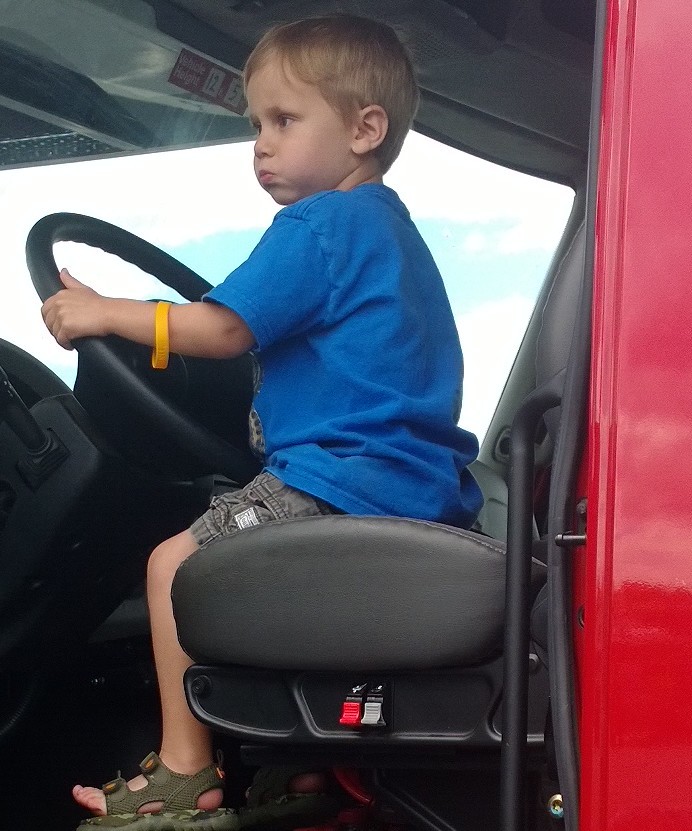
serious-truck-driver


Play is important for all kinds of reasons in childhood, including testing out skills and experiencing the satisfaction of creativity.

John Poole at National Public Radio focused on the socialization aspects of play in a recent report.

He began, “Why do we humans like to play so much? Play sports, play tag, play the stock market, play duck, duck, goose? We love it all. And we’re not the only ones. Dogs, cats, bears, even birds seem to like to play. …

“The scientist who has perhaps done more research on brains at play than any other is a man named Jaak Panksepp. And he has developed a pretty good hypothesis.

“In a nutshell, he, and many others, think play is how we social animals learn the rules of being social.  …

“Play seems so deeply wired by evolution into the brains of highly social animals that it might not be a stretch to say that play is crucial to how we and they learn much of what we know that isn’t instinct. …

“Not surprisingly, Panksepp and others think the lack of play is a serious problem. Especially at younger ages. And particularly in school settings. …

” ‘It’s not just superfluous,’ says Panksepp. ‘It’s a very valuable thing for childhood development. And we as a culture have to learn to use it properly and have to make sure our kids get plenty of it.’ ” More here.

More still from Jon Hamilton, another reporter in the NPR series on play, here.

Photo: David Gilkey/NPR
Deion Jefferson, 10, and Samuel Jefferson, 7, take turns climbing and jumping off a stack of old tires at the Berkeley Adventure Playground in California. The playground is a half-acre park with a junkyard feel where kids are encouraged to “play wild.” 

Read Full Post »

I was first drawn to Joseph P. Kahn’s story about clowns in children’s hospitals by the cute pictures — and the fact  that my brother sometimes performs with a clown troupe at his church.

But what I especially appreciated learning from the article is that hospital clowning today is not just about getting a laugh out of a sick kid, important as that is. It’s also about giving children a little bit of control — to point out that the clown is doing something wrong, for example, or even to say the clown is not welcome and should go.

Kahn writes, “For hospital clowns Joyce Friedman and David Levitin, no two tours of duty are quite the same. Which is just how they like it.

“During rounds at Boston Medical Center, Friedman (a.k.a. Frizzle) and Levitin (Toodles) showed off their improv skills room by room, careful to assign an active role to each young patient they visited.

“At the bedside of 10-year old Cheyanne, the pair held a mock marriage ceremony, prompting Cheyanne to exclaim, through her oxygen mask, ‘You forgot to exchange vows!’ …

“Handed a joystick, a child might be encouraged to ‘control’ the clown as he or she chooses. Another patient, nervous or scared, might not want a visit at all. Either way, something positive comes from the encounter.

“ ‘Being empowered is really a key component of the healing process,’ says [Children’s Hospital endocrinologist Dr. Michael] Agus. ‘The more passive you are with an illness, the more challenging it is to heal.’ …

“Whatever a patient’s age or condition, said [clown Cheryl] Lekousi, she and her colleagues focus on the positive, even in the bleakest situations.

“ ‘Our message to the kids is, we’re a witness of you, of your childhood,’ said Lekousi.”

More here.

Photo: Dina Rudick/Globe Staff
Christopher reacts to the entrance of Cheryl Lekousi (a.k.a. Tic Toc).

Read Full Post »

My friend Jean Devine is always up to something interesting. A Brown U grad, with an MBA from Simmons, she used to work in investor relations but in recent years has been testing the waters of social entrepreneurship.

Her latest initiative, with Barbara Passero of Sandpiper Creative, is called meadowscaping and is intriguing on many levels.

With access to a Waltham church lawn for a summer youth program, Jean and Barbara will work with kids to convert the yard into a meadow that uses native species from Garden in the Woods and provides a habitat to the bugs and other small creatures that make a healthy environment.

From the Meadowscaping for Biodiversity website: Meadowscaping “is an outdoor, project-based, environmental education program that provides middle school youth with real-world experiences in STEAM learning (Science, Technology, Engineering, Arts and Math), while inspiring and empowering them to address challenges to the environment and our society.

“Today, few children spend time experiencing Nature and the benefits of outdoor recreation, education, and contemplation. Founder and former Director of the Children and Nature Network (C& NN) Richard Louv coined the phrase nature-deficit disorder to describe the negative effects of reduced outdoor time on children’s development. …

“Children who spend little time outdoors may value nature less than children who spend time outdoors in free play. Similarly, children who feel part of something bigger than themselves may … understand their dependence on a clean environment and know that they are responsible for caring for the Earth as their home.” More here.

The idea behind the meadowscaping summer program is that children, both at a young age and as they become adults, can actually do something about the environment.

Remember our post “The Doctor Is In” about the woman who sets up in a Providence park to listen to your worries about global warming (here)? Stop worrying and do something, say the meadowscape entrepreneurs. Give up lawn chemicals, plant a meadow, provide a home for tiny necessary critters, and work to make change.

white-iris-in-morning

Read Full Post »

« Newer Posts - Older Posts »