Feeds:
Posts
Comments

Posts Tagged ‘community’

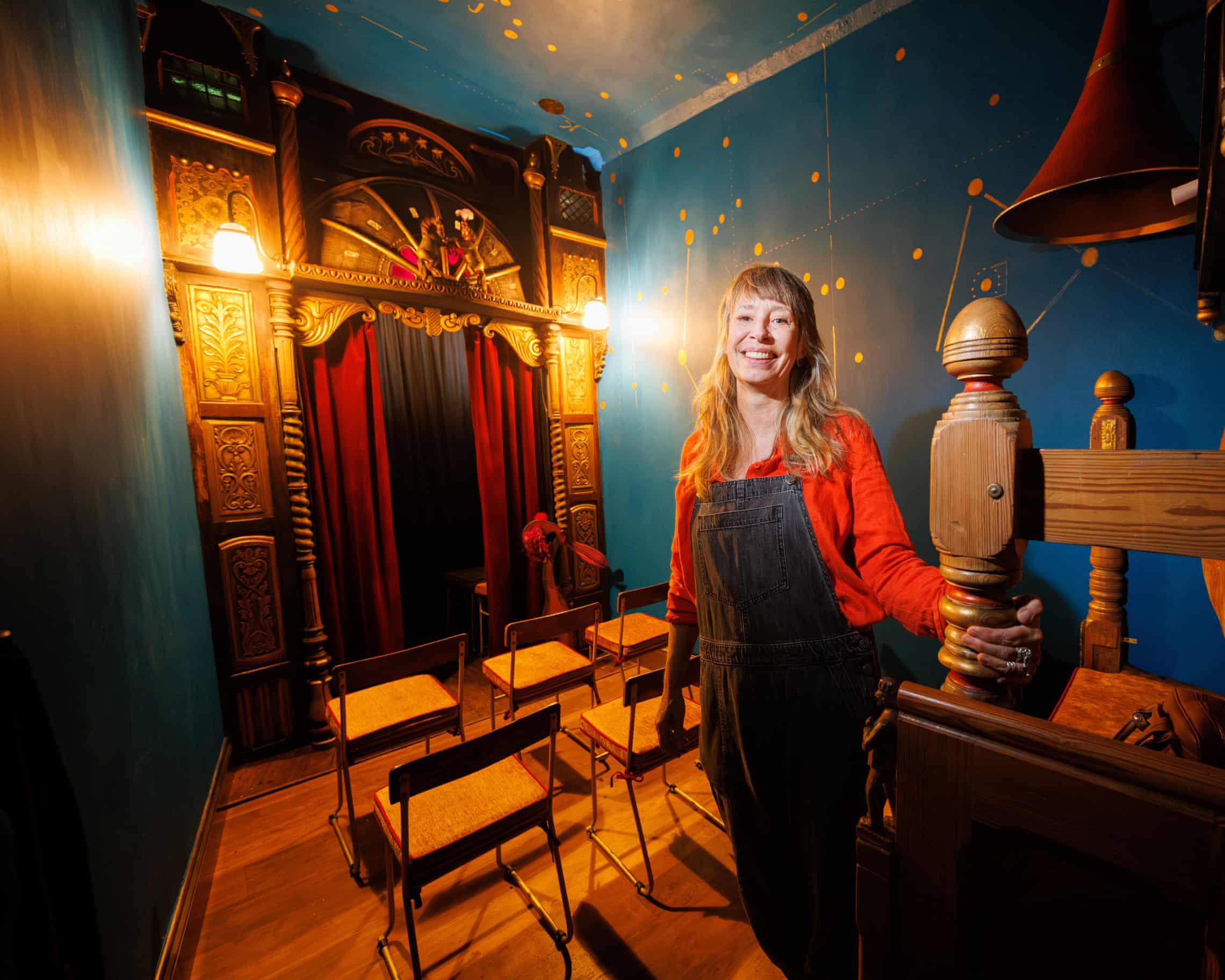
Photo: Sam Frost/The Guardian.
Loz Samuels, creative director of the tiny Theatre of Small Convenience, believes that in the digital age it is ‘really important’ to keep places like this alive. 

People care about having the arts in their lives. It’s not all about big donors wanting to show themselves in designer clothes at a charity ball. Although they are needed, too.

It’s mostly about the audience.

Jessica Murray writes at the Guardian about how a threatened UK theater, housed in what was once a Victorian public toilet, was brought back to life.

“Perched on a sign above a tiny stage draped with red velvet curtains are the Latin words Multum in parvo. Meaning ‘much in little,’ it has become the motto of this minuscule establishment in the Worcestershire town of Malvern.

“This is the world’s smallest commercial theater, with room for 12 people – or 16 with some standing – that has been brought back to life by local residents after falling into disrepair and at risk of demolition.

“Called the Theatre of Small Convenience, it was once a Victorian toilet and measures just [108 square feet] – the stage itself is a snug [16 square feet].

“ ‘Places like this are so rare now,’ said Loz Samuels, the theatre’s creative director and co-founder of the community interest company which runs it. …

“The theatre was created in 1997 by Dennis Neale, described as a local legend and eccentric performer who spent 19 years putting on puppetry shows in the space that captivated local children. In its heyday it was a much-loved and unique claim to fame for Malvern, with the theatre entering the Guinness World Records in 2002.

“But after Neale’s retirement in 2017, the building fell into disrepair and was badly damaged by a fire caused by a dehumidifier. With a destroyed roof, damp floor and damaged walls, local residents began to fear it would be lost for ever, especially with talk of a development next door. …

“Along with local volunteers Jan Birtle and Dibah Farooqui, [the community interest company] acquired the building from the council and raised [$22,000] from the local community to help get the renovation off the ground.

“ ‘It needs replastering, it needed rewiring, it needed a new floor, it needed underfloor heating. There’s obviously no room for heaters,’ Samuels said. …

“The theatre’s deep blue walls are adorned with a vivid gold constellation – with stars ‘sponsored’ by local residents – while intricate wooden carvings frame the stage.

“The challenge hasn’t been plain sailing, and Samuels has fears for the long-term future of the theatre. The team were recently rejected for Arts Council funding, and … with just 12 seats, making the space financially viable will take some creative thinking.

“Set to open its doors in October [2025], the theatre’s first show is Sceptre, a seance-themed immersive show designed specifically for the space. There are plans for a Narnia-style Christmas grotto and even weddings in the future.

“ ‘It is a challenge to find work that fits in here,’ she said. ‘But I feel like the building creates opportunities, you’ve just got to be imaginative. You can make real sensory experiences because you can control the light. As soon as you step foot in here, you forget the world outside, you could be anywhere.’

“Neale, who still lives locally, has also given the project his blessing and recorded a message that will be played at the start of future performances.

“ ‘I think what he did is so quintessentially English and so special,’ Samuels said. ‘He’s really happy, although I think at first he was a bit like, Who is this crazy woman?  …

“Samuels is urging performers and artists with original ideas for the space to come forward, and despite some nervousness, is optimistic for the future of the venue.

“ ‘I feel like it’s a strangely magical place and I just believe that the universe will look after it somehow,’ she said.”

More at the Guardian, here. No paywall.

Read Full Post »

Photo: Alfredo Sosa/CSM.
Community MusicWorks, a program that allows students to use stringed instruments at no cost, is shown presenting its end-of-year gala in Providence, Rhode Island.

When I was visiting Nancy on Thursday, we talked about an amazing new music hall and school in our area and how it provides free noontime concerts to all comers. My husband and I had just attended one where some of the jazz teachers performed new compositions.

Looking at the huge crowd reminded me what music means to people, and how the word “free” in connection with “music” can make a real difference in people’s lives.

Troy Aidan Sambajon reports at the Christian Science Monitor about how it can make a difference for low-income children.

“The melodies drifting from Community MusicWorks’ spacious building are more than just the sounds of young musicians practicing. They are the heartbeat of the neighborhood.

“For 28 years, an after-school program run by the Providence, Rhode Island-based nonprofit has been reimagining what access to classical music education looks like. Community MusicWorks operates in areas of the state where K-12 students might not otherwise be able to afford to play stringed instruments. The program allows students to use instruments at no cost, offers mentorship, and hosts free concerts and workshops for the wider community to attend.

“Eli Arrecis, 10, is starting his fourth season in CMW this fall. On the last day of summer camp in late July, he and his fellow campers are performing original songs for their parents, using violins, violas, cellos – and shakers they crafted out of cardboard.

“Since joining the program, Eli listens to music with a newfound appreciation and even picks up sheet music at home to read for fun. His parents hope to enroll Eli’s siblings in the program. …

“In an era when many schools’ arts budgets are dwindling, CMW offers something increasingly rare: a space where young people find joy, purpose, and camaraderie through music.

“CMW’s beginnings were modest. In 1997, while he was a senior at Brown University, Sebastian Ruth launched the program with a $10,000 grant and a vision for what he termed ‘musicianship working for positive social change.’

“Mr. Ruth grew up in Ithaca, New York, and was first inspired by a high school violin teacher, who encouraged him to think about the social and spiritual impact of music on people. He and a small team rented a tiny storefront in Providence’s West End neighborhood – one of the city’s most diverse but also most economically disadvantaged areas – and began offering free violin lessons. …

“Within a few years, CMW expanded to the building next door to accommodate its growing after-school program. Hundreds of students later, CMW has cemented its place in the neighborhood with a new state-of-the-art facility, which opened in September 2024. …

“The three-story building has a performing arts center, group practice rooms, an instrument repair workshop, and plenty of space for lessons. Financing for the $15 million project came from state and local funds, as well as individual donations.

“AlexisMarie Nelson started her CMW journey in the sixth grade in 2006. It led her to study violin and viola and to eventually graduate from the Boston Conservatory at Berklee College of Music. Now a program coordinator at CMW, she says … ‘The connections that we’re making are so important.’

“Inside the building, teens such as Cesar Mendez shuffle in and out of lessons and jam sessions. They engage in soul-searching discussions about music and identity.

“ ‘This place feels like home,’ says Mr. Mendez, an 18-year-old violist who joined the program nearly a decade ago. ‘It’s just full of life.’

“But the real impact goes beyond mastering scales. ‘The arts aren’t just about skill-building or learning to play an instrument,’ Mr. Ruth says. ‘It’s a different way of being with other people. Many communities, particularly urban communities, are just doing a disservice to the children by not having adequate opportunities to learn the arts.’ …

“Notes Cecil Adderley, chair of music education at Berklee College of Music and president of the National Association for Music Education. ‘It’s a way to model how to excel at something artistic.’

“Even if students never go pro, he adds, they’re using their creativity as well as fostering collaboration and a sense of belonging. ‘You’re learning not just how to be a musician – but how to be a better neighbor.’ …

” ‘A lot of the time, we talk just so we don’t feel alone in the questions we have,’ says Mr. Mendez, who will study biomedical engineering at the University of Rhode Island this fall.”

More at the Monitor, here.

Read Full Post »

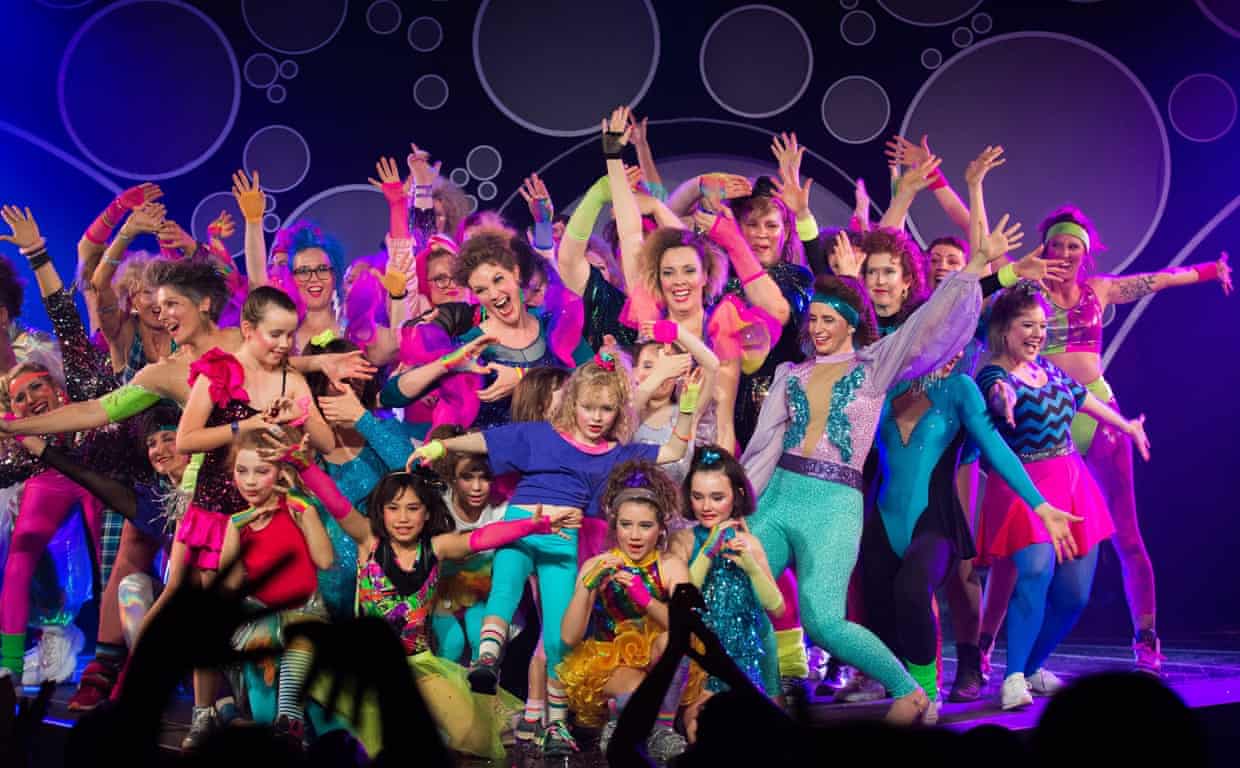
Photo: Barbara Lowing/Common People Dance Project.
Goofing around on stage is the whole point at Australia’s Common People Dance Eisteddfod.

You could pull many different lessons from today’s story, but one that stands out to me is the way that a mother’s insecurity can warp a young child’s self-image, making a revolution necessary. The revolution may turn out playful and silly, a childlike release like a new dance style in Australia.

Dee Jefferson interviews an enthusiast called Bryony Walters, whose mother used to shame her about her weight. Bryony tells Jefferson it “affected her relationship with exercise, and movement in general. ‘It always seemed like a punishment that I was inflicting upon myself. … It wasn’t a thing you were engaging with to have fun or to feel good.’

“But when she saw a post in her community Facebook group about dance classes for a DIY eisteddfod, Bryony’s curiosity was piqued. …

“Neridah Waters and her Facebook post set off the amateur dance revolution known as Common People Dance Eisteddfod. Now in its seventh year, the project invites people of all ages, abilities and bodies to dance together – to 80s and 90s music, while wearing leotards, sequins, sparkles and glitter – culminating in a dance-off as part of the Brisbane festival. ….

“Waters, a stalwart of Brisbane’s alt cabaret scene, describes the project as a mix between Young Talent Time, sports carnivals, 80s gameshow ‘It’s a Knockout’ – and, of course, the Australian Rock Eisteddfod Challenge: a nation-wide high school competition that was popular in the 80s and 90s.

“Bryony, who has performed in five Common People Dance Eisteddfods, says it’s a ‘rare and special’ opportunity to ‘engage in really joyful movement in circumstances where the concern isn’t how you look.’ …

“Like Bryony, Amanda [Dell] came to Common People with an unfulfilled childhood dream of dancing. This year, she is dancing for Southside, one of seven teams of between 30 and 65 people competing in the eisteddfod, each performing their own routine of around five minutes – featuring moves with names like Jazz on Ya Face, Chicken Chicken Pelvis and Aunty Pat’s Christmas Trifle.

“Waters, who came up with the idea for the eisteddfod during a middle-of-the-night burst of inspiration, had no idea it would snowball into an annual juggernaut attracting hundreds of participants. Back in 2019, she was experiencing a lull in her career after becoming a mother. She’d been teaching community dance classes that were attracting middle-aged men and shy people who ‘wanted me to teach them seriously, from scratch, how to dance,’ she says.

“ ‘I wanted to do something more theatrical. I wanted participants who were as silly [as me].’

“As soon as she posted her alternative rock eisteddfod idea ‘it went nuts.’ she says. ‘People understood immediately the sense of humor behind it.’

“Starting off in her local community hall, the project spiraled into classes and teams in different suburbs. Brisbane festival came on board to host the eisteddfod as part of their program, and before the inaugural event the dancers of each team marched through the streets of South Bank to converge in a dance battle outside the festival’s Spiegeltent – set to Survivor’s ‘Eye of the Tiger.’

“Amanda, who was part of the march – wearing a leotard for the first time, not to mention in public – remembers it being nerve-racking. ‘The way that women think about their bodies, that’s a big thing to do,’ she says. ‘But you’ve got the power of the group. And that day is one of the best days of my life – it was just such joy and excitement.’

“Waters says, ‘We had women who were size 20 or 24 in leotards who looked like superhero versions of their suburban selves.’ …

“From the get-go, Common People Dance Eisteddfod has predominantly attracted middle-aged women. … Some are former dancers looking to let their hair down, most are amateurs or people who have never danced. Whatever their reasons for coming, they stay for the sense of community, the confidence boost – and the endorphins.

“Amanda, who describes the last few years of her personal life as ‘a shocker,’ rarely misses a class. ‘I know that no matter how I’m feeling beforehand, I will feel better afterwards,’ she says. ‘Having people that you meet with regularly, who you can rely on for that emotional support and friendship and fun – those things are invaluable.’

“For some, the eisteddfod is life-changing. Waters tells me about Zak, a shy teenage boy who slowly came out of his shell doing Common People’s living-room dance parties during lockdown. When IRL classes resumed, Waters encouraged him to take more of a leading role – culminating in him dancing and lip-syncing to a packed house for the eisteddfod.

“A couple of months later, Zak decided he wanted to run for school captain. ‘His mum said “Are you sure?” and he said, “Mum, look, I stood in front of 1,500 people and did the dance battle. I can do anything now,” ‘ Waters says. ‘And so he did it – and he ended up becoming school captain.’ “

More on the Brisbane Dance Festival at the Guardian, here. The Guardian has no paywall, but please consider donating to them — any amount.

Read Full Post »

Photo: Autodesk Instructables.
Building a ship in a bottle. “Hobbies are about doing things: planning, painting, building, contributing an article to your favorite magazine,” writes Alexander Poots at UnHerd.

Niche print magazines seem to survive even after everyone else has gone online. According to an article at UnHerd, that’s especially true of magazines about hobbies.

Alexander Poots writes, “Phil Parker is the editor of Garden Rail magazine. He’s a passionate man — especially on the subject of steam engines. ‘The steam engine is the nearest anybody has come to building a living thing,’ he says. … He talks about the joy of seeing them in action. The smells, the hiss and chuff, the weight of them on the line. It’s a joy that many people want to recreate at home. …

“Layouts in back gardens across Britain range from tiny loops of track to colossal, intricate landscapes. Parker knows a guy whose line crosses Lilliputian bridges and snakes through mountains 10 feet tall. Layouts are much more than models, he says. They really are railways, albeit on a smaller scale than usual. A keen sense of ownership is important: ‘these are their railway lines.’

“Ardent hobbyists are often viewed as eccentric. I think they might be the only normal people left. As a rule, they are active and engaged. They are more interested in making than consuming. They dream and they do. A passive appreciation for steam engines or military history or orchids isn’t enough. Hobbyists want to take part.

“ ‘I grew up fascinated by history, and wargaming helps you make that interest interactive,’ says Daniel Faulconbridge, editor of Wargames Illustrated. ‘It’s not good enough for me that I just read about the Battle of Hastings, I want to collect the figures that represent the troops that fought in the battle, and then paint them and play a game with them.’ …

“Magazines like Garden Rail and Wargames Illustrated are at the heart of the hobby world. The variety is extraordinary. Hornby MagazineAirfix Model WorldThe Orchid ReviewLute News. Monthly publications dedicated to remote control aircraft and koi keeping. Some hobbies have broader appeal than others — the UK has enough carp fishermen to support both Total Carp and CARPology. But even the more niche titles have a readership large enough to keep them viable in a brutal publishing environment. …

“The physical hobby magazine has in fact proved surprisingly durable. Both Faulconbridge and Parker acknowledge that their readers tend to be older, and prefer print media because it’s what they grew up with. There’s also a practical aspect: if you’re following a guide to painting a model Landsknecht, it’s easier to have a paper copy open on the table than faff about with a phone or tablet. …

“Again and again when talking to Parker and Faulconbridge, I am struck by the emphasis on the physical. Hobbies are about doing things: planning, painting, building, contributing an article to your favorite magazine. ‘You come into a hobby and you’re not being encouraged to binge-watch something on the tele — which is a very, very passive activity — you’re being encouraged to have a go at something,’ Parker observes. …

“Hanging out with like-minded people is the best way to have a go. Community is a word that comes up a lot in my chats with the editors. … Parker emphasizes that railway modeling exhibitions are as much social gatherings as they are celebrations of the hobby. As anyone who has worked an allotment knows, shared enthusiasms have a way of collapsing social barriers. Parker remembers one exhibition where he sat around a pub table with ‘a physics professor, a guy who ran his own bus company, a Liberal Democrat councillor, a theatre manager, a bishop and two lawyers. Our common interest was model railways. You find yourself meeting a really wide variety of people.’

“Still, it’s a mistake to think that these groups are purely focused on the hobby itself. Wargames and model railways are often the starting point for other things. Friendships are made, money is raised for charity, and support networks are formed. ‘Men are particularly bad at chatting,’ says Parker. ‘But they will chat about steam engines and they will chat about garden railways, and that chat can then move on to more valuable topics. We run the largest model railway forum in the world, and tucked away on it is a prostate cancer discussion group.’ …

“Hobby magazines survive because they are outgrowths of these communities. Most articles are written by hobbyists, in what Faulconbridge describes as ‘a fanzine approach.’ Neither the editors nor the contributors are in it for the money. They just love it. In a recent thread on X, Stone Age Herbalist observed that the continued success of the hobby magazine can be attributed to a particularly British — and more broadly Northern European — genius for voluntary association. Whether centered around giant vegetables or antique fountain pens, little communities bubble up everywhere. …

“A link between hobbies and productive industry can also be found in the world of railway modeling. Parker tells me that, ‘I’ve just reviewed a loco from a company based in Doncaster, Roundhouse Engineering. You’d be amazed, we do still build steam locomotives in this country! It’s a proper Rolls Royce engine model, beautifully constructed. They do pretty much everything in-house.’ This pride and attention to detail is at the root of what all hobbyists are up to. …

“Hobby magazines are heartening advertisements for that reward. Planning, making, getting things wrong, having a laugh about it.”

More at UnHerd, here.

Are bloggers hobbyists? We seem to check a lot of the boxes in the definition.

Read Full Post »

Photo: Alex Barber/Contemporary Arts Museum Houston/Theaster Gates Studio.
“We Will Save Ourselves” (2024), a painting by Theaster Gates made with roofing materials.

I have blogged before about the unusual urban planner and artist Theaster Gates. Now the New York Times has done a deep dive on the many surprising facets of his work.

Siddhartha Mitter writes, “Theaster Gates is the kind of artist whose work is perpetually on view somewhere in the world. When we met for the first time, in May at his studio in Chicago’s Greater Grand Crossing neighborhood, he had just returned from opening exhibitions at the Mori Art Museum in Tokyo and the Contemporary Arts Museum Houston. …

“He is known for installations that use supplies and furnishings from old buildings, paying tribute to their past lives — as homes, stores, churches. These installations serve double or even triple duty: They are works of art in themselves, but they can also become venues for parties or performances. His sculptures and paintings employ construction materials like wood, rubber and roofing tar. He’s a master ceramist and a musician and singer who performs with his experimental group, the Black Monks, in which he’s known as the Abbot.

“For years, Gates has acquired archives, and he sees their stewardship as integral to his work. Many preserve Black American cultural memory, like the roughly 20,000-volume library that once belonged to the Johnson Publishing Company, publisher of Ebony and Jet, and the 5,000-record vinyl collection of Frankie Knuckles, the Chicago D.J. at whose late ’70s parties house music was born.

“He is currently advising an arts-led redevelopment project in Philadelphia and an initiative to preserve Houston’s Freedmen’s Town, a historically Black district in the city’s Fourth Ward. He chairs the diversity council at Prada, where he runs a mentorship program for designers of color, and he is developing partnerships in Japan with small family-owned businesses to produce incense and sake. …

“In his hometown, Gates is recognized as an entrepreneur who buys and restores properties on Chicago’s South Side. He puts these properties to unusual, sometimes less than practical use. The core of his holdings is a quiet half-mile stretch of South Dorchester Avenue, where he started acquiring run-down houses in 2006. He filled some with archives — thousands of art books purchased from a shuttered bookshop; LPs from a defunct record store. One house became his residence. …

“Salvage from the buildings goes into his art installations; proceeds from his art sales fund his building renovations and community programs. But they also stem from shared soil — his upbringing as the son of a roofer on Chicago’s West Side, his training as an urban planner — and commingle in his projects to the point where it would be artificial to separate them. …

“He rebuffs categories like ‘social practice’ — jargon for participative art with civic goals — but cites predecessors like Donald Judd, who made furniture as well as geometric objects, and the Fluxus movement, with its interest in everyday materials and spontaneous performances. He’s an inheritor of the legacy of Marcel Duchamp and his readymades, mass-produced and utilitarian objects that the French artist displayed as art. …

Gates sees himself as helping Chicago to ‘hold its Black self together.’

“A bureaucrat before he was ever an artist, Gates worked as an art planner for the Chicago Transit Authority from 2000 to 2005. After that, he began investing in Grand Crossing when he moved to the South Side to become an arts administrator at the University of Chicago, where he’s now a professor.

“ ‘The neighborhood had stigma, but the people were great and interesting,’ he said. He recognized the terrain: Black neighborhoods that faced disinvestment and crime but were once self-contained and self-possessed — places where, he said, ‘the Black doctor and lawyer and bus driver and maid were all on the same block, and they all went to the same church.’ By revitalizing these quotidian spaces — homes, a bank, a school, hardware stores that he has bought, often with their contents, when they were going out of business — he is summoning a kind of utopian memory in the service of new functions. … Through his investments in Grand Crossing — even when they take unconventional forms — Gates sees himself as helping Chicago to ‘hold its Black self together.’

“He took me down a side street edged by commuter rail tracks where in 2021 he opened Kenwood Gardens, a sanctuary with lawns, wildflowers and a pavilion that hosts house-music parties in the summer. It occupies 13 lots that were in decline — notorious, he said, for burned-out cars and prostitution. A wall encircling the garden is made partly from bricks that he saved from St. Laurence Catholic Church, a neighborhood anchor that the archdiocese sold and that was razed in 2014.

“ ‘When I built the perimeter wall, I didn’t own the property,’ Gates said. ‘I built the wall to stop the bad stuff.’ He then bought the lots, many loaded with tax arrears. ‘The city was quite happy to help us negotiate the land sales,’ he said, ‘because they would finally have a steward.’ Building his unauthorized wall, Gates said, was a case of tactical urbanism, as citizen initiatives that bypass city bureaucracy or goad it to action are called in the planning business. …

“[Gates] is too obviously sincere, even earnest, to come across as an operator. And yet he has both an aptitude and an appetite for policy and negotiations. In a famous deal, he purchased the former Stony Island State Savings Bank, a 1920s edifice facing demolition, from the city in 2012 for $1 and the commitment to restore it — which he funded in part by selling salvaged marble slabs at Art Basel for $5,000 each. …

“Romi Crawford, 58, a professor of visual and critical studies at the School of the Art Institute of Chicago, described how Gates enfolds transactions into his art as ‘contract aesthetics.’ Gates has fielded periodic criticism that he is too amenable to the rich and powerful. He rejects this. … ‘If you’re talking about protesting, there are people who are better protesters,’ he said. ‘If you’re talking about getting [things] done in the city, I can do it better than most artists. I can do it better than most developers.’ …

“But despite the busy world Gates has built for himself, its center is paradoxically calm. At the studio in Chicago, I’d been struck by the quiet. His operation has downsized, he said — from 65 employees at its peak, around 2016, which he admitted overwhelmed him, to just 15.

“Next to go might be his collection of buildings, though it could take a while. ‘I did not attempt to amass a real estate holdings situation,’ he said. ‘I was simply trying to prove the point that artists can change a place.’ “

For the the rest of the long profile, click here.

Read Full Post »

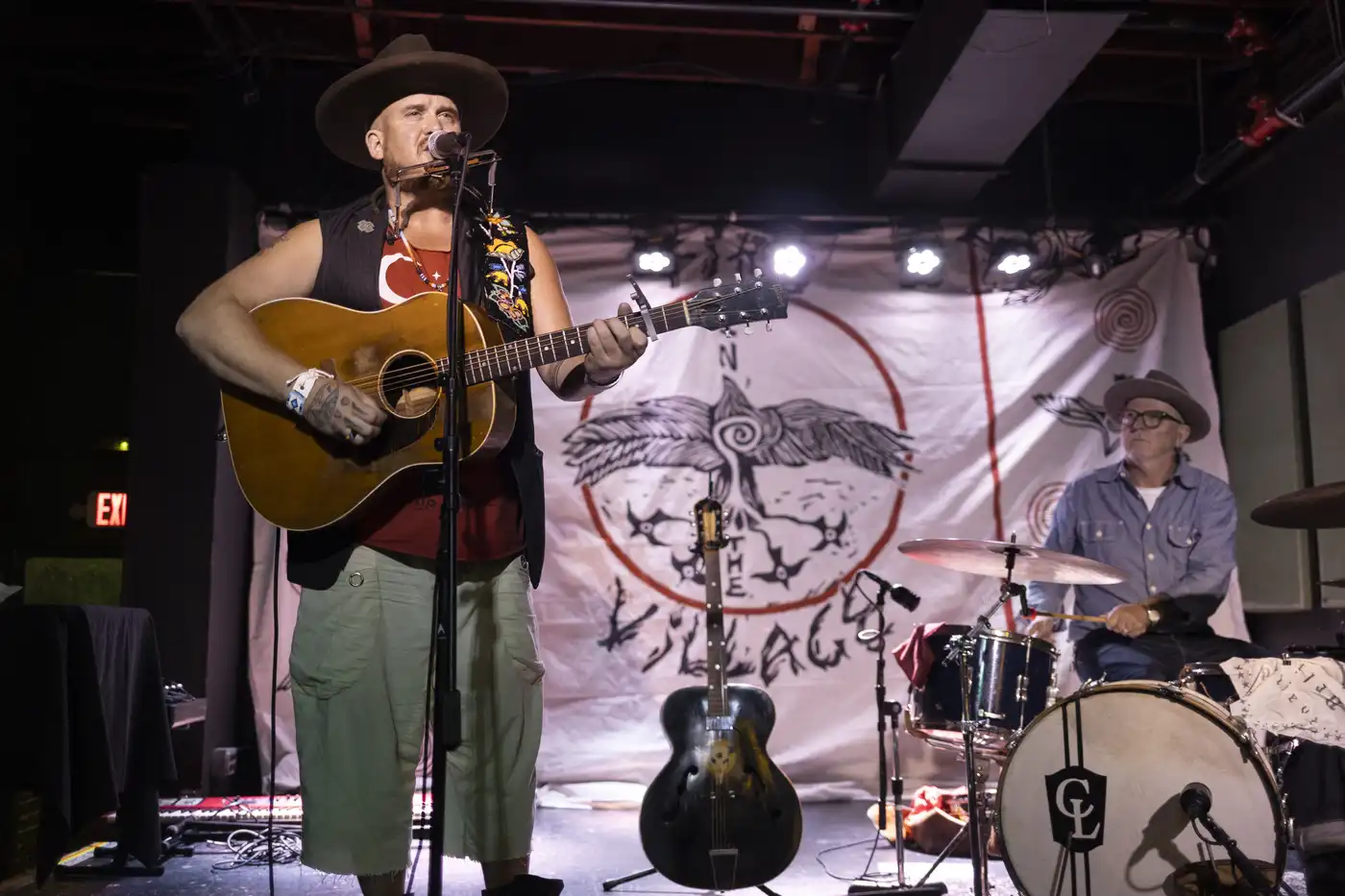
Photo: Liam James Doyle/MPR News.
David Huckfelt performs on the Turf Club stage. “We’re building these little fires in small places,” Huckfelt says.

Because I still believe that “one and two and fifty make a million,” as Pete Seeger used to sing, I get a kick out of all the stories I’ve been seeing lately that confirm the power of small.

Alex V. Cipolle reports at Minnesota Public Radio (MPR) about one small but mighty effort, a new arts collective that “goes on tour to build community in rural Minnesota and beyond. …

“On a September evening at the Turf Club in St. Paul, models weave through bar tables in upcycled designs.

Annie Humphrey, an artist and musician based on the Leech Lake Reservation, performs on the stage, followed by Minneapolis musician David Huckfelt. On a back table Shanai Matteson, an artist from Palisade leads printmaking demos with a stencil of a black aandeg (the Anishinaabe word for crow) and an orange-red sun.

“ ‘There’s a story about the crow. Long ago, the crow had bright, beautiful, vibrant colored feathers,’ Humphrey recalls. ‘But crow also saw that the people were suffering because they had no fire.’ To bring fire to the people, crow flew close to the sun and scorched his feathers black.

“ ‘He was able to grab the fire and bring it back down to the earth and bring fire to the people so that they could be warm,’ Humphrey continues. ‘If you take a crow feather and hold it in the sun, it’s iridescent, and all these colors are still in that feather.’

“The stencil is the logo for the new arts and community-building collective Fire in the Village, started by Humphrey, Matteson and Huckfelt this year. (Fire in the Village is also the title of a book of Ojibwe stories by Humphrey’s mother, Anne Dunn.) …

“The trio all share a background in activism, specifically fighting the Line 3 oil pipeline. … But with Fire in the Village, the collective wants to do something untethered from any one cause. 

“ ‘If we were going to start something, I knew that it should center on art and the human spirit, the human condition,’ Humphrey says, ‘and have no politics involved at all.’

“Through art, fashion, music and collaborative events with schools and local organizations, the collective is hoping to heal divides and put a dent in the loneliness epidemic in rural communities and on reservations.

“ ‘I think a lot of people are feeling isolated,’ Matteson says. ‘There’s a lot of divisiveness going on. Personally, I’m not interested in continuing that. I don’t want to be part of a cause where it feels like it’s putting another barrier between me and the people who live around me.’ …

“ ‘We like the feeling of the collective and not pushing one person as a front for something,’ Huckfelt adds. ‘So, we’re really working together with our skillset because we believe in music, we believe in art, we believe in community, and so that’s what’s being put forward here.’ …

“ ‘Fire in the Village is a way to connect with individuals and to smaller communities that you’re a part of,’ says Meira Smit, one of the Macalester students who came to the Turf Club. ‘A way to build messages and movements around the things that we deeply care about.’

“Haley Cherry, a producer for Minnesota’s Native Roots Radio on AM950, also came out to walk in the fashion show after meeting Humphrey and Huckfelt this past year.

“ ‘It’s important to hear from both perspectives: issues of Indigenous identity, but also [from] David, as a white ally, I think it’s important to draw those bridges of community concerns,’ says Cherry, who is a descendant of the Ho-Chunk Nation of Wisconsin. …

“In June, Humphrey also led a community mural with youth groups on the Leech Lake Reservation, the Boys & Girls Club in Deer River and the Long Lake Conservation Center. Soon, the mural will be installed at the powwow grounds in Ball Club, a village on the reservation. There are more murals to come, Humphrey says.

“The tour is also about revival, Huckfelt says, stopping at historic community buildings in small towns, such as the 210 Gallery and Art Center in Sandstone Oct. 19 and the Historic Chief Theater in Bemidji on Nov. 2. ‘A lot of these spaces are really beautiful old music and theater art spaces,’ Huckfelt says. …

“Huckfelt says, ‘We’ve been doing this work in our own ways for a long time, individually and together. It’s a natural step to call it “Fire in the Village” —  little fires that we can sustain and we can huddle around for good ideas and for community.’ …

“ ‘It’s a very gentle way to say really hard stuff,’ Humphrey says. ‘I have played in front of people who don’t agree with what I speak, but when I sing it?’ “

More at MPR, here. No firewall. Great pictures.

Read Full Post »

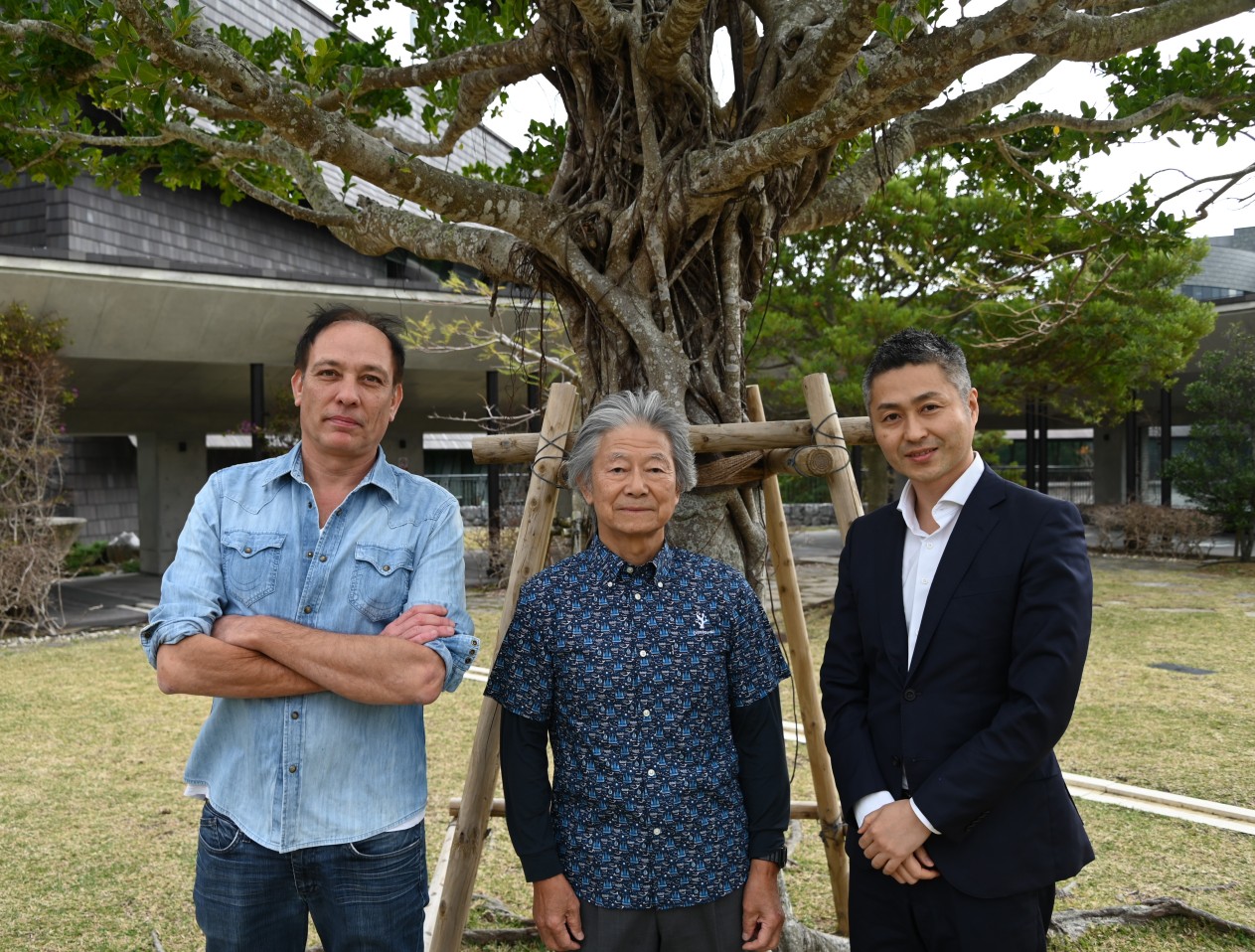
Photo: Okinawa Institute of Science and Technology.
Prof. Timothy Ravasi, Prof. Noriyuki Satoh, and Shimon Sato (L-R) lead the Coral Project at OIST, a nonprofit initiative helping conserve coral biodiversity in Okinawa. 

It is now generally known that corals are important for ocean biodiversity but are in danger from climate change. If you search on “coral” at this blog, you will find a variety of stories about what people are trying to do to help.

Today we look at an organization in Japan that merges the work of local people to that of scientists.

The website of the Okinawa Institute of Science and Technology (OIST) says, “Unlike many global reef locations requiring a boat ride, Okinawa’s reefs are accessible directly from the beach — a simple walk to a nearby beach, a quick dip into the crystal-clear waters, and within moments, you are immersed in a lively ocean community. 

“Yet elders in Okinawa remember a time when coral-filled waters were more abundant, a contrast to the significant coral decline observed in recent years, especially near shorelines. Worldwide, human activities have resulted in an alarming decrease in coral populations in the last decade. Consequently, efforts to plant corals are gaining momentum. 

“The OIST Coral Project, an initiative focused on studying and preserving coral biodiversity in Okinawa, was launched in July 2023 at the Okinawa Institute of Science and Technology (OIST). To date, the project has successfully enlisted the support of 20 companies in Okinawa and mainland Japan. …

“In January 2023, Prof. Noriyuki Satoh, head of OIST’s Marine Genomics Unit, sat down with Shimon Sato, an experienced fundraiser and Advancement Officer at OIST. They came up with an ambitious idea: to use knowledge of genomics and eDNA in a new project to plant and conserve coral in Okinawa. This was the start of an innovative effort to protect local marine life by connecting with locals and companies in Okinawa and Tokyo to establish potential collaborations. 

“Prof. Satoh and his team at the Marine Genomics Unit achieved groundbreaking milestones by decoding the genomes of corals in 2011, zooxanthellae (symbiotic organisms that coexist with corals) in 2013, and the crown-of-thorns starfish (known for devouring corals) in 2017. …

“Using this knowledge, Prof. Satoh identified the best types of coral that can be planted at specific sites in Okinawa. … Permission was granted by Okinawa Prefecture and planting is done by professional vendors, following Japan’s strict coral planting regulations.

Each planting site is overseen by a different fishermen’s organization, each with its own unique team and structure.

“Before planting, Prof. Satoh engages in negotiations with the fishermen’s organizations, explaining the project’s objectives and benefits. These fishermen, who have a deep understanding and respect for the sea, are important allies. …

“Yet this project is not just about planting corals — scientists also conduct eDNA monitoring of corals and study the fish that arrive after the planting, observing which species are on the rise or decline. …

“Cause-related marketing is one of the unique aspects of this project. This is an approach where businesses associate themselves with societal issues or values by working with non-profit organizations to promote a specific cause. …

“ ‘We began with 8 companies, including Japan’s largest mobile company NTT Docomo in Tokyo and several others in Okinawa.’ … Supporting companies can use the project’s [logo]. Ryukyu Cement Co., Ltd., the largest cement company in Okinawa, displays the logo on their cement bags and donates a portion of their cement sales to the project. Another notable supporter is Majun, the leading Kariyushi wear company in Japan. Majun has created an original 100% cotton Kariyushi t-shirt embroidered with the Coral Project logo. …

“In 2018 Onna Village, where OIST is located, was declared a ‘coral village’ or ‘sango no mura’ in Japanese, and in 2019 the Government of Japan declared the village a ‘Sustainable Development Goals Future City.’ Impressively, the practice of coral planting in Onna Village began two decades ago. In 2004, a local organization, Team Churasango, was established by community members with participation from both local and mainland companies. On average, they plant 1,000 corals annually, in response to the observed decline in coral numbers. …

“The project team has recently welcomed a third person – Prof. Timothy Ravasi, leader of the Marine Climate Change Unit at OIST. Prof. Ravasi’s unit uses the latest methods in genomics to study how marine organisms adjust to warmer and more acidic oceans. …

“Shimon attributes the success of the project to two main factors. First, Prof. Satoh’s expert knowledge of corals and excellent people skills. Second, the project has secured the support of numerous stakeholders. … ‘Okinawan people value coral, and they want to return the coral reefs to their previous beautiful and healthy state. We want to support those hopes using the power of science,’ he said.”

More at the Okinawa Institute of Science and Technology, here. And you can click here to read about how OIST got the Isawa Award for this work.

Read Full Post »

Photo: Melanie Stetson Freeman/CSM Staff.
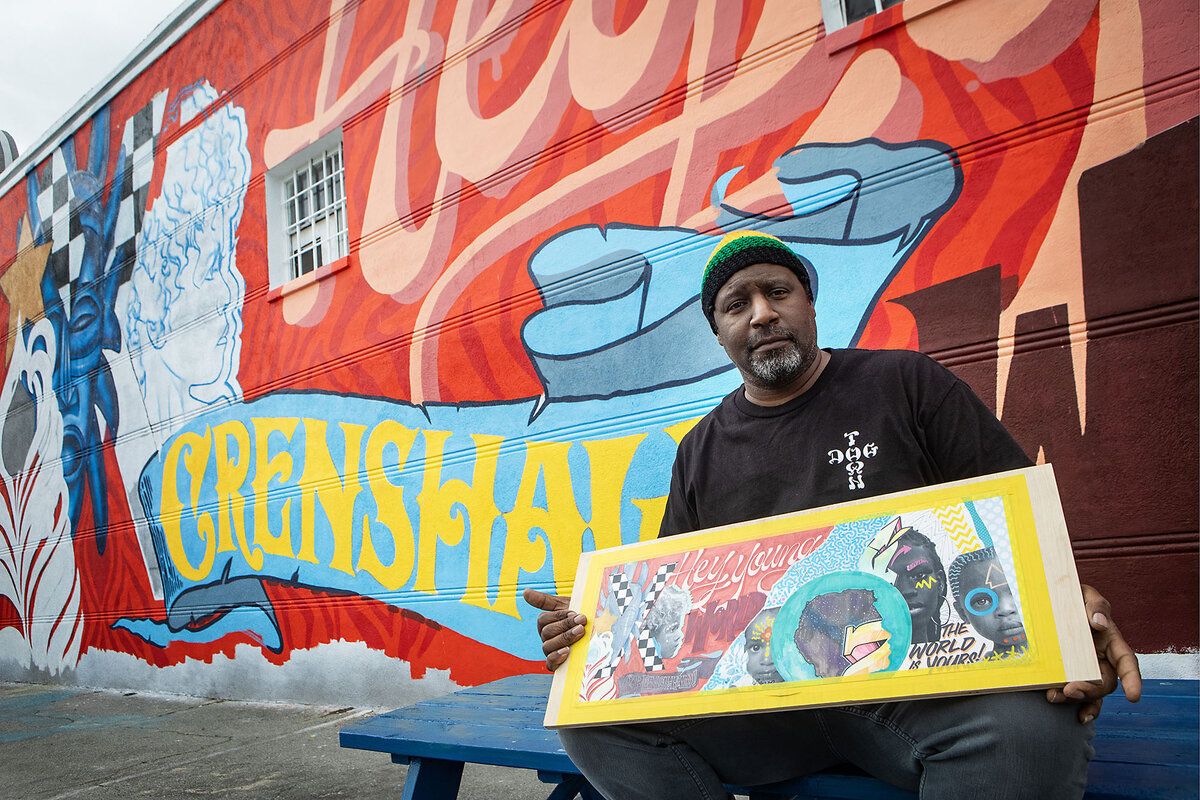
Anthony “Toons One” Martin created this mural as part of a $100 million art-focused initiative in South Los Angeles called Destination Crenshaw.

To bring out the beauty inherent in a marginalized community, you need to get everyone on board. Because the beauty is there.

Ali Martin writes at the Christian Science Monitor about Destination Crenshaw, a part of Los Angeles that used to be known as South Central.

“Growing up in South Los Angeles, Anthony Fagan was ‘very much part of all of the problems that take place in this community,’ he says. Today, he’s overseeing construction on a park that is at the heart of efforts to make the Crenshaw District a must-visit stretch of LA.   

“ ‘We’re going to change lives with this park on so many different levels,’ says Mr. Fagan, an assistant superintendent with PCL Construction. 

“The $100 million initiative has drawn public and private funding to transform a 1.3-mile stretch of Crenshaw Boulevard into the largest Black-centered public art display in the United States. Destination Crenshaw is a holistic plan that weaves economic and community development together with cultural celebration to recast this neighborhood as a tourism center and create economic stability for those who live here – and for generations to come. …

“Destination Crenshaw runs north-south through the Hyde Park neighborhood – part of South LA, known as South-Central Los Angeles until 2003, when the LA City Council changed the name, hoping to dissociate the 16-square-mile area from a reputation for gang violence and race riots. 

“Destination Crenshaw touches three census tracts that fall in California’s highest quartile for poverty and unemployment. On average, about three-fourths of the residents who live in these neighborhoods are Black.

“In the 1950s, South LA had the highest concentration of Japanese Americans in the country. … African American families soon followed, and by the late 1960s, Crenshaw Boulevard was a corridor of flourishing Black-owned businesses. Leimert Park, capping the northern end of the district, was a center of artistic expression.

“Rosemary Williams moved here from Chicago in 1968. She opened Dog Lovers Pet Grooming on Crenshaw Boulevard in 1980. … Ms. Williams’ daughter convinced her to participate in Destination Crenshaw’s mural program, which pairs artists with storefronts. Her reluctance gave way, she said, because of the organizers’ efforts to support small businesses and to clean up the area. …

“Anthony ‘Toons One‘ Martin answered the call. He grew up in South LA in the ’70s, and remembers it as vibrant. He turned a talent for graffiti art into a career and worked around the world as a muralist. … His design is titled ‘Hey Young World,’ inspired by the hip-hop song with the same name. He hopes, in turn, to inspire the youth who live here to take pride in their neighborhood and themselves – and dream big about their futures. … He says, ‘If we want to see [solutions], we have to be a part of that process.’  

“Nobody knows that better than Marqueece Harris-Dawson, City Council member representing the 8th District and a driving force behind Destination Crenshaw. The South LA native came into office as plans were underway to build a light rail station at Leimert Park.

“Residents were upset that the line would be built at street level, instead of below or above ground, bisecting their main throughway and disrupting foot traffic. But Mr. Harris-Dawson took a cue from Beverly Hills, which lobbied to have its light rail at grade to showcase the world-famous shopping district around Rodeo Drive, where palm trees punctuate power lunches and luxury stores.

“He enlisted the Crenshaw community for ideas about building on the city’s investment. … What emerged was a plan to capitalize on the art and culture that radiate from this district, stimulate economic development, and strengthen community ties. …

“People associate Black culture with Harlem, Chicago, or Atlanta, ‘but they don’t think of LA. And it’s because we just don’t put it forward,’ says Mr. Harris-Dawson. … Organizers describe Destination Crenshaw as ‘unapologetically Black.’ Sankofa Park showcases that spirit. The triangle-shaped plot sits across from Leimert Park Station, one of a half dozen pocket parks. …

“Every detail is intentional: The park name – Sankofa – is for the African bird that represents moving forward while learning from the past.”

More at the Monitor, here. No firewall. Subscriptions are reasonable.

Read Full Post »

Photo: Alfredo Sosa/CSM Staff.
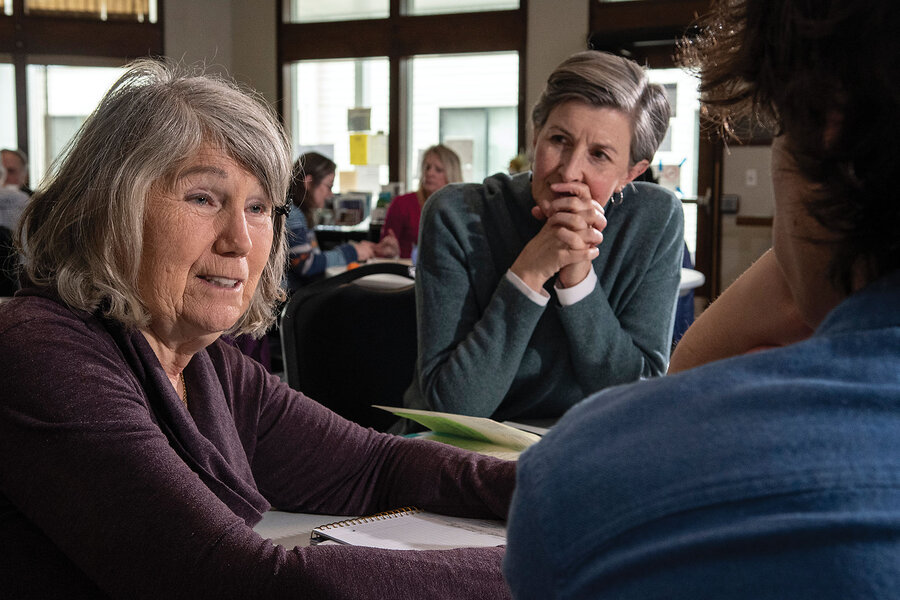
Virginia Frederick (left) and Sarah Duncan (center) participate in a conversation table training workshop hosted by the East County Citizens’ Alliance in Washougal, Washington.

Sometimes it seems we have nothing in common with other passengers on spaceship Earth, and it sure is anxiety making. But if we were invaded by aliens from deep space, you know, we’d suddenly all band together. We’d realize what we have in common.

What else do we have in common? What can we build on? Some people in the state of Washington reaiized they could start with trash.

Stephen Humphries has the story at the Christian Science Monitor. “Before the troubles started, Melanie Wilson believed she’d finally found paradise. 

“She and her husband had moved from Washington, D.C., to Washougal, Washington, in 2019. After the cacophonies of the U.S. capital, they immediately felt at home with tranquil views of the mountains, including the snowcapped peak of Mount Hood in the Oregon distance. … The pace of life here is as unhurried as the logging barges wending through its gorge.

“ ‘I’ve been looking for a home my whole life,’ Ms. Wilson says of the town of 17,000 people. ‘I want to make friends here. I want to put down roots here.’

“That was five years ago. Then the pandemic hit in March 2020. Two months after that, George Floyd was murdered by Minneapolis police. And the Wilsons’ paradise, it seemed, suddenly erupted into the kind of rancor they thought they had left in Washington, D.C. 

“Protests sprang up in the conjoined towns of Washougal and Camas that summer. By August, pro-police rallies were attracting hundreds of supporters waving American flags in support of law enforcement. On opposite sides of the street, half as many counterprotesters hoisted Black Lives Matter signs in a clash of highly charged remonstrations.

“The area has been called the ‘crossroads to discovery.’ Today both towns are at the crossroads of America’s deepening political and cultural divides. The bedroom communities are just a 30-minute drive west from progressive Portland, Oregon. A few miles to the east, however, horses, cows, and alpacas graze on gentle swells of verdant farmland, scattered with barns. …

“The protests in Washougal and Camas were mostly peaceful. Mostly. The police broke up a couple of push-and-shove scuffles. …

“Ms. Wilson was getting increasingly worried. Then, at a school board meeting in 2021, the vitriol she’d been witnessing reached a tipping point, jolting the sense of home that had become so important to her life.

“During the meeting, a man stood up and jabbed his finger at the elected officials sitting in front of them. ‘ “Civil war is almost here. We’re sharpening our bullets,” ‘ Ms. Wilson recalls the man saying. …

“She was startled once again by the crowd’s response. ‘People around the room clapped and stamped their feet on the floor,’ she says. ‘It seemed to me, that’s a flashing red warning in a community.’

“After the meeting, she began talking to others in the community about the violent rhetoric. She joined a group of citizens in Washougal and Camas to think about how to counter the civic vitriol that seemed to be tearing their community apart. Over time, she conceived a simple idea: People would gather to pick up trash, together.

“Today, Ms. Wilson is the co-founder and executive director of the East County Citizens’ Alliance. Its volunteers don’t chant and shout. They don’t tote signs and megaphones, let alone AR-15s. What they do carry, however, are seedlings, paintbrushes, and trash bags. One volunteer even brings his tractor. 

“The organization engages in other projects, too, from feeding the hungry to mentoring students. It’s all in service of an underlying mission: Getting people out of their news silos and partisan bubbles to gather together outside – their outside, their gorgeous, scenic, pastoral part of the world – and make an effort to work together and get to know each other. 

“This idea, too, is simple: To fix our politics, we must first mend our culture.

“There are groups like Ms. Wilson’s springing up all over America, in fact. From Wilkesboro, North Carolina, to Madison, Wisconsin, to Compton, California, small bands of volunteers are working to improve their quality of life, not only in their neighborhoods, but also in their hearts. 

“There’s little glory in it. Sometimes, volunteers may even wonder if they’re making any progress at all. But with each small act of kindness, they’re working to weave a social fabric of grace, stitch by stitch, and rooted in tolerance, respect, and faith in each other, as different as that other may be. …

“Ms. Wilson, riding shotgun, plays tour guide to Monitor journalists along for the ride [with Barbara Seaman]. A few days previously, the duo transported braised barbecue to ReFuel Washougal, a program that serves free meals to residents in need. The East County Citizens’ Alliance took a turn hosting a dinner in collaboration with Washougal High School’s culinary arts program. 

“ ‘If you were in my car, it’d be full of traffic cones and trash bags and trash,’ Ms. Wilson says. ‘This is what community-building looks like. It doesn’t look like fancy discussions about policy.’

“But the group’s members did get their start with discussions. About 90 residents, including Ms. Wilson and Ms. Seaman, held regular meetings in 2021 about the culture war issues roiling their schools. The topic of political extremism in the area started cropping up more and more. 

“The discussions soon grew into the organized alliance. People decided they were done focusing on politics as a community. ‘I’m so sick and tired of everybody labeling everybody,’ says Ms. Seaman, the group’s assistant executive director. ‘I just want to get people together to build relationships.’ …

“The emerging alliance needed a project that could both build community ties and be free of controversy. So it decided to start simply, getting people with opposing political views outside, working together for a common purpose in the offline world.

“ ‘Nobody likes trash,’ says Ms. Wilson. ‘They’re both picking up trash next to each other. They’re talking about, “Who would leave a tire on here? … And I’m sick of these beer cans out here. What are people doing?” ‘

“That could lead to conversations about drinking and driving, she continues. ‘We’re all against drinking and driving. They’re finding what they’re against and for, together, in the moment. And if you have to start out small because everybody hates trash, that’s where you start.’ ”

Lots more at the Monitor, here. No paywall.

Read Full Post »

Photo: Luke Waddington.
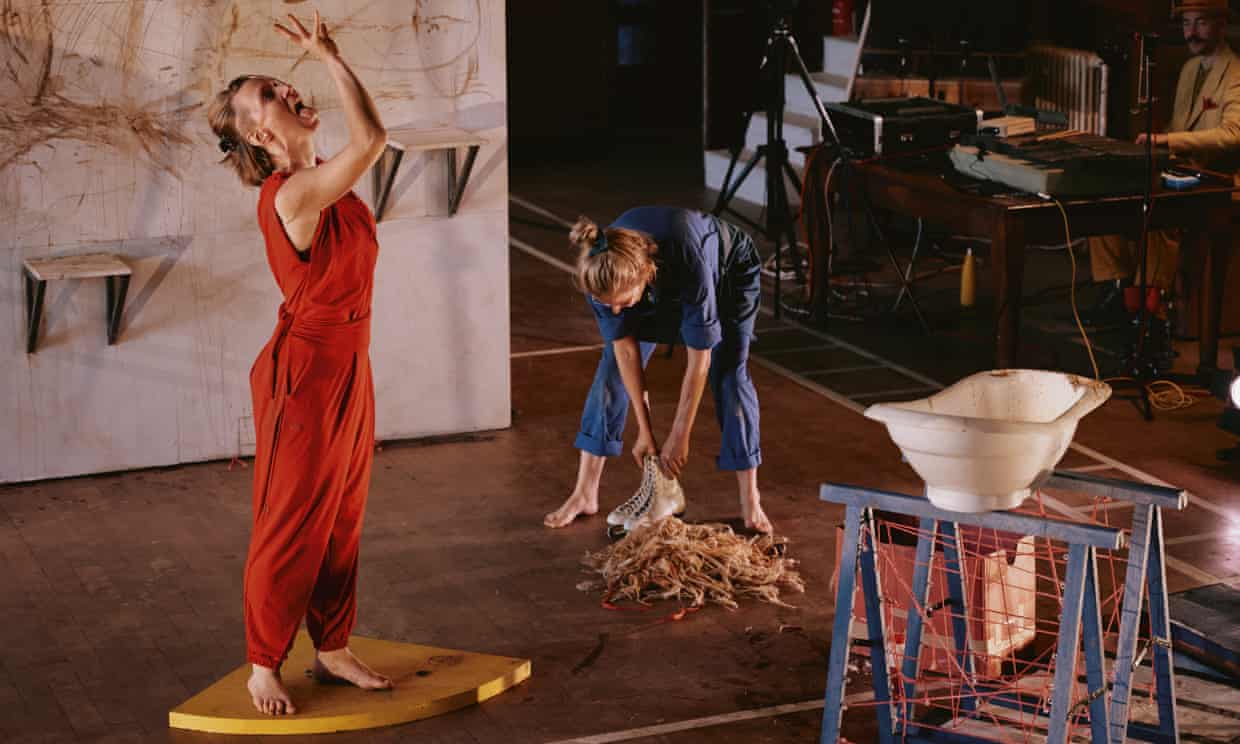
At Cambois Miners Welfare Institute, Esther Huss’s avant garde dance group involved local residents in performing Stairwall. Another choreographer in the north of England tapped local low-income children for a production and realized that it would be practical to make costumes that the kids could keep.

When the arts engage local people, they learn fast that fantasy tied to the practical concerns of daily life works best.

Lyndsey Winship reports at the Guardian on dance groups in the UK that are serious about involving the community.

“On the beach, the sand is black-flecked with coal. The pit closed in 1968, houses condemned and residents pushed to move out. But people stayed. ‘There’s not much in the way of anything really,’ says one local resident, Becca Sproat, except for a strong sense of community.

“This isolated patch of Northumberland seems an unlikely place for the German choreographer Esther Huss to have set up shop, after 20 years in London. But her husband, the playwright Alex Oates, who grew up down the coast in Whitley Bay, brought her here. ‘I fell in love with the oddness of this place, this meeting of the industrial and nature and being slightly outside mainstream society. It’s creatively interesting,’ she says. …

“In the middle of a row of brightly painted houses stands the Cambois Miners Welfare Institute, built in 1929. It had been unused for more than a decade until Huss asked to have a look inside. … Huss and Oates took on the lease, shared with the local boxing club. So there is a boxing ring on the hall’s stage and leather punchbags along one wall. As well as Huss making her own work here, she runs a dance group, and Oates runs a writing group, shivering through the winter with no heating and scraping together funding to keep everything free. Some artists pay lip service to reaching new audiences, Huss and Oates are actually living it. Next is a two-year project Cambois Creates, to make a memorable event for the whole community.

“Huss’s choreography is inspired by dadaism, German expressionism and the Japanese dance-theatre form butoh, and in the Cambois dance group, she encourages novice dancers to create their own movement.

‘My family howl at me,’ laughs 61-year-old Alison Johnson, ‘ “Oh mam, show us your latest interpretive dance!” But it’s nice to do something different,’ she says.

“ ‘It’s become such a safe environment where we all get out of our comfort zone, because we trust each other, because of Esther. It’s special.’

“Sproat, 33, had been stuck at home for 16 months during the pandemic when she got a leaflet through the door. ‘Something about a dance group, and I just laughed and binned it, because there’s no way I was going to do that. Or so I thought!’ she says. Desperate to get out of the house, she agreed to volunteer at the Institute, ‘And somehow Esther’s enthusiasm rubbed off on me. I’m not a dancer,’ says Sproat, who has some mobility issues, ‘but I’ve learned how to express myself through movement. I’m a lot more confident than I was.’ …

“You’re a long way from the London bubble and for artists working here that can be part of the appeal. ‘Moving up here, it changed everything,’ says Huss. ‘I always felt like, does London need another dance piece?’ Liv Lorent, who moved to Newcastle 30 years ago, tells me the same: ‘London didn’t need another choreographer.’ Lorent only planned to stay a few months, but fell in love with the people, the light, the beauty, the audiences. [They’re] no-nonsense, there’s no woolliness, she says, but there’s always a sense of humor. …

“Lorent describes herself as ‘all heart and idealism’ and being in the north-east has allowed that. Like Huss, she’s long been committed to community involvement. Her company, balletLORENT, recently moved into a 1930s former school building in Newcastle’s deprived West End. Lorent frequently works with local adults and children in performances. She tells me about one project where there was a costume budget, but knowing some of those children were in need of every day clothes, she made the costumes something they could take home and wear after the show. It’s about creating fantasy, while living in the real world.

“Huss likes to take her fantasies into the real world. Her last piece, Stairwall, toured in unconventional venues including a timber merchants in North Shields. She heard that some of the male staff were expecting the dancers to arrive in heels and sexy outfits – ‘It’s quite blokey up here sometimes’ – so they must have been surprised by Huss’s multidisciplinary dance-theatre. But some of the men were game to be part of the performance, one telling Huss: ‘When I die, this is going to be one of the proudest days of my life.’ She loves seeing how people respond to her work. ‘I’m not pretending everyone liked it, but generally people were really open to it,’ says Huss.

“ ‘I was surprised how immersed I became in it,’ says Johnson. ‘I found myself becoming quite emotionally charged. The fact that she’s showcased these within Cambois, I remember feeling very privileged that something you would see on a stage in a major town or city was on in Cambois Institute!’

“ ‘I didn’t think I would actually like it,’ says Sproat, ‘But it was just so inspiring. Esther and Alex lived in London and there’s millions of opportunities down there. So for them to come here is amazing.’ ”

More at the Guardian, here.

Read Full Post »

Photo: Dua Anjum.
“Poet Hiram Sims,” the Christian Science Monitor reports,” has given poetry a permanent home in his South Los Angeles neighborhood.

This is another story about how the Covid pandemic gave some people a moment of “not much going on” to pursue a dream.

Dua Anjum writes at the Christian Science Monitor, “From Hiram Sims’ earliest memory, poetry defined his inner world – songs of praise at his church choir; the rap lyrics of The Notorious B.I.G., Puff Daddy, and Mase’s ‘Mo Money Mo Problems’; Edgar Allan Poe’s ‘The Raven’ in seventh grade.

“ ‘Poetry’s like a frequency that I can hear above all other frequencies,’ he says. … ‘When I hear that sound, I pay attention.’

“That sound became his favorite form of expression. As a kid, he wrote about candy, his thoughts about God, and a lot of verses for girls at school. In college, while he progressed to mature writing around the Black experience in America and the struggles of being young and broke, witty comic poems remained key to his repertoire. He chuckles recalling a poem comparing Ugg boots to rhinoceros feet. Now, he has published three collections of poetry and frequently writes love poems for his wife.

“While it was clear early that his calling was poetry, Mr. Sims remembers having an anchorless feeling: Poetry sections of libraries were rare, and the poetry scene was a series of countless borrowed spaces in restaurants, cafes, and bars. It felt like ‘poetry is homeless because it’s constantly couch surfing,’ says Mr. Sims, who became a creative writing and composition professor at colleges in the area, including his alma mater, the University of Southern California.

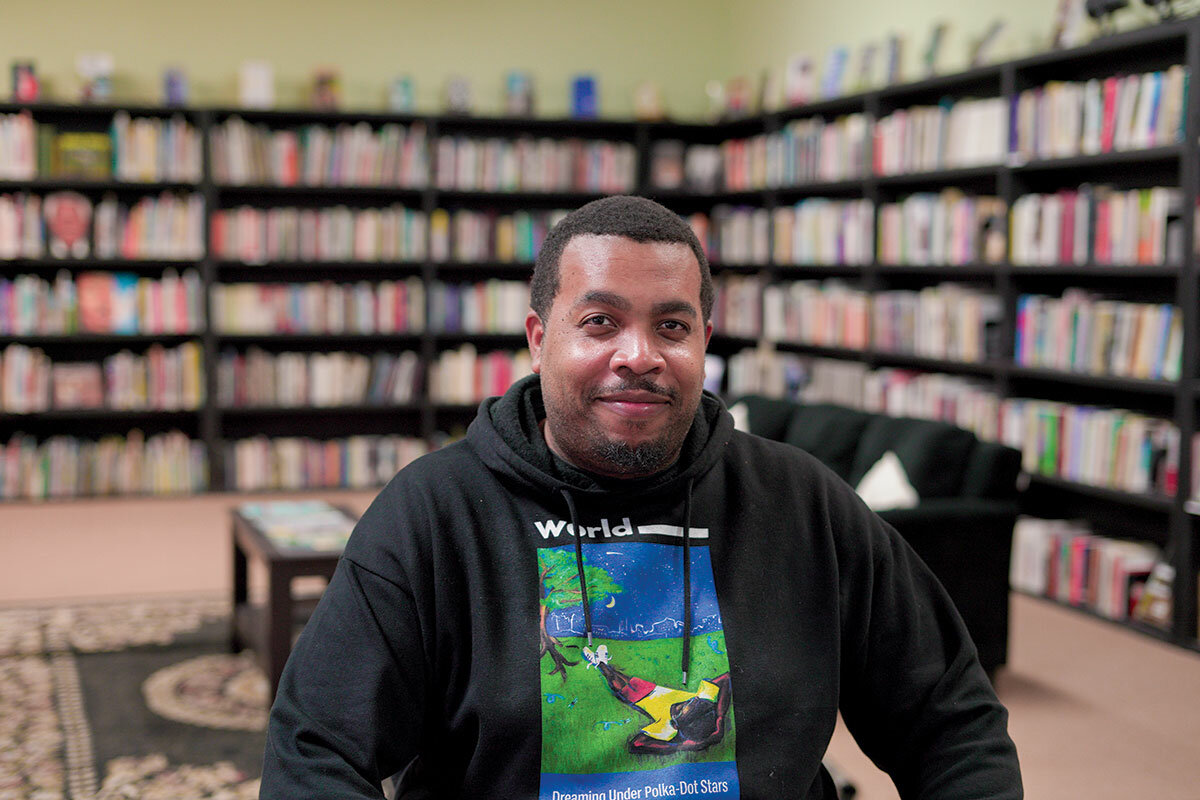
“In 2020, he gave poetry a permanent home in his South Los Angeles neighborhood, founding the Sims Library of Poetry, for reading, writing, studying, and performing poetry. 

“The space has evolved into an indispensable gathering place for anyone looking for inspiration, say poets who live nearby. It whimsically invites the public in: ‘Poetry Lives Here’ is painted on a low concrete boundary. A mural pays homage to the dragon fire that poets spit in words. A ‘Poet Parking Only’ sign peeks from a patch of grass. 

“The spiritual foundation for this landmark came from what Mr. Sims considers a personal triumph: the Community Literature Initiative (CLI), through which he helps poets produce manuscripts ready for publication and connect to presses.  

“ ‘I was at an open mic and I heard all of these amazing poets. After the show, I said, “I’d like to buy a copy of your book,” and none of them had books,’ says Mr. Sims, who has coached poets in publishing now for 10 years in space provided by USC. … Sims Library origin story goes back to a $29.99 suitcase.

After assigning his CLI students to read one book of poetry a week, he realized: They couldn’t afford them, and libraries had slim poetry offerings. 

“So, he fit 80 books from his collection into the purple-brown suitcase, carted it around in his car, unzipped it, and let students borrow poetry collections by living authors, especially local LA poets.

“ ‘One of my students said, “This is the little Sims library of poetry right here.” And I was like, “Wow.” … After that, I put all my energy into building that microcosm of the library that I had in my head.’

“The idea came to life in his garage at a birthday party-turned-library-launch. … Several poets read their own verse. And people brought boxes full of books: The party started with 300 and ended with 2,000. 

“Mr. Sims’ mother, Gwendolyn, who remembers her young son loved to read greeting card stanzas at the Rite Aid, was one of the first to donate money. The library continued to thrive with family, community, and foundation contributions of books, cash, and grants. And CLI class tuition also helped. 

“It was peak pandemic, and the preschool run by his wife, Charisse, closed. The family decided to take over the building as the next iteration of the library. Mr. Sims’ father, Edward, who is a contractor, and his brother Job helped with shelves. Word of another donation drive reached further and book donations came from across the country. …

“The nonprofit offers more than 9,000 volumes of poetry, says Mr. Sims. ‘So many of these books are people that live in LA, you know, people in this community.’ 

“Open until 8 on Saturday nights, the thrum of activity – from book launches, workshops, and open mics – spills into the neighborhood with singing voices, fingers snapping, and the rhythm of rhyme. …

“Mr. Sims says, ‘I think the library represents value for a part of people they don’t often share. So people often bring poems from their shoeboxes and folders. It’s so personal with people.’ …

“ ‘When the first volunteers came in, they expected to come to a library, but then realized, we have to build one,’ says Karo Ska, library manager and a CLI writer. For them, the best part is that the library has books that can’t be found elsewhere – pre-1950s special collections, self-published collections, periodicals, local literary journals, and handmade chapbooks.

“ ‘The idea of giving back to the community is a phrase that a lot of people use but isn’t always manifested,’  says Lynne Thompson, 2021 Los Angeles poet laureate. ‘[Hiram] is as interested in the work of others and facilitating not only the writing of it but the publishing of it as he is in his own work.’ …

“Poet bridgette bianca, who grew up in the neighborhood without a public library nearby, says: ‘We are in an area that’s very much Black, very much brown, very much working class. And that somebody built a library here is just fantastic.’ 

“Now, as a community college professor, she uses the library as a resource, encouraging students to explore the poetry collection and attend events for extra credit.”

More at the Monitor, here. No firewall, but subscriptions are encouraged.

Read Full Post »

Photo: Suzanne and John’s Mom.
In a rebellion against online behemoths, bookworms are ensuring that local shops survive and even grow.

Do you like to browse in bookshops? Pretty hard to do that online. That’s one reason book lovers have been supporting independent stores, not to mention the unique assistance and advice that shop staff can provide.

Dana Gerber investigated the topic for the Boston Globe last month.

“On the weekends, the line outside the new Beacon Hill Books sometimes snakes out the door. Brookline Booksmith has expanded twice since the pandemic. Later this year, Harvard Book Store will open at the Prudential Center. …

“Indeed, these are optimistic times for independent bookstores in Greater Boston, with four new shops sprouting up in and around Boston since 2020, and more on the way. And what variety bibliophiles have to choose from: There’s a feminist bookstore at Somerville’s Assembly Row, an outpost of a Provincetown favorite coming to the Seaport, and that five-story spectacle on Charles Street.

“ ‘There was a period where there were more stores closing in Boston than were opening,’ said Allison Hill, the CEO of the American Booksellers Association. ‘Now we’re seeing Boston return to being a bookstore town.’ …

“Interviews with more than a dozen local independent bookstore proprietors and experts describe an industry entering a new chapter.

“The pandemic, far from a death knell, galvanized customers to read more, shop locally, and, as the world reopened, indulge a bit more in offline experiences. Federal funds and other investments helped owners stay afloat, or even expand. And for developers and landlords looking to lure people back to brick-and-mortar shopping, bookstores old and new became model tenants. …

“So, how exactly did independent bookstores change their story? [Harvard Business School professor Ryan Raffaelli] says bookstores tend to knit themselves into a neighborhood, offer customers a unique selection of books and ‘sidelines’ (gifts or other products, which tend to have higher margins), and act as a ‘third space,’ away from home and work, where people can gather.

“These are attributes, said Raffaelli, that no algorithm can match. ‘As Boston continues to expand, and reconfigure itself, people are moving into new parts of the city and looking for those similar types of experiences,’ he said. …

“Just take the newest addition to Boston’s bookstore scene: Rozzie Bound Co-op in Roslindale, a neighborhood that has gone without a full-service bookstore for more than a decade. Roy Karp, along with four other worker-owners, opened the 200-square-foot nook in January with the help of more than 150 ‘consumer-owners’ — members of the community who purchased $100 shares in the business.

“ ‘They’re buying the shares because they want to see the bookstore in their community,’ said Karp. …

“In Fields Corner, too, a forthcoming bookstore was willed into reality. Words as Worlds — helmed by Boston poet laureate Porsha Olayiwola and Bing Broderick, the longtime head of the nonprofit Haley House — is slated to open this fall on the ground floor of a new Dorchester Avenue apartment building. The goal, the pair said, is for the store to act as a community hub in a neighborhood that tends to go dark early.

“And it’s clear that sort of space is in demand. The building’s developer collected community feedback and held a vote to help decide what to put on the ground floor. The bookstore prevailed. ‘People want it,’ said Olayiwola. …

“Other bookstores have found success by carving out niches. At Hummingbird Books in Chestnut Hill, which opened last spring, a giant, climbable tree welcomes children to the space. In Assembly Row, readers come from near and far to shop at All She Wrote, a bookstore that carries queer and feminist texts. …

“ ‘People showed up for us and were like, “We need this. We need this type of bookstore in Boston,” ‘ said owner Christina Pascucci Ciampa. ‘Our curation is what makes us who we are.’

“Even at established bookstores, owners are noticing renewed enthusiasm from shoppers that has allowed them to widen their footprints. People are returning in person to Harvard Book Store’s big-name author readings, which make up a sizable chunk of its business and are expected to draw crowds to the new Pru location. ‘They see us as bringing a lot of business to the building,’ said general manager Rachel Cass.

“Meanwhile, Brookline Booksmith has taken over two neighboring storefronts since the pandemic — first to expand their gift section and next to broaden their art and design stacks. The store now takes up nearly half the block. Sales are up ‘double-digit percentage points’ from pre-pandemic, said co-owner Lisa Gozashti.

“ ‘There’s something about it that’s changed,’ said Gozashti. ‘It’s not just browsing. I feel like people are making a day of it.’ “

More at the Globe, here.

If you lack a local bookshop. consider buying online at Bookshop.org, which gives a percentage of sales to indie shops. When my local shop can’t get a certain book, I have found that Bookshop.org has everything I ask for and delivers fast. So even if you are not getting the browsing experience, you are providing it for others in other towns — towns you might someday visit.

Read Full Post »

Photo: Jon Swihart.
Belly dancer performance and artist lecture at a potluck in Santa Monica. (The potluck founders are moving to a state where they will have to remember to call a potluck “hot dish.”)

A sense of community is important to us all. Today’s story is about artists in California using the act of breaking bread together as a way to build bonds and reduce isolation.

“When artists Jon Swihart and Kimberly Merrill move from Santa Monica to Minneapolis … they will be leaving behind both a cherished home and a remarkable artistic and social legacy. Inspired by their friends Mark Ryden and Marion Peck’s recent move out of state, the couple decided it was time for a change. …

“Paying the home’s mortgage for decades solely by working as an artist is something Jon considers one of his greatest accomplishments. Another is the role he played — along with Kim — in hosting 162 potlucks in their verdant backyard, each one featuring artists or other creative producers who spoke about their life and work.

“ ‘Painting can be so isolating,’ Jon notes. ‘So sometime in the late 1980s I started inviting artists over to the house to talk about their work. Word spread quickly and people started asking if they could join us. The potlucks officially launched in 2003 after we became a couple. At Kim’s suggestion we started using the backyard — and supplying plates and plastic cutlery — and things really took off.’ By the time COVID-19 forced Jon and Kim to discontinue them in 2020, the artist potlucks had taken on a life of their own, drawing as many as 200 people at a time from an email list of over 2,500 names. …

“The backyard potlucks followed a consistent formula that worked because so many people stepped up to contribute and help out. Around 6pm on a Saturday night, a long table filled up with potluck delicacies — both store bought and homemade — while a drink table was stocked with wine and beer. Jon and his tech crew would set up for the artist slideshow as Kim greeted visitors in her studio at the back of the house.

“The house itself, although only 1,300 square feet, was one of the attractions. Built in 1927, its tile floors, beamed ceilings, and arched doorways offered a sense of warmth and comfort. On top of that, Jon’s trove of antiques and art objects — which include a painting attributed to Jean-Léon Gérôme that was later authenticated on the show popular British TV show Fake or Fortune — provided sophisticated eye candy.

“Over time an extraordinary variety of artists stood under the lanterns in Jon and Kim’s backyard, discussing not just their work, but also the events and challenges of their lives.

‘I would tell the speakers to avoid art theory,’ Jon recalls, ‘and instead talk about how a passion for art sustained you through disasters and triumphs.’ …

“Every now and then a potluck broke the mold. At one unforgettable event, a group of fire-spitters recruited from the Venice Beach boardwalk performed on the sidewalk in front of the house, stopping traffic and astonishing the neighbors. Another off-the-charts event was art historian Gerald Ackerman’s talk, which was also a celebration of his 80th birthday. 

“As artist F. Scott Hess recalls: ‘Jerry, the world’s foremost authority on Jon’s favorite artist, Jean-Léon Gérôme, was a longtime friend of all of us. That night in Jon’s backyard there were theatrical recreations of Gérôme paintings, with costumes as close to the originals as was possible. And there was a belly dancer as well. Jerry was thrilled with the acting out of Gérôme’s ‘The Duel After the Masquerade,’ with Brian Apthorp as the wounded harlequin taking a good 10 minutes to die.

“To cap off the evening, Jerry was given a Gerald Ackerman Action Figure, in its original box, a creation of Peter Zokosky, with all the extras a topnotch art historian would need.

“The popularity of the potlucks brought innovations. Trekell Art Supplies began sending merchandise for one-dollar-ticket raffles that raised money to support the events. Artists also began to donate prints or small works of art to be included in the raffles. Artist Eric Davis soon began creating buttons that included a logo and event date along with the featured artist’s name and work. … Davis made between 40 and 100 buttons, which were given away for free: a total of over 7,500 in a span of 14 years.

“ ‘They were open events and anyone could come,’ Swihart comments. Art dealers, critics, students, and collectors began to attend, especially after Greg Escalante — a dealer and the founder of Juxtapoz Magazine — talked them up. Thousands of complete strangers streamed through the house. Amazingly, nothing was ever stolen, which gave Jon and Kim a new faith in humanity. …

“During many of the artist talks — held under strands of paper lamps and a glowing moon — there was absolute silence among the audience. The energy was positive, even magical, and artists who might have seemed unapproachable before laid themselves bare. Again and again the talks humanized artists by revealing them as people who had struggled and who, at some point, had been afraid to experiment with their art. 

“One notable speaker — Robert Williams, the legendary underground comic and ‘lowbrow’ artist — told the crowd how the dominance of Abstract Expressionism had inhibited the development of representational art when he was a student. Because Jon and Kim’s potlucks were not sponsored by an organization or institution, contrarian points of view, like those offered by Williams, were respected and even welcomed. … From Swihart’s point of view, having Robert Williams speak at a potluck was ‘like having Eric Clapton stop by to play in my garage band.’ …

“ It was a cauldron for friendships, conversation, networking, alchemy, and artistry,’ recalls Eric Davis. … Artist Peter Zokosky comments: ‘Even at the time, you knew something rare and miraculous was happening. Jon gave a forum to 100-plus artists over the years, and never once did he give a slideshow of his own work.’

“ ‘The potluck was one of the most satisfying experiences of my life,’ Jon states. ‘We had so many artists on our wishlist when COVID shut them down, but it was time to bring it to an end.’ ” 

More at Hyperallergic, here. No firewall.

Read Full Post »

Image: Nations Online Project.
At an unnamed trailer park in Northern Virginia, residents help one another.

One recent morning as I returned from my walk, I was stopped by a woman even older than me walking slowly with a cane. She wanted directions to the hospital, apparently to visit a patient. “But,” I said, “you can’t walk there! It’s over a mile!” “I have to get to the hospital,” she said.

After trying unsuccessfully to come up with other transportation options for her (my own car was in the shop), I gave her directions and off she went. I hope she made it. Sometimes women are beyond amazing.

In August, Theresa Vargas at the Washington Post, wrote about how a group of immigrant women turned a manufactured-housing park into a real community.

“The heat was unforgiving and the mosquitoes were biting, but the women who filled the foldout chairs in Imelda Castro’s backyard didn’t seem bothered. During the pandemic, that small strip of greenery tucked behind a Northern Virginia trailer park has been a haven for them. It has served as a classroom, an office and a community play space.

“That backyard is where the women learned from a health-care worker what medical services their children are entitled to receive. That backyard is where a DJ played music on Día del Niño, Day of the Child, and the community invited a police officer to take a swing at a piñata. ‘She had never hit one before!’ said a woman who captured that moment on video. That backyard is where, every Friday, the women form an assembly line and empty with impressive efficiency a truck filled with fresh produce and other goods, and then make sure everyone in the trailer park who needs food gets it.

“ ‘If we didn’t have this community we’ve built, we’d be very vulnerable,’ Rosalia Mendoza said in Spanish as she sat in one of those foldout chairs. ‘We’re united, and it makes us stronger. What affects one trailer affects the whole community.’ …

“That’s why the women want people to know what they’ve created in that trailer park on Route 1. From a shared struggle, they have built something special — a network of moms who regularly check on one another, inform one another and push one another.

To spend time with those moms is to recognize this: Alone, some could find themselves drowning. But together, they’ve been able to do more than tread water.

“ ‘This is unique,’ Patricia Moreno said of the community. ‘This is not everywhere.’

“Moreno has spent the last two decades as an outreach worker for Anthem HealthKeepers Plus, a job that takes her into low-income communities throughout Northern Virginia to teach residents about their Medicaid benefits. Her fluency in Spanish and willingness to go into even the most neglected of neighborhoods has made her a welcome presence among Latino immigrants who don’t trust easily authority figures.

“Moreno first learned about the women when one of them, Ana Delia Romero, called to ask whether she could come speak to them about health care. …

“The population of the trailer park is one that nonprofit workers often worry about. The majority of the residents are immigrants from Central and South America, and their families are tied to the local economy by threads that are usually among the first to be severed during economic downturns. Most of the men work in construction and restaurant jobs, two industries that were hit hard during the pandemic, and many of the women don’t work because of a lack of access to transportation and child care. In the last few years, several families have gone weeks without income, and some have faced eviction.

“Moreno said many people in the communities she visits are hesitant to ask for help, or accept it, but these mothers have worked hard to turn their trailer park into a village. They watch one another’s children. They give one another rides. They invite people to come teach them about subjects that will benefit their families and their neighbors. …

“ ‘I’ve been doing this for 20 years, and I’ve never seen a system like this,’ Moreno said.

“On the day I visited, she sat with eight of the women in the foldout chairs. Also there was Ivana Escobar, director of collective impact for United Community, a nonprofit that provides food to the trailer park and support to the women.

“ ‘We go to every community in this area,’ Escobar said, ‘and these women have made something stronger than anywhere else.’

“As the women tell it, Ana Delia Romero, who is partially blind, is the one who started bringing them together. She was the first person in the community to test positive for the coronavirus, and she ended up in the hospital for six days. After she recovered, she started volunteering with the Health Department. She knew many Latinos were hesitant to learn about the virus and the safety precautions they could take, and she wanted to help get that information to more people.

“She also wanted to make sure none of her neighbors was going hungry during the pandemic. She got involved with free food-distribution efforts and started knocking on her neighbors’ doors to ask whether they had enough to eat. …

“Escobar said that Romero asked United Community whether a truck could deliver food to the trailer park, and now, a truck comes every Friday. When it arrives, the women unload the contents and distribute them. On the day I met the women, all but one were wearing a United Community T-shirt. Escobar said they don’t get paid by the organization. They handle the food distribution as volunteers.

“ ‘The women here, they mobilized themselves,’ Escobar said. ‘You wouldn’t even know they’re struggling because of how they show up.’ …

“ ‘When Ana asked, “Who wants to volunteer?” the answer was “Me, me, me,” ‘ Elizabeth Villatoro said. ‘This community doesn’t have excuses. Ana doesn’t say, “I lost my vision, I can’t do anything.” Alberta doesn’t say, “I have children with special needs, I can’t do anything.” We do what we need to do.’ “

More at the Post, here.

Read Full Post »

My friend Di, who is a trustee of our library, caught me going into the building Monday and said she had put a new bench in the Large Print section and asked me to let her know what I thought of it. Little did she know what a kindness I think benches are!

Sydney Page at the Washington Post reports on a kind man who was moved to make a bench for a weary bus rider he’d seen — and was then moved to make another bench and another.

“James Warren rides the public bus a lot in his hometown of Denver. Ever since he went car-free in 2017, he uses buses to get around if he can’t get to his destination on foot or bike. Many of the bus stops, he began to notice, lack seating for riders as they wait.

Then in January, Warren spotted a woman waiting for a bus along a busy road. There was no seating at the stop — and no sidewalk — so she sat in the dirt.

“ ‘For people to have to sit in the dirt while they’re waiting for a bus is just undignified,’ said Warren, 28, who works as a consultant for the Colorado Workforce Development Council. He wanted to do something about it. He decided to build a bench.

“ ‘I just took some scrap wood and went to town,’ Warren said, adding that he hoped this woman — and others seeking a seat — would not need to rest in the dirt again.

“He then realized that one bench was far from enough. There are more than 9,000 Regional Transportation District (RTD) bus stops in the Denver metro area, many of them without seating or shelter.

“Warren decided to contribute what he could. Perhaps, he thought, his homemade bench initiative might get the attention of transit or city officials who would see the need for better bus stops. …

“Since building his first bench in January, he has crafted seven more and placed them at bus stops around Denver — each made from scrap wood he finds in construction dumpsters. As far as design goes, ‘I mostly just wing it,’ Warren said.

“The benches take about three hours to build, and Warren inscribes ‘Be Kind’ on each one — either using a stencil or a wood-burning tool. …

“For Warren, what is most rewarding about his project is knowing his benches are being put to use.

” ‘I get a little giddy when I see someone using a bench,’ he said. ‘They are so thankful. … I met some ladies the other day who were talking about how they used the benches every single day,’ Warren added. ‘It fills me up. It’s air in my tires.’

“Although some of the benches have been vandalized or stolen, Warren said it doesn’t dampen his desire to make them. … ‘It’s not going to stop me,’ he said. ‘I’ll keep doing it. For every bench they steal, I’ll put out two more.’

“Warren said many people have hopped on his bench-making bandwagon, which has motivated him to build more. …

“Aleks Haugom, 32, heard what Warren was doing and was eager to join the effort. They spent an afternoon together building a bench.

“ ‘He showed me how he does it. It’s a pretty simple design, but it seems to work well,’ Haugom said. … ‘This guy has motivation [and not] just a normal amount, huge amounts of motivation. I have never seen anyone quite as motivated as James is to do these things. Hopefully it rubs off on me.’

“Others saw Warren’s work in the local news and decided to take out their tools, too. People also started donating supplies.

“ ‘That puts me over the moon,’ Warren said. ‘That’s the idea. Let’s just all help our neighbors.’ ”

More at the Post, here.

Photo: Suzanne and John’s Mom.
A public bench is a kindness.

Read Full Post »

Older Posts »