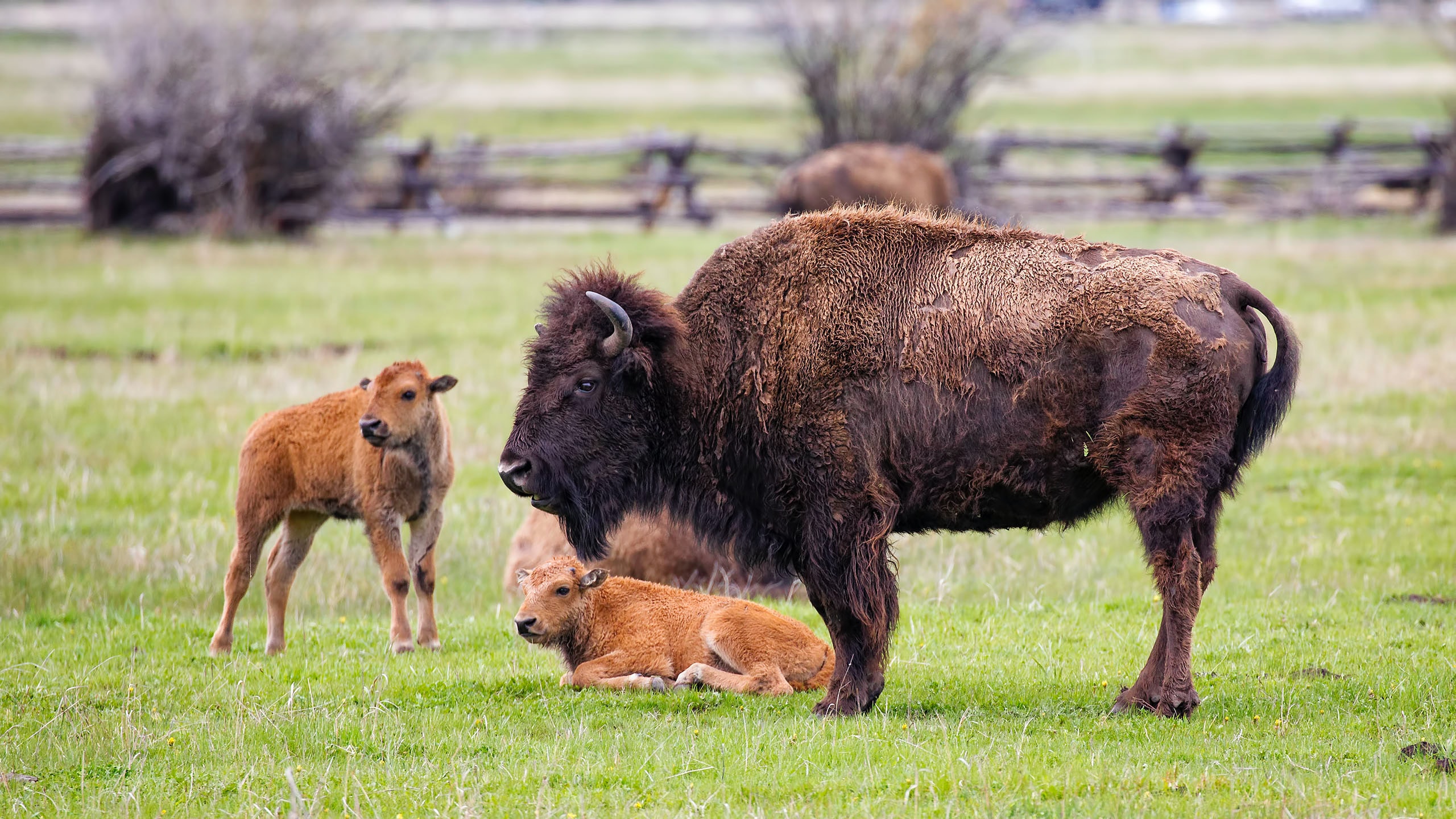
Led by tribes, conservationists are helping bison make a comeback.
Having recently watched an appalling old Annie Get Your Gun film with Betty Hutton (appalling on the subjects of poverty, women, and especially indigenous people), I was relieved to learned from today’s article that attitudes may have evolved into something more promising.
Back in the day, settlers fought natives in underhanded ways. One way was killing bison, a sacred food source. Today European descendants and tribes are actually collaborating to bring the animals back from the edge of extinction.
Jess McHugh reports at the Washington Post, “Miles of prairie stretched out across the Wichita Mountains Wildlife Refuge in southern Oklahoma, acre after acre of brush, grasses and hearty vegetation creeping toward the low-range granite mountains rising in the distance. Like in much of Oklahoma, the road is flat here, but the speed limit remains 30 mph. That’s because of the bison.
“They appeared seemingly out of nowhere: dozens of massive animals lumbering up the shoulder of the road to cross to the fresh vegetation on the other side. The herd moved slowly, their soft, bovine eyes barely registering the stopped cars awaiting their passage. They quickly set to work mowing down the fresh springtime grass.
“The bison’s quiet munching does more than nourish their bodies — it’s one of many things they do to nurture their entire ecosystem, one that is increasingly under threat from climate change. Grazing bison shaving down acres of vegetation leave more than dung behind:
Their aggressive chewing spurs growth of nutritious new plant shoots, and their natural behaviors — the microhabitats they create by rolling in the ground, the many birds that forged symbiotic relationships with them — trickle down the food chain.
“Once bordering on extinction, bison now serve as a great provider for their ecosystems, standing as an example of the ways in which animal conservation and ecological protection can work in tandem.
“ ‘Buffalo is the original climate regulator,’ said Troy Heinert, a member of the Sicangu Lakota (Rosebud Sioux) tribe and executive director of the InterTribal Buffalo Council, a coalition working to restore the animal on tribal lands. ‘Just by how they use the grass, how they graze, how their hoofs are designed, the way they move.’ …
“Tribes are leading the effort to bring back the bison, Heinert says, which in turn allows for the return of other native grasses, animals and insects — all of which will ‘help fight this changing climate.’
“Bison, called buffalo by some Indigenous peoples, are mammoth creatures. Weighing up to 2,000 pounds, they are the largest land mammal in North America. … Two centuries ago, bison dominated much of the continent from Canada to Mexico, when tens of millions roamed North America. They were so numerous that the pounding of their hoofs beating across the land sounded like rolling thunder. For the many tribes of the plains region — the Lakota, the Shoshone, the Arapaho, to name a few — buffalo was a sacred animal that nourished their people and played an important ceremonial role.
“For European colonizers, the bison were both a commodity and a weapon. Americans massacred them by the thousands, selling their pelts and organizing vast sport hunts. As the United States pushed West in the 1800s, bison became a pawn in their quest to wrest Indigenous tribes off their ancestral homes. …
“By the turn-of-the-20th century, millions of bison had been killed. In 1900, fewer than 1,000 — of an estimated 30 to 60 million — remained, many in zoos.
“President Theodore Roosevelt ordered federal bison herds to be put into place (some, such as Custer State Park, were ironically sourced from tribal herds). The bison observed in the Wichita Mountains are descended from 15 animals commandeered from the Bronx Zoo in 1907 and brought to Oklahoma via train car. In the intervening century, federal, tribal and private herds have brought the species back from the brink of extinction. The estimated number of bison nationwide — while far from the millions — now hovers in the low hundreds of thousands.
“Indigenous peoples have been integral to this effort from the start, both by managing herds and by introducing legislation to protect and expand bison territory. In the past few decades, tribal herd numbers have soared: The InterTribal Buffalo Council, which began as a modest coalition of fewer than 10 tribes in the early 1990s, will soon count 76 tribes across 20 states from New York to Hawaii among its members, managing a total of more than 20,000 animals across 32 million acres.
“The return of the bison is a victory not only for the sake of biodiversity but for the entire ecosystem in which they live. As a keystone species, the bison sustain their environment from the top down.
“ ‘They move through, graze everything down. It’s a type of disturbance — like fire would be,’ said Dan McDonald, lead wildlife biologist at the Wichita Mountains Wildlife Refuge. ‘The fresh green [draws] other animals that would feed on it: elk and deer and whatever other type of grazers that would consume some of that new forage.’
“The herd in Oklahoma is approximately 625 animals, but when large herds move synchronously across the land, they create what scientists have dubbed a ‘green wave.’ The bison’s vigorous grazing stimulates plant growth, creating a flood of new vegetation that follows in the bison’s wake to be ‘surfed’ by animals large and small. Green waves can be so dramatic that some — such as the one created by Yellowstone’s bison herd — can be seen from space.”
Read about the extraordinary side benefits of herd restoration at the Post, here.



 Suzanne's Mom's Blog