Feeds:
Posts
Comments

Posts Tagged ‘dance’

Photo: Cliff Grassmick
Lucy Wallace, the co-founder of Dance to Be Free, incorporates jazz, lyrical, and hip-hop into the dance classes she offers in women’s prisons.

My friend Asakiyume has been a tutor in a women’s prison for several years, where she has learned that many inmates got in trouble after suffering repeated abuse or gross failure by the educational system. Most students, she says, are grateful for any attention from outside and are determined to do better on release. I think she would like this story about a dancer serving incarcerated women in the South.

Maria Di Mento writes at the Chronicle of Philanthropy, “Lucy Wallace is a dancer who has spent a lot of time in prison. That’s because Wallace, the co-founder of Dance to Be Free, travels the country teaching dance classes to incarcerated women to help them cope with depression, despair, PTSD, and complex trauma. …

“Despite her assumption that most prisons would turn her away, not one has.

‘I’ve never had a warden say, “No, we don’t want your program,” ’ Wallace says. ‘They’re grateful to get programming, especially in rural areas that are so remote no one goes there to volunteer.’

“A former dance major who has a master’s degree in psychology, Wallace incorporates a mix of movement styles into her dance classes, including jazz, lyrical, and hip-hop, and a variety of musical genres. …

“The program involves writing exercises and group discussions that let the women talk about their lives, how they coped with their first few weeks in prison, their biggest challenges, and what they’re getting out of the classes. She provides the prisons with DVDs of the classes and has certified about 400 prisoners who can lead the courses.

“Dance to Be Free is in 13 prisons in eight states and operates on a budget of about $100,000 a year. Few prisons will pay for the programming, something Wallace would like to change. For now, the charity receives all of its funding from individual donors, raising roughly $175,000 since 2015. …

“Wallace is holding off expanding the program for the time being and is instead focusing solely on the South, especially Mississippi and Florida, where she says women’s prisons are in deep need of programs.” More here.

From the Dance to Be Free website: “Our mission is to radically improve the lives of incarcerated women through the healing power of dance. We use ‘Cathartic Choreography’ to both train the inmates and teach them a new skill. We have seen this technique help our students deal with physical and mental illness, including PTSD and complex trauma.

“During our teacher trainings inmates gain confidence as they experience leadership and responsibility, often for the first time in their lives. That sense of accomplishment flourishes as our students learn to not only express themselves through dance, but to free others to do the same.

“Throughout this transformative experience, we teach the nuts and bolts of choreography, timing and flow, and just as importantly we facilitate journaling and sharing exercises that nurture introspection and self-awareness that inmates often need.”

I found the nonprofit organization’s video very moving.

Read Full Post »

Photo: Bangkok Post
Masked dance tradition rises from near extinction in Cambodia.

Dictators try their hardest to wipe out whole cultures and groups of people. They can do horrific damage, but they can never fully succeed in their evil intentions. From whatever is left, new shoots will grow. The Khmer Rouge and the tyrant Pol Pot (1963 to 1981), for example, thought they could crush traditional arts in Cambodia, but today those arts are rebounding. In addition to resurrecting Cambodian ballet, devotees are also bringing back masked dance.

Check out this story by Chantha Lach, Panu Wongcha-um at Reuters.

“Cambodia’s centuries-old tradition of masked dance was nearly wiped out by the Khmer Rouge’s ‘Killing Fields’ regime, but a handful of artists managed to keep it alive and are now working to pass it along to a new generation.

“Sun Rithy’s father and grandfather were both performers of the Lakhon Khol masked dance, but the ultra-Maoist Khmer Rouge — who scorned most art as decadent — banned its study when he was a child in the 1970s.

“Now 48, Sun Rithy leads one of the last Lakhon Khol troupes in Cambodia, made up of about 20 performers and students aged six to 15. …

“Lakhon Khol was recently listed by UNESCO, the United Nations’ cultural agency, as an intangible cultural heritage, along with neighboring Thailand’s version of the dance, known as Khon. …

“ ‘In the Khmer Rouge, I was young and they didn’t teach people dance. Lakhon Khol was destroyed,’ said Sun Rithy, who started to learn the dance when he was 14, after the Khmer Rouge were ousted from power.

“Ahead of a recent rehearsal, students stretched their legs and hands at the troupe’s a newly built theater at Wat Svay Andet, a Buddhist temple outside the capital, Phnom Penh. …

“Cambodian Minister of Culture and Fine Arts, Phoeurng Sackona, said that the dance needed immediate preservation and urged all people to get involved.

“ ‘Elderly performers are trying to preserve the dance at this Wat Svay Andet,’ Phoeurng Sackona told Reuters. ‘But it is up to young people whether they agree or not to receive knowledge from the elders.’

“Thailand’s version of the dance has fared better than its neighbor’s, but practitioners still depend on recruiting a new generation of performers. Thailand’s Khon tradition, originally centered on the royal court, is now taught by many schools and universities.

“Mom Luang Pongsawad Sukhasvasti, 67, has followed his father’s footstep in making Khon masks since he was 10 and still hand-fashions the masks from his home studio in Ayutthaya province, north of Bangkok.

“Each mask takes a month to produce, from molding the plaster to drawing the intricate details. Pongsawad said the UNESCO listing could boost awareness.

“ ‘Teachers now must do more than teaching the dance,’ he said. ‘They need to help students understand the roots as well to preserve it.’ ” More here.

This effort reminds me of the book Farenheit 451, which takes its name from the temperature at which book paper burns. Did you see the movie, with Julie Christie playing two different women? In the Ray Bradbury story, a future civilization bans books, but in a secret camp of outlaws, each individual takes on a book to memorize to keep the treasures of literature alive. They walk around most of the day reciting David Copperfield or whatever. The experience of Cambodia suggests the 1954 science fiction story was not so far-fetched.

Read Full Post »

Photo: Pari Naderi 
In the dance called Stroke Odysseys, projections reveal stroke victims’ inner thoughts.

What is your experience of stroke? Both my brothers recovered from theirs, but our father was incapacitated by a stroke in his late 40s and lived as an invalid for the next 23 years. Medicine has improved a lot since then, as have programs that get people moving again.

At the Guardian, Lyndsey Winship has an interesting story about life after stroke.

“It was around four in the morning when Pauline Boye woke up and realised she couldn’t move. ‘I was unable to get up,’ she remembers. ‘I called to my partner, “Can you help me? I can’t get up!” ‘

“Boye, who was 47, had suffered a stroke. She spent four months in hospital, and was left with physical impairment down her right side and difficulty with her speech. The former nurse suddenly went from caring for others to being the one in need of care. Once she was home, she didn’t want to leave the house. …

“Boye was shy even to speak, worried that people wouldn’t understand her. But eight years later, on stage in front of me, she is acting out a scene based on her time in hospital, her voice carrying across the stage. Clearly she is not ashamed any more.

“The transformation is thanks to the [UK] organisation Rosetta Life and its director, Lucinda Jarrett, who works with artists and health professionals to devise arts projects that have a meaningful impact on the lives of people with brain injuries. For Boye, this now means touring the country as a performer in Stroke Odysseys, a production by choreographer and director Ben Duke and the composer Orlando Gough, featuring a cast of musicians, dancers and five stroke survivors. …

“The physicality of each person is different and shows vulnerability but also determined strength. Through a series of scenes and songs, the performers’ experiences – of struggling to express themselves, mixing up words – come to life, with projections cleverly revealing inner thoughts and subtext. …

“The discipline of rehearsals, the camaraderie and the drive towards performance can offer very real motivations and therapeutic benefits. ‘The key outcomes are increased mobility, increased cognition, increased verbal articulacy,’ says Jarrett. One in three people experience depression after a stroke, but evaluations of Rosetta Life’s work shows that it has ‘enabled people to change the perception of their disability and look forward to a new life’, says Jarrett. Reducing depression means people stay more active and are less isolated, and hopefully therefore less prone to accidents, second strokes and hospital readmissions.

“In that light, it is surprising when Duke says: ‘I’m interested in the idea of dance as a useless activity.’ But he goes on to explain the benefits of physical activity that have no practical function. When you lose the use of one hand, for example, you tend to use your other hand instead, and the impaired hand becomes weaker as a result. Whereas with dance, the performers are asked to make gestures simply because it’s the choreography, and they’re forced to do things they might not otherwise. …

“ ‘For Pauline, dancing was a big part of her life,’ Duke says, remembering the day she brought in some videos of her dancing at a wedding. ‘But the first time she talked about it, she stood up and she [danced], and even now with her limited movement, it’s all there. Physically it is a fraction of how she used to be, and yet, it’s there. The body lights up.’ ”

More at the Guardian, here.

Read Full Post »

methode2ftimes2fprod2fweb2fbin2f7bfa7a70-aa3c-11e8-8404-0bee60a6f70d

Photo: James Glossop
Scottish Ballet expands Dance for Parkinson’s classes to cities across the country.

The class that comes right before my Essentrics stretch class on Thursdays is for people with Parkinson’s. The participants seem to enjoy it. One man, who is said to be over 100, routinely leaves the class with a smile on his face.

Exercise classes for people with Parkinson’s are not new, but there are always new locations offering them and new techniques to help people keep moving. Consider, for example, this report from Scotland, where the Scottish Ballet has a program.

Jeremy Watson writes at the Times, “Research has shown that dance can help people with the degenerative disease physically, mentally and socially. [At the Scottish Ballet,] staff and volunteers help participants develop movement skills with particular emphasis on fluidity, balance, co-ordination and posture. The sessions include activities focused on problem solving, improvisation, vocal skills, memory and multi-tasking.”

The Scottish Ballet website adds background. “Established in 2016, the Dance for Parkinson’s Scotland programme supports those with Parkinson’s to experience the benefits of dance and creativity — improving balance, spatial awareness, confidence and fluidity in movement. Every week, around 75 participants take part in sessions delivered by Scottish Ballet in Glasgow and Dance Base in Edinburgh. …

“The warm and informal Dance for Parkinson’s Scotland classes feature elements of ballet and contemporary dance with a focus on Scottish Ballet’s repertoire. Using the themes and movement from current productions, specially trained Scottish Ballet and Dance Base Dance Artists lead participants to develop movement skills with particular focus on fluidity of movement, balance, coordination, expression, posture and rhythm.”

The Edinburgh Parkinson’s site says that the aims of the classes “are to

* wake up stiff muscles and improve flexibility,
* encourage mind-body connection,
* improve co-ordination and balance, and
* increase self-awareness and self-esteem
* in a supportive and joyful environment

“The social time at the end of each session is a chance to make connections and feel part of the dance community. … The teachers have a wonderful sense of light-heartedness and fun which they bring to the classes. Live music is an essential ingredient, and we have a talented pianist, Robert Briggs, providing the accompaniment, so the music is used flexibly to encourage movement and development of sequences. …

“The original concept, arising from collaboration between the Mark Morris Dance Group and the Brooklyn Parkinson’s Group in New York, is now increasingly practised worldwide among the Parkinson’s community.”

Patients’ partners and caregivers attend the class that I’ve looked in on, and they are welcome to participate and get some exercise, too. The musical selections are great, but unlike in Scotland, there is not a live accompaniment.

Read Full Post »

mana-lsw-08-644x1219_q100

Photo: Fred Hatt
Mana Hashimoto is a New York City–based contemporary dancer and choreographer who, despite losing her eyesight, is determined to keep dancing and making dance.

We all have obstacles that rise up in our lives, but for some of us, the obstacles are exceptionally daunting. That was true for the dancer in this story, who made up her mind that her career would not be lost when her eyesight was lost.

Victoria Dombroski interviewed her for Backstage.

“Mana Hashimoto is a New York City-based contemporary dancer and choreographer whose career has spanned from her native Tokyo to many stages worldwide. She also happens to be blind. After losing her eyesight due to optic nerve atrophy, she was determined to keep dancing despite the unexpected obstacle. Since then, she has dedicated her life to merging blindness and dance, and to create artistic works through the use of her remaining senses.

How did losing your eyesight change your trajectory as a dancer?
I trained as a classic ballet dancer and it’s very common that when you take class, you have to check in the mirror to see how you look. It becomes a sort of obsession and trap, consciously or unconsciously. I think it was a relief that I no longer had to see myself in the mirror, but instead be in the moment and be with myself and accept who I am physically, emotionally, and spiritually.

Were there certain things you learned about yourself as a dancer after losing your sight?
“I learned how to accept who I am, [to] be free, and to observe myself internally. It changed my perspective of what beauty is. Visual information can be overwhelming and we are shown what beauty should be instead of who you should be. …

What advice do you have for blind dancers and dancers with disabilities?
“I’m still a work-in-progress as a human being, but if I could advise something: keep enjoying dance. If there are some challenges, you can take them as opportunities to make your dance original. Any challenge is a door we didn’t expect we could open. …

What would you like to see more of in the New York dance community?
“I think more accessibility and openness to have visually impaired participants for workshops and classes. Once we have the right access, dance is open to anybody’s needs. I would also like to see more verbal description for dance performances. Before my performances, I invite visually impaired audiences to feel the space; they can touch and feel the props and costumes. …

What advice do you have for dancers encountering major setbacks in their dance career?
Hold onto your hope. I think it’s very important to share your difficulties along with your dreams.”

More here.

Read Full Post »

wwasp4iub5cohnfzrupp4aleui

Photo: Jose F. Moreno / Inquirer Staff Photographer
In South Philadelphia, young Khmer women are earning to perform traditional Cambodian dance.

When one marginalized community taps into its roots and strengthens its identity, other ethnic groups may benefit, too. Consider this story about young Cambodian women in South Philadelphia and their how traditional dances are often performed for neighboring communities of color.

Bethany Ao reports at the Inquirer, “When Lanica Angpak started the organization Cambodian American Girls Empowering three years ago as a personal project, she visualized it as a safe space where young Cambodian women could talk about ‘taboo’ topics they didn’t feel comfortable discussing with their families.

“But when Angpak broached that idea with the women she was mentoring at the time, the group had an addendum: They wanted Angpak to teach them traditional Cambodian dance.

” ‘I was already teaching some of them,’ said Angpak, who learned how to dance from her mother. ‘But bringing it into this organization allowed us to build bridges through dance.’

“On a recent Sunday, the organization gathered at Bok Bar, a popular rooftop bar in South Philly with gorgeous views of the Philadelphia skyline, for a sunny afternoon workshop performance.

“The women slipped off their shoes and completed stretches that were harder than your average yoga pose. Eventually, they shifted into formation and performed a dance about a Cambodian celebration for young children. The dancers moved slowly, but their movements required just as much precision as ballet. Their mastery of balance was impressive, as was their flexibility. …

“Cambodian dance is a crucial part of storytelling in the country’s culture. It has existed for thousands of years and draws its roots from Indian mythology and religion. Every component of the dancer’s body is engaged during a performance, from their fingertips to their facial expressions. …

“The Philly area has the fourth largest Cambodian population in the United States — about 13,000, according to the most recent census — centered in South Philly. Angpak works closely with the Cambodian Association to help support the community here. Besides the performances, CAGE also holds dance workshops for females as young as 6 and as old as 72.

” ‘On average, we do about 14 performances a year, and we’ve already surpassed that number this year,’ Angpak said. ‘We prioritize public events.’ … The group particularly enjoys performing for organizations representing other communities of color.

“Angpak said dance is an alternative way of sharing between communities, an exchange of culture and art, of sorts. The organization charges on a sliding scale for performances. Workshops, including the one at Bok Bar next month, are free and open to the public.”

More at the Inquirer, here. And click here for my 2017 post about how Princess Norodom Buppha Devi, half-sister of Cambodia’s King, is working to reenergize the Royal Ballet of Cambodia. Perhaps some of these Philadelphia women and girls will get a chance to audition for that.

Photo: Jose F. Moreno / Inquirer Staff Photographer
A mother and daughter learn traditional Cambodian dance at the Bok Bar in South Philadelphia. Cambodian American Girls Empowering (CASE) helps women and girls preserve their heritage through traditional Cambodian dance.

pltyg5csarh53btkfol46pgw5a

Read Full Post »

980x

Photo: Amitava Sarkar/Forklift
The cast of
Served performs a dance phrase based on the five key movements of mopping. Forklift Danceworks makes choreography from everyday life, revealing the beauty and majesty of what you thought was mundane.

From childhood, I was always one for fantasy and found it easy to relate to imaginary worlds in the arts. Lately, though, I find myself more interested in art that feels relevant, art that uncovers wonder in everyday life. So it’s not surprising that this Dance Magazine article about discovering the dancelike moves of ordinary occupations appealed to me.

Nancy Wozny writes, “Austin renegade Allison Orr doesn’t use traditional performers. With her Forklift Danceworks, she has created dances featuring everyone from sanitation workers (The Trash Project) to power linemen (PowerUP), urban forestry department members (The Trees of Govalle) and food service employees (Served).

“Orr has a BA in anthropology and calls her process ‘ethnographic choreography.’ Using the movements of everyday workers, she crafts large-scale extravaganzas that have included more than 75 performers (and sometimes trucks), audiences of 2,000, and a deep research process that may involve her learning how to scale a power-line distribution pole or riding with a sanitation worker at 4 am.

“She recently spoke to Dance Magazine about her unique creative process.

” ‘When I start a new piece, I listen for the story the workers want told. What do they want people to know about what they do? I usually do about 50 to 100 interviews. Then I watch people doing their expert movement, looking for that seed. ,,, Usually there’s an all-staff meeting where I am introduced. Then I start job shadowing, working alongside them when I can. …

” ‘We don’t actually get people to agree to perform until very late in the process. I usually don’t ask for what we want until that person is likely to say yes. We put out a question, like “How do you cook an omelet in three minutes or less?” and they start choreographing it. Then they want to be in it, because they are the ones who can do it.

” ‘For the actual piece we organize sequences based on their movements, expanding it in space and time. For Served I watched one gentleman mop the floor and observed five different movements he does, including this beautiful turn. …

” ‘Because participants are asked to collaborate across different work groups to make the dance together, they build trust with people they might have worked with for years but never had the chance to really get to know.

” ‘The act of performing changes how collaborators see themselves. Being witnessed in one’s everyday work, particularly doing what might be thought of as mundane or ordinary, is transformational.’ ”

More at Dance Magazine, here.

Photo: Jonica Moore/Forklift Danceworks
A worker from Austin’s Urban Forestry Division performs in the dance
The Trees of Govanelle.

980x1

Read Full Post »

arev_oom_2017_ezerum_close-up

Photo: J. Urban/Smithsonian
Arev Armenian Dance Ensemble

Because I live in the Greater Boston area, where there is a large Armenian population, I was interested to read how how Armenian dance is helping to preserve the culture in the diaspora.

Roger Catlin writes at Smithsonian that Armenian dance has adapted in intriguing ways over time and place.

“Can dancing preserve culture?” he asks. “Those who circle up, link pinkies and swirl to the traditional village dances of Armenia believe they can.

“And as part of the 52nd annual Smithsonian Folklife Festival this summer, scores of dancers from Armenia and across North America will perform, present master classes and share technique. [Note: This took pace in July.] …

“One of the oldest centers of civilization, Armenia once stretched from the Black Sea to the Caspian Sea and between the Mediterranean Sea and Lake Urmia in present-day Iran. Its key location in the South Caucaus region of Eurasia made it a central place for commerce with other cultures, but also a site for constant invasion from neighboring empires, the Ottomans to the west and Iran to the south and Russia to the east.

“Already the dance traditions of individual villages, separated by mountainous topography had been unique to each town. But with the Armenian diaspora, the dancing, which continued as a way to keep connected to the old country, became even more individualistic, [says Carolyn Rapkievian, who is serving as an Armenian dance advisor for this year’s Folklife Festival], noting that the dances were further influenced by the host countries. …

“Gary and Susan Lind-Sinanian, dance historians at the Armenian Museum of America in Watertown, Massachusetts, say traditional western Armenian music and dance remained an important cultural touchstone for the immigrating community.

“ ‘As the Armenian language fell into disuse among many American-born Armenians, the music and dance gained even more importance, as one of the remaining avenues of cultural identity maintenance,’ they have written. ‘Today, this music and dance have developed into a characteristic form unique to the United States, and one of the principal means that today’s Armenian-American youth assert their Armenian identity.’

“ ‘The two means of expression, outside of being a member of the church, to mark you as an Armenian are dance and food,’ Gary Lind-Sinanian says. ‘Those are the two every Armenian family practices to some degree.’ Still, every village seemed to have its own style, he said. ‘When people make their pilgrimages to some monastery for a festival, they could see, when various groups danced to a melody, by the way they danced, you could tell where they came from.’

More at the Smithsonian, here. If you are ever in Watertown, try to get some Armenian food. It’s delicious — a little bit like Middle Eastern cuisines you already know, a little bit not. And you can get an interesting angle on the Ottoman Empire’s relationship with the Armenians from this wonderful book, Destiny Disrupted, by Tamin Ansary.

Read Full Post »

Photo: Jorge de la Quintana
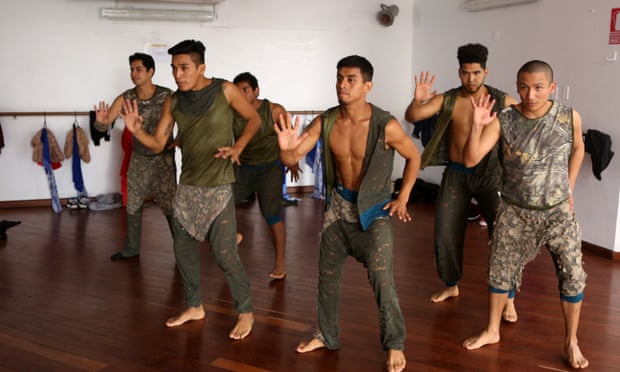
A ballerina admired impoverished acrobats performing at Lima, Peru, traffic lights and decided to offer them a better opportunity. In the photo, members of her D1 Dance Company rehearse.

Once upon a time, a privileged young lady, a ballerina with an international reputation, saw the face of aspirational poverty on acrobats performing in traffic and decided to offer them an opportunity.

Dan Collyns writes at the Guardian, “Vania Masías vividly remembers the first time she saw acrobats somersaulting at a traffic light on a visit to her home city in 2004. She was at the peak of an illustrious career as a ballet dancer in Europe – but before long, she would leave it all behind it to nurture the raw talent she found in the streets of the Peruvian capital. …

“She was so inspired by the abilities of the teenage acrobats she encountered in Lima she set up a pilot project to teach them to dance – not ballet, but hip-hop. …

“It began on the self-taught gymnasts’ home turf in Ventanilla, a tough neighbourhood near the city’s port. Masías arranged to meet them on the shanty’s sand dunes where they practised their flips. The response was overwhelming.

“ ‘I thought I was going to meet with three kids,’ she said. ‘When I arrived, there were more than a hundred kids.’ …

“In 2005 Masías formed the D1 Cultural Association: part dance school, part non-profit organisation seeking to create young leaders and promote positive social change through the arts.

“D1’s social arm, which is 85% self-sufficient thanks to the school’s private classes, works with 7,000 children and young people in the capital and has schools in the Peruvian cities of Ica and Trujillo. More than 100,000 children have passed through the programme over the years, says Masías.

“Among them is Eddy Revilla, who at 13 became his family’s breadwinner somersaulting at traffics lights in downtown Lima.

“ ‘I was earning 300 soles a week [£66/$92] and here in Peru – that’s money! I could help my family and they started to thank me,’ says Revilla, now 25.

“But after blacking out in mid-air doing a somersault, Revilla auditioned for D1, and is now a member of the group’s professional dance company.

“ ‘When we started nobody thought that you could make a living from dance. Now it’s an amazing opportunity for young people,’ says Revilla, who also teaches hip-hop to paying students at D1’s dance studio. …

“Masías acknowledges that only a few of the young students will eventually follow a career in dance, but she says that the act of dancing itself gives them the confidence to transform their circumstances. …

“Masías has encouraged her dancers to embrace their provincial roots through fusing traditional Peruvian and urban styles.

“ ‘It’s in their blood, in their veins,’ she says. Dancers who had been ashamed of their origins ‘now fight to say where they come from,’ she says.”

More at the Guardian, here.

Read Full Post »

Photo: Hartford Courant
Former US Marine Roman Baca
develops ballets that help veterans heal and help audiences gain empathy. For his Fulbright Fellowship, he’s creating a new version of Igor Stravinsky’s
Rite of Spring tied to WW I.

Not long ago, Suzanne’s friend Liz found a piece of antique weaponry and asked instagram friends how it might be used in an art project or something else positive.

I said to “beat it into plowshares.”

In their own way of beating weapons into plowshares, war veterans may continue to serve the country after their time in the military. They may run for Congress like Seth Moulton of Massachusetts or establish a nonprofit like Soldier On, which treats veterans suffering from addictions.

And then there’s the Marine who became a choreographer to tell stories that enlighten and heal.

Candice Thompson writes at Dance Magazine, “When Roman Baca returned home from active duty in Iraq in 2007, he found himself having a tough time transitioning to civilian life.

” ‘I remember a couple of instances where I was mean and angry and depressed,’ says Baca. [His wife] suggested Baca return to his roots in dance. ‘She asked me, “If you could do anything in the world, what would you do?” ‘…

“Baca had to broker his transition back into dance. Earlier, he had trained at The Nutmeg Ballet Conservatory in Connecticut and spent a few years as a freelance dancer before feeling compelled, like his grandfather had, to serve his country. ‘I walked into the recruiter’s office and said, “I want to help people who can’t help themselves.” ‘ Baca reveled in the rigor of the Marine Corps, which seemed like a perfect analog to classical ballet. …

“Baca served as a machine gunner and fire team leader [in Fallujah]. And while his job was one of looking for insurgents and intelligence, Baca also ended up doing humanitarian work, bringing water and school supplies to those in need. The transition from violence to aid helped him meet his original desire to defend the vulnerable.

“In 2008 … he reached out to his mentor Sharon Dante from The Nutmeg Ballet Conservatory. He had dabbled in choreography before joining the Marines and had begun to write while overseas. Dante suggested [that he] focus his writing and choreography on his experiences in Iraq. The exploration led Baca to form Exit12 Dance Company, a small troupe with a goal of inspiring conversations about the lasting effects of violence and conflict. …

“When a theater in the UK reached out to him in 2016 about creating a new Rite of Spring — one that would explore the connections between the creation of this famous ballet and the outbreak of World War I, in commemoration of the war’s centennial, as well as touch on today’s veterans and current events — he knew immediately it was a project for [him].

” ‘One percent of our population serves in the military, and an even smaller number serves in war,’ explains Baca of one of the central questions motivating this new commission. ‘How do we take all of this remote and little understood experience and inspire the audience to positive action?’ ”

More at Dance Magazine, here.

Read Full Post »

Photo: Elizabeth Hafalia, The Chronicle
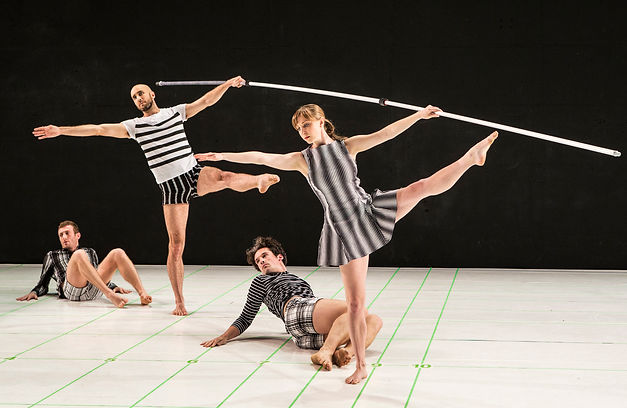
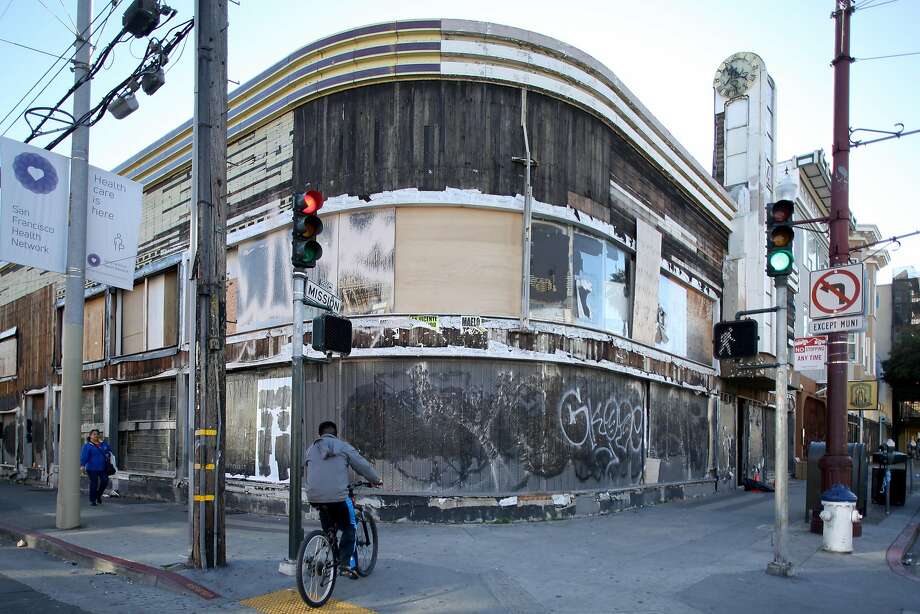
Facing a need for affordable housing and arts space, San Francisco’s Mission Economic Development Agency is joining with Dance Mission Theater and the Mission Neighborhood Centers to repurpose this neglected 1919 building.

Have you ever visited San Francisco’s Mission District? A poor, immigrant neighborhood, it is nevertheless a vibrant experiment in people-oriented housing and support for food entrepreneurs and the arts. The creative energy there is tangible.

Moreover, the neighborhood’s community-development folks never stop turning dreams into reality. J.K. Dineen has an update at the San Francisco Chronicle.

“A historic but long-neglected commercial building at Mission and 18th streets in San Francisco is poised to be rejuvenated with a mix of affordable housing, child care and dance.

“The dilapidated 1919 structure, a former furniture store that was remodeled with an Art Deco flair in the late 1930s, has been on and off the market for more than a decade. …

“Finally the Mission Economic Development Agency, a politically powerful group that often opposes market-rate housing, reached a deal to buy it by collaborating with Dance Mission Theater and the Mission Neighborhood Centers, which will open a child care facility there.

“ ‘We are all going in together to do a new model of cooperative living and dancing and taking care of our children,’ said Krissy Keefer, executive director of Dance Mission Theater. ‘It’s going to be very communal.’ …

“Brokers with the San Francisco office of the realty firm Marcus & Millichap … said market-rate developers were scared off by the Mission’s anti-gentrification political environment and that ‘MEDA was very good to work with.’ …

“The building will be the group’s first home ownership project — the others are rentals — and the first targeting middle-income families rather than low-income folks. Mission Neighborhood Centers is providing some of the project funding, along with two nonprofits: Low Income Investment Fund, a financial intermediary that provides capital for community developments, and the Neighbor to Neighbor fund.”

I’m sure everyone has read about the housing crunch in San Francisco, with tech employees pushing prices up. It’s good to hear of anything designed to ease the shortage. More here.

Read Full Post »


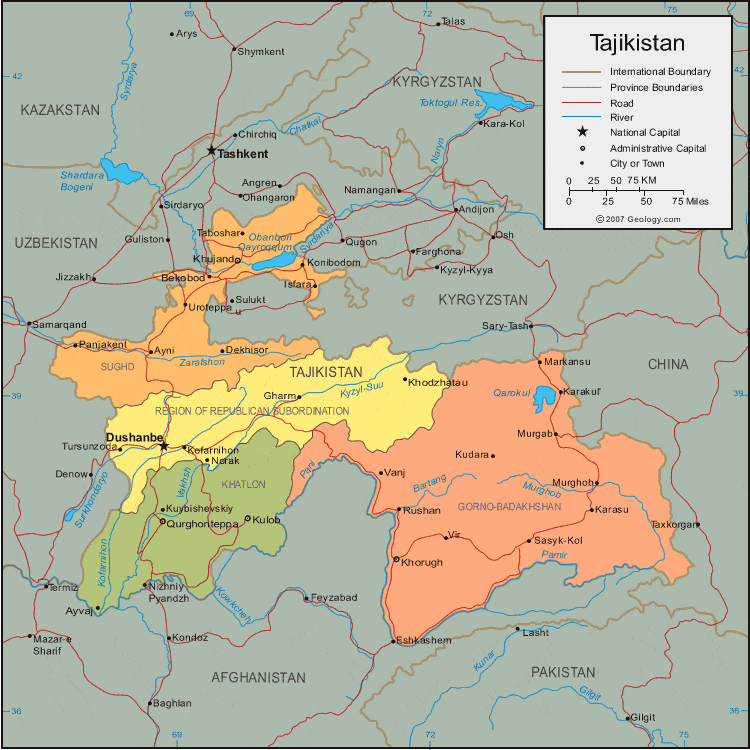
Do you mix up Tajikistan, Kyrgyzstan, Kazakstan, and Uzbekistan? I do. But while Americans go about their business completely unaware of those Central Asian countries, a vibrant culture flourishes there.

Every once in a while, I make an effort to learn something about the “stans” — for example, when I read a Uzbek novel, The Railway, a few years ago. Even that I found hard to follow.

Tara Pandeya is an American dancer who decided to immerse herself in the traditional dance of Tajikistan. She writes at Dance Magazine, “Two years ago, I was touring the world as a principal dancer in Cirque du Soleil’s production of Dralion. But after 1500 shows on a five-continent and 170-city tour, I left the commercial entertainment world to reconnect with the art form I’m most passionate about: Central Asian dance.

“I have dedicated the last 18 years of my life to dance styles from the Central Asian Silk Road region. My fascination started when I was 13 and fell in love with the miniature paintings of Central Asian dancers and the Arabic calligraphic script I saw in museums. …

“Months after leaving Cirque, I moved to Tajikistan. I had planned to stay for one month but ended up staying for a whole year and dancing as the first Westerner in Lola, the state-funded Tajik National Ensemble.

“The other dancers were confused, cautious and curious about me. In the beginning, I felt like a complete outsider. I was new to their culture, food and environment, and could not speak the language. My daily routine after a full day of rehearsals was to also take a private class to better understand the nuances of the different styles and to push myself technically. The other dancers observed my dedication, and over time I earned their trust and respect. …

“Sometimes I had issues getting into high security buildings because of my American passport, so our director had to start carrying a certified paper clearing me for entrance. We toured within the country on poorly-maintained roads via a bus provided by the state.

“There were rarely enough seats for all of us, and often the men would stand for long parts of the journey so the women could sit. …

“During rehearsal one day, a local journalist noticed me and, thinking I was Tajik, invited me to participate in a televised dance competition which brought together dancers from every region of the country.

“I made it through all four rounds of cuts and amazingly, I won. … I was stopped several times on the street by strangers — the produce guy at my local grocery store said he was excited to see me dance so beautifully in a style from his culture, and hoped that if a foreigner placed so much value on their art forms that local Tajiks would learn to appreciate these forms more themselves.

“This year, I was selected by Forecast, an international mentorship platform, to have my work produced in Berlin … [It will] express the concepts of migration, otherness and gender inequality.”

That interests me — especially as what I know of Tajikistan today is that it is a harsh dictatorship and dangerous to minorities. Anything that builds understanding among ordinary people has to be a step in the right direction.

More at Dance Magazine, here.

Read Full Post »


Photo: NCCAkron
The National Center for Choreography is an initiative of the University of Akron in Ohio.

There’s a national center for everything else, why not choreography? Why not Akron? This Midwest university is thinking big.

Steve Sucato writes about its new concept at Dance Magazine. “For countless dancemakers without their own space, there is no place to call home. Enter the new National Center for Choreography at The University of Akron. Its mission: to support the research and development of new dance by providing choreographers, dance companies, arts administrators and dance writers access to the world-class facilities in the University’s Guzzetta Hall and other venues on campus. …

“The Center opened with the support of the University of Akron and a $5 million grant from the John S. and James L. Knight Foundation. [Last] month it [hosted] its first official artist residency when it welcome[d] choreographer Tere O’Connor, July 17–28.

“The Center’s founding executive/artistic director, Christy Bolingbroke, says it needs to be adaptable so as not to impose a certain way of working on any artist.

“One way of doing that is to offer several types of residencies: space, for use of the studio facilities; research, in which choreographers can explore alongside academic scholars; laboratory, in which choreographers and dancers can work without the expectation of a finished project; technical, for dancemakers and/or production designers to experiment in a theatrical venue; and commissioning, where artists receive funds in addition to time and space. …

“Overall, the Center is interested in curating dancemakers it can support on a long-term basis. ‘We are trying to shift the paradigm from just final-product–oriented residencies,’ says Bolingbroke.”

More at Dance Magazine, here. And kudos to the Knight Foundation for recognizing that the coasts do not have a monopoly on the making of art.

Read Full Post »

Photo: Sara Teresa
The rollout of a dance-based falls prevention programme in the UK by arts and health charity Aesop will see 1,000 older people benefit.

About 15 years ago, after breast cancer treatment, I joined a hospital-based class called “I Hope You’ll Dance.” I used to call it Cancer Dance Class because anyone who was being treated for cancer or had been treated could join. It happened to have only women during the time I was a participant although men were welcome.

The dance routines were very simple, but there was something pleasant about doing them with women you didn’t know but with whom you shared something as big as cancer. I also liked the music selections, which ranged from the playful “Diamonds Are a Girl’s Best Friend” to numbers that were more moving, like “You Raise Me Up” and “I Pray You’ll Be All Right.”

I thought of the mysterious comfort that class provided when I read about a dance program for the elderly in England and Wales. Christy Romer described it at Arts Professional, a UK-based website.

“The rollout of a dance-based falls prevention programme by arts and health charity Aesop will see 1,000 older people benefit from a new £2.3m investment.

“The programme will run for two years from October 2017, during which time 63 interventions will take place across England in Wales. These will be delivered in collaboration with health and social care providers, and arts organisations including Yorkshire Dance and Birmingham Royal Ballet. …

“Previous Aesop research showed how the Dance to Health programmes could address a problem that costs the NHS £2.3bn a year, as the rates of completion for dance-based alternatives to NHS exercise courses are 55% higher.

“An evaluation of the Dance to Health pilot programme in February 2017 also concluded that dance artists could be trained to deliver classes which were an enjoyable artistic challenge, faithful to healthcare objectives, and would deliver measurable reductions in loneliness for participants. …

“The expanded programme will receive support from ‘Dialogue Partner’ organisations, including Age UK and NHS England, and collaborate with eight Arts Council England-funded dance organisations. …

“A formal evaluation of the programme will be conducted in 2019, ahead of an anticipated national rollout in the coming years.” More at Arts Professional, here.

Romer mentioned the effort to address loneliness through the dance classes, but I imagine that the way physical motion improves thought processes is a big piece of the health benefit. And what about improving balance? That’s a concern for me, and a reason I take both tai chi and Essentrics when I’m not on vacation.

But I’m on vacation. So I’ll sign off now and go practice standing on one foot.

Read Full Post »

Photo: Travel Blog
Crow Hop dance, one of several being adapted for exercise classes on the reservation.

A fitness program for members of a tribe in Idaho is showing results with its combination of exercise and spirituality.

Emily Schwing reports at National Public Radio, “In Indian Country, a gym membership is not a cultural norm and the incidence of heart disease and obesity are high. Native Americans are 60 percent more likely to be obese than non-Hispanic whites. The Coeur D’Alene tribe, whose headquarters is in northern Idaho, is trying to combat the problem by incorporating culture into fitness programs.

“The tribe has created an exercise routine — called ‘Powwow Sweat’ — based on traditional dancing. The program features a series of workout videos that break down six traditional dances into step-by-step exercise routines.

” ‘Drop the pringles and let’s jingle,’ commands Shedaezha Hodge, as she demonstrates the steps that make up the women’s ‘Jingle Dress’ dance.

“High steps, box steps, cross steps and kicks combine into a routine that would give any Zumba class a run for its money. …

“All the dances in the exercise program are typical at powwows, including the ‘Men’s Fancy Dance’ — which features four basic steps and a hip move. The hip move involves lifting your knee up, then circling it out to the side, all the while bouncing to the drum beat.

” ‘I lost 13 1/2 pounds,’ says Ryan Ortivez, who attends the weekly ‘Powwow Sweat’ classes at the Coeur D’Alene Wellness Center, in Plummer, Idaho. …

“The CDC [Centers for Disease Control and Prevention] has given the Coeur D’Alene tribe $2 million to develop ‘Powwow Sweat.’ It also supports a community garden on the reservation and a project that stocks the gas station market with healthy food options. …

“Mainstream fitness and nutrition programs don’t meet the needs of tribal members, [LoVina Louie, director of the tribe’s wellness center] says.

” ‘What they lack is spirituality,’ says Louie. ‘Most programming is only physical, or it’s only nutrition. It’s in these compartments — whereas we’re more holistic,’ Louie says. …

“It’s this combination of tradition and exercise that keeps tribal member Ryan Ortivez and his neighbors coming to class each week, to watch the videos and dance alongside each other.

” ‘It’s a lot more attractive than doing jogging or the bicycle for me, because it also relates to my culture,’ says Ortivez.

I’m in love with my community, first and foremost,’ he says. ‘My people. I love to see my community get involved and get active and be healthy.’ “

More here. Be sure to see the great little videos.

Read Full Post »

« Newer Posts - Older Posts »