Feeds:
Posts
Comments

Posts Tagged ‘england’

Photo: Sam Frost/The Guardian.
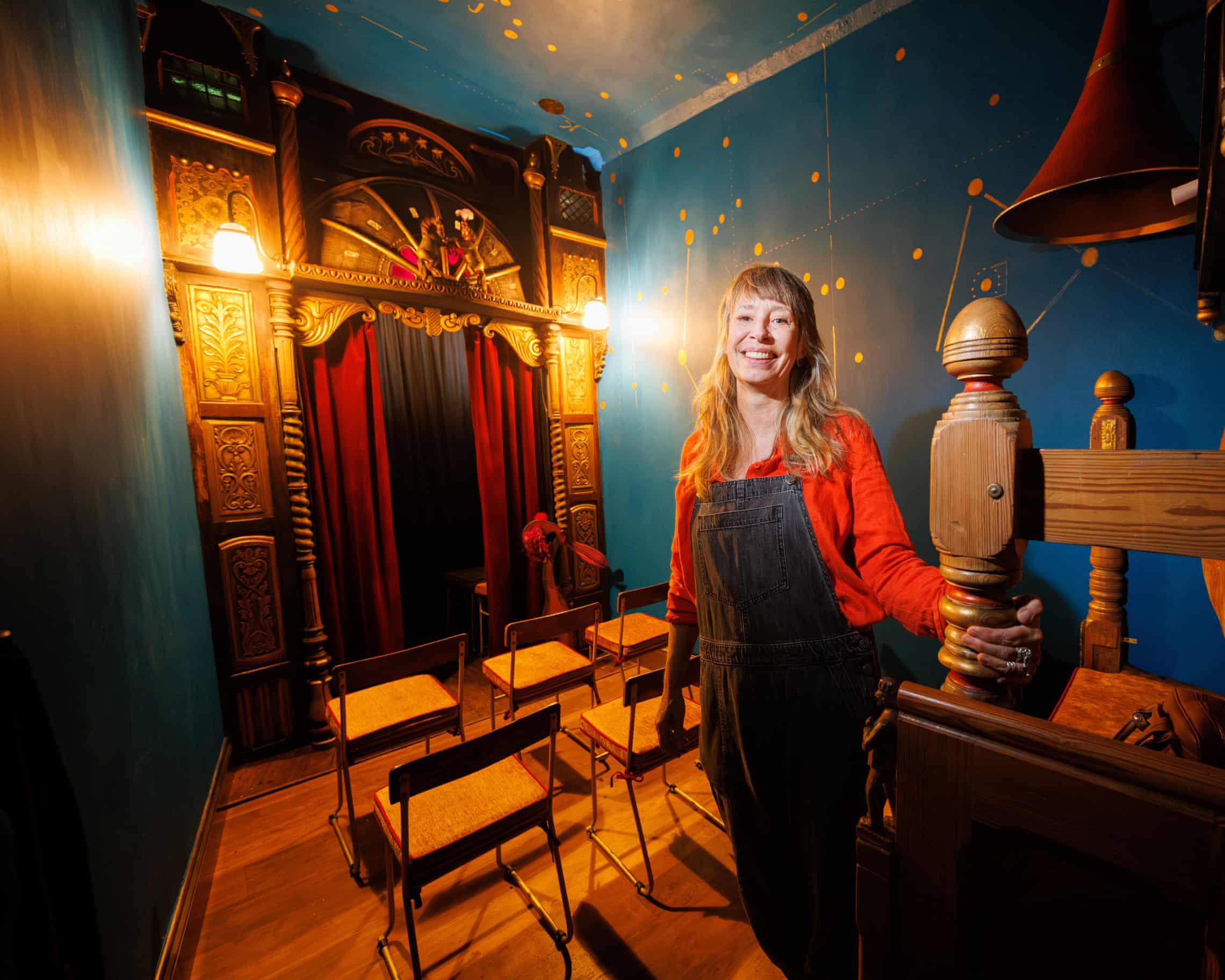
Loz Samuels, creative director of the tiny Theatre of Small Convenience, believes that in the digital age it is ‘really important’ to keep places like this alive. 

People care about having the arts in their lives. It’s not all about big donors wanting to show themselves in designer clothes at a charity ball. Although they are needed, too.

It’s mostly about the audience.

Jessica Murray writes at the Guardian about how a threatened UK theater, housed in what was once a Victorian public toilet, was brought back to life.

“Perched on a sign above a tiny stage draped with red velvet curtains are the Latin words Multum in parvo. Meaning ‘much in little,’ it has become the motto of this minuscule establishment in the Worcestershire town of Malvern.

“This is the world’s smallest commercial theater, with room for 12 people – or 16 with some standing – that has been brought back to life by local residents after falling into disrepair and at risk of demolition.

“Called the Theatre of Small Convenience, it was once a Victorian toilet and measures just [108 square feet] – the stage itself is a snug [16 square feet].

“ ‘Places like this are so rare now,’ said Loz Samuels, the theatre’s creative director and co-founder of the community interest company which runs it. …

“The theatre was created in 1997 by Dennis Neale, described as a local legend and eccentric performer who spent 19 years putting on puppetry shows in the space that captivated local children. In its heyday it was a much-loved and unique claim to fame for Malvern, with the theatre entering the Guinness World Records in 2002.

“But after Neale’s retirement in 2017, the building fell into disrepair and was badly damaged by a fire caused by a dehumidifier. With a destroyed roof, damp floor and damaged walls, local residents began to fear it would be lost for ever, especially with talk of a development next door. …

“Along with local volunteers Jan Birtle and Dibah Farooqui, [the community interest company] acquired the building from the council and raised [$22,000] from the local community to help get the renovation off the ground.

“ ‘It needs replastering, it needed rewiring, it needed a new floor, it needed underfloor heating. There’s obviously no room for heaters,’ Samuels said. …

“The theatre’s deep blue walls are adorned with a vivid gold constellation – with stars ‘sponsored’ by local residents – while intricate wooden carvings frame the stage.

“The challenge hasn’t been plain sailing, and Samuels has fears for the long-term future of the theatre. The team were recently rejected for Arts Council funding, and … with just 12 seats, making the space financially viable will take some creative thinking.

“Set to open its doors in October [2025], the theatre’s first show is Sceptre, a seance-themed immersive show designed specifically for the space. There are plans for a Narnia-style Christmas grotto and even weddings in the future.

“ ‘It is a challenge to find work that fits in here,’ she said. ‘But I feel like the building creates opportunities, you’ve just got to be imaginative. You can make real sensory experiences because you can control the light. As soon as you step foot in here, you forget the world outside, you could be anywhere.’

“Neale, who still lives locally, has also given the project his blessing and recorded a message that will be played at the start of future performances.

“ ‘I think what he did is so quintessentially English and so special,’ Samuels said. ‘He’s really happy, although I think at first he was a bit like, Who is this crazy woman?  …

“Samuels is urging performers and artists with original ideas for the space to come forward, and despite some nervousness, is optimistic for the future of the venue.

“ ‘I feel like it’s a strangely magical place and I just believe that the universe will look after it somehow,’ she said.”

More at the Guardian, here. No paywall.

Read Full Post »

Photo: Jeremie Souteyrat for the New York Times.
Steve Mills shows his copy of The Naughtiest Girl Again, by Enid Blyton, with marginalia by a child.

In a fun story from the New York Times, Jonathan Wolfe writes about a children’s-book collector in England who was surprised to discover who did the childish drawings inside an acquisition. It reminded me of some favorite childhood books — and how I loved to draw pictures of girls with pointy noses on any piece of paper I could find.

“In retirement,” writes Wolfe, “Steve Mills began collecting secondhand books that he had read as a child. It was an effort to reawaken lost memories. …

“He was at home in Hockley, east of London, flipping through titles from a recent book haul from a charity shop. Inside the pages of an early hardcover edition of The Naughtiest Girl Again, by the English author Enid Blyton, he found a girl’s handwritten notes from more than 50 years earlier. It took a few moments for Mr. Mills to grasp who the writer was: his wife, Karen.

“At first, Mr. Mills, a 67-year-old former civil servant, simply recognized an address in the town where his wife had grown up, written in a child’s handwriting. He brought the book to Ms. Mills, and said, ‘Oh look, they used to live in the village you came from,’ Mr. Mills recalled.

“The address had been her childhood home, though it was spelled wrong. Ms. Mills couldn’t believe it. …

“ ‘I thought at first that it was him being a silly bugger,’ she said. ‘I actually said to him, “Are you trying to misspell our first address?” But I looked at it again, and I thought, “Oh my word, this is written by my brother and me when we were 9 and 10,” ‘ she said. … There were timetables she had carefully recorded, pages she had folded to save her place and a sketch of little Karen, freckles dotting her face. …

“[Ms. Mills] grew up in Staffordshire, about 170 miles northwest of Hockley. Her parents, Brenda and David Larden, both 87, told their daughter that they must have donated the book to a church or school drive around 1975, when they moved. …

“ ‘For 50 years,’ Ms. Mills said, the book had ‘gone around the country, doing I don’t know what — entertaining children — and then it came back to us.’ …

“But his discoveries weren’t over. A few days after finding his wife’s name in The Naughtiest Girl Again, Mr. Mills suddenly realized that there were other titles in the haul that he hadn’t looked at. Could some of those, too, have been from his wife’s childhood home?

“ ‘I picked up another couple of books and, lo and behold, there was my wife’s name,’ he said.

“He found doodles by Ms. Mills and her brother Mark on two other Enid Blyton books, The Adventures of Pip and The Famous Five: Five on a Treasure Island. The latter was one of Mr. Mills’s favorite books as a boy.

“The find was particularly meaningful for him, he said, because Ms. Blyton’s stories reminded him of boyhood adventures with his mother in Cornwall, on the English coast. …

“In the back of one of the three books, he said, his wife had written, ‘I have got 12 of Enid BLYTONS Books.’

“ ‘So that leaves me with another nine to try and find now,’ he said.”

More at the Times, here. What did you draw in your books — or hide inside? Four-leaf clovers?

Read Full Post »

Photo: Rebecca Cole.
A female stonechat calls from a bilberry bush. Cooperation between farmers and conservationists in England is bringing back “ghost woodlands” and wildlife habitat.

When do tree-planting programs accomplish what they set out to do? That is the question as we hear more and more that some massive initiatives haven’t worked. In a story from Yorkshire we learn that cooperation among different interest groups is one route to success. Another is using native species to reawaken ancient species buried deep in the soil.

Phoebe Weston writes at the Guardian about a restoration effort by both conservationists and farmers to transform barren sheep fells.

“The Howgill Fells are a smooth, treeless cluster of hills in the Yorkshire Dales national park, so bald and lumpy that they are sometimes described as a herd of sleeping elephants. Their bare appearance – stark even by UK standards – has been shaped by centuries of sheep grazing. Yet beneath the soil lie ancient tree roots: the silent traces of long-lost ‘ghost woodlands.’ …

“Over the past 12 years, 300,000 native trees have been planted across these hills in sheep-free enclosures. The results are beginning to be seen: birds and flowers are returning. … Says ecologist Mike Douglas from South Lakes Ecology, who is monitoring birds in the enclosures, ‘We are 10 years into what was ecologically very damaged land.’ …

“Big rewilding projects often happen on private land with limited public access. These enclosures are a result of agreements reached between dozens of farmers on common land with public access. ‘Doing so much tree-planting on a common was groundbreaking,’ says Peter Leeson from the Woodland Trust. …

“Bluebells are popping up and there are patches of bracken, which suggest the soils and seed banks retain the memory of being a woodland despite hundreds of years of sheep grazing. “We call these memories ‘ghost woodlands,’ says Leeson. These ancient woodland indicators could offer a blueprint of where trees should return. …

“Last year, there were 14 breeding species here. Before the enclosure was created, he says, just four would have been found: meadow pipit, skylarks, wren and grey wagtails. Eleven new breeding bird species have been recorded since the original 2016 survey, with numbers increasing year-on-year. ‘I’m surprised by how quickly birds have colonized, and the diversity of species,’ says Douglas. …

“The enclosures were possible thanks to a 10-year government agri-environment scheme, signed by farmers with grazing rights to the fell as part of the Tebay Common Grazing Association, and the owner of the fell, Lonsdale Estates, supported and monitored by the Woodland Trust. …

“Across Europe, conflicts between farmers and conservationists are increasing due to the need for maintaining food production while creating space for nature. This conflict tends to be especially pronounced in the uplands because the land is relatively unproductive for farming. ‘Farmer and conservation collaboration is the real joy,’ Leeson says. ‘We want the same things. We want to be listened to, and heard and involved. I’d say we’re friends now.’

“John Capstick, chair of the Ravenstonedale Common Graziers Association, which hosts 187 hectares (462 acres) of fenced off land, says at first some farmers ‘were dead against it being fenced off. They were frightened it was an ulterior motive to get sheep off the fell.’ …

“In fact, the trees are not proving a threat to hill farming. The money is a lifeline for farmers, who earn as little as £7,500 a year from selling sheep and have been reliant on disappearing government subsidies. The Tebay scheme provides payments of £25,600 a year for maintaining the trees and fences and for loss of grazing rights, which are shared equally between the landowner and the farmers.

“Twenty-five years ago, there were 25 farmers on Tebay common. Now there are 10. For those who still graze on the common, the payments are ‘keeping them going,’ says Tim Winder, chair of the Tebay Common Grazing Association, whose father’s family have been farming for as long as they can remember.

“Now Winder is working with researchers on using the fells for peatland restoration and natural flood management. ‘We have to look at different ways of farming,’ he says. ‘We’ll invite anyone to work with us.’

“In the years to come, patches of mature woodland and scrubland will develop here, and common birds such as great tits, blue tits, dunnocks and blackbirds, will move in, says Douglas. It is a mystery what these hills may have looked like hundreds of years ago – no detailed historical records exist. Ghost woodlands speak of not only what has been lost, but what could one day return. ‘This was a leap in the dark for the farmers, as much as anyone else,’ says Leeson. ‘Hats off to them.’ “

More at the Guardian, here.

Read Full Post »

Photo: Zoey Goto.
UK’s Folk Dance Remixed combines traditions like May Day music with contemporary street dance styles.

On May Day, I was telling Diana that I had just received a surprise May Basket from my college’s local club. I have left May baskets of my own off and on since childhood, loving people’s puzzlement. Now it was time for me to wonder who I should thank.

That reminded Diana that for years she went to New York City’s Riverside Park on numerous May firsts to see the Morris dancers perform.

Nowadays, May 1 is associated with the international labor movement, and that’s a fine thing, too. But I am usually conscious of a different, more ancient celebration underneath it all.

Today’s story is about reimagining traditions like the Morris dancing of May Day for a new age.

Zoey Goto wrote at the BBC, “Camden’s Cecil Sharp House has been questioning the very notion of what traditional British music means in the multicultural 21st Century.

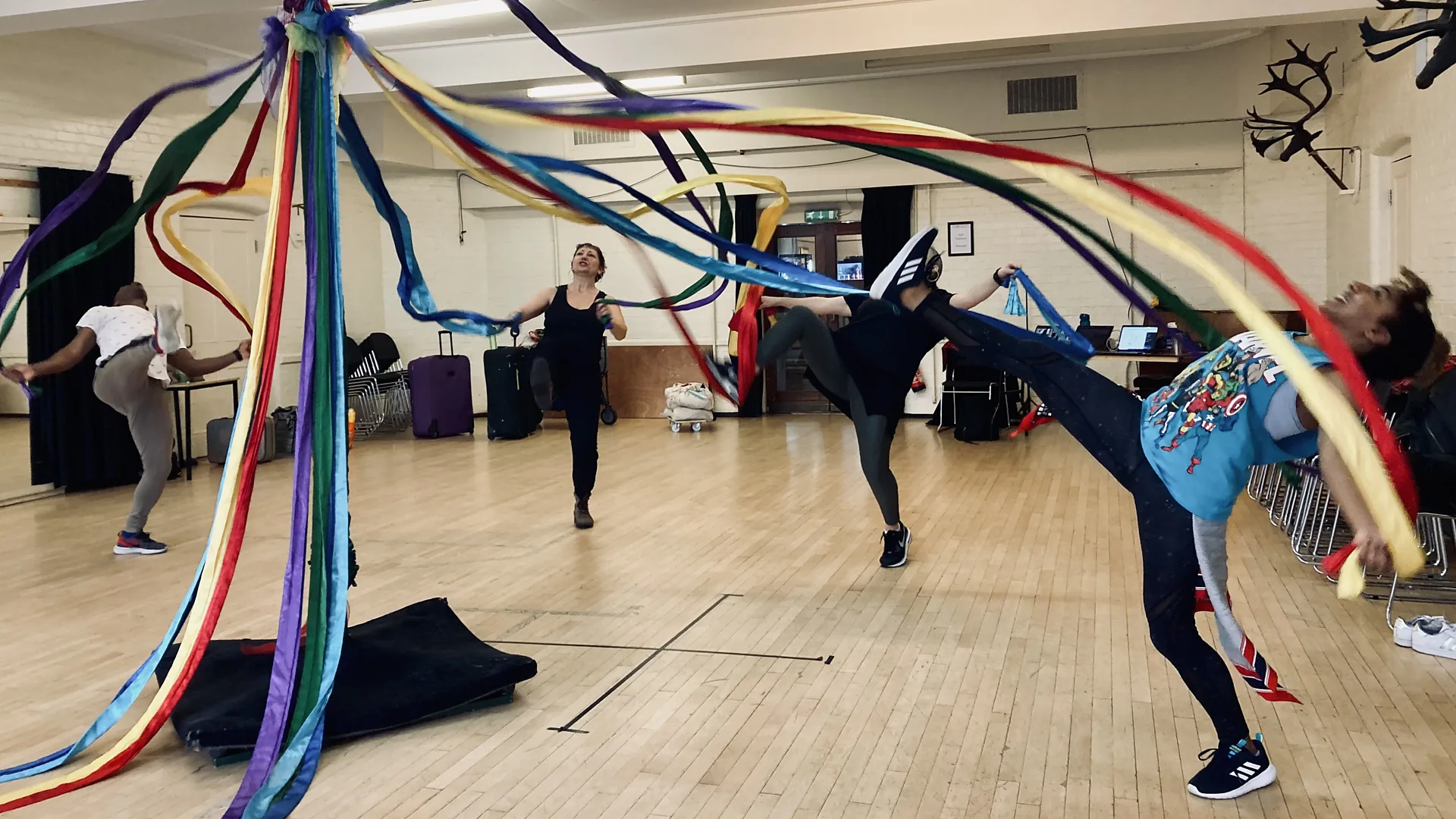
” ‘Hip-hop is the folk dance of today,’ said Natasha Khamjani, breathing heavily. They’re both social dances created for crowd participation, both also existing on the fringes of the mainstream, she added. Khamjani was taking a quick break during a rehearsal of a high-energy performance blending Bollywood moves and English country dancing with the unmistakable bounce of hip-hop moves.

“In an unexpected twist, Khamjani and her troupe were also dancing under a rainbow of swirling maypole ribbons – a sight more commonly associated with English village fetes rather than a basement in inner-city London. …

“For Khamjani, artistic director of Folk Dance Remixed, a collective putting a global spin on old-time English dances, a natural synergy exists. These are the dances of the people, bubbling up from the streets, pubs, village greens, dance halls and international communities that birthed them, Khamjani explained. An easy fit between age-old English country dances and house music exists, she pointed out. ‘It sounds weird but the steps are basically the same,’ she laughed. …

“Remixing maypole dancing is just one of the myriad ways that English folk culture is currently having a reboot, thanks to a new wave of switched-on folkies diversifying the scene. At the heart of this progressive movement is the Cecil Sharp House, a music venue and folk arts centre that’s home to the English Folk Dance and Song Society (EFDSS) and where Folk Dance Remixed perform regularly.

“Named after Cecil Sharp, a folk music enthusiast who roamed the countryside of England and the US South collecting folk music and dances in the early 20th Century, this temple to vernacular culture threw open its Arts and Crafts-style doors in 1930. …

“Over the last few years, the EFDSS has ramped up its outreach efforts to engage new audiences, mixing diverse cultural traditions to create new interpretations of ‘Englishness.’ Projects have included teaming up with musician Kuljit Bhamra, pioneer of the British Bhangra sound, an upbeat musical style that mixes traditional Punjabi beats with Western pop, to uncover similarities between 18th-Century traditional Kentish jigs and Bhangra music. There have been sea shanty lessons with rap verses taught to schoolchildren; and feminist-themed pop-up events, including a recording of the podcast Thank Folk for Feminism at the house.

“Certain projects have undeniably chimed easier than others. Take for example Queer Folk’s Queer Ceilidh parties hosted at Cecil Sharp House, where evenings of LGBTQ ceilidh dancing and drag acts have proved a sell-out success. …

“Joining me in the main hall at the Cecil Sharp House beneath a whimsical mural of folkloric creatures and abstract dancing figures, Katy Spicer, the chief executive and artistic director at EFDSS, pointed out that it is, however, a work in progress making the English folk scene truly inclusive. ‘In terms of diversity, ethnicity has been the hardest challenge’ she said. …

” ‘There was perhaps a tunnel vision back then and histories not recorded, which no one questioned until recently. We’re working to set the record straight,’ Spicer said, as a group of teenagers, part of the National Youth Folk Ensemble, shuffled onstage to tune violins ready for the evening’s show. ‘Particularly when you have English in your title, you have to address what it means to be English and whose England is it?’ …

“Exploring some of these overlooked histories and racial crosscurrents is Cohen Braithwaite-Kilcoyne, a singer, musician and rising star of the folk scene, who in 2021 collaborated with the EFDSS on the Black Singers and Folk Ballads project. The work explored links between English folk and music-making among enslaved people in former British colonies in the US Southern states and the Caribbean.

” ‘I’d always been aware that there are songs and ballads that crop up across English folk music traditions and the music of Black America and the Caribbean, but perhaps hadn’t quite realised the extent of the shared repertoire,’ he told me. ‘These songs started life in Britain and migrated with the people to the Americas. It seemed that there was a certain amount of cultural exchange between the white colonizers and Black enslaved people,’ he said of his research, which unearthed examples of similar storytelling and melodies across the three traditions. ‘But the very nature of folk song means that as it’s passed along orally, you get an evolution.’

“Often still viewed as a relic from a dusty, bygone era, folk has also long struggled to attract a younger, hipper crowd. But things look set to change.”

More at the BBC, here. No firewall.

Read Full Post »

Photo: Lorne Thomson/Redferns.
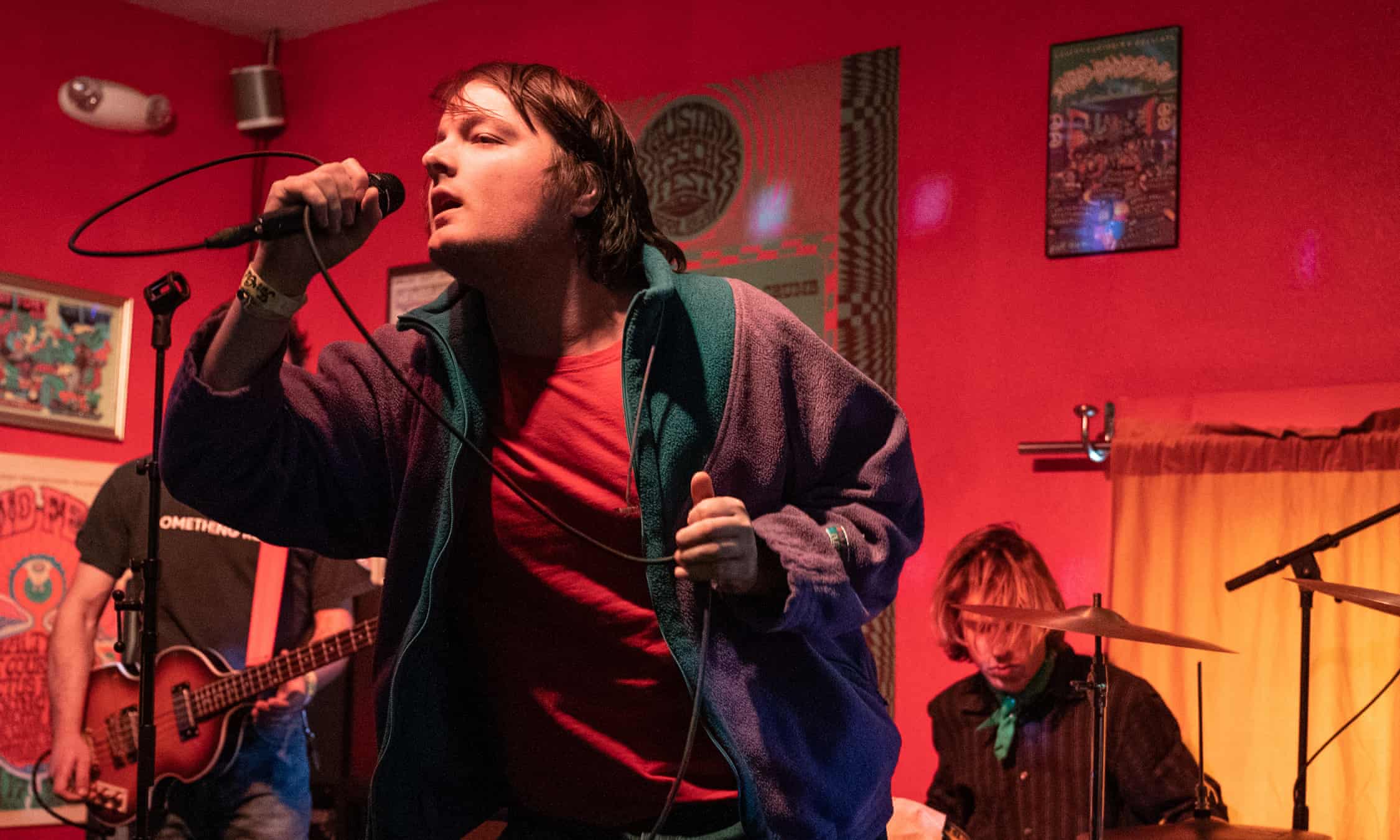
A group called Personal Trainer performs in an Austin, Texas, record shop (above). Like NPR’s Tiny Desk Concerts, record shops provide a welcome venue for performers.

In the record industry, apparently, as long as performances feel a little different and surprising, it’s good for business. But how long do things stay surprising? Today’s article traces the rise of band performances in record shops and leads me to wonder, After record shops, what’s next?

Michael Hann writes at the Guardian, “At one end of Banquet Records in Kingston upon Thames the Dutch indie band Personal Trainer are performing a short set next to the album racks. … Afterwards, the band will sign the albums the fans have bought and everyone will depart a little happier: the fans with memories of an intimate show and signed records; the band a few quid richer, a few more sales made, maybe a few more fans won. And Banquet will have sold a few hundred quid’s worth of stock.

“It’s early August and the start of an intensive week for Personal Trainer – as well as Banquet, they will play record shops in London, Brighton, Portsmouth, Totnes, Bristol, Liverpool, Leeds and Nottingham. There will be festival shows, too, but only one conventional gig, an undersell in a tiny pub. This campaign is not launching with touring, at least not in the old-fashioned sense. …

“Artists have always gone to record shops to sign albums. And there have long been one-off promo shows in shops. But the idea of the in-store performance as a key part of an album launch dates back a decade or so, partly because physical sales of music were so low that the extra sales from a handful of appearances could dramatically affect chart position for bands with a loyal fanbase (physical sales still carry a greater chart weighting than streams or digital downloads).

“But also it’s because it’s one of the few routes left to promote a new album, says Tara Richardson, who managed the Last Dinner Party when they reached No 1 in the album charts earlier this year with their debut. ‘There’s no TV any more for bands,’ she says. ‘There’s only a Radio X session and a Live Lounge recording. So in the week of release you either put in shows, or you put in in-stores, and they’re the perfect thing to keep everyone busy in the week of release.’

“Labels favor in-stores, she says, not just for the chart position, but because it keeps the decks clear for a proper tour later in the campaign. Meanwhile in-stores tend to favor indie-ish bands, not least because independent record shops are now far more of a driving force in retail than the megastores. The Rough Trade chain, for example, hosts scores of shows. …

“With the right act and enough advance notice, in-stores can make a huge difference to sales and set the tone of an album campaign. ‘In the UK, the in-store has become part of the process of building a week-one launchpad for the campaign and building a chart position, because physical sales still leapfrog the streaming economy,’ says James Sandom, who works as a manager with bands including the Vaccines and Interpol. Sandom says the charts actually measure nothing of meaning any longer, but they still have use, because a high chart position will allow booking agents to demand higher fees, and get bands better spots on festival bills. …

“Simon Raymonde of Bella Union – Personal Trainer’s label – says it’s about building community. ‘I really like it when the shops are fully involved and they will be far more supportive of the record.’ …

“But for Rupert Morrison of Drift Records in Totnes, which staged one of Personal Trainer’s shows, in-stores becoming an institutionalized part of an album campaign risks losing what was once special about them. ‘Originally it was an American thing,’ he says. ‘Culturally outlying stores like Other Music in New York were melting people’s minds: the people there would talk about Laurie Anderson playing and Lou Reed cheering her on and helping with her pedals. They were these incredible, intimate, mind-blowing experiences, where you got completely different access to people. …

“ ‘I worry that like everything, once people see that something is a thing, it gets hammered and hammered.’ …

“Nevertheless, the results, for certain artists, can’t be argued with. Shed Seven had their first No 1 album earlier this year thanks to sales made at their in-store appearances in January. ‘You’re in a van, you’ve got one crew member to help, and you’re in Brighton at midday, then Southampton at teatime, Bristol the next lunchtime. And then you’re in Glasgow,’ says singer Rick Witter. ‘It’s intense.’

“But that No 1 changed perceptions of the band, Witter says. No longer were they a Britpop punchline, but a band with a No 1 album.”

More at the Guardian, here.

Read Full Post »

Photo: Roy Riley.
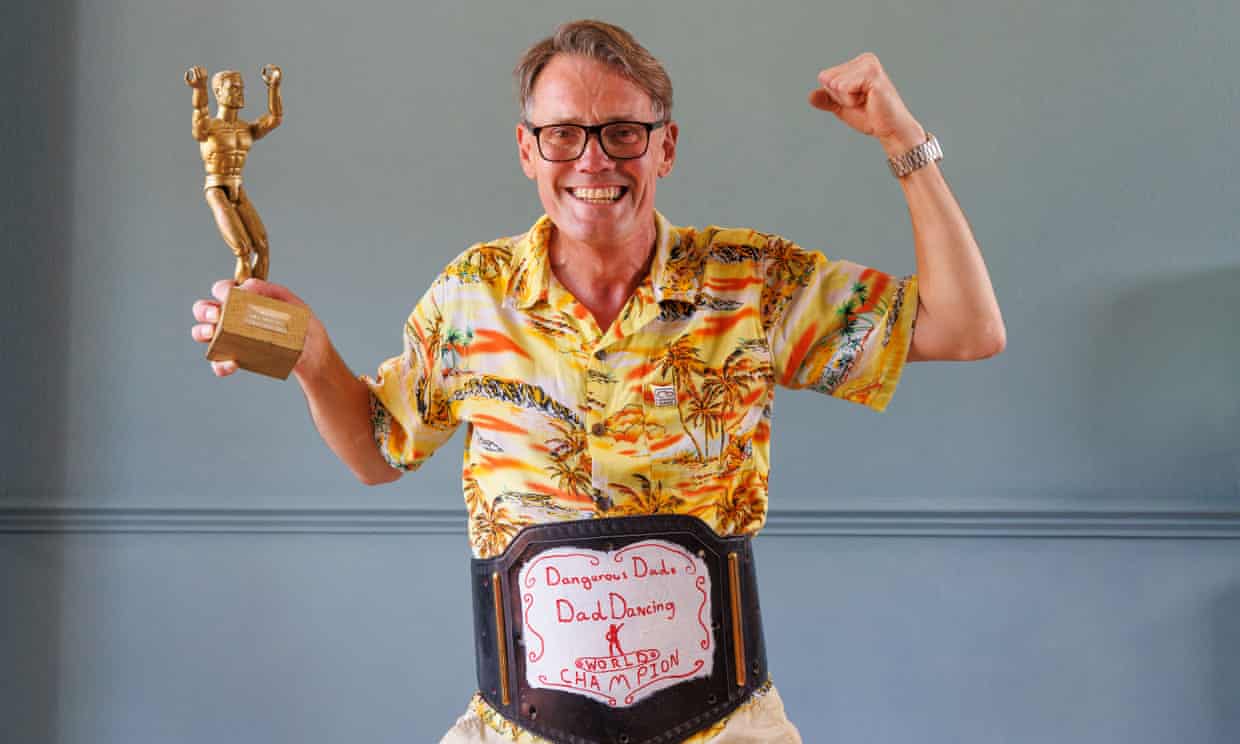
Robin Woods, from Devon, UK, was crowned World Dad Dancing champion at Dadfest last year. The Dadfest is judged by children.

When in the mood, both my son and son-in-law have at different times been known to perform some pretty inspired Dad Dancing, a zaniness that tends to affect all other potential dancers in the vicinity. We have videos.

As it happens, Dad Dancing is good for health.

Linda Geddes reports at the Guardian, “In his early 20s, Prince William was often seen stumbling out of night clubs after a night of grooving. Now, however, as though a clock has struck 12, this youthful cavorting appears to have transformed into something altogether more cringeworthy: dad dancing.

‘In a viral video captured at a Taylor Swift concert, the heir to the throne was filmed with his arms aloft, chest shimmying swiftly – and somewhat stiffly – to the beat. … Experts argue that dad dancing should be celebrated, not slated, for the numerous benefits it can bring.

“ ‘When I look at Prince William dancing, I just see someone who’s smiling, he’s happy, and dance does those amazing things,’ said Dr Peter Lovatt (AKA Dr Dance), the head of dance psychology at Movement in Practice and author of The Dance Cure. …

“Dr Nick Neave at Northumbria University, found that young women judged men to be good dancers if they had a varied repertoire and more moves that involved tilting and twisting the torso and neck – although most men display highly repetitive moves involving their arms and legs, but not the rest of their bodies. …

“As well as boosting familiarity and trust, other studies have suggested that improvised dancing – or ‘groovy moving’ – also changes the way we think and solve problems.

“Lovatt said: ‘We know that anxiety and depression are associated with being stuck in negative patterns of thinking, and when people engage in dance, those negative thoughts get disrupted for a while. There’s a lifting in their mood and they break away from those set patterns of thinking.’

“To Dr Ian Blackwell, a visiting lecturer at Plymouth Marjon University and the organizer of the World Dad Dancing Championships, the scrutiny of William’s dancing is a reflection of how society still expects men to conform, and not express themselves. ‘It’s a shame that anytime that a dad gets up to move, it has negative connotations – it’s embarrassing for him and the children, it’s embarrassing for the public. We know the value of dancing for health, wellbeing and making friends. It’s something that we should celebrate.’

“Despite further research by Lovatt suggesting some men avoid dancing because they fear being judged, men’s confidence in their dancing abilities usually grows as they get older – and once they hit their mid-60s, it ‘goes through the roof.’

“The reigning World Dad Dancing champion, Robin Woods, a father of three from Paignton in Devon, said he has not been shy about sharing his triumph on Facebook. ‘I think the people that know me from when I used to go out a lot – and always ended up on the dance floor – were pleased that I’ve finally been recognized,’ he chuckled. ‘It’s a nice thing – it’s not a serious thing – and so it’s fine that I’m making fun of myself.’

“Woods, who describes his usual dancing style as ‘freestyle’ with influences from James Brown and Michael Jackson, was not even sure what dad dancing involved when he entered the competition, which is judged by children and takes place at DadFest in Devon each September. ‘I just assumed it would be a bit more enthusiastic and amateurish than normal dancing – so, I just went for it and exaggerated everything I did.’

“He claimed the title after a hard-fought dance-off with two other finalists performed to ‘Mr Brightside’ by The Killers and ‘Baby Shark’ by Pinkfong.

“Blackwell said that while the clip of William’s dancing was too short to judge whether he could be in with a chance of winning, ‘he would be very welcome to come to DadFest in September so we can see the full extent of his moves and whether he’s got a decent Lawnmower Starter, Big Fish, Little Fish, John Travolta, or Lasso.’ ”

More at the Guardian, here, including a photo of Taylor Swift with Prince William. No firewall.

Read Full Post »

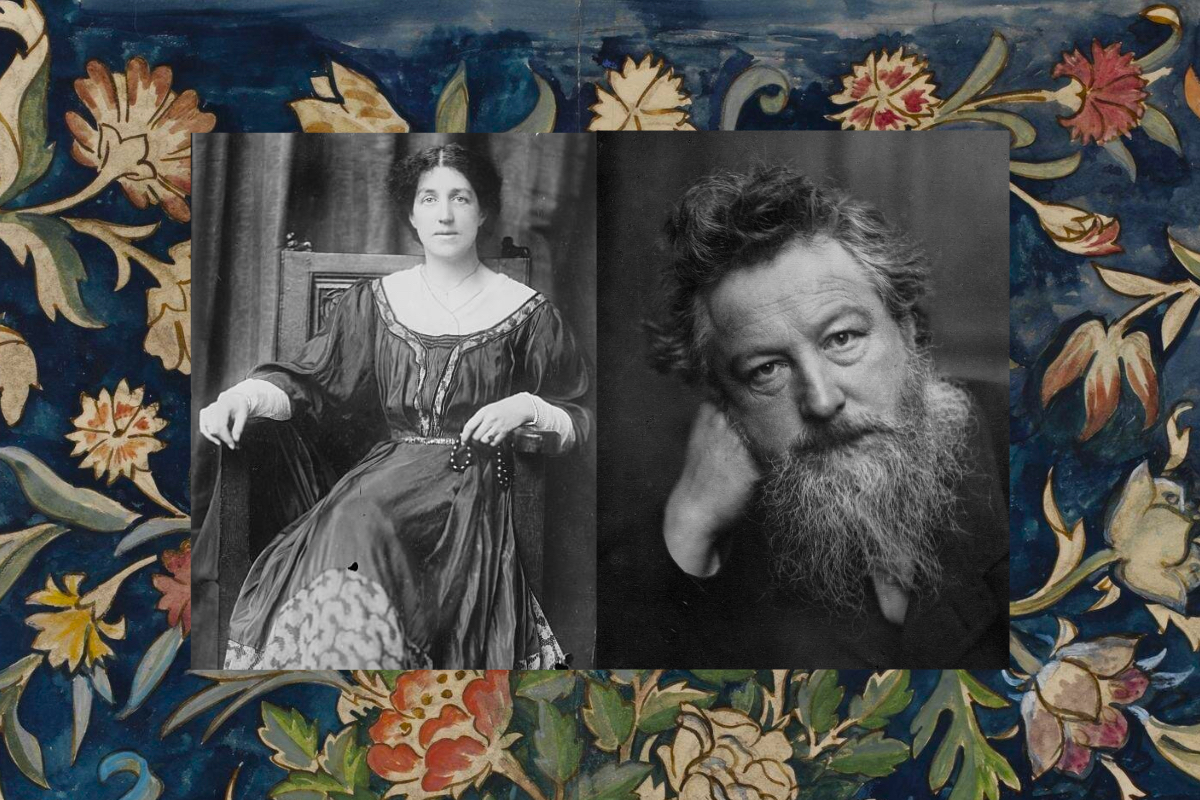
Photo collage: Isabella Segalovich/Hyperallergic, using images from Wikimedia Commons.
Detail of embroidery design by May Morris overlaid with portraits of May and her father William Morris.

Is this the year that the contributions of women get recognized in a big way? There seems to be something in the air.

In any case, today’s story draws attention to art that most of us have known about for years as the work of William Morris. Who knew that much of it was by his daughter May?

Isabella Segalovich wrote recently at Hyperallergic, “On a bright, sunny day in Victorian England, a little curly-haired May Morris gleefully handed a ball of wriggling worms to her father, William. The legendary textile and wallpaper designer smiled: He was both glad to have fresh bait for his favorite pastime of fishing and proud to see his daughter happily playing in the dirt, a freedom afforded to few girls of their social class. 

“There’s plenty to admire about artist William Morris, from his timeless ornamental wallpaper designs to his late-in-life turn to socialist politics, where he imperfectly but tirelessly fought for workers rights and against British imperialism. Less well known is that by all accounts, William was a pretty great dad, who encouraged his two daughters, Jenny and May, to grow into incredibly talented designers themselves. …

“The sisters soaked up their father’s aesthetic brilliance as they carefully observed him experiment with drawing, calligraphy, and textile dying; William even provided them with their own dying kits for messy, colorful play. May enrolled in what is today the Royal College of Art in 1878, where she studied embroidery. This was in no way preparing her for a life of a housewife with an under-appreciated textile skill. Rather, her father had been slowly training her to take over the reins at his historic company’s embroidery department at only 23 years old — a business decision typically reserved for the sons of the era, not its daughters.

“There, she began designing patterns for Morris & Co. that became mainstays of the company, some of which, unfortunately, were later misattributed to her father. She supervised a team of embroiderers as they produced all manner of textiles, from bedspreads to book covers to altar cloths. Soon, she was a leading artist of the progressive Arts and Crafts Movement.

“Before long, the two were close comrades in the small but mighty English socialist movement: May stood close on blustery London sidewalks as William became a kind of socialist street preacher. Together, they broke from the Social Democratic Federation in 1885 and took part in founding the Socialist League, where May took charge of the group’s library and became close friends with Karl Marx’s daughter, Eleanor, another one of the league’s founders. …

“Scholars have noted that William Morris was certainly a flawed crusader for women’s rights, once proclaiming that ‘it would be poor economy setting women to do men’s work’ in the same breath that he called for ‘absolute equality of condition between men and women.’ A powerful feminist, May greatly improved upon his political legacy by co-founding the Women’s Guild of Arts for the crafters who were not allowed into the Arts and Crafts Movement’s foundational Art Worker’s Guild. 

“It’s quite likely that no one knew William Morris better than May did. After his death, while caring for her older sister who struggled with epilepsy, she edited a whopping 24 volumes of her father’s writing, each with introductions so studied and lengthy that they were later published as their own two volume set. Biographer Fiona MacCarthy wrote that their relationship was ‘partly suffocating, in the intensity of its demands, but in another sense a kind of freedom … It released her latent talents and brought her into contact with ideas and activities far beyond the reach of most young women of her period and class.’ 

“Even so, May was undervalued in her time, and she knew it. ‘I’m a remarkable woman – always was,’ she wrote to playwright George Bernard Shaw in 1924. ‘Though none of you seemed to think so.’ “

Gorgeous pictures at Hyperallergic, here. No firewall. Subscriptions encouraged.

Read Full Post »

Photo: Fareth Fuller, PA.
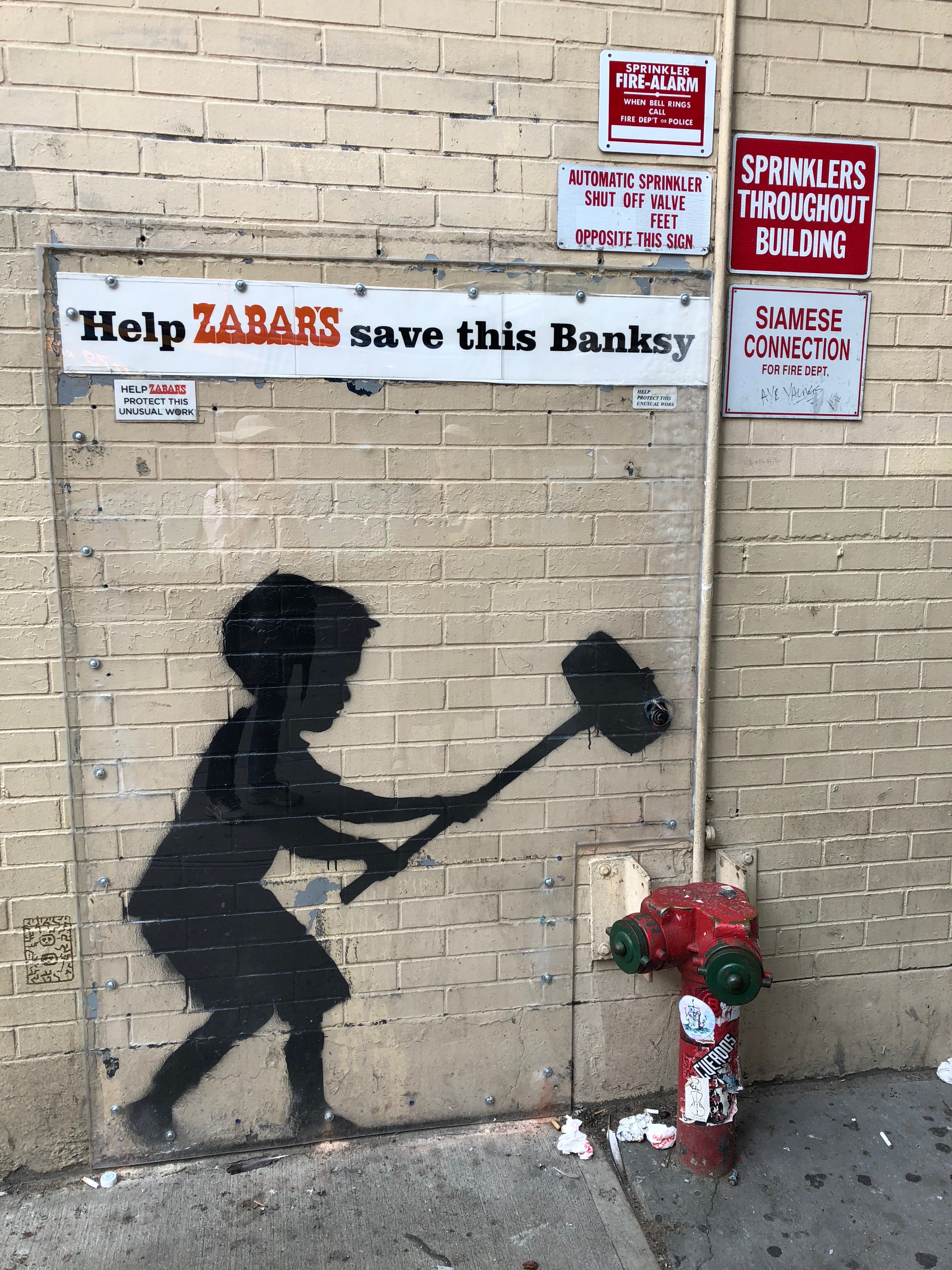
Valentine’s Day Mascara is one of Banksy’s murals in Margate, Kent.

I like Banksy’s stealth art a lot and have seen works — or imagined I’ve seen works — in both Boston and New York. But Loraine Holmes is a super fan, and she really knows what’s what.

Hayley Coyle writes at BBC News, “Rumblings a few weeks ago about a new piece of work by world famous street artist Banksy appearing in London meant it was not long before social media was awash with rumors.

“About 200 miles away in Leeds, one of those caught up in the buzz was Loraine Holmes, a self-confessed Bansky super fan and co-founder of a Facebook group charting the elusive graffiti artist’s work.

“Within an hour of Banksy’s new tree-themed mural in Finsbury Park being ‘claimed,’ Mrs Holmes was already at the spot — one of the first in the world to view the fresh and, as she put it, ‘raw’ mural.

“After being tipped off the night before, Mrs Holmes, 61, had taken an early train from Leeds. …

” ‘I spent a total of about five hours there, just taking it all in and observing people,’ she added.

“Banksy’s latest offering, which he later confirmed on his Instagram account was one of his, was a green spray-painted wall depicting foliage, with a stencil of a person holding a sprayer standing next to it.

“Mrs Holmes was one of the lucky ones who got to see it before it was covered in plastic and surrounded by wooden boards after it was defaced with white paint.

“The self-confessed super fan is such a hardcore Banksy aficionado that she said she also once drove 14 hours from Leeds to Margate and back so she could spend just 10 minutes taking some photos of his mural in the Kent seaside town. …

“Mrs Holmes co-founded a Facebook super fan group called Banksy Locations in 2020 with fellow street art enthusiast Jay Tompkins. The group now has 20,000 members worldwide and covers ‘every single aspect of Banksy’ from the 1990s to today, Mrs Holmes said.

“The group also shares information on what condition Banksy’s works are in and where they can be found. In fact, Mrs Holmes said it was members of the Banksy Locations group who ‘unofficially confirmed’ the new London mural before the artist himself.

“Mrs Holmes, a senior business analyst, said she first discovered Banksy’s works in 2018 after seeing some of them online. Her admiration for the anonymous artist ‘spiraled’ and she said that now he would be her ‘Mastermind specialist subject.’

“She said: ‘It started out with me not knowing much about graffiti, but after I saw some pictures I liked on eBay, I started doing some research, read a few books and joined a few groups.’ …

“Mrs Holmes said other Banksy-related adventures included traveling to Paris while suffering with a broken ankle to see Man with Dog. She had undergone surgery a few weeks before to have screws put in her leg, but that did not put her off the journey.

” ‘I still managed to see six Banksy pieces that weekend,’ she recalled. … Mrs Holmes now has plans to visit San Francisco and Los Angeles in the near future to see more of the artist’s work.”

More at the BBC, here.

Photos below: John and Suzanne’s Mom.

Read Full Post »

Photo: Antonio Olmos/The Guardian.
Debbie Chazen, Gemma Barnett and Josh Glanc, the stars of JW3’s holiday pantomime in London.

There’s a kind of Christmas entertainment in England (English friends: correct me if I am describing this wrong) called a pantomime, or panto. I have read about it but never seen it. It’s kind of like the old, slapstick Punch and Judy show, but without puppets.

This year, a comedy troupe in London is doing a takeoff of Christmas panto in a Jewish storytelling style.

Deborah Linton writes at the Guardian, “What else would you call ‘Britain’s first professional Jewish pantomime’ but Red Riding Hood and the Big Bad Pig? And where else would you set it but north London, at Hanukah? At the JW3 centre in London – an arts and community venue. …

“The cast of the first professional stage production to merge two great traditions in Jewish storytelling and festive panto are gathered around a table sharing their experiences of both. And the crossover, it transpires, is richer and more obvious than one might first imagine.

“Comedy, community, a fairytale quest and a flawed hero are ‘at the heart of every panto,’ says the show’s writer, Nick Cassenbaum. ‘But I think it comes from … the Talmudtoo.’ …

“So, too, the panto dame, he says – in this instance Mother Hoodman, Red’s eccentric mum who appears on stage heavily made up, wigged and wearing a voluminous dress modeled on a Hanukah dreidel singing You Spin Me Round – has a natural home in both traditions. ‘A panto dame is warm, loving and says the wrong thing. It’s a Jewish mother,’ says Cassenbaum. …

“Audiences will be immersed in a production that combines Jewish humour and music (imagine new lyrics to Jewish artists including Amy Winehouse, Doja Cat, Paul Simon and Craig David) with traditional panto magic – lots of slapstick comedy, a scene where the leads get lost in the woods, and cartoonish baddies – as it transposes the millennia-old Hanukah miracle into a fairytale fit for 2023.

“Cassenbaum’s premise is that Red, a hard-working young scientist pushing against the plans her mum – the dame – has for her to marry a Jewish doctor, sets out on a quest to find enough sustainable energy to power her village through Hanukah. … The wolf, the main antagonist in the storybook version, is replaced here by a hyper-capitalist pig, the best known non-kosher animal of the lot. Although, Cassenbaum explains, ‘in my mind, all the characters are Jewish, even the pig, who as a city boy who made a lot of money under Thatcher, maybe isn’t so open about his Jewishness.’

“Cassenbaum, a former street performer … was interested ‘in how we could hold both things – something that was really British, all the panto techniques, but something that also felt unashamedly Jewish. With panto, you have to pick from the canon of fairytales. Red Riding Hood is such a short story, you’re not so set with the script. I wanted to make something that can hold Jewish traditions, dense Jewish jokes and reflect certain Jewish archetypes, so you’ll see the ex-black-cab driver and a wolf who is a neurotic mess.’ …

“It mirrors the generational Jewish experience – and the immigrant humor that accompanies it. ‘Humor is our biggest cultural export. It’s truth humor,’ says Josh Glanc, an award-winning Australian comedian who plays the pig. …

” ‘In British popular theatre, Jews were there from the [beginning] – Bud Flanagan (who sang the theme tune to Dad’s Army), writers Barry Cryer and Marty Feldman – but they weren’t “out.” Then, with more modern comedians, like Matt Lucas and Sacha Baron Cohen, the Jewishness is secondary to the joke. Through it all, there’s something about using community and humor as a way of fitting in and being part of things, a means of assimilation.’

“Gemma Barnett, who plays Red, agrees. ‘It’s intense self-awareness,’ she says. … ‘Red’s constantly trying to work out if she believes what her mum believes. I love the character.’ …

“East London-born musical director Josh Middleton, a world-leading klezmer (eastern and central European Jewish folk) musician, has given Streisand and other Jewish artists a klezmer flavor, via accordion and violin live on stage, as well as a lyrical rewrite and song sheet, in pure panto style. …

“ ‘Let’s take the premise of rewriting pop songs, because that’s what people expect at panto, but let’s do people of Jewish descent. … I want them to recognize the songs and enjoy that familiarity, and I want them to feel they’re at a Jewish panto,’ says Middleton.”

More at the Guardian, here. No paywall, but they do rely on donations.

Read Full Post »

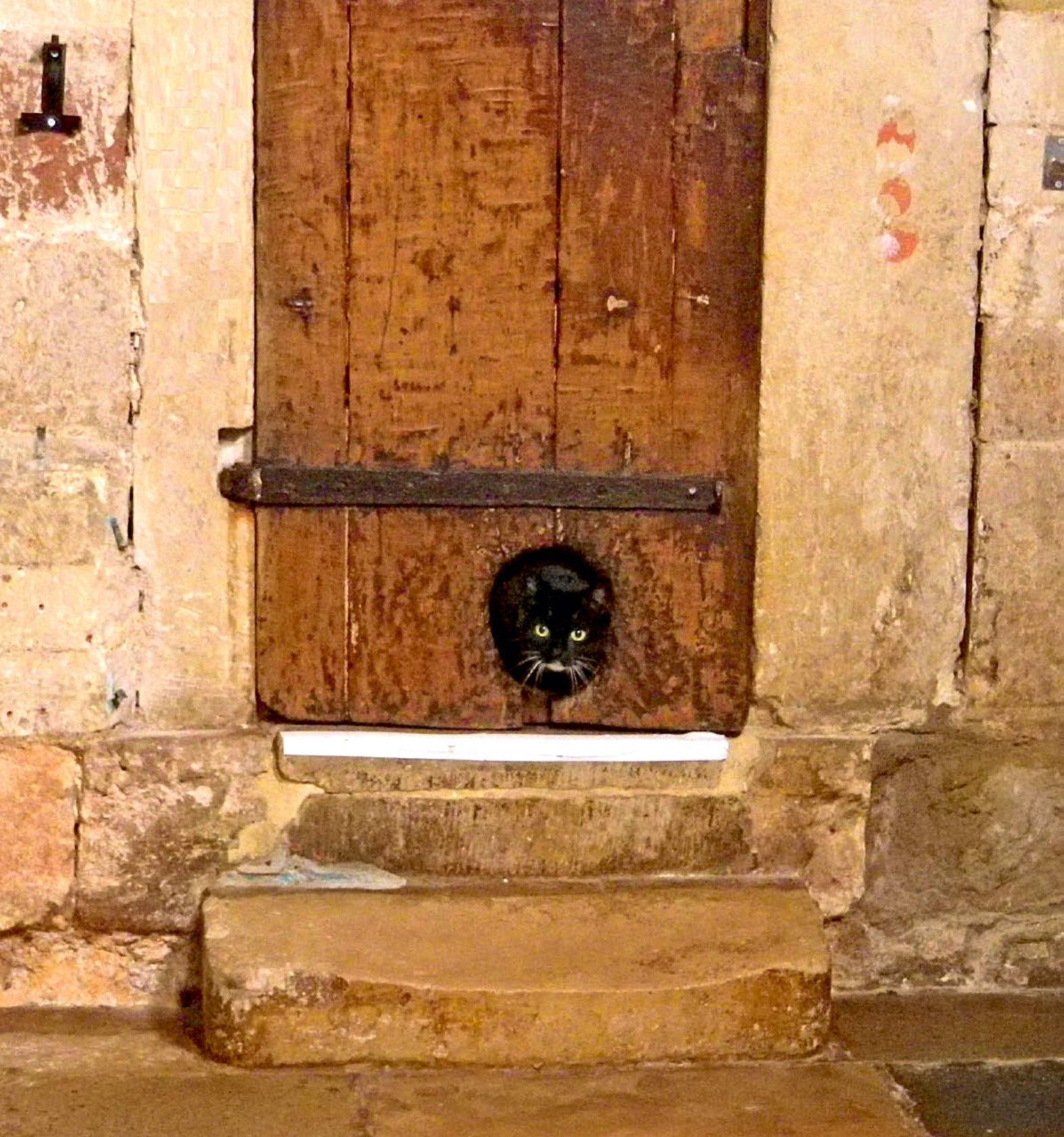
Photo: Diane Walker via Exeter Cathedral and Hyperallergic.
The 400-year-old door hole in the Exeter Cathedral in Devon County, UK.

Are you ready for a silly post? It’s silly, but it has a serious side. Especially for cat owners. Rhea Nayaar introduces the topic at Hyperallergic.

“There are a few rumors floating around about the invention of the handy cat door through which our beloved friends pass in and out as they please, but how far back does it go, really? Apparently for centuries, as the Exeter Cathedral in Devon county, England, is gaining attention for a 16th-century circular door hole for the resident pest control cat.

A circular hole was cut into the bottom right side of the painted panel for pest control cats to keep mice from the sacristy, and thus, the painting was dubbed ‘Madonna della Gattaiola‘ (c. 1458), or ‘The Virgin of the Cat Flap.’

“Historian and author Diane Walker told Hyperallergic that cathedral records indicated that the door in question was installed in 1376, when the space behind it was renovated and outfitted for a large astronomical clock. The clock’s mechanics were lubricated with animal fat which attracted mice down the line, and by 1598, per the records, then-Bishop of Exeter William Cotton had paid carpenters to make a hole in the door so his mouser cat could take care of the problem.

“ ‘The idea that the hole was cut to enable the bishop’s cat to catch mice in the space where the clock mechanism was located does lead to a re-think of the “Hickory, Dickory, Dock, the mouse ran up the clock” nursery rhyme,’ Walker told Hyperallergic

“ ‘The story is normally illustrated with a picture of a mouse running up the outside of a long-case clock,’ Walker continued. ‘But it makes much more sense that the idea of a mouse running up a clock would be associated with an ancient clock mechanism, such as that at Exeter Cathedral, where the original mechanisms included weightlines making an easy climb for a mouse attracted to the lubricating tallow.’

“The best part of it all is that the cathedral actually had cats on the payroll throughout the 14th and 15th centuries — 13 pence a quarter, according to written records. It’s unclear how the cats received their wages. …

“Cuteness aside, even Walker admits that while this is a very old cat door, it’s unlikely to have been the first. The 14th-century church of San Giorgio in Montemerano, Italy, has its own cat hole cut into a painted door that’s now preserved and on display. A 15th-century painting on panel of the Virgin Mary by an anonymous local painter who went by the nickname ‘Master of Montemerano’ was reportedly adapted into a door at the church. A circular hole was cut into the bottom right side of the painted panel for pest control cats to keep mice from the sacristy, and thus, the painting was dubbed ‘Madonna della Gattaiola‘ (c. 1458), or ‘The Virgin of the Cat Flap.’

“But humans have relied on cats for pest control long before the 15th century. Ancient Egyptians were known for pedestalizing cats and honoring deities with cat-like features. One would think that cat doors would have been folded into Ancient Egyptian architecture and design considering the cultural reverence for felines, but two Egyptologists confirmed with Hyperallergic that they haven’t come across any such invention in their research.

“Cairo-based professor, archaeologist, and archaeozoology expert Salima Ikram said that while cats were ‘definitely used for pest control,’ the geography and climate of Northeast Africa meant that homes and buildings were more open-air so doors weren’t used often. And University of California, Los Angeles professor and architectural Egyptologist Willeke Wendrich told Hyperallergic that field researchers ‘hardly have any actual doors that have survived from antiquity.’ “

More at Hyperallergic, here.

Are you a cat person and do you have a cat door? I like cats myself and am all for indoor pest control. But I worry a lot about cats killing birds outdoors.

Did you know this? “Predation by domestic cats is the number-one direct, human-caused threat to birds in the United States and Canada. In the United States alone, outdoor cats kill approximately 2.4 billion birds every year. Although this number may seem unbelievable, it represents the combined impact of tens of millions of outdoor cats. Each outdoor cat plays a part.”

So says American Bird Conservancy, here. So if you have a cat door like the one at the Exeter Cathedral, think twice about using it.

Read Full Post »

Photo: Joel Goodman/The Guardian.
Kevin Duffy has built a publishing business in his home that focuses on ten books a year, many of them prize contenders.

Do you know the Aesop fable in which animal mothers brag about the number of their children? According to MIT Classics, “A controversy prevailed among the beasts of the field as to which of the animals deserved the most credit for producing the greatest number of whelps at a birth. They rushed clamorously into the presence of the Lioness and demanded of her the settlement of the dispute. ‘And you,’ they said, ‘how many sons have you at a birth?’ ”

And the Lioness said, “I have only one. But that one is a lion.”

That is my introduction to a story about a publisher who publishes only ten books a year.

Helen Pidd, North of England editor of the Guardian, writes, “The two-up, two-down terraced house on a cobbled Hebden Bridge street does not look like the headquarters of a multi award-winning publishing house.

“There is no gleaming edifice, no sign and certainly no reception desk. The green front door leads straight into Kevin Duffy’s living room, the nerve centre of Bluemoose books, his independent literary hit factory.

“It is at a cluttered table in the corner that Duffy has built a business with a success rate that billion-pound publishers regard with envy. Each year, Bluemoose puts out no more than 10 titles, but a remarkable number end up in contention for major literary prizes.

“Each author is handpicked by Duffy, 62, a self-confessed ‘control freak’ from Stockport, Greater Manchester, who spent years as a salesperson for big publishers before remortgaging his house to start Bluemoose in 2006. …

“It was Duffy who published Benjamin Myers’ The Gallows Pole, which has been made into a BBC series that was given five stars by the Guardian. …

“In March, Bluemoose won best northern publisher at the Small Press of the Year awards. In April, a Bluemoose title – I Am Not Your Eve, the debut novel by Devika Ponnambalam, which tells the story of Paul Gauguin’s child bride and muse, Teha’amana – was shortlisted for the £25,000 Walter Scott prize for historical fiction. …

“Bluemoose’s current bestselling author is Rónán Hession, a former musician who balances his writing career with being the assistant general secretary of the department of social protection in the Irish government.

“Hession’s 2019 debut Leonard and Hungry Paul, a funny and tender story about kindness, has sold more than 125,000 copies worldwide. A bestseller in Germany, it has also attracted fans in Hollywood – Duffy recalls receiving an email from someone claiming to be Julia Roberts’s agent. …

“ ‘Then her PR person got in touch saying she wanted to get in touch with Rónán because she loved the book. … How wonderful is that? She just wanted to say thank you,’ he said. …

“Another Bluemoose success story with a day job is Stuart Hennigan, a librarian from Leeds. Ghost Signs, an eyewitness account of the impact of the early days of the pandemic on those living in poverty, made the shortlist of the Parliamentary Book awards.

“Duffy shares an anarchic streak with Hennigan, finding it hilarious when he turned up to the Tory-packed ceremony in a T-shirt that said: ‘Still hate Thatcher.’ …

“Duffy remains Bluemoose’s only employee, drawing a ‘tiny’ salary, working with five freelance editors, including his lawyer wife, Hetha.

“He is happy that way. ‘I don’t want to be the next Penguin. I don’t want to be a huge business. I just want to publish eight to 10 books a year, make a bit of a profit and invest it all back into the business to find new writers,’ Duffy said.

“Running Bluemoose is a seven-day-a-week vocation. On an average day, Duffy receives 10-20 unsolicited pitches, usually the first three chapters of a new book, all of which, he insists, he reads. Perhaps four in a month will grab his attention enough for him to ask for the full manuscript.

“Duffy insists that there remains a ‘class ceiling‘ in the publishing of literary fiction. LGBTQ+ writers are being given deals, as well as people of color, he says, but working-class writers are not being heard. …

“ ‘The people making those publishing decisions, because of their educational background and their life background, are not reading books about people in the rest of the country. You know, 93% of the people in this country don’t go to private school. There’s a reading public out there that wants books about themselves and the areas they live in.’

“Myers, he notes, originally signed with Picador, which would not publish Pig Iron, his third novel about a Traveling community in the north-east. ‘Because, they said, “who would be interested in a working-class character from a small northern town?” That small northern town was Durham, theological capital of Europe for 2,500 years.

“ ‘Pig Iron went on to win the inaugural Gordon Burn prize. Ben’s next book, Beastings, won the £10,000 Portico prize. Then The Gallows Pole won the world’s leading prize for historical fiction. Then all the agents were interested,’ he said.”

As a reader who turns to Dickens whenever in doubt, I am surprised to find that I actually have read (and liked) one of these: Leonard and Hungry Paul. That’s because Wendy Greenberg, a prolific UK reader on Goodreads, wrote about it.

More at the Guardian, here.

Read Full Post »

Photo: Richard Saker/Guardian.
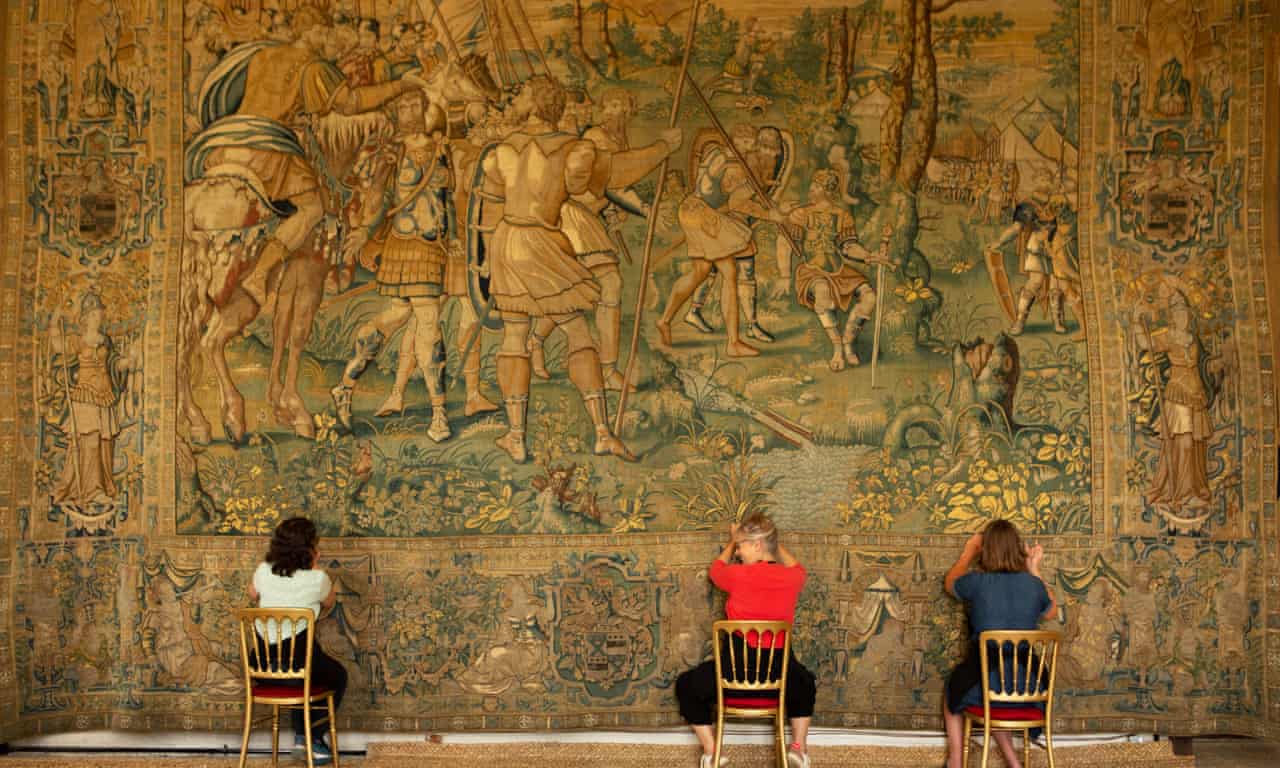
Staff at Hardwick Hall making final adjustments to restored tapestries that Bess of Hardwick bought for £326 15s 9d [~$406] in 1592.

This story is reminding me of childhood visits to the Cloisters before my father had his stroke and how he liked to point out the years of work that went into medieval tapestries.

Jessica Murray, Midlands correspondent of the Guardian, reports on 24 years of work just to do repairs.

“After a 24-year project, the National Trust has finally finished the restoration of a set of 16th-century tapestries at Hardwick Hall in Derbyshire, the longest such endeavor in its history.

“[In July] the final tapestry in the set of 13 Gideon tapestries was unveiled on the wall of the long gallery, the culmination of a painstaking effort to clean and handstitch the huge pieces one at a time, at a cost of £1.7m [~$2,118,718].

“ ‘It has been quite emotional because this is the first time I’ve seen them all on the walls together, and this project was in the background of my every day for so long,’ said Denise Edwards, the former general manager of the estate who retired last year, having overseen the project since 2003.

“ ‘They were supposed to be completed in 2021, the year I was due to retire, but they got delayed because of Covid so I stayed on because I really wanted to see the project through to the end,’ she said. ‘It has taken up a lot of my life for 20 years.’

“The enormous works, 6 metres tall [~20 feet] and more than 70 metres [~230 feet] in length, are considered to be one of the most ambitiously scaled tapestry sets of their time, and were last on display together before the project began in 1999.

“Hardwick Hall, an Elizabethan country house situated on a hilltop between Chesterfield and Mansfield, was at one point surrounded by nine coal mines. ‘You can imagine all the pollution that brought, and with leaky windows they were absolutely filthy,’ Edwards said. ‘And cleaning them is just the beginning of the battle – then it’s repairing all the damage done to the fine silks of the tapestries.’

“The set was bought by Bess of Hardwick, one of the richest women of her time and a friend of Elizabeth I, in 1592 after the death of the lord chancellor Sir Christopher Hatton, who had commissioned them for his estate in Northamptonshire. …

“The set, which depicts the biblical story of Gideon who led an army to save his people from the Midianites, has remained in the long gallery at Hardwick Hall since the end of the 16th century, and unlike many other tapestry sets it has never been moved or cut up. …

“Each tapestry took more than two years to restore, after a process involving a thorough vacuum to remove loose fibers, dust and soot, and a journey to Belgium for specialist wet cleaning.

“National Trust conservators used specialist conservation stitching with hand-dyed yarns to repair damaged areas, with each tapestry taking about 5,000 hours to complete.

“ ‘We work through it slowly … and we use different conservation stitches to bring structure to the tapestry and to fill in the design where it’s missing due to damage,’ said Yoko Hanegreefs, a textile curator, adding that ‘recipe books’ for bespoke dye colors were created to maintain consistency over the life of the project.

” ‘We use wool and stranded cotton to do that because they have faded and no longer have the brightness new silk would have.’ …

“Visitors can see the full Gideon set at Hardwick Hall, and there are plans to remove portraits hanging on some of the tapestries so they can be viewed unrestricted as they would have been 400 years ago.”

More at the Guardian, here. No firewall.

Read Full Post »

Photo: Michael Briones via Vancouver Island Free Daily.
Vancouver Island Walking Soccer Alternate’s Rob Jonas (left) and Bob Unwin try to stop Harry Hubbal of UBC Masters.

The second time my neighbor Ralph broke his leg playing pick-up soccer with other old folks, he decided maybe it was time to give it up. But he loved playing the game. Giving it up was going to be hard.

Wait! There’s hope for people like Ralph! Meeri Kim describes the interesting alternative at the Washington Post.

“Aside from his wife, soccer is the love of Gary Clark’s life. He started playing at age 7 and kept it up for more than four decades, even representing his home country Canada at the international level.

“His involvement in the sport, though, was cut short at age 48, following a knee replacement surgery. When Clark asked about getting back on the field, his doctor told him to go ahead — but only if he wanted another knee replaced.

“He dipped his toe in the water by joining a pickup game and tore the cartilage in his other knee.

“ ‘There was a sense of loss at not being able to go out and partake in my passion,’ said Clark, now 68, of Coquitlam, B.C. ‘And I knew that if I tried, I would injure myself again.’ …

“The game requires rapid accelerations, decelerations, turns and stops, which take a toll on players’ knees and ankles. A standard soccer pitch, at 115 yards long and 74 yards wide, is larger than an American football field. Players cover, on average, nearly seven miles, in a single match.

“So when a variant of the sport with no running allowed emerged in 2011, some laughed it off as a joke. Walking soccer, however, has become a global phenomenon.

“In 2011, Chesterfield FC Community Trust launched its walking football program in Derbyshire, England, as part of an initiative for older adults.

“Players can’t run or jog, with or without the ball, and one foot must be in contact with the ground at all times. Other rules also differ from regular soccer, to prioritize players’ health and safety. For example, tackling is only allowed with no contact; all free kicks are indirect; and the ball must never go over head height.

“Walking soccer is played on a smaller field (55 to 65 yards long, and 35 to 45 yards wide) and with six people on each team instead of 11.

“There are about 600 walking football clubs in England alone, for men and women.

“The country is also home to the international governing body for walking football, the Federation of International Walking Football Associations (FIWFA), which includes member organizations from countries such as Italy, Nigeria, Australia, South Korea and India. And the inaugural World Nations Cup — the equivalent of the World Cup for walking soccer — will take place in August in the United Kingdom.

Clubs have cropped up in Seattle, Chicago, Southern California, Vancouver and a few other cities and regions in the United States and Canada. …

“ ‘I have lost weight playing, so I think that’s a good sign,’ said Clark, who has played with the Tri-City Walking Soccer Club for about a year. He logs up to 13,000 to 18,000 steps in a single game, but notes that most players average around 3,500 to 7,000 steps.

“George Gorecki, 62, started Walking Soccer Chicago in early 2019, after hearing about the sport from a U.K.-based friend. The Chicago resident used to play competitive amateur soccer with a club before arthritis in his left knee and right hip slowed him down. Many older members of Walking Soccer Chicago found themselves in the same boat — unable to play because of medical conditions. …

“ ‘The guys really took to it because they were able to reconnect with their teammates, both on the field and in a social setting after the game,’ Gorecki said. …

“Most studies on walking soccer have small sample sizes, but a 2020 review of research on the sport determined that it may have health benefits and help build social connections. A 2015 study found that 12 weeks of walking soccer, in the form of a two-hour training session per week, significantly reduced body mass and percentage body fat in 10 older men. Participants, with an average age of 66, had various comorbidities, including hypertension, knee osteoarthritis and Type 2 diabetes.

“The researchers concluded that walking football is safe and effective as a public health intervention — for not only healthy individuals but also those with various exercise-limiting medical conditions.

“Other research has focused on the mental and social aspects of the sport. In a 2022 study, seven men with mental health conditions such as depression or anxiety underwent a walking football intervention. It involved up to an hour playing a game, followed by an opportunity to meet and socialize. The men reported several positive effects on their well-being. They enjoyed socializing, developed new friendships and felt a renewed sense of purpose.” More at the Post, here.

I don’t know why I am chuckling my way through this story. I do think it’s a great idea for soccer lovers — maybe even less dangerous than pickleball.

Read Full Post »

Photo: Dave Farrance at Wikimedia Commons.
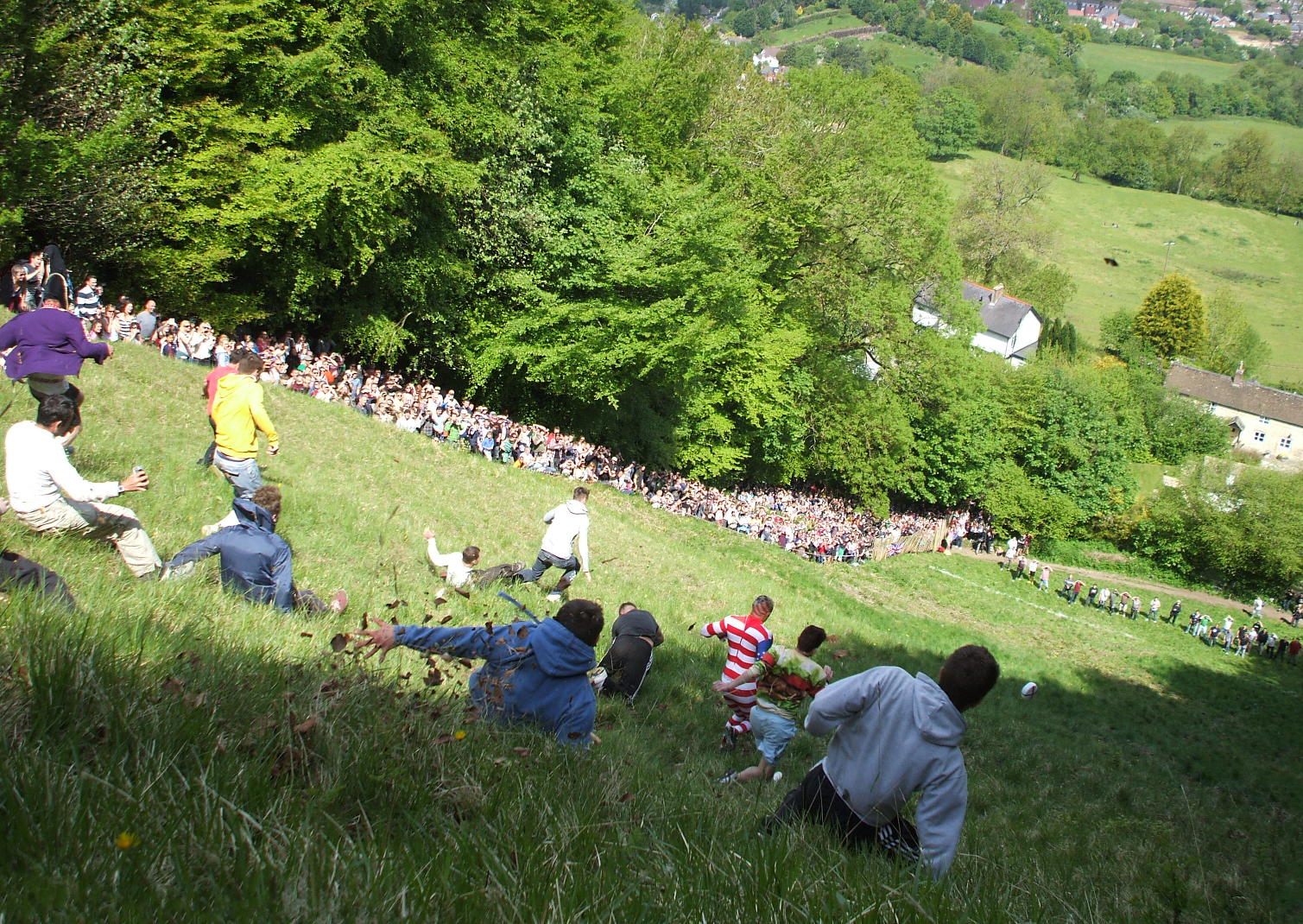
An annual cheese-rolling competition is held on Cooper’s Hill near Gloucester in England.

Do any longtime readers of the New Yorker magazine remember the bottom-of-column blurbs called “There’ll Always Be an England?” Although that faith is questioned in some quarters nowadays, a recent article suggests to me that English quirkiness is still going strong.

Jennifer Hassan reports at the Washington Post, “For hundreds of years, people have gathered in Gloucestershire, England, to fling themselves down a notoriously steep hill — in pursuit of a hefty chunk of golden-yellow cheese.

“The annual cheese roll, a race dating back centuries, often results in broken bones and concussions as participants tumble, run and bounce down the 180-meter (590-foot) hillside to become the first to cross the finish line.

“This year was no exception: Delaney Irving was crowned the winner of the women’s cheese-rolling race Monday — but the 19-year-old Canadian apparently did not actually realize she had won the competition until she regained consciousness in a medical tent shortly after.

“ ‘How are you? You took a hell of a tumble,’ one British interviewer asked Irving, shortly after she regained consciousness after bumping her head. Irving replied: ‘Did I?’ …

“The teenager was one of hundreds of racers who chased a cheese — a seven-pound full-fat hard cheese named ‘Double Gloucester. ‘ … The cheese can reach up to 70 to 80 mph as it topples down the hill, according to Gloucestershire outlets. Rugby players wait at the bottom of the hill to catch people as they crash across the finish line.

“Footage recorded of Irving shows her emerging triumphant — with her lump of precious cheese. …

“The tradition, according to a website for the modern-day cheese-roll organizers, is believed to be one of the oldest customs to have survived in Britain. A site for the town says the first written evidence of it is found in a message to the town crier in 1826. It brings spectators from around the world who gather to watch in awe and horror as individuals tumble down the hill.

“A 2020 Netflix documentary — on ‘unique, quirky and bizarre’ competitions people may not know about — dubbed the cheese roll as the ‘world’s most dangerous footrace.’ …

“The rules of the race are simple. Admission is free of charge. Participants must gather at the top of the hill before the race starts. The first person to cross the line wins, and gets to keep the cheese.

But the contest, often labeled an ‘extreme sport’ is not for the fainthearted. Injuries from past races include bruised kidneys, severe concussion, broken bones, sprained ankles and dislocated joints. …

“Irving was not the only overseas visitor to take part in the event. An American man dressed as George Washington attended the contest Monday alongside his friend who also dressed as the first president, local media reported. The pair’s day took a dramatic turn when one of the George Washingtons broke their foot amid the downhill race.

“Aside from the risks to people, People for the Ethical Treatment of Animals (PETA) also expressed concern about the risks to animals. Ahead of the race, they urged organizers of the event to … to ‘switch to a vegan cheese,’ a move they said would be ‘better for cows and the planet,’ while making the race itself ‘more inclusive.’ “

More at the Post, here.

Although it’s not nearly as cool, there’s a parade for a giant cheese in Massachusetts every year. Read about that here.

Read Full Post »

Photo: David A. Lindon/BBC.
These micro paintings cannot be seen with the naked eye.

We were speaking of miniatures. Today’s story is about an artist who goes beyond miniature to microscopic: art that can’t be seen with the naked eye, art that has to be painted at night to avoid the slightest jostling from traffic.

Cathy Free wrote about the artist at the Washington Post. “Late at night while most everyone in the coastal English town of Bournemouth is sleeping, David A. Lindon sits in front of a microscope making the tiniest of artworks. His creations are so minuscule and precise, he steadies his hands by only moving them between his own heartbeats.

“One twitch — or worse, something as disastrous as a sneeze — and his latest painting or sculpture could disappear into the fibers of his carpet or be lost forever in the jumble of tools on his desk. … A few years ago, at least one piece of artwork became lodged inside Lindon’s nose, never to be seen again.

“ ‘I inhaled it by accident, and poof. It was gone,’ he said. ‘To do what I do, you practically have to work yourself into a trance.’ …

“He started out putting each of his tiny masterpieces inside the eye of a needle or on top of a pin. His latest work is rotating as a wearable miniature art gallery inside a watch.

“To celebrate the 50th anniversary of the Van Gogh Museum in the Netherlands last month, Lindon collaborated with Edward Hammond, the founder of Hammond Galleries in the United Kingdom, to re-create three of Vincent van Gogh’s most famous paintings — ‘Starry Night,‘ ‘Sunflowers‘ and ‘Self-Portrait‘ in micro form. … The project took him six months.

“The watch with the microscopic Van Goghs is now on view at Hammond Galleries, valued at $190,000. …

“Lindon has three other pieces on display in New York this summer at an exhibition called ‘Small Is Beautiful,’ and he said he’s next hoping to showcase the world’s smallest zoo. …

“ ‘What I do doesn’t take up much space, but it’s very, very hard to do,’ he said. ‘It takes hundreds of hours.’ …

“Lindon, a former engineer who once worked in the aircraft industry, said he developed a fascination [with] ultra small-scale art after watching a TV special in the U.K. about artists who enjoyed creating diminutive works.

“In 2019, he said he decided to create a few of his own pieces and spent months working on his painstaking technique. His first piece was a wee Dalmatian that he made for his daughter, Abigail. It measured about a half of a millimeter long, and was crafted from materials that included porcelain, nylon, carbon fiber and precious metals.

“ ‘She suggested that I put it online, so I posted it on Facebook and Instagram,’ he said. ‘When people went nuts over it, I knew I must be on to something.’

“Lindon experimented with materials such as carpet fibers and crushed micro pigments, and he developed his own small tools, including a blade made from a hypodermic needle with a diamond fragment on the tip, and brushes made with fibers from silkworms.

“ ‘People ask me, “Do you paint with the leg of a fly?” But I actually use micro hooks and shovels that I’m constantly remaking,’ he said. …

“His work is reminiscent of the famed micro artist Willard Wigan, who for decades has painted with materials such as human eyelashes, and has won two Guinness World Records for the tiniest art made by a human hand. Other micro artists — including Hasan Kale, who paints on a grain of rice, as well as almond slivers, and Salavat Fidai, who makes sculptures on the tip of a pencil — have gained notoriety for their talents in the world of tiny art.

“Lindon said he usually works late at night so vibrations from traffic won’t disturb his concentration or cause his art to tremble under the microscope. ‘One mistake and it’s gone,’ he said. …

“His most frustrating loss was a mini reproduction of Pablo Picasso’s ‘Weeping Woman,‘ Lindon said.

“ ‘She has lots of color and is very angular with lots of straight lines,’ he said. ‘Basically, she’s a jigsaw. Earlier this year, I got three-quarters of the way through this complicated piece when my fingers suddenly twitched and I ripped the painting apart.

“ ‘I could have cried, but I carried on,’ Lindon added. …

“He said that mishaps happen less frequently now that he has taught himself to control his heartbeat by slowing down his breathing and relaxing.”

People sure come up with the most amazing hobbies! More at the Post, here.

Read Full Post »

Older Posts »