Feeds:
Posts
Comments

Posts Tagged ‘environment’

Building energy savings into school design means more money for education.

At Yes! Magazine, Erin L. McCoy describes what planners did for the rural Richardsville Elementary School near Bowling Green, Kentucky.

“When Richardsville opened its doors in fall 2010, it was the first net zero school in the nation, meaning that the school produces more energy on-site than it uses in a year.

“Solar tubes piping sunlight directly into classrooms eliminate much of the school’s demand for electric light, while a combination of geothermal and solar power cut down on the rest of the energy bill. Concrete floors treated with a soy-based stain don’t need buffing. The kitchen, which in most schools contributes to 20 percent of the energy bill, houses a combi-oven that cooks healthier meals and eliminates frying. This means an exhaust fan doesn’t pipe the school’s temperature-controlled air to the outdoors all day long.

“Meanwhile, ‘green screens’ in the front hall track the school’s energy usage so kids can see the impact of turning off a light in real time.

“These and other innovations make Richardsville better than net zero. It actually earns about $2,000 a month selling excess energy to the Tennessee Valley Authority. …

“Three factors are essential to making a green school work: First, you need the participation of the community and the local power company; second, you can’t forget that a school is a dynamic learning environment; and third, you need to speak the language of money.

“Since the economic recession began in 2008, school districts have suffered. Local tax bases were shaken as property values plummeted, and states have cut back on funding to districts, which were pushed to cut funds wherever they were able. Addressing energy use made a lot of financial sense.”

More.

Photograph: Michael Heinz/The Journal & Courier/AP/File
Students gather on the first day of school at Wyandotte Elementary School near Lafayette, Ind., in 2011. Wyandotte is one of many US schools that have made cutting energy use a priority.


Read Full Post »

Pius Sawa at AlertNet (and the Christian Science Monitor) writes, “Residents of Rusinga Island in Kenya [are experimenting] with renewable energy innovations, environmentally friendly farming, tree planting, and other efforts aimed at improving the island’s environment, creating jobs, and overcoming shortages of food and water.

“For the past 16 years, Ester Evelyn Odhiambo has dedicated herself to improving life on one small island. It’s no small task.

“Rusinga Island, in the northeast corner of Lake Victoria in Kenya, is about 16 km (10 miles) long and 5 km (3 miles) wide. About 30,000 people call it home. But the island over the years has become an increasingly inhospitable environment for them.

“ ‘If you plant something, it just dries out,’ says Ms. Odhiabmo, who runs an organization to help people widowed or orphaned by AIDS [Kisibom, or “come and learn”]. ‘You try to irrigate, and the water is too little because the sun comes and dries everything.’

“The changes have come because of poor management of resources – including forests and fishing grounds – and because of increasing climate impacts.

“But now residents are experimenting with renewable energy innovations, environmentally friendly farming, tree planting, and other efforts aimed at improving the island’s environment, building resilience, creating livelihoods, and overcoming shortages of food and water.”

More.

Photograph: Pius Sawa/AlertNet
Ester Evelyn Odhiambo opens a charcoal refrigerator on Rusinga Island, Kenya. It is lined with charcoal, into which water seeps through a hosepipe fed by a bucket. The wet charcoal absorbs heat and keeps the items inside the fridge cool without needing electricity.


Read Full Post »
The big thermometer on the garage may have said 40 degrees when I woke up this morning, but I’m still thinking spring.

My husband has planted an array of annuals and perennials, and both kids are seeding lawns.

Since I am rather a fan of Mass Challenge winners and I also had a heartfelt testimonial from Mimsey, I encouraged both families to try a 2010 Mass Challenge winner, Pearl’s Premium grass seed.

Mimsey said that she had thrown Pearl’s into a wooded area next to her house, expecting nothing. Before she knew it, a lovely velvety carpet had grown there. Sounded to me like the beans Jack’s mother threw away that led to Jack’s adventures at the top of a beanstalk.

And speaking of plants, the plant identification site Mister Smarty Plants, a big supporter of this blog, needs my support tonight. So if you would like to help him get recognition at a Mass Innovation Night on June 10, vote for him here. It took me a while to figure out the voting. You have to vote for four entries in the event and make a comment. But you don’t have to give your name. Thanks!

Read Full Post »

I am happy that the Wall Street Journal kept its front page human-interest stories after all when Murdock took over. Today’s feature opened up a side of the U.S. Marines I knew nothing about — protecting endangered species.

Ben Kesling writes from Twentynine Palms, California, “U.S. Marines are taught to overcome obstacles with a minimum of help. But when some Marines prepared to charge a hill in a training exercise here a few months ago, they were forced to halt and radio the one man who could help them advance: Brian Henen, turtle expert.

“The troops were ‘running up the hill and firing at targets,’ Mr. Henen said. ‘Some of the tortoises like the hill also. The Marines don’t want to hurt the tortoise, so they call us and we go in and move it.’

“Mr. Henen, who has a doctorate in biology, is part of a little-known army of biologists and other scientists who manage the Mojave desert tortoise and about 420 other threatened and endangered species on about 28 million acres of federally managed military land.

” ‘There’s a lot of people who don’t recognize the amount of conservation the Marine Corps does,’ said Martin Husung, a natural-resource specialist on the base. ‘A lot of people think we’re just running over things.’ …

John Brent, base environmental manager at Fort Benning in Georgia, says, “‘It’s a well-kept secret’ that biologists are drawn to work on military bases … There’s a chance to do terrific work.’ ”

More.

Read Full Post »

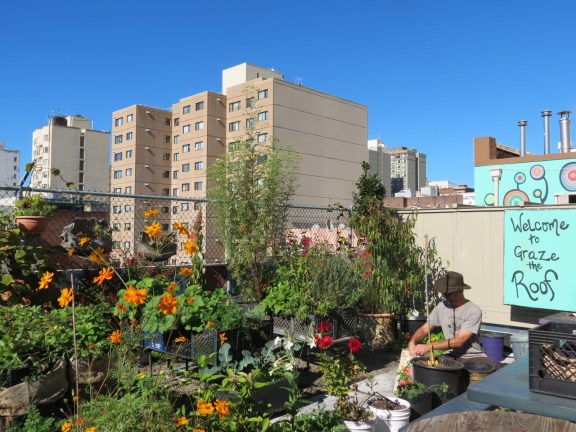
If you had to guess one church in San Francisco that would be all over the idea of rooftop gardening to feed whoever needs feeding, which one would it be?

Right. Glide. I like its garden’s name: Graze the Rooftop.

“Graze the Roof is an edible, community-produced vegetable garden on the rooftop of Glide Memorial Church, a progressive church and nonprofit located in the Tenderloin district of San Francisco.

“Graze the Roof features lightweight (upcycled) raised garden beds made from milk crates; a worm composting system and an educational mural which ties the whole project together. Glide youth and volunteers from throughout the Bay Area maintain the garden and host monthly tours and workshops.”

Do you live in the San Francisco area? Looks like there are a lot of fun workshops available, such as Designing Sustainable Habitats, Introduction to Permaculture, and Urban Fruit Tree Stewardship. Read more here.

Photo: Graze the Roof

Read Full Post »

On Saturday we watched the documentary Urbanized, about urban planning.

Although there were many discouraging notes (Mumbai slums, Beijing smog, destructive construction in Stuttgart), there were enough positive ones to give hope.

I liked the grassroots gardening efforts in Detroit, pedestrian/bike paths in Bogota (while cars were relegated to mud), miraculous transformations of aging infrastructure (the High Line in Manhattan), lighted paths in Cape Town, and bicycle commuting in Copenhagen.

The point was made that walkability (one of my favorite topics, as readers know) and similar quality-of-life improvements in cities can be hugely beneficial to the planet just because cities are so big and changes there affect so many people.

Doug Foy, who helped get Boston Harbor cleaned up and now consults with New York City’s Mayor Bloomberg, has spoken at my workplace a few times. He likes to talk about how New York avoided buying a whole new water supply simply by partnering with plumbers unions to get standard toilets gradually replaced with low-flush toilets.

Read Full Post »

Planetizen’s Brent Toderian wrote a while back that he attended a book party in Vancouver where Simon Fraser University City Program Director Gordon Price asked “each member of the crowd to state an urban design decision that ‘they loved.’ …

“When it came to my turn, my answer took a big picture and perhaps surprising approach, depending on your definition of urban design. In Vancouver, a city often referred to as ‘a city by design,’ the most important urban design decision we ever made, the decision I loved most, is actually usually referred to as a transportation decision.

“In 1997, the city approved its first influential Transportation Plan.

“It was a game-changer for our city-making model in many ways, most notably in its decision to prioritize the ways we get around, rather than balance them. The active, healthy and green ways of getting around were ranked highest – first walking, our top priority, then biking, and then transit, in that order. The prioritization then went on to goods movement for the purposes of business support and economic development, and lastly, the private vehicle. …

“If you’re a driver who is worried about a ‘war on the car,’ remember this — our model of city building understands the ‘Law of Congestion’ and proves that when you build a multimodal city, it makes getting around better and easier for every mode of transportation, including the car. It makes our city work better in every way.”

Read Toderian’s whole Planetizen post, here.

Photo: Vancouver.ca

Read Full Post »

Brian sent me information about Higher Ground Farm, which is putting down roots on the roof of the Design Center in South Boston.

“A roof farm is a type of green roof. A green roof is a system of layers that is laid over an existing roof. A green roof is beneficial to a building owner and the community because it protects the existing roof, doubling to tripling its life, thereby saving money and keeping materials out of the landfill.

“Green roofs also reduce a building’s energy costs by insulating in the winter and cooling the rooftop in the summer. Finally, green roofs temper the effects of two common urban environmental problems – combined sewer overflow and the urban heat island effect.

“A series of roof farms throughout the city will capitalize on the environmental benefits of green roofs while also increasing access to fresh, healthy food. Higher Ground Farm will operate several roof farms throughout the greater Boston area, utilizing previously unused space while providing additional rental revenue to a building owner.

“Roof agriculture has the potential to be a job-producing boost to the economy, and a completely environmentally sustainable business sector that can set Boston apart from other cities. Higher Ground Farm will utilize the resources of our top-notch universities to study roof agriculture, which will position Boston as a leader in the field. Finally, Higher Ground Farm will be a space where our community can reconnect to productive green space and learn about sustainable city planning.” More.

I also found a video interview about it that you will like, here.

Read Full Post »

Happy President’s Day! Why are you working?

​According to Mother Jones, economist David Rosnick has “found that dialing back the amount of time the average person works by 0.5 percent per year would mean a significant reduction in greenhouse gas emissions. If you work 40 hours a week, that would mean shaving about 12 minutes off the average work week per year. Working one minute less per month seems pretty doable. Basically, we’re using a whole lot more of everything when we’re working – electricity, gasoline, heating, air conditioning, etc. Leisure requires less greenhouse-gas-producing activity.”

I forget were I found this story first, but you can read more at Mother Jones, here.

Photograph: http://yasmincolemanportraits.wordpress.com/
“Lazy Bones, sleeping in the shade. How you ‘spect to get your corn meal made?”
(Hoagy Carmichael)

Read Full Post »

I hope colleagues who saw almost the same post on the blog I contribute to at work don’t mind a repeat. I’m winging it a bit as I hold a two-day-old little girl in my left arm and type on her mom’s Mac with my right.

This post can be taken as reassurance that there are pockets of people here and there working to make the world greener for my grandkids and yours. It originates with Jim Robbins, Yale Environment 360, part of the Guardian Environment Network.

He begins in Seattle.

” ‘The biggest threat to Puget Sound is non-point sources [of pollution],’ says Nancy Ahern, Seattle Public Utilities deputy director.

“Blowhole samples taken from killer whales have revealed fungi, viruses and bacteria living in their respiratory tracts, some of them antibiotic-resistant and once found only on land. Health officials often have to shut down oyster beds because of fecal contamination. Salmon in streams are killed by torrents of dirty storm water.

“To lessen this deluge of diffuse pollution — a problem faced by many regions worldwide — Seattle is looking not at new and expensive sewage treatment infrastructure. Instead it is embracing an innovative solution to storm water runoff called green infrastructure … A growing number of places, from New York City to Sweden, are investing in everything from rooftop gardens to pollution-filtering assemblages of trees to reduce tainted runoff.

“Gray infrastructure is the system of pipes and ditches that channel storm water. Green infrastructure is the harnessing of the natural processes of trees and other vegetation — so-called ecosystem services — to carry out the functions of the built systems. Green infrastructure often intercepts the water before it can run into streets and become polluted and stores the water for gradual release through percolation or evapotranspiration. Trees also clean dirty water through natural filtering functions. …

A 2012 study by American Rivers, ECONorthwest, and other groups examined 479 projects around the country. About a quarter of the projects were more expensive, they concluded, and 31 percent cost the same; more than 44 percent brought the costs down, in some cases substantially. New York City, for example, expects to save $1.5 billion over the next 20 years by using green infrastructure.” I call that having your cake and eating it, too.

More.

Photograph: Mike Di Paola/Getty Images
Plants grow on a rooftop farm in Greenpoint, New York.

Read Full Post »

Do you remember the scene in War and Peace (I know, I read it a long time ago, too) in which Prince Andrei, lying wounded on the field of Austerlitz, looks up at the sky and experiences a kind of awakening?

Well, there’s an organization that hopes we will all connect with the sky with that sort of attention and feel renewed.

“It began with a cryptic e-mail from an unfamiliar source,” writes Jan Brogan at the Boston Globe.

“ ‘Look at the sky as often as you can — for about 21 days. I’ll contact you again in 3 wks.’ It included a link to a website with clouds.

“Signing off with ‘More Light,’ this guy could have been a total whack job. But something about the writing said this had nothing to do with UFO sightings. I clicked in.

“The website was ForSpaciousSkies.com. The man who sent the e-mail, Jack Borden, a former Boston television reporter, had had an epiphany as he looked up from a meadow one day in the mid-1970s and saw the sky as if for the first time. He has been on a mission to educate people about sky awareness ever since.

“ ‘When we are unconscious in regard to our surroundings, we are irresponsible to them,’ says Borden, speaking of that mission now.

“It began with a series of televised man-on-the-street interviews. Borden stopped pedestrians, covered their eyes, and asked what the sky looked like. Most had no clue. They were rushing through their lives without ever looking up.” More.

I want to take up the challenge, pay more attention to the sky. I’m good about this when I go out early in the dark for my walk and take a deep breath of the moon and stars, but I should be more attentive more often during the day. I think my hiking and skiing and sailing friends must get sky vitamins  all the time. They probably don’t even think about it.

I include a couple pictures from times I did pay attention during the day.

042912_Japanese_Maple_3

063012_clouds (2)

Read Full Post »

It should be obvious that being out in nature is good for us, but today it often seems like a foreign concept.

“Take Two Hours of Pine Forest and Call Me in the Morning” is a lovely article, coming to you from Outside magazine. (I got the link from Andrew Sullivan’s blog.)

“These days, screen-addicted Americans are more stressed out and distracted than ever. And nope, there’s no app for that. But there is a radically simple remedy: get outside. [Outside magazine’s] Florence Williams travels to the deep woods of Japan, where researchers are backing up the surprising theory that nature can lower your blood pressure, fight off depression, beat back stress —  and even prevent cancer. …

“If the Japanese embrace of forest therapy can be attributed to one man, it’s [Yoshifumi] Miyazaki, a physiological anthropologist and vice director of Chiba University’s Center for Environment, Health, and Field Sciences, located just outside Tokyo.

“Miyazaki believes that because humans evolved in nature, it’s where we feel most comfortable, even if we don’t always know it. …

“Miyazaki has taken more than 600 research subjects into the woods since 2004. He and his colleague Juyoung Lee, also of Chiba University, have found that leisurely forest walks, compared with urban walks, yield a 12.4 percent decrease in the stress hormone cortisol, a seven percent decrease in sympathetic nerve activity, a 1.4 percent decrease in blood pressure, and a 5.8 percent decrease in heart rate. On subjective tests, study participants also report better moods and lower anxiety. …

“The science is so convincing that other countries are following Japan’s lead in studying and promoting nature as a cure. Lee just got hired away by the South Korean government, which is pouring more than $140 million into a new National Forest Therapy Center, expected to be completed in 2014. Finland, an empire of boreal spruce and pine, is also funding numerous studies. ‘Japan showed us that there could be cooperation between forestry and medical fields,’ says Liisa Tyrvainen of the Finnish Forest Research Institute” More.

Apart from just feeling better when I step outside for my walk and breathe the outdoors air, I note that a couple of my hero writers (Dickens and Asakiyume) are known for ruminating on long walks. Nature nourishes creative thought. P.S. Asakiyume also takes great pictures on her walks and posts them on her blog.

May 27, 2013, update from John: Mononoke creator Hayao Miyazaki on how he thinks about his art, here.

Photograph: Casey Yee
Mononoke forest, Yakushima Island, a
long the Kusugawa Trail. This is the forest that inspired Ghibli studio’s “Princess Mononoke.”

[University of Chiba‘s Yoshifumi Miyazaki] believes that because humans evolved in nature, it’s where we feel most comfortable, even if we don’t always know it. “Throughout our evolution, we’ve spent 99.9 percent of our time in natural environments,” he says. “Our physiological functions are still adapted to it. During everyday life, a feeling of comfort can be achieved if our rhythms are synchronized with those of the environment.”

To prove it, Miyazaki has taken more than 600 research subjects into the woods since 2004. He and his colleague Juyoung Lee, also of Chiba University, have found that leisurely forest walks, compared with urban walks, yield a 12.4 percent decrease in the stress hormone cortisol, a seven percent decrease in sympathetic nerve activity, a 1.4 percent decrease in blood pressure, and a 5.8 percent decrease in heart rate. On subjective tests, study participants also report better moods and lower anxiety.

Read Full Post »

An editorial in the NY Times earlier this month praised the efforts of a Long Island organization committed to rescuing a lovely, endangered body of water.

The editorial said that in Shinnecock Bay, “pollution from fertilizer and septic runoff feeds frequent algae blooms that block oxygen and sunlight. …  Once-lush beds of eelgrass, shelter for the little fish that feed bigger ones, have largely disappeared from the western part of the bay.”

But there is hope. “What Shinnecock Bay has going for it are scientists working to restore its waters and tidal flats to health. The Shinnecock Bay Restoration Program, run by Stony Brook University’s School of Marine and Atmospheric Sciences and its Institute for Ocean Conservation Science, means to fix the problem, not just study it.

“The institute’s executive director, Dr. Ellen Pikitch, said a big part of the job was as simple as replanting eelgrass and seeding the bay with clams and oysters, which filter the water clean and make the bay better able to fend for itself. …  Local officials were doing their part by agreeing to close sections of the bay to shellfishing.”

More on what is being done now and ideas for even bigger efforts here. The program could serve as a model for sustainability elsewhere in the world. And we can all do our bit by using less fertilizer and thinking first before putting pollutants down our drains.

Read Full Post »

Hurricane Sandy was terrible for many communities in its path, and the devastation has given urgency to climate concerns and innovative solutions.

Henry Fountain writes about one such solution in the NY Times, “With a few dull thuds, the one-ton bag of high-strength fabric tumbled from the wall of the mock subway tunnel and onto the floor. Then it began to grow. As air flowed into it through a hose, the bundle inflated until it was crammed tight inside the 16-foot-diameter tunnel, looking like the filling in a giant concrete-and-steel cannoli.

“The three-minute procedure, conducted on a chilly morning this month in an airport hangar not far from West Virginia University, was the latest test of a device that may someday help guard real tunnels during disasters — whether a terrorist strike or a storm like Hurricane Sandy, whose wind-driven surge of water overwhelmed New York City’s subway system, shutting it down for days.

“ ‘The goal is to provide flooding protection for transportation tunnels,’ said John Fortune, who is managing the project for the federal Department of Homeland Security’s Science and Technology Directorate.

“The idea is a simple one: rather than retrofitting tunnels with metal floodgates or other expensive structures, the project aims to use a relatively cheap inflatable plug to hold back floodwaters.

“In theory, it would be like blowing up a balloon inside a tube. But in practice, developing a plug that is strong, durable, quick to install and foolproof to deploy is a difficult engineering task, one made even more challenging because of the pliable, relatively lightweight materials required.”

More.

Photograph: NY Times

Read Full Post »

I just got a great lead from Erik. It seems that Sweden has run out of garbage for running its waste-to-energy program. Fortunately, Norway has garbage it can spare. (I wonder if Erik’s buddy Svein knows that.)

Check out Matt Hickman at Mother Nature Network:

“Sweden, birthplace of the Smörgåsbord, Eric Northman, and the world’s preferred solar-powered purveyor of flat-pack home furnishings, is in a bit of a pickle: the squeaky clean Scandinavian nation of more than 9.5 million has run out of garbage. The landfills have been tapped dry; the rubbish reserves depleted. And although this may seem like a positive — even enviable — predicament for a country to be facing, Sweden has been forced to import trash from neighboring countries, namely Norway. Yep, Sweden is so trash-strapped that officials are shipping it in — 80,000 tons of refuse annually, to be exact — from elsewhere.

“You see, Swedes are big on recycling. So big in fact that only 4 percent of all waste generated in the country is landfilled.

“Good for them! However, the population’s remarkably pertinacious recycling habits are also a bit of a problem given that the country relies on waste to heat and to provide electricity to hundreds of thousands of homes through a longstanding waste-to-energy incineration program. So with citizens simply not generating enough burnable waste to power the incinerators, the country has been forced to look elsewhere for fuel. Says Catarina Ostlund, a senior advisor for the Swedish Environmental Protection Agency: ‘We have more capacity than the production of waste in Sweden and that is usable for incineration.

“Public Radio International has the whole story (hat tip to Ariel Schwartz at Co.Exist), a story that may seem implausible in a country like garbage-bloated America where overflowing landfills are anything but scarce.” Read more.

Photograph: Smath/Flickr

Read Full Post »

« Newer Posts - Older Posts »