Feeds:
Posts
Comments

Posts Tagged ‘finland’

Photo: Janne Körkkö for the New York Times
A team from Vihti, Finland, competing in the country’s 20th annual Swamp Soccer World Championships. Their mascot, a badger doll, is the one in the cage.

Gotta love those Finns. They have possibly the best education system in the world and all those unusual contests like wife carrying and cellphone tossing. Long, dark winters must make for desperate ideas about how to have fun in summer.

Andrew Keh writes at the New York Times, “There’s something strange going on in Finland. Over the past few decades, as it has all but disappeared from the global sports stage, this humble Nordic nation has sort of lost its sports mind.

“More than 2,000 people ventured to the remote backwaters of central Finland recently for the 20th annual Swamp Soccer World Championships. If you and your spouse want to compete in the Wife Carrying World Championships, you must come to Finland. The Mobile Phone Throwing World Championships? Finland. The World Berry Picking Championship and the Air Guitar World Championships? Finland and Finland.

“ ‘We have some weird hobbies,’ said Paivi Kemppainen, 26, a staff member at the swamp soccer competition and master of the understatement.

“Just look at swamp soccer in Hyrynsalmi, a place where Jetta can achieve a small level of celebrity over the years. Jetta is a stuffed badger ensconced in a bird cage. She acts as a mascot of sorts for a team of 12 friends who make the seven-hour drive each year from Vihti, near Helsinki, for the competition. They bought the doll seven years ago from a junk store at a highway rest stop, and her fame around the swamp has grown ever since. A couple of years ago, she was interviewed by a local newspaper. …

“On Saturday morning … a bottle of vodka was being passed around (their preferred way, apparently, of warming up). It was about 10 o’clock. Soon it would be time for their first game of the day. They set Jetta aside and stripped off their outerwear, revealing skimpy blue wrestling singlets.

“Before they treaded into the mud, they were asked a question: Why?

“ ‘You can say you’re world champions of swamp soccer,’ said Matti Paulavaara, 34, one of the team members, after a contemplative pause. ‘How many can say that?’

“The genesis of swamp soccer was in 1998, when creative town officials in Hyrynsalmi cooked up a festival-like event that would make use of the area’s vast swamplands. Thirteen teams showed up for the first tournament. Since then, the competitive field has grown to about 200 teams. …

“People striding on seemingly firm ground would disappear suddenly into the soft earth, as if descending a stairway. Some tottered on their hands and knees, like babies. Others stood still, until they were waist-deep in muck. The scores were generally low. Many of the players were drunk. …

You play, you lose, you win — no one cares,’ said Sami Korhonen, 25, of Kajaani, who was playing in the tournament for the ninth time. ‘The whole game is so tough, you’re totally wiped out when you’re done.’ ”

More at the New York Times, here.

Read Full Post »

Photo: Taught by Finland
Taught by Finland promotes a play-centered approach to early education and writes loving posts about “the joyful, illiterate kindergartners of Finland.”

On Facebook, I’ve been following Taught by Finland, which highlights the Finnish approach to education (e.g., lots of playtime for young children) and posts links to related research and stories.

In higher grades, Finns usually outrank American students by a lot on standardized tests. That may have multiple causes, but it seems reasonable to ask what Finland is doing right and what would happen if American schools were to lighten up.

A school in Burlington, Vermont, is beginning to get answers to that question.

Nicole Higgins DeSmet writes at the Burlington Free Press, “Five months after a no-homework policy went into effect, Orchard Elementary parents report that after-school reading is flourishing.

” ‘We have a first grader, and at her age it’s as much a chore for the parents as the kids,’ parent Rani Philip said about homework. ‘Instead we’ve been spending time reading. We don’t have to rush.’

“Philip said her husband was skeptical, but now he’s convinced. Other parents who were surprised by the policy said their children are reading more. …

“[Kindergartner Sean Conway] hid behind his dad’s legs but managed to share that his solo literary conquest was the book ‘Spirit Animals.’

“Teachers at Orchard voted unanimously before the start of the school year to end homework for their kindergarten through fifth-grade students. Instead students are encouraged to read, play games and be kids.

“Orchard Principal Mark Trifilio sent a homework policy survey to parents in November. Of those parents, 254 sent back answers. About 80 percent indicated they agree with the policy.

“Parents reported in the survey concern that their fifth-graders might miss skills that will help them succeed in middle school. …

“Lolly Bliss, a fifth-grade teacher with 25 years experience, said her students will be prepared to accomplish more because they are freed from busywork — which is how she defined some homework.

“She has more time to accomplish academic goals in class because she doesn’t have to spend time on kids’ and parents’ anxieties about missing or incomplete homework.

” ‘We get a lot done in a calm class,’ Bliss said.”

If you read the rest of the story, you’ll see that some parents fear children are missing needed skills. They may not take into account how difficult it is to learn if you are stressed. I hope someone will tell those parents about Finland.

Read Full Post »

o8haafk

Photo: Imgur
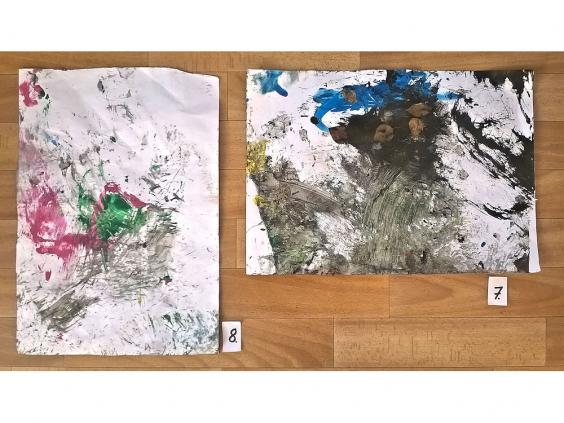
Juuso makes art by rolling in paint. Sales of his paintings help animals who, like him, have been orphaned.

This orphaned brown bear is helping to raise money for the Finnish center that rescued him. And he’s not riding a unicycle like a circus bear. He’s doing something he apparently really likes: Art.

Jussi Rosendahl and Attila Cser report at Reuters, “The artist behind the exhibition entitled ‘Strong and soft touches’ is a 423-kilogram (930 pound) brown bear named Juuso who uses his body, especially his paws, as paintbrushes.

” ‘We just leave paint for him, some plywood and paper … If we ask him to do it, he doesn’t do anything. He does all the work in his own time, when he’s alone, sitting and moving his legs on the paper,’ said Pasi Jantti, one of his keepers.

“Juuso, who is 17 years old, favors blue and red, the keeper said, adding that the paints used posed no health risk to the bear.

“His keepers discovered Juuso’s artistic bent one day while painting some facilities at Kuusamo animal center in northern Finland where he has been living since being orphaned as a cub.

” ‘Juuso got some paint in his paws and started to make marks with them. We noticed that he liked it,’ Jantti said.”

Read more at Reuters, here.

I have to hand it to keepers who noticed what the bear enjoyed, let him do it, and thought up a way it could help other animals in their care.

Photo: The Independent
Two Juuso originals that have already sold.

Read Full Post »

The Atlantic magazine says Estonia is the new Finland, meaning that it is doing a bang-up job with quality education for all. Educating the poor turns out to be a salient strength of the system.

Sarah Butrymowicz writes, “In 2012, Estonia’s 15-year-olds ranked 11th in math and reading and sixth in science out of the 65 countries that participated in an international test that compares educational systems from around the world (called the Programme for International Student Assessment, or PISA).

“In addition to beating out western nations such as France and Germany and essentially tying Finland in math and science, Estonia also had the smallest number of weak performers in all of Europe, about 10 percent in math and reading and 5 percent in science.”

In comparison, the United States hovers in the middle of the pack.

“While there is less income inequality in Estonia than in the United States—and, with 1.3 million people, the country is significantly smaller—the Baltic nation also has its share of cultural diversity.

“When it achieved independence from the Soviet Union 25 years ago, Estonian became the official language and the language of school instruction. Yet about a fifth of its students come from families that still speak Russian at home, and they have historically lagged behind their native speaking counterparts on tests such as PISA. …

“Marc Tucker, president of National Center on Education and the Economy in Washington, D.C., visited Estonia last year to find out what they’re doing right. He said that after the fall of the Iron Curtain other former Soviet satellites, such as Hungary and the Czech Republic, transitioned to a system preferentially suited to the needs of its elites. Estonia, however, kept giving equal opportunities to students of all backgrounds. …

“There are many factors that may contribute to Estonia’s success on PISA beyond their focus on equality. Education continues to be highly valued. Teacher autonomy is relatively high, which has been shown to be related to better test scores. Teachers stay with the same students in grades one to three – or sometimes even up to sixth grade – allowing deep relationships to develop.”

Maybe we could learn something from this small Baltic state. Read more here about why Estonian students are so successful on tests and whether they are happy with the system and why the country is trying to encourage more individuality and creativity without losing rigor.

Photo: Ints Kalnins / Reuters
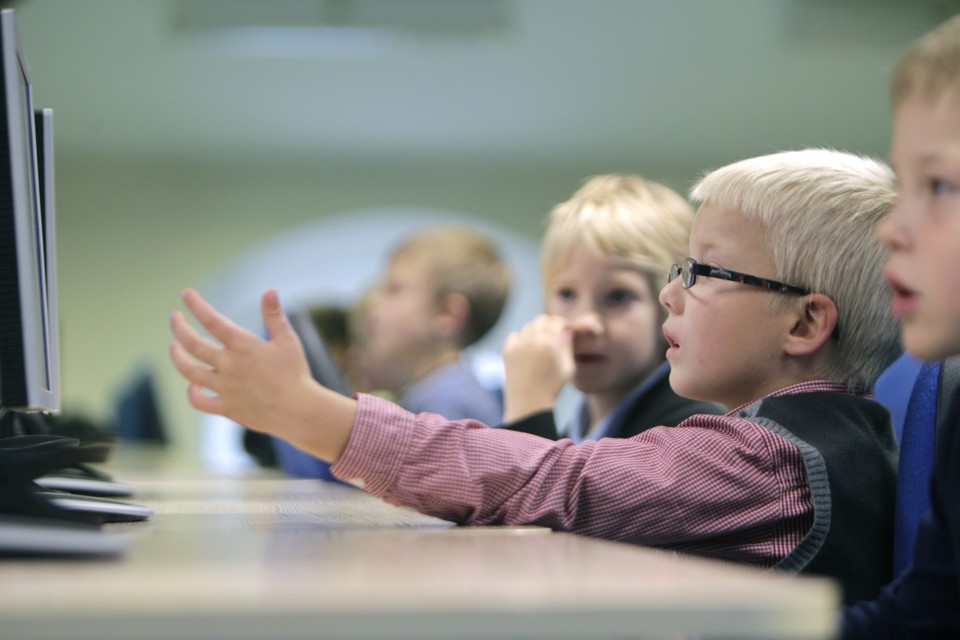
First graders take a computer class in Tallinn, Estonia.

Read Full Post »

A New York Times article that was widely shared yesterday detailed how eager many Canadians are to welcome refugees. Enthusiastic, sometimes a bit bossy, they are volunteering in droves to make a difference in the lives of anxious families who have been through the mill.

It reminded me of other welcome stories I’ve been collecting. Small towns, in particular, seem to feel they could benefit from welcoming refugees.

On Nagu, a remote island on the southwest tip of Finland, migrants have found open arms.

Giles Duley writes in the Guardian, “From the start, the people of Nagu made their guests feel welcome. A Facebook group was set up, activities suggested, volunteers came forward. ‘It was exciting,’ says Mona Hemmer, a bastion of Nagu life and one of the organisers of activities for the refugees. …

“Of course, for the refugees, being busy does not erase their past or the uncertainty of their future. … Many still find it hard to sleep, aware that until their asylum applications have been processed, they have not reached the end of their journey.

“However, the warm welcome of the Nagu people has made a difference. And despite their initial reservations, the islanders now feel that it is the refugees who have brought them something.”  More.

In this Al Jazeera story by Thomas Bruckner, refugees are reviving faded Italian villages.

“The village of Riace had seen its population drop from 2,500 to 400 since the 1990s, when people moved to northern Italy for better economic opportunities.

“Domenico Lucano, Mayor of Riace, saw the flow of refugees in Italy as an opportunity. ‘We have been welcoming refugees with open arms for the past 15 years. [They have] saved our village,’ Lucano explained.

“The resourceful mayor first acted on this opportunity in 1998, when a boat with 218 Kurdish refugees on their way to Greece got stranded on a beach in Riace. This is when Lucano first proposed that the refugees should stay in the village and take over the homes and apartments that had been left vacant by the migrating former residents of the town.

“The mayor helped to facilitate the integration by establishing a ‘refugees welcome’ project, which is now spreading through neighbouring towns.”

Here’s a PBS story by Jason M. Breslow about a small town in Germany that wants more population. “With Goslar’s population shrinking by around 2,000 people per year as young people flee to bigger cities and older residents die, [Mayor Oliver] Junk sees refugees as key to the town’s future.

“ ‘Europeans must welcome and integrate refugees, accepting that they are not a burden but a great opportunity,’ Junk wrote in an op-ed published last month in the policy journal Europe’s World.”

The mayor has also said, “Anyone who tells me Germany is full up, or that we can’t afford them, I say think of our past, and of the future. Of course we can afford them – we’re a rich country, and we have a duty to help those in need.’ ” More from PBS.

And here’s a story closer to home. Brian MacQuarrie writes at the Boston Globe about Rutland, Vermont, and its interest in refugees.

“Mayor Christopher Louras has unveiled a plan, developed in near-secrecy, to resettle 100 Syrian refugees who fled the onslaught of the Islamic State and are exiled in sprawling Jordanian camps. …

“Most residents appear ready to welcome the refugees, mindful of the harrowing images of Syrians desperately seeking refuge outside their ravaged country….

“ ‘The benefits, economically and culturally, that we will recognize is exactly what the community needs at this time,’ said Louras, the grandson of a Greek immigrant who fled the Ottoman Turks a century ago. ‘As much as I want to say it’s for compassionate reasons, I realize that there is not a vibrant, growing, successful community in the country right now that is not embracing new Americans.’ ” More at the Globe.

Photo: Giles Duley/UNCHR
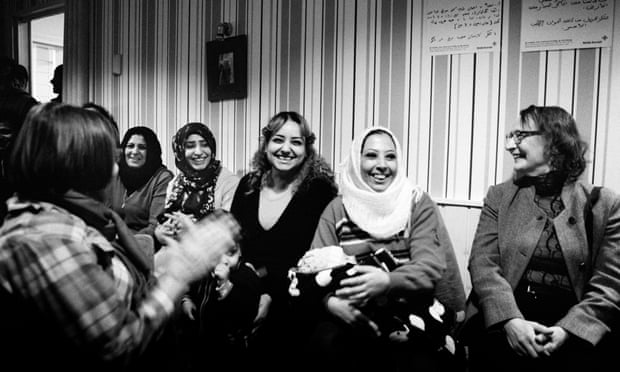
Volunteers from Nagu, a small island in Finland, laugh with refugees during a New Year’s Eve concert put on by local musicians.

Read Full Post »

In Helsinki, Finland, where young people traditionally leave home at 18 but can no longer afford urban rents, Millennials are applying by the hundreds to live with the elderly.

According to Kae Lani Kennedy at Matador Network, “Retirement homes are serving as more than a community for the elderly. These facilities are providing affordable housing for the city’s growing population of homeless millennials.

“ ‘It’s almost like a dorm, but the people aren’t young. They’re old,’ explains Emil Bostrom, a participant in ‘A Home That Fits,’ a new housing project that allows millennials to move into retirement communities. Bostrom is a 24-year-old kindergarten teacher, and though he has a steady income, it is not enough to compete with 90,000 other renters in a city that has roughly 60,000 affordable rental properties. …

“Bostrom, along with many other young adults, can enjoy discounted rent in exchange for socializing with the seniors in their community. …

“By interacting with a younger generation, the elderly involved with ‘A Home That Fits’ have the opportunity to be engaged in an active and diverse community, instead of being left behind in a forgotten generation.” More here.

And check out a post I wrote about the same phenomenon in Cleveland, here. Both initiatives sound like fun to me.

Video: Seeker Stories

Read Full Post »

If I didn’t know that Finns were good at finding creative solutions to problems, I would think Cara Giaimo was pulling my leg. Belatedly, I give you her Atlas Obscura story about reindeer that glow in the dark.

“If you’re on the lookout for magical reindeer this year, don’t bother gazing skyward — turn your attention to Finland, where local herders are using iridescent antler paint to cut down on deer-car collisions.

“In Finland’s Lapland region, vehicles share space with huge groups of freely roaming reindeer, herded by the Sami people. During the long, dark winter, this coexistence can be dangerous.

” ‘Every year, about 4,000 reindeer are lost on Finnish roads in car accidents,’ explained Juho Tahkola of the Reindeer Herder’s Association in an email. ‘We need to find a way to get these numbers down.’ …

“This year, after spray paint and fur-coating both proved lackluster, they’ve swabbed a test group of antlers with a thick brushing paint.”

More here.

Photo: Reindeer Herders Association
A Finnish reindeer browses “reflectively.” (Wish I could take credit for that bon mot.)

Read Full Post »

Bill Littlefield, at Only a Game on WBUR radio, got a lesson in the subtleties of Finnish baseball when he interviewed the Wall Street Journal’s Brian Costa recently. Costa went to Finland to report on pesäpallo, a game whose players are sometimes scouted by US baseball teams.

“Brian Costa: The biggest difference is the pitcher, instead of throwing the ball from a mound at the batter, stands beside him and throws it up in the air and sort of gets out of the way. But there are base paths, there’s four bases, there’s home plate, players field with gloves. …

“Bill Littlefield: Critics of baseball in the U.S. say the games are too long. It’s too slow. There’s not enough action. Would such critics be happier with pesäpallo?

“Brian: Oh, they would love pesäpallo. There are very, very few strikeouts, very few swings and misses, so pretty much every ball that gets pitched gets put into play. …

“Bill: What’s it like for fans attending a game of pesäpallo? And how many are there? Is this a big popular attraction?

“Brian: This is really not a city sport, so [in] Helsinki, you won’t see that much of it. But it is the sport of the Finnish countryside. You’ll have towns where the local population may be 3,000 people, and they’ll get 3,500 at a game. …

“Bill: You note that a scout from the New York Yankees was in Finland last month for All-Star weekend there. … [But] Finnish players, I gather, do not seem very interested in playing baseball as we know it?

“Brian: No they’re not. It’s very interesting. … None of them seemed to really follow Major League Baseball. The people who I asked about their impressions of it kind of smirked or winced or just said, ‘eh.’ I mean, they feel like they’ve got a better version of it.”

More here.

Video: PattijoenUrheilijat

Read Full Post »

Photo: Milla Kontkanen

Lynley Beckbridge — whose tweets I have been following since a Harvard conference on aging and design — recently tweeted this BBC story about baby boxes in Finland.

Helena Lee writes, “It’s a tradition that dates back to the 1930s and it’s designed to give all children in Finland, no matter what background they’re from, an equal start in life. The maternity package — a gift from the government — is available to all expectant mothers.

“It contains bodysuits, a sleeping bag, outdoor gear, bathing products for the baby, as well as nappies, bedding and a small mattress. With the mattress in the bottom, the box becomes a baby’s first bed. Many children, from all social backgrounds, have their first naps within the safety of the box’s four cardboard walls. …

“At 75 years old, the box is now an established part of the Finnish rite of passage towards motherhood, uniting generations of women.

“Reija Klemetti, a 49-year-old from Helsinki, remembers going to the post office to collect a box for one of her six children. …

“Her mother-in-law, aged 78, relied heavily on the box when she had the first of her four children in the 60s. At that point she had little idea what she would need, but it was all provided.

“More recently, Klemetti’s daughter Solja, aged 23, shared the sense of excitement that her mother had once experienced. …

” ‘There was a recent report saying that Finnish mums are the happiest in the world, and the box was one thing that came to my mind. We are very well taken care of,’ says [Titta Vayrynen, a 35-year-old mother with two young boys].

More here. And be sure to see this related story on customs in Nordic countries, “The babies who nap in sub-zero temperatures.”

Read Full Post »

My WordPress stats indicated that someone from the Åland Islands clicked on this blog today, and I said to myself, “Where are the Åland Islands?”

Naturally, Wikipedia had an answer. They are between Sweden and Finland.

They are “an autonomous, demilitarised, monolingually Swedish-speaking region of Finland that consists of an archipelago lying at the entrance to the Gulf of Bothnia in the Baltic Sea. …

“Åland comprises Fasta Åland (“Main Island”, on which 90% of the population resides) and a further 6,500 skerries and islands to its east. Fasta Åland is separated from the coast of Sweden by 38 kilometres (24 mi) of open water to the west. In the east, the Åland archipelago is contiguous with the Finnish Archipelago Sea. Åland’s only land border is located on the uninhabited skerry of Märket, which it shares with Sweden.

“Åland’s autonomous status means that those provincial powers normally exercised by representatives of the central Finnish government are largely exercised by its own government.” More here.

What brought a reader from that part of the world to Suzanne’s Mom’s Blog? Was it the same person who (according to WordPress stats) searched on the word “lusthus”? A reasonable guess. Here are my pictures of Margareta and Jimmy’s lusthus, or gazebo, when Suzanne and Erik were visiting in Sweden.

I wonder if the reader from the Åland Islands is there on vacation right now or lives there all year ’round. And if you live there all year ’round, what kind of job can you have there?

Map from Wikipedia

Read Full Post »

Poet friend Ronnie expressed admiration on Facebook for Colorado’s governor, who actively supports the arts, and she linked to an announcement about applying for the Governor’s 2014 arts awards.

“The 2014 Governor’s Creative Leadership Awards are now accepting nominations, through Feb. 27, 4 p.m. Formerly the Governor’s Art Awards, and given to locations or districts (Pueblo won one last year), this year it will recognize organizations and individuals who ‘demonstrated a significant commitment to Colorado’s creative landscape through civic leadership and volunteerism including advocacy, vision, collaboration or innovation.’ …

“Nominations are accepted under the following categories:

• “Arts and creative placemaking: Presented to individuals or organizations that use the arts to envision new futures through activities such as activating a public space, animating a community or sparking redevelopment.

• “Arts and community action: Presented to individuals and organizations that have demonstrated selfless service, inspired others to take action or catalyze change in their community using the arts.

• “Arts and social change: Presented to individuals or organizations that work to solve a critical social problem such as homelessness, drug prevention, abuse, poverty or racism using creativity and/or arts.”

In addition, you have until Feb. 3 to nominate Colorado’s poet laureate. More here on Colorado’s efforts.

Why don’t more states and cities promote the arts? I can think of places right now that should have their own creative arts districts. Or maybe a design district. Suzanne tells me that Helsinki, Finland, has attracted international recognition for its own design district, here. I like how they define it as a state of mind rather than by specific street boundaries:

“Design District Helsinki is a neighbourhood and a state of mind.  It is creativity, uniqueness, experiences, design and Finnish urban culture.”

Photo: Salida Creates
Downtown Salida is a Certified Colorado Creative Arts District.

Read Full Post »

In Sweden, mangata is the word for the roadlike reflection the moon casts on the water. In Finland there’s a word for the distance reindeer can travel comfortably before taking a break: poronkusema. A terrific German word that people familiar with Concord, Massachusetts, will appreciate is Waldeinsamkeit. What do you think it means? Yep. “A feeling of solitude, being alone in the woods and a connectedness to nature.”

National Public Radio staff say:  “Just as good writing demands brevity, so, too, does spoken language. Sentences and phrases get whittled down over time. One result: single words that are packed with meaning, words that are so succinct and detailed in what they connote in one language that they may have no corresponding word in another language.

“Such words aroused the curiosity of the folks at a website called Maptia, which aims to encourage people to tell stories about places.

” ‘We wanted to know how they used their language to tell their stories,’ Maptia co-founder and CEO Dorothy Sanders tells All Things Considered host Robert Siegel.

“So they asked people across the globe to give them examples of words that didn’t translate easily to English.”

I loved this report. You will, too.  Read more at NPR, here.

Art: National Public Radio, “All Things Considered”

Read Full Post »

When you consider all the minority languages that are endangered today — many of which I’ve blogged about (for example, here) — it seems a bit perverse to be bringing back Latin on the radio. But as one more way to interest people in languages, how bad can it be?

For the Finns, who have to speak many languages because hardly anyone speaks theirs, it’s just one more.

As John Tagliabue wrote in yesterday’s New York Times, the Internet has given a boost to “a weekly summary of world events and news broadcast by Finnish state radio — not in Finnish, but in classical Latin. …

“In recent weeks, the subjects have included the financial crisis in Cyprus, an unusually brilliant aurora borealis and the election of Pope Francis. …

“It may be no coincidence that the broadcast began in 1989, the year Communism collapsed in Eastern Europe and the Finns turned toward Western Europe. For educated Finns, Latin had long been the country’s link to Western culture, and they were required to study the language in school. …

“While the broadcasts once went out over the airwaves, with shortwave reception for listeners outside Finland, more and more listeners tune in to the program’s Web site, through podcasts and MP3 downloads.” More.

Image: Wikipedia
Cicero Denounces Catiline, fresco by Cesare Maccari, 1882–1888. It’s what Suzanne’s Mom thinks of when she thinks “Latin.”

Read Full Post »

I blogged in May about the late Paul Nagel, the great biographer of the John Adams family and a friend from the years my husband and I spent in Minneapolis.

Today his son sent a lovely memorial piece by Paul’s longtime buddy Norbert Hirschhorn. Bert’s article appeared in the St. Paul Pioneer Press. Read it here. Bert is a physician who has written investigative medical articles on the real illnesses that likely killed historic figures. He is also  a poet. His website and photo are here. He divides his time between London and Beirut, where his wife is a professor at the American University. The following poem, written about a period he spent in Finland, might be an elegy for Paul.

Finnish Autumn

by Norbert Hirschhorn

Leaves flee their trees. Gold coins strewn across
woodland paths turn black, rain-smashed to dross.

Silver birches’ ciliate tips outside my window
incised against the sky like intaglio.

Bohemian waxwings rise in flocks, take flight –
maple leaves mottled by black-spotted blight.

Bone-white horizon, a full setting moon;
bone-white the sun rising into the brume.

I am worried, curious: the coming chill –
mythic, drear – augury of a world… gone still.

Read Full Post »

« Newer Posts