Feeds:
Posts
Comments

Posts Tagged ‘homeless’

Photo: Melanie Stetson Freeman/CSM.
More Than Words bookshop in Massachusetts uses 100% of its proceeds for training and educating young people ages 16 to 24 in professional skills and goal setting.

My husband and I first encountered the bookshop More Than Words on a movie night. We had been to dinner at one of the many cool restaurants in Waltham, Massachusetts, and were just walking around looking in shop windows until it was time for the movie.

Jacob Posner has written about it at the Christian Science Monitor.

“Jarris Charley says he didn’t believe in jobs when he was growing up on the line between Boston’s Roxbury and Dorchester neighborhoods. The people he knew who had legitimate jobs, including his mom, didn’t find much success. Everyone in his community lived check-to-check and paid rent. The drug dealers were the ones with money.

“ ‘So I was invested in the streets: drugs, guns, robberies. That’s just what I was caught up into at a young age,’ he says. He ended up in juvenile detention at age 15, and in prison for robbery at 23.

“Near the end of a five-year prison term, a second chance arrived. An old manager from a job-training program called More Than Words visited, and asked him, ‘Jarris, why don’t you just come back?’

“More Than Words is a bookstore, but one that does much more than sell bestsellers. The program serves young people ages 16 to 24 who face the highest barriers to building stable lives. Participants face homelessness, are in the foster care system, are out of school, or are involved in the legal system. It gives them job skills, but graduates like Mr. Charley say that the sense of belonging and acceptance – that they matter – is the most valuable thing they take from the program.

“ ‘I like to say we’re in the mattering business,’ says founder Jodi Rosenbaum.

“More Than Words’ support goes beyond job training. There’s a paid ‘on-ramp’ of six to 12 weeks in which the program helps with everything from housing and food costs to making sure participants have suitable work attire. Youth development managers offer support in a range of areas, including future employment, housing, transportation, financial planning, and navigating the legal system. After graduation, young people can access career services and bridge funding for tuition, rent, and child care so they can further their education and training.

“ ‘None of this works if that all doesn’t hang together, right? Like a job training program means nothing if you don’t know where you’re sleeping at night or if you have court the next day, and you don’t have people helping you plan and figure that out,’ says Ms. Rosenbaum.

“More Than Words has grown significantly in its two decades of existence. It started with a 150-square-foot office space where young people sold donated books online. Today, it operates three storefronts in the Boston area. It served around 318 young people last year, who sorted about 4.5 million donated books and earned over $3.8 million in net revenue. Almost all More Than Words graduates go on to earn a high school diploma or equivalent degree, according to the organization’s data. …

“ ‘A lot of people feel that they don’t have a lot going for them or they don’t have a lot of potential,’ says Mr. Charley. ‘We speak life into them.’ That was the case for him.

“For the past three years, he’s been mentoring young people at More Than Words. He works in career services, helping young people in the area that tripped him up the most: getting that first good job after graduating from the program.

“Ms. Rosenbaum founded More Than Words in 2004. She had worked as a public school teacher and for the child welfare system, and became disenchanted with government systems. … Ms. Rosenbaum found that the process of selling a book online had therapeutic value. It has clear steps leading toward a positive outcome: Pick up the book from where it was donated, find out how much it’s worth, package the book, ship it, and then watch money come in. …

“More Than Words Boston, where Mr. Charley works, is located on a street just off Interstate 93 in a postindustrial part of South Boston. … Inside, it’s tidy and spacious. In the front, wooden tables carry rattan cross-body bags and socks with giraffes and penguins. All the merchandise is made by businesses that address social issues as part of their mission. …

“[Mr. Charley] had attended Lexington Minuteman High School. He says there were limited spots at the vocational high school for people from his part of the city. Mr. Charley says he’s grateful for the experience, but felt like he was only appreciated for his athletic prowess. …

“ ‘You don’t think a Black person sees that?’ he adds.

“He left school near the end of his sophomore year after an event involving his cousin, he says. Arrest and juvenile detention followed. Then he found his way to More Than Words.

“ ‘He was the first white man I trusted,’ says Mr. Charley about one of his managers. He always asked when he didn’t understand part of Mr. Charley’s experience – instead of just spouting advice. …

“One of Mr. Charley’s goals is to help his mentees understand their behavior and, ultimately, figure out how to stop doing things that get them into trouble.

“Back when Chris Anderson joined More Than Words, around 2005, he worked directly with Ms. Rosenbaum. He was at a group home in Watertown when he first encountered her.

“ ‘Jodi just kind of walked in one time and we’re all sitting in the living room and she kind of just stood up and said, “Does anybody want a job?” ‘ he says.

“He found ‘a sense of belonging’ while helping Ms. Rosenbaum start her business. Participants were stubborn, got in trouble at school, and didn’t do what they were supposed to do. ‘No matter what, she just kept trying to realign you to get onto that path,’ he says. …

“Today, Mr. Anderson, now in his 30s, is a chief operations officer for a technology company, a father, and sits on the board of More Than Words. And he’s still close with Ms. Rosenbaum.”

More at the Monitor, here.
Read Full Post »

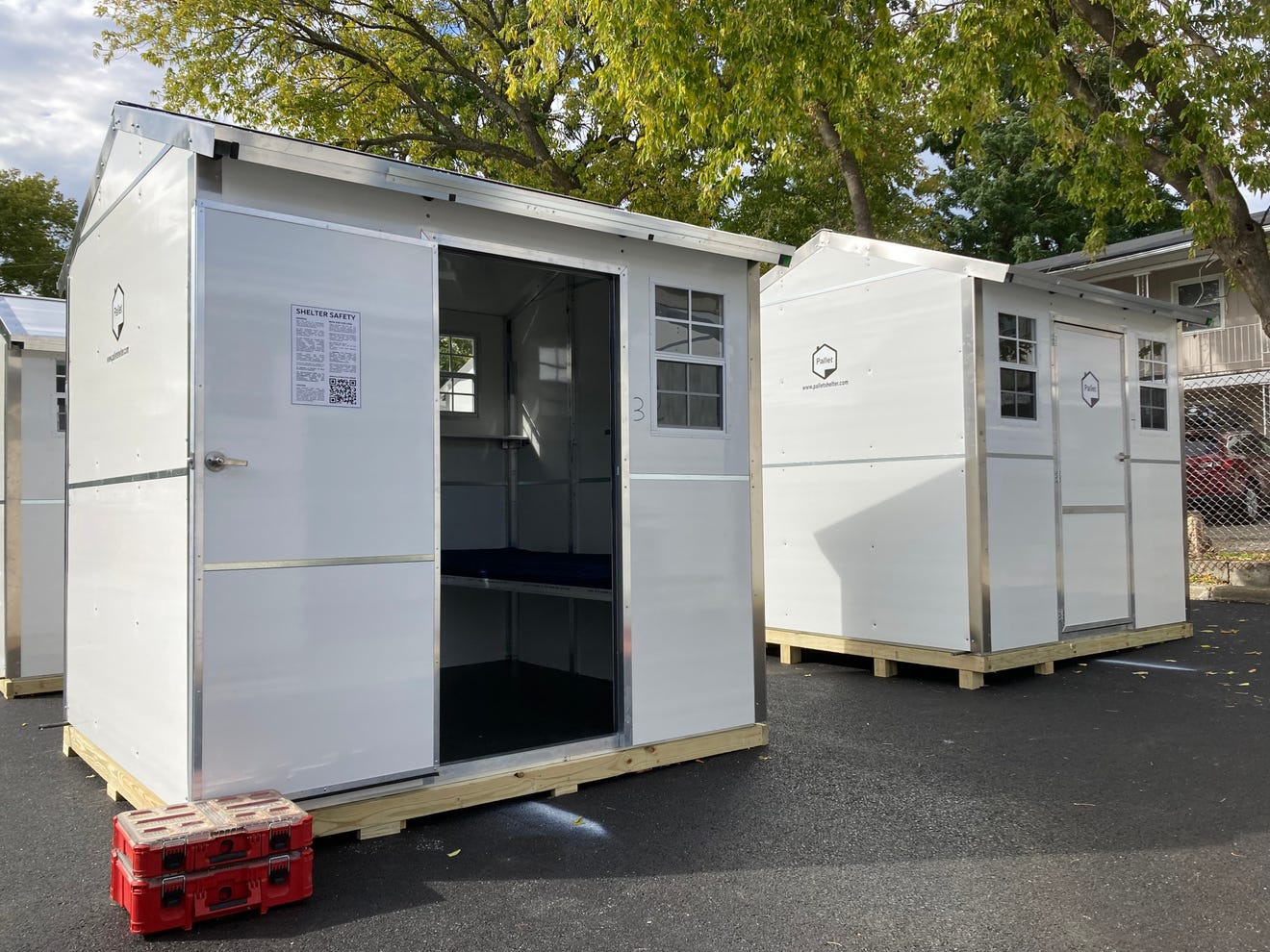
Photo: Lily St Angelo/Burlington Free Press.
Pallet shelters opened in Burlington, Vermont, in November 2022.

Is this unfancy housing a good idea? It’s a reprieve from sleeping rough. It’s off the bare ground, it provides a roof and some heating and cooling, but … but …

In January, Wheeler Cowperthwaite wrote about “pallet shelters” (above picture) for the Providence Journal.

“Since the onset of the COVID-19 pandemic, when the limitations of congregate homeless shelters became clear as the world shut down against a new disease, House of Hope Executive Director Laura Jaworski has been thinking about pallet shelters.

“Three years later, as Burlington, Vermont and Boston have set up their own pallet shelters, Providence could be next in line with a plan for 45 individual tiny shelter buildings, 70 square feet, with screened windows, fire extinguishers, smoke and carbon-dioxide detectors, electrical outlets and their own heating and cooling systems.

“State officials are ‘pursuing’ a plan to open a 45-unit pallet-shelter village on state land off Victor Street in Providence, state Department of Housing spokeswoman Emily Marshall wrote in a news release.

“An additional four ‘office units’ are in the plan, as the site would be staffed at all times, as well as a ‘free-standing community room’ and a combination shower/bathroom and a laundry room. The shower and bathroom would be Americans with Disabilities Act compliant. …

“The proposed site is on 1 acre of a 4-acre half-moon-shaped lot on Victor Street that is bounded by the on-ramp for Route 146 from Douglas Avenue, as well as by Route 146. One street over, on Chalkstone Avenue, is the Foxy Lady strip club.

“It is unclear how long people will stay, but it’s meant to help them stabilize and move into permanent housing. … Rhode Island Homeless Advocacy Project Director Eric Hirsch said the pallet shelters are very needed and will make a difference to the state’s estimated population of 300 people sleeping outdoors.

” ‘These are a particularly good option, and I like the way they’ve set it up, with one person in each unit, so you don’t have to worry about roommate conflict,’ Hirsch said.

“The pallet shelters will take referrals from the state’s Coordinated Entry System, including those who have been chronically homeless.

“The pallet-shelter initiative is largely a result of outreach workers listening to people struggling with homelessness, and the reasons they would rather live outside than go to congregate shelters, where their lives and behavior are largely controlled by the operators, Jaworski said. …

“In congregate shelters, there is no privacy, people are often kicked out early in the morning and not allowed to come back until late in the afternoon and do not allow people to decompress and begin shifting from survival mode to secure residency. …

“Among the ways the pallet shelter would meet people where they are is allowing pets, including having a dog run, and allowing couples. … Pet ownership being banned and couples being separated were two of the major things that providers found were preventing people from taking offered shelter options, she said.

“Each shelter would also have electric service, which is especially important for people who need medication to be refrigerated, including anyone who needs insulin. …

“The city Board of Contract and Supply has scheduled a Jan. 16 hearing on a proposed $475,763 contract with House of Hope, paid for with American Rescue Plan Act funds, as well as a $475,394 outlay for Amos House to extend its program, or add shelter beds, at the Charlesgate shelter program. … In an email, Providence spokesman Josh Estrella wrote that, because the proposed shelter community would be built on state-owned ‘public right-of-way land,’ it is exempt from city zoning regulations.”

My only question is: Since temporary fixes so often become permanent, who is in charge of seeing this solution is truly transitional?

More at Projo, here. A February update from Sarah Doiron and Kayla Fish at WPRI notes that the shelters will open in early spring. See WPRI here.

Read Full Post »

Photo: Charles Lawrence.
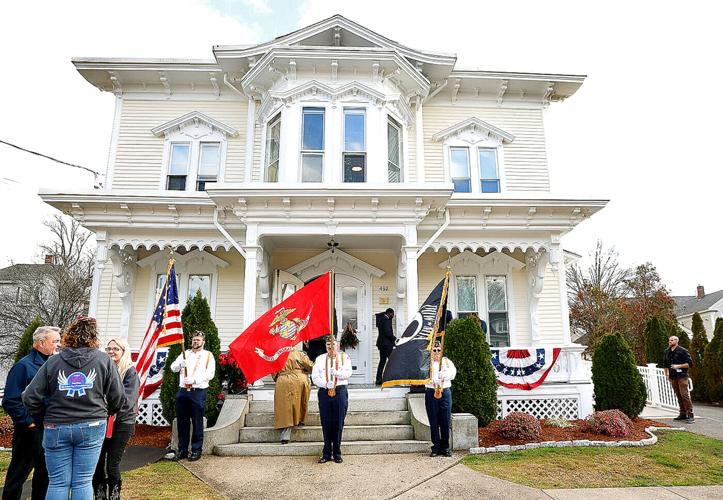
A renovated 1865 Woonsocket, RI, home now provides living space for homeless female veterans.

When one thinks of homeless veterans, one tends to think of men. I remember visiting a new space for veterans when I worked at Rhode Island Housing. Saccoccio & Associates were the architects for the historic renovation of the Heaton and Cowing Mill in Providence, which created 20 units of veterans housing. It was beautifully done, but it did not house women.

So I was interested to read about housing specifically for female veterans in nearby Woonsocket, Rhode Island.

Bella Pelletiere has the story at the Valley Breeze.

“Homeless female veterans in Woonsocket will now have a home to spend the holidays in, say representatives from Operation Stand Down Rhode Island.

“[In November] the historic house at 495 South Main St. was reopened as transitional housing for female veterans in honor of the late Marine Corporal Andrea Ryder.

“Operation Stand Down Rhode Island is Rhode Island’s primary nonprofit resource for homeless and at-risk veterans. OSDRI facilitates a combination of permanent supportive, transitional and recovery housing to low-income and disabled veterans and has 88 locations for housing throughout the state.

“Executive Director Erik Wallin told The Breeze that since 2010, OSDRI has been operating a six-unit facility in Johnston for female veterans. That facility was recently filled to capacity and they have been trying to find alternative ways to house female veterans, who are currently allowed to stay between 6 and 24 months. …

“In May, Wallin told news sources that lead paint had been discovered during renovations, but OSDRI was working with the city and painters to restore the building. Though it was a long process, he said they knew they wanted to restore this ‘magnificent piece of architecture’ for the veterans who were coming to live there.

He added that they wouldn’t house veterans in any building they wouldn’t put their own family members in. …

“OSDRI dedicated the home to Ryder, a Rhode Island native who enlisted in the Marine Corps after graduating high school and was diagnosed with stage three melanoma when she left the service. After numerous surgeries she appeared to be in remission. In 2014, Ryder learned both that she was pregnant and that the cancer had returned at stage four.

“Ryder give birth to her baby girl in 2014, and in 2020, she ultimately succumbed to her illness after spending some time in hospice.

“Wallin said that throughout the years, they had gotten to know Ryder and her family, hosting fundraisers and supporting her until she died. …

“Many officials attended the reopening of the [house], including Tony DeQuattro, president and chairperson of the board of OSDRI, Sen. Sheldon Whitehouse, and Ryder’s family members.

“Ryder’s mother, Donna Paradiso, as well as her daughter, Olivia, and husband, Dennis Bourassa, also came to celebrate the life of their loved one and her name that will live on at 495 South Main St.”

These stories of veteran homelessness are so sad. You just know every time a war starts up that some who serve will come back traumatized. Some will end up homeless. We never do enough for them, but organizations like Operation Stand Down keeping chipping away at the needs.

More at the Valley Breeze, here. No firewall.

Read Full Post »

Photo: Sarah Matusek/The Christian Science Monitor.
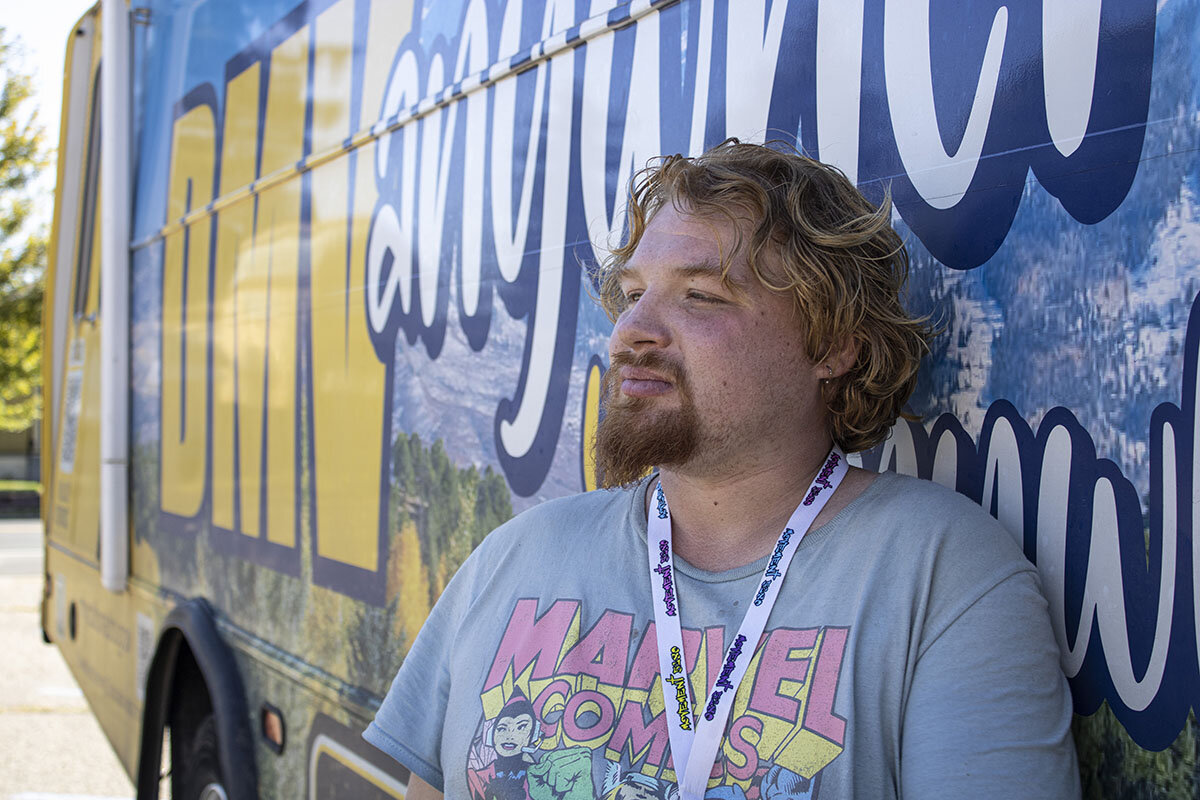
At Colorado’s roving Department of Motor Vehicles — a bus — people experiencing homelessness and others can get an ID.

Some kind of ID is necessary in life — to apply for a job, get a bank account, rent an apartment, and sometimes to vote. That’s why Colorado has decided everyone should be able to get legal identification. The state’s Department of Motor Vehicles (DMV) is making it happen.

Sarah Matusek writes at the Christian Science Monitor, “Radio in hand, Steven Rustemeyer ushers the next person aboard the bus. … This bus has no rows of seats, no driver or destination. This is a project of the Colorado Division of Motor Vehicles – a DMV on wheels. It sits parked with an office inside – complete with computer, printer, fingerprint reader, and vision test chart. 

“ ‘It’s easier that way,’ says Mr. Rustemeyer, who got a new ID from the mobile clinic earlier this year. Homeless for eight years since he aged out of foster care, he says he appreciates not having to pay bus fare to head to the brick-and-mortar office. The bus shows up once a month at a nonprofit whose job readiness program he attends – and where he’s helping out today. The stop is one of several across the state. …

“As it issues IDs and licenses to hard-to-reach Coloradans, the DMV2GO program blunts bureaucracy by saving time and travel to traditional sites. Officially launched last year, the mobile program has issued around 11,000 documents as of September, stopping by incarceration sites, homeless shelters, universities, and rural community hubs. Given how IDs are key to securing housing, work, and other basics, the goal is to ensure equitable access to identity services for all, says Desiree Trostel, the program manager.

‘It’s important to “meet people where they’re at,” ‘ Ms. Trostel says, ‘regardless of circumstance or location.’

“Mobile staff members report more enjoyment on the job, too. Customers on the road are ‘a lot happier to come and see us,’ says Liz Kuhlman, an upbeat licensing technician on the bus.

“In mountainous Archuleta County, where there is no state DMV, Warren Brown says he and his wife saw the problem up close. At their former insurance business, part of the job meant helping older customers navigate license services online. 

“ ‘In my mind, this just didn’t have to be that way,’ says the county commissioner, who contacted the state for help. His constituents were first in line to benefit from the formal rollout of DMV2GO in 2022. …

“Customers can apply for or renew driver’s licenses or ID cards, including out-of-state transfers. The clinic doesn’t offer knowledge tests or print the physical card on-site (those will arrive later by mail), but it does offer temporary ones. …

“The Florida Licensing on Wheels program, or FLOW, has operated since 1988, says David Brown, a FLOW program manager. Beyond making regular stops, it’s also grown to respond to manmade and natural disasters. … ‘In order for you to start the process of rebuilding after a disaster, you need those solid credentials,’ he says.

“Rebuilding can also mean navigating society after incarceration. That’s why DMV2GO’s list of stops includes sites like the Jefferson County jail. …

“Convenience aside, mobile DMVs also aren’t without challenges. Spotty internet access in rural areas, for one, can complicate service. And in Colorado, demand is high for the program that currently involves four licensing technicians and three vehicles. The state says it’s gathering data on DMV2GO’s impact and hopes to expand. 

“That demand is clear at a recent stop at a public library in rural Westcliffe when a dozen people arrive ahead of the clinic’s opening at 10 a.m. Though a couple of locals note the wait, those in line still appreciate the service.

“ ‘This is awesome,’ says John Van Doren, a retiree here for a license renewal. ‘Very convenient.’ “

More at the Monitor, here.

Read Full Post »

Photo: Ned Gerard/Hearst Connecticut Media.
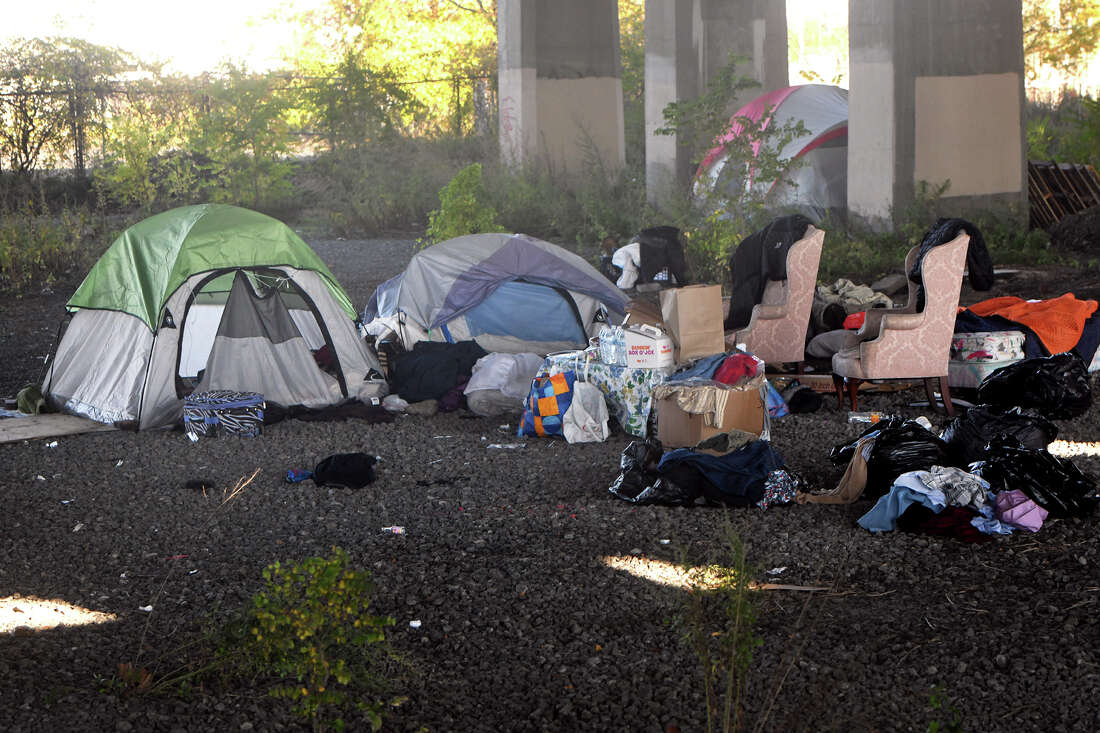
A homeless camp set up in Connecticut.

We really do have housing crisis in this country, and it’s going to be expensive to fix it. Government can’t do it alone, says my friend Jeanne, who has been researching the subject. It will require partnerships with builders and communities that imagine the current situation can’t hurt them.

In the meantime, don’t blame the people who fall into homelessness. It’s harder than ever to work your way out.

Joana Slater writes at the Washington Post about a woman in Connecticut who has been there and now assists others. “Shanta Wiley sits down in a swivel chair, slips on a black headset and takes a deep breath. Three minutes to go. It’s 7:57 a.m. on a Friday, and the Connecticut homelessness hotline that Wiley staffs is about to open.

“With each shift, Wiley hears from people sleeping in cars and parks, people evicted by landlords or turned out by relatives. Frightened, angry, vulnerable people seeking shelter at a time of rising rents in one of the most expensive states in the country. Calls have surged in recent years, and Wiley’s job is to funnel a tide of need toward limited help.

“On this morning, Wiley’s mind is still on one of the prior day’s callers: a young woman living in her car with her 2-year-old child. For several minutes, Wiley just listened to her cry. Then they made a list of next steps to find a spot at a shelter.

“She’s still thinking about the woman when a beep sounds on the line.

“ ‘211 Housing Crisis,’ Wiley answers, her voice light and even. ‘Shanta speaking, how can I help you?’

“It’s a mother of two girls, ages 5 and 6. She’s staying temporarily in a hotel in the southern part of the state. Checkout is in three hours and she doesn’t know where to go. Before the hotel, she and her kids were staying in a car, ‘taking washes at McDonald’s and stuff,’ the woman says. ‘There’s nobody out here to lean on at all.’

“ ‘Completely understand,’ says Wiley. ‘Glad to assist you.’

“Behind the courtesy is a story the caller will never hear. Wiley understands exactly how the woman is feeling. She knows, because she was once the person calling for help.

“Wiley, 41, started working at the 211 Housing Crisis Line, which is run by United Way of Connecticut, in January. For nearly a decade, it has served as the central access point for all shelters in the state.

“The work is a window into the acute shortage of affordable housing nationwide and the withdrawal of pandemic-era programs aimed at protecting Americans from eviction and hunger. …

“So much of what [Wiley] hears on the calls echoes her own experience. There was the man who, when Wiley asked when he last ate, said he was fine with a cup of coffee. Wiley remembered that well. When she had no money for groceries at the end of the month, she’d let her kids eat while she just drank coffee. …

“Wiley went to a high school with a lively debate program, which she loved. In her senior year, she became pregnant and had a baby boy. She still graduated. After a year, she dropped out of college and later broke up with her fiance. It was the start of a long period of instability. She had another son and was staying with her parents when they were evicted from their apartment in 2005. Wiley and her two boys, the youngest an infant, ended up in a shelter in south Hartford.

“Even then, she was always working, always pushing ahead with her studies. At the shelter, Wiley’s mom watched the kids while Wiley worked the overnight shift processing checks for Bank of America. For four years, Wiley worked at Target. She completed her associate’s degree and later her bachelor’s in business administration.

“But steady housing remained elusive. Many landlords seemed wary of renting to a single mother. There were spells staying with her mother, with a cousin, with a boyfriend. She and her boys slept on couches and living room floors.

“In 2012, she was living at her mother’s place when it was condemned, forcing the whole family, yet again, to look for somewhere else to live. A friend told Wiley about an apartment available in her building.

“It was the worst one yet: Drug dealers hung out inside the front entrance and patrolled the halls. The building was regularly raided by police. Wiley remembers sitting at the kitchen table and crying as she tried to finish a college paper on entrepreneurship while people used drugs outside in the hallway.

“After a month, she saw a listing for a place nearby and grabbed it. She had started a new job with the Hispanic Health Council doing outreach with pregnant women. That meant she needed a car to do home visits, so she purchased a used Saturn Ion.

“Soon she faced a choice familiar to many on the hotline: Either she lost the car critical to her job, or she fell behind on rent. She chose the latter. If she had to, she reasoned, she would park her car in her mom’s driveway and her kids would sleep inside while Wiley stayed in the vehicle.

“Midmorning, Wiley takes the first of two 15-minute breaks. … She just sighs.

“ ‘It’s heavy,’ she says. … Especially in situations where ‘there’s no answer — or not much of an answer.’

“Sometimes, when Wiley puts callers on hold to look up information or arrange appointments, she uses it as a chance to step away from the intensity of the need. …

“At 11:56, Wiley takes a call from a mother of two children, ages 3 and 13. They’ve recently arrived in Connecticut from Georgia and are staying with a friend, but it’s a volatile situation. The woman is reluctant to say more. Wiley explains that she will arrange an intake interview for a shelter, but a spot is not guaranteed.

“ ‘Are you okay?’ she asks. ‘Not really,’ the woman replies, and begins to cry. Wiley urges her to get her teenager enrolled in school and directs her to the state’s child-care hotline so she can apply for assistance for her toddler.

“ ‘She has to get that child in school as soon as possible,’ Wiley says. That’s the very first thing Wiley would do when she and her boys were in a new area. It gave them a sense of normalcy, she says, plus ‘I could think while they’re in school.’ …

“Wiley’s mind is on the future. She is teaching herself a programming language so she can look for work as a data analyst to increase her pay. ‘I want to break those generational curses,’ she says.

“Her older son is studying to become a machinist and her younger son is preparing to attend the Connecticut School of Broadcasting. … A few weeks ago, her older son, Justus, gave her a measure of closure. He told her everything that had happened to them wasn’t all her fault. ‘He’s like, “You were always working and going to school. You really was trying,” ‘ Wiley recalls.

“Looking back, Wiley says there were times she made poor decisions. But mostly, it’s a question of the system, she says. What she hears on her calls hasn’t changed much since she was one of the callers.

“ ‘You have to literally be at the total bottom before they help you,’ she says. ‘They’re not going to help you before you get to that point.’ ”

Do you notice how many of those experiencing homelessness are women with young children? In addition to the lack of housing, something else is definitely not right.

More at the Post, here. For deeper insight, read Matthew Desmond’s Evicted, here, or Tracy Kidder’s Rough Sleepers, here.

Read Full Post »

Photo: Still image of A1 Hand Car Wash surveillance video.
Ron Nessman stops a baby stroller that was freely rolling into the path of traffic after being blown by wind in California. 

I once read a mystery series in which a man spends all his spare time trying to track down the homeless man said to have pushed his wife and child into the path of a New York subway car. But appearances can be deceiving, as readers learn if they stick with the series.

I thought of those books when I read today’s story about a homeless man who stopped a runaway stroller.

Ramon Antonio Vargas reports at the Guardian, “Having experienced homelessness and unemployment for years, Ron Nessman was leaving a job interview at an Applebee’s restaurant in California when a baby in a stroller rolling into the path of several cars captured his attention.

“Nessman sprinted toward the stroller, stopped it before it reached the roadway, saved the child from harm – and landed his first job in years. …

“ ‘I didn’t even have time to think about it,’ Nessman told the local news station KOVR-TV when reflecting on his actions, which many have hailed as heroic. ‘You just react.’

“Unhoused for about eight years, Nessman had reportedly been living with his sister during recent months and was in need of work when he went to an Applebee’s in San Bernardino county to interview for a position washing dishes at the restaurant on May 1. Nessman had left the interview and was waiting on a bench outside when he spotted an extraordinary emergency unfolding.

“A woman had stopped on the driveway of a nearby car wash and loaded her great-nephew into a stroller when strong winds blew the baby away from her. The woman chased after the stroller but fell, and she struggled to get back up as she helplessly watched the baby roll toward a street which was packed with motorists who may or may not have been obeying a speed limit of 40 miles an hour.

“Nessman immediately jumped up from the bench, sprinted to the stroller and stopped it with his right hand as it approached the nearest traffic lane, according to dramatic video captured by a surveillance camera at the car wash. He turned the stroller around and began wheeling it up the driveway as at least eight cars who did not appear to notice the scene zoomed by.

“ ‘I said, you know, “I got it!” ‘ Nessman recounted. … I felt so bad for the lady. I got nephews and nieces. I can imagine something like that.

” ‘I wouldn’t have been able to live with myself if I did nothing.’ …

“The video of Nessman’s leaping into life-saving action circulated widely on social media. Nessman told the California news station KNSD that relatives as far away as Florida and Missouri had seen the footage.

“In his interview with KOVR, Nessman said he began experiencing homelessness after becoming deeply struck with grief over his girlfriend’s unexpected death.

“ ‘It was sudden and I didn’t want to do anything,’ Nessman said. …

KNSD reported on May 4 that Applebee’s subsequently hired Nessman, and his orientation was scheduled for the next day.”

More at the Guardian, here. No firewall.

Read Full Post »

Photo: Rick Bowmer/AP/File.
People collect their belongings as Salt Lake County conducts a homeless camp cleanup of the Fleet Block area in 2021. Today Utah and a few other states are considering government-sanctioned tent encampments as steppingstones for those without homes.

One has to appreciate politicians who try to solve problems rather than sweep them under the rug. If people are homeless, kicking them out of an encampment with nowhere to go just creates an encampment somewhere else. Some states are considering a different approach.

Patrik Jonsson reports at the Christian Science Monitor, “When Salt Lake City began enforcing an urban camping ban several years ago, hundreds of Utahns picked up their belongings and headed toward the Jordan River.

“For centuries, the river has been a trading post, a border, and a nexus of nomadic activity. But most of all, it has been ‘a place of refuge,’ says Søren Simonsen, executive director of the Jordan River Commission.

“Today, growing numbers of encampments filled with Americans without permanent homes dot the banks of the river. And Mr. Simonsen is on the front line of what to do about it.

“A decade ago, Utah claimed it had largely ‘solved’ homelessness, reducing it by 91%. Now it is considering an idea, supported by Mr. Simonsen, that is gaining traction across the United States: outlawing unsanctioned camping and instead creating government-sanctioned tent encampments as steppingstones for those without homes to find more permanent housing.

“For much of the recent past, one assumption in addressing homelessness has been that everyone wants a solid roof. The debate over encampments is shifting those assumptions.

“Increasingly, cities and states are exploring whether there can be a sense of dignity and agency in ‘safe outside spaces’ as an end in themselves. As some carry out sweeps to clear out encampments, others are experimenting with the idea of making them more humane, hygienic, and livable as one potential part of the solution to the housing crisis. …

Says Mr. Simonsen. ‘Can’t we make space for people that aren’t ready, aren’t capable, aren’t interested in living such a fixed-address kind of lifestyle?’

“The situation is Utah is common across the country. Tent encampments have ‘definitely become more of a visible issue since the pandemic,’ exacerbated by a national housing shortage, says Courtney Anderson, an expert on social welfare law at Georgia State University College of Law in Atlanta. ‘It’s a problem that people can see, so they need a solution where they can’t see it.’

“Under pressure from voters, officials are taking action. Authorities in Rhode Island cleared an encampment from the steps of the state capitol in December. Washington, D.C., conducts regular camp removals. New York City has conducted hundreds of ‘sweeps’ under Mayor Eric Adams. Residents have largely hailed the efforts, but the majority of those affected haven’t moved into more permanent housing. …

“ ‘The raiding of camps is really tragic,’ says Professor Anderson. ‘The more you dehumanize people, the easier it is to do that kind of thing.’

“The 9th U.S. Circuit Court of Appeals ruled it is unconstitutional to ban sleeping in public if there are no other sleeping options available, and some municipal courts have made similar rulings. But this year, Tennessee made camping away from sanctioned areas a felony. Other states are following suit.

“The Georgia Senate is considering a bill that would criminalize camping and force municipalities to comply. But the bill would also allow the state to designate areas for sanctioned camps.

“In Savannah, Georgia, Shirley Walkowicz says the move to criminalize what she is doing – living in her car – ‘just shows that people don’t [care] about me and people like me.’ …

“The Georgia bill is significantly based on the thinking of Judge Glock, a senior fellow at the nonpartisan Cicero Institute. Dr. Glock saw the early potential of ‘housing first’ – an Obama-era policy that ended requirements such as drug testing for housing recipients. But he now says the policy has largely failed. An average of five homeless people die on the streets of Los Angeles every day, he says – more than twice as many as a decade ago.

“ ‘This is a crisis situation,’ he says. ‘It’s about what we can do this month, this year. We can’t just sit on our hands until the housing [shortage] is solved.’

“He points to cities such as Austin, Texas, and Portland, Oregon, which are banning makeshift encampments but creating safe spaces for people without homes.

“ ‘The argument is, if cities are going to allow it, make sure they provide the things you need: sanitation, social services, security,’ says Dr. Glock. …

“Birmingham, Alabama, has just voted to erect a tiny house village to accomplish many of these goals. For City Council member Hunter Williams, the logic is clear. …

“ ‘We don’t have to have tent cities under every overpass in America. … We can do better than that.’ ”

More at the Monitor, here. No firewall; subscriptions welcome.
Read Full Post »

Photo: Parker Michels-Boyce for NPR.
Eric Perkins (right)
says lived on the beach, then a shelter and then in a hotel during the pandemic before moving into the Norfolk apartment,” NPR reports.”The median local rent for a one-bedroom apartment is over $1,000. Perkins’ rent is $600.

This is a story about an approach to housing that hasn’t always worked in the past but, when carefully managed, really can move people out of homelessness and into eventual independence. It’s called the roommate.

Jennifer Ludden has a report at National Public Radio (NPR).

“Even after three years of homelessness, Eric Perkins did not want to move into an apartment with another person who had been unhoused.

” ‘I was real skeptical because of the things I was seeing inside the shelter,’ he says. ‘A lot of drug use, lot of alcohol abuse, PTSD, there was a lot of veterans there. …

“But the arrangement suggested by a local housing provider has turned out better than he expected. On a recent afternoon, Perkins gave a tour of the two-story house where he has lived for more than two years. It’s divided into two apartments, and he shares the one on the first floor. The place came furnished, including with some homey knickknacks. Perkins has his own bedroom but shares a bathroom.

” ‘It’s small, but it’s enough for us,’ he says.

“Farther down the hall is what sold him on the place — a roomy kitchen with a window onto the small yard. ‘I like to cook,’ he says. ‘This is where I want to be.’

“Before he moved in, Perkins had lived on the beach in Virginia Beach, then a shelter and — during the pandemic — a hotel. He ended up without housing after a heart attack in 2017 and double-bypass surgery with no health insurance. He also has chronic lung disease that limits his ability to work. Perkins’ monthly disability payment is just under $800. The median local rent for a one-bedroom apartment is more than $1,000.

“After seeing the apartment and meeting the roommate he’d be paired with, Perkins decided to try it out. His rent is $600, and he gets a lot of help from housing aid. He says his roommate was also a good match with his personality, neat and quiet.

” ‘We got to know each other, we respected each other’s space, we shared everything,’ he says. ‘It was really nice.’

“That roommate ended up reuniting with his family and moved out, and in April 2021, Leon Corprew moved in. Corprew is 59 and Perkins is 56. They say they get along well, though they mostly keep to themselves and give each other space. Perkins used to cook for both of them, but Corprew makes his own meals now because, he says with a laugh, ‘I eat a lot!’

“Getting homeless people into their own apartment, without roommates, is considered the ‘gold standard’ for achieving independence, says Ann Oliva, CEO of the National Alliance to End Homelessness. But record high rents and a historic housing shortage are making it all but impossible in many places in the U.S. …

“Rents in many places around the country have gone up by double digits in the past couple of years, and in June, the median listed rent for an available apartment rose above $2,000 a month for the first time. Federal benefits like Supplemental Security Income — or disability — have been unable to keep up. …

“Oliva says she’s seeing more interest in offering roommate arrangements to homeless people out of necessity. When vacancy rates are as low as 1% or 2%, she says expanding the search to two- or three-bedroom apartments can make it easier to find a place.

“It may also lead to housing in nicer neighborhoods, says Todd Walker, executive director of the Judeo-Christian Outreach Center in Virginia Beach, which found the shared apartment for Eric Perkins.

“Walker started trying out this kind of shared housing eight years ago when one of his volunteers offered to rent out a four-bedroom family home. And he says he quickly learned some of the pitfalls.

” ‘We had clients that weren’t paying [rent], other clients giving that client their money to pay for the utility and it wasn’t getting paid,’ he says. ‘It was a catastrophe.’

“The first major lesson Walker learned was to have a separate lease for each roommate. That way, if one person is a problem they can be moved — or evicted — without everyone else being kicked out. Also, he says it’s important to keep utilities in the landlord’s name and include that cost in the rent.

“Another rule that Walker considers nonnegotiable: No doubling up in bedrooms, and there must be locks on the bedroom doors so that each renter is guaranteed a safe space. …

“The whole idea can also be a tough sell to landlords, who might worry about property damage. Walker talks it up to mom-and-pop landlords at every chance and offers incentives like a bonus or double deposit. He says these arrangements often let him house people who would otherwise be denied a lease, because of lack of income, a criminal record or past eviction. …

“Landlord Sophia Sills-Tailor owns the house where Perkins and Corprew live. When she heard about Walker’s program five years ago, she was desperate to rent out a couple of places. She’d been using Craigslist but found those tenants ‘fly-by-night.’ Working with a nonprofit seemed more stable, even if its clients were homeless.

” ‘When they come in, they don’t just say, “OK, here is the person, goodbye,” ‘ she says. They help them set up the household, donating things like blankets, pots and pans. ‘”‘And then they’re coming to see them.’ “

More at NPR, here. No firewall.

I love that when Perkins says the shared apartment is small, he adds that it’s “enough for us.” The roommates are not friends, but they are still an “us.”

Read Full Post »

Photo: Genna Martin/Crosscut.
Writes Crosscut, “In their roles as King County support services specialists, Kirk Rodriguez, right, and Joe Barnhart walk the area around the King County Courthouse and City Hall Park, as they build relationships with those who live or hang out in that area, … using their own lived experiences with homelessness to form connections.”

After a recent post on better approaches to homelessness, Hannah sent me a link to a New York Times opinion piece by Maia Szalavitz.

“The needs of homeowners and businesses and those of people who are unsheltered often conflict, ” she writes. “Community leaders, faced with increasing crime and disorder, frequently see police sweeps as the only answer, while advocates for homeless people argue that this response is merely a stopgap that does more damage than good.

“But what if there was a way to stop shifting ‌‌people from encampments to jails to shelters to hospitals and back again? In Seattle a unique collaboration among businesses, neighborhood groups, the police, advocates and nonprofits is fighting cynics and misperceptions driven by politics to cut homelessness.

“The coronavirus pandemic presented Seattle with a crisis and an opportunity. In early 2020, authorities closed congregate shelters, emptied jails and stopped new arrests for minor crimes. Lisa Daugaard, a lawyer, saw a rare chance to develop a new approach to addressing homelessness that didn’t involve law enforcement.

“She’d already had success in getting officials to cooperate across siloed systems: In 2019, she won a MacArthur ‘genius’ award for helping to create a program originally called Law Enforcement Assisted Diversion, which has now been replicated in over 80 jurisdictions across the United States.

“Instead of re-incarcerating homeless people who typically already have long histories of minor arrests, police departments that participate in LEAD refer them to case management services. The program has an overall philosophy of harm reduction, which, in addition to securing shelter, focuses on improving health, rather than mandating abstinence from drugs and other risky behaviors. LEAD originated as a collaboration of public defenders, the police and prosecutors, who put aside differences to work on solutions.

“Peer-reviewed research published in 2017 by the University of Washington found a 39‌‌ percent reduction in felony charges for participants (a group of over 300 people suspected of low-level drug and sex work activity in downtown Seattle) in LEAD compared with controls and an 89‌‌ percent increase in the likelihood of being permanently housed for participants after they started case management. ‌‌

“At the height of the pandemic, when the police were ordered not to make minor arrests or referrals to LEAD, Ms. Daugaard decided to try something new. With federal pandemic funds becoming available and desperate hotel owners newly open to being paid to house nontraditional guests, she said she saw ‘our chance to show that there is another way.’

“Ms. Daugaard and her colleagues created a program now known as JustCare. JustCare staff members, rather than police officers, would respond to urgent calls about encampments. After building trust with ‌‌local homeless people, the workers would move them into housing without strict abstinence requirements and then help clean up the site. The police would be contacted only as a last resort.

“An early success involved an encampment on a major thoroughfare, Third Avenue‌‌, where around two dozen tents were ‌‌erected directly outside the popular local restaurant Wild Ginger, which had closed under pandemic restrictions. A co-owner, Rick Yoder, wanted to reopen the restaurant in the summer of 2021, but he told me, ‘I couldn’t get the windows repaired because the guy said, “I’m not going near those tents.” ‘ …

“Outreach workers from JustCare managed to house ‌‌those living in the encampment and clean up the site without police reinforcement. …

‌”The work begins with no-strings offerings of items like food, water and clean needles‌‌. These regular visits help‌‌ demonstrate trustworthiness and defuse fear about coercion. Creativity is also a must: Conflicts arise over everything from open drug use to burning items for heat. Workers neutralize tense situations with humor and compassion and by recognizing that often bizarre behavior is driven by fundamental needs like hunger, thirst and exhaustion.

“Alison McLean owns a condo in the Pioneer Square neighborhood and contacted JustCare for help dealing with tents that started being pitched against her building during the pandemic. …

“JustCare began its outreach. ‘Maybe two weeks later, they were like, “We found housing for everybody,” ‘ Ms. McLean said. …

“Between the fall of 2020 and this past spring, JustCare closed 14 encampments and placed over 400 people in hotels and other lodging.”

More at the Times, here. Thanks, Hannah. Good tip.

Read Full Post »

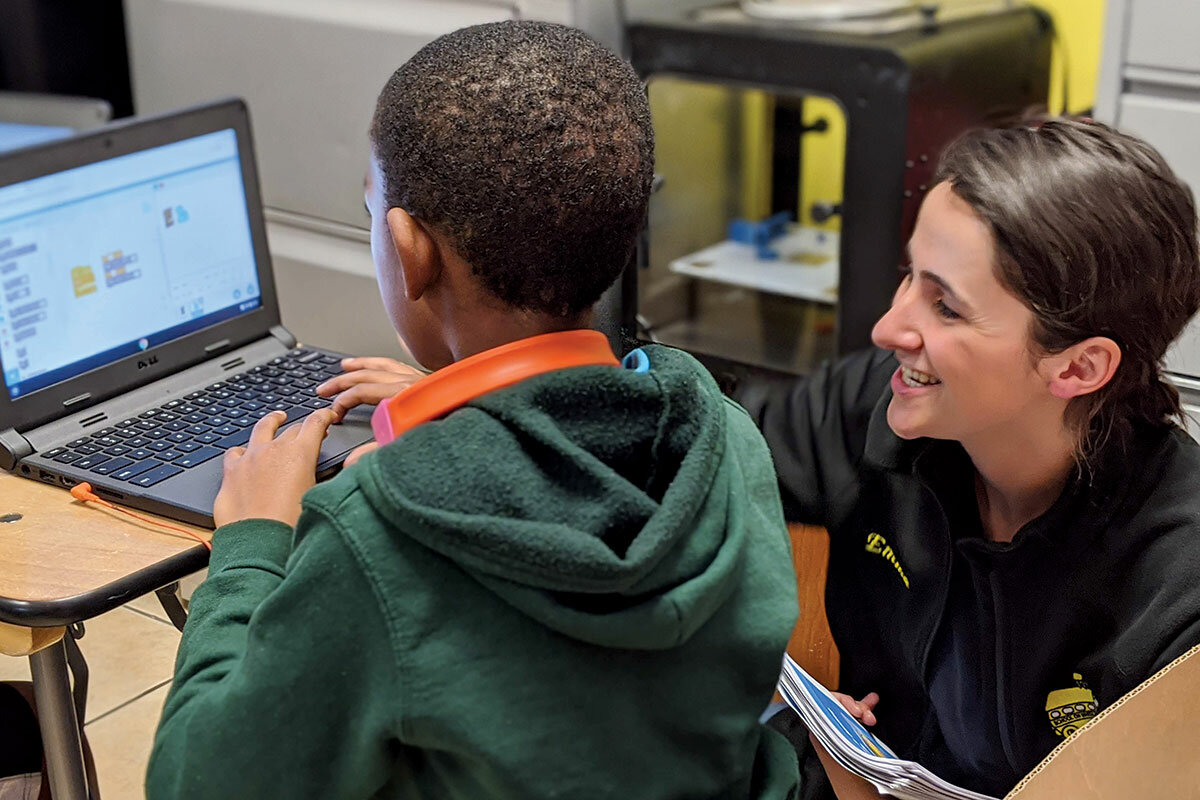
Photo: School on Wheels.
A student at School on Wheels’ Skid Row Learning Center works with staff member Emma Gersh.

All children need an education, but those experiencing homelessness get a spotty one at best. That’s a situation the nonprofit School on Wheels is aiming to rectify.

Magda Hernandez wrote about it at the Christian Science Monitor. “The little girl was 6 years old, and life hadn’t been kind to her. 

“When Catherine Meek walked into a homeless shelter for their tutoring session, she found the child hiding under a desk. 

“No questions asked, the volunteer joined her on the floor and began reading to her. For an hour a week, the session would allow the girl to be just a kid, getting the assistance she needed, and for at least a moment forgetting about the circumstances that put the girl educationally behind by about a grade. 

“The space remained their meeting spot for six sessions until, one day, Ms. Meek walked in to find the girl sitting at the desk waiting for her. 

“ ‘I had, I remember, the biggest smile on my face, and she did too,’ Ms. Meek says. ‘I think even at that young, vulnerable age she understood that something had changed, that there was a set level of trust, that she could trust me.’

“Ms. Meek lights up recalling that moment – one of her greatest success stories as a volunteer tutor for School on Wheels, a nonprofit addressing educational needs of children K-12 who are experiencing homelessness. She and the girl worked together for about two years until the child moved out of state and they lost touch. 

“Recently, Ms. Meek – now executive adviser to the organization – attended that no-longer-little-girl’s wedding after they reconnected through social media. 

“A brainchild of the late Agnes Stevens, a retired schoolteacher, School on Wheels began in 1993 when she started tutoring kids living in shelters on Skid Row, an area of Los Angeles known for its large homeless population. In the next few years, she formalized her efforts, recruited more volunteers, and grew the organization with the help of Ms. Meek, who joined in 1999. 

“ ‘She was the inspiration and teacher and had the education background, and I had the business and financial background,’ says Ms. Meek.

‘The need was there in 1993, and it’s just grown astronomically since then. One in 30 kids in California in a classroom is homeless.’

“The organization grew steadily, partnering with shelters, school districts, motels, libraries, anywhere homeless families could be – even reaching those living in cars, in foster homes, and on the streets. With year-round operations in six counties, prior to the pandemic, the organization reached more than 3,000 homeless children a year, and it recruited and trained more than 2,000 tutors annually. …

“ ‘Students experiencing homelessness move on average about three to four times a year, and with each move, it’s estimated that they fall behind four months academically,’ says Charles Evans, the organization’s executive director. …

“School on Wheels doesn’t get into the students’ backgrounds but focuses solely on assessing the kids’ educational needs – like a fourth grader who is two grades behind in reading or a 10th grader who’s struggling with pre-algebra and biology – and matching them with tutors. …

“Says Mr. Evans. ‘We don’t pry and try to figure out why a family became homeless.’

“The children are assessed every few weeks to make sure they’re improving. Ms. Meek says that in 2021, K-4 students improved their literacy skills by 21%; in the past six months, fifth through eighth grade students increased math skills by almost one grade level, and self-efficacy surveys showed a 40% increase in confidence in ninth through 12th graders. 

” ‘Before the pandemic, tutors would meet students wherever they were – motels, shelters, libraries. But tutoring sessions have been remote – via donated Chromebooks and laptops – in the past couple of years. The drastic change had benefits and drawbacks. On one hand, students could stay in touch with tutors even on the move. On the other, School on Wheels had to pivot from handing out backpacks and school supplies to figuring out how to get digital equipment into kids’ hands and making sure they had Wi-Fi access. … Now, the organization is returning to in-person sessions, particularly for younger kids. But it will keep the hybrid model. …

“Outside of tutoring, School on Wheels is out to erase the stigma of homelessness. Many of the families the organization works with found themselves homeless through no negligence of their own – victims of domestic violence or economic hardship, doing their best to get back on their feet.

“For example, one single mother in her 20s, who for security reasons asked not to be named, left an abusive relationship, and ended up in a shelter with her four young kids. When she noticed her children falling behind in school, she connected with School on Wheels.

“ ‘It’s been the best thing ever, because my kids love their tutors,’ says the young woman, who works and goes to school. She now gets reports from school that her kids are doing much better: ‘The teacher did see a lot of improvement in [my daughter’s] math and her spelling.’ That motivates her to do better herself, says the mother.”

Read at the Monitor, here, about Angela Sanchez and how she got math help from a rocket scientist. No firewall.

Read Full Post »

Photo: World Housing.
In a tiny village on the outskirts of Nacajuca, Mexico, builders are creating new homes using an oversize 3-D printer.

Pop-up temporary cabins, 3-D-printed buildings: whether such super-cheap housing is a good idea or not, it’s probably the wave of the future because we are so far behind providing shelter for all. Typhoons, floods, entrenched poverty, opioid devastation. All require new solutions to homelessness.

First, let’s take a look at 3-D homes in Mexico.

Debra Kamin reports at the New York Times, “Pedro García Hernández, 48, is a carpenter in the southeastern Mexican state of Tabasco, a rainforest-shrouded region of the country where about half of the residents live below the poverty line.

“He ekes out a living making about 2,500 pesos ($125.17) a month from a tiny workspace inside the home he shares with his wife, Patrona, and their daughter, Yareli. The home has dirt floors, and during Tabasco’s long rainy season, it’s prone to flooding. Dust from his construction projects coats nearly everything in the home, clinging to the bedroom walls, the pump toilet and the counters of his makeshift kitchen.

“But that will soon change. In a matter of months, Mr. Hernández and his family are moving to a new home on the outskirts of Nacajuca, Mexico: a sleek, 500-square-foot building with two bedrooms, a finished kitchen and bath, and indoor plumbing. What’s most unusual about the home is that it was made with an 11-foot-tall three-dimensional printer. …

“And now, the era of the 3-D printed community has arrived. Mr. Hernández’s home is one of 500 being built by New Story, a San Francisco nonprofit organization focused on providing housing solutions to communities in extreme poverty, in partnership with Échale, a social housing production company in Mexico, and Icon, a construction technology company in Austin, Texas.

“When New Story broke ground on the village in 2019, it was called the world’s first community of 3-D printed homes. Two years and a pandemic later, 200 homes either are under construction or have been completed, 10 of which were printed on site by Icon’s Vulcan II printer. Plans for roads, a soccer field, a school, a market and a library are in the works.

“Single-family homes are a good testing ground for the durability of 3-D printed construction because they are small and offer a repetitive design process without much height, said Henry D’Esposito, who leads construction research at JLL, a commercial real estate firm.

They can also be constructed to tolerate natural disasters: Nacajuca sits in a seismic zone, and the homes there have already withstood a magnitude 7.4 earthquake. …

“ ‘We know that being able to build more quickly, without sacrificing quality, is something that we have to make huge leaps on if we’re going to even make a dent on the issue of housing in our lifetime,’ said Brett Hagler, New Story’s chief executive and one of four founders.

“The organization was started in 2015, shortly after Mr. Hagler took a trip to Haiti and saw families still living in tents years after the 2010 earthquake there. Across the globe, 1.6 billion people live with inadequate housing, according to Habitat for Humanity. …

“Speed is only one factor in bringing a village to completion — New Story has teamed up with local officials in Tabasco to bring sewage services, electricity and water to the community.

“Mr. Hernández, who has plans to expand his construction business to a larger space in his new home, said he was not focused on a move-in date. He cares about the long-term impact the home will have for his daughter, who is studying to become a nurse.

“ ‘When we receive the house, my daughter will be able to rely on it,’ he said. ‘She won’t have to worry anymore.’ ”

Meanwhile in Boston, construction crews have been working on a pop-up, temporary community to relieve the pressure at a trouble spot known locally as Mass and Cass.

Milton J. Valencia reports at the Boston Globe, “The crews had already built new pop-up cabins over the last two weeks. And on this day, they were digging through concrete to connect to water and sewer lines, putting the finishing touches on a new, makeshift cottage community to house people who are homeless.

“The pop-up community — which could be fully operational by Monday — is just one piece of what state and city officials hope will be the solution to a sprawling tent encampment at the intersection of Massachusetts Avenue and Melnea Cass Boulevard, what has become the epicenter of the region’s opioid crisis.

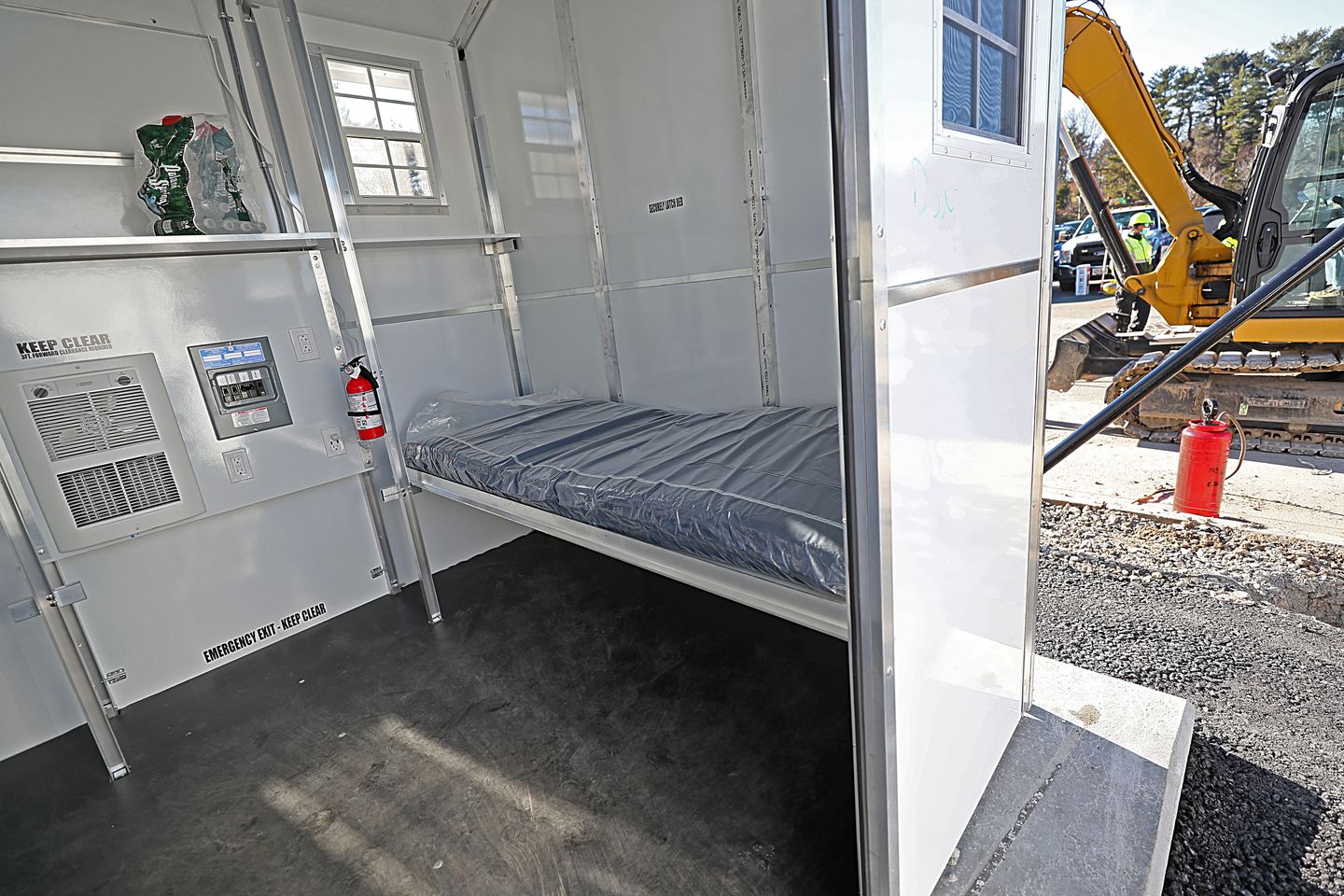
Photo: Suzanne Kreiter/Globe.
An inside view of one of the temporary cottages on the grounds of the Lemuel Shattuck Hospital campus.

“Seventeen sleeping cabins, ranging in size from 64 to 100 square feet, are lined up in two rows. At one end is a courtyard. And at the front of the village is a 500-square-foot structure that will serve as a common room, where those living there can gather for meals or counseling. Other services — to help treat addiction or mental illness — will be available at the site. And at the end of the day, those living there can retire to their own personal sleeping space. …

“As city officials and social workers push people to leave their tent encampments near the Mass. and Cass intersection, they invite them to the new cottage community, marketing it as a temporary but appealing option that could serve as a warmer, safer transition to long-term housing.”

Will there, in fact, be safer, long-term housing? That is the question.

More on 3-D homes at the Times, here, and on Boston’s pop-up community at the Globe, here.

Read Full Post »

Photo: West Volusia Beacon.
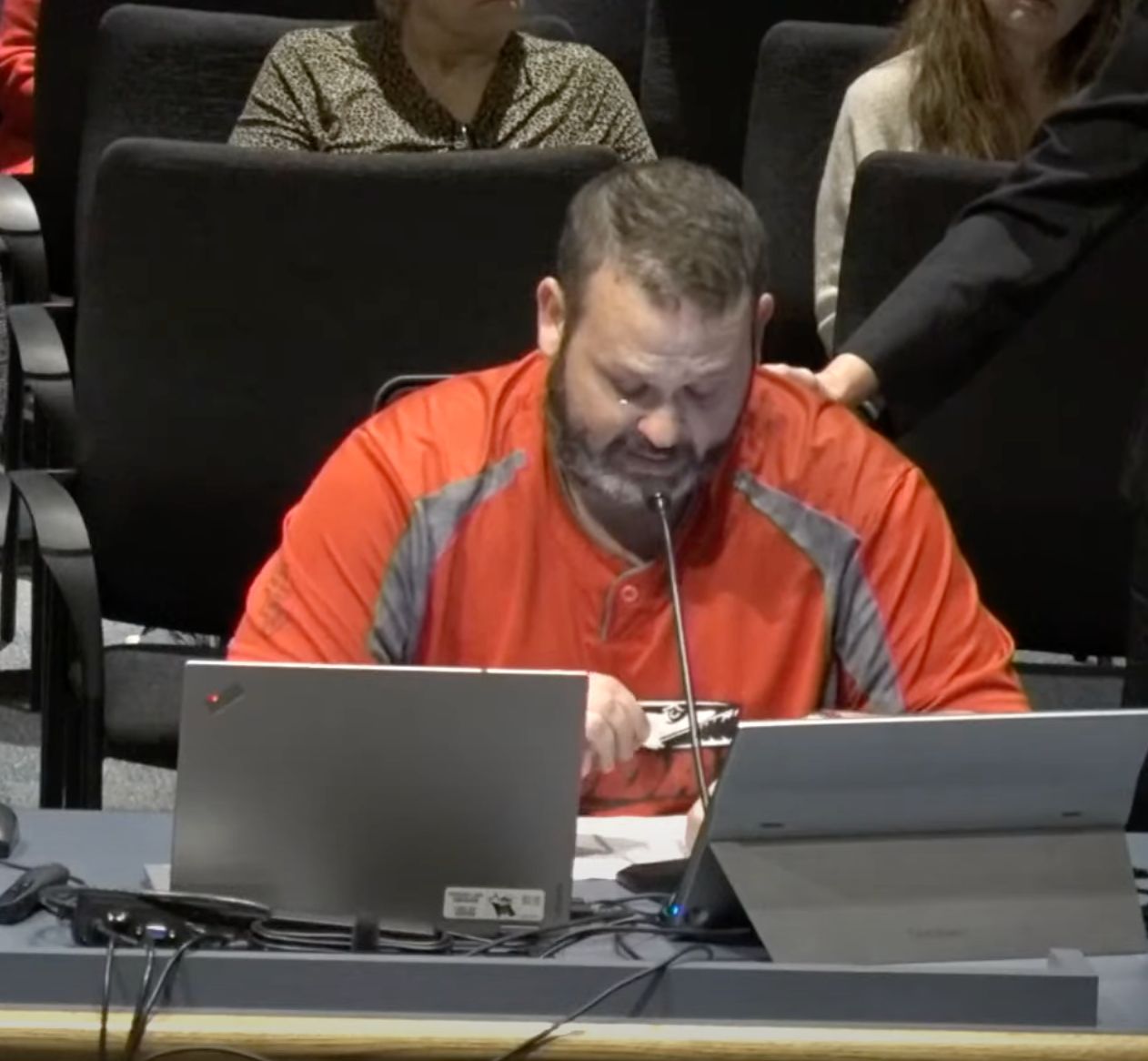
Charles Peacock, a paraprofessional at New Smyrna Beach High School, tells the Volusia County School Board that he has recently been made homeless.

It pains me to think how little most of those entrusted with educating America’s children — daycare professionals, teachers, teachers’ aides — are paid. We are talking about work that any country should give the highest respect and reward.

In today’s story, a popular Florida teaching assistant confesses that he cannot find housing on his income. The shame he feels should be for us.

Kyle Swenson wrote at the Washington Post recently about the moment Charles Peacock went public.

“They called his name and Charles Peacock hustled up to the microphone to address the Volusia County School Board. The public comment period gave him three minutes. He had practiced his speech, but the 40-year-old knew that somewhere in that time frame, his emotions would overwhelm him.

“He introduced himself as a teacher’s assistant — called a ‘paraprofessional’ in the district — at New Smyrna Beach High School, a school of nearly 1,900-students near Daytona Beach, Fla. The divorced father of three detailed how overworked he and his colleagues are, how the ranks have thinned due to high demands and low compensation.

“Then he paused, knowing that his next sentences swung from workplace complaint to raw confession.

‘I myself, like most others, have to work multiple jobs in order to simply scrape by. I put in 80-plus hours each week, every week, between four jobs to barely make it,’ he said, the words bobbing along on muffled sobs.

“ ‘After four years with the county, I make a minimum salary which equates to less than a thousand dollars per month.’

“Peacock stopped, took a breath, and looked at the board.

“ ‘I personally have been made homeless,’ he said. ‘At least one of your employees — one who is great at their job, has been nominated for para of the year, who loves his students beyond measure — is homeless. Living out of his car. Crashing on couches from time to time. Getting showers at friend’s houses. I dare you to look me in the eyes right here, right now, and tell me that this is okay.’

“His three minutes were up.

“Peacock … represents a large number of Americans who struggle outside the reach of public policy because they don’t fall inside the traditional definitions of poverty. He was homeless, but he technically wasn’t poor.

“Untangling the difference for the board, or explaining it in public, was nothing compared with knowing that after the meeting that his family would now have questions.

“ ‘It wasn’t hard facing the board,’ he said later. ‘Facing my kids was harder.’

“Peacock’s typical day starts at 7 a.m. He is at the school by 8 a.m. He is done by 4 p.m., but then it’s off to a local bar where he works security. That gig ends between midnight and 2 a.m. Weekends, he umpires youth baseball games.

“For all of this scramble, Peacock estimates he makes somewhere between $22,000 to $25,000 each year.

“ ‘It was exhausting, and I was not the only one of my colleagues trying to keep this kind of schedule,’ he said. ‘We were all exhausted.’ …

“For decades, poverty experts have warned that the federal government’s official measurement misses a larger chunk of Americans. One measure that has since emerged has been pioneered by the United Way: the ALICE threshold, or Asset Limited, Income Constrained, Employed. Since 2009, United Way and its partners have used the criteria to take a high-definition snapshot of people in Peacock’s position — those living above the federal poverty line but scrambling to pay for necessities. …

“After his divorce, Peacock could only afford to rent a bedroom in a friend’s house. The profession he had chosen — he makes $11.65 an hour — alone could not support his basic needs.

” ‘I make next to nothing doing a job that I love,’ Peacock told the board in November. ‘But when does that love get outweighed by the need to survive, and dare I say, thrive? … If I’m in this situation, how many other paras are on the brink?’

“He decided to speak before the board and publicly detail his own situation. ‘That was difficult, trying to swallow my pride.’ “

More at the Post, here.

Read Full Post »

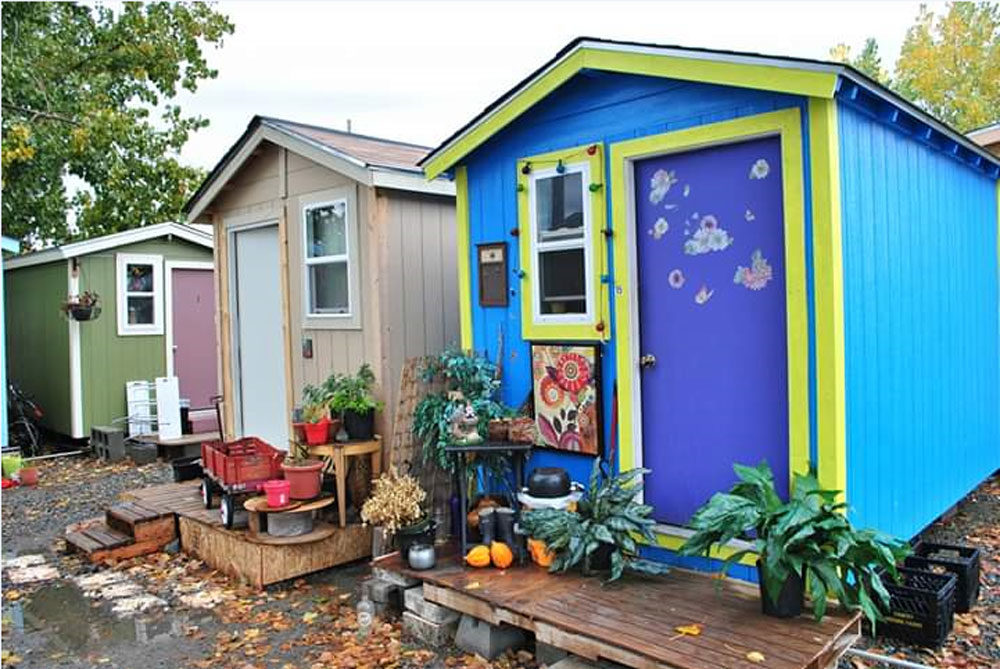
An example of tiny houses designed to combat homelessness.

It’s been a while since I’ve written about tiny houses (you can search on the term to see what I posted before), and I was curious to see what was going on in the movement. To my surprise, I learned that a tiny-house community is being planned to combat homelessness in Worcester.

Tori Bedford writes at GBH News, “Plans for a community of tiny homes for people experiencing chronic homelessness in Worcester have been announced, with a small village slated to open in 2023.

“The village, to be located at 264 Stafford St., will have 21 tiny homes that contain a bedroom, bathroom and combination kitchen and living room, contained within about 480 square feet. As of 2019, 84 people in Worcester were chronically homeless, according to data reported to Central Mass Housing.

” ‘It’s expanding the options for people,’ said Amy Arrell, a service director at Open Sky Community Services, ‘because different things work for different people, depending on their trauma history, their need for privacy, their different experiences when they’ve been out on the streets.’

“Arrell says Worcester’s homelessness crisis has heightened during the coronavirus pandemic: at the height of the crisis in April of last year, nearly half of the population at a Worcester adult emergency homeless shelter tested positive for COVID-19.

“Open Sky is working in partnership with the Worcester East Side Community Development Corporation and a group of local real estate developers, organizations and agencies to offer permanent housing for people who have struggled with chronic homelessness, mental health challenges and substance use.

“Applicants for residency will be processed through a coordinated entry process, led by the city, Open Sky and the Department of Mental Health, to select candidates who don’t thrive in a group setting or temporary housing. …

“The village will include on-site housing specialists to help transition tenants into the neighborhood, as well as individualized and group mental health and substance use treatment. Staff will live in a central building that also serves as a community center, offering monthly social activities like barbecues and picnics. Residents will additionally have access to both individual and community gardens.

“Subsidies will be available to cover the cost of rent based on a percentage of income, and resources for job placement will be made available to residents on-site. …

“ ‘In permanent supportive housing programs, people usually don’t live there forever, they live there for as long as they need to. But there is a sense of security as you’re recovering to know that if you do need that, it’s a permanent option for you.’ …

“Some funding has already been secured through UMass Memorial Health’s anchor mission program, which has connected Worcester East Side CDC and Civico, a real estate development firm that has designed the model based on similar projects across the Pacific Northwest.

“ ‘We abide by some of the principles referred to as “trauma-informed design,” ‘ Taylor Bearden, a partner at Civico, said. ‘The idea is that you’re actually designing for the population and the experiences that these people who may have suffered from chronic homelessness have had in their life. You’re not creating dark corners. You’re making sure that, from the bedroom, you have a clear line of sight to the front door. Certain things that may be triggers for trauma are sort of addressed in the architecture of the spaces themselves.’

“Bearden says safety and community are huge factors in designing a space that can serve as both a recovery center and a liveable space for people who have experienced trauma.

“ ‘The goal is to create a really permanent community where the people who live there develop relationships.’ “

More at GBH radio, here. At the Christian Science Monitor, here, you can see what some other cities are doing to address homelessness.

Read Full Post »

Photo: Angie Smith/Redux/eyevine.
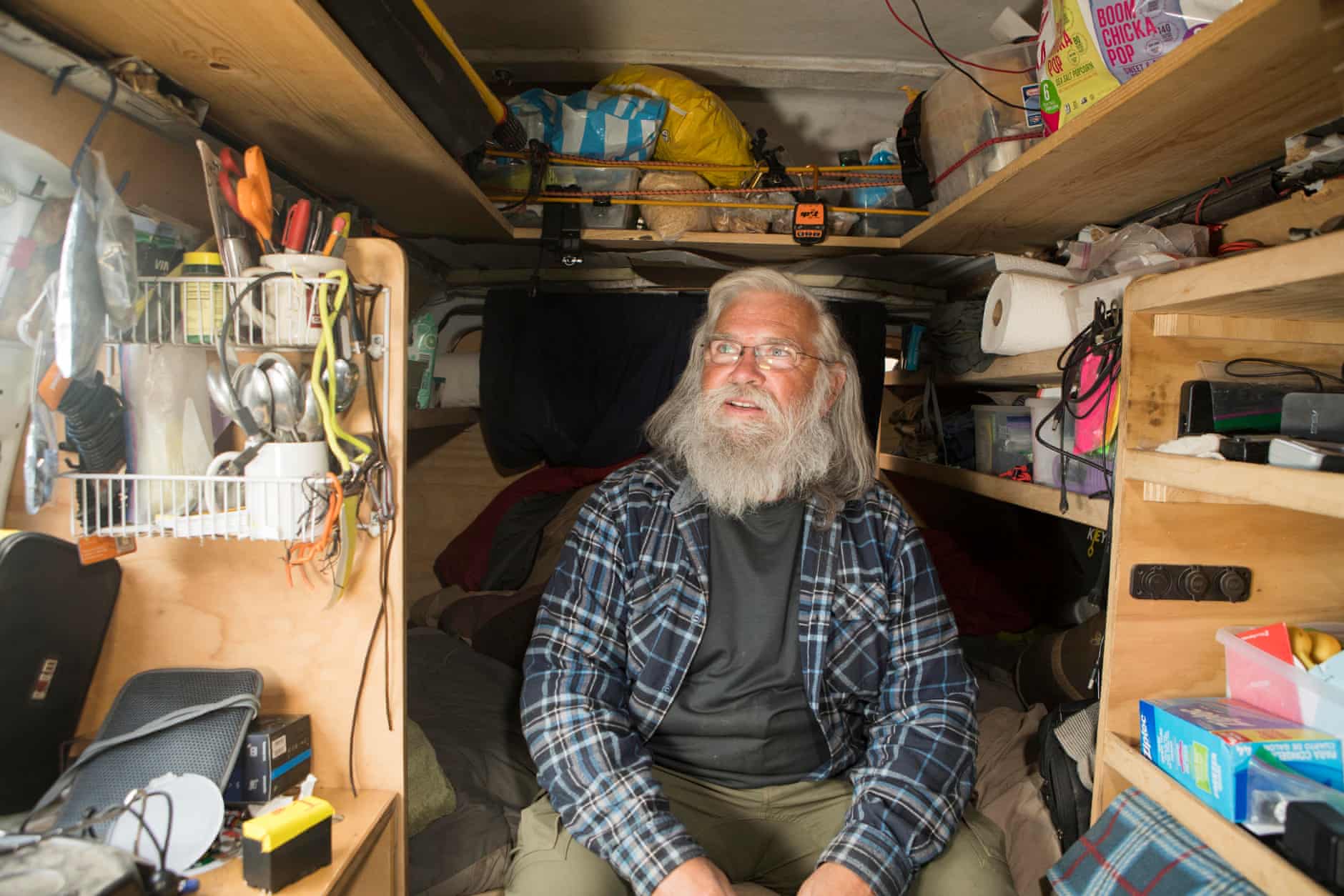
Bob Wells: ‘Then came the first of the month, and something clicked: he didn’t have to pay rent.’

Although many of us have yet to see the award-winning film Nomadland, we can get a taste of the characters’ way of life from this article at the Guardian.

Reporter Stevie Trujillo describes living off the grid in the back roads of America. “If you look closely on city streets, campgrounds and stretches of desert run by the Bureau of Land Management, you’ll see more Americans living in vehicles than ever before. It was never their plan.

” ‘I wasn’t prepared when I had to move into my SUV. The transmission was going. I had no money saved. I was really scared,’ said April Craren, 52, bundled in blankets atop a cot inside her new minivan, a 2003 Toyota Sienna.

“She flipped the camera on her phone to show me the camp stove she uses to make coffee and her view of the sun rising over the Colorado River. She has no toilet, shower or refrigeration.

“After separating from her husband, April found herself homeless in June 2020, exacerbating the depressive disorder for which she receives $1,100 a month in disability benefits.

“ ‘I could have gotten an apartment but in a crappy unsafe place with no money to do anything at all,’ she explained.

“Last year, where April lived in Nixa, Missouri, the average rent for an apartment was $762, slightly less than the national average. Like nearly half of American renters, she would have been crippled by the cost.

“It’s not surprising, then, that job loss, divorce or, say, the sudden onset of a global health or financial crisis can push so many over the edge.

“ ‘If the Great Recession was a crack in the system, Covid and climate change will be the chasm,’ says Bob Wells, 65, the nomad who plays himself in the film Nomadland. …

Today, he lives exclusively on public lands in his GMC Savana fitted with 400 watts of solar power and a 12-volt refrigerator. His life mission is to promote nomadic tribalism in a car, van or RV as a way to prevent homelessness and live more sustainably.

“Before becoming a nomad in 1995, Bob lived in Anchorage, Alaska, with his wife and two boys. He worked as a union clerk at the same Safeway where his father had worked until retirement, only to die two years later. … By his own telling, he was the living embodiment of Thoreau’s ‘quiet desperation.’ …

“Then, when he was 40 years old, the divorce happened. After paying alimony and child support, he was taking home $1,200 a month, $800 of which went towards rent.

“One day, fretting about impossible finances, he saw a green box van for sale and thought: ‘Why don’t I buy that van and move into it?’ The idea struck him as crazy, but with the prospect of homelessness closing in, he drained the last $1,500 in his savings account and bought the van. …

“Then came the first of the month, and something clicked: he didn’t have to pay rent. As his finances improved, he installed insulation, a proper bed, even a dream-come-true PlayStation fortress for his boys. He started working only 32 hours a week, and since every weekend was a three-day weekend, he spent more time camping with his kids, which ‘tremendously helped’ his mental outlook on life. …

“Realizing he had something valuable to share, he bought the domain name Cheap RV Living in 2005. He posted tips and tricks about better vehicle-dwelling, but what he was really offering was a road map to a better life.

“Four years later, when close to 10 million Americans were displaced after the Great Recession, traffic to his site exploded. Finding himself at the center of a growing online community, he decided to create a meet-up in Quartzsite, Arizona. He dubbed it the Rubber Tramp Rendezvous (RTR), and in January 2011, 45 vehicles showed up. Eight years later, an estimated 10,000 vehicles convened for what was said to be the largest nomad gathering in the world. …

“While Bob concedes the limits of his solution – it doesn’t address PTSD, mental illness or drug addiction, three main causes of homelessness – he does see it as a way to lower our carbon footprint and make ourselves more financially resilient in trying times ahead.”

At the Guardian, here, read why it’s mostly older women seeking advice and assistance from Bob’s programs.

Read Full Post »

Did you ever picture yourself running away from home as a kid? I did. I liked the book The Boxcar Children because it suggested that kids could manage on their own. Even as a young adult, I was still puzzling about it in my imagination but was never able to invent a scenario that didn’t involve some helpful adult.

When I read today’s story, I was reminded of that conundrum because the author, Sabra Boyd, notes the impossibility of getting any landlord to rent to a 14-girl-old with two younger siblings. Her article at the Washington Post also discusses how foraging for food influenced her cooking style.

“Desperate times call for comfort food,” Boyd writes. “And whenever I have time, making fresh pasta helps me embrace being home. … Rolling out fettuccine noodles is the only kind of meditation I have patience for these days. I press my hands firmly into the dough, feeling grateful to have a kitchen. I coat the rolling pin in extra flour and think about how, as a homeless teenager 20 years ago, I cooked using only a backpacking stove. Surviving teen homelessness prepared me for a pandemic in ways I never could have imagined.

“My mother first kicked me out when I was 14. … I didn’t know anyone to crash with, so I trudged uphill to the dark high school because I could not think of anywhere better to go other than the place I needed to be in the morning. I climbed the roof of the auditorium and took a clumsy parkour leap from the eave of my English classroom’s window. Tracing constellations with my finger, I pulled my hoodie tight against the cold. The glare of a neon crucifix, perched on a hill above the school, flooded the football field with light. I closed my eyes and tried to fall asleep.

“The following night, I sneaked into my mom’s house through a window and packed my camping gear. I set up my new home in a cave above the Elwha River. Sometimes I slept in an abandoned house in Eden Valley. When it grew too cold, I stayed at a hippie commune, in the goat stable, but I left when the commune became too dangerous. I returned periodically to check on my younger siblings, but Mom would fly into an alcoholic rage, so I spent most of high school homeless. …

“I kept my favorite nonperishables in a bear canister: instant noodles, dehydrated miso soup, granola bars and halvah. In the spring, I sauteed fiddleheads and horsetails in olive oil with my compact camp stove. In summer, I gorged on blackberries, delicately picked bright red thimbleberries and, when their pink blossoms fell, hunted for the electric hue of salmonberries. In the fall I gathered apples from wild orchards and scanned the sepia leaves on the forest floor, training my eye for a pop of yellow chanterelle.

“In winter I relied more on eating lunch at school and at work, or restocking my canister with trips to the co-op near my many after-school jobs. I worked as a barista, landscaper, maid, caregiver, caterer and pastry chef. I also volunteered for Olympic National Park’s revegetation crew and as a tour guide at the local aquarium. Volunteering and working all the time distracted me from everything going wrong in my life — plus, I hoped it would help me get into a good college far away. Volunteering also meant I could spend a few extra hours indoors if it was raining or cold outside.

Despite working seven days a week, I could never save enough money to persuade a landlord to rent an apartment to a 14-year-old girl and her two siblings.

“Striving to make fewer trips to the grocery store during the coronavirus pandemic has pushed me to become more creative and less precious about my culinary endeavors. … I am making Douglas-fir fettuccine Alfredo, or fettuccine al burro, named for its rich butter sauce, because the weather has turned cold and there is not much else to forage. The bright citrus tang of Doug fir is welcome when the days turn dreary, and I use it as a wild alternative to rosemary. …

“The leaves are most tender in the spring when they are neon, but they can be harvested year round, making this literally an evergreen recipe. The first rule of foraging is to be certain that you know what you are eating, because otherwise it can be dangerous.”

Get both the recipe and the rest of the story at the Washington Post, here.

Read Full Post »

Older Posts »