Feeds:
Posts
Comments

Posts Tagged ‘india’

The clouds on Wednesday were amazing here, and to share my photos of them, I first tried to find a cloud poem on Google.  But after reading several that weren’t quite right, I decided to change tack and see what I could learn about languages with numerous names for clouds.

That’s how I came across photographer and journalist Arati Kumar-Rao, who writes at Peepli about clouds in an Indian desert, where clouds are few and far between.

“There was excitement in the air. The horizon was flashing an intermittent neon in the darkness, silhouetting ghostly clouds.

“What are those clouds called? I asked. Chhattar Singh gazed into the distance, as if mining a lost memory. The words began to trickle — hesitant at first, then faster, crowding one another in his excitement. Those were kanThi, he said. And if they consolidate and promise rain, their name will change to ghaTaaTope. If the clouds become very dense, they’ll be called kaLaan.

“That night, the kanThi did not build up. It did not rain.

“Life stirred awake next morning under a pretty-patterned sky — tufts of white trailing in arcs and lines, horizon to blue horizon.

“We sat sipping chai and watching a distant wind ripple through a feathery, fruit-laden khejri. ‘Those clouds won’t rain either,’ I offered.

“ ‘Teetar pankhi’ Chhattar Singh replied. They had a word for this cloud pattern too – a perfect analogy that likened it to the pattern on the wings of a partridge.

“They say eskimos have 40 names for snow. I get that — they are surrounded by snow all year. The people of the Thar have just forty cloudy days in a year — and yet they have as many names for clouds! …

“The area I have been visiting over the past three years, the deep western part of the Thar desert, lies in Jaisalmer district. It is bounded on the north and west by Pakistan, in the east by Jodhpur district, in the south by Barmer district, and in the northeast by Bikaner district.

“The rainfall here is a meager 100-150mm, about a tenth of the national average and a pitiful 2 per cent of the rainfall Kerala and some other of the wettest areas in India get. For the people of the Thar, sighting clouds and rain are events. Memorable. Priceless. Because these moments hold the key to their very existence.” Read Kumar-Rao’s report here. I think you will like how respectful she is of Singh, controlling her instinct to ask a million questions.

My Massachusetts scenes don’t look much like the Thar desert, I know, but maybe clouds are similar everywhere.

062117-happy-clouds-over-home

062117-stupendous-clouds-Verrill-Farm


062117-clouds-over-plowed-field

062117-First-Parish-dome-and-clouds

Read Full Post »


Photo: Chandana Banerjee
Dr. Medha Tadpatrikar found a nontoxic way to burn plastic and produce a cheap fuel for India.

I never use plastic in the oven or the microwave because I know that as plastic heats and disintegrates, it lets off toxic fumes.

So I was a little surprised — but also relieved — to learn that a new process burns plastic waste to generate energy and doesn’t expose anyone to danger.

For the Christian Science Monitor, Chandana Banerjee reports, “In 60 cities in India, 16,876 tons of plastic waste are generated each day, according to data from the country’s Central Pollution Control Board. Multiply that by 365, and you have more than 6 million tons of plastic that end up in landfills a year. …

“Dr. [Medha] Tadpatrikar resolved to find a way to make plastic waste useful. She and Shirish Phadtare started experimenting in Tadpatrikar’s kitchen, trying to ‘cook’ plastic in a pressure cooker to create a practical fuel. ‘Plastic is made of crude oil, and we wanted to reverse the process to get usable oil,’ Tadpatrikar explains.

“After lots of kitchen R&D, some trial and error, and help from engineer friends, this experimenting duo has come up with an operation in the Pune, India, area that benefits the environment in several ways. They are indeed producing fuel, using a process that doesn’t emit toxic gases. …

“ ‘We blew up quite a few cookers in the process,’ says Tadpatrikar, smiling. Later that year, they cofounded Rudra Environmental Solution. …

“ ‘Our two new machines, one that we launched in 2013 and the other in 2015, use up every bit of the byproducts, including the gases,’ says Tadpatrikar, noting that even the leftover sludge can be mixed with bitumen to create roads. …

“The fuel churned out by the two machines is carefully collected in bottles, and it’s sold to people in 122 villages around Pune at a subsidized rate of 38 rupees (53 cents) per liter. It’s a boon for villagers like Nanda Shinde, who can’t afford to buy any other fuel. …

“ ‘In the monsoons, when the wood is soggy, I’d have to burn plastic bags to cook a meal on,’ explains Shinde, who toils in the fields, attends to household chores, and looks after her family of six from the first light of dawn until the last of the evening.

” ‘Now I give my waste plastic to Rudra, and I am doing this so my children will have a cleaner world to live in,” adds Shinde.”

More at the Christian Science Monitor, here.

Read Full Post »

Photo: Wikimedia Commons
Sari weaving at Kanchipuram — a city in the Indian state of Tamil Nadu.

One Instagram account I follow is The_Deepaks, which today posted a video about silk weaving that fascinated me. Instagram doesn’t make it easy to share posts, so I hunted around YouTube until I found another video on silk weaving.

The text accompanying the YouTube video is not in perfect English but is worth reprinting. “The saree is an unstitched garment worn by the women India, that reflects the vast aesthetics to suit a women’s need for adornment and cultural identity. It is a traditional wear across India of different styles depending on the region and occasion. Silk sarees (Pattu sarees) are renowned for their intricate work and adds value through Zari work which is considered to be special.

“These are characterized by huge contrast border offers an ethnic look along with appealing color combination, made through the inclusion of checks of varied colors and geometric patterns. Fine stripes as well as checks in both horizontal and vertical manner add to the relish of the fabric. Traditional motifs found are peacock and parrot with colors in mustard, brick red and black.”

Other videos I found bemoaned the dying art of silk weaving. It’s really unfortunate that the sari weavers, inevitably competing with machines, can no longer make a living doing the work by hand.

I wonder if some of them could earn a living teaching Westerners who appreciate handcrafts. I could imagine tour buses full of people coming for courses by skilled craftsmen and craftswomen.

More at Wikipedia, here.

Video: Dsource Ekalpa India


Read Full Post »

A “funky, eco-friendly” shop in Providence, Small Point Café, serves wooden cutlery that can be recycled. The only problem is that if you do takeout and want to use the recycling bin at work, wood is not accepted.

Here’s an idea that could solve the problem of takeout-cutlery waste once and for all: utensils you can eat.

Brittany Levine Beckman writes at Mashable, “Tired of seeing mountains of plastic cutlery polluting India’s landfills, Narayana Peesapaty had an idea: What if you could eat your disposable spoon rather than toss it?

“Peesapaty, a researcher and agriculture consultant from Hyderabad, India, developed an edible spoon made of millet, rice and wheat flours, in 2010. Now, after selling 1.5 million spoons for his company Bakeys, he wants to reach even more eaters. Peesapaty knows that means he has to cut the cost of his products to compete with cheaper plastic counterparts. …

“Bakeys plans to use its successful Kickstarter campaign to improve production and expand the product line. Its ‘edible lunch spoon,’ which can last 20 minutes in hot liquid, comes in a variety of flavors: sugar, ginger-cinnamon, ginger-garlic, cumin, celery, black pepper, mint-ginger and carrot-beetroot. The spoons have a shelf life of two to three years.

” ‘You can eat it up. If you don’t want to eat it, you can throw it. It decomposes within four to five days,’ Peesapaty said in a promotional video that has been shared millions of times since posting on March 16. …

” ‘Plastic is very cheap, true. But I can make it as cheap,’ Peesapaty remarks confidently. ‘I can with volumes, and once I get the volumes, I [can go to] the farmers directly and start procuring raw material directly from the farmers, in which case my spoons will be as cheap as the plastic spoons.’ ”

More. Learn how to get a supply of your own.

Photo: Mashable
Edible cutlery is already reducing plastic waste and benefiting the environment.

Read Full Post »

The People Making a Difference series of the Christian Science Monitor is a reliable source of worthy stories that don’t make the US headlines. I thought this one — about women in Nepal holding things together as their husbands pursue jobs in India — was worth sharing.

Zoe Tabary, of the Thomson Reuters Foundation writes, “Ratna Chaudhary delicately lifts the hem of her pink and green dress with one hand, while using the other to scoop up a batch of cabbages in her garden in the village of Phulbari, a dozen kilometers from the Nepal-India border.

“She calls three women to help, who join the dance-like movement, bending and swaying as they pick up vegetables and lay them in a basket.

” ‘Since my husband works in India now, I’m responsible for harvesting all our crops,’ said Chaudhary, holding two cabbages to her face before throwing the yellower one to the ground.

“Her husband, Chatkauna, is one of at least 2.2 million Nepalis – nearly 10 percent of the population – who work abroad, according to the Nepal Institute of Development Studies.

“For the past three years, Chatkauna has taken on seasonal work for most of the year as a miner in the Indian city of Haldwani. It pays more than the daily jobs he used to do in his hometown, and he returns to Phulbari every four months to see his family and hand over his earnings. …

“The outflow of male workers – in particular from rural areas faced with worsening climate conditions – has major implications for the country’s agricultural sector, believes Madan Pariyar, project director at International Development Enterprises (iDE), a non-profit group that helps poor farmers with work and income opportunities. …

“Chaudhary used to work on a sugarcane farm in India herself. ‘We just couldn’t earn enough in our village,’ she said.

“For the past six months, however, she has cultivated her own patch of land and leases the remainder of it – 1,700 square meters (18,299 square feet) – to other poor, low-caste farmers from the ‘tharu’ ethnic minority group, one of Nepal’s largest.

“In 2015, iDE helped Chaudhary set up a village vegetable co-operative, which she chairs, to boost local farmers’ incomes. The project is part of the Building Resilience and Adaptation to Climate Extremes and Disasters (BRACED) program, funded by the British government. …

“With iDE’s help, 25 subsistence farmers – 18 women and five men – grow vegetables on 68 square-meter plots of land, which they rent from Chaudhary, paying her in cash or in kind. They bring their spare produce to a collection center, which transports the vegetables and other crops to large markets or sells them to regular buyers.

“The co-operative also gives farmers better access to cheaper seeds, fertilizers and finance such as private investment and micro-credit. While the project is still in its early days, it is already yielding results. ‘Farmers now earn 50 rupees ($0.50) more a day than they did previously,’ said Pariyar.”

More here.

Photo: Zoe Tabary
Women farmers pick vegetable crops in the village of Phulbari, Nepal, May 18, 2016.


Read Full Post »

The article by Astrid Zweynert and Ros Russell begins, “Boys campaigning for girls’ education is not common in most parts of the world, but in India’s Rajasthan state, they are at the heart of a drive to get more girls into schools.

Educate Girls trains young people to go into villages to find girls who are not in the classroom in a country where more than 3 million girls are out of school.

“Some 60 percent of Educate Girls’ 4,500 volunteers are boys, founder and executive director Safeena Husain told the Thomson Reuters Foundation.

” ‘Having these boys as champions for the girls is absolutely at the core of what we’re trying to achieve,’ Husain said in an interview as she was awarded the $1.25 million Skoll Award for Social Entrepreneurship, the largest prize of its kind. …

“In Rajasthan, 40 percent of girls leave school before reaching fifth grade, often because their parents do not see education as necessary for their daughter because she is going to get married or stay at home to do housework, Husain said. …

“Educate Girls’ approach to is to define hotspots where many girls are out of school, often in remote rural or tribal areas, and then deploy its volunteers to bring them back into the classroom, said Husain.”

There’s plenty of research showing that when girls are educated, the standard of living in a country goes up. Educated girls “are less likely to get married at an early age or to die in childbirth, they are likely to have healthier children and more likely to find work and earn more money.”

More at the Christian Science Monitor, here.

Read Full Post »

In India, a civic-minded restaurant put a working fridge out front so patrons could join the eatery in offering leftovers to the hungry instead of throwing good food away.

Elyse Wanshel writes at the Huffington Post, “Pappadavada, a popular restaurant in Kochi, is urging customers and the community to put their leftover food in a refrigerator located outside of the eatery for the hungry to take. …

“The fridge is open 24-hours a day, seven days a week and stays unlocked. … Pauline told the Huffington Post that despite a huge response from the community and ample donations, the fridge needs to be restocked regularly. Pauline herself adds around 75 to 80 portions of food from Pappadavada a day in the fridge. …

“The idea to put a fridge on the street came to Pauline late one night when she saw a lady searching in a trashcan for food. As she watched the woman, she had a terrible thought:

“ ‘That the woman had been sleeping and was woken up by her hunger, so she had to go in search of food instead of sleeping.’

“She was especially saddened because that particular night, her restaurant had made a ton of food that they could’ve easily given the woman, instead of her searching for it.

“The experience made her feel like she contributed to waste, and avoiding waste is what Pauline is focused on.

“ ‘Money is yours but resources belong to society,” she told HuffPost. “That’s the message I want to send out. If you’re wasting your money, it’s your money, but you’re wasting the society’s resources. Don’t waste the resource, don’t waste the food.’ ”

More here.

Photo: Thesny Alikhan
Minu Pauline, right, the restaurateur behind the free food fridge, with a supporter, actor/director Thesny Alikhan

Read Full Post »

021416-luna-and-stella-at-playtimeNYJPG


Trade shows have been helpful to Suzanne’s birthstone-jewelry company, Luna & Stella, as it branches out from being strictly online to selling to retail outlets like Talulah Cooper Boutique in Providence.

A couple weeks ago, Suzanne took Luna & Stella to the trade show NewYorkNow (“the market for home, lifestyle + gift”). Today, she is making an impression at PlaytimeNewYork — while making friends with other relationship-oriented businesses, like Little Paisley People.

I love how the founder of Little Paisley People describes the origins of her business: “I spent the most memorable summers of my childhood in Amalsaad, a quaint village, in Gujarat, India. … I grew up watching my mom work with the local artisans to hand-make toys that would support the local community. Those are the toys you also see in the Little Paisley People line. And that’s the logo you see – the passing on of the thread over the generations. …

“We create handcrafted lifestyle products for children, never forgetting that kids need to be kids. The handmade nature of these products evoke an understated elegance but are always playful. Social responsibility, the people who make these products, and how they make them are very important to us.”

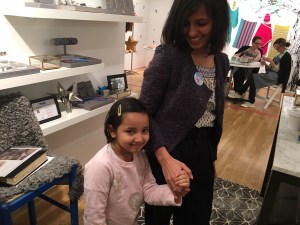
Here, she and her daughter model Luna & Stella’s mother-daughter heart rings. How nice that new businesses are emphasizing the importance of family and friend relationships!

Luna-and-Stella-heart-rings

mother-daughter-of-little-paisley-people


Read Full Post »

The Christian Science Monitor collects wonderful stories for the series “People Making a Difference.” I’m on the email list and receive so much good news, it’s hard to choose what to share.

This story was written by Anita Satyajitin.

“The 41 boys of Sanmati Bal Niketan keep a lamp burning all the time in their home. They believe that the flame should never be extinguished, for as long as it burns, their ‘mother’ will be hale, hearty, and healthy.

“Their mother is Sindhutai Sapkal, a beggar who has used her earnings to raise 1,042 orphans over the past four decades.

“As a young pregnant woman in rural India, Ms. Sapkal was abandoned by her husband. She turned to begging for a living, seeking refuge in cowsheds, cemeteries, and train stations. But despite these hardships she found her calling as a mother to hundreds of children.

“Today Sapkal runs four homes for orphans and others in need across India’s state of Maharashtra, currently caring for more than 400 children and 150 women abandoned by their families.

“ ‘I have experienced what it feels like to have no one and nowhere to go. This [work] makes me feel like someone is dressing my wounds,’ Sapkal says.

“Four decades ago, when she would sing at train stations and beg to earn a living, she noticed the large number of orphans who made the stations their home. She had been grappling with thoughts of suicide, but instead she felt a strong call to care for the children.

“The more of them she looked after, the more vigorously she begged. …

“After a few years, with the help of supporters, Sapkal set up her first orphans’ home in Chikhaldara, a town in rural Maharashtra. As word about her work spread, people from other villages began to approach her with orphaned children. …

“Her innovative idea of having women abandoned by their families live in the same home as the children ensures that the children are cared for and the women have a family, too. …

“The children [are] all sent to nearby private schools or colleges to pursue an education. Sapkal, who travels between these homes, has worked with a network of nearby schools, colleges, and hospitals that offer their services free of charge or at a reduced rate to her children. …

“Sapkal’s success is also a result of the support she receives from the people she has raised. The day-to-day operations of her homes are run by her ‘children’ and their families.

“Dipak Gaikwad was 11 when relatives handed him over to Sapkal. When as an adult he inherited his ancestral home, he sold it and gave the money to her to carry on her work. Today he manages her Saswad home.”

More here.

Photo: Anita Satyajit 
Sindhutai Sapkal, who has nurtured more than 1,000 orphans, is seen here with a few of them at her home in Pune, India.

Read Full Post »

In India, a man who saw sculptural possibilities in castaways has left behind hundreds of pieces of art in a public rock garden.

Nek Chand, an Indian artist who rose to prominence by quietly building a sprawling kingdom of folk sculptures in northern India that became one of the country’s most popular tourist destinations, died on [June 12] in Chandigarh. He was 90. …

“Mr. Chand’s life’s work, known as the Rock Garden of Chandigarh, covers several acres and is populated by rock sculptures and figures of dancing women and animals, many of them fashioned from found objects like the mudguards of motorcycles and broken bangles.

“It stands in contrast to the striking if neglected government buildings conceived by Le Corbusier, who planned Chandigarh — the capital of the states of Punjab and Haryana — in the 1950s.

“For some, the Rock Garden, which has thousands of visitors a day, is an antidote to what, with its stark Modernist buildings, is seen as something of a bureaucrat’s city. …

“Mr. Chand was born Nek Chand Saini on Dec. 15, 1924, in the village of Barian Kalan, which became part of Pakistan after partition. He was newly arrived in the city of Chandigarh just after India’s independence in 1947. He worked for the government as a road inspector, according to the Department of Chandigarh Tourism website. But, [Rupan Deol Bajaj, a retired government functionary] said, he became fascinated by found objects, including weather-beaten rocks.

“ ‘I started building this garden as a hobby’ in the 1950s, he said in an interview with Agence France-Presse in December. ‘I had many ideas, I was thinking all the time. I saw beauty and art in what people said was junk.’

“By night he slipped onto a patch of land and artfully arranged rocks and construction waste behind a barricade of empty tar drums.”

The garden was a secret for a long time. When the authorities learned about it, a debate on its future ensued. But, says the Times reporter, “a groundswell of support led to its official opening to the public in 1976.” More here.

Photo: Reuters
Nek Chand, at 76, next to one of his sculptures. He died in June at age 90.

Read Full Post »

As a longtime believer in “one and one and 50 make a million,” I am not surprised to learn that some big environmental problems are being successfully tackled through small-dollar grants.

Karen Weintraub writes at the NY Times, “In Pakistan and India, the blind Indus River dolphin, one of the most endangered species, swims a shrinking stretch of water, trapped by development and dams. …

“Overfishing, habitat loss and pollution threaten species in so many places that research and conservation organizations cannot do all that is needed. So, with the aim of making a dent through small, targeted efforts, the New England Aquarium, which sits on Boston’s downtown waterfront, has for 15 years awarded microgrants to projects across the globe. …

“The aquarium’s Marine Conservation Action Fund has paid out $700,000 since 1999, supporting 122 projects in 40 countries on six continents. Elizabeth Stephenson, the fund’s manager, calls these projects ‘stories of hope for the ocean.’

“The grants are modest. One researcher, Rohan Arthur, used his $6,700 payout from the fund to buy a ‘secondhand, beat-up compressor’ to fill his scuba tanks. But the support allowed him to maintain his critical assessment of coral reefs in the Arabian Sea off the west coast of India.

“Dr. Arthur, a senior scientist at the Nature Conservation Foundation in Karnataka, India, said that in some ways, he preferred the scale of the New England Aquarium gifts. …

“Small grants, he said, offer more freedom, but can still be transformative. …

“Gill Braulik, a dolphin expert based in Tanzania, used a … grant in 2011 to teach Pakistani scientists to take over her research on a blind dolphin species that lives only in the Indus River. …

“In 2011, a $6,000 aquarium grant allowed her to train the local researchers in complex survey methods and analysis. Now, two groups of local scientists have led the work. ‘They really don’t need me anymore,’ she said.”

Read more here.

Photo: Gill Braulik
Najam Ul-Huda Khan, left, interviews village elders about sightings of Indus River dolphins. 

Read Full Post »

Having given myself a serious scare reviewing the film Revolution (on the planet’s race to extinction through practices such as destroying critical forests), I was happy to read about a positive forestry initiative started in India and expanded to Haiti and Kenya. The pressures are the same in those countries as in Madagascar, which was featured in Revolution, but there is also a recognition that trees are life-giving.

Gregory M. Lamb writes at the Christian Science Monitor, “Aviram Rozin was excited. He had just returned from Haiti where the 80,000 Maya nut trees that volunteers with Sadhana Forest had planted there during the past five years had started to flower. Before long each tree would be producing huge quantities of nuts high in protein and other nutrients. One tree could supply enough yearly protein for a family of five.

“The nonprofit Sadhana Forest, cofounded by Mr. Rozin and his wife, Yorit, follows three simple strategies:

“• Plant indigenous trees in arid regions that once had been forested but have become barren, useless land.

“• With few exceptions, do the work using volunteers, both local and from around the world.

“• Since trees don’t grow overnight, plan on staying around for a long, long time to see the project through.

“The Rozins started Sadhana Forest in 2003, the year after they moved to India from Aviram’s native Israel to live in Auroville, an experimental township in southeast India that emphasizes sustainable living and has attracted immigrants from all over. The couple bought 70 acres of degraded land and set about creating a community dedicated to reforestation. …

“The aim of Sadhana Forest isn’t to buy and reforest massive tracts of public land. Rather, it is to teach local people how to grow trees on their own land. Faced with the dry climate, Rozin has come up with a simple, yet innovative, way to water the trees: wick irrigation. A two-liter plastic bottle filled with water is planted up to its neck next to each sapling or tree. A piece of cotton rope fed through a tiny hole in the bottom of the bottle acts as a wick, slowly moistening the soil. Loosening or tightening the bottle’s cap can control the rate of flow. …

“Each wick bottle becomes ‘a personal watering system for each tree,’ Rozin says, yet the materials are readily available locally and cost almost nothing. …

“Rozin, who studied psychology and later worked in management for an Israeli medical device company, does not have a degree in forestry but says that may have been a blessing in disguise.

“ ‘We found out that, in a way, ignorance is bliss because we’re very open to learning,’ he says. ‘We don’t think we know everything. A lot of innovation comes from listening to people, to being open.’ ”

More here.

Photo: Sadhana Forest
Volunteer Nixon Casseus (l.) and Sadhana Forest cofounder Aviram Rozin show off the first flowering Maya nut tree in Haiti.

Read Full Post »

Speaking of libraries, if any of you decide to publish a collection of stories on the value of libraries, be sure to include this one about a family in India.

The nonprofit Read Global provided opportunity to them. “Om Prakash and his wife Sheela Devi raised three daughters and a son in the rural community of Geejgarh, in Rajasthan India. There were no educational resources nearby except for underfunded public schools, where books and computers were rare. …

“When we opened a READ Center in their village, the whole family was excited to join.

“ ‘It is a safe place for my daughters and wife to visit because it is close by, and it’s community owned and operated,’ Om Prakash says, ‘The staff are like family members. Anyone can visit and see what’s going on.’

“Their daughter Anuradha was the first to join the local READ Center. She took trainings in English, computer skills, and radio, where she created programs on health and women’s rights to help spread awareness in her community.  …

“Their daughter Archana started an online college program, and uses the books and computers at the Center for school. After graduating, she wants to become a teacher …

“Their son Pankaj is applying for government jobs. He took computer training from the Center and uses the library daily to prepare for the government’s required entrance exam.

“Mahima is the youngest. She participated in beautician training at the Center, and now she plans to become a makeup artist and open a beauty parlor of her own. …

“Anuradha says there has been a change in social norms in her community because of the Center: ‘Earlier, villagers were totally against letting their wives and daughters work, but now many of them have changed. They see women with respect, and they value their opinions.’ ”

More at Read Global.

Photo: ReadGlobal.org 

Read Full Post »

You have heard of “slow food” and perhaps “slow money” (a loan with a long time to pay back) and other efforts designed to help us reduce the often meaningless haste of modern life. Well, Cousin Claire has been posting news on Facebook about another slow movement that is sure to intrigue you, Slow Textiles.

Says Slow Fiber Studios on its About page, “We are founded on a simple intention: to offer real-world insight into the multifaceted and holistic practice of textile-making. Slow Fiber Studios™ offers dynamic, hands-on field study programs in diverse areas of the world where textile culture runs deep — India, Mexico, Japan, France, Italy, and on. We believe the best way to understand a philosophy is to see it being lived.”

Here is a description of a 2012 offering: “Special opportunity to travel throughout India with Yoshiko, who has been exploring this country for over 30 years (lived in Ahmedabad in 1983/84 on an Education & Culture Fellowship and frequent 3-month residencies spanning 3 decades). Yoshiko will introduce her friends in India who are involved in welfare, community empowerment, and cultural sustainability projects.

“Tour Highlights: natural dyes, organic cotton cultivation, handloom weaving, khadi, biodynamic farming, architecture, local food and religion, contemporary art and design educational institutions, museums, solar energy development, hand spinning and weaving wild silks and Tibetan wool in Himalayan communities.” More here.

How well I remember the wistful feeling I got in reading the book Lark Rise to Candleford when the beautiful handmade lace was spurned as soon as the factory-made came in. There is something to be said for speed and efficiency, but also something to be said for craft.

Photos: Slow  Fiber Studios

Read Full Post »

Here’s an interesting start-up by a couple of entrepreneurs who love to eat. The two women decided to build a business around helping travelers find truly authentic cooking.

According to Aashi Vel and Steph Lawrence’s website, “Traveling Spoon believes in creating meaningful travel. We are passionate about food, and believe that by connecting people with authentic food experiences in people’s homes around the world we can help facilitate meaningful travel experiences for travelers and hosts worldwide.

“To help you experience local cuisine while traveling, Traveling Spoon offers in-home meals with our hosts. In addition, we also offer in-home cooking classes as well as market tours as an extra add-on to many of the meal experiences. All of our hosts have been vetted to ensure a safe and delightful culinary experience.

“Traveling Spoon currently offers home dining experiences in over 35 cities throughout Bangladesh, Cambodia, China, Hong Kong, India, Indonesia, Japan, Singapore, South Korea, Sri Lanka, Taiwan, Thailand, Turkey and Vietnam, and more countries are coming soon!” More here.

I have no doubt that Traveling Spoon is also boosting international understanding. What a good way to use an MBA! Business school is not all about becoming an investment banker, as Suzanne and Erik would tell you.

Photo: Traveling Spoon
Traveling Spoon founders Aashi Vel and Steph Lawrence met at the Haas School of Business.

Read Full Post »

« Newer Posts - Older Posts »