Feeds:
Posts
Comments

Posts Tagged ‘japan’

884

Photo: Wycliffe College/PA
English school girl
Gracie Starkey wrote a winning haiku. Here she is at the prize-giving ceremony in Tokyo.

I’ve always liked the standard 17-syllable haiku poem and taught the form to fifth graders years ago. Asakiyume remembers one I wrote for her at a business magazine where we worked. It was about a dream she’d recounted, and it referred to the moon as “trending downward” (business jargon we heard a lot).

Of course, most experts are Japanese. Until now. Here is a story my husband emailed me about a young girl in England who won a haiku contest.

Steven Morris writes at the Guardian, “A British schoolgirl inspired by an autumnal stroll across a newly mown lawn has become the first non-Japanese person to win a prestigious haiku competition.

“Gracie Starkey, 14, from Gloucestershire, beat more than 18,000 entries to take the prize in the English-language section of the contest organised annually by a Japanese tea company. …

“As she and a friend took a walk after [her school’s haiku] workshop, grass cuttings stuck to her footwear and the haiku came to her:

“Freshly mown grass
“clinging to my shoes
“my muddled thoughts

“Her poem – a non-traditional form that does not follow the classic five-seven-five syllable pattern – was entered into the competition organised by the multinational Ito En, first held in 1989. For the first 27 years the English-language section was won by Japanese people. …

“Gracie said she was amazed when she heard she had won and had been invited to Tokyo.

“ ‘I could only tell my mum and dad and sister and my Japanese teacher at Wycliffe College,’ said Gracie. ‘I told my friends that I was going to Wales for a week and that I wouldn’t have any phone reception.’ …

“As well as winning the trip, Gracie’s poem was rendered by a famous calligrapher, and she received a cash prize. Most thrillingly, her poem is being reproduced on thousands of bottles of green tea. …

“Previously she had little interest in poetry. ‘This has certainly made me more interested in poetry and in Japanese culture.’ ”

More at the Guardianhere.

Read Full Post »

Image: Reuters/Denis Balibouse
The World Economic Forum touts research suggesting that “forest bathing,” the act of being among the trees, has health benefits.

We love trees. John, for example, serves on the Arlington tree committee and helps with the town’s efforts to inventory its trees, acquire more sidewalk plantings, and assist researchers studying the role of urban trees in carbon reduction.

A master landscaper I know is also into trees. He shared this story about the health benefits of something the Japanese call “forest bathing.”

Ephrat Livini wrote at the World Economic Forum, “Now there’s scientific evidence supporting eco-therapy. The Japanese practice of forest bathing is proven to lower heart rate and blood pressure, reduce stress hormone production, boost the immune system, and improve overall feelings of well-being.

“Forest bathing — basically just being in the presence of trees—became part of a national public health program in Japan in 1982 when the forestry ministry coined the phrase shinrin-yoku and promoted topiary as therapy. …

“Forest air doesn’t just feel fresher and better — inhaling phytoncide seems to actually improve immune system function. …

“From 2004 to 2012, Japanese officials spent about $4 million dollars studying the physiological and psychological effects of forest bathing, designating 48 therapy trails based on the results. Qing Li, a professor at Nippon Medical School in Tokyo, measured the activity of human natural killer (NK) cells in the immune system before and after exposure to the woods. These cells provide rapid responses to viral-infected cells and respond to tumor formation, and are associated with immune system health and cancer prevention. In a 2009 study Li’s subjects showed significant increases in NK cell activity in the week after a forest visit, and positive effects lasted a month following each weekend in the woods. …

“Experiments on forest bathing conducted by the Center for Environment, Health and Field Sciences in Japan’s Chiba University measured its physiological effects on 280 subjects in their early 20s. The team measured the subjects’ salivary cortisol (which increases with stress), blood pressure, pulse rate, and heart rate variability during a day in the city and compared those to the same biometrics taken during a day with a 30-minute forest visit. …

“Trees soothe the spirit too. A study on forest bathing’s psychological effects surveyed 498 healthy volunteers, twice in a forest and twice in control environments. The subjects showed significantly reduced hostility and depression scores, coupled with increased liveliness, after exposure to trees. …

“City dwellers can benefit from the effects of trees with just a visit to the park. Brief exposure to greenery in urban environments can relieve stress levels.”

More here. Be sure to watch the video.

Hat tip: Paul Kelly on Facebook.

Read Full Post »

Art: Tomihiro Hoshino

For more than 30 years, a woman from Hokkaido, Japan, who stayed at our house while studying the local PTA has been sending me magnificent calendars.

The calendars are from a talented artist and former athlete whose paralysis led him to master holding a brush in his mouth. His name is Tomihiro Hoshino.

An article at AccessibleJapan reports, “Tomihiro Hoshino was an experienced 24-year-old gymnastics teacher with a real passion for the sport. An active mountain climber and gymnastics instructor, his life changed completely as he was demonstrating a double somersault technique to a group of junior high school students. Hoshino unfortunately injured his neck during the maneuver and since that day he has been completely paralyzed from the neck down.

“The accident was a serious blow to this extremely active person who was forced to lay motionless for nine years in a Gunma orthopedic Hospital where he was kept under heavy surveillance for respiratory problems and complications as a result of the injury. He and his family never gave up hope that his physical condition would stabilize and improve. Although it took nine years, and he came close to death many times, there was always hope for the future.

“Many say that this hope came two years after his accident. In 1972 one of the patients that had stayed in the same room as Tomihiro Hoshino was being transferred into a different hospital. He asked that the staff, as well as all of the people that stayed with him, to sign a card as a memento of his time in the hospital. Tomihiro couldn’t come up with a solution as to how he would be able to sign his name for the man but with the help of his mother he was able to hold a pen in his mouth and eventually sign Tomo. This would be the beginning of how Tomihiro would begin his career in writing and painting.

“The second event that produced real inspiration for Tomihiro Hoshino was a time that a friend brought him flowers and left them in the window. …

“He was moved to start expressing what they meant to him. He began to gradually draw flowers and eventually became an adept painter with his mouth. …

“Tomihiro Hoshino has successfully produced hundreds of pieces of artwork, many of his essays and poems have been published and his work is displayed in permanent exhibitions at the Tomihiro Hoshino Museum. …

“If you are interested in Tomihiro Hoshino’s works, you can purchase them on Amazon or visit his art gallery in Gunma, Japan.”

More at AccessibleJapan, here. Read about his museum here. Those who read Japanese may click here.

I feel lucky to have had this decades-long friendship with a woman in Hokkaido. Although we haven’t seen each other since the 1980s, her daughter, Mika, came to visit while living in New York. Mika helped decorate our Christmas tree that year. Nowadays, I never do the tree without thinking of her.

Image: Tomihiro Art Museum

Read Full Post »

Here’s a great story from the Japan Times about a theater group for people over 60. Where do I sign up?

Nobuko Tanaka writes, “At the age of 91, Saitama resident Izumi Noguchi is speaking at his first press conference — at least as an actor anyway.

“ ‘When I saw an advert in April inviting anyone aged 60 or older to audition for a new project called 10,000 Gold Theater, I just felt like challenging myself to do something I’d never had a chance to try before,’ he says.

“Noguchi is the oldest person to join the 10,000 Gold Theater ensemble. …  ‘Gold Symphony, my dream, your dream’ [is] a staging on an unparalleled scale that features some 1,600 performers (not 10,000 as the name suggests) who are all volunteers and almost all amateurs …

“Arts promoter Taneo Kato came up with the idea [when] he was watching a performance of ‘Hamlet’ in which stage icon Yukio Ninagawa directed members of the Saitama Gold Theater and Saitama Next Theater — troupes made up of older and younger actors that he formed in 2006 and 2009, respectively, after becoming artistic director at Saitama Arts Theater in 2006.

“ ‘Out of the blue, midway through “Hamlet,” veteran enka singers the Komadori Sisters — who are actually twins — appeared and sang “I Want to be Happy One Day,” ’ Kato says, recalling how striking a moment it was to see the women, born in 1938, sing those words.” More here.

I wonder how big an issue memorization is for the performers. My friend Dorothy started a group of older amateur actors in Concord, but they do readings and don’t have to memorize. I have many memorized stories, Bible verses, and poems in my head and can trot them out at a moment’s notice. Not sure if I could acquire new ones to the same extent.

Photo: Maiko Miyagawa
Massive undertaking: Seiji Nozoe directs elderly actors during rehearsals for the play ‘Gold Symphony, my dream, your dream,’ performed in Chuo-ku, Saitama City, December 2016.

Read Full Post »

Gudetama, a gloomy egg yolk in a Japanese cartoon series, is one manifestation of an offbeat sense of humor that some observers see as uniquely Japanese.

Patrick Winn wrote the Global Post story.

“Is it possible to market malaise? In Japan at least, the answer is yes. Meet Gudetama, the anthropomorphic embodiment of severe depression.

“Gudetama is a cartoon egg yolk that feels existence is almost unbearable. It shivers with sadness. It clings to a strip of bacon as a security blanket. Rather than engage in society, it jams its face into an eggshell and mutters the words, ‘Cold world. What can we do about it?’

“Gudetama may hate the world beyond its shell. But the world — within Japan’s borders, at least — sure loves Gudetama.

“The misanthropic egg was introduced last year by Sanrio, a Tokyo-based corporation devoted to creating cutesy characters and licensing out their images. Its flagship character, Hello Kitty, is valued at $7 billion and appears on lunch boxes and pajama sets across the globe.

“Gudetama is following Hello Kitty’s lead. Its distressed little face now appears on fuzzy slippers, iPhone covers, plush dolls and even a themed credit card by Visa. …

“Matt Alt, a Japanese-speaking American and specialist in Japan’s pop culture, [decodes] Japan for Western audiences. [He opines that] in Japan, there’s a long history of personifying and anthropomorphizing inanimate objects.

“Gudetama is the most recent of a long, long lineage of mascot characters. Many Japanese mascots will express emotions that Western mascots would not. In the West, mascots are used almost exclusively to cheer people up. In Japan, they’re often used to get a point across or act as mediators in situations where you wouldn’t want to express yourself directly.” More here.

Some US advocates for people with mental illness object strongly to  humor on the subject (even criticizing phrases like “wild and crazy guy”). Others recognize that there are those who use humor to help themselves get well. Wonder what they would think of this egg yolk.

Photo: Sanrio

Read Full Post »

Photo: Wally Skalij / Los Angeles Times

So, actually, he was an artist first and only did gardening to support himself as immigrant with no connections.

Los Angeles Times reporter Carolina A. Miranda wrote about him in July, around the time of the “Made in L.A.” biennial at the Hammer Museum.

She says, “When artist Kenzi Shiokava received a telephone call from a pair of curators organizing [the biennial], he says he had little clue of the meteoric effect it would have on his life.

“ ‘I’d never seen “Made in L.A.,” ‘ says the 78-year-old sculptor. ‘I’ve always been off the art establishment.’

“But as he does with anyone who is interested in seeing his work, he invited the curators — Hamza Walker and Aram Moshayedi — to his studio so that they could have a look at his totemic wood sculptures, junk-art assemblages and curiosity boxes featuring orderly, patterned displays of old toys, plastic fruit and discarded religious ephemera.

“Shiokava says he was buoyed by the visit but subdued in his expectations. ‘Lots of shows come and go,’ he says. …

” ‘I didn’t know it’d be like this,’ he says with a resplendent grin. ‘The response has been amazing.’…

“[Walker] says that from the moment he and Moshayedi stepped into Shiokava’s studio, early in 2015, they were sure that this was an artist they wanted to include in the show.

“ ‘It was pretty immediate,’ he says. ‘We were both speechless within 10 paces of the entrance. There were all of these totems right up front and we were like, woooowwww.’ …

“ ‘What’s always kept me going is people coming to my studio and enjoying the work,’ [Shiokava] says in his deeply accented English. ‘But now I know my work will have a legacy. My work will live.’ ”

Read about the artist’s early life as a Japanese immigrant in Brazil, how he ended up in LA, and how he began to develop his art while working as a gardener for Marlon Brando and others (here).

Photo: Wally Skalij / Los Angeles Times
Kenzi Shiokava in his studio.

Read Full Post »

In a Nippon article by Sakurai Shin, translated, we learn about urban bee culture in Central Tokyo.

“The urban bee farm is the work of the nonprofit Ginza Honey Bee Project, or Ginpachi, founded in March 2006 by Tanaka Atsuo.

“It started when Tanaka, who rented out space in Ginza, learned from a beekeeper that it might be possible to raise honeybees on the roof of the Kami Parupu Kaikan building. From this location, Tanaka learned, the bees could gather nectar from Hibiya Park and the grounds of the Imperial Palace, both within a radius of around three kilometers. Bees are highly sensitive to pesticides and other environmental pollutants, but the Imperial Palace is relatively free of agrichemicals. In this sense, Ginza turns out to be a surprisingly good area for beekeeping. …

“In the 10 years since the Ginza Honey Bee Project began on one corner of a Ginza rooftop, the ripple effect has spread to other parts of Tokyo and far beyond. There are now more than 100 urban beekeeping projects nationwide, and more in South Korea, Taiwan, and elsewhere in Asia.

“ ‘Ten years ago, of course, we never imagined the project would have such an impact,’ Tanaka says. ‘I think it’s because people have been able to make it into their own project, reflecting local conditions and responding to local issues.’

“Tanaka also credits the honeybees themselves, emphasizing what human beings can learn from contact with these industrious insects.

“ ‘For example, when I see the bees returning to the rooftop from their flight around Ginza, I can tell from the pollen stuck to them that it’s safflower season, or the tochinoki [Japanese horse chestnut] trees are in bloom. Spending time with the bees puts us in touch with the natural world and its changes. Ginza may seem an unlikely place to be tackling environmental issues, but it’s becoming that sort of neighborhood.’ ”

More here.

This lovely story came to me by way of blogger Asakiyume.

Photo: Nagasaka Yoshiki/Nippon.com

Read Full Post »

Well, this is a new one on me: a bookstore that sells only one title at a time.

Amy X. Wang reports at a website called Quartz that in September 2014, “Yoshiyuki Morioka, a bookseller who had been running a store in Tokyo, Japan, for 10 years, had a curious thought. Lots of customers, it seemed, dropped in during book launches and other events to buy the same title; others often appeared overwhelmed by all the extra variety. So why not start a bookstore that only sold one book at a time?

“Now, Morioka Shoten — Morioka’s new venture that threw open its doors in Tokyo’s trendy Ginza shopping district in May 2015 — operates around that very principle. The store stocks multiple copies of only one carefully selected tome each week …

“Takram, the design engineering firm that helped Morioka put together the look of his new store, says the experience highlights ‘the importance of a physical venue in the era of digital reading.’

“Books that have been displayed so far include Swedish-Finnish author Tove Jansson’s The True Deceiver, Hans Christian Andersen’s Fairy Tales, and works from well-known Japanese writers like Mimei Ogawa and Akito Akagi. Each title is displayed for six days in a row—Tuesday to Sunday—and then swapped out for a new book.

“And things are going quite well at the quiet little store. According to Morioka, Morioka Shoten has sold more than 2,000 works since it opened. Proof, then, that readers seeking deep, personal relationships with physical books are still around across the world.” More here.

You know, that last sentence strikes a chord. I was just explaining to a friend today how this blog resulted from my daughter asking if I would apply my love of blogging to support the vibe of the jewelry company she founded, which emphasizes deep, personal relationships.

If you’ve never clicked on the Luna & Stella site (or even if you have), please do now. Suzanne and Erik have posted a steady stream of new birthstone-jewelry designs and charms over the five years I’ve been blogging. Each one is full of meaning.

Photo: Takram/Miyuki Kaneko
The one-room bookstore Morioka Shoten in Tokyo

Read Full Post »

I checked Gwarlingo not long ago to catch up on Michelle Aldredge’s thorough, sensitive meditations on art and literature.

What caught my attention was her review of a movie about restoring an old house in Japan.

“It is rare to find a film that is pitch-perfect in its cinematography, story, pacing, and length,” Aldredge writes, “but Davina Pardo’s short film Minka is such a gem. (I owe writer Craig Mod a thank you for turning me onto this quiet masterpiece.)

“Based on journalist John Roderick’s book Minka: My Farmhouse in Japan, the film is a moving meditation on place, memory, friendship, family, and the meaning of home. Most remarkable, this haunting story plays out in a mere 15 minutes.

Minka is the Japanese name for the dwellings of 18th-century farmers, merchants, and artisans (i.e., the three non samurai-castes), but as Wikipedia explains, this caste-connotation no longer exists in the modern Japanese language, and any traditional Japanese style residence of an appropriate age could be referred to as minka. The word minka literally means ‘a house of the people.’

“The story of how AP foreign correspondent John Roderick and his adopted Japanese son Yoshihiro Takishita met, and then rescued a massive, timber minka by moving it from the Japanese Alps to the Tokyo suburb of Kamakura is full of small surprises and revelations (the biggest one comes at the end of the film).

Minka is a film that celebrates stillness. Pardo’s camera lovingly lingers on sun, shadows, and dust. But the peaceful home is not just a restored space full of beautiful, personal objects, it is also an expression of the deep connection between Roderick and Takishita and of familial love.”

Read about that at Gwarlingo, where the filmmaker will let you watch the entire 15-minute movie.

Photo: Davina Pardo & Birdlings LLC
A still from the film
Minka

Read Full Post »

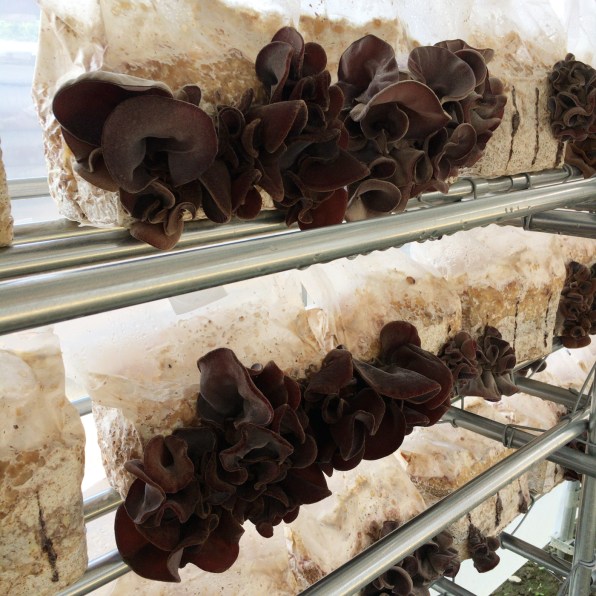
Treehugger recently featured some rather magical lamps in the shape of mushrooms.

Kimberley Mok writes, “Whether they glow in the dark or are uncommonly rare, mushrooms are the incredible, unsung heroes of the natural world. They can bio-remediate oil spills, potentially cure diseases, and when used in your garden, can lessen its need for watering. Now, thanks to Japanese artist Yukio Takano, you can even have a LED version of them on your desk, transforming any mundane workspace into one of glowing, fungal wonder.

“Made with glass, salvaged driftwood and outfitted with energy-efficient LEDs and unique little light switches, Takano — who creates under the name The Great Mushrooming — seems to get the little details right enough to make these lamps look like the real thing (they come with hidden battery packs, to up the authentic-look factor, apparently). …

“Takano’s mushroom lights are one-of-a-kind, and while he sells at design fairs like Tokyo’s Design Festa, according to blogger tokyobling he doesn’t ship them abroad, due to the fragility of these glassworks. You can always feast your eyes over at Yukio Takano’s site The Great Mushrooming and visit the portfolio.”

More styles at Treehugger, here.

 Photo: Yukio Takano

Read Full Post »

Four years ago, I blogged about some beautiful manhole covers is Japan. Now I learn that Minneapolis also has discovered the artistic possibilities of heavy, round metal that lots of people see as they cross the street.

Eric Grundhauser writes at Slate‘s Atlas Obscura blog, “Minneapolis has made its underfoot sewer covers a point of artistic pride, with designs that celebrate the area’s art, history, and wildlife.

“In the early 1980s, Minneapolis began asking artists to design iconic manhole covers for the city. … From David Atkinson’s whimsical summer grill design to Stuart D. Kippler’s introspective geography marker, each of the covers turned what was once a mundane city feature into a unique piece of art. …

“[Kate] Burke created sculpted images of regional icons like the Minnesota state fish (the walleye), the state fruit (Halverson apple), and the state bird (loon). The detailed pieces of steel each feature tableaux of their subject that make most municipal equipment look lazy by comparison.

“Some of the covers even feature small hidden details such as a worm in the state apple, or a pheasant erupting from the bronzed image of the state grain (wild rice).” More here.

I love that the Minnesotan sense of humor is part of the artistic effort. Reminds me of Massachusetts sculptor Mags Harries, who is still associated with the bronze banana peels, orange skins, and broken crates she embedded among the produce vendors in the Haymarket in 1976.

Photo: J Wynia/Creative Commons
Manhole cover in Minneapolis.

Read Full Post »

Three cheers for quirky causes that, at a minimum, don’t do any harm and, at best, make a contribution to the world.

Simon Romero recently covered one such cause in the New York Times: “Shigeru Nakayama, the guardian of this ghost city in the Amazon rain forest, gazes at the Rio Negro, a vast blackwater tributary. From some angles, it looks less like a river than a sea, spurring him to remember Japan.

“ ‘Fukuoka got kind of cold during winter,’ said Mr. Nakayama, 66, who left the island of Kyushu in southern Japan with his parents and three brothers in the mid-1960s for a new life in Brazil. ‘We were farming people, trying to get ahead. Japan was reduced to ashes after the war. Life was still tough.’

“ ‘But Brazil was the land of our dreams,’ said Mr. Nakayama, squinting under the punishing midday sun as he leaned his wiry frame against one of the crumbling stone buildings of Airão Velho — a town so overgrown and forlorn it is now held in a labyrinthine embrace of tree roots and vines.”

He has made it his life’s work to “to care for the abandoned outpost. …

“ ‘I’m glad there’s someone taking care of Airão Velho,’ said Victor Leonardi, a historian of Amazonia at the University of Brasília who explored the ruins here in the 1990s. “It smelled of jaguar urine back then, but it was obviously a place of riches at one point, where people dined on porcelain from England and consumed Cognac from France.’ …

“ ‘Japan has turned into a new kind of prosperous country, and I guess that’s good for the people there,’ Mr. Nakayama said. ‘But that kind of life was never in the cards for me.’

“Mr. Nakayama acknowledged that shielding Airão Velho from the encroachment of the jungle was an uphill struggle. A glance around suggests that the strangler figs have the scales tipped in their favor. Amid the ruins, wasps hover; fire ants march; cicadas sing. …

“Nakayama feels the need to clean the graveyard, hacking away at the growth that threatens to devour the site once and for all. ‘For centuries, people lived and died in Airão Velho,’ he said. ‘They were the true pioneers, and I have to honor their memory by preserving this place. It is a matter of respect.’ ”

More here.

Photo: Mauricio Lima for The New York Times
Shigeru Nakayama has made it his life’s work to care for an abandoned outpost in the Amazon jungle.

Read Full Post »

I followed the consummate eclectic blogger Andrew Sullivan from 2004 until a couple weeks ago, when he closed up shop. I can’t begin to say what a loss it is, but at least he decided to leave up all his previous posts. I had planned to link to this one some time ago. It’s a good example of the kind of story I probably would have missed but for Andrew and his team.

In the post, we are directed to a Wired story about a series of Fabrice Fouillet photographs featuring giant statues. Zachary Slobig wrote, “Enormous statues have been erected around the globe for centuries, omnipresent memorials to historical figures and events. Fabrice Fouillet’s series Colosses—a collection of photographs of the world’s most imposing monuments—makes these familiar sights downright strange through a simple shift in perspective. It’s not the size and scale that interests him, but their place in the surrounding landscape. The result can be dizzying and disorienting. …

“ ‘It was important to me to extract the monument from its formal touristic and religious surroundings,’ said Fouillet. ‘It is not about a description of monumental symbol but more to observe how and where it takes place.’ ”

The Andrew Sullivan post, Face of the Day, is still available here. Photographer Fouillet’s website is here.

Image: Fabrice Fouillet
Grand Byakue. Takazaki, Japan

Read Full Post »

From time to time I hear about a growing interest in play areas that focus less on safety and more on creativity and fending for yourself. Safety has always been important to me, but maybe children (grownups, too) get in more trouble when they leave the safety issues to authorities. Maybe there’s something to be said for learning to handle tricky situations by being in tricky situations.

In any case, woodland nursery schools, wild parks, and junky playgrounds are getting attention.

Amy Fusselman, adapting her book Savage Park for the Atlantic, describes her family’s reaction to a wild park in Japan.

“As the eight of us walked, first up a slight dirt hill, then past a gaggle of unlocked bicycles, we smelled it: smoke. The smell became stronger as we went ahead. We followed it until at last we were all standing beside a traditional Japanese hut that was perched atop a downward-sloping one-acre patch of dirt and trees.

“The hut’s front porch was completely overflowing with crap, including a pink-painted piano at which a girl, five, was sitting and playing a John Cage-ian ditty. It was a strangely radiant sound to be hearing as we stood there looking down through the smoke—we could see it as well as smell it now—to the smoke’s source: open fires.

“There were three of them. At one, a boy about eight years old was kneeling, poking at the flames with paper fans; at another, a father was sitting and roasting marshmallows with his toddler son. A third fire seemed to be unattended. …

“We stood there, dumbfounded, staring at the dirt and trees and the structures that were woven around and between them, structures that were clearly not made in any place where safety surfacing had ever been a subject of serious discussion. These were structures that looked like what remained when my sons decided to build an airport out of Legos and then abandoned the project halfway through, only these half-made baggage carts and control towers were much larger and crafted not from nicely interlocking plastic rectangles but from scraps of wood and nails. …

“At one point, I looked up at the trees. I was astonished to see that there were children in them. The more I looked, the more children I saw. There were children 15 feet high in the air. …

“I sat on a log, eating warm, white gooey marshmallows. The park was around us, and the trees were around us, and the dirt was around us, and the smoke, and the music. The children were in the trees, and were flying in the air. We stayed there as long as we could.”

More here.

Photo: Associated Press


Read Full Post »

At Christmas, Yuriko sent a translated Japan News article about the business she runs with her husband, who retired rather young. She told me the newspaper, called Yomiuri Shinbun in Japan, “has the largest distribution nationwide. We were really busy after that.”

The article mentioned that Japanese retirees starting small businesses or finding work at a reduced rate is a growing phenomenon, so I Googled around to see if I could learn more.

Kanoko Matsuyama writes at Bloomberg Businessweek, “When he retired three years ago, Hirofumi Mishima got right back to work. After aging out of a $77,000-a-year job as an industrial gas analyst, he spent six months trawling the vacancy boards at a Tokyo employment center.

“Fifteen days each month, Mishima, 69, rises at 4 a.m. for an eight-and-a-half-hour shift overseeing the supply of hydrogen gas to buses. His daily commute has risen from three hours to four even as his earnings have dropped by more than a third. ‘Keeping a regular job is the most stimulating thing for me,’ he says. ‘Now, I work for my health. I’m very happy my job gives me mobility and helps me stay active.’

“Though Japan’s retirement age stands at 60, more than 5.7 million Japanese have continued to work past 65, either because they can’t afford to stop working or they’re looking to get out of the house. The nation’s private companies can force employees to retire at 60 if they wish, so workers often accept slashed wages to stay on, sometimes in a reduced capacity as they start collecting public pension benefits. …

“Under the current system, Japanese men exit the labor market on average at 70, and women at 67, according to a 2011 report from the Organization for Economic Cooperation and Development. ‘The pension isn’t enough to live comfortably,’ says Kazuyoshi Hirota, 69, who works 24 hours a week as an apartment building manager and janitor in central Tokyo. Hirota retired seven years ago from his full-time security job at Asahi Group Holdings. His wife, 70, works as a cleaner. It’s not just about the money, though: ‘Life is boring without work,’ he says.”

More here.

My friend Yuriko runs a consignment shop. Her husband does financial consulting in the same storefront, which gives Yuriko flexibility to run out and look after her 90-something mother-in-law.

Photo: Jeremy Sutton-Hibbert

Read Full Post »

« Newer Posts - Older Posts »