Feeds:
Posts
Comments

Posts Tagged ‘library’

Ajay Singh writes about the good work of a library in Haiti that manages to do everything libraries do … except hand out books.

“When Rebecca McDonald was helping rebuild Haiti in the aftermath of its 2010 earthquake, the former construction manager witnessed … noticed that children had little or no access to books. …

” ‘I asked myself how children were supposed to get any education without books, especially given that they’d catch up with their teachers really fast,” McDonald said. An avid reader herself, the 36-year-old often shopped for books online, which led to her epiphany about the medium.

“ ‘It hit me that Haiti’s kids could use digital books,’ she said. …

“In spring 2012, McDonald met Tanyella Evans, then the Scottish executive director of Artists for Peace and Justice in charge of building a school in Haiti. Evans, 27, immediately liked McDonald’s idea, and together they set out to achieve a lofty goal: Launch a cloud-based digital library that would make books accessible to 250 million schoolchildren in developing countries around the world.

“With $110,000 raised on Kickstarter in July 2013, the duo officially established their nonprofit, Library for All. By the end of that year—thanks to Open Educational Resources, free digital titles provided by major US publishers, and partnerships with local governments and NGOs to purchase electronic devices—Evans and McDonald started their pilot program at Respire Haiti, a K–12 school on the outskirts of Port-au-Prince. …

“Today, Library for All uses an Android app for low-cost tablets, PCs, and feature phones to make available a selection of 1,200 cloud-based e-books in Haitian Creole, French, English, and Spanish; many of the students had never even seen books in their native language of Haitian Creole before.” More here.

The story comes from TakePart, by way of the Christian Science Monitor feature “People Making a Difference.”

Swoan Parker/Reuters/File
Students at Julie Siskind School in Port-au-Prince, Haiti, identify alphabet letters on a wall.

Read Full Post »

Mary Ann is a creative person and a great source of blog ideas. She also remembers topics I’ve enjoyed in the past. For example, the stealth book artist in Scotland. She sent me word of the artist’s new accessibility.

The BBC reports, “An anonymous artist has been leaving delicate paper sculptures made from old books at locations in Edinburgh and around Scotland for more than three years.  The identity of the woman has remained secret despite the international attention that the book sculptures have received.

“BBC Scotland’s arts correspondent Pauline McLean conducted an interview with her — via email to maintain her anonymity.

“Question: Why did you start making the sculptures?

“Answer: The first book sculpture, a little tree for The Scottish Poetry Library, was made primarily as a response to library closures and cutbacks. But it was also as a bit of fun for the library staff who, throughout Scotland, the UK and much further afield, provide a service in straitened times — above and beyond. It was a poor attempt to illustrate the notion that a book is more than just a book — and a library is a special kind of building.

“It’s no secret that I would like everyone to have access to books, art, artifacts and the buildings that house them. Not just those with the money for a ticket. I think it’s true that the immediate way we can and do now access information has altered things. But it remains important to have expert help, to see things for real, to have buildings set aside that inspire and make expectations of us and that anyone can enter. …

“I like to think the sculptures have served their purpose in some small way, but I do worry that they overly draw attention to themselves as objects. My intention was never that they be viewed as artworks or even that they would last. They are, after all, made from clapped-out old books. The end for me though was in leaving them. Once a gift is given it is in the hands of another.” More here.

There are several good pictures of book sculptures at the BBC site. Suzanne’s Mom couldn’t resist the one below. It makes me nostalgic for the inspired ceramic tea cups of Anne Kraus.

Photo: Anonymous book sculptor
“Nothing beats a nice cup of tea (or coffee) and a really good book.”

Read Full Post »

First there was the photo, which was tweeted with a link to tumblr. But tumblr offered no story and no credit. I did some searching and found the story at The Trumpet. It reminds me of this post on Sam and Leslie’s Uni, a pop-up library that has traveled from New York to Kazakhstan and many places in between.

At The Trumpet, Jeremiah Jacques reports on a Mongolian Andrew Carnegie (without the fortune). “What do you do if you are a young book lover? You go to the library. But what if you live in the rural regions of the Gobi desert? Your situation would be bleak — were it not for Dashdondog Jamba. He has devoted his life to writing, translating, publishing and transporting books to children all over Mongolia with his Children’s Mobile Library.

“ ‘I can’t remember how many trips I have made—I have lost count,’ Mr. Jamba said. ‘Sometimes we travel by camel, sometimes on horseback, and with horse carts or ox carts; we now also have our van.’

“Over the last 20 years, his library has traveled 50,000 miles through every province of Mongolia — mostly before the van was part of the operation. Jamba’s assistants are his wife and his son. They often spend several days in one place to give as many children as possible a chance to read their books.

“ ‘[It] is a little different from other libraries,’ Jamba says. ‘The walls of this reading room are made of mountains covered with forest, the roof is blue sky, the floor is a flower-covered steppe, and the reading light bulb is the sun.’

“Jamba created his library in the early 1990s, shortly after Mongolia abandoned communism and adopted free-market economics. Life in Mongolia changed dramatically, mostly for the good. But organizations focused on children’s literature fared badly. They were viewed as profitless, so no private investors wanted to take them over. Most children’s libraries were converted into banks.

“Jamba tried to keep the libraries alive. … Ever since, he’s been writing children’s books, translating foreign youth literature into Mongolian, and bringing books to children who would otherwise never read them. Several of his original books have earned the Best Book of Mongolia award. Some of his stories have been put to song. Some have been made into movies. In 2006, his mobile library won the prestigious ibby-Asahi Reading Promotion Award.” More here.

Photo: Dashdondog Jamba
Dashdondog Jamba has traveled more than 50,000 miles through every province of Mongolia with his Children’s Mobile Library.

Read Full Post »

Maria Popova at Brain Pickings has wide-ranging interests, and one of her special strengths is finding charming children’s books. In a recent post, she wrote about an alphabet book you can get at the library.

“I was instantly taken with Work: An Occupational ABC (public library) by Toronto-based illustrator and designer Kellen Hatanaka — a compendium of imaginative, uncommon, stereotype-defying answers to the essential what-do-you-want-to-be-when-you-grow-up question.

“With a sensibility between mid-century children’s books and Blexbolex [a French graphic artist described here], Hatanaka weaves bold graphics and soft shades into a tapestry of tender vignettes about people of all shapes, sizes, and colors. There is the K-9 officer (female) training her trusty dog on an obstacle course; the Butcher (heavy-set) chasing after a mischievous raccoon that got away with the sausage; the Naval Architect (female) oversees the construction of a large ship near the shore as the Oceanographer (female, dark-skinned) explores the marine world below the surface.”

Canadian independent children’s-book publisher Groundwood Books is to be commended for this little treasure. You can see most of the pictures in Popova’s blog post, here. They are completely delightful.

Art: Kellen Hatanaka
Vibraphonist from Work: An Occupational ABC

Read Full Post »

Speaking of libraries, if any of you decide to publish a collection of stories on the value of libraries, be sure to include this one about a family in India.

The nonprofit Read Global provided opportunity to them. “Om Prakash and his wife Sheela Devi raised three daughters and a son in the rural community of Geejgarh, in Rajasthan India. There were no educational resources nearby except for underfunded public schools, where books and computers were rare. …

“When we opened a READ Center in their village, the whole family was excited to join.

“ ‘It is a safe place for my daughters and wife to visit because it is close by, and it’s community owned and operated,’ Om Prakash says, ‘The staff are like family members. Anyone can visit and see what’s going on.’

“Their daughter Anuradha was the first to join the local READ Center. She took trainings in English, computer skills, and radio, where she created programs on health and women’s rights to help spread awareness in her community.  …

“Their daughter Archana started an online college program, and uses the books and computers at the Center for school. After graduating, she wants to become a teacher …

“Their son Pankaj is applying for government jobs. He took computer training from the Center and uses the library daily to prepare for the government’s required entrance exam.

“Mahima is the youngest. She participated in beautician training at the Center, and now she plans to become a makeup artist and open a beauty parlor of her own. …

“Anuradha says there has been a change in social norms in her community because of the Center: ‘Earlier, villagers were totally against letting their wives and daughters work, but now many of them have changed. They see women with respect, and they value their opinions.’ ”

More at Read Global.

Photo: ReadGlobal.org 

Read Full Post »

Ferguson Library

When the town of Ferguson was turned upside down and the schools had to close, the library stayed open and provided children with learning activities and comfort.

People around the world felt the urge to “do something” for Ferguson, and I began seeing tweets about donating to the Ferguson Library. To have an objective like that was a relief to the feelings, but I had no idea what a special library it turned out to be, how many kinds of help would coalesce around it, and how much I would learn about libraries in general from following @FergusonLibrary on twitter and Facebook.

The Ferguson Library has been sharing the work of other libraries and exhibiting great insight about using this moment of fame to benefit the community and the important work of libraries in our society.

One of the many nice things that have happened is that a children’s book author has organized donations from other authors, and they are coming in from near and far. It all makes one want to spend a lot more time in the library.

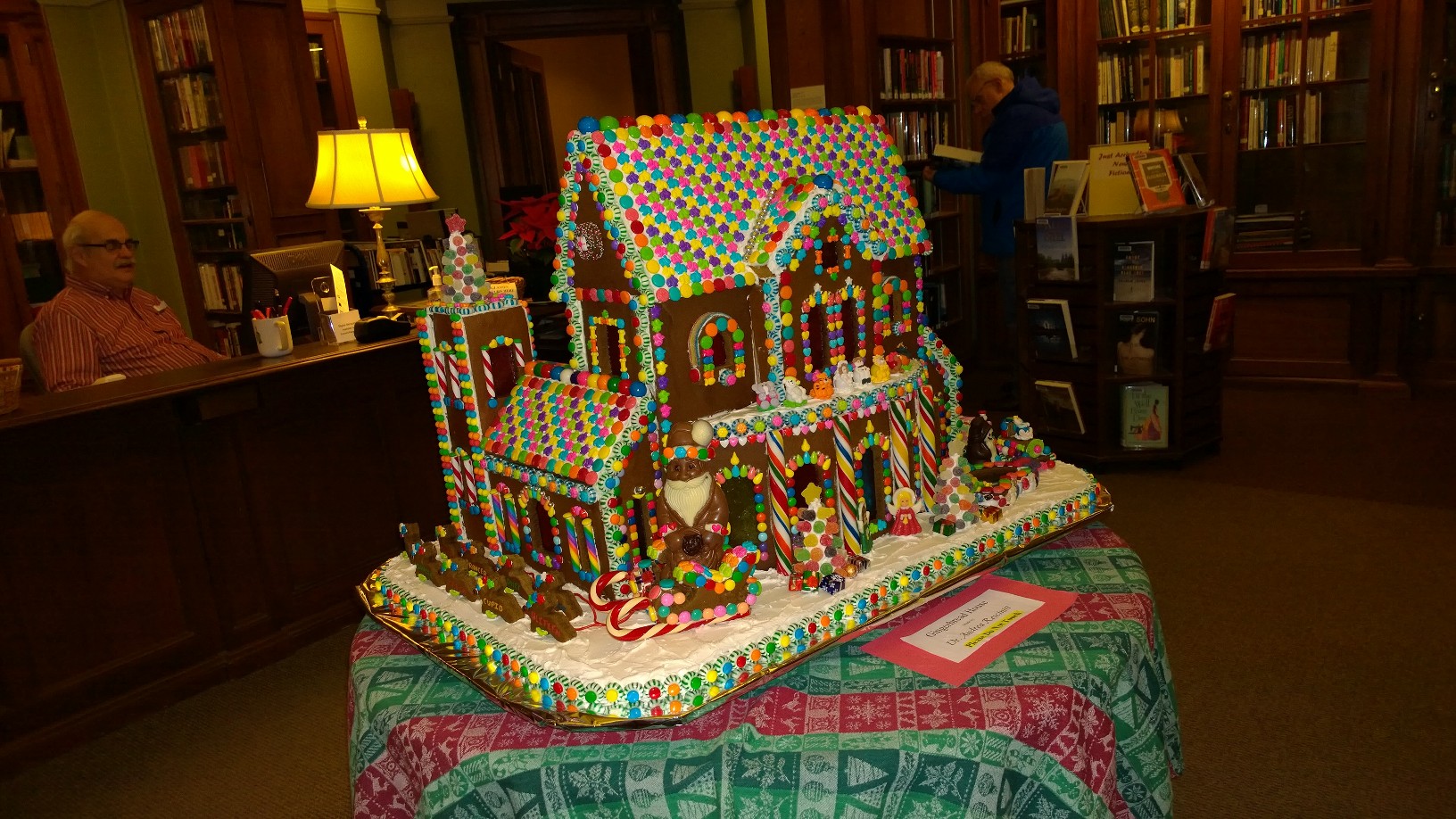
Gingerbread house at Concord Library

library-gingerbread-house


Read Full Post »

I like walking around town at this season, dodging intent holiday shoppers but without any important agenda of my own. No urgent missions, just fun ones like yesterday’s to choose a pair of socks. I never realized how many local stores carry socks.

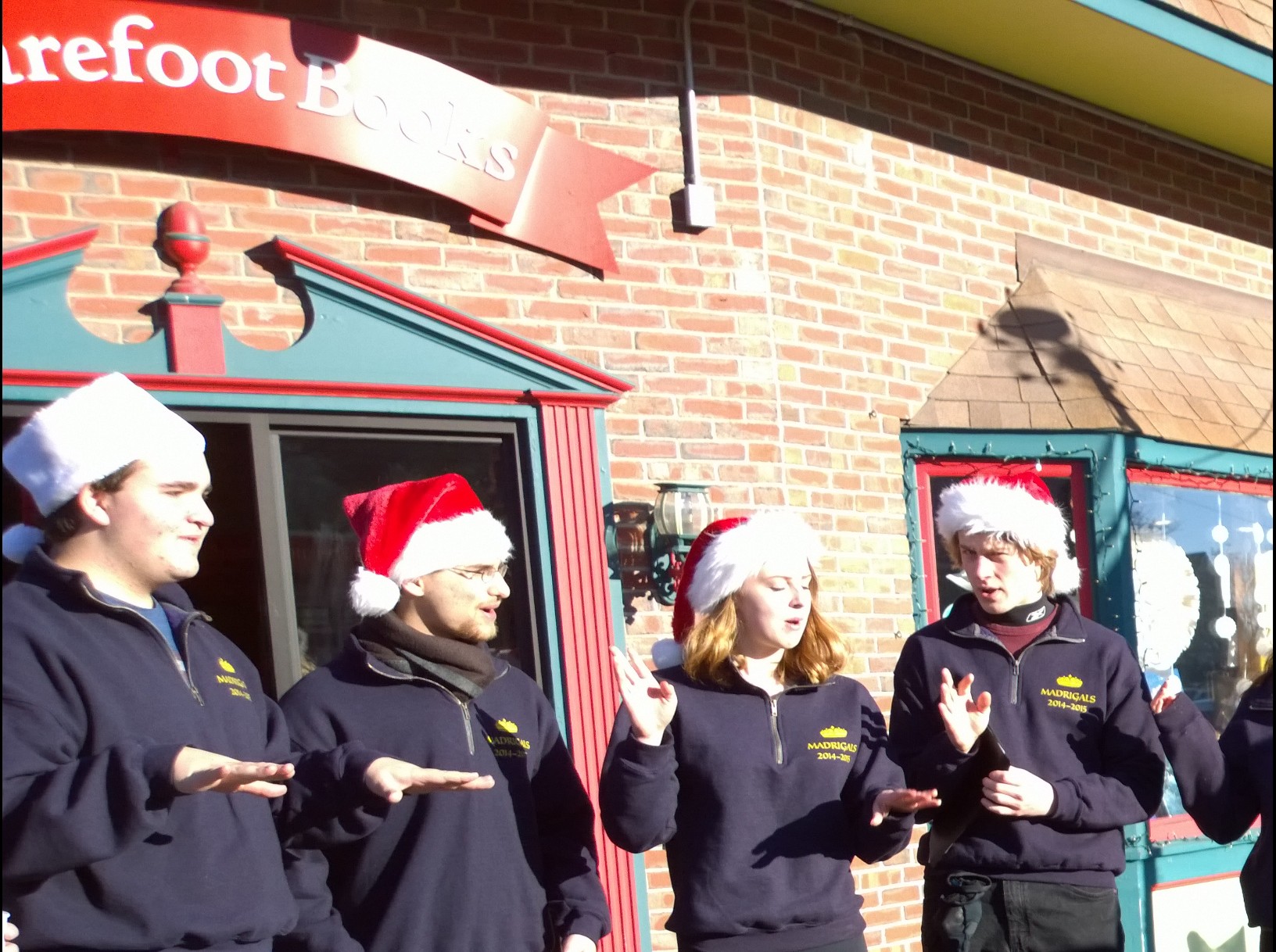
Then today, who should pop up outside Barefoot Books but the Acton-Boxborough High School Madrigal Singers, regaling passersby with seasonal favorites. And hand motions.

There was also a poetry reading at the library, part of an ongoing series. Today we had poet Sandra Lim, who read from her collection The Wilderness. The poems tended to start out straightforward and end up obscure. I need to read and think about them. I liked the title of one section of the nine-part poem “Homage to Anne Bradstreet” (a Puritan poet that Lim likes because of the crazy contrasts between controlled and wild), but I’m afraid my train of thought had nothing to do with the subject at hand.

The section of the Bradstreet homage was called “Black Painting,” and it reminded me of a friend who so detested the level of conversation at her husband’s management-consultant social events that she would invariably announce in the middle of the party, “I’m going home now and make a black painting.”

121414-madrigals-at Barefoot-Books

Read Full Post »

A nonprofit book service in Portland, Oregon, has recognized that “people living outside” are as likely to enjoy a book as people who live indoors.

Kirk Johnson writes in the NY Times, “A homeless man named Daniel was engrossed in a Barbara Kingsolver novel when his backpack was stolen recently, and Laura Moulton was determined to set things to right.

“Ms. Moulton, 44, an artist, writer and adjunct professor of creative nonfiction, did not know Daniel’s last name, his exact age, or really even how to find him — they had met only once. But she knew the novel, ‘Prodigal Summer,’ and that was a start. So, armed with a new copy of the book, off she went. Such is the life of a street librarian.

“This city has a deeply dyed liberal impulse beating in its veins around social and environmental causes, and a literary culture that has flourished like the blackberry thickets that mark misty Northwest woods. It is also one of the most bike-friendly, if not bike-crazed, urban spaces in the nation, as measured by commuters and bike lanes. All three of those forces are combined in Street Books, a nonprofit book service delivered by pedal-power for ‘people living outside,”’ as Ms. Moulton, the founder, describes the mission. …

“ ‘It’s not just a little novelty act — “Oh, that’s so Portland and cute,” ’ ” says Diana Rempe, a community psychologist. “Taking books to the streets, she said, sends the message that poor and marginalized people are not so different from the ‘us’ that defines the educated, literate mainstream of the city, whether in its hipsters, computer geeks or bankers.”

More here.

Photo: Thomas Patterson for The New York Times
Laura Moulton and Matt Tufaro in Portland, Ore. Ms. Moulton founded Street Books, a nonprofit book service for “people living outside.”

Read Full Post »

Following up on yesterday’s post, which highlighted simple pleasures like spending time in the library, I give you this report by Morgan Ribera at Bustle.

“Apparently, libraries provide patrons with a happiness that money can’t buy. Or at least nothing less than almost two grand in cash. According to a recent study commissioned by the U.K.’s Department for Culture, Media, and Sport, the act of going to the library induces joy equivalent to that brought on by a £1,359 ($1,878) pay raise.

“The study was conducted in an attempt to measure which activities have the most positive impact on an individual’s well-being. Visiting a library scored among the top joy-generating activities, alongside dancing and swimming, giving us yet another reason to hang-out at our local library. …

“And this U.K. study adds even more to the proof already stacking up on the value of libraries, a value that was evidenced extensively in a Pew Research Study released [in March]. The rather pleasing results of this eye-opening Pew study showed that habitual library goers maintain stronger community ties, are more likely to socialize with friends and neighbors, and exhibit higher levels of technological engagement.”

More at Bustle, here.
Photo: Bill Lapp

Read Full Post »

I have blogged before about the Little Free Library movement (for example, here), and I have sometimes wondered if everyone uses the libraries as intended, taking a book and returning it or contributing another.

Today John sent this link from BookRiot.com. A woman who sponsors a Little Free Library, Swapna Krishna, is stamping all her books with a message that folks should play by the rules.

She writes, “One thing I started doing a month ago (and I’m very glad of now) is that I ordered a custom stamp for my library and started stamping the books I put out. It doesn’t require that the person return the book (and honestly, I don’t care whether they do or not), but it does tell a used bookstore or library that they really shouldn’t be buying that book or accepting it for donation. And I hope that if something like this happens, they’ll make their way back to me eventually.

“I purchased the stamp off Etsy from TailorMadeStamps. They were easy to work with and did a pretty awesome job in not much time!” The stamp is below, with her address blotted out for the Internet.

I love the idea of TailorMadeStamps and can think of a number of stamp messages that might come in handy. How about this variation on an old friend’s rejection to rejection slips: “Thank you for your recent scam letter about reducing my debts. I’m obliged to inform you that it does not meet my needs at the current time. However, I have forwarded it the attorney general, who may have a use for it.”

On second thought, that might be a little too long for a stamp — and expensive. How about “Just returning your unsolicited credit card account offer in this unstamped envelope”?

Read Full Post »

I have blogged before about Sam and Leslie Davol’s library projects, including the Uni, a portable library (here). They were living in Boston’s Chinatown during the economic downturn and got an idea for a temporary library in one of the empty storefronts. Chinatown has not had a branch of the Boston Public Library since the 1950s.

(Read a couple stories about that at the BostonStreetLab, here, and the Boston Globe, here.)

Now it seems some 8-year-olds in Mattapan have become indignant about no-library injustice and have marched on City Hall.

Wesley Lowery writes in the Globe, “The voices were young, but they rang out in a synchronized and forceful chant as the children made their way through the downtown streets. Gloved hands held painted signs as pink and blue bookbags bounced on their backs.

“ ‘Books, access fairness, we’re marching to raise awareness’” the more than 50 second-graders declared as they marched from the Chinatown gate to City Hall Friday afternoon. …

“The youthful protesters were seeking to raise awareness of a campaign to bring a public library to Chinatown, which is the only Boston neighborhood without a library branch. …

“The protest was planned and carried out by students at the Young Achievers School in Mattapan, which as part of its curriculum has recently spent time learning about libraries. Upon hearing that Chinatown does not have a public library, organizers said, the students decided to stage the protest.

“ ‘They asked: “What can we do to help?” ’ said Kim Situ of the Chinese Progressive Association, which helped to organized the march.” Read more here.

And when the Young Achievers from Mattapan have gotten a library for Chinatown, maybe they could work on one for Fort Point. It’s something @FortPointer has been tweeting about for ages.

Maybe he should have been talking to 8-year-olds.

Photo: Jonathan Wiggs/Globe Staff
Luis Pizarro, 8, was one of the students from the Young Achievers School who marched on City Hall.

Read Full Post »

Libraries are busting out all over. We’ve blogged about the Little Free Library in Cambridge as well as Sam and Leslie Davol’s uni, which got invited to Kazakhstan — not to mention a library housed in an unused pay phone shelter.

Now it seems that a subway system in China is getting into the act.

Writes Zhang Kun at China Daily, “Shanghai’s Metro Line 2 is turning a new page with a library taking literally an online approach. Passengers will be able to select a book at one station, and return it to any of the other stations with customized bookshelves.

“Readers do not have to pay a deposit or any rent for the books and magazines they take. Instead, they are encouraged to donate 1 yuan (16 US cents) to charity at the bookshelf.

” ‘Now you can read a real book, rather than staring at the cellphone through the metro ride,’ said Zou Shuxian, a spokeswoman for the Aizhi bookstore, which initiated the project jointly with Hujiang.com” and the Metro Line.

“The Chinese Academy of Press and Publication released a survey recently that said the general public between the ages of 18 to 70 read 4.39 books in 2012, much fewer than in Western countries.”

The library “has been a resounding success with office workers. Waiting lines have developed during rush hour. … All the books have green tape on the cover to inform people about the program [and] to remind people it is borrowed and should be returned.”

I myself find it essential to have a book with me whenever I take the subway, but that’s largely because I ride the oldest system in America and it’s always breaking down.

My husband, who lived in Shanghai for about a year, says subways there are fast and efficient. I don’t think book lovers will have time to finish their books before their last stop. A lot of green tapes will be going home with commuters. You can’t keep a book lover down.

Read Full Post »

When I got my current job, I went through the human resources “onboarding” with a young man from Mali. Even though he went back to Africa a couple years ago, we keep in touch. Naturally, I was worried when radicals took over Timbuktu, Mali, for a while. Fortunately, Mamoudou wasn’t living in Mali at the time, although he says Guinea is not that much safer.

Because of Mamoudou, I continue to follow the Mali news, and was especially interested in a link at the Arts Journal blog today: “Mali’s Underground Railroad: How Timbuktu’s Ancient Manuscripts Were Smuggled To Safety.”

Writes Sudarsan Raghavan of the Washington Post, “It was 7 o’clock on a hot night in August, and Hassine Traore was nervous. Behind him were 10 donkeys, each strapped with two large rice bags filled with ancient manuscripts. The bags were covered in plastic to shield them from a light rain.”

Radicals had taken over Timbuktu four months earlier and “had demolished the tombs of Sufi saints. They had beaten up women for not covering their faces and flogged men for smoking or drinking. They most certainly would have burned the manuscripts — nearly 300,000 pages on a variety of subjects, including the teachings of Islam, law, medicine, mathematics and astronomy — housed in public and private libraries across the city.”The scholarly documents depicted Islam as a historically moderate and intellectual religion and were considered cultural treasures  …

“A secret operation had been set in motion … It included donkeys, safe houses and smugglers, all deployed to protect the manuscripts by sneaking them out of town.

“This is the story of how nearly all the documents were saved, based on interviews with an unlikely cast of characters who detailed their roles for the first time. They included Traore, a 30-year-old part-time janitor, and his grandfather, a guard. …

“The New York-based Ford Foundation, the German and Dutch governments, and an Islamic center in Dubai provided most of the funds for the operation, which cost about $1 million.

“ ‘We took a big risk to save our heritage,’ said Abdel Kader Haidara, a prominent preservationist who once loaned 16th- and 18th-century manuscripts from his family’s private collection to the Library of Congress. ‘This is not only the city’s heritage, it is the heritage of all humanity.’ ”

There are heroes everywhere, keeping a low profile. And I am also pretty impressed with the funders, springing into action like that.

More here.
Map: National Geographic

Read Full Post »

A library seed program, described by Luke Runyon at National Public Radio,  reminds me of the sharing concept behind Heifer Project International (if you are given a chicken or a rabbit or a calf, you must give some of the offspring to another person in need).

“In a corner of the library, Stephanie Syson and her 4-year-old daughter, Gray, are just finishing a book with a white rabbit on the cover.

“When Gray approaches the knee-high shelves filled with seed packets, she zeroes in on a pack labeled ‘rainbow carrots.’

” ‘We just read two books with bunnies in them, so we’ve got bunnies on the brain,’ Syson says.

“Syson flips through a wicker bin labeled ‘carrots’ and offers other varieties to Gray, like ‘atomic red’ and ‘cosmic purple.’

“Here’s how it works: A library card gets you a packet of seeds. You then grow the fruits and vegetables, harvest the new seeds from the biggest and best, and return those seeds so the library can lend them out to others. …

“The library’s director, Barbara Milnor, says in the age of digital, downloadable books and magazines, the tangible seed packets are another way to draw people in.

” ‘You have to be fleet of foot if you’re going to stay relevant, and that’s what the big problem is with a lot of libraries, is relevancy,’ she says.

“Milnor says that while a library may seem like an odd location for a project like this, seeds and plants should be open to everyone. That makes a public library the perfect home for a seed collection.” More.

The sharing aspect is what stands out to me. Remember the post about Hebden Bridge in England and how people were planting in random bits of land and making the produce to free to anyone? Check that out, too.

4/7/13 Update: A similar effort in Concord, http://www.concordseedlendinglibrary.org.

Photograph: Dylan Johns
The seed library is a partnership between the Basalt Public Library and the Central Rocky Mountain Permaculture Institute. Seed packets encourage gardeners to write their names and take credit for their harvested seeds.

Read Full Post »

The other day John brought up the topic of Andrew Carnegie. Whatever else might be said about this 19th Century steel baron, you have to give him credit for putting so much of his fortune into philanthropy, especially libraries.

Today John Wood is carrying on that work in impoverished countries around the world. As Nicholas Kristof writes in the NY Times, “Wood’s charity, Room to Read, has opened 12,000 … libraries around the world, along with 1,500 schools. …

“He has opened nearly five times as many libraries as Carnegie, even if his are mostly single-room affairs that look nothing like the grand Carnegie libraries. Room to Read is one of America’s fastest-growing charities and is now opening new libraries at an astonishing clip of six a day. …

“He also runs Room to Read with an aggressive businesslike efficiency that he learned at Microsoft, attacking illiteracy as if it were Netscape. He tells supporters that they aren’t donating to charity but making an investment: Where can you get more bang for the buck than starting a library for $5,000? …

“ ‘In 20 years,’ Wood told me, ‘I’d like to have 100,000 libraries, reaching 50 million kids. Our 50-year goal is to reverse the notion that any child can be told “you were born in the wrong place at the wrong time and so you will not get educated.” ‘ ” Read more.

Photograph of John Wood: Room to Read

Read Full Post »

« Newer Posts - Older Posts »