Feeds:
Posts
Comments

Posts Tagged ‘music’

I’ve been meaning to blog about the wildly successful music-education program out of Venezuela, El Sistema.

Here music critic Mark Swed follows the L.A. Philharmonic to Caracas and writes about El Sistema for the Los Angeles Times.

“Musically, Venezuela is like no other place on Earth. Along with baseball and beauty pageants, classical music is one of the country’s greatest passions.

“In the capital, Caracas, superstar Venezuelan conductor Gustavo Dudamel is mobbed wherever he goes. Classical music teeny-boppers run up to him for autographs when he walks off the podium at concerts. The state-run music education program, which is known as El Sistema and from which Dudamel emerged, is the most extensive, admired and increasingly imitated in the world. One of its nearly 300 music schools for children, or núcleos, is deep in the Venezuelan Amazon, reachable only by boat. …

“The basic tenet of José Antonio Abreu, the revered founder of El Sistema, is the universal aspect of music. He likes to say that music is a human right. That’s an effective, politically expedient slogan. But what he has demonstrated on a greater scale than ever before is that music is not so much a right as a given. El Sistema is not about talent, ingeniously effective system though it may be for discovering and fostering musical talent. The truly revolutionary aspect of El Sistema is its proof that everyone has a capacity for music.”

Read about how El Sistema has spread worldwide in the Los Angeles Times.

Children at La Rinconada in Caracas, Venezuela, Feb. 14, 2012. Gustavo Dudamel, right, among students at a showcase of El Sistema in Caracas, Venezuela, Feb. 15. Photograph: Mark Swed / Los Angeles Times

Read Full Post »

Tom Jacobs at Pacific Standard reports on new research into the benefits of music for children.

“Music education produces myriad benefits,” he writes, “strengthening kids’ abilities in reading, math, and verbal intelligence. New British research suggests it may also teach something less tangible, but arguably just as important: The ability to empathize.

“In a year-long program focused on group music-making, 8- to 11-year old children became markedly more compassionate, according to a just-published study from the University of Cambridge. The finding suggests kids who make music together aren’t just having fun: they’re absorbing a key component of emotional intelligence.”

The research team was led by Tal-Chen Rabinowitch of the university’s Centre for Music and Science. Read more.

Photograph: Pete Pahham/Shutterstock

Read Full Post »

A musician and his scholar wife have created an unusual show based on their visits to Israel and Palestine and on the music and sounds they absorbed there.

Joel Brown writes in the Boston Globe: “Performer Yuri Lane grew up the son of artists in San Francisco’s then-gritty Haight-Ashbury neighborhood, which he found to be good preparation for traveling the West Bank as a Jew.

“ ‘I learned a lot about tolerance, and seeing people for who they are, not judging them,’ he says. ‘Also, some street smarts.’

“Lane began visiting Israel and the West Bank in the late 1990s, following his girlfriend, now wife, Rachel Havrelock, a religion scholar who studied on both sides of the Green Line that marks Israel’s pre-1967 borders.”

Together they have created “From Tel Aviv to Ramallah: A Beatbox Journey,” which they call a “hip-hop travelogue.”

Lane tells the Globe his travels “just kind of opened me up, just being Jewish in Israel . . . and also traveling across the Green Line and seeing a lot of similarities between Tel Aviv and Ramallah. … The night life and the jazz cafes and places where people can smoke water pipes and hang out, listening to the sounds of music, from sped-up Bedouin music to hip-hop. I really just tried to be a sponge.” More from the Globe.

By the way, you can hear Yuri’s harmonica beatboxing on YouTube. (Had to look up beatboxing: “a form of vocal percussion primarily involving the art of producing drum beats, rhythm, and musical sounds using one’s mouth, lips, tongue, and voice.”)

Photograph: The Boston Globe


Read Full Post »

My husband went to college with Frank Popper, who went on to become a professor at Rutgers and Princeton. Along with his wife Deborah, also a professor, Popper has written extensively about the loss of population in the industrial Midwest and the idea of returning former urban areas to a “Buffalo Commons.”

That once seemed far out, but today he is popular with leaders of shrinking cities like Detroit that are open to any idea that might make cities livable again, including turning abandoned neighborhoods into parkland.

This week he sent a surprising e-mail. His research is in an opera being performed by a Milwaukee new-music ensemble called Present Music.

“The libretto.” writes Popper, “has big quotes from a 1999 academic-journal article Deborah and I wrote about the Buffalo Commons, and two of the actors  play us. Composer Kitzke, librettist Masterson, baritone Ollmann and the other performers are all excellent.”

From Present Music’s website: “Buffalo Nation (Bison bison), by Jerome Kitzke and Kathleen Masterson, [was] commissioned by the Map Fund, a program of Creative Capital supported by the Doris Duke Charitable Foundation and the Rockefeller Foundation; Forest County Potawatomi Foundation, Suzanne and Richard Pieper Family Foundation and by other individual donors. This project is supported in part by an award from the National Endowment for the Arts.”

Jerome Kitzke and Kathleen Masterson

Read Full Post »

Mice find Verdi and Mozart more healing than Enya. Tom Jacobs at Miller-McCune (now called Pacific Standard) explains.

“Writing in the Journal of Cardiothoracic Surgery,” he says, “a team of Japanese researchers led by Dr. Masanori Nimi describe an experiment in which a group of 8- to 12-week-old mice underwent heart transplants. The rodents were randomly assigned to one of five groups: those exposed to opera (a recording of Verdi’s La Traviata, conducted by Sir Georg Solti); instrumental music by Mozart; New Age music (The Best of Enya); no music; or ‘one of six different sound frequencies.’

“After one week, the mice whose personal soundtrack featured Enya, one of the sound frequencies, or no music at all ‘rejected their grafts acutely,’ the researchers report. …

“In contrast, those exposed to Verdi or Mozart ‘had significantly prolonged survival.’ …

“In explaining the results, the researchers point to the immune system. They report exposure to classical music generated regulatory cells, which suppress immune responses and are thus vital to preventing rejection of a transplanted organ. …

“In any event, this provides more evidence that classical music has a health-inducing impact on the body.” Read more.

Hmmm. You want to suppress your immune system when you have a transplant because you don’t want your body to reject an organ from a donor. But suppose you want a strong immune system for some other reason? Would classical music be bad for you (or a mouse) in that case? Hard to get my head around that one.

Read Full Post »

Last night I went to a jazz benefit for the nonprofit Kids4Peace Boston, which sponsors a summer camp and other events for children of three faiths — Christian, Muslim, and Jewish. The children are from both the United States and Jerusalem and are 11 to 12. Read more about the program here.

The fundraising event was held in the Grand Circle Gallery in Boston, which features magnificent travel posters and travel photography from the 1930s and 1940s. The entertainment was provided by Indian vocalist Annette Philip and her jazz quartet. Very impressive.

Read Full Post »

Living on Earth, a national radio program produced in Somerville, Massachusetts, has interviewed an interesting guy who makes audio recordings of nature.

He may record, for example, what a woodland sounds like before a logging company comes in and what it sounds like after clear cutting. He may record the sounds of insects in trees. He says it is nearly impossible to get away from man-made sounds when recording nature.

Listening to his recordings early this morning resulted in my listening for the birds more on the walk I took later. (And I turned to see a very jubilant cardinal.)

“Few have heard the world as Bernie Krause has. Originally trained as a musician, he spent years recording the most famous musicians of the 1960s and 70s. Then he left the studio to explore the origins of music in nature. Krause has recorded wild sounds in places few have ever been or even dreamed of. Living on Earth’s Ike Sriskandarajah listens in.” Listen here or read transcript.

Krause calls his field of study soundscape ecology. Here is his new book, The Great Animal Orchestra.

Read Full Post »

I went to the concert of an oboe-playing friend Sunday. The 3 p.m. event coincided with the anniversary of the earthquake and tsunami that took place a year ago in Japan. My friend, of Japanese heritage, was moved by the music he was playing, and so was I. The modern pieces really sounded like an earthquake to me. I had visions of Poseidon, the Bull from the Sea, rising up in anger against humankind, and later of hope dawning.

The Charles River Wind Ensemble, where my friend plays, has a new conductor. I liked Matthew Marsit’s energetic style and his explanations of the pieces. Marsit, a clarinetist himself, is also a conductor at Dartmouth College, where he practices his belief in music outreach to lower-income communities.

“An advocate for the use of music as a vehicle for service, Matthew has led ensembles on service missions in Costa Rica and Philadelphia, Pennsylvania, collecting instruments for donation to schools, performing charity benefit concerts and offering workshops to benefit arts programs in struggling schools.  His current work at Dartmouth allows for outreach projects in the rural schools of New Hampshire and Vermont, working to stimulate interest in school performing arts programs.” Read more.

I think musicians can be very giving people. Indian Hill Music in Littleton, Massachusetts, offers scholarships and more. Someone I know on the board tells me that Indian Hill has “a program to bring music instruction to schools in the region that have cut out music due to budgetary constraints. They also offer free concerts, a Threshold choir (music for dying patients), and a number of other outreach efforts.”

In Providence, Rhode Island, Community MusicWorks demonstrates how music builds community and teaches social responsibility. You can read about this and other innovations in Rhode Island’s creative economy here.

Read Full Post »

I was reading an article in the Sunday Globe about a musician who self-published a comedic memoir on his years as a freelance bassist with the Boston Pops. The book was called Real Men Don’t Rehearse; the article was mainly about self-publishing.

As I read the article, I kept thinking the guy’s name was familiar. I racked my brain: who wrote and the funny plays for Adventures in Music in the 1980s, the stage series introducing kids to classical music?

John had performed in two of those productions, sometimes called the Splatgort Series after the adult character. But John was 11 or 12 and now he’s a grown-up with a toddler and a wife. I looked at the photo of the author in the paper. Less hair. Not sure.

But, soft! (as they say in Shakespeare). Google meets all needs (as they don’t say in Shakespeare). Here is the site for Justin Locke Productions, and it’s definitely the same guy.

If you are mainly interested in the self-publishing aspect of this tale, read the Globe  article by Megan McKee. That’s quite engaging, too. I especially like this line, “Locke believes that real success can often be found through unconventional routes.”

Read Full Post »

In case anyone thought that this blog wasn’t eclectic enough, I’m linking today to a story about garbage collection in Taiwan.

“For several years, Taiwan’s garbage trucks have played classical music as they travel through crowded residential areas, drawing forth residents with their garbage. Conceived by Taiwan’s Environmental Protection Administration as a way to decrease pests and odors in outdoor public trash disposal areas, the trucks musically notify residents that they are to bring their garbage directly to the trucks, ensuring that the garbage never sits on the curb attracting vermin and releasing odors.”

I wonder how two-career families who aren’t home to respond to the music deal with this. Read more on Taiwan’s approach at New York’s classical music station, WQXR.

Meanwhile, at Los Alamos, Americans show they can innovate in garbage collection, too. I think my grandson will like this truck.


Read Full Post »

First Parish does not have a typical service on New Year’s Day. For one thing, attendance is sparse.

Sunday’s “Taizé” service put me in mind of something my mother used to say about Unitarians to tease my father, who was one. (The denomination was not yet Unitarian-Universalist.) She liked to say that her impression of Unitarians had always been “seven people in an attic with a violin.”

Parishioner Joan Esch and her cello provided the opening music yesterday. Instead of going into the main sanctuary, we gathered in the parish hall, sitting on folding chairs around a small table with candles and flowers. At most there were 40 people, including toddlers running and climbing.

Mark Richards led the Taizé service, explaining that the concept started in France. The First Parish version is short and consists of one-verse songs sung over and over in unison without accompaniment and interspersed with readings, cello interludes, meditation, and candle lighting — for remembrance (such as an illness or death) and hope (such as a new beginning or a birth).

I enjoyed being there. It was different. And I liked a line that was quoted from a long-ago minister — something about the mystery within reaching for the mystery without.

Read Full Post »

Friday night I went to see the Groove Barbers at 51 Walden, not knowing quite what to expect. It turns out that three of the barbershop team were the original founders of Rockapella. One of them, Charlie Evett, lives in Concord, which explains why the others came to town.

They started off with “Love Potion Number 9,” and I knew I had come to the right place. The evening was super entertaining. It wasn’t exactly Oldies Night, but I liked hearing some songs I recognized from my youth. I also appreciated some of the musical jokes. The guys did a jazzy “Angels we have heard on high,” with the Deo of “in excelsis Deo” gradually morphing into “Day-o.” And they premiered of a new orchestration of one of my all-time favorite pop songs, “You don’t know me.”

They brought on a few guests: a young guy who makes those snare drum sounds so essential to a capella and a niece from Barnard College. Really terrific was lead singer Sean’s wife, Inna Dukach, a professional opera singer, who sometimes performs opera as they doo-wop in the background.

Sean Altman, Charlie Evett and Steve Keyes are the ones who were in Rockapella. Kevin Weist is the fourth Groove Barber. In addition to barbershop, the four perform rock, doo-wop, and jazz. Their website says they were featured in national TV commercials as The Astelins, offering “Astelin nasal spray to seasonal allergy sufferers.” (Available on YouTube.)

The Groove Barbers wound up with a bread and butter song from their past life, “Where in the World Is Carmen Sandiego,” which Suzanne’s dad suspects had a key influence on her love of travel.

Read Full Post »

Someone who used to know her well alerted me to the story of the Mystery Grammy Nominee. At 51 and without a record label, she has managed to get a remarkable burst of attention for her music.

Writes Christopher Morris at Variety, “Linda Chorney used the Recording Academy’s Grammy 365 website to connect with voters.

“Armed only with a computer and some chutzpah, a longshot snuck through the back door and into the Grammy Awards competition this year.
The resourceful Linda Chorney secured a Grammy nomination in the category of Americana album for her self-produced, self-released ‘Emotional Jukebox’ by taking her mission directly to voters, employing the peer-to-peer function of the Recording Academy’s own site for members, Grammy 365.

“Many in the tight-knit Americana community have reacted quizzically, and sometimes vehemently, to Chorney’s nomination, which trumped several well-known artists in the genre. The virtually unknown Sea Bright, N.J.-based musician will face off on Feb. 12 against a field of nominees that has collectively garnered a total of 23 Grammys. And while some question her methods, her online campaign falls completely within the academy’s parameters for acceptable self-promotion.” Read more.

There are several videos on YouTube. What do you think? Leave a comment.

Follow us on twitter @LunaStellaBlog1.

Update: Chorney didn’t win a Grammy, but she has been invited to sing the national anthem at Fenway Park before an April 2012 Red Sox game, another item on her “bucket list.”

Read Full Post »

The phrase comes from the carol “Lo, How a Rose E’er Blooming.”

Somehow, the words “when half-spent was the night” instead of “in the middle of the night” (a choice doubtless made to fit the rhythm) makes one think about the meaning more. Something about a gift arriving unexpectedly halfway through a time of darkness. Something surprising and curious.

A nice gift I received Friday was an expression of gratitude for being there for someone through her first year at my workplace. With tears in her eyes. Golly. Something surprising. A welcome surprise.

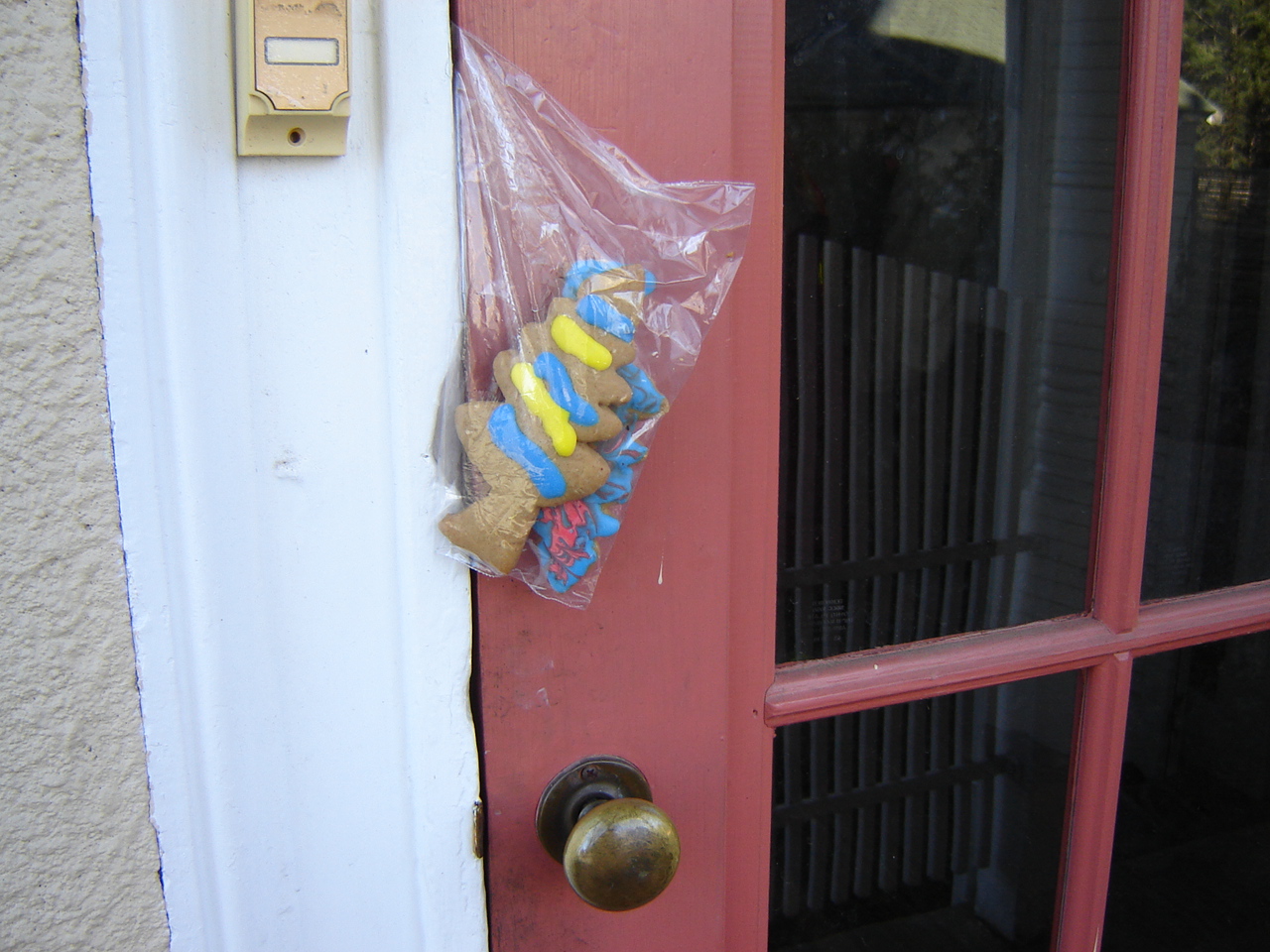
Then today, tucked in the back door, a stealth gift. Hmmm. No note. Swedish colors. For Erik? I think I recognize the cookie style. It suggests Suzanne’s longtime friend, a buddy since kindergarten, known for — among other things — her mother’s cookie-painting parties at Christmas.

Suzanne is being remembered, and being reminded of fun times, at a busy season when her friend is visiting town for only a short while. These are gifts that make people feel good.

Read Full Post »

Gian Carlo Menotti composed Amahl and the Night Visitors for an NBC Christmas show in 1951. He was under deadline and drawing a blank when the painting “The Adoration of the Magi” at the Metropolitan Museum of Art sparked his childhood memories of three kings who visit Italian children with gifts.

I have seen the operetta and listened to the recording many times. It takes only the first few bars and the lovely oboe representing the shepherd boy’s pipe for me to bring out the tissues and start crying and smiling all the way through.

A production today at the Friends of the Performing Arts in Concord was excellent. Kim Lamoureux took the role of Amahl. Robert Runck was stage director. Robin Farnsley was music director. Farnsley also was a breathtaking Mother of Amahl. Her anguish in the scene where her fear for her son overcomes her is heartbreaking as she inches toward the gold of the sleeping kings.

“All that gold! All that gold!
I wonder if rich people know what to do with their gold?
Do they know how a child could be fed? Do rich people know?”

You may read the whole script of this short operetta here. And there are lots of snippets on YouTube.

Update: December 22, 2013 at 2:00 p.m. and 4:00 p.m.
Amahl and the Night Visitors, with soloists Julia Shneyderman, Robin Farnsley, Ray Bauwens, Brad Amidon, Thomas Dawkins, and Michael Prichard. Chorus and orchestra conducted by Alan Yost,  Tickets $20 adults/$10 students. Call 978 369-7911 or buy on-line.

Follow us on twitter @LunaStellaBlog.

Read Full Post »

« Newer Posts - Older Posts »