Feeds:
Posts
Comments

Posts Tagged ‘music’

Photo: Musica Secreta
A new effort to bring back the choral music of Renaissance nuns is getting attention in classical circles. Composer and princess Leonora d’Este is the focus of this research.

Like other achievements of women centuries ago, the music of nuns in the Renaissance has been mostly lost to time. Until now.

At Bachtrack, Laura Volpi reports on a gifted daughter of Lucrezia Borgia.

“In 16th-century Italy – and across Europe – convents were the backbones of the economic and spiritual well-being of a city. At their core were expertly run choirs of nuns, so talented and so popular that they were considered tourist attractions. … During this vibrant yet under-explored chapter in Renaissance musical history, a princess nun was composing for her convent in Ferrara, and her anonymously published motets lay unsung and unloved for 500 years.

“To find out more, I spoke to Dr Laurie Stras, Professor of Music at the University of Huddersfield, author of the recently published book Women and Music in Sixteenth-Century Ferrara, musicologist and co-director of two early music female-voice ensembles – Musica Secreta and Celestial Sirens. …

” ‘Most families couldn’t afford to pay a marriage dowry for more than one daughter,’ explains Stras. … ‘So families who wanted the best for their daughter would get her into a convent with plenty of income. But a comfortable convent might have had quite a high dowry in itself, so one of the ways to get a reduction was by bringing a skill to it, such as music.’

“Music was really profitable for convents: it brought in money from the community, donating to hear mass on their behalf, while a great musical reputation brought in girls of higher status and wealth. Music also kept the nuns entertained and helped develop and maintain community harmony. …

“Music composed for convents would only be for the choirs’ consumption, so to find some published was unusual. Yet princess Leonora d’Este is strongly believed to be the author of 23 motets. …

“Leonora D’Este was the daughter of Lucrezia Borgia and Alfonso I, the Duke of Ferrara. She became Mother Superior at Corpus Domini when she was 18 and several of her contemporaries write of her exceptional musical abilities. We know that her family supported her musical activities up to her death.

“Despite the limitations of a life of enclosure, for many women life in a convent was a passport to freedom.

‘Some women chose a monastic life because they were creatively driven and felt that they had more space to develop as creative or intellectuals in the convent than they would outside.’ …

“ ‘Leonora sent these motets for publication to see them preserved for posterity. Hers are incredible works, so far beyond what was already in print in the 1540s. Technically they are an amazing achievement. All these motets are written for five, equal voices, voci pari, all of which are more or less in the same compass. You get some very interesting dissonance treatment when you have five parts moving in such a confined space. … One of the most outlandish pieces is a setting of the Mass Gradual for Easter Sunday, Haec dies, in which the voices imitate the sounds of all the bells of the city going off.’ …

“It is important to bring this music back to choral ensembles today. ‘We know about the Sistine Chapel, we know about Palestrina and we know about Josquin des Prez only because of the way history has been written and the things that have been given value,’ says Stras. ‘By recovering this wonderful music, we bring the balance back. The English choral tradition has given prominence to boys’ voices as more appropriate for Renaissance music, but the sound of women singing is the sound of the Renaissance. It’s not something that is unusual or that should be suppressed: this is part of our heritage.’ ”

More at Bachtrack, here.

Read Full Post »

Photo: Bruce Mendelsohn

A teen at a Youth Services center in Massachusetts takes a turn at conducting musicians from the Sarasa Chamber Music Ensemble.

Years ago, just before Christmas every year, I would receive a funding request from a volunteer who was concerned for teens held in state custody. He would write that these young people were largely forgotten at the holidays, and he would take whatever donations he could round up and go buy them small gifts. I always thought he sounded like a very kind person.

This past holiday season, I heard about a similar outreach to youth in trouble and wanted to tell you about it.

Cintia Lopez reported at WBUR radio, “On a recent morning, a teen living at the Metro Regional Center, a Department of Youth Services facility, nervously stood in front of a string quartet in a windowless recreation room. Trying his hand at conducting a group of classically trained musicians, he tentatively moved his hands like a conductor, setting the tempo for the musicians as they played Bach’s ‘The Art of Fugue.’

“His peers laughed in the background, while the musicians offered words of encouragement. When he got a better feel for the music, he began to dance, pointing his fingers up and down, bobbing his head and rolling his arms to the rhythm of the music.

“ ‘It kind of gave me a warm and kind of calm feeling and then as the tempo got a little bit higher it kind of gave me like a little adrenaline rush,’ another teen said of the classical performance. …

“The teens were being visited by musicians from Sarasa, a Boston-based chamber ensemble. Artistic Director Timothy Merton said he likes helping the teens talk about the music.

“ ‘They don’t have much contact with the outside while they’re there. And certainly not with arts programs,’ Merton said. He founded Sarasa about 20 years ago. … The group now performs in youth service facilities about a dozen times a year.

“For the teen, Sarasa taught him that he can listen to classical music to calm down when he is feeling angry.

‘I think it’s a very good experience for the youth here,’ he said. ‘Just to show culture that people aren’t always exposed to and it’s kind of like getting everyone to see other parts of cultures and kind of the diversity that the world has.’ …

“Later in the visit, violinist Rodolfo Richter played Krzysztof Penderecki’s ‘Cadenza’ for a second group of teens. The teens perked up at the speed at which Richter played, seemingly with ease. One teen likened the piece to an old ‘Tom and Jerry’ cartoon. …

“Here are teens, who in some ways have been hardened by life’s turns, awed by the sounds of a cartoon, revealing how much innocence they still possess.

“Seeing the teens connect with the music reminds cellist Jennifer Morsches of her own discovery of classical music.

“ ‘That’s where I learned much about classical music, watching “Bugs Bunny,” ‘ Morsches said. ‘And a lot of people react, young kids, react that way. It’s true and it does sound like Tom and Jerry chasing.’ ”

More at WBUR, here.

Read Full Post »

Photo: Katherine Taylor for the Boston Globe
Eureka Ensemble, whose mission is to nurture social change, launched a Women’s Chorus that welcomes women experiencing severe poverty and homelessness.

How does one write a headline for a story like this? It’s not exactly about music giving homeless people hope. It’s more that focusing on music — music performed for you and music you make — activates a positive side of who you are. It’s that positive things can lead to other positive things.

During the 2018 Christmas season, there was quite a bit of comfort and joy being spread by music in the Greater Boston homeless community. Zoë Madonna wrote about it at the Boston Globe.

“The CASPAR homeless shelter, a low-slung brick building, crouches on Albany Street in Cambridge. When percussionist Jennie Dorris wheels her marimba through the front door, half of a large central room has been cleared, and a line of grizzled men sits at a long row of tables, watching. An enthusiastic older man in a Boston Strong T-shirt marches up, introducing himself as Danny. ‘Finally, the marimba’s here!’ he exclaims, grinning. ‘I wait all year for this.’…

” ‘What compels me is to take music where it’s needed and treat everyone with respect,’ says founder Julie Leven, a violinist. This year, its eighth, Shelter Music Boston has mounted scores of concerts in shelters throughout the Greater Boston area, including a full schedule in the days leading up to Christmas.

“It’s not the only music group focusing on the homeless around Boston. Eureka Ensemble, whose mission is to nurture social change, launched a Women’s Chorus that welcomes women experiencing severe poverty and homelessness. …

“Eureka’s most ambitious project, according to cofounder and conductor Kristo Kondakci, was a commissioned composition, Stephanie Ann Boyd’s ‘Sheltering Voices.’ Auditions for choral fellowships for women were held at Pine Street Inn and Women’s Lunch Place, says Kondakci, a recent graduate of New England Conservatory who has worked with the homeless since his student days at Boston College High School. Around 15 took part.

“Carrie Jaynes and Rottisha Mewborn are friends who met at Pine Street Inn. When they saw the audition sign-up sheet, they were initially skeptical, they say — they’re used to well-meaning outsiders putting in a few hours and then disappearing. But they went to the audition in March, in a room where the heater was going haywire. To cool it down, Kondakci threw open the door of a nearby freezer.

“And that, Mewborn says, put them at ease. … As Eureka Fellows, Jaynes and Mewborn rehearsed weekly with Kondakci, learning ‘Sheltering Voices.’ They were never treated as anything less than important and independent, they say.

“ ‘We became so desensitized at Pine Street that we forgot how we can be treated like a normal person,’ says Jaynes. At the rehearsals, she says, ‘we knew that we were in this together. We knew that we were all right . . . we could be human again. We could show emotion and not be judged if we cried, or laughed, or showed a softer side of us.’ …

“Shelter staff say that after Shelter Music Boston concerts, the atmosphere is more peaceful, and nights are more restful, notes Leven, who also plays with Handel and Haydn Society and the Boston Pops Esplanade Orchestra. …

“As for the Eureka fellowships, Jaynes and Mewborn say their experiences were powerful. ‘Having Kristo say “We’ll get you there no matter what” built up our trust and our safety,’ Mewborn says. Because Pine Street Inn has a daily lottery, she explains, she never knows if she’ll have a bed to sleep in each night. There’s little in her life she can truly count on. ‘So just having this little safety — even if things are going crazy out here, we can get there — it’s amazing.’ ”

More here.

Read Full Post »

3-nocrop-w1024-h2147483647

Photo: Michelle Groskopf
Scenes from the fifth annual Write On Song Camp at Atlantic Records in Los Angeles. From left, Federico Vindver, Angel Lopez, Oscarcito, Sam Derosa, and Adriel Favela.

I know almost nothing about popular music these days or the names of current stars, but I thought this article about songwriting camps was interesting. The artists’ collaborative process might be fun for creatives in other arts to try once in a while.

Steve Knopper writes at Vulture, “At a studio in 2016, Dave Longstreth was working by himself on a chord progression, as he usually does when writing for his band, Dirty Projectors.

” ‘It’s normally a pretty solitary process,’ he says now. But that time, Solange was there, as were Sampha, a British songwriter and producer; Blue, Solange’s engineer; and a bunch of other creative people, all part of what Longstreth calls ‘the camps,’ to make Solange’s 2016 album, ‘A Seat at the Table.’

“ ‘I’d have a melody from her, and would be just harmonizing on it, and she would come over and say, “Ooh, I really love this chord and that chord, but this one is too dissonant,” ‘ he recalls. ‘To be just a spoke on the wheel was a novel experience, and to be thinking in a collective way was just really fresh for me.’

“As long as there has been indie rock, songwriters have worked in their own band bubbles. … But over the past decade, the genre’s biggest names … have substantively contributed to albums by Beyoncé, Rihanna, Kanye West, Lady Gaga, and others. Many of these connections happen by serendipity — Beyoncé’s ‘They don’t love you like I love you’ hook in ‘Hold Up,’ [was] the result of Koenig tweeting a slightly misremembered line from Yeah Yeah Yeahs’ 2003 single ‘Maps,’ then recording it with Diplo. …

“When I walked into a room at the Lakehouse Recording Studios in Asbury Park, New Jersey, in late June,” reporter Knopper continues, “my eyes took a few seconds to adjust from the fluorescent hallway lighting. Through flickering candles, I made out Chelsea Jade, a New Zealand singer-songwriter, dressed in black, singing in a high, glassy pitch; Danny Mercer, a Colombian-American guitarist and singer, tapping out a Depeche Mode–style riff on a keyboard; and Randy Class, a Bronx producer, capturing everything on a laptop and looping it back. This was the BMI songwriters’ camp, which split up ten top writers into groups of three or more with the hope of regurgitating multiple daily songs. … Jade improvised: ‘I’m a psychopath.’ Class quickly discerned a double meaning about a ‘psycho’s path.’ Mercer fleshed out the melody with Spanish-guitar runs. …

“Ben Dickey, manager of Future Islands, Washed Out, and other indie-rock stars, believes the trend begins with hip-hop, in which artists are more experimental and willing to take chances than those in any other genre. Whereas a songwriter in a rock band can be stuck in a routine, collaborating with the same people in the same configurations, West, Drake, and Beyoncé pick the best material from whoever inspires them at the time. ‘You come up with what can be a really interesting song that has way more diverse influences than what one singular singer-songwriter would come up with — then you have Kanye or Drake come in and rap over it,’ Dickey says.” Read more at Vulture, here.

Read Full Post »

bigsingcaliforniaeric-whitacre-crop

Photo: Marc Royce/Los Angeles Times
Conductor Eric Whitacre (above), the Los Angeles Master Chorale, and a 2,200-person audience at Walt Disney Concert Hall participated in “the largest free group singing event in California history” on July 21.

Kudos to creative thinkers who keep coming up with new ideas to engage people in the arts! In July, the conductor of the Los Angeles Master Chorale led an exceptionally large audience of interested Californians in a free singing event that must have warmed the cockles of a lot of hearts. This went well beyond the annual singing of the “Hallelujah Chorus,” which many other choral groups invite the public to join.

Jessica Gelt of the Los Angeles Times reports, “Eric Whitacre, the Los Angeles Master Chorale’s Swan family artist-in-residence, says he’s like that old cola commercial — he wants to teach the world to sing. The whole world. And he’s not joking. But he’ll start with a statewide singing event, ‘Big Sing California.’ …

“The massive project, years in the making, [featured] the 100-voice Master Chorale onstage singing along with 2,200 audience members to a program of songs selected and conducted by Whitacre and Master Chorale Artistic Director Grant Gershon, along with guest conductors Moira Smiley and Rollo Dilworth.

“Those proceedings [were] simulcast to five venues all over the state packed with additional audience members [also] singing along. Each venue [rehearsed] with its audience for a few hours before the event. …

“ ‘If you’ve never experienced a couple thousand people singing together, it just brings chills. … It’s the best of human experience … the best of who we are distilled together.’

“Whitacre began singing when he was 18, and it changed his life. He has been singing and composing since then, traveling the world in the process, establishing a massive social media following and creating a series of online ‘virtual choirs,’ which are edited together after participants upload videos of themselves all singing the same song. …

“Gershon adds that Whitacre has ‘single-handedly gotten more people excited about singing together than anyone else on the planet. He confirms that the choral experience is transcendent and transformative.’ ”

More at the Los Angeles Times, here. The list of songs are here.

Read Full Post »

vyc-camryn-jordan-wn-1684w

Photo: Celeste Sloman for The New York Times
Camryn Cowan and Jordan Millar, 11-year-old students in the Philharmonic’s Very Young Composers (VYC) program, received a burst of media attention after being featured along with their compositions in the New York Philharmonic Concerts in the Parks.

The young composers in this story got a boost for their musical talent thanks to a New York Philharmonic program. Just imagine what could be accomplished with similar programs in all areas of the arts — playwriting, painting, poetry, sculpture, etc.! Giving kids an opportunity to blossom benefits us all.

Joshua Barone described the experience of two gifted girls in a New York Times article: “It was the kind of debut most musicians only dream of: a world-class orchestra, tens of thousands of listeners.

“At its outdoor parks concerts [in June], the New York Philharmonic performed works by two 11-year-old girls, Camryn Cowan and Jordan Millar — newcomers to the world of composing. They won over the crowds, who gave standing ovations. Anthony Tommasini of The New York Times gave them an effusive review. …

“Where does a composer go from here? Ms. Cowan and Ms. Millar — two students from Brooklyn who are part of the Philharmonic’s Very Young Composers initiative — followed up on their victorious tour of New York City by, well, returning to class. …

“Both girls … were confident in explaining their works, originally written for a Harlem Renaissance-theme program earlier this year. Ms. Cowan, who was 10 at the time, said that her ‘Harlem Shake’ was an exercise in layering, but with saxophone improvisations that nodded to the neighborhood’s past.

“Ms. Millar’s ‘Boogie Down Uptown’ conjures stepping out of the subway onto the streets of Harlem for the first time, with musical textures inspired by the shadowy movement of Aaron Douglas paintings. (For all this seriousness, they are still children: Ms. Millar said her fascination with Douglas’s art comes from her favorite Disney movie, ‘The Princess and the Frog,’ which borrows its aesthetic from his paintings.) …

“Jon Deak — a composer, the Philharmonic’s longtime associate principal bassist, and the founder of its Very Young Composers initiative — said that … all children are creative. ‘People ask whether I’ve found the next little Mozart, and I say yes, I’ve found dozens of them,’ he said. ‘They’re all over the place. We just need to listen to them.’

“Participants in the program come from about 15 partner schools in New York. … Eventually, they graduate to writing complex scores that they workshop with one another and try out at Young People’s Concerts.

“In the process, Mr. Deak said, the students have to become leaders: ‘Look at a 10-year-old who comes up to a bassoonist’s kneecaps and says “That’s too fast” or “There’s something wrong with that note.” They have to defend their pieces, and boy, do they … do it.’ ”

More at the New York Times, here.

Read Full Post »

orchestra-main

Photo: Ge Wang
The Stanford Laptop Orchestra rehearsing for its tenth anniversary concert last month.

Not sure I would enjoy the sound of an all-electronic orchestra even though I did think MIT professor Tod Machover’s partly electronic opera Resurrection was lovely. What I do like about the Stanford Laptop Orchestra is the idea that the most important requirement for taking the course is curiosity. I’m all for curiosity.

Arielle Pardes Gear writes at Wired magazine, “Ten days before the big concert, the members of the Stanford Laptop Orchestra are performing technology triage. Rehearsal has only just started, but already, things seemed to be falling apart. First there was trouble with the network that connects the laptops to one another. Then one of the laptops crashed. …

“The orchestra members have gathered at Stanford’s Center for Computer Research in Music and Acoustics to rehearse a new kind of musical composition. Together, sitting on meditation pillows in front of MacBooks, they create songs that stretch the definition of music. The orchestra plays laptops like accordions, turns video games into musical scores, and harnesses face-tracking software to turn webcams into instruments. …

“Fixing a broken network isn’t as simple as a replacing a snapped string on a violin. But in a laptop orchestra, the potential for disaster is part of the delight. Since it was founded in 2008, the SLOrk has been making music that surprises audiences while it subverts the concept of orchestral performance. The compositions, part-machine and part-human, don’t always go according to plan. Technical difficulties are all but guaranteed.  …

” ‘Nothing’s better at being a cello than a cello,’ says [Ge Wang, the SLOrk’s founder and director]. ‘So we’re not trying to make a cello. We’re trying to make something you don’t have a name for yet.’ …

“[The Stanford Laptop Orchestra is] a for-credit course at Stanford — Music 128, cross-listed in the computer science department as CS 170 — but getting in isn’t easy. The group of 15 students includes those with computer science credentials, and those with more traditional music backgrounds, but neither is enough to become a great laptop orchestra player. The most important thing is curiosity. ‘We’re unified by this interest to make music together with computers,’ says Wang, ‘and to figure out what that means.’ ”

More here.


Read Full Post »

Photo: The Human Rights Warrior
New study suggests that children exposed to music from other ethnic groups become more tolerant.

Numerous studies have shown that children pick up biases against other ethnic and racial groups at a very young age. Here’s a study suggesting that the music of other cultures can temper that process.

Tom Jacobs writes at Pacific Standard, “Ethnocentrism remains a fact of life in both Europe and the United States. Combating it will require teaching a new generation to view members of different cultures as potential friends rather than threatening outsiders. But what mode of communication has the power to stimulate such a shift?

“New research from Portugal suggests the answer may be music. It reports schoolchildren around age 11 who learned about the music and culture of a faraway land expressed warmer feelings toward immigrants from that country than those who did not. What’s more, those positive emotions were still evident three months after this exposure to the foreign culture. …

“[The] study, published in the journal Psychology of Music, featured 229 Portuguese sixth graders, all living in greater Lisbon. Two-thirds came from blue-collar families.

“The students began by filling out a survey in which they were presented with 10 personal traits — five positive (including ‘hard-working’ and ‘honest’) and five negative (including ‘stupid’ and ‘lazy’). They were asked to pick those that applied to members of three ethnic groups common to the Lisbon area: Portuguese, Brazilian, or Cape Verdean people. …

“For the next six months, half of the students took part in a specially designed ‘cross-cultural music education program.’ During the 20 sessions, each of which was 90 minutes long, they learned about Cape Verdean culture, and listened and sang to both Portuguese and Cape Verdean songs.

“At the end of the program, all the students again filled out the survey in which they evaluated people of the three ethnicities.

“Among those who took the class, ‘prejudice towards Cape Verdean people was reduced,’ the researchers report. ‘Attitudes towards other groups were not altered.’

“In contrast, prejudice did not drop among those who did not take the class. A follow-up three months later found the same pattern held for all of the youngsters, meaning the prejudice reduction for those who took the course had stuck.”

More here.

Read Full Post »

Photo: Walker State Prison/Times Free Press
Holly Mulcahy, left, and Mary Corbett perform in front of 128 Walker State Prison’s Faith and Character Based inmates.

When I read about some of the crimes that send people to prison, I do have trouble experiencing empathy for the perpetrators. But then I remember that not everyone in prison is unreachable. That’s why I find stories like Barry Courter’s at the Associated Press hopeful.

He writes about a music program in a Georgia State prison: “Holly Mulcahy stands with her violin, her back to the wall of the gym at Walker State Prison in Rock Spring, Georgia. Next to her is Mary Corbett with her violin. Between them and 128 inmates serving time for a host of crimes big and small. …

“The men are seated in chairs fanned out in a semicircle facing the stage, quiet and staring at the two women, who are smiling and relaxed.

“The place is so quiet, Corbett steps to the microphone and says with a laugh, ‘Talk amongst yourselves. We have to tune up.’

“It’s a relatively simple moment, but it sets the tone for how the rest of the evening will go.

“Walker State Prison, home to about 400 inmates, is unique among Georgia prisons. In 2011, the facility became the testing ground for the Georgia Department of Corrections’ new Faith and Character Based program, which focuses on accountability, responsibility, integrity and faith.

“Inmates in the Faith and Character Based curriculum have all requested to be there and have gone through a vetting process before being allowed to participate in the two-year program. …

“ ‘Half of the men there are lifers, but to be there, they must be eligible for parole,’ says Alan Bonderud. He’s been volunteering there since 2010 and was involved in mentoring new mentors when the prison added the [program]. …

“The goal is to give the men skills that will help them increase their chances of reacclimating into society upon release and to reduce the chances of the men ever returning to prison.

“Education is a key component as the men take a variety of classes — a few have earned Master of Divinity degrees, for example — but so is character development.

“Mulcahy first visited Walker State about three years ago after a chance meeting with Bonderud at a Chattanooga Symphony & Opera-sponsored gala. When Mulcahy, the CSO concertmaster, learned that Bonderud mentored at Walker State, she expressed an interest in performing there.

“ ‘I didn’t want to just go there and perform,’ she says. ‘I wanted to do more.’

“Bonderud says the recitals ‘have been very effective. They continue to increase the numbers of men who attend, and reports from the men are that they now share their programs with family members, and it gives them something new to talk about. It encourages them with their families. Some even have had family members take up the violin.’ …

“The program begins with ‘How Majestic the Expanse’ by Shawna Wolf, then Mulcahy opens the floor for discussion. Two inmates move around the room delivering hand-held microphones to prisoners who have raised their hands to speak.

“No one speaks except for the inmate with the microphone.

“ ‘I pictured it reminded me of icicles,’ he begins. ‘I could hear the sound of light coming through the trees and birds chirping. I heard the pulse in the music.’ …

“Mulcahy doesn’t try to lead, correct, judge or in any way influence the discussion, except to encourage the men to say what they think.

“ ‘There are no wrong answers,’ she says. …

“[Inmate Scott] Reed says he did not attend the early recitals, but he couldn’t help but be surprised at what he heard in the dormitories (the men live in bunk beds in large open rooms rather than cells) after the performances.

“ ‘I heard grown men talking about their feelings and their emotions that they felt hearing the music,’ he says.

“ ‘These are pretty hard guys from the streets.’

“Says inmate Garrett Anderson, ‘I’ve never heard this kind of music before. Never. And I never thought about how something made me feel. I never talked about it.’ ”

More.

Read Full Post »

Photo: Serena McKinney
Ludwig Göransson, composer to the
Black Panther music score, spent a month in Africa, returning home with “a totally different idea of music.”

I’m looking forward to seeing Black Panther when we can get it on DVD. In the meantime, I’m reading a lot about it. This story by Jon Burligame in Variety is on the development of the movie’s musical score.

“Ludwig Göransson, the Swedish-born composer who was charged with scoring Marvel’s ‘Black Panther’ movie and has worked with director Ryan Coogler on all of his films, didn’t just visit a university library or look at YouTube videos: He spent a month in Africa.

“The result was life-changing, he tells Variety: ‘I came back with a totally different idea of music, a different knowledge. The music that I discovered was so unique and special. [The challenge was] how do I use that as the foundation of the entire score, but with an orchestra and modern production techniques — infuse it in a way that it doesn’t lose its African authenticity?’ …

“Nearly all of the unusual sounds in the ‘Black Panther’ score were recorded in the West African nation of Senegal, where Göransson spent two and a half weeks accompanying singer-guitarist Baaba Maal on tour. Maal introduced Göransson to other Senegalese musicians, and many performed on the soundtrack.

“The music that pairs with T’Challa (Chadwick Boseman), monarch of the film’s fictional African kingdom Wakanda, is led by six ‘talking drums,’ which Göransson explains as ‘a small drum you put on your shoulder, one that does what no other percussion instrument does — it breathes.’ The drummer squeezes, then loosens it to change the pitch. …

“For the theme associated with usurper Killmonger (Michael B. Jordan), the composer used another West African instrument, the Fula flute: ‘It sounded sad but also aggressive, energetic and impulsive,’ he says, and with the flutist speaking and even screaming into the flute, ‘it really resonated with the character.’ …

“Having recorded hours of music in Senegal, the composer flew to South Africa, where he spent a week studying at the International Library of African Music in Grahamstown. There he sought out recordings from across the continent and played dozens of instruments.

“At the same time, says Coogler, the score had to work as a superhero movie … ‘Ludwig is so well versed in orchestral composition, he could find a way to merge the two, and know when to go with one or the other.

“After months of writing, Göransson recorded more than two hours of music with a 92-piece London orchestra and a 40-voice choir in October and December, augmenting the African recordings and even using the orchestra to echo the multiple layers of rhythms in some of the complex drumming he first heard in Senegal. The choir sang in Xhosa, a South African language. …

“Says Coogler: ‘Ludwig really set the table for the emotion that we were trying to get across, whether it was excitement or reflection or sadness.’ ” More at Variety, here.

Have you seen Black Panther? If you are knowledgeable about African music, I’d love to hear what you thought of the music. Even if you aren’t that knowledgeable.

Read Full Post »

b9cb4c5be96466ffe5e9e1e8f5886398

Art: Dawn Marie Livett
Music goes hand-in-hand with other creative endeavors. This teacher writes, “Through music, from classical to popular, kids encounter themselves and experience the feelings and sensations associated with their worlds.”

Jeffrey Pflaum, a reader of this blog who taught children creative writing for many years, asked me if I’d be interested in reporting on some of his techniques. I am. This post is adapted from one of his blogs.

Pflaum writes that using experiences, reflections, and insights geared to “struggling, reluctant, and average readers and learners” in grades 3 to 6 helps them develop. “One key step to learning about any world is to know our selves first. …

“As an introduction to reading and writing I deal with kids’ inside worlds. What does each child have to know about mind, self, and imagination in order to learn? What makes up this inner universe? Why is it so important to know the contents of our worlds before studying the worlds of different subjects? …

“My lessons connect with the children’s inner lives.  It doesn’t help when education builds test walls around creativity and motivation, two huge channels to learning and developing a passion for reading. Education’s role is to open up students’ worlds so they are receptive to new ideas. … Motivation becomes self-motivation and education means self-education.”

Pflaum finds that helping children to develop self-knowledge enables them to tap their inner worlds and use their life experiences to enrich both schoolwork and everyday life. “Thoughts, ideas, feelings, fantasies, daydreams, dreams, dialogues, monologues, memories, reflections, and all the mental image pictures are the stuff of our inside worlds,” he says.

In one exercise, “kids close their eyes, visualize words in the mind, describe them orally and in writing, and then draw/sketch what they ‘see.’ Some examples of words for this practice exercise are: dog, rose, apple, room, sky, rainbow, clouds, parrot, pencil, pen.

“From here, I’ll build two-word sentences such as: Frogs hop; children play; birds fly. And then I probe what they are viewing with questions: What are you looking at? What pictures do you see in your mind? What thoughts are triggered? What feelings are connected to the image? Can you describe the mind-picture and your experience? Draw/Sketch the sentence you visualized (crayons, markers, pencil, or pen).”

Another exercise I liked had to do with using music for creative inspiration. It starts with a counting technique and progresses to listening to music, with the following instructions: “ ‘Sit back and relax. Put your heads gently down on the desks, close your eyes, and enjoy the music. When it’s over, write whatever you experienced inside yourself.’ … They learn to appreciate the contemplation process and the music as it soothes them into their worlds and journeys of self-discovery. …

“Through music, from classical to popular, kids encounter themselves and experience the feelings and sensations associated with their worlds.  They see what brings them up and down and learn to create a positive attitude towards contemplation, reflection, and self-expression.”

More ideas for teachers can be found at http://www.JeffreyPflaum.com. Some approaches might also work with adult students.

Educator Jeffrey Pflaum

fixed20pic


https://www.bamradionetwork.com/home/experiences-reflections-and-insights-a-project-in-reading-and-emotional-intelligence

Read Full Post »


Photo: National Institutes of Health via AP
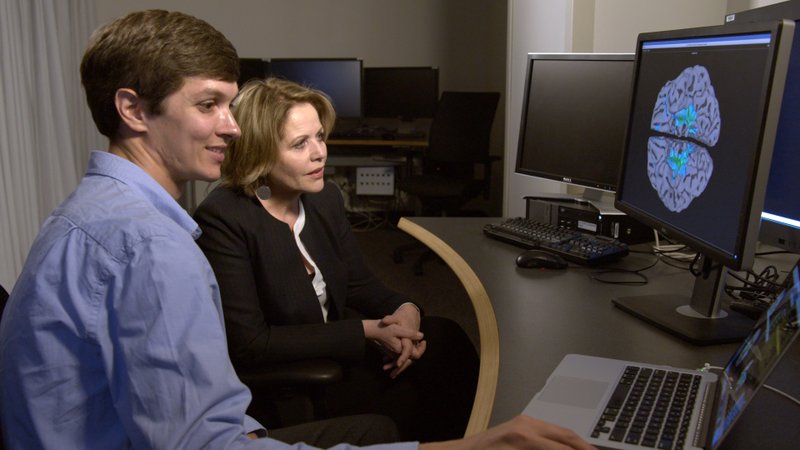
Soprano Renee Fleming looks at a brain scan with NIH neuroscientist David Jangraw after singing in the MRI machine.

To help scientists understand how music helps patients heal, notable musicians like opera’s Renee Fleming are getting brain scans.

Lauran Neergaard writes at the Associated Press, “Music increasingly is becoming a part of patient care — although it’s still pretty unusual to see roving performers captivating entire wards, like at MedStar Georgetown University Hospital one fall morning.

“ ‘It takes them away for just a few minutes to some other place where they don’t have to think about what’s going on,’ said cellist Martha Vance after playing for a patient isolated to avoid spreading infection.

“The challenge: Harnessing music to do more than comfort the sick. Now, moving beyond programs like Georgetown’s, the National Institutes of Health is bringing together musicians, music therapists and neuroscientists to tap into the brain’s circuitry and figure out how.

“ ‘The brain is able to compensate for other deficits sometimes by using music to communicate,’ said NIH Director Dr. Francis Collins, a geneticist who also plays a mean guitar.

“To turn that ability into a successful therapy, ‘it would be a really good thing to know which parts of the brain are still intact to be called into action. To know the circuits well enough to know the backup plan,’ Collins added. …

“ ‘The water is wide, I cannot cross over,’ well-known soprano Renee Fleming belted out, not from a concert stage but from inside an MRI machine at the NIH campus.

“The opera star — who partnered with Collins to start the Sound Health initiative — spent two hours in the scanner to help researchers tease out what brain activity is key for singing. How? First Fleming spoke the lyrics. Then she sang them. Finally, she imagined singing them.

“ ‘We’re trying to understand the brain not just so we can address mental disorders or diseases or injuries, but also so we can understand what happens when a brain’s working right and what happens when it’s performing at a really high level,’ said NIH researcher David Jangraw, who shared the MRI data with The Associated Press.

“To Jangraw’s surprise, several brain regions were more active when Fleming imagined singing than when she actually sang, including the brain’s emotion center and areas involved with motion and vision. One theory: it took more mental effort to keep track of where she was in the song, and to maintain its emotion, without auditory feedback.”

Read how the new insights are being used to study Alzzheimer’s patients and others here.

Read Full Post »


Photo: The Guardian
Silicon Valley companies are sprouting a cappella groups with sui generis names.

I know that some people don’t like barbershop quartets and their stylized singing, but I have always gotten a kick out of them, whether they are harmonizing over traditional songs like “Ain’t She Sweet” to benefit the New Shoreham fire department or adapting contemporary pop songs like those you can hear at All A Capella on WERS.

Singing in harmony without instruments does not have to be hidebound. And it’s cropping up in strange places.

As Olivia Solon writes at the Guardian, “What’s the first thing that comes into your head when you think of Silicon Valley? … It’s probably not an a cappella Destiny’s Child mash-up where the opening lyrics of Bootylicious have been altered to include the names of technology companies.

“ ‘Apple, can you handle this? Twitter, can you handle this? Facebook, can you handle this? I don’t think you can handle this.’

“Techapella is an annual Christmas concert where the in-house a cappella teams from all of the major technology companies showcase their singing capabilities.

“Software engineers, data scientists, accountants, marketers and sales reps from across Silicon Valley’s fiercely competitive technology industry have over the last few years formed groups including Facebook’s the Vocal Network, Googapella, Twitter’s Songbirds, LinkedIn’s InTune and Apple’s Keynotes. The groups meet each week in boardrooms and music rooms on their respective campuses to prepare for a dramatic end-of-year crescendo: two public concerts held in celebrated music halls in the San Francisco Bay Area.

“ ‘I didn’t expect us to have an a cappella group, let alone everyone in Silicon Valley,’ said Remy DeCausemaker, open source program manager at Twitter and beatboxer in the Songbirds. …

“ ‘People don’t usually equate hardcore engineering and the arts. It’s very cool to see brilliant technical people one moment solving database scalability problems and the next moment saying: “I think you’re half a step flat on this note here.” ‘ …

“Deke Sharon, the ‘father’ of modern a cappella and this year’s Techapella emcee [says,] ‘There’s no better way to connect to other people and create something wonderful than to get together with others and sing.’

“Allie Polubiec, a front end engineer at Facebook and soloist in the Vocal Network, agrees. ‘It’s physically exhausting working at a computer day in day out. I need time to rest and stretch other muscles,’ she said.

“ ‘Singing is just good for you. Psychologically, there’s something very cathartic about using your voice and expressing your inner joy,’ added Rico Rodriguez, a software engineer at LinkedIn. …

“Techapella diverges from pop culture tropes insofar as it’s resolutely not a competition, with the exception of a friendly beatbox battle during the show’s interlude.

“ ‘My entire tenure has been more defined by a cappella than the work that I do. It was the thing that kept me at Google for as long as it did and it was the thing that keeps me at LinkedIn,’ said Rodriguez. ‘So really, I’m just a singer – and I code as a side job.’ ”

More at the Guardian, here. I really liked the video there.

Read Full Post »

Photo: Hulton Archive/Getty Images
Trumpeter Miles Davis, circa 1959. He once said, ‘”There are no wrong notes in jazz. It’s the note you play afterwards that makes it right or wrong.”‘ A small study suggests that jazz and classical music have different effects on the brain.

Pacific Standard loves these small-scale studies because they are fun and interesting. But as a retiree from an organization dominated by economists, I feel compelled to remind you that larger studies are needed.

Now for the fun. Tom Jacobs writes at Pacific Standard, “Can creativity be taught? Not directly, perhaps. But if such a curriculum exists, it would train one’s brain to regard unforeseen occurrences as potential springboards, rather than disturbing anomalies.

“Fortunately, there is at least one type of specialized training that shapes neural activity in precisely that way. …

“In a new, small-scale study, a Wesleyan University research team led by Psyche Loui and Emily Przysinda report the brains of jazz musicians are uniquely attuned to surprising sounds. Electronic monitoring revealed these players have ‘markedly different neural sensitivity to unexpected musical stimuli,’ the researchers write.

“These musicians are trained not only to anticipate unpredictable turns, but also to engage with them in a positive, creative way. That dynamic reflex stimulates creative thinking.

“The study in … Brain and Cognition featured 36 students from Wesleyan University and the Hartt School of Music. Twelve were studying jazz (including improvisation), 12 classical music, and the final 12 were non-musicians. …

“The participants completed a short version of a well-known creative thinking test, in which they were given six open-ended prompts such as ‘List all the uses you can think of for a paper clip’ in three minutes. They were scored on both the number of items they came up with, and their originality (that is, how often each answer was also given by other students). …

“The young musical improvisers were uniquely receptive to unexpected sounds. …

” ‘The improvisatory and experimental nature of jazz training can encourage musicians to take notes and chords that are out of place, and use them as a pivot to transition to new tonal and musical ideas,’ Loui and her colleagues write. ‘This could lead to the increased cognitive flexibility in jazz musicians.’ …

“It’s possible that people who decide to learn an instrument have brains that are pre-wired in a certain way, but previous research suggests that’s unlikely. Loui plans to study that issue, as well as whether other types of artistic training — say, improvisational theater — will yield similar results.”

More here.

Read Full Post »

Photo: AP
Hurricane Marie, as seen from the International Space Station last year.

To understand more about how tropical storms evolve and become hurricanes, two Penn State professors from very different fields are joining forces.

Mark Ballora, professor of music technology, and Jenni Evans, professor of meteorology, report on their research at the Conversation.

“During the 2017 hurricane season, major storms in the North Atlantic devastated communities in and around Houston, Florida, Puerto Rico and the wider Caribbean. The destruction shows how important it is to understand and communicate the serious threats that these storms pose. …

“Since 2014, we have been working together to sonify the dynamics of tropical storms. In other words, we turn environmental data into music. …

“Most of us are familiar with data visualization: charts, graphs, maps and animations that represent complex series of numbers. Sonification is an emerging field that creates graphs with sound.

“As a simple example, a sonified graph might consist of a rising and falling melody, instead of a rising and falling line on a page.

“Sonification offers a few benefits over traditional data visualization. One is accessibility: People with visual or cognitive disabilities may be better able to engage with sound-based media.

“Sonification is also good for discovery. Our eyes are good at detecting static properties, like color, size and texture. But our ears are better at sensing properties that change and fluctuate. Qualities such as pitch or rhythm may change very subtly, but still be sensed quite easily. The ears are also better than the eyes at following multiple patterns simultaneously, which is what we do when we appreciate the interlocking parts in a complex piece of music. …

“We distilled the changing characteristics of a hurricane into four features measured every six hours: air pressure, latitude, longitude and asymmetry, a measure of the pattern of the winds blowing around the storm’s center. …

“In our recordings, air pressure is conveyed by a swirling, windy sound reflecting pressure changes. More intense hurricanes have lower values of air pressure at sea level. The winds near the ground are also stronger in intense storms.

“As pressure lowers, the speed of the swirling in our sonic recordings increases, the volume increases and the windy sound becomes brighter.

“The longitude of the storm center is reflected in stereo pan, the position of a sound source between the left and right speaker channels.

“Latitude is reflected in the pitch of the swirling sound, as well as in a higher, pulsing sound. As a storm moves away from the equator toward one of the poles, the pitch drops to reflect the drop in temperatures outside the tropics.

“A more circular storm is typically more intense. Symmetry values are reflected in the brightness of a low, underlying sound. When the storm has an oblong or oval shape, the sound is brighter.

“So far, we have sonified 11 storms, as well as mapped global storm activity from the year 2005. …

“Even for experts in meteorology, it can be easier to get a sense of interrelated storm dynamics by hearing them as simultaneous musical parts than by relying on graphics alone. For example, while a storm’s shape is typically tied to air pressure, there are times when storms change shape without changing in air pressure. While this difference can be difficult to see in a visual graph, it’s easily heard in the sonified data.”

More here.

Read Full Post »

« Newer Posts - Older Posts »