Feeds:
Posts
Comments

Posts Tagged ‘new york’

I liked a Nov. 19 editorial in the NY Times: “Day Laborers, Helping Hands.” It shows that attitudes about immigration can be affected by circumstances.

“About 50 or so people gathered outside a storm-ruined taco restaurant on Saturday morning in Coney Island, on a backstreet behind the Boardwalk near the Wonder Wheel. They were day laborers, Hispanic men and women who have been spending weekends as a volunteer brigade, helping other people chip away at the mountains of debris and accepting nothing in return except work gloves, face masks and safety information cards from the Occupational Safety and Health Administration. They came from all over the region, including a day labor hiring center in Bensonhurst, Brooklyn, that Hurricane Sandy had washed away.

“It’s not unusual to find day laborers looking for work after a disaster. What was striking was the warmth and gratitude they found. They even had an official welcome, from the local state assemblyman, Alec Brook-Krasny, and two City Council members — Domenic Recchia Jr. of Coney Island and Vincent Gentile of Bensonhurst.

“They thanked everyone for coming and pledged to get the Bensonhurst work center open again. A man from the laborers’ union gave a safety lecture. …  ‘We are all New Yorkers,’ said Mr. Recchia, who had brought a box of masks. An observer used to the anti-Latino screeds of politicians on Long Island, a few miles east, marveled at the sense of community — the feeling that after a disaster, immigration status didn’t matter, only a willingness to help.”

Although I took this photo in downtown Boston, the union mural seemed fitting, suggesting the importance of keeping fairness in mind after the crisis has passed.

Read Full Post »

I recently saw a National Geographic special about money and the central bank. The documentary took viewers into the vault at the NY Fed, where gold bars are stored. Although the security is really tight, anyone may sign up for a tour there. The film also went to places where cameras are usually not allowed, like the National Bureau of Engraving and Printing, which prints dollar bills.

It also went to offices deep underground in the gold and diamond district of New York City. I thought Suzanne would be interested to see the broker who buys gold. Being in the jewelry business with Luna & Stella, she naturally is aware that gold has been expensive since the economic downturn. The film showed the multilingual broker buying small bags of gold objects, which were then shown being melted down and made into a gold bar.

National Geographic has also blogged about the movie: “What Jake Ward of Popular Science magazine discovers in this one hour special is that without the engines that power the world’s financial systems, that world would grind to a halt.

America’s Money Vault follows 55 million dollars worth of gold as it makes its way down into the most valuable gold vault in the world. Hidden deep under the streets of New York City, hundreds of billion dollars in gold bars  …

“Jake goes behind the storefronts to see how everybody from the street level to the brokers make their money buying, selling and even finding gold. He meets Onikwa Thomas who calls himself the urban miner and claims to earn up to four hundred dollars a week off of gold specks found in the cracks of sidewalks.”  More from the documentary.

P.S. Speaking of Luna & Stella, Suzanne’s birthstone jewelry company, gold vermeil angel wings can make a lovely gift for the right person.

Photograph: National Geographic

Read Full Post »

Many flowering trees are early this year. I associate lilacs with Mother’s Day, the Lilac Festival in Rochester, New York, and Lilac Sunday at the Arnold Arboretum in Boston — events that occur May 13 this year. But here we are in April, and lilacs are delicious everywhere.

The unusually dark red of the Japanese Maple at Dunkin Donuts is hard to capture on film. But as amazing as the color is, even more amazing is the tree’s comeback after March’s unseasonal heat and frost blasted the first leaves to brown. I was sure that was it for this year, but the leaves are richer than ever.

Read Full Post »

I was interested in an article in today’s NY Times about a school that gives chronically failing students another chance. It succeeds against all odds, but success is a slow process. New York’s mayor is not a fan, because many kids take six years to graduate.

Aniah McAllister, once a lost and wandering soul, has one of the happier stories. Reporter Michael Powell writes that she seems amazed to have earned 46 credits and to be headed to college.

“ ‘This school made realize,’ she says, ‘that I am much better than I thought I was.’

“That’s a pretty fair bottom line for any school,” writes Powell, “although in the up-is-down world of public education in New York, it might just be an epitaph for this small marvel of a high school. Known as a transfer high school, Bushwick Community admits only those teenagers who have failed elsewhere. Most students enter at age 17 or 18, and most have fewer than 10 credits.

“You can muck around quite a bit trying to find someone who has walked the school’s corridors, talked to its students and faculty, and come away unmoved. Most sound like Kathleen M. Cashin, a member of the State Board of Regents and a former superintendent. ‘They care for the neediest with love and rigor,’ she said. ‘They are a tribute to public education.’ ”

Read the article. I’m hoping it will have an influence on the policymakers and let an initiative that sounds so positive keep going.

Aniah McAllister, left, Justin Soto and Kassandra Barrientos attend Bushwick Community High School. Photograph: Kirsten Luce, NY Times

Read Full Post »

I was chatting with a colleague in the washroom today, asking what she was doing this weekend, and she said she was going to New York to cheer for her brother in the marathon. She also mentioned in a proud but modest way that there was an article about him in today’s NY Times. We went and looked for the article, and I realized I had already read it word for word.

What an unusual brother! Kevin Dwyer decided as a child to be a dancer and had a ballet career, all while suffering from cystic fibrosis. The youngest in a family of seven children, he was the fourth to have CF. He didn’t tell people.

Although he and his siblings have a mutation of the disease that means it is not as severe as for many, it takes a real toll. Nevertheless, this weekend Kevin is running a marathon. His aim is to raise money for Team Boomer (started by the retired quarterback Boomer Esiason),  which funds much-needed CF research.

The NY Times writes that Kevin has “chronicled [his marathon training] in a lively blog, Kevin Running. When he goes out this Sunday, he will have lung capacity of 58 to 60 percent.

“ ‘I can beat this, in one little way,’ he said. ‘For at least one day, I can beat it. We’ve trained at 11-minute miles, but I think we will go kind of slow, maybe 11:45 or 12 minutes, so I can take everything in. Take everybody in. Make it a celebration.’ ” Read more.

I highly recommend chatting with colleagues in the washroom. I have learned so much that way!

P.S. Kevin was on the Early Show the next day.

Read Full Post »

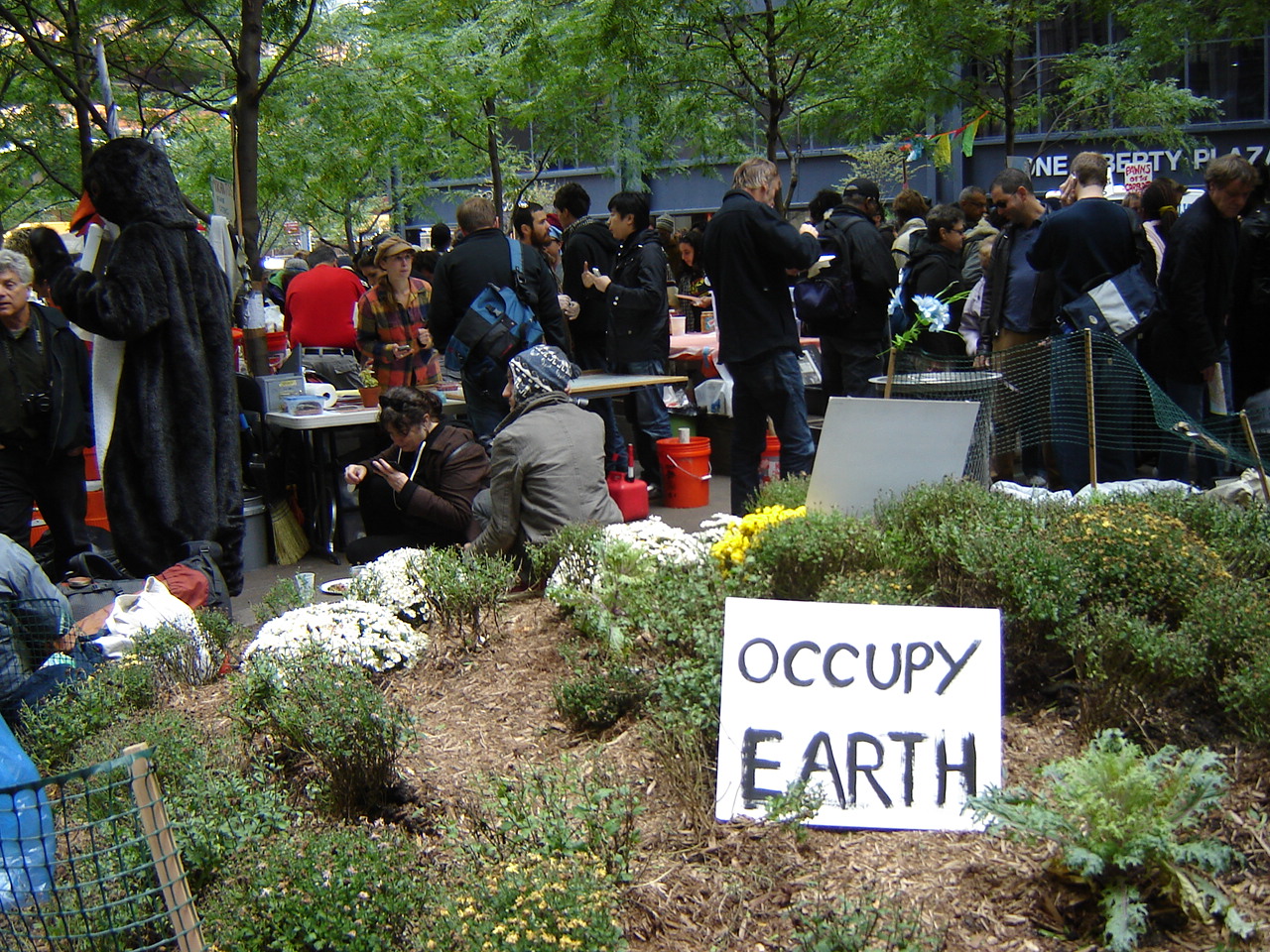
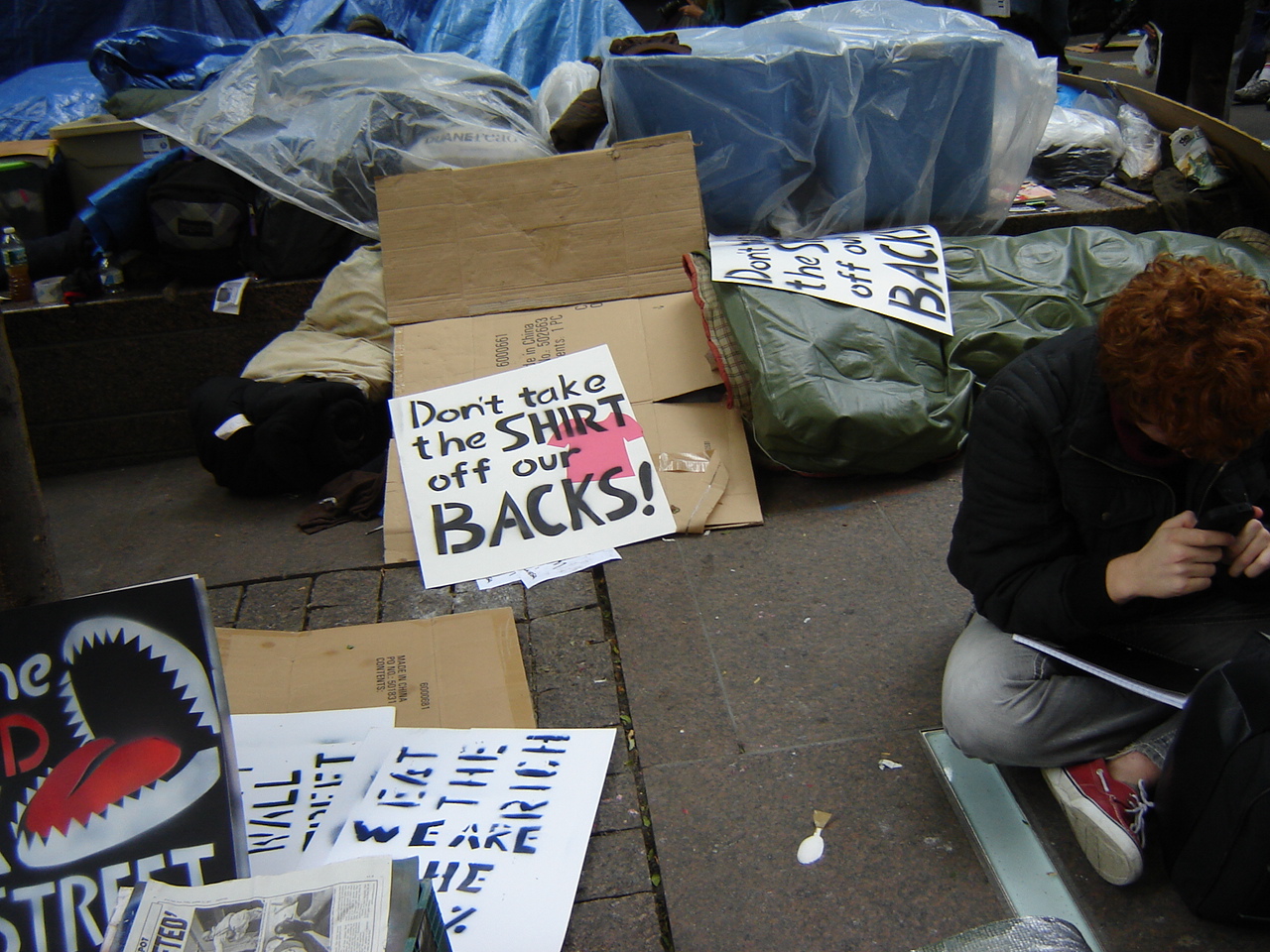
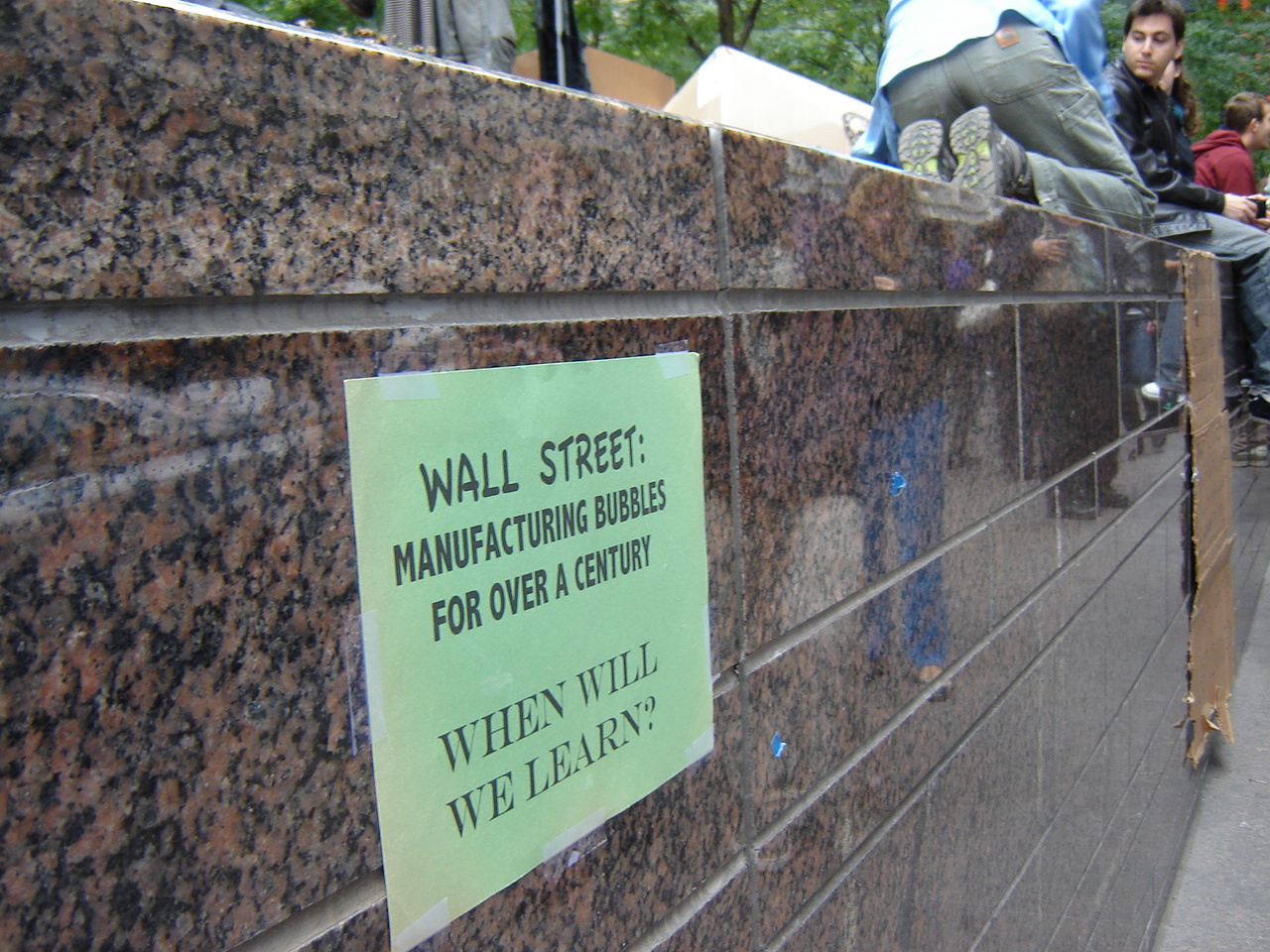
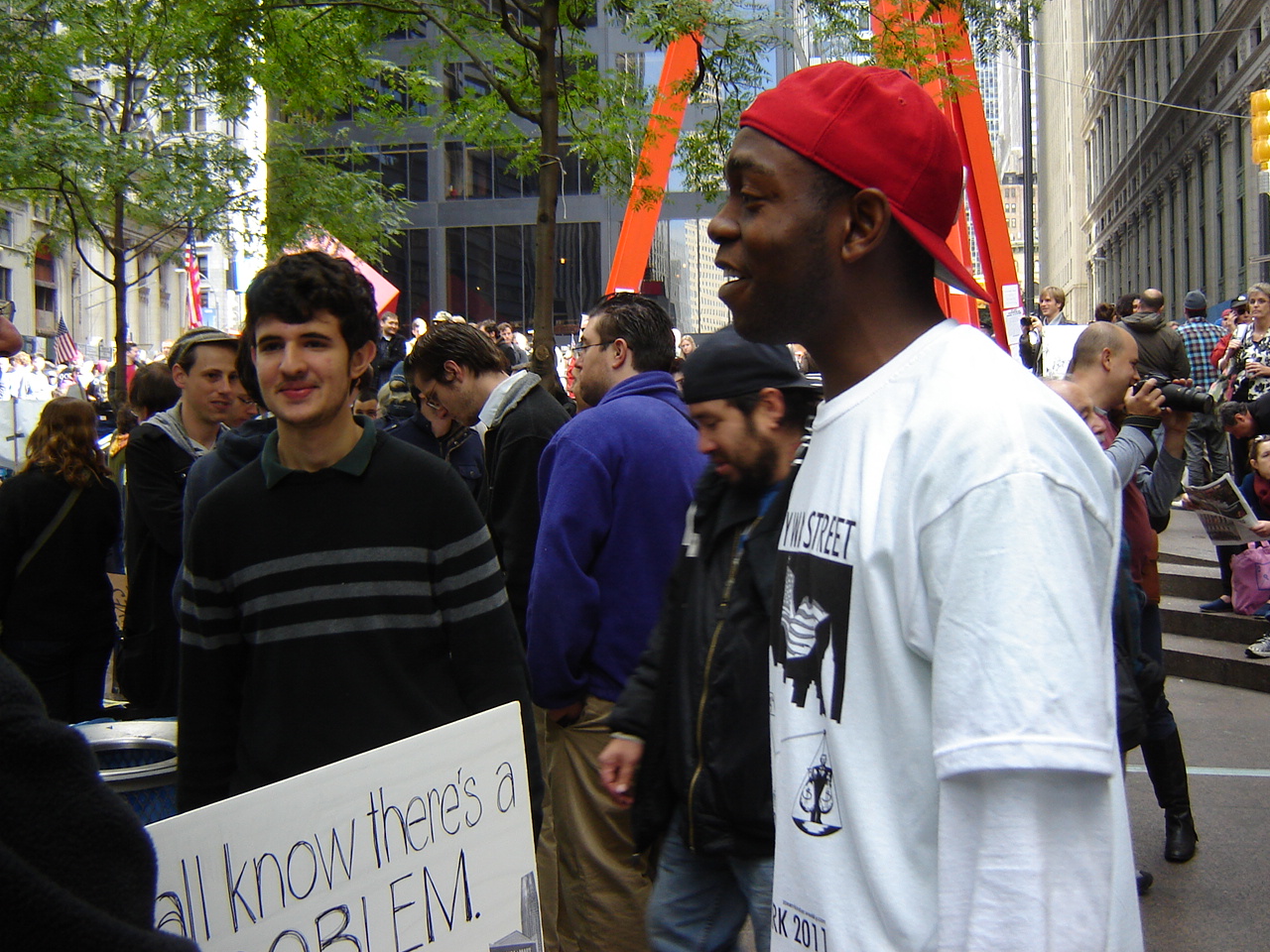
I couldn’t resist the pull of Occupy Wall Street yesterday, and I think that was true for most of the tourists in the Ground Zero area.

Everyone had a camera out, and most occupiers were taking advantage of being on display by holding up signs for their causes or handing out flyers. Souvenir buttons were on sale.  A brass band whooped it up. Both occupiers and visitors danced.

I got to thinking about the documentary I saw in September on how to start a revolution. The movie was about the work of 80-something Gene Sharp, an influential exponent nonviolent ways to overthrow despotic regimes. (See my blog entry here.) After the screening, I listened to Sharp as he answered audience questions. One thing he said was that he believed the uprising in China’s Tiananmen Square in 1989 failed because the organizers were winging it and didn’t have an adequate plan for next steps.

Today’s Occupiers also seem to be winging it. But they are not aiming to overthrow the government, and I’m not sure it matters that a central theme has yet to stand out. I’m willing to wait and see what emerges. In the meantime, here are pictures from Saturday.


Read Full Post »

I’m in Harlem this weekend with five other family members in a leafy neighborhood, mostly very quiet.

Well, not always quiet in the middle of the night when, on more than one occasion, I’ve woken up wondering, “Should I be calling 911?” Fortunately, last night’s commotion didn’t seem like a true 911 issue. Her: “Don’t touch me! Don’t touch me! Don’t touch me!” Him: “But I love you!”

I went back to sleep.

Margareta and Jimmy, mostly recovered from the jetlag caused by a long flight from Sweden on Wednesday, spent Friday afternoon wandering around Chelsea art galleries.

They got a kick out of taking the bus back north, watching as the mostly white clientele became the mostly black clientele, observing the people interactions, and trying to understand the rapid English conversations. (Of course, like most Swedes, they are great at English, and a whole bunch of other languages.)

Margareta was fascinated by one episode that took place as the bus approached Harlem. A boy of about 10 tried to sneak on behind his friend. It seemed that he did not have the bus pass that is routine for New York school children. Margareta was impressed that the driver was not too stern and just told him to have the pass next time. Meanwhile a woman on the bus, possibly from his school, told the boy not to worry, that the school would help him get a new pass.

A day in the life.

Read Full Post »

Yesterday’s NY Times Dining section had a delightful story about all the food being delivered to Occupy Wall Street. Donations have come from far and wide, and people have self-organized to distribute it and do the washing up. The story is here.

“Requests for food go out on Twitter and various Web sites sympathetic to the protesters. And somehow, in spontaneous waves, day after day, the food pours in. …

“Platters and utensils are washed on site. The soapy runoff slides into a gray-water system that’s said to draw impurities out through a small network of mulch-like filters. …

“Members of the [food] crew sometimes fail to show up in the morning because they were arrested the night before. (Then again, as many a chef will tell you, that happens in a lot of restaurants.)” …

“Telly Liberatos, 29, the owner of Liberatos Pizza on Cedar Street in the Financial District, said he has received orders from places like Germany, France, England, Italy and Greece, as well as every region of the United States.

“ ‘It’s been nonstop,’ he said. ‘The phones don’t stop ringing. People from California order the most at one time.’ Someone from the West Coast had called in the biggest delivery: he wanted 50 pizzas dispatched to the park.”

You might enjoy knowing that Asakiyume’s blog offers music suggestions for the 99 percent. Check it out. (I borrowed the picture from downtownmonks.blogspot.com.)

Read Full Post »

The blue-collar city of Buffalo, New York, has struggled in recent decades with unemployment and economic decline. A few years ago, it had a big idea for redeveloping its waterfront — a big idea that went up in smoke.

But when residents and local organizations starting thinking small instead of big, good things began to happen.

“In 2004, it was decided that the region would invest large sums of public money [at the site of the old Memorial Auditorium] to draw a new outlet for Bass Pro Shops, a national purveyor of sporting goods and fishing equipment. Local leaders scraped together $65 million in promised tax breaks, infrastructure improvements and other public subsidies to speed its arrival and to catalyze a new era of growth and commerce on the waterfront. It was all for nothing.

Since the Bass Pro deal collapsed, the harbor development corporation has shifted its focus on some comparatively tiny, piecemeal projects, such as the multicolored Adirondack chairs that dot the waterfront park, a new small restaurant that dispenses ice cream and veggie burgers, Jason Mendola’s fledgling kayak rental business and the relocation of the free Thursday at the Square concerts to Canalside’s Central Wharf.

None of those improvements required huge investments. None were heralded as keystone projects for future growth. But together, they have begun to transform the phrase ‘waterfront development’ from an oxymoron into a reality.”

Read the thoughtful article by Colin Dabkowski in the Buffalo News. I found the lead at ArtsJournal.com.
*
*
By the way, when my mother met my father, he was an editorial writer for the Buffalo Evening News, the forerunner of the Buffalo News. She was attending law school.

Read Full Post »

Many of Suzanne’s college classmates went into careers that involve helping people. I think that for Liz, who works at the organization Facing History and Ourselves (helping classrooms and communities link the past to moral choices today), it just comes naturally. She has also been an energetically thoughtful friend, who noted a freshman Suzanne’s wistfulness over missing an Easter egg hunt and decided to create one for her. Every college year. Liz later managed the details and complexities of Suzanne’s American-Swedish wedding. (Liz said it was a piece of cake as she was used to Facing History and Ourselves events with zillions of participants.)

Now I am reading about the girls’ classmate Emily, who works for a group that assists people who are seeking asylum in the United States.

Emily weighed in at the Daily Beast last week, offering insight for Jesse Ellison in a column on an asylum seeker currently making headlines.

Writes Jesse of the hotel maid who lost DSK his job, “That she lied on her claim for asylum has been covered with partiuclar zeal. But experts and those familiar with such claims say that dishonesty is common when it comes to refugees—not because they’re intentionally trying to scam the system, but because the way such claims are processed and determined puts asylum-seekers in a position where they may feel they have no other choice.

“ ‘It’s hard for those of us who haven’t gone through those experiences to imagine what it would be like to continually relive something that caused you to flee your country,’ says Emily Arnold-Fernandez, of Asylum Access. ‘When the issue of potentially falsifying testimony comes up, it tends to paint all asylum claimants in black and white. Either you tell the whole truth, and nothing but the truth, 100 percent of the time, or you’re not telling the truth and you have some sort of nefarious purpose. I don’t think that the reality is that stark.’ ”

Read Full Post »

« Newer Posts