Feeds:
Posts
Comments

Posts Tagged ‘orchestra’

Photo: Alamy.
Sir Edward Elgar recording acoustically – via horn – in 1914.

The first recording device that I came in contact with was my father’s wire recorder, a machine that seemed pretty magical to me. To make his recordings more accessible and “permanent,” he would take special ones to a place in New York City to have them made into records. That’s how I eventually ended up with “The Birth of Willie,” which in turn I had made into a cassette tape. And now of course, no one uses cassette tapes. That’s the trouble with new technologies. You put heart and soul into an artifact and then it goes obsolete.

In today’s article from Gramophone, Bob Cowan gets a bit into the weeds with the attributes and strengths of various early recordings.

“Back in the May edition of my Replay column, under the heading ‘Electric centenary’, I offered an enthusiastic welcome to Pristine Audio’s release ‘1925: Landmarks from the Dawn of Electrical Recording’. On this set, producer and audio restoration engineer Mark Obert-Thorn has programmed two CDs’ worth of recordings, principally from that epoch-making year when for the most part a microphone took over from purely mechanical recording, in other words from a pre-electric recording horn (where the sound is transmitted on to the master grooves with no electronics involved). The ascent from one method to the other was more significant even than the later leaps from wax cylinder to flat disc, shellac to vinyl, mono to stereo, analogue to digital or CD to streaming.

“The electrical breakthrough (from acoustic, horn-recorded sound) had one thing in common with the advent of stereo: it necessitated, for the full effect of the newer system to register, the acquisition of fully up-to-date reproducing equipment. You can’t play a stereo LP with a mono-only tone arm; likewise, reproducing electrically recorded 78s on even the most sophisticated of horn gramophones keeps the dynamic ‘realism’ of an electrical recording at bay, although the human voice or even the most distinctive solo (stringed) instrument can, at best, remain more or less intact.

Arthur Rubinstein, who never left us any horn gramophone recordings, always maintained that the mechanical horn recording system made the piano sound like a banjo. …

“Eliminating resonances from the horn and producing clearer sound with a wider frequency range via the electrical system works especially well with a piano, while it goes without saying that orchestral music benefits enormously after the cavernous horn’s obvious limitations.

“There are, however, a few notable exceptions, principally Sergey Rachmaninov playing his own Prelude in C sharp minor, also known as ‘The Bells of Moscow’, which calls on the composer’s firm, commanding touch (especially strong at the bass end of the keyboard) and suspenseful sense of timing. He recorded it three times, twice acoustically (April 1919 and October 1921) and once electrically (April 1928), and all three versions are included in RCA’s 10-disc set ‘Sergei Rachmaninoff: The Complete Recordings’. Pianists such as Alfred Cortot (with his bel canto top line) and Benno Moiseiwitsch (whose style incorporates the projection of countless simultaneous subsidiary voices) managed to circumvent the horn recording system in ways that other pianists, even the best of them, rarely could; however, Rachmaninov playing Rachmaninov is special: it has listeners poised at a crossroads between passion and foreboding, whether he was recording acoustically or electrically. …

“The great British-born American conductor Leopold Stokowski, who knew Rachmaninov well and recorded with him both acoustically and electrically, made his first discs with the Philadelphia Orchestra in 1917 – though, as the Stokowski guru Edward Johnson has noted, ‘Between 1917 and 1924, they made an estimated 450 acoustic recordings, but the old method of playing into a large horn gave a very poor representation of orchestral sound, and of all their acoustic discs, only 60 or so were actually issued.’

“Listening to Stokowski’s acoustic recordings of music from Rimsky-Korsakov’s Sheherazade, specifically ‘The Young Prince and Young Princess’ (recorded 1921), is instructive. The acoustic version (now on Pristine Audio, alongside another excerpt recorded in 1919) sounds as if it’s being played by a chamber ensemble with bongos, whereas by the time the complete work was recorded in 1927, captured on wax, Stokowski’s characteristic Philadelphian opulence could be reproduced with impressive realism. …

“Sir Edward Elgar’s acoustic recordings of his own music enshrine riveting performances that often generate newsreel-style excitement (even though Fritz Kreisler said, on at least one occasion, that Elgar was a ‘lousy conductor’), but the horn loses the subtler aspects of the composer’s orchestration. …

“Among the most notable ‘Elgar conducts Elgar’ comparisons concerns the Violin Concerto, recorded acoustically in 1916 with the Edwardian virtuoso Marie Hall as soloist, then, most famously, electrically in 1932 with the teenage Yehudi Menuhin. The earlier version crams about a third of the concerto onto four 78rpm sides, making a significant alteration to the scoring by adding a harp to the strummed cadenza, which doesn’t exactly bolster the music’s shimmering sense of mystery (Elgar apparently rewrote his cadenza so that the recording horn could pick it up). Hall, a good, lusty player who was historically significant, can’t match the burning infatuation with the music that Menuhin conveys, seemingly with total ease. …

“Over the years, much confusion has accumulated about the identity of the first Beethoven Fifth Symphony on disc, which was long thought to be a highly individual reading by the Berlin Philharmonic under Arthur Nikisch, recorded in Berlin on November 10, 1913. Then informed pundits revealed that it was preceded in 1910 by a recording featuring a ‘string orchestra’ (a mysterious and inaccurate attribution) allegedly under one Friedrich Kark (1869-1939), who was conductor of the Hamburg Opera House from 1906 to 1918 and also set down the first Pastoral Symphony with the same orchestra during the same year. …

“A rather blurrily recorded Furtwängler Fifth with the Berlin Philharmonic was set down in October (16th and 30th) 1926 and January 1927. You can catch it on YouTube transferred from an ultra-rare set of 78rpm discs issued in the US on the Brunswick label. Although, in terms of its date, it falls securely within the remit of electrical sound, it comes across like a boxy-sounding acoustic production. I can’t say for sure which side of the divide this 1926-27 recording falls. The same conductor’s Berlin Fifth from 1937 (Warner) is superior in all respects. …

“In December 1920, Arturo Toscanini brought the La Scala Orchestra to the US on a concert tour and it was then that he made his first recordings for Victor. This impressive showing of material has been released as Volume 71 of RCA’s ‘Arturo Toscanini Collection’ and proves beyond reasonable doubt that with this orchestra in Camden, New Jersey, Toscanini upped the standard of orchestral playing on disc a good few notches higher than had been achieved elsewhere. The finale of Beethoven’s Fifth (1920) displays an orchestra at the top of its game.”

Loys more at Gramophone, here. No paywall.

Read Full Post »

Photo: Malin Fezehai for the Washington Post.
Steve Otieno (described below) rehearsing with the Ghetto Classics orchestra in Kenya.

Charitable work is complicated. It is not always possible to do the good for people that you intend. But if you are making a meaningful difference in some lives, that may be enough.

In Kenya, an orchestra called Ghetto Classics aims to help poor children achieve something fine and eventually move away from the dangers of their extreme poverty.

Katharine Houreld writes at the Washington Post about both the successes and failures of the orchestra.

“The violin’s quaver steadied and swelled through the gloomy concrete staircase, escaped through the wire mesh and soared over the packed-dirt playground before dissipating in the acrid smoke drifting in from the smoldering dump site next door.

“It was the last day of class before Ghetto Classics broke up for Christmas, and 14-year-old Steve Otieno was practicing his Christmas carols for his final performance of 2024. Undeterred by the demolition of his home last month, the floods that devastated his neighborhood in Nairobi this year, or the eye-watering stink of burning plastic all around him, he stroked the strings to coax forth each note of ‘Joy to the World.’

“ ‘Music makes me feel calm when I’m stressed,’ he said shyly. ‘Some people have drugs. For me, it is music.’

“Steve is one of thousands of children from the poorest neighborhoods of the Kenyan capital who have been introduced to classical music by Ghetto Classics. The organization was set up in 2008 by Elizabeth Njoroge, a classically trained singer who studied pharmacology at her parents’ urging but longed to return to music. A chance encounter with a priest trying to fund a basketball court at a Catholic school in the Nairobi slum of Korogocho inspired her to raise money for the first class of musicians there. …

“Now Ghetto Classics provides lessons to about 1,000 students, who feed three orchestras, a choir and a dance group. Njoroge raises funds to support its expanding programs.

“Ghetto Classics works in schools and community centers in Nairobi and Mombasa, but its headquarters is in the St. John compound in Korogocho, where a church, school and community all share space. A tarmacked basketball court and a dirt field for soccer are enclosed by a sagging chain-link fence and scraggly trees; on one side of the compound, the children have planted a garden to try to filter out the choking smoke.

“Ghetto Classics has performed for former president Barack Obama, first lady Jill Biden and Pope Francis. Alumni are studying in the United States, Britain and Poland.

They include one determined pianist who learned to play by watching videos and repeating the motions on a piece of cardboard on which he’d drawn keys.

“The lessons provide a refugee for students suffering from hunger, domestic violence and crime, said violin instructor David Otieno, who is not related to Steve. He joined the program a decade ago as a student; now he’s one of 45 graduates working as paid instructors.

“The tall, dreadlocked 29-year-old credits Ghetto Classics with saving him from the neighborhood gangs. He witnessed his first homicide when he was still in primary school, and as he grew up, the gangs sucked in friend after friend. His teachers became so worried he’d be killed, he said, that they collected money to move his mother and six siblings to a safer neighborhood where he could continue his music.

“Back then, he said, the group shared 10 violins among 30 students. Now he has his own instrument. Once shy and fearful, he has played in Poland, in the United States and at State House, the Kenyan president’s home in Nairobi.

“ ‘The violin gives you a voice,’ he said. ‘It makes you talk to people you’d never otherwise talk to.’ His students filed into the compound bumping fists.

“Thousands of kids enroll in Ghetto Classics, but most fall away. The discipline is demanding. … About a dozen young musicians who spoke to the Washington Post said their parents had never seen them perform. Some were single parents too busy working, some weren’t interested and some were actively opposed. …

“When opera singer David Mwenje started with Ghetto Classics, his father was skeptical, he said, but he came to see him perform and was won over — a bittersweet memory to which Mwenje clings now that his father has died.

“Mwenje sang for six years, including for Pope Francis at the Vatican, before turning professional in 2021. His first audition landed him the role of Okoth — a messenger who must tell a village medicine man that his daughter has taken up with foreign missionaries — in Nyanga: Runaway Grandmother with Baraka Opera Kenya at the Kenya National Theatre. It was the first ray of hope in years darkened by his father’s death and the covid pandemic that shuttered his school, he said.

“ ‘Through this opera, I could control all my pain,’ he said. ‘I also love to sing “Bring Him Home,” from Les Misérables, because the song reminds me of my dad and I feel like I’m pleading with God to bring him home.’ ”

More at the Post, here.

Read Full Post »

Photo: Cross Border Orchestra of Ireland.
The peace proms involves 6,000 children from schools all over the island, from diverse backgrounds and abilities.

Today’s story is not necessarily a holiday topic unless peace is a holiday topic. … Well, there’s that.

Niall McCracken wrote at the BBC about one longstanding Irish peace initiative.

“The passion of 15-year-old Cara is written all over her face as she takes her handmade violin from its case. She is one of the youngest musicians in the Cross Border Orchestra of Ireland.

“I’m in Dundalk, County Louth, in the Republic of Ireland,” McCracken continues, “to watch her and more than 100 other young musicians rehearse ahead of a series of concerts. Cara, from County Down, plays in the strings section of the orchestra that emerged out of the Northern Ireland peace process.

“It was set up in 1995, a year after republican and loyalist paramilitaries announced ceasefires. This followed more than a quarter of a century of violence in Northern Ireland.

“The key aim was to use music to connect young people from Catholic and Protestant backgrounds on both sides of the Irish border. Almost 30 years on, this remains the central goal of the 140-member orchestra.

“Cara attends a Catholic girls’ grammar school in Ballynahinch and has always loved music.

” ‘I started playing violin and piano when I was young. You have to practise a lot but it’s taught me so much about perseverance,’ she said. … ‘There are still aspects of life in Northern Ireland that can make it difficult to meet people from different backgrounds. … Going to the orchestra has been great because I’ve made friends from all sides of the community, all over the country.’

“The orchestra has also ignited Cara’s love for different types of music. ‘I just wouldn’t have listened to things like Ulster-Scots music, simply because I just wouldn’t have been exposed to it because it wasn’t played where I live. But I love the pipes they use and getting to become immersed in that Ulster-Scots music and culture has given me a whole new perspective.’

“The orchestra combines Ulster-Scots culture, including bagpipes and Lambeg drums, with Irish traditional instruments such as uilleann pipes, the harp, the fiddle and bodhrán (drum). They also have their own take on some of the biggest pop, rock and dance songs in the charts.

“A diverse range of music has been key to the project’s success, according to the orchestra’s founder Sharon Treacy-Dunne.

“She is originally from Hackballscross, a rural village in County Louth in the Republic of Ireland, a few miles south of the border with Northern Ireland.

” ‘Growing up in the 1970s and 80s, and as a young teacher in Dundalk in the early to mid-90s, before the ceasefire and the Good Friday peace agreement, I remember being really worried about what I was seeing,’ she said. … ‘Then in 1994 when we reached this momentous ceasefire, as a teacher I thought I needed to be some sort of role model. The only thing I knew was music.’

“Sharon began writing to schools on both sides of the Irish border about taking part in the orchestra. She said: ‘To be honest it took a while to bring some of the Protestant schools on board, but music was the answer. Once we made it clear that we were also using music that was important to them with instruments such as pipes and Lambeg drums, that was a huge turning point.’ …

“Being part of the orchestra also means young people like Cara had the chance to perform at New York’s famous Carnegie Hall on St Patrick’s Day earlier [in 2022].

” ‘It was unbelievable, I could never have imagined having an opportunity like that, but music just opens up so many doors,’ she said.

“The New York concert was part of a series of events to mark the 25th anniversary of the 1998 Good Friday Agreement. The deal brought an end to 30 years of conflict in Northern Ireland, known as the Troubles.”

More at the BBC, here. No paywall. Upcoming events orchestra here.

Read Full Post »

Photo: Bostock Brothers via the Guardian.
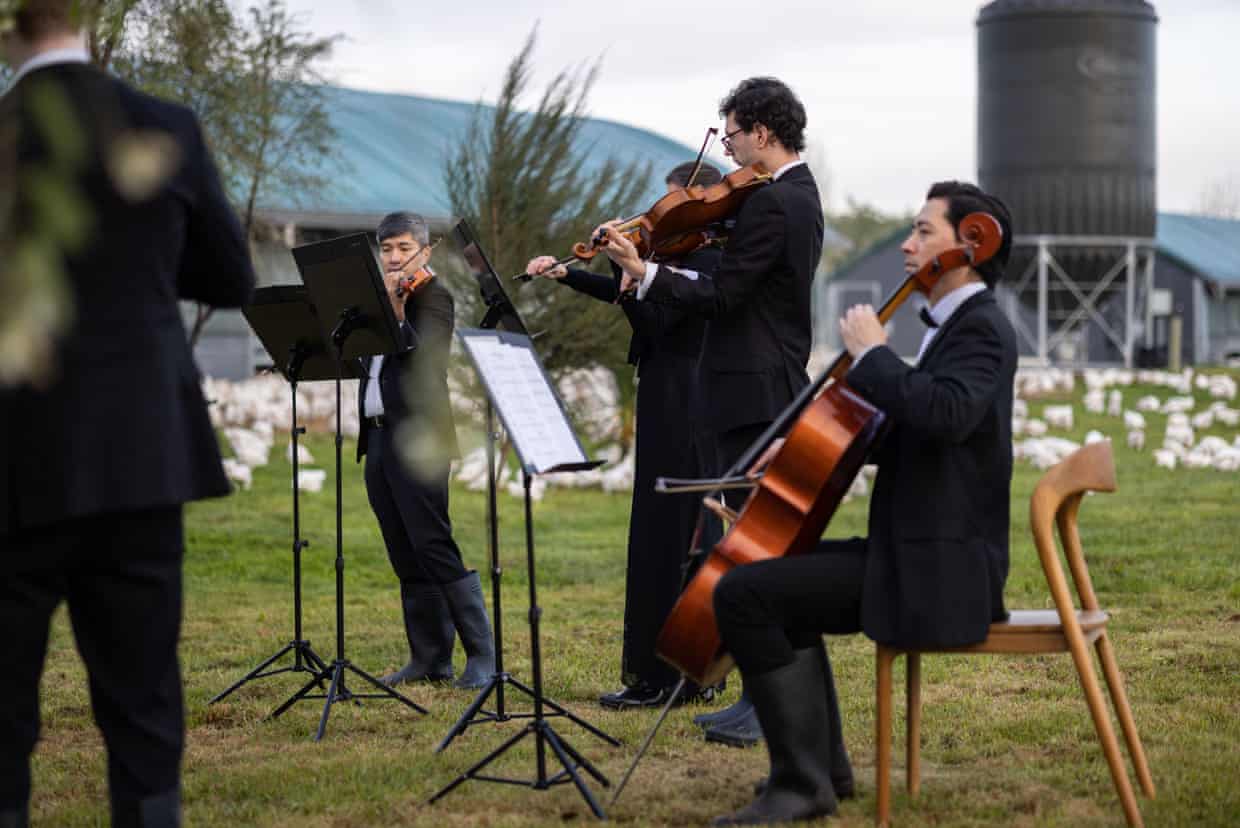
A live orchestral performance at the Bostock Brothers’ farm in Hawke’s Bay New Zealand. 

The media really knows how to have fun with a story that is susceptible to wordplay: “New Zealand Symphony Gives World Premiere for Hen-tastic Audience”; “Beethov-hen’s first symphony”; “NZ Symphony Orchestra members perform for thousands”; “im-peck-able.”

Mitchell Hageman at the New Zealand Herald wrote one of several delightful reports you can find online.

“Do chickens like classical music?” Hageman asks. “A Friday morning stunt in Hawke’s Bay proved they most certainly do.Members of the esteemed New Zealand Symphony Orchestra have performed for the likes of Dame Kiri Te Kanawa [and Sir Howard Morrison] but on Friday they faced some of their toughest critics yet: a hungry flock of thousands of Ross chickens.

“It was all part of a collaboration between Bostock Brothers Farm and the NZSO to promote ethical farming.

While slightly hesitant at first, the concert-going [chickens] eventually crowded around the clearly delighted musicians as they performed the world premiere of Chook Symphony No 1, created by composer and sound designer Hamish Oliver.

“ ‘Never could we have imagined producing a composition especially for a flock of chooks, let alone performing for them, but the opportunity was too good to pass up,’ NZSO chief executive Peter Biggs said. ‘The NZSO, like Bostock, is about being world-class and about wellbeing, so the two organizations have combined to create something very different and very new, and we hope it catches on.’

“The orchestra did some research and found instances where chickens responded particularly well to baroque music, which became the basis for the roughly two-minute symphony.

” ‘That’s strings, oboe, bassoon and harpsichord,’ Biggs said.

“After the composition was created, a sound recording was sent so it could be tested on the chickens. ‘They loved it,’ Biggs said. …

“For Bostock Brothers free-range chicken owners Ben and George Bostock, the collaboration was also a way to showcase the organic nature of chicken farming.

“ ‘Chicken farming is incredibly complex and organic farming even more so, and we’re constantly looking for ways to better our practices, ensuring our chickens are happy, healthy and organic,’ Ben Bostock said. ‘[We] know investing in a quality environment for our birds will only further yield quality results.’ …

“[George] said the response so far from the chickens had been great, and they would continue to play classical music in the sheds in future. ‘There’s lots of science that says classical music is really good for animal welfare and the response from our chickens has been really, really good.’ “

More at the Herald, here, at the Guardian, here, and at Symphony.org (the League of American Orchestras), here. No firewalls.

(And speaking of chickens, the Washington Post, here, reports that in Maine, chickens are now permitted as emotional support animals. Not that you asked.)

Read Full Post »

Photo: BBC.
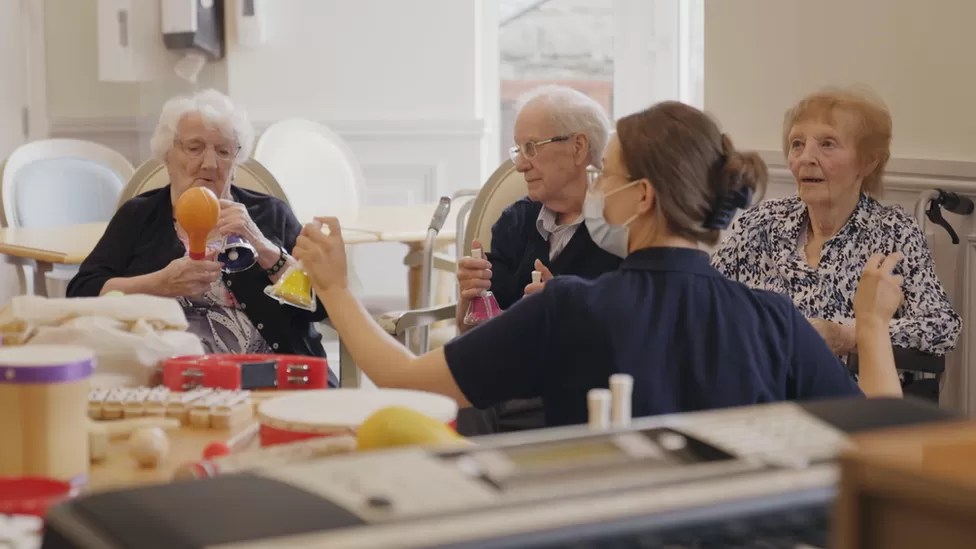
Carer Beth Forster leads music workshops for seniors with dementia in the UK.

At Thanksgiving, we had the pleasure of meeting Meg, a relatively new member of our family who shared a bit about using music therapy with hospitalized patients suffering from mental illness. So I was interested to read today’s story about a similar music program in the UK, one that focuses on people with dementia.

Sarah Gwynne and Woody Morris had this report at the BBC.

“An orchestra is attempting to bring people living with dementia back into the present. The work being done by Manchester Camerata has never been more important, given that there are about 900,000 people with the condition in the UK, a number that is predicted to nearly double by 2040. …

“People with dementia often find listening to music can reignite old memories from long ago. Much more overlooked, though, is the impact that making music can have on the present.

“While some with dementia can often feel trapped in the past, some researchers believe the act of creating music – as well as listening to it – can help to reconnect them to the here and now.

“A new BBC documentary — Dementia, Music and Us — follows the work of Manchester Camerata and its principal flautist Amina Hussain.

“Amina, who is also a professional music therapist, leads classes across the north-west of England that have been described as life-changing.

” ‘Taking part in the ‘Music in Mind’ workshops has been an enormous privilege for me as a musician,’ she said. …

“Classes for the community consist of improvisation, singing, and writing their own music and lyrics.

“Keith Taylor, 62, was diagnosed with frontotemporal dementia when he was 53. … Like many, he really struggled to come to terms with his new reality.

” ‘The best way I could explain it,’ he said, ‘is if you’re in a pine-wooded area and all of the trees are in grids and blocks and you’re walking through that and it’s dark and you can see the mist coming up behind you and you can feel it catching you.’ …

“Keith’s partner of 14 years, Joan, said they had found the sessions to be genuinely life-changing. ‘I think the thing that saved us was the first ever music group we went to because from that group it opened other groups up for us,’ she said. ‘It’s been fantastic.’

“Keith added: ‘I live life every week. Not every day — every week because I’ve got music sessions.’ He said the workshops ‘make him smile, enjoy life and it just brings the best out of you.’

“Researcher Dr Robyn Dowlen is seeking to better understand the ‘in the moment’ benefits of music-making for people with dementia. … She believes the improvisational music workshop experience allows people to ‘create something that is held now in the moment.’

“Keith described how the sessions and being in what Dr Dowlen calls the ‘musical spotlight’ had helped him ‘stand up taller.’

“Dr Dowlen added: ‘Improvisational music-making is particularly important for people with dementia, especially when it comes to building their confidence and their self-esteem.’

“Beth Forster, from Liverpool, started her career in caring as a volunteer two years ago when she found herself furloughed during the pandemic. When a staff position subsequently became available she applied and has never looked back.

“The 28-year-old decided to get involved in the music workshops after news began to spread about the positive impact they could have on those living in care homes. A musician herself, Beth received training from Manchester Camerata’s professional music therapists so she could lead her own workshops.

“Beth said: ‘I feel like I’ve got more strategies to bring residents into the present to help them if they’re distressed… I can’t really believe this is my job. … it is a real privilege.’ “

More at the BBC, here.

Read Full Post »

Photo: Singapore Chinese Orchestra.
Ionisers attached to ornamental snake plants in front of the stage improve air circulation with an “ionising curtain” between the performers and audience at a Singapore Chinese Orchestra concert. The idea is to keep people safe from Covid.

I was saddened and surprised the other day when I offended a woman wearing a mask by asking her if she was also vaccinated. We were in a small room where there was little air circulation, and she was there to give me a hearing test.

Sadness was my primary reaction as the question really upset her. But I was also surprised because so many clinics, performance spaces, restaurants, etc. bend over backwards to make patrons feel safe, even if their requests seem unreasonable.

Consider the introduction of snake plants at the Singapore Chinese Orchestra. Toh Wen Li reports for the Straits Times about their role in an unusual air-quality initiative.

“The air was charged with more than just emotion when the Singapore Chinese Orchestra (SCO) staged its first wind concert in months last Saturday (Sept 25).

“As the rousing sounds of the dizi, sheng and suona filled the concert hall, high-tech devices attached to 20 ornamental snake plants in front of the stage created an ‘ionising curtain’ between the performers and audience.

“The ionisers, designed to reduce the spread of Covid-19, induce a negative charge in the air particles around the plants. This pulls positively charged aerosols, droplets and particulate matter towards the leaves of the plants.

“The devices were introduced following a six-month collaboration between the orchestra and the Agency for Science, Technology and Research (A*Star).

“SCO’s executive director Terence Ho hopes these — and a slew of other measures, such as a filterless high-volume air purifier developed by A*Star to be used in the foyer — will give people peace of mind and encourage them to attend live concerts.

” ‘We have to work towards bringing audiences back to the hall and more musicians back on stage,’ he tells The Straits Times, adding that the plant-based ionisers will remain for future concerts at Singapore Conference Hall, home to the SCO. …

“SCO’s suona and guan principal Jin Shiyi, 56, says in Mandarin: ‘Wind players are now a “high-risk” occupation, and we have had fewer opportunities to go on stage. I’m so happy we can perform on stage again.’

“Last Saturday’s wind concert, also available online for streaming, was part of the recently concluded Singapore Chinese Music Festival. It had drawn a physical audience of about 100 people, less than half the permitted capacity of 250 for that venue.

“Mr Ho says audiences are worried about the recent spike in Covid-19 cases. … For now, he is keeping his fingers crossed as the orchestra prepares for two concerts in early October to celebrate the SCO’s 25th anniversary, while taking precautions to reduce the risk of Covid-19 transmission. It has split performers  into separate ‘teams,’ cut down on rehearsals and roped in understudies in case performers are hit by the virus or with a 10-day quarantine order. …

“The orchestra would have launched it even without the pandemic, [Chief executive Chng Hak-Peng ] adds, as a way to maintain ties with local and overseas audiences. Before the pandemic, as many as 10 per cent of SSO’s live audience members were tourists.

“Home-grown charity the Foundation For The Arts And Social Enterprise has also launched a 10-year Music Commissioning Series to support Singapore composers and build up a canon of local contemporary music — from Chinese orchestra and cross-cultural works to jazz and musicals. …

“Founder Michael Tay says: ‘While we have had Singapore composers write works for wind bands and orchestras in the past, we don’t see a systematic plan to encourage the writing of major works (of at least 30 minutes).’ The series, he adds, ‘is meant to plug this gap.’ …

“Despite the resumption of live concerts … life has not returned to normal for orchestras. While live performances with up to 1,000 audience members, subject to conditions, are allowed, most venues can accommodate only a fraction of this after factoring in safe distancing measures. …

“[Mr Chng] adds: ‘Even though we are having concerts, we still have not, for the last year and a half, been able to have our entire orchestra perform together.’

“Then there is the impact on freelancers, who in pre-pandemic times would often perform with the orchestra and give pre-concert talks. …

“Countertenor and freelance choral director and educator Phua Ee Kia, 41, had no income for eight months last year and has not performed since 2019. He has been doing his rehearsals online during the pandemic.

” ‘Conductors are really struggling,’ he says. ‘Not all of us are tech-savvy and we don’t just have to cope with our own (issues), but also have to deal with situations when our students say, … “My screen went blank.” ‘

“Phua, who tapped a training grant to take a course in audio production software Logic Pro, hopes there will be more upskilling opportunities and financial support for freelancers. …

“Phua says: ‘A choir is not formed of just five people. I hope in the near future, we are allowed to gather and sing in a bigger group, albeit with masks on. Some of us are forgetting what it’s like to be able to perform in a bigger group.’ “

More at the Straits Times, here.

Read Full Post »

Photo: Milwaukee Symphony Orchestra.
Robert Black started playing tuba with the Milwaukee Symphony Orchestra at 19.

The photo above reminds me of a long-ago time that one of my brothers played the tuba. Even today, people remember how it hung out the door of the VW bug when my mother drove him to junior high.

A tuba is a mighty big instrument, and it takes a certain kind of musician to fall in love with it. For example, the young man in today’s story.

Jim Higgins writes at the Milwaukee Journal Sentinel, “If Robert Black drops out of college, and that day could be coming soon, his professor and his parents aren’t going to cry or scold.

“Black, 19, beat out dozens of older musicians to win the job of tuba player in the Milwaukee Symphony Orchestra through a blind audition process. He’s the orchestra’s youngest musician and only member of the Gen Z cohort.

“He signed his contract in early 2020, but the COVID-19 pandemic disrupted chances to play last spring. So Black [made] his MSO subscription debut March 6, playing Paul Hindemith’s ‘Morgenmusik,’ though he did play a Christmas music quintet with MSO colleagues in December. 

“A calm speaker, Black finds it easy to explain why he enjoys being an orchestra tuba player. A tuba — and the low brass section — adds fullness in an ensemble filled with higher register instruments.

” ‘I just really love being … the person that gets to add that (depth) to the whole sound of the ensemble,’ he said.

“Black said he likely became a tuba player because his late godfather, who played the instrument, gave his family a small E-flat three-valve tuba. Black’s mother was a middle school and high school band teacher, and both his mom and his older sister played horns, so brass music was a regular part of family life in Vernon Hills, Illinois. …

“After finishing his college auditions and choosing Rice University in Houston, Black took part in the 2019 auditions for the Milwaukee Symphony’s open tuba position with 61 other musicians. He did not expect much to come from it.

” ‘My kind of goal was if I can advance past the first round, I’ll consider it a success,’ he said. 

“In the ‘elephant room’ where the tuba auditioners warmed up, he recognized musicians he knew from Facebook, people who already had jobs. But to his pleasant surprise, Black made it through to the final round, playing excerpts from Bruckner’s Seventh with a professional trombone section for the first time.  

“The MSO didn’t hire a player out of that audition, but Black went off to his freshman year at Rice with helpful feedback. … At Rice, he worked closely with professor David Kirk, who is also the principal tubist of the Houston Symphony. 

‘It was clear to me from when I first heard him that he would have a very short time as a student. He was destined for professional success,’ Kirk said during a telephone interview.

“For his second audition in January 2020, in attempting to prepare as much as possible at Rice while still making his flight to Milwaukee, but with dorms closed for winter break, Black slept on a couch in a practice room for a few days. …

“After the final round, assistant personnel manager Rip Prétat took him to meet the panel of musicians and music director Ken-David Masur, who welcomed him to the orchestra. …

” ‘Robert is an incredible musician,’ principal trombonist Megumi Kanda said in an email message. ‘He is sensitive to his surroundings and has great style. His playing and blending skills are remarkably mature, especially given his youthfulness! His ability and willingness to musically interact and adjust quickly will make him a great fit.’

“Lest Black’s parents have any concern about his adjustment to life in the MSO, Kanda wrote: ‘As his neighbors in the orchestra, the trombones are a nurturing bunch; we will take good care of him!’

“Kirk said he has counseled Black on integrating himself into the orchestra. Ask questions, don’t make statements, he has told the young musician: ‘You have to be respectful of the fact that those people have been playing music together for so long. They have their own habits, their own customs and they must be respected.’ “

More at the Milwaukee Journal Sentinel, here.

Read Full Post »

photographer-nate-guidry-1573489788

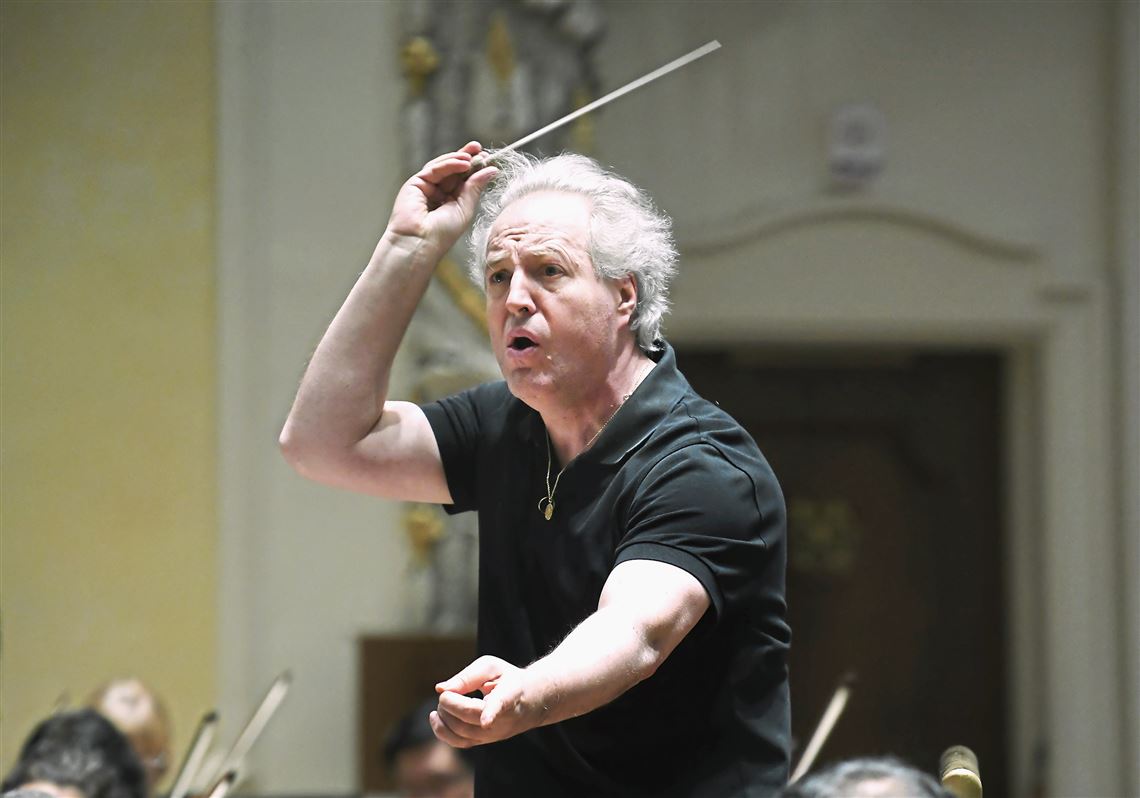
Photo: Nate Guidry/Post-Gazette
When Manfred Honeck, music director of the Pittsburgh Symphony Orchestra, sets his feet wide, furrows his brow and flings his arms out, it essentially means “play louder.” But there are nuances.

Have you ever wondered what messages the gestures of conductors are meant to convey — or whether the orchestra players understand them? What about last-minute substitute conductors? Do they change their style to be readable by musicians who have never worked with them  — and how difficult would that be for conductors trying to concentrate on a piece they hadn’t expected to play that night?

Jeremy Reynolds writes at the Post-Gazette, “When talking to a body language expert, the mere dilating of pupils can reveal the difference between truth and a bald-faced lie. Facial expression, hand gestures and eye contact all carry similar significance.

“Just as actors and dancers are experts in communicating with their anatomy, orchestra conductors also extensively train in nonverbal communication, as their primary role is to beat time and use their bodies to direct emotional intensity and nuance during a performance.

“At the root level, some cues have obvious meanings. When Manfred Honeck, music director of the Pittsburgh Symphony Orchestra, sets his feet wide, furrows his brow and flings his arms out, this essentially boils down to ‘play louder.’ But to a trumpet player, his meaning might be as nuanced as ‘play this as though you’re standing alone on a precipice yowling into an infinite void.’ His smoother, smaller movements generally imply softer melodies and phrases but might suggest to a violinist playing with a sound no louder than the pattering of a mouse’s footsteps.

“ ‘I have to be the music for every moment, every gesture, every bit of eye contact,’ Mr. Honeck said in a telephone interview from Paris. ‘If I conduct a piece, I fill it in with character, the meaning of the music.

 ‘It takes me weeks to find the right gesture for the right music.’

“In Pittsburgh, Lauren Tan, 28, is a certified body language expert. [She’s] reviewed surveillance footage for court cases and works with businesspeople looking for that nonverbal deal-closing edge. … For this article, she reviewed footage of several conductors including Mr. Honeck, the famous Leonard Bernstein, Venezuela’s Gustavo Dudamel and others to assess their movements and nonverbal cues.

“ ‘The first thing you notice is somebody’s hands,’ Ms. Tan said. “People will say that they notice the eyes first, but that’s not true. … Keeping your hands visible is typically a great cue for meeting people and introductions.’ …

“When Mr. Honeck began conducting, she zeroed in on moments when he leaned toward the musicians. ‘I tell businessmen this, it’s a good way to indicate agreement and say, “Hey, I’m on your side.” When Honeck does this, it’s about giving the music more feeling.’

“So are all of these cues practiced and polished? Mr. Honeck says no.

“ ‘You can train and rehearse things, but in the moment of making music, things are spontaneous, you can’t calculate and you have to see how you feel with your body,’ he said. …

“Watching footage of Bernstein, Ms. Tan noted that he consistently nodded to his musicians, which functions both as a cue but also as a sign of approval, an encouraging gesture that builds conscious and subconscious rapport. She said that the audience will pick up on such movements as a sign of mutual respect and positivity …

“While the audience can’t see a conductor’s face, Ms. Tan said that from the videos she could see conductors using different facial micro expressions to project certain emotional qualities for the musicians. There are seven such expressions: happiness, surprise, anger, fear, disgust, contempt and sadness. Sadness is the hardest to mimic, while contempt is most often mistaken. …

“Mr. Honeck has spent years training his hands to move in certain ways to cue musicians for specific kinds of sounds, and he said that the right gesture will be effective no matter which orchestra he is conducting.

“ ‘I train with my hands not because of technical things but because I want to have a special sound,’ he said. ‘If I move in a different way, I get a different and better sound. That’s what counts. The sound must be right.’ ”

More at the Post-Gazette, here.

The famously emotional conductor Arturo Toscanini conducts Wagner’s “Ride of the Valkyries” (circa 1937).

Read Full Post »

Photo: Afghanistan National Institute of Music
Afghanistan’s first all-female orchestra, Zohra, is touring.

I’ve been interested in Afghanistan since before the headlines were all about the US conflict there. At least since reading Jason Elliot’s excellent An Unexpected Light and seeing the Tony Kushner play Homebody: Kabul. But lately I have an even stronger interest as Erik’s sister works on women’s rights in Afghanistan for the United Nations.

This BBC story provides one angle on Afghan women’s rights. Vincent Dowd has the report.

“Five years ago, a unique all-female orchestra was formed in Afghanistan, a nation where only a few years previously music had been outlawed and women barred from education. Now Zohra is visiting the UK for the first time.

“No-one claims that in Afghanistan, the Taliban influence has been rooted out entirely. Violence continues. But two decades ago, the Afghanistan National Institute of Music would have been unthinkable.

“ANIM was founded in 2008, with international support, to bring music education to young Afghans. … ANIM teaches music skills to some 250 young people, both male and female. That figure is about to rise to 320 and there are plans to expand to cities such as Herat, Mazar-e Sharif and Jalalabad.

“About 70% of the young people at the institute come from disadvantaged backgrounds — some used to work the streets selling vegetables, plastic bags or chewing gum to support their families. Ages range from 12 to around 20.

“But five years ago, ANIM founder by Dr Ahmad Sarmast was urged to start a new project specifically to benefit girls.

” ‘One of our students told me we needed a group of four or five girls to play pop music,’ he says. ‘I liked the idea but almost at once it became clear most of the girls at ANIM wanted to join. Suddenly we were talking about a full orchestra.’ …

“There are around 100 female students at ANIM, 23 of whom have come to Britain. Their numbers will be doubled when they play in concert with the London-based Orchestra of St John’s and others. Instruments they’ve brought with them include the sarod, the rubab, tabla drums and the dutar.

“The music performed is a combination of traditional Afghan music and western classical. For instance, their new arrangement of Greensleeves contains attractive new instrumentation probably not envisaged by Ralph Vaughan Williams in 1934.

“The conductor for the Afghan pieces is Negin Khpalwak, who at 22 is one of the older musicians in the group. She joined the school not long after it opened — not initially with the idea of conducting at all. …

” ‘It’s much easier for me to conduct when we play Afghan music,’ she says. ‘We’re very familiar with it and we play together easily. If we perform something like Greensleeves — which I think is very well-known in England — we have to concentrate extra hard.’ …

“Negin Khpalwak says even in Kabul, students can still sometimes encounter people beyond the school who think it’s wrong that the orchestra even exists.

” ‘They will say that in Islam women aren’t allowed to go to school, not just for music but to study anything. But it’s not true — women have their own rights and those people need to be educated. Our music isn’t the only way to do that — but it’s one way.’ ”

More here.

Read Full Post »

orchestra-main

Photo: Ge Wang
The Stanford Laptop Orchestra rehearsing for its tenth anniversary concert last month.

Not sure I would enjoy the sound of an all-electronic orchestra even though I did think MIT professor Tod Machover’s partly electronic opera Resurrection was lovely. What I do like about the Stanford Laptop Orchestra is the idea that the most important requirement for taking the course is curiosity. I’m all for curiosity.

Arielle Pardes Gear writes at Wired magazine, “Ten days before the big concert, the members of the Stanford Laptop Orchestra are performing technology triage. Rehearsal has only just started, but already, things seemed to be falling apart. First there was trouble with the network that connects the laptops to one another. Then one of the laptops crashed. …

“The orchestra members have gathered at Stanford’s Center for Computer Research in Music and Acoustics to rehearse a new kind of musical composition. Together, sitting on meditation pillows in front of MacBooks, they create songs that stretch the definition of music. The orchestra plays laptops like accordions, turns video games into musical scores, and harnesses face-tracking software to turn webcams into instruments. …

“Fixing a broken network isn’t as simple as a replacing a snapped string on a violin. But in a laptop orchestra, the potential for disaster is part of the delight. Since it was founded in 2008, the SLOrk has been making music that surprises audiences while it subverts the concept of orchestral performance. The compositions, part-machine and part-human, don’t always go according to plan. Technical difficulties are all but guaranteed.  …

” ‘Nothing’s better at being a cello than a cello,’ says [Ge Wang, the SLOrk’s founder and director]. ‘So we’re not trying to make a cello. We’re trying to make something you don’t have a name for yet.’ …

“[The Stanford Laptop Orchestra is] a for-credit course at Stanford — Music 128, cross-listed in the computer science department as CS 170 — but getting in isn’t easy. The group of 15 students includes those with computer science credentials, and those with more traditional music backgrounds, but neither is enough to become a great laptop orchestra player. The most important thing is curiosity. ‘We’re unified by this interest to make music together with computers,’ says Wang, ‘and to figure out what that means.’ ”

More here.


Read Full Post »

Photo: Mary Carole McCauley, The Baltimore Sun
Tuba player Dan Trahey has helped make OrchKids a national model for lifting up kids. “We’re all interconnected,” he says. “We’re bad at this in America, where we’re all bred to be soloists. We create our own little worlds, and that’s really dangerous.”

When I was in second grade, my mother convinced the school principal to show a movie for children that I think came from the United Nations. It involved hand puppets who were enemies. And what I remember most was that in the end, each puppet felt its way up the arm of the puppeteer and discovered that they were connected.

That message, the message about human interconnectedness, is always having to be retaught, but people who understand it often get involved in initiatives that help disadvantaged children. Consider this story.

Michael Cooper writes at the New York Times, “From the outside, Lockerman-Bundy Elementary School looks forbidding, a tan monolith built in the 1970s. Some of the rowhouses across the street are boarded up — reminders of the cycles of poverty and abandonment this city has struggled with for years.

“Inside on an afternoon [in April], though, it was a different story. Music echoed through brightly colored halls lined with murals. Classes were over, but school was not out: Young string players rehearsed Beethoven in one classroom, while flutists practiced in another and brass players worked on fanfares in a third. Also on offer were homework tutors, an after-school snack and dinner. …

“It was just another afternoon at OrchKids, the free after-school program that the Baltimore Symphony Orchestra and its music director, Marin Alsop, started a decade ago with just 30 children in a single school. The program now reaches 1,300 students in six schools; its participants have gone on to win scholarships to prestigious summer music programs; play with famous musicians, including the cellist Yo-Yo Ma and the trumpeter Wynton Marsalis; perform at halftime at a Baltimore Ravens game; and win accolades at the White House.

“The program was the idea of Ms. Alsop, who began thinking about how to forge closer ties to the city soon after she became Baltimore’s music director — and the first woman to lead a major American symphony orchestra — in 2007. …

“The first student to enroll in the program was Keith Fleming, then a first grader. ‘At first I didn’t really like music,’ he recalled recently. ‘I just thought, I’m going to do this because I didn’t really have something else to do. The first day came, and I started to learn music — and I started to like it.’

“He is 15 now, and his tuba skills have taken him to Austria and London and helped him win an audition to the Baltimore School of the Arts, where he is a sophomore. …

“From the very beginning,” [Nick Skinner, the OrchKids director of operations], said, ‘it was very important that we were immersed in the school, and in the community.’ ”

More at the New York Times, here. And there’s a nice article at the Baltimore Sun about tuba player and OrchKids volunteer Dan Trahey, here.

Read Full Post »