Feeds:
Posts
Comments

Posts Tagged ‘pandemic’

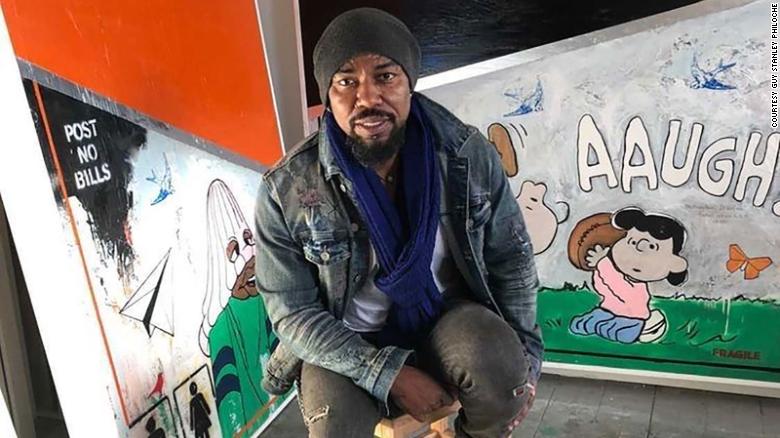
Photo: CNN “The Good Stuff”
Guy Stanley Philoche, seen here with his own work, has helped fellow artists survive the pandemic by buying their art.

No one can solve all the problems of the world, but if we each try to address a problem we see in our particular corner of the world, we can move civilization forward. In today’s story, an artist saw other artists struggling in lockdown and knew what he could do to help.

Alaa Elassar, writes at CNN’s “The Good Stuff,” “Painter Guy Stanley Philoche, a New Yorker known for his colorful textured abstract artworks, has spent more than $65,000 buying work from struggling artists affected by the coronavirus pandemic.

“Philoche, 43, has dedicated himself to seeking out artists from around the world who are unable to make ends meet and has so far purchased more than 150 artworks for up to $500 each. His own pieces sell for up to $120,000, according to Cavalier Galleries.

” ‘The art world is my community and I needed to help my community,’ Philoche told CNN. ‘People say New York is dead, but it’s far from that. There’s an artist somewhere writing the next greatest album. There’s a kid right now in his studio painting the next Mona Lisa. There’s probably a dancer right now choreographing the next epic ballet.’ …

“When the pandemic began to affect families across the country, many people found themselves unable to pay rent, afford WiFi for their kids’ distance learning, or even put food on the table.

“As the ability to afford the basic necessities slowly diminished, art became a luxury not many could splurge on. In turn, hundreds of thousands of artists and independent creators were left without an income stream in the midst of the chaos.

“One of these artists was Philoche’s own friend, who just had a baby and had lost his job because of the pandemic.

‘I told him, “Don’t worry, we’re New Yorkers. We’ve been through 9/11, the blackout, the market crash, we’ve got this,” ‘ Philoche said. ‘But he was scared, so I bought a painting from him to help him get through it.’

” ‘It was such a big deal for him at that moment, and that’s when I realized if he’s panicking like this, other artists are too.’ … So, Philoche took matters into his own hands.

“On March 20, he posted on Instagram a video asking artists who were feeling the effects of the pandemic to direct message him their work. Whenever he saw a piece he fell in love with, Philoche bought it and paid for it to be shipped to his East Harlem studio.

“Within months, artists from Los Angeles and Chicago to London and New Zealand — and even artists who were in prison — reached out to him with their stories and their creations. … ‘It meant a lot to me. I want to help as many artists as possible, to make sure they are able to buy groceries, or pay their rent, or get their kids diapers or formula.’

“For Tara Blackwell, an artist from Stamford, Connecticut, art is her sole source of income. The only way she can survive off her art is through showing her work to collectors at exhibits, galleries, and studio visits — all which stopped because of the pandemic. …

” ‘The struggle to make a living as an artist is something I’ve known from a young age. I’m used to the ups and downs, but this felt different. There were so many unknowns.’ …

“Philoche purchased ‘Free Speech’ for $500 from Blackwell’s ‘Corner Store’ series, in which she uses retro pop culture imagery from her childhood with graffiti influences and the incorporation of subtle social-political commentary. ‘His support meant the world to me at a time when things seemed really bleak.’ …

“When Philoche was 3 years old, his family immigrated to the US from Haiti with nothing to their name. ‘Leaving one country to come to another was difficult. I didn’t speak the language, I was awkward and weird and trying to find myself in a new country,’ Philoche said. ‘I learned the language by watching cartoons and reading comics, and found my voice by drawing Disney characters. It’s how it all started.’ …

“Philoche started off by sliding business cards under apartment doors and hopping from art gallery to art gallery in hopes of meeting interested collectors. ‘Fast forward twenty years, I’m in the game,’ he said. ‘But throughout those years, I had no one open a door for me. It was me going through the back door, the window, until I found a way in the room by myself. Now that I have a seat at the table and I actually have a voice, I vowed to myself to open that door for other artists.’

“After struggling for years to make a name for himself, the artist now has a philosophy: ‘Sell a painting, buy a painting.’ ”

More at CNN, here.

Read Full Post »

One of my brothers, the science professor, used to perform regularly as a clown, particularly at church and Sunday School. Clowns-in-ministry is actually a thing, a way to engage parishioners and provide a different perspective on teachings.

In San Francisco during the pandemic, clowns and performers of all kinds have heard the call to keep people healthy using laughter, entertainment, and public-service messaging.

Lily Janiak has the story at the San Francisco Chronicle.

“Robin Lara and Stella Adelman of Dance Mission Theater were strapping on stilts. Michael Houston of San Francisco Bay Area Theatre Company was affixing a red clown nose on top of his face mask. Marcelo Javier, also of SFBATCO, was trying out a jury-rigged pandemic-era clown prop — two extendable massage rollers tied together, allowing him to interact with passersby from a safer distance.

“If these artists were backstage — at a side room in the Mission District restaurant West of Pecos — their theater was Valencia Street on a recent sunny afternoon. And if they were about to open a show, their message was public health.

“These four, along with Rodney E. Jackson Jr. of SFBATCO and Aura Barba of SF Carnaval, were just one shift of artists in San Francisco Creative Corps, a pilot program that recruits underemployed local artists as community health ambassadors to promote healthy behavior during the pandemic.

“A partnership between the San Francisco mayor’s office, Yerba Buena Center for the Arts, the Office of Economic and Workforce Development, and the San Francisco Parks Alliance, the program launched last month. It employs 30 performing artists to encourage mask wearing and other best practices and 30 visual artists to paint murals about public health on boarded-up storefronts.

“The city chose Valencia Street and Washington Square in North Beach as pilot sites because of their high pedestrian traffic, significant amounts of outdoor eating and drinking, low mask compliance and high or increasing case rates, according to Jeff Cretan, director of communications at the mayor’s office. …

“Deborah Cullinan, YBCA’s chief executive officer, approached the city with the idea after being part of Gov. Gavin Newsom’s Task Force on Business and Jobs Recovery.

‘What’s the WPA program for today?’ she recalls thinking, referring to Depression-era initiatives such as the Federal Theatre Project and the Federal Art Project that employed artists not just as work relief but as a broad public investment in art. …

” ‘Artists are very effective in driving health outcomes in communities,’ she said, citing projects ranging from a radio drama combating the spread of Ebola in Sierra Leone to National Endowment for the Arts-backed therapy helping veterans with PTSD and traumatic brain injury at Walter Reed Army Medical Center. …

“On Nov. 29, Lara and Adelman — decked in feathers, bustiers and leg flares in addition to their stilts — paraded down Valencia Street. … Houston, with blazer, tie, rainbow wig and microphone, in addition to the red nose and mask, approached passersby for man-on-the-street interviews, asking — in a news announcer baritone — what they were doing to keep themselves safe from COVID-19. …

“The artists never scolded those without masks — emphatically not the point of the program — and pedestrians who were offered masks usually weren’t hostile. Only once in the first two hours did someone yell in response. Most either kept going or accepted, smiling sheepishly as if to say, ‘Yeah, you’re right. I knew I should have been wearing one.’ …

“ ‘If we need people to take care of one another, they have to feel taken care of first,’ said Cullinan. ‘Messages that make us feel bad aren’t going to work. Messages that make us feel good and want to be a part of something. … That’s what theater makers do.’ ”

More at the San Francisco Chronicle, here.

Read Full Post »

People like to paint rocks. It’s an art that’s simultaneously permanent and impermanent. In New Shoreham, for example, the beloved Painted Rock is like a mural or community bulletin board (there’s a real bulletin board, too, online). I’ve blogged about it often, including in 2015, here.

In the summer, you need to photograph your artwork quickly because the rock gets painted over faster than you can say Jack Robinson. But an archaeologist would find all the layers still underneath, and the rock itself has probably been there since the last Ice Age.

Similarly, there are small, smooth rocks people paint for sale, for charity, or for gifts. In a May post I wrote about local kids painting rocks during the pandemic and raising money for medical workers.

Meanwhile, the Washington Post has a story on another pandemic-inspired rock project, one featuring thousands of painted rocks from around the country.

Cathy Free reports, “Chris Penny figures that his mail carrier must have spectacular biceps by now.

“Most every day for the past seven months, when the carrier arrives at Penny’s home in Grapevine, Tex., he unloads a few heavy bins and hauls them one by one up the driveway to Penny’s front porch.

“The boxes are filled with packages containing painted rocks, most of them intricate works of art, handmade and mailed from people all over the country. Since the beginning of the pandemic, people have been sending them to Penny so that he and his family can place them along the Parr Park Rock Art Trail — a mile-long public walking path that has become a wonderland of more than 4,000 art rocks. …

‘These aren’t just any rocks — they’re works of art,’ said Penny, 44. …

“The rocks — painted to resemble everything from the Beatles to Mickey Mouse to a face mask — started arriving at Penny’s house ever since he bought a bunch on eBay after noticing a dozen painted rocks scattered along a nature trail in Parr Park. Penny said he knew right away that he wanted to flood the trail with them and make it a destination.

“Penny learned that the colorful rocks he’d stumbled upon were painted by [Grapevine photographer and RV dealer] Ron Olsen and his three grown children in March, after Olsen returned from a trip to Iceland and discovered that Grapevine, a city of around 46,000 people, had practically become a ghost town due to the nationwide coronavirus shutdown. …

“Soon, he and Penny decided to join forces to transform the trail into an artsy attraction for anyone in Grapevine and beyond who wanted to escape the stress of covid-19 for a while.

“ ‘We wanted to make it a getaway for people and give parents something safe to do outdoors with their children,’ said Olsen, 62. …

“Penny, who runs the nonprofit Broken Crayon, focused on helping women and children living in poverty in the United States and Ghana, said the project has provided his family with something fun and positive to do close to home during the pandemic.

“In the early days in March, after he’d painted several dozen rocks with his daughters and bought dozens more online, Penny posted on Facebook, asking anyone who would like to contribute to the project to mail him their rocks and he’d pay for the shipping. …

“Penny said he’s contributed almost $10,000 of his own money for shipping costs (rocks are heavy), although many people now pay to ship their rock masterpieces on their own. …

“All along the nature trail, visitors will now find painted owls, unicorns, tigers and humpback whales, along with the emblems of favorite sports teams, salutes to fallen soldiers and paintings of beloved cartoon characters and classic cars. Somebody even mailed Penny a giant tic-tac-toe board. …

“Penny’s favorite part of the project is that every rock tells a story. ‘Some people have painted rocks in memory of family members who have died, and others have painted memories of high school, like a favorite teacher or a favorite song,’ he said. ‘One woman painted a rock to honor her daughter because she’s serving with the military in Afghanistan and she misses her.’ …

“Whether a rock is painted by a professional artist or a 2-year-old doesn’t matter, Penny said. ‘When it comes down to it, there’s really no such thing as a bad rock,’ he said.”

Check out photos of some beautiful rocks at the Washington Post, here.

Read Full Post »

Have you been reading any of the advice columns on ways to deal with undifferentiated time in a pandemic? The columns with titles like “What day is today?”

Not knowing what day it is was one thing I dreaded before I retired, but I’ve developed my own systems. In today’s article, agricultural time suggests another approach.

Layli Foroudi writes at Sierra, “In the second half of January, I met a friend in Tunis, the capital of Tunisia. He was agitated and said that he needed to go back to his hometown of Gabès. …

“He said he needed to plant trees. It was that time of the year, when temperatures are mild at night and cold in the day — the ideal climate for planting fruit trees. It’s known as the layali essoud.

“In March, I followed my tree-planting friend to Gabès. A few days later, the country went into lockdown to stop the spread of the novel coronavirus. And so, I became a guest in a ghabba.

“The word ghabba means ‘forest’ in Tunisian Arabic. But it also means a plot of farmland within an oasis. The ghabba that I passed my time in was a hectare of land (around 2.5 acres), much of it overgrown with reeds. …

“I didn’t look for a way to leave. I was ready to replace humans with plants, and the uncertainty [with] the work of making things take root.

“The Tunisian traditional agricultural calendar splits the year into unequal slots of time that indicate how crops behave and what activities to carry out. Layali essoud comes just after layali el bidh — the white nights from December 25 to January 13 when temperatures plunge in the night. ‘The plant sleeps, so it is the time to cut it — it doesn’t hurt them,’ explained Hassen Waja, a 74-year-old retired teacher. …

“In Gabès, dates came up often in my conversations with those aged over 50. … Back in the day, dates were the go-to food for breakfast or a snack, and Gabès-grown dates were bought in bulk by nomads because they travel well. …

“The demise of the local date has transformed the oasis, said Nizar Kabaou. … Since the 1970s, he said, Gabès has seen a 60 percent reduction in the surface area covered by date palms. …

“Now, it is the smell of sulfur that is a marker of home. … Since the 1970s, the region has served as a zone for the treatment of phosphate, a key natural resource for the country, used for the production of fertilizers — an irony given the devastating effect the industry has on local agriculture. …

“Cement and phosphate treatment plants [have] exhausted the region’s natural water resources. …

“Water comes every 40 to 50 days and costs three to five dinars per hour ($1 to $1.7), plus a five to 10 dinar bribe for those who want to skip to the head of the line. ‘Before the creation of the industrial zone, the oasis benefited from 750 liters of water per second — from a natural source. Now we are at 150 to 170 liters per second, with a pump. That is the ecological catastrophe that Gabès has undergone,’ said [one man]. …

“In some parts of Tunisia, people still count their days according to the agricultural calendar, though this is rare now. In Gabès, only the farmers still use it, said Waja, the retired schoolteacher. When Waja was a child, he said, ‘the oasis used to be life.’ …

“Ninety-five percent of the population of the Chenini Oasis were full-time farmers, according to Nizar Kabaou. Today, about 20 percent are. But 40 percent still practice agriculture in their spare time, and, in the past five years, Kabaou has seen a small renaissance of part-time oasis farming, which has only grown during the lockdown.

‘This period gives value to the old type of agriculture,’ he said. ‘To live, we need to do our own production. In situations like this, we need to be self-sufficient.’ …

“In Tunisia, the economic toll of the lockdown sparked protests in parts of the country where people were struggling to eat. This did not happen in Gabès, where the ghabba remained. ‘In Chenini, you never go hungry,’ said [farmer Zakaria] Hechmi, who still trades produce with his neighbors. …

“At the oasis, I [read] Flights by Olga Tokarczuk, In one chapter, a character describes two types of time. ‘Sedentary peoples, farmers, prefer the pleasures of circular time, in which every object and event must return to its own beginning, curl back up into an embryo and repeat the process of maturation and death.’ Linear time, which is ‘able to measure progress towards a goal or destination, rises in percentages,’ was more favored by nomads and merchants. …

“When I arrived at my friend’s ghabba, only a portion of the land was still being used to grow fruit and vegetables. Gradually, we began to plant more and clear away reeds that hadn’t been touched in 25 years. No one had the time, and then we did.”

More at Sierra, here.

Read Full Post »

I guess that for people with little outside contact in normal times, coronavirus doesn’t pose much of a threat. At least, that seems to be the case with a dance school in India, where the pandemic is otherwise taking a huge toll.

From Marina Harss at the New York Times: “The other day, I took a tour around Nrityagram. This small community near Bangalore, in southern India, is an oasis of calm and utter devotion to an ancient art: classical Indian dance. Birds were calling, and around the low, earth-colored buildings containing dance studios, living quarters and a small temple, stood hundreds of vibrantly green trees. …

“This early morning scene — the trees, the gray sky threatening rain, people sitting at breakfast — unfolded as I peered into a screen on my phone late at night in my New York apartment. The tour was virtual, conducted on WhatsApp. That is more or less the only way you can visit Nrityagram these days, since it closed its doors to the outside world at the beginning of the pandemic.

‘We have been living our lives exactly as if nothing has happened,’ Surupa Sen, Nrityagram’s artistic director of 23 years, said later in an interview on Zoom. Under her leadership, Nrityagram continues to be what it always has been, but more so: a dance haven. …

“Even before a general lockdown was declared in India, Nrityagram limited access. The dance students — nearly 150 from nearby villages and as far as Bangalore attend classes — have been asked to stay away, for fear of introducing Covid-19 into this small, intimately entwined community.

“Because there is so little communication with the outside world, the people who live within this self-contained hamlet don’t wear masks, and training continues unperturbed, in studios that are open on the sides to the elements, allowing the breeze to blow through year-round.

“The only people who come and go are a small group of women from the nearby village, who help with daily chores. Upon arrival, they are asked to change into clothes that have been washed on-site and to don masks.

“The form practiced by Ms. Sen and her dancers is Odissi, which originated in the eastern state of Odisha. It is one of India’s eight official classical dance forms, with movements and shapes that evoke the sculptures and bas-reliefs on medieval temples. …

“ ‘The idea is that you submit yourself to a universal something,’ Ms. Sen said. … Ms. Sen and her dancers devote most of their waking hours to perfecting this art, refining and strengthening their bodies through exercise, and perfecting their dancing through technique classes and rehearsals in which they learn traditional Odissi choreography as well as new works by Ms. Sen. …

“At 6 a.m., they rise for a morning run. Then, each woman is responsible for cleaning some part of the hamlet and for placing flowers on the small altars in the dance studios. …

” ‘It’s part of their training,’ said Lynne Fernandez, Nrityagram’s executive director. Next, they warm up by doing yoga or practicing the Indian martial art form Kalaripayattu.

“At 10:30 a.m., dance class begins, starting with exercises that target one kind of movement and then another — sharp and fast, slow and supple, low to the ground, up in the air, and more. In its gradual, almost scientific progression from one part of the body to the next, it is not dissimilar to a ballet class.

“After lunch — ‘our favorite moment of the day!’ one of the dancers, Abhinaya Rohan, said during our WhatsApp tour — they return to the studio for another three or four hours, more if Ms. Sen is creating a new dance.

“In the evenings, they teach. These days, that happens over Zoom, though everyone agrees that it’s not good for conveying the nuances of dance. …

“That makes for at least six hours of dancing each day (except Mondays, their day off), plus conditioning. It sounds exhausting, but Ms. Rohan said: ‘The strange thing about dance is that it energizes you. I never feel tired.’ …

“There are six other members of the community, whose work allows the dancers to devote themselves to their art: Two office workers and two volunteers who are helping to set up a Food Forest, a haphazard-looking but productive and low-maintenance agricultural system that produces most of the community’s food; And there are Ms. Fernandez and her mother, whom everyone refers to as nani, or grandmother. Nani makes meal plans and prepares pickles to last them through the year.”

More of the story here. Lots of gorgeous pictures, too.

Read Full Post »

One thing that’s been interesting in the pandemic has been reading about various wild animals that apparently feel safer exploring suburbs and streets now that they are quieter. Today’s story is about birds that have stopped feeling the need to shout.

Eva Botkin-Kowacki reports at the Christian Science Monitor, “When the pandemic began, Elizabeth Derryberry wasn’t thinking about her research. Her focus was on the basics: how to teach remotely as an associate professor at the University of Tennessee, Knoxville; how to manage the lockdown with her young family; and how to keep everyone safe and healthy.

“But as she scrolled through social media one evening, she saw a picture of a coyote at the empty Golden Gate Bridge in San Francisco. She recalls thinking, ‘Oh my goodness, there really are no cars.’ And as she stared at that image, Dr. Derryberry thought about how quiet it must be nearby without the normal hubbub of traffic – and about the birds she had been studying there.

“Along with her colleague David Luther of George Mason University, Dr. Derryberry had been recording the songs of white-crowned sparrows in both the urban setting of San Francisco and the more rural Marin County to study how the birds responded to the hum of human-made noise. They’d found that the city sparrows sang more loudly, but with a much more limited range, than their country cousins. And the shutdown presented an unprecedented opportunity for the researchers to see if those urban birds changed their tune.

“Indeed, the urban sparrows took full advantage of the relative silence. When the research team recorded birdsongs near the Golden Gate Bridge in April and May of this year, they sounded notably different – and of higher quality – from those recorded during previous springs. Their findings were published [in September] in the journal Science. …

“As people stayed home this spring, many noticed more wildlife around them. Some pondered whether there were actually more birds, for example, or if the quieter cities just made their songs (and presence) more obvious. …

“ ‘When we’re going about our daily lives, we get used to the patterns of the animals that we see,’ says Allison Injaian, a lecturer in the Odum School of Ecology at the University of Georgia, who was not involved in the study. ‘It’s pretty hard to know what we’re missing out on if that never is visible or audible.

“ ‘But when this really unprecedented shift in human behavior occurred,’ she says, it presented ‘a great opportunity for all of us to realize the impact that we ourselves are having on the wildlife around us.’ …

“For the birds themselves, their songs encode information crucial to their existence. White-crowned sparrows, for example, listen to each other’s songs to pick potential mates in spring, and as a way to assess the fitness of another male from afar when deciding whether or not to fight him to try to take over his territory.

“But in cities, they’re typically making a trade-off between the quality of their songs and simply being heard, says Ken Otter, a biologist at University of Northern British Columbia who was not involved in the new study. …

“Before the shutdown, Dr. Derryberry and Dr. Luther found that birds in San Francisco were competing with nearly three times as much noise as those in Marin County. But when the pandemic closed everything down, there was no difference in noise levels. They attribute that to less traffic, as the amount of cars passing through had reverted to levels not seen since the 1950s.

“As a result, birdsongs could travel much farther. The researchers found that the birds sang more softly because they didn’t have to be louder than the anthropogenic noise, and even still, their songs could travel twice the distance as before the shutdown. 

“The bandwidth of the trill at the end of the sparrows’ song is also key to communicating physical fitness to potential mates or rivals. Researchers found previously that the urban birds limit their trills to higher frequencies so they don’t have to compete with the low hum of traffic. But during the shutdown, the team found that the city sparrows utilized their full range – and when they compared the 2020 songs to historical recordings in the area, they found that some of the sparrows were singing in ways not heard in the city since the 1970s. 

“Whether this has a long-term effect remains to be seen, says Dr. Derryberry. But she plans to study the San Francisco sparrows’ sounds during the breeding season once again next year. ‘I’m really excited to see what happened with the nestlings that learned their songs this year,’ she says. …

Birds don’t just adjust their songs’ volume and range. Research has found that some urban birds will adjust the time of day that they sing to avoid rush hour. …

“Studies like this one, Dr. Otter says, can also help give us direction. ‘It’s really important for understanding how we can move forward with planning,’ he says, ‘so that we can create spaces that not only attract the birds, but allow them to be successful.’ ”

More here.

Read Full Post »

Many of the activities people used to seek out for entertainment are closed these days, so more of us are walking in woods and shady cemeteries or looking for nearby public gardens. One of our favorite gardens was started by friends in Lee, New Hampshire, but we haven’t visited there for a while. Silly reason, I suppose: since Covid-19, I’m afraid to use a public bathroom on the highway.

Arnoldia, the voice of Harvard’s Arnold Arboretum, recently touched base with staff of public gardens around the country to learn what their days have been like in the shadow of coronavirus.

“Public gardens,” the magazine reports, “like other cultural institutions, were confronted with the same stay-at-home mandates that shuttered their communities. According to the American Public Gardens Association, more than 25 percent of gardens closed on a single day (Monday, March 16), and by the end of March, only 4 percent remained fully open to the public. The plants, of course, did not wait to begin growing until gardens reopened. The sunshine-colored blossoms of forsythia and daffodils put on their radiant shows no matter what.

“The unrelenting arrival of spring was, in many ways, incongruous with the national mood. It also meant that horticulturists at public gardens continued working despite closures and event cancellations at their institutions. Schedules changed. Procedures changed. But there were plants to be tended. [Thirteen] horticulturists from gardens around the country describe the on-the-ground realities of caring for their collections during the first months of the pandemic — the months in which an old normal faded and a new normal was created.”

Among the updates is one from the Bellevue Botanical Garden near Seattle, the New York Botanical Garden, the San Francisco region’s Filoli (“birdsongs provide a sense of vibrancy during the day, and large animals [like cougars, coyotes, foxes, and raccoons] leave evidence of nighttime visits”), Utah’s Ashton Gardens, the Boston region’s Wakefield Arboretum, Pittsburgh’s Phipps Conservatory, Pennsylvania’s famed Longwood Gardens, Denver Botanic Gardens, the Morton Arboretum in Illinois, and Florida’s Naples Botanical Garden.

Conor Guidarelli, Arnold Arboretum’s horticulturist, had a rather sad entry about the Covid-19 version of the annual Lilac Day, and event that Suzanne and I loved to attend when she was small.

He says he “spray-painted white arrows on the sidewalk to request one-way traffic to limit potential exposure of those in the garden. I spent the afternoon posting normal signage (‘Please don’t pick the lilacs,’ ‘No picnicking at the Arboretum’), along with another, ‘Don’t smell the lilacs.’ ”

Golly. There’s almost no point in going if you can’t smell the lilacs. We once spent a whole day sniffing as we tried to find a particularly fragrant variety we thought was called Persian Lilac.

The Arnoldia article concludes, “By the end of the spring, gardens and arboreta began to reopen. Bellevue Botanical Garden and the Arnold Arboretum were among the few whose grounds remained fully open throughout the early months of the pandemic. Ashton Gardens reopened on May 1, allowing visitors to catch the late-blooming tulips, and Filoli reopened on May 11. Attendees at both gardens were required to purchase timed-entry tickets. Filoli initially offered eight hundred tickets each day and later raised the number to fourteen hundred.

“Prepurchased tickets became the modus operandi for gardens — a way of preventing attendance surges and of reducing interactions between visitors and staff at entrance bottlenecks. Denver Botanic Gardens reopened with a ticketed entry on May 22. The Morton Arboretum reopened to members on June 1 and to the general public on June 15. Phipps Conservatory and Botanical Gardens reopened on June 13, allowing a one-way path through the indoor conservatories. Longwood Gardens reopened on June 18, about three weeks before a massive corpse flower (Amorphophallus titanum) came into bloom.

“Due to state-mandated limits on guest capacity, the garden significantly expanded their evening hours so that more visitors could obtain tickets to experience the rare and short-lived bloom. Some visitors were relieved to find that the notoriously foul smell of the flowers was muffled by their masks.

“Naples Botanical Garden fully reopened on July 6. New York Botanical Garden partially reopened on July 21. By the end of July, the Wakefield Arboretum had opened for limited reservation-only tours and special programs.” Read more at Arnoldia, here.

Read Full Post »

Photo: Cape Cod Fishermen’s Alliance
Captain Eric Hesse is a member of the Cape Cod Commercial Fishermen’s Alliance, which is participating in a collaborative initiative to help food banks and fishermen at the same time.

Even though fishermen have been able to fish during the pandemic, reliable clients like restaurants have not been able to buy. Fishermen — and those who support the industry — have had to put their creativity to work to find new ways to survive.

This story highlights one recent solution, a win for food pantries as well as for fishermen.

As Meg Wilcox reported at the Boston Globe, “Massachusetts fishermen have struggled to make ends meet during the pandemic, as restaurants — their main market — have closed or scaled back. Less demand for seafood means fishermen get paid less for their catch, or worse, they can’t sell it. That’s led some to make the painful decision to forgo fishing.

“Now, the Cape Cod Commercial Fishermen’s Alliance has found a way to keep fishermen on the water while also helping local families in need keep food on their tables. Haddock chowder.

“With philanthropic support from Catch Invest, the fishermen’s alliance will pay fishermen a fair, predictable price for haddock, making it worth their while to harvest the fish. The alliance will also pay a Dorchester fish processor, Great Eastern Seafood, to fillet the fish, and a Lowell soup company, Plenus Group, to produce the chowder, which it will donate to Massachusetts food banks.

“Starting Monday, Aug. 17, chowder frozen in 18-ounce containers will be provided to four Massachusetts food banks. The first donation includes 18,720 containers, providing about 56,000 individual servings. All told, some 100,000 pounds of haddock will be donated through the program. …

“Hearty, yet light, the chowder recipe features 25 percent locally caught haddock, potatoes, celery and onions, and milk sourced from New England dairy farms. Most chowders typically use only 10 to 15 percent fish, according to Seth Rolbein, director of the Cape Cod Fisheries Trust and coordinator for the effort. ‘But we felt very strongly we wanted to increase that, and make a really great chowder.’ ”

Food insecurity has increased 53 percent in Massachusetts as a result of COVID-19, so this is big.

‘Our big hope is to help with food security,’ said Rolbein, while also supporting Cape Cod’s historic small-boat, independent, fishing fleet.

“After the initial donation, the alliance plans to introduce the chowder to retail outlets under the brand name Small Boats, Big Taste to raise revenue to keep the program self-sustaining. …

“Other kinds of chowders, including quahog or oyster stew, could be added to the line based on the needs of local fishermen and the availability of product.

“The Plenus Group, maker of Herban Fresh, a soup line that supports local agriculture, and Boston Chowda, sees potential in Small Boats, Big Taste. ‘We’re hoping it takes off and are looking forward to growing it along with the fishermen’s alliance,’ said Michael Jolly, Plenus’s marketing director. ‘It’s a great product, with a great story.’ ”

More at the Globe, here. You might also be interested in this retail/wholesale seafood vendor that gives Rhode Island fishermen an outlet for their catch. I follow the family-owned company on Instagram, @andrades_catch, and I can attest that the photos are really mouth-watering.


Read Full Post »

Photo: Peter J. Thompson/National Post/File
The Royal George Theatre in Niagara-On-The-Lake, Canada, is home to the annual George Bernard Shaw Festival. The National Post reported in July, “Shaw’s are among the only actors, musicians, and theatre workers in the world who still have jobs.”

When Suzanne was a toddler and John about 6, we made the pilgrimage from our home near Rochester, New York, to the famed Shaw Festival at Niagara-on-the-Lake. Curiously, although it’s a June event, I think of the festival every year in December when I hang Christmas tree ornaments that I bought in Niagara-on-the-Lake.

The main focus of the festival is the oeuvre of playwright George Bernard Shaw, but there are other offerings. We took turns babysitting, and I went to see the British concert comedienne Anna Russell (1911-2006), always hilarious.

But I digress. Today’s post is about the Shaw Festival, but not about the performances.

Calum Marsh writes at Canada’s National Post, “About three-and-a-half years ago, Tim Jennings, the executive director and CEO of the Shaw Festival in Niagara-on-the-Lake, decided to undertake some risk analysis alongside his CFO. He looked at potential problem areas, and at concerns that might arise throughout the course of an ordinary season of theatre, and came to a shrewd conclusion: The festival should take out an insurance policy against the threat of a pandemic.

“The policy covered the interruption of planned performances by communicable disease. As a consequence of that remarkable foresight, the Shaw Festival has been able to do the basically impossible …

In an industry that has been universally devastated, the festival has kept its more than 500 employees on the payroll full-time.

“Almost everyone in the field of arts and entertainment has been out of work since the beginning of the lockdown, when live performances became a logistical impossibility. But thanks to the coverage, Shaw’s are among the only actors, musicians, and theatre workers in the world who still have jobs. …

“Given how few people were prepared for such an incredible turn of events — and how many businesses, including major corporations, failed to anticipate such a contingency — the Shaw’s insurance policy doesn’t look merely fortuitous. It looks downright prophetic. Jennings insists he is no Nostradamus. He was simply planning ahead.

‘People keep telling me it was genius,’ Jennings says, reflecting on this extraordinary stroke of luck. ‘It wasn’t actually genius. It wasn’t about this pandemic at all — it was about communicable disease.’

“In his time working in theatre Jennings has seen a minor stomach bug waylay productions on countless occasions. Shaw employs a rotating repertory ensemble; if one of his actors got the flu, ten of them could, and that might stall a show. ‘We took it out for the whole season, thinking that if six actors got ill and we had to shut down for two weeks, we might lose two million bucks,’ he explains. ‘But the policy also very clearly covered a pandemic. That was really a useful piece of good fortune.’

“No insurance policy is perfect, of course, and the Shaw Festival, Jennings points out, is ‘still running into money issues, as one would expect.’ But it is nevertheless the only organization of its kind to have managed to keep so many people employed and working when the actual work they do isn’t feasible.

“The festival has also taken advantage of the CEWS [Canada Emergency Wage Subsidy] to offset the cost of paying its people — including the many actors and musicians who aren’t technically eligible, as independent contractors, thanks to another canny move. ‘Our actors rehearsed on Zoom from March through May, waiting to get back on stage,’ he says. ‘When it became clear that it wasn’t going to happen, we pivoted.’

“Jennings terminated their contracts, instead hiring them on as employees, under the title Education and Community Outreach Specialists.

“[They] made calls to donors, taught choreography to students over Zoom, and performed for the ill in hospice. ‘I was able to rehire all of the artists, actors, and musicians, plus about ten more. All of these artists are able to get back to work.’ ”

Such a nice story! Read more here.

Hat tip: ArtsJournal.com

Read Full Post »

Art: Liu Xiaodong
“Thank you 2020.4.9” (2020), watercolor on paper, at New York City’s Lisson Gallery.

People from around the world often perceive New Yorkers as brash, rude. But if you have spent any time in the city, you know there’s another side, a side that is helpful and kind, that will drop everything to give a stranger detailed directions to the Empire State Building or a place to buy the freshest lychee nuts.

During the height of the pandemic, artist Liu Xiaodong seems to have seen the generosity, humanity, and vulnerability of New Yorkers and to have captured it in his watercolors.

John Yau writes at Hyperallergic, “Charles Baudelaire said in his 1863 essay that the ‘painter of modern life’ is the ‘passionate observer’ who can be ‘away from home and yet […] feel at home anywhere.’

“Among contemporary artists, the Chinese observational painter Liu Xiaodong is the closest embodiment of Baudelaire’s ideal that I know. For years, he has been, in the words of Baudelaire, an ‘independent, intense, and impartial spirit’ who observes the ‘ebb and flow’ of the world around him. This has led him to set up a temporary studio near an orphanage in Greenland and one among Uyghur jade miners in China’s harsh northwest. …

“In 1978, when Liu was 15, his family sent him to live with his uncle, who had studied Western painting at the Jilin Academy of Fine Arts and had gone on to become the art editor of a magazine. His uncle taught him watercolor, and showed him the books he had about English watercolors, European oil painting, and the Peredvizhniki, a group of late 19th-century Russian realists who believed that Russia and its people possessed an inner beauty.

“The date of 1978 is significant: it is two years after the death of Mao Zedong, the end of the Cultural Revolution, and the Tangshan earthquake, which devastated the region where he and his family lived. Born in 1963, Liu belongs to a generation that has both witnessed and been directly affected by the convulsive social, political, and economic changes that China has undergone during Mao’s lifetime, and since his death. …

“His instinct to respond to what is directly in front of him with whatever medium he has on hand endows his views with an unrivaled propinquity. He is, to cite Baudelaire, at the very center of the world he is depicting, and unseen by it. …

“[A recent exhibition provided] a visual and written record of a specific area of Manhattan, determined by what he can walk to.

Liu made his watercolors during an extreme period in New York’s history, starting with the empty streets during the first months of the COVID-19 quarantine, and including the Black Lives Matter protests and demonstrations in response to the video-recorded murder of George Floyd.

“Even in this acute moment in our history, he is able to slow down his looking to find and celebrate the beauty of human determination, as well as recognize feelings of wariness and displacement. …

“The watercolor ‘Kitchen Paper cannot be flushed down the Toilet, right, 2020’ [is] a wonderful tonal view of a roll of paper towels resting on a toilet tank, a quick yet careful placing of pale yellows, blues, off whites, and grays. …

“[But] the range of subjects and views underscores a person who is remarkably open to the world, from a blooming tree, to children’s toys left at a park, to an evening view of the top of the Empire State Building, seen between two buildings, to a homeless man’s legs sticking out of a doorway. … You never get the feeling that he is looking for something; there is no hierarchy to what he chooses. …

“As Manhattan transitioned from the largely empty streets of the quarantine to demonstrations and large groups of police, Liu kept looking, kept going out, and kept making watercolors and taking photographs, to work on later.  His attention to detail, to the color and light, is masterful and precise. … The merging of mark and color, and his sensitivity to light and dark, feel effortless, though we know they are not. This is Liu’s genius; there are no signs of hesitation in his work.

“In Liu’s watercolors and painted-over photographs, the viewer encounters scenes in which hand, eye, and intelligence work in astonishing tandem. … We are the lucky beneficiaries of a vision at once candid and sophisticated, open and sincere, witty and compassionate — an unlikely combination in this dark, nerve-fraying, and isolating period in history.”

To see an array of Liu Xiaodong’s New York paintings, go to Hyperallergic, here. And fall in love with that city all over again.

Read Full Post »

Photo: Letters Against Isolation
The Patel sisters from Boston founded Letters Against Isolation, an organization that has sent thousands of cards to seniors during the coronavirus pandemic.

I always liked writing letters as a kid. I think I was about 8 when I made a big push for my friends to send me letters or postcards when I was away over the summer. I liked receiving them and I liked writing back. I still have a great letter from Patsy about seeing a dead rabbit in the orchard. “It was squooshed!” she wrote. But Joan’s parents thought it would be too expensive for her to keep sending postcards. (At the time, postcards were 2 cents.)

Recently I got an unexpected treat — letters from both of John’s kids, ages 10 and 7. Then there’s my niece Barbara. She began writing letters when she was about 10 and holds the record as the most prolific letter-writing kid I have ever known. Today, having passed age 50, Barbara writes long, newsy emails.

Here’s a story about sisters who have managed to sustain a generous letter-writing campaign … with a little help from strangers.

Emily Giambalvo wrote at the Washington Post in June, “Shreya and Saffron Patel usually FaceTime their grandparents in England every weekend, but during the novel coronavirus pandemic, they have typically reached out each day. Their grandmother on their mom’s side hasn’t left her apartment in nearly four months. She lives alone and can no longer socialize at the gym. Some of her younger friends have stopped by, and she leans out her kitchen window to chat. One friend sends handwritten letters.

“When the Patel sisters, who live in Boston, spoke to their grandmother, they noticed her mood improve. She texted them about the cards and showed them to her teenage granddaughters during their video calls.

‘We wanted to share that joy she was feeling with other seniors,’ said Saffron, a 16-year-old who recently finished 10th grade.

“They started Letters Against Isolation in early April with a plan to send cards to seniors at care centers, where residents have lost in-person contact with their family and friends because of the coronavirus. Shreya, 18, who will begin her freshman year at Washington University in St. Louis this fall, reached out to a few local nursing homes, expecting maybe one to respond and ask for 10 cards. Instead, several agreed and hoped to receive a combined 200 cards.

“ ‘We can’t do that on our own,’ Shreya said. ‘We can’t do that on our kitchen table.’

“The sisters reached out to others asking for help.” More at the Post.

Lauren Daley continued the story in July at the Boston Globe: “The response was massive. Overwhelmed, they put out a call for volunteers on Reddit, Facebook, and All For Good. It grew like wildfire. …

“One nursing home staffer says ‘everywhere she looks, she can see the letters and cards stuck up on [residents’] walls,’ says Saffron.

“Post-pandemic, the Patels have no plans to stop. ‘This pandemic has made us aware that senior loneliness is a massive problem — it’s not going away, and it was here before the pandemic started,’ says Saffron.” More at the Globe.

Read Full Post »

Photo: eBay
Vintage Singer sewing machine. More people are turning to sewing — or returning to sewing — during the pandemic.

Did you have home ec in high school? Did you ever finish your sewing project? I’m afraid I never did. My project was a puffy cotton skirt in a beautiful shade of blue. I still have the thread on its wooden spool.

I wonder if my wooden spool collection will ever be valuable. After all, as Jura Koncius reports at the Washington Post, sewing and other such homely skills are back in style. Maybe wooden spools, too.

“When the pandemic shut down businesses in mid-March,” says Koncius, “people who ran sewing stores, sold sewing machines and did workshops were in a panic about how they would stay afloat.

‘Then the mask thing happened,’ says Heather Grant, executive director of the Strategic Sewing & Quilting Summit.

“ ‘The mask thing’ began in early April after the Centers for Disease Control and Prevention recommended that people wear face coverings when going out in public to slow the spread of the novel coronavirus. They were not suggesting the hospital-grade variety (which were in short supply and were needed for health-care workers) but basic cloth masks that could be sewn at home.

“ ‘People dragged machines out of their closets or went online to buy new ones,’ Grant says, and stores started selling out of sewing machines, dark fabrics and elastic.

“Bryan Morris, co-owner of the four Washington-area Brothers Sew & Vac stores, says each of his stores was getting 10 or 20 calls a day from people looking to buy or repair sewing machines.

” ‘I was also getting calls from some medical facilities looking for people to sew masks,’ he says. Even now, he says, demand hasn’t slowed down.

“As the stay-at-home weeks wore on, novice and expert sewers alike found themselves with more time to work on projects. ‘People were finishing quilts they had in a drawer for years,’ Grant says.

“Mathew Boudreaux, who lives outside of Portland, Ore., (instagram.com/ misterdomestic) designs fabrics and gives classes all over the country. He has started finishing projects, such as crocheting afghans, that he had never had time to get to.

“ ‘It was a way not to have to think,’ he says. …

“Singer, which sells 56 models of sewing machines ranging from $99 to $400, saw an immediate spike. ‘Our business grew quickly during the pandemic, resulting in almost every model being out of stock in early April,’ says Dean Brindle, chief marketing officer of SVP Worldwide, Singer’s parent company. …

“The company has attracted younger customers and more male customers since the pandemic began, including boys who have taken up sewing to make masks. ‘Roughly 20 percent of our consumers have been men,’ Brindle says. …

“At Bernina, the entry-level Bernette machine (about $199) sold out in a few weeks, says Paul Ashworth, chief executive and president of Bernina of America. …

‘By the end of April, you really could not find a single sewing machine below $500 in the United States,’ he says. …

“Joe Cunningham of San Francisco, who has been quilting for 40 years, lost all of his teaching gigs and seminars for the rest of the year. … He did a lecture and studio tour on Zoom, and then he hosted his first online class. He was skeptical as to how many people would pay $35 for it, but he was thrilled that 268 people signed up for the webinar. ..

” ‘This pandemic could sure change my business,’ he says. ‘This forced me to learn online teaching, and now I actually have more time to quilt.’ …

Latifah Saafir, 44, who has been sewing since she was 10, designs fabrics and patterns for children. ‘There’s not too much out there in product lines for kids, so parents are happy to find these,’ says Saafir, who is co-founder of the Modern Quilt Guild.

“She says stores have increased their orders of her designs, hearing from parents that they needed ways to keep kids occupied. ‘I have one customer who ordered three patterns directly from me so she could teach sewing to her grandkids on Zoom,’ she says. …

“Industry executives are betting people are not going to pack away their machines anytime soon. ‘People are not returning to life as normal for a while,’ Brindle says. ‘We are already in month four, and a lot of people who did come back to sewing will continue.’ ” More at the Washington Post, here.

I got my lovely mask from a talented woman I know on Etsy, here.

Read Full Post »

Photo: ergey Ponomarev for the New York Times.

This was completely new to me: Many Russian restaurants provide disposable gloves for things like burgers that you eat with your hands. Although I know I’m much more likely to get Covid-19 from breathing droplets, I think I could get used to the glove concept.

As Anton Troianovski reports at the New York Times, “When you enter a home in Moscow, you take off your shoes. When you go to a play, you have to check your coat. When you eat a burger, you often wear gloves.

“Across hygiene-conscious Eastern Europe, many people consider it uncouth and unsanitary to eat a burger with their bare hands. The answer used to be a knife and fork. But the pandemic has accelerated a years-old trend: order a burger from Kyiv to Kamchatka — or in Brighton Beach, Brooklyn — and there is a fair chance it will come with a side of disposable gloves.

“Most often, the gloves are made of a synthetic, latex-free rubber called nitrile. At Black Star Burger, which launched the phenomenon in Moscow in 2016, the gloves on offer are black, individually wrapped in plastic packets. At Star Burger in Kyiv, Ukraine, they are green (or pink on Valentine’s Day). At Butterbro, a gastro pub in Minsk, Belarus, they come wrapped discreetly inside a napkin next to a serving dish made of the trunk of an ash tree.

‘Gloves, I think, are an unspoken, required attribute of any burger restaurant,’ said Butterbro’s manager, Alina Volkolovskaya. ‘I’m surprised that establishments in every country don’t offer them.’

“To visiting Americans, the practice always seemed odd, bordering on blasphemous. But when Moscow’s lockdown ended this month and I went out to celebrate, nervously, with a cheeseburger to go, it suddenly kind of made sense. …

“I called George Motz, a New York hamburger specialist, and he insisted that gloves negate the ‘very tactile experience’ of eating a burger. ‘Take the gloves off and get closer to your burger!’ Mr. Motz said. ..

“Several American restaurant safety experts, however, were intrigued, having never heard of establishments providing diners with disposable gloves. They doubted the practice would take off in the United States — the coronavirus, after all, is not even known to spread through food — but some said that gloves used properly could help protect people who don’t wash their hands from a variety of germs. …

“Vanity, not health concerns, first propelled Eastern Europe’s gloves-and-burgers fad. Mr. Levitas of Black Star Burger recruited Timati, a Russian rap star close to the Kremlin, to lend a celebrity cachet to his new burger chain, which now has 67 locations across the former Soviet Union and one in Los Angeles. …

“The gloves help Black Star’s customers feel special, Mr. Levitas said, like the sparklers that go off when waiters bring out the $11 ‘V.I.P.’ burger.

“The gloves proved impervious to politics. A Kyiv restaurateur, Gennady Medvedev, says he had the idea to serve gloves with burgers independently of Black Star Burger in the years after he opened his Star Burger chain in the Ukrainian capital in early 2014 — during his country’s anti-Putin revolution. …

“The trend took off behind the former Iron Curtain as fancy burger places popped up in a region unfamiliar with the dish before McDonald’s arrived in the 1990s. Alexander Monaenkov, a Moscow-born burger-bar owner in Prague, says he handed out gloves to evoke the refinement of white-gloved waiters in Michelin-star restaurants. Corina Enciu, a Moldovan-born restaurateur in Krakow, Poland, said she introduced gloves because her burger joint lacked a place for people to wash their hands. …

“Gera Wise, a Kyiv-born cafe and nightclub owner in the Russian-speaking Brooklyn neighborhood of Brighton Beach, said his customers started asking for gloves after Timati started modeling them. …

“Isaac Correa, a Puerto Rico-born chef who lived in Moscow for two decades, thinks the gloves-and-burgers concept could have a global future. Mr. Correa worked with Mr. Medvedev in Kyiv to start the Star Burger chain. … Now Mr. Correa runs a restaurant in Sarasota, Fla., and his diners hesitate to touch menus or to come inside to collect takeout orders.

“ ‘I could see some of my customers in a casual restaurant say, “Hey, look, I’m going to try this,” ‘ Mr. Correa said.”

I’m thinking of adding gloves to my other nutty pandemic practices, including throwing out the takeout container immediately and reheating all the food in the oven. Now, if only I could find a place that sells disposable gloves.

More at the New York Times, here.

Read Full Post »

APTOPIX Virus Outbreak Germany

Art: Street artist FreeThinker via the Mercury News
Artists are reflecting our pandemic experience in whatever media they use. Some of the work ends up in the Covid Art Museum, some can be found on the street.

The Covid Art Museum (@covidartmuseum on Instagram) has provided some laughs for me lately. It’s one of the many new links I’ve added to my social media during the pandemic. I first learned about it at a site called OZY.

Dan Peleschuk reported, “With entire populations around the world locked inside, museums everywhere have closed their doors until the deadly coronavirus pandemic passes.

“Not this one. Which actually opened. …

“Three Barcelona-based advertising professionals came up with a bright idea: the Covid Art Museum (CAM), an Instagram account collecting the best COVID-19-related work out there.

“Launched in mid-March, just as Spain was careening into the health crisis, this volunteer effort showcases the creative fruits of mostly European artists who have something to say about how society’s changing before our eyes. …

“After all, ‘we are now in a period of very important reflection on everything,’ says CAM co-founder Irene Llorca, creative art director at marketing agency Honest Barcelona.

“Popular themes include creative pleas for consumers to stay home, as well as playful takes on the newly ubiquitous face masks. And, perhaps unsurprisingly, toilet paper features prominently too. Virtually every art form — photographs, illustrations, installations and much more — makes an appearance in the museum’s quickly growing archive. …

“London-based art director Thomas Ollivier, also known as Tom le French, has turned his attention to a series of photographic manipulations that comment, among other things, on what face masks might tell us about our future. Even after the crisis ends, he says, the objects might find their way into our normal routine. ‘Surely it will start to become like a handbag or an accessory, and obviously brands will step in and create their own version of it,’ he says. …

“For creators, it’s a free platform for their art. For everyone else, Llorca adds, ‘it’s a space that can give them strength and help them realize that they are not alone in this.

‘Maybe they’ll see that artwork by a Spanish person in Bilbao speaks directly about their current situation. It’s a way to connect people virtually.’

“Just like with every other aspect of life these days, it feels pointless to talk about future plans. But at the very least, Llorca says, a digital book might be in the works — plus a physical exhibition, for when it’s all over.” More.

In Angie Kordic’s Widewalls interview with the museum’s founders, Irene Llorca explains more: “From the artworks that we receive through our questionnaire, so far we have counted more than 50 different nationalities. We have also created the hashtag #CovidArtMuseum and many artists are using it. They send the artworks to us and we also look for them.

“The three of us are passionate about art and we follow many artists and art galleries; this has helped us find very interesting works.

“The main filter when choosing the pieces is that they are related to the current moment: the crisis of Covid19. That’s why we don’t close ourselves to any technique, we collect all kinds of art whether it’s illustrations, photographs, paintings, drawings, animations, video, etc. From all the works received or found, a selection is made to publish those that best reflect the current moment.” More.

If you are on Instagram, it’s definitely worth following @covidartmuseum.

Photo: Bored Panda

yorkshire-silly-walks-1-5ea299cbc7ddf__700

Photo: CBC

altered-city-of-ottawa-sign

Image: Ozy

shutterstock1101396713-3

Read Full Post »

« Newer Posts