Feeds:
Posts
Comments

Posts Tagged ‘playwright’

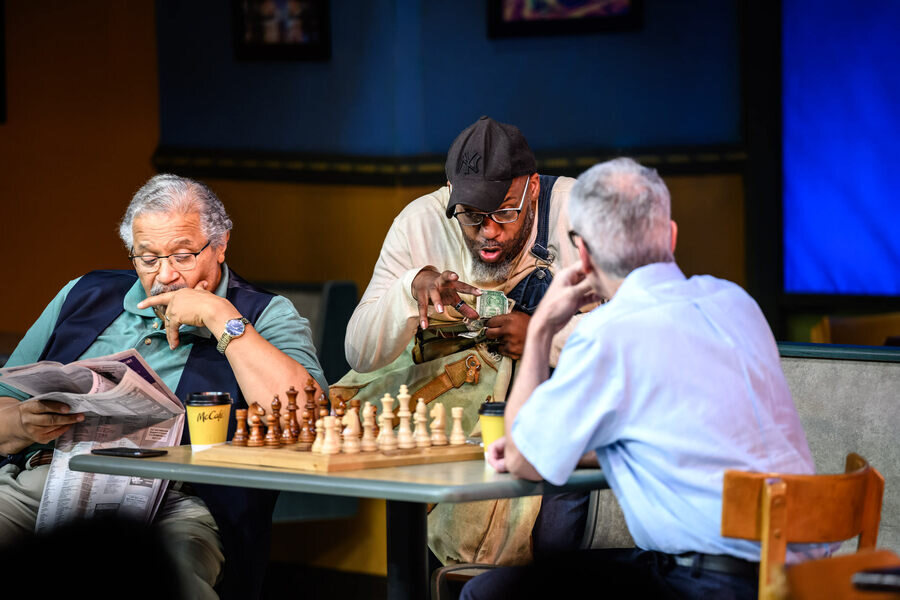
Photo: C. Stephen Hurst.
A production of the play Coconut Cake at the International Black Theatre Festival in July 2024.

One of the interesting things about theater targeted at a particular group is that people from many demographics may be curious to see it. The production may become a kind of meeting place, a place of shared laughter and emotion. Just for example, the plays of Black playwright August Wilson were often tried out in Boston, where a very diverse audience jumped at the chance to see them.

To encourage and support more Black playwrights, several theaters have decided to collaborate.

Dorothy Marcic and Kimberly LaMarque Orman report at American Theatre, “Chicagoan and English professor Melda Beaty started writing plays in 2011 and sent them out to readings, festivals, and theatres, with limited response. Then she submitted to a contest — and won.

“Her life changed when the International Black Theatre Festival (IBTF) awarded her play Coconut Cake the Sylvia Sprinkle-Hamlin Rolling Premiere (SSHRP) Award, presented at the IBTF July 29-Aug. 3 in Winston-Salem, N.C. Named after the co-founder of the IBTF, the SSHRP award includes ‘rolling premieres’ at several Black theatres. …

“The idea for the award came from IBTF artistic director Jackie Alexander, also North Carolina Black Rep’s producing artistic director. Recalling his experiences in New York seeing great plays that disappeared after a single run, Alexander wanted to try another model. As he put it to us, ‘We have these great Black theatre companies in major cities, and if we work together on a worthy play, we don’t need critics, we don’t need funding — we can create a hit of our own.’

“He’d been talking for a number of years with various artistic directors on how to collaborate, including at a dinner with the founder/executive director of Memphis’s Hattiloo Theatre, Ekundayo Bandele, and with the artistic director of Houston’s Ensemble Theatre, Eileen J. Morris, who recalled discussions about what their theatres could do to create art in the most efficient and economical way.

“When Alexander called and asked Morris if her theatre could be one stop for the rolling premiere of a new play about Maya Angelou called Phenomenal Woman, while its writer, Angelica Chéri, was still writing it, Morris noted, ‘For me, that was cool because I believed in the play. I believed in the experience. I believed in the opportunity. Despite not seeing the final script yet, I trusted in the process. The fact the first play was about Dr. Maya Angelou — that was a great selling point.’

Their goal for the first project was to share resources: designers, director, costumes.

“Though they wanted a female director, Morris was already booked to helm several plays in her own season, so Alexander stepped in and directed productions in both North Carolina and Houston; each theatre came up with its own funding. …

Phenomenal Woman played first in North Carolina, and by the time it opened in Houston it was selling out already because of the buzz from press in Winston-Salem. That success led to Phenomenal Woman to be picked up by producers with an eye on New York. …

“Hattiloo was recently able to produce Beaty’s Coconut Cake, [a] play about five senior men (four Black, one white), who meet every morning at the same McDonald’s to talk about marriages, health, and ambitions, while playing chess and learning important life lessons. This time around, each rolling premiere production of Coconut Cake is being produced on its own, without sharing designers or directors — a structure that allows both bigger-budget theatres like Houston’s Ensemble and theatres with fewer resources to each have their own vision. …

Coconut Cake has been in the oven for a while; it first appeared at IBTF in a reading in 2017. This was followed by a 2020 virtual reading through Houston’s Ensemble Theatre, in collaboration with St. Louis Black Rep. Ron Himes, St. Louis Black Rep’s producing artistic director, was initially skeptical.

” ‘I was one of those adamantly opposed to streaming theatre,’ he said, ‘and I had told everyone, no, we’re not doing it. Then Eileen called, and I was in. And you know, it worked. It was great!’ …

“Another Coconut Cake cast member was the indomitable Count Stovall, who had been in the original 2017 festival reading. An avid chess player, he had inspired Beaty with some moves she uses, particularly at the end of the play, when the audience sees that the king only can move a couple spaces at a time, while ‘the queen is everything.’ Stovall also told us even though memory loss was not explicitly written into the play, the fact that all actors were in their 60s and 70s meant, ‘It was there — you just didn’t see it.’

“Also joining for the Coconut Cake rolling premiere program was the Westcoast Black Theatre Troupe (WCBTT) of Sarasota, Fla. Founder/artistic director Nate Jacobs had been mentored for years by Sprinkle-Hamlin and her husband, Larry Leon Hamlin, the Festival’s co-founder and also the director of Jacobs’s first production at the IBTF.

“As Jacobs continued attending the festival, bringing other artists, he remembered what Sprinkle-Hamlin had told him about the festival: ‘We Black artists are competing with each other. But we ain’t got anything — no money. We need to unify and become stronger, because no other people are obligated to tell our stories.’

“So when Alexander asked if Westcoast would join the rolling world premiere program, Jacobs immediately agreed. ‘The show was a hit,’ he said of Westcoast’s production of Coconut Cake in June. ‘It popped. I was happy, again, to propel another artist.’ Beaty came and took notes, making changes as the show progressed through the various productions. ‘She’s a phenomenal writer,’ Jacobs told us. ‘And we need quality. [Audiences] such as ours, love Black culture, but they don’t want mediocrity, which means we have to be better than the best.’ “

More at American Theatre here.

Read Full Post »

Art: Stella Teller.
“Seated Storyteller with Four Children.”

For too long, the dominant culture has missed out on some great storytelling. Gradually that is changing, and indigenous playwrights are part of the change.

Mark Kennedy wrote at the Associated Press (AP), “The financial crisis of 2008 hit Mary Kathryn Nagle differently. As a playwright and a citizen of the Cherokee Nation, she saw parallels to events that negatively impacted Indigenous people centuries ago.

“Her play Manahatta juxtaposes the recent mortgage meltdown when thousands lost their homes to predatory lenders with the shady 17th-century Dutch who swindled and violently pushed Native Americans off their ancestral lands. …

“Nagle’s 2018 play has landed in New York City at the prestigious Public Theater this winter and it’s just the latest in a flowering of Native storytelling. From Reservation Dogs, Dark Winds and Rutherford Falls on TV to Prey on the big screen and Larissa FastHorse becoming the first Indigenous female playwright on Broadway, barriers are being broken.

“ ‘I hope it’s not a moment. I hope it’s the beginning of an era,’ says FastHorse, a member of the Sicangu Lakota Nation and a 2020 MacArthur Fellow. …

“ ‘[Most] film studios had never produced any content actually written or produced by Natives. It may have been about some Native people, but it was not written by Native people. And we’ve just seen that flipped on its head,’ Nagle said. …

“Nagle recalls moving to New York in 2010 and asking artistic directors of theaters why they weren’t producing Native work. They would answer that they didn’t know any Native playwrights or that there weren’t enough Native audiences to power ticket sales.

“ ‘Good storytelling is good storytelling, whether the protagonist is white, Black, Asian, LGBTQ — it doesn’t matter,’ said Nagle, who is on the board of IllumiNative, a nonprofit working to deal with the erasure of Native people.

” ‘There’s a lot of projects out there that are changing the narrative and that are proving that our stories are powerful and that non-Natives are really moved by them because they’re good stories.’

“Madeline Sayet, a playwright and professor at Arizona State University who also runs the Yale Indigenous Performing Arts Program, sees the contemporary Native theater movement flowing from the Civil Rights Movement of the ‘60s and ’70s and an increase in awareness of Indigenous issues ever since Native people won the right to legally practice their culture, art and religion.

“She connects the Wounded Knee occupation of 1973 to the Standing Rock standoff over the Dakota Access Pipeline in 2016 to Ned Blackhawk’s The Rediscovery of America: Native Peoples and the Unmaking of U.S History winning the National Book Award this year.

“Sayet, a member of the Mohegan Tribe who became the first Native playwright produced at the Public when her Where We Belong made it in 2020, said keeping Indigenous stories being produced depends on changing funding structures and getting long-term commitments from theaters and programs like Young Native Playwrights Contest.

“FastHorse, who made history on Broadway in 2023 with her satirical comedy The Thanksgiving Play, which follows white liberals trying to devise a culturally sensitive Thanksgiving play, has since turned her attention to helping rewrite some classic stage musicals to be more culturally sensitive. …

“She has recently reworked the book for an upcoming touring musical revival of the 1954 classic Peter Pan, which was adapted by Jerome Robbins and has a score by Moose Charlap-Carolyn Leigh and additional songs by Jule Styne, Betty Comden and Adolph Green.

“FastHorse found the character of Peter Pan complex, the pirates funny, the music enchanting but the depictions of Indigenous people and women appalling. There were references to ‘redskins’ throughout, a nonsense song called ‘Ugh-A-Wug’ and Tiger Lily fends off randy braves ‘with a hatchet.’ …

“FastHorse widened the concept of Native in the musical to encompass members of several under-pressure Indigenous cultures from all over the globe — Africa, Japan and Eastern Europe, among them — who have retreated to Neverland to preserve their culture until they can find a way back.

“The playwright said one of her guiding principles in the reworking was to make sure a little Native girl in South Dakota could see herself and celebrate. ‘Then we’ve done our job and she can join the magic instead of having to armor herself against the magic.’ …

“ ‘I think one thing I’m just hoping that people take away from this play is like, “Wow, Native stories are really compelling. Native people are incredible. They’re incredibly resilient. They’re incredibly brilliant. Yes, there’s tragedy, but they have such incredible senses of humor,” ‘ [Nagle] said.

“ ‘I want them to love my characters the way I love them. I want them to feel the heartache. I want them to feel the laughter. I want them to feel the love,’ she said. ‘And I want them to leave the theater just wanting to know more about our tribal nations and our Native people.’ ” More at AP, here.

Got ideas for a show that needs the red pencil of FastHorse? I’d start with Annie Get Your Gun. Come to think of it, that show also needs the red pencil of poor, white mountain people. Their presentation is painful, too.

Read Full Post »

Photo: Garrett Houston.
Terrance Jackson came to Virginia’s Barter Theatre as an actor and now leads Barter’s Outreach and its Black Stories Black Voices initiative.

I have always loved August Wilson’s plays about the Black families in the Pittsburgh neighborhood where he grew up. I’ve seen most as many were tried out in Boston during Wilson’s lifetime. But there are other Black playwrights achieving success, and today’s article from American Theatre highlights efforts to help still more develop their skills.

Former Barter Theatre director Karen Sabo writes, “Barter Theatre in Virginia isn’t unique in their current position: It is a predominantly white institution that is currently attempting to better serve audiences and artists of color. But the innovative structure of Barter’s new Black Stories Black Voices program … could well serve as a national model for inclusive art-making that embraces and empowers Black communities at mainstream theatres.

“It may seem like a departure, but in some ways it’s also a continuation. When, 90 years ago, Robert Porterfield founded Barter in his rural, mostly white hometown of Abingdon, Va., in the midst of the Great Depression, he brought New York actors to this Appalachian agricultural area to match unemployed — and in some cases, underfed — actors with local farmers struggling to sell goods to people with little money. The price of admission was 40 cents, or an equivalent amount of produce, dairy, or livestock. ‘Porterfield and his partners accepted almost anything as payment,’ according to Encyclopedia Virginia. ‘A pig was worth 10 tickets, while two quarts of milk bought one ticket.’ …

“Full disclosure: I spent six years working as a director and resident actor at Barter in the early 2000s. My immersion in this organization gave me an appreciation for certain aspects of the institutional culture of this rural LORT [League of Resident Theatres] theatre. …

“During my tenure, Barter had an acting company made partly of out-of-towners — big-city pros who landed at Barter and stayed — alongside some home-grown artists. A few particularly talented local performers made their artistic home at Barter, and the Barter Players, the young, non-Equity company, produced many actors who eventually joined the resident acting company.

“While few would deny that the creation of regional theatres in the United States was a positive development, in their early days these organizations often operated with a kind of cultural imperialism, as they attempted to enlighten or elevate audiences by bringing work from the cities to ‘the provinces.’ In an attempt to better serve its Appalachian population, 20 years ago Barter started the Appalachian Festival of Plays and Playwrights. This encouraged writers to tell the stories of the unique region where Barter is located, and while some of these new plays featured characters who were Black, Indigenous, or people of color, they mostly told stories of the majority-white population of the Southern Appalachian Mountains.

“Just before the pandemic, Katy Brown became Barter’s new producing artistic director, only the fourth in the theatre’s 90-year history. Brown herself is a home-grown leader; I remember seeing her first performance 25 years ago with the Barter Players shortly after she finished college. Like many other predominantly white theatres, Barter has begun hiring more people of color, and producing more shows telling stories of Black Americans. They’ve also designated that at least one play in the yearly Appalachian Festival of Plays and Playwrights be written by a Black artist. But in the spirit of Barter’s culture of empowerment, honoring its region, and developing local artists, they’ve also created the program Black Stories Black Voices (BSBV).

“BSBV is the brainchild of collaborative thinking from many on the Barter leadership team. The first public performance under this new initiative was the 2022 Shine project last April 24, which featured professional actors reading new monologues submitted by Black residents of the counties surrounding Barter. …

“The Barter team wanted input from an authority regarding presenting more inclusive stories. They reached out to Dr. William H. Turner, a known expert on Black life in the South and Appalachia, and Turner suggested that rather than just focusing on producing Black plays, they help create Black playwrights.

“ ‘We wanted people who knew nothing about playwriting to get involved, so that’s where the story collection idea came from, and that came through Cathy,’ Brown said, referring to Barter’s resident playwright, Catherine Bush. Bush suggested asking local people to share stories and then hiring Black artists to help turn stories into monologues. At Shine, those monologues were performed by professional actors, and the Barter team intends the next steps to be turning monologues into scenes and eventually full-length plays.

“But to encourage the sharing of stories, Barter needed to strengthen their outreach and build relationships, especially with communities of color. Enter Terrance Jackson, a Florida native who initially came to Barter as an actor, and who now leads both Barter’s Outreach and Black Stories Black Voices.

“ ‘Our statement of intent is to provide a safe space for Black Appalachian artists to share their stories and showcase their work, while also fostering our Black community with a safe space to see theatrical work,’ said Jackson. … ‘I will be reaching out to different groups and different people, not just Black and brown people, but all types of people, and letting them know that they matter at our theatre, and that they have a place here.’ …

“Jackson summed up his experience with the project so far by saying, ‘Barter is a predominantly white institution still, and we are actively doing our best to, not necessarily to change that, but to make it equitable, and to build a space where all people feel comfortable to work and to see plays. We’re not done creating dope Black stuff — we’re just beginning. And hopefully we do work that really matters to Black folks in Appalachia, but also to the entire theatre world and theatre industry as a whole.’ ”

More at American Theatre, here. No firewall.

Read Full Post »

When I was 12, I was a playwright. I’d had a terrific gig as an actor in community theater at age 10 and just fell in love with the whole scene. At 12, I rounded up cousins to perform my play about a talking snowman outdoors for parents. We save things in our family. Not long ago one cousin sent me her tattered, penciled script.

Theater people are often very generous. Most are not celebrities and don’t make good money. The playwright in today’s story did have a successful show on Broadway, but the bulk of his money came from sidelines. When he saw how much it was, he decided to help theater people who were struggling.

As Michael Paulson reports at the New York Times, “Jeremy O. Harris is a playwright, a performer, and a provocateur. And now, he’s a philanthropist.

“The 31-year-old author of Slave Play, which is nominated for 12 Tony Awards, emerged during the pandemic not only as a vocal advocate for the beleaguered theater industry, but also as someone determined to model generosity.

“After years in which he earned very little making theater — he said his total commissions over four years amounted to about $22,000 — this year he made nearly $1 million, primarily from collaborations with the fashion industry and an HBO deal. (Fashion and television pay better than Broadway.)

So in the months since the virus shuttered theaters across America, Harris has:

“He has also used his bully pulpit to champion theater. He sent a letter to President-elect Biden, urging him to revive the Federal Theater Project, and then used an appearance on ‘Late Night with Seth Meyers’ to push that show’s host to rally support for the idea.

“In a telephone interview, Harris explained why in dire times he believes everyone should be committed to ‘protecting, uplifting and sharing,’ adding: ‘Some might call it philanthropy, but I call it upkeep or maintenance.’ These are edited excerpts from the conversation.

How would you describe the kinds of artists or works you’re looking to support?

“I want to make sure that we have a really fertile artistic landscape when we return to the theaters. And I think it’s been pretty evident that I’m really excited about work that’s challenging, that’s scary, that probably wouldn’t get support otherwise. …

“Even before the tumult of this year, you’ve had an interest in highlighting Black theater artists.

“It was so exciting to see myself in Tennessee Williams, in Beckett and Caryl Churchill. But there came a point where I was like, ‘Wait, have Black people never done anything like this?’ And when I discovered that not only had they, but so many had done it to wild acclaim, and yet no one I talked to remembered that acclaim or knew those people, I knew that something had to be done about this cultural amnesia. …

“The $50,000 commissions are above the norm for playwrights. How did you arrive at that amount?

“I wanted to give someone a living wage in New York. I wanted someone to feel excited about spending a year and a half, maybe two, working on one play, and not feeling compelled to work in a coffee shop.”

More at the New York Times, here

Read Full Post »

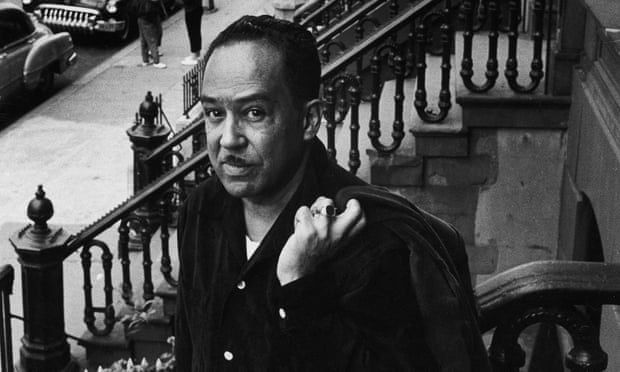
Photo: Robert W Kelley/Time Life Pictures/Getty Images
Langston Hughes on the front steps of his house in Harlem, June 1958.

Before Suzanne and Erik moved to Providence, they were living in a lovely renovated brownstone in Harlem.

There’s a fine line between newcomers investing where there’s been too much disinvestment — and gentrification. The early changes seem to benefit a neighborhood and its people, but inevitably rising property values push out many longtime residents and institutions.

Today, a group of Harlem artists from various disciplines are banding together to keep a significant piece of the Harlem Renaissance around to nourish African American arts.

Tom Kutsch writes at the Guardian, “All that signifies the legacy of a house once occupied by the poet laureate of Harlem is a small bronze plaque, partially covered by a cedar tree’s branches and the green ivy that envelops much of the building.

“The onetime home of Langston Hughes has sat largely unoccupied for years, but a new movement is trying to reclaim, for a next generation of artists, the space of a man who is forever intertwined with the Harlem Renaissance.

“Spearheaded by writer, performer and educator Renée Watson, the collective effort is busily trying to raise the necessary funds to purchase a lease and make needed renovations to the house. …

“Watson plans to make the Hughes house the home of the I Too, Arts Collective that she launched alongside the effort, which aims to, in her words, have ‘programming that nurtures, amplifies, and honors work by and about people of color and people from other marginalized communities.’ …

“The collective gets its name from one of Hughes’s most famous poems – I, Too – in which his narrator concludes by intoning:

They’ll see how beautiful I am
And be ashamed—
I, too, am America.

“Watson is using the crowdfunding website Indiegogo to solicit donations for the project, for which they’re hoping to raise at least $150,000 to cover a lease and begin the renovation process. By the time of publication, they had raised more than $54,000, already exceeding the $40,000 Watson says would cover at least a six-month lease. …

“For more than a century, Harlem has been inextricably linked to black life and culture in America; the birthplace of the aforementioned Harlem Renaissance, which fostered a wide array pre-eminent black artists and writers, from Zora Neale Hurston to Claude McKay and Duke Ellington. …

” ‘The erasure of black Harlem may come despite our best efforts …’ said Tracey Baptiste, a local children’s author who is involved with Watson’s collective. ‘But this project is about making sure that gentrification doesn’t also happen in the hearts and minds of our artists.’ ”

More here.

Read Full Post »

One thinks of Iran as repressive, and having watched the doomed 2009 revolution unfold on twitter, I believe it is. But Iranian theater people seem to be managing to squeeze in some fun.

I blogged before about the Tehran production in a taxi, here. Now Studio 360 has a story on what might be called extreme improvisation. I take that back. There’s a script. But the actor doesn’t get to see it in advance.

“Actors face stage fright all the time,” says Studio 360, a radio show. “But consider this scenario: you show up to perform a one-person show, and you’ve never seen the script. You don’t know what it’s about because you promised not to do any research. It’s your first performance, and the only one you’ll ever have. The theater’s artistic director hands you a fat manila envelope with a script. And go.

“Also, the audience will decide whether you drink a glass of water that appears to have been poisoned.

“This is the premise of White Rabbit, Red Rabbit, by Iranian playwright Nassim Soleimanpour. ‘I did not know what was in front of me inside that envelope,’ says actor Gwydion Suilebhan. ‘What if this script is going to require that I disrobe? Or insult my mother? Or be rude or self-debasing?’ …

“Soleimanpour pulls his strings from afar, because — although the play has been performed in Toronto, Berlin, San Francisco, Brisbane, Edinburgh, London, and now Washington, DC — he really is in a cage. He doesn’t have a passport and can’t leave Iran, so he has never seen his play performed. ‘Nassim has given up the kind of control that is customary for playwrights,’ says Suilebhan, of working with actors and directors to realize the play. ‘At the same time, because he has put all of these restrictions on how it is to be performed, he has seized certain kinds of control that playwrights normally do not have. So he is literally embodying the ideas of control and submission and manipulation that he’s baked into his script.’ ” More.

Photo of Iranian playwright Nassim Soleimanpour found at the HuffingtonPost

Read Full Post »

Deanna Isaacs has a funny post at the Chicago Reader. It’s about the Storefront Playwright Project.

“Tired of sitting around watching paint dry?” she asks.

“Then get yourself over to 72 E. Randolph, where, thanks to the League of Chicago Theatres and the Department of Cultural Affairs and Special Events, you can watch a real, live writer at work.

“The Storefront Playwright Project is putting 27 authors on exhibit this month in the big front window at Hot Tix/Expo 72.

“Never mind that writing is right up there with sleeping as a potential spectator sport, so stimulating that the writer him- or herself often has to bring the action to a complete stop in order to check e-mail, clean a closet, or book a flight and get the hell out of there. …

“Guessing that dramatists would be more dynamic at work than, say, novelists (readily observed in deep rumination at most any coffee shop), I stopped by last week, when Emilio Williams was on display.

“The playwrights each take a four-hour shift. Williams was a couple hours into his afternoon stint, gamely focused on his laptop, which was perched on a small white table and hooked into a large screen mounted in the window. The big screen faces outward, allowing passersby a look at the creative product the instant it emerges from the writer’s brain. …

“Behind the glass, Williams pursed his lips and crossed his ankles. …

“He leaned his chin on his hand and scrolled through several pages of dialogue that went something like this:

“Mar: Done?

“Ted: Yep.

“Mar: You don’t sound very enthusiastic.

“Williams paused.

“He blinked.

“He scrolled again.

“And then, it happened!

“On the big screen, before my very eyes, the cursor hesitated. It stopped. And it backed up, deleting as it went, wiping out ‘tucitcennoC’ and replacing it with ‘Lake Geneva.’ ” More from Deanna, even funnier.

Readers may recall several posts I wrote on a playwriting class I took the summer before last. (For example, here.) I thought the class got playwriting out of my system. Should I reconsider now that playwrights have the opportunity to sit in storefronts where strangers can watch them think?

Um, maybe not.

Photograph: The Chicago Reader

Read Full Post »

I have always loved theater, and even when I have been in a play and felt stage fright, I have been able to make it work as a springboard for the lines I have to say. But when I have to do a presentation as myself and not a character, I freeze up.

Which is why I keep taking classes in how to give presentations, to no avail. But the class that I took last week may finally help me. And I think the secret of it was that the instructor, though an experienced corporate coach and adviser, is also a practicing actor and playwright.

He was very good at paring down the words participants wanted to use and helping choose the most effective ones. And his ideas about how to make an entrance, how to stand, natural gestures to use, tone of voice, and eye contact seemed to have roots in the stage. Even the freshness of his own presentation to the class seemed the result of having to say the same lines night after night in a show and make them seem new.

Of course, no class is magic, so we have to wait and see how it goes when I do my work presentation in late March. But I am definitely going to try harder to apply what I heard than when I took presentation classes in the past full of jargon, phony jokes, and gimmicks that are supposed to work but don’t seem to have a lot underpinning them.

The teacher was Brandt Johnson. See the actor here. See the corporate consultant here. Another one of these people who lead several lives simultaneously.

Read Full Post »

When playwright Willie Reale started the 52nd Street Project in 1981 it was to meet a need. Children living in poverty in and around the Hell’s Kitchen section of New York City often had little joy in their lives. A group of theater people decided to use the art they knew best to change that.

“The mission of The 52nd Street Project is to bring together kids (ages 9 to 18) from the Hell’s Kitchen neighborhood, with theater professionals to create original theater.  The primary activity of the Project is to present free theater to a general audience. The Project’s deeper purpose is to use the art form of theater to engage the children’s imaginations, broaden their means of expression, and increase their sense of self worth, their literacy skills and their appreciation for the arts. With the addition of our expanded Clubhouse and our own theater, the Project has been able to add programming in various other art forms (such as Photography, Poetry, Theatrical Design and Dance). Additionally, the Project runs a free, after school homework help and academic mentoring program.”

In the early years, I saw some of the plays created when one child and one actor bonded and collaborated. Delightful. As Reale says, “There is no way to fast forward and know how the kids will look back on this, but I have seen the joy in their eyes and have heard it in their voices and I have watched them take a bow and come up taller.”

In this clip, kids work with adult partners on haiku.

Read Full Post »

Only two more sessions now. After a class on a meltingly hot day when we discussed the play “Mud,” by Maria Irene Fornes, my teacher’s longtime mentor, we were sent out into the world to write down conversations overheard in public places.

Some class members got great conversations down on paper in spite of noisy air conditioning and music. My scene, which featured three tourists (a mother, father, and 14-ish son) was beyond boring. Instructive, though. People really do not converse the way we think they do. Lots of broken-off and garbled lines. Nonsequitors. Chitchat to fill dead air. Often about food. And to cover real thoughts.

I’m really interested in how people use language to not communicate. Not just when the chitchat covers what they are consciously thinking, but even more, when the words cover thoughts that are too deep for the speaker to be aware of. Like some political or religious discussions. For example, one Right to Life person getting red in the face shouting at a clinic could be feeling on a deep level that being the 10th child, his mother might have thought twice about having him. I’m oversimplifying. But I do know a couple folks whose political arguments are closely tied to how they felt about their fathers.

An art professor Suzanne had at Pomona used to paint over an under story. He believed one could sense the completely invisible picture. That interests me.

This week, members of the playwriting class are to take our overheard scenes and develop them more. I am mainly adding what the people are consciously thinking. Someday I’ll write about what people don’t even recognize they’re thinking.

Read Full Post »