Feeds:
Posts
Comments

Posts Tagged ‘poem’

With no wish to detract from the joy that Italians take from their countryman’s spirit of adventure or the pride that Americans feel for positive developments that followed the First Encounter, it’s hard to deny that it wasn’t the best thing for the people already living here. So without beating a drum that isn’t mine to beat, I’ll just share a gentle poem by a major Native American poet, a member of the Muscogee (Creek) Nation. It’s a poem that is good for all people.

Eagle Poem by Joy Harjo

To pray you open your whole self
To sky, to earth, to sun, to moon
To one whole voice that is you.
And know there is more
That you can’t see, can’t hear;
Can’t know except in moments
Steadily growing, and in languages
That aren’t always sound but other
Circles of motion.
Like eagle that Sunday morning
Over Salt River. Circled in blue sky
In wind, swept our hearts clean
With sacred wings.
We see you, see ourselves and know
That we must take the utmost care
And kindness in all things.
Breathe in, knowing we are made of
All this, and breathe, knowing
We are truly blessed because we
Were born, and die soon within a
True circle of motion,
Like eagle rounding out the morning
Inside us.
We pray that it will be done
In beauty.
In beauty.

More at the Poetry Foundation.

Update June 21, 2019: Joy Harjo became the first Native American US Poet Laureate in 2019. Click here.

Photo: Wikipedia
Joy Harjo in 2012.

Read Full Post »

Photo: Star Tribune
Ojibwe poet Jim Northrup

I have been trying to learn something about tribal cultures in the United States. I liked Spokane/Coeur d’Alene tribal member Sherman Alexie’s Thunder Boy (a charming picture book for young children) and The Lone Ranger and Tonto Fistfight in Heaven (an early, painful collection of short stories). Now I am reading some Native American poetry.

One poet, Jim Northrup, recently died. Here is a beautiful obit by Jana Hollingsworth in the Duluth News Tribune.

“Jim Northrup was a ‘tough man’ who taught his eldest sons to survive in the elements by living in a tepee on the Fond du Lac Reservation for several years, when money and jobs were scarce.

“But it was more than physical survival, said his son, Matthew, on Tuesday, the day after his father died from cancer-related complications. He taught them how to be strong in a world that didn’t treat everyone the same, he said, using humor — and education — as tools.

” ‘ “When you have really nothing else,” he said to me a lot, “you have your humor,” Matthew said. ” ‘When you grow up poor on the rez and when you grow up a lower class in society, you realize that.’

“Northrup, an award-winning writer of books, columns, plays and poetry — and a prominent member of the Fond du Lac Band of Lake Superior Chippewa — died [in July]. He was 73.

“Northrup was a storyteller, known for his stark and honest writing about his experience as a U.S. Marine in Vietnam and his early years at a federal boarding school. He was funny and pointed in his writings about everyday life on the reservation, politics and change in Indian Country. He wrote as a way to heal himself from some of the trauma he experienced during the war, he said earlier this year.

” ‘I knew my poetry was being used in vets’ groups to help people open up (and) maybe even write their own poetry as part of their healing,’ he told the News Tribune in March. ‘It worked for me, so I hoped it helped (others).’ ”

More here, where you can hear Northrup read a poem in Ojibwe about passing along the culture. Read the whole obit. It’s really lovely. I hated to cut it.

Read Full Post »

I Hear America Singing

By Walt Whitman

I hear America singing, the varied carols I hear,
Those of mechanics, each one singing his as it should be blithe and strong,
The carpenter singing his as he measures his plank or beam,
The mason singing his as he makes ready for work, or leaves off work,
The boatman singing what belongs to him in his boat, the deckhand singing on the steamboat deck,
The shoemaker singing as he sits on his bench, the hatter singing as he stands,
The wood-cutter’s song, the ploughboy’s on his way in the morning, or at noon intermission or at sundown,
The delicious singing of the mother, or of the young wife at work, or of the girl sewing or washing,
Each singing what belongs to him or her and to none else,
The day what belongs to the day—at night the party of young fellows, robust, friendly,
Singing with open mouths their strong melodious songs.

090116-working-on-the-railroad

Read Full Post »

Last Sunday, Pam and I walked over to the library to hear an acclaimed poet read at the poetry series. Ross Gay, who lives in Indiana, had just published his poetry collection Catalogue of Unabashed Gratitude and was doing readings around New England.

Glenn Mitchell, who organizes the library’s poetry series, was able to publish an advance interview with Gay in the local paper.

She wrote, “Gay says his inspiration for writing poems is a determination to practice joy as a discipline. He is a finalist for the 2015 Kingsley Tufts Poetry Award and the National Book Critics Circle Award and was a finalist for the 2015 National Book Award in Poetry and the NAACP Image Award in Poetry.

“Gay also works in the field of literary sports writing. He is a founding editor of the online sports magazine Some Call it Ballin’, a publication of reflective essays written by well-known poets, essayists and fiction writers along with podcasts of contributors.

“He serves on the board of the Bloomington Community Orchard, a nonprofit, food justice project.

“An associate professor of poetry at Indiana University, Gay is residing in Cambridge while a 2015-16 Fellow at the Radcliffe Institute for Advanced Study.”

Here is what Gay told Mitchell about the poet that inspired him to write poetry: “[Amiri] Baraka’s poems were such a clear articulation of the kind of alienation I was experiencing when I went off to college — a kind of racial alienation and class alienation — that I had no idea how to begin to talk about other than wanting to break things. I knew I was full of rage (which I later knew was a version of sorrow, too), but I didn’t know how to put it into words, which Baraka’s work made it possible for me to understand was possible.”

To her question about gardening coming into his life and the difference it made, he says, “I think close looking, paying attention, going slow, a kind of training in receptivity — I think those are things I learn from the garden … I approach poems like that, usually. I like to listen to them as much as I try to impose my own will on them. … A garden or a poem is potentially a device for pulling people together, they are both food, I’m saying, which we might feed to each other.”

In his Sunday reading, Gay included a poem about strangers sharing figs from a tree unexpectedly flourishing near his Philadelphia home — a poem that expresses some of his thoughts about our history of racism and the possibility of goodness.

He says, “The poem ‘To the Fig Tree at 9th and Christian’ gets at it—gets at what it means for us to come together despite the brutal history we’ve inherited, or even enacted. I think that fig tree is a kind of mercy.”

More here.

Read Full Post »

I’ve been meaning to share a charmingly illustrated 1986 publication called The Book of Holidays around the World. The author is Alice van Straaten.

Her entry for January 1 mentions the Rose Bowl Parade, of all things, and how it was launched in 1890 in imitation of the Festival of Flowers in Nice, France.

She also describes a celebration in Greece honoring St. Basil: “Children go from door to door, carrying an apple, a paper ship — or a paper star — and receive coins for singing calends, carols of good wishes for the year.”

(Kind of makes me think of going door-to-door at day camp on Fire Island with a list of scavenger-hunt needs. Of course, in that case, you’d be asking for a paper ship or an apple, not carrying items to the houses. Summer renters were very tolerant of scavenger hunts. Today, you’d probably want to do a scavenger hunt only where you knew the neighbors.)

I’ll conclude with one more tradition, highlighted on the website Watching the Swedes.

“Almost every New Year’s Eve since 1896, a well-known person has stood on the stage at a Swedish open-air museum and recited the poem ‘Ring out Wild Bells’ by Lord Alfred Tennyson written in 1850. This may seem weird, but nowadays, the event is televised and attracts a large public. Translated into Swedish, the poem is called ‘Ring Klocka Ring’ and it has a very meaningful and deep content as we leave one year and enter into another.

“Various famous people, mostly actors, have had the honour of delivering this rousing poem throughout the years. Of the 20 narrators so far, only one has been a woman. However, this year the second female narrator – popular opera singer Malena Ehrman – will take the stage.”

Art: Edmund Dulac
Father Time, featured in The Book of Holidays around the World.

Read Full Post »

The poet Marianne Moore once helped to save a special tree by writing a poem about it, proving that art is more powerful than apathy.

Maria Popova writes at Brain Pickings, “In 1867, Brooklyn’s Prospect Park, once an American Revolution battlefield, opened its gates to a community hungry for a peaceful respite of wilderness amid the urban bustle. So intense was public enthusiasm that local residents began donating a variety of wildlife to fill the 585-acre green expanse, from ducks to deer. But the most unusual and enduring gift turned out to be a tree, donated by a man named A.G. Burgess and planted in 1872.

“This was no ordinary tree. Ulmus glabra ‘Camperdownii,’ better-known as Camperdown Elm, is a species unlike regular trees in that it cannot reproduce from a seed. The rare elm carries its irregularity on the outside — its majestic, knobby branches grow almost parallel to the ground, ‘weeping’ down. To ameliorate its reproductive helplessness, the Camperdown Elm requires outside help — a sort of assisted grafting, be it by accident of nature or intentional human hand. …

“As excitement over the novelty of Prospect Park began dying down, the Camperdown Elm came to suffer years of neglect. …

“But then, in the 1960s, it was saved by a force even more miraculous than that by which its Scottish great-great-grandfather had been born — not by a botanist or a park commissioner or a policymaker, but by a poet fifteen years the tree’s junior.

“The poet was Marianne Moore (November 15, 1887–February 5, 1972), who had been elected president of New York’s Greensward Foundation — an advocacy group for public parks — in 1965. This brilliant and eccentric woman … created a citizen group called Friends of Prospect Park, aimed at protecting the Camperdown Elm and other endangered trees in the park.

“In 1967, eighty at the time and with a Pulitzer Prize under her belt, Moore penned ‘The Camperdown Elm’ — a beautiful ode to this unusual, dignified, yet surprisingly fragile life-form of which humans are the only bastions. …

“Moore’s poem mobilized the Friends of Prospect Park to envelop the Camperdown Elm in attentive and nurturing care, which ultimately saved it.”

Read the poem and the rest of the story here.

Come to think of it, the Camperdown Elm’s reliance on humans to do the right thing make it very little different from the rest of the natural world.

Read Full Post »

Cambridge knows how to make artists feel welcome, even cherished. Recently the city had a poetry contest, and the winners are getting their poems embedded in the sidewalk.

Steve Annear writes at the Boston Globe, “Cambridge officials received hundreds of submissions from residents hoping to make their mark as literary legends through the city’s first-ever ‘Sidewalk Poetry’ contest this spring. In the end, only five scribes emerged victorious.

“In March, the city put out a call for poets to participate in the project. Winners were promised a permanent display space for their musings — the poems would be imprinted in the freshly poured concrete as Department of Public Works crews replaced sidewalk slabs cracked or damaged during the winter.

“The response was great, said Molly Akin, the Cambridge Arts Council’s marketing director. More than 300 submissions flooded in from writers ranging in age from 4 to 95, according to organizers.

“A special committee that included workers from the [Department of Public Works], representatives from the local libraries, members of the Arts Council, and Cambridge’s former Poet Populists helped select the finalists. …

“Below are the names of the winners, and their poems:

Rose Breslin Blake
Children, look up
Cherish those clouds
Ride grey ponies over their hills
Feed the shiny fish
Boo the big bear
Chase the gloomy giant
Giggle with the geese
Sing with the lambs
Cherish those clouds; they cherish you
Rest on their pillows.

Benjamin Grimm
I could not forget you if I tried.
I have tried.

Ty Muto
Your blue-green glances
My heart skips double dutch beats
Caught in your rhythm

Carolyn Russell Stonewell
Sun takes a bite of
mango as it sets.
Its last rays
run down my cheek.

Elissa Warner
A Mother’s Wish
Little boys, little treasures
Shine like lights from above
My son, my only one
My wish for you is that you wake
One day when you are old
And feel raindrops on your cheek
Tears of joy from my heart
For you to keep

More here.

Photo: Cambridge Arts Council

Read Full Post »

Move him into the sun —
Gently its touch awoke him once
At home, whispering of fields unsown.
Always it woke him, even in France
Until this morning and this snow.
If anything might rouse him now
The kind old sun will know …

Wilfred Owen (1893-1918)

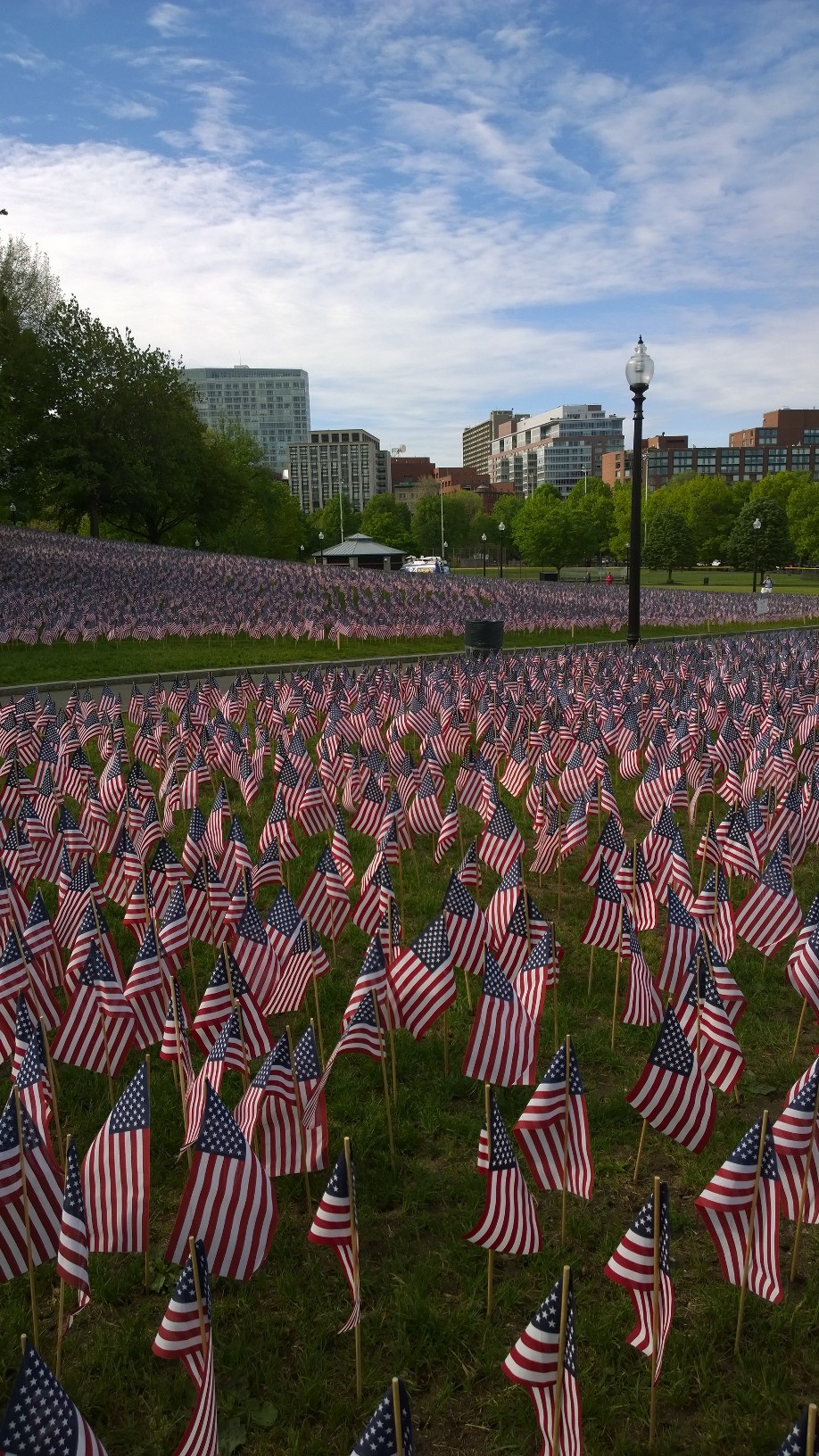
flags-for-the-fallen-since-Civil-War

Read Full Post »

When the Swedish poet Tomas Tranströmer won the Nobel Prize for Literature, I wrote a post about it. Several Swedes, including Erik and his mother, had told me about Tranströmer, and I have a couple books of his poems in translation.

An obit by Bruce Weber in yesterday’s New York Times gave me a lot more information about “a body of work known for shrewd metaphors couched in deceptively spare language, crystalline descriptions of natural beauty and explorations of the mysteries of identity and creativity. …

“Though he was not especially well known among American readers, he was widely admired by English-speaking poets, including his friends Robert Bly, who translated many of his poems, and Seamus Heaney, himself a Nobel laureate in 1995.”

It seems Tranströmer also was a trained psychologist, who “worked in state institutions with juvenile offenders, parole violators and the disabled. …

“Mr. Tranströmer’s poetry production slowed after his stroke, but he took refuge in music, playing the piano with just his left hand. As a testament to his prominence in Sweden, several composers there wrote pieces for the left hand specifically for him.

“He was also an amateur entomologist. The Swedish National Museum presented an exhibition of his childhood insect collection, and a Swedish scientist who discovered a new species of beetle named it for him.”

Here is an excerpt from a poem the New York Times printed in the obit:

“I know I must get far away

“straight through the city and then

“further until it is time to go out

“and walk far into the forest.

“Walk in the footprints of the badger.”

More here.

Photo: Jonathan Nackstrand/Agence France-Presse — Getty Images
Tomas Tranströmer with his wife, Monica, after winning the Nobel Prize in Literature in 2011.


Read Full Post »

I admit I dropped the poem-a-day e-mail from poets.org because I couldn’t keep up, but I saved a few that I liked recently.

This one by Alberto Rios, for example.

“One river gives
Its journey to the next.

“We give because someone gave to us.
“We give because nobody gave to us.

“We give because giving has changed us.
“We give because giving could have changed us. …

“You gave me blue and I gave you yellow.
“Together we are simple green. You gave me

“What you did not have, and I gave you
“What I had to give—together, we made

“Something greater from the difference.”

Read the whole poem here.

Meanwhile, poet friends have been busy capturing present realities and past screen shots. Ronnie Hess wrote a poem inspired by watching home movies of her Fire Island childhood. It reads in part,

“follow your sister
“as she leaps and cartwheels along

“the beach into the sea. I see your eyes
“follow her, your mind dart,
“your body imitate her older moves.” The whole poem is at Quill and Parchment.

And poet Nancy Greenaway caught the mood of our endless winter with this roll-over-and-go-back-to-sleep nugget

Sleeping In
School vacation: time for winter hibernation.

Photo: svsnowgoose.com

Read Full Post »

While we’re on the subject, here are two more poetry events scheduled for spring.

Nancy writes, “Some of your readers may also be interested in the Massachusetts Poetry Festival, in Salem, May 1 – 3. Marge Piercy and Richard Blanco will be among the many well-known poets reading.”

She also notes that if you are near Providence in March, you may want to attend the Poetry Out Loud recitation competition for high school students. The statewide competition will be held at Rhode Island School of Design in Providence, with 15 students from schools across Rhode Island reciting poems (by such people as Shakespeare, Mary Oliver, Robert Frost, etc.) in hopes of qualifying for nationals. Info here.

Another inspiring poetry competition for youth is the one depicted by the movie Louder than a Bomb, in which students compose their own poems and perform them. My husband and I were impressed by what the creative opportunity and the discipline did for some at-risk kids. You can get the movie from Netflix, which describes it thus: “Capturing the combined creative spirit of more than 600 Chicago-area teenagers who are participating in what’s billed as the world’s largest youth poetry slam, this documentary highlights the joy of language and the power of collaboration.”

Read Full Post »

I have mentioned the Block Island Poetry Project in past years, and I wanted to let you know that I just got the scoop on this year’s theme.

Nancy writes, “The Block Island Poetry Project weekend will be April 16-19 and will focus on Poetry of the Wild, a project of Ana Flores, who visited just a few days ago to show us examples of what she’s been doing around the country for the last twelve years. … I’m in the process of developing my Poetry of the Wild poetry box project for the school.”

The Poetry of the Wild website explains, “Poetry of the Wild invites the public out for a walk to see their world anew through the keenly felt perspectives of poets and artists. Using a unique presentation of ‘poetry boxes’ that combine art and poetry, the project serves as a catalyst for exploring our towns and considering how place informs mindfulness. The public becomes engaged by finding the boxes which are sited as a network on mapped trails, reading the poems, and responding in the public journals contained in each.

“The sculptor Ana Flores created Poetry of the Wild in 2003 while she was the first artist in residence for the Wood-Pawcatuck Watershed Association in Southern Rhode Island. Her mission was to use the arts to foster public awareness and stewardship of the land and waterways protected by the Association. That first project had a dozen boxes created by students from area schools, members of the environmental group and other artists. The public response was overwhelming during its three month tenure. It turned out that many people roaming the trails were poetic– but they had had no place to express themselves. Journals were replaced three times and the trails leading to boxes also became less littered.”

For more about Ana’s work, see earthinform.com. And for more about the Block Island Poetry Project (founded by 2008-2013 Rhode Island poet laureate Lisa Starr), click here.

Ana Flores

Read Full Post »

Photo: Andrea Shea/WBUR
Amy Clampitt used her award money to buy a house in Stockbridge, Mass., where today rising poets can have six- to 12-month tuition-free residencies.

When National Public Radio’s Andrea Shea heard about this year’s winners of the MacArthur award, she began to wonder how past recipients had spent the money. Her curiosity led her to 1992 honoree and poet Amy Clampitt.

“The recipients of this year’s MacArthur Foundation ‘genius grants’ will each receive $625,000 over five years, no strings attached,” writes Shea.

“[Clampitt] was on vacation when she heard from her friend, writer Karen Chase, that she had been named a MacArthur genius.

” ‘ She was furious with me because she thought I was teasing her,’ Chase recalls. ‘And by the end of the conversation she said, “I’m gonna buy a house in Lenox!” ‘

“That’s Lenox, Mass., home of Edith Wharton, one of Clampitt’s favorite writers. Chase helped Clampitt find a small, clapboard house that became the 72-year-old poet’s first major purchase. The next year, Clampitt was diagnosed with ovarian cancer. Chase reads from notes of conversations between Clampitt and her husband, Harold Korn:

” ‘What’s going to happen to the house? I don’t want it broken up,’ Clampitt said. …

“After his wife’s death, and before his own in 2001, Korn dreamed up a fund to benefit poetry and the literary arts. Since 2003, the house Clampitt bought with her MacArthur money has been used to help rising poets by offering six- to 12-month tuition-free residencies.

“Clampitt herself didn’t publish her first volume of poetry until she was 63.”

Her Atlantic Monthly editor, poet Mary Jo Salter, thinks Clampitt “would be delighted that her house is helping give poets the kind of opportunity that she didn’t have when she was coming up. …

“This December, the 19th resident of the house Amy Clampitt purchased with her MacArthur purse will settle in.”

More at NPR, where you also can listen to the audio.

Read Full Post »

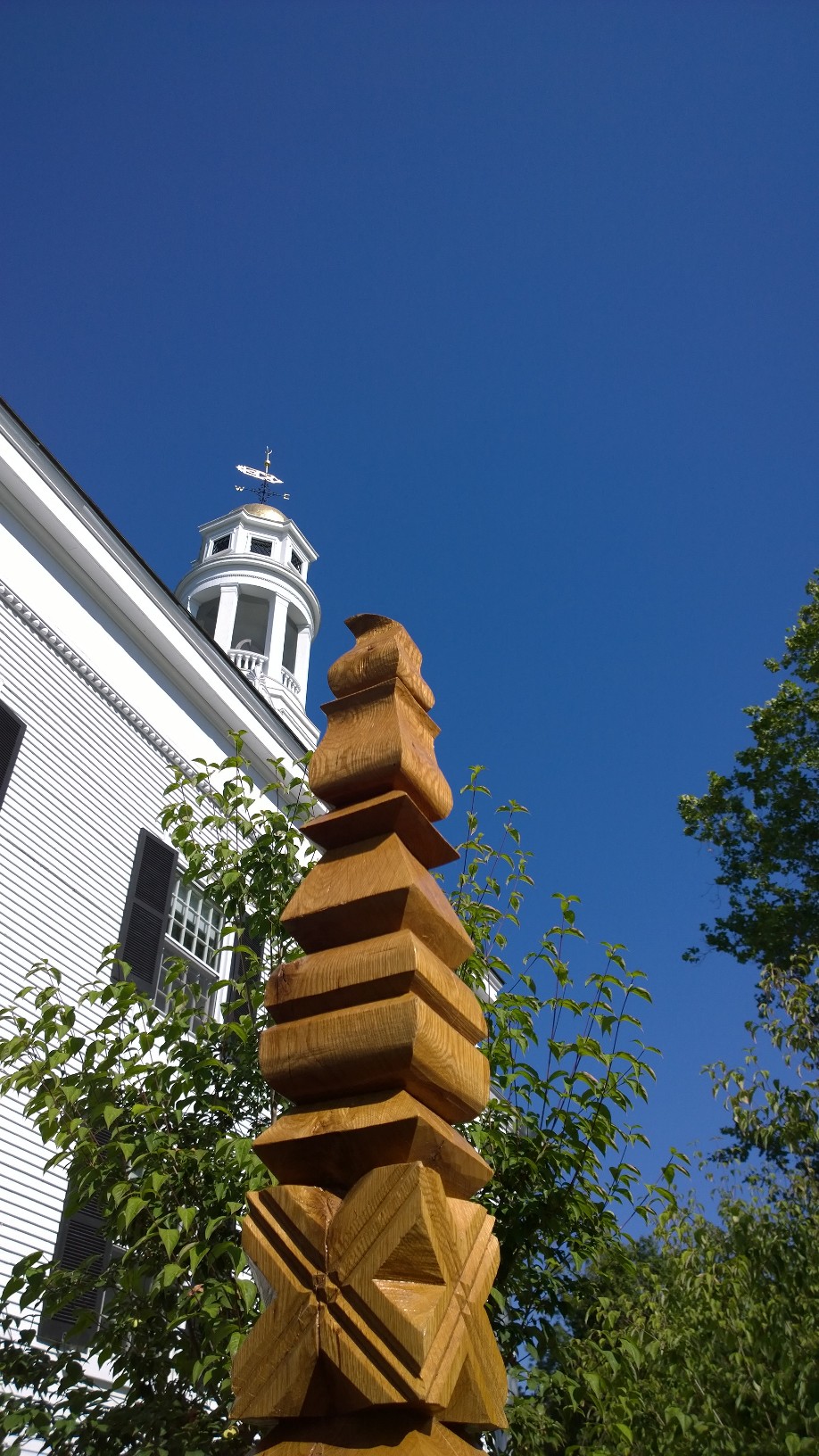
OK, it’s not really a totem pole, but I was afraid the word kopjafa wouldn’t ring any bells with readers.

Today at church we dedicated a wooden pole that was carved by the minister of our sister church in Transylvania when he visited Massachusetts last year.

A translated Wikipedia entry says that, originally, two kopjafa poles were to used to carry a coffin to a cemetery. The poles were then placed at the head and foot of the mound. But according to my minister, nowadays kopjafa poles are set outside churches and, as in our case, sometimes given to a partner church.

The minister read the poem below as he spoke about our church’s connection to Transylvanians of the (almost) same religion. The subject is a little sad for what we do at Suzanne’s Mom’s Blog, but it fits with our previous discussions about the value of preserving language and customs in minority communities. (Hungarian Transylvania was handed over to Romania after World War I, and has had some challenges, starting with language challenges.)

“Leave, if you can …
“Leave, if you think,
“That somewhere, anywhere in the world beyond
“It will be easier to bear your fate.
“Leave …
“Fly like a swallow, to the south,
“Or northward, like a bird of storm,
“And from high above in the wide skies
“Search for the place
“Where you can build a nest,
“Leave, if you can.
“Leave if you hope
“Against hope that homelessness
“Is less bitter abroad than at home.
“Leave, if you think
“That out in the world
“Memory will not carve new crosses from
“Your soul, from that sensitive
“Living tree.”

Read about the poem’s author, Hungarian poet Sandor Remenyik, here.

Transylvania-kopjafa-at-sister-church

Read Full Post »

Photo of Gertrude Ely: Bryn Mawr College Collection

I was on the brink of unsubscribing to the American Academy of Poets poem-a-day e-mail because I let so many pile up and then have to slog through all sorts of contemporary brain twisters.

But as I was working my way through the poems today, I came across the one below. I thought, “Oh, I know exactly what this is about” and was carried back to my college days and hanging out at the home of my great aunt’s friend Gertrude Ely.

Gertrude Ely was quite elderly at that time but really interesting to be around. She knew all sorts of movers and shakers and was an awesome storyteller. I happened to be staying at her house one weekend when she received an unusual letter.

An elderly Philadelphia gentleman wrote that he had read in the Bulletin that she had received some civic award, and he just had to write and tell her a memory he had from his service in WW I in Europe. The Army was sending over carloads of friendly, proper young volunteers to chat with and cheer soldiers and bring a breath of home. The man wrote he would never forget a load of girls pulling up in an open car and Gertrude Ely calling out, “Any of you boys from Philadelphia?” He said, “At that moment, I believe every soldier there was wishing he was from Philadelphia.”

Gertrude Ely at my college graduation.

1966-GS-ELY-AT-CB-GRADUATION

***

American Boys, Hello! by Ella Wheeler Wilcox

Oh! we love all the French, and we speak in French
As along through France we go.
But the moments to us that are keen and sweet
Are the ones when our khaki boys we meet,
Stalwart and handsome and trim and neat;
And we call to them—“Boys, hello!”
“Hello, American boys,
Luck to you, and life’s best joys!
American boys, hello!”

We couldn’t do that if we were at home—
It never would do, you know!
For there you must wait till you’re told who’s who,
And to meet in the way that nice folks do.
Though you knew his name, and your name he knew—
You never would say “Hello, hello, American boy!”
But here it’s just a joy,
As we pass along in the stranger throng,
To call out, “Boys, hello!”

For each is a brother away from home;
And this we are sure is so,
There’s a lonesome spot in his heart somewhere,
And we want him to feel there are friends
right there

In this foreign land, and so we dare
To call out “Boys, hello!”
“Hello, American boys,
Luck to you, and life’s best joys!
American boys, hello!”

[Ella Wheeler Wilcox wrote “American Boys, Hello!” while visiting France during the latter stages of World War I as entertainment for the American soldiers stationed there.]

Photo of Ella Wheeler Wilcox: American Academy of Poets, here.

Read Full Post »

« Newer Posts - Older Posts »