Feeds:
Posts
Comments

Posts Tagged ‘poet’

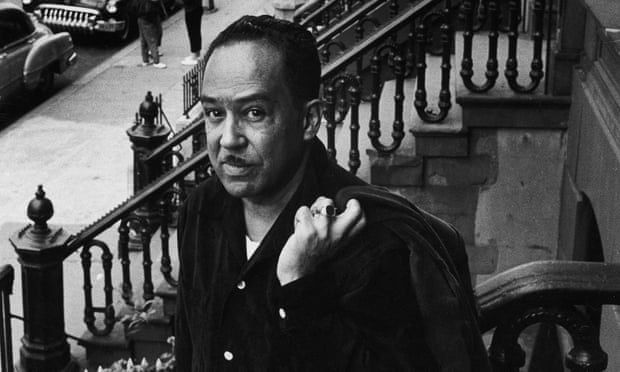
Photo: Robert W Kelley/Time Life Pictures/Getty Images
Langston Hughes on the front steps of his house in Harlem, June 1958.

Before Suzanne and Erik moved to Providence, they were living in a lovely renovated brownstone in Harlem.

There’s a fine line between newcomers investing where there’s been too much disinvestment — and gentrification. The early changes seem to benefit a neighborhood and its people, but inevitably rising property values push out many longtime residents and institutions.

Today, a group of Harlem artists from various disciplines are banding together to keep a significant piece of the Harlem Renaissance around to nourish African American arts.

Tom Kutsch writes at the Guardian, “All that signifies the legacy of a house once occupied by the poet laureate of Harlem is a small bronze plaque, partially covered by a cedar tree’s branches and the green ivy that envelops much of the building.

“The onetime home of Langston Hughes has sat largely unoccupied for years, but a new movement is trying to reclaim, for a next generation of artists, the space of a man who is forever intertwined with the Harlem Renaissance.

“Spearheaded by writer, performer and educator Renée Watson, the collective effort is busily trying to raise the necessary funds to purchase a lease and make needed renovations to the house. …

“Watson plans to make the Hughes house the home of the I Too, Arts Collective that she launched alongside the effort, which aims to, in her words, have ‘programming that nurtures, amplifies, and honors work by and about people of color and people from other marginalized communities.’ …

“The collective gets its name from one of Hughes’s most famous poems – I, Too – in which his narrator concludes by intoning:

They’ll see how beautiful I am
And be ashamed—
I, too, am America.

“Watson is using the crowdfunding website Indiegogo to solicit donations for the project, for which they’re hoping to raise at least $150,000 to cover a lease and begin the renovation process. By the time of publication, they had raised more than $54,000, already exceeding the $40,000 Watson says would cover at least a six-month lease. …

“For more than a century, Harlem has been inextricably linked to black life and culture in America; the birthplace of the aforementioned Harlem Renaissance, which fostered a wide array pre-eminent black artists and writers, from Zora Neale Hurston to Claude McKay and Duke Ellington. …

” ‘The erasure of black Harlem may come despite our best efforts …’ said Tracey Baptiste, a local children’s author who is involved with Watson’s collective. ‘But this project is about making sure that gentrification doesn’t also happen in the hearts and minds of our artists.’ ”

More here.

Read Full Post »

Last Sunday, Pam and I walked over to the library to hear an acclaimed poet read at the poetry series. Ross Gay, who lives in Indiana, had just published his poetry collection Catalogue of Unabashed Gratitude and was doing readings around New England.

Glenn Mitchell, who organizes the library’s poetry series, was able to publish an advance interview with Gay in the local paper.

She wrote, “Gay says his inspiration for writing poems is a determination to practice joy as a discipline. He is a finalist for the 2015 Kingsley Tufts Poetry Award and the National Book Critics Circle Award and was a finalist for the 2015 National Book Award in Poetry and the NAACP Image Award in Poetry.

“Gay also works in the field of literary sports writing. He is a founding editor of the online sports magazine Some Call it Ballin’, a publication of reflective essays written by well-known poets, essayists and fiction writers along with podcasts of contributors.

“He serves on the board of the Bloomington Community Orchard, a nonprofit, food justice project.

“An associate professor of poetry at Indiana University, Gay is residing in Cambridge while a 2015-16 Fellow at the Radcliffe Institute for Advanced Study.”

Here is what Gay told Mitchell about the poet that inspired him to write poetry: “[Amiri] Baraka’s poems were such a clear articulation of the kind of alienation I was experiencing when I went off to college — a kind of racial alienation and class alienation — that I had no idea how to begin to talk about other than wanting to break things. I knew I was full of rage (which I later knew was a version of sorrow, too), but I didn’t know how to put it into words, which Baraka’s work made it possible for me to understand was possible.”

To her question about gardening coming into his life and the difference it made, he says, “I think close looking, paying attention, going slow, a kind of training in receptivity — I think those are things I learn from the garden … I approach poems like that, usually. I like to listen to them as much as I try to impose my own will on them. … A garden or a poem is potentially a device for pulling people together, they are both food, I’m saying, which we might feed to each other.”

In his Sunday reading, Gay included a poem about strangers sharing figs from a tree unexpectedly flourishing near his Philadelphia home — a poem that expresses some of his thoughts about our history of racism and the possibility of goodness.

He says, “The poem ‘To the Fig Tree at 9th and Christian’ gets at it—gets at what it means for us to come together despite the brutal history we’ve inherited, or even enacted. I think that fig tree is a kind of mercy.”

More here.

Read Full Post »

The poet Marianne Moore once helped to save a special tree by writing a poem about it, proving that art is more powerful than apathy.

Maria Popova writes at Brain Pickings, “In 1867, Brooklyn’s Prospect Park, once an American Revolution battlefield, opened its gates to a community hungry for a peaceful respite of wilderness amid the urban bustle. So intense was public enthusiasm that local residents began donating a variety of wildlife to fill the 585-acre green expanse, from ducks to deer. But the most unusual and enduring gift turned out to be a tree, donated by a man named A.G. Burgess and planted in 1872.

“This was no ordinary tree. Ulmus glabra ‘Camperdownii,’ better-known as Camperdown Elm, is a species unlike regular trees in that it cannot reproduce from a seed. The rare elm carries its irregularity on the outside — its majestic, knobby branches grow almost parallel to the ground, ‘weeping’ down. To ameliorate its reproductive helplessness, the Camperdown Elm requires outside help — a sort of assisted grafting, be it by accident of nature or intentional human hand. …

“As excitement over the novelty of Prospect Park began dying down, the Camperdown Elm came to suffer years of neglect. …

“But then, in the 1960s, it was saved by a force even more miraculous than that by which its Scottish great-great-grandfather had been born — not by a botanist or a park commissioner or a policymaker, but by a poet fifteen years the tree’s junior.

“The poet was Marianne Moore (November 15, 1887–February 5, 1972), who had been elected president of New York’s Greensward Foundation — an advocacy group for public parks — in 1965. This brilliant and eccentric woman … created a citizen group called Friends of Prospect Park, aimed at protecting the Camperdown Elm and other endangered trees in the park.

“In 1967, eighty at the time and with a Pulitzer Prize under her belt, Moore penned ‘The Camperdown Elm’ — a beautiful ode to this unusual, dignified, yet surprisingly fragile life-form of which humans are the only bastions. …

“Moore’s poem mobilized the Friends of Prospect Park to envelop the Camperdown Elm in attentive and nurturing care, which ultimately saved it.”

Read the poem and the rest of the story here.

Come to think of it, the Camperdown Elm’s reliance on humans to do the right thing make it very little different from the rest of the natural world.

Read Full Post »

Try to Praise the Mutilated World

By Adam Zagajewski
Translated By Clare Cavanagh

Try to praise the mutilated world.
Remember June’s long days,
and wild strawberries, drops of rosé wine.
The nettles that methodically overgrow
the abandoned homesteads of exiles.
You must praise the mutilated world.
You watched the stylish yachts and ships;
one of them had a long trip ahead of it,
while salty oblivion awaited others.
You’ve seen the refugees going nowhere,
you’ve heard the executioners sing joyfully.
You should praise the mutilated world.
Remember the moments when we were together
in a white room and the curtain fluttered.
Return in thought to the concert where music flared.
You gathered acorns in the park in autumn
and leaves eddied over the earth’s scars.
Praise the mutilated world
and the gray feather a thrush lost,
and the gentle light that strays and vanishes
and returns.

082015-flower-in-Greenway-for-DS

Adam Zagajewski, “Try to Praise the Mutilated World” from Without End: New and Selected Poems. Copyright © 2002 by Adam Zagajewski.

Read Full Post »

I realized we hadn’t done any poetry for a while. So after I heard poet Mary Jo Bang on the radio show Studio 360, I thought I would share an unusual thing she has done. She has created a modern version of Dante’s Inferno — relying on poetic license and others’ translations to make it more accessible.

Studio 360’s host calls Bang a “poet’s poet, one whose books regularly make year-end best-of lists. Her latest book of poetry is called The Last Two Seconds, and it couldn’t be farther from the stereotypical pretty nature poetry. The collection is full of a sense of impending environmental collapse: natural disaster, extinction, climate change, and cataclysmic violence. …

“The book’s title is also connected to Bang’s sense of her own mortality. ‘Once you get into your 60s you know you have x amount of time. …’

“Bang also recently produced a new translation of Dante’s Inferno — a feat she accomplished without knowing Italian. She worked from previous translations, she explains, comparing the work of other scholarly translators to get an idea of the literal meaning of the original. ‘I could see what was going on; I could see the liberties that each of these translators had taken,’ she says. ‘That gave me permission to come up with my own way of saying it, but it established the borders.’

“Bang also updated Dante’s hell to include [more-recent fiends, including] South Park’s Eric Cartman, who is condemned for the sin of gluttony. ‘Dante wrote the Inferno in the vernacular. He wanted everyone to be able to read it. I wanted to do the equivalent,’ she explains.

“Bang teaches at Washington University in St. Louis, and she says her students appreciate the contemporary references. ‘They tell me things like, “I always wanted to read this and I tried several times and I couldn’t.” That’s exactly the person for whom I wrote this, because I was one of those people, too.’ ”

Maybe me, too.

Hear Bang read her work at Studio 360, here.

Photo: Matt Valentine
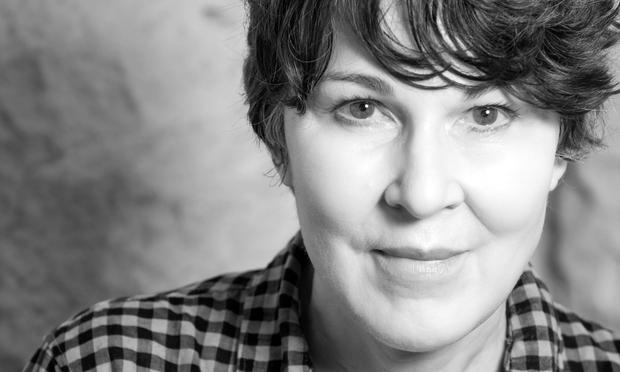
Poet Mary Jo Bang. (Does this woman look like she hit 60?)

Read Full Post »

Kate Colby (for whose offer of a room to Suzanne and Erik when they were house hunting there can never be enough gratitude) is a poet.

She came to the rescue when Suzanne was starting Luna & Stella and was having trouble finding a writer to capture the more ethereal qualities of the birthstones.

“What you need,” I said, “is a poet.”

“I know a poet!” she cried. She remembered Kate used to write copy for a catalog.

Beyond such marketing endeavors, Kate publishes poetry, choreographs offbeat theater, and co-leads art/poetry walks. An example of the latter will occur soon.

As Eryn Carlson writes at the Boston Globe, Kate is collaborating with artist Todd Shalom to offer “Duly Noted,” a participatory walk incorporating techniques from poetry, sound, and performance, at deCordova Sculpture Park and Museum in Lincoln, Massachusetts, July 18, at 2 p.m. and 5 p.m.

Carlson comments, “Shalom and Colby know that the very nature of tours makes it easy to overlook the ways in which artworks and their settings inform one another. … The pair created the collaborative walk ‘Duly Noted,’ a poetic exchange between participants and the Lincoln museum’s site and surroundings.

“ ‘Reading the art is apt because it’s so framed by woods and walls and water, and all this history,’ said Colby, who grew up in Wayland and lives in Providence. …

“ ‘It’s all about reframing the site,’ said Shalom, a Brooklyn, N.Y.-based artist who founded Elastic City.”

At a performance in May, “participants evolved from visitors to artists and performers. Individuals gave one-word soliloquies atop a stump, announcing their visual discoveries, and, guided by a partner, wandered the grounds with eyes closed to pay special attention to the surrounding cacophony. …

“Shalom and Colby, who met while working on their master’s degrees in fine arts at California College of the Arts, planned ‘Duly Noted’ meticulously over the course of a year, visiting the deCordova several times to perfect the route, pacing, and segues. But a degree of uncertainty and room for spontaneity remained.”

This could be a fun activity on July 18 if you live in the area. The grounds of the museum offer breathtaking views and sculptures everywhere you turn. Add to that a participatory happening like this, and you have the ingredients for a memorable day.

Read more here.

Photo: Barry Chin/Globe staff
Visitors at the deCordova Sculpture Park and Museum on a participatory walk titled “Duly Noted.’’

Read Full Post »

Cambridge knows how to make artists feel welcome, even cherished. Recently the city had a poetry contest, and the winners are getting their poems embedded in the sidewalk.

Steve Annear writes at the Boston Globe, “Cambridge officials received hundreds of submissions from residents hoping to make their mark as literary legends through the city’s first-ever ‘Sidewalk Poetry’ contest this spring. In the end, only five scribes emerged victorious.

“In March, the city put out a call for poets to participate in the project. Winners were promised a permanent display space for their musings — the poems would be imprinted in the freshly poured concrete as Department of Public Works crews replaced sidewalk slabs cracked or damaged during the winter.

“The response was great, said Molly Akin, the Cambridge Arts Council’s marketing director. More than 300 submissions flooded in from writers ranging in age from 4 to 95, according to organizers.

“A special committee that included workers from the [Department of Public Works], representatives from the local libraries, members of the Arts Council, and Cambridge’s former Poet Populists helped select the finalists. …

“Below are the names of the winners, and their poems:

Rose Breslin Blake
Children, look up
Cherish those clouds
Ride grey ponies over their hills
Feed the shiny fish
Boo the big bear
Chase the gloomy giant
Giggle with the geese
Sing with the lambs
Cherish those clouds; they cherish you
Rest on their pillows.

Benjamin Grimm
I could not forget you if I tried.
I have tried.

Ty Muto
Your blue-green glances
My heart skips double dutch beats
Caught in your rhythm

Carolyn Russell Stonewell
Sun takes a bite of
mango as it sets.
Its last rays
run down my cheek.

Elissa Warner
A Mother’s Wish
Little boys, little treasures
Shine like lights from above
My son, my only one
My wish for you is that you wake
One day when you are old
And feel raindrops on your cheek
Tears of joy from my heart
For you to keep

More here.

Photo: Cambridge Arts Council

Read Full Post »

I heard about poet Terrance Hayes on the radio show Studio 360. He is the winner of a MacArthur Fellowship, among other honors, and a University of Pittsburgh writing professor. Kurt Andersen interviewed him.

“Hayes grew up in South Carolina, where he was one of the only black students at a very preppy high school. But he says that race didn’t define him as a kid. ‘I was a basketball player, and I ran track, and I was a visual artist.’

“With all his accolades, invisibility hasn’t been too much of an issue for Hayes. But as a theme, it’s certainly present in his work. His poem ‘How to Draw an Invisible Man’ plays with Ralph Ellison’s take on black invisibility in the eyes of white society. ‘The thing that I’ve decided is, I don’t want to be invisible, but I’d like to be transparent. I want people to see what I’m thinking and see through me,’ he says. ‘I’m about 6’6’’. You know, I don’t have trouble walking into a room. I would prefer to be more invisible, in fact, than I am.’ ”

Listen to the interview at Studio 360. And read a review by Jonathan Farmer, at Slate, of his latest book of poems.

Photo: Becky Thurner Braddock
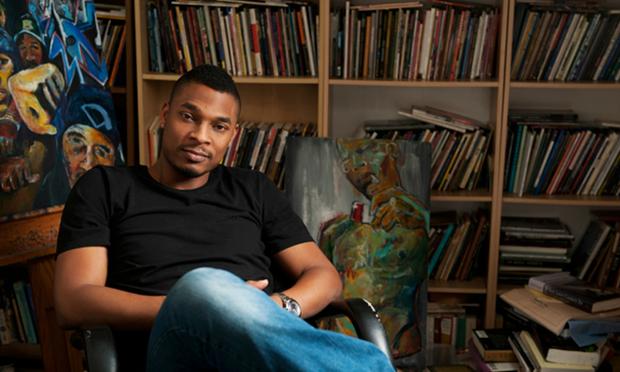
Poet Terrance Hayes. His new book of poems is called How to Be Drawn.

Read Full Post »

no-path-wanderer


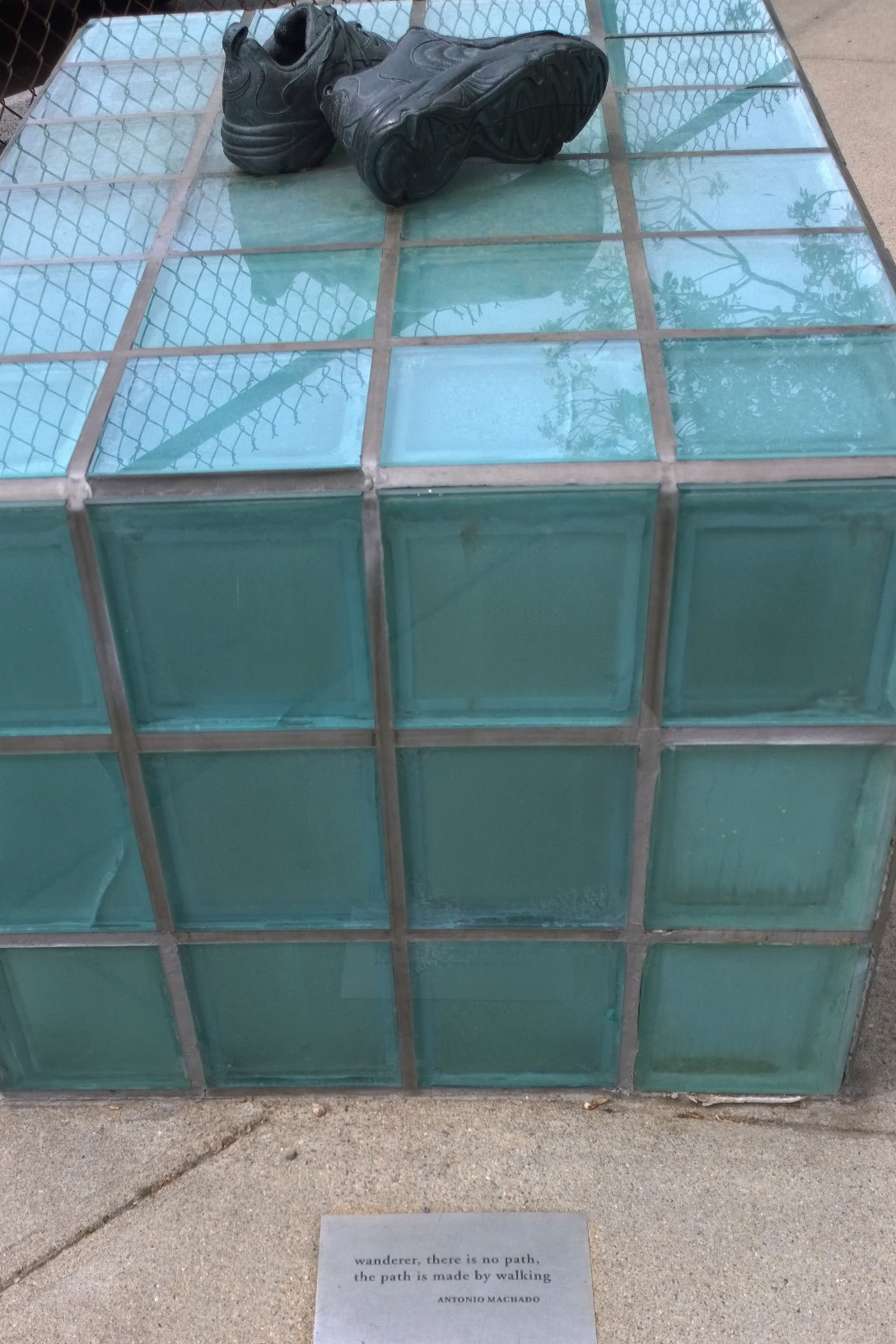
The plaque quotes the Spanish poet Antonio Machado, 1875-1939: “Wanderer, there is no path. the path is made by walking.” (The shoes are part of the sculpture.)

The line is metaphorical, of course, but I like treading a physical path with lots of photo ops while I’m working on the other path. It helps me think.

artists-can-never-resist

artists-Claudia-and-Michael


merry--go-round-horse

Boston-Common-carousel


molasses-in-fort-point

window-washers


music-in-Dewey-Square


Read Full Post »

Move him into the sun —
Gently its touch awoke him once
At home, whispering of fields unsown.
Always it woke him, even in France
Until this morning and this snow.
If anything might rouse him now
The kind old sun will know …

Wilfred Owen (1893-1918)

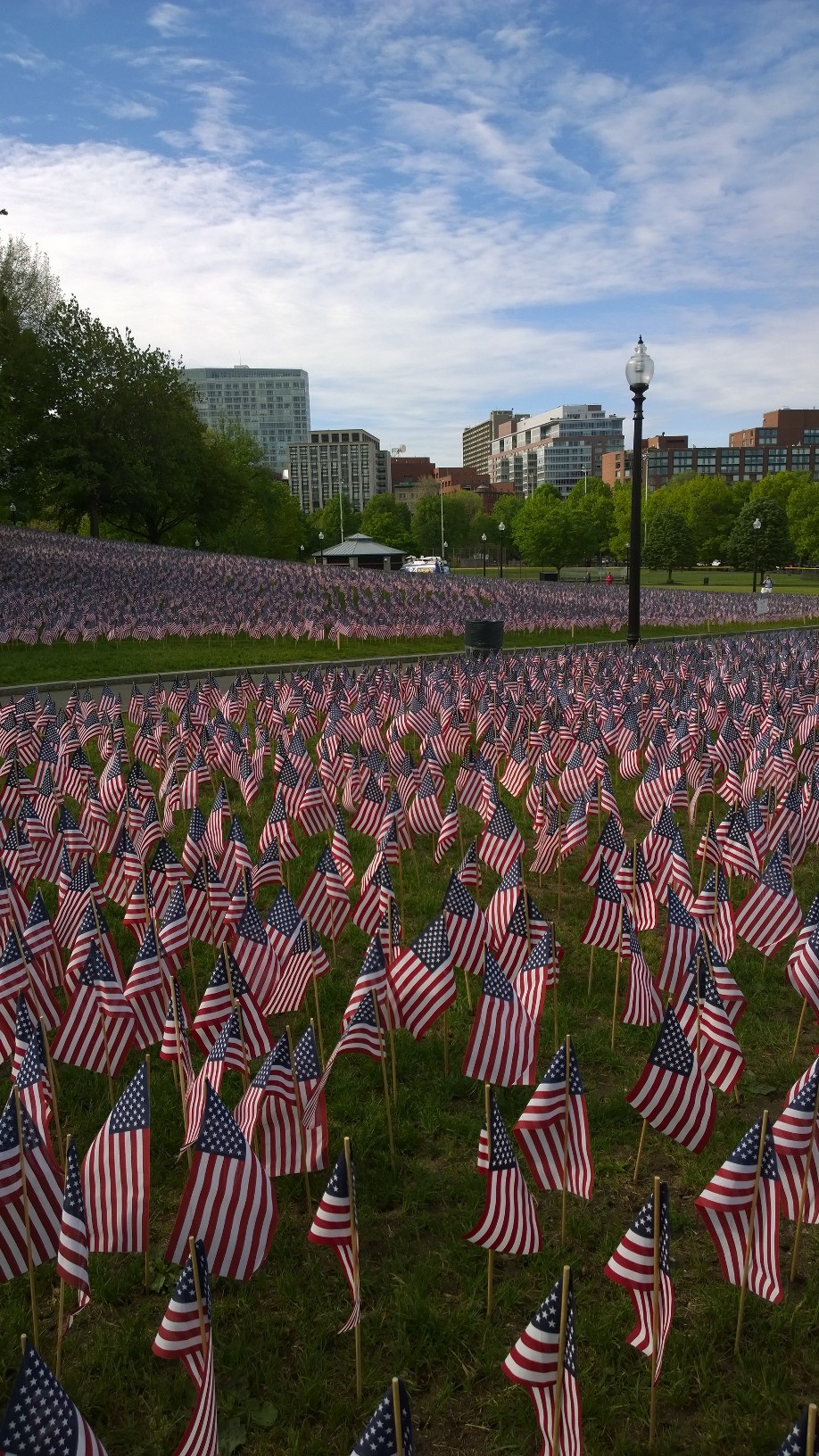
flags-for-the-fallen-since-Civil-War

Read Full Post »

When the Swedish poet Tomas Tranströmer won the Nobel Prize for Literature, I wrote a post about it. Several Swedes, including Erik and his mother, had told me about Tranströmer, and I have a couple books of his poems in translation.

An obit by Bruce Weber in yesterday’s New York Times gave me a lot more information about “a body of work known for shrewd metaphors couched in deceptively spare language, crystalline descriptions of natural beauty and explorations of the mysteries of identity and creativity. …

“Though he was not especially well known among American readers, he was widely admired by English-speaking poets, including his friends Robert Bly, who translated many of his poems, and Seamus Heaney, himself a Nobel laureate in 1995.”

It seems Tranströmer also was a trained psychologist, who “worked in state institutions with juvenile offenders, parole violators and the disabled. …

“Mr. Tranströmer’s poetry production slowed after his stroke, but he took refuge in music, playing the piano with just his left hand. As a testament to his prominence in Sweden, several composers there wrote pieces for the left hand specifically for him.

“He was also an amateur entomologist. The Swedish National Museum presented an exhibition of his childhood insect collection, and a Swedish scientist who discovered a new species of beetle named it for him.”

Here is an excerpt from a poem the New York Times printed in the obit:

“I know I must get far away

“straight through the city and then

“further until it is time to go out

“and walk far into the forest.

“Walk in the footprints of the badger.”

More here.

Photo: Jonathan Nackstrand/Agence France-Presse — Getty Images
Tomas Tranströmer with his wife, Monica, after winning the Nobel Prize in Literature in 2011.


Read Full Post »

I admit I dropped the poem-a-day e-mail from poets.org because I couldn’t keep up, but I saved a few that I liked recently.

This one by Alberto Rios, for example.

“One river gives
Its journey to the next.

“We give because someone gave to us.
“We give because nobody gave to us.

“We give because giving has changed us.
“We give because giving could have changed us. …

“You gave me blue and I gave you yellow.
“Together we are simple green. You gave me

“What you did not have, and I gave you
“What I had to give—together, we made

“Something greater from the difference.”

Read the whole poem here.

Meanwhile, poet friends have been busy capturing present realities and past screen shots. Ronnie Hess wrote a poem inspired by watching home movies of her Fire Island childhood. It reads in part,

“follow your sister
“as she leaps and cartwheels along

“the beach into the sea. I see your eyes
“follow her, your mind dart,
“your body imitate her older moves.” The whole poem is at Quill and Parchment.

And poet Nancy Greenaway caught the mood of our endless winter with this roll-over-and-go-back-to-sleep nugget

Sleeping In
School vacation: time for winter hibernation.

Photo: svsnowgoose.com

Read Full Post »

While we’re on the subject, here are two more poetry events scheduled for spring.

Nancy writes, “Some of your readers may also be interested in the Massachusetts Poetry Festival, in Salem, May 1 – 3. Marge Piercy and Richard Blanco will be among the many well-known poets reading.”

She also notes that if you are near Providence in March, you may want to attend the Poetry Out Loud recitation competition for high school students. The statewide competition will be held at Rhode Island School of Design in Providence, with 15 students from schools across Rhode Island reciting poems (by such people as Shakespeare, Mary Oliver, Robert Frost, etc.) in hopes of qualifying for nationals. Info here.

Another inspiring poetry competition for youth is the one depicted by the movie Louder than a Bomb, in which students compose their own poems and perform them. My husband and I were impressed by what the creative opportunity and the discipline did for some at-risk kids. You can get the movie from Netflix, which describes it thus: “Capturing the combined creative spirit of more than 600 Chicago-area teenagers who are participating in what’s billed as the world’s largest youth poetry slam, this documentary highlights the joy of language and the power of collaboration.”

Read Full Post »

I like walking around town at this season, dodging intent holiday shoppers but without any important agenda of my own. No urgent missions, just fun ones like yesterday’s to choose a pair of socks. I never realized how many local stores carry socks.

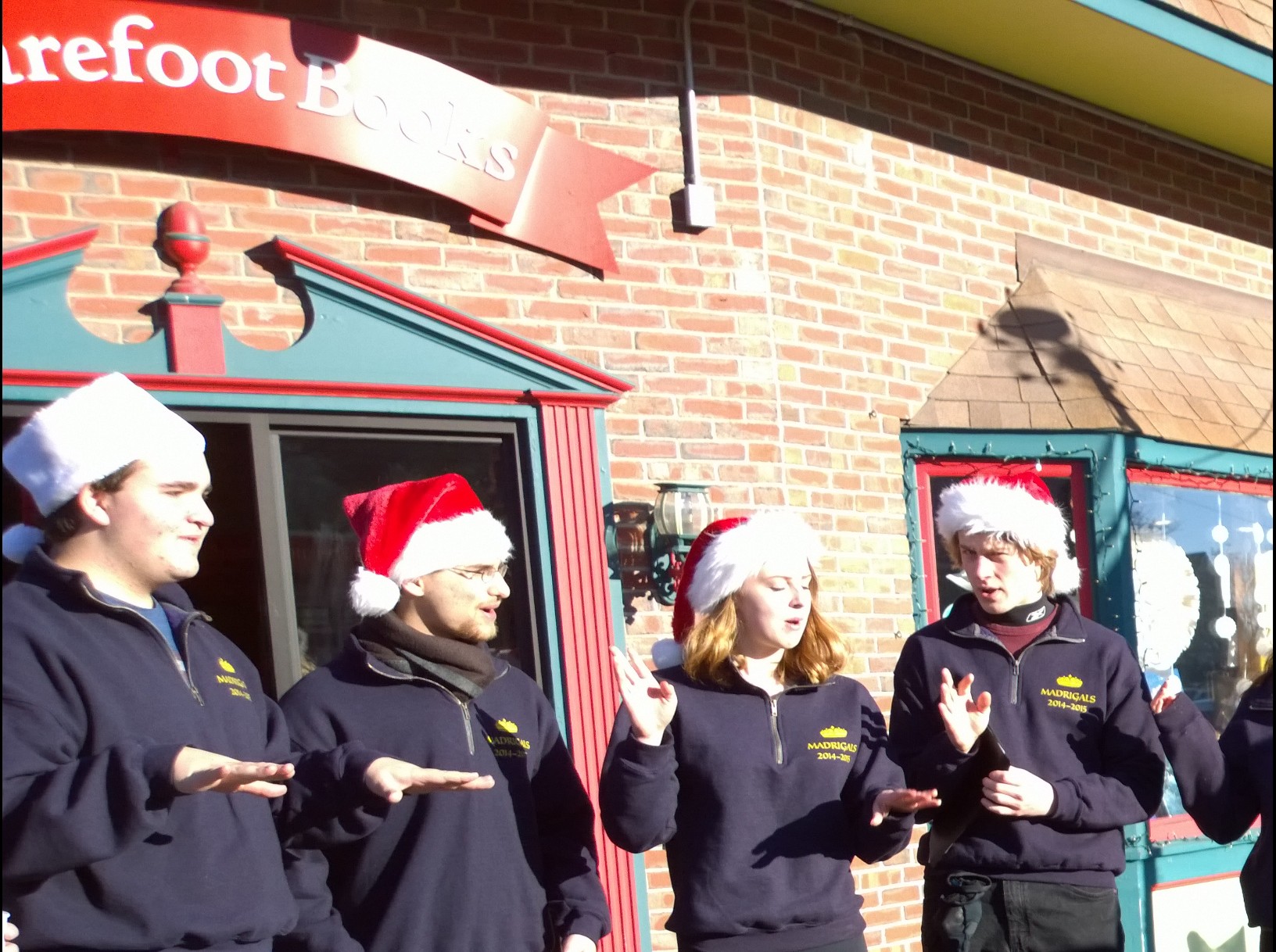
Then today, who should pop up outside Barefoot Books but the Acton-Boxborough High School Madrigal Singers, regaling passersby with seasonal favorites. And hand motions.

There was also a poetry reading at the library, part of an ongoing series. Today we had poet Sandra Lim, who read from her collection The Wilderness. The poems tended to start out straightforward and end up obscure. I need to read and think about them. I liked the title of one section of the nine-part poem “Homage to Anne Bradstreet” (a Puritan poet that Lim likes because of the crazy contrasts between controlled and wild), but I’m afraid my train of thought had nothing to do with the subject at hand.

The section of the Bradstreet homage was called “Black Painting,” and it reminded me of a friend who so detested the level of conversation at her husband’s management-consultant social events that she would invariably announce in the middle of the party, “I’m going home now and make a black painting.”

121414-madrigals-at Barefoot-Books

Read Full Post »

I saw an article in the paper today about 3-D machines making protein snacks for soldiers. The results looked like not very appealing beef jerky.

Other 3-D food creations in the works run the gamut from unappealing to gorgeous.

Jane Dornbusch wrote in a September Globe article, “The most popular application in 3-D food printing seems to be in the decidedly low-tech area of cake decoration.

“Well, not just cake decoration, but sugary creations of all kinds. The Sugar Lab is the confectionary arm of 3-D printing pioneer 3D Systems, and it expects to have the ChefJet, a 3-D food printer, available commercially later this year.”

3-D printing, says ChefJet co-inventor Liz von Hasseln, “is additive manufacturing. Instead of carving away at something, with 3-D printing you build something up layer by layer. That’s the hallmark. You build it exactly as it exists in a file.” More here.

As lovely as the sugar sculptures in the Globe story appear, the beef jerky, veggie burgers, and chicken nuggets are kind of scary. But let’s put it in context: could they be any more strange than certain staples of your childhood? 3-D burgers are probably no worse than, say, canned fruit cocktail. Here is poet Amy Gerstier on that old-time delicacy:

what was fruit cocktail’s secret
meaning? It glistened as though varnished.
Faint of taste and watery, it contained anemic
grapes, wrinkled and pale. Also deflated
maraschino cherries. Fan-shaped pineapple
chunks, and squares of bleached peach
and pear completed the scene. Fruit cocktail’s
colorlessness, its lack of connection to anything
living, (like tree, seed or leaf) seemed
cautionary, sad.

Photo: 3-D Systems
3-D printed sugar design by The Sugar Lab.

Read Full Post »

« Newer Posts - Older Posts »