Feeds:
Posts
Comments

Posts Tagged ‘poetry’

I realized we hadn’t done any poetry for a while. So after I heard poet Mary Jo Bang on the radio show Studio 360, I thought I would share an unusual thing she has done. She has created a modern version of Dante’s Inferno — relying on poetic license and others’ translations to make it more accessible.

Studio 360’s host calls Bang a “poet’s poet, one whose books regularly make year-end best-of lists. Her latest book of poetry is called The Last Two Seconds, and it couldn’t be farther from the stereotypical pretty nature poetry. The collection is full of a sense of impending environmental collapse: natural disaster, extinction, climate change, and cataclysmic violence. …

“The book’s title is also connected to Bang’s sense of her own mortality. ‘Once you get into your 60s you know you have x amount of time. …’

“Bang also recently produced a new translation of Dante’s Inferno — a feat she accomplished without knowing Italian. She worked from previous translations, she explains, comparing the work of other scholarly translators to get an idea of the literal meaning of the original. ‘I could see what was going on; I could see the liberties that each of these translators had taken,’ she says. ‘That gave me permission to come up with my own way of saying it, but it established the borders.’

“Bang also updated Dante’s hell to include [more-recent fiends, including] South Park’s Eric Cartman, who is condemned for the sin of gluttony. ‘Dante wrote the Inferno in the vernacular. He wanted everyone to be able to read it. I wanted to do the equivalent,’ she explains.

“Bang teaches at Washington University in St. Louis, and she says her students appreciate the contemporary references. ‘They tell me things like, “I always wanted to read this and I tried several times and I couldn’t.” That’s exactly the person for whom I wrote this, because I was one of those people, too.’ ”

Maybe me, too.

Hear Bang read her work at Studio 360, here.

Photo: Matt Valentine
Poet Mary Jo Bang. (Does this woman look like she hit 60?)

Read Full Post »

Cambridge knows how to make artists feel welcome, even cherished. Recently the city had a poetry contest, and the winners are getting their poems embedded in the sidewalk.

Steve Annear writes at the Boston Globe, “Cambridge officials received hundreds of submissions from residents hoping to make their mark as literary legends through the city’s first-ever ‘Sidewalk Poetry’ contest this spring. In the end, only five scribes emerged victorious.

“In March, the city put out a call for poets to participate in the project. Winners were promised a permanent display space for their musings — the poems would be imprinted in the freshly poured concrete as Department of Public Works crews replaced sidewalk slabs cracked or damaged during the winter.

“The response was great, said Molly Akin, the Cambridge Arts Council’s marketing director. More than 300 submissions flooded in from writers ranging in age from 4 to 95, according to organizers.

“A special committee that included workers from the [Department of Public Works], representatives from the local libraries, members of the Arts Council, and Cambridge’s former Poet Populists helped select the finalists. …

“Below are the names of the winners, and their poems:

Rose Breslin Blake
Children, look up
Cherish those clouds
Ride grey ponies over their hills
Feed the shiny fish
Boo the big bear
Chase the gloomy giant
Giggle with the geese
Sing with the lambs
Cherish those clouds; they cherish you
Rest on their pillows.

Benjamin Grimm
I could not forget you if I tried.
I have tried.

Ty Muto
Your blue-green glances
My heart skips double dutch beats
Caught in your rhythm

Carolyn Russell Stonewell
Sun takes a bite of
mango as it sets.
Its last rays
run down my cheek.

Elissa Warner
A Mother’s Wish
Little boys, little treasures
Shine like lights from above
My son, my only one
My wish for you is that you wake
One day when you are old
And feel raindrops on your cheek
Tears of joy from my heart
For you to keep

More here.

Photo: Cambridge Arts Council

Read Full Post »

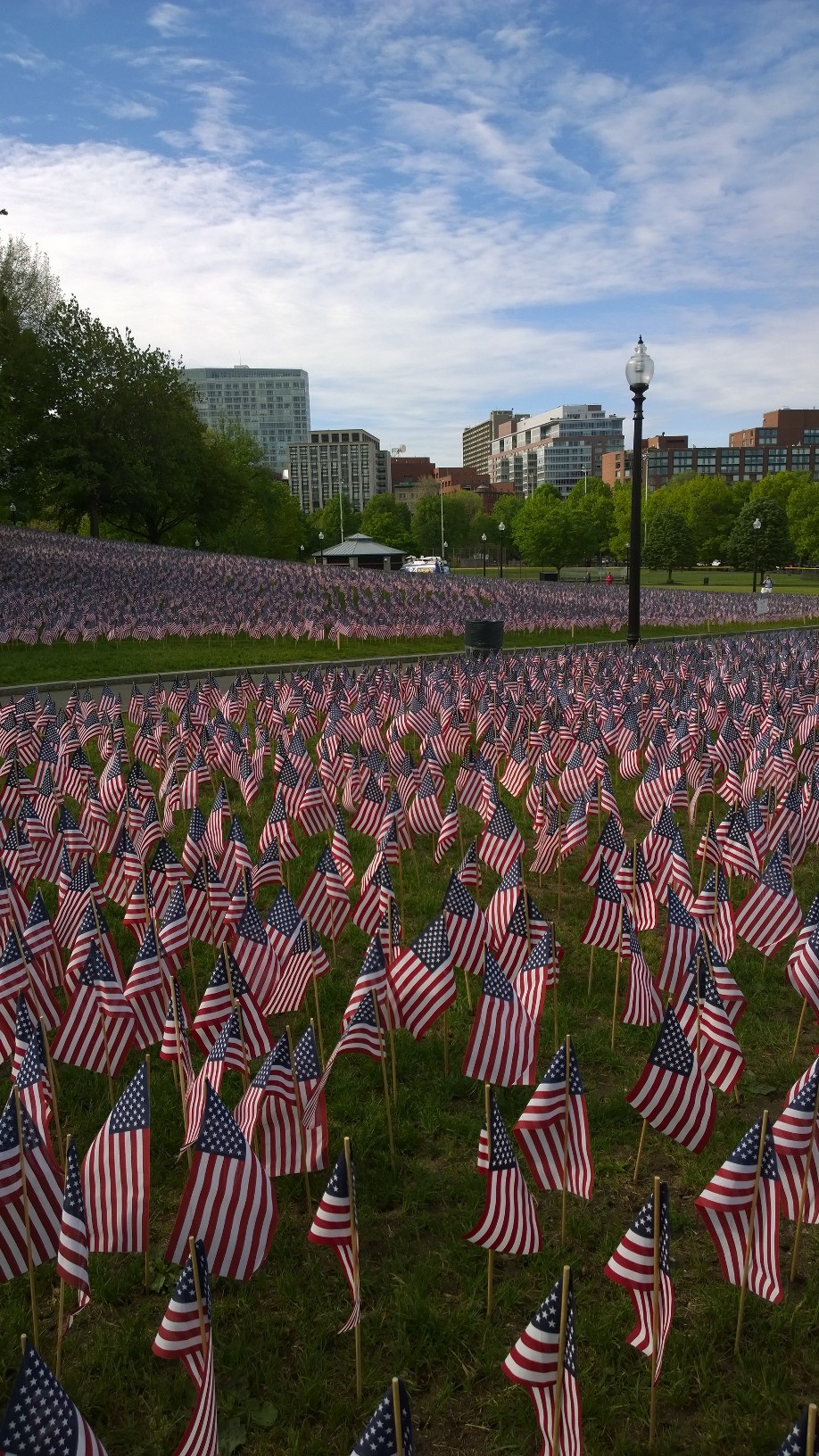
Move him into the sun —
Gently its touch awoke him once
At home, whispering of fields unsown.
Always it woke him, even in France
Until this morning and this snow.
If anything might rouse him now
The kind old sun will know …

Wilfred Owen (1893-1918)

flags-for-the-fallen-since-Civil-War

Read Full Post »

When the Swedish poet Tomas Tranströmer won the Nobel Prize for Literature, I wrote a post about it. Several Swedes, including Erik and his mother, had told me about Tranströmer, and I have a couple books of his poems in translation.

An obit by Bruce Weber in yesterday’s New York Times gave me a lot more information about “a body of work known for shrewd metaphors couched in deceptively spare language, crystalline descriptions of natural beauty and explorations of the mysteries of identity and creativity. …

“Though he was not especially well known among American readers, he was widely admired by English-speaking poets, including his friends Robert Bly, who translated many of his poems, and Seamus Heaney, himself a Nobel laureate in 1995.”

It seems Tranströmer also was a trained psychologist, who “worked in state institutions with juvenile offenders, parole violators and the disabled. …

“Mr. Tranströmer’s poetry production slowed after his stroke, but he took refuge in music, playing the piano with just his left hand. As a testament to his prominence in Sweden, several composers there wrote pieces for the left hand specifically for him.

“He was also an amateur entomologist. The Swedish National Museum presented an exhibition of his childhood insect collection, and a Swedish scientist who discovered a new species of beetle named it for him.”

Here is an excerpt from a poem the New York Times printed in the obit:

“I know I must get far away

“straight through the city and then

“further until it is time to go out

“and walk far into the forest.

“Walk in the footprints of the badger.”

More here.

Photo: Jonathan Nackstrand/Agence France-Presse — Getty Images
Tomas Tranströmer with his wife, Monica, after winning the Nobel Prize in Literature in 2011.


Read Full Post »

I read Maria Popova’s review of this children’s book on the universe a while ago and have been thinking about it ever since.

She writes, “There’s something at once incredibly empowering and incredibly humbling in knowing that the flame in your fireplace came from the sun.

“That’s precisely the kind of cosmic awe environmental writer Elin Kelsey and Toronto-based Korean artist Soyeon Kim seek to inspire in kids in You Are Stardust (public library) — an exquisite picture-book that instills that profound sense of connection with the natural world. Underpinning the narrative is a bold sense of optimism …

“Kim’s breathtaking dioramas … mix tactile physical materials with fine drawing techniques and digital compositing to illuminate the relentlessly wondrous realities of our intertwined existence: The water in your sink once quenched the thirst of dinosaurs; with every sneeze, wind blasts out of your nose faster than a cheetah’s sprint; the electricity that powers every thought in your brain is stronger than lightning.

“But rather than dry science trivia, the message is carried on the wings of poetic admiration for these intricate relationships:

“Be still. Listen.
“Like you, the earth breathes.” More here.

Popova adds these thoughts from particle physicist and cosmologist Lawrence Krauss:

Atoms come in different types called elements. Hydrogen, oxygen and carbon are three of the most important elements in your body. … How did those elements get into our bodies? The only way they could have got there, to make up all the material on our Earth, is if some of those stars exploded a long time ago, spewing all the elements from their cores into space. … So, most of the atoms that now make up your body were created inside stars! The atoms in your left hand might have come from a different star from those in your right hand. You are really a child of the stars.

Art: Soyeon Kim
From the children’s book You Are Stardust

Read Full Post »

I admit I dropped the poem-a-day e-mail from poets.org because I couldn’t keep up, but I saved a few that I liked recently.

This one by Alberto Rios, for example.

“One river gives
Its journey to the next.

“We give because someone gave to us.
“We give because nobody gave to us.

“We give because giving has changed us.
“We give because giving could have changed us. …

“You gave me blue and I gave you yellow.
“Together we are simple green. You gave me

“What you did not have, and I gave you
“What I had to give—together, we made

“Something greater from the difference.”

Read the whole poem here.

Meanwhile, poet friends have been busy capturing present realities and past screen shots. Ronnie Hess wrote a poem inspired by watching home movies of her Fire Island childhood. It reads in part,

“follow your sister
“as she leaps and cartwheels along

“the beach into the sea. I see your eyes
“follow her, your mind dart,
“your body imitate her older moves.” The whole poem is at Quill and Parchment.

And poet Nancy Greenaway caught the mood of our endless winter with this roll-over-and-go-back-to-sleep nugget

Sleeping In
School vacation: time for winter hibernation.

Photo: svsnowgoose.com

Read Full Post »

While we’re on the subject, here are two more poetry events scheduled for spring.

Nancy writes, “Some of your readers may also be interested in the Massachusetts Poetry Festival, in Salem, May 1 – 3. Marge Piercy and Richard Blanco will be among the many well-known poets reading.”

She also notes that if you are near Providence in March, you may want to attend the Poetry Out Loud recitation competition for high school students. The statewide competition will be held at Rhode Island School of Design in Providence, with 15 students from schools across Rhode Island reciting poems (by such people as Shakespeare, Mary Oliver, Robert Frost, etc.) in hopes of qualifying for nationals. Info here.

Another inspiring poetry competition for youth is the one depicted by the movie Louder than a Bomb, in which students compose their own poems and perform them. My husband and I were impressed by what the creative opportunity and the discipline did for some at-risk kids. You can get the movie from Netflix, which describes it thus: “Capturing the combined creative spirit of more than 600 Chicago-area teenagers who are participating in what’s billed as the world’s largest youth poetry slam, this documentary highlights the joy of language and the power of collaboration.”

Read Full Post »

I have mentioned the Block Island Poetry Project in past years, and I wanted to let you know that I just got the scoop on this year’s theme.

Nancy writes, “The Block Island Poetry Project weekend will be April 16-19 and will focus on Poetry of the Wild, a project of Ana Flores, who visited just a few days ago to show us examples of what she’s been doing around the country for the last twelve years. … I’m in the process of developing my Poetry of the Wild poetry box project for the school.”

The Poetry of the Wild website explains, “Poetry of the Wild invites the public out for a walk to see their world anew through the keenly felt perspectives of poets and artists. Using a unique presentation of ‘poetry boxes’ that combine art and poetry, the project serves as a catalyst for exploring our towns and considering how place informs mindfulness. The public becomes engaged by finding the boxes which are sited as a network on mapped trails, reading the poems, and responding in the public journals contained in each.

“The sculptor Ana Flores created Poetry of the Wild in 2003 while she was the first artist in residence for the Wood-Pawcatuck Watershed Association in Southern Rhode Island. Her mission was to use the arts to foster public awareness and stewardship of the land and waterways protected by the Association. That first project had a dozen boxes created by students from area schools, members of the environmental group and other artists. The public response was overwhelming during its three month tenure. It turned out that many people roaming the trails were poetic– but they had had no place to express themselves. Journals were replaced three times and the trails leading to boxes also became less littered.”

For more about Ana’s work, see earthinform.com. And for more about the Block Island Poetry Project (founded by 2008-2013 Rhode Island poet laureate Lisa Starr), click here.

Ana Flores

Read Full Post »

I like walking around town at this season, dodging intent holiday shoppers but without any important agenda of my own. No urgent missions, just fun ones like yesterday’s to choose a pair of socks. I never realized how many local stores carry socks.

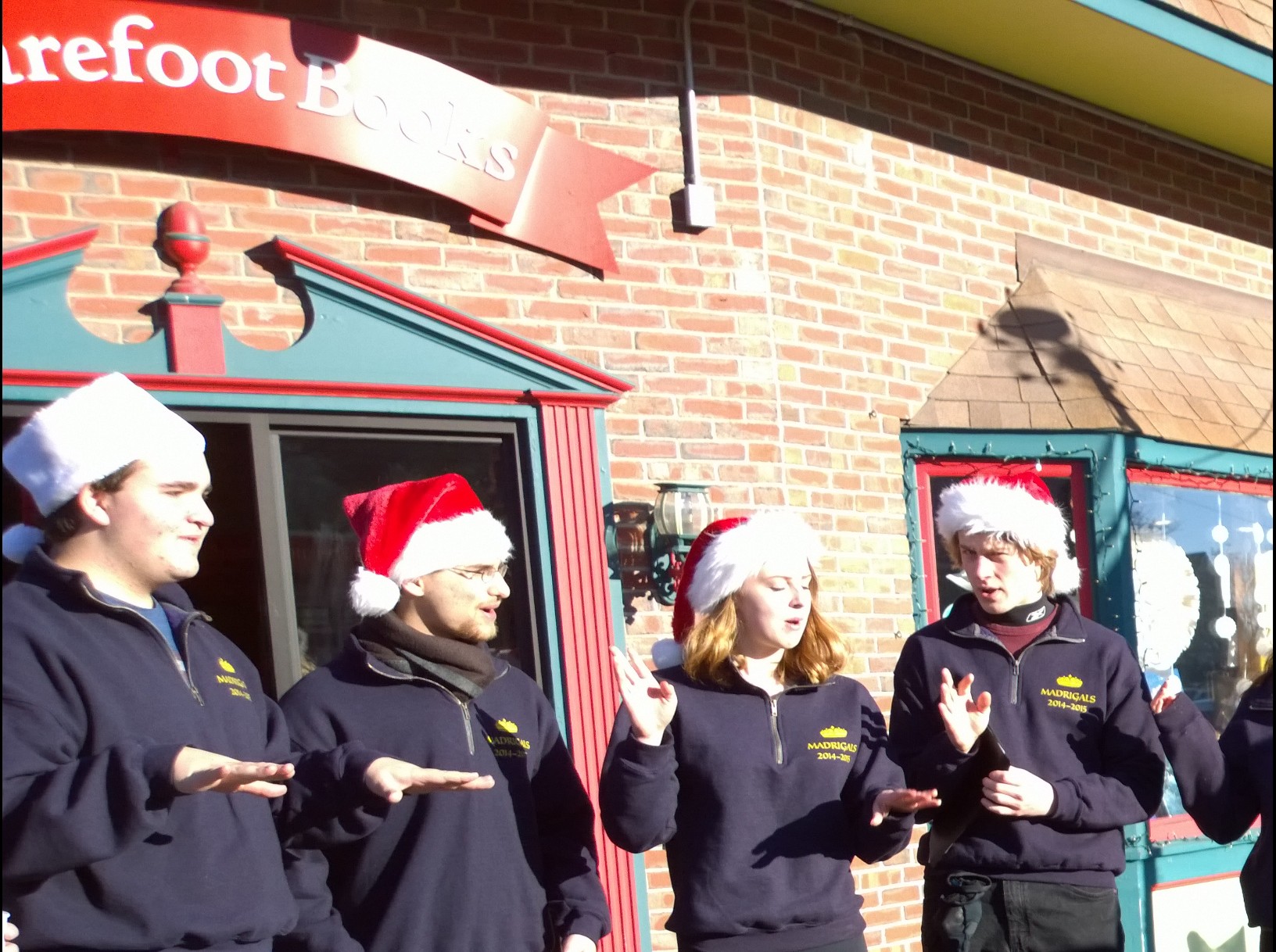
Then today, who should pop up outside Barefoot Books but the Acton-Boxborough High School Madrigal Singers, regaling passersby with seasonal favorites. And hand motions.

There was also a poetry reading at the library, part of an ongoing series. Today we had poet Sandra Lim, who read from her collection The Wilderness. The poems tended to start out straightforward and end up obscure. I need to read and think about them. I liked the title of one section of the nine-part poem “Homage to Anne Bradstreet” (a Puritan poet that Lim likes because of the crazy contrasts between controlled and wild), but I’m afraid my train of thought had nothing to do with the subject at hand.

The section of the Bradstreet homage was called “Black Painting,” and it reminded me of a friend who so detested the level of conversation at her husband’s management-consultant social events that she would invariably announce in the middle of the party, “I’m going home now and make a black painting.”

121414-madrigals-at Barefoot-Books

Read Full Post »

Photo: Andrea Shea/WBUR
Amy Clampitt used her award money to buy a house in Stockbridge, Mass., where today rising poets can have six- to 12-month tuition-free residencies.

When National Public Radio’s Andrea Shea heard about this year’s winners of the MacArthur award, she began to wonder how past recipients had spent the money. Her curiosity led her to 1992 honoree and poet Amy Clampitt.

“The recipients of this year’s MacArthur Foundation ‘genius grants’ will each receive $625,000 over five years, no strings attached,” writes Shea.

“[Clampitt] was on vacation when she heard from her friend, writer Karen Chase, that she had been named a MacArthur genius.

” ‘ She was furious with me because she thought I was teasing her,’ Chase recalls. ‘And by the end of the conversation she said, “I’m gonna buy a house in Lenox!” ‘

“That’s Lenox, Mass., home of Edith Wharton, one of Clampitt’s favorite writers. Chase helped Clampitt find a small, clapboard house that became the 72-year-old poet’s first major purchase. The next year, Clampitt was diagnosed with ovarian cancer. Chase reads from notes of conversations between Clampitt and her husband, Harold Korn:

” ‘What’s going to happen to the house? I don’t want it broken up,’ Clampitt said. …

“After his wife’s death, and before his own in 2001, Korn dreamed up a fund to benefit poetry and the literary arts. Since 2003, the house Clampitt bought with her MacArthur money has been used to help rising poets by offering six- to 12-month tuition-free residencies.

“Clampitt herself didn’t publish her first volume of poetry until she was 63.”

Her Atlantic Monthly editor, poet Mary Jo Salter, thinks Clampitt “would be delighted that her house is helping give poets the kind of opportunity that she didn’t have when she was coming up. …

“This December, the 19th resident of the house Amy Clampitt purchased with her MacArthur purse will settle in.”

More at NPR, where you also can listen to the audio.

Read Full Post »

Photo of Gertrude Ely: Bryn Mawr College Collection

I was on the brink of unsubscribing to the American Academy of Poets poem-a-day e-mail because I let so many pile up and then have to slog through all sorts of contemporary brain twisters.

But as I was working my way through the poems today, I came across the one below. I thought, “Oh, I know exactly what this is about” and was carried back to my college days and hanging out at the home of my great aunt’s friend Gertrude Ely.

Gertrude Ely was quite elderly at that time but really interesting to be around. She knew all sorts of movers and shakers and was an awesome storyteller. I happened to be staying at her house one weekend when she received an unusual letter.

An elderly Philadelphia gentleman wrote that he had read in the Bulletin that she had received some civic award, and he just had to write and tell her a memory he had from his service in WW I in Europe. The Army was sending over carloads of friendly, proper young volunteers to chat with and cheer soldiers and bring a breath of home. The man wrote he would never forget a load of girls pulling up in an open car and Gertrude Ely calling out, “Any of you boys from Philadelphia?” He said, “At that moment, I believe every soldier there was wishing he was from Philadelphia.”

Gertrude Ely at my college graduation.

1966-GS-ELY-AT-CB-GRADUATION

***

American Boys, Hello! by Ella Wheeler Wilcox

Oh! we love all the French, and we speak in French
As along through France we go.
But the moments to us that are keen and sweet
Are the ones when our khaki boys we meet,
Stalwart and handsome and trim and neat;
And we call to them—“Boys, hello!”
“Hello, American boys,
Luck to you, and life’s best joys!
American boys, hello!”

We couldn’t do that if we were at home—
It never would do, you know!
For there you must wait till you’re told who’s who,
And to meet in the way that nice folks do.
Though you knew his name, and your name he knew—
You never would say “Hello, hello, American boy!”
But here it’s just a joy,
As we pass along in the stranger throng,
To call out, “Boys, hello!”

For each is a brother away from home;
And this we are sure is so,
There’s a lonesome spot in his heart somewhere,
And we want him to feel there are friends
right there

In this foreign land, and so we dare
To call out “Boys, hello!”
“Hello, American boys,
Luck to you, and life’s best joys!
American boys, hello!”

[Ella Wheeler Wilcox wrote “American Boys, Hello!” while visiting France during the latter stages of World War I as entertainment for the American soldiers stationed there.]

Photo of Ella Wheeler Wilcox: American Academy of Poets, here.

Read Full Post »

If you want people to innovate, get out of the way. That’s what I think must have happened when Bill Littlefield launched his sports program at WBUR. Clearly, someone gave him freedom to do it his own kooky way, and when radio stations around the country wanted to carry the program, that laissez-faire manager must have smiled.

Both sports fans and non-sports fans like Littlefield’s show. He covers all the usual sports topics but also showcases offbeat competitions like this one at the Vermont College of Fine Arts in Montpelier. Karen Given was the reporter.

“Just 15 minutes before game time, the vast and serene campus green at Vermont College of Fine Arts showed no signs of the annual Writers vs. Poets softball game. There were no bats, no balls, no bases, and no players. Suddenly, Victorio Reyes stormed onto the scene.

“ ‘First of all I’m a poet,’ he said. … ‘There’s two things,” Reyes continued. “One: the United States invests way too much money in sports and too much emotion, okay? That’s the first thing. The second thing? This game is life or death. That’s all you need to know.’ …

“No one seems to know the overall record. Louise Crowley, director of the MFA in Writing program, said the game itself is similarly imprecise.

“ ‘We might have 50 people in the outfield. It’s just kinda an informal, crazy game.’

“ ‘Eventually, will there be bases?’ I asked.

“ ‘There will be bases, yes,’ Crowley said. ‘There will be bases, there will be a batter, there will be a catcher, you know. But other than that, it’s just sort of a free flowing, everything goes.’ …

“After dinner, there’s a reading, and then hours of painstaking writing and re-writing before workshops begin again early tomorrow morning. …

“Poetry instructor Matthew Dickman had a preexisting injury this time around, so his job was to provide inspiration — of the negative variety.

“ ‘Whenever a fiction writer gets to bat, a student, I’m going to sit behind them and talk about how difficult it is to get published,’ Dickman said. ‘How they’ll probably just go back to working wherever they work and their dreams will come to an end.’  …

“Every once in a while, the pitcher lobbed in a good one and the batter managed a hit — usually a pop fly that floated over the outfield. And, although the number of outfielders had ballooned to at least a dozen, every single one of those pop flies dropped to the grass.” More at Only a Game.

I laughed all the way through this report.

Photo: Going the Distance Blog
At the annual Vermont College of Fine Arts softball game, it’s war. Cats vs. dogs have nothing on poets vs. prose writers.

Read Full Post »

I have decided that if Ireland ever names people as national treasures, it should include James J. Hackett of Moate.

Last night at the Kellys’ party, James clinked the glasses at the table and called everyone to attention. Then he recited Yeats’s poem “The Ballad of Father Gilligan,” preceding it with a little history and acting out all the parts.

The grandson of a man who taught Latin and Greek in a hedgerow school back in the dark days when the English forbade sending Irish children to school, James has taken it upon himself to preserve the culture. His ordinary conversation is a living history, and he is frequently dropping into poetry.

James’s book Days Gone By is written in the way he speaks when talking to friends or taking people on a tour of some ruin. Consider this sample.

“It was long past the witching hour when the poteen revellers came upon Kate resting on the puchann and in a most distressful state.* They took her along to the wake, where she related all her adventures. Great was the wonder and fear that was expressed at hearing this story, and needless to say, many a post mortem was held upon Kate Brambles’s account of the witches’ dance at the half way house in Ballylurkin Bog on the Hallow’een night that Tubbs Lanigan was waked.”

Recent chronicler of Ireland lore and customs Turtle Bunbury discovered James in Moate and has included him in one of his Vanishing Ireland books. Bunbury also features James on a Facebook page, which I hope to access as soon as Turtle accepts my friend request.

[Update: Turtle has just put my post on his page, here.]

You may recall that I blogged about James once before, here, at another time that he was visiting his Rhode Island cousin.

(*James says a “puchann” is a little hill in a bog.)

Photo: Suzanne’s Mom
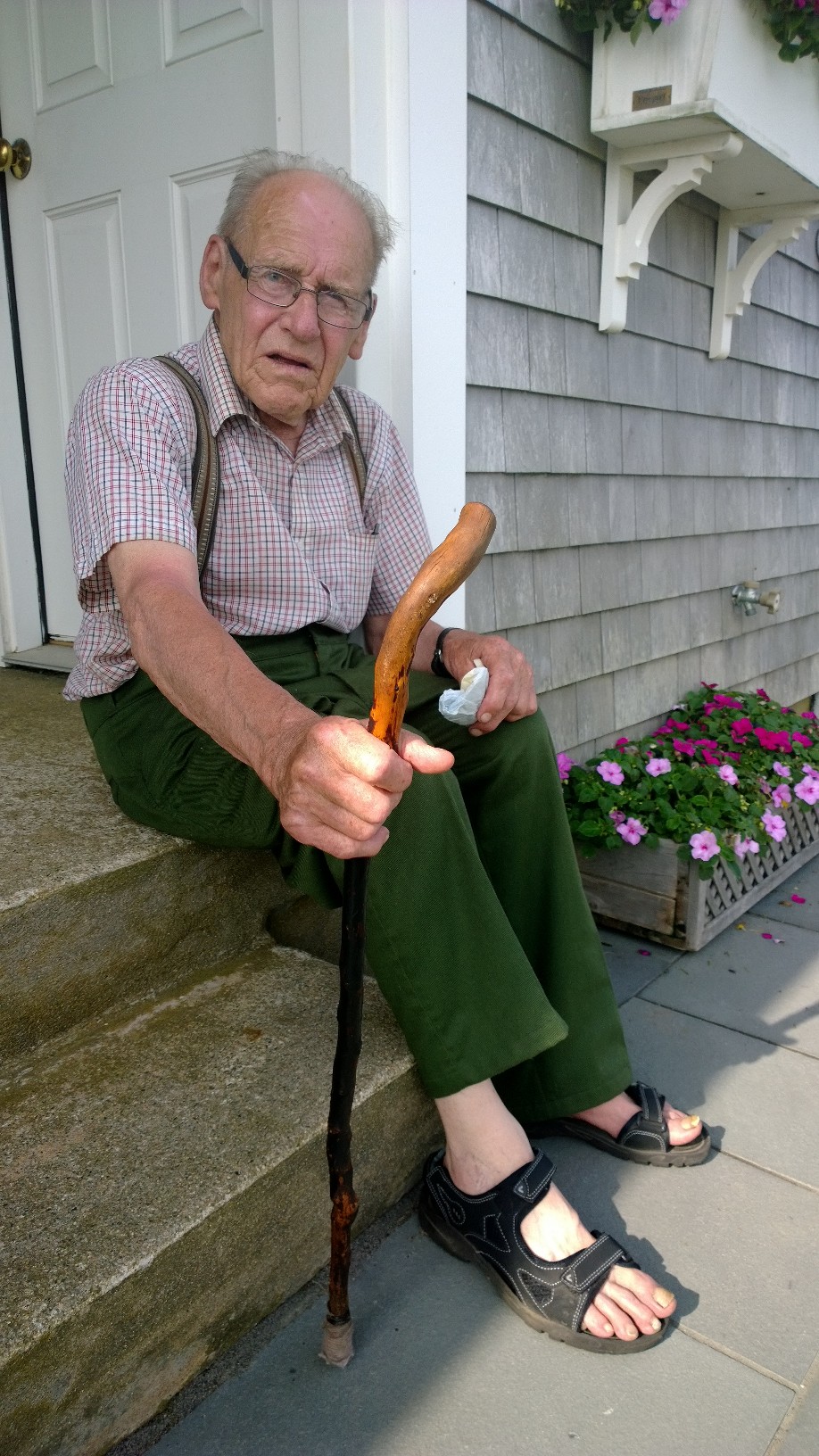
James J. Hackett in New Shoreham. He made his own shillelagh of blackthorn. He also made one for John and mailed it to him with instructions on how to cure the wood.

070314-james-hackett


Read Full Post »

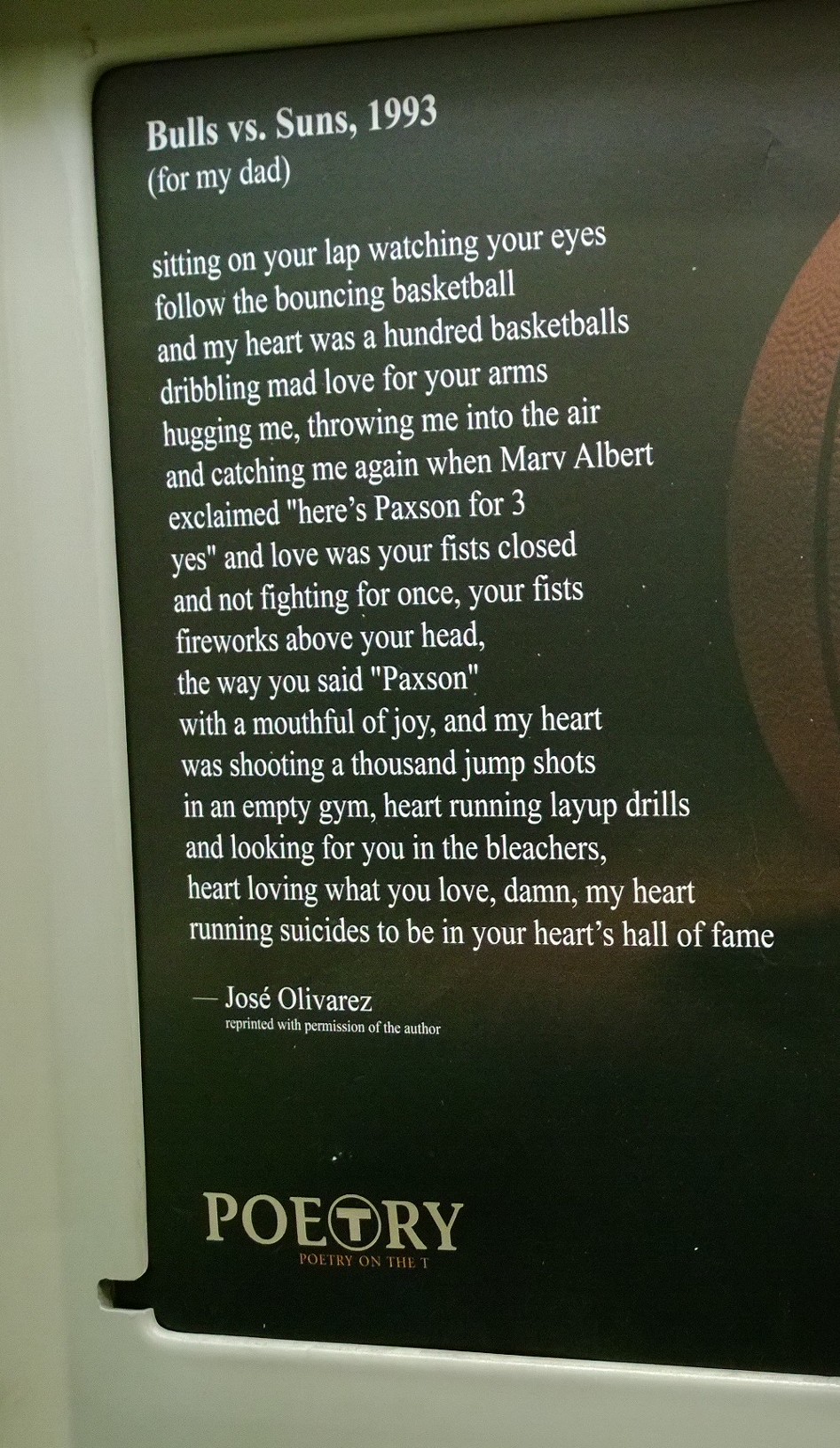
Jose-Olivarez-MBTA-poem


I was always impressed when I saw a poem in the place of an ad in the New York City subway. Now Boston has caught on.

Martine Powers wrote recently at the Boston Globe, “Finally, Bostonians will have the chance to experience the pleasures of poetry on the MBTA.

“Mass Poetry [is] bringing poems to advertisement spaces on subway cars. The initiative, dubbed PoeTry, is part of the organization’s Poetry in Public Spaces initiative, which began last year, said Mass Poetry program director Laurin Macios…

“ ‘Contemporary poetry is barely taught in schools, and often when it is, it is taught in a very scholastic sense instead of an artistic one,’ Macios said. “People often grow up without ever realizing there is poetry out there that can speak to them, or that they can speak back to. …

“Each appearance of a poem includes a tearsheet on the corner of the sign, allowing passengers to take a copy of the poem with them if the spirit strikes them.”

One poem in the series, says Powers, “What Travels,” by Joseph O. Legaspi, takes place on a subway car. “What travels beneath their secret faces? What is train but transport to other lives?” More at the Globe.

See also http://masspoetry.org.

Photo: Suzanne’s Mom
Poem: “Bulls vs. Suns, 1993,” by Jos
é Olivarez

Read Full Post »

An Imperial Elegy
by Wilfred Owen

Not one corner of a foreign field
But a span as wide as Europe;
An appearance of a titan’s grave,
And the length thereof a thousand miles,
It crossed all Europe like a mystic road,
Or as the Spirits’ Pathway lieth on the night.
And I heard a voice crying
This is the Path of Glory.

@-> @-> @->
Born in Shropshire, England, poet Wilfred Owen is best known for telling the truth of what he saw in World War I, a war joined too lightheartedly by many of his countrymen 100 years ago. He  died at the Sambre-Oise Canal a week before the Armistice was signed.

Read more about Owen here.

Photo: Suzanne’s Mom
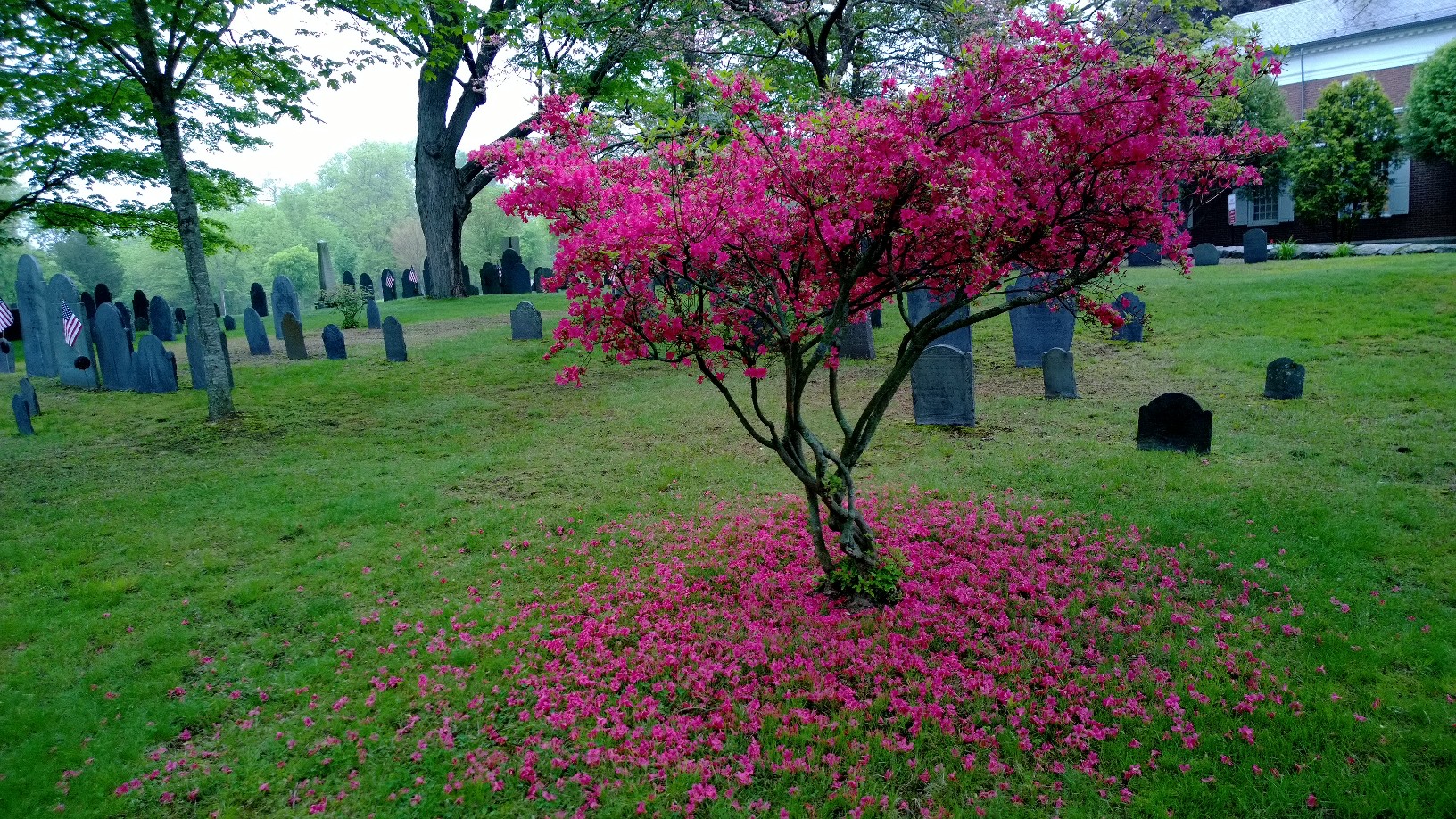
Azalea moving to the next phase

azalea-moving-to-next-stage

Read Full Post »

« Newer Posts - Older Posts »