Feeds:
Posts
Comments

Posts Tagged ‘postaday’

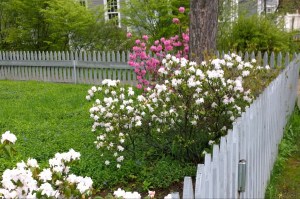
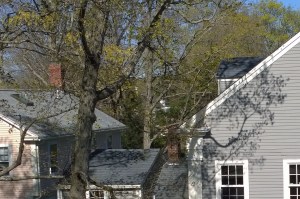
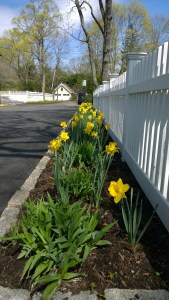
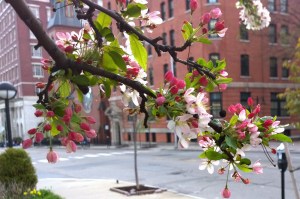
Happy Mother’s Day to all mothers! This mother is indulging her interest in photography today (the simple kind: pointing and shooting with a phone). So here are a few recent pictures and explanations for the less obvious.

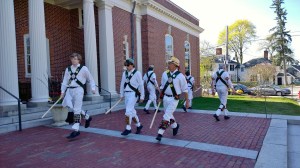
For example: I went out for a walk one evening and was surprised to encounter Morris Dancers on the steps of the library. They seemed to be practicing, not performing. Where would Morris dancers be performing in late April, after Patriots Day? That was a mystery. Another mystery to me was how young men and boys get drawn into performing Morris Dance. I’m sure it’s good exercise, but …

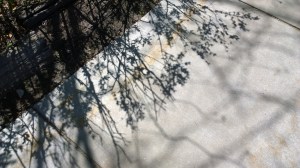
I include shots of a clay bird’s shadow on my wall and hedge shadows on a sidewalk. The fence with the stage coach and other old timey images painted along the railings is in Providence — easy to overlook when walking past.

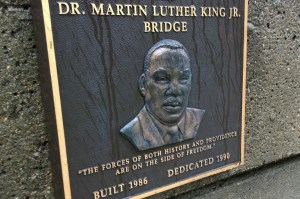
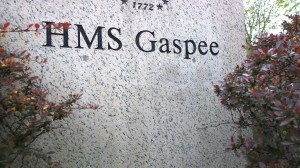
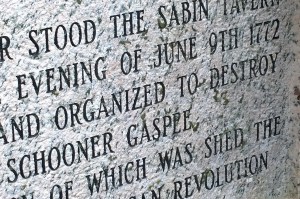
Providence plaques and memorials. The one of Martin Luther King Jr. is on a bridge with a view of Water Place. The monument to an event Rhode Island celebrates as the real first engagement of the American Revolution — the colonists’  clash with Brits on the HMS Gaspee — is partly obscured by bushes.

Little old Rhode Island gets no respect. It was also the first colony to sign on for independence, May 4, 1776. Who knew?

042316-daffodils-and-white-feince

042616-1821-universalist-church-providence


WP_20160505_10_01_32_Pro

042416-branches-shadows


042416-Morris-dancers-stepping-out

043016-bird-in-window


042616-stage-coach-on-fence-providence

043016-pavement-shadows


WP_20160503_07_47_05_Pro

WP_20160504_07_32_57_Pro


WP_20160504_07_33_23_Pro


Read Full Post »

050616-NCWyeth-at-Concord-Museum


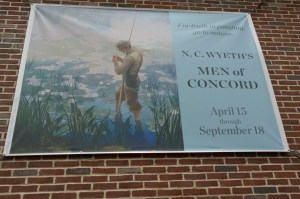
If you can get to the N.C. Wyeth exhibit at the Concord Museum by September 18, I think it will be worth your while.

You’re familiar with the family of painters, the Wyeths, right? Best known are Nathaniel C., his son Andrew, and Andrew’s son, Jamie. Perhaps you have been to the Brandywine Museum in Chadd’s Ford, Pennsylvania, which got its start with generations of Wyeth art.

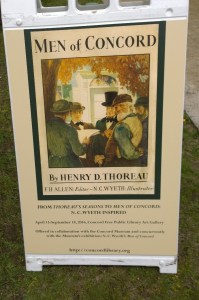
N.C. fell in love with Henry D. Thoreau‘s writing in 1909, made several pilgrimages to Concord, and eventually conceived of a book that he would illustrate , calling it Men of Concord: And Some Others as Portrayed in the Journal of Henry David Thoreau.

The Concord Museum and the Concord Library are each hosting exhibits related to the book, but if you like N.C.’s art, the museum exhibit is the one to see. It’s small but informative and lovely to look at.

N.C. was known for heroic illustrations of classics like Treasure Island, and his characters’ facial expressions and body postures always tell a story. That might be too literal for some art lovers, but I like it. I like the looks on the faces of three men Thoreau described in his journal as “slimy.” I like the watchful, coiled bodies of the muskrat hunters on the river, and the youthful innocence of N.C.’s Thoreau — a quality I have never associated with the writer.

One fanciful painting with bluebirds in a bubble of light like angels over Thoreau’s head seems like hagiography. It’s not my favorite work here, but it’s an intriguing summary of the writer’s interests. And people do make a religion out of Thoreau and Transcendentalism, so maybe it’s not surprising. The whole Concord gang — including Bronson Alcott and Ralph Waldo Emerson — is in the show, minus most of the brilliant women, of course.

One thing I learned was that N.C. had his pencil sketches converted into glass slides, and then he projected them onto the Renaissance board he favored so he could work directly on the enlarged sketch.

More on the museum website.

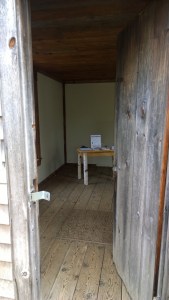
The hut is a replica of the cabin Thoreau stayed in at Walden Pond and is located on the grounds of the museum.

050616-Thoreau-replica-cabin

050616-Wyeth-and-Thoreau-at-Library


Read Full Post »

Pigeons are often associated with pollution underfoot, but in London, pigeons are being harnessed in the fight against another kind of pollution.

Melissa Breyer reports at TreeHugger that the ubiquitous birds are being “outfitted with light-as-a-feather backpacks that collect air pollution data and tweet back live info in an effort to track air quality.

“Putting pigeons to work was the brainstorm of Pierre Duquesnoy, creative director at the global marketing and technology agency DigitasLBi. He entered the curious concept into the #PoweredByTweets competition which was launched last year in conjunction with the London Design Festival.

“Currently there are 120 stations monitoring air pollution in London but they are in fixed locations. ‘That means there are blind spots,’ Duquesnoy tells the Evening Standard. ‘The stations are really accurate but only for the immediate vicinity, so scientists don’t have a clear idea of what is happening elsewhere.’ …

“Pigeon Patrol was one of six winning entries that was built and exhibited – and now, the patrol is actually patrolling. [They will] measure levels of nitrogen dioxide and ozone, the main gases behind harmful urban air pollution …

“For the project Duquesnoy worked with Plume Labs, a tech firm that helps citizens track their exposure to air pollution.” More here.

Video: Newsy

Read Full Post »

Sam Borden at the NY Times had a cool story yesterday about a jack-of-all-trades performer who never got much attention — until his ability to mimic the sounds of nature turned him into an overnight sensation.

According to Borden, Gennady Tkachenko-Papizh, 52, finally got attention in March.

“That was when, while sitting at a cafe [in Berlin] checking his smartphone, he saw that Miss Arab U.S.A. — who is a 22-year-old Brooklyn-born Syrian named Fabiola al-Ibrahim — had, for some reason, posted to her Facebook page a video of Mr. Tkachenko-Papizh competing on a talent show in the former Soviet republic of Georgia. ‘This will take you to another world!’ she promised of the link, which leads to about three minutes of Mr. Tkachenko-Papizh vocalizing the sounds of crickets, bird wings rustling, water dripping and hyper-dramatized operatic chanting.

“The show, ‘Georgia’s Got Talent,’ is about what you might expect from spectacles like this anywhere … Yet Mr. Tkachenko-Papizh’s performance, which he began by solemnly intoning, ‘Let us try to feel what the Mother Earth wants to tell us,’ resonated more deeply. …

“The video on Miss Arab U.S.A.’s page has logged more than 70 million views and inspired more than 102,000 comments — mostly unbridled encomiums.”

Despite the change in Tkachenko-Papizh’s life, says Borden, he is not becoming a prima donna. “He lives here with his wife, Larissa Porkhimovich, who is a financial auditor, and their two young children (he also has an older son from a previous relationship), and he said that he is most interested in simply harnessing ‘this gift I have, which has a magical effect.’

“It has taken some adjustment for his wife. ‘I think he really likes testing, trying things,’ she said. ‘It can be a little strange — sometimes I am in the house and I will just hear sounds, like a bird flying, but it is inside. But that is who he is.’ ”

More here.

Photo: Gordon Welters for The New York Times
Gennady Tkachenko-Papizh said he hopes to travel to London soon to work on recording an album. 

Read Full Post »

I liked this story from the radio show Studio 360. It explains how recordings of whales making music were used by Judy Collins and others to draw attention to the plight of our biggest mammals.

“If you hear whale songs today, you might be getting a massage or a facial. Some recordings of humpback whales feature slow melodies soothing enough for spa soundtracks. But in the 1970s, whale songs ignited the passions of music listeners and animal activists.

“Biologist Roger Payne still thinks whale songs are the most evocative sound made by any animal. But he may be biased — he discovered them. In 1966, Payne got a recording from a sound designer doing research for the military on undersea dynamite explosions. Caught on the tape were some of the first recordings of sounds made by humpback whales.

“Payne became obsessed with the recording, and made a startling discovery: the sounds were repeating. That means that they weren’t just sounds, they were technically songs — arguably the most complex songs made by any animal. Unlike birds or crickets, the whales’ songs were ten minutes or longer and repeated without a break.

“At the time, whales were being hunted to near-extinction, and Payne saw the discovery of whale songs as a call-to-arms. …

“Over the following years, Payne pressed the recordings on musicians, composers, and singers, including Judy Collins. ‘This tall man walked backstage,’ Collins recalls. ‘And he handed me this little package’ with a tape of the humpbacks. ‘It was very emotional. …

“In 1970, Collins used the recordings on her album “Whales and Nightingales”, which went gold and introduced millions to whale song. … Collins devoted the royalties of those songs to Payne’s conservation work. …  Just as Payne hoped, these strange, evocative sounds inspired the growing Save the Whales movement, and by 1972 the US had banned whaling and whale products.”

More here.

Photo: Phillip Colla, Oceanlight.com
Humpback whale.

Read Full Post »

A week ago, I went to a cheerful ribbon cutting enlivened by smiling faces and Woonsocket’s own Marching Milkman Band.

Local, state and federal officials, residents, nonprofits such as NeighborWorks Blackstone River Valley and Rhode Island Housing, businesses such as the Federal Home Loan Bank, Bank of America and Navigant Bank — and a long list of equally important partners — were celebrating the conversion of the rundown Mulvey’s Hardware into a range of new community uses.

Sandy Seone has the story at the Valley Breeze newspaper.

“A downtown building that sat dormant for more than a decade was declared officially revived this week as NeighborWorks Blackstone River Valley celebrated the grand opening of 40 South Main St.

“The $3.3 million renovation project began in 2014 and has resulted in the complete conversion of a former hardware store into six, [one-bedroom] apartments; a meeting space; a rooftop patio; a basement rental area for small businesses; and a kitchen ‘incubator’ space, which will provide top of the line appliances to small-time local cooks and bakers looking for a chance to sell their wares. …

“The six housing units in the building have all been rented – three men and three women are slated to move in soon – and the building has a waiting list of additional potential tenants. The one-bedroom apartments cost $700 per month, and include some 750 square feet of modern space with a kitchen, living room and bathroom.

“Secretary of State Nellie Gorbea was among a small group to tour the two-story building at a ribbon-cutting ceremony on [April 25].

“ ‘Those who have concerns about affordable housing can look at this and see how wonderful the right kind of development truly is,’ Gorbea noted. …

“The construction project is believed to have supported more than 25 local small businesses, and NeighborWorks officials said that the housing units should generate $100,000 annually in consumer spending.”

More at Valley Breeze, here.

Members of the Marching Milkman Band perform at the opening of the latest NeighborWorks Blackstone River Valley (NWBRV) development. According to NWBRV Executive Director Joseph Garlick, band members Emily Lisker and Bill Calhoun have played a key role in building the arts community in Woonsocket.
042516-Milkman-Marching-band-Woonsocket


Read Full Post »

My mother had me celebrating May Day from an early age (you leave a basket of flowers on a neighbor’s doorstep, ring the bell, then run and hide), and I continued the custom when Suzanne and John were small. (Mrs. Polhemus down the street said to me once, “Oh, my Dear, I’m going to be so sad when your children grow up!”)

But I have felt in recent years that nobody knows about May Day anymore, unless it’s the May Day of the labor movement. Not even florists promote it.

So imagine my delight when Alden posted on Facebook a Happy Lei Day greeting today! It turns out that something like May Day lives on in Hawaii.

Alden, a native Hawaiian, routinely posts the glorious flower photos of Nate Yuen, Commissioner of Natural Area Reserves System Hawaii. Today he linked to the beautiful lei below.

I was intrigued to learn that it took just one person to start the Lei Day tradition (proving that “one and one and 50 make a million”). Here’s what Don Blanding said about it in Hula Moons (quoted in Hawaiian History):

Along in the latter part of 1927 I had an idea … I told the editors of the Honolulu Star-Bulletin, the paper on which I worked. They agreed that it was a good idea and that we ought to present it to the public, which we proceeded to do. It took hold at once and resulted in something decidedly beautiful. …

Hawaii observed all of the mainland holidays as well as those of a number of the immigrant nationalities in the Islands. But there was no day that was peculiarly and completely Hawaii’s own; that is none that included all of the polyglot population there.

So, the bright idea that I presented was, “Why not have a Lei Day?” Let everyone wear a lei and give a lei. Let it be a day of general rejoicing over the fact that one lived in a Paradise. Let it be a day for remembering old friends, renewing neglected contacts, with the slogan “Aloha,” allowing that flexible word to mean friendliness on that day.

Lei Day became an official holiday in 1929. Lei Day celebrations continue today, marking May First with lei-making competitions, concerts, and the giving and receiving of lei among friends and family.”

Here’s a bit more from the Huffington Post: “Giving or receiving a lei in Hawaiian culture carries special meaning. Although the lei has become a popular souvenir to purchase, the true value of the lei is the process that leads up to the finished product. When gifting a lei, one starts with choosing the flowers to be used and then personally strings each blossom with thoughtful purpose for the recipient.” (Interesting. That’s how I pick pictures for my collage cards.)

Photo: Nate Yuen
This splendid lei was made by Brian Choy in 2007.


Read Full Post »

Following up on my 2012 post about fairy circles.

Rachel Nuwer writes at the NY Times, “When Stephan Getzin, an ecologist at the Helmholtz Center for Environmental Research in Leipzig, Germany, opened the email, his heart began to flutter. Attached was an aerial image of fairy circles, just as he had seen in countless photos before. But those images were always taken along long strips of arid grassland stretching from southern Angola to northern South Africa. These fairy circles — which looked nearly identical — came from Australia, not Africa. …

“The emailed photo came from Bronwyn Bell, who does environmental restoration work in Perth. She had read about Dr. Getzin’s research in Namibia and made a connection to the odd formations in her home state, Western Australia. …

“Scientists have been interested in fairy circles since the 1970s, but have not been able to agree on what causes the patterns to form. Researchers generally fall into two groups — team termite and team water competition — but there are other hypotheses as well, including one involving noxious gases.

“Dr. Getzin, like others on team water competition, explains the circles through pattern-formation theory, a model for understanding the way nature organizes itself. The theory was first developed not by biologists, but by the mathematician Alan Turing. In the 1990s, ecologists and physicists realized it could be tweaked to explain some vegetation patterns as well. In harsh habitats where plants compete for nutrients and water, the new theory predicts that, as weaker plants die and stronger ones grow larger, vegetation will self-organize into patterns …

“In the case of African fairy circles, the bare patches act as troughs, storing moisture from rare rainfalls for several months, lasting into the dry season. Tall grasses on the edge of the circles tap into the water with their roots and also suck it up with the help of water diffusion through the sandy soil.

“Although similar in appearance, Australian fairy circles turn out to behave differently, Dr. Getzin and his colleagues have found. … Aussie circles feature a very hard surface of dry, nearly impenetrable clay, which can reach up to a scalding 167 degrees during the day. Despite the differences, though, they believe the fairy circles’ function remains the same. When the researchers poured water into the circles in a simple irrigation experiment, it flowed to the edges, reaching the bushy grass …

“The new research ‘moves us closer toward a unifying theory of fairy circle formation,’ said Nichole Barger, an ecosystem ecologist at the University of Colorado, Boulder.

“It could be that more fairy circles are yet to be discovered in arid environments around the world, she said.

“According to Walter Tschinkel, an entomologist at Florida State University, the findings strengthen the claim that the circles are a result of self-organization by plants. He cautioned, though, that to be more certain, scientists would need to control environmental factors — water and termites, for example — to see which produce the predicted outcome.”
More here.

Photo: Norbert Jürgens
Tracks of Oryx antelopes crossing fairy circles in Namibia.

Read Full Post »

A certain community organization that believes in the importance of affordable housing also believes in the importance of community. That is why it fosters numerous community-building initiatives, including the new Sankofa farm and market.

Leigh Vincola at ecoRI reports from Providence.

“If you have traveled around the city’s West End this winter, you may have noticed a number of buildings going up rather quickly. Wondering what they are and who they belong to?

“The answer is Sankofa, a Ghanaian word meaning to go back, get what is yours and make positive progress in the future. The Sankofa Initiative of the West Elmwood Housing Development Corporation (WEHDC) is doing just this.

“The initiative was born in 2011, when the WEHDC completed an extensive survey of West End residents that determined their primary concerns centered around health and food. In a predominately low-income neighborhood — 32.5 percent of households live below the poverty level — the survey determined that for many the West End is a food-insecure neighborhood. There isn’t enough access to fresh food, and particularly food that is culturally relevant to the immigrant populations that make up the community, primarily Central American, West African and Southeast Asian. …

“Sankofa is a response to these needs, and has three main elements: an affordable housing development, a large-scale community garden and a weekly World Market. The $15 million project is funded by Rhode Island Housing and work is underway on all aspects.” Read up on the amazing range of positive efforts here.

According to the market’s Facebook page, things will get going for spring with a “pop-up market May 7th, from 12pm to 4pm at Knight Memorial Library on Elmwood Ave. There will be art, bath and hair products, handmade jewelry, homemade candles, fresh food, FREE seeds, henna, giant bubbles and much more.”

Photo: Sankofa Initiative
The Sankofa World Market is a local farmers market with international flavor.

Read Full Post »

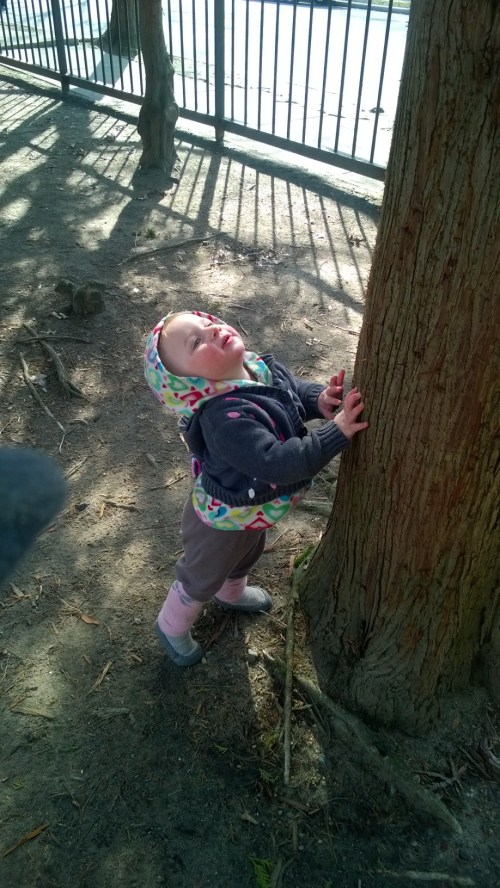
Babies can be exhausting, but they also can be relaxing. It’s relaxing to be with people who see everything as new and amazing. They may babble and bounce with wild excitement and drag you over to show you that your pocketbook is on the stairs. They are amazed!

For babies, many things of concern to grownups are nonexistent. They focus on fundamentals.

They eat when they’re hungry, they drink when they’re dry, and they sleep when they’re tired. They aren’t trying to convince you they’re cool. If you meet their needs on demand, that’s all they ask.

They can switch from wanting desperately to ravage your cellphone to forgetting all about it in an instant. They can surprise you by doing something completely random — like suddenly grabbing your legs and growling.

They don’t care if they impress big shots in mansions, office buildings or the statehouse. They don’t care if the shiny thing on your hand is a 2-carat diamond or a piece of plastic. They don’t care if your sneakers are Pumas or Schlock Box — they just like the colors and the laces. They don’t care if their stomach hangs out or if you can jump higher than they can.

And if a squirrel climbs way up high, they don’t care if they can’t catch it, they go after it anyway.

032716-squirrel-went-up-tree

Read Full Post »

Erik keeps tabs on health-related issues and just got an email that he thought would interest me.

He was right. I was reminded of a visit from a “laugh doctor” back when I was editor of Minnesota Physician. The laugh doctor showed us how we could get ourselves laughing. He talked about the endorphins produced and how good they were for health.

In apparent agreement, a Rhode Island clinic that serves low-income people is putting on a comedy show May 7 and inviting neighbors, patients — anyone who is up for a good laugh and willing to make a donation.

The comedy will be performed by the Providence Improv Guild at the Fête Event Space in Olneyville, RI, May 7th, 5:30 – 8:30 p.m.

Says the Laugh for Health invitation, “Suggested donation for tickets: Giggle $10 – Chuckle $ 25 – Laughing out Loud $100 ($150 per couple). Belly Laugh $1000 and above! …

“Here at Clínica Esperanza/Hope Clinic — we believe in laughter and joy. We celebrate health. We laugh at ourselves. We applaud our patients. We take joy in volunteering. We consider health, not wealth, to be the most valuable asset in our community.

“And since many of our neighbors do not have the resources to receive proper healthcare, or don’t know where to be seen for their health problems and how they’ll manage to pay for it all, we are there for them.

“Clínica Esperanza/Hope Clinic welcomes our neighbors in need with open arms. We celebrate health, and with our patients, laugh out loud as they make the journey from illness to good health. … It’s simple to RSVP – click here.”

To learn more about Hope Clinic, visit http://www.aplacetobehealthy.org.

Photo: Hope Clinic
Members of the Providence Improv Guild will perform at a benefit for Clínica Esperanza/Hope Clinic May 7.

Read Full Post »

John is a great source for articles on cutting-edge technologies. He sent me this one Thursday about using plants to make electricity. The students in Spain who designed the technology are nothing if not ambitious. Their goal is to have the whole world covered in trees making electricity. You can watch their video, below, or bear with me as I channel Google Translate’s English rendition of a Spanish blog post.

, at Blog Think Big, says, “Thanks to Bioo system, created by the students of the Autonomous University of Barcelona and Ramón Llull University with the startup Arkyne Technologies, families could cover their basic electricity needs through 10 × 10 meters of vegetation panels. But how?

“The prototype initially created by the students of the UAB is a plant in a pot that lets you charge a mobile phone. According to the explanation for the 4YFN space last Mobile World Congress in Barcelona, the system ‘generates power 3-40 watts per square meter from some vegetable panels and a biological battery that takes energy waste (matter organic) that plants need not despise.’ [Oops: that has to be Google. Shall we change it to ‘plants don’t need’?]

“Thus, the device is able to steadily produce electricity through a self-supply system. In addition, according to the engineers, the operation does not affect the plants and is economical.

“Students are betting on a ‘smart city’ concept that allows people using Bioo buy or sell electricity. The goal, in addition to developing these systems in homes, [is to extend them to] agriculture or green roofs of public buildings.”

Maybe you better watch the video. But there’s more here, if you read Spanish.

Video: Bioo Lite

Read Full Post »

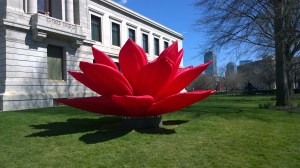
I’m bummed that I couldn’t get my video of the giant red lotus to load. I can provide a still shot, but the flower outside the Museum of Fine Arts in Boston does more than look big — it opens and closes with a goofy clatter. Audrey II from the Broadway show Little Shop of Horrors has nothing on this hilarious monster.

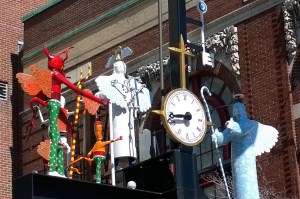
A few blocks away, speaking of clatter, is the mechanical clock that graces Mass College of Art.

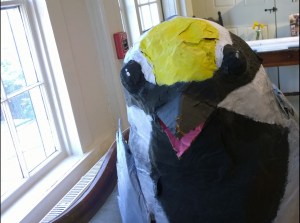
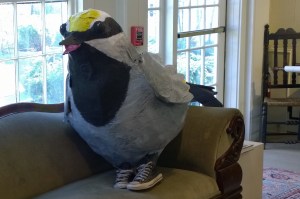
At Concord Art, where Mary Ann’s friend Holly Harrison curated a fascinating show on birds, Rivers and Revolutions students from Concord Carlisle High School had a small exhibit of their own — featuring a giant yellow warbler (in sneakers) and a nest complete with appropriately spotted eggs.

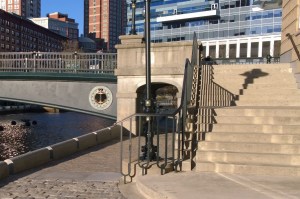
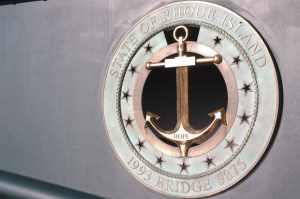
Next is Waterplace Park in Providence, where I was once again tempted by shadows. Note how interesting the streetlamp looks stretched out on the staircase. The state emblem with “hope” and an anchor reminds me to tell you that Suzanne sells an anchor charm at Luna & Stella and donates $5 of the sale of every anchor to the Rhode Island Foundation, now celebrating its 100th year.

My favorite photo here is the little boy on the banks of the Sudbury River, where he has just pulled in a nice bass, his fourth fish of the day. I took a bunch of photos of the boy and his dad, but this was the only one that made clear you are actually looking at a fish.

041416-Museum-Fine-Arts-lotus

041416-Mass-Art-clock


041516-giant-warbler-Concord-Art

041516-warbler-in-sneakers


041516-art-nest-for-warbler

042016-shadows-by-Providence-River


042016-RI-anchor-and-Hope

042116-boy-catches-fish-Sudbury-River

Read Full Post »

A beautiful day is always a good excuse to walk the grounds of the deCordova Museum in Lincoln, Mass., enjoying the sculptures and lake view.

A little history from the museum website: “DeCordova Sculpture Park and Museum is located on the former estate of Julian de Cordova (1851-1945). The self-educated son of a Jamaican merchant, Julian de Cordova became a successful tea broker, wholesale merchant, investor, and president of the Union Glass Company in Somerville, Massachusetts. Although he married into the locally prominent Dana family of Boston, Julian achieved prosperity without the advantages of inheritance or social position. …

“Inspired by his trips to Spain and his own Spanish heritage, Julian remodeled his summer home in Lincoln, Massachusetts in 1910 to resemble a European castle. …

“For Julian, the visual arts served as a medium for self-improvement and enlightenment. In his later years, he opened the doors of his estate to share the wonders he had collected during seven decades of world travel. Julian envisioned a place where art would continue to educate and excite beyond his lifetime. To meet that end, he gave his property to the town of Lincoln in 1930 with the stipulation that his estate would become a public museum of art following his death.

“Julian’s will established a committee of incorporation, whose duties included formulating the policy, objectives, and supervision of the new museum with the guidance of professionals in the field, such as the Director of the Museum of Fine Arts (MFA) in Boston. Independent appraisers determined that Julian’s collections were not of substantial interest or value, so the collection was sold and the proceeds were used to create a museum of regional contemporary art.”

It’s nice to have an institution that focuses on New England artists, especially one that also offers a beautiful park for families to enjoy.

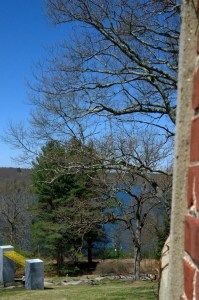
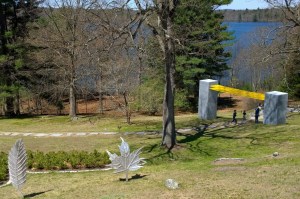
The yellow cables that seem to vibrate between the concrete blocks are a startling aspect of Stephanie Cardon’s sculpture Beacon. The collection of giant leaves, by Alan Sonfist, is called The Endangered Species of New England. The purple carpet is by Mother Nature and is called Violets.

042416-DeCprdova-lake

042416-DeCordova-giant-leaves


042416-violet-carpet-Lincoln-Mass

Read Full Post »

« Newer Posts - Older Posts »