Feeds:
Posts
Comments

Posts Tagged ‘postaday’

The website Narratively just alerted me to something cool from StoryCorps, a feature I generally hear on National Public Radio (NPR).

According to the StoryCorps website, “The first-ever animated feature from StoryCorps, Listening Is an Act of Love, presents six stories from 10 years of StoryCorps, where everyday people sit down together to ask life’s important questions and share stories from their lives. Framing these intimate conversations is an interview between StoryCorps founder Dave Isay and his nine-year-old nephew, Benji.

Listening Is an Act of Love will be broadcast by public television stations nationwide. … on varying dates through February 2014. Can’t wait until the animated special airs on your local station? Watch on PBS Roku and Apple TV channels — available on DVD, too!” More here.

(At ny1.com, here, you can read how recording people’s stories caused Isay to take a permanent detour from his medical school ambitions.)

Do you have favorite StoryCorps stories? Have you ever created one?

I have a tape of my father reading the Kipling story “The Elephant’s Child” and poems he loved like “La Belle Dame Sans Merci,” which always choked him up. But if you do a StoryCorps story, you get it archived at the Library of Congress — probably more permanent than my old cassette tape.

Read Full Post »

Album cover for The Bathrooms are Coming!, a 1969 American-Standard musical (Blast Books)

I heard a great Studio360 show today. It was on the industrial musicals once used by corporations to get the sales team charged up to go out and sell.

“In the 1950, 60s, and 70s, a subgenre of musical theater entertained thousands. It had showstoppers composed by some of the brightest talent in the business. But instead of selling out Broadway houses, these shows played to packed hotel ballrooms and convention halls. …

“ ‘It was to build morale and build a sense of being on a team,’ explains Steve Young. ‘You weren’t isolated, you were a part of a greater whole that was looking out for you.’ A writer for David Letterman, Young has made himself the curator of the world’s largest collection of corporate musical theater performances. ‘Sales Training,’ a groovy number from 1972, includes specs for York air conditioner’s new line. ‘Once in a Lifetime’ breathlessly heralds the arrival of the 1958 Ford Edsel.

“Writing these musicals was no simple task and corporations spent lavishly to attract top talent. In 1966, John Kander and Fred Ebb wrote Go Fly a Kite for General Electric (in which Benjamin Franklin meets modern utility executives) — they went on to win a Tony for Cabaret. …

“Steve Young is co-author of the book  Everything’s Coming Up Profits.”

If you like musicals, you really must listen to the whole Studio360 show. It’s too funny.

You don’t want to miss “PDM (Power Distribution Management) Can Do”
from Go Fly a Kite — General Electric, 1966, by John Kander, Fred Ebb, and Walter Marks, or “An Exxon Dealer’s Wife.” Be sure to catch the song composed to sell Edsels and the haunting American-Standard number “My Bathroom” from 1969. (“My bathroom, my bathroom is a private kind of place.”)

Studio360’s show,”Curtain Call: Industrial Strength Musicals,” may be found here.

Read Full Post »

Photo of John Bauer: Wikimedia Commons

When I was poking around the web for art to illustrate my post Iceland Has Elves, I found a lovely picture by John Bauer.

I didn’t know anything about him. But Stuga40 wrote in the comments that he was Swedish. She knew where he had lived before his untimely death in 1918 and said she grew up on his fairy stories.

I decided I wanted to know more.

Wikipedia says John Bauer is “best known for his illustrations of Bland tomtar och troll (Among Gnomes and Trolls). Princess Tuvstarr and the Fishpond  [is] perhaps Bauer’s most notable work. …

“Bauer’s early work was influenced to a large extent by Albert Engström and Carl Larsson, two contemporaries and influential painters. Bauer’s first major work was commissioned in 1904, when he was asked to illustrate a book on Lappland. It was not until 1907 that he would become known for his illustrations of Bland tomtar och troll, the yearly fairy tale book.”

A contemporary story collection called Swedish Folk Tales uses Bauer’s illustrations and is available here. Also, someone posted a bunch of his illustrations on Pinterest, including a sweet Santa Lucia.

John Bauer art showing a boy and a troll: Wikimedia Commons

Read Full Post »

I can’t remember at the moment how I came across this tidbit, but I knew as soon as I saw it that I wouldn’t be able to resist something cool about  Stockholm.

I took the Stockholm subway a few times in the 1990s, but I don’t remember anything like this. Relatives living in Stockholm will have to let me know if the subway today is really the magical mystery tour that Dangerous Minds suggests.

Go to the Dangerous Minds website for a wonderful array of pictures. It sure doesn’t look like the Red Line. If the Red Line looked like this, I would expect to encounter Ming the Merciless around every corner.

Might make the commute more interesting.

Click here.

Photo: Dangerous Minds
A human emerges from a wall in the Stockholm subway’s “wild underground fantasia.”

ssssdddwwwcccc

Read Full Post »

Some school districts are pushing the envelope on recycling.

Michael Wines wrote for the NY Times in December, “Nothing seemed special about the plates from which students at a handful of Miami schools devoured their meals for a few weeks last spring — round, rigid and colorless, with four compartments for food and a fifth in the center for a carton of milk.

“Looks, however, can be deceiving: They were the vanguard of what could become an environmental revolution in schools across the United States.

“With any uneaten food, the plates, made from sugar cane, can be thrown away and turned into a product prized by gardeners and farmers everywhere: compost. If all goes as planned, compostable plates will replace plastic foam lunch trays by September not just for the 345,000 students in the Miami-Dade County school system, but also for more than 2.6 million others nationwide.

“That would be some 271 million plates a year, replacing enough foam trays to create a stack of plastic several hundred miles tall. …

“Compostable plates are but the first initiative on the environmental checklist of the Urban School Food Alliance, a pioneering attempt by six big-city school systems to create new markets for sustainable food and lunchroom supplies.” More here.

Apart from what the initiative does for school budgets, what it does for the environment, just think how educators are setting an example for children about working to find solutions to problems. Impressive.

Photo: Joshua Bright for The New York Times
Kindergartners in Manhattan being served lunch on plates made from sugar cane, which are expected to replace plastic foam trays next year in six districts.

Read Full Post »

Photo: Shareable
The tiny village in Austin will include tiny houses, mobile homes, teepees, and refurbished RVs,

Housing the homeless is not something that we as a country have done very successfully yet. Some solutions work for some families, but many solutions don’t.

Some communities have tried supportive housing, which provides extra services that some homeless families need. Others build wonderful programs to get people on the road to independence. But I have also read about weird little pods just big enough for one person to sleep in. (That was in a design article. You never hear afterward how these designs work out for actual humans.)

Austin, Texas, has recognized that failing to house the chronically homeless costs the city too much. So it is inaugurating a village of tiny houses that will have a lot of community-building elements and could be just the ticket. My friend Mary Ann put this on Facebook.

Kelly McCartney writes at Shareable, “In Austin, Texas, a project to offer affordable housing to some 200 chronically homeless citizens is on the move. Community First! Village, which has been in the planning stages for nearly 10 years, is set to soon break ground on a 27-acre property sprinkled with tiny houses, mobile homes, teepees, refurbished RVs, a three-acre community garden, a chapel, a medical facility, a workshop, a bed and breakfast, and an Alamo Drafthouse outdoor movie theater.

“Supporter Alan Graham, of Mobile Loaves and Fishes, notes that the price of not housing these folks costs taxpayers about $10 million a year, not to mention the emotional and psychological tolls on the homeless themselves. …

“Graham has been working with the homeless in his community for more than 14 years and cites broken families as the leading cause of homelessness. With Mobile Loaves and Fishes, Graham has not only helped feed the homeless all these years, but he has helped transition them into homes and jobs, as well.” More.

3/2/14 Update: At the Associated Press, Carrie Antlfinger describes how the movement has spread, here.

Read Full Post »

Lots of creative people need a little push to just sit down and do it.

If I recall writer Anne Lamott’s advice in Bird by Bird correctly, she says that in addition to writing a little every day and embracing terrible first drafts, the most important thing is a group of other creative types with whom you meet on a regular basis to say what you have done since last time.

So it doesn’t surprise me that there are popular musicians who are grateful to be allowed into a songwriting challenge called “The Song Game.”

Acacia Squires wrote about it for National Public Radio: “Bob Schneider finished writing ‘The Effect,’ a song from his latest album, Burden of Proof, in just a few days. That’s how he does it: For 12 years, the Texas musician has beaten back the urge to procrastinate by writing a song once a week, every week. It began casually, just him and a friend sharing their songs with one another. …

“Now it’s grown into an Internet-based, deadline-driven songwriting motivation strategy which Schneider calls ‘The Song Game.’ It’s a game without winners or losers — just productivity. He’s filled five studio albums with songs from the game since 2001, and says he still needs it all these years later.

” ‘There’s the critical voice inside your head and it stops people from writing,’ he says. ‘I try to eliminate that voice by saying, “Look, I’m gonna write a song. I’m gonna try to make it interesting.” ‘ …

“One of the ground rules of the game: fail to submit a song every week, and Schneider will cut you from the invite-only email list. And here’s another rule: the phrase. To keep songwriters from working ahead, he sends a short phrase to the group that has to be in the next week’s song.”

Read more here and see what well-known songs started out with the word of the week from Schneider.

Photo: Chris Miller
Singer and songwriter Bob Schneider, founder of “The Song Game”

Read Full Post »

Another great one from the “Only a Game” show on WBUR radio.

Bill Littlefield describes a tournament between young lacrosse players in Harlem and middle schoolers from the Boston suburbs: “There are many stories that have built up over the years of kids being asked questions in Harlem as they carry the lacrosse stick on the subway, including, ‘What is that thing? A fishing pole? ’”

“Charles Gildehaus, a board member of an organization called Harlem Lacrosse and Leadership, is one of the people responsible for children in Harlem mystifying their friends on the subway.

“Gildehaus, who is also president of the youth lacrosse organization in Concord, Mass., where he and his family live, spoke with me on a recent Sunday afternoon on the lacrosse field at Lincoln-Sudbury Regional High School. There 6th, 7th, and 8th grade boys from Concord and some of Boston’s other western suburbs had formed teams with players from Harlem’s Frederick Douglass Academy.

“ ‘Concord’ may have mythical implications [to the Harlem kids] now, but according to Gildehaus’s wife, Pamela, a driving force in the event they call ‘The One Nation Tournament,’ at first the trip just seemed scary.

“’We picked the kids up,’ she remembered. ‘They arrived in Concord in the pitch black, and they got off the bus, and everyone was quiet and shy, and very fearful. And we put them in our car, and this one boy looked out the window at all the trees and said, “Oh, my gosh, are there wolves in these forests?” And then I pulled the car into the garage, and another one said, “You put the car right in the house?” ‘ ”

“During her first experience hosting the boys from New York, Pamela Gildehaus and her husband took in 12 lacrosse players. Ms. Gildehaus became concerned about the only one of the dozen who wasn’t active and loud.

“ ‘This one boy was sitting very quietly in a chair, reading a book. And I said, “Are you okay?” And he said, “I’m just in the middle of a really great book.” And my daughter, who was 11 at the time, said, “Oh, my gosh, I’m reading the same book.” ‘ ” More here.

I love how Littlefield seeks out these offbeat sports stories. He covers pro sports, too, and invites lots of expert commentators on, but for me the delights of his show are in stories like this one, the one about the K9 Fitness Club, and oddball “games” that only he would think qualify for a sports show. Every story has the perfect musical bridge, too, but Littlefield says it’s a guy on the WBUR staff who picks the music.

Try to catch the show. It’s hosted in Boston but picked up in other markets.

Photo: Bill Littlefield/Only A Game
The One Nation Tournament in Concord, Mass., brings middle school lacrosse players from New York and Boston’s suburbs together. 

Read Full Post »

I moonlighted as a theater reviewer for years and loved doing it. But even if I hated a particular show, I worked hard to find some aspect to praise. People had to read between the lines for the criticism. I really felt for the actors.

The critics of yore had no such scruples, and as I laugh out loud, I can’t help being a little jealous of their freedom.

Yesterday my husband dug out some reviews of the 1945 Broadway show Polonaise. He had read an obit about the star, who just died at age 99. As there are few shows he hasn’t heard of, he was stumped and went straight to the “critical quotebook” Opening Night on Broadway.

The show’s creators had decided to use the music of Chopin, a Pole, for a story about another Pole, a man who volunteered in George Washington’s army. The two Poles had nothing else in common.

Reviewer Luis Kroneberger wrote, “The best I can say for the thing as a whole is that it appalled me enough at times to keep me from being bored.”

Burton Rascoe noted, “The playbill says that the Alvin Theatre is perfumed with Prince Matchabelli’s ‘Stradivari.’ There was not enough of it used to overcome the odor of dry-rot and mothballs that emanated from the book, the lyrics, and the production of Polonaise.”

And Willela Waldorf must have been hanging out at the Algonquin with Dorothy Parker too much. She let it rip: “It is about time somebody started a League for the Defense of Dead Composers. It is disturbing that some of Chopin’s finest  works, ‘adapted’ for the occasion, should be carelessly flaunted on the Broadway stage in a futile attempt to add luster to a stupid, inept, often embarrassingly ludicrous spectacle. …  The concert pianist hired to play Chopin’s Polonaise in A-flat while the ballet stormed the Royal Palace, not only performed with vigor at the pianoforte but spoke his one line of dialogue clearly and as if he knew what it meant. Maybe what Polonaise needs is a few more concert pianists in some of the other roles.”

Today there is plenty of harsh talk in the media, but I would venture to say it lacks the literary flair of the critics of 1945.

Photo of Chopin: Bisson, c. 1849, via Wikipedia
He looks troubled. Is he foreseeing the future Broadway show
Polonaise?

Read Full Post »

Did you see this cute story at Today.com?

Lilit Marcus writes, “61 years ago, Donald and Dorothy Lutz’s wedding photographer stood them up … . But six decades later, they got a very special belated wedding gift — a beautiful anniversary photo shoot, inspired by the Disney movie ‘Up.’

“The idea began when stylist Lauren Wells — who is married to the Lutzes’ grandson Matt — and her photographer partner Cambria Grace found themselves with a bunch of colorful balloons left over from a photo shoot. After a conversation with her husband, Lauren got the idea for the ‘Up’-inspired shoot and decided the photos would be a gift for her grandparents-in-law. …

“The shoot took place on Boston’s Old Northern Avenue Bridge, chosen for its ‘industrial’ look, and was a true family affair, with Matt’s sister Abby assisting — and keeping pedestrians from crossing the bridge and walking through the shots.”

Read the rest of the story here, and check out the completely charming series of photos. I have taken many photos myself on the photogenic Northern Avenue Bridge. After this, I think it will become a destination. Thank you @FortPointer, whoever you are, for another great lead!

Photo: Cambria Grace Photography

Read Full Post »

I started really paying attention to Iran (and to Twitter, tops for breaking news) on June 20, 2009, when the tragic, short-lived Green Revolution erupted, fueling unrealized hopes for a more democratic country.

Then I read Jason Elliot’s Mirrors of the Unseen (and blogged about it here) about his travels in Iran, and especially about the people he met and the architecture he admired. He came up with a theory about the architecture that related to the builders’ Islamic beliefs, a love of nature, and a concept of sacred proportions. (If you should see the Nova special on how Medieval architects used the Bible to decide on ideal Gothic cathedral measurements, you will get the idea.)

Elliot loved the people he met in Iran and bemoans the way the Western media depict them. In full agreement with Elliot is the British translator of ancient Persian poetry, Dick Davis, who was on PBS NewsHour last night.

But though the Iranian people may be like people anywhere, the government is not. Residents are frequently obliged to be cautious. Which is how theatrical productions in the privacy of a taxi have come about.

Haleh Anvari of the Guardian‘s Tehran Bureau has that story.

Unpermitted Whispers is a 35-minute play that takes place in one of Tehran’s ‘Rahi’ taxis, which traverse the city along fixed, often straight-line, routes. Rahis pick up passengers at major intersections and drop them off anywhere along their set route, making for a convenient method of getting around town and one cheaper than the minicabs available in every neighbourhood of the capital.

“In contrast to the minicabs, which provide door-to-door service, the Rahi system affords passengers much more anonymity, allowing for candid and uninhibited conversation. Tehranis frequently share stories that they have overheard in these communal cabs; for many, they serve as an extension of the private sphere in which Iranians feel safe to talk about issues of the day.

Unpermitted Whispers takes advantage of this unlikely superimposition of public and private to tell the story of three passengers, all women, who are picked up by a male driver at different points along his route. …

“The play’s first scene was performed entirely on the telephone, as we eavesdropped on a conversation of a kind with which many Iranian women are familiar: a young bride wants to go to the theatre with her university friends but needs an alibi as her traditional family and jealous husband will not approve.”

More here.

Update 2/5/14: Turns out NY City has a play in a cab. It’s called “Take Me Home” and is reviewed by Neil Genzlinger, here.

Photograph: Hanna Havarinasab
Unpermitted Whispers is a play by Azadeh Ganjeh performed in a taxi.

Read Full Post »

Among my best gifts this season was that my dentist was available when I broke my tooth at the office holiday party and that a dermatologist was available when I decided that a weird rash on my leg was was from a dangerous woodchuck tick bite (which, as I had read that morning, had struck down a grandmother in Maine).

Even though I knew I really didn’t have Powassan disease from a woodchuck tick, I do like knowing sensible medical people are available.

Now I read at Narratively that there is a 24-hour dentist in New York.

Alissa Fleck writes that many patients wind up in Isaac Datikashvili’s office “because they put off getting help until the last minute, when the pain becomes unbearable.

“According to Datikashvili, this phenomenon stems from a deeply ingrained dental phobia, a fear that’s implanted during childhood when kids typically experience some sort of traumatic—and occasionally anesthesia-free—procedure. …

“Once out of high school in Philadelphia, he immediately began working as an EMT, and he grew accustomed then to a sporadic schedule that has given him a unique advantage …

“ ‘When it was time to start applying to graduate schools I could go to medical or dental school,’ he explains. ‘My uncle was a dentist and I followed in his footsteps. I realized I didn’t want to be a general dentist and just do cleanings, though, so I put together the two things I knew how to do.’ By this, he means dentistry and emergency care.”

Patients call him at night and “on the holidays, when no other dentist can be reached. ‘We get very busy around Thanksgiving, Christmas, New Years, Labor Day, Memorial Day… ‘ he says, noting that he’s on call  364 days a year; Datikashvili’s only day off is Yom Kippur , when he’ll refer emergency callers to colleagues.”

Read more about him here. Who knows? You may need him if you break a tooth some New Year’s Eve in New York.

Photo: Emon Hassan

Read Full Post »

There was no joy in Mudville when it looked like there would be no First Night celebration this year in Boston, the birthplace of urban, family-friendly First Nights. But just as one would hope, the news of the founding organization’s shuttering was followed immediately by the mayor and a slew of other First Night fans stepping up to the plate.

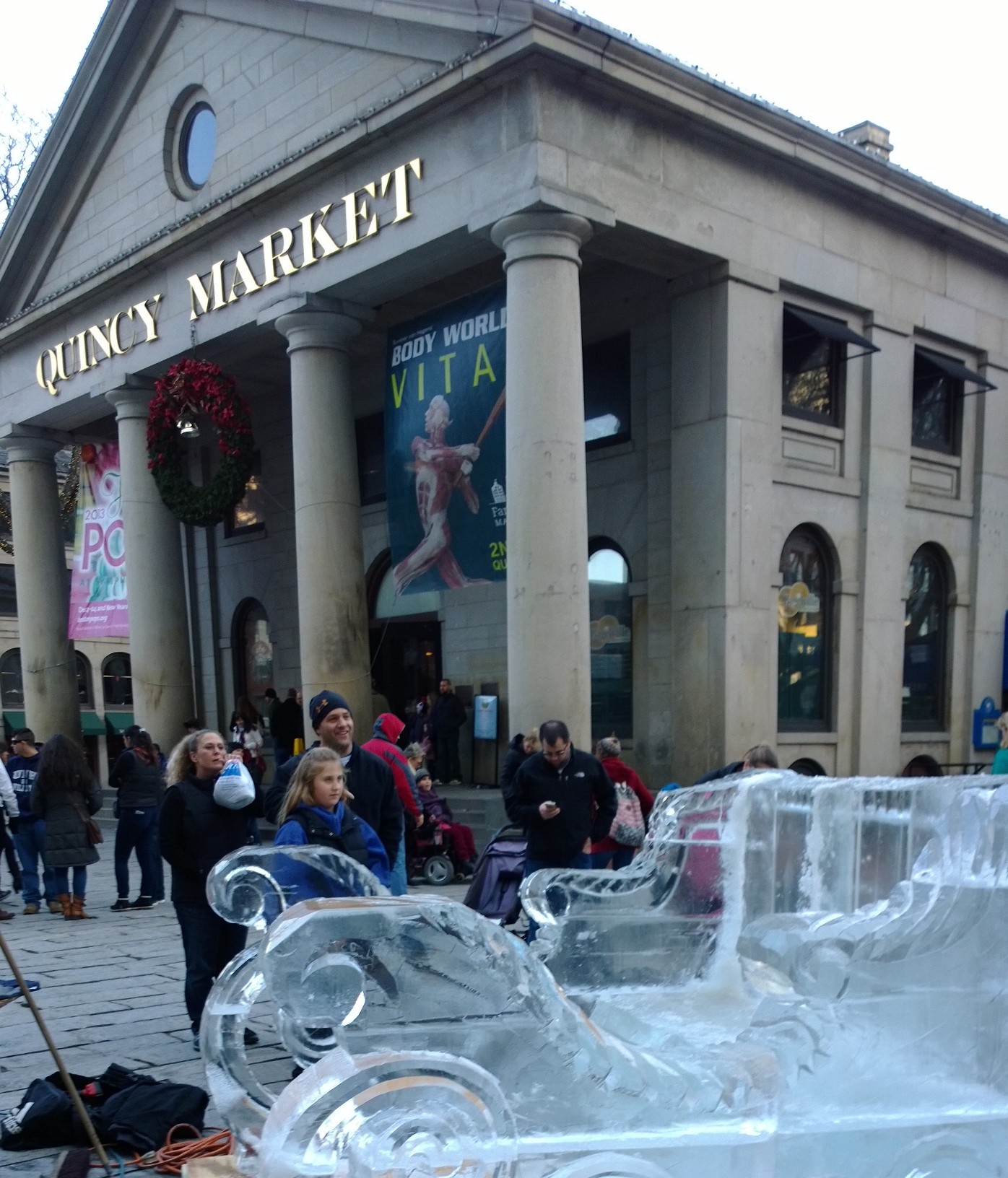
By some accounts, this year will be better than ever — with great bands, two fireworks displays, and ice sculptures in other places besides Copley Square. I happened upon one sculpture in Quincy Market today, where I also saw a woman making balloon animals for kids.

For a Monday, there sure were an unusual number of children and babies out and about in the city, not to mention on the subway. I wondered if it was because the children were on vacation or because their parents were. Lots of activities planned for everyone tomorrow, at First Night.

making-balloon-animals-123013

ice-sculpture-Quincy-Market


ice-sculpture-123013


Read Full Post »

My husband passed along word of a TV special on an ecologist interested in the Siberian tiger who joins forces with a remarkable Korean filmmaker.

From the Public Broadcasting website: “Hunted almost to extinction, the last wild Siberian tigers can only be found in the forests of the far eastern Russian frontier—but not easily.

“Ecologist Chris Morgan embarks on a challenge that will fulfill a lifelong dream — to find and film a Siberian tiger living wild and free in these forests. To help him, Morgan turns to Korean filmmaker Sooyong Park, the first individual ever to film Siberian tigers in the wild.

“Park spent more than five years watching and waiting for a glimpse of the elusive creatures, confined sometimes for months in tiny underground pits or 15-foot hides in trees. His technique was unconventional, but produced more than a thousand hours of wild tiger footage that told the story of a three-generation tiger dynasty.

“During their time together, Park teaches Morgan the secrets of tracking tigers—where to look and what to look for in these vast, seemingly uninhabited frozen forests. Eventually, Morgan’s mentor and guide leaves him to his own private quest, and it is up to Morgan to follow the tracks and markings of these giant cats, searching out spots where tigers are prone to hunt, setting up cameras he hopes will also capture a precious image of a wild Siberian tiger.

It must take courage to do pursue these creatures. The local bears are so afraid of Siberian tigers that they hibernate in nests up in trees.

More.

Read Full Post »

Today the public radio program Studio 360 featured a shortened version of a wonderful WNYC documentary about the year 1913. That was the year Stravinsky’s The Rite of Spring was only one of many “shocking” arts events to usher in the modern age.

From the Studio 360 website: “What a year was 1913! In an exhibition in a New York Armory, American viewers confronted Cubism and abstraction for the first time. In Vienna, the audience at a concert of atonal music by Schoenberg and others broke out into a near-riot. And in Paris, Stravinsky and Nijinsky’s new ballet The Rite of Spring burst on stage with inflammatory results.

Culture Shock 1913 tells the stories behind these and other groundbreaking events that year, and goes back to consider what led to this mad, Modernist moment.

” ‘I think in a lot of ways it was just the beginning of a century just of absolute chaos and nightmare, and as so often, the artists heard it and reflected it first,’ notes the critic Tim Page.

“WNYC’s Sara Fishko speaks with thinkers, authors, musicians, art curators, and historians about this unsettling era of sweeping change — and the not-so-subtle ways in which it mirrors our own uncertain age.

“This Studio 360 episode is an abridged version of a one-hour documentary Sara Fishko produced for WNYC.” More here.

I liked how the documentary explains that the shock was derived from artists not wanting to master and perfect what was done in the past or to replicate nature but rather to be different and to focus on structure, taking things apart and putting back again differently. Artists themselves organized the Armory Show, not curators or galleries. They went to Europe, where change was erupting like crazy, and they brought back art never seen in conservative America.

A key takeaway was that when we see something really new we often think it is ugly, as people thought the Eiffel Tower ugly. But once they look and look some more, they begin to like it.

That helps me think about some of the art Asakiyume and I saw yesterday at the Worcester Museum of Art. It sure looked ugly to me, but it’s a good idea to keep an open mind. Asakiyume sets a good example in that department.

(My mother was born in 1913. Perhaps something was in the air that year that can explain her rebellious nature.)

Photograph taken by spDuchamp/flickr
Marcel Duchamp’s NudeDescending a Staircase, No. 2, was featured in the landmark Armory Show and outraged most visitors because she wasn’t reclining like traditional nudes and she was in motion and it was hard to see her.

Read Full Post »

« Newer Posts - Older Posts »