Feeds:
Posts
Comments

Posts Tagged ‘postaday’

Brian sent me information about Higher Ground Farm, which is putting down roots on the roof of the Design Center in South Boston.

“A roof farm is a type of green roof. A green roof is a system of layers that is laid over an existing roof. A green roof is beneficial to a building owner and the community because it protects the existing roof, doubling to tripling its life, thereby saving money and keeping materials out of the landfill.

“Green roofs also reduce a building’s energy costs by insulating in the winter and cooling the rooftop in the summer. Finally, green roofs temper the effects of two common urban environmental problems – combined sewer overflow and the urban heat island effect.

“A series of roof farms throughout the city will capitalize on the environmental benefits of green roofs while also increasing access to fresh, healthy food. Higher Ground Farm will operate several roof farms throughout the greater Boston area, utilizing previously unused space while providing additional rental revenue to a building owner.

“Roof agriculture has the potential to be a job-producing boost to the economy, and a completely environmentally sustainable business sector that can set Boston apart from other cities. Higher Ground Farm will utilize the resources of our top-notch universities to study roof agriculture, which will position Boston as a leader in the field. Finally, Higher Ground Farm will be a space where our community can reconnect to productive green space and learn about sustainable city planning.” More.

I also found a video interview about it that you will like, here.

Read Full Post »

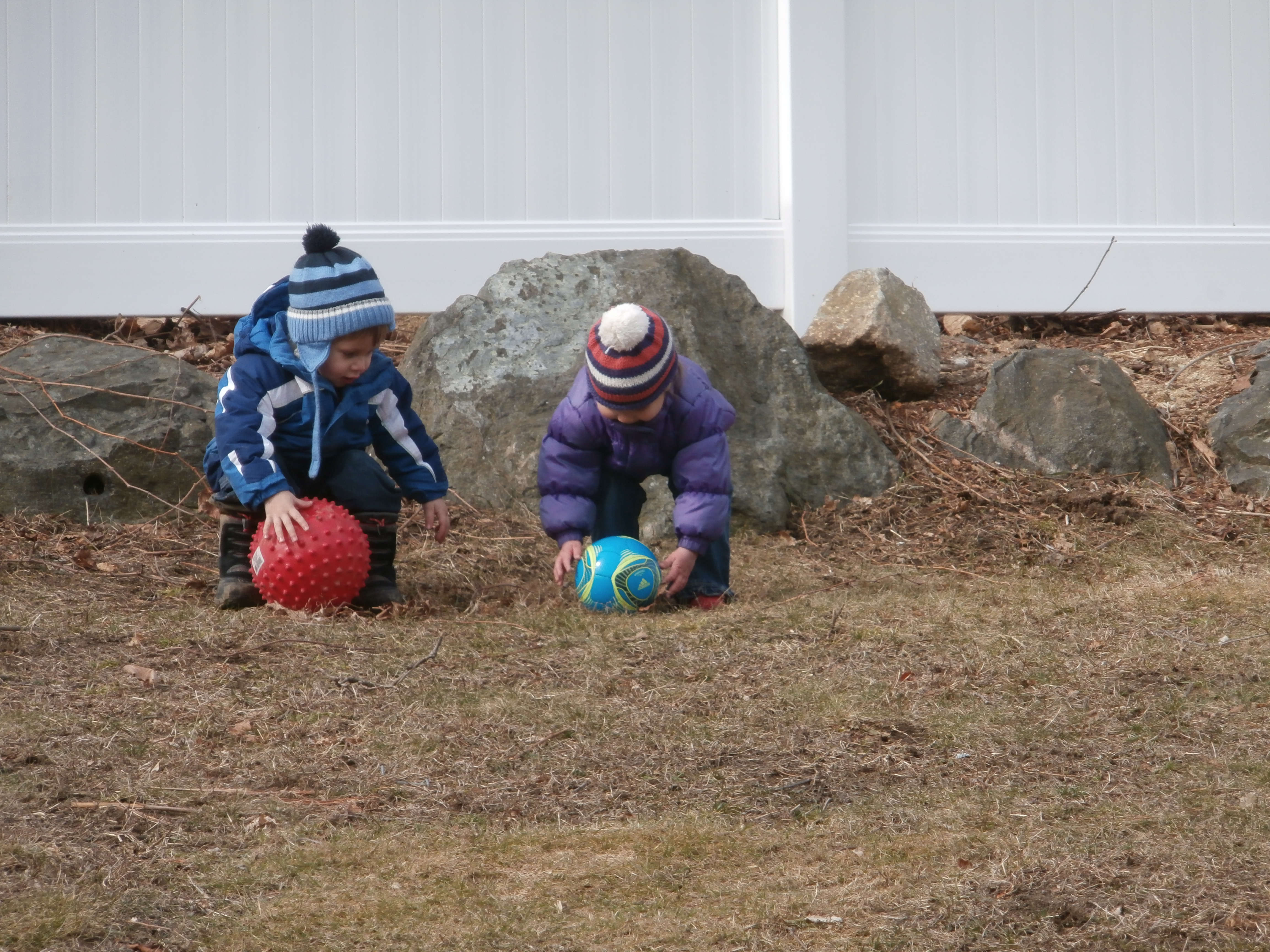
At around age 2-1/2, small people begin to be ready for friendship. My almost-three-years grandson plays with his friend now, instead of just in the same space.

They understand each other’s words. They find the same things funny — leaning way, way back on the swing, climbing back up the chute of the double slide, feeding wood chips to mitten puppets, getting ready to kick the ball down the hill when suddenly it decides to go ahead without you.

I spent a little time Saturday morning with my grandson, his friend, and her mother. I told the mother how much I love the learning-language stage. She agreed and gave me an example of how it can be confusing when one word has two meanings.

She said she had told her daughter that the new baby brother had no teeth you could see but that the teeth were in his gums. Sometime later, when her daughter asked what she was chewing and she answered that she was chewing “gum,” the little girl thought her baby brother’s teeth must be in there.

Two and a half is a time so full of strange new things, she probably didn’t think it was any stranger than anything else.

A WordPress blogger in Australia [subsequent correction: not Australia but B.C Canada in the Okanagan] has another cute story, here.

Hungry mitten puppets

get ready to kick

the ball got away

casting light, not shadow

Read Full Post »

Facebook can be annoying, but I guess it does sometimes pay to be on it.

After “liking” a number of my cousin Sally Frank’s nature photos and art over the years, I finally figured out via Facebook that much of her work is on a WordPress blog — and she has had the blog longer than I have had this one.

Trees are a specialty. Often she will start with a photograph like the one below for inspiration. She then turns to printmaking, which you can learn about at her blog.

“Ms. Frank uses centuries-old printmaking techniques like etching and aquatint on copper plates, as well as innovative methods like solarplate intaglio. She says that although her work is grounded in drawing, she finds the unpredictable nature of printmaking inspirational and exciting.” More.

This photo reminds me of the strangler fig that I saw years ago in Costa Rica, a tree that wraps itself around a host and literally loves it to death. The host tree crumbles, and only the strangler is left — with an empty space inside.

Sally’s photo probably has a happier story — perhaps a nymph turned into a tree to escape danger.

Photo called “bound”: Sally Frank

Read Full Post »

According to wikipedia, “The term chimera has come to describe any mythical or fictional animal with parts taken from various animals.” Which explains why it has been appropriated in genetics where it relates to the phenomenon of different creatures sharing T-cells.

Anyway, I have a brother who studies chimerism and its potential application for organ-transplant retention. I may not have this quite right, but I think if you could have enough of the cells of an organ donor in you when you get a transplant, you wouldn’t need to take antirejection drugs.

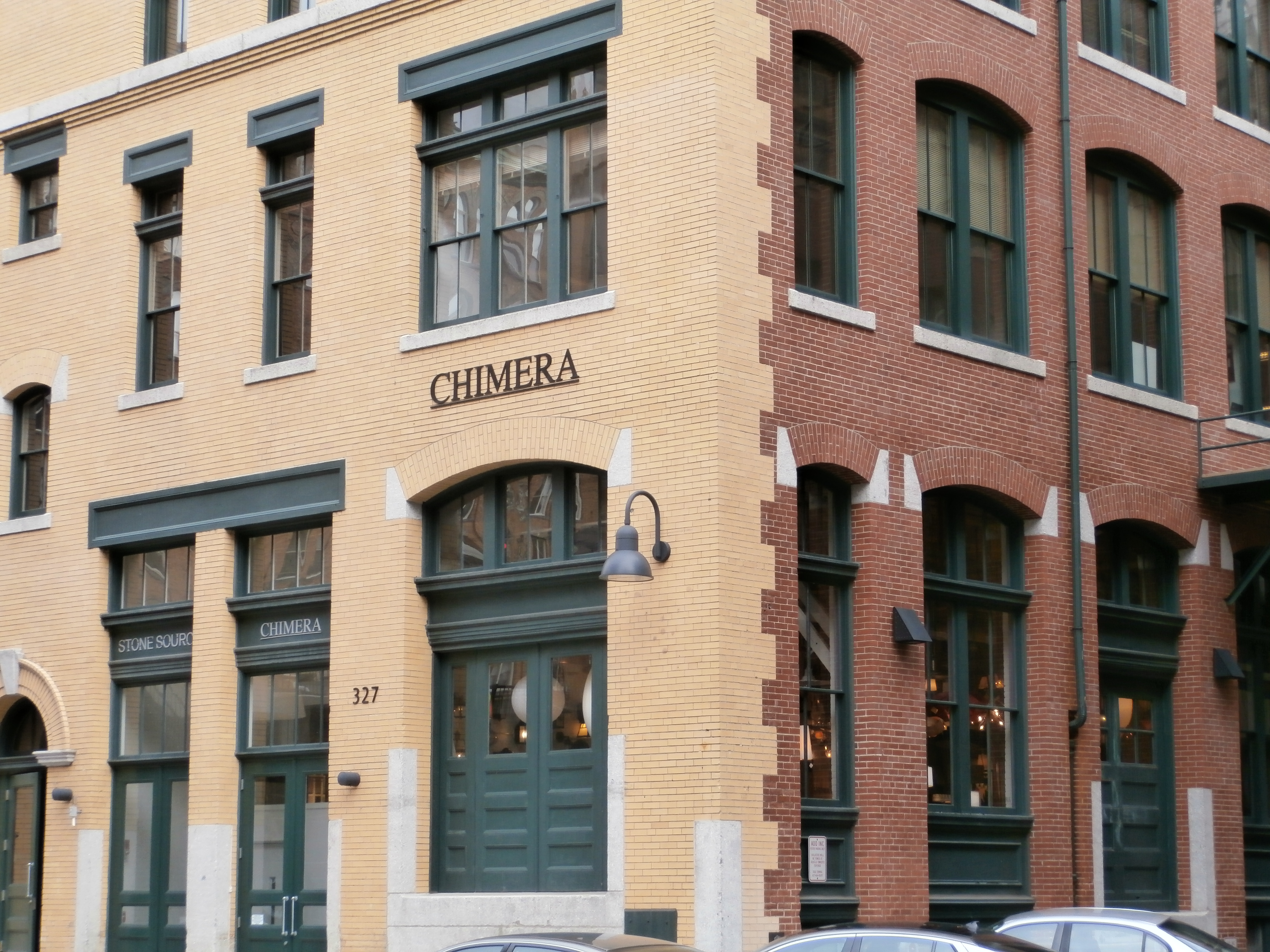
I had been trying to explain this to people when I decided to go out for a walk in Fort Point Channel. Eerily, this sign greeted me.

chimera

I think it’s an eclectic gift shop or interior decorator business.

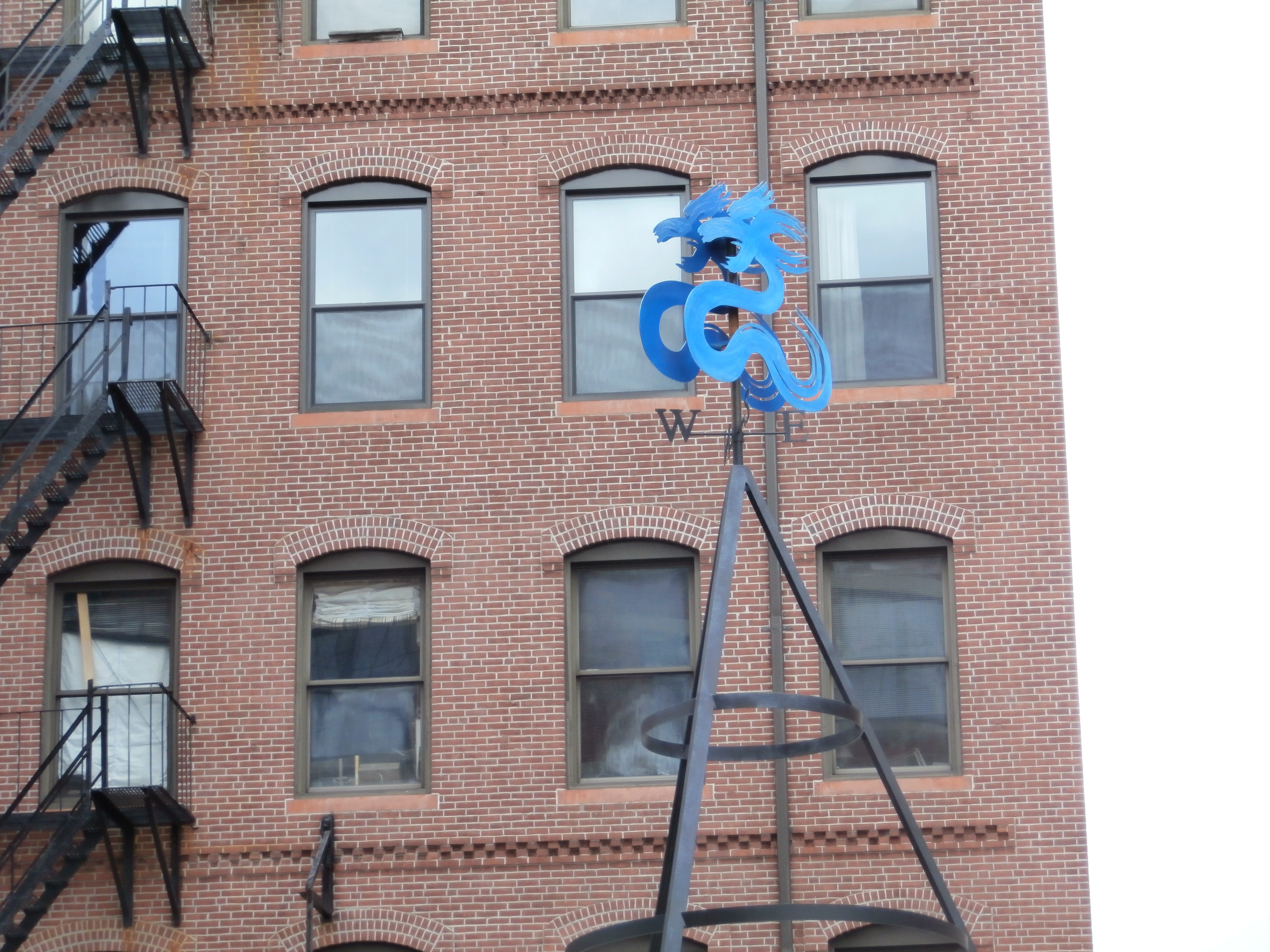
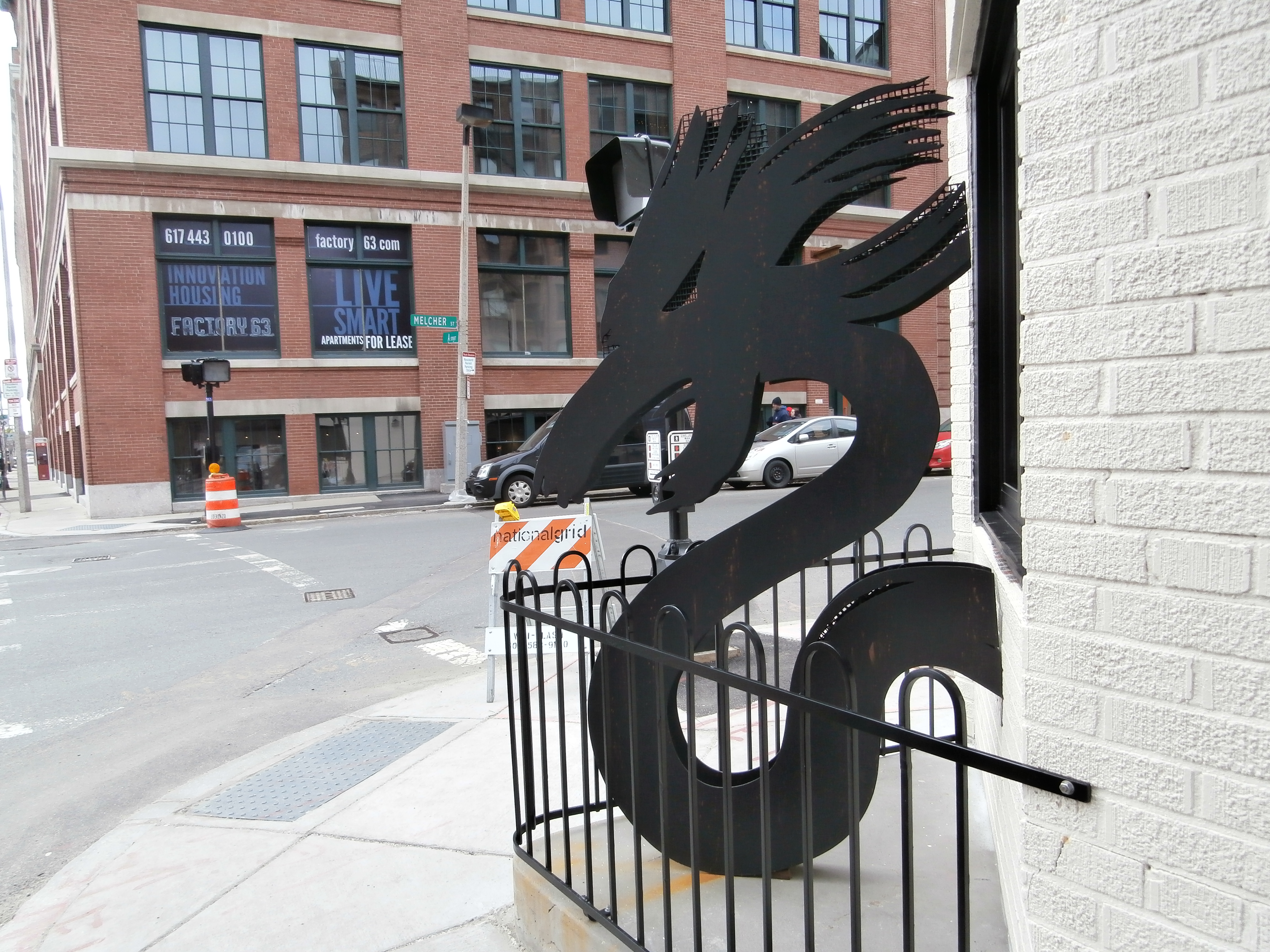
Other signs and portents on the same walk related to Suzanne and Erik’s Year of the Dragon baby.

dragon on roof

dragon sculpture in fort point

Who is the dragon artist? I need to know more.

Read Full Post »

I was thinking about houses this past weekend.

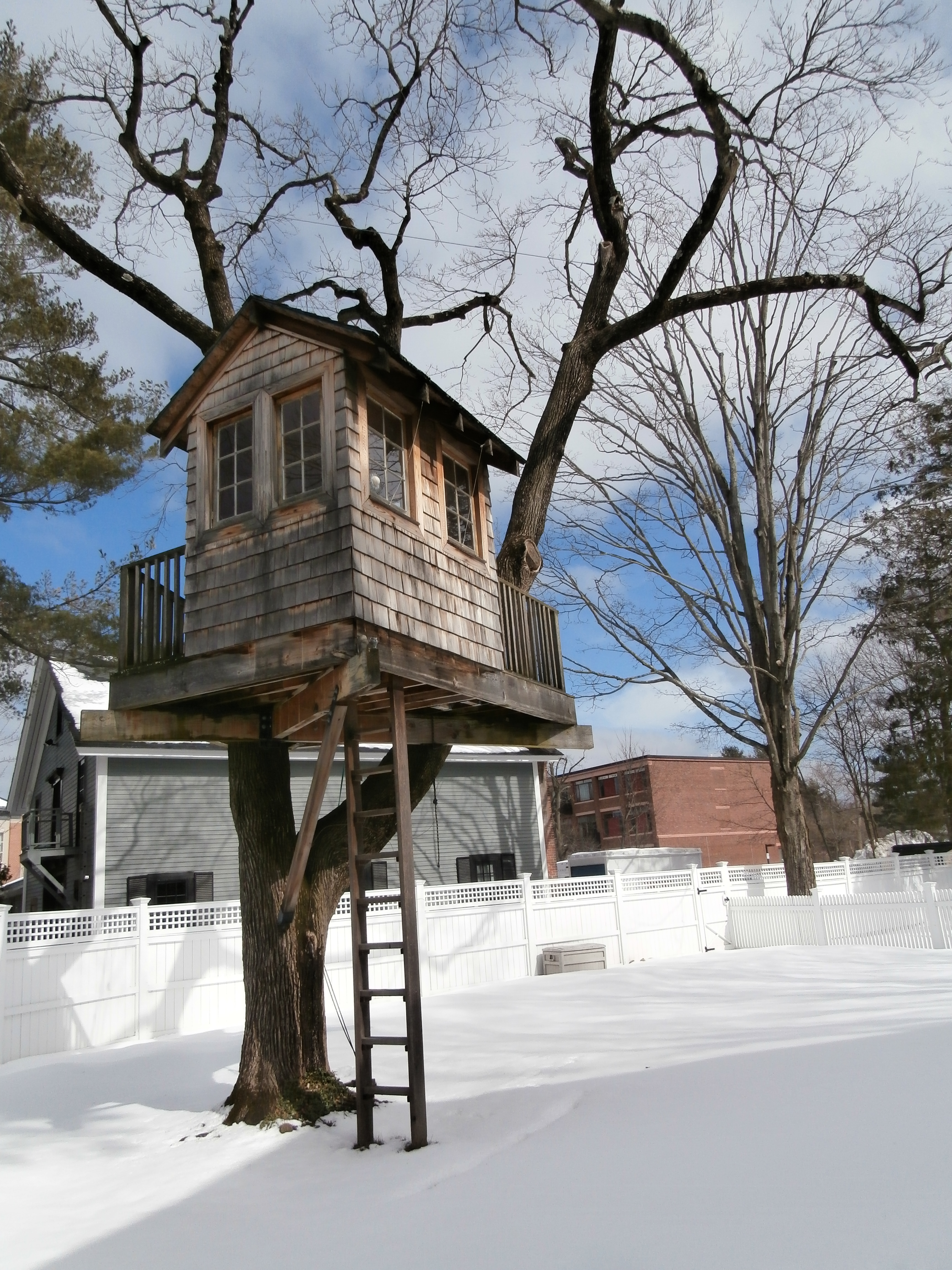
First, there is this house on the grounds of a private school near where I live. I snapped it on my walk.

Concord Academy Treehouse

Second, there is this house on a Hudson River Estate falling down around the ears of the latest, impecunious generation.

Photo of Rokeby, a 43-room house on the Hudson River, by Piotr Redlinski for The New York Times. New York Times story here.

Third, there is a tiny house that a Hampshire College student is living in as a senior project.

James Sullivan writes, “As a child, Hampshire College senior Nara Williams hated being told to pick up after herself. This semester, she’s learning to keep things tidy — very tidy.

“For her senior project, she is living in a 130-square-foot house to explore the realities and benefits of living small.

“A few weeks ago, Williams took delivery on a model home used as a showcase for the Tumbleweed Tiny House Co., a leader in the burgeoning ‘small house’ movement. …

“The housing project, Williams said, is her inquiry into ‘viable alternatives’ to the American dream. Blogging about the experience, she is raising questions about property ownership, material goods, consumption, sustainable living, and other issues in an era marked by housing and environmental concerns.”

Read about Rokeby, the Hudson River estate passed down through too many generations, and read about the tiny house, and pray that no one bequeaths you anything like the former. A tree house or a tiny house are what you want if you prefer to own property and not have property own you.

Update: Omigosh, a scathing memoir is just out on what it was like to grow up at Rokeby — reviewed in the Globe, here

Photo: Darren Durlach/Globe Staff
Boston Globe story here.

Read Full Post »

Optics maven Gregg just tweeted this link from Wired‘s GeekMom blog.

In the 2010 entry, Judy Berna writes about discovering a clever artist/inventor called Rufus Butler while working in her local library.

“The whole thing started with a baby board book that joined our collection at the library. …

“When you move the book left to right, the picture actually moves. We took turns playing with it and more than one of us almost went into a trance by its hypnotic movements.  …

“Then [my family and I] found ourselves in an art studio over the weekend, somewhere in the back woods of Massachusetts. Taking up one full window was a display of these amazing ‘moving’ discs. Each was a different picture and each moved in the same way the pictures on the library board books moved. …

“Once I got home I looked up their website, Eye Think.  Eye Think’s founder, Rufus Butler, is an artist, filmmaker, and inventor. He was so fascinated with optical illusions that he began creating these new ways to trick the eye. …

“The spinning circles that caught my eye in the art store are called CiniSpinners and come in an impressive variety of pictures. When you click on the web page picture, a moving sample pops up. There’s a little girl skipping rope. And fingers playing a piano. …

“Many animals are represented too. A dragonfly hovers, a dolphin frolics in the water. An adorable penguin waddles to and fro. My nine year old and I had to click on every single one, just to see which one was the best.  (My personal favorite: swimming man, with splashing water and all.)

“(Fun geek fact: After contacting Mr. Butler and sharing my enthusiasm for his products, he admitted that he himself had been the model for the swimming man. His wife videotaped him doing a swimming stroke as he laid across a kitchen chair, then he added the splashing water when he refined the picture in the studio.)” More.

Photo: Eye Think Inc.

Read Full Post »

When you take pretty much the same walk every day, camera in hand, you may have trouble finding new things to photograph. You may look in vain for something different, puzzling, or mysterious.

But there is something to be said for combing the same territory over and over, as scientists are finding from studying the detailed record keeping of Henry David Thoreau.

“ ‘As far as I know, there is more information about the effect of climate change in Concord than any other place in the United States,’ said Richard Primack, a Boston University biologist who calls Concord a living lab for his research. …

Primack, writes Kathleen Burge at the Boston Globe, “has researched how climate change has affected the flowering times of plants, comparing modern data with the information Thoreau collected between 1852 and 1860. Primack and his lab found that for every 1 degree Celsius increase in mean spring temperature, plants bloom about three days earlier. …

“Primack came to his work about a decade ago, when he decided to change the direction of his research. He had been studying the effects of climate change on plants and animals in southeast Asia and decided, instead, to focus on his home state.

“But when he began searching for older records of plant flowering times in the United States, he came up short. Finally, after six months, someone told him about Thoreau’s journals.

“This was kind of a gold mine of data,” Primack said. “As soon as we saw it, we knew it was amazing.” More from the Globe.

Keep an eye open for the upcoming Thoreau exhibit at the Concord Museum April 12 to September 15, described here.

cross over the bridge

Read Full Post »

A library seed program, described by Luke Runyon at National Public Radio,  reminds me of the sharing concept behind Heifer Project International (if you are given a chicken or a rabbit or a calf, you must give some of the offspring to another person in need).

“In a corner of the library, Stephanie Syson and her 4-year-old daughter, Gray, are just finishing a book with a white rabbit on the cover.

“When Gray approaches the knee-high shelves filled with seed packets, she zeroes in on a pack labeled ‘rainbow carrots.’

” ‘We just read two books with bunnies in them, so we’ve got bunnies on the brain,’ Syson says.

“Syson flips through a wicker bin labeled ‘carrots’ and offers other varieties to Gray, like ‘atomic red’ and ‘cosmic purple.’

“Here’s how it works: A library card gets you a packet of seeds. You then grow the fruits and vegetables, harvest the new seeds from the biggest and best, and return those seeds so the library can lend them out to others. …

“The library’s director, Barbara Milnor, says in the age of digital, downloadable books and magazines, the tangible seed packets are another way to draw people in.

” ‘You have to be fleet of foot if you’re going to stay relevant, and that’s what the big problem is with a lot of libraries, is relevancy,’ she says.

“Milnor says that while a library may seem like an odd location for a project like this, seeds and plants should be open to everyone. That makes a public library the perfect home for a seed collection.” More.

The sharing aspect is what stands out to me. Remember the post about Hebden Bridge in England and how people were planting in random bits of land and making the produce to free to anyone? Check that out, too.

4/7/13 Update: A similar effort in Concord, http://www.concordseedlendinglibrary.org.

Photograph: Dylan Johns
The seed library is a partnership between the Basalt Public Library and the Central Rocky Mountain Permaculture Institute. Seed packets encourage gardeners to write their names and take credit for their harvested seeds.

Read Full Post »

I learned something new about gratitude today.

It seems that years ago the people of Boston sent emergency aid to Nova Scotia, and now every November, Nova Scotia sends Boston a Christmas tree.

Geoffrey Agombar writes in Canada’s Annapolis County Spectator, “All Nova Scotians are familiar with the legend of Boston’s speedy and heroic support when just week’s before Christmas 1917 two ships collided in Halifax Harbour leaving 2000 dead, thousands injured, and flattening surrounding buildings. Every year since 1971, Nova Scotia has sent a big thank you card to the city in the form of a 12-16 metre tall Christmas Tree.” More.

Canada Online has a story by Susan Munroe: “For more than 40 years it’s been a Christmas tradition for the province of Nova Scotia to ship one of its biggest and best Christmas trees to Boston to thank the people of Boston for the emergency assistance they provided after the Halifax Explosion in 1917. Relief from Boston was the first to arrive the day after the horrendous explosion which killed 1,900 people and wounded another 9,000. The New Englanders were also the last to leave.

“The 2012 Christmas tree is a 70-year-old, 15-metre (50-foot) white spruce donated by Paul and Jan Hicks from Jordan Bay, Shelburne County, Nova Scotia. On November 13, hundreds of children from local elementary schools attended the Christmas tree cutting ceremony, where Nova Scotia storyteller Bruce Nunn read from his book Buddy the Bluenose Reindeer and the Boston Christmas Tree Adventure.

“The tree was loaded onto a flatbed truck and made its way to Boston. It arrived on November 16, and was escorted by the Boston Police Department to the Boston Common where it is being installed. The Christmas tree will be the focal point of the annual Boston Common Tree Lighting Event on November 29. The ceremony will be televised and is expected to draw a live crowd of about 30,000. The ceremony will feature two performances from the Nova Scotian percussion ensemble Squid, and remarks from [a representative of the ailing] Boston Mayor Thomas Menino and the Deputy Premier of Nova Scotia, Frank Corbett. The RCMP and Santa Claus will be on hand, and there will be fireworks too.”

Update 4/20/13 — After the Boston Marathon tragedy, Nova Scotia is making a $50,000 donation to Massachusetts General Hospital. Read.

Photograph: The Spectator

Read Full Post »

Doubtless you know about fairy circles, also called fairy rings. According to Wikipedia, they’re a “naturally occurring ring or arc of mushrooms. The rings may grow to over 10 metres (33 ft) in diameter, and they become stable over time as the fungus grows and seeks food underground.

“They are found mainly in forested areas, but also appear in grasslands or rangelands. Fairy rings are detectable by sporocarps in rings or arcs, as well as by a necrotic zone (dead grass), or a ring of dark green grass. If these manifestations are visible a fairy fungus mycelium is likely to be present in the ring or arc underneath.

“Fairy rings also occupy a prominent place in European folklore as the location of gateways into elfin kingdoms.”

But in Africa, there is a different kind of fairy circle that doesn’t seem to have anything to do with mushrooms.

Did you catch the article by Sindya Bhanoo in the NY Times?

“The grasslands of Namibia — and to a lesser extent its neighbors Angola and South Africa — are speckled with millions of mysterious bare spots called ‘fairy circles,’ their origins unknown.

“Now, a study based on several years of satellite images describes the circles’ life span as they appear, transform over decades, and then eventually disappear.

“Writing in the journal PLoS One, Walter R. Tschinkel, the study’s author and a biologist at Florida State University, reports that the circles can last 24 to 75 years.

“The circles, which range from about 6 to 30 feet in diameter, begin as bare spots on an otherwise continuous grass carpet; after a few years, taller grass starts to grow around the circle’s perimeter.”

The reader is left with the question, Are these circles gateways to elfin kingdoms? What kind of elves are in Namibia?

I don’t understand why scientists don’t investigate matters like that.

Update July 13, 2012: Asakiyume has been tracking down stories about African fairy circles. Read this.

Update March 30, 2013: NY Times has fingered a particular species of sand termites, Psammotermes alloceru. Read this.

Photograph: Walter R. Tschinkel

Read Full Post »

So far this spring I have walked to the office by way of North Station only a few times. But when I did, I got curious seeing people in hard hats working like they had a deadline on a part of the Greenway blocked off by a fence. I peeked in and thought, “What is that? It looks like a labyrinth.”

As someone who tends to think of Theseus, Ariadne, and the Minotaur on
Crete when labyrinths are mentioned, it has taken me a while to realize how many people today use them for meditation. And work being what it is, there will probably come a day soon when I want to test out the possibilities.

The new labyrinth was dedicated on a rainy day this week as part of a lovely Armenian Heritage Park.

Alejandra Matos writes for the Boston Globe, “US Representative Edward Markey and other officials welcomed the rain, calling it tears of joy from generations of Armenians.

“The park, located between the North End and Faneuil Hall, includes a sculpture surrounded by a reflecting pool, and is meant to honor Armenian immigrants to the state. Middlesex Sheriff Peter J. Koutoujian, who is Armenian, said he has been fighting for the park since 1999.

“ ‘This is a gift to the city, not just for the Armenian immigrants. This is a park dedicated to all immigrants who have experienced coming to this great city,’ Koutoujian said.”

The third-largest Armenian population in the United States is in nearby Watertown. Read more at the Globe.

4/8/13 Update: The sculpture gets reconfigured to reflect how immigrants adapt. Check it out here.

Photograph: Aram Boghosian for the Boston Globe

Read Full Post »

Dutch artist Peter Gentenaar makes stunning paper sculptures that Nathaniel Ross at Inhabitat (“design will save the world”) describes as “soaring through the air like flying jellyfish. …

“Peter Gentenaar’s art was born out of the limitations of what he could (or couldn’t) create with store-bought paper. So with the help of the Royal Dutch Paper Factory, he built his own paper factory and devised a custom beater that processes and mills long-fiber paper pulp into the material you see in his artwork. He saw the potential that wet paper had when reinforced with very fine bamboo ribs, and he learned to form the material into anything his imagination would allow.”

Check out the machine Gentenaar uses to create his paper. You can buy one. He describes it thus:

“A machine suitable for beating long fibers, flax, hemp or sisal, as well as for beating soft and short fibers like cotton linters. The machine is built in stainless steel and has a bronze bedplate. The bronze bedplate has the same curve as the knife roll, this gives effective grinding/beating over a surface of: ± 20 x 10 cm. The distance between the roll and the bedplate can be finely adjusted. Also the weight under which the fibers are beaten can be varied from 0 to 60 kilo’s. This means you can use the beater on very delicate fibers and on very strong and rough fibers as well. I never have to cook my fibers. There is a factory guarantee on the beater of one year. At present I’m getting a CE mark, which ensures certain safety standards. There are over 70 beaters of this type sold over the last 12 years and they are all still working.”

Art: Peter Gentenaar

Read Full Post »

Asakiyume has alerted me to a great story about an anonymous library patron in Scotland who creates sculpture from old books and deposits them in libraries by stealth. The artist makes reference in his (her?) sculptures to Scottish mystery writer Ian Rankin and dragons and all sorts of literary things. You will flip over the pictures here.

Asakiyume says she likes the quotations that the mystery artist leaves with the sculptures: “I liked ‘Libraries are expensive,’ corrected to ‘Libraries are expansive,’ and also the quote from Robert Owen … (founder of some utopian communities) … ‘No infant has the power of deciding … by what circumstances (they) shall be surrounded.’ ”

The messages remind me of the mysterious tea cups of Anne Kraus, which I described here.

Now although Asakiyume knew I would love the book art, she may not have known that I have a family reputation for stealth projects, like secretly leaving a small Zimbabwean soapstone sculpture of parents and baby in John’s house after Meran gave birth.

Recently, I was telling Erik about a few of my escapades, and he got a look on his face suggesting that he was a little worried about the family he had married into.

When I was on the publicity committee for a local theater producing a musical about George Seurat, I purchased Seurat greeting cards and left them in stores’ card racks around town. They got sold, but the sales staff would have had to wing the price as there was no price on them.

Then there was the year that I sent a series of postcards from different cities under different names to an ice cream shop and in each card suggested a type of frozen dessert the shop should carry. Every card had a different reason why customers might want that dessert.

It worked, and the shop must have made money off the dessert as they stocked it for years afterward.

Photo: ThisCentralStation.com

Read Full Post »

James is an Irish poet, widely considered part leprechaun. Every few years he comes to stay with his cousins for a couple weeks, across the street from my house. James is on the left in this photo, which I took at the Fourth of July parade.

James has two main modes of conversation: storytelling and poetry recitation. It is a pure delight to chat with him. As we waited for the parade, he narrated pages of Irish history, including dates, and recited from W.B. Yeats and our own Nathaniel Hawthorne, among others.

Earlier, he was sitting on his cousins’ front porch and saw a young woman he knows coming across the street. He was moved by the way she walks, as he told me, and with a kind of poetic spontaneous combustion, intoned on the spot:

Meran, fairest maid art thou,

Lovely is thy stride.

My heart goes out to thee

As ebbs the great sea tide.

But, ah, my kind Meran, I’ll not forget thee.

Nor the kind words you said unto me.

James has self-published a couple books of lore in his unique style. He and his brother, both lifelong bachelors, sell peat. On certain Sundays, James bikes 18 miles to the ruins of an old monastery, where he narrates the history for visitors. Then he bikes 18 miles home. In any kind of weather. James is 73.

Read Full Post »

After a mostly cold and rainy month of May, the sun shone, and there was a lovely warm wind.

But the weather can change again. A surer sign of summer is something that happens outside my office on Tuesdays and Thursdays during the season. So I’m excited that the farmers market returned to Dewey Square today.

There were lots of fresh vegetables and flowers, baked goods (including bread from Maine’s ever popular When Pigs Fly), nuts, prepared foods, preserves, and more. I ended up buying some nice-looking granola. Also a Swedish almond cake because son-in-law Erik is from Sweden, and I am a sucker for pastries said to be Swedish.

The Farmers Market is at one end of the Rose Kennedy Greenway, across from South Station. I wrote about the Greenway a couple days ago, here.

Read Full Post »

« Newer Posts