Feeds:
Posts
Comments

Posts Tagged ‘poverty’

Even if, like me, you never got into the TV show “The Wire,” you may know that it was about a troubled section of Baltimore. You also may be interested in a new school there, intended to serve as a real community gathering place.

New York Times design critic Michael Kimmelman has the story.

“In many ways, public schools are gated communities, dead zones,” writes Kimmelman. “They’re shuttered after dark and during the summer, open to parents and students while in session but not to the larger community.

“A new public school in one of the poorest neighborhoods in East Baltimore wants to challenge the blueprint. Designed by Rob Rogers, of Rogers Partners in New York, Henderson-Hopkins, as it’s called, aspires to be a campus for the whole area — with a community center, library, auditorium and gym — as well as a hub for economic renewal.

“This is the neighborhood where parts of ‘The Wire’ were filmed. In 2000, when the city’s mayor convened local business leaders, the vacancy rate was 70 percent. Poverty was twice the city average. Crime, infant mortality and unemployment were all through the roof.

“The idea that emerged — of making the school the centerpiece of a major redevelopment project — is a grand urban experiment. Operated by Johns Hopkins University in collaboration with Morgan State University, the school, which opened in January, belongs to a $1.8 billion plan that also includes new science and technology buildings, a park, retail development and mixed-income housing. While gentrification might threaten to displace the poor, the school is to be the glue that helps bind the district together.” Read more here.

Photo: Matt Roth for The New York Times
Henderson-Hopkins, which shares its library, gym, auditorium, and other features with the surrounding area, is designed to catalyze change in a blighted section of Baltimore.
 

Read Full Post »

The Christian Science Monitor recently ran a story by Bryan Kay about an ongoing  community service project.

“Not even the recent furlough of federal workers was enough to snuff out the latest community outreach effort of Masjid al Islam mosque in Dallas.

“On a weekend in early October, the mosque was participating in a national initiative known as the Day of Dignity, an annual event during which mosques feed, clothe, and equip people living in poverty. But federal workers who had been scheduled to attend to speak about the details of the Affordable Care Act …  had been forced to cancel because of a partial federal government shutdown.

“It was a blow to the mosque’s boosters, says Muhammad Abdul-Jami, treasurer of Masjid al Islam and coordinator of the Day of Dignity event. But it didn’t deter them from pursuing the same purpose they have had for the last several years, he says: aiding homeless people … .

“Masjid al Islam is in an area where the homeless are a ubiquitous sight. … Because of the great need every weekend, the mosque seeks to do what the Day of Dignity event, organized in conjunction with the national charity Islamic Relief USA, does on an annual basis. Through its Beacon of Light community center, Masjid al Islam feeds approximately 300 individuals in need on Saturdays and Sundays each week, Mr. Abdul-Jami estimates. That’s more than 15,000 meals per year, paid for with donations from individuals and other mosques and served by volunteers, he says. …

” ‘There are millions of Muslims in this country who are very regular people, people who [other] Americans might consider much like them,’ Abdul-Jami says. …  ‘These events help us showcase that we are concerned about the rest of humanity, not just wanting to help Muslims.’ ”

Read more here.

Photo: Walid Ajaj

Read Full Post »

A high-minded concert may be a drop in the bucket when it comes to fighting global poverty, but as you know, I’m a believer in the power of “One and one and 50 make a million.”

In May, James C.McKinley Jr. wrote for the NY Times, “When the Global Poverty Project staged a benefit concert with Neil Young, the Black Keys and Foo Fighters in Central Park last fall, skeptics wondered if that nonprofit’s attempt to generate pressure on world leaders to help the poor would fade as soon as the amplifiers and guitars were put away.

“But this week the charity proved it had won converts, at least within the music industry. More than 70 artists, among them Jay-Z, Beyoncé, Bruce Springsteen, Pearl Jam and Bruno Mars, have pledged to give the project two tickets from each of their concerts over the next year, creating a pool of more than 20,000 tickets.

“The tickets will be used as prizes to encourage people to become involved in causes like fighting poverty in the third world, eradicating polio, building schools and ending famine. To win the tickets, fans are asked to earn points by taking action through a related Web site, globalcitizen.org. They can sign petitions, pledge to volunteer their time as aid workers, write elected leaders or donate money to aid organizations.

“‘It provides us with an opportunity to get really powerful activism worldwide,’ said Hugh Evans, the chief executive of the Global Poverty Project.” More.

Do check out a related post from 2011 on a countertenor who runs Artists for a Cause, a collaboration that provides talent for fundraising events — here.

Photo: Julie Glassberg for The New York Times
Neil Young with Crazy Horse performing in Central Park in September 2012 in a benefit concert for the Global Poverty Project.

Read Full Post »

You have heard of Let Us Now Praise Famous Men, the Depression era book on poverty in the South by James Agee and photographer Walker Evans. The forerunner was an article assigned by Fortune magazine to a young Agee but never published. This past Tuesday it was published as a book.

There are a couple aspacts to Christine Haughney’s NY Times story on the new book that intrigue me. One is the image of a young Agee moved by the plight of the sharecroppers and indignant at the magazine’s apparent exploitation of them.

The other is  how the original subjects, and later, their children, were embarrassed and didn’t want names used, but the grandchildren are able to see the beauty in their forebears.

Writes Haughney, “In 1936 Fortune magazine’s editors assigned a relatively unknown and disgruntled staff writer named James Agee to travel to Alabama for the summer and chronicle the lives of sharecroppers. When Agee returned, he was inspired by the subjects he had met and lived with, but frustrated by the limitations of the magazine format. His subjects, he argued, warranted far more than an article.

“What readers have known for decades is that Agee used his reporting material to create his 1941 book, Let Us Now Praise Famous Men, a literary description of abject poverty in the South, accompanied by starkly haunting Walker Evans photographs.

“The original magazine article was never published, as Agee squabbled with his editors over what he felt was the exploitation and trivialization of destitute American families. In the early pages of Famous Men, he wrote that it was obscene for a commercial enterprise to ‘pry intimately into the lives of an undefended and appallingly damaged group of human beings.’ What readers are about to discover now is what all the fighting was about.

“Melville House [is publishing] Agee’s original, unprinted 30,000-word article in book form, under the title Cotton Tenants: Three Families. The publication gives Agee fans a glimpse of an early draft of what became a seminal work of American literature.

” ‘With the book, we have a much better map of him writing Let Us Now Praise Famous Men,’ said John Summers, who edited Cotton Tenants and printed an excerpt from the article in a literary journal he edits, The Baffler. …

“Irvin Fields, whose grandfather Bud Fields was featured in the book, said he didn’t mind that the names were now being published.

“ ‘It makes me appreciate my relatives for bearing up under those circumstances and making me appreciate what I’ve got today.’ ” More.

A photo by Walker Evans, from “Cotton Tenants: Three Families,” via Library of Congress

Read Full Post »

Take two tomatoes and call me in the morning.

***

The University of South Carolina has developed a manual for health centers that want to collaborate with farmers markets on health, even writing food prescriptions for patients who need to improve their eating habits.

The manual’s authors, Darcy Freedman and Kassandra Alia, write in the intro of their manual:

“Farmers’ markets have grown in popularity in recent years as a place for improving health, increasing economic growth for local agriculture, and building communities. …

“Though the rebirth of farmers’ markets represents an exciting movement in the United States, data reveal that the benefits of farmers’ markets are not evenly distributed. Communities with the greatest need for farmers’ markets, for instance, are least likely to have them.

“In the present manual, we describe an approach for developing a health center‐based farmers’ market. Health centers, in particular federally qualified health centers or FQHCs, were identified as a strategic place to locate farmers’ markets because they may be located in food desert contexts (i.e., low‐income communities with low‐access to healthy food retailers). Additionally, locating at a health center makes an explicit connection between farmers’ market and preventive medicine.” More.

Photo: Aram Boghosian for The Boston Globe

Read Full Post »

Back in first-grade, we learned to read from books featuring invariably blond, blue-eyed children. Today, primers have more variety, but multicultural pleasure reading, where it exists, is not always available to poor children.

Leslie Kaufman wrote recently at the NY Times that a  “nonprofit called First Book, which promotes literacy among children in low-income communities, announced the Stories for All project, a program intended to prod publishers to print more multicultural books. …

“In a 2012 study, the Cooperative Children’s Book Center at the University of Wisconsin-Madison evaluated some 3,600 books, looking for multicultural content. Of the books examined, 3.3 percent were found to be about African-Americans, 2.1 percent were about Asian-Pacific Americans, 1.5 percent were about Latinos and 0.6 percent were about American Indians.” More.

First Book picked two winning publishers in its first Stories for All competition — HarperCollins and Lee & Low Books — and purchased $500,000-worth of books from them. The books “will be available beginning in May through the First Book Marketplace, a website offering deeply discounted books and educational materials exclusively to schools and programs serving kids in need.”

Among the books are:  “Shooter”, Walter Dean Myers (HarperCollins); “Tofu Quilt”, Ching Yueng (Lee & Low Books); “In the Year of the Boar and Jackie Robinson”, Bette Bao Lord (HarperCollins); “The Storyteller’s Candle: La Velita de Los Cuentos”, Lucia Gonzalez (Lee & Low Books); “El Bronx Remembered: A Novella and Stories”, Nicholasa Mohr (HarperCollins); and “Passage to Freedom: The Sugihara Story”, Ken Mochizuki (Lee & Low Books).

More information at FirstBook.org.

Photograph: Strategies for Children

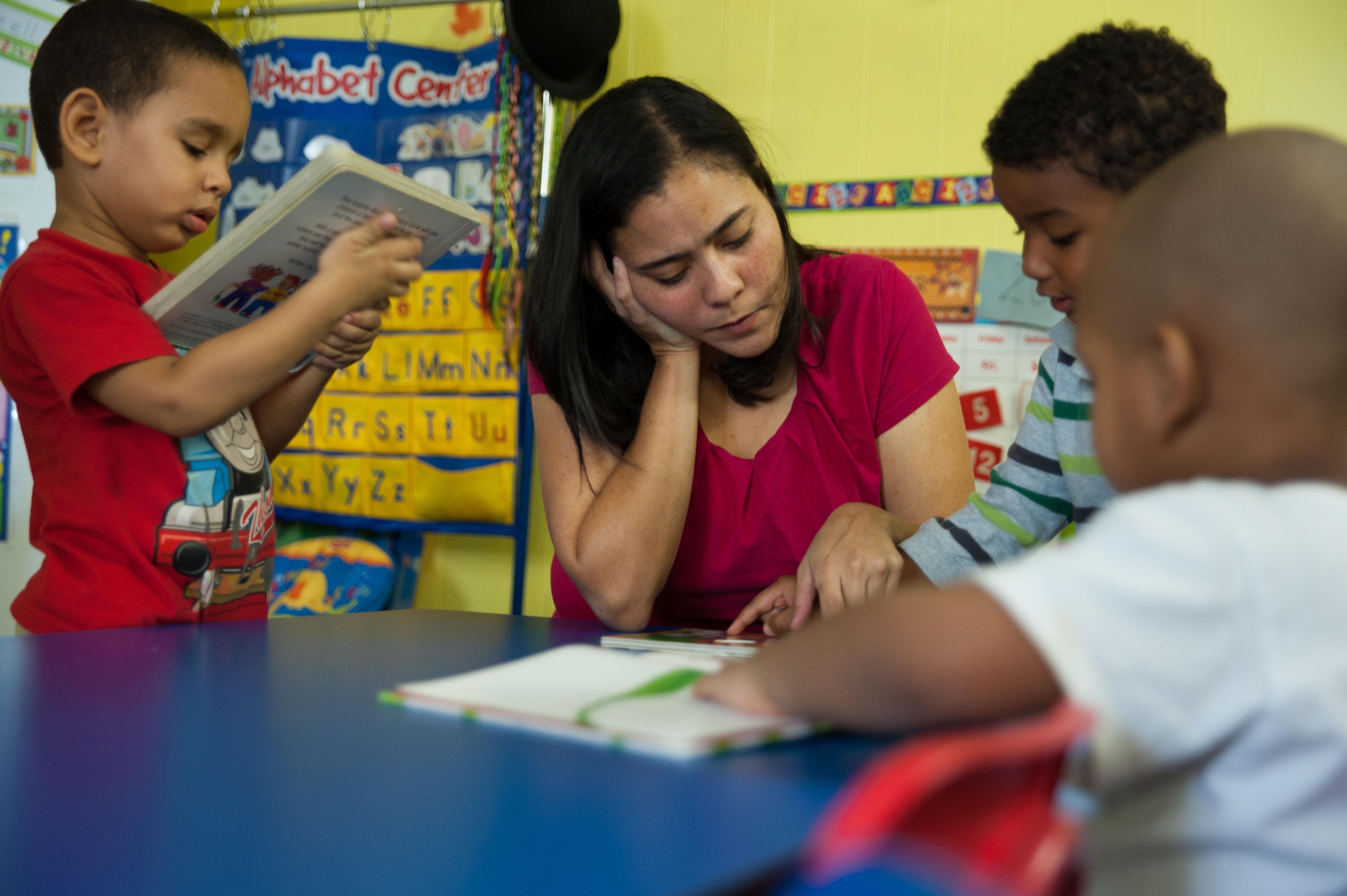
kids--teacher

Read Full Post »

This weekend, having spent special time with both grandsons and a brand-new granddaughter, I have been pretty aware of how much promise children hold.

Not just my grandchildren. All children.

But sometimes children who live in poverty need a boost from the rest of us. Kind of like at christenings when everyone in the congregation says they will help the baby learn and grow even though they don’t know the baby’s family and may not see them again. It’s a symbol that people take all children seriously.

At the Chronicle of Philanthropy, Suzanne Perry writes about the Washington, DC, version of the federal Promise Neighborhoods initiative that takes the nation’s responsibility toward children very seriously.

“The D.C. Promise Neighborhood Initiative, one of the country’s premier efforts to lift children out of poverty by offering a comprehensive array of educational and social services, has won a five-year, $25-million federal grant to step up its work.

“The grant, one of just seven of its kind that the Education Department awarded last month, was an especially sweet victory for the Washington project, which is working to turn around the city’s Parkside-Kenilworth neighborhood. Last year, it failed to win a similar award because it missed the application deadline due to technical problems it faced when e-mailing its proposal.

“This time, the group’s leaders left no stone unturned to ensure the application met all of the federal agency’s specifications, says Ayris Scales, the executive director—who now calls the project ‘the comeback kid’ and says she feels like ‘Cinderella at the ball.’

“The Washington effort is among dozens across the country that are following an approach pioneered by Geoffrey Canada, founder of Harlem Children’s Zone, which involves marshaling schools, nonprofits, and other community organizations to help children in troubled neighborhoods from ‘cradle to college.’ ” More.

By the way, I blogged about Geoffrey Canada and the movie on Harlem Children’s Zone, Waiting for Superman, a couple years ago, here.

Photograph: Cliff Owen/AP/File
A three-year-old pre-kindergarten student practices drawing spirals during a class at Powell Elementary School in Washington, DC. The DC Promise Neighborhood Initiative offers ‘cradle to college’ help to children in the nation’s capital.

Read Full Post »

Global Envision is part of an effort at the nonprofit Mercy Corps “to foster a richer conversation about global poverty.”

Last fall, Global Envision’s Erin Butler set off to investigate technologies that help schools in impoverished parts of of the world.

“For some students, hopping on the school bus is hopping into the classroom. Four communities are using solar-powered mobile classrooms to overcome inaccessibility to the power grid.

“Last week,” writes Butler, “we looked at a bus in Chitradurga, India, that brought modern computer technology to students in energy-poor rural schools through solar power. SELCO, a private energy company, engineered the bus with 400 watts of solar modules, 10 laptops, fans, and lights.

“Circumventing the area’s erratic power supply with its solar panels, this bus provides much-needed modern computer education and exposure to the advantages of solar energy. Motoring through rural villages in Chitradurga since January 2012, the bus has reached ’60 schools and 2,081 children,’ the New Indian Express reported in early September. …

“Where there’s more water than land, boats replace buses, and with rising sea levels, low-income Bangladeshi students have difficulty getting to school altogether.

“Pushed to inaccessible riverside settlements that lack basic infrastructure, students often can’t get to school due to monsoon flooding. Shidhulai Swanirvar Sangstha, a nonprofit organization started by Mohammed Rezwan, rides the rising tides with his solar-powered floating schools.

“Trained as an architect and personally experienced with soggy school disruptions in Bangladesh, Rezwan rode a brainwave that led him to floating schools. Combining the best of traditional boat design and modern sustainable practices, the organization’s 54 boats have been operating since 2002 and have served over 90,000 families.”

Read about the other solar-powered schools here.

Photograph: Jayanta Shaw/Reuters/File
Students in Kolkata, India, check out their solar sunglasses as they prepare to watch the transit of Venus across the sun. The sun is being harnessed in India and Africa to power mobile solar classrooms for students.

Read Full Post »

I was pushing the stroller this morning, singing the old Thanksgiving hymns (“Come Ye Thankful People,” “We Gather Together,” “We Plow the Fields and Scatter the Good Seed on the Ground”) and thinking of harvests.

So today might be a good time to blog about harvests and drought-resistant crops.

“Scientists are developing faster-maturing and drought-tolerant varieties of corn and cotton,” writes Madalitso Mwando at AlertNet, “holding out the hope of much-needed relief for thousands of farmers across Zimbabwe.

“As planting season approaches amid concerns about successive poor harvests, research into drought-resistant seeds is gaining momentum …

“Zimbabwean farmers have suffered a succession of poor harvests with yields far below what the country needs, forcing the agriculture ministry repeatedly to revise its projections for harvests.

“Farmers and their unions blame the cyclical uncertainties of their sector not only on a lack of up-to-date farming technology, but also on their inability to obtain seed varieties that can survive the low rainfall caused by climatic shifts.

“The Scientific and Industrial Research and Development Centre (SIRDC), in partnership with the University of Zimbabwe and Biotechnology Research Institute (BRI), has developed a drought-resistant variety of maize (corn) seed called Sirdamaize 113.

“Farmers have had to wait between 150 and 180 days before harvesting their traditional maize crop, but the center says the new seed takes only 136 days to mature.” Read more.

I hope a bountiful harvest was represented at your dinner table today.

With gratitude to blog readers for reading,
Suzanne’s Mom

Photograph: Philimon Bulawayo/Reuters/File
Martha Mafa, a subsistence farmer, stacks her crop of maize (corn) in Chivi, about 378km (235 miles) southeast of the Zimbabwean capital of Harare.


Read Full Post »

Today I want to highlight Taylor Barnes’s story in the Christian Science Monitor about the transformative effect of volleyball among poor Brazilian children.

But first an admission that the topic of volleyball reminds me (incongruously) of the movie A Thousand Clowns, in which an out-of-work writer goes around New York City fulfilling lifetime ambitions such as  standing on Park Avenue at dawn and hollering, “All right, all you rich people; everybody out in the street for volleyball.”

OK. Got that off my chest. Back to Brazil.

“Roberto Bosch’s volleyball school was getting nowhere,” writes Barnes. “Then he invited kids from the slums to join for free.

“The gangly [Bosch] joined his first volleyball club at age 12; before he was old enough to drive, he was already under contract and being paid for playing the sport. In college, Betinho, as he is known [in Rio], dropped out of his classes in economics to travel with a professional team. When he competed in the youth world championships in Italy at age 20, he was considered the best player on earth.

“But health concerns made him leave pro volleyball just as his peers were graduating from college. Soon he found he was struggling to find a new direction for his life. …

“His wife suggested he start his own volleyball school.

” ‘Given that I was really depressed, really low at the time, I didn’t think I was capable’ of running a school,’ he says. Still, he set up a volleyball court on Rio de Janeiro’s glamorous, celebrity-studded Leblon Beach.

” ‘In the beginning, it was one old net, three old balls, and one student, which was my wife,’ he recalls. …

“Then Betinho had an idea … Why not go to the public schools and offer volleyball lessons to students free of charge?”

Students from the favelas and shantytowns jumped at the chance. As the school’s reputation grew, wealthy children signed up, too. Volleyball became the great leveler in Rio. And Betinho found a purpose in life, better than the first.

More here.

Photograph: Jimmy Chalk
Roberto Bosch teaches beach volleyball on Leblon Beach in Rio de Janeiro. His students come from both local slums and wealthy neighborhoods.

Read Full Post »

I’ve been meaning to blog about the wildly successful music-education program out of Venezuela, El Sistema.

Here music critic Mark Swed follows the L.A. Philharmonic to Caracas and writes about El Sistema for the Los Angeles Times.

“Musically, Venezuela is like no other place on Earth. Along with baseball and beauty pageants, classical music is one of the country’s greatest passions.

“In the capital, Caracas, superstar Venezuelan conductor Gustavo Dudamel is mobbed wherever he goes. Classical music teeny-boppers run up to him for autographs when he walks off the podium at concerts. The state-run music education program, which is known as El Sistema and from which Dudamel emerged, is the most extensive, admired and increasingly imitated in the world. One of its nearly 300 music schools for children, or núcleos, is deep in the Venezuelan Amazon, reachable only by boat. …

“The basic tenet of José Antonio Abreu, the revered founder of El Sistema, is the universal aspect of music. He likes to say that music is a human right. That’s an effective, politically expedient slogan. But what he has demonstrated on a greater scale than ever before is that music is not so much a right as a given. El Sistema is not about talent, ingeniously effective system though it may be for discovering and fostering musical talent. The truly revolutionary aspect of El Sistema is its proof that everyone has a capacity for music.”

Read about how El Sistema has spread worldwide in the Los Angeles Times.

Children at La Rinconada in Caracas, Venezuela, Feb. 14, 2012. Gustavo Dudamel, right, among students at a showcase of El Sistema in Caracas, Venezuela, Feb. 15. Photograph: Mark Swed / Los Angeles Times

Read Full Post »

Pamela Boykoff at CNN has a nice story about a ballet school in the Philippines and the hope it offers children from very poor families.

“Jessa Balote is 14-years-old and training to be a professional ballerina in Manila,” writes Boykoff.

“It is a task that takes enormous amounts of dedication for even the most determined of young women, but Balote’s challenge is nothing compared to life outside the dance studio where she has to support her entire family.

” ‘I’m the only one they expect to bring the family out of poverty,’ she says.

“Balote is one of 54 students enrolled in ‘Project Ballet Futures,’ a program run by Ballet Manila to provide free ballet training to children from some of the city’s most deprived neighborhoods.

“Balote lives in Tondo, a slum built next to a major waste dump in Manila. Her parents make what little money they have by selling trash. If Balote was not involved in the dance program, she says she wouldn’t be able to eat everyday.

” ‘They want to earn money to be able to survive,’ says Lisa Macuja-Elizalde, founder of the program and the Philippines’ first prima ballerina. She believes in her students, personally paying for their lessons and uniforms.

“Macuja-Elizalde’s goal is to help these children become professional members of the company with incomes to match. They are among her most focused students, she says, not afraid to work hard and to push themselves and their bodies.”

Read more.

Photograph: CNN

Read Full Post »

The other day John brought up the topic of Andrew Carnegie. Whatever else might be said about this 19th Century steel baron, you have to give him credit for putting so much of his fortune into philanthropy, especially libraries.

Today John Wood is carrying on that work in impoverished countries around the world. As Nicholas Kristof writes in the NY Times, “Wood’s charity, Room to Read, has opened 12,000 … libraries around the world, along with 1,500 schools. …

“He has opened nearly five times as many libraries as Carnegie, even if his are mostly single-room affairs that look nothing like the grand Carnegie libraries. Room to Read is one of America’s fastest-growing charities and is now opening new libraries at an astonishing clip of six a day. …

“He also runs Room to Read with an aggressive businesslike efficiency that he learned at Microsoft, attacking illiteracy as if it were Netscape. He tells supporters that they aren’t donating to charity but making an investment: Where can you get more bang for the buck than starting a library for $5,000? …

“ ‘In 20 years,’ Wood told me, ‘I’d like to have 100,000 libraries, reaching 50 million kids. Our 50-year goal is to reverse the notion that any child can be told “you were born in the wrong place at the wrong time and so you will not get educated.” ‘ ” Read more.

Photograph of John Wood: Room to Read

Read Full Post »

A while back I watched the movie The Little Red Truck, a documentary by producer Pam Voth and director Rob Whitehair highlighting the work of the Missoula Children’s Theatre. It was a moving experience.

The Missoula (Montana) Children’s Theatre travels by truck from city to city all over America to put on productions with children in low-income urban and rural areas. The transformation of some of these children in the week it takes to produce a full-scale, one-hour musical is something to see, with many insecure children discovering talents that no one, including the children themselves, knew they had.

For kids who have never seen a play and have no place to rehearse — nor any props or costumes or sets other than what the theater company can pack into the truck —  putting on a production seems unimaginable.

As the movie unfolds, you see how doing the unimaginable builds self-confidence, and generates both laughter and ideas about possible futures. It’s not about growing up to be actors. It’s about seeing that there are options, and starting to think differently.

And in case anyone is more interested in the academic skills boosted through theater, this Education Week article makes that case. Not a bad case to be made, but it’s the magic of Queen Mab that speaks to me.

Read Full Post »

A reason that poor children are sometimes unprepared for school is that the words they are starting to read in books may not convey meaning to them. What does it mean to park a car if you have never ridden in a car?

The NY Times has a lovely article about one NYC school’s unusual field trips, designed to fill some gaps in knowledge that textbook writers take for granted.

Michael Winerip writes, “Experiences that are routine in middle-class homes are not for P.S. 142 children. When Dao Krings, a second-grade teacher, asked her students recently how many had never been inside a car, several, including Tyler Rodriguez, raised their hands. ‘I’ve been inside a bus,’ Tyler said. ‘Does that count?’

“When a new shipment of books arrives, Rhonda Levy, the principal, frets. Reading with comprehension assumes a shared prior knowledge, and cars are not the only gap at P.S. 142. Many of the children have never been to a zoo or to New Jersey. Some think the emergency room of New York Downtown Hospital is the doctor’s office. …

“Working with Renée Dinnerstein, an early childhood specialist, [Ms. Levy] has made real life experiences the center of academic lessons, in hopes of improving reading and math skills by broadening children’s frames of reference.

“The goal is to make learning more fun for younger children. … While many schools have removed stations for play from kindergarten, Ms. Levy has added them in first and second grades. [And] several times a month they take what are known as field trips to the sidewalk. In early February the second graders went around the block to study Muni-Meters and parking signs. They learned new vocabulary words, like ‘parking,’ ‘violations’ and ‘bureau.’ JenLee Zhong calculated that if Ms. Krings put 50 cents in the Muni-Meter and could park for 10 minutes, for 40 minutes she would have to put in $2. They discovered that a sign that says ‘No Standing Any Time’ is not intended for kids like them on the sidewalk.” Read more.

One thinks of all the small daily interactions one has with one’s own children and the learning occurring without forethought. There are interactions and learning in poor families, too, but if the words and concepts are not what they kids will encounter in school, I think these excursions can be very helpful.

Photograph: Librado Romero, NY Times

Read Full Post »

« Newer Posts - Older Posts »