Feeds:
Posts
Comments

Posts Tagged ‘preservation’

Photo: Lancaster Farming

Wish I could remember where I first saw that this Ephrata-based magazine had a story on a farm that I have been driving past for 30-plus years without knowing much about it.

Sarah L. Hamby writes at Lancaster Farming, “Since 1999, the Farrell family has lived and worked at Sunset Farm, transforming nearly 150 acres into a well-known destination for freshly baked pies, heirloom tomatoes, and quality, all-natural meats not just for sale to the public, but also served at dozens of beach-front restaurants.

“Located on a four-lane highway in the south end of Narragansett, a small beach town in Rhode Island with a population that doubles during the summer months, Sunset Farm is one of a kind.

“In 1986, the Narragansett Land Trust was established to preserve open land in the largely developed Rhode Island town. …

“In 1991, historic Sunset Farm, established in 1864, along with Kinney Bungalow, a turn-of-the-century landmark and picturesque spot for weddings, was acquired by the town. … Since 2013, both the farm and bungalow have been on the National Register of Historic Places.

“The farm has been so successful that in 2014 the family signed a 25-year lease with the town of Narragansett. In return for taking care of the farm, the Farrells live rent free, though they do pay utilities. Maintenance and restoration work is part of the job, too, and must be up to historical standards.

“If you ask farmer and landscaper Jeff Farrell why he and his family applied to be caretakers of Sunset Farm, the last working farm in Narragansett, he will answer you with the candor and humor of most who work the land for a living.

“ ‘I lost my mind.’

“Ethan Farrell, who is now 25, has put a marketing degree from Johnson and Wales University to work at Sunset Farm. His phone constantly rings with calls from local restaurants and delivery trucks. … Last July, he started a food truck designed for local festivals and events, bringing his own flare to the farm-to-table movement. …

“The family donates to the local food pantry, supports area events for veterans and charities, and recently introduced gift certificates to increase activity from the local community.”

Read about the challenges of being the only farm in a tourist town at Lancaster Farming, here. And do check out Sunset Farm on Facebook at http://www.facebook.com/SunsetFarm505 — or  at http://www.sunsetfarm1864.com.

Photo: Seth Jacobson
Kinney Bungalow is available for events.

Read Full Post »

A while back, I showed a photo of a very skinny building near my workplace. Now I have some professional photos from the Providence Revolving Fund, and I think they convey the uniqueness of this building better than my photograph.

I love how Providence works so hard to repurpose old and interesting buildings. This one is only a piece of an old building. Once condemned, it is now lovely and functional.

Here’s what the Providence Revolving Fund had to say before the dedication in May. “The partnership of David Stem, Lori Quinn and the Providence Revolving Fund announce the completion of the formerly-condemned George C. Arnold Building (built 1923).  The Providence Redevelopment Agency (PRA) also played a pivotal role in the revitalization of this unique building.

“The mixed-use building houses two commercial units (Momo and a soon-to-be-opened [Asian] market) and three residential units.  Two of the units are rented at affordable prices.  The historic building rehabilitation was self-financed by the partnership and utilized Federal and State Historic Tax Credits and City of Providence Home Funds.”

I’ve noticed that most Providence buildings have names and people use the names, as if the buildings were pets. When you call something by its name, it strengthens your bond to it.

I’ve had the teriyaki chicken crêpe at Momo a couple times. Messy but delicious. I’m eager for the Asian market to open.

skinniest-building-ever

051216-Arnold-Bldg-Prov-Revolving-Fund


051216-Arnold-Bldg-Prov-Revolving-Fund2

051216-Arnold-Bldg-Prov-Revolving-Fund-Momo


Read Full Post »

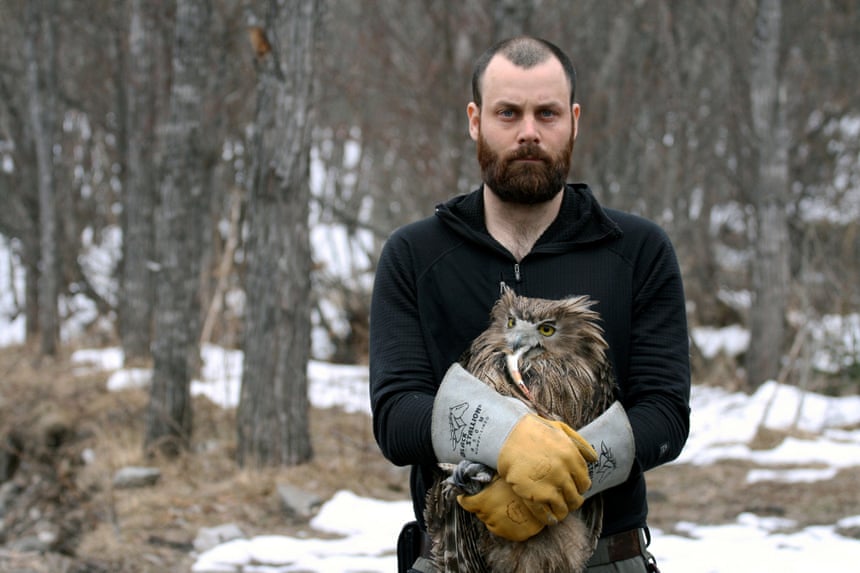
Jeremy Hance has an article at the Guardian on the quest to save from human encroachment a huge — and largely unknown — raptor: Blakiston’s fish owl.

“It’s not easy studying an endangered species few people have ever heard of,” says Hance. “It’s difficult to raise money, build awareness, or quite simply get people to care. But still, Jonathan Slaght – one of the world’s only experts on the massive, salmon-eating, frog-devouring Blakiston’s fish owl – insisted there are upsides. …

“Blakiston’s fish owl is the world’s largest [owl], and in the Russian forests, where Slaght conducts his research, it cohabits with a lot of big names: the Ussuri brown bear, the Amur leopard, the Asiatic black bear and, of course, the grand-daddy of them all, the ever-popular Amur Tiger. …

“Slaght is a project manager with the Wildlife Conservation Society and a co-founder of the Blakiston’s Fish Owl Project along with Russian ornithologist, Sergei Surmach. But his first run-in with a Blakiston’s came in 2001 when he was a Peace Corps volunteer in Russia. At the time, all he knew about the species was from a tattered bird book more than 40 years old, including an ‘inaccurate, terrible illustration of Blakiston’s fish owl. …

“Although an avid birder, Slaght never expected to actually see one of these things. He was told the owl was so rare that even seasoned ornithologists rarely saw it. Yet one day, hiking in the forest with a friend, he had an encounter that changed the course of his life.

“ ‘Something enormous flies away from us and lands close by and it’s just this big owl.’

“He assumed it was a Eurasian eagle owl – which can be found across the entirety of Eurasia, from the coast of Spain to that of Primorye – but took a few photos just in case.

“ ‘My brain wouldn’t believe it was this mythical thing.’ …

“A few weeks later, though, Slaght gets his pictures developed and takes them to a local ornithologist.

“ ‘He says: “don’t show anyone this picture; this is a Blakiston’s fish owl.” ‘

“Slaght … has become one of the foremost experts on the great owls and continues to find them where people thought them vanished.”

Read about other places this rare bird is found (including Hokkaido, where it was once considered a god), here.

Photo: Jonathan C. Slaght/WCS Russia  
Jonathan Slaght holds a Blakiston’s fish owl in his arms. He is one of a handful of researchers studying this massive raptor, which is threatened by human activity.

Read Full Post »

Three cheers for quirky causes that, at a minimum, don’t do any harm and, at best, make a contribution to the world.

Simon Romero recently covered one such cause in the New York Times: “Shigeru Nakayama, the guardian of this ghost city in the Amazon rain forest, gazes at the Rio Negro, a vast blackwater tributary. From some angles, it looks less like a river than a sea, spurring him to remember Japan.

“ ‘Fukuoka got kind of cold during winter,’ said Mr. Nakayama, 66, who left the island of Kyushu in southern Japan with his parents and three brothers in the mid-1960s for a new life in Brazil. ‘We were farming people, trying to get ahead. Japan was reduced to ashes after the war. Life was still tough.’

“ ‘But Brazil was the land of our dreams,’ said Mr. Nakayama, squinting under the punishing midday sun as he leaned his wiry frame against one of the crumbling stone buildings of Airão Velho — a town so overgrown and forlorn it is now held in a labyrinthine embrace of tree roots and vines.”

He has made it his life’s work to “to care for the abandoned outpost. …

“ ‘I’m glad there’s someone taking care of Airão Velho,’ said Victor Leonardi, a historian of Amazonia at the University of Brasília who explored the ruins here in the 1990s. “It smelled of jaguar urine back then, but it was obviously a place of riches at one point, where people dined on porcelain from England and consumed Cognac from France.’ …

“ ‘Japan has turned into a new kind of prosperous country, and I guess that’s good for the people there,’ Mr. Nakayama said. ‘But that kind of life was never in the cards for me.’

“Mr. Nakayama acknowledged that shielding Airão Velho from the encroachment of the jungle was an uphill struggle. A glance around suggests that the strangler figs have the scales tipped in their favor. Amid the ruins, wasps hover; fire ants march; cicadas sing. …

“Nakayama feels the need to clean the graveyard, hacking away at the growth that threatens to devour the site once and for all. ‘For centuries, people lived and died in Airão Velho,’ he said. ‘They were the true pioneers, and I have to honor their memory by preserving this place. It is a matter of respect.’ ”

More here.

Photo: Mauricio Lima for The New York Times
Shigeru Nakayama has made it his life’s work to care for an abandoned outpost in the Amazon jungle.

Read Full Post »

Good news for Letterbox Farm Collective in New York State! The environmental nonprofit Scenic Hudson’s interest in protecting a Hudson River tributary has enabled the young farmers to purchase land.

Scenic Hudson’s Jay Burgess writes, “Scenic Hudson has acquired a conservation easement protecting 62 acres of productive farm fields and watershed lands in Greenport, just south of the City of Hudson. The easement’s purchase enabled a group of young farmers who had been leasing the property to purchase it, securing the future of their farm operations.

“Known as the Letterbox Farm Collective, the farm partners supply specialty vegetables, herbs, pork, poultry, rabbits and eggs to a variety of regional and New York City markets — local bakeries and food trucks, many restaurants (including New York City’s renowned Momofuku restaurants) and two farmers’ markets. In the spring the farmers will launch a diversified Community Supported Agriculture (CSA) operation. …

“ ‘Achieving the goal of Scenic Hudson’s Foodshed Conservation Plan — meeting the growing demand for fresh, local food in the Hudson Valley and New York City — depends on successful partnerships like this, which provides a stable base of operations for the dedicated young farmers in the Letterbox Farm Collective. We also thank these farmers for enabling a future public access point to our protected lands along South Bay Creek, which present exciting opportunities for Hudson residents and visitors to enjoy the outdoors,’ said Steve Rosenberg, executive director of The Scenic Hudson Land Trust. …

“ ‘We were lucky to have Scenic Hudson with us while we gathered our financing and at the closing table when the moment came and we were able to buy our land,” said Letterbox’s Faith Gilbert.” More here.

Thanks to Sandy and Pat for letting me know and congrats to their niece for being successfully launched in farming.

Photo: Nathaniel Nardi-Cyrus

Read Full Post »

Asakiyume put me on to this offer from the nautical museum in Mystic, Connecticut. They have just finished restoring a whaling ship, and the public is invited to apply for the role of stowaway on its first trip.

Now, as we all know, stowaways stow themselves away in secret, against the wishes of the boat’s owners, but the museum has decided to put a new spin on an old concept.

Here’s what the Providence Journal reports: “Mystic Seaport is looking for a stowaway for its restored 19th century whaling ship. Whoever is hired will sail with the Charles W. Morgan ship next summer on visits to ports across New England. The stowaway will receive a stipend and will share the experience through videos and blog posts.

“The museum in Mystic has spent four years restoring the ship that was built in 1841. The Morgan’s last voyage ended in 1921 and is the world’s only surviving wooden whaling ship.

“The ship … will sail with a mission to raise awareness of the importance of protecting the oceans and its species.” More here.

Kind of counterintuitive to use a whaling ship to promote preserving the ocean and its creatures, but I guess no one is going to hunt any whales. Good thing, too. I read Moby You-Know-Who finally in 2010, and I wouldn’t recommend the life aboard ship.

Stowaway entries must be submitted via e-mail to stowaway@mysticseaport.org by 5 p.m. Eastern Standard Time on February 18, 2014. I like the idea that the stowaway is expected to blog about the trip. S/he just better not be prone to seasickness.

Update 5/11/14: Read here how the whaling ship restoration benefited from special timber stored upright in saltwater at Charlestown Navy Yard in Mass. and rediscovered during the construction of Spaulding Rehab.

Photo: Bob Breidenbach/The Providence Journal
Matthew Barnes of Mystic Seaport examines the billet head on the bow of the whaling ship Charles W. Morgan.

Read Full Post »

When I got my current job, I went through the human resources “onboarding” with a young man from Mali. Even though he went back to Africa a couple years ago, we keep in touch. Naturally, I was worried when radicals took over Timbuktu, Mali, for a while. Fortunately, Mamoudou wasn’t living in Mali at the time, although he says Guinea is not that much safer.

Because of Mamoudou, I continue to follow the Mali news, and was especially interested in a link at the Arts Journal blog today: “Mali’s Underground Railroad: How Timbuktu’s Ancient Manuscripts Were Smuggled To Safety.”

Writes Sudarsan Raghavan of the Washington Post, “It was 7 o’clock on a hot night in August, and Hassine Traore was nervous. Behind him were 10 donkeys, each strapped with two large rice bags filled with ancient manuscripts. The bags were covered in plastic to shield them from a light rain.”

Radicals had taken over Timbuktu four months earlier and “had demolished the tombs of Sufi saints. They had beaten up women for not covering their faces and flogged men for smoking or drinking. They most certainly would have burned the manuscripts — nearly 300,000 pages on a variety of subjects, including the teachings of Islam, law, medicine, mathematics and astronomy — housed in public and private libraries across the city.”The scholarly documents depicted Islam as a historically moderate and intellectual religion and were considered cultural treasures  …

“A secret operation had been set in motion … It included donkeys, safe houses and smugglers, all deployed to protect the manuscripts by sneaking them out of town.

“This is the story of how nearly all the documents were saved, based on interviews with an unlikely cast of characters who detailed their roles for the first time. They included Traore, a 30-year-old part-time janitor, and his grandfather, a guard. …

“The New York-based Ford Foundation, the German and Dutch governments, and an Islamic center in Dubai provided most of the funds for the operation, which cost about $1 million.

“ ‘We took a big risk to save our heritage,’ said Abdel Kader Haidara, a prominent preservationist who once loaned 16th- and 18th-century manuscripts from his family’s private collection to the Library of Congress. ‘This is not only the city’s heritage, it is the heritage of all humanity.’ ”

There are heroes everywhere, keeping a low profile. And I am also pretty impressed with the funders, springing into action like that.

More here.
Map: National Geographic

Read Full Post »

I keep a folder of things I want to check out in walking distance of the office. Today I pulled out a Boston Globe article from 2-1/2 years ago, “Depression-era mural gets a second chance to shine,” and set out.

A Stephen Etnier mural of Boston Harbor that had been rolled up and stored away in 1981 was back on display.

Etnier, as Brian Ballou wrote in the Globe, was “one of hundreds of artists across the country picked by the federal government in the late 1930s to early ’40s to depict characteristic scenes of their region in post offices. …

“In early 2005, postal employee Brian Houlihan came across the painting and alerted Dallan Wordekemper, the federal preservation officer for the United States Postal Service. The mural was sent to Parma Conservation in Chicago, which began to restore the artwork in late 2008.”

The restored painting, “Mail for New England,” was unveiled in April 2010, but it took me until today to get to the post office branch at Stuart and Clarendon.

I got an extra bonus, too, because on the way I saw a completely unexpected bit of street art by the famed Gemeos twins, whose work at the ICA and Dewey Square was described in an earlier post.

Read Full Post »

Thousands of languages are becoming extinct as the last of the people who speak them die off.

In a race against time, some determined souls who value the richness and insights that individual languages provide are making efforts to save as many minority languages as possible. We posted about that here.

Today National Public Radio had a feature on another approach to preservation, the Liet International Song Contest.

“Auditions are now underway for next May’s Eurovision Song Contest — that often-ridiculed television spectacle that has drawn millions of viewers around the world every year since 1956. In 2012 the host country will be Azerbaijan, since that country fielded last year’s winner. The show’s performers rely on outlandish costumes, dance moves and gimmicks to grab attention because most viewers can’t understand what they’re singing. But language is at the heart of another Eurovision-sponsored song and performance competition this weekend in Italy. The Liet International Song Contest is a very serious attempt to keep some of the continent’s neglected languages alive.”

Read more.’


Read Full Post »

« Newer Posts