Feeds:
Posts
Comments

Posts Tagged ‘ptsd’

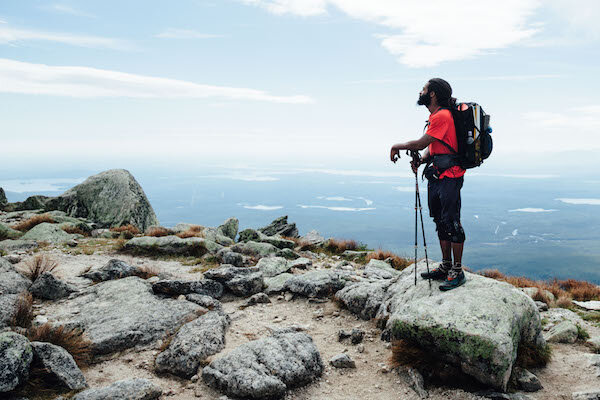
Photo: AkunaHikes.
“I learned that I was capable of living, I was capable of leading,” said the 41-year-old Army veteran who had struggled with post-traumatic stress disorder after Iraq.

I know that the Sound of Music is a little corny, but there is wisdom in the line “I go to the hills when my heart is lonely,” which Maria (soon to be Maria von Trapp) sings. Nature can be healing.

Andrea Sachs writes at the Washington Post about an Iraq war veteran and how the mountains healed him.

“Will Robinson was about 100 miles into his hike on the Pacific Crest Trail when the dark clouds started to lift. Not the ones high in the California sky, but the ones clustered in his head.

“ ‘I learned that I was capable of living, I was capable of leading. I was capable of inspiring and motivating people. That was something I had completely lost for a decade-plus,’ said the 41-year-old Army veteran who struggled with depression, anxiety and post-traumatic stress disorder after his medical discharge in 2003. …

“Since that first long-distance hike in 2016, his mileage has multiplied to more than 11,000 miles and counting. In 2019, he became the first Black American man to earn the Triple Crown of thru-hiking by completing the trifecta of legacy trails: the 2,650-mile PCT from California to Washington state, the 2,194-mile Appalachian Trail from Georgia to Maine and the 3,100-mile Continental Divide Trail from New Mexico to Montana. Two years later, ESPN declared Robinson ‘the trailblazing superstar of thru-hiking.’ He also received the 2022 George Mallory Award, which honors exceptional outdoor explorers. …

“Before the PCT, Robinson had never seriously hiked, though the military had prepared him for similarly tough challenges. ‘The closest thing I did to hiking was drill marching,’ said Robinson, who grew up on bases with his Army father. ‘It’s a lot different with a 100-pound pack and an M16, but it gave me a basis for hiking.’ In the armed forces, he powered through his pain, a practice he had to unlearn as a trekker. …

“After six months in Iraq and a stop in Germany for medical treatment, he returned to Louisiana, where he often felt too broken to leave the house, much less pursue outdoor activities. He underwent multiple surgeries and tried various therapy treatments and medications, to no avail. ‘After Iraq, I was disabled at 23,’ he said. A chance ‘encounter’ with celebrity long-haul hiker and Wild author Cheryl Strayed provided the jolt he needed to recharge his life.

“On that fateful day in March 2016, Robinson was in his room, ‘like always,’ when he glanced at the TV and saw Wild on the small screen. In the film version of Strayed’s best-selling memoir, he watched Reese Witherspoon lug her pack by a PCT trail marker, a scene that stirred up a memory from Iraq. During his downtime, Robinson would often pore over a PCT guidebook that someone had sent to the soldiers in a care package. ‘One day I’d love to do this,’ he said, reminiscing about that period in his life when he envisioned a future filled with adventure.

Without waiting for the closing credits, he jumped onto his computer and acquired a free long-distance permit, one of 5,657 issued that year.

“On April 2, he arrived in Southern California and embarked on a journey of personal discovery and recovery that resembled Strayed’s transformative quest two decades earlier. …

“In addition to the physical benefits of hiking in nature, medical experts extol its psychological virtuesStanford University-led research from 2015 determined that walking at least 90 minutes in a non-urbanized setting can help alleviate depression, lower stress and anxiety, and reduce rumination, the infinite loop of negative thoughts. A 2019 study called ‘Nature and mental health: An ecosystem service perspective’ also explored the wide-ranging rewards, such as a happier state of mind, more positive social interactions, a clearer sense of purpose and a sturdier grip on life’s demands. …

“Robinson did not initially set out to complete the entire PCT, which runs from the Mexican border to the Canadian border. His primary goal, he said, ‘was to try to see if I could find me again, regardless of how many miles it would take.’ With only a few weeks to prepare, he trained around Slidell, about 30 miles northeast of New Orleans. …

“Early in the hike, he found his trail family and earned his trail name, ‘Akuna,’ a riff on a Swahili phrase (and The Lion King refrain) that translates to ‘no worries.’ The nicknames are bestowed by other long-distance hikers or are given to oneself. They are often fanciful, silly or philosophical.

“About five miles in, he was resting on a rock, feeling sluggish, when a woman named ‘Cookie’ appeared at his side. She determined that he needed food and proceeded to stuff her namesake snack into his mouth. The pair forged a bond, along with ‘2Pie,’ a teacher from Ohio, and ‘Nothing Yet,’ a veteran who had tackled the AT [Arizona Trail] the previous year to quell his PTSD. The group hiked together for long stretches, a major breakthrough for Robinson, who for years had avoided social situations because of his fraught mental state.

“ ‘Being around people triggered panic and anxiety attacks, and I didn’t want any part of it. I just shut down,’ he said. ‘But on the trail, I ran into so many great individuals who were there for me. All they wanted was to be part of my adventure and help me accomplish my goal.’ …

“He said, ‘For me, every hike is like a therapy session in progress. I’m going through things in my head, working out problems. When I find a solution, I can zone out and be in peace.’ “

More at the Post, here, and at AkunaHikes, here.

Read Full Post »

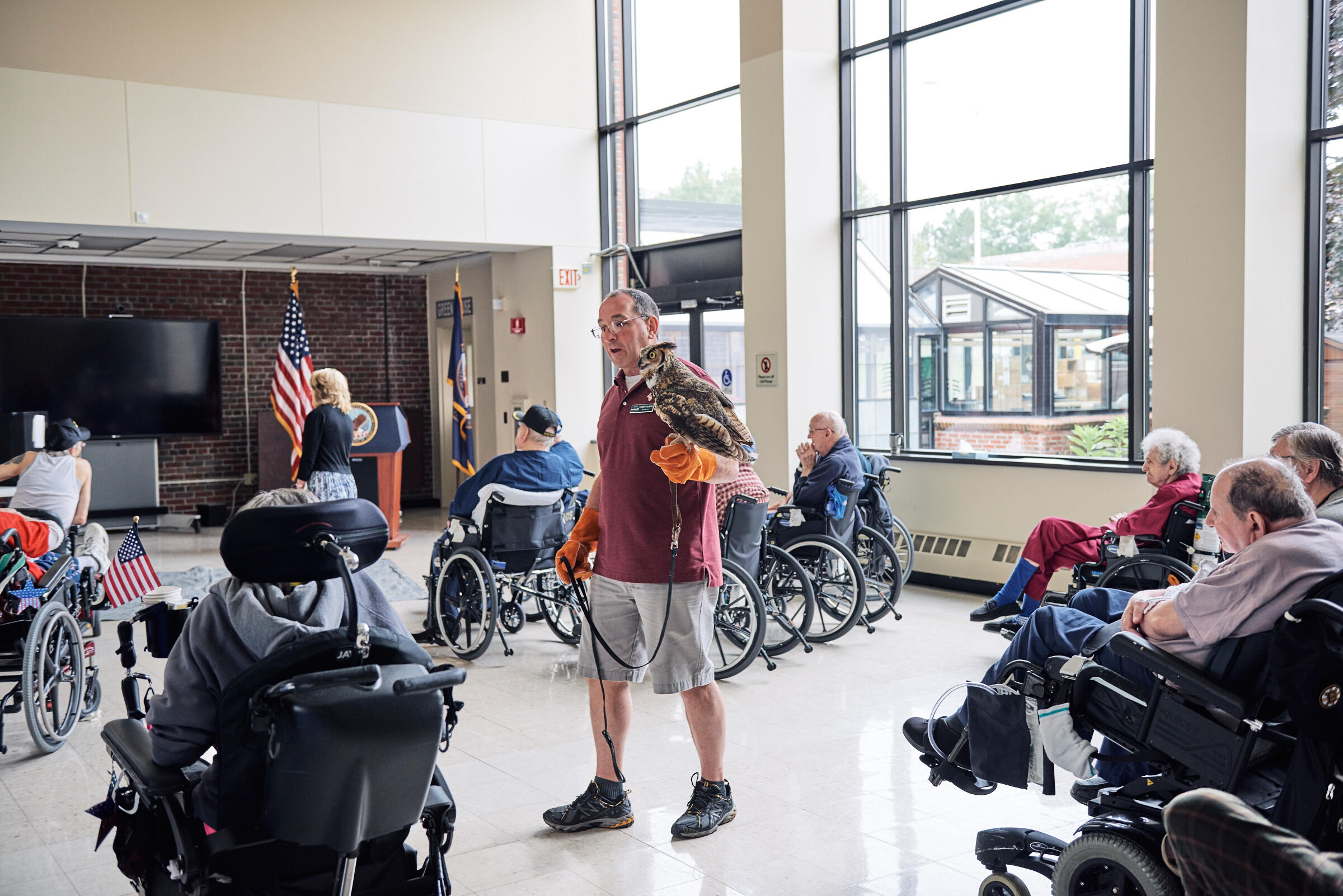
Photo: Tony Luong.
Robert Vallières brings a raptor when he speaks to veterans about how birds helped his recovery, like here at the Manchester VA Medical Center in New Hampshire. When asked the worth of this Great Horned Owl, he told the vet: “I can’t put a value on it.” 

Tomorrow, November 11, is Veterans Day, one of only two federal holidays that hasn’t been switched to a Monday. The other is July 4. I saw today’s story around this time last year and decided to save it for you.

Purbita Saha and Tony Luong wrote at Audubon magazine in 2017 about a former soldier who found solace in Nature and then used his insights to help other veterans.

“The first bird that saved Robert Vallières,” they report, “was a Black Hawk helicopter. It was October 1990, and the then 28-year-old Army soldier was serving in the Persian Gulf War. While riding in the back of a truck on a mission to fortify a foxhole in the remote Arabian Desert, a heavy beam slammed into him, sending him flying and causing severe head injuries and swelling in the brain. The chopper sped Vallières to a field hospital for emergency care. …

“After being honorably discharged, Vallières returned to Concord, New Hampshire. While he appeared to be on the mend, he continued to grapple with chest spasms and Gulf War Syndrome—the mysterious mix of symptoms, including headaches, exhaustion, and memory problems, that plagued up to a third of returning veterans. On top of that, he had lingering effects from a pre-deployment aneurysm, and was diagnosed with post-traumatic stress disorder. … The PTSD led to serious depression and horrific anger, he says. He was overwhelmed with trying to readapt to civilian life when he saw a newspaper ad for a birding trip in the White Mountains. Remembering his hikes with his nature-loving father, also a veteran, Vallières signed up immediately. Up on the slopes, as he scanned the leafy ledges for passerines, a Peregrine Falcon hurtled into view, seizing a Northern Flicker mid-air in a puff of feathers. He followed it back to a snag, where it tore the woodpecker apart, yellow shaft after yellow shaft. ‘I was glued,’ Vallières says. …

“Vallières credits that Peregrine with saving him from despair. The encounter sparked a full-fledged birding obsession that ultimately helped shape his philosophy on healing. He quickly signed on to monitor raptor nests with New Hampshire Audubon. The first site he claimed was Joe English Hill, near Concord, where he and his son Andrew would watch American Kestrels speed rodents to their begging chicks’ mouths. As his identification and observational skills deepened, his responsibilities multiplied. He began tracking breeding Peregrine Falcons and Bald Eagles, aiding in the recognition of an uptick in chicks that confirms the birds’ nationwide resurgence since the pesticide DDT was banned.

“Vallières finds strength and hope in their comeback. ‘They keep my defeats in perspective,’ he says. And, he discovered, while painkillers reduced his chronic pain, his ailments often temporarily vanished in the presence of birds. Besides taking his mind off the hurt, tracking wild birds also allowed Vallières to beat back depression and regain much of his physical strength. …

“He began rehabilitating raptors, first with Audubon, then with the local wildlife hospital Wings of Dawn, where he learned to train unreleasable birds as educational ambassadors.

Working with the feathered charges allowed him to pay forward the care and kindness he’d received from doctors, nurses, and therapists, he says. It also made him feel like less of a burden.

“Given the profoundly soothing effect raptors had on Vallières, he was motivated to share the experience. He brought other vets to the New Hampshire Audubon hawkwatch platform to take in thousands of Broad-wingeds during fall migration. He cowrote a memoir, Wounded Warriors, about his experiences in battle and birding. And he started bringing rehab birds to the New Hampshire Veterans Home and Manchester VA Medical Center. (Vallières is a patient at the latter, receiving therapy for his chronic pain, taking drawing lessons to relieve stress, and learning cognitive exercises to combat memory loss from a second aneurysm in 2012.)

“On the Friday before Memorial Day, Vallières made his rounds at both facilities. In the solarium of the medical center that morning he saluted each of the 15 seniors, many in wheelchairs and Vietnam and Korean War caps. Then he introduced a male Great Horned Owl that is permanently grounded due to a wing injury. Vallières walked around with the raptor on his arm, lifting it above the veterans’ heads so they could feel the rush of its beating feathers. The room buzzed with questions and anecdotes of pet cockatoos; placid faces broke into grins. With his audience transfixed, Vallières related his story. He showed them sketches he has drawn of being airlifted out of Kuwait, shared dark reflections of his struggle with PTSD, and explained the important role that birds have played in his recovery.”

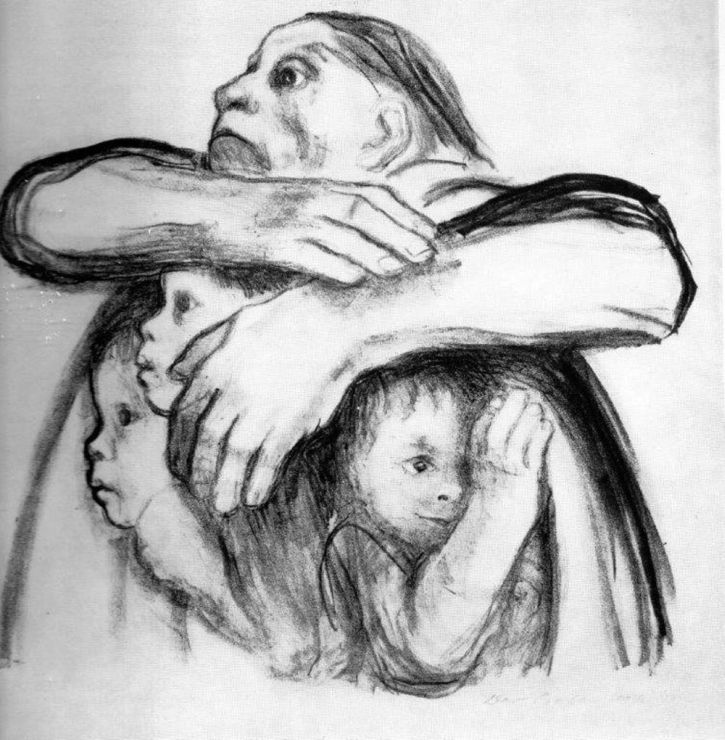
We owe so much to veterans, but you know as soon as a war starts that many, if not most, will be physically or mentally wounded or never come home. And the services to help them will be limited. All by itself, that’s a good reason not to go to war. Sometimes it’s necessary, of course, as the Ukrainians who take up arms today already know. Below is art that shows why they do it.

More at Audubon, here. No firewall. A description of the art is at WordPress, here.

Protecting the children: Kathe Kollwitz’s ‘Grieving Parents’ at Vladslo: ‘Seed Corn Must Not Be Ground.’

Read Full Post »

Shakespeare continues to make headlines, working his magic on people from all walks of life — prisoners, refugee children, veterans, and more.

Recently, New York Times reporter Laura Collins-Hughes interviewed an Army veteran who found Shakespeare helped him over a trauma and who now uses the Bard to help other veterans.

Collins-Hughes writes, “Stephan Wolfert was drunk when he hopped off an Amtrak train somewhere in Montana, toting a rucksack of clothes and a cooler stocked with ice, peanut butter, bread and Miller High Life — bottles, not cans. It was 1991, he was 24, and he had recently seen his best friend fatally wounded in a military training exercise.

“His mind in need of a salve, he went to a play: ‘Richard III,’ the story of a king who was also a soldier. In Shakespeare’s words, he heard an echo of his own experience, and though he had been raised to believe that being a tough guy was the only way to be a man, something cracked open inside him.

“ ‘I was sobbing,’ Mr. Wolfert, now 50 and an actor, said recently over coffee in Chelsea. ‘I didn’t know you could have emotions out loud.’

“That road-to-Damascus moment — not coming to Jesus, but coming to Shakespeare — is part of the story that Mr. Wolfert tells in his solo show, ‘Cry Havoc!’ … Taking its title from Mark Antony’s speech over the slain Caesar in ‘Julius Caesar,’ it intercuts Mr. Wolfert’s own memories with text borrowed from Shakespeare. Decoupling those lines from their plays, Mr. Wolfert uses them to explore strength and duty, bravery and trauma, examining what it is to be in the military and what it is to carry that experience back into civilian life. …

“To Mr. Wolfert, who teaches controlled methods of accessing charged memories, the need to retool a lethal skill set for civilian life is a vital task that the military leaves people to figure out on their own.

“ ‘That’s something that we hold uniquely, I think, as veterans,’ he told [a] class. ‘We know what we’re capable of — even for the so-called peacetime or Cold War vets. The training’s still there. And I don’t care if you’re a clerk typist. You still fired a weapon at a human silhouette.’

“This, he believes, is where Shakespeare can prove an ally: as a means to understand trauma, and to start coming back from it.”

More at the NY Times, here. For more on Wolpert, check out a Shakespeare & Co. interview from last summer, here.

Photo: Folger Theatre
Actor Stephan Wolfert in 2014, performing his one-man show Cry “Havoc!” at the Folger Theatre in Washington, DC. The line is from Shakespeare’s Julius Caesar.

Read Full Post »

Longtime concert pianist Byron Janis recently wrote an essay for the Wall Street Journal about programs using music to help veterans with PTSD and other traumas to heal.

“Can music heal?” he asks. “There’s been a great deal of study by neuroscientists on the different ways music acts upon the brain, affecting our behavior, memory and the like. …

“I recently witnessed the healing effects of music first hand. As part of their ‘National Initiative for Arts and Health in the Military,’ I was invited by Americans for the Arts to visit the Walter Reed National Military Medical Center and participate in ‘Stages of Healing.’ This program, created by Dr. Micah Sickel, helps patients learn how to play a musical instrument and facilitates live performances whose aim, according to the hospital, is to ‘enhance the healing process’ …

I knew what I wanted to play for them—two Chopin waltzes and ‘A Hero’s Passing By’ … I then played two songs from a musical I had written about the Hunchback of Notre Dame. One was a love song and the other is titled ‘Like Any Man,’ which I felt very much suited the occasion. The Hunchback sings that although he is so disabled, he is just like any man.” Read more.

Photo of Byron Janis in 1962: Wikimedia Commons

Read Full Post »

I’ve blogged before about programs that use theater for healing purposes and programs that use the arts specifically to help veterans.

Now Dana Ferguson writes at The Los Angeles Times about Shakespeare getting into the act and easing vets into the job world.

“Fifteen years ago former Pfc. and military police officer Jerry Whiteside had two masks tattooed on his left bicep, one smiling, one frowning. …

“Little did he know that more than a decade later, he would be symbolically reunited with the images imprinted on his skin.

“His journey began at the end of a 30-year struggle with drugs and alcohol, he said. Whiteside, a Chicago native turned Angeleno who had served in the Marine Corps from 1972 to ’76, sought help from the Veterans Administration in Los Angeles. He completed a detoxification program in 2011 and for this summer was referred to the Shakespeare Center of Los Angeles to do various jobs on the set of A Midsummer Night’s Dream.

“Whiteside, 61, and some 30 other veterans of the Afghanistan, Iraq, Vietnam and the Gulf wars assisted in building the set and working odd jobs with the production, which continues through July 28.

“Shakespeare Center artistic director Ben Donenberg said employing veterans stemmed from another of the company’s outreach programs, Will Power to Youth, which hires young Angelenos to study and perform Shakespeare plays. After seeing alumni of the program serving in the armed services and later seeking jobs at home, Donenberg said, the company decided to extend its employment program opportunity to veterans, starting last year. …

“One of the things we want to do as a company is to ease the transition to civilian life, and part of that is on the civilians; there’s only so much the veterans can do,” [Chris Anthony, associate artistic director at the Shakespeare Center] said. “The rest of us have to see them in a different light. It’s something we need to work on as civilians.” More.

Photo: Ricardo DeAratanha / Los Angeles Times
Military veteran Jerry Whiteside passes out programs before each Shakespeare Center performance.

Read Full Post »

At Nourishing the Planet in October, Molly Redfield interviewed Vietnam vet Howard Hinterthuer, a peer-to-peer mentor for an Organic Therapy Program that helps distressed veterans.

Redfield: “You recently gave a Ted Talk on the Organic Therapy Program (OTP). Can you tell us how the OTP started? …

“William Sims, a Vietnam veteran of the 101st Airborne Division who served from 1966 to 1967, started the Organic Therapy Program. Mr. Sims was wounded after being in Vietnam for about 9 months, and returned home to Milwaukee. He was able to deal with the stress of coming home and experiencing combat by puttering around in his mom’s garden. He remembered that.

“The Center for Veterans Issues [in Milwaukee] has about 300 or more formerly homeless veterans in transition with PTSD, traumatic brain injury, and depression. These veterans come to us and we provide a wrap-around service to deal with their different problems. Mr. Sims figured that if gardening was good for him, then it would be good for other veterans as well. So he began creating raised-bed gardens to help veterans cope with their problems. …

“Gardening is important because it allows our veterans to have …  positive experiences. This is almost guaranteed by the act itself, as it creates such a peaceful place. Gardening is meditative and increases self-esteem. …

“After the TED talk I gave, I was contacted by a woman in Scotland working with veterans of the British military. Her program used horticulture for veterans’ recovery, so I think gardening is an approach to dealing with difficult issues that can definitely be replicated in other places.”

Read more.

Photograph: AP Photo/Chattanooga Times Free Press/Allison Love
Working in community gardening programs is proving to have many good effects on troubled military veterans.


Read Full Post »

It’s amazing how much the arts can help people.

I have blogged about programs that use the arts to turn convicts toward something positive, to build up the self-worth of the homeless, to turn Brazilian slums into more hopeful places. The list goes on.

Recently ArtsJournal.com alerted me to a BBC story on an arts initiative that helps veterans reacclimate to civilian life.

“Many veterans are turning to charities for help. One is using the unlikely weapon of art to help fight the psychological wounds of war, while another organisation is actively encouraging artwork in the army. Outside of the [national health service] the charity Combat Stress is the biggest provider of support to armed forces veterans with conditions such as post-traumatic stress disorder (PTSD), depression and anxiety.

“Art therapy is one of the treatments it uses. Drawing, sculpting and painting are helping patients manage their symptoms with great success.

” ‘Traumatic memories take a different path from our normal memories and tend to be frozen in the body in the central nervous system,’ explains Janice Lobban, who has been a trauma therapist at Combat Stress for the past 10 years. …

“Group sessions typically begin with the therapist giving a one or two word brief to inspire creativity before veterans are given a selection of materials for painting, modelling or writing. After 45 minutes of quick work, the group then get together to talk about and describe what they’ve just created.

” ‘I try to keep a blank mind and just let images and feelings rise out from my unconscious to my hand and things start appearing,’ says Richard Kidgell … who served in the Royal Air Force from 1978 to 1985. ‘What surprises me is that while I’m drawing I don’t know what it is — they’re just images, but by the end of the session I’ve made a complete story. It’s quite enlightening as sometimes I’m not entirely sure what I’ve drawn until I speak to others about it.’ ”

Read more of Genevieve Hassan’s story on arts therapy for veterans here.

Read Full Post »