Feeds:
Posts
Comments

Posts Tagged ‘restoration’

Art: NC Wyeth.
N.C. Wyeth’s “Apotheosis of the Family,” which hung behind the tellers in the downtown Wilmington Savings Fund Society for three quarters of a century, has been readied for public viewing at the artist’s grandson’s home in Wilmington, Delaware.

I have always loved the monumental paintings of NC Wyeth. Today we learn about his largest mural, which was created during the Depression and is getting a new lease on life.

Ralph Blumenthal writes at the New York Times, “As the Great Depression savaged America, a bank in Wilmington, Del., commissioned the protean illustrator N.C. Wyeth to soothe anxious customers with an epic tribute to the bounteous land and its laboring families.

“Known more by his initials than his given name, Newell Convers, he had long been a towering figure in American art, embellishing classics like Treasure Island. … Wyeth’s mural, in oil in five panels, came in at 60 feet long and 19 feet high — his biggest and one of the largest ever created for a public space in the United States. For three quarters of a century, it hung behind the tellers in the downtown Wilmington Savings Fund Society, inspiring visions of thrift and industry. And then it came down and disappeared.

“Now it has re-emerged in a gleaming new round barn on N.C.’s grandson Jamie Wyeth’s Point Lookout Farm outside Wilmington and near the Wyeth studios in Chadds Ford, Pa. …

“The 1932 work, ‘Apotheosis of the Family,” aims to welcome visitors by jitney from the nearby Brandywine Museum of Art [soon].

“N.C. Wyeth is enjoying a renaissance of sorts. His work will be included in the filmmaker George Lucas’s new Museum of Narrative Art, scheduled to open next year in Los Angeles. Five years ago, Wyeth had a retrospective at the Taft Museum of Art in Cincinnati, an exhibition that cited his influence on cinema. …

“In ‘Apotheosis,’ which celebrates the pinnacle of family, Wyeth … looms bare-chested dead center as a kind of superman, beside his wife, Carol, amid vignettes of harvesting, fishing, weaving and timbering as the seasons change. Pan plays the pipes, smoke boils from a campfire, and ships with billowing sails race for a distant shore. The foreground sprouts strange flowers hardly seen in nature.

“Prominent among other family models is Wyeth’s flaxen-haired son, Andrew, then 15 — destined to eclipse the rest of the famous art clan with his starkly realistic landscapes and portraits — drawing a bow and arrow and nude but for a modest blurry G-string. Next to him stands his sister Carolyn as a toddler, although she was actually eight years older. …

‘The work enshrines two of N.C.’s core beliefs — ‘love of family and the importance of land’ — at a terrible time when such values were especially precious. …

“After periodic restorations, most recently in 1998, the painting was pried off the wall and damagingly rolled up 10 years later when the bank was sold for conversion into apartments.

“The mural went to the Delaware Historical Society, which couldn’t place it. It was then bequeathed to the Wyeth Foundation for conservation, with Jamie, now 79, committing about $1 million for its reinstallation in a new round barn on his 250-acre Brandywine farm.

“Jamie is the widower of Phyllis Mills Wyeth, a philanthropist and socialite racehorse breeder. … As a tribute to his wife after her death at 78 in 2019, Jamie opened the pastures as a lifetime sanctuary for former racehorses. It also became a refuge for the nearly-century-old artwork. …

“ ‘I adore my grandfather’s work,’ he said. ‘He had more influence on me than my father.’ …

“Jamie, who was born the year after N.C. was killed in a bizarre train collision in 1945, recalled visits to his grandfather’s painting studio crammed with old muskets and cutlasses for his illustrations. …

“The story of the mural’s resurrection has many beginnings, but let’s start with the Wyeth patriarch: N.C., a descendant of early English colonists and maternal grandparents from Switzerland, who settled in Needham, Mass., where he was born in 1882. His father wanted him to go into farming but he was strongly drawn to art, winning acceptance as a star protégé of the pre-eminent illustrator Howard Pyle.”

Lots more at the Times, here. You will love how the Times animated restoration visuals by Caroline Gutman.

Read Full Post »

Photo: Dani Anguiano.
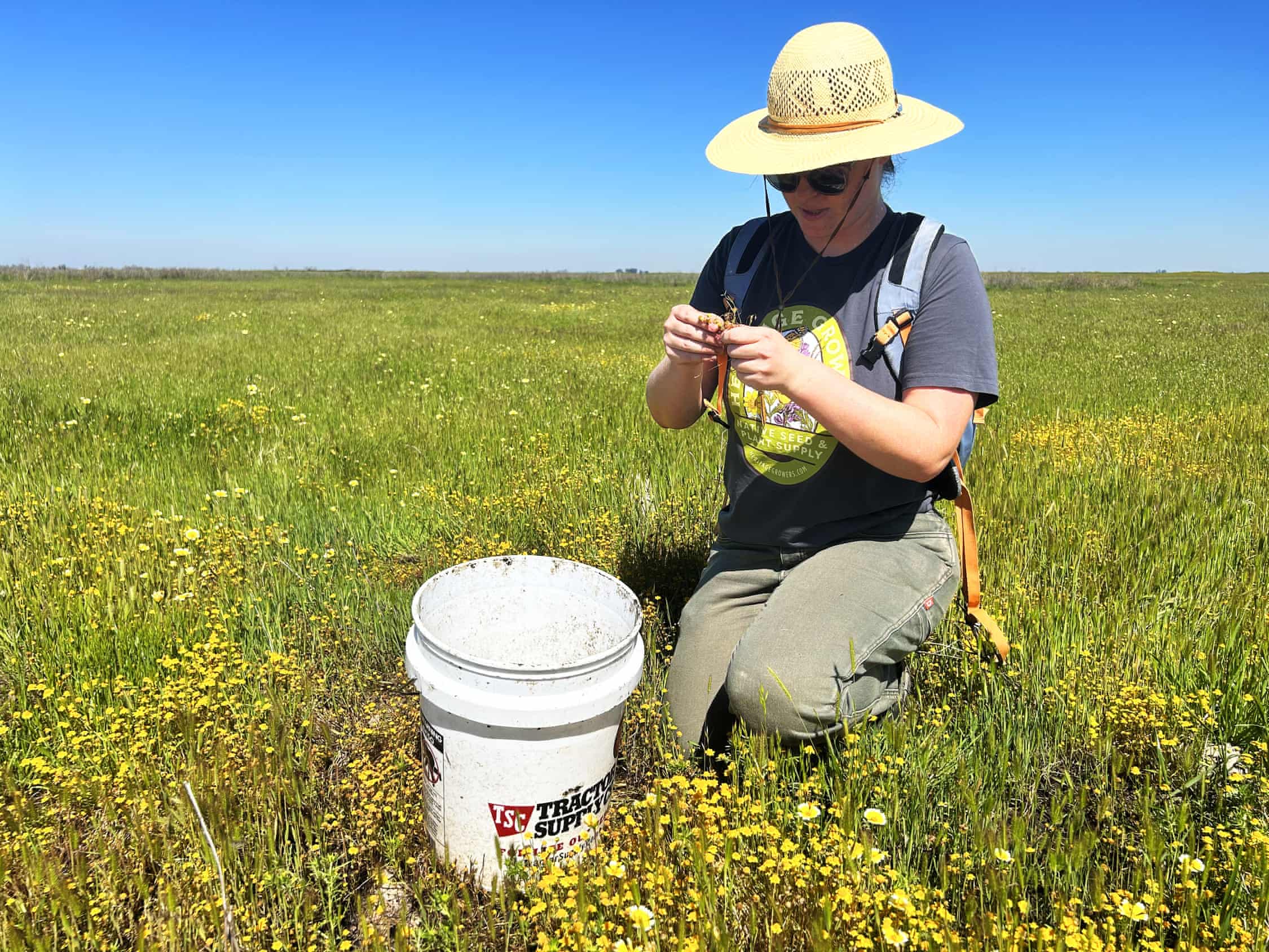
Haleigh Holgate, seed collection manager at Heritage Growers, inspects a seed in the San Luis national wildlife refuge complex on March 2025. Only the correct species will do.

I have blogged about seed banks in various countries (search on “seed bank”), and particularly about the global one that will keep seeds safe forever — if it stays frozen.

Today we learn what’s going on in California, where Heritage Growers is focused on local flora.

Dani Anguiano reported at the Guardian, “Deep in California’s agricultural heartland, Haleigh Holgate marched through the expansive wildflower-dotted plains of the San Luis national wildlife refuge complex in search of something precious.

“She surveyed the native grasses and flowering plants that painted the Central valley landscape in almost blinding swaths of yellow. Her objective on that sweltering spring day was to gather materials pivotal to California’s ambitious environmental agenda – seeds. …

“As a seed collection manager with the non-profit Heritage Growers native seed supplier, Holgate is tasked with traveling to the state’s wildlands to collect native seeds crucial for habitat restoration projects.

“The need has become particularly acute as California aims to conserve 30% of its land by 2030, with the governor pledging to restore ‘degraded landscapes’ and expand ‘nature-based solutions’ to fight the climate crisis. …

“But the rising demand for seeds far outpaces the available supply. California faces an ‘urgent and growing need’ to coordinate efforts to increase the availability of native seeds, according to a 2023 report from the California Native Plant Society. There simply isn’t enough wildland seed available to restore the land at the rate the state has set out to, Holgate said.

“Bridging the gap starts with people like Holgate, who spends five days a week, eight months of the year, traveling with colleagues to remote spots across the state collecting seeds – an endeavor that could shape California’s landscape for years.

“That fact is not lost on the 26-year-old. It’s something she tries to remind her team during long, grueling, hot days in the oilfields of Kern county or the San Joaquin valley. …

“Seeds play a vital role in landscape recovery. When fires move through forests, decimating native species and leaving the earth a charred sea of grey ash, or when farmlands come out of production, land managers use native seeds to help return the land to something closer to its original form. They have been an essential part of restoring the Klamath River after the largest dam removal project in US history, covering the banks of the ailing river in milkweeds that attract bees and other pollinators, and Lemmon’s needlegrass, which produces seeds that feed birds and small mammals.

“California has emphasized the importance of increasing native seed production to protect the state’s biodiversity. … Three-quarters of native vegetation in the state has been altered in the last 200 years, including more than 90% of California wetlands, much of them here in the Central valley.

“For the state to implement its plans, it needs a massive quantity of native seeds. … Enter Heritage Growers, the northern California-based non-profit founded by experts with the non-profit River Partners, which works to restore river corridors in the state and create wildlife habitat.

“The organization takes seed that Holgate and others collect and amplifies them at its Colusa farm, a 2,088-acre (845-hectare) property located an hour from the state capital. (The ethical harvesting rules Heritage Growers adhere to mean that they can take no more than 20% of seeds available the day of collection.) …

“Currently, the farm is producing more than 30,000 lbs of seeds each year and has more than 200 native plant varieties.

“The goal, general manager Pat Reynolds said, is to produce source-identified native seed and get as much of it out in the environment as possible to restore habitat at scale. …

“The benefit of restoring California’s wildlands extends far beyond the environment, said Austin Stevenot, a member of the Northern Sierra Mewuk Tribe and the director of tribal engagement for River Partners.

“ ‘It’s more than just work on the landscape, because you’re restoring places where people have been removed and by inviting those people back in these places we can have cultural restoration,’ Stevenot said. ‘Our languages, our cultures, are all tied to the landscape. … It’s giving the space back to people to freely do what we would like for the landscape and for our culture,’ he said. …

“The mission is worthwhile, Holgate said. The seeds she collects are expensive, but if they can be amplified and expanded, native seeds will become more abundant and restoration projects can happen more quickly.

“ ‘We can restore California faster,’ she said. … ‘I know that when I’m dreaming about a certain species, I should go check that population and see what’s happening. And normally there’s something going on where it’s like grasshoppers came in and ate all the seed, or the seed is ripe and ready, and I gotta call in a crew,’ she said. ‘I’ve really put my whole heart into this job.’ “

More at the Guardian, here. No firewall at this outstanding news site, but please support it.

Read Full Post »

Photo: Gabriela Contreras González.
Saint Catherine of Alexandria, patroness of students, teachers, librarians, and lawyers.

Today’s post is about art restoration, a field that always seems brave to me. Imagine charging into some time-honored work and presuming to “fix” it! I guess a good restorer becomes the artist, too — perhaps in the way that a skilled translator of a literary work becomes a coauthor.

This month, with trepidation, my husband and I put a lovely Inuit watercolor into the hands of a conservator. Would she be able to remove all the mildew from life in a damp summer cottage? The results were nothing short of miraculous.

At Artnet, Min Chen writes about a larger work of conservation in Mexico.

“For decades, the interior of the Temple of Our Lady of the Assumption, a church in the town of Santa María Huiramangaro in Mexico, stood stark white, with blue accents. But the parish was not always so bare. A new restoration has revealed a host of resplendent 16th-century religious paintings that once spanned the ceiling of the historic church.

“The project, undertaken by participants including the Ministry of Culture of the Government of Mexico and the National Institute of Anthropology and History (INAH), dispatched a team of professionals to conserve the roof of the church. What they discovered instead were ancient images of saints and martyrs — hagiographic works rarely found in the Michoacán region — which had been painted over during the 1940s.

“The work, said Laura Elena Lelo de Larrea López, expert restorer at the INAH Michoacán Center, in a statement, ‘allowed us to recover an extraordinary work on the horizontal roof of the main altar, and to discover the rich artistic, technical and iconographic evolution that has marked this religious site.’

“The Temple of Our Lady of the Assumption was constructed in the early 16th century, when Santa María Huiramangaro was designated a district head, overseeing the communities of San Juan Tumbio, Zirahuén, and Ajuno. The building reflected the architectural styles of Mudéjar, which featured ornate motifs believed to have been originated by Muslim craftspeople in the 13th century, and Plateresque, a late-Gothic and early Renaissance aesthetic imported by the Franciscans.

“During restoration work, three pictorial layers of religious iconography were uncovered on the church’s ceiling. The oldest, from the 16th century, saw the use of tempera paint, which was applied in thin glazes to depict various characters corresponding to Saints Paul, Peter, Agatha of Cantania, and Catherine of Alexandria, as well as baby Jesus in Franciscan habit. The works were retouched with oil paints in the following century, adding volume and colors to the depicted figures’ clothing.

“When water ran dry in the region in the 17th century, the church fell largely into disrepair, as Santa María Huiramangaro lost its capital status. ‘The misfortune was a blessing in disguise, in terms of conservation,’ said Lelo de Larrea López, ‘since, not having the resources to renew its religious furnishings, the parish priests of the Temple of Santa María preserved its Plateresque ornaments. …

“Still, experts uncovered evidence of a restoration effort in the 20th century. Acrylic paints were deployed to touch up the faces of the saints. …

“During remodeling work in the 1940s, the iconography on the church’s roof was painted over in white, with blue designs. The repainting, noted Lelo de Larrea López, ’caused an alteration in the appearance of the place.’

“The latest conservation removed the repainted layer and restored missing portions of the paintings. Additionally, the ceiling was cleaned of dust and animal droppings, reinforced with joints and wood grafts, and fumigated to deter wood-eating insects. Other roof elements, such as corbels, partitions, and Franciscan cord carvings, were also given a refresh.

“The work marks the latest phase in a major restoration of the Temple of Our Lady of the Assumption, which began a decade ago with a focus on its main altarpiece. Despite a dismantling (undertaken to tackle a collapse in the church’s rear wall), conservators found the artifact in a well-preserved state. Over 2022 and 2023, they addressed damage to its cornices and carvings, and undid a repainting job to reveal its original gold leaf and polychrome.”

I admire the commitment it takes to work on projects of ten years or more like this. Have you ever had a piece of art restored?

More at Artnet, here.

Read Full Post »

Photo: Charles Krupa/AP.
Workers harvest cranberries at the Rocky Meadow bog in Middleborough, Massachusetts, ahead of Thanksgiving. 

Recently, I read about a federal program paying “farmers to convert the land of bogs that is not efficient for growing” into wetlands that can alleviate climate change consequences. Whether or not the federal program will continue, Massachusetts is on the case, helping its own farmers with restoration.

Gloria Oladipo wrote at the Guardian last November, “As millions of cranberries were being harvested for Thursday’s US Thanksgiving holiday, Massachusetts farmers were working to convert defunct cranberry bogs back to wild wetlands, amid climate crisis woes. Several restoration projects were awarded $6m in grants to carry out such initiatives, state officials announced this week.

“The grants, provided by the New England state’s department of fish and game division of ecological restoration (DER), will ‘increase resilience to climate change for people and nature, restore crucial wildlife habitat, and improve water quality’ in 12 communities, said the Massachusetts governor, Maura Healey, in a statement. …

“ ‘These initiatives will enhance our ability to store and sequester carbon with nature and help us meet our net zero goals,’ said Rebecca Tepper, secretary of the state’s office of energy and environmental affairs. …

“The grants are being awarded through two state programs: the DER’s wetland restoration program and the DER’s cranberry bog restoration program, which converts defunct cranberry bogs into wetlands and streams.

“To date, scientists and government officials have converted 400 acres of retired cranberry bogs into wetlands, the Washington Post reported. State officials have said they hope to restore an additional 1,000 acres of bogs within the next decade. …

“As sea levels rise in Massachusetts because of the climate crisis caused by humans burning fossil fuels, scientists are looking to develop bogs into wetlands to improve coastal resilience and slow down erosion.

“Wetlands can hold more water and filter out pollutants amid increased storms that bring potential flooding. They also have other environmental benefits, acting as wildlife habitats and storing carbon dioxide from the atmosphere in their soil.

“More farmers have been drawn to the prospect of transitioning their former cranberry bogs into wetlands. The climate crisis and economic factors, including the high cost of modernizing bogs, can make cranberry farming more difficult. …

“ ‘We are in an upward trend in terms of interest in retiring cranberry bogs,’ said Brian Wick, executive director of the Cape Cod Cranberry Growers Association, to the Post. … But getting land for restoration remains a competitive process, as other businesses – such as housing developers – vie for undeveloped coastal land.

“ ‘This opportunity won’t be here in 25 years,’ said Christopher Neill, a senior scientist at the Woodwell Climate Research Center and an expert in restored bogs, to the Post. ‘These growers are not going to hang on, they’re going to make decisions and the land won’t be available forever.’

“While conservation projects have steadily increased in southeastern Massachusetts, restoration initiatives are still relatively new. The majority of finished projects are only a few years old, with 14 restoration initiatives still being designed and implemented, the Post reported.”

In addition to benefits like carbon storage and habitat for wildlife, converted cranberry bogs can be lovely for walkers.

More at the Guardian, here. Nice photos. No firewall.

Read Full Post »

Photo: Mount Vernon Ladies’ Association.
Bottles that were filled with cherries and other fruit were found buried in the basement of Mount Vernon.

Back in the day, little American children had early exposure to fake news in the form of a story about George Washington, invented by his biographer Mason Locke Weems. We were told to believe that even as a boy, Washington was scrupulously honest and that when accused of cutting down a cherry tree, he confessed his guilt with the words “I cannot tell a lie.”

Today’s more scientific take on our first president reveals a remote but fact-based connection with cherry trees.

Michael E. Ruane reports at the Washington Post, “The furniture in the bedroom where George Washington died will go into storage. So will his silver oil lamps, his French marble and bronze mantel clock, and most of the other contents of his elegant 290-year-old Mount Vernon mansion on the Potomac River.

“[The] bulk of Washington’s famous home is due to close for several months as it undergoes the next phase of its largest-scale rehabilitation in over 150 years.

“The $30 million project is the most complicated preservation effort since the house was saved from decay in 1860 by the private, nonprofit Mount Vernon Ladies’ Association of the Union, which still owns it, said Douglas Bradburn, president of George Washington’s Mount Vernon. …

“Other parts of the house, along with the extensive grounds, Washington’s tomb, the quarters for enslaved people [yes, he owned slaves and freeing them on his death does not make up for that] and other outbuildings will remain open, Bradburn said in a recent interview. …

“The historic structure had become loosened from its foundation over time, and the work will resecure it, Bradburn said. There also will be restoration work done in the basement and on flooring, among other things. …

“Earlier repair projects have been piecemeal. [They’ve been] ‘dealing with problems as they come,’ he said. This is a chance for a more complete approach.

“The project made headlines in the spring when archaeologists digging in the basement found six storage pits containing more than two dozen bottles filled with cherries and other fruit that had been buried about 250 years ago. …

“The rehabilitation project began last year after officials realized that over time the big oak ‘sills’ that connected the mansion to the foundation had been devoured by termites and the house was no longer being held firmly in place.

“ ‘Essentially, the mansion was sitting on termite shields, or just sitting directly on brick,’ Bradburn said. ‘Lateral winds could knock it off its foundation.’ … The new sills are being made with oak from trees grown at Mount Vernon and from salvaged 18th-century oak acquired in Ohio, said Amy McAuley, Mount Vernon’s restoration manager. …

“Mount Vernon is about 20 miles south of Washington. The original house was a modest structure built for Washington’s father in 1734.

“George Washington inherited it in 1761 and expanded it dramatically over the decades — most of the work being done by people enslaved at Mount Vernon, officials said. By the time of Washington’s death in 1799, more than 300 were enslaved across the plantation there.

“Washington [was] was often away from Mount Vernon but loved the site and died there on Dec. 14, 1799.

“But by the 1850s, the mansion was in poor condition. … John Augustine Washington tried unsuccessfully to sell the mansion to the federal government and the state of Virginia.

“In 1853, Ann Pamela Cunningham, a well-to-do woman from South Carolina who was shocked by accounts of the dilapidated state of the home, founded the Mount Vernon Ladies’ Association of the Union to save it, according to the website.

“At the time, tensions that would eventually lead to the Civil War were already on the rise. But the association had members from the South and the North, Bradburn said.

“ ‘That “of the Union” part was like, “If we save the house of Washington, maybe we can save the Union,” ‘ he said.”

More at the Post, here.

PS. Hannah got me wondering about how the fruit could get out of those narrow mouths on the bottles. Here’s a different photo from CNN. The cherries were small!

Read Full Post »

Photo: Wikipedia.
Rembrandt’s “The Night Watch” (1642) at the Rijksmuseum in Amsterdam.

A couple years ago I wrote (here) about how AI was being used to help in the restoration of Rembrandt’s “The Night Watch.” Now at the Rijksmuseum in Amsterdam, conservators are taking another unusual step: allowing museum goers to watch the restoration process.

Kelsey Ables writes at the Washington Post, “Visitors eager to catch a glimpse of Rembrandt’s ‘The Night Watch’ at the Rijksmuseum in Amsterdam may be surprised to find the large oil painting looking more like a work in progress than a masterpiece that was completed in 1642. On Tuesday, conservators — equipped with masks, gloves, brushes and scaffolding — began a long-anticipated restoration of the work, a process that would usually take place behind the scenes but that the Rijksmuseum is putting on full display to the public.

“Images and videos from the museum show conservators inside a glass chamber, crouching over Rembrandt’s emphatic figures and gently removing decades-old varnish with brushes and solvent, as curious visitors crowd around outside.

“Taco Dibbits, director of the Rijksmuseum, said in a statement that the beginning of the restoration, which follows years of research and a re-stretching of the canvas, ‘is filled with anticipation.’ …

“A sprawling 12½-by-15-foot canvas that depicts a group of civic guardsmen cast in a dramatic lighting style known as chiaroscuro, ‘The Night Watch’ is considered one of the crowning artistic achievements of the Dutch Golden Age. The Rijksmuseum’s undertaking marks another chapter in the long life of the famous work, which has survived two knife attacks and was hidden in a cave during World War II.

“The process will involve removing varnish that was applied during its 1975-1976 restoration and will significantly change the look of the painting, making white paint whiter and dark areas more visible. The current varnish is ‘discolored, has yellowed, and it saturates poorly,’ Ige Verslype, paintings conservator at the Rijksmuseum, said in a video. …

“To remove the old varnish, conservators are using a special technique that reduces the need for ‘mechanical action’ and involves applying a measured amount of solvent to the canvas with a tissue and brush. As they remove the varnish, the famously dark painting will become more matte and gray, the Rijksmuseum explained, until a fresh layer is applied, imbuing the figures with new life.

“Paula Dredge, a lecturer in cultural materials conservation at the University of Melbourne in Australia … said that such work, which involves peeling back previous restorations, is a ‘process of discovery,’ even for the conservator. ‘The value we give originality and artists’ intent is a modern concept. In the past, restorations were more invasive and often covered over passages of the artist’s paint,’ she wrote, adding, ‘We may find more of Rembrandt.’

“In the 18th century, the painting’s old varnish and accumulated dirt actually became a part of its identity when it was nicknamed ‘The Night Watch,’ in response to its dark colors. The painting is in fact set during the day.

“It is a type of painting unique to the northern Netherlands, where civic watchmen companies commissioned group portraits that were intended to create a sense of local pride. While such paintings were usually stiff and straightforward, Rembrandt broke with tradition in ‘The Night Watch’ by imagining a dynamic composition that shows the guardsmen poised for attack. In his scene, the guardsmen, cloaked in darkness, appear to be responding to a threat. They hold up flags, raise weapons, play the drums, as their captain, bathed in light, guides them forward.

“Rembrandt also added unique flourishes, such as a personification of the watchmen’s company in the form of a small girl with a chicken — and even his own self-portrait (peeking over a soldier’s shoulder in the top row, just left of center).

“But the drama is a fiction. By the time Rembrandt finished this, the Dutch war of independence against the Spanish was nearly over, Amsterdam was mostly safe, and these watchmen companies were largely drinking societies.”

More at the Post (via MSN), here.

Read Full Post »

Photo: Michel Doutemont.
“European bison disappeared from Romania more than 200 years ago,” says the Guardian, “but the species was reintroduced to the southern Carpathian mountains in 2014.” 

We think of bison as iconically North American. Who knew about the bison in Europe — also nearly wiped out by humans? It turns out they are worth bringing back, if only to store carbon.

Graeme Green explains at the Guardian, “A herd of 170 bison reintroduced to Romania’s Țarcu mountains could help store CO2 emissions equivalent to removing 43,000 US cars from the road for a year, research has found, demonstrating how the animals can help mitigate some effects of the climate crisis.

“European bison disappeared from Romania more than 200 years ago, but Rewilding Europe and WWF Romania reintroduced the species to the southern Carpathian mountains in 2014. Since then, more than 100 bison have been given new homes in the Țarcu mountains, growing to more than 170 animals today, one of the largest free-roaming populations in Europe. The landscape holds the potential for 350-450 bison.

“The latest research, which has not been peer-reviewed, used a new model developed by scientists at the Yale School of the Environment and funded by the Global Rewilding Alliance, with the bison paper funded by WWF Netherlands. The model, which has been published and peer reviewed in the Journal of Geophysical Research: Biogeosciences, calculates the additional amount of atmospheric CO2 that wildlife species help to capture and store in soils through their interactions within ecosystems.

“The European bison herd grazing in an area of nearly 50 sq km [~19 square miles] of grasslands within the wider Țarcu mountains was found to potentially capture an additional 54,000 tonnes of carbon a yearThat is nearly 9.8 times more carbon than without the bison – although the report authors noted the 9.8 figure could be up to 55% higher or lower, so making the median estimate uncertain. This corresponds to the yearly CO2 released by a median of 43,000 average US petrol cars, or 84,000 using the higher figure, or a median of 123,000 average European cars, due to their higher energy efficiency, the researchers said.

“Prof Oswald Schmitz of the Yale School of the Environment in Connecticut in the US, who was the lead author of the report, said: ‘Bison influence grassland and forest ecosystems by grazing grasslands evenly, recycling nutrients to fertilize the soil and all of its life, dispersing seeds to enrich the ecosystem, and compacting the soil to prevent stored carbon from being released.

“ ‘These creatures evolved for millions of years with grassland and forest ecosystems, and their removal, especially where grasslands have been plowed up, has led to the release of vast amounts of carbon. Restoring these ecosystems can bring back balance, and “rewilded” bison are some of the climate heroes that can help achieve this.’

“[Alexander Lees, a reader in biodiversity at Manchester Metropolitan University, who was not involved with the study] said more in-the-field research would help validate the models and assist understanding of how long it would take for bison benefits to accrue, adding: ‘This study reinforces an emerging consensus that large mammals have very important roles in the carbon cycle.’ …

“A keystone species, bison play an important role in ecosystems – their grazing and browsing helps maintain a biodiverse landscape of forests, scrub, grasslands and microhabitats. In the Țarcu mountains, their return has also inspired nature-based tourism and businesses around rewilding. Schmitz noted that the Carpathian grasslands have specific soil and climate conditions, so the effect of the European bison could not necessarily be extrapolated internationally – American prairies, for example, have much lower productivity.

“ ‘This research opens up a whole new raft of options for climate policymakers around the world,’ said Magnus Sylvén, the director of science policy practice at Global Rewilding Alliance. ‘Until now, nature protection and restoration has largely been treated as another challenge and cost that we need to face alongside the climate emergency. This research shows we can address both challenges: we can bring back nature through rewilding and this will draw down vast amounts of carbon, helping to stabilize the global climate.’ …

“Schmitz said the team had looked at nine species in detail, including tropical forest elephants, musk oxen and sea otters, and had begun to investigate others. He added: ‘Many of them show similar promise to these bison, often doubling an ecosystem’s capacity to draw down and store carbon, and sometimes much more. This really is a policy option with massive potential.’ “

More at the Guardian, here.

Read Full Post »

Photo: Isabelle de Pommereau.
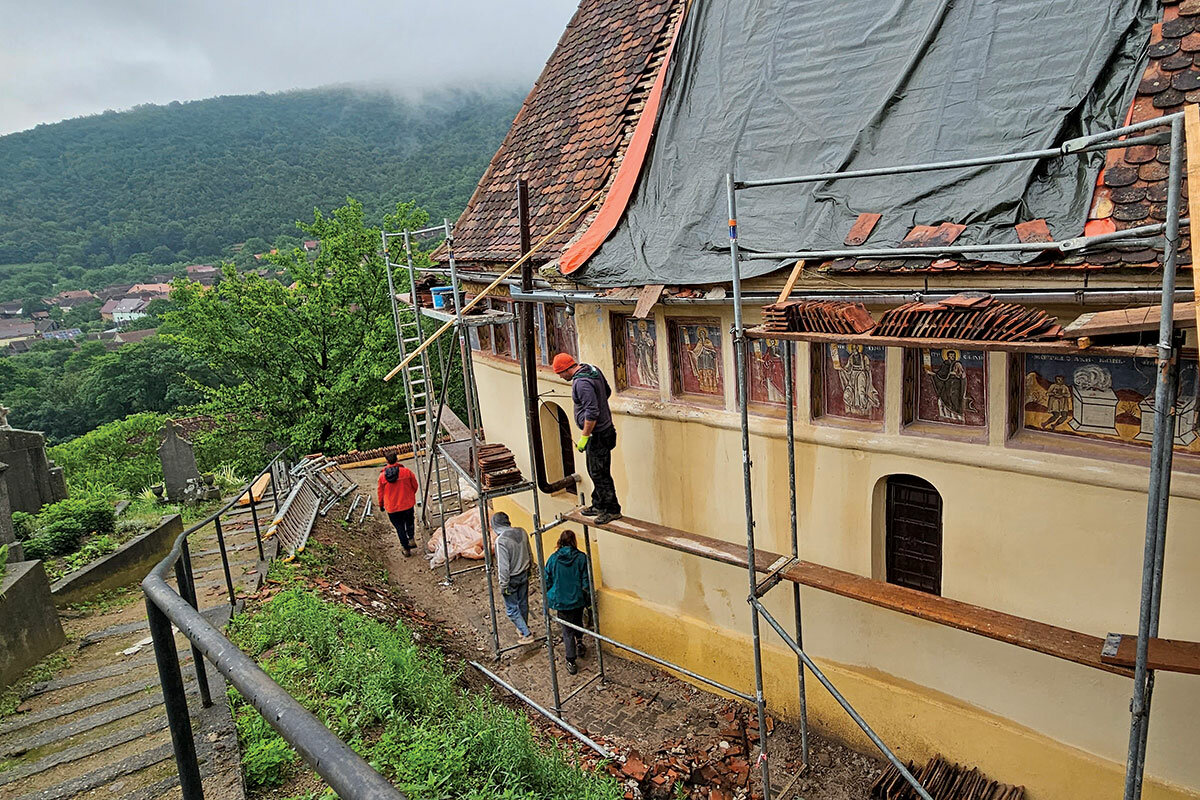
Eugen Vaida and an Ambulance for Monuments team repair the Church of St. Nicholas the Hierarch in Fântânele, Romania.

Today’s story is all about the Power of One. That is, one who organizes many. The setting is a post-Communist country that is struggling to build its economy and has little left over for preserving cultural monuments.

Isabelle de Pommereau writes at the Christian Science Monitor, “It is midday on a damp Friday. Eugen Vaida guides his team into the final phase of re-tiling the roof of a church, at the crest of a forested hill in this mountainous Transylvanian village.

“Village craftspeople and students from the city meticulously lay tiles on the roof timbers of the 18th-century Romanian Orthodox Church of St. Nicholas of the Hierarch. From the scaffolding, students respectfully and attentively watch Nicolae Gabriel Lungu, who is descended from a Romani family who all knew this skill. Soon an older woman summons the crew to share in a platter of clătite, thin cheese-filled crepes.

“Once bustling with families and culture, Mr. Vaida’s home region had become a string of largely empty villages surrounding abandoned stone churches. But now, watching this group interact, he has newfound hope. The repair by his group, Ambulance for Monuments, will help safeguard the church’s stunning outer frescoes. And the impact will ripple far beyond the building itself. 

“ ‘People are starting to understand the value of heritage,’ Mr. Vaida says. For the past seven years, he’s been driving around the country with a van equipped with tools and volunteers in a race against time to rescue endangered historic buildings. He has helped save more than 55 historical structures on the verge of collapse, from medieval churches and fortification walls to old watermills and UNESCO World Heritage Sites. He does so by impressing preservation methods and mindsets onto local communities. 

“ ‘I wanted to reconnect the members of the community to their roots, make them aware that those buildings are part of their cultural identity, and show them how they can continue the work we do,’ he says.

“Mr. Vaida offers a ‘best-practice example of how, with not so much effort, you can save the identity of Romania as a country,’ says Ciprian Stefan, director of the ASTRA Museum, Europe’s largest open-air ethnographic museum, in Sibiu.

“Romania’s rich cultural legacy of painted churches and fortified villages was shaped over centuries. But close to 600 historic monuments are in an acute state of degradation, victims of years of dictatorship, poor legislation, and plain neglect, experts say.

“Mr. Vaida experienced the destruction in a very personal way. He grew up playing with Romani and Hungarian friends, as well as the German Saxons who had literally built the region. When the 1989 collapse of communist dictatorship flung Romania’s doors wide open, half a million people left. The mass exodus tore the Romanian soul apart – and fractured Mr. Vaida’s own identity. Ambulance for Monuments is an attempt to reclaim both his identity and that of his country. …

“He, too, left for the city, to get an education, and he became a successful architect in Bucharest. But six years into the job, he quit to return home. The big city was not his future; his home village was.

“He soon discovered that many village craftspeople who had passed on their know-how from generation to generation had left for Western Europe. … Mr. Vaida wanted to use his architectural skills to save his region’s extraordinary architectural and cultural heritage. He started by teaching children about local history. …

“In 2016, he launched Ambulance for Monuments in hopes of connecting architectural students, craftspeople, and communities around a new effort to restore decaying historic buildings. …

“Volunteer students get hands-on practice in historical restoration; local craftspeople get jobs; and communities help house and feed the teams, and donate the material. … ‘It’s going from grassroots up, from down to up,’ says Mr. Vaida. …

” ‘He doesn’t go to villagers to ask for anything, but he goes there to give something,’ says Mr. Stefan. ‘The community stays in the shadows at first. When they see Eugen comes with material and manpower to restore their church, they say, “Let’s help him,” and, little by little, they come and help with housing, with food.’ …

“The task of rescuing Romania’s cultural legacy is huge, but Mr. Vaida sees signs of progress. … ‘People are moving back to the villages of their grandparents, because they feel they belong there,’ he says. ‘They are rediscovering old houses, their heritage, their villages, and are getting involved in the preservation of this type of living.’ ”

More at the Monitor, here. No paywall. Subscriptions solicited.

Read Full Post »

Photo: Sophie Hills/The Christian Science Monitor.
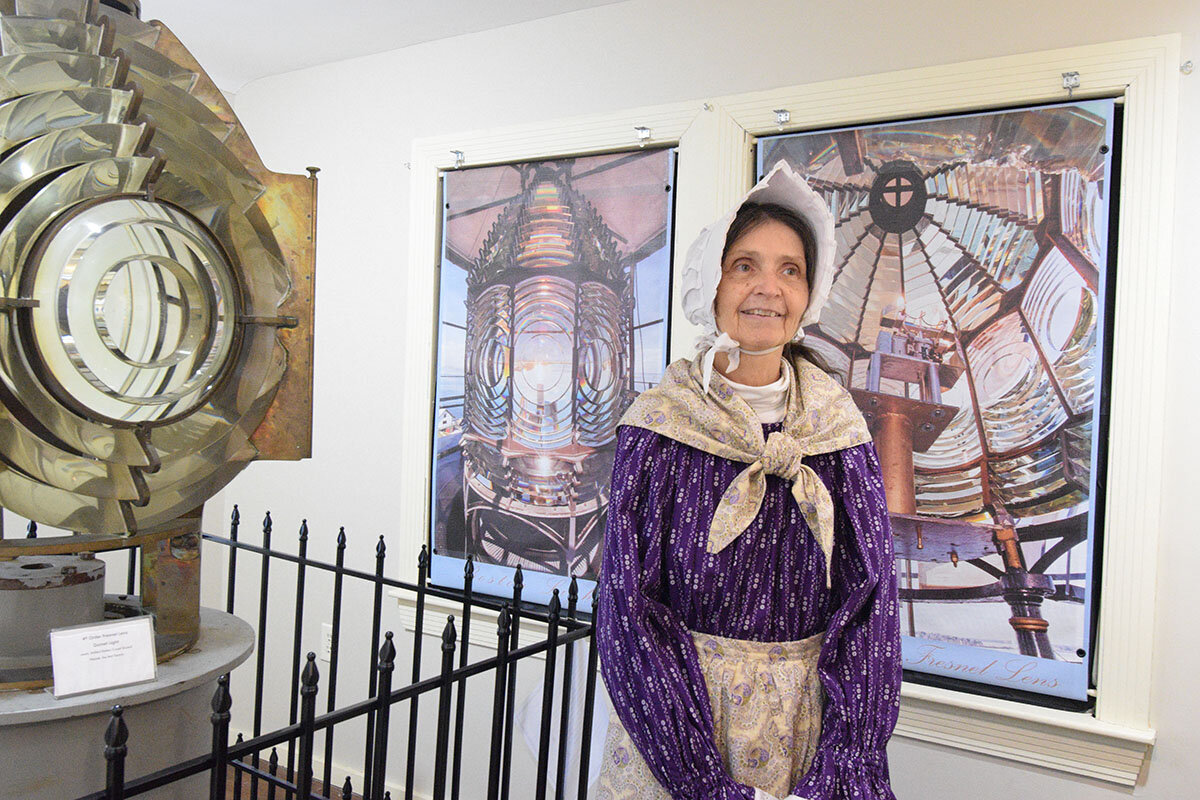
Sally Snowman stands next to a Fresnel lens in the Hull Lifesaving Museum in Hull, Massachusetts, Nov. 9, 2023. She retired at the end of the year after two decades as the keeper of nearby Boston Light.

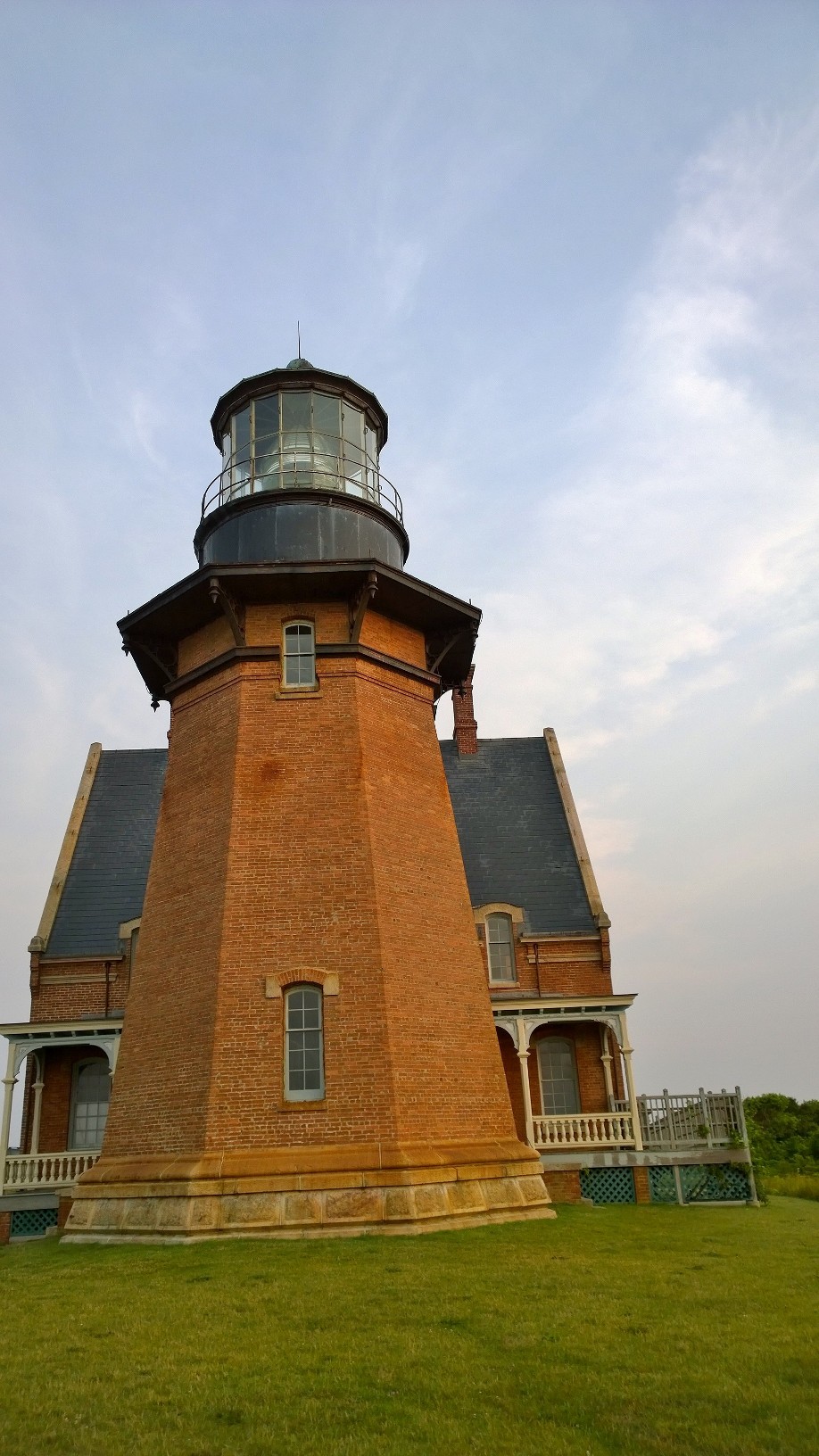
Lighthouses are to the US what castles are to Europe, and there are many enthusiasts working to ensure that lighthouses don’t crumble but have an economically sustainable future for generations to come.

Sophie Hills reports at the Christian Science Monitor, “When Sally Snowman became the keeper of Boston Light in 2003, she expected the role to last only two years. … Ms. Snowman is the last of the lighthouse keepers in the United States. Her retirement marks the end of 307 years of keepers of Boston Light, originally established in 1716.

“When Ms. Snowman first set foot on Little Brewster Island at age 10, it was love at first sight. ‘I want to work as a keeper and get married here,’ she recalls saying. She did both. Now, after 20 years as keeper and even longer as a volunteer, she’s ready to retire. …

“For centuries lighthouses played the crucial role of guiding sailors safely through hazardous waters. Today, some are still active aids to navigation. They also hold a mystical, sentimental power to many, mariners or not, who balked at the news of the last lighthouse keeper retiring. The keeper herself has little patience for a nostalgia that would hamper the future of the icon she has tended for two decades. Ms. Snowman believes the transition will help lighthouses keep shining in the 21st century, rather than fade away. 

“The appeal of lighthouses reaches far and wide, says Jeremy D’Entremont, who has a weekly podcast, ‘Light Hearted,’ and is the historian for the United States Lighthouse Society. Just recently, his co-host was an 11-year-old girl from Kentucky. 

“While big ships today have ample navigational technology, their captains ‘feel welcomed’ by lights at harbor mouths, says local Dave Waller, who co-owns nearby Graves Light Station in Boston Harbor. And the need is still practical for smaller crafts. …

“The U.S. Coast Guard’s mandate isn’t to restore or preserve historical structures like lighthouses. The military branch will continue to operate the aids to navigation – like the light and foghorn – but the actual upkeep of the physical structures and tours of the island are better suited to a different entity. …

“Over her 46 years as a Coast Guard auxiliary volunteer and keeper, Ms. Snowman has become intricately acquainted with the history of the lighthouse and local nautical history. … A spiritual person, she’s touched by all the light has seen and withstood. And even those things it has not been able to withstand, such as when it was demolished by the British as they made their last escape from the harbor during the Revolutionary War. …

“Ms. Snowman is quietly firm that the transfer of the lighthouse is what’s best. ‘It’s important to ensure that our national icons are properly cared for,’ she says.

“Under a process laid out by the National Historic Lighthouse Preservation Act of 2000, there’s a mechanism for ownership of the historic sites to be transferred. Federally owned lighthouses are offered first to other federal agencies, then state and local governments, followed by nonprofits, and eventually private individuals.

“Graves Light Station was bought at auction a decade ago after sitting neglected. When Mr. Waller stepped out onto the top deck and saw the panoramic view of Boston and the ocean, he ‘fell in love.’ … The lifesaving role of lighthouses ‘is not ancient history,’ says Mr. Waller. Just recently, two men had a boating accident and made it to the rocks at the base of Graves Light before they were rescued.” 

More at the Monitor, here. No paywall. Subscriptions solicited.

Photo: Suzanne and John’s Mom.
The Southeast Light, New Shoreham, RI, is still important in navigation but is not manned.

Read Full Post »

Photo: Richard Saker/Guardian.
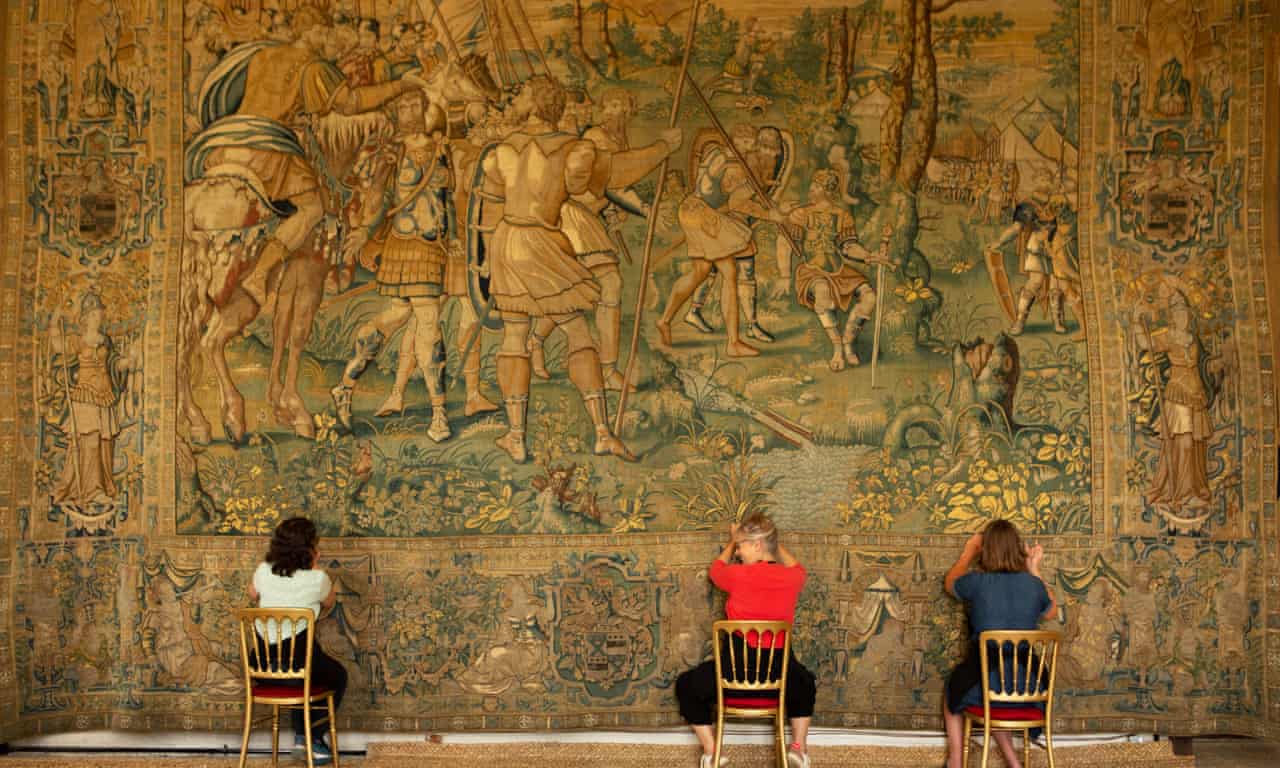
Staff at Hardwick Hall making final adjustments to restored tapestries that Bess of Hardwick bought for £326 15s 9d [~$406] in 1592.

This story is reminding me of childhood visits to the Cloisters before my father had his stroke and how he liked to point out the years of work that went into medieval tapestries.

Jessica Murray, Midlands correspondent of the Guardian, reports on 24 years of work just to do repairs.

“After a 24-year project, the National Trust has finally finished the restoration of a set of 16th-century tapestries at Hardwick Hall in Derbyshire, the longest such endeavor in its history.

“[In July] the final tapestry in the set of 13 Gideon tapestries was unveiled on the wall of the long gallery, the culmination of a painstaking effort to clean and handstitch the huge pieces one at a time, at a cost of £1.7m [~$2,118,718].

“ ‘It has been quite emotional because this is the first time I’ve seen them all on the walls together, and this project was in the background of my every day for so long,’ said Denise Edwards, the former general manager of the estate who retired last year, having overseen the project since 2003.

“ ‘They were supposed to be completed in 2021, the year I was due to retire, but they got delayed because of Covid so I stayed on because I really wanted to see the project through to the end,’ she said. ‘It has taken up a lot of my life for 20 years.’

“The enormous works, 6 metres tall [~20 feet] and more than 70 metres [~230 feet] in length, are considered to be one of the most ambitiously scaled tapestry sets of their time, and were last on display together before the project began in 1999.

“Hardwick Hall, an Elizabethan country house situated on a hilltop between Chesterfield and Mansfield, was at one point surrounded by nine coal mines. ‘You can imagine all the pollution that brought, and with leaky windows they were absolutely filthy,’ Edwards said. ‘And cleaning them is just the beginning of the battle – then it’s repairing all the damage done to the fine silks of the tapestries.’

“The set was bought by Bess of Hardwick, one of the richest women of her time and a friend of Elizabeth I, in 1592 after the death of the lord chancellor Sir Christopher Hatton, who had commissioned them for his estate in Northamptonshire. …

“The set, which depicts the biblical story of Gideon who led an army to save his people from the Midianites, has remained in the long gallery at Hardwick Hall since the end of the 16th century, and unlike many other tapestry sets it has never been moved or cut up. …

“Each tapestry took more than two years to restore, after a process involving a thorough vacuum to remove loose fibers, dust and soot, and a journey to Belgium for specialist wet cleaning.

“National Trust conservators used specialist conservation stitching with hand-dyed yarns to repair damaged areas, with each tapestry taking about 5,000 hours to complete.

“ ‘We work through it slowly … and we use different conservation stitches to bring structure to the tapestry and to fill in the design where it’s missing due to damage,’ said Yoko Hanegreefs, a textile curator, adding that ‘recipe books’ for bespoke dye colors were created to maintain consistency over the life of the project.

” ‘We use wool and stranded cotton to do that because they have faded and no longer have the brightness new silk would have.’ …

“Visitors can see the full Gideon set at Hardwick Hall, and there are plans to remove portraits hanging on some of the tapestries so they can be viewed unrestricted as they would have been 400 years ago.”

More at the Guardian, here. No firewall.

Read Full Post »

Photo: AllAboutBirds.
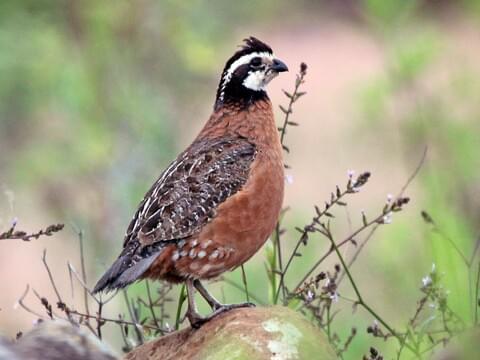
The northern bobwhite quail has a hopeful story.

This is a comeback story. When habitat is lost through ignorance, knowledge can restore that habitat — and the wildlife that used to live there. Humans can learn.

At the Washington Post, Dana Hedgpeth reports on a charming bird that says its name.

‘I don’t want to shoot them anymore — I just like to see them around and hear them whistle,’ said a landowner

“In his teen years, when Joe Graves heard the unique call of quail on his family’s 800-acre farm in rural Virginia, he and his brother Clark would often go out with their dogs and hunt them.

“But due to development and a shift in agricultural practices, the birds that once flourished on their farm in Halifax County and in the state have become harder to find. Now Virginia wildlife experts, hunters and landowners, including the Graves brothers — who are now in their 70s — are working to restore quail habitats in an effort to increase their population.

“ ‘We want to see quail be a part of the Virginia landscape, so we’re trying to create habitats that are critical for their survival,’ said Graves.

“Northern bobwhite quail, which are roughly the size of a softball, have short legs, short wings and don’t fly much. From afar they look like small, plump chickens that walk with their chests puffed out. Male quail typically have a white coloring on their neck area. Quail are best known for their unique sound — similar to a sharp whistle, which they make to communicate with each other and as a way to attract a mate.

“Because they spend most of their life on the ground — much like pheasants and turkeys — quail need a mix of habitat: Honeysuckle and briers provide protection from predators, and they walk among shrubby patches, between weeds and grasses, pecking at seeds. In the fall and winter, quail typically live in flocks, or coveys, with about a dozen birds. They roost in a circle, shoulder-to-shoulder to stay warm, and face outward to watch for predators.

“When a snake, hawk or raccoon approaches, a quail’s defense mechanism is to escape by leaping into the air, flying fast for a few seconds, though they don’t go far — about half the length of a football field. The longer they’re in the air, the more exposed they are to a predator. …

“Quail habitats have been ruined by several factors, including encroaching development and farming practices that have changed because many landowners want neat, well-kept fields between planting seasons. Justin Folks, a wildlife biologist for the Virginia Department of Wildlife Resources, said simply, ‘Quail like weeds and brush, and farmers don’t.’

“Hudson Reese, 84, who owns 1,000 acres in Halifax County, said as a teen, he could regularly find eight coveys of quail on his farm, and now that’s down to one or two. ‘People have tractors, bush hogs and mowers now,’ Reese said. ‘They want to keep their property looking like a golf course. You don’t have quail on a golf course.’ …

“With the destruction of their habitats, the quail population in Virginia has plunged nearly 80 percent since the 1960s, and so too has interest in hunting them. …

“Nationally, experts said quail were once in the mid-Atlantic region, Southeast and Midwest but are now considered one of the top birds suffering a major population decline.

“ ‘It’s amazing we have any because our environment of modern, manicured land doesn’t suit them,’ [John Morgan, director of the National Bobwhite & Grassland Initiative at Clemson University] said. ‘They’re just hanging on and slowly slipping away.’

“While northern bobwhite quail are not considered an endangered species, they are a ‘species of concern,’ according to Jay Howell, a wildlife biologist and small-game project leader who works on the quail recovery team for the Virginia Department of Wildlife Resources. He is worried that continued population declines could make them even more rare.

“Over the past 13 years, Virginia wildlife officials have made a concerted effort with hunters and more than 3,300 landowners to revive their population, and there are signs of success. Howell said the state’s quail population, though still low, is starting to reach equilibrium, and the rate of decline is slowing.

“Landowners are trying to improve quail habitat through controlled burns of forest areas. That process gets rid of pine needles, leaf debris and dead vegetation, leaving more easily walkable areas for quail. The more open ground encourages the growth of new plants and seeds and attracts insects — all of which in turn appeal to quail.

“There are similar efforts in neighboring Maryland. Officials have conducted timber harvests and controlled burns in Pocomoke State Forest since 2013, and last year quail were heard for the first time in decades, according to a 2022 report by the National Bobwhite and Grasslands Initiative, a group that promotes quail conservation.

“Overton McGehee, who owns 150 acres in Virginia’s Fluvanna County, is also working with state wildlife experts to bring quail back.

“ ‘Quail are one more of the species in Virginia that we don’t want to see disappear,’ he said. ‘They’re like a canary in a coal mine,’ he said. ‘If we don’t have the right habitat for quail, then we probably don’t have the right habitat for a variety of birds and pollinators — from whippoorwills and goldfinches to monarch butterflies and bumble bees.’ ”

When I was a kid, I was surprised that organizations of people who fish and hunt were great supporters of conservation, but it stands to reason they need places to hunt. Today I’m grateful for this example of how very different ideologies can work together for common goals.

More at the Post, here.

Read Full Post »

Photo: Felipe Werneck/Ibama via Wikimedia.
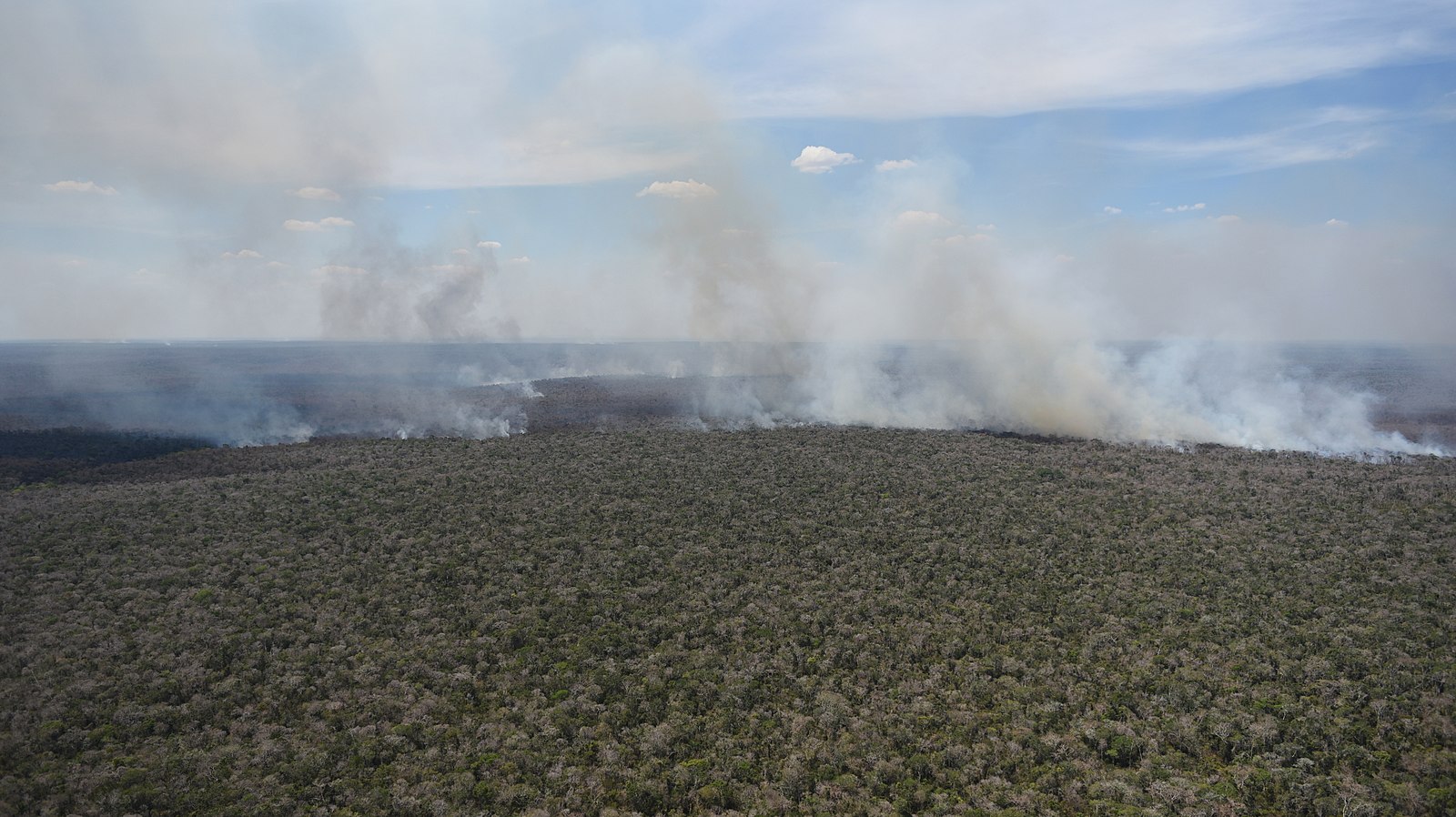
Wildfires in Brazil’s indigenous territory, 2017. Conservationists believe that restoration of the rainforest works best if a variety of seedlings are used, not just one kind.

I think humans are like ants in this regard: as soon as our anthill is destroyed, we start rebuilding. And as soon as greed destroys another swath of rainforest, conversationists, indigenous people, and fundraisers move in to rebuild. It may be hopeless, but that’s how we roll.

Bruno Vander Velde, managing director of content at Conservation International, writes at the Conversation about one rebuilding program.

“A bold initiative to regrow 73 million trees in the Brazilian Amazon has made substantial progress despite some unexpected hurdles, according to an upcoming report. While the global pandemic and an increase in Amazon fires presented setbacks, the initiative, launched in 2017, has delivered almost 20 percent of its forest restoration target, according to Conservation International in Brazil, one of several partners involved in implementation. 

“The partners point to surprising progress taking root, as the COVID pandemic shows signs of leveling off and a new incoming presidential administration publicly commits to stem the tide of deforestation. …

Launched at a Brazilian music festival, the initiative targeted areas along the southern edges of the Amazon forest, known as Brazil’s ‘arc of deforestation,’ as well as in the heart of the forest, where natural regeneration is still possible.

“By restoring these carbon-absorbing forests, the initiative is intended to help the South American country achieve its climate commitments under the Paris Agreement, as well as its target of reforesting 12 million hectares (nearly 30 million acres) of land by 2030. 

“The initiative comprises two efforts: Amazonia Live, an effort led by the Rock in Rio music festival in collaboration with Conservation International and Brazilian nonprofit Instituto Socioambiental; and the Amazon Sustainable Landscape project, a collaboration among Conservation International, the Brazilian Ministry of Environment, the Global Environment Facility, the World Bank and the Brazilian Biodiversity Fund. 

“In sum, the initiative is an experiment to ‘figure out how to do tropical restoration at scale, so that people can replicate it and we can drive the costs down dramatically,’ Conservation International CEO M. Sanjayan told Fast Company in 2017. …

“One of the initiative’s most noteworthy features was the use of a seed-planting method called ‘muvuca,’ widely advocated by the Instituto Socioambiental as a way to reduce restoration costs. Unlike typical reforestation efforts, in which tree saplings are planted one at a time, the muvuca method relies on spreading a large and varied mixture of native seeds across the targeted areas, to assure a higher diversity of trees. The technique’s results have exceeded expectations, experts say. 

‘We’re seeing a tree yield that is three times higher than our initial estimates,’ said Miguel Moraes of Conservation International’s Brazil office. 

“ ‘Rather than 3 million trees growing in 1,200 hectares (3,000 acres), as we would have expected, we’re estimating 9.6 million trees in the same area,’ based on monitoring reports, he added. …

“This restoration effort has not escaped some hard, real-world realities in Brazil’s Amazon. Some restored areas were burned by fires and will be monitored to see if they can regenerate on their own, Moraes said. (The area lost was not counted against the overall goal.) 

“Such fires — all of them set by humans, usually to clear forests for agriculture and livestock — are a sign of the times. The Brazilian Amazon has been hit especially hard by wildfires in recent years. By September 2022, more forest fires were recorded in the region than in all of 2021, amid a surge of deforestation. …

“ ‘Our initial expectation [in this effort] was to prioritize the restoration of large contiguous areas within conserved areas,’ Moraes said. Restored forests in those areas should have been more durable; however, in the past two years ‘deforestation within protected areas in Brazil has increased significantly,’ he added. 

“The resilience of the Brazilian Amazon’s many protected areas will be critical to the long-term success of the initiative. 

“As it did around the world, COVID upended life in Brazil. …

“ ‘Like everyone, we were completely unprepared for a global pandemic — not only at the project level, but also at an individual level,’ [Moreas] said. … ‘Twenty percent restored might seem a low figure — and it generates a bit of frustration. But given the context, that we were able to achieve 20 percent of our target is impressive.’

“Even in the tropics, trees take years to grow to maturity. But reforestation projects usually last only a fraction of that time. … ‘Most projects like these are an intervention at a point of time, and then they end,’ Moraes said. ‘But restoration is a long and continuous process. So, ensuring permanence is a huge issue.’

“Practitioners are taking steps to address this, including planning for long-term satellite monitoring to keep a close eye on restored forests. They will also work with communities and local governments to try to bolster on-the-ground protection of these areas. 

“Five years after the restoration initiative was announced, nearly three years into a pandemic and just weeks since a new administration took office in Brazil, project organizers are hopeful. The 2023 deadline for completion has been shifted to 2026, after some administrative challenges in the project’s early years. Organizers have now grown more comfortable managing the complexities inherent in a partnership of this size, Moraes said.

“ ‘I believe we underestimated the complexity of the challenge ahead of us. We are now trying to be more strategic. … Conservation International’s restoration efforts in Brazil go beyond just this effort,’ he said. ‘But if we succeed, we can show that we can make an impact at the scale needed to bring the forest back from the brink.’ ”

More at Conversation, here. No firewall.

Read Full Post »

Photo: Philip Brown/Unsplash.
Led by tribes, conservationists are helping bison make a comeback.

Having recently watched an appalling old Annie Get Your Gun film with Betty Hutton (appalling on the subjects of poverty, women, and especially indigenous people), I was relieved to learned from today’s article that attitudes may have evolved into something more promising.

Back in the day, settlers fought natives in underhanded ways. One way was killing bison, a sacred food source. Today European descendants and tribes are actually collaborating to bring the animals back from the edge of extinction.

Jess McHugh reports at the Washington Post, “Miles of prairie stretched out across the Wichita Mountains Wildlife Refuge in southern Oklahoma, acre after acre of brush, grasses and hearty vegetation creeping toward the low-range granite mountains rising in the distance. Like in much of Oklahoma, the road is flat here, but the speed limit remains 30 mph. That’s because of the bison.

“They appeared seemingly out of nowhere: dozens of massive animals lumbering up the shoulder of the road to cross to the fresh vegetation on the other side. The herd moved slowly, their soft, bovine eyes barely registering the stopped cars awaiting their passage. They quickly set to work mowing down the fresh springtime grass.

“The bison’s quiet munching does more than nourish their bodies — it’s one of many things they do to nurture their entire ecosystem, one that is increasingly under threat from climate change. Grazing bison shaving down acres of vegetation leave more than dung behind:

Their aggressive chewing spurs growth of nutritious new plant shoots, and their natural behaviors — the microhabitats they create by rolling in the ground, the many birds that forged symbiotic relationships with them — trickle down the food chain.

“Once bordering on extinction, bison now serve as a great provider for their ecosystems, standing as an example of the ways in which animal conservation and ecological protection can work in tandem.

“ ‘Buffalo is the original climate regulator,’ said Troy Heinert, a member of the Sicangu Lakota (Rosebud Sioux) tribe and executive director of the InterTribal Buffalo Council, a coalition working to restore the animal on tribal lands. ‘Just by how they use the grass, how they graze, how their hoofs are designed, the way they move.’ …

“Tribes are leading the effort to bring back the bison, Heinert says, which in turn allows for the return of other native grasses, animals and insects — all of which will ‘help fight this changing climate.’

“Bison, called buffalo by some Indigenous peoples, are mammoth creatures. Weighing up to 2,000 pounds, they are the largest land mammal in North America. … Two centuries ago, bison dominated much of the continent from Canada to Mexico, when tens of millions roamed North America. They were so numerous that the pounding of their hoofs beating across the land sounded like rolling thunder. For the many tribes of the plains region — the Lakota, the Shoshone, the Arapaho, to name a few — buffalo was a sacred animal that nourished their people and played an important ceremonial role.

“For European colonizers, the bison were both a commodity and a weapon. Americans massacred them by the thousands, selling their pelts and organizing vast sport hunts. As the United States pushed West in the 1800s, bison became a pawn in their quest to wrest Indigenous tribes off their ancestral homes. …

“By the turn-of-the-20th century, millions of bison had been killed. In 1900, fewer than 1,000 — of an estimated 30 to 60 million — remained, many in zoos.

“President Theodore Roosevelt ordered federal bison herds to be put into place (some, such as Custer State Park, were ironically sourced from tribal herds). The bison observed in the Wichita Mountains are descended from 15 animals commandeered from the Bronx Zoo in 1907 and brought to Oklahoma via train car. In the intervening century, federal, tribal and private herds have brought the species back from the brink of extinction. The estimated number of bison nationwide — while far from the millions — now hovers in the low hundreds of thousands.

“Indigenous peoples have been integral to this effort from the start, both by managing herds and by introducing legislation to protect and expand bison territory. In the past few decades, tribal herd numbers have soared: The InterTribal Buffalo Council, which began as a modest coalition of fewer than 10 tribes in the early 1990s, will soon count 76 tribes across 20 states from New York to Hawaii among its members, managing a total of more than 20,000 animals across 32 million acres.

“The return of the bison is a victory not only for the sake of biodiversity but for the entire ecosystem in which they live. As a keystone species, the bison sustain their environment from the top down.

“ ‘They move through, graze everything down. It’s a type of disturbance — like fire would be,’ said Dan McDonald, lead wildlife biologist at the Wichita Mountains Wildlife Refuge. ‘The fresh green [draws] other animals that would feed on it: elk and deer and whatever other type of grazers that would consume some of that new forage.’

“The herd in Oklahoma is approximately 625 animals, but when large herds move synchronously across the land, they create what scientists have dubbed a ‘green wave.’ The bison’s vigorous grazing stimulates plant growth, creating a flood of new vegetation that follows in the bison’s wake to be ‘surfed’ by animals large and small. Green waves can be so dramatic that some — such as the one created by Yellowstone’s bison herd — can be seen from space.”

Read about the extraordinary side benefits of herd restoration at the Post, here.

Read Full Post »

Map: Jacob Turcotte/Christian Science Monitor.
Efforts are afoot in Florida to save the the biodiversity of the Everglades by saving the water.

Last Thanksgiving, when John and family went to Florida, they sent great videos of a ride on one of those Everglades airboats that seem to float above the surface and allow visitors to get up close and personal with Everglades wildlife.

I had read, though, that the Everglades region was in trouble from overdevelopment and water pollution. Today’s article shows people are making a strong effort to protect it.

Richard Mertens has the story at the Christian Science Monitor, “Eight hundred feet up, the helicopter banks hard to the left. The horizon disappears. Mark Cook, an avian biologist, peers out his side window at a small irregular patch of water below. It’s hardly distinguishable from innumerable other patches that lie in every direction, dark and shining amid a ragged expanse of brown marsh grass and green tree islands.

“There’s one small difference: This patch is flecked with tiny specks of white, scattered like scraps of paper around a puddle.

“ ‘This year is pretty quiet,’ Dr. Cook has been saying. ‘It’s not very good for wading birds.’

“Now he looks more closely. The specks resolve into a variety of different birds, not all of them white: great egrets, snowy egrets, wood storks, white ibises, and pale pink roseate spoonbills, all standing in and around the shallow water. …

“For the birds of the Everglades, it’s not really been good for almost a century. First came the plume hunters of the 1800s and early 1900s, who shot birds by the thousands so that their feathers could adorn women’s hats in New York and London. Then came the speculators, developers, and visionaries who did more lasting damage, draining the marshes, logging the cypress swamps, digging canals, and building levees. They turned the Everglades into fields and housing tracts until half of it was gone. What’s more, says Paul Gray, a biologist with Audubon Florida, ‘The half of what’s there is all screwed up.’ 

“Today the state of Florida, the federal government, and many private organizations and individuals are working to bring the Everglades back -– at least the half that’s still left. Everglades restoration became national policy in 2000 when Congress adopted the $7.8 billion Comprehensive Everglades Restoration Plan.

“Since then, lawsuits, political fighting, and dwindled funding have at times slowed progress. But in recent years restoration efforts have gained momentum. Some projects have been completed, and new ones are underway. …

“ ‘The Everglades ball is rolling,’ says Peter Frederick, a retired wildlife ecologist at the University of Florida and an expert on Everglades restoration. 

“But will it work? Everglades restoration is a long-term undertaking. It’s expected to cost $23.2 billion and take until 2050 to finish. People often say it’s the largest ecological restoration project ever. ‘A lot could stop it,’ says Dr. Frederick. …

The Everglades system is unique in the world, an inextricable mix of water and vegetation resting on a shallow bed of porous limestone.

“More than just Everglades National Park, the Everglades once encompassed the whole southern third of the Florida Peninsula. … In those days, water that fell during Florida’s summer rains drained slowly south into Lake Okeechobee, a huge basin that in many places is hardly deeper than a suburban swimming pool. When the water was high, it lapped over the southern rim and flowed a hundred miles south in a broad sheet, through swamps and saw-grass marshes, wet prairies and sloughs, before finally discharging through mangrove swamps and coastal islands into the Gulf of Mexico. It was a rich and biologically diverse ecosystem governed by water. And the land was very flat. …

“Today those Everglades are mostly gone. They’re no longer a single vast interconnected system of flowing water but a collection of divided and diminished parts – large shallow basins separated by levees and tied together by gates and canals, with some devoted to holding water, some to cleaning it, and others to conserving wildlife.

“Lake Okeechobee is diked and polluted, and the swamps and saw-grass marshes that once received its overflowing waters are a checkerboard of sugar cane fields. The flow of water from north to south is much reduced, where it survives at all. For all its natural abundance, the Everglades today is an artificial landscape, a creature of engineering as much as topography and nature. 

“The main challenge of restoration is hydrological. It’s to re-create the old pre-drainage conditions by delivering more clean water to the Everglades. It’s to bring back the old cycle of rising water in summer followed by a long drying out through the winter. It’s to restore, at least in part, the slow flow south.

“The easiest way to accomplish this would be simply to pull the plug: tear down the dikes and levees, fill the canals, and send the engineers home. But restoration is also political, and it has always involved more than the Everglades. Its aim is also to provide clean water to coastal cities and estuaries and protect them from flooding. It’s to preserve and irrigate an agricultural district the size of Rhode Island that sits in the middle. …

“ ‘They all say the best engineer is no engineer at all,’ says Dr. Frederick. ‘Let nature do the work. The problem is that we now want to do more things with that water than we used to.’

“Dr. Cook enjoys a stork’s-eye view of the Everglades. His weekly flights take him over both the good and the bad, the degraded and the only partly degraded. [Some] areas are thick with cattails, a sign of nutrient pollution. Passing over one of these, Dr. Cook says, ‘We can’t get it back to what it once was, for maybe 100 to 200 years. But we can improve it for wildlife.’ …

“Sometimes there are surprises. In 2017, Hurricane Irma inundated the Everglades. The next spring, birds nested in numbers no one living had ever seen. To biologists, it seemed a vision of the old Everglades – and of what might still be.

“ ‘As an ecologist, you think, you get the water right and maybe they’ll come back,’ Dr. Cook says.”

Lots more on what’s being done at the Monitor, here. No firewall.

Read Full Post »

Photo: Remko de Waal/ANP/AFP via Getty Images.
Rembrandt’s restored ‘Night Watch’ at the Rijksmuseum in Amsterdam.

A project to restore a Rembrandt called “Night Watch” has received a lot of attention recently, but at the risk of repeating what you already know, I’d just like to point out that trimming a work of art can seriously affect its greatness.

How many times have building renovations cut paintings to fit or squashed them into too small a space to be properly appreciated. I think, for example, of the many special WPA paintings in US post offices that have been significantly altered over the years. I understand competing needs, but it’s a loss.

What was lost in Rembrandt’s ‘Night Watch,’ the New York Times says, was a sense of movement. The original was “asymmetrical: The large arch that stands behind the crowd was in the middle, and the group’s leaders were on the right. Rembrandt painted them this way to create a sense of movement through the canvas.

“Once the new pieces were restored, so was the balance, [said Rijksmuseum’s director, Taco Dibbits.] ‘You really get the physical feeling that Banninck Cocq and his colleagues really walk towards you.’ “

The main focus of the recent news coverage, however, was on how experts used artificial intelligence (AI) — along with an early copy of the original painting — to reimagine Rembrandt’s intentions.

Nina Siegal reported at the Times, “Rembrandt’s “The Night Watch” has been a national icon in the Netherlands ever since it was painted in 1642, but even that didn’t protect it.

“In 1715, the monumental canvas was cut down on all four sides to fit onto a wall between two doors in Amsterdam’s Town Hall. The snipped pieces were lost. Since the 19th century, the trimmed painting has been housed in the Rijksmuseum, where it is displayed as the museum’s centerpiece, at the focal point of its Gallery of Honor.

“[Now] for the first time in more than three centuries, it will be possible for the public to see the painting ‘nearly as it was intended,’ said the museum’s director, Taco Dibbits. …

“Rather than hiring a painter to reconstruct the missing pieces, the museum’s senior scientist, Robert Erdmann, trained a computer to recreate them pixel by pixel in Rembrandt’s style. A project of this complexity was possible thanks to a relatively new technology known as convolutional neural networks, a class of artificial-intelligence algorithms designed to help computers make sense of images, Erdmann said.”

As amazing as AI is, the work would not have been possible if a less renowned painter hadn’t made an early copy of Rembrandt’s work.

“Indications already existed of how the original ‘Night Watch’ likely looked,” Siegal continues, “thanks to a copy made by Gerrit Lundens, another 17th-century Dutch painter. He made his replica within 12 years of the original, before it was trimmed.

“Lundens’s copy is less than one-fifth the size of Rembrandt’s monumental canvas, but it is thought to be mostly faithful to the original. It was useful as a model for the missing pieces, even if Lundens’s style was nowhere near as detailed as Rembrandt’s. Lundens’s composition is also much looser, with the figures spread out more haphazardly across the canvas, so it could not be used to make a one-to-one reconstruction.

“The Rijksmuseum recently made high-resolution scans of Rembrandt’s ‘Night Watch,’ as part of a multimillion-dollar, multiyear restoration project, initiated in 2019. Those scans provided Erdmann with precise information about the details and colors in Rembrandt’s original, which the algorithms used to recreate the missing sections using Lundens’s copy as a guide. The images were then printed on canvas, attached to metal plates for stability and varnished to look like a painting.” More at the Times, here.

The Guardian also covered the story, quoting the Dibbits as saying, “With the addition especially on the left and the bottom, an empty space is created in the painting where they march towards. When the painting was cut [the lieutenants] were in the centre, but Rembrandt intended them to be off-centre marching towards that empty space, and that is the genius that Rembrandt understands: you create movement, a dynamic of the troops marching towards the left of the painting. …

“I am always hoping that somebody will call up one day to say that they have the missing pieces. I can understand that the bottom part and top might not be saved but on the left hand you have three figures, so it is surprising that they didn’t surface because at the time in 1715 Rembrandt was already much appreciated and an expensive artist.”

Update 8/11/21 — Michiel of Cook & Drink went to the exhibit, sending a picture and comment: “The AI-part adds a lot of value to the overall painting, but obviously it’s a reconstruction. This is clearly visible (the painting lies a bit deeper than the reconstruction) and that helps to appreciate both the original and the extended version. We’ve seen the painting many times, always in its original frame. To see it without a frame was also special. Very nice to see so many people interested in this project. It’s special to see the combination of very advanced IT, AI, art and history.”

Nice to see a line for art!

Read Full Post »

Older Posts »