Feeds:
Posts
Comments

Posts Tagged ‘school’

I’m so glad Cousin Claire shared this New York Times story on Facebook. It’s about a school custodian with an artistic bent whose talent is raising everyone’s spirits.

Corey Kilgannon writes writes that Israel Reyes, “senior handyman and longtime boiler operator at Public School 69X Journey Prep in the Soundview section of the Bronx,” finds the lonely summer months to be a good time “to concentrate on the colorful wall murals he has become known for painting inside the 93-year-old building. …

“For years, the 15-foot walls were faded and drab, Mr. Reyes said.

“ ‘There were no colors — it was like walking into a prison,’ recalled Mr. Reyes, who said that 12 years ago he grew tired of watching students entering the building each morning with their heads down.

“ ‘A lot of these kids come from broken homes, just like I did, and I’d see them walking in, all stressed out and looking down, because the school looked even worse than their homes,’ he said. ‘I wanted to do something to make them look up.’

“So he persuaded the principal to let him use leftover paint from other jobs in the building to start creating an educational wonderland. He worked for years, during his down time, his lunch hour and on his personal time, even late into the night.

“ ‘The kids come in now in the morning and they smile,’ Mr. Reyes said. ‘They come in and ask me, “What’s next?” and I show them what I worked on overnight.’ ” …

“Mr. Reyes, whom everyone calls Carlos, said he and his five brothers were raised by his father in the Bronx and on a farm in Puerto Rico.

“ ‘We had to make our own toys from garbage, from whatever we found,’ said Mr. Reyes, who as an adult has made sculptures out of trash-picked objects, especially the wooden legs off discarded furniture, to entertain his four children and 14 grandchildren.

“He calls it ‘table leg art,’ and has made a panorama representation of Manhattan that is on display in the school library, a cityscape with wooden legs as skyscrapers. …

“Until recently, said Mr. Reyes, a widower, his apartment was decorated in an over-the-top theme — a botanical garden with a pond, a lamppost and a park bench — recalling his Puerto Rican upbringing.

“ ‘When my son moved back home, I had to sleep on the bench,’ he said. ‘I’d tell people, “I’m not homeless, but I sleep on a park bench.” ‘ ” More.

I’ve read that no matter what kind of job you have, there should be some aspect that is yours alone, where you can express your creativity. I couldn’t agree more.

Photo: Santiago Mejia/The New York Times  
Israel Reyes, at Public School 69X in the Bronx, wanted to brighten the building for students. 

Read Full Post »

Among all the sad aspects of the refugee crisis, children in refugee camps going without any education — sometimes for years — has to be one of the saddest.

10 million under the age of 8 are displaced

Fortunately, there are occasional rays of light, such as adult refugees deciding to start their own school. And here is a story from Mashable about a partnership between the International Rescue Committee and the makers of Sesame Street.

Matt Petronzio writes, “A new partnership between Sesame Workshop, the brand’s educational nonprofit, and global humanitarian aid organization International Rescue Committee (IRC) will allow the two groups to develop, distribute, and test educational resources and programs designed with young refugees in mind. …

“The first phase is to develop educational multimedia content that can reach children living in displaced or resettled communities through mobile devices, radio, TV and printed materials in engaging, enjoyable ways.

” ‘We really set out to find a partner that complements our offerings, and I think the IRC is ideal,’ said Sherrie Westin, executive vice president of global impact and philanthropy at Sesame Workshop. …

“Sesame Workshop and the IRC will adapt existing Sesame products and content for regions where the two organizations already have a presence working with young children and their families. …

“The partnership is aimed at the children who make up half of the record 60 million people currently displaced around the world, specifically the one-third of that population under the age of eight. In addition to a lack of education, these children also often deal with toxic stress and trauma.

” ‘We’ve seen time and time again, in the context of conflict and crisis, that those very young children don’t have a safety net to support them,’ Sarah Smith, senior director for education at the IRC, told Mashable. …

“Most recently [Sesame] launched Zari, the first local Muppet in Afghanistan, a country where many young children lack access to education, especially girls.

“Zari’s gender was a deliberate choice to promote girls’ empowerment — an example of tailoring curricular goals to the needs of a particular country. (According to Westin, recent research showed that fathers in Afghanistan changed their minds about sending their daughters to school after watching Baghch-e-Simsim, the local language version of Sesame Street.)”

More at Mashable.

Image: Vicky Leta/Mashable

Read Full Post »

The article by Astrid Zweynert and Ros Russell begins, “Boys campaigning for girls’ education is not common in most parts of the world, but in India’s Rajasthan state, they are at the heart of a drive to get more girls into schools.

Educate Girls trains young people to go into villages to find girls who are not in the classroom in a country where more than 3 million girls are out of school.

“Some 60 percent of Educate Girls’ 4,500 volunteers are boys, founder and executive director Safeena Husain told the Thomson Reuters Foundation.

” ‘Having these boys as champions for the girls is absolutely at the core of what we’re trying to achieve,’ Husain said in an interview as she was awarded the $1.25 million Skoll Award for Social Entrepreneurship, the largest prize of its kind. …

“In Rajasthan, 40 percent of girls leave school before reaching fifth grade, often because their parents do not see education as necessary for their daughter because she is going to get married or stay at home to do housework, Husain said. …

“Educate Girls’ approach to is to define hotspots where many girls are out of school, often in remote rural or tribal areas, and then deploy its volunteers to bring them back into the classroom, said Husain.”

There’s plenty of research showing that when girls are educated, the standard of living in a country goes up. Educated girls “are less likely to get married at an early age or to die in childbirth, they are likely to have healthier children and more likely to find work and earn more money.”

More at the Christian Science Monitor, here.

Read Full Post »

Do you ever read Kevin Lewis’s Sunday Globe column, “Uncommon Knowledge”? He covers new research in the social sciences. Thanks to him, I learned about this study on helping minority boys get engaged in education.

“A disproportionate number of students struggling academically are minorities, ” he writes. “Can we do better?

“In what they claim is the first credible study of the effect of an ethnically grounded education, researchers at Stanford analyzed the effect of a ninth-grade course offered in several San Francisco public schools covering ‘themes of social justice, discrimination, stereotypes, and social movements from US history spanning the late 18th century until the 1970s’ and requiring students ‘to design and implement service-learning projects based on their study of their local community.’…

“The researchers found that taking the course ‘increased attendance by 21 percentage points, GPA by 1.4 grade points, and credits earned by 23 credits (or roughly four courses).’ They call the results ‘surprisingly large effects,’ which were concentrated among boys.”

The paper, by Thomas S. Dee, and Emily Penner, is The Causal Effects of Cultural Relevance: Evidence from an Ethnic Studies Curriculum.” It was posted at the National Bureau of Economic Research in January.

More here.

Photo: Stanford University
Teacher David Ko instructs an ethnic studies class at Washington High School in San Francisco. A Stanford study found students benefit from such courses. Here, Ko is explaining an assignment about the role of advertising in reinforcing cultural stereotypes.

Read Full Post »

Raising a family is challenging under any circumstances, but Simon Romero of the NY Times can tell you about families that have added on a somewhat more extreme challenge: settling in Antarctica.

He writes from Villa Las Estrellas, “Children at the schoolhouse here study under a portrait of Bernardo O’Higgins, Chile’s independence leader. The bank manager welcomes deposits in Chilean pesos. The cellphone service from the Chilean phone company Entel is so robust that downloading iPhone apps works like a charm. …

“Fewer than 200 people live in this outpost founded in 1984 during the dictatorship of Gen. Augusto Pinochet, when Chile was seeking to bolster its territorial claims in Antarctica. Since then, the tiny hamlet has been at the center of one of Antarctica’s most remarkable experiments: exposing entire families to isolation and extreme conditions in an attempt to arrive at a semblance of normal life at the bottom of the planet.

“It gets a little intense here in winter,” said José Luis Carillán, 40, who moved to Villa Las Estrellas three years ago with his wife and their two children to take a job as a teacher in the public school.

“He described challenges like trekking through punishing wind storms to arrive at a schoolhouse concealed by snow drifts, and withstanding long stretches with only a few hours of sunlight each day. …

“Most of the students at the village’s small school, who generally number less than a dozen, are the children of air force officials who operate the base; some of the parents say the isolating experience strengthens family bonds.

“That Villa Las Estrellas is so remote — its name can be translated as Hamlet of the Stars, since the lack of artificial light pollution here enhances gazing into the heavens — sits just fine with many who live here.

“ ‘People in the rest of Chile are so afraid of thieves that they build walls around their homes,’ said Paul Robledo, 40, an electrician from Iquique (pronounced E-key-kay). ‘Not here in Antarctica. This is one of the safest places in the world.’ More here.

And here you thought our cold snap was a little intense!

Photo: Daniel Berehulak for The New York Times  
Children being picked up from school in Villa Las Estrellas. Most of the students at the village’s small school, who generally number less than a dozen, are the children of air force officials who operate a nearby base. 

Read Full Post »

At the Guardian, teacher Steve Ritz tells Matthew Jenkin about how he began growing food in a troubled South Bronx school.

“The Green Bronx Machine was an accidental success. I wound up working at a very troubled high school in New York’s South Bronx district. It had a very low graduation rate and the bulk of my kids were special educational needs, English language learners, in foster care or homeless. It was dysfunctional to say the least.

“Someone sent me a box of daffodil bulbs one day and I hid them behind a radiator – I didn’t know what they were and figured they may cause problems in class. A while later … we looked behind the radiator and there were all these flowers. The steam from the radiator forced the bulbs to grow.

“That was when I realised that collectively and collaboratively we could grow something greater. We started taking over abandoned lots and doing landscape gardening, really just to beautify our neighbourhood. … We then moved on to growing food indoors in vertical planters around the school.

“By building an ‘edible wall’ to grow fresh vegetables in our science classroom, I gave the kids a reason to come to school. …

“Remarkably the plants grew. The kids really believe that they are responsible for them and attendance has increased from 43% to 93%. Students come to school to take care of their plants – they want to see them succeed. Along the way, the kids succeed, too.” More here.

Photo: Progressive Photos  
Steve Ritz gets students involved in the natural world. Attendance has more than doubled.

Read Full Post »

Two grandsons are starting school this week and overcoming shyness, which got me talking to John about what happened one time when I was a shy first grader.

My family had stayed an extra month on Fire Island that year, which meant that when I got to first grade on the mainland, I didn’t know any of the routines. For example, I didn’t know what the lined paper that appeared on my desk after recess was for. (It turned out it was not for drawing a picture of a girl.)

Another routine was morning attendance. We would all sit quietly at our desks, and when Miss Dobbins called our name, we would say, “Here.”

This particular morning, I was really not feeling at all well but was too shy to raise my hand in the middle of a ritual. I didn’t want anyone to look at me.

But becoming increasingly desperate, I made up my mind that when my name was called, I would go up to the teacher’s desk and tell her I felt sick.

Miss Dobbins called my name. I got out of my seat quickly and hurried up to her desk and opened my mouth to say, “I feel sick,” and vomited all over her lap.

She didn’t get mad, just asked another teacher to hold the fort while she cleaned up and got me some help.

People looked at me after all.

(One always feels an urge to come up with a moral for every tale one tells children, but I don’t think this tale has one. Stuff happens to everyone. Even grandmas.)

Read Full Post »

Thomas Whaley, a teacher of 7-year-old English-language learners on Long Island came up with a creative way to build confidence while building writing skills. He has students make the case for why they should be president.

Jasmine Garsd reports at National Public Radio, “Whaley does not look like the kind of guy that dabbles in magic markers. Before he was a second-grade teacher, he worked at a public relations company in New York City.

“He says he started thinking about doing something else while riding to and from work on the Long Island Rail Road. ‘I would talk with people on the train at 6 a.m. and 8 p.m. on the way home,’ he recalls. ‘They were people who had a complete disconnect from the young people of the world. They were all so focused on adults and the rat race. And I realized that this was not for me.’

“That was 16 years ago. He has been teaching ever since.

“In addition, Whaley has found time to write a novel called Leaving Montana, and he’s starting to write children’s books. Last year, he won the New York state teacher-of-the-year award.

“This second-grade presidential campaign is an example of why. He tells me he got the idea when he asked the children one day to raise their hands if they thought they could never be a U.S. president.

“The answer broke his heart.

” ‘Almost every single child who is an English-language learner believed that they couldn’t be,’ Whaley recalls. They’d say things like, ‘ “I can’t run for president because my parents are from a different country.” That was a biggie. “Because I’m poor, and you need a lot of money to be the president.” “Because I don’t like to read, or I can’t read.” ‘

“Whaley says the presidential speech project is about more than just learning to read and speak in public. He wants these kids to learn to boast about themselves.

” ‘Bragging about yourself, and your best qualities,’ Whaley says, ‘is very difficult for a child who came into the classroom not feeling any confidence whatsoever to read three or four words.’

“Robert Epstein, the principal at Canaan Elementary, says this is the essence of what makes Whaley such a great teacher.

” ‘There’s a sense of community that’s really unsurpassed,’ and the students will take risks as a result, Epstein says. He adds that Whaley goes above and beyond what is expected of him as a teacher. ‘If one needs sneakers, I’ve seen him go out and buy sneakers. He’s gone to homes. He’s constantly on the phone, constantly emailing parents.’ ”

More at NPR.

Photo: Christopher Gregory for NPR
Thomas Whaley walks his students back to class from the library.

Read Full Post »

Adele Peters writes at FastCoExist that some schools, “like Ward Elementary in Winston-Salem, North Carolina, are starting to fill classrooms with exercise bikes, so students can work out while they learn.

“The Read and Ride program at Ward began five years ago. One classroom is equipped with enough exercise bikes for a full class of students, and teachers bring students throughout the day to use them. As they ride, they read. The combination burns calories, but it turns out that it also helps students learn better. As the elementary school analyzed testing data at the end of school year, they found that students who had spent the most time in the program achieved an 83% proficiency in reading, while those who spent the least time in the program had failing scores–only 41% proficiency.” More here.

The concept, which I learned about at Andrew Sullivan’s blog, is interesting. I hope most such efforts are in addition to recess, not instead of, but I know from experience that physical motion can helping with learning. And if the kids like it, so much the better.

Photo: Read and Ride

Read Full Post »

And speaking of schools that develop a love of the natural world, check out this story from the radio show Living on Earth.

“On the other side of the world, in the tourist paradise of Bali, there’s a school that the U.S. Green Building Council named the greenest school on Earth for 2012. It’s called the Green School, and it educates some 300 students from 25 different countries. Living on Earth’s Bobby Bascomb went to check out what’s so green about the school.”

Among the people he spoke with was Charis Ford, director of communications for the Green School.

“BOBBY BASCOMB: It rains a lot in Bali. Humidity and bugs typically destroy a bamboo structure in about 4 years, but the Green School buildings should survive 20 years or more.

“CHARIS FORD: We use treated bamboo, but it’s been treated with salt essentially. We heat water and we submerge the bamboo poles into the saltwater and it makes the bamboo unpalatable to termites and mold and funguses and other things that would biodegrade the bamboo. …

“FORD: All the building companies that he spoke with were like well, ‘You have to have walls. All schools have to have walls,’ and John [Hardy, a Canadian jewelry designer who moved to Bali in the 1970s and founded the school] said, ‘Why do they have to have walls?”’ They rubbed their chins and scratched their heads and said, “’Well, where are the kids going to hang the art?’ As it turns out, you don’t have to have walls. And we don’t have walls and we’re quite happy about it.

“BASCOMB: Just outside the classroom, a chicken wanders through a patch of green beans. Gardens are everywhere, integrated throughout the campus. They mimic a natural forest ecosystem using edible plants, a design called permaculture.

“FORD: When you wander around Green School’s campus, you might think it looks kind of like it’s wild, but then as you tune in and look at the plants that you’re around, you’ll see that that’s a bean trellis, and that’s a guava tree, and that’s ginger. Even though it looks like a jungle setting, you get a little closer and you see that’s chocolate — cacao pods — hanging from a tree next to you.” Lots more here. You also can listen to the recording of the radio interview.

Photo: Mark Fabian
On extremely hot days a canvas envelope can be pulled around a wall-less Green School classroom so cool air can be piped in to keep kids comfortable. 

Read Full Post »

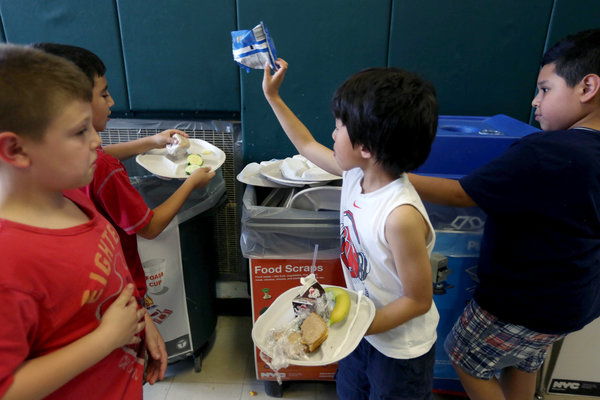
Discouraging as it is to read that many children won’t eat the healthful food schools are now providing, I take heart that at least they are learning to compost.

Al Baker writes at the NY Times, “The sad voyage of fruits and vegetables from lunch lady to landfill has frustrated parents, nutritionists and environmentalists for decades. Children are still as picky and wasteful as ever, but at least there is now a happier ending — that banana-filled bin is a composting container, part of a growing effort to shrink the mountains of perfectly good food being hauled away to trash heaps every year.

“New York City’s school composting program, kicked off just two years ago by parents on the Upper West Side, is now in 230 school buildings in Manhattan, Brooklyn and Staten Island, and is expected to more than double in size and reach all five boroughs in the fall, with an ultimate goal of encompassing all 1,300-plus school buildings. …

“The hope is that by building up composting in school, the city will help the environment, instill a sense of conservation in schoolchildren and, critically, save some money. The city paid $93 per ton in 2013 to dump in landfills, up from $68 in 2004. Composting saves the city $10 to $50 per ton, because the cost is offset by the sale of the end product, according to the Sanitation Department.” More here.

I tend to think kids will eventually eat something nourishing if that’s what’s available and they’re hungry. All I know is my kids eat everything now that they are grown-ups. (Still laughing that John came home from college and said, “How come you never told me I like mushrooms?”)

Photo: Hiroko Masuike/The New York Times

Read Full Post »

When I was a teacher in Pennsylvania hoping to get accreditation, a supervisor from the teachers college where I took classes came to observe me at work. It was quite a long time ago, and the only thing I recall is that he remarked that I needed to do more with my classroom bulletin boards.

There I was, trying to do creative things with 11-year-olds in language arts (the play within the play from A Midsummer Night’s Dream springs to mind), but his checklist required him to observe the bulletin boards.

So imagine my delight when I saw an article today about a study suggesting teachers may be putting too much emphasis on bulletin boards and wall decorations.

Jan Hoffman writes at the NY Times, “That bright, cheery look has become a familiar sight in classrooms across the country, one that has only grown over the last few decades, fed by the proliferation of educational supply stores. But to what effect?

“A new study looked at whether such classrooms encourage, or actually distract from, learning. The study … found that when kindergartners were taught in a highly decorated classroom, they were more distracted … than when they were taught in a room that was comparatively spartan.

“The researchers, from Carnegie Mellon University, did not conclude that kindergartners, who spend most of the day in one room, should be taught in an austere environment. But they urged educators to establish standards.

“ ‘So many things affect academic outcomes that are not under our control,’ said Anna V. Fisher, an associate professor of psychology at Carnegie Mellon and the lead author of the study, which was published in Psychological Science. ‘But the classroom’s visual environment is under the direct control of the teachers. They’re trying their best in the absence of empirically validated guidelines.’ ”  Hence the impetus for the study. Read more here.

Photo: Psychological Science
In a new study, 24 kindergartners were taught in two classroom settings: one unadorned, the other decorated with posters and artwork.

Read Full Post »

At my husband’s college reunion yesterday, we heard a former classmate talk about a wonderfully innovative school he founded  in San Diego (High Tech High).

After hearing that a fairly typical class project was developing a genetic bar code to identify endangered species in the bush, my husband wondered how such an inventive school can function in today’s teaching-to-the-test world. I myself figured that whatever the kids absorb from meaningful projects and cutting-edge teaching they absorb deeply enough to pass tests if they need to.

And when I think of the lengths to which test mania is going, I think more schools should learn from High Tech High. Consider the latest testing aberration: robots grading essays.

Les Perelman at the Boston Globe gives examples:

” ‘According to professor of theory of knowledge Leon Trotsky, privacy is the most fundamental report of humankind. Radiation on advocates to an orator transmits gamma rays of parsimony to implode.

“Any native speaker over age 5 knows that the preceding sentences are incoherent babble. But a computer essay grader, like the one Massachusetts may use as part of its new public school tests, thinks it is exceptionally good prose.

“PARCC, the consortium of states including Massachusetts that is developing assessments for the Common Core Curriculum, has contracted with Pearson Education, the same company that graded the notorious SAT essay, to grade the essay portions of the Common Core tests. Some students throughout Massachusetts just took the pilot test, which wasted precious school time on an exercise that will provide no feedback to students or to their schools.

“It was, however, not wasted time for Pearson. The company is using these student essays to train its robo-grader to replace one of the two human readers grading the essay, although there are no published data on their effectiveness in correcting human readers.

“Robo-graders do not score by understanding meaning but almost solely by use of gross measures, especially length and the presence of pretentious language. The fallacy underlying this approach is confusing association with causation. A person makes the observation that many smart college professors wear tweed jackets and then believes that if she wears a tweed jacket, she will be a smart college professor.” More here.

Uh-oh. Sounds like the children’s book Petunia. Fortunately, a timely explosion taught the silly goose that books have pages you need to read, that carrying a book under your wing doesn’t make you smart.

More explosions needed.

Photo: blog.spoongraphics.co.uk

Read Full Post »

There is a constant drumbeat in the news these days about the cost of college. Of course, it’s not really news. Families have struggled to pay for generations, and there have always been students who worked their way through (Suzanne’s dad, for one). And there have always been a few institutions seeking ways to help them.

Lisa Rathke writes in the Boston Globe about today’s “work colleges,” which believe that working your way through has many advantages, especially if all students are in the same boat.

She writes, “After college, many students spend years working off tens of thousands of dollars in school debt. But at seven ‘Work Colleges’ around the country, students are required to work on campus as part of their studies — doing everything from landscaping and growing and cooking food to public relations and feeding farm animals — to pay off at least some of their tuition before they graduate.

“The arrangement not only makes college more affordable for students who otherwise might not be able to go to school, it also gives them real-life experience while teaching them responsibility and how to work together, officials said. …

“With rising college costs and a national student loan debt reaching more than $1 trillion, ‘earning while learning’ is becoming more appealing for some students. But the work-college program differs from the federal work-study program, which is an optional voluntary program that offers funds for part-time jobs for needy students.

“At the seven Work Colleges — Sterling College, Alice Lloyd College in Pippa Passes, Ky., Berea College in Berea, Ky., Blackburn College in Carlinville, Ill., College of the Ozarks in Lookout, Mo., Ecclesia College in Springdale, Ariz., and Warren Wilson College in Asheville, N.C. — work is required and relied upon for the daily operation of the institution, no matter what the student’s background.” Read more.

Photo: Sterling College via Associated Press
At the seven Work Colleges, it’s not optional: Students must hold jobs during their undergraduate careers and pay off some of their tuition before they graduate.

Read Full Post »

Some school districts are pushing the envelope on recycling.

Michael Wines wrote for the NY Times in December, “Nothing seemed special about the plates from which students at a handful of Miami schools devoured their meals for a few weeks last spring — round, rigid and colorless, with four compartments for food and a fifth in the center for a carton of milk.

“Looks, however, can be deceiving: They were the vanguard of what could become an environmental revolution in schools across the United States.

“With any uneaten food, the plates, made from sugar cane, can be thrown away and turned into a product prized by gardeners and farmers everywhere: compost. If all goes as planned, compostable plates will replace plastic foam lunch trays by September not just for the 345,000 students in the Miami-Dade County school system, but also for more than 2.6 million others nationwide.

“That would be some 271 million plates a year, replacing enough foam trays to create a stack of plastic several hundred miles tall. …

“Compostable plates are but the first initiative on the environmental checklist of the Urban School Food Alliance, a pioneering attempt by six big-city school systems to create new markets for sustainable food and lunchroom supplies.” More here.

Apart from what the initiative does for school budgets, what it does for the environment, just think how educators are setting an example for children about working to find solutions to problems. Impressive.

Photo: Joshua Bright for The New York Times
Kindergartners in Manhattan being served lunch on plates made from sugar cane, which are expected to replace plastic foam trays next year in six districts.

Read Full Post »

« Newer Posts - Older Posts »