Feeds:
Posts
Comments

Posts Tagged ‘science’

As a scientist with young children, Gregg often tweets ideas for engaging kids in science. Recently @gfavalora tweeted about a website with instructive and fun videos. It’s called The Kid Should See This.

The site describes the video below thus:

“To celebrate World Ocean Day 2013, director and animator Akiko McQuerrey created a Papa Cloudy stop-motion music video: Overfishing Song from Papa Cloudy’s Restaurant.

Overfishing—catching fish faster than they can reproduce—is an urgent and devastating issue, and may be the single biggest threat to ocean ecosystems… The global fishing fleet is operating at 2.5 times the sustainable level—there are simply too many boats chasing a dwindling number of fish.

“What can we do to help? With more sustainable practices, our oceans can be healthy and plentiful for everyone. Recommendations from the Monterey Bay Aquarium suggest that we select sustainable fish from restaurants and stores, and diversify the kinds of fish we eat beyond just the popular choices.

“To help make these choices easier, they created a Monterey Bay Aquarium Seafood Watch pocket guide and mobile app. They even have recipes and more information about how to solve our ocean challenges.”

More videos here.

Read Full Post »

At Public Radio International’s “The World,” David Leveille has a story on research at Ellesmere Island in northern Canada.  There, University of Alberta biologist Catherine La Farge is finding that some frozen plants are able to begin growing again after 400 years on ice.

“Cold as it may be during the winter,” writes Leveille, “it’s a part of the world where glaciers are melting and ice sheets are breaking up due to climate change.

“One glacier there is called the Tear Drop glacier. As it has melted, some interesting plant life was exposed.”

La Farge’s results, published in the Proceedings of the National Academy of Sciences “suggest that bryophytes, representing the earliest lineages of land plants, may be far more resilient than previously thought, and likely contribute to the establishment, colonization, and maintenance of polar ecosystems.” Who knows what else is under the glacier and about to be thawed out.

More.

Photo: Catherine La Farge
In vitro culture of Aulacomnium turgidum regenerated from emergent Little Ice Age plants beneath the Tear Drop Glacier, Sverdrup Pass, Ellesmere Island, Nunavut.


Read Full Post »

Kirk Johnson writes in today’s NY Times about efforts to make time in prison more constructive, both in terms of sustainable practices that control prison costs and in terms of inmate improvement.​ The endangered frog program in Oregon, which requires perfect behavior from participating prisoners, is especially intriguing.

Johnson writes, “Mat Henson, 25, serving a four-and-a-half-year sentence for robbery and assault, and his research partner, Taylor Davis, 29, who landed in the Cedar Creek Corrections Center here in central Washington for stealing cars, raised about 250 Oregon spotted frogs in the prison yard this summer.

“Working with biologists, Mr. Henson is now helping write a scientific curriculum for other frog-raisers, in prison or out. A previous inmate in the program, released some years ago, is finishing his Ph.D. in molecular biology. …

“The program’s broader goal of bringing nature and sustainable practices to prisons is echoed across the nation as states seek ways to run prisons more cost-effectively.

“Utilitarian practicality led Wisconsin in 2008 to begin having inmates grow much of their own food. And federal energy rules are pushing the goal of zero-net energy use in federal prisons by 2030.

“Indiana and Massachusetts have become aggressive in reducing energy and water consumption and waste in their prisons, and tough renewable energy mandates in California are pushing alternative generation and conservation at prisons there, said Paul Sheldon, a senior adviser at Natural Capitalism Solutions, a Colorado-based nonprofit that works with government agencies and companies on sustainability issues. …

“There may be some intangible benefits for inmates who are being exposed to the scientific process, many of them for the first time, said Carri LeRoy, a professor of ecology at Evergreen State College in Olympia, and co-director of the Sustainability in Prisons project.

“Science, she said, is about procedural order, point A to point B, with every step measured and marked for others to check and follow. And when the focus of that work is a creature that undergoes a profound metamorphosis from egg to tadpole to adult, the lesson is also one about the possibilities of change. In a prison, Professor LeRoy said, that is a big deal.

“ ‘This image of transformation, I think, allows them maybe to understand their own transformation,’ Professor LeRoy said.”

Read more.

Photograph: Matthew Ryan Williams for The New York Times

Read Full Post »

I’m fascinated by the many ways the Internet has enabled broader support for worthy causes. I’ve blogged about Kickstarter, for example, “a funding platform for creative projects.” Through Kickstarter, friends and other well-wishers can help fund a documentary, an art installation, or a book publication within a designated time frame. Magic can happen, often with only small donations that add up.

Today OFH_John tweeted about something similar for schools, Donors Choose. Donors Choose calls itself “an online charity connecting you to classrooms in need.” You can search for projects in your local area, projects that have special meaning to you, and projects that might let your company offer special expertise.

John’s company has optical expertise and jumped on a need at a District of Columbia school, where an applied science project on light called for optical gear. Read about that here.

If you are seeking to help impoverished schools in particular, you may look for the “high poverty” rating at Donors Choose. School needs of all sorts are listed here.

Photograph: DonorsChoose.org

Read Full Post »

There is always something new to learn about Stonehenge, a site shrouded in mystery for centuries.

Rossella Lorenzi writes at Discovery News, “Using noninvasive technologies such as ground-penetrating radar and geophysical imaging, a team from the University of Birmingham’s IBM Visual and Spatial Technology Centre, known as VISTA, and the Ludwig Boltzmann Institute for Archaeological Prospection and Virtual Archaeology in Vienna, discovered evidence of two huge pits positioned on a celestial alignment at Stonehenge. …

” ‘This is the first time we have seen anything quite like this at Stonehenge,’ said project leader Vince Gaffney, an archaeologist from the University of Birmingham. ‘When viewed from the Heel Stone, a rather enigmatic stone which stands just outside the entrance to Stonehenge, the pits effectively mark the rising and setting of the sun at midsummer days.’ ”

Read more here.

On YouTube you can find both boring videos about Stonehenge and funny ones. A comedy routine by Eddie Izzard made me laugh, but it’s a bit too naughty for Suzanne’s Mom’s Blog. You can check out a few of Spinal Tap singing “Stonehenge” in the movie This is Spinal Tap. And here is a great scene about Druids from that movie.

Read Full Post »

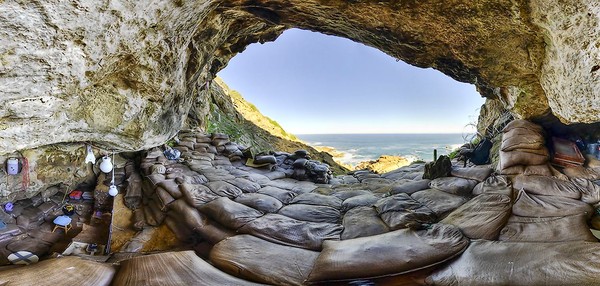
“In a tiny South African cave,” writes Amina Khan in the Los Angeles Times, “archaeologists have unearthed a 100,000-year-old art studio that contains tools for mixing powder from red and yellow rocks with animal fat and marrow to make vibrant paints as well as abalone shells full of dried-out red pigment, the oldest paint containers ever found. (Photo by Magnus Haaland / October 5, 2011)

“The discovery, described in [the 10/14/11] edition of the journal Science, suggests that humans may have been thinking symbolically — more like modern-day humans think — much earlier than previously recognized, experts said. Symbolic thinking could have been a key evolutionary step in the development of other quintessentially human abilities, such as language, art and complex ritual.

“The artifacts were uncovered at a well-studied site called the Blombos Cave, which sits by the edge of the Indian Ocean about 180 miles east of Cape Town. The two shells, lying about 6 inches from each other, had a red residue from a soft, grindable stone known as ochre. Ochre is rich in iron compounds that usually give it red or yellow hues, and it is known to have been used in ancient paints.”

It is lovely to think that the longing to be creative is something innate. Now we know that at least 100,000 years ago, people were experiencing that urge and acting on it.

Read more here.

Read Full Post »

« Newer Posts